Watch a Korean Master Craftsman Make a Kimchi Pot by Hand, All According to Ancient Tradition
The South Korean capital of Seoul, where I live, has in the 21st century astonished visiting Westerners with its technology, its infrastructure, and its sheer urban vitality. It strikes many of those Westerners (and I include myself among them) as considerably more developed than anywhere in the countries they came from. But however much Seoul may feel like the future, nowhere in Korea has the past wholly vanished. Take the bulbous earthenware jars still visible on more than a few of the country’s terraces and rooftops, meant to hold condiments like soybean and red pepper paste as well as that world-famous symbol of not just Korean cuisine but Korean culture itself, the fermented cabbage known as kimchi.
Commonly called hangari, or more traditionally onggi, these jars essential to the fermentation of kimchi and other Korean foods are today produced in large numbers with industrial methods. But there are also Korean potters who’ve stuck to the old ways — and in a select few cases, the very old ways indeed. Take Jin-Gyu, the subject of the video above, a short documentary from Eater’s “Handmade” series.
“I’m the youngest of the intangible cultural assets in Korea,” he says, referring to the official list of Important Intangible Cultural Properties introduced to protect long-standing traditions in music, dance, and craft just as the country began its unprecedented surge into modernity. The making of onggi itself, a process Jin-Gyu demonstrates from start to finish in the video, is Important Intangible Cultural Property No. 96.
After pounding his clay into shape while describing how its soil first flows down from the mountains, Jin-gyu places it onto his wheel and gives it the distinctive shape recognizable from all those terraces and rooftops. This requires constant use of his hands, occasional use of his feet, and even the application of traditional tools that he also made himself. The contrast with traditional Japanese pottery, its emphasis on small-scale elegance and near-existentialist attitude toward the final product, is instructive: the Korean variety, as Jin-gyu practices it, has a different energy, more of an emotional and physical rusticity. “This makes me so happy,” he says after removing finished jar from the kiln originally built by his onggi-potter father. “After 300 years, it’ll return to the soil.” But there are plenty of hearty meals to be had in the meantime, none of them without kimchi.
Related Content:
How Soy Sauce Has Been Made in Japan for Over 220 Years: An Inside View
Modern Artists Show How the Ancient Greeks & Romans Made Coins, Vases & Artisanal Glass
Based in Seoul, Colin Marshall writes and broadcasts on cities, language, and culture. His projects include the Substack newsletter Books on Cities, the book The Stateless City: a Walk through 21st-Century Los Angeles and the video series The City in Cinema. Follow him on Twitter at @colinmarshall or on Facebook.
Read More...Life Lessons From 100-Year-Olds: Timeless Advice in a Short Film
And therefore my opinion is, that when once forty years old we should consider our time of life as an age to which very few arrive; for seeing that men do not usually last so long, it is a sign that we are pretty well advanced; and since we have exceeded the bounds which make the true measure of life, we ought not to expect to go much further. —Michel de Montaigne
After his retirement at age 38, renaissance essayist Michel de Montaigne devoted several pages to the subject of mortality, as pressing an issue for him as for the classical philosophers he adored. And no less pressing an issue for us, of course. The brute fact of death aside, the quality of our lives has little in common with those of Cato, Seneca, or Montaigne himself. We meet needs and wants with commands to Alexa. We are beset by global anxieties they never imagined, and by remedies that would have saved millions in their time. Even in the age of Covid-19, life isn’t nearly so precarious as it was in 16th century France.
But whether we set the threshold at 40, 80, or 100, “to die of old age is a death rare, extraordinary, and singular,” Montaigne argued. Few attain it today. “It is the last and extremest sort of dying… the boundary of life beyond which we are not to pass, and which the law of nature has pitched for a limit not to be exceeded.” For these reasons and more, we look to the very aged for wisdom: they have attained what most of us will not, and can only look backwards, seeing the fullness of life, if they have clarity, in panoramic hindsight. Such vision is the subject of the 2016 short film above, in which three uniquely lucid centenarians dispense advice, reflect on their experience, and reminisce about the jazz age.
“I have always been lucky,” says now-108-year-old Tereza Harper. “I’ve never been unlucky.” No one lives to such an advanced age without facing a little hardship. Harper immigrated to England from Czechoslovakia during World War II to reunite with her father, who had been a prisoner of war. She lived to witness the many horrors of the 20th century and the many of the 21st so far. And yet, she says, “Everything makes me happy. I love talking to people. I like doing things. I like going out shopping. Once I go out shopping, I don’t really want to come back…. I’m not going yet. I’m still strong. I’m very very strong. I never realized how strong I am.” ”
What is the source of such strength and joy in the ordinary repetitions of daily life? A profound contentment marked by a sense of completion, for one thing. “I don’t think there’s anything that I really need to do,” Harper says, “because I’ve done practically everything that I’ve ever wanted to do in the past.” Likewise, 101-year-old Cliff Crozier, who died last year, remarks, “I think I’ve done all that I wanted to do.” Later, he adds some nuance: “I don’t have many failures,” he says. “If I’m making a cake and it fails it becomes a pudding.” (He also says, “It always pleases me that I can keep robbing the government with my pension.”)
Are there regrets? Naturally. 102-year-old John Denerley, who passed away in 2018, says ruefully, “If I’d have been more attentive at school in my early life, I’d have studied more, and harder…. Well, I didn’t do too bad in the end. But I think the sooner you start studying the better.” Crozier expresses regrets over the way he treated his father, a relationship that still causes him grief. These three are not, after all, superhumans. They are subject to the same pains as the rest of us. But they have achieved a vantage from which to see the whole of life from its limit. Whether or not we achieve the same, we can all learn from them how to make the most of the “extraordinary fortune,” as Montaigne wrote, “which has hitherto kept us above ground.”
Related Content:
Ram Dass (RIP) Offers Wisdom on Confronting Aging and Dying
Josh Jones is a writer and musician based in Durham, NC. Follow him at @jdmagness
Read More...Werner Herzog Discovers the Ecstasy of Skateboarding: “That’s Kind of My People”
If Werner Herzog has ever stood atop a skateboard, cinema seems not to have recorded it. But when asked by online skateboarding magazine Jenkem to discuss the sport and/or lifestyle, he did so with characteristically little reservation. “I’m not familiar with the scene of skateboarding,” he admits in the video interview above. “At the same time, I had the feeling, yes, that’s kind of my people.” Fans will make the connection between skateboarding videos and the Bavarian filmmaker’s early documentary The Great Ecstasy of Woodcarver Steiner, on champion ski jumper Walter Steiner, even before a clip of it appears.
In fact Herzog himself, as revealed in the autobiographical short Portrait Werner Herzog, only turned filmmaker after shelving his own dreams of ski-jumping. The experience must have taught him viscerally, through those parts of the body that don’t forget, what it means to make countless attempts resulting in countless failures — with a better failure here and there, and at some distant, ecstatic moment, perhaps a success.
Viewed at great enough length, the kind of skateboarder who attempts a trick on video dozens, even hundreds of times, before landing it could well be a character from one of Herzog’s own films, especially his documentaries about men unable to stop putting themselves in harm’s way in the name of their fixations.
“So many failures,” marvels Herzog as he watches one such video. “That’s astonishing.” It certainly “doesn’t do good to his pelvis, nor to his elbows,” Herzog adds, but such is the price of ecstasy. For him, the obscurity of the vast majority of skateboarders only compounds the sacredness of their practice. This as opposed to the David Blaines of the world, whose physical feats “are meant only for his own publicity, and for shining out in the media. Skateboard kids are not out for the media. They do it for the joy of it, and for the fun of it.” If Herzog were to pay cinematic tribute to these kids, surely he would make similar observations though voiceover narration. As for his instinct of how to fill out the rest of the soundtrack, “What comes to mind first and foremost would be Russian Orthodox church choirs.”
Related Content:
Werner Herzog Offers 24 Pieces of Filmmaking and Life Advice
Portrait Werner Herzog: The Director’s Autobiographical Short Film from 1986
Based in Seoul, Colin Marshall writes and broadcasts on cities, language, and culture. His projects include the Substack newsletter Books on Cities, the book The Stateless City: a Walk through 21st-Century Los Angeles and the video series The City in Cinema. Follow him on Twitter at @colinmarshall or on Facebook.
Read More...The Internet Archive Now Digitizing 1,000,000+ Objects from a Massive Cinema History Library
Major motion pictures need the work of writers, directors, actors, cinematographers, and a slew of other professionals besides. That group also includes researchers, whose role has until recently gone practically uncelebrated outside the industry. In 2015, filmmaker Daniel Raim brought the work of the film researcher to light with Harold and Lillian: A Hollywood Love Story, about production designer Harold Michelson and his researcher wife Lillian. “In Raim’s documentary, she talks about working on Fiddler on the Roof and the filmmakers needed to know what a Jewish woman’s undergarments looked like in the 1890s,” writes The Hollywood Reporter’s Emily Hilton. How could she find such obscure information?
“Michelson sat on a bench at Fairfax and Beverly near a Jewish deli and spoke to women who were about the right age to have been alive in that era.” One of these women “ran home and grabbed a sewing pattern for her to reference. This research inspired the outfits that Τevye’s daughters wear in the number: knee length bloomers with scalloped edges.”
As yet, this pattern hasn’t appeared in the Michelson Cinema Research Library, now hosted online at the Internet Archive. But it may yet, as the project of digitization and uploading has hardly begun: it was just last year that the nonagenarian Lillian Michelson donated to the Archive her formidable collection of research materials, amassed over her long career.

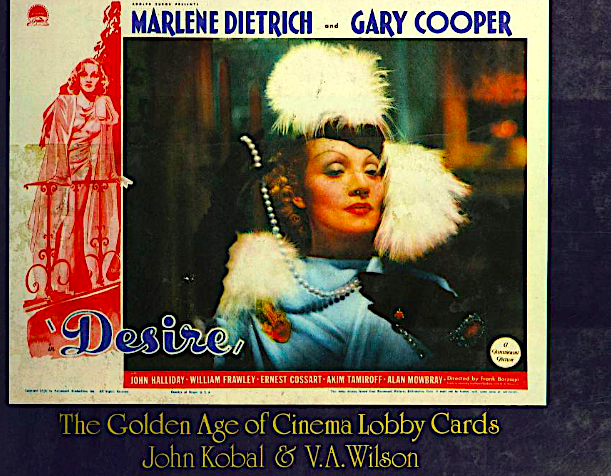
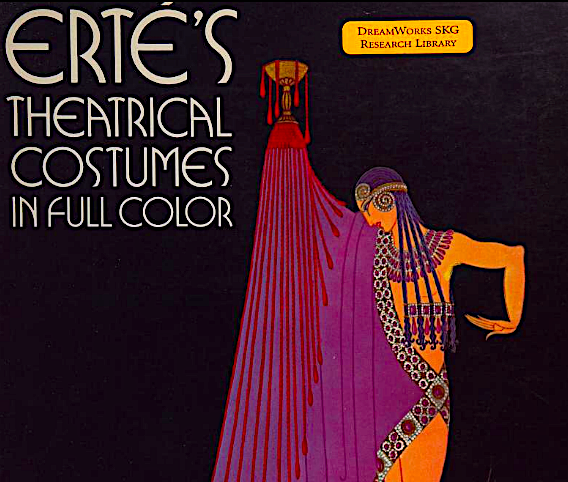
“After nearly six decades serving filmmakers first at Samuel Goldwyn, then the American Film Institute, Zoetrope Studio, Paramount and DreamWorks,” writes the Los Angeles Times’ Mary McNamara, “the library filled 1,594 boxes: tens of thousands of books, photographs, magazines and a panoply of other visual resources. All of this had been sitting for five years in a storage facility, paid for by friends who could not bear to see it all destroyed.” Now that the digital archival process is underway, you can browse the first 1,300 or so entries at the Internet Archive, which allows users to virtually check out the Michelson Cinema Research Library’s books on subjects ranging from theatrical costumes and vintage cinema lobby cards to places like Japan and Paris to less expected topics like the Amazing Kreskin and the externals of the Catholic Church.
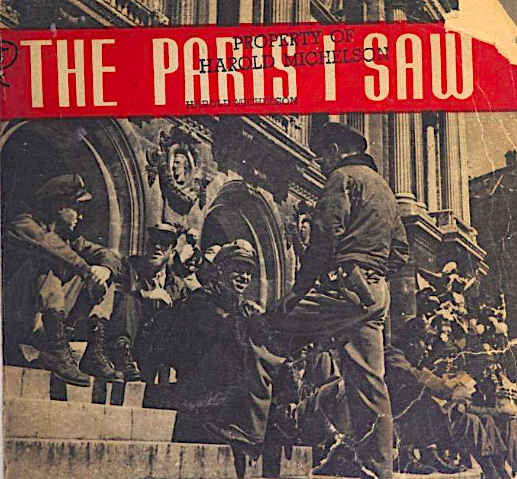
But then, a Hollywood researcher must be prepared to learn about anything, and by all accounts Lillian Michelson was perhaps the greatest of them all. In addition to its comprehensiveness, her library became a hangout of choice for a variety of studio professionals and celebrities including Tom Waits. (“I wouldn’t be surprised if that’s how he found some time to unwind,” says Raim, “just drinking tea there.”) The Internet Archive describes her collection as consisting of “5,000 books, 30,000 photographs, and more than 1,000,000 clippings, scrapbooks and ephemera,” more of which will come online as time goes by. Eventually the site will contain all the materials from which Michelson drew vital knowledge for filmmakers like Roman Polanski, Alfred Hitchcock, and Stanley Kubrick. And if her research materials satisfied those three, they’re more than good enough for us.
Related Content:
Download 6600 Free Films from The Prelinger Archives and Use Them However You Like
Good Movies as Old Books: 100 Films Reimagined as Vintage Book Covers
1,150 Free Movies Online: Great Classics, Indies, Noir, Westerns, etc.
Based in Seoul, Colin Marshall writes and broadcasts on cities, language, and culture. His projects include the Substack newsletter Books on Cities, the book The Stateless City: a Walk through 21st-Century Los Angeles and the video series The City in Cinema. Follow him on Twitter at @colinmarshall or on Facebook.
Read More...Jimi Hendrix Revisits His Searing Performance of “The Star-Spangled Banner”: The Dick Cavett Show (September 9, 1969)
On the final August morning of Woodstock, after a previous day’s downpour had turned most of the field near the stage into mud, after an evening of blues and rock and the comedown of whatever drugs had peaked everybody earlier, as the sunlight crept over what was left of the 500,000 music lovers, now less than half in number, wrapped in blankets and still vibing, Jimi Hendrix took the stage. Now, the Star-Spangled Banner wasn’t his final song, but it was a finale of sorts, a coda for a three-day event where love triumphed for just a little while over war, that war raging across the ocean in the similar mud of Vietnam. Hendrix ripped the National Anthem, with its famous lyrics about bombs and its hidden stanzas about slaves, a new one. He turned that guitar into its own kind of weapon, sounding like those jet bombers raining fire and napalm down, interrupting Francis Scott Key’s melody like a protestor begging to differ at the Chicago convention. Hendrix was going to send his audience out into America, back into society, with something to chew on.
“All I did was play it. I’m American, so I played it,” Hendrix tells Dick Cavett in the above clip from September 9, 1969, less than a month after the concert. “They made me sing it in school, so it was a flashback, you know?”
But there was more to it than that. Hendrix himself was a veteran. He joined the 101st Airborne Division in 1961 under duress—it was either that or jail. He lasted a year, discharged for “behavior problems,” “little regard for regulations,” and “masturbating in platoon area while supposed to be on detail.” Even while there, he had time to play guitar. Did this give him a “buffer” to lambaste the war? Not really. Right wing Americans tend to be very touchy about the anthem, and anything that strays from the usual army band arrangement brings distrust and nasty letters, as Cavett notes in the video. (And being a person of color surely had something to do with it too.) To wit: folk singer José Feliciano performed a soulful version of the anthem before Game Five of the 1968 World Series in Detroit, where the Tigers played the Cardinals. Nowhere near the coruscating version of Hendrix, but still the audience, even the players themselves, were divided.
Hendrix raised the game and the ire. It was all journalists wanted to ask Hendrix, hoping to goad him into a statement about the war. Hendrix didn’t take the bait. “We’re all Americans,” he answered at a press conference after the concert. “…it was like ‘Go, America!’”
But then the more telling line followed. “We play it the way the air is in America today. The air is slightly static, see.”
Cavett is kinder, allowing Hendrix to correct him when he calls the version unorthodox.
“No, no. I thought it was beautiful,” the modest musician says. “But there you go, you know?”
Related Content:
Jimi Hendrix’s Home Audio System & Record Collection Gets Recreated in His London Flat
How Science Fiction Formed Jimi Hendrix
Ted Mills is a freelance writer on the arts who currently hosts the Notes from the Shed podcast and is the producer of KCRW’s Curious Coast. You can also follow him on Twitter at @tedmills, and/or watch his films here.
Read More...A 10 Billion Pixel Scan of Vermeer’s Masterpiece Girl with a Pearl Earring: Explore It Online
We admire Johannes Vermeer’s Girl with a Pearl Earring for many reasons, not least that it looks exactly like a girl with a pearl earring. Or at least it does from a distance, as the master of light himself no doubt stepped back to confirm countless times during the painting process, at any moment of which he would have been more concerned with the brushstrokes constituting only a small part of the image. But even Vermeer himself could have perceived only so much detail of the painting that would become his masterpiece.
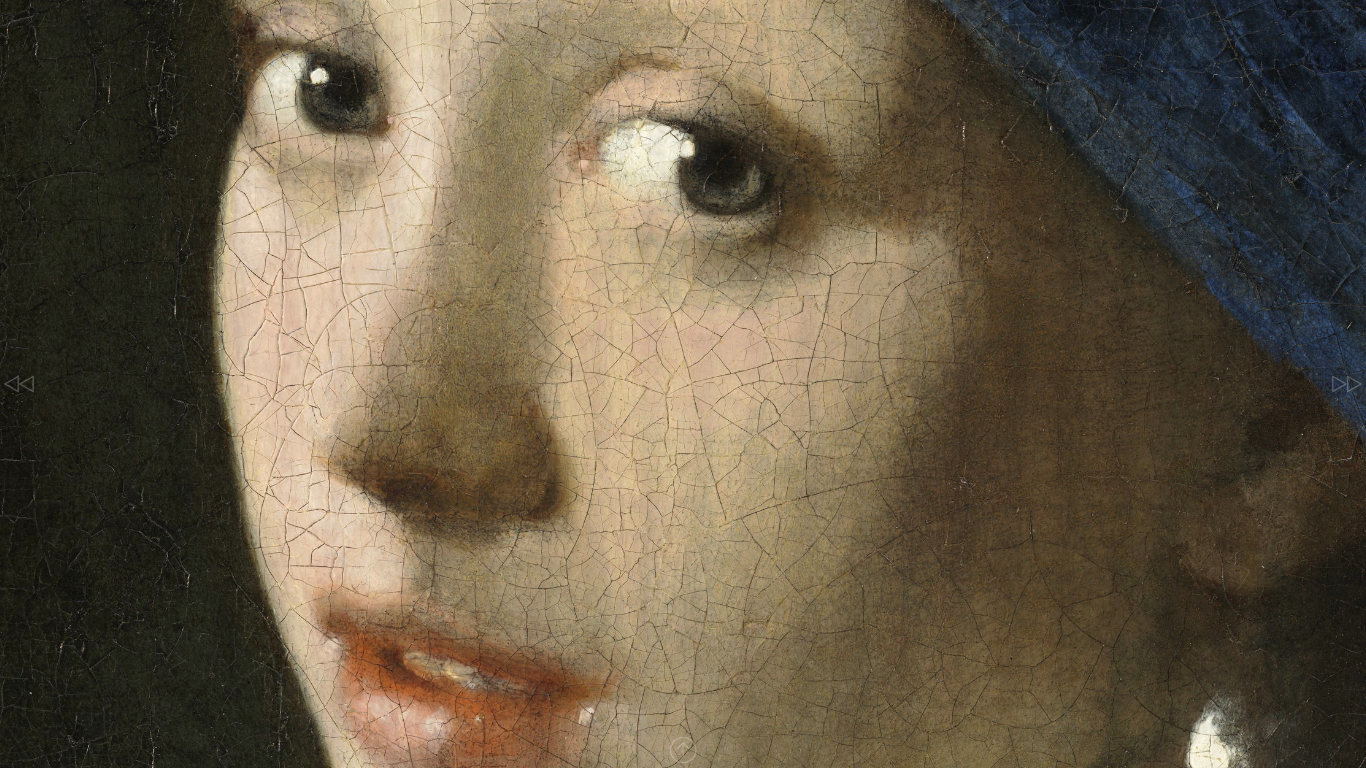
Now, more than 350 years after its completion, we can get a closer view of Girl with a Pearl Earring than anyone has before through a newly released 10 billion-pixel panorama. At this resolution, writes Petapixel’s Jason Schneider, we can “see the painting down to the level of 4.4‑microns per pixel.”
Undertaken by Emilien Leonhardt and Vincent Sabatier of 3D microscope maker Hirox Europe “in order to evaluate the surface condition of the painting, measure cracks, and see the topography of various key areas while assessing past restorations,” the project required taking 9,100 photos, which “were automatically captured and stitched together to form one finished panorama image where one pixel equals 4.4 microns.”
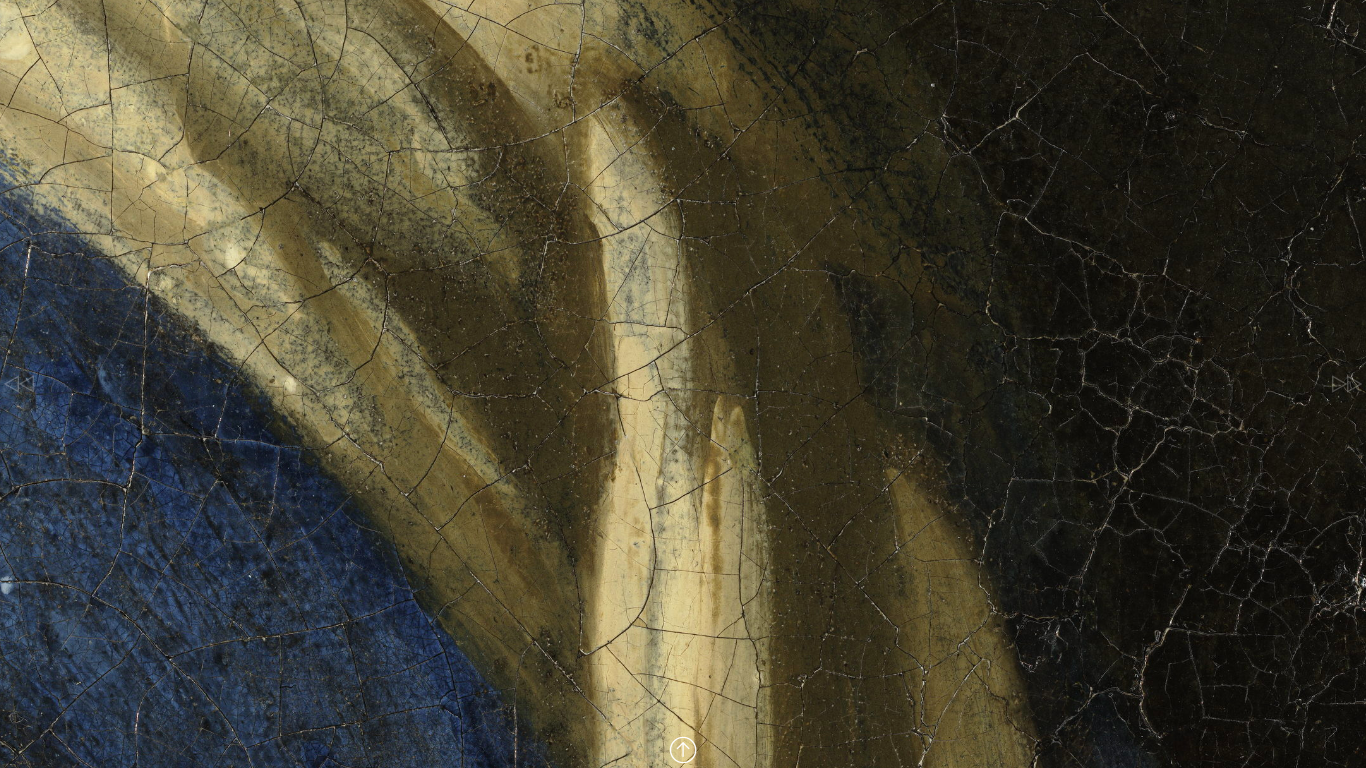
You’ll understand what this means if you view the panorama and click the plus symbol on the bottom control bar to zoom in — and click it again, and again, and again. (Or just click it and hold it down.) Before long, Girl with a Pearl Earring will look less like a girl with a pearl earring than what she really is: centuries-old oil paints on a centuries-old canvas. The physicality of this work of art, one so often held up as the realization of aesthetic ideal, becomes even less ignorable if you click the “3D” button. This presents ten individual sections of the painting scanned in three dimensions, which you can freely rotate and even light from all directions.

The 3D-scanned portions include the titular pearl earring, which appears to have a bit of a gouge in it. They’re more clearly visible in 5x topographical viewing mode (selectable on the top control bar). This official Hirox video offers a glimpse of the procedure required to achieve the kind of unprecedentedly high-resolution view of Girl with a Pearl Earring that allows us to behold details heretofore practically invisible. At more than 10,000 megapixels, the background reveals itself to be in fact a dark green curtain, and the girl herself has clearly defined eyelashes. But as for her long-speculated-about identity, well, there are some things microscopy can’t determine. Take a close look at Vermeer’s painting here. And if you’d like to take a similar look at Rembrandt’s The Night Watch, click here.
via Colossal
Related Content:
Master of Light: A Close Look at the Paintings of Johannes Vermeer Narrated by Meryl Streep
Based in Seoul, Colin Marshall writes and broadcasts on cities, language, and culture. His projects include the Substack newsletterBooks on Cities, the book The Stateless City: a Walk through 21st-Century Los Angeles and the video series The City in Cinema. Follow him on Twitter at @colinmarshall, on Facebook, or on Instagram.
Read More...Prince’s First Television Interview (1985)
By 1985, Prince had made appearances on American Bandstand and Saturday Night Live, toured the world several times, and released seven studio albums, including the groundbreaking Purple Rain and less-than-groundbreaking accompanying film, for which he won an Oscar. He had inadvertently helped launch Tipper Gore’s Parents Music Resource Council after she caught her daughter listening to “Darling Nikki.” He was a bona fide global superstar and one of the biggest-selling artists of the decade. And he had yet to give a single interview.
Well, this isn’t entirely true. During his American Bandstand appearance in 1979, the 19-year-old funk wunderkind responded to questions from Dick Clark with a few guarded, one-word answers. He also gave an interview to his high school newspaper, telling them “I think it is very hard for a band to make it in [Minneapolis], even if they’re good. Mainly because there aren’t any big record companies or studios in this state. I really feel that if we would have lived in Los Angeles or New York or some other big city, we would have gotten over by now.”
Prince got over soon enough, but he didn’t seem at all eager to talk about himself, one of the primary responsibilities of a pop star. It was as though he knew he was so good he didn’t have to advertise. Soon after the release of his seventh album, Around the World in a Day—the source of such hits as “Raspberry Beret” and “Paisley Park”—he gave an interview to Rolling Stone (who described the “Kung Fu Grasshopper voice with which Prince whispers when meeting strangers or accepting Academy Awards.”)
He also agreed to appear on a new cable television station called MTV. The interview, above, begins with the expected question, “Why were you so secretive prior to this?” Prince, surrounded by a cohort of young audience members, says he was “homesick” and pouts. Then we immediately get a better answer to the question when the interviewer asks whether Prince’s need for control came from a troubled childhood. He sneers, calls the question “horrible,” and answers a better one about how he found his musical direction and handled disagreements with his bandmates.
The tone remains strangely combative and Prince remains eerily calm, but his expressive face registers irritation and amusement. “I strive for originality in my music,” he says. He also “remembers how he was influenced by James Brown after dancing on stage with him at just 10 years old, touches on comparisons to musicians like Jimi Hendrix and answers provocative questions about ‘selling out to white audiences’ with Purple Rain,” writes the Vinyl Factory. Watch the full interview above and see if you can better understand why Prince avoided interviews, or why interviewers tried so hard to box him into stereotypical roles.
Related Content:
Read Prince’s First Interview, Printed in His High School Newspaper (1976)
The Prince Online Museum Archives 16 of Prince’s Official Web Sites, Spanning 20 Years
Josh Jones is a writer and musician based in Durham, NC. Follow him at @jdmagness
Read More...How the Bicycle Accelerated the Women’s Rights Movement (Circa 1890)
The early history of the bicycle did not promise great things—or anything, really—for women at the dawn of the 19th century. A two-wheeled bicycle-like invention, for example, built in 1820, “was more like an agricultural implement in construction than a bicycle,” one bicycle history notes. Made of wood, the “hobby horses” and velocipedes of cycling’s first decades rolled on iron wheels. Their near-total lack of suspension led to the epithet “boneshaker.” Some had steering mechanisms, some did not. Braking was generally accomplished with the feet, or a crowd of pedestrians, a tree, or horse-drawn cart.
Laddish clubs formed and raced around London, Paris, and New York. No girls allowed. The earliest bicycles for women were ridden side-saddle…. But despite all this, it is entirely fair to say that few technologies in history, ancient or modern, have done more to free women from domestic toilage and bring them careening into the public square, to the dismay of the Victorian establishment.
Bicycles “gave women a new level of transportation independence that perplexed newspaper columnists” and the general public, writes Adrienne LaFrance at The Atlantic, quoting a San Francisco journalist in 1895:
It really doesn’t matter much where this one individual young lady is going on her wheel. It may be that she’s going to the park on pleasure bent, or to the store for a dozen hairpins, or to call on a sick friend at the other side of town, or to get a doily pattern of somebody, or a recipe for removing tan and freckles. Let that be as it may. What the interested public wishes to know is, Where are all the women on wheels going? Is there a grand rendezvous somewhere toward which they are all headed and where they will some time hold a meet that will cause this wobbly old world to wake up and readjust itself?
Women cyclists were seen as the advanced guard of a coming war. “Squarely in the center of this battle was one tool,” notes the Vox video above, “that completely changed the game.” Both Susan B. Anthony and Elizabeth Cady Stanton are credited with declaring that ‘woman is riding to suffrage on the bicycle,’ a line that was printed and reprinted in newspapers at the turn of the century,” LaFrance writes. By the 1890s, everyone rode bicycles, the first Tour de France was only a few years away, and cycling technology had come so far that it would help create both the car—with its innovative pneumatic tires and spoked wheels—and the airplane, through the experiments of Ohio bicycle-makers the Wright Brothers.
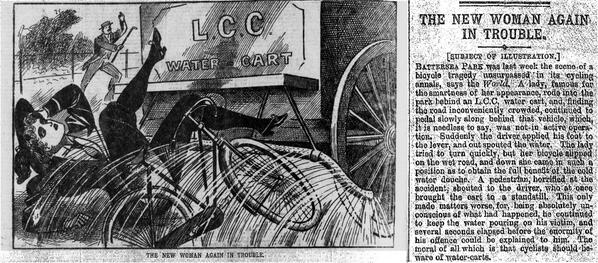
The new bikes, originally called “safety bikes” to contrast them with giant-wheeled penny-farthings that were briefly the norm, may not have developed gearing systems yet, but they were far lighter, cheaper, and easier to ride (comparatively) than the bicycles that had come before, which began as playthings for wealthy young men-about-town. The National Women’s History Museum describes the scene:
At the turn of the century, trains, automobiles, and streetcars were growing in use in urban areas, but people still largely depended on horses for transportation. Horses, and especially carriages, were expensive and women often had to depend on men to hitch up the horses for travel…. Surrounded by inefficient and expensive forms of travel, bicycles arrived in cities with the promise of practicality and affordability. Bicycles were relatively inexpensive and provided men and women with individual transportation for business, sports, or recreation.
Not only did bicycles give women equal access to personal rapid transit, but they did so for women of many different social classes. The leveling effects were significant, as were the changes to women’s fashion. Exposed calves (though still encased in various cycling boots) prepared the way for trousers. Traditionalists were outraged, ceaselessly mocked women on bikes, as they mocked the suffragists, and pushed for restrictions on full freedom of movement. “Whilst the 1890s saw discourses of middle-class femininity become reconciled with the notion of women on bicycles,” The Victorian Cyclist points out, “learning to ride a bicycle required middle-class women to carefully navigate their way through a set of highly conservative and rigid gender norms.”
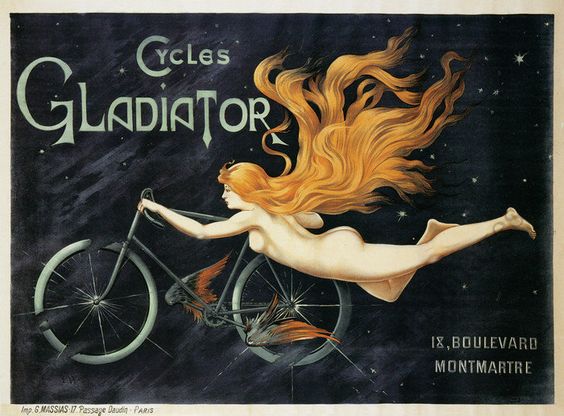
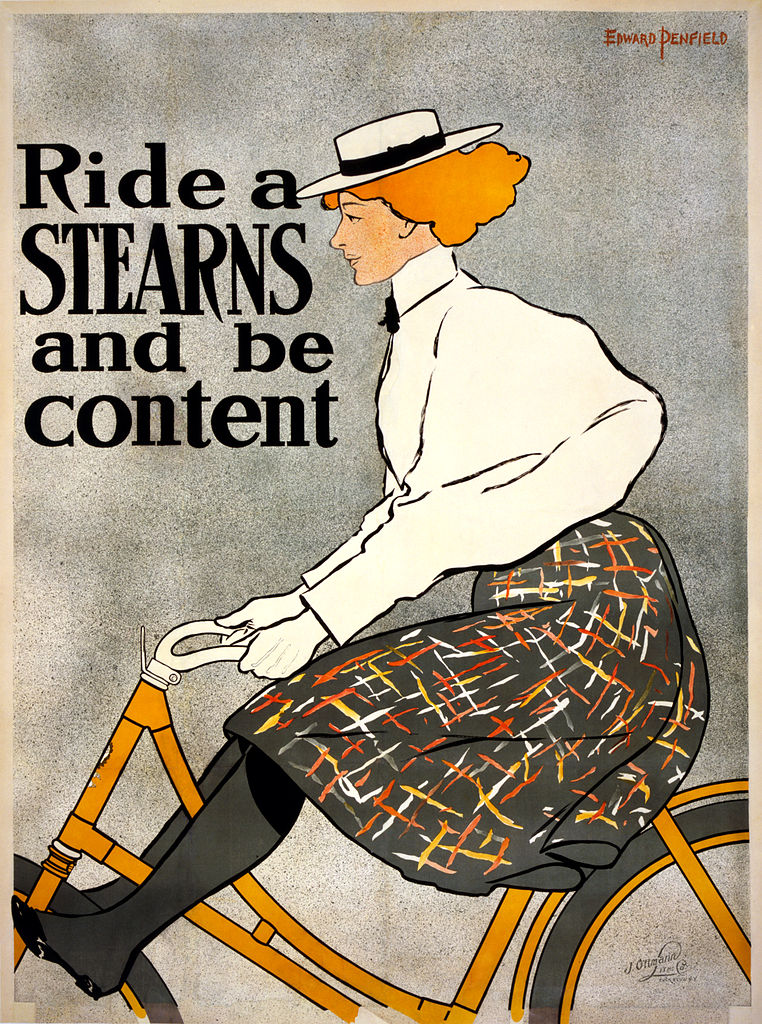
Despite media efforts to tamp down or tame the revolutionary potential of the bicycle for women, the market that made the machines saw no problem with increasing sales. Bicycle poster art and advertising from the turn of the 20th century is dominated by women cyclists, who are portrayed as ordinary ramblers about town, hip adventurers, ultra-modern “New Women,” and, perhaps less progressively, nude goddesses. Whether we call it Gilded Age, Belle Epoque, or Fin de siècle, the end of the 19th century produced a transportation revolution that was also, through no particularly conscious design of the makers of the bicycle, a revolution in women’s rights and thus human freedom writ large.
Related Content:
Odd Vintage Postcards Document the Propaganda Against Women’s Rights 100 Years Ago
Josh Jones is a writer and musician based in Durham, NC. Follow him at @jdmagness
Read More...
How to Talk with a Conspiracy Theorist: What the Experts Recommend
Why do people pledge allegiance to views that seem fundamentally hostile to reality? Maybe believers in shadowy, evil forces and secret cabals fall prey to motivated reasoning. Truth for them is what they need to believe in order to get what they want. Their certainty in the justness of a cause can feel as comforting as a warm blanket on a winter’s night. But conspiracy theories go farther than private delusions of grandeur. They have spilled into the streets, into the halls of the U.S. Capitol building and various statehouses. Conspiracy theories about a “stolen” 2020 election are out for blood.
As distressing as such recent public spectacles seem at present, they hardly come near the harm accomplished by propaganda like Plandemic—a short film that claims the COVID-19 crisis is a sinister plot—part of a wave of disinformation that has sent infection and death rates soaring into the hundreds of thousands.
We may never know the numbers of people who have infected others by refusing to take precautions for themselves, but we do know that the number of people in the U.S. who believe conspiracy theories is alarmingly high.
A Pew Research survey of adults in the U.S. “found that 36% thought that these conspiracy theories” about the election and the pandemic “were probably or definitely true,” Tanya Basu writes at the MIT Technology Review. “Perhaps some of these people are your family, your friends, your neighbors.” Maybe you are conspiracy theorist yourself. After all, “it’s very human and normal to believe in conspiracy theories…. No one is above [them]—not even you.” We all resist facts, as Cass Sunstein (author of Conspiracy Theories and Other Dangerous Ideas) says in the Vox video above, that contradict cherished beliefs and the communities of people who hold them.
So how do we distinguish between reality-based views and conspiracy theories if we’re all so prone to the latter? Standards of logical reasoning and evidence still help separate truth from falsehood in laboratories. When it comes to the human mind, emotions are just as important as data. “Conspiracy theories make people feel as though they have some sort of control over the world,” says Daniel Romer, a psychologist and research director at the University of Pennsylvania’s Annenberg Public Policy Center. They’re airtight, as Wired shows below, and it can be useless to argue.
Basu spoke with experts like Romer and the moderators of Reddit’s r/ChangeMyView community to find out how to approach others who hold beliefs that cause harm and have no basis in fact. The consensus recommends proceeding with kindness, finding some common ground, and applying a degree of restraint, which includes dropping or pausing the conversation if things get heated. We need to recognize competing motivations: “some people don’t want to change, no matter the facts.”
Unregulated emotions can and do undermine our ability to reason all the time. We cannot ignore or dismiss them; they can be clear indications something has gone wrong with our thinking and perhaps with our mental and physical health. We are all subjected, though not equally, to incredible amounts of heightened stress under our current conditions, which allows bad actors like the still-current U.S. President to more easily exploit universal human vulnerabilities and “weaponize motivated reasoning,” as University of California, Irvine social psychologist Peter Ditto observes.
To help counter these tendencies in some small way, we present the resources above. In Bill Nye’s Big Think answer to a video question from a viewer named Daniel, the longtime science communicator talks about the discomfort of cognitive dissonance. “The way to overcome that,” he says, is with the attitude, “we’re all in this together. Let’s learn about this together.”
We can perhaps best approach those who embrace harmful conspiracy theories by not immediately telling them that we know more than they do. It’s a conversation that requires some intellectual humility and acknowledgement that change is hard and it feels really scary not to know what’s going on. Below, see an abridged version of MIT Technology Review’s ten tips for reasoning with a conspiracy theorist, and read Basu’s full article here.
- Always, always speak respectfully: “Without respect, compassion, and empathy, no one will open their mind or heart to you. No one will listen.”
- Go private: Using direct messages when online “prevents discussion from getting embarrassing for the poster, and it implies a genuine compassion and interest in conversation rather than a desire for public shaming.”
- Test the waters first: “You can ask what it would take to change their mind, and if they say they will never change their mind, then you should take them at their word and not bother engaging.”
- Agree: “Conspiracy theories often feature elements that everyone can agree on.”
- Try the “truth sandwich”: “Use the fact-fallacy-fact approach, a method first proposed by linguist George Lakoff.”
- Or use the Socratic method: This “challenges people to come up with sources and defend their position themselves.”
- Be very careful with loved ones: “Biting your tongue and picking your battles can help your mental health.”
- Realize that some people don’t want to change, no matter the facts.
- If it gets bad, stop: “One r/ChangeMyView moderator suggested ‘IRL calming down’: shutting off your phone or computer and going for a walk.”
- Every little bit helps. “One conversation will probably not change a person’s mind, and that’s okay.”
Related Content:
Constantly Wrong: Filmmaker Kirby Ferguson Makes the Case Against Conspiracy Theories
Michio Kaku & Noam Chomsky School Moon Landing and 9/11 Conspiracy Theorists
Josh Jones is a writer and musician based in Durham, NC. Follow him at @jdmagness
Read More...Social Psychologist Erich Fromm Diagnoses Why People Wear a Mask of Happiness in Modern Society (1977)
Modern man still is anxious and tempted to surrender his freedom to dictators of all kinds, or to lose it by transforming himself into a small cog in the machine. —Erich Fromm
There are more think pieces published every day than any one person can read about our current moment of social disintegration. But we seem to have lost touch with the insights of social psychology, a field that dominated popular intellectual discourse in the post-war 20th century, largely due to the influential work of German exiles like Erich Fromm. The humanist philosopher and psychologist’s “prescient 1941 treasure Escape from Freedom,” writes Maria Popova, serves as what he called “‘a diagnosis rather than a prognosis,’ written during humanity’s grimmest descent into madness in WWII, laying out the foundational ideas on which Fromm would later draw in considering the basis of a sane society,” the title of his 1955 study of alienation, conformity, and authoritarianism.
Fromm “is an unjustly neglected figure,” Kieran Durkin argues at Jacobin, “certainly when compared with his erstwhile Frankfurt School colleagues, such as Max Horkheimer and Theodor Adorno.” But he has much to offer as a “grounded alternative” to their critical theory, and his work “reveals a distinctly more optimistic and hopeful engagement with the question of radical social change.” Nonetheless, Fromm well understood that social diseases must be identified before they can be treated, and he did not sugarcoat his diagnoses. Had society become more “sane” thirty-plus years after the war? Fromm didn’t think so.
In the 1977 interview clip above, Fromm defends his claim that “We live in a society of notoriously unhappy people,” which the interviewer calls an “incredible statement.” Fromm replies:
For me it isn’t incredible at all, but if you just open your eyes, you see it. That is, most people pretend that they are happy, even to themselves, because if you are unhappy, you are considered a failure, so you must wear the mask of being satisfied, of happy.
Contrast this observation with Albert Camus’ 1959 statement, “Today happiness is like a crime—never admit it. Don’t say ‘I’m happy’ otherwise you will hear condemnation all around.” Were Fromm and Camus observing vastly different cultural worlds? Or is it possible that in the intervening years, forced happiness—akin to the socially coerced emotions Camus depicted in The Stranger—had become normalized, a screen of denial stretched over existential dread, economic exploitation, and social decay?
Fromm’s diagnosis of forced happiness resonates strongly with The Stranger (and Billie Holiday), and with the image-obsessed society in which we live most of our lives now, presenting various curated personae on social media and videoconferencing apps. Unhappiness may be a byproduct of depression, violence, poverty, physical illness, social alienation… but its manifestations produce even more of the same: “Them that’s got shall get / Them that’s not shall lose.” If you’re unhappy, says Fromm, “you lose credit on the market, you’re no longer a normal person or a capable person. But you just have to look at people. You only have to see how behind the mask there is unrest.”
Have we learned how to look at people behind the mask? Is it possible to do so when we mostly interact with them from behind a screen? These are the kinds of questions Fromm’s work can help us grapple with, if we’re willing to accept his diagnosis and truly reckon with our unhappiness.
Related Content:
How Much Money Do You Need to Be Happy? A New Study Gives Us Some Exact Figures
Josh Jones is a writer and musician based in Durham, NC. Follow him at @jdmagness
Read More...Support Us
We're hoping to rely on loyal readers, rather than erratic ads. Please click the Donate button and support Open Culture. You can use Paypal, Venmo, Patreon, even Crypto! We thank you!

About Us

Open Culture scours the web for the best educational media. We find the free courses and audio books you need, the language lessons & educational videos you want, and plenty of enlightenment in between.
Advertise With Us

FREE UPDATES!
GET OUR DAILY EMAIL
Get the best cultural and educational resources on the web curated for you in a daily email. We never spam. Unsubscribe at any time.
FOLLOW ON SOCIAL MEDIA

Open Culture editor Dan Colman scours the web for the best educational media. He finds the free courses and audio books you need, the language lessons & movies you want, and plenty of enlightenment in between.
Advertise With Us

