The Book of Leaves: A Beautiful Stop Motion Film Featuring 12,000 Pressed Leaves
Brett Foxwell meticulously collected over 12,000 leaves while walking through forests and parks. Then he carefully arranged the leaves, many at different stage of development, into a stop motion sequence. He says:
While collecting leaves, I conceived that the leaf shape [of] every single plant type I could find would fit somewhere into a continuous animated sequence of leaves if that sequence were expansive enough. If I didn’t have the perfect shape, it meant I just had to collect more leaves.
Above, you can see the result of his painstaking work. You can also watch another exacting Foxwell animation, The Woodswimmer, here.
If you would like to support the mission of Open Culture, consider making a donation to our site. It’s hard to rely 100% on ads, and your contributions will help us continue providing the best free cultural and educational materials to learners everywhere. You can contribute through PayPal, Patreon, and Venmo (@openculture). Thanks!
via Petapixel/Laughing Squid
Related Content
Stunningly Elaborate Ottoman Calligraphy Drawn on Dried Leaves
Read More...Watch You Suck at Cooking, a Hilarious Source for Tasty Recipes and Food Hacks of Questionable Veracity
Is it just us, or did half of Gen Z teach themselves how to cook on TikTok during the height of the pandemic?
The recipes that go viral have more in common with gonzo science experiments than Julia Child’s Coq au Vin.
Hacks are golden in this forum — whether or not they actually work — and running time is of the essence.
There’s an unmistakable visual vocabulary, too — from the god shots of manicured hands dumping pre-measured ingredients into mixing bowls to the reveal of the completed dish just seconds later.
One has to be conversant in these tropes to subvert them as gleefully as the anonymous creator of the seven year old online series You Suck at Cooking.
Unlike such TikTok heavy hitters as cloud bread or whipped coffee, most of You Suck at Cooking’s dishes are things you might consider preparing on a regular basis, however trendy they may be at the moment.
The responsible party’s cooking and editing skills are solid, but his writing is the real star here. We also appreciate the massive amount of planning and care that goes into every five minute episode.
He’s an unabashed coiner of vocabulary and elaborate ways to refer to straightforward appliances and ingredients. His delivery is mild mannered, but he doesn’t mince words when it comes to culinary biases — e.g., condimenting only one side of the bun is a certifiable burger crime and if you don’t like pickles, one thing you can do is seek help.
Simple dishes such as overnight oats require so little instruction, he’s freed up to skewer the questionable claims of food-focused wellness “experts” by leaning all the way in.
The spirit of the project carries over into his written step-by-steps on the rare occasions when mere video demonstration will not suffice.
(His cookbook, You Suck at Cooking: The Absurdly Practical Guide to Sucking Slightly Less at Making Food, was published anonymously in 2019.)
To get the most from your experience, we recommend you first watch his deep fried Korean-style corndog How To, then follow the written recipe:
1. Go to the store
2. Buy corn dogs
3. Enjoy
If you insist on making corn dogs yourself, first read these frying safety tips
The reason home fryers are safer than doing it on the stovetop is because they limit the heat of your oil so it won’t catch fire. It’s easy to let it get too hot which is very bad news.
Batter
-
- 1 ¼ cups flour
- 2 tablespoon sugar
- ½ teaspoon salt
- 1.3 teaspoon yeast
- 1 egg
- 100 ml warm water
Wangjangle until your wrist is furious (I did it for a few minutes tops)
Let it sit for half an hour
Dry off anything you’re rolling in it
Peg your dogs
Roll ‘em
Roll them in artisan Italian bread crumbs (okay seriously this is a flavor game changer and I can’t recommend them enough. Kortalian food just has such depth.
Fry for 3 minutes
Cool for a few minutes
I think anything else is pretty straight forward
When it comes to cooking hacks, our hero is a champion fabulist.
It’s safe to assume that the first tip is legit, after which… well, let’s just say that some of his orange peeling methods remind us in the best possible way of our old pal Shel Silverstein’s Uncle Shelby’s ABZ Book.
Enjoy a playlist of all 150 episodes of You Suck at Cooking here.
Related Content
- Ayun Halliday is the Chief Primatologist of the East Village Inky zine and author, most recently, of Creative, Not Famous: The Small Potato Manifesto. Follow her @AyunHalliday.
Read More...How to Make Roman Concrete, One of Human Civilization’s Longest-Lasting Building Materials
More than a millennium and a half after its fall, we still look back with wonder on the accomplishments of the ancient Roman Empire. Few elements of its legacy impress us as much as its built environment — or in any case, what’s left of its built environment. Still, the fact that anything remains at all of the structures built by the Romans tells us that they were doing something right: specifically, they were doing concrete right. Just how they made that astonishingly durable building material has been a subject of research even in recent years, and we even featured it here on Open Culture back in 2017. But could we make Roman concrete today?
Such is the task of Shawn Kelly, host of the Youtube channel Corporal’s Corner, in the video above. Using materials like volcanic ash, pumice and limestone, he makes a brick that looks more than solid enough to go up against any modern concrete.
As of this writing, this simple video has racked up more than three million views, a number that reflects our enduring fascination with the question of how the ancient Romans created their world — as well as the question addressed in the higher-tech Practical Engineering video below, “Was Roman Concrete Better?”
The fact of the matter is that, despite possessing technologies the Romans could hardly have imagined, their concrete lasts longer than ours. Why that should be the case comes down, in large part, to water: we put a great deal more of it into our concrete than the Romans did, in order to pour it more cheaply and easily. But this makes it more fragile and subject to deterioration over time (as seen in the early dilapidation of certain Brutalist buildings), even despite our use of chemical additives and steel reinforcement. Roman concrete was also mixed with seawater, which caused the formation of crystals within the material that actually strengthened it as it aged — thus cementing, as one wag in the comments puts it, the Romans’ place in history.


If you would like to support the mission of Open Culture, consider making a donation to our site. It’s hard to rely 100% on ads, and your contributions will help us continue providing the best free cultural and educational materials to learners everywhere. You can contribute through PayPal, Patreon, and Venmo (@openculture). Thanks!
Related content:
The Roman Roads and Bridges You Can Still Travel Today
Roman Architecture: A Free Course from Yale
Based in Seoul, Colin Marshall writes and broadcasts on cities, language, and culture. His projects include the Substack newsletter Books on Cities, the book The Stateless City: a Walk through 21st-Century Los Angeles and the video series The City in Cinema. Follow him on Twitter at @colinmarshall or on Facebook.
Read More...How Fast Food Began: The History of This Thoroughly American (and Now Global) Form of Dining
What is the most American institution of all? The mind first goes in the directions of church, of the military, of football. But if we consider only the systems of modern life developed on United States soil, the most influential must surely be fast food. That influence manifests in not just the homeland but the rest of the world as well, and like every robust American creation, fast food both changes and adapts to the foreign lands in which it takes root. Though unknown in the U.S., the yellow motorcycles of McDonald’s deliverymen are an everyday sight in the capital of South Korea, where I live. That could hardly have figured in even the farthest-reaching visions Richard and Maurice McDonald had for the entirely new model of hamburger stand they launched in San Bernardino, California, in 1948.
Back in postwar America, “car culture reigns supreme. Drive-in movies and drive-in restaurants become all the rage, taking convenience to another level.” So says the narrator of the clip above, from the fast-food episode of the Netflix series History 101. But before long, drive-ins would be relegated to the status of historical curiosity, and fast food on the McDonald’s model would become nearly omnipresent.
As with much else in American industrial history, the key was efficiency. Having previously run a drive-in, the McDonald brothers understood well how cumbersome such operations could be, and how they encouraged customers to linger rather than spend their money and be on their way. The stripped-down menu, the streamlined cooking process: every element was now engineered for speed above all.
McDonald’s did not, however, invent the drive-through. That honor goes to a Texas establishment called Pig Stand, which first erected that pillar of the American way of life back in 1921. In Fast Food: The Fast Lane of Life, the History Chanel documentary above, the president of Texas Pig Stands says that the chain’s founder Jessie G. Kirby “was famous for his quote of saying that people with cars are so lazy that they don’t want to get out of them to go eat. That prophecy proved to be very true.” Even as the spread of car ownership across America and then the world made drive-through fast food into a viable proposition, it put (and continues to put) greater and greater pressure on the businesses to deliver their product in shorter and shorter times.
“Beyond the challenges of technical hardware that delivered things fast, the industry had to deliver a pipeline to deliver the food,” says the documentary’s narrator. “Throughout the eighties, the burger giants set about designing a network of suppliers that could deliver millions of tons of foods to thousands of restaurants at exacting standards of uniformity.” This uniformity — hamburgers that cost and taste exactly the same, everywhere — enchanted Andy Warhol, that maven of American mass culture. It has also, arguably, done its part to trivialize the rituals of preparing and consuming food, to say nothing of the health dangers posed by frequent indulgence in salty, sugary, oily meals, especially in the context of a sedentary automotive lifestyle. But if you don’t understand fast food — and all the technological, economic, and social factors that have made it not just possible but world-dominant — can you claim understand America?
Related content:
How Eating Kentucky Fried Chicken Became a Christmas Tradition in Japan
A Brief History of the Great American Road Trip
McDonald’s Opens a Tiny Restaurant — and It’s Only for Bees
Based in Seoul, Colin Marshall writes and broadcasts on cities, language, and culture. His projects include the Substack newsletter Books on Cities, the book The Stateless City: a Walk through 21st-Century Los Angeles and the video series The City in Cinema. Follow him on Twitter at @colinmarshall or on Facebook.
Read More...The Making of Modern Ukraine: A Free Online Course from Yale University, Featuring 23 Lectures
Back in September, we mentioned that Yale historian Timothy Snyder had started teaching a course, The Making of Modern Ukraine, and putting the lectures online. With the fall semester now over, you can watch 23 lectures on YouTube. All of the lectures appear above, or on this playlist. Key questions explored by the course include:
What brought about the Ukrainian nation? Ukraine must have existed as a society and polity on 23 February 2022, else Ukrainians would not have collectively resisted Russian invasion the next day. Why has the existence of Ukraine occasioned such controversy? In what ways are Polish, Russian, and Jewish self-understanding dependent upon experiences in Ukraine? Just how and when did a modern Ukrainian nation emerge? Just how for that matter does any modern nation emerge? And why some nations and not others? What is the balance between structure and agency in history? Can nations be chosen, and does it matter? Can the choices of individuals influence the rise of much larger social organizations? If so, how? Ukraine was the country most touched by Soviet and Nazi terror: what can we learn about those systems, then, from Ukraine? Is the post-colonial, multilingual Ukrainian nation a holdover from the past, or does it hold some promise for the future?
A syllabus for the course can be found on Snyder’s Substack.
The Making of Modern Ukraine will be added to our collection of Free Online History Courses, a subset of our meta collection: 1,700 Free Online Courses from Top Universities
If you would like to support the mission of Open Culture, consider making a donation to our site. It’s hard to rely 100% on ads, and your contributions will help us continue providing the best free cultural and educational materials to learners everywhere. You can contribute through PayPal, Patreon, and Venmo (@openculture). Thanks!
Related Content
Putin’s War on Ukraine Explained in 8 Minutes
Read More...How a Lavish 17th-Century Study of Fish Almost Prevented the Publication of Newton’s Principia, One of the Most Important Science Books Ever Written
The exalted status of Isaac Newton’s Philosophiæ Naturalis Principia Mathematica is reflected by the fact that everybody knows it as, simply, the Principia. Very few of us, by contrast, speak of the Historia when we mean to refer to John Ray and Francis Willughby’s De Historia Piscium, which came out in 1686, the year before the Principia. Both books were published by the Royal Society, and as it happens, the formidable cost of Willughby and Ray’s lavish work of ichthyology nearly kept Newton’s groundbreaking treatise on motion and gravitation from the printing press.
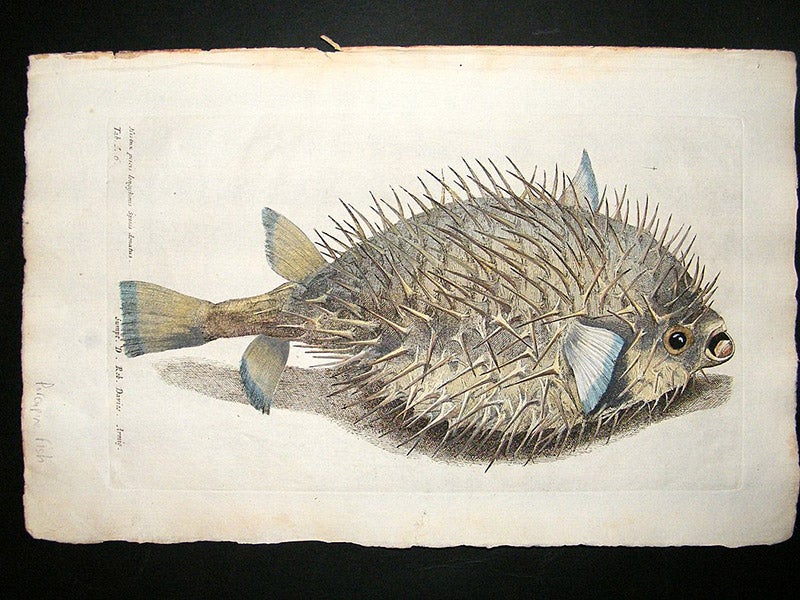
According to the Royal Society’s web site, “Ray and Willughby’s Historia did not prove to be the publishing sensation that the Fellows had hoped and the book nearly bankrupted the Society. This meant that the Society was unable to meet its promise to support the publication of Isaac Newton’s masterpiece.”
Fortunately, “it was saved from obscurity by Edmund Halley, then Clerk at the Royal Society” — and now better known for his eponymous comet — “who raised the funds to publish the work, providing much of the money from his own pocket. ”
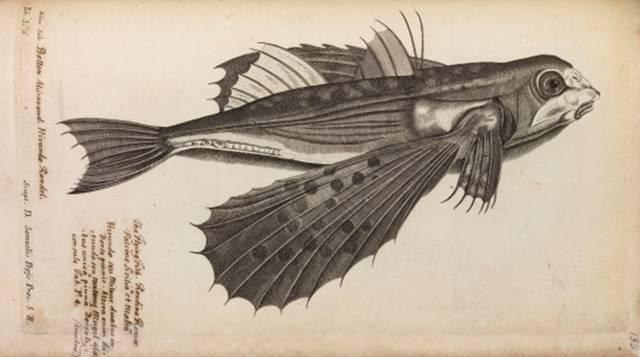
Halley’s great reward, in lieu of the salary the Royal Society could no longer pay, was a pile of unsold copies of De Historia Piscium. That may not have been quite the insult it sounds like, given that the book represented a triumph of production and design in its day. You can see a copy in the episode of Adam Savage’s Tested at the top of the post, and you can closely examine its imagery at your leisure in the digital archive of the Royal Society. In the words of Jonathan Ashmore, Chair of the Royal Society’s Library Committee, a browsing session should help us “appreciate why early Fellows of the Royal Society were so impressed by Willughby’s stunning illustrations of piscine natural history.”
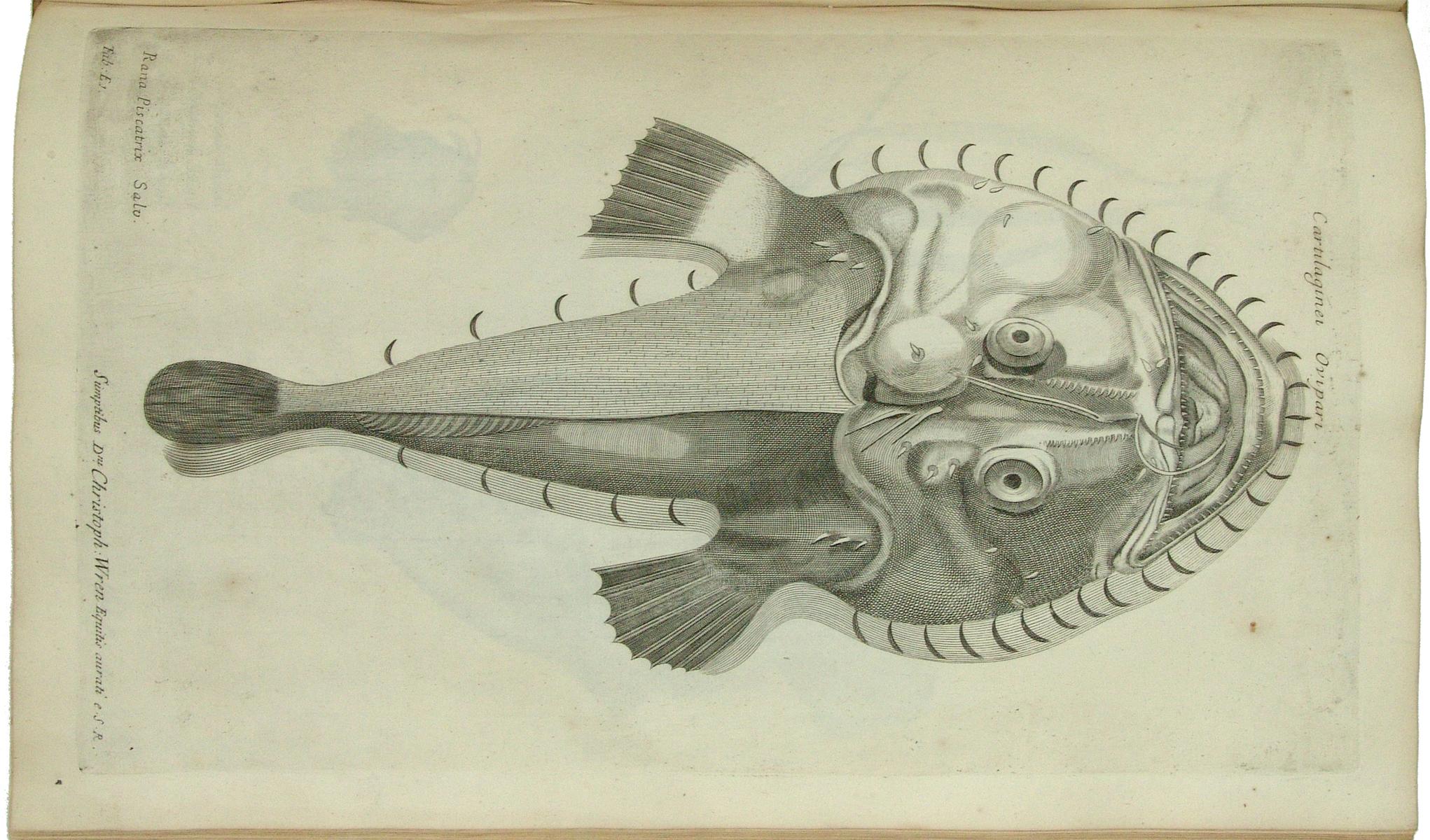
Though Savage duly marvels at the Royal Society’s copy of the Historia — a reconstruction made up of pages long ago cut out and sold separately, as was once common practice with books with pictures suitable for framing — it’s clear that much of the motivation for his visit came from the prospect of close proximity to Newtoniana, up to and including the man’s death mask. But then, Newton lays fair claim to being the most important scientist who ever lived, and the Principia to being the most important science book ever written. Almost three and a half centuries later, physics still holds mysteries for generations of Newton’s successors to solve. But then, so do the depths of the ocean.
Related content:
Sir Isaac Newton’s Papers & Annotated Principia Go Digital
The Brilliant Colors of the Great Barrier Revealed in a Historic Illustrated Book from 1893
Based in Seoul, Colin Marshall writes and broadcasts on cities, language, and culture. His projects include the Substack newsletter Books on Cities, the book The Stateless City: a Walk through 21st-Century Los Angeles and the video series The City in Cinema. Follow him on Twitter at @colinmarshall or on Facebook.
Read More...Dave Grohl, Jack Black & Greg Kurstin Sing Rush’s “The Spirit Of Radio” for Hanukkah
Once again, Foo Fighters frontman Dave Grohl and producer Greg Kurstin have teamed up to celebrate Hanukkah by performing songs created by musicians with Jewish roots. Above, they perform–along with Jack Black–Rush’s “The Spirit Of Radio.” (Geddy Lee’s parents were both Jews who survived Auschwitz and Dachau. Lee tells their story below.) Other songs featured in this year’s celebration include Randy Newman’s “I Love L.A.,” “Spinning Wheel” by Blood, Sweat & Tears, Janis Ian’s “At Seventeen” and more. Find performances from prior Hanukkah celebrations in the Relateds below.
If you would like to support the mission of Open Culture, consider making a donation to our site. It’s hard to rely 100% on ads, and your contributions will help us continue providing the best free cultural and educational materials to learners everywhere. You can contribute through PayPal, Patreon, and Venmo (@openculture). Thanks!
Related Content
Read More...An Old-Time Radio Yuletide: Hear 20+ Hours of Vintage Christmas Radio Shows (1938–1956)
As Christmas approaches, we reach for our bookshelves and pull down Charles Dickens’ beloved tale of hardship, revelation, and a miser’s redemption in the holiday season. I speak, of course, of The Cricket on the Hearth, published in 1845 as the third of what would be Dickens’ five Christmas books. (The first, of which you may have heard, was A Christmas Carol.) From the very year of its publication, The Cricket on the Hearth found great success as a stage production, and it continued to be adapted even in the age of radio. The story was a century old by the time it aired on NBC, in the broadcast that opens the five-and-a-half-hour compilation of Christmas old-time radio above.
That video is just one of three uploaded in the past few weeks by the Youtube channel An Evening of Old-Time Radio. It collects a variety of Christmas-themed specials and broadcasts from shows like Lux Radio Theatre, The Coronet Little Show, and CBS Ceiling Unlimited (an aviation-promoting wartime effort created by Orson Welles).
The second volume features more than six hours of holiday episodes from the hit series of the Golden Age of Radio, including sitcoms like Our Miss Brooks, The Life of Riley, Fibber McGee and Molly, and its spinoff The Great Gildersleeve. Their characters, much like their listeners, struggle to do their shopping and organize their parties — and amid it all, of course, find their way to the true meaning of Christmas.
The latest video in An Evening of Old Time Radio’s “Yuletide OTR” series includes radio adaptations of It’s a Wonderful Life, which now defines the genre of the Christmas movie, followed by one of Dickens’ Christmas Carol. Scheduled for release this Christmas day, the fourth installment promises yet more seasonally appropriate stories — with the requisite gags, complications, and final swells of good cheer — from such mid-century domestic comedies as The Aldrich Family, Lum and Abner, and The Adventures of Ozzie and Harriet. But as you’ll hear, neither could thriller, mystery, and western shows like The Man Called X, The New Adventures of Nero Wolfe, and The Six Shooter resist telling a Christmas tale — nor can we, all these decades later, resist hearing one.
Related content:
Bob Dylan Reads “‘Twas the Night Before Christmas” On His Holiday Radio Show (2006)
Hear 149 Vintage Halloween Radio Shows from the Golden Age of Radio
Hear 90+ Episodes of Suspense, the Iconic Golden Age Radio Show Launched by Alfred Hitchcock
Free: Listen to 298 Episodes of the Vintage Crime Radio Series Dragnet
Based in Seoul, Colin Marshall writes and broadcasts on cities, language, and culture. His projects include the Substack newsletter Books on Cities, the book The Stateless City: a Walk through 21st-Century Los Angeles and the video series The City in Cinema. Follow him on Twitter at @colinmarshall or on Facebook.
Read More...Support Us
We're hoping to rely on loyal readers, rather than erratic ads. Please click the Donate button and support Open Culture. You can use Paypal, Venmo, Patreon, even Crypto! We thank you!

About Us

Open Culture scours the web for the best educational media. We find the free courses and audio books you need, the language lessons & educational videos you want, and plenty of enlightenment in between.
Advertise With Us
FREE UPDATES!
GET OUR DAILY EMAIL
Get the best cultural and educational resources on the web curated for you in a daily email. We never spam. Unsubscribe at any time.
FOLLOW ON SOCIAL MEDIA
Open Culture editor Dan Colman scours the web for the best educational media. He finds the free courses and audio books you need, the language lessons & movies you want, and plenty of enlightenment in between.
Advertise With Us

