Joni Mitchell’s Catalog of Albums Now on YouTube: Stream Them Online

2022 — another difficult year for so many — has drawn to a close.
While not a remedy for all the hardships and privations we’ve been privy to, Joni Mitchell’s music remains good medicine. Listening to her always makes us feel more connected, reflective and calm for at least an hour or two.
Lucky us. The beloved singer-songwriter has given us a New Year’s gift — all her albums posted to her official Youtube channel.
What a lovely way to usher the old year offstage, and quietly welcome the new.
We all have our allegiances, though many who identify as fans may discover they’ve missed a couple releases along the way.
She has, to date, released 19 studio albums, 5 live albums, and an EP, as well as inspiring 2 tribute albums. A recent remark on Elton John’s Rocket Hour left us hopeful that more may be in the offing.
Sir Elton is but one of many well known musicians who are unabashed Mitchell fans. Artists as diverse as Harry Styles, k.d. lang, and Herbie Hancock have written songs in response to their favorite Joni cuts.
And the internet teems with covers from both heavy hitters and unknowns. (See them organized by song title on Mitchell’s website, where “Both Sides Now” remains the champ with a whopping 1576 renditions.)
Her fourth album, 1971’s Blue, seems to garner the most fervent praise…
Taylor Swift: She wrote it about her deepest pains and most haunting demons. Songs like ‘River,’ which is just about her regrets and doubts of herself – I think this album is my favorite because it explores somebody’s soul so deeply.”
James Taylor: I said it probably too many times that Joni is like, you tap the tree, and you know, it’s like maple syrup. This stuff, this nectar comes out of the most unusual places.
Jewel: On Blue, you hear everything she experienced, the highs and the lows. It’s such a lonely album — not in the “I don’t have any friends” sense but in the sense that you’re a little bit removed, and always watching. It takes a lot of courage to be that honest, especially as a woman.
Prince on The Hissing of Summer Lawns:
It was the last album I loved all the way through.
Boy George on Court and Spark:
I’ve bought this for many people because it is probably her most accessible [album]. I love unusual voices and I’ve sat and cried to so many of her songs. My favorite is Car On A Hill because I’ve done what it’s about: waited for the boyfriend to turn up as the cars go by.
Björk on 1977’s double album, Don Juan’s Reckless Daughter and Hejira:
I think it was that accidental thing in Iceland, where the wrong albums arrive to shore, because I was obsessed with Don Juan’s Reckless Daughter and Hejira as a teenager. I hear much more of her in those albums. She almost made her own type of music style with those, it’s more a woman’s world.”
Sisters Danielle and Este Haim on 1974’s live album Miles of Aisles:
There’s a little bit of everything. Songs from all her albums up until then, and she’s playing them with the L.A. Express, which was this amazing jazz band… a reimagining of a lot of her early work through this jazz lens.
Enjoy a lovely wander through Joni Mitchell’s oeuvre here. When you click on this page, scroll down to the “Albums & Singles” section, and then move (from left to right) through the entire discography.
Related Content
Songs by Joni Mitchell Re-Imagined as Pulp Fiction Book Covers & Vintage Movie Posters
Hear Demos & Outtakes of Joni Mitchell’s Blue on the 50th Anniversary of the Classic Album
- Ayun Halliday is the Chief Primatologist of the East Village Inky zine and author, most recently, of Creative, Not Famous: The Small Potato Manifesto. Follow her @AyunHalliday.
Read More...“Weird Al” Yankovic Breaks Down His Most Iconic Tracks: “Eat It,” “Amish Paradise,” “White and Nerdy,” and His Other Hilarious Songs
Few things could have been more amusing to a twelve-year-old in 1996 than an Amish-themed parody of the late Coolio’s portentously grim life-in-the-hood anthem “Gangsta’s Paradise.” As luck would have it, “Weird Al” Yankovic released just such a song in 1996, when I happened to be twelve years old myself. Like everyone who’s been a kid at some point in the past 40 years, I grew up hearing and appreciating Yankovic’s prolific output of parodies, pastiches, and even original songs. From “Eat It” to “Smells like Nirvana” to “White and Nerdy,” there was hardly a pop-music phase of my childhood, adolescence, and early adulthood that he didn’t make funny.
That’s to make funny, as distinct from to make fun of: unlike that of a predecessor in comedy songwriting like Tom Lehrer, Yankovic’s body of work evidences not the least tendency toward harshness or ridicule.
Hence his appeal from his very first recording “My Bologona,” an accordion-based parody of “My Sharona” recorded in the bathroom of his college radio station, to no less an advocate of silliness than Dr. Demento, whose airplay launched the young Weird Al’s career — a career that, as Yankovic acknowledges while telling the stories behind his iconic songs in the GQ video above, has not gone without its strokes of luck.
Yet few living performers more clearly personify the old aphorism describing luck as the meeting of preparation and opportunity. “Weird Al approaches the composition of his music with something like the holy passion of Michelangelo painting the ceiling of the Sistine Chapel,” writes Sam Anderson in a 2020 New York Times Magazine profile. Seeing Yankovic’s notes for “White & Nerdy” “file felt like watching a supercomputer crunch through possible chess moves. Every single variable had to be considered, in every single line.” To work in musical form, even the silliest humor demands his total dedication.
Yankovic has long showed a willingness straightforwardly to discuss what it’s like to be Weird Al, as well as what it takes to be Weird Al. For a considerably less straightforward version, we can watch The Roku Channel’s new Weird: The Al Yankovic Story. Most biopics take artistic liberties with the lives of their subjects, but Weird goes all the way, parodying the very form of the biopic itself while performing colossal (and surely fan-delighting) exaggerations of the facts of Yankovic’s life. In the GQ video, for example, he mentions getting the idea for “Like a Surgeon” by hearing Madonna throw it out in an interview; in the trailer above, Madonna turns at the door at his opulent mansion, a veritable succubus ready to drag him into the musical underworld. And it seems a safe bet that things only get Weirder thereafter.
Related content:
“Weird Al” Yankovic Releases “Word Crimes,” a Grammar Nerd Parody of “Blurred Lines”
Two Legends: Weird Al Yankovic “Interviews” James Brown (1986)
Monty Python’s Eric Idle Breaks Down His Most Iconic Characters
Based in Seoul, Colin Marshall writes and broadcasts on cities, language, and culture. His projects include the Substack newsletter Books on Cities, the book The Stateless City: a Walk through 21st-Century Los Angeles and the video series The City in Cinema. Follow him on Twitter at @colinmarshall or on Facebook.
Read More...The Archives of the Planet: Explore 72,000 Photos Taken a Century Ago to Document Human Cultures Around the World

The world, we often hear, used to be bigger. Today, if you feel the faintest twinge of curiosity about a distant place — Beijing, Paris, Cambodia, Egypt — you can near-instantaneously call up countless hours of high-quality video footage shot there, and with only a little more effort even communicate in real-time with people actually living there. This may be the case in the early twenty-first century, but it certainly wasn’t in the early twentieth. If you’d wanted to see the world back then, you either had to travel it yourself, an expensive and even dangerous proposition, or else hire a team of expert photographers to go forth and capture it for you.

Albert Kahn, a successful French banker and speculator, did both. A few years after making his own trip around the world, taking stereographic photos and even motion-picture footage along the way, he came up with the idea for a project called Les archives de la planète, or The Archives of the Planet.
Directed by the geographer Jean Brunhes (and influenced by the philosopher Henri Bergson, a friend of Kahn’s), Les archives de la planète spent most of the nineteen-tens and nineteen-twenties dispatching photographers to various ends of the earth on fewer than four continents: Europe, America, Asia, and Africa. And if you click on those links, you can see the project’s photos from the relevant regions yourself.

Having been digitized, the fruits of Les archives de la planète now reside online, at the web site of the Albert Kahn Museum. You can browse its collection there, or on this image portal, where you can view featured photos or access whichever part of the world in the early twentieth century you’d like to see. (Just make sure to do it in French.) The online archive contains a large chunk of the 72,000 autochrome pictures taken in 50 countries by Kahn’s photographers before he was wiped out by the stock market crash of 1929. Made freely available in high resolution a century after the height of his project, these vivid and evocative pictures remind us that, however small the world has become, the past remains a foreign country.
Related content:
Footage of Cities Around the World in the 1890s: London, Tokyo, New York, Venice, Moscow & More
How Vividly Colorized Photos Helped Introduce Japan to the World in the 19th Century
1850s Japan Comes to Life in 3D, Color Photos: See the Stereoscopic Photography of T. Enami
Petite Planète: Discover Chris Marker’s Influential 1950s Travel Photobook Series
Based in Seoul, Colin Marshall writes and broadcasts on cities, language, and culture. His projects include the Substack newsletter Books on Cities, the book The Stateless City: a Walk through 21st-Century Los Angeles and the video series The City in Cinema. Follow him on Twitter at @colinmarshall or on Facebook.
Read More...How the Ancient Romans Built Their Roads, the Lifelines of Their Vast Empire
At its peak in the second century, the Roman Empire dominated nearly two million square miles of the world. As with most such grand achievements, it couldn’t have happened without the development of certain technologies. The long reach of the Eternal City was made possible in large part by the humble technology of the road — or at least it looks like a humble technology here in the twenty-first century. Roads existed before the Roman Empire, of course, but the Romans built them to new standards of length, capacity, and durability. How they did it so gets explained in the short video above.
On a representative stretch of Roman-road-to be, says the narrator, a “wide area would be deforested.” Then “the topsoil would be removed until a solid base was found.” Atop that base, workers laid down curbs at the width determined by the road plan, then filled the gap between them with a foundation of large stones.
Atop the large stones went a layer of smaller stones mixed with fine aggregates, and finally the gravel, sand, and clay that made up the surface. All of this was accomplished with the old-fashioned power of man and animal, using tipper carts to pour out the materials and other tools to spread and compact them.
Roman road-builders didn’t just use any old rocks and dirt, but “carefully selected materials of the highest quality” — including formidably long-lasting Roman concrete, the secrets of whose sturdiness have only been fully understood in the past decade. In another ingenious design choice recently discovered, “ditches were placed to prevent access to the road from unauthorized vehicles,” as well as to widen the peripheral view of the road’s users. In the video just above, civil-engineering specialist Isaac Moreno Gallo takes a closer look at a section of a real Roman road being excavated where it will intersect with a modern highway under construction. The new road will surely stand for a long time to come — but will it inspire fascination a couple millennia from now?
Related content:
The Roman Roads and Bridges You Can Still Travel Today
How to Make Roman Concrete, One of Human Civilization’s Longest-Lasting Building Materials
The Roads of Ancient Rome Visualized in the Style of Modern Subway Maps
The Roman Roads of Britain Visualized as a Subway Map
Based in Seoul, Colin Marshall writes and broadcasts on cities, language, and culture. His projects include the Substack newsletter Books on Cities, the book The Stateless City: a Walk through 21st-Century Los Angeles and the video series The City in Cinema. Follow him on Twitter at @colinmarshall or on Facebook.
Read More...Paul McCartney Explains How Bach Influenced “Blackbird”
If you’re going to steal, steal from the best.
For most of humanity, this might mean nabbing a lick or two from Paul McCartney’s playbook.
For Paul McCartney, it meant borrowing from Bach — the fifth movement from Suite in E minor for Lute, to be specific.
As he explained during the above 2005 appearance on the Parkinson Show, when he and his buddy, George Harrison, used to sit around teaching themselves basic rock n’ roll chords, their show off move was a bit of semi-classical fingerpicking that Sir Paul modestly claimed to be “not very good at:”
It was actually classical but we made it semi.
Thusly did the chord progressions of Bach’s Bourree in E minor — a piece which “I never knew the title of, which George and I had learned to play at an early age; he better than me actually” — inspire Blackbird:
Part of its structure is a particular harmonic thing between the melody and the bass line which intrigued me. Bach was always one of our favorite composers; we felt we had a lot in common with him. For some reason we thought his music was very similar to ours and we latched on to him amazingly quickly. We also liked the stories of him being the church organist and wopping this stuff out weekly, which was rather similar to what we were doing. We were very pleased to hear that…The fingerpicking style was something we admired in Chet Atkins, particularly in a piece called Trambone, though it was also played by Colin Manley, from a group called The Remo Four. They’d started out in Liverpool around the same time as The Beatles.
This deceptively slow burn, now a staple of Sir Paul’s setlists, debuted as a solo acoustic track on the White Album.
Bach’s Bourree in E minor also inspired Jethro Tull and, hilariously, Tenacious D.
Related Content
When the Beatles Refused to Play Before Segregated Audiences on Their First U.S. Tour (1964)
The Beatles’ ‘Blackbird’ Sung in the Indigenous Mi’kmaq Language
- Ayun Halliday is the Chief Primatologist of the East Village Inky zine and author, most recently, of Creative, Not Famous: The Small Potato Manifesto. Follow her @AyunHalliday.
Read More...Miley Cyrus & David Byrne Perform David Bowie’s “Let’s Dance” on New Year’s Eve
Last night, Miley Cyrus and David Byrne performed David Bowie’s “Let’s Dance” on the NBC holiday special Miley’s New Year’s Eve Party. And they also treated viewers to a performance of “Everybody’s Coming to My House,” from Byrne’s 2018 album American Utopia. Not a bad way to send off 2022.
Before leaving 2022 behind, we’ll also flag another Miley Cyrus collaboration–a performance from this summer’s celebration of the life of Taylor Hawkins. Below, watch her take the stage with Def Leppard and perform “Photograph” at the 3:45. No doubt, she can sing.
Happy 2023.
Related Content
How David Byrne and Brian Eno Make Music Together: A Short Documentary
Watch a Very Nervous, 23-Year-Old David Byrne and Talking Heads Performing Live in NYC (1976)
Watch David Byrne Lead a Massive Choir in Singing David Bowie’s “Heroes”
Read More...Isaac Asimov on How Libraries Can Radically Change Your Life (1971)
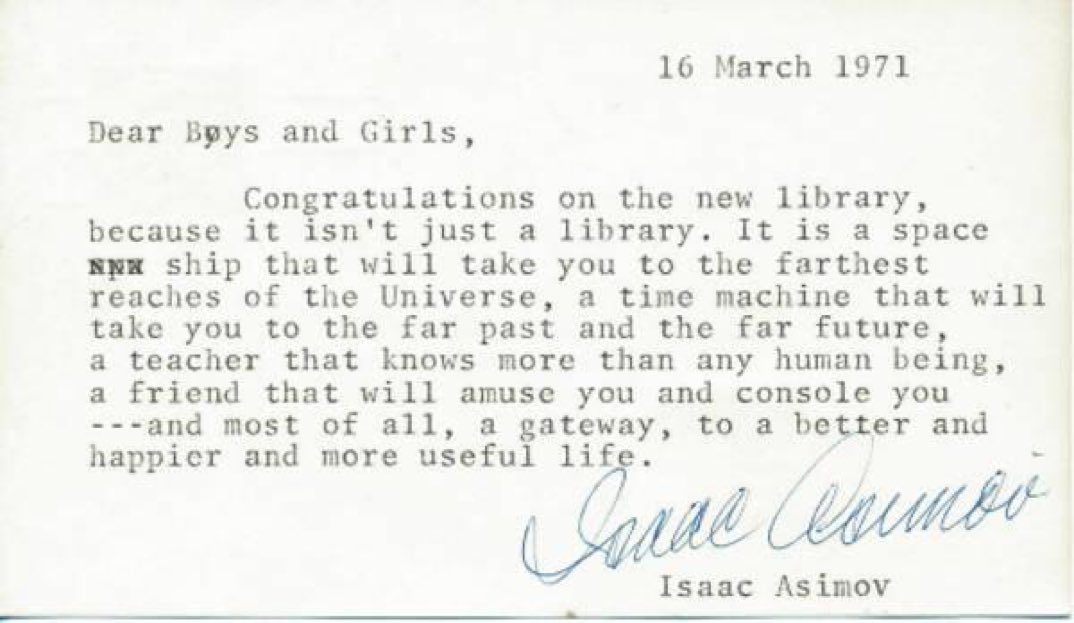
Back in 1971, Isaac Asimov sent a letter to celebrate the opening of a new library in Troy, Michigan. Thoughtful as always, his letter addressed the children of the Troy community as follows: “Congratulations on the new library, because it isn’t just a library. It is a space ship that will take you to the farthest reaches of the Universe, a time machine that will take you to the far past and the far future, a teacher that knows more than any human being, a friend that will amuse you and console you—and most of all, a gateway, to a better and happier and more useful life.”
In total, 97 writers (including Dr. Spock, Dr. Seuss and E.B. White) sent letters to mark the occasion. You can read through them in the Troy Library Flickr stream here.
If you would like to support the mission of Open Culture, consider making a donation to our site. It’s hard to rely 100% on ads, and your contributions will help us continue providing the best free cultural and educational materials to learners everywhere. You can contribute through PayPal, Patreon, and Venmo (@openculture). Thanks!
Related Content
Isaac Asimov Laments the “Cult of Ignorance” in the United States (1980)
How Isaac Asimov Went from Star Trek Critic to Star Trek Fan & Advisor
Read More...Watch Restored Versions of Classic Fleischer Cartoons on Youtube, Featuring Betty Boop, Koko the Clown & Others
Quite a few generations of American children have by now grown up knowing the names of Max and Dave Fleischer — albeit knowing even better the names of the characters they animated, like Betty Boop, Popeye the Sailor, and Superman. The kids who first thrilled to Max Fleischer’s early “Out of the Inkwell” series, which he started in the late nineteen-tens and continued into the late nineteen-twenties, would naturally have seen them in a movie theater. But most of us under the age of eighty would have received our introduction to the lively, whimsical, and often bizarre world of the brothers Fleischer through the television, a medium hungry for cartoons practically since its inception.
Now viewers of all ages can enjoy Fleischer cartoons on Youtube, and in newly restored form at that. “The Fabulous Fleischer Cartoons Restored team is dedicated to preserving Fleischer’s films by restoring them from original prints and negatives,” writes Boing Boing’s Rusty Blazenhoff, adding that “Adam Savage’s Tested visited the Blackhawk Films scanning facility in California and spoke with restoration expert Steve Stanchfield about the process of bringing these classic films back to life.”
The charm of Fleischer cartoons may still feel effortless a century after their creation, but anyone familiar with animation knows how painstaking that creation would have been; by the same token, bringing the surviving films back to pristine condition is a more complicated job than most viewers would imagine.
The current offerings on Fabulous Fleischer Cartoons Restored’s channel include Betty Boop and Pudgy in “Happy You and Merry Me,” Bimbo the Dog in “Teacher’s Pest,” and even the short but lavish Technicolor fantasy “Somewhere in Dreamland,” which brightened up the grim days of the Great Depression for all who saw it. The restorers have also worked their magic on Fleischer holiday cartoons like “Rudolph the Red-Nosed Reindeer” and “Christmas Comes But Once a Year” (including with the latter a side-by-side comparison of the new restoration with the existing sixteen-millimeter DVD print). Yes, Christmas has just passed, but it will come again next year, and bring with it the latest generation’s chance to be delighted by Fleischer cartoons crisper and more vivid than the ones with which any of us grew up.
via Boing Boing
Related content:
The Harlem Jazz Singer Who Inspired Betty Boop: Meet the Original Boop-Oop-a-Doop, “Baby Esther”
The Original 1940s Superman Cartoon: Watch 17 Classic Episodes Free Online
The Trick That Made Animation Realistic: Watch a Short History of Rotoscoping
How Walt Disney Cartoons Are Made: 1939 Documentary Gives an Inside Look
Based in Seoul, Colin Marshall writes and broadcasts on cities, language, and culture. His projects include the Substack newsletter Books on Cities, the book The Stateless City: a Walk through 21st-Century Los Angeles and the video series The City in Cinema. Follow him on Twitter at @colinmarshall or on Facebook.
Read More...Pelé’s Great World Cup Goals (RIP)
Today, the soccer legend, Pelé, passed away at age 82. The most dominant player of his generation, Pelé turned professional at age 15, won the World Cup at age 17 in 1958 (before winning two more World Cups in 1962 and 1970), and ultimately scored 1,283 goals in 1,367 professional matches, averaging nearly one goal per game. On the international stage, he scored 77 goals for Brazil, 12 of them in the World Cup.
The highlight reel above features the young Pelé’s goals in the 1958 World Cup. Separately, you can see his 5 greatest goals in the World Cup finals here. And, for good measure, we’ve added more footage below that highlights his magical skills across his career.
If you would like to support the mission of Open Culture, consider making a donation to our site. It’s hard to rely 100% on ads, and your contributions will help us continue providing the best free cultural and educational materials to learners everywhere. You can contribute through PayPal, Patreon, and Venmo (@openculture). Thanks!
Related Content
Video: Bob Marley Plays a Soccer Match in Brazil, 1980
Why Jorge Luis Borges Hated Soccer: “Soccer is Popular Because Stupidity is Popular”
Read More...Support Us
We're hoping to rely on loyal readers, rather than erratic ads. Please click the Donate button and support Open Culture. You can use Paypal, Venmo, Patreon, even Crypto! We thank you!

About Us

Open Culture scours the web for the best educational media. We find the free courses and audio books you need, the language lessons & educational videos you want, and plenty of enlightenment in between.
Advertise With Us
FREE UPDATES!
GET OUR DAILY EMAIL
Get the best cultural and educational resources on the web curated for you in a daily email. We never spam. Unsubscribe at any time.
FOLLOW ON SOCIAL MEDIA
Open Culture editor Dan Colman scours the web for the best educational media. He finds the free courses and audio books you need, the language lessons & movies you want, and plenty of enlightenment in between.
Advertise With Us

