An Architect Demystifies the Art Deco Design of the Iconic Chrysler Building (1930)
The Chrysler Building was once the tallest structure in the world — a heyday that ended up lasting less than a year. The loss of that glorious title owed to the completion of the Empire State Building, twelve blocks away, in 1931. But it was all in the spirit of the game, the Chrysler Building having itself one-upped its close competitor 40 Wall Street (then called the Bank of Manhattan Trust Building) by installing a non-functional spire atop its signature crown at the last moment. But however much of a triumph it represented, that moment was poorly timed: the very next day would bring the Wall Street Crash of 1929, harbinger of the Great Depression. The subsequent decade would inspire little public favor for extravagant monuments in the Big Apple.
Yet compared to the life of a tower, economic cycles are short indeed. By now the Chrysler Building has seen the United States of America through a fair few ups and downs, only gaining appreciation all the while. Removed from its immediate historical context, we can more keenly appreciate architect William Van Alen’s elaborate yet elegant Art Deco design.
In the Architectural Digest video above, architect Michael Wyetzner takes us on a tour of that design, explaining how each of its features works with the others to make an enduring visual impact. Some, like the gleaming oversized radiator-cap gargoyles, impress with sheer brazenness; others, like the Native American-derived patterns that repeat in various locations at various scales, take a more practiced eye to identify.
Despite having been surpassed in height over and over again, the Chrysler Building remains a sine qua non of understanding the New York skyscraper. Hence its appearance at the very beginning of “Why New York’s Skyscrapers Keep Changing Shape” from The B1M. We’ve previously featured that channel here on Open Culture for its investigation of why there are so few skyscrapers in Europe; in New York, however, the ambitiously tall building has become something like a force of nature, tamed only temporarily even by crisis or disaster. Some have used the COVID-19 pandemic to declare an end of the office building, even the end of the city, and much like early in the Depression, skyscrapers now under construction reflect the priorities of a previous reality. Yet the 92-year-old Chrysler Building continues to inspire us today, and to that extent, we still live in the world that made it.
Related content:
New York’s Lost Skyscraper: The Rise and Fall of the Singer Tower
How the World Trade Center Was Rebuilt: A Visual Exploration of a 20-Year Project
A Whirlwind Architectural Tour of the New York Public Library — “Hidden Details” and All
Famous Architects Dress as Their Famous New York City Buildings (1931)
Based in Seoul, Colin Marshall writes and broadcasts on cities, language, and culture. His projects include the Substack newsletter Books on Cities, the book The Stateless City: a Walk through 21st-Century Los Angeles and the video series The City in Cinema. Follow him on Twitter at @colinmarshall or on Facebook.
Read More...Humans First Started Wearing Clothes At Least 300,000 Years Ago, New Research Finds

Images courtesy of University of Tuebingen
That people wore clothes back in the Stone Age will hardly come as a surprise to anyone who grew up watching The Flintstones. That show, never wholly reliant on established archaeological fact, didn’t get too specific about its time period. But it turns out, based on recently published discoveries by a team of researchers from the University of Tübingen, the Senckenberg Centre for Human Evolution and Palaeoenvironment, and Leiden University, that Stone Agers were dressing themselves as early as 300,000 years ago — over one hundred millennia earlier than previously thought.
“This is suggested by cut marks on the metatarsal and phalanx of a cave bear discovered at the Lower Paleolithic site of Schöningen in Lower Saxony, Germany,” says the University of Tübingen’s site. The location of such marks indicate that the bear was not simply butchered but carefully skinned.
A cave bear’s winter coat “consists of both long outer hairs that form an airy protective layer and short, dense hairs that provide particularly good insulation” — making it a fine winter coat for a prehistoric human being as well. Such a use of bear skins “is likely a key adaptation of early humans to the climate in the north,” where winters would be difficult indeed without warm clothing.

Though some residents of Bedrock did wear furs (made from the prized pelts of the minkasaurus), they seemed not to be essential to survival in that Stone Age equivalent of California. Jean M. Auel’s The Clan of the Cave Bear proved much more realistic about this sort of thing, though its characters live and die between 28,000 and 25,000 BC, the relatively recent past compared to the Lower Paleolithic from which this particular cave bear dates. It was also in Schöningen that “the world’s oldest spears were discovered,” making it a prime location from which to understand more clearly the ways of humans from that distant period. If a foot-powered Stone Age car were one day to be unearthed, it would surely be unearthed there.
via Boing Boing
Related content:
Archaeologists Find the Earliest Work of “Abstract Art,” Dating Back 73,000 Years
Hear the World’s Oldest Instrument, the “Neanderthal Flute,” Dating Back Over 43,000 Years
How to Wear a Toga the Official Ancient Roman Way
Based in Seoul, Colin Marshall writes and broadcasts on cities, language, and culture. His projects include the Substack newsletter Books on Cities, the book The Stateless City: a Walk through 21st-Century Los Angeles and the video series The City in Cinema. Follow him on Twitter at @colinmarshall or on Facebook.
Read More...A Wooden Artwork That Beautifully Unfolds into a Functional Desk
Robert van Embricqs, a designer based in Amsterdam, has created The Flow Wall Desk–a wooden decoration that “transforms from a piece of art on the wall into a functional desk by showing off its unique aesthetic.” On his site, he writes:
The Flow Wall Desk acknowledges the potential how to combine functionality with art. This results in creating a desk inside one’s indoor environment. And only with one twist, it becomes a true joy to have a separate working area when needed. It can be subscribed as a piece of functional art that builds on the design track record of transformations in space. However, this one offers a part of the interior that shifts with time: a cozy workspace during the day becomes a compact wall hanging after being used.
Inspired by recent global events and the longer-term trends that precede them, to devise a statement piece that lends dignity to the digital workspace through craft, warm textures, and durably engineered fastenings. The Flow Wall Desk is adaptable and with the contemporary design elements, it can be used throughout homes, libraries, hotels, and many other inside designations. During the design process, van Embricqs strove to merge the desk’s execution with its design formula by creating a cohesive whole.
Usability demands that an everyday object such as this should be created with a generalized user’s psychology in mind. Vertical element emerges from the wall like a caterpillar with the help of specifically placed hinges. These exposed brass hinges establish a visual rhythm and ensure that the form can follow its function. This led to the notion of a transformation in form and purpose achieved through a single, simple gesture that everyone can familiarize themselves with. With a single turn by hand around its axis, a tabletop is created and once in its horizontal position, the tabletop is supported by wooden slats, creating a more natural look and organic effect that also serves as a screen for more privacy.
The horizontal work surface is comfortable yet functional due to its depth and width for the seated user and making it perfect for typing and handwriting. Finally, a unique opportunity is created for a temporary work surface and ergonomically adjustable desk in a sunny corner which invites the user to fold that desk away when work is over.
With the finished design appearance, more sustainable material developments are being examined and analyzed for production. And when it comes to functionality, each part of the Flow Wall desk has been specifically engineered without losing the appeal to attract, just like a folding magic trick with a well-kept secret.
You can purchase your own Flow Wall desk (for about $2850) via Robert’s webshop here. And find more of his work on Instagram here.
If you would like to support the mission of Open Culture, consider making a donation to our site. It’s hard to rely 100% on ads, and your contributions will help us continue providing the best free cultural and educational materials to learners everywhere. You can contribute through PayPal, Patreon, and Venmo (@openculture). Thanks!
Related Content
Behold the Elaborate Writing Desks of 18th Century Aristocrats
Who Wrote at Standing Desks? Kierkegaard, Dickens and Ernest Hemingway Too
Read More...The Oldest Known Sentence Written in an Alphabet Has Been Found on a Head-Lice Comb (Circa 1700 BC)
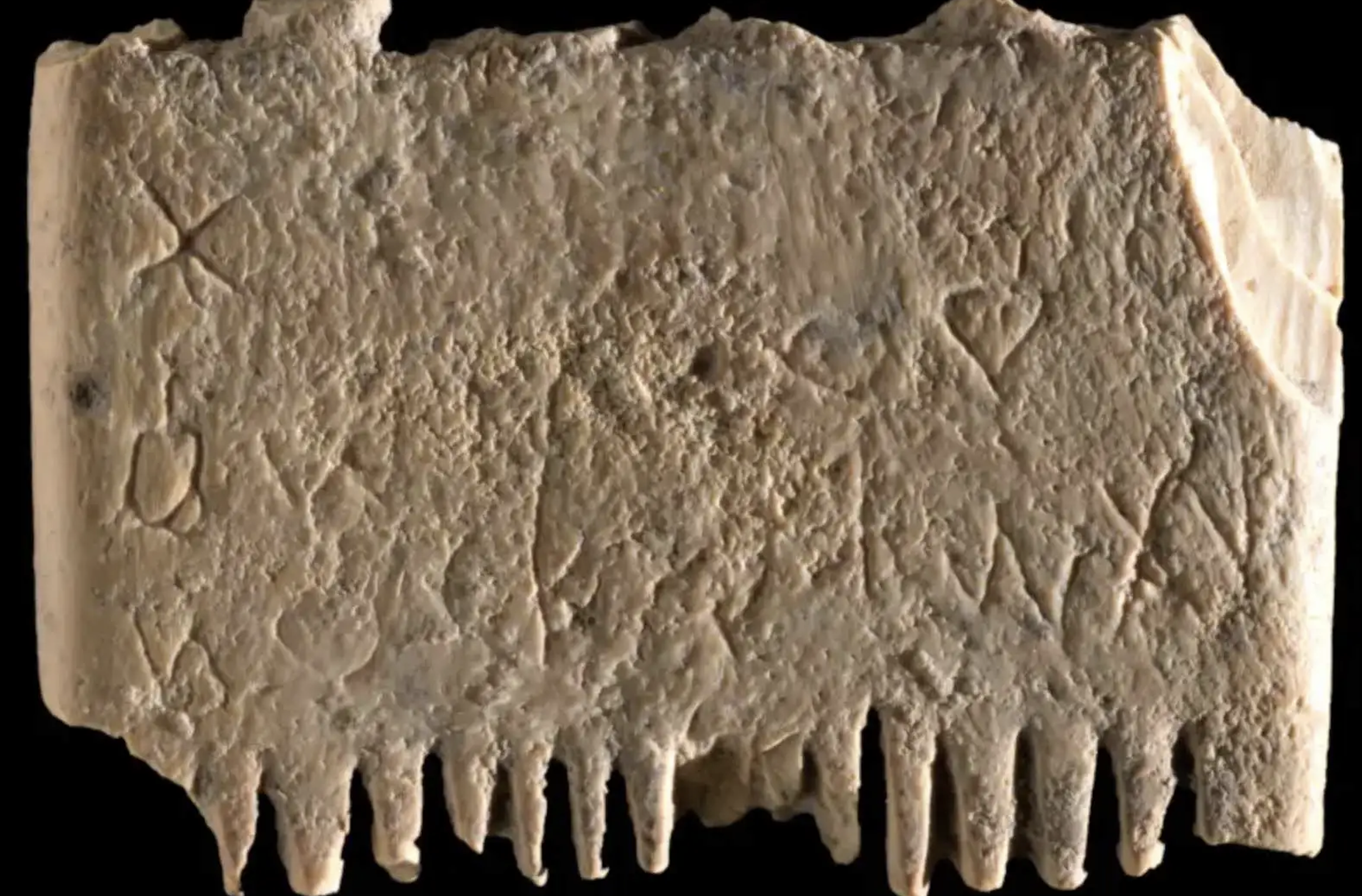
Image by Dafna Gazit, Israel Antiquities Authority
I don’t recall any of my elementary-school classmates looking forward to head-lice inspection day. But had archaeological progress been a few decades more advanced at the time, the teachers might have turned it into a major history lesson. For it was on a comb, designed to remove head lice, that researchers in southern Israel recently found the oldest known sentence written in an alphabet. Invented around 1800 BC, that Canaanite alphabet “was standardized by the Phoenicians in ancient Lebanon,” writes the Guardian’s Ian Sample, later becoming “the foundation for ancient Greek, Latin and most modern languages in Europe today.”
The comb itself, dated to around 1700 BC, bears a simple Canaanite message: “May this tusk root out the lice of the hair and the beard.” As Sample notes, “ancient combs were made from wood, bone and ivory, but the latter would have been expensive, imported luxuries. There were no elephants in Canaan at the time.”
Despite its small size, then, this comb must have been a big-ticket item. The New York Times’ Oliver Whang writes that these facts have already inspired a new set of questions, many of them not strictly linguistic in nature: “Where was the ivory comb inscribed? Who inscribed it? What purpose did the inscription serve?”
As our lice-combating technology has evolved over the millennia, so have our alphabets. From the Canaanite script “the alphabet continued to evolve, from Phoenician to Old Hebrew to Old Aramaic to Ancient Greek to Latin, becoming the basis for today’s modern English characters.” And that wasn’t its only path: Korea, where I live, has a completely different alphabet of its own, but one that caught on for the same reasons as its distant cousins elsewhere in the world. The key is simplicity, as against older writing systems in which one character represented one word or syllable: “Matching one letter to one sound made writing and reading far easier to learn,” Whang writes. Not that some students, even today, wouldn’t submit to the lice comb rather than practice their ABCs.
Related content:
How Writing Has Spread Across the World, from 3000 BC to This Year: An Animated Map
An Ancient Egyptian Homework Assignment from 1800 Years Ago: Some Things Are Truly Timeless
What the Rosetta Stone Actually Says
Based in Seoul, Colin Marshall writes and broadcasts on cities, language, and culture. His projects include the Substack newsletter Books on Cities, the book The Stateless City: a Walk through 21st-Century Los Angeles and the video series The City in Cinema. Follow him on Twitter at @colinmarshall or on Facebook.
Read More...An Introduction to Hokusai’s Great Wave, One of the Most Recognizable Artworks in the World
You need not be a student of Japanese Ukiyo‑e woodblock prints to recognize artist Katsushika Hokusai’s Under the Wave Off Kanagawa — or the Great Wave, as it has come to be known.
Like Leonardo da Vinci’s Mona Lisa and Botticelli’s The Birth of Venus, it’s been reproduced on all manner of improbable items and subjected to liberal reimagining — something Sarah Urist Green, describes in the above episode of her series The Art Assignment as “numerous crimes against this image perpetrated across the internet.”
Such repurposing is the ultimate compliment.
The Great Wave is so graphically indelible, anyone who co-opts it can expect it to do a lot of heavy lifting.
For those who bother looking closely enough to take in the three boatloads of fishermen struggling to escape with their lives, it’s also narratively gripping, a terrifying woodblock still from an easily imagined disaster film.
It’s also an homage to Mount Fuji, one of a series of 36.
Thousands of prints were produced in the early 1830s for the domestic tourist trade. Visitors to Mount Fuji snapped these souvenirs up for about the same price as a bowl of noodle soup.

Green, a curator and educator, points out how the water-obsessed Hokusai borrowed elements from both the Rinpa school and Western realism for the Great Wave. The latter can be seen in the use of linear perspective, a low horizon line, and Prussian blue.
An 1867 posthumous showing at the International Exhibition in Paris turned such notable artists as Claude Monet, Edgar Degas, Mary Cassatt, and Henri de Toulouse-Lautrec into major Ukiyo‑e fans.
Without them, this iconic plunging breaker might never have spilled over onto our dorm room walls, our shower curtains, our yoga mats, t‑shirts, Doc Martens, street art, and tattoos.
Hell, there’s even a Lego set and an official Sanrio characters greeting card showing Hello Kitty nonchalantly surfing the crest in a two piece bathing suit, more interested in disporting herself than considering the sort of extreme oceanic events we can expect more of, owing to climate change.
Related Content
View 103 Discovered Drawings by Famed Japanese Woodcut Artist Katsushika Hokusai
- Ayun Halliday is the Chief Primatologist of the East Village Inky zine and author, most recently, of Creative, Not Famous: The Small Potato Manifesto. Follow her @AyunHalliday.
Read More...Watch Cher Play All the Major Parts in a 12-Minute Remake of West Side Story (1978)
Cher, the mononymous Goddess of Pop, gifted the small screens of the 70s with a lot of over-the-top glamour.
Her work ethic, comedic flair and unapologetic embrace of camp helped her stand out from the crowd, conferring the fame she had longed for since childhood, when she commandeered her 5th grade classmates for an unofficial, and, from the sounds of it, all-female production of Oklahoma, covering the male roles herself when the boys declined to participate.
Some twenty years later, she was a household name — one that was no longer appended to that of ex-husband Sonny Bono, co-host of the popular eponymous variety hour in which they sang, hammed their way through goofy skits, and busted each other’s chops to the delight of the live studio audience.
The 1978 television event Cher…special found her bringing many of those same talents to bear, along with country star Dolly Parton, rocker Rod Stewart, outré glam band, The Tubes, and the crowd-pleasing array of spangled, skin-baring Bob Mackie designs that defined her look.
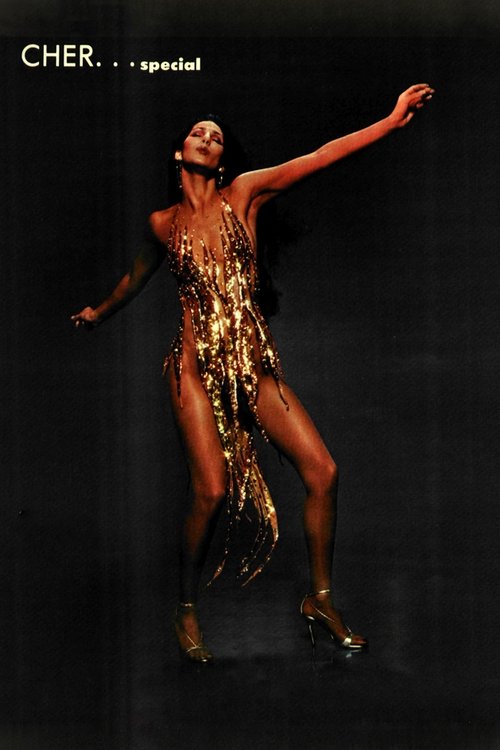
More shocking than any of Mackie’s creations or the Musical Battle to Save Cher’s Soul, a set piece wherein Parton and a gospel choir endeavor to coax the diva from a kinky disco hellscape, is the star’s 12-and-a-half minute solo version of West Side Story, above.
This is no mere medley. Cher puts the big pot in the little, donning multiple wigs, a facsimile of the chaste white party dress Natalie Wood wore to the dance at the gym, and flats (!) to embody Tony, Maria, Anita, Bernardo and various Jets, sans irony.
Some of Stephen Sondheim’s award-winning songs have been transposed to a different key to accommodate Cher’s contralto, and when they haven’t, her famous voice is stretched a bit thin.
Vocally, she makes a more convincing Jet than she does the ingenue, Maria.
(Speaking of which, let’s not forget that that’s ghost singer Marni Nixon, not Wood, as Maria on the 1961 film’s soundtrack…)
Why West Side Story?
Why not Godspell or Jesus Christ Superstar? Wouldn’t those fit better thematically with the portion of the special that has Dolly and a white-robed chorus battling the denizens of Satan’s sexy playpen?
Two words:
1. Variety. That’s what Cher was peddling in the 70s.
2. Nostalgia. As Cher recalls in On the Dance Floor: Spinning Out on Screen:
I remember dancing around my living room to West Side Story (1961). I would sing all the parts and dance every single dance, when there was no one else around.
That admission helps us reframe the cringe factor. Before ye cast the first stone, think: hast thou never stood before a mirror singing into a hairbrush?
And if, by some chance, you’re unfamiliar with West Side Story’s dramatis personae and plot, don’t look to Cher for clarification.
Instead, we refer you to Romeo and Juliet, and for some modern context touching on green screens, genderfluidity, and the color-conscious casting of the 2021 remake, the below episode of Chris Frank’s snarky Bad Music Video Theater.
Related Content
David Bowie and Cher Sing Duet of “Young Americans” and Other Songs on 1975 Variety Show
- Ayun Halliday is the Chief Primatologist of the East Village Inky zine and author, most recently, of Creative, Not Famous: The Small Potato Manifesto. Follow her @AyunHalliday.
Read More...Visit the “Cat Islands” of Japan, Where Felines Outnumber Humans
The world has heard much about the aging and shrinking of Japanese society, a process that has created ghost towns like those we’ve previously featured here on Open Culture. But however seriously Japan’s population may be contracting, its love of cats abides undiminished. Hence the replacement of people by felines — effectively, anyway — on the island of Aoshima, visited in the CBS Sunday Morning segment above. “Here, cats outnumber humans more than ten to one,” says correspondent Seth Doane. Its “tiny fishing village once had a population of 800 people, but the sardine fisheries depleted, jobs moved to cities, and human residents left the island.”
Such is the way, it seems, of any post-industrial society — but as always, Japan has ways of setting itself apart. On Aoshima, Doane says, “the big moment of the day is when the tourist boat shows up. It’s 45 minutes of bliss for all involved,” including the cat-lovers bearing treats as well as all the peckish animals awaiting them at the dock. But Aoshima is only one of ten such “cat islands” around Japan. The much larger (but still small) Tashirojima boasts not just over 100 resident cats, but also Neko-jinja (猫神社), literally “Cat Shrine,” one of a host of such feline-dedicated religious sites in the island’s Miyagi Prefecture.
Whether Japan’s attitude toward cats amounts to worship remains a matter of debate. But the fact remains that cats have proven to be the salvation of more places in Japan than a few of its islands: take Tama (literally “ball,” but the Japanese equivalent of “Kitty”), a calico whose assumption of the position of “station master” brought a train stop in Wakayama Prefecture back from the brink of closure. In the old days, Japanese cats did the dirty work of killing rodents that would otherwise infest fishing boats and destroy silkworm farms; today, their ancestors drum up tourism. The Japanese may love cats with an enthusiasm unknown in the rest of the world, but clearly they still expect them to earn their keep.
Related content:
Cats in Japanese Woodblock Prints: How Japan’s Favorite Animals Came to Star in Its Popular Art
Insanely Cute Cat Commercials from Studio Ghibli, Hayao Miyazaki’s Legendary Animation Shop
Japanese Researcher Sleeps in the Same Location as Her Cat for 24 Consecutive Nights!
In 1183, a Chinese Poet Describes Being Domesticated by His Own Cats
Based in Seoul, Colin Marshall writes and broadcasts on cities, language, and culture. His projects include the Substack newsletter Books on Cities, the book The Stateless City: a Walk through 21st-Century Los Angeles and the video series The City in Cinema. Follow him on Twitter at @colinmarshall or on Facebook.
Read More...How to Watch Hundreds of Free Movies on YouTube
We lived in the age of movie theaters, then we lived in the age of home video, and now we live in the age of streaming. Like every period in the history of cinema, ours has its advantages and its disadvantages. The quasi-religiosity of the cinephile viewing experience is, arguably, not as well served by clicking on a Youtube video as it is by attending a screening at a grand revival house. But on the whole, we do have the advantage of access, whenever and wherever we like, to a great many films that most of us may have been wholly unable to see just a couple of decades ago — and often, we can watch them for free.
That said, these are still relatively early days for on-demand viewing, and finding out just where to do it isn’t as easy as it could be. That’s why we’ve rounded up this collection of Youtube channels with free movies, which together constitute one big meta-collection of hundreds of films. Among them are numerous black-and-white classics, of course, but also critically acclaimed pictures by international auteurs, rather less critically acclaimed (but nonetheless enjoyable) cult favorites, documentaries on a wide variety of subjects, and even twenty-first-century Hollywood releases.
Which films you can watch will vary, unfortunately, depending on which part of the world you happen to be watching them in. But no matter your location, you should easily be able to find more than a few worthwhile selections on all these channels. One under-appreciated aspect of our streaming age is that, though the number of choices may sometimes overwhelm, it’s never been easier to give a movie a chance. One click may, after all, transport you into a picture that changes the way you experience cinema itself — and if it doesn’t, well, at least the price was right.
- Cult Cinema Classics: This channel features cult classic films from the 30s, 40s, 50s, 60, 70s and 80s, providing access to 100 horror films, almost 400 western films, and a large number of Pre-Code films.
- Kino Lorber: Kino Lorber, a leading film distributor, has put 145 films on YouTube. The collection includes 80 documentaries on topics like on M.C. Escher, Stanley Kubrick, Hannah Arendt, and Hilma af Klint.
- Korean Classic Films: This channel lets you experience decades of Korean cinema, including but not limited to those of mid-20th-century masters like Kim Ki-young, Im Kwon-taek, and Kim Soo-yong, director of haunting, even brazen pictures of the 1960s and 70s like Mist and Night Journey. Enter the channel here.
- Mosfilm: One of the oldest film studios in Russia & Europe, Mosfilm has put online hundreds of Russian and Soviet films, many with English subtitles. The collection includes major films by Andrei Tarkovsky and an epic adaptation of War & Peace. Here, you will also find Battleship Potemkin and other films by Sergei Eisenstein. Enter the channel here.
- National Film Board of Canada: Canada’s public film producer and distributor has put online a large collection of short films. The channel features over 50 films from celebrated Canadian animator Norman McLaren, plus curated collections of films from the 1940s, 50s, 60s, 70s, 80s, and beyond.
- New Yorker’s Screening Room: On The New Yorker’s YouTube channel, you can find a Screening Room that hosts nearly 70 award-winning short films. This collection includes some wonderful claymations and animations. We previously featured the collection on our site in 2021.
- PizzaFlix: A passion project created by two film industry professionals with 50 years combined experience. They control a large, privately-held broadcast-quality film & TV library and have put online over 300 cowboy westerns, 80+ noir films, 200+ classic thriller and mystery films, and a number of films by Roger Corman.
- Popcorn Flix: A little like PizzaFlix (above), this archive has playlists of action movies, sci fi films, westerns, thrillers, comedies, dramas, and more.
- Timeless Classic Movies: Just as the title says, it’s a fine collection of timeless classic movies. Among other things, you can find 35 noir films and 60 classic thrillers here.
- YouTube’s Free Streaming Movies: YouTube itself hosts a large number of free streaming movies, mostly mainstream Hollywood productions. That said, you can also find some classics there, like the Coen Brothers’O Brother, Where Art Thou?, Akira Kurosawa’s Dreams, Yasujiro Ozu’s Tokyo Story, and Clint Eastwood’s The Good, The Bad, and The Ugly and also Fistful of Dollars. Enter the channel here.
If you know of other YouTube channels that legitimately host films online, please add them to the comments section below.
And, for more films, be sure to explore our collection, 4,000+ Free Movies Online: Great Classics, Indies, Noir, Westerns, Documentaries & More
Related Content
Watch 3,000+ Films Free Online from the National Film Board of Canada
Watch 30+ Exceptional Short Films for Free in The New Yorker’s Online Screening Room
Watch More Than 400 Classic Korean Films Free Online Thanks to the Korean Film Archive
Charade, the Best Hitchcock Film Hitchcock Never Made: Stars Cary Grant & Audrey Hepburn
Based in Seoul, Colin Marshall writes and broadcasts on cities, language, and culture. His projects include the Substack newsletter Books on Cities, the book The Stateless City: a Walk through 21st-Century Los Angeles and the video series The City in Cinema. Follow him on Twitter at @colinmarshall or on Facebook.
Read More...How to Make Ancient Mesopotamian Beer: See the 4,000-Year-Old Brewing Method Put to the Test
The philosopher Giambattista Vico had quite a few ideas, but we remember him for one above all: Verum esse ipsum factum, often shortened to the principle of verum factum. It means, in essence, that we understand what we make. In accordance with verum factum, then, if you want to understand, say, ancient Mesopotamian beer, you should make some ancient Mesopotamian beer yourself. Such is the path taken in the video above by Max Miller, host of the Youtube series Tasting History.
We previously featured Tasting History here on Open Culture for its humorous and as-faithful-as-possible re-creations of dishes from the past, including periods as recent as the nineteenth century and as distant as the dawn of civilization. No matter the era, humanity has always been eating and drinking — and, just as soon as the necessary technology became available, getting drunk. That we were doing it 4,000 years ago is evidenced by the recipe Miller follows in his quest to re-create Mesopotamian beer, for which even the research proves to be no simple matter.
In fact, he begins with not a recipe at all, but a hymn to Ninkasi, the Sumerian goddess of beer. But this holy text constitutes only a starting point: Miller goes on to consult not just other information preserved on archaeological artifacts, but at least one expert in the field. The resulting beer-making procedure isn’t without its ambiguity, but you can certainly try it at home. You can try it at home if you’ve got about a week to do so, that is; even ancient beer needed to ferment. (If you’re anything like Miller, you’ll use the waiting time to research more about Mesopotamian society and the significant place of beer within it.)
How does the final product taste? Miller describes it as not carbonated but “effervescent,” with a “nuttiness” to its flavor: “I’m getting, like, a little bit of a cardamom.” (Moderns who prefer a sweeter beer will want to add date syrup.) Perhaps it would go well with a Babylonian lamb stew, or one of the other ancient dishes Miller has re-created on Tasting History. Such a meal would provide a fine occasion to test the principle of verum factum — or an even finer way to test the Sumerian proverb “He who does not know beer, does not know what is good.”
Related Content:
Discover the Oldest Beer Recipe in History From Ancient Sumeria, 1800 B.C.
5,000-Year-Old Chinese Beer Recipe Gets Recreated by Stanford Students
Beer Archaeology: Yes, It’s a Thing
Based in Seoul, Colin Marshall writes and broadcasts on cities, language, and culture. His projects include the Substack newsletter Books on Cities, the book The Stateless City: a Walk through 21st-Century Los Angeles and the video series The City in Cinema. Follow him on Twitter at @colinmarshall or on Facebook.
Read More...What’s Entering the Public Domain in 2023: Fritz Lang’s Metropolis, Virginia Woolf’s To the Lighthouse, Franz Kafka’s Amerika & More
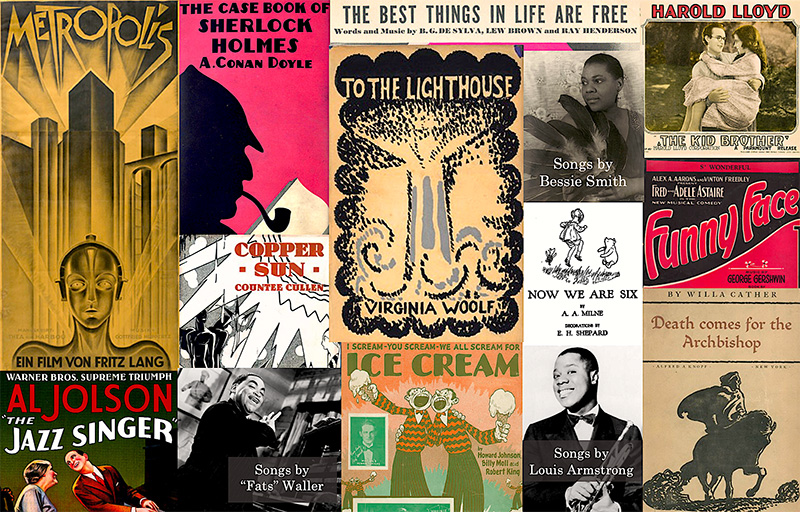
It’s safe to say that few, if any, of us alive today were doing any movie-going in 1927. But that shouldn’t stop us from recognizing the importance of that year to cinema itself. It saw the release of, among other pictures, The Lodger, with which the young Alfred Hitchcock first fully assembled his signature mechanics of suspense; Metropolis, Fritz Lang’s still-influential vision of Art Deco dystopia; F. W. Murnau’s Sunrise, a lavish romantic drama complete with sound effects; and even the very first feature-length “talkie,” The Jazz Singer starring Al Jolson. And don’t even get us started on what a year 1927 was for literature.
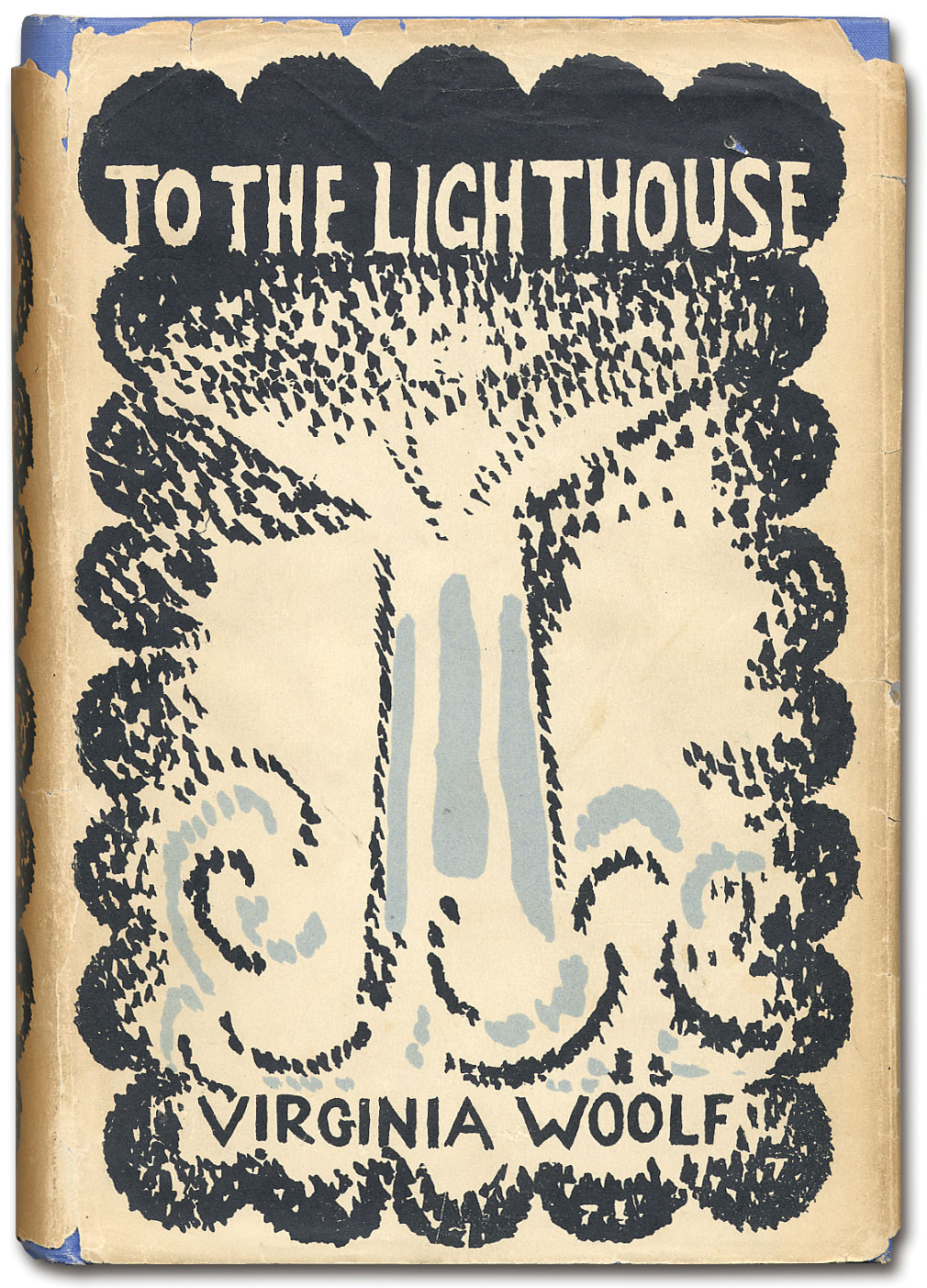
Rather, take it from Hyperallergic’s Rhea Nayyar, who highlights Franz Kafka’s posthumously published first novel Amerika, which is now “considered one of his more realistic and humorous works.” Nayyar also mentions Virginia Woolf’s much better-known To the Lighthouse, which, like Amerika as well as all the aforementioned films, has just entered the public domain in the United States in 2023 for anyone to enjoy and use as they please.
So has Arthur Conan Doyle’s The Case-Book of Sherlock Holmes, the final book of stories featuring that iconic detective, Ernest Hemingway’s collection Men Without Women, Hermann Hesse’s Der Steppenwolf, and even the very first Hardy Boys novel, The Tower Treasure.
You’ll find many such notable books, movies, and musical compositions — that last group including such immortal tunes as “The Best Things in Life are Free,” “Puttin’ on the Ritz” and “(I Scream You Scream, We All Scream for) Ice Cream” — rounded up here by Jennifer Jenkins, director of Duke Law School’s Center for the Study of the Public Domain. She also explains why we should care: “1927 was a long time ago. The vast majority of works from 1927 are out of circulation. When they enter the public domain in 2023, anyone can rescue them from obscurity and make them available, where we can all discover, enjoy, and breathe new life into them.” We know that many works created in 1927 have stood the test of time; now to find out what they’ll inspire us to create in 2023.
Find a list of important works entering the public domain here.
via Duke University Law School
Related content:
The Lodger: Alfred Hitchcock’s First Truly ‘Hitchcockian’ Movie (1927)
Metropolis: Watch Fritz Lang’s 1927 Masterpiece
Free: F. W. Murnau’s Sunrise, the 1927 Masterpiece Voted the 5th Best Movie of All Time
Why Should We Read Virginia Woolf? A TED-Ed Animation Makes the Case
Franz Kafka: An Animated Introduction to His Literary Genius
Based in Seoul, Colin Marshall writes and broadcasts on cities, language, and culture. His projects include the Substack newsletter Books on Cities, the book The Stateless City: a Walk through 21st-Century Los Angeles and the video series The City in Cinema. Follow him on Twitter at @colinmarshall or on Facebook.
Read More...Support Us
We're hoping to rely on loyal readers, rather than erratic ads. Please click the Donate button and support Open Culture. You can use Paypal, Venmo, Patreon, even Crypto! We thank you!

About Us

Open Culture scours the web for the best educational media. We find the free courses and audio books you need, the language lessons & educational videos you want, and plenty of enlightenment in between.
Advertise With Us
FREE UPDATES!
GET OUR DAILY EMAIL
Get the best cultural and educational resources on the web curated for you in a daily email. We never spam. Unsubscribe at any time.
FOLLOW ON SOCIAL MEDIA
Open Culture editor Dan Colman scours the web for the best educational media. He finds the free courses and audio books you need, the language lessons & movies you want, and plenty of enlightenment in between.
Advertise With Us


