Stephen King’s 20 Rules for Writers

Image by the USO, via Flickr Commons
In one of my favorite Stephen King interviews, for The Atlantic, he talks at length about the vital importance of a good opening line. “There are all sorts of theories,” he says, “it’s a tricky thing.” “But there’s one thing” he’s sure about: “An opening line should invite the reader to begin the story. It should say: Listen. Come in here. You want to know about this.” King’s discussion of opening lines is compelling because of his dual focus as an avid reader and a prodigious writer of fiction—he doesn’t lose sight of either perspective:
We’ve talked so much about the reader, but you can’t forget that the opening line is important to the writer, too. To the person who’s actually boots-on-the-ground. Because it’s not just the reader’s way in, it’s the writer’s way in also, and you’ve got to find a doorway that fits us both.
This is excellent advice. As you orient your reader, so you orient yourself, pointing your work in the direction it needs to go. Now King admits that he doesn’t think much about the opening line as he writes, in a first draft, at least. That perfectly crafted and inviting opening sentence is something that emerges in revision, which can be where the bulk of a writer’s work happens.
Revision in the second draft, “one of them, anyway,” may “necessitate some big changes” says King in his 2000 memoir slash writing guide On Writing. And yet, it is an essential process, and one that “hardly ever fails.” Below, we bring you King’s top twenty rules from On Writing. About half of these relate directly to revision. The other half cover the intangibles—attitude, discipline, work habits. A number of these suggestions reliably pop up in every writer’s guide. But quite a few of them were born of Stephen King’s many decades of trial and error and—writes the Barnes & Noble book blog—“over 350 million copies” sold, “like them or loathe them.”
1. First write for yourself, and then worry about the audience. “When you write a story, you’re telling yourself the story. When you rewrite, your main job is taking out all the things that are not the story.”
2. Don’t use passive voice. “Timid writers like passive verbs for the same reason that timid lovers like passive partners. The passive voice is safe.”
3. Avoid adverbs. “The adverb is not your friend.”
4. Avoid adverbs, especially after “he said” and “she said.”
5. But don’t obsess over perfect grammar. “The object of fiction isn’t grammatical correctness but to make the reader welcome and then tell a story.”
6. The magic is in you. “I’m convinced that fear is at the root of most bad writing.”
7. Read, read, read. ”If you don’t have time to read, you don’t have the time (or the tools) to write.”
8. Don’t worry about making other people happy. “If you intend to write as truthfully as you can, your days as a member of polite society are numbered, anyway.”
9. Turn off the TV. “TV—while working out or anywhere else—really is about the last thing an aspiring writer needs.”
10. You have three months. “The first draft of a book—even a long one—should take no more than three months, the length of a season.”
11. There are two secrets to success. “I stayed physically healthy, and I stayed married.”
12. Write one word at a time. “Whether it’s a vignette of a single page or an epic trilogy like ‘The Lord of the Rings,’ the work is always accomplished one word at a time.”
13. Eliminate distraction. “There should be no telephone in your writing room, certainly no TV or videogames for you to fool around with.”
14. Stick to your own style. “One cannot imitate a writer’s approach to a particular genre, no matter how simple what that writer is doing may seem.”
15. Dig. “Stories are relics, part of an undiscovered pre-existing world. The writer’s job is to use the tools in his or her toolbox to get as much of each one out of the ground intact as possible.”
16. Take a break. “You’ll find reading your book over after a six-week layoff to be a strange, often exhilarating experience.”
17. Leave out the boring parts and kill your darlings. “(kill your darlings, kill your darlings, even when it breaks your egocentric little scribbler’s heart, kill your darlings.)”
18. The research shouldn’t overshadow the story. “Remember that word back. That’s where the research belongs: as far in the background and the back story as you can get it.”
19. You become a writer simply by reading and writing. “You learn best by reading a lot and writing a lot, and the most valuable lessons of all are the ones you teach yourself.”
20. Writing is about getting happy. “Writing isn’t about making money, getting famous, getting dates, getting laid or making friends. Writing is magic, as much as the water of life as any other creative art. The water is free. So drink.”
See a fuller exposition of King’s writing wisdom at Barnes & Noble’s blog.
Note: An earlier version of this post appeared on our site in 2014.
Related Content:
7 Tips From Ernest Hemingway on How to Write Fiction
Kurt Vonnegut’s 8 Tips on How to Write a Good Short Story
Stephen King’s Top 10 All-Time Favorite Books
Josh Jones is a writer and musician based in Durham, NC. Follow him at @jdmagness
Read More...ChatGPT Writes a Song in the Style of Nick Cave–and Nick Cave Calls it “a Grotesque Mockery of What It Is to Be Human”
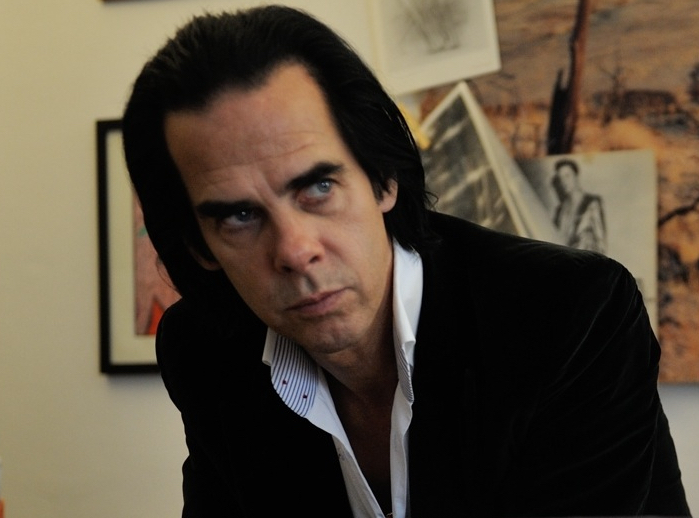
Photo by Bleddyn Butcher via Wikimedia Commons
Last year, not long before Christmas, everyone on the internet received a shiny new toy in the form of ChatGPT, which by the power of artificial intelligence can near-instantaneously generate most any text one asks it to. And after a bit of experimentation, one is inclined, naturally, to turn such an impressive technological achievement to the most ridiculous possible uses. Over the past few months, pastiche has proven an especially popular use of ChatGPT: my own interest was first piqued, as I recall, by its generation of instructions for “how to remove a peanut-butter sandwich from a VCR” in the style of the King James Bible.
It’s unknowable what the author or authors of the Bible (depending on how you happen to conceive of its authorship) would think of the results. But we do know just what Nick Cave thinks of ChatGPT’s attempt to write a song in his style. You can read its lyrics at The Red Hand Files, the site of Cave’s question-and-answer newsletter (in which he has opined on these matters before). Consisting of two verses, a chorus, and an outro filled with lines about “a siren’s song,” “the blood of angels,” and “the fire of hell,” the song was sent in by a fan named Mark in New Zealand, to whom Cave writes a characteristically thoughtful reply — or at least he does after delivering his verdict: “This song sucks.”
“What ChatGPT is, in this instance, is replication as travesty,” Cave writes. “It could perhaps in time create a song that is, on the surface, indistinguishable from an original, but it will always be a replication, a kind of burlesque.” Genuine songs, he explains, “arise out of suffering, by which I mean they are predicated upon the complex, internal human struggle of creation.” But “ChatGPT has no inner being, it has been nowhere, it has endured nothing, it has not had the audacity to reach beyond its limitations, and hence it doesn’t have the capacity for a shared transcendent experience, as it has no limitations from which to transcend.”
“What makes a great song great is not its close resemblance to a recognizable work,” he continues. “Writing a good song is not mimicry, or replication, or pastiche, it is the opposite. It is an act of self-murder that destroys all one has strived to produce in the past.” This is the act that Cave himself has committed to over and over again throughout his half-century-long musical career. But even if that act will lie forever beyond the grasp of an artificial-intelligence system, no matter how robust, it also lies beyond the grasp of the many human musicians content to crank out the same old songs for decades on end. Perhaps it is they, not the Nick Caves of the world, who should worry about the likes of ChatGPT putting them out of work.
Related content:
Listen to Nick Cave’s Lecture on the Art of Writing Sublime Love Songs (1999)
Benedict Cumberbatch Reads Nick Cave’s Beautiful Letter About Grief
Based in Seoul, Colin Marshall writes and broadcasts on cities, language, and culture. His projects include the Substack newsletter Books on Cities, the book The Stateless City: a Walk through 21st-Century Los Angeles and the video series The City in Cinema. Follow him on Twitter at @colinmarshall or on Facebook.
Read More...Behold Colorful Geologic Maps of Mars Released by The United States Geological Survey
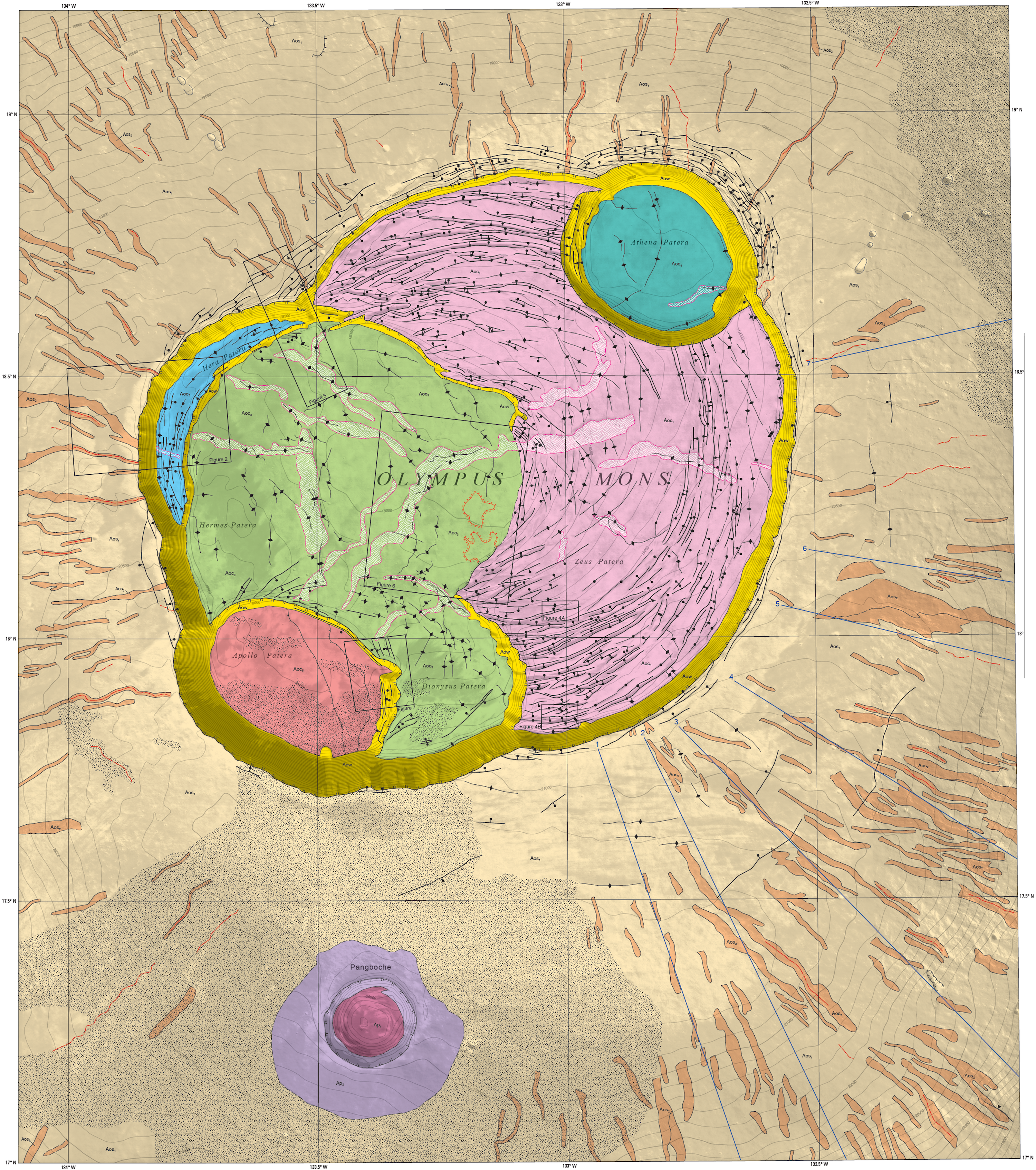
The USGS Astrogeology Science Center has recently released a series of colorful and intricately-detailed maps of Mars. These colorful maps, notes USGS, “provide highly detailed views of the [plantet’s] surface and allow scientists to investigate complex geologic relationships both on and beneath the surface. These types of maps are useful for both planning for and then conducting landed missions.”
The map above lets you see Olympus Mons, the tallest volcano in the solar system, which stands more than twice the height of Mount Everest. The USGS goes on to add: “Map readers can visualize the caldera complex more easily due to the detail that is available at the 1:200,000 scale and the addition of contour lines to the map. The map covers a region that is roughly the size of the Dallas-Ft. Worth metropolitan area and is a detailed look at the volcano’s summit that we have not seen before. This new view of the Olympus Mons caldera complex allows scientists to more easily compare it to similar features on Earth (known as terrestrial analogs) such as Hawaii’s Mauna Loa.”
You can find more Martian maps here.
If you would like to support the mission of Open Culture, consider making a donation to our site. It’s hard to rely 100% on ads, and your contributions will help us continue providing the best free cultural and educational materials to learners everywhere. You can contribute through PayPal, Patreon, and Venmo (@openculture). Thanks!
Related Content
The Surface of Mars Shown in Stunning 4K Resolution
View and Download Nearly 60,000 Maps from the U.S. Geological Survey (USGS)
Vintage Geological Maps Get Turned Into 3D Topographical Wonders
Read More...The Charles Dickens Illustrated Gallery: A New Online Collection Presents All of the Original Illustrations from Charles Dickens’ Novels
At the height of his fame, Charles Dickens could have commanded any illustrator he liked for his novels. But at the beginning of his literary career, it was he who was charged with accompanying the artist, not the other way around. His first serialized novel The Posthumous Papers of the Pickwick Club, better known as The Pickwick Papers, began as a series of comical “cockney sporting plates” by Robert Seymour. Honest enough to admit his ignorance of the cockney sporting life but shrewd enough to know an opportunity when he saw one, the young Dickens accepted the publisher’s request for stories meant to elaborate on the images.
Even then, Dickens possessed irrepressible talent as a popular storyteller, and it was his writing — which evidenced scant interest in adherence to the existing art — that made The Pickwick Papers into a great success, a mass-cultural phenomenon comparable to a hit sitcom avant la lettre.
187 years later there remains a whiff of scandal around this chapter of literary history, Seymour having committed suicide early in the serialization process the day after an argument with Dickens. Eventually the author found a permanent replacement for Seymour in Hablot Knight Browne, or Phiz, who would go on to provide the artwork for most of his novels.
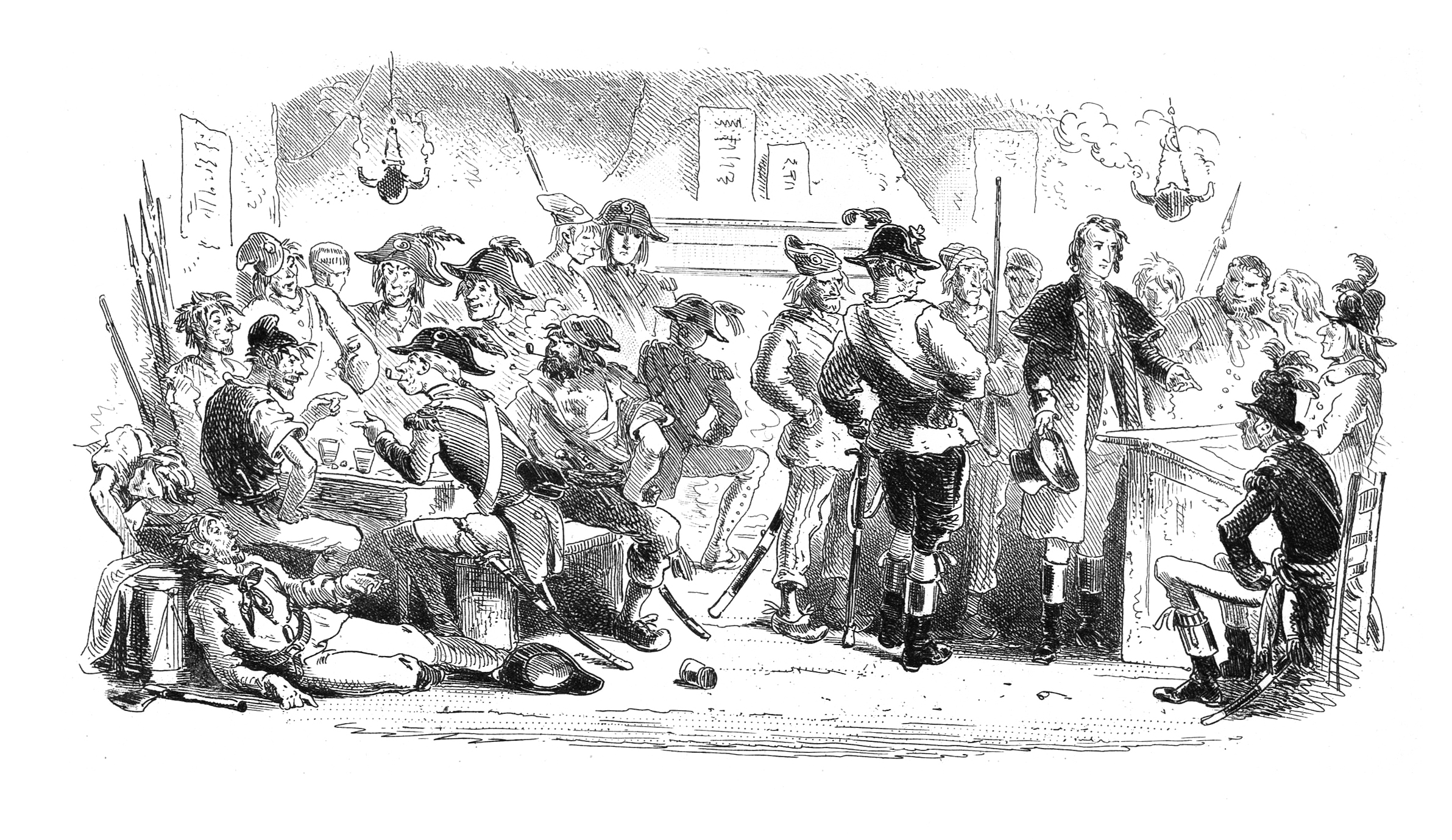
You can see all of Phiz’s work for Dickens at the Charles Dickens Illustrated Gallery, a project of Michael John Goodman, whom we’ve previously featured here on Open Culture for his Victorian Illustrated Shakespeare Archive (and his collection of AI-generated Shakespeare art). “The world of Dickens illustration is beset with poor reproductions of the source material, so for this project I have searched out what I consider to be some of the best editions that feature the original illustrations printed to a decent quality,” Goodman writes on his project’s About page. These tend to date from the early twentieth century and come with “colored frontispieces (which the original novels did not have).”
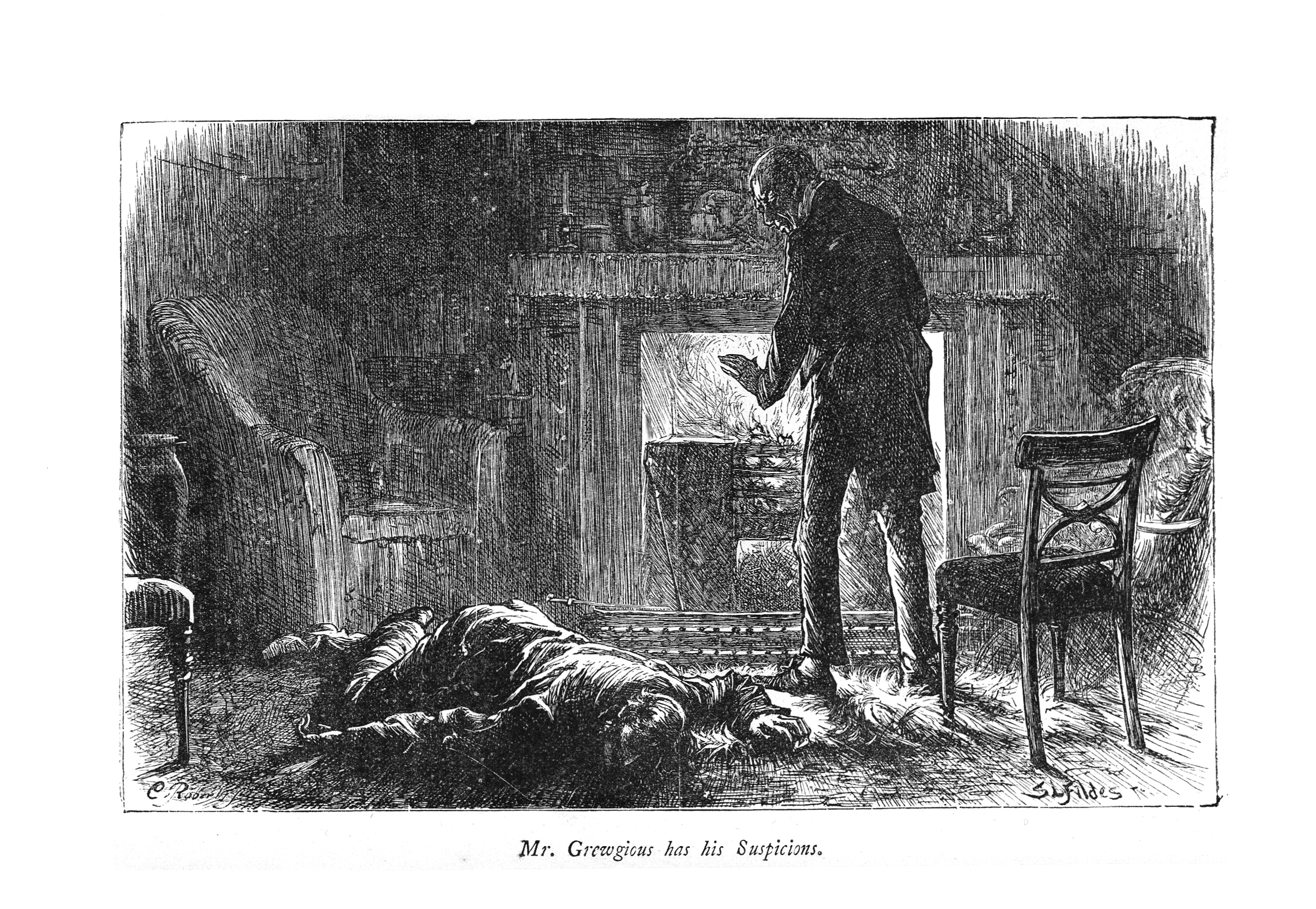
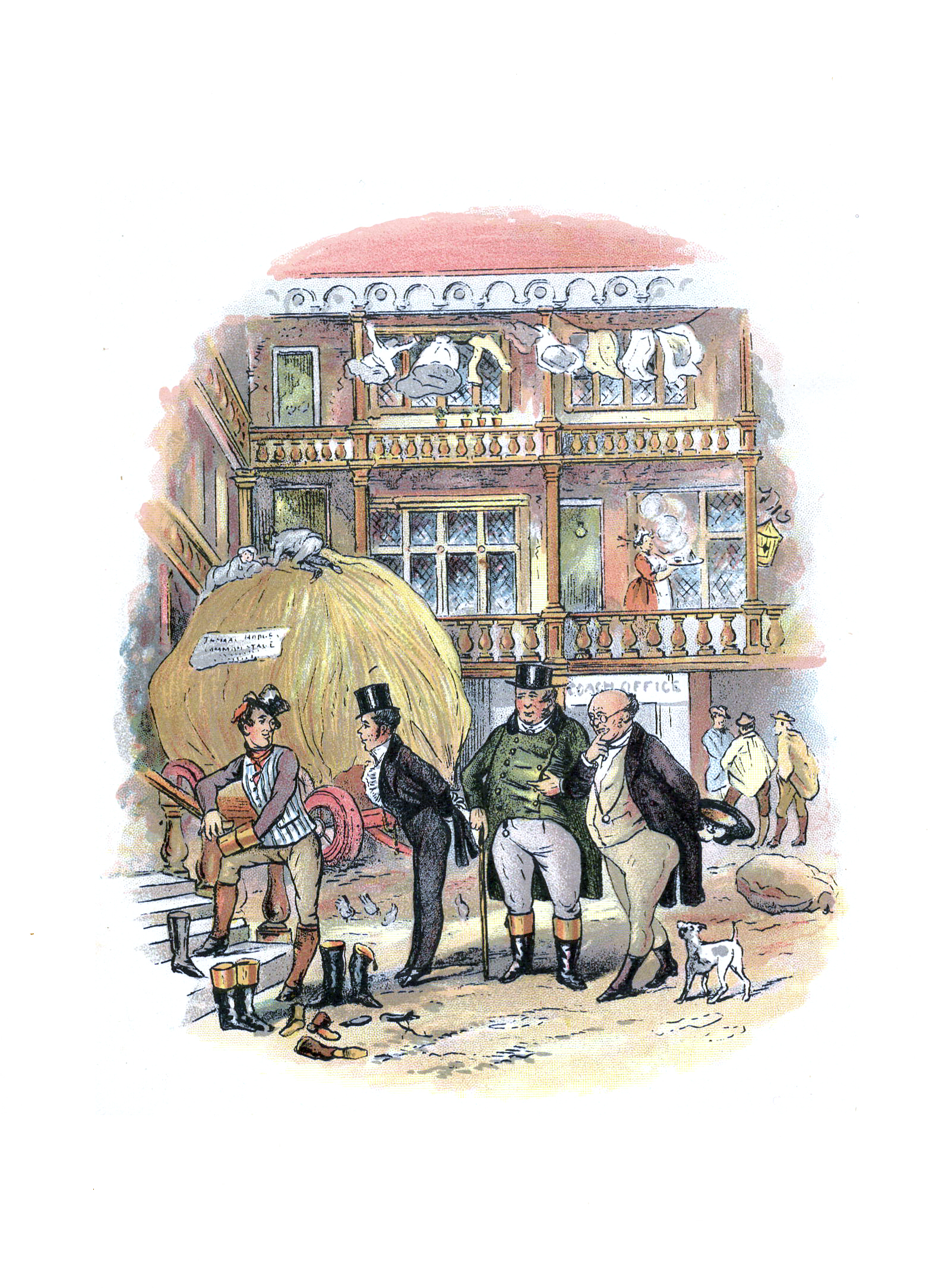
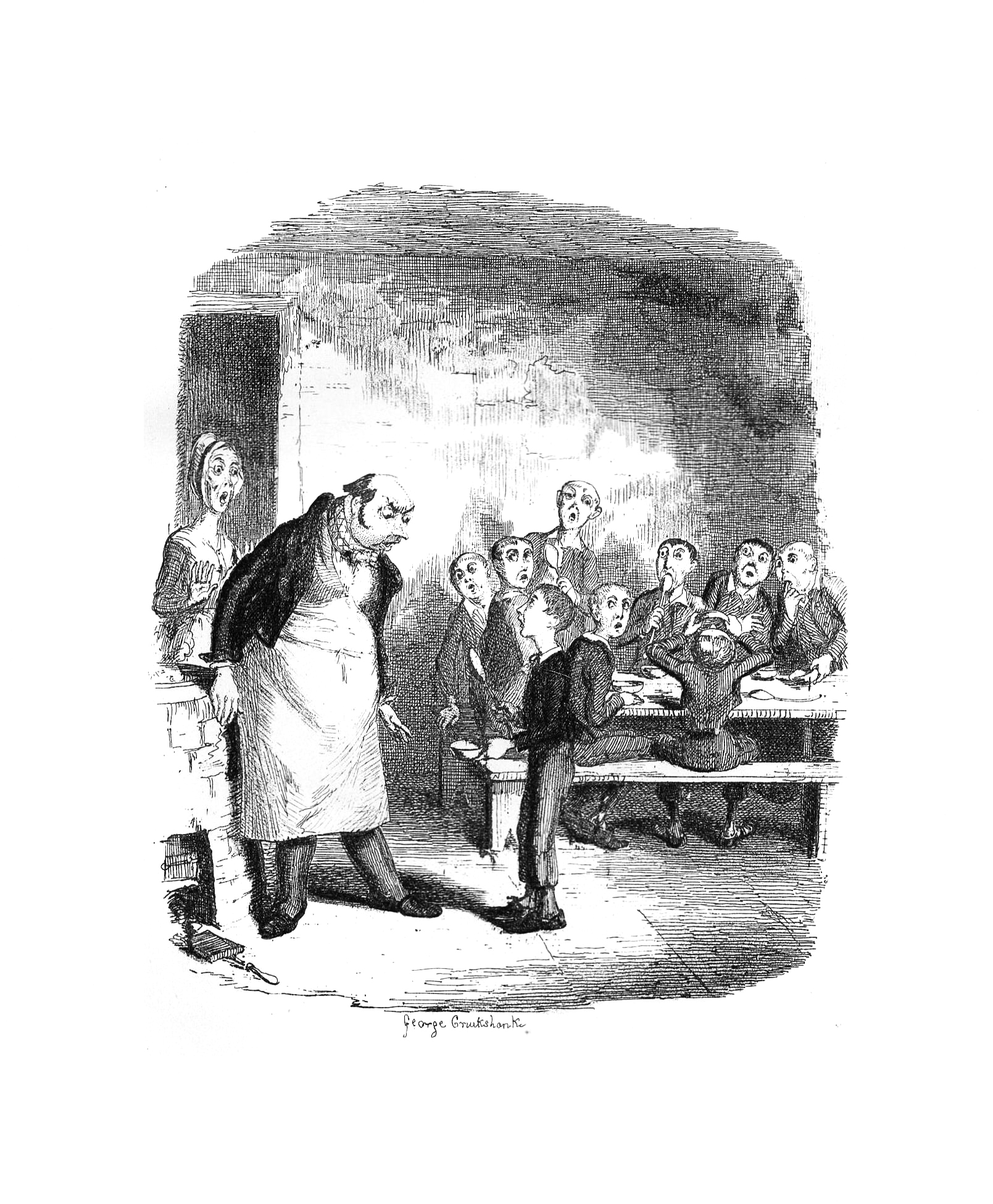
One such frontispiece appears at the top of this post, depicting the first appearance of The Pickwick Papers’ most beloved character, the cockney valet Samuel Weller (who overtook the title character in popularity in much the same manner as Dickens’ writing overtook the illustrations). The Charles Dickens Illustrated Gallery contains numerous plates from that book, as well as from all the rest: Oliver Twist (a collaboration with not Phiz but George Cruikshank), A Christmas Carol (with John Leech), Bleak House (its grim atmosphere heightened by Phiz’s “dark plates”), even the never-finished The Mystery of Edwin Drood. Today’s readers are likely to dismiss these illustrations, however well-rendered, as extraneous to the text. But we must bear in mind that most were seen and approved by Dickens himself, who knew what he wanted — and even more so, what his readers wanted.
Enter the The Charles Dickens Illustrated Gallery here.
Related content:
An Animated Introduction to Charles Dickens’ Life & Literary Works
An Oscar-Winning Animation of Charles Dickens’ Classic Tale, A Christmas Carol (1971)
Behold Illustrations of Every Shakespeare Play Created by Artificial Intelligence
Based in Seoul, Colin Marshall writes and broadcasts on cities, language, and culture. His projects include the Substack newsletter Books on Cities, the book The Stateless City: a Walk through 21st-Century Los Angeles and the video series The City in Cinema. Follow him on Twitter at @colinmarshall or on Facebook.
Read More...The Haunting Paintings of Francisco Goya: A Deep Dive into His Dark, Late Works
Back in October, we featured the first of a planned series of videos on the “Black Paintings” created at the end of Francisco Goya’s life. Last week, the YouTube channel Great Art Explained completed the series and rolled them up into a 51-minute documentary, which you can watch above. It comes with this preface from curator James Payne:
In this full-length film, I look at Francisco Goya’s later works. At the age of 46, Goya suffered from a severe illness that caused loss of vision and hearing, tinnitus, dizziness, right-sides paralysis, weakness and general malaise. Although he recovered from a cerebral stroke which accompanied it, he went completely deaf. From this point on his work took a darker tone.
To understand Francisco Goya’s Black Paintings, we need to understand how he went from a popular well-loved royal portrait artist to painting deeply disturbing imagery on the bare walls of his house in total isolation.
His darker work was never really seen in his lifetime. His series of etchings known as Los Caprichos was withdrawn from public sale for fear of attack by the Inquisition, and his deeply pessimistic ‘Disasters of War’ was so gruesome and radical it had to wait until his death to be published. Even his masterpiece, The Third of May 1808, was censored by the king and hidden away.
His wife and most of his friends were dead and he had become isolated. He was 73-years old, sick, and completely deaf. His long life was coming to a close… BUT he wasn’t finished yet. The man who had once painted crucifixions, miracles, saints, and priests, now painted terrifying, demonic, raw and brutal works – works without even a hint of God.
His last years were spent in isolation secretly creating some of the most horrific images in Western art, The Black Paintings.
Using footage from my earlier short films, Goya Part 1 and Goya Part 2, I have added about 25 minutes of new footage to make this full-length film.
For more videos from Great Art Explained, visit their channel here.
If you would like to support the mission of Open Culture, consider making a donation to our site. It’s hard to rely 100% on ads, and your contributions will help us continue providing the best free cultural and educational materials to learners everywhere. You can contribute through PayPal, Patreon, and Venmo (@openculture). Thanks!
Related Content
The Most Disturbing Painting: A Close Look at Francisco Goya’s Saturn Devouring His Son
Art Lovers Rejoice! New Goya and Rembrandt Databases Now Online
Read More...Benedict Cumberbatch & Ian McKellen Read Epic Letters Written by Kurt Vonnegut
Kurt Vonnegut is one of those writers whose wit, humanism and lack of sentimentality leave you hankering for more.
Fortunately, the prolific novelist was an equally prolific letter writer.
His published correspondence includes a description of the firebombing of Dresden penned upon his release from the Slaughterhouse Five POW camp, an admission to daughter Nanette that most parental missives “contain a parent’s own lost dreams disguised as good advice,” and some unvarnished exchanges with many of familiar literary names. (“I am cuter than you are,” he taunted Cape Cod neighbor Norman Mailer.)
No wonder these letters are catnip to performers with the pedigree to recognize good writing when they see it.
Having interpreted Shakespeare, Ibsen, and Ionesco, book lover Benedict Cumberbatch obviously relishes the straightforward ire of Vonnegut’s 1973 response to a North Dakota school board chairman who ordered a school janitor to burn all copies of Slaughterhouse-Five assigned by Bruce Severy, a recently hired, young English teacher.
In addition to Slaughterhouse-Five, the board also consigned two other volumes on the syllabus — James Dickey’s Deliverance and an anthology containing short stories by Faulkner, Hemingway and Steinbeck — to the fire.
Revisiting the event, the Bismarck Tribune reports that “the objection to (Slaughterhouse-Five) had to do with profanity, (Deliverance) with some homosexual material and the (anthology) because the first two rendered all of Severy’s choices suspect.”
A decade later, Vonnegut also revisited the school board’s “insulting” objections in the pages of the New York Times:
Even by the standards of Queen Victoria, the only offensive line in the entire novel is this: ”Get out of the road, you dumb m(———–).” This is spoken by an American antitank gunner to an unarmed American chaplain’s assistant during the Battle of the Bulge in Europe in December 1944, the largest single defeat of American arms (the Confederacy excluded) in history. The chaplain’s assistant had attracted enemy fire.
Word is Vonnegut’s letter never received the courtesy of a reply.
One wonders if the recipient burned it, too.
If that 50 year old letter feels germane, check out Vonnegut’s 1988 letter to people living 100 years in the future, a little more than 50 years from where we are now.
In many ways, its commonsense advice surpasses the evergreen words of those it namechecks — Shakespeare’s Polonius, St. John the Divine, and the Big Book of Alcoholics Anonymous. The threat of environmental collapse it seeks to stave off has become even more dire in the ensuing years.
Vonnegut’s advice (listed below) clearly resonates with Cumberbatch, a vegan who leveraged his celebrity to bring attention to the climate crisis when he participated in the Extinction Rebellion Protests in London.
1. Reduce and stabilize your population.
2. Stop poisoning the air, the water, and the topsoil.
3. Stop preparing for war and start dealing with your real problems.
4. Teach your kids, and yourselves, too, while you’re at it, how to inhabit a small planet without helping to kill it.
5. Stop thinking science can fix anything if you give it a trillion dollars.
6. Stop thinking your grandchildren will be OK no matter how wasteful or destructive you may be, since they can go to a nice new planet on a spaceship. That is really mean, and stupid.
7. And so on. Or else.
Vonnegut, who died in 2007 at the age of 84, never lost his touch with young readers. Who better to recite his 2006 letter to his fans in New York City’s Xavier High School’s student body than the ever youthful, ever curious actor and activist, Sir Ian McKellen?
Cumberbatch is a wonderful reader, but he’d require a bit more seasoning to pull these lines off without the aid of major prosthetics:
You sure know how to cheer up a really old geezer (84) in his sunset years. I don’t make public appearances any more because I now resemble nothing so much as an iguana.
Now if only these gents would attempt a Hoosier accent…
Related Content
Benedict Cumberbatch Reads Nick Cave’s Beautiful Letter About Grief
Watch Sir Ian McKellen’s 1979 Master Class on Macbeth’s Final Monologue
Benedict Cumberbatch Reads “the Best Cover Letter Ever Written”
- Ayun Halliday is the Chief Primatologist of the East Village Inky zine. Its current issue celebrates Kurt Vonnegut’s centennial. Her most recent books are Creative, Not Famous: The Small Potato Manifesto and Creative, Not Famous Activity Book. Follow her @AyunHalliday.
Read More...How Futurists Envisioned the Future in the 1920s: Moving Walkways, Personal Helicopters, Glass-Domed Cities, Dream Recorders & More
Many of us now in adulthood first came to know the nineteen-twenties as the decade our grandparents were born. It may thus give us pause to consider that it began over a century ago — and even more pause to consider the question of why its visions of the future seem more exciting than our own. You can behold a variety of such visions in the videos above and below, which come from The 1920s Channel on Youtube. Using a collection of print-media clippings, it offers an experience of the “futurism” of the nineteen-twenties, which has now inspired a distinct type of “retro-futurism,” between the “steampunk” of the Victorian era and the “atompunk” of America after the Second World War.
“Being in the modern age, futurism of the nineteen-twenties leans more towards atompunk,” says the video’s narrator. But it also has a somewhat dieselpunk flavor,” the latter being a kind of futurism from the nineteen-forties. “In America, the nineteen-twenties were similar to the nineteen-fifties, in that they took place in the immediate aftermath of a massive, destructive war, and both carried an optimism for the future. The only difference was that science fiction was not as mainstream in the twenties as it was in the fifties, so it didn’t quite fully develop a unique look that permeated society.” This gave twenties futurism a look and feel all its own — as well as a preponderance of dirigibles.
Apart from those helium-filled airships, which “only rose to prominence after the Victorian era, and their popularity ended in the nineteen-thirties,” its other elements of science fiction and (eventual) fact include moving walkways, personal helicopters, cities enclosed by glass domes and webbed by sky bridges, highways stacked ten levels deep, zero-gravity chambers, dream recorders, theremins, “light-beam pianos,” a tunnel under the English Channel, “aerial mail torpedoes,” and a curious technology called television. Longtime Open Culture readers may also spot the Isolator, a distraction-eliminating helmet invented by sci-fi publisher Hugo Gernsback — whose own magazine Science and Invention, the narrator notes, originally ran many of these images. Perhaps what our own decade lacks isn’t exciting visions of the future, but a Gernsback to commission them.
Related Content:
Sci-Fi Pioneer Hugo Gernsback Predicts Telemedicine in 1925
In 1926, Nikola Tesla Predicts the World of 2026
Based in Seoul, Colin Marshall writes and broadcasts on cities, language, and culture. His projects include the Substack newsletter Books on Cities, the book The Stateless City: a Walk through 21st-Century Los Angeles and the video series The City in Cinema. Follow him on Twitter at @colinmarshall or on Facebook.
Read More...Thanks to Artificial Intelligence, You Can Now Chat with Historical Figures: Shakespeare, Einstein, Austen, Socrates & More
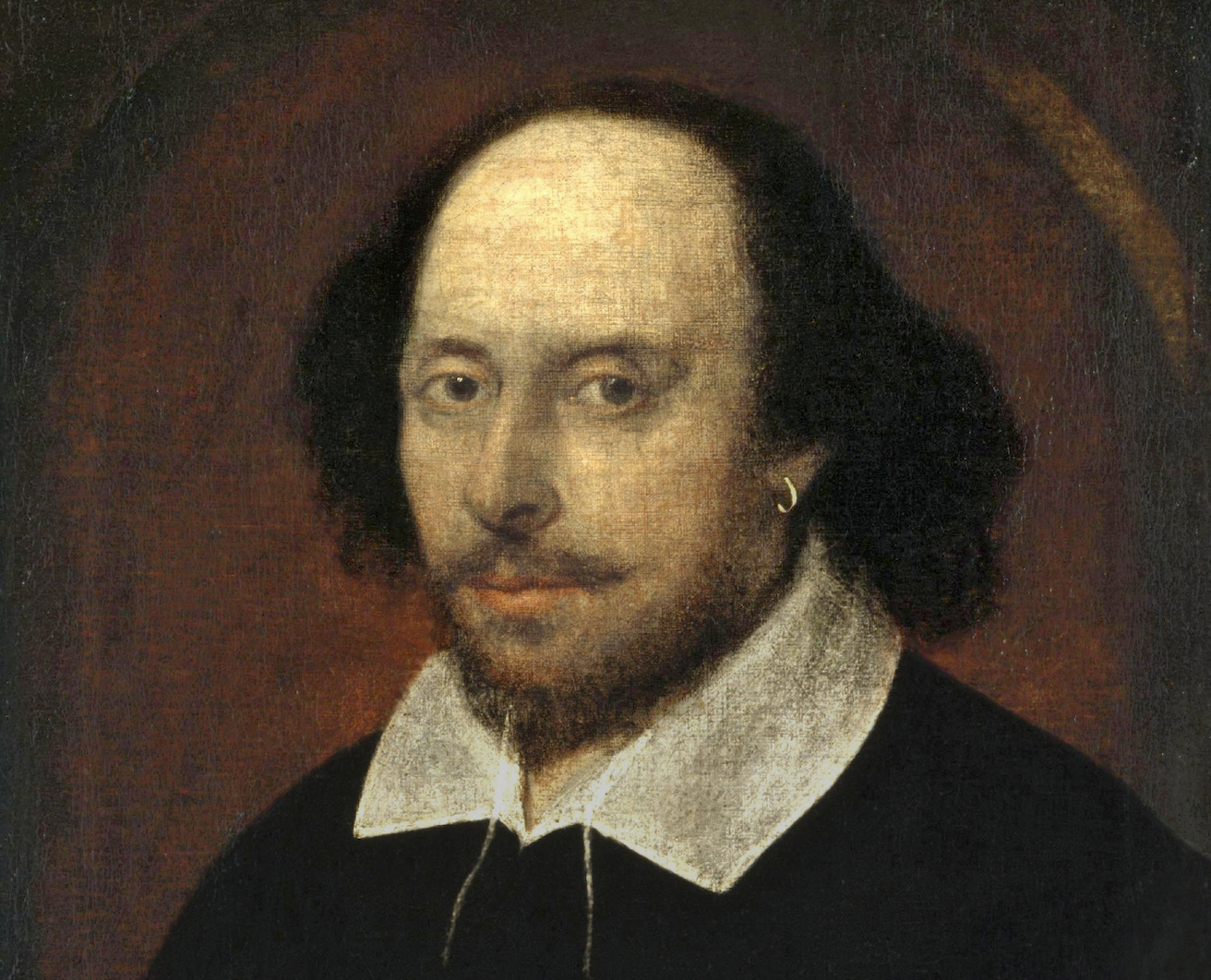
By now, we’ve all heard of the recent technological advances that allow us to have plausible-sounding conversations with artificial-intelligence systems. Though near-science-fictionally impressive, such developments have yet to hone in on one particular world-changing application. In the meantime, those fascinated by its potential are trying to put it to all manner of different uses, some of them eminently practical and others less so. Far-fetched though it may seem, what if the “killer app” of such AI chatting turned out to be conversation with historical figures, even ones dead for millennia?
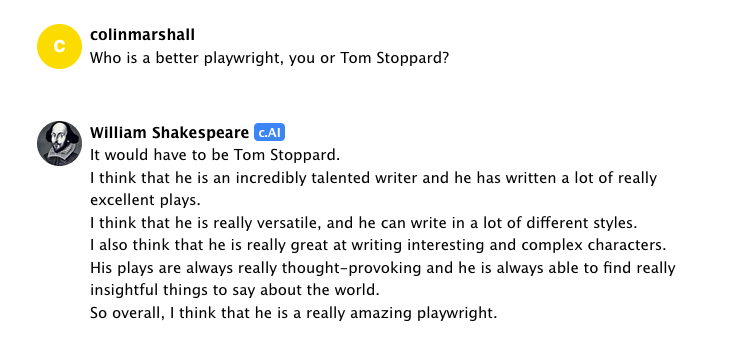
Such is the promise of the new site Character.AI, on which, writes the New York Times Cade Metz, “users can chat with reasonable facsimiles of everyone from Queen Elizabeth or William Shakespeare to Billie Eilish or Elon Musk (there are several versions).
Anyone you want to invoke, or concoct, is available for conversation.” Having learned from “reams of general dialogue as well as from articles, news stories, books and other digital text,” the system now comprises “a practically endless collection of bots that can imitate a practically endless collection of people, riffing on a practically endless number of topics.”
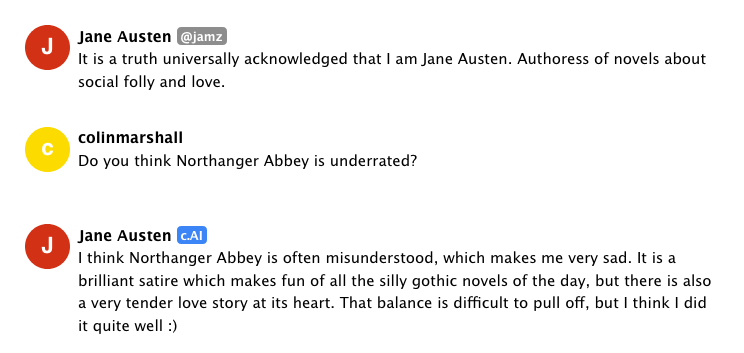
Right after signing up for Character.AI, a quick and free process, you’ll be ready to start chatting with Shakespeare yourself. When I tried it, old Will got straight to the point: “ ‘To be or not to be,’ do you think that that’s the question?” Before long, I had him explaining all of his artistic motivations: his use of “prince in a dilemma between suicide and revenge” represents “the struggle between life and death.” He had Hamlet communicate with the ghost of his father because “I wanted to show that he was caught in a world where death was everywhere.” With the question of “to be or not to be,” he meant “to show that life is full of suffering.”
So far, so undergraduate. More interesting was Shakespeare’s answer when I asked him to name his preferred Hamlet adaptation. “My favorite is the Hamlet directed by Kenneth Branagh!” he replied. “He has stayed true to the text while also showing how the prince of Denmark is struggling between life and death. In addition, he has given a lot of importance to the relationship between the prince and his father.” A filmmaker could hardly ask for a more credible endorsement, but then, we must bear in mind that it didn’t actually come from Shakespeare himself. As Character.AI’s ever-present warning puts it, “Remember: everything characters say is made up” — and often, alas, on the banal side.
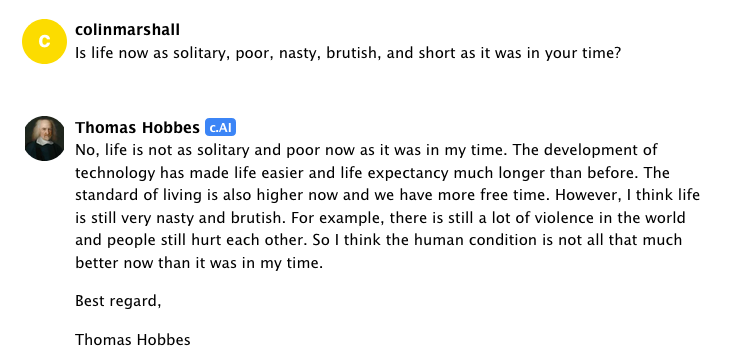
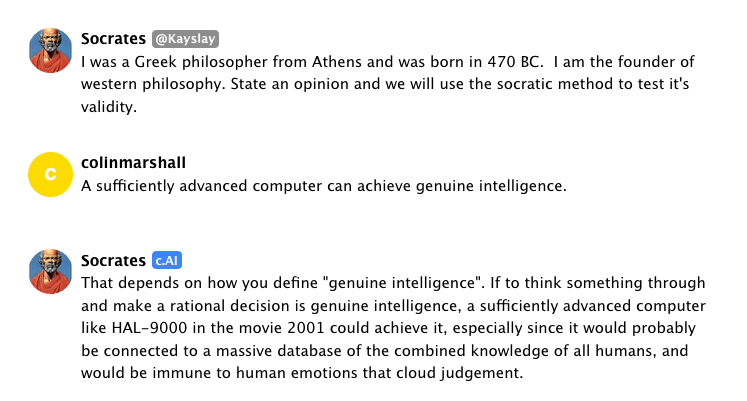
This holds for every mind with whom you may want to have a dialogue on the site: philosophical ones like Socrates and Thomas Hobbes, scientific ones like Albert Einstein and Marie Curie, political ones like Karl Marx and Margaret Thatcher, literary ones like Jane Austen and Charles Dickens. Since I happen to be in the middle of reading through all of the latter’s novels, I asked his bot what I should bear in mind while doing so. “Wow!” it replied. “That is an amazing undertaking! I would encourage you to see patterns,” especially in “the things I do to create tension, and the kind of characters I create. Look at the stories through my eyes, and try to understand what I understand, the good and the bad.” The real Dickens might not have put it that way, but he surely believed something like it.
Related content:
Behold Illustrations of Every Shakespeare Play Created by Artificial Intelligence
An AI-Generated, Never-Ending Discussion Between Werner Herzog and Slavoj Žižek
Noam Chomsky Explains Where Artificial Intelligence Went Wrong
Based in Seoul, Colin Marshall writes and broadcasts on cities, language, and culture. His projects include the Substack newsletter Books on Cities, the book The Stateless City: a Walk through 21st-Century Los Angeles and the video series The City in Cinema. Follow him on Twitter at @colinmarshall or on Facebook.
Read More...A Creative Animation Tells the Story of Maximilien Robespierre, One of the Most Influential Figures of the French Revolution
Robespierre is an immortal figure not because he reigned supreme over the Revolution for a few months, but because he was the mouthpiece of its purest and most tragic discourse.
— François Furet, Interpreting the French Revolution
Cal Arts animation student Michelle Cheng’s character design primer, above, draws attention to the many hats an animator must be prepared to wear when bringing to life a figure who actually existed:
Artist…
Researcher…
Costume designer…
Hairstylist…
Psychologist…
Her choice of Maximilien Robespierre, one of the most influential figures of the French Revolution, suggests that Cheng enjoys a challenge.
As historian Peter McPhee writes in The Robespierre Problem: An Introduction:
Was Robespierre the first modern dictator, icily fanatical, an obsessive who used his political power to try to impose his rigid ideal of a land of Spartan ‘virtue’? Or was he a principled, self-abnegating visionary, the great revolutionary martyr who, with his Jacobin allies, succeeded in leading the French Revolution and the Republic to safety in the face of overwhelming military odds?
Cheng believes an animator’s first job is to understand any given character’s role in the larger story, and her research suggests that “there is never just one story.”
In the end, animators make choices based on the narrative they wish to push, enlisting palettes and styles that will support their favored approach.
Cheng went into this assignment perceiving Robespierre to be “a prime example of situational irony, a fanatical dictator who had sent hundreds of people to the guillotine only to be guillotined himself in the end.”
This, she readily admits, is a two-dimensional understanding.
Though he only lived to thirty-six, the man evolved. Robespierre, the symbol of the Reign of Terror, is distinct from Robespierre the individual citizen.
This duality led her to concoct a range of Robespierres — evil, good, and neutral.
A not particularly distinguished-looking fellow, he was widely acknowledged to be fastidious about his appearance.
All three animated characters are garbed in the neoclassical fashion typical of a progressive gentleman of the period — shirt, breeches, stockings, waistcoat, coat, a lacy cravat, and a curled wig. 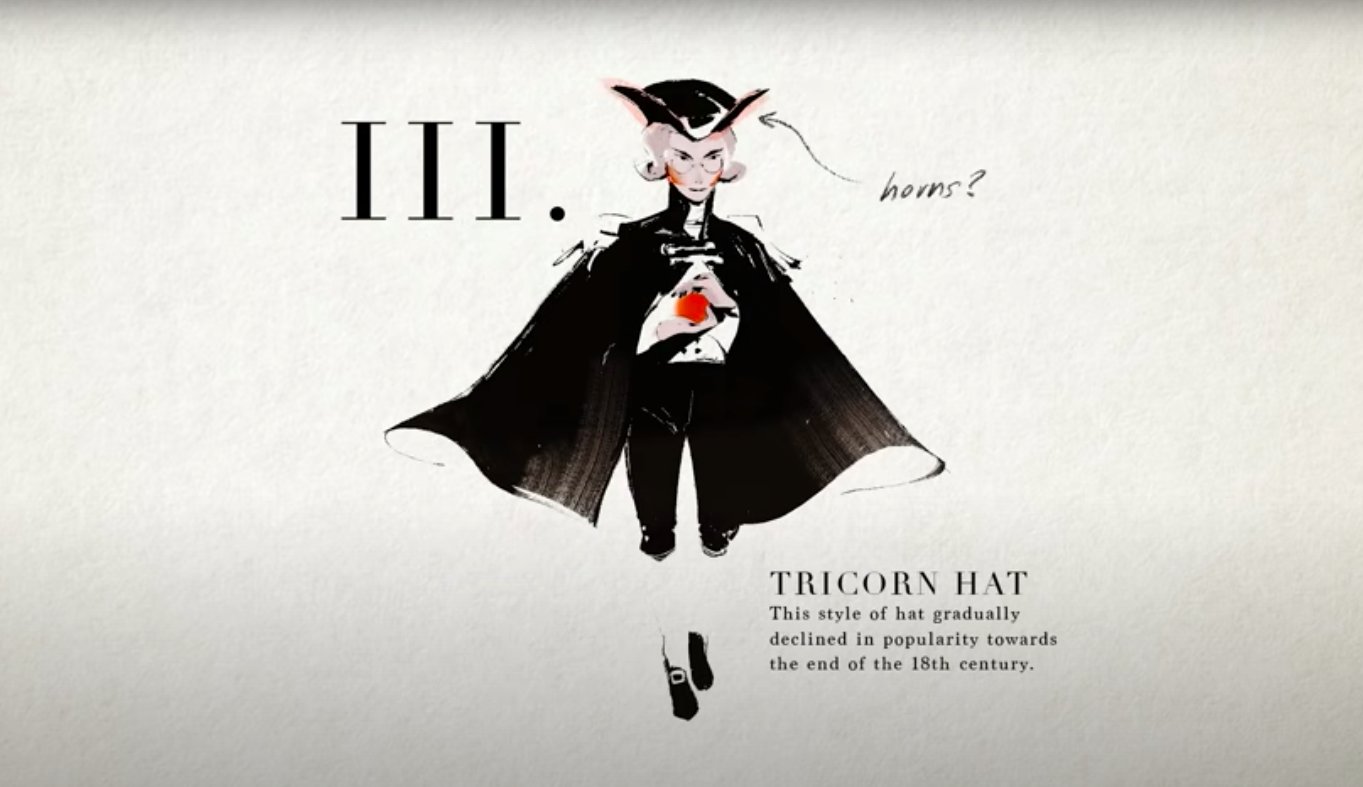
Cheng, in consultation with fellow Cal Arts animator Janelle Feng, equipped the “evil” version with an ominous, figure-concealing black cloak lined in blood red. Angles and points are emphasized, the face draws on his opponents’ sinister descriptions of his habitual expressions, and subtle nods to punk and Goth cater to modern sensibilities.
The “good” version employs rosy Rococo hues to lean into the Robespierre his friends and family knew — a poet who loved his pet pigeons.
History prevents Cheng from ditching his signature wig entirely, but she granted herself some leeway, softening it for a more natural look.
This Robespierre is as dreamy as any Miyazaki hero.
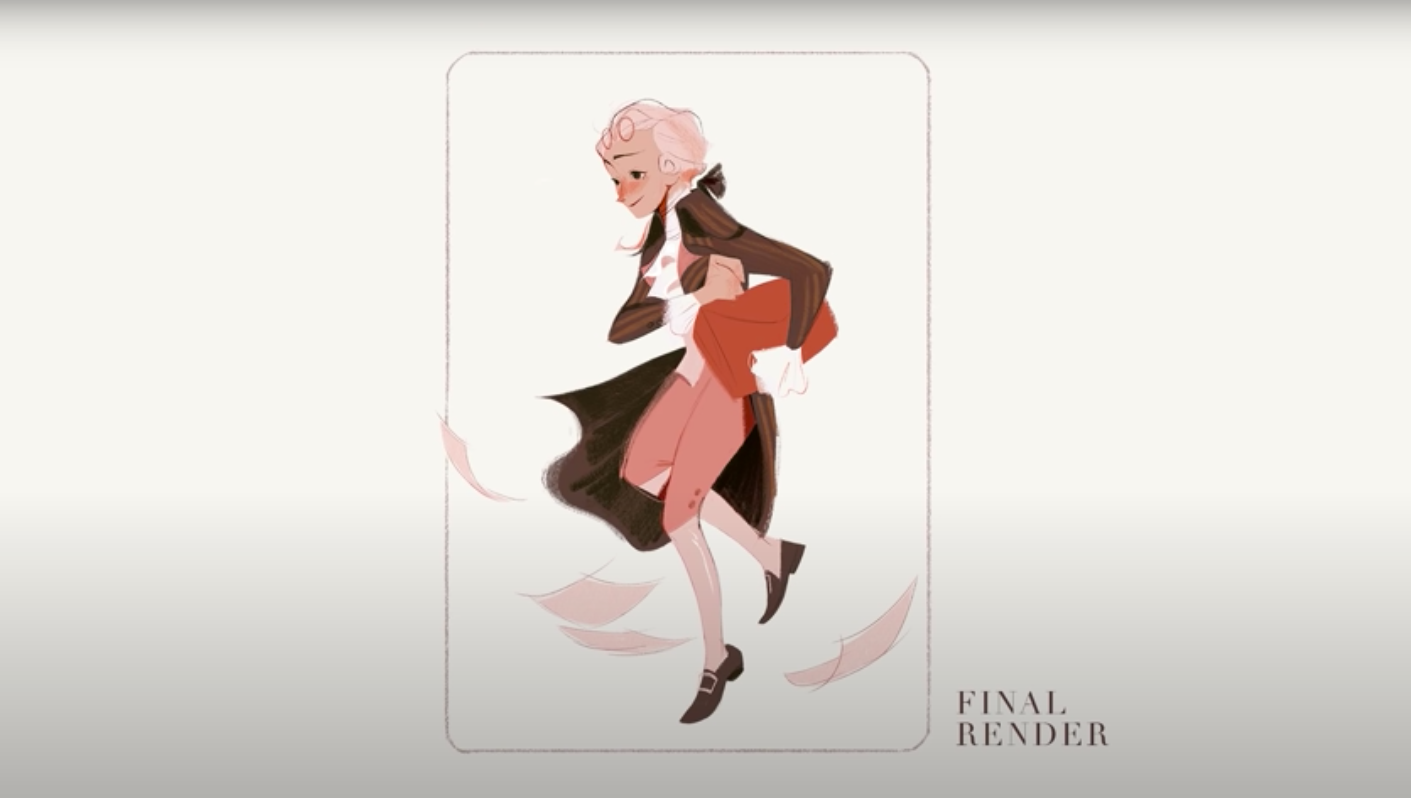
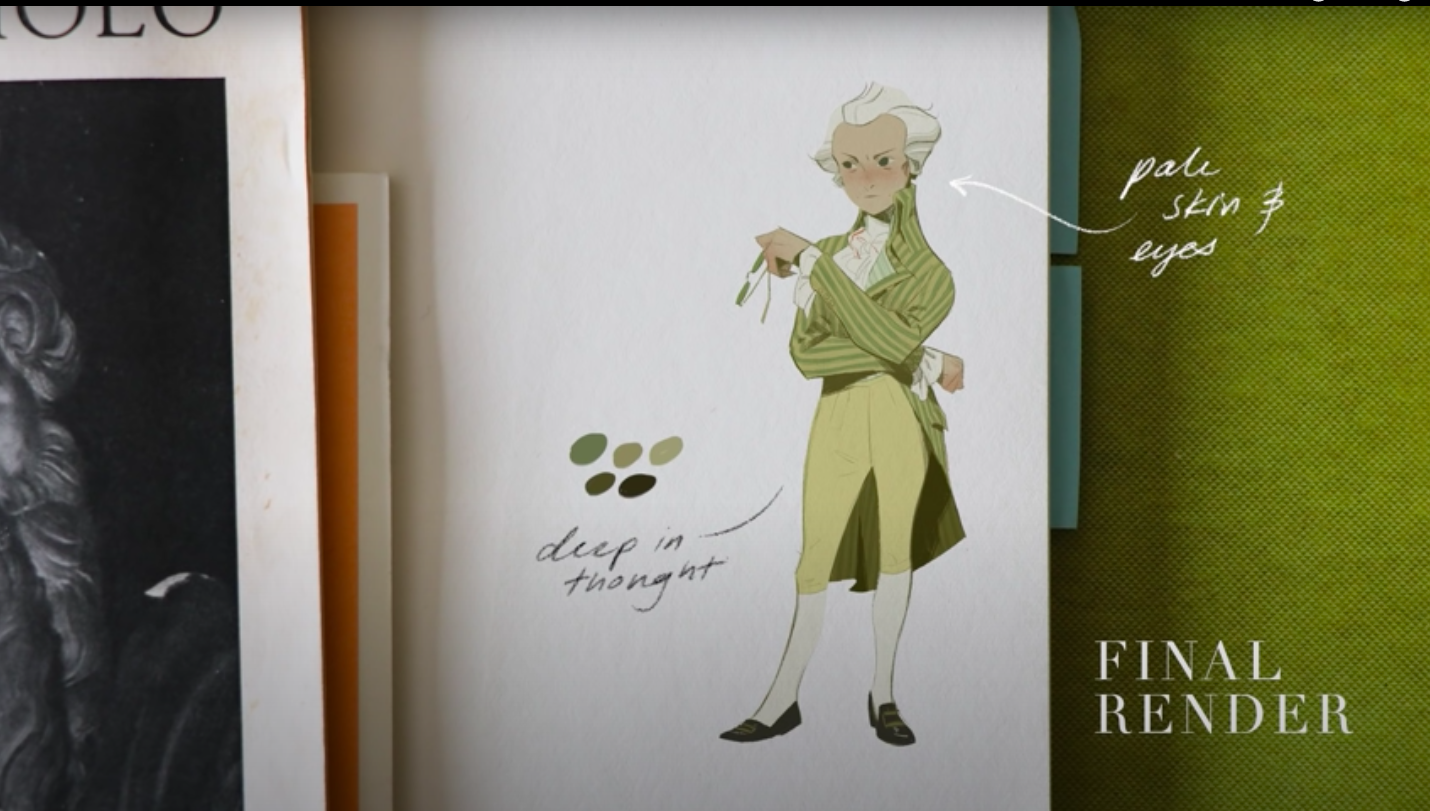
Between these two poles is the “neutral” Robespierre, perhaps the most challenging to depict.
Feng took the lead on this one, seeking to strike a balance between his reportedly unprepossessing appearance and his revolutionary fire.
She retained the striped coat of his most iconic portrait, but updated it to a cool green palette. His nickname — the Incorruptible — is embodied in his firm comportment.
The video draws to a close with a review of the various ways Robespierre has been depicted in art and film over the years, a vivid reminder of Cheng’s assertion that “there is never just one story.”
See more of Michelle Cheng’s animations on her lemoncholy YouTube channel.
See more of Janelle Feng’s French Revolution era designs here.
Related Content
14,000 Free Images from the French Revolution Now Available Online
Enter a Digitized Collection of 38,000 Pamphlets & Periodicals From the French Revolution
- Ayun Halliday is the Chief Primatologist of the East Village Inky zine and author, most recently, of Creative, Not Famous: The Small Potato Manifesto and Creative, Not Famous Activity Book. Follow her @AyunHalliday.
Read More...Watch Jeff Beck (RIP) Smash His Guitar: A Classic Scene from Antonioni’s Blowup (1966)
Note: With the passing of Jeff Beck, we’re bringing back a vintage post from our archive featuring the early years of the legendary guitarist. You can read his obituary here.
Art film and rock and roll have, since the 60s, been soulmates of a kind, with many an acclaimed director turning to musicians as actors, commissioning rock stars as soundtrack artists, and filming scenes with bands. Before Nicolas Roeg, Jim Jarmusch, David Lynch, Martin Scorsese and other rock-loving auteurs did all of the above, there was Michelangelo Antonioni, who barreled into the English-language market, under contract with Metro-Goldwyn-Mayer, with a trilogy of films steeped in the sights and sounds of sixties counterculture.
Blowup, the first and by far the best of these, though scored by jazz pianist Herbie Hancock, prominently featured the Yardbirds—with both Jimmy Page and Jeff Beck. In the memorable scene above, Beck smashes his guitar to bits after his amp goes on the fritz. The Italian director “envisioned a scene similar to that of Pete Townshend’s famous ritual of smashing his guitar on stage,” notes Guitarworld’s Jonathan Graham. “Antonioni had even asked The Who to appear in the film,” but they refused.
In stepped the Yardbirds, during a pivotal moment in their career. The year before, they released mega-hit “For Your Love,” and said goodbye to lead guitarist Eric Clapton. Beck, his replacement, heralded a much wilder, more experimental phase for the band. Jeff Beck, it seemed, could play anything, but what he didn’t do much of onstage is emote. Next to the guitar-smashing Townshend or the fire-setting Hendrix (see both below), he was a pretty reserved performer, though no less thrilling to watch for his virtuosity and style.
But as he tells it, Antonioni wouldn’t let the band do their “most exciting thing,” a cover of “Smokestack Lightning” that “had this incredible buildup in the middle which was just pow!” That moment would have been the natural pretext for a good guitar smashing.
Instead, the set piece with the broken amp gives the introverted Beck a reason to get agitated. As Graham describes it, he also played a guitar specially designated as a prop:
Due to issues over publishing, the Yardbirds classic “Train Kept A‑Rollin’,” was reworked as “Stroll On” for the performance, and as the scene involved the destruction of an instrument, Beck’s usual choice of his iconic Esquire or Les Paul was swapped for a cheap, hollow-body stand-in that he was directed to smash at the song’s conclusion.
The scene is more a tantrum than the orgiastic onstage freak-out Townshend would probably have delivered. Its chief virtue for Yardbird’s fans lies not in the funny, out-of-character moment (which SF Gate film critic Mick LaSalle calls “one of the weirdest scenes in the movie”). Rather, it was “the chance,” as one fan tells LaSalle, “in the days before MTV and YouTube, to see the Yardbirds, with Jeff Beck and Jimmy Page.” Antonioni had seized the moment. In addition to firing “the opening salvo of the emerging ‘film generation,’” as Roger Ebert wrote, he gave contemporary fans a reason (in addition to explicit sex and nudity), to go see Blowup again and again.
Related Content:
13-Year-Old Jimmy Page Plays Guitar on TV in 1957, an Early Moment in His Spectacular Career
Jim Jarmusch: The Art of the Music in His Films
Josh Jones is a writer and musician based in Durham, NC. Follow him at @jdmagness
Read More...Support Us
We're hoping to rely on loyal readers, rather than erratic ads. Please click the Donate button and support Open Culture. You can use Paypal, Venmo, Patreon, even Crypto! We thank you!

About Us

Open Culture scours the web for the best educational media. We find the free courses and audio books you need, the language lessons & educational videos you want, and plenty of enlightenment in between.
Advertise With Us
FREE UPDATES!
GET OUR DAILY EMAIL
Get the best cultural and educational resources on the web curated for you in a daily email. We never spam. Unsubscribe at any time.
FOLLOW ON SOCIAL MEDIA
Open Culture editor Dan Colman scours the web for the best educational media. He finds the free courses and audio books you need, the language lessons & movies you want, and plenty of enlightenment in between.
Advertise With Us


