Around the World in 1896: 40 Minutes of Real Footage Lets You Visit Paris, New York, Venice, Rome, Budapest & More
No cultural tour of Glasgow could be complete without a visit to the Britannia Panopticon, the world’s oldest surviving music hall. “Converted from warehouse to music hall in 1857 and licensed in 1859, the Britannia Music Hall entertained Glasgow’s working classes for nearly 80 years,” says its about page. “By the time it closed in 1938 it had also accommodated cinema, carnival, freak show, wax works, zoo, art gallery and hall of mirrors,” and it had also changed its name to reflect the fact that every conceivable form of entertainment could be seen there. Thanks to an ongoing conservation effort, the building still stands today, and its details have gradually been returned to the look and feel of its glory days.
In 2016, the Britannia Panopticon marked 120 years of showing film in that building. Part of the celebration involved uploading, to its very own Youtube channel, this 40-minute compilation of real footage from 1896, the year its cinematic programming began. (Ambient sound has been added to enhance the sensation of time travel.)
In it you’ll catch glimpses of life as it was really lived 126 years ago in places like Manhattan’s Union Square, London’s Piccadilly Circus, Budapest’s Széchenyi Chain Bridge, Rome’s Porto di Ripetta, and Paris’ Bassin des Tuileries — as well as the Pont Neuf and Arc de Triomphe. The preponderance of Parisian locations is unsurprising, given that most of the footage was shot by the French brothers Auguste and Louis Lumière, pioneers of both the technology and art of cinema.
The sons of a family involved in the nascent photography industry, the Lumière brothers patented their own motion-picture system in 1895, the same year they gave their first screening: the film was La Sortie de l’usine Lumière à Lyon, whose 46 seconds show exactly that. A few months later, they put on a public program including nine more films of similar length, each also consisting of a single shot in what we would now call documentary style. This proved entertainment enough to launch a world tour, and the brothers took their cinématographe to London, New York City, Bombay, Buenos Aires and elsewhere. This presumably gave them their chance to shoot in such cities, suggesting that a wide variety of locations and cultures could become captivating material for motion pictures: a proposition more than validated by the subsequent century, but not one in which the Lumière brothers, who quit cinema less than a decade later, seem to have put much stock themselves.
Related content:
Watch the Films of the Lumière Brothers & the Birth of Cinema (1895)
Footage of Cities Around the World in the 1890s: London, Tokyo, New York, Venice, Moscow & More
Watch Scenes from Czarist Moscow Vividly Restored with Artificial Intelligence (May 1896)
Real Interviews with People Who Lived in the 1800s
What the First Movies Really Looked Like: Discover the IMAX Films of the 1890s
Based in Seoul, Colin Marshall writes and broadcasts on cities, language, and culture. His projects include the Substack newsletter Books on Cities, the book The Stateless City: a Walk through 21st-Century Los Angeles and the video series The City in Cinema. Follow him on Twitter at @colinmarshall or on Facebook.
Read More...A Stunning, Hand-Illustrated Book of Mushrooms Drawn by an Overlooked 19th Century Female Scientist
Mushrooms have quietly become superstars of the global stage.
Sure, not everyone likes them on pizza, but who cares?
In the 21st-century, they are hailed as role models and potential planet savers (not to mention a wildly popular design motif…)
Time-lapse cinematography pioneer Louie Schwartzberg’s critically acclaimed documentary, Fantastic Fungi, has made experts of us all.
Go back a century, and such knowledge was much harder won, requiring time, patience, and proximity to field or forest.
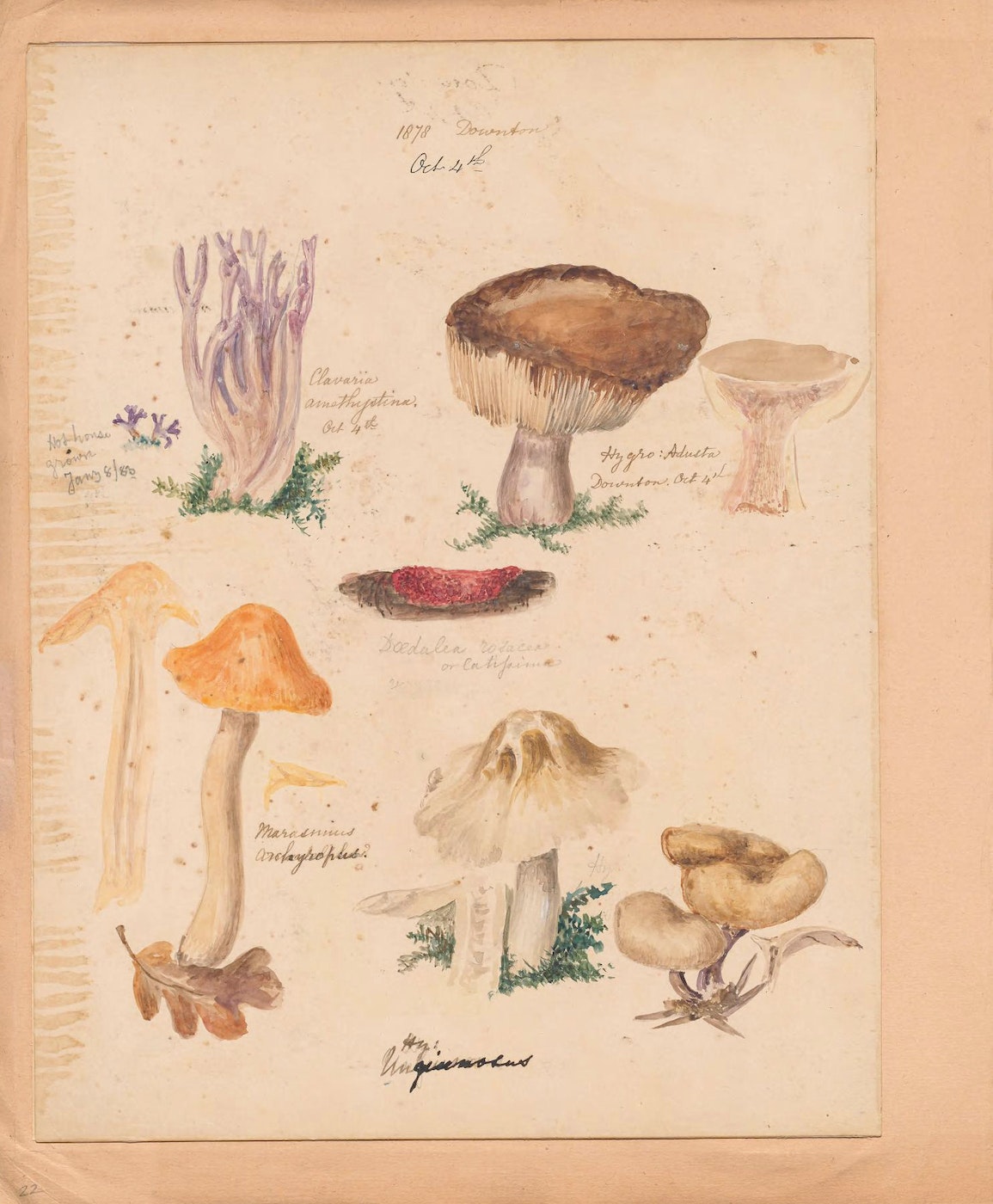
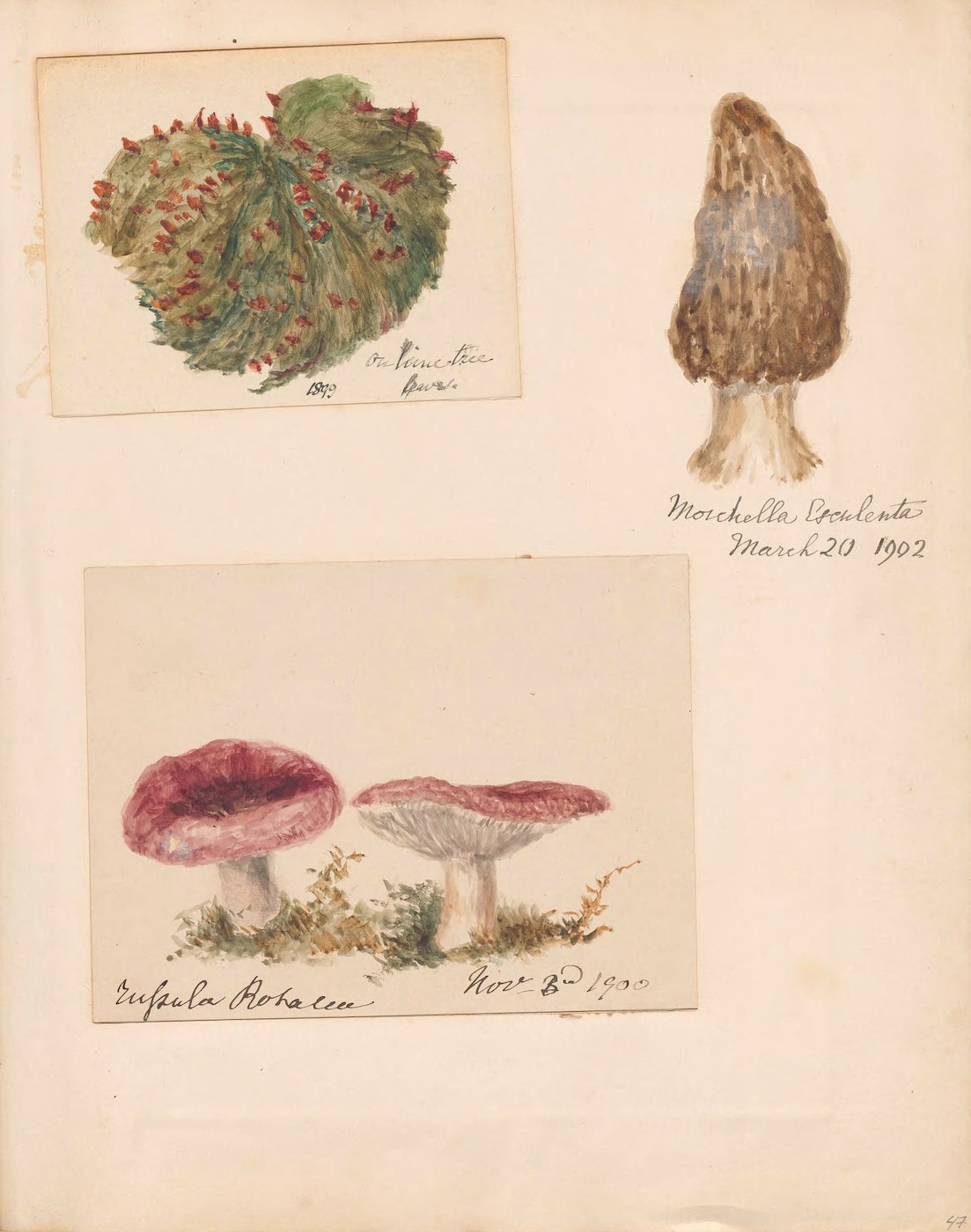
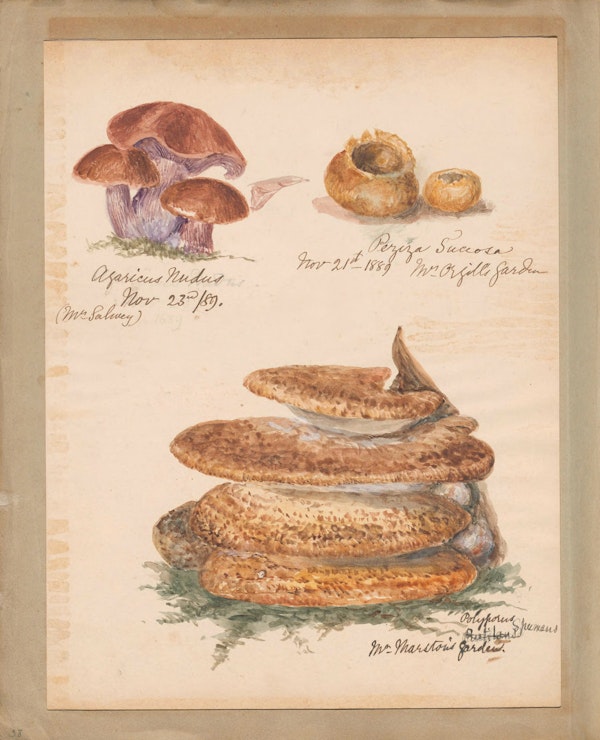
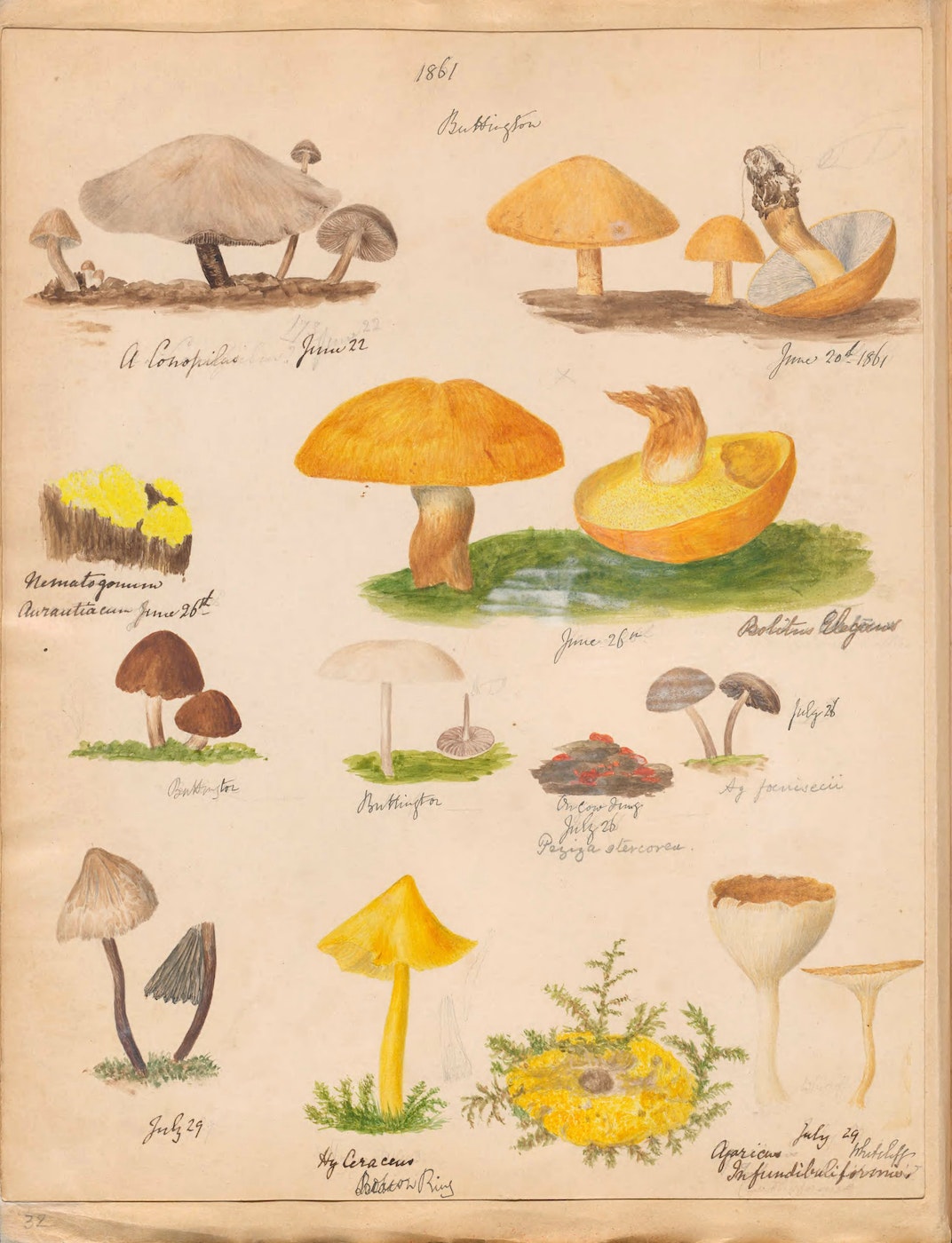
Witness Fungi collected in Shropshire and other neighborhoods, a handbound, hand-illustrated 3‑volume collection by one Miss M. F. Lewis, of Ludlow, England.
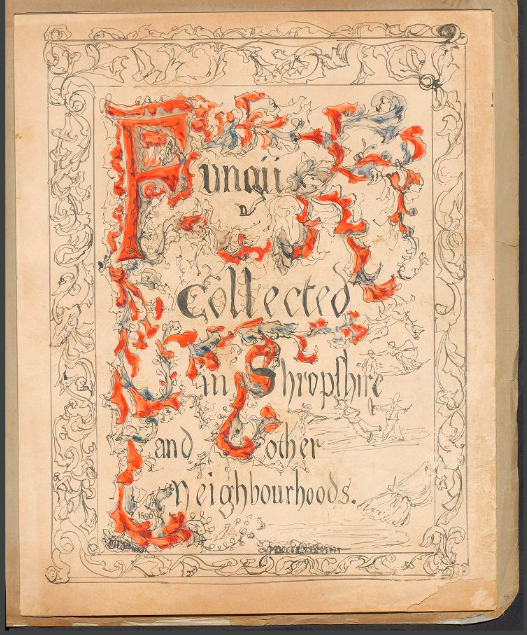
Miss Lewis, a talented artist with an obvious passion for mycology spent over 40 years painstakingly documenting the specimens she ran across in England’s West Midlands region.
Each drawing or watercolor is identified in Miss Lewis’ hand by its subject’s scientific name. The location in which it was found is dutifully noted, as is the date.
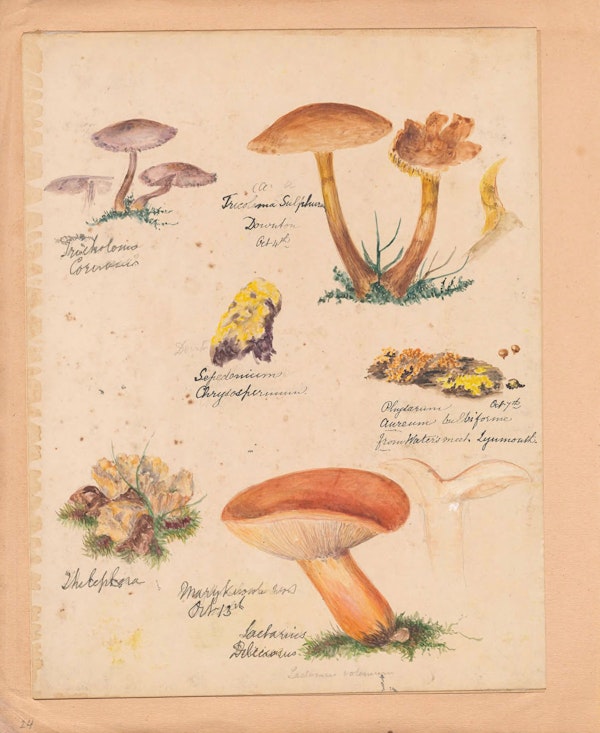
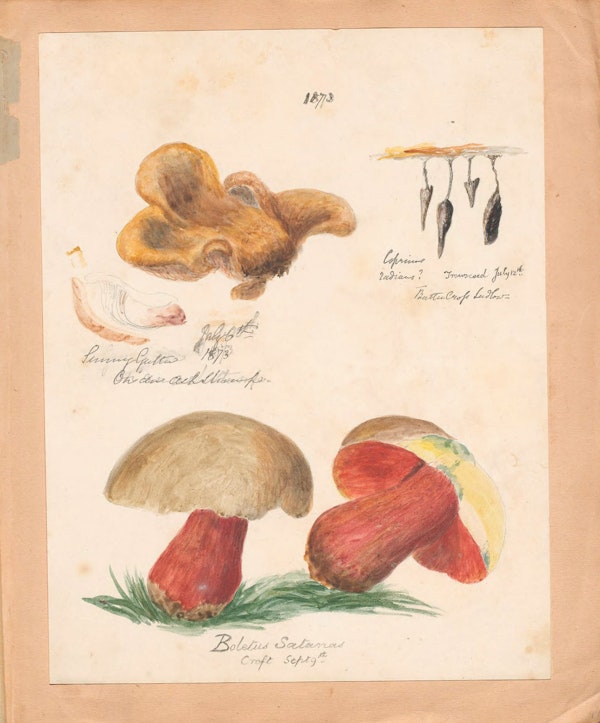
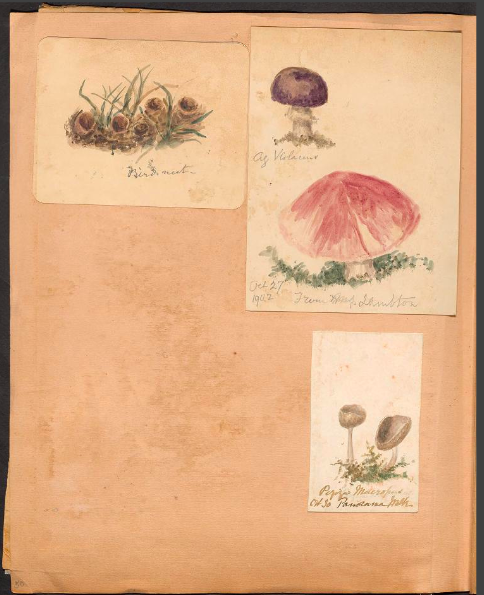
The hundreds of species she captured with pen and brush between 1860 and 1902 definitely constitute a life’s work, and also an unpublished one.
Cornell University’s Mann Library, where the only copy of this precious record is housed, has managed to truffle up but a single reference to Miss Lewis’ scientific mycological contribution.
English botanist William Phillips, writing in an 1880 issue of the Transactions of the Shropshire Archaeological and Natural History Society, noted that he been “permitted to look over [a work] of very much excellence executed by Miss M. F. Lewis, of Ludlow”, adding that “several rare species [of fungi] are very artistically represented.“
The historical significance of Miss Lewis’ work extends beyond the fungal realm.
As Sage writes in Missing Misses in Mycology, a post on the Mann Library’s Tumblr celebrating Miss Lewis and her contemporary, English mycologist and illustrator, Sarah Price, women’s work was often omitted from the official scientific record:
While we’re now seeing considerable effort to rectify the record, the discovery of untold stories to fill in the blanks can be tricky business. It’s not that the stories never happened — the field of botany, for one, is replete with some pretty spectacular evidence of women’s (often unacknowledged) engagement with scientific inquiry, embodied in the detailed illustrations that captured the insights of observations from the natural world. But the published historical record is often woefully scant when it comes to closer detail on the lives and careers of the women who have helped carry modern science forward.
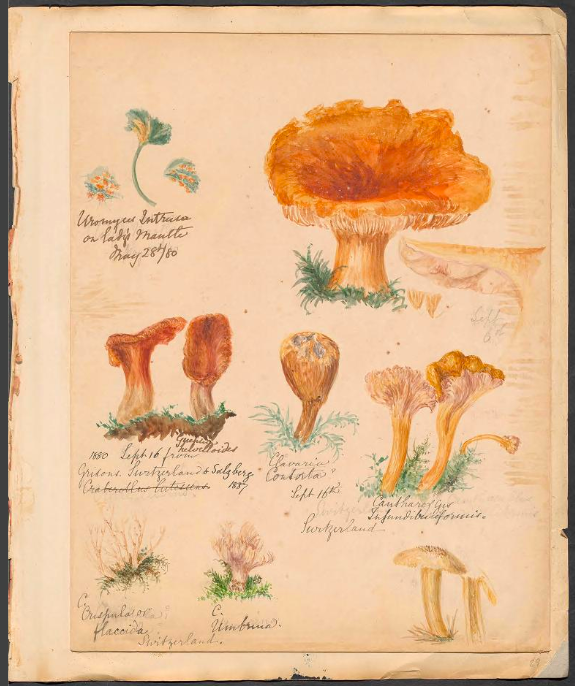
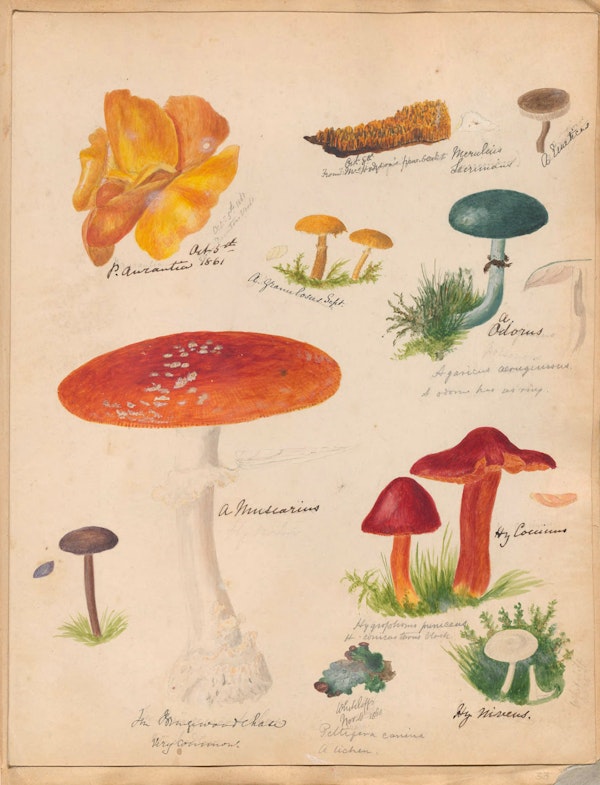
We may never learn anything more about the particulars of Miss Lewis’ training or personal circumstances, but the care she took to preserve her own work turned out to be a great gift for future generations.
Leaf through all three volumes of Miss M.F. Lewis’ Fungi collected in Shropshire and other neighborhoods on the Internet Archive:
Related Content
John Cage Had a Surprising Mushroom Obsession (Which Began with His Poverty in the Depression)
The Beautifully Illustrated Atlas of Mushrooms: Edible, Suspect and Poisonous (1827)
Algerian Cave Paintings Suggest Humans Did Magic Mushrooms 9,000 Years Ago
- Ayun Halliday is the Chief Primatologist of the East Village Inky zine and author, most recently, of Creative, Not Famous: The Small Potato Manifesto. Follow her @AyunHalliday.
Read More...The History of Jazz Visualized on a Circuit Diagram of a 1950s Phonograph: Features 1,000+ Musicians, Artists, Songwriters and Producers
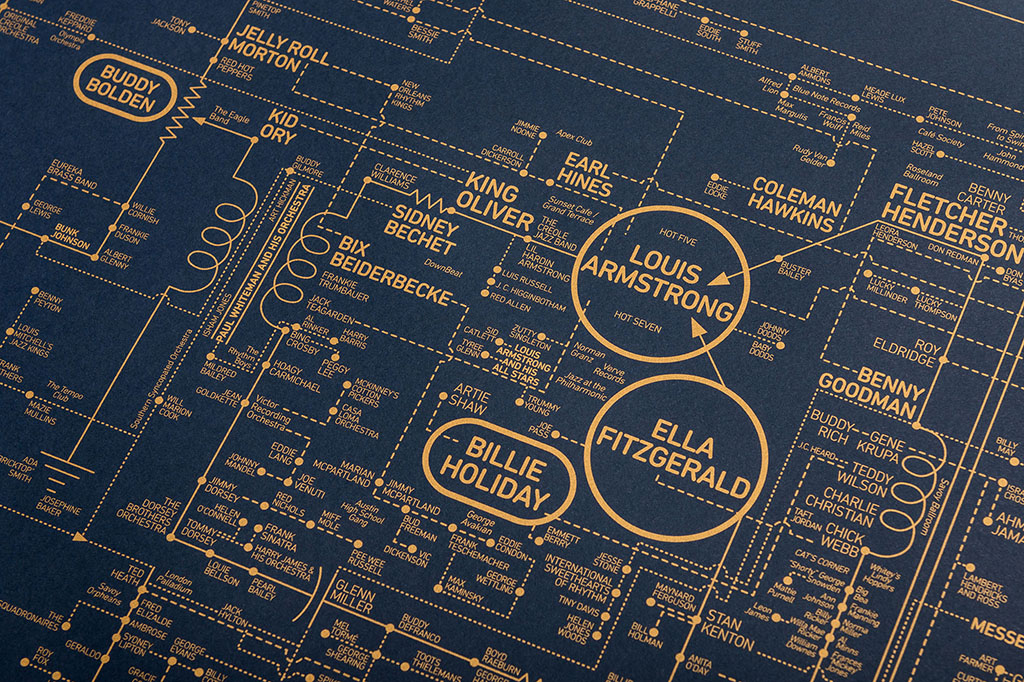
The danger of enjoying jazz is the possibility of letting ourselves slide into the assumption that we understand it. To do so would make no more sense than believing that, say, an enjoyment of listening to records automatically transmits an understanding of record players. One look at such a machine’s inner workings would disabuse most of us of that notion, just as one look at a map of the universe of jazz would disabuse us of the notion that we understand that music in all the varieties into which it has evolved. But a jazz map that extensive hasn’t been easy to come by until this month, when design studio Dorothy put on sale their Jazz Love Blueprint.
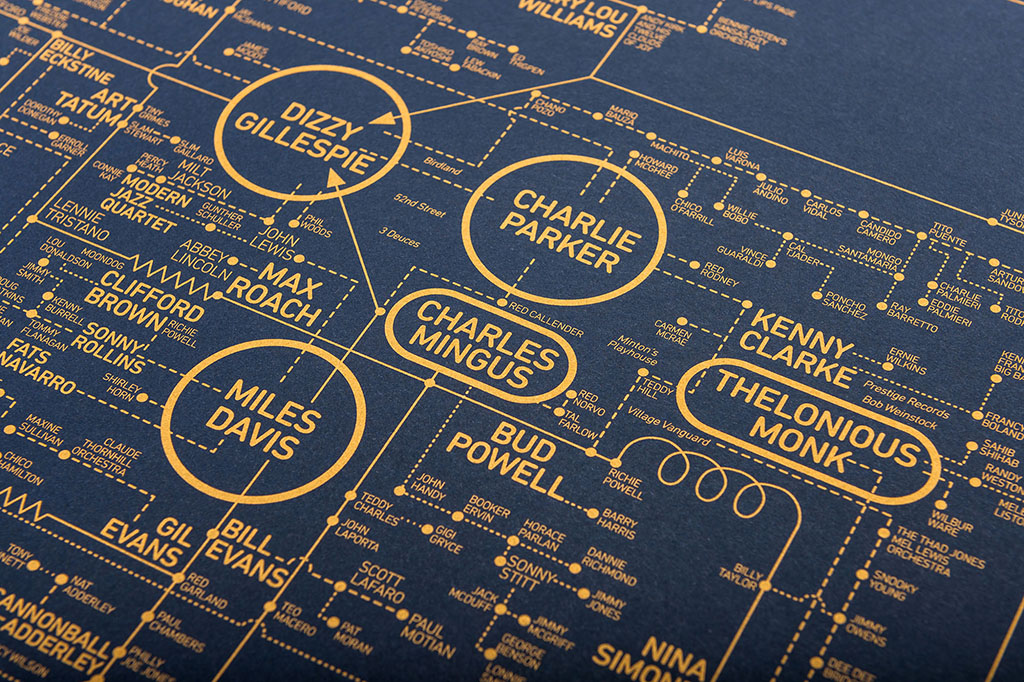
Measuring 80 centimeters by 60 centimeters (roughly two and half by two feet), the Jazz Love Blueprint visually celebrates “over 1,000 musicians, artists, songwriters and producers who have been pivotal to the evolution of this ever changing and constantly creative genre of music,” diagramming the connections between the defining artists of major eras and movements in jazz.
These include the “innovators that laid the foundations for jazz music” like Scott Joplin and Jelly Roll Morton, “original jazz giants” like Louis Armstrong and Ella Fitzgerald, “inspired musicians of bebop” like Charlie Parker, Dizzy Gillespie, and such leading lights of “spiritual jazz” as John Coltrane, Alice Coltrane, and the late Pharoah Sanders.
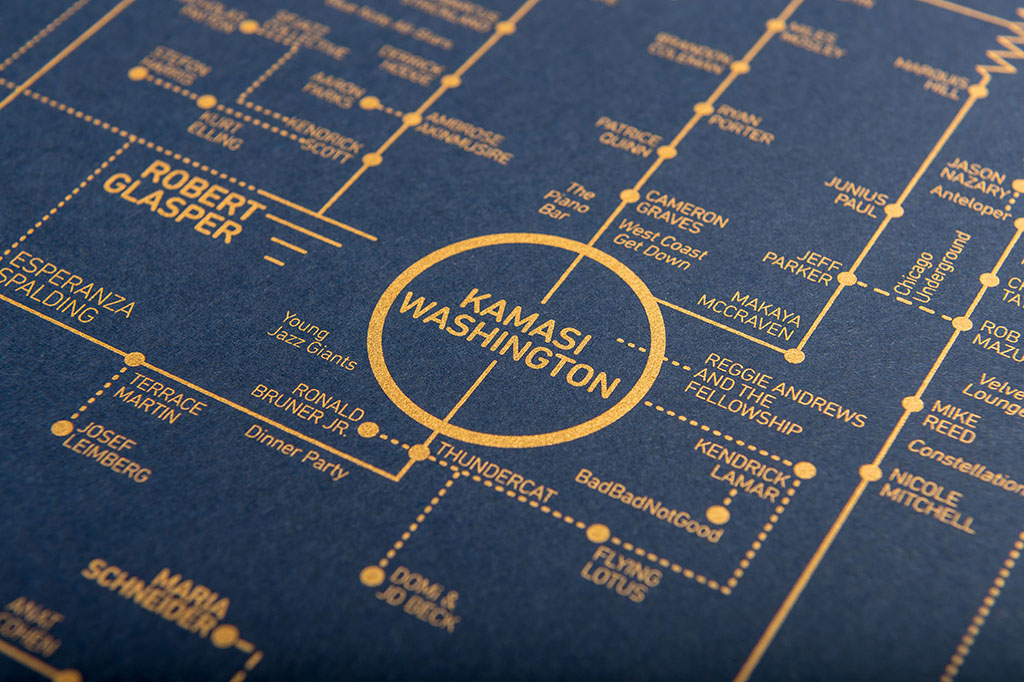
You probably know all those names, even if you only casually listen to jazz. But you may not have heard of such players on “the current vibrant UK scene” as Ezra Collective, Shabaka Hutchings, Nubya Garcia, Kokoroko, and Moses Boyd, or those on “the exploding US scene” like Kamasi Washington, Robert Glasper, and Makaya McCraven. The map includes not only the individuals but also the institutions that have shaped jazz in all its forms: clubs like Birdland and Ronnie Scott’s, record labels like Blue Note, Verve, and ECM. Even the most experienced jazz fans will surely spot new listening paths on the Jazz Love Blueprint. Those with an electronic or mechanical bent will also notice that the whole design has been based on the circuit diagram of a phonograph: the very machine that set so many of us on the path to our love of jazz in the first place.
You can find other diagrams mapping the history of Electronic Music, Rock, Hip Hop and Alternative Music here.
Related content:
Hear 2,000 Recordings of the Most Essential Jazz Songs: A Huge Playlist for Your Jazz Education
1959: The Year That Changed Jazz
Langston Hughes Presents the History of Jazz in an Illustrated Children’s Book (1955)
Hear the First Jazz Record, Which Launched the Jazz Age: “Livery Stable Blues” (1917)
Based in Seoul, Colin Marshall writes and broadcasts on cities, language, and culture. His projects include the Substack newsletter Books on Cities, the book The Stateless City: a Walk through 21st-Century Los Angeles and the video series The City in Cinema. Follow him on Twitter at @colinmarshall or on Facebook.
Read More...When Medieval Manuscripts Were Recycled & Used to Make the First Printed Books
“Old paint on a canvas, as it ages, sometimes becomes transparent,” playwright Lillian Hellman observed in Pentimento, the second volume of her memoirs. “When that happens it is possible, in some pictures, to see the original lines: a tree will show through a woman’s dress, a child makes way for a dog, a large boat is no longer on an open sea.”
Seven years ago, something similar started happening with thousands of old books, dating from the 15th to 19th century.
Age, however, didn’t force these volumes to spill their secrets…at least not directly.
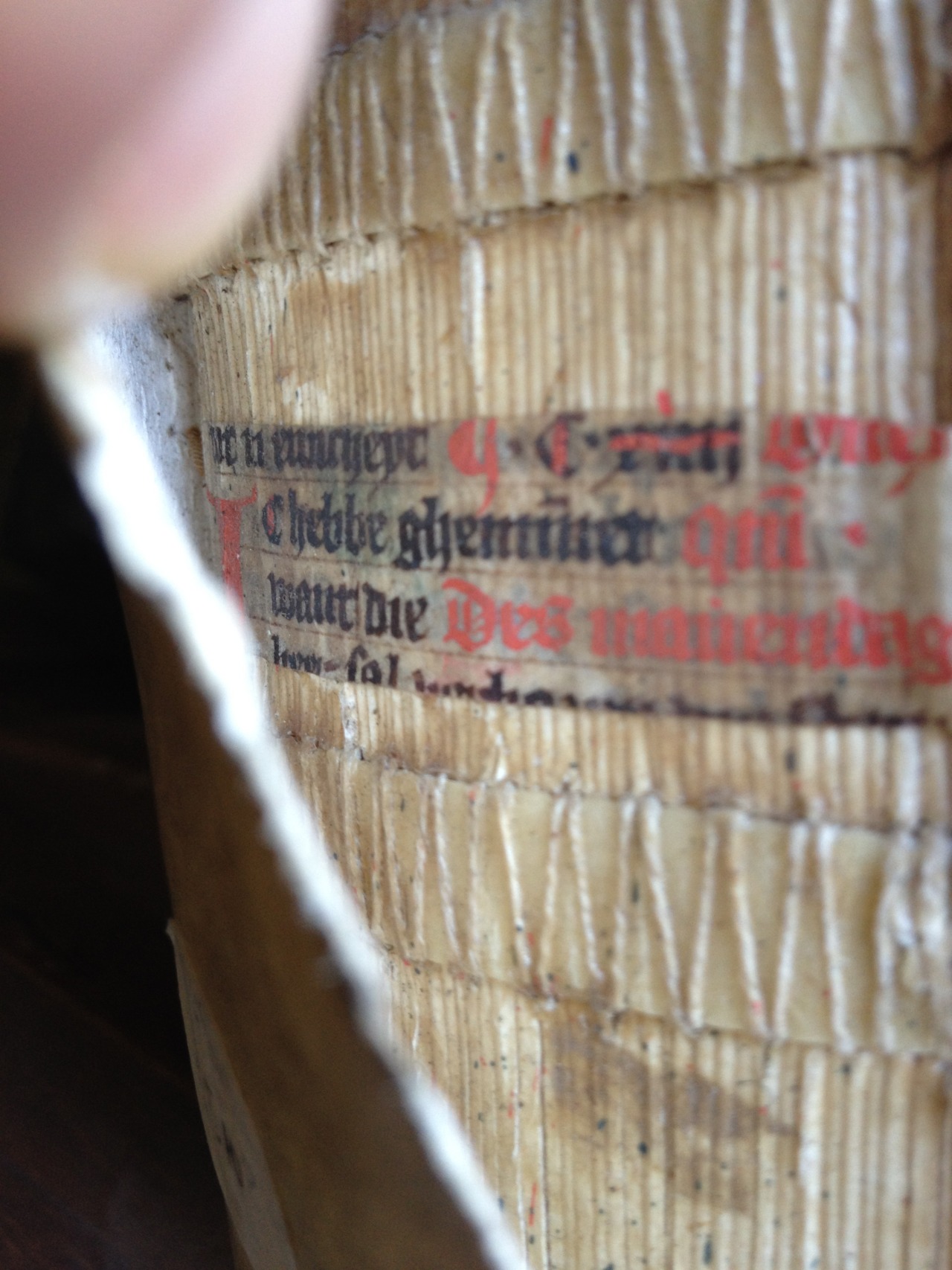
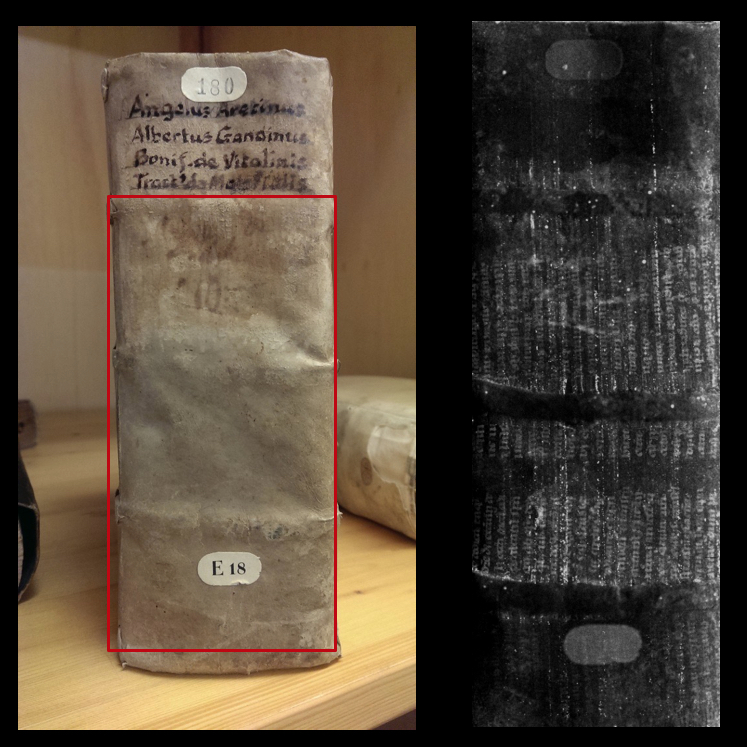
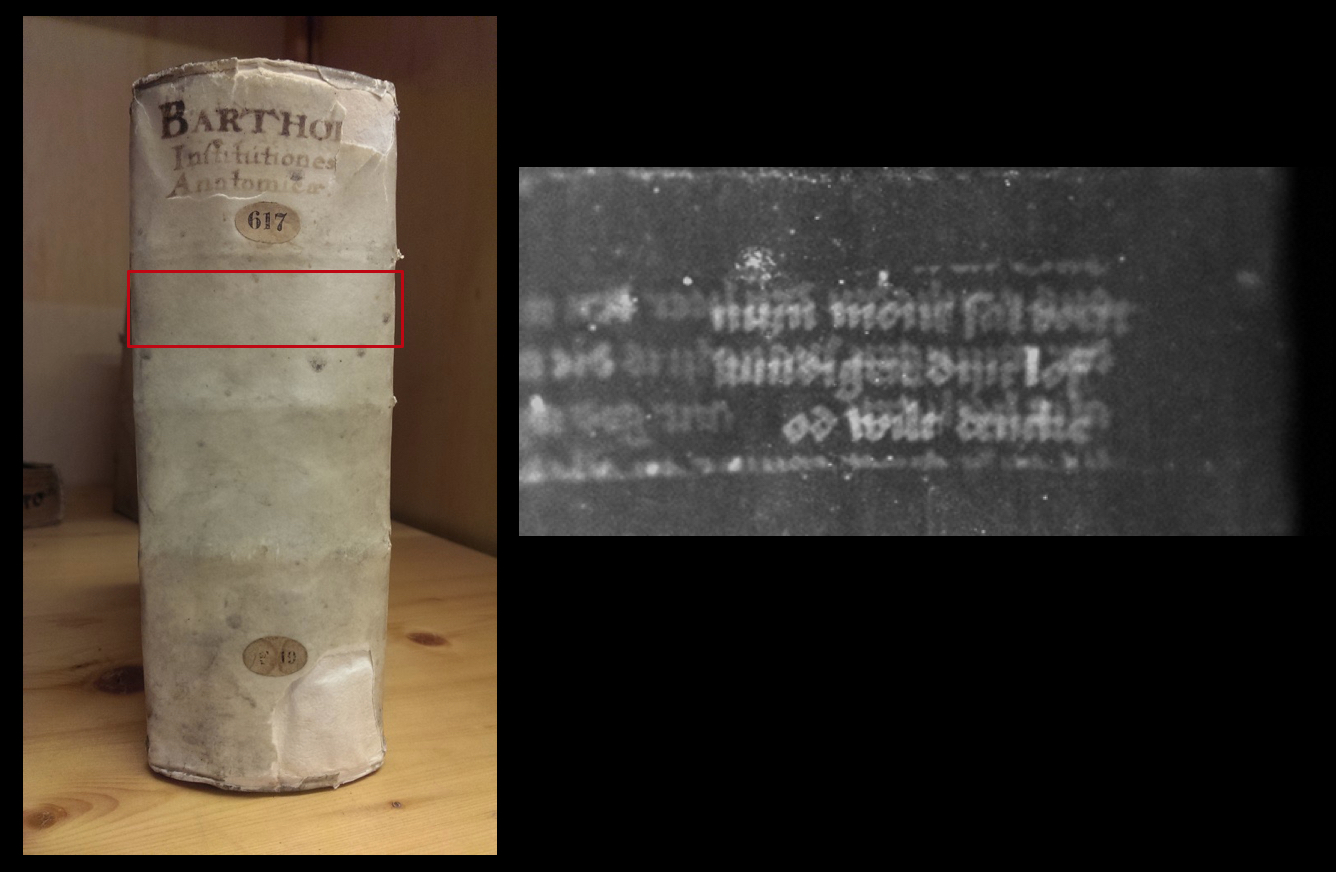
That honor goes to macro X‑ray fluorescence spectrometry (MA-XRF) and Erik Kwakkel, a book historian who theorized that this technology might reveal medieval manuscript fragments hidden in the bindings of newer texts, much as it had earlier revealed hidden layers of paint on Old Master canvases.
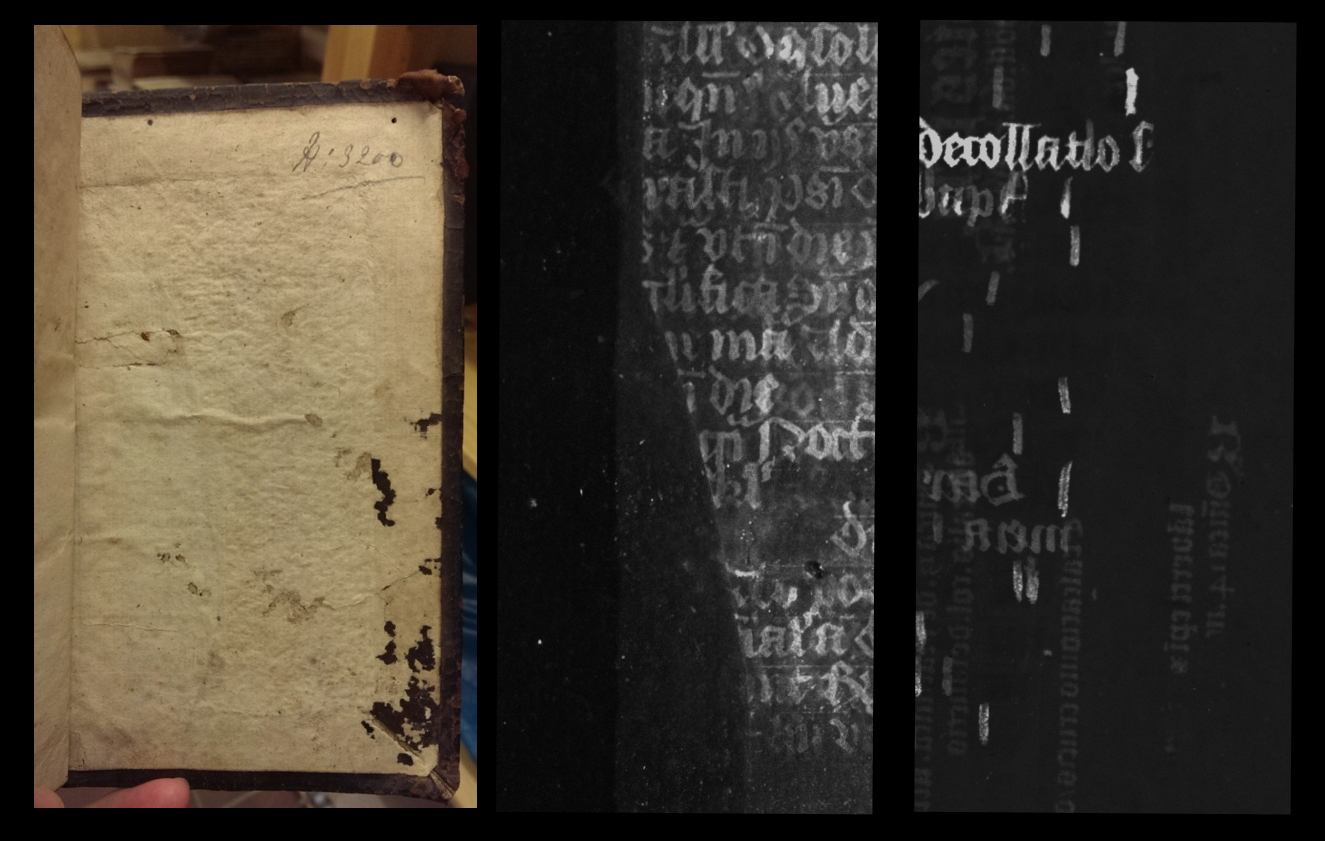
How did this strange “hidden library” come to be?
Books were highly prized objects when manuscripts were copied by hand, but as Kwakkel notes on his medievalbooks blog, “thousands and thousands of medieval manuscripts were torn apart, ripped to pieces, boiled, burned, and stripped for parts” upon the advent of the printing press.
Their pages were pressed into service as toilet paper, bukram-like clothing stiffeners, bookmarks, and, most tantalizing to a medieval book specialist, binding support for printed books.
This practice was so common that the bindings of nearly 150 early printed books in the Yale Law Library are known to contain pieces of medieval manuscripts.
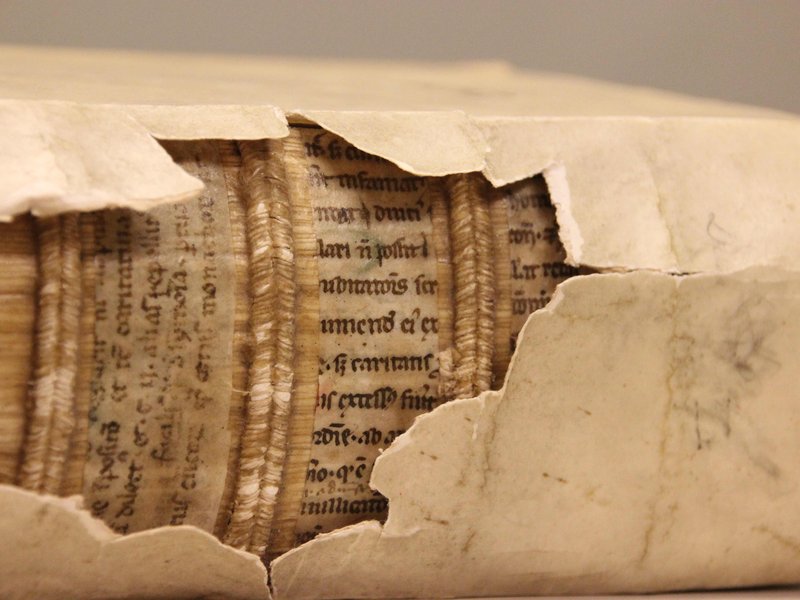
These materials may have been downgraded in the literary sense, but to Kwakkel they are “travelers in time, stowaways in leather cases with great and important stories to tell:”
Indeed, stories that may otherwise not have survived, given that classical and medieval texts frequently only come down to us in fragmentary form. The early history of the Bible as a book could not be written if we were to throw out fragment evidence. Moreover, while ancient and medieval texts survive in many handsome books from before the age of print, quite often the oldest witnesses are fragments. At the very least a fragment tells you that a certain text was available at a certain location at a certain time. Stepping out of their leather time capsules after centuries of darkness, fragments are “blips” on the map of Europe, expressing “I existed, I was used by a reader in tenth-century Italy!”
A few lines of a mutilated text can often be sufficient to identify it, as well as the location and general timing of its creation:
That said, it is not easy to make sense of the remains. Binders seem to have particularly enjoyed slicing text columns in half, as if they knew how to frustrate future researchers best. Identifying what works these unfulfilling quotes come from can be a nightmare. Dating and localizing the remains can cause insomnia.
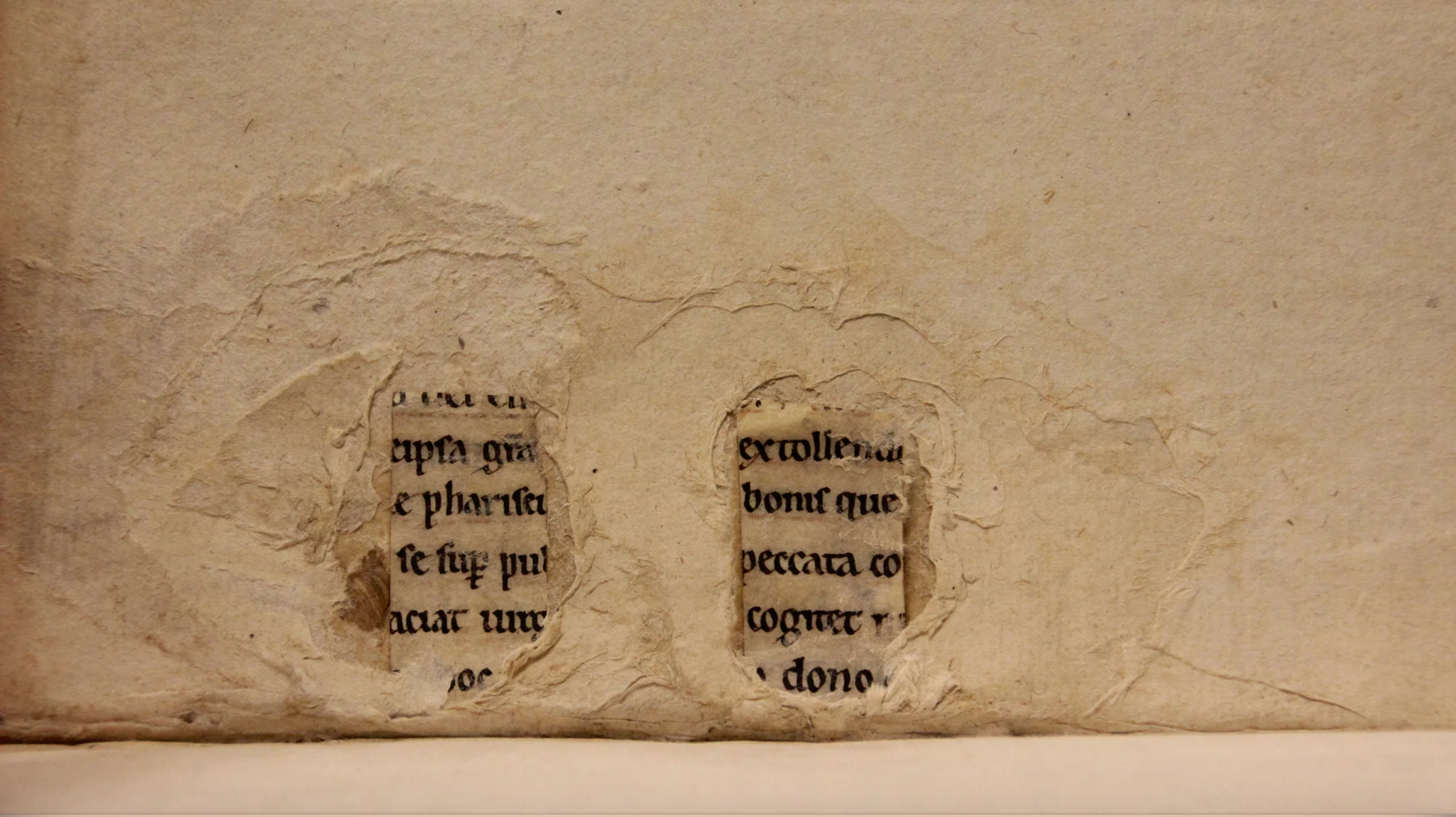
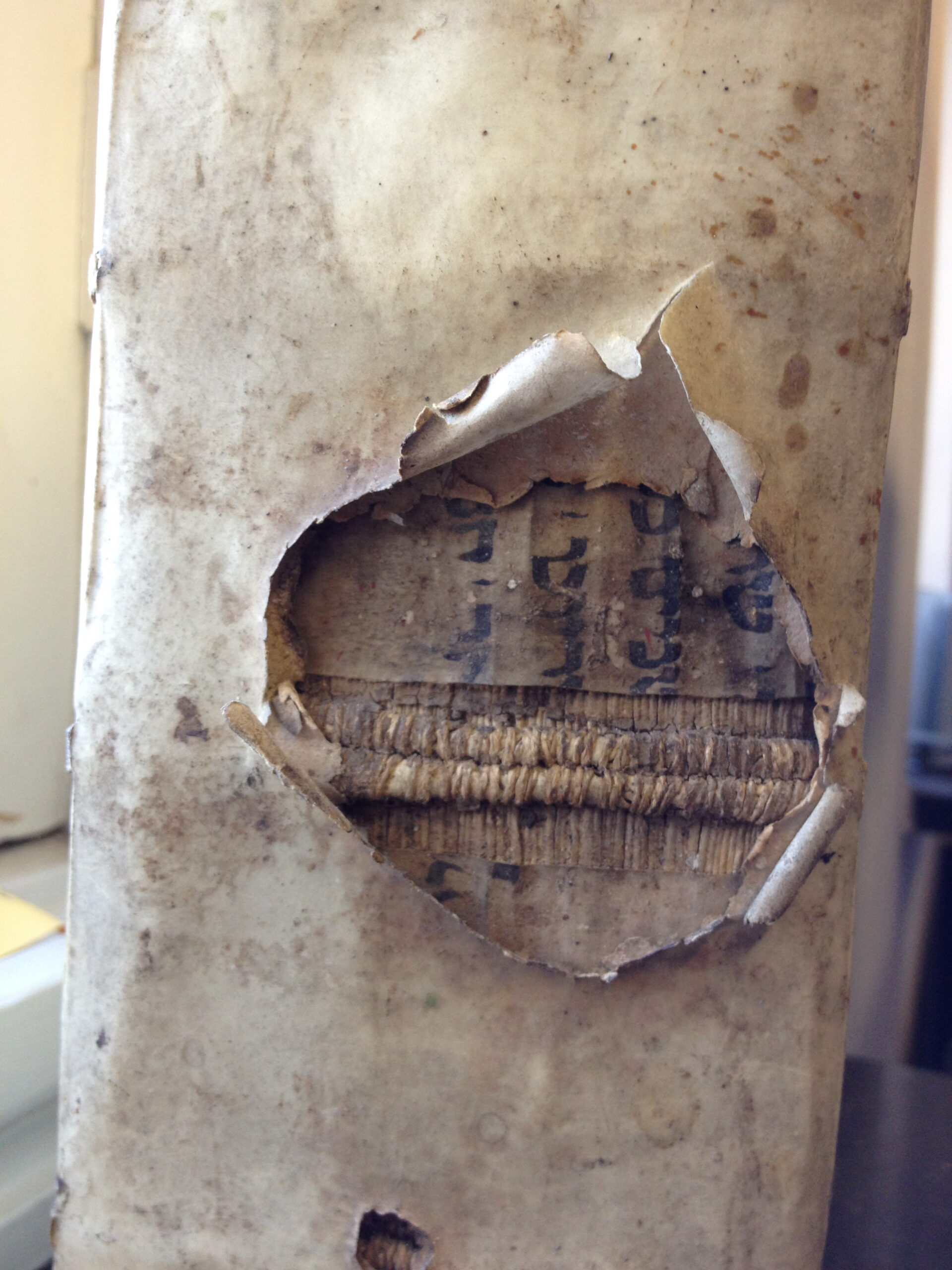
Prior to Kwakkel’s high tech experiments at Leiden University, modern researchers had to confine themselves to accidents, as when, say, an old book’s spine cracks, revealing the contents within.
Macro X‑ray fluorescence spectrometry turns out to be well equipped to detect the iron, copper and zinc of medieval inks beneath a layer of paper or parchment.
But it does so at a pace that might not knock a medieval scribe’s socks off.
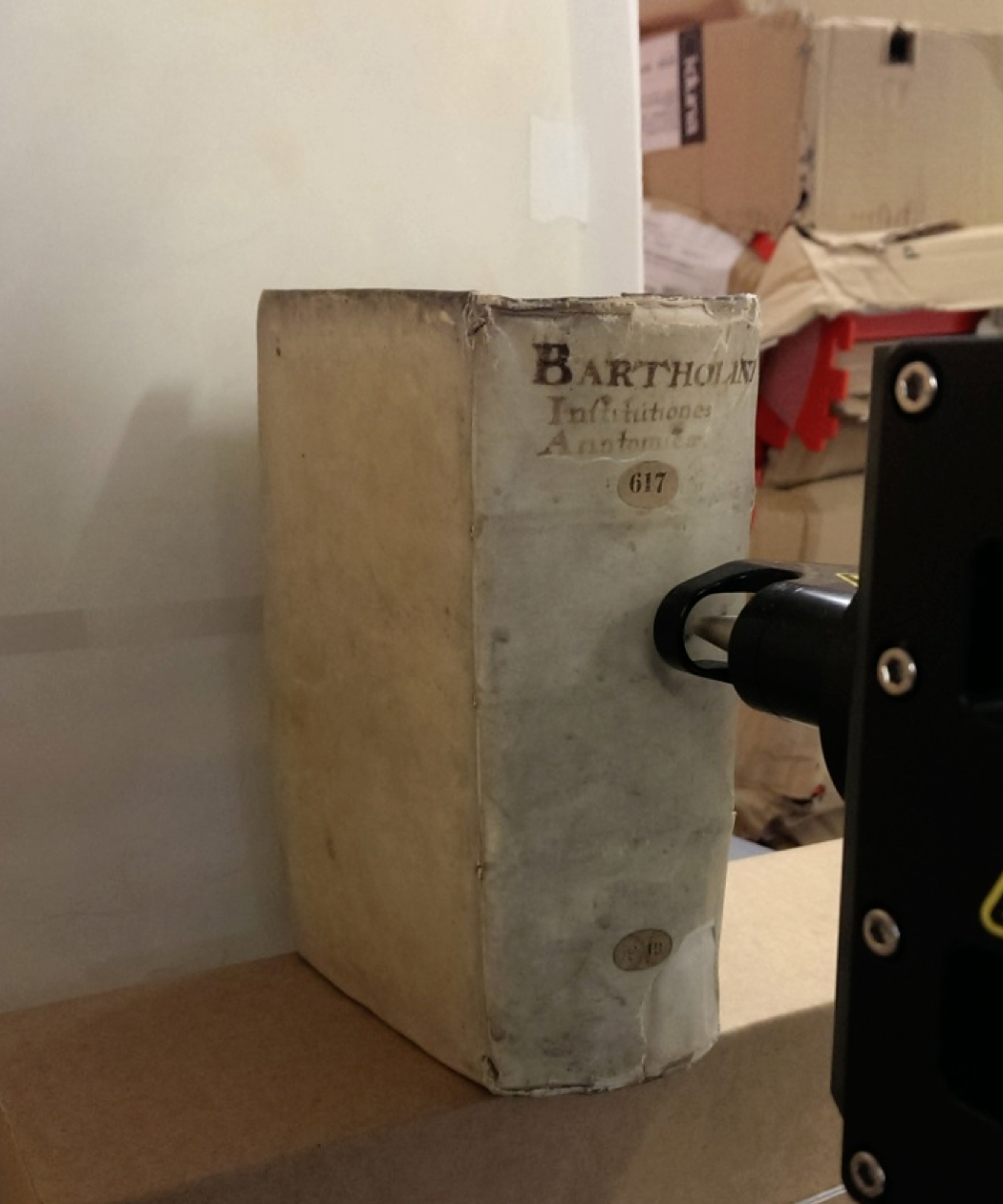
Producing a legible scan of what lurks beneath a single volume’s spine can require as much as 24 hours, and expensive and time consuming proposition.
With thousands of these bindings hiding so close to the surface in collections as massive as the British Library and Oxford’s Bodleian, be prepared to remain on your tenterhooks for the foreseeable future.
If you would like to support the mission of Open Culture, consider making a donation to our site. It’s hard to rely 100% on ads, and your contributions will help us continue providing the best free cultural and educational materials to learners everywhere. You can contribute through PayPal, Patreon, and Venmo (@openculture). Thanks!
via Messy Nessy
Related Content
A Medieval Book That Opens Six Different Ways, Revealing Six Different Books in One
Cats in Medieval Manuscripts & Paintings
- Ayun Halliday is the Chief Primatologist of the East Village Inky zine and author, most recently, of Creative, Not Famous: The Small Potato Manifesto. Join her in New York City on November 11 to create a collaborative Kurt Vonnegut Centennial fanzine. Follow her @AyunHalliday.
Read More...The Comiclopedia: An Online Archive of 14,000 Comic Artists, From Stan Lee and Jack Kirby, to Mœbius and Hergé
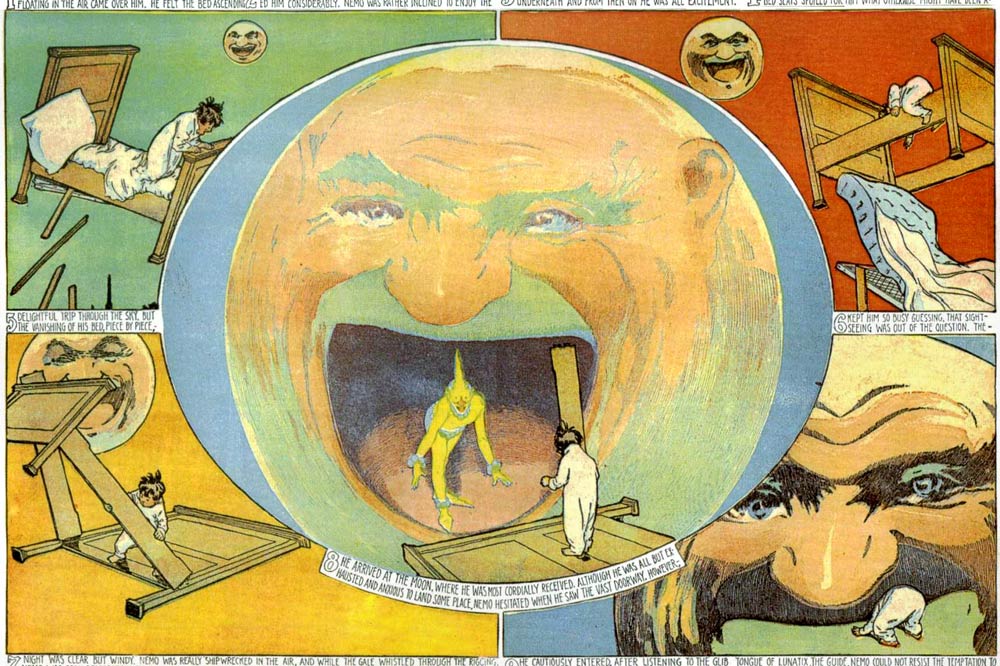
Nobody interested in comics can pass through Amsterdam without visiting Lambiek. Having opened in 1968 as the third comic-book shop in human history, it now survives as the oldest one still in existence. But even those without a trip to the Netherlands lined up can easily marvel at one of Lambiek’s major claims to fame: the Comiclopedia, “an illustrated compendium of over 14,000 comic artists from around the world.” Displaying the same kind of prescience that inspired him to open his store ahead of the comic-industry boom, Lambiek’s founder Kees Kousemaker launched this online encyclopedia in 1999, more than a year before Wikipedia first went live.
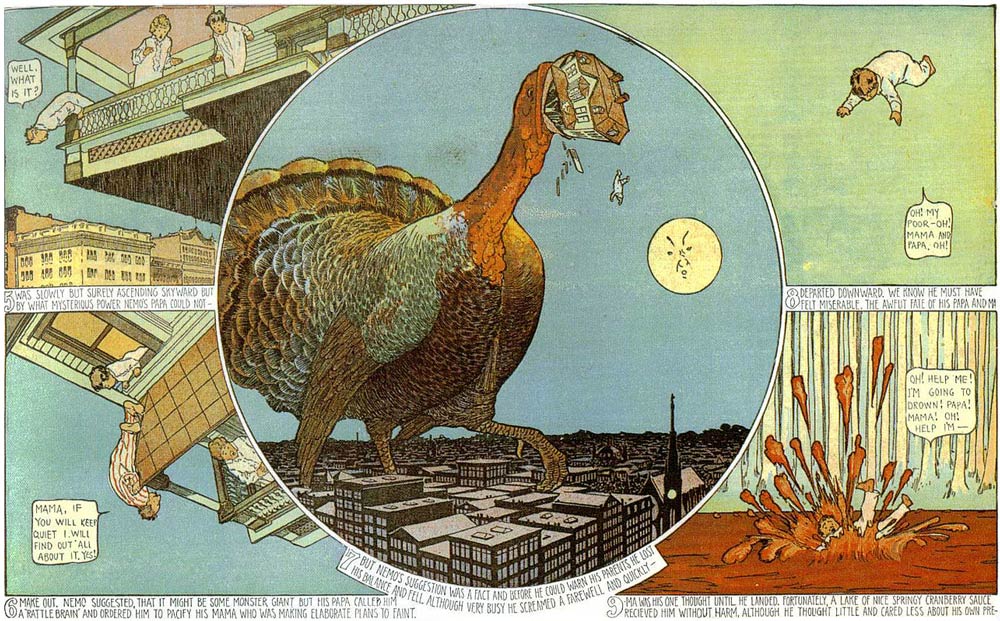
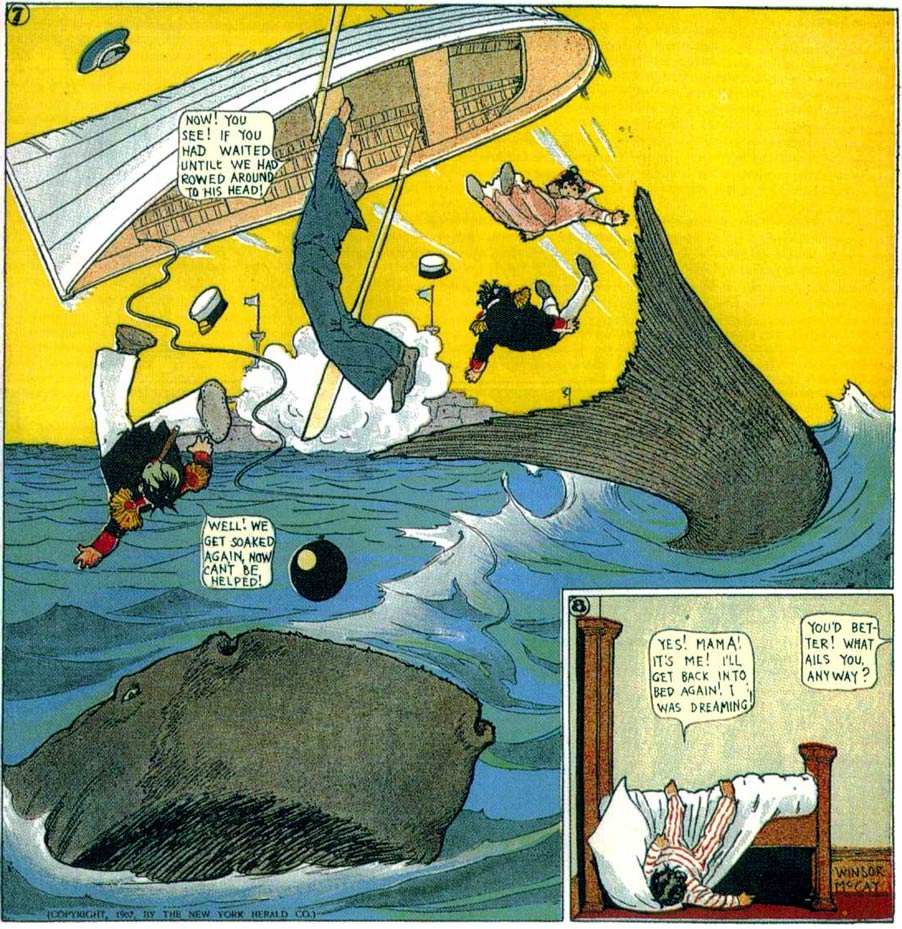
The video above offers a brief illustrated history of the Comiclopedia, but the project’s ambition comes across just as clearly in alphabetically organized index pages. American comic-book icons like Stan Lee and Jack Kirby get extensive entries, of course, but so do newspaper comic-strip creators from George Herriman and Winsor McCay (featured on this page) to Charles Schulz and Bill Watterson (whose entry features not just Calvin and Hobbes but such early work as a panel published in his college newspaper). There are even figures not known primarily as comic artists: the late Charlie Watts, for instance, whose artwork included the back cover of Between the Buttons, or David Lynch, who for nine years “drew” The Angriest Dog in the World.
For 23 years now, the Comiclopedia has maintained its commitment to both including deep cuts of that kind as well as constantly widening its international perspective. You’d expect its robust entries on Jean Giraud, better known as Mœbius, and Georges Remi, better known as Hergé, but you’ll also find introductions to the likes of Serafín Rojo Caamaño, creator of a host of characters beloved in twentieth-century Spain (including the perpetually drunken marchionesses), and Kim Seong-hwan, whose unflappable old man Gobau bore witness to half a century of tumultuous South Korean history.
Nor have Lambiek or the Comiclopedia ignored the comics of its homeland. “Kousemaker and his entourage wrote various essays, articles and books about comics,” says the page on the store’s own story, and without their work “much of the Netherlands’ comics history might otherwise have remained unexplored.” Batavophones can enjoy a thorough overview of the history of Dutch comics here; others can read a more condensed English version here, or set the Comiclopedia’s country filter to the Netherlands and sample the work of the 1,045-and-counting artists currently in the database. If you do make it out to Amsterdam, after all, you’re going to want to know Tom Poes from Eric de Noorman from Kapitein Rob beforehand.
via Metafilter
Related content:
Explore a Big Archive of Vintage Early Comics: 1700–1929
Read The Very First Comic Book: The Adventures of Obadiah Oldbuck (1837)
How to Make Comics: A Four-Part Series from the Museum of Modern Art
Free: Download 15,000+ Free Golden Age Comics from the Digital Comic Museum
The Encyclopedia of Science Fiction: 17,500 Entries on All Things Sci-Fi Are Now Free Online
Based in Seoul, Colin Marshall writes and broadcasts on cities, language, and culture. His projects include the Substack newsletter Books on Cities, the book The Stateless City: a Walk through 21st-Century Los Angeles and the video series The City in Cinema. Follow him on Twitter at @colinmarshall or on Facebook.
Read More...The Mastermind of Devo, Mark Mothersbaugh, Presents His Personal Synthesizer Collection
Mark Mothersbaugh’s studio is located in a cylindrical structure painted bright green — it looks more like a festive auto part than an office building. It’s a fitting place for the iconoclast musician. For those of you who didn’t spend your childhoods obsessively watching the early years of MTV, Mark Mothersbaugh was the mastermind behind the band Devo. They skewered American conformity by dressing alike in shiny uniforms and their music was nervy, twitchy and weird. They taught a nation that if you must whip it, you should whip it good.
In the years since, Mothersbaugh has segued into a successful career as a Hollywood composer, spinning scores for 21 Jump Street and The Royal Tenenbaums among others.
In the video above, you can see Mothersbaugh hang out in his studio filled with synthesizers of various makes and vintages, including Bob Moog’s own personal Memorymoog. Watching Mothersbaugh pull out and play with each one is a bit like watching a precocious child talk about his toys. He just has an infectious energy that is a lot of fun to watch.
Probably the best part in the video is when he shows off a device that can play sounds backward. It turns out that if you say, “We smell sausage” backwards it sounds an awful lot like “Jesus loves you.” Who knew?
Below you can see Mothersbaugh in action with Devo, performing live in Japan during the band’s heyday in 1979.
If you would like to support the mission of Open Culture, consider making a donation to our site. It’s hard to rely 100% on ads, and your contributions will help us continue providing the best free cultural and educational materials to learners everywhere. You can contribute through PayPal, Patreon, and Venmo (@openculture). Thanks!
Note: An earlier version of this post appeared on our site in February 2015.
Related Content:
See Devo Perform Live for the Very First Time (Kent State University, 1973)
Jonathan Crow is a Los Angeles-based writer and filmmaker whose work has appeared in Yahoo!, The Hollywood Reporter, and other publications. You can follow him at @jonccrow. And check out his blog Veeptopus, featuring lots of pictures of badgers and even more pictures of vice presidents with octopuses on their heads. The Veeptopus store is here.
Read More...An AI Generated, Never-Ending Discussion Between Werner Herzog and Slavoj Žižek
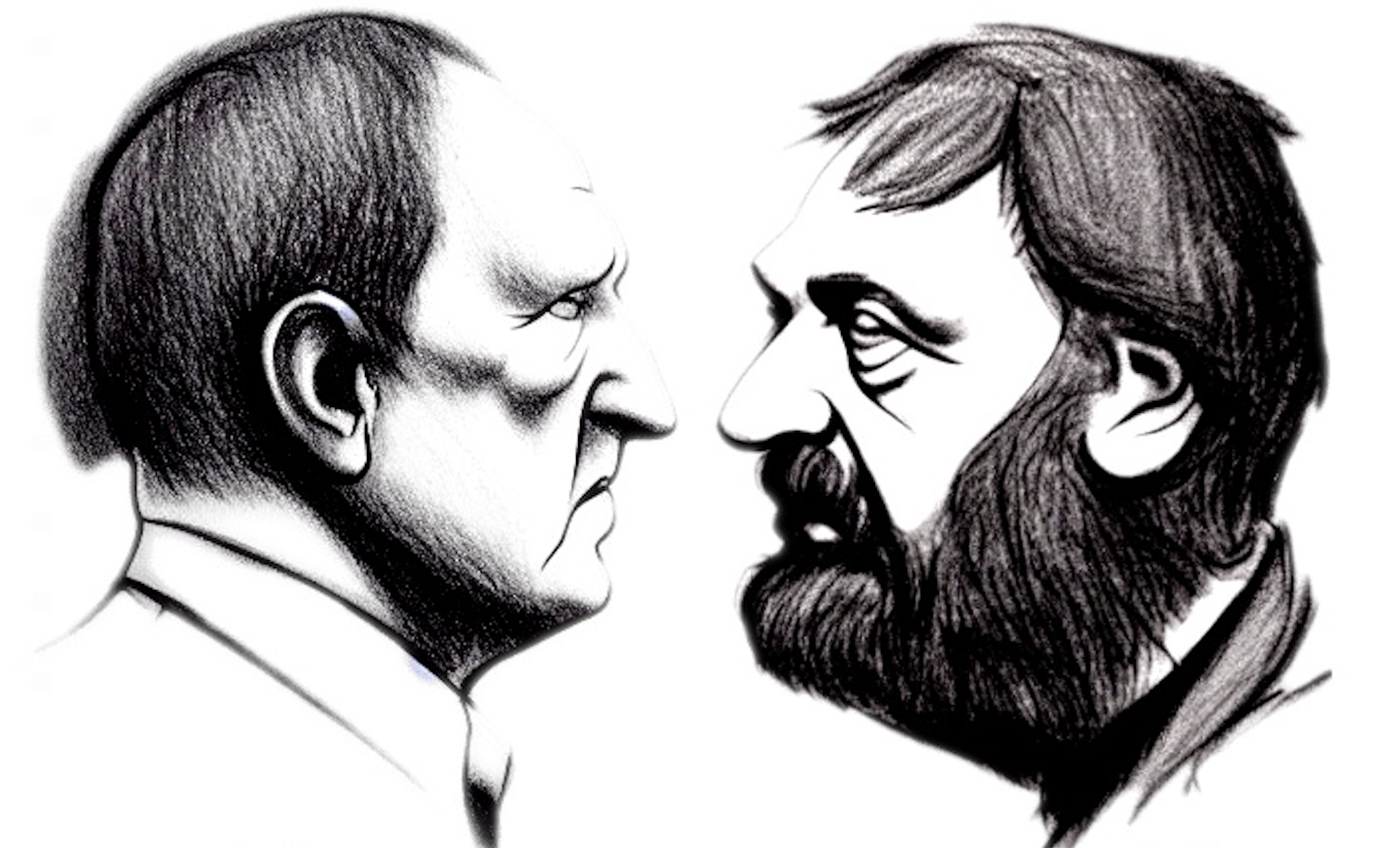
From the site Infinite Conversation comes an AI generated, never-ending discussion between Werner Herzog and Slavoj Žižek. What’s the point of this AI generated conversation? The creator explains:
As of late 2022, it’s cheap and easy to produce AI-generated content that is superficially good and surprisingly similar to “the real thing”. This applies to videos resembling celebrities (commonly known as Deepfakes) or, as in the case of the Infinite Conversation, speech.
This project aims to raise awareness about the ease of using tools for synthesizing a real voice. Right now, any motivated fool can do this with a laptop in their bedroom. This changes our relationship with the media we consume online and raises questions about the importance of authoritative sources, breach of trust and gullibility.
Will this technology lead to a massive proliferation of sub-optimal-quality content? Should we simply distrust anything we see online? As new tools are developed to help identify generated content, I recommend maintaining a skeptical stance, particularly when the source/channel of information doesn’t seem reliable and when the claims seem preposterous or outrageous.
Ultimately, I don’t see this as a technical problem, but as a human one. We all share a duty to educate the coming generations about the new paradigm while focusing on forming compassionate individuals who would not misuse these awesome powers.
As an AI optimist, I remain hopeful that we will be able to regulate ourselves, and that we will take experiments such as the Infinite Conversation for what they are: a playful way to help us imagine what our favorite people would do, if we had unlimited access to their minds. Art and Philosophy, here exemplified by Bavarian director Werner Herzog and Slovenian philosopher Slavoj Žižek, can guide us while navigating these treacherous waters.
Listen to the endless Herzog-Žižek conversation here.
If you would like to support the mission of Open Culture, consider making a donation to our site. It’s hard to rely 100% on ads, and your contributions will help us continue providing the best free cultural and educational materials to learners everywhere. You can contribute through PayPal, Patreon, and Venmo (@openculture). Thanks!
Related Content
Werner Herzog Offers 24 Pieces of Filmmaking and Life Advice
Slavoj Žižek: What Fulfils You Creatively Isn’t What Makes You Happy
Werner Herzog Narrates the Touching, Existential Journey of a Plastic Bag
Read More...
Bruce Springsteen Performs Moving Acoustic Versions of “Thunder Road,” “The Rising” & “Land of Hope & Dreams” on the Howard Stern Show
After trying for 35 years, the Howard Stern Show finally landed an interview with Bruce Springsteen–an interview that lasted 2 hours and 15 minutes and covered a tremendous amount of ground. Along the way, Springsteen talked about his song-writing process and the origins of his classic songs, and then performed some acoustic versions, alternating between guitar and piano. Above and below, you can watch stirring performances of “Thunder Road,” “The Rising,” “Land of Hope and Dreams,” “Born to Run, and “Tougher Than the Rest.”
Those who have the Sirius XM app can watch the entire performance online. For those who don’t, you can always sign up for a free trial to the service.
Land of Hope and Dreams
The Rising
Tougher Than the Rest
Born to Run
If you would like to support the mission of Open Culture, consider making a donation to our site. It’s hard to rely 100% on ads, and your contributions will help us continue providing the best free cultural and educational materials to learners everywhere. You can contribute through PayPal, Patreon, and Venmo (@openculture). Thanks!
Related Content
Read More...Michael Pollan, Sam Harris & Others Explain How Psychedelics Can Change Your Mind
You may never have tried psychedelic substances. You may never have had an interest in trying psychedelic substances. But if you’re reading this, you do have a mind, and you’ve almost certainly felt some curiosity about how that mind works. As any engineer knows, one of the shortest routes to understanding how a machine works is to disrupt its normal operations. Psychedelics do just that for your brain, shifting your consciousness into a new perspective that can offer insights into your very perceptions of reality. Or at least they do it in the view of Michael Pollan, Sam Harris, Jacob Silva, Ben Goertzel, and Matthew Johnson.
The more familiar you are with current psychedelics research, the more of those names you’ll know. Pollan, who made his name writing about food, stars in the Big Think video above about the scientific renaissance of mind-altering drugs. “The brain is a hierarchical system, and the default mode network appears to be at the top,” he explains. That network is “the orchestra conductor or corporate executive. You take that out of the picture, and suddenly you have this uprising from other parts of the brain and you have networks that don’t ordinarily communicate with one another suddenly striking up conversations.”
Psychedelic substances do this, meaning that when they’re in use, “you might have the visual cortex talking to the auditory system, and suddenly you’re seeing music.” Any music-lover would feel at least some desire for the same experience. And even those without any interest in music would surely like to enjoy for themselves what Sam Harris describes feeling during one of his own psychedelic experiences: “There was a whole veneer of fear, frankly, that I didn’t know was there that got stripped away,” leaving a “naked awareness of the present moment.”
This may sound similar to the kind of state commonly ascribed to intensive meditation, and indeed, Harris — himself a practitioner and advocate of meditative practice — acknowledges it as another path to the same destination. But for some people, Harris says, “taking a drug is the only way they’re going to notice that it’s possible to have a very different experience of the world.” Even if we’re not so “lumpen and un-inquisitive,” we still may not have seriously considered the range of benefits psychedelics could offer humanity. “Many of the disorders that psychedelics appear to treat well are manifestations of a stuck brain,” Pollan says, “a mind that’s telling itself destructive stories like, ‘I can’t get through the day without a cigarette,’ ‘I’m unworthy of love,’ ‘My work is shit.’ ”
The United States was actually conducting research into psychedelic drugs up until the early 1970s, when Richard Nixon’s administration made them illegal due to their potential to sap the will of the men who were supposed to fight the Vietnam War. (“He may well have been right,” Pollan acknowledges.) But now our society has found itself in a “mental health crisis,” as Johnson, a psychedelic-substance researcher at Johns Hopkins, puts it in the brief explainer just above, we’ll have to explore all possible avenues — even previously closed ones — in order to change our minds.
Related content:
Inside MK-Ultra, the CIA’s Secret Program That Used LSD to Achieve Mind Control (1953–1973)
Based in Seoul, Colin Marshall writes and broadcasts on cities, language, and culture. His projects include the Substack newsletter Books on Cities, the book The Stateless City: a Walk through 21st-Century Los Angeles and the video series The City in Cinema. Follow him on Twitter at @colinmarshall or on Facebook.
Read More...How Pink Floyd Built The Wall: The Album, Tour & Film
The making of Pink Floyd’s 1979 rock opera The Wall is rife with the kind of rock star ironies exploited a few years later by This Is Spinal Tap. Their fall into fractiousness and bloat began when Roger Waters firmly established himself as captain on 1977’s Animals, his tribute album for George Orwell. Stage shows became even more grandiose, leading keyboardist Richard Wright to worry they were “in danger of becoming slaves to our equipment.” Certain moments during the 1977 In the Flesh tour in support of the album seem right out of a Christopher Guest brainstorm.
One night in Frankfurt, “the stage filled with so much dry ice that the band were almost completely obscured,” Mark Blake writes in Comfortably Numb. Fans threw bottles. Crowds felt further alienated when Waters started wearing headphones onstage, trying to sync the music and visuals. During a five-night run at London’s Wembley Empire Pool, “officials from the Greater London Council descended on the venue to check that the band’s inflatable pig had been equipped with a safety line” (due to a minor panic caused by an earlier escaped pig). “Roger Waters oversaw the inspection, barking orders to the pig’s operators… “ ‘Halt pig! Revolve pig!’ ”
Moments like these could have added levity to Alan Parker’s 1982 film of The Wall, starring Bob Geldof as the main character, disaffected rock star Pink. Waters hated the movie at the time, though later said, “I’ve actually grown quite fond of it, though I very much regret there’s no humour in it, but that’s my fault. I don’t think I was in a particularly jolly state.” A prisoner of his own success, Waters resented inebriated fans who were (understandably) distracted by stage shows that threatened to overwhelm the music. Seeing fans singing along in the front row instead of listening intently sent him into a rage, leading to the infamous spitting incident, as recalled by touring guitarist Snowy White: “It was a funny gig. It was a really weird vibe… to look across the stage and see Roger spitting at this guy at the front… It was a very strange gig. Not very good vibes.”
This is still only backstory for the album and tour to come — the making of which you can learn all about in the three-part Vinyl Rewind video series here. Waters based the jaded Pink on himself and former Pink Floyd frontman Syd Barrett, who did not return from his own onstage meltdown. Waters found himself wishing he could build a wall between himself and the fans. The band liked his demo ideas and voted to move forward with the project. Then things really went sour. Pink Floyd began to fall apart during the recording sessions. As engineer James Guthrie remembers, at the start, “they were still playing together, rather than one guy at a time, which is the way we ended up recording in France.” Fractures between Waters and Richard Wright would eventually lead to Wright’s firing from the band.
Most of the personal disputes were already established before The Wall. Certainly Roger’s relationship with Rick, but things did deteriorate further on that level during the making of the album. There were some very difficult moments, but I don’t think there was ever a question of Roger not finishing the album. He’s a very strong person. Not easily deterred from his path. If everyone else had walked out, he would still have finished it.
Waters would have toured the album by himself as well — as he did after he left the band following 1983’s The Final Cut, a Pink Floyd album in name only. As it was, The Wall tour ended up sending the band into debt. Only Richard Wright made a profit, playing with the band as a salaried musician. For all the stage mishaps and interpersonal feuds — despite it all — Pink Floyd did what they set out to do. “We knew when we were making it,” says David Gilmour, in recollections mellowed by time and age, “that it was a good record.” It still stands, some forty-three years later, as one of the greats. Learn how it earned the distinction, and what that greatness cost the band that made it.
If you would like to support the mission of Open Culture, consider making a donation to our site. It’s hard to rely 100% on ads, and your contributions will help us continue providing the best free cultural and educational materials to learners everywhere. You can contribute through PayPal, Patreon, and Venmo (@openculture). Thanks!
Related Content:
Pink Floyd’s Entire Studio Discography is Now on YouTube: Stream the Studio & Live Albums
Pink Floyd Releases Its First New Song in 28 Years to Help Support Ukraine
Josh Jones is a writer and musician based in Durham, NC. Follow him at @jdmagness
Read More...Support Us
We're hoping to rely on loyal readers, rather than erratic ads. Please click the Donate button and support Open Culture. You can use Paypal, Venmo, Patreon, even Crypto! We thank you!

About Us

Open Culture scours the web for the best educational media. We find the free courses and audio books you need, the language lessons & educational videos you want, and plenty of enlightenment in between.
Advertise With Us
FREE UPDATES!
GET OUR DAILY EMAIL
Get the best cultural and educational resources on the web curated for you in a daily email. We never spam. Unsubscribe at any time.
FOLLOW ON SOCIAL MEDIA
Open Culture editor Dan Colman scours the web for the best educational media. He finds the free courses and audio books you need, the language lessons & movies you want, and plenty of enlightenment in between.
Advertise With Us

