200 Bassists Play the Famous Bass Line of Queen & Bowie’s “Under Pressure”
Ding, ding, ding, de de, ding, ding–the bassline for Queen and David Bowie’s “Under Pressure” is simple and unforgettable. In Sao Paulo, British bassist Charles Berthoud paid tribute to John Deacon’s riff, performing it with 200 other bassists. Berthoud plays a beautiful lead; the others keep the rhythm going. Evidently, the event was sponsored by Rockin’ 1000, a collective that stages gigs where hundreds of musicians perform rock classics together. You can find more of their videos in the Relateds below.
If you would like to support the mission of Open Culture, consider making a donation to our site. It’s hard to rely 100% on ads, and your contributions will help us continue providing the best free cultural and educational materials to learners everywhere. You can contribute through PayPal, Patreon, and Venmo (@openculture). Thanks!
Related Content
1,000 Musicians Perform “My Hero” in a Moving Tribute to Foo Fighters’ Drummer Taylor Hawkins
Read More...
See Metropolis’ Scandalous Dance Scene Colorized, Enhanced, and Newly Soundtracked
It didn’t take long after the invention of cinema for its sheer power of spectacle to become clear. Arguably, it was apparent even in the pioneering work of the Lumière brothers, though they attempted only to capture images familiar from everyday life at the time. But in a decade or two emerged auteurs like Fritz Lang, who, having grown up with cinema itself, possessed highly developed instincts for how to use it to captivate large and various audiences. Released in 1927, Lang’s Metropolis showed moviegoers an elaborate vision, both fearsome and alluring, of the industrial dystopia that could lay ahead. But it also had dancing girls!
Or rather, it had a dancing girl who’s actually a robot — a Maschinenmensch, according to the script — built by the film’s villain in an attempt to besmirch the heroine who would liberate the titular city’s downtrodden workers. (Both the real woman and her mechanical impersonator are skillfully played by Brigitte Helm.)
In the video above, you can see the scandalous and cinematically innovative spectacle-within-a-spectacle that is Metropolis’ dance scene colorized, upscaled to 4K resolution at 60 frames per second, and newly soundtracked with a track called “Lemme See About It” by Max McFerren. This is recognizably Metropolis, but it’s also a Metropolis none of us has ever seen before.
The production also combines visual material from different versions of the film, quite a few of which have been edited and re-edited, lost and recovered over nearly the past century. (The running times of the officially released cuts alone range from 83 to 153 minutes.) Certain differences in quality between one shot and the next make this obvious, though the consistency of the overall colorization eases the sudden transitions between them. A Metropolis fan couldn’t help but feel some curiosity about how the whole picture would play with all of these enhancements, not that it would resemble anything Lang could originally have envisioned. But then, no single cut exists that definitively reflects his intentions — and besides, he’d surely approve of how the film’s dance sequence has been made to captivate us once again.
Related content:
Metropolis: Watch Fritz Lang’s 1927 Masterpiece
If Fritz Lang’s Iconic Film Metropolis Had a Kraftwerk Soundtrack
Based in Seoul, Colin Marshall writes and broadcasts on cities, language, and culture. His projects include the Substack newsletter Books on Cities, the book The Stateless City: a Walk through 21st-Century Los Angeles and the video series The City in Cinema. Follow him on Twitter at @colinmarshall or on Facebook.
Read More...Discover Nüshu, a 19th-Century Chinese Writing System That Only Women Knew How to Write

Literacy in Chinese may now be widely attained, but it isn’t easily attained. Just a century ago it wasn’t widely attained either, at least not by half of the Chinese speakers alive. As a rule, women once weren’t taught the thousands of logographic characters necessary to read and write in the language. But in one particular section of the land, Jiangyong County in Hunan province, some did master the 600 to 700 characters of a phonetic script made to reflect the local dialect and now called Nüshu (女书), or “women’s writing.”
In its heyday, Nüshu’s users had a variety of names for it, “including ‘mosquito writing,’ because it is a little slanted and with long ‘legs,’ ” writes Ilaria Maria Sala in a Quartz piece on the script’s history. Its greatest concentration of practitioners lived in “the village of Shangjiangxu, where young girls exchanged small tokens of friendly affection, such as fans decorated with calligraphy or handkerchiefs embroidered with a few auspicious words.”
Other, more formal occasions for the use of Nüshu, included when girls decided to “make a full-fledged pact of closeness with one another that they were ‘best friends’ — jiebai zimei or ‘sworn sisters’ — a relationship that was recognized as valuable and even necessary for them in the local social system. Such a once-obscure chapter of Chinese history has proven irresistible to readers from a variety of cultures in recent decades.
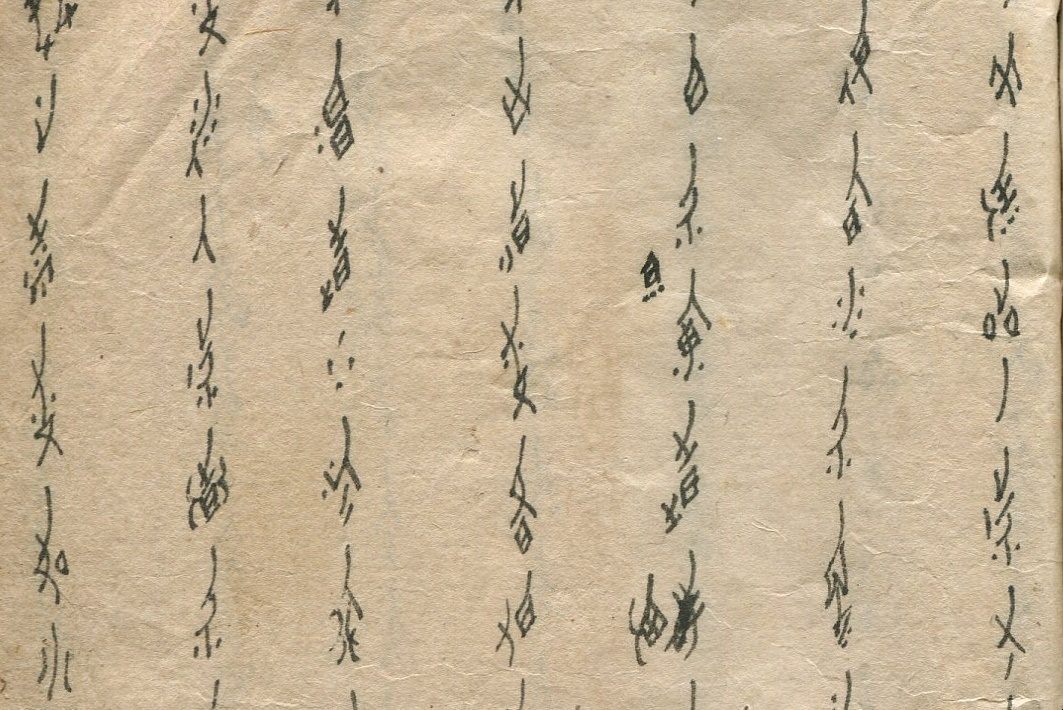
“Most interpretations and headlines have been about a ‘secret language’ that women used, preferably to communicate their pain,” writes Sala, which struck her as evidence of people taking the story of Nüshu and “reading into it what they wanted, regardless of what it meant.” Yet such an interpretation has surely done its part to spread interest in the near-extinct’s script’s revival, described by BBC.com’s Andrew Lofthouse as originating in “the tiny village of Puwei, which is surrounded by the Xiao river and only accessible via a small suspension bridge.” After three Nüshu writers were discovered there in the eighties, “it became the focal point for Nüshu research. In 2006, the script was listed as a National Intangible Cultural Heritage by the State Council of China, and a year later, a museum was built on Puwei Island.”
There training is provided to the few select “interpreters or ‘inheritors’ of the language, learning to read, write, sing and embroider Nüshu.” Ironically, Lofthouse adds, “much of what we know about Nüshu is due to the work of male researcher Zhou Shuoyi” who happened to hear of it in the nineteen-fifties and was later persecuted during Mao Zedong’s Cultural Revolution — a treatment that included 21 years in a labor camp — for having researched such an artifact of the feudal past. Once a useful tool for expressing emotions and performing social rituals socialization, Nüshu had become politically dangerous. What it becomes now, half a century later and with its renewal only just beginning, is up to its new learners.
Related content:
How Writing Has Spread Across the World, from 3000 BC to This Year: An Animated Map
Based in Seoul, Colin Marshall writes and broadcasts on cities, language, and culture. His projects include the Substack newsletter Books on Cities, the book The Stateless City: a Walk through 21st-Century Los Angeles and the video series The City in Cinema. Follow him on Twitter at @colinmarshall or on Facebook.
Read More...There Are Eight Forms of Intelligence, Not Just One: Which Apply to You?
Intelligence is a fraught subject of discussion, and only becoming more so. Among the frameworks developed safely to approach it, one has gained special prominence: the theory championed by developmental psychologist Howard Gardner, author of the book Frames of Mind: The Theory of Multiple Intelligences. And how many such intelligences are there? In the Big Think video above — posted in 2016, 33 years after Frames of Mind — he names ten: language, logic and mathematics, musical, spatial, bodily-kinesthetic, interpersonal, intrapersonal, naturalist, teaching, and existential.
Some of these may strike you as only tangentially related to intelligence, traditionally defined. Gardner has considered this: “People say, ‘Well, music’s a talent, it’s not an intelligence.’ And I say, ‘Well, why, if you’re good with words, is that an intelligence, but if you’re good with tones and rhythms and timbres…”
Nobody, in his telling, has ever come up with a convincing response. Hence his mission to expand the definition of intelligence beyond the aggregate measure of brainpower long known as the general intelligence factor — or more commonly, “g factor” — to encompass the sort of skills whose usefulness we can see in the real world, away from the constructed rigors of psychometric tests.
“Whether there’s eight intelligences or ten or twelve is less important to me than having broken the monopoly of a single intelligence, which sort of labels you for all time,” says Gardner. You can see eight of his intelligences broken down in more detail — and perhaps even identify your own strongest suit — in the Practical Psychology video just above. Gardner also expresses optimism about our ability to develop different intelligences: you can choose to concentrate on a specific one, but “if you want to be a jack of all trades and be very well-rounded, then you’re probably going to want to nurture the intelligences which aren’t that strong.” Whatever your own view on multiple intelligences, don’t forget how the old saying originally went in full: “Jack of all trades, master of none, though often better than a master of one.”
Related content:
Why You Do Your Best Thinking In The Shower: Creativity & the “Incubation Period”
Based in Seoul, Colin Marshall writes and broadcasts on cities, language, and culture. His projects include the Substack newsletter Books on Cities, the book The Stateless City: a Walk through 21st-Century Los Angeles and the video series The City in Cinema. Follow him on Twitter at @colinmarshall or on Facebook.
Read More...The Breaking Bad-O-Verse — Pretty Much Pop: A Culture Podcast #135 Considers “Better Call Saul”

Given the end of Better Call Saul, your Pretty Much Pop host Mark Linsenmayer, plus NY Times entertainment writer/philosophy professor Lawrence Ware, novelist/writing professor Sarahlyn Bruck, and philosopher/musician Al Baker discuss this strange TV “franchise” that amazingly produced a prequel that was arguably better than the original. We cover the characterization and pacing, novelistic TV vs. not having a plot roadmap in advance, and whether we want to see another installment in this world.
A few articles we consulted included:
- “Breaking Bad vs Better Call Saul: Which Series Is Better?” by Frazier Tharpe
- “What’s next for the ‘Breaking Bad’ universe?” By Adam Starkey
- “Giancarlo Esposito Wants A Gus Fring Breaking Bad Prequel” by Eddie Makuch
- “Current TV Shows That Are Just Breaking Bad Ripoffs” from Ranker
Follow us @law_writes, @sarahlynbruck, @ixisnox, @MarkLinsenmayer.
Hear more Pretty Much Pop. Support the show and hear bonus talking for this and nearly every other episode at patreon.com/prettymuchpop or by choosing a paid subscription through Apple Podcasts. This podcast is part of the Partially Examined Life podcast network.
Pretty Much Pop: A Culture Podcast is the first podcast curated by Open Culture. Browse all Pretty Much Pop posts.
Read More...
The Internet Archive Launches Democracy’s Library, a Free Online Library of 500,000 Documents Supporting Democracy

“Democracy is the worst form of government except all those other forms that have been tried from time to time.” So said Winston Churchill, perhaps not suspecting how frequently the remark would be quoted in the decades thereafter. Time and experience continue to reveal to us democracy’s liabilities, but also — at least in certain societies — the nature of its surprising staying power. Since well before Churchill’s time, democracy and its workings have been objects of fascination the world over. So have its central questions, not least the one of just how to maintain the “informed citizenry” on which its operation supposedly depends.
The Internet Archive has just launched its own kind of answer in the form of Democracy’s Library. “A free, open, online compendium of government research and publications from around the world,” the site offers citizens a way to “leverage useful research, learn about the workings of their government, hold officials accountable, and be more informed voters.”
Collected from a variety of governmental bodies like the United States’ National Agricultural Library, Foreign Broadcast Information Service, and National Institute of Standards and Technology Research Library — as well as Statistics Canada and Public Accounts of Canada — its materials were ostensibly produced for the public, but haven’t always been easy to find. It total, there are more than 500,000 documents in the collection.
“Governments have created an abundance of information and put it in the public domain, but it turns out the public can’t easily access it,” says Brewster Kahle, founder of the Internet Archive. He gives one of the series of talks that comprise “Building Democracy’s Library,” the launch celebration that took place last week and that you can still watch in the video above. Its proceedings go into quite a bit of detail about the efforts of acquisition and organization that went into this project, as well as the nature of its mission. For this isn’t just an effort to document democracy, but to strengthen it by making the information it produces available as conveniently as possible to as many citizens as possible. And no matter the country of which you count yourself a citizen, you can start browsing Democracy’s Library here.
Related content:
Does Democracy Demand the Tolerance of the Intolerant? Karl Popper’s Paradox
Based in Seoul, Colin Marshall writes and broadcasts on cities, language, and culture. His projects include the Substack newsletter Books on Cities, the book The Stateless City: a Walk through 21st-Century Los Angeles and the video series The City in Cinema. Follow him on Twitter at @colinmarshall or on Facebook.
Read More...Meet Little Amal, the 12-Foot Puppet of a 10-Year-Old Syrian Girl, Who Has Been Touring the World
Little Amal is a 10-year-old Syrian girl from a small village near Aleppo, a refugee and unaccompanied minor, who’s traveled over 9,000 kilometers over the last 15 months, hoping to reunite with her mother.
Little Amal is also a 12-foot tall rod puppet, operated by three performers — one on stilts inside her molded cane torso, to operate her head, face and legs, with two more taking charge of her hands.
As her creators, Handspring Puppet Company co-founders Adrian Kohler and Basil Jones, explain above, Amal’s puppeteers must enter a group mind state when interacting with the crowds who turn out to meet her at free, community-created events:
If the person inside on the stilts decides to turn left, the other two have to respond immediately as the arms would, so they all think the same thought.
Amal, who travels with three times as many puppeteers as are required for any given appearance and two back up versions of herself in case of malfunction, is truly a miracle of non-verbal communication.
As a child who doesn’t speak the language of the countries she has visited, she expresses herself with gestures, and seemingly involuntary micro-movements.
She bows graciously in both greeting and farewell, taking extra time to touch hands with little children.
She swivels her head, eagerly, if a bit apprehensively, taking in her surroundings.
Her lips part in wonder, revealing a row of pearly teeth.
Her big, expressive eyes are operated by the performer on stilts, using a trackpad on a tiny computer.
The lightweight ribbons that make up her long hair, pulled none too tidily away from her face with a floppy bow, catch the breeze as she towers above her well wishers.
After stops in Turkey, Greece, Italy, Switzerland, Germany, Belgium, France and the UK, Little Amal landed in New York City, where members of the Metropolitan Opera Orchestra and Children’s Chorus serenaded her with Evening Song from Philip Glass’ opera Satyagraha as she passed through John F. Kennedy International Airport.
The New York Times’ Matt Stevens described the scene as Amal came into view:
As her head peeked out from above metal barriers, Little Amal widened her eyes as she took in the arrivals terminal at Kennedy International Airport on Wednesday. She looked left, then right, clutching her big green suitcase with its rainbow and sun stickers. She was, as newcomers to New York City so often are, a little nervous, and a little lost…(she) appeared transfixed by the music — much like the many travelers strolling by with their suitcases appeared transfixed by the 12-foot-tall puppet suddenly towering before them. Still, she was trepidatious, a tad reluctant to approach the orchestra. At least, that is, until a chorus member — a girl wearing a sunflower yellow shirt — went up to her and took her by the hand.
With 50 events in 20 days, Little Amal had a packed schedule that included a nightime visit to Jane’s Carousel in Brooklyn Bridge Park and an early morning trip along Coney Island’s boardwalk. Unlike most first time visitors, she spent time in Queens, Staten Island and The Bronx.
A New Orleans style second line processional escorted her a little over a dozen blocks, from Lincoln Center, where she interacted with dancers and performance artist Machine Dazzle, to the American Museum of Natural History, above.
New York’s immigrant history was evident in Little Amal’s tour of the Lower East Side and Chinatown, with stops at the Tenement Museum and the Clemente Soto Vélez Cultural & Educational Center.
With every appearance, Amal’s incredibly lifelike movements and dignified reserved turned adults as well as children turned into believers, while bringing attention to the tens of thousands of children who have fled war and persecution in their home countries.
See photos and read more about Little Amal’s past and future travels here.
Download a free Little Amal activity and education pack here.
Related Content
Jim Henson Teaches You How to Make Puppets in Vintage Primer From 1969
The Hand Puppets That Bauhaus Artist Paul Klee Made for His Young Son
Albert Einstein Holding an Albert Einstein Puppet (Circa 1931)
- Ayun Halliday is the Chief Primatologist of the East Village Inky zine and author, most recently, of Creative, Not Famous: The Small Potato Manifesto. Follow her @AyunHalliday.
Read More...How Did They Build the Great Pyramid of Giza?: An Animated Introduction
The Great Pyramid of Giza is a miracle of geometry, construction, and planning ahead.
Pharaoh Khufu’s relative — likely nephew — Hemienu, was put in charge of the project as soon as Khufu succeeded his father, Pharaoh Sneferu circa 2550 B.C.E.
Hemienu, an engineer, priest and magician whose honorifics included Member of the Elite, Vizier, King’s Seal-Bearer, Priest of Bastet, Priest of Shesmetet, High Priest of Thoth, and, most importantly, Overseer of All Construction Projects of the King, picked wisely when choosing the Great Pyramid’s site - a rocky plateau on the Nile’s west bank made for a far sturdier foundation than shifting sands.
Historian Soraya Field Fiorio’s animated TED-Ed lesson, above, details how the 25,000 workers who took 20 years to make Hemienu’s vision a reality were not enslaved labor, as they have so often been portrayed — a rumor started by Greek historian Herodotus — but rather, ordinary Egyptian citizens fulfilling a period of mandatory government service.
Some toiled on the administrative end or in a support capacity, while others got to spend ten hours a day hauling limestone on massive cedar sleds.
A team of 500 hammered out the Pyramid’s granite support beams using dolerite rocks, a task so time consuming that Hemienu put them to work immediately, anticipating that it would take them 12 years to produce the necessary materials.
Construction schedules are always an iffy bet, but Hemienu had the added stress of knowing that Khufu could take his leave well before his glorious, golden tipped tomb was ready to receive him.
This is why there are three burial chambers within the Great Pyramid. The last and grandest of these, known as the King’s Chamber, is an impressive pink granite room at the heart of pyramid, where its roof supports over four hundred tons of masonry. An enormous red granite sarcophagus weighing well over 3 tons is located in the middle of this chamber, but alas, the lid has been ajar for centuries.
Khufu is not within.
What became of him is a mystery, but if Scooby-Doo taught us anything of value in our pre-TED-Ed childhood, it’s that mysteries exist to be solved.
Several years ago, an international team of architects and scientists Egypt surveyed the Great Pyramid and its Giza neighbors at sunrise and sunset, using infrared thermography, which seemed to indicate the existence of an as yet unexplored chamber.
TED-Ed’s lesson plan directs those interested in plumbing these and other mysteries further to the National Geographic documentary, Unlocking the Great Pyramid and Egyptologist Bob Brier’s book, The Secret of the Great Pyramid: How One Man’s Obsession Led to the Solution of Ancient Egypt’s Greatest Mystery, both of which are rooted in the work of French architect Jean-Pierre Houdin, below.
Related Content
Take a 3D Tour Through Ancient Giza, Including the Great Pyramids, the Sphinx & More
A Drone’s Eye View of the Ancient Pyramids of Egypt, Sudan & Mexico
Pyramids of Giza: Ancient Egyptian Art and Archaeology–a Free Online Course from Harvard
- Ayun Halliday is the Chief Primatologist of the East Village Inky zine and author, most recently, of Creative, Not Famous: The Small Potato Manifesto. Follow her @AyunHalliday.
Read More...The French Designed a Fake Replica of Paris to Fool German Bombers During World War I
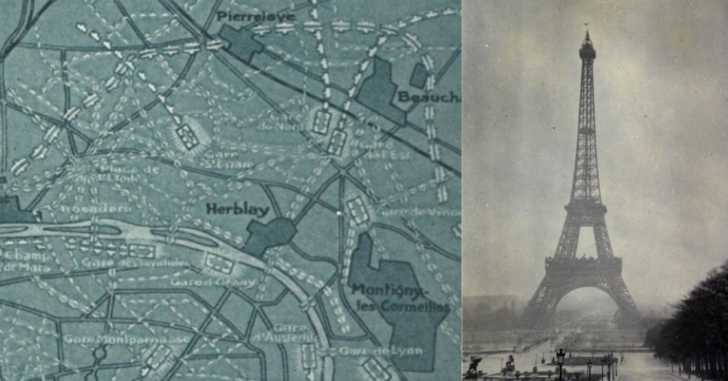
Paris counts among the most beloved cities on Earth, a status that owes in part to the relative lack of damage taken in during both World Wars. The desire to protect and preserve Paris thus runs high today, but then, it also did a century ago. The prospect of the city’s obliteration during what was then called the Great War inspired an especially ambitious defensive scheme. “At the beginning of 1917, a wild idea was floated,” writes the Daily Beast’s Allison McNearney. “Why not build a replica of Paris just outside of the city and fool German bombers into dropping their destructive loads where only the decoys made of wood and fabric could be harmed.”
This Paris leurre (decoy) is the subject of the 35-minute British Pathé documentary above, Illusion: The City That Never Was. Its detailed plan “called for the construction of three separate ‘sham’ neighborhoods just outside of the city”: a large train station modeled after Gare du Nord, a replica city center with its own Champs-Élysées, and a “faux industrial zone with factories and other indications of wartime production.”
Built mostly out of wood and fabric, these remote uninhabited quarters were to be equipped with elements like working street lighting — designed by Fernand Jacopozzi, later famed for his illumination of the Eiffel Tower — and a moving train.
As it turned out, the train was one of the few elements of this elaborate fake City of Light actually constructed. “In 1918, before the project could be completed, the war came to an end and the government quickly moved to dismantle their secret project and suppress all information concerning its existence,” writes McNearney. Only in the twenty-first century has this World War I‑era push to build a fake Paris come to light. Though never completed, its sheer ambition speaks to France’s own conception of its capital as a store of priceless cultural and historical heritage. In a sense, Paris is civilization, or at least French civilization. One must ask: would humanity go to the same lengths to protect it today?
Related content:
Color Footage of the Liberation of Paris, Shot by Hollywood Director George Stevens (1944)
How France Hid the Mona Lisa & Other Louvre Masterpieces During World War II
See Berlin Before and After World War II in Startling Color Video
Based in Seoul, Colin Marshall writes and broadcasts on cities, language, and culture. His projects include the Substack newsletter Books on Cities, the book The Stateless City: a Walk through 21st-Century Los Angeles and the video series The City in Cinema. Follow him on Twitter at @colinmarshall or on Facebook.
Read More...Futurist Makes Weirdly Accurate Predictions in 1922 About What the World Will Look Like in 2022: Wireless Telephones, 8‑Hour Flights to Europe & More
Earlier this year, we revisited a set of predictions made in 1922 about what life would look like 100 years hence, in 2022. In the pages of the New York Herald, English novelist W.L. George imagined a world in which “commercial flying will have become entirely commonplace,” and “wireless telegraphy and wireless telephones will have crushed the cable system,” resulting in generations who’ll never have seen “a wire outlined against the sky.” As for the cinema, “the figures on the screen will not only move, but they will have their natural colors and speak with ordinary voices. Thus, the stage as we know it to-day may entirely disappear, which does not mean the doom of art, since the movie actress of 2022 will not only need to know how to smile but also how to talk.” Above, you can hear a reading of W.L. George’s uncanny forecasts. The reading comes courtesy of the YouTube Channel Voices of the Past. You can read the original text of the article here.
Related Content
In 1900, Ladies’ Home Journal Publishes 28 Predictions for the Year 2000
In 1926, Nikola Tesla Predicts the World of 2026
Read More...Support Us
We're hoping to rely on loyal readers, rather than erratic ads. Please click the Donate button and support Open Culture. You can use Paypal, Venmo, Patreon, even Crypto! We thank you!

About Us

Open Culture scours the web for the best educational media. We find the free courses and audio books you need, the language lessons & educational videos you want, and plenty of enlightenment in between.
Advertise With Us
FREE UPDATES!
GET OUR DAILY EMAIL
Get the best cultural and educational resources on the web curated for you in a daily email. We never spam. Unsubscribe at any time.
FOLLOW ON SOCIAL MEDIA
Open Culture editor Dan Colman scours the web for the best educational media. He finds the free courses and audio books you need, the language lessons & movies you want, and plenty of enlightenment in between.
Advertise With Us

