Hear a Great Radio Documentary on William S. Burroughs Narrated by Iggy Pop
Images via Wikimedia Commons
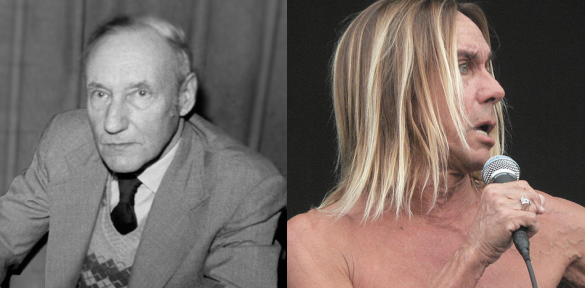
William S. Burroughs is one of the most mythologized American authors of the 20th century. When you recall the details of his life, they read like the biography of a fictional character. He was an unabashed heroin addict yet he dressed like a dapper insurance salesman. He was openly, militantly gay at a time when homosexuality wasn’t even mentioned in polite society. He shot his wife, Joan Vollmer, in Mexico City while playing an ill-conceived game of William Tell and then spent years in Tangiers indulging in every possible vice while writing Naked Lunch, which happened to be one of the most controversial books of the century. And his writing influenced just about everyone you consider cool.
Back in 2015, to commemorate the 101st birthday of Burroughs, This American Life aired a BBC documentary on Burroughs’s life. The show is narrated by Iggy Pop whose voice, in announcer mode, bears an uncanny resemblance to Sam Elliot. Pop relates how Burroughs influenced Kurt Cobain, punk rock and Bob Dylan, and how he himself lifted lyrics from Burroughs for his most popular song, and unlikely Carnival Cruise jingle, “Lust for Life.”
As Ira Glass notes, the documentary paints a clear picture of why he is such a revered figure – going into detail about his writing, his hugely influential “Cut Up” method, his obsession with cats – while never buying into his mystique. In fact, one of the most interesting parts of the doc is a damning appraisal of Burroughs’s cool junkie persona by author Will Self, who was himself an addict for a couple of decades. You can listen to the whole episode above.
If you would like to support the mission of Open Culture, consider making a donation to our site. It’s hard to rely 100% on ads, and your contributions will help us continue providing the best free cultural and educational materials to learners everywhere. You can contribute through PayPal, Patreon, and Venmo (@openculture). Thanks!
Note: This post originally appeared on our site in 2015.
Related Content:
William S. Burroughs on the Art of Cut-up Writing
William S. Burroughs on Saturday Night Live, 1981
Jonathan Crow is a Los Angeles-based writer and filmmaker whose work has appeared in Yahoo!, The Hollywood Reporter, and other publications. You can follow him at @jonccrow. And check out his blog Veeptopus, featuring lots of pictures of badgers and even more pictures of vice presidents with octopuses on their heads. The Veeptopus store is here.
Read More...What the Rosetta Stone Actually Says
When most of us think of the words “Rosetta Stone” — or, at least, when those of us past a certain age do — we also think of at-home language-learning courses. This must count as a triumph of branding, but not one without a genuine basis in history. For the Rosetta Stone, the real Rosetta Stone, did provide humanity with a means of greatly expanding its store of linguistic knowledge. The stone’s text, originally carved during the Hellenistic period, turned out to be useful indeed after the stone’s rediscovery about twenty centuries later. Its content, and more specifically its content’s having been written three times in three different scripts, unlocked the mystery of Ancient Egyptian hieroglyphs.
But what, exactly, is that content? In the video above, you can hear the nature of the Rosetta Stone’s message explained by British Museum curator Ilona Regulski. “It was a priestly decree that was drawn up on the 22nd of March, 196 BC,” she says. Issued by a council of priests who’d traveled to the ancient capital of Memphis, it lists “honors that they want to give to the king” Ptolemy V Epiphanes, going so far as “to compare him with a god.” These honors include his statue being placed in the temple and carried during processions, his birthday being celebrated in the temple, and the date of his succession being added to official documents — all of them enumerated in “one big sentence.”
The text also stipulates that this decree had to be “written in stone, in sacred writing, which is hieroglyphs, in native writing, which is the Demotic that we see in the middle, and the writing of the Greeks. And the stele would have to be put up in all important temples of Egypt,” which means that there would have been many copies all over the country. (And indeed, more have been found since the initial discovery in 1799.) Nor is the Rosetta Stone the only known example of such a priestly decree from Ancient Egypt. More recent research has turned toward the question of who wrote such texts, as well as who translated them.
“In the time the Rosetta Stone was inscribed, Egypt was a very multicultural place, with many foreigners and people who could speak more than one language,” says Regulski. “For Egyptian priests and scribes, who were working for the centralized administration for the states, it probably wouldn’t have been so difficult to compose the text in Greek and then translate it into their own Egyptian native language. In fact, this probably would have been easier for them, because they worked on a daily basis in the Greek language.” At the time, the task of translation would surely have seemed routine, even trivial beside the royal exaltation performed by the message itself. But today, when few of us worship kings as gods, we exalt the Rosetta Stone’s forgotten translator instead.
Related content:
How Scholars Finally Deciphered Linear B, the Oldest Preserved Form of Ancient Greek Writing
A 4,000-Year-Old Student ‘Writing Board’ from Ancient Egypt (with Teacher’s Corrections in Red)
What Ancient Egyptian Sounded Like & How We Know It
Learn 48 Languages Online for Free: Spanish, Chinese, English & More
Based in Seoul, Colin Marshall writes and broadcasts on cities, language, and culture. His projects include the Substack newsletter Books on Cities, the book The Stateless City: a Walk through 21st-Century Los Angeles and the video series The City in Cinema. Follow him on Twitter at @colinmarshall or on Facebook.
Read More...Why Quentin Tarantino Will Only Make 10 Movies
Time and again in interviews, Quentin Tarantino has straight-facedly declared that he will retire from filmmaking after his tenth feature. He may already have reached that number with 2019’s Once Upon a Time… in Hollywood, depending on whether each part of Kill Bill counts as a separate film. If not, we have one more Tarantino picture to look forward to. His declaration of imminent retirement is unusual and even dispiriting given that he’s still in his late fifties, an age that has found many auteurs at the peak of their powers. What lies behind it is the subject of the short video above from Evan Puschak, better known as the Nerdwriter.
“I like the idea that there is an umbilical cord connected to my first film, all the way to my last, and that is my body of work,” says Tarantino in one of the interview clips included. “A bad film on the filmography affects good films.” Being known not just as a prominent director but an obsessive cinephile, Tarantino can surely name off the top of his head dozens of master filmmakers who allowed their own bodies of work to be blemished.
“Artists don’t always notice when their skills are flagging,” as Puschak puts it. “Tarantino is leaving early to prevent crossing that line unwittingly.” Though speculative, this notion has hardly been contradicted by the director’s own words.
Puschak writes about the power of the oeuvre — an artist’s body of work taken as a whole, even as an artwork in itself — in his new book Escape into Meaning. The content of this video reflects only the first section of that essay, a meditation on what it means to consider everything a creator has made as a piece of an interconnected whole. The techniques, references, themes, and obsessions that recur prominently in Tarantino’s movies make his filmography practically invite such an analysis, as well the question asked by Puschak: “Can a well-designed filmography bestow greater meaning onto the films that make it up?” No matter how many more works Tarantino will make, and whatever form they take, the whole of his existing oeuvre assures us that all of them will be thoroughly Tarantinian.
Related content:
An Analysis of Quentin Tarantino’s Films Narrated (Mostly) by Quentin Tarantino
How Quentin Tarantino Remixes History: A Brief Study of Once Upon a Time… in Hollywood
Based in Seoul, Colin Marshall writes and broadcasts on cities, language, and culture. His projects include the Substack newsletter Books on Cities, the book The Stateless City: a Walk through 21st-Century Los Angeles and the video series The City in Cinema. Follow him on Twitter at @colinmarshall or on Facebook.
Read More...Unpopular Music Fandom — Musicians and Philosophers Discuss on Pretty Much Pop: A Culture Podcast #134

With the dissolution of popular music culture by the Internet, what is it now to be into music genres that aren’t currently popular? Is it still an act of rebellion, or is even that passé?
Your Pretty Much Pop host Mark Linsenmayer is joined by composer/multi-instrumentalist Jonathan Segel from Camper van Beethoven, philosopher Matt Teichman of the Elucidations podcast, and musician and Internet DJ Steve Petrinko to talk about our relation to the mainstream, the different types of unpopular music (popular 30 years ago vs. never popular avant garde), post-irony, and more.
Listen to Jonathan and Steve talking about their own music on Mark’s Nakedly Examined Music podcast. Listen to one of Matt’s electronic compositions from college. Listen to Mark and Matt on Matt’s podcast.
Watch Richard Thompson sing “Oops I Did It Again.” Here’s that attempt to give a 2022 remix to the 80s hit “Come On Eileen.”
As recommendations, Jonathan mentioned Venetian Snares, Steve recommended early Weather Report. Read Jonathan’s blog about various versions of The Grateful Dead’s “Dark Star.” Read Pat Metheny picking on Kenny G.
Hear more Pretty Much Pop. Support the show and hear bonus talking for this and nearly every other episode at patreon.com/prettymuchpop or by choosing a paid subscription through Apple Podcasts. This podcast is part of the Partially Examined Life podcast network.
Pretty Much Pop: A Culture Podcast is the first podcast curated by Open Culture. Browse all Pretty Much Pop posts.
Read More...DALL‑E, the New AI Art Generator, Is Now Open for Everyone to Use
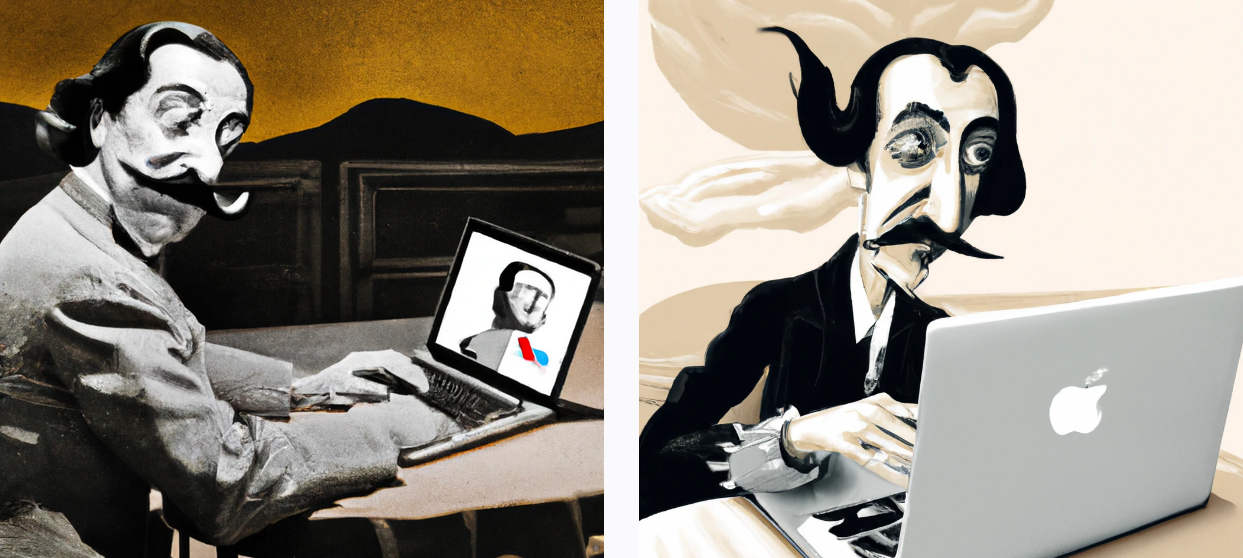
If you spend any time at all on social media, you’ll have glimpsed the work of DALL‑E, OpenAI’s now-famous artificial-intelligence engine that generate images from simple text descriptions. A velociraptor dressed like Travis Bickle, American Gothic starring Homer and Marge Simpson, that astronaut riding a horse on the moon: like any the-future-is-now moment, especially in recent years on the internet, DALL-E’s rise has produced a host of artifacts as impressive as they are ridiculous. Now you can try to top them in both of those dimensions yourself, since not just DALL‑E but the new, improved, higher-resolution DALL‑E 2 has just opened for public use.
“How do you use DALL‑E 2?” You might well ask, and Creative Bloq has a guide for you. “The tool generates art based on text prompts,” it explains. “On the face of it, that couldn’t be more simple. Once you’ve completed the DALL‑E 2 sign up to open an account, you use the program in your browser on the DALL‑E 2 website. You type in a description of what you want, and DALL‑E will create the image.”
Of course, some prompts produce more visually interesting results than others. The guide recommends that you consult the DALL‑E 2 prompt book, which gets into how best to phrase your descriptions in order to inspire the richest combinations of subject, texture, style, and form.
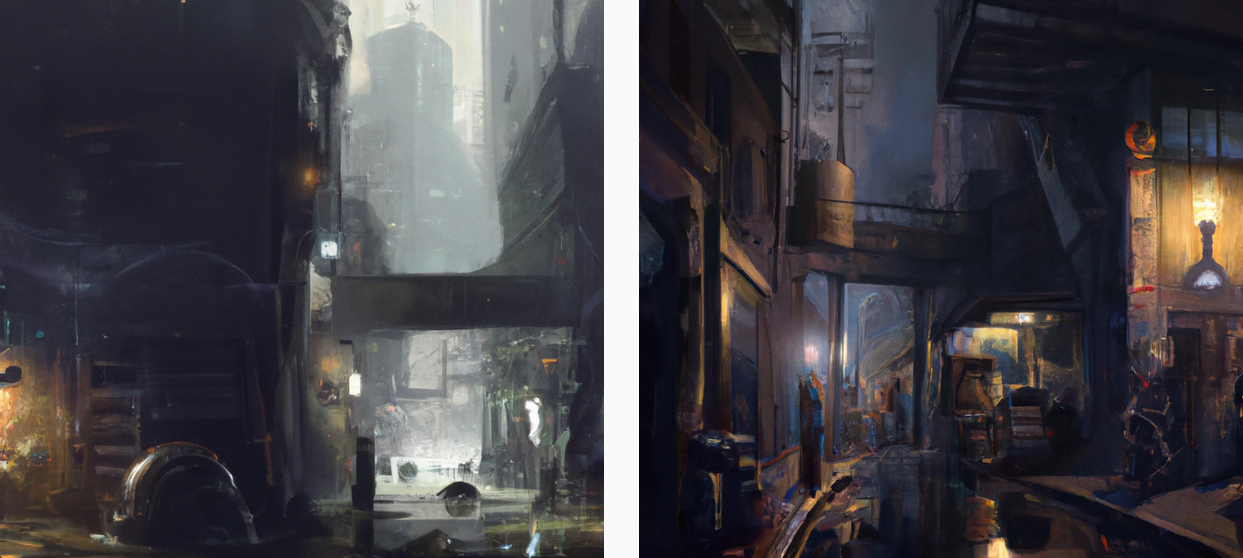
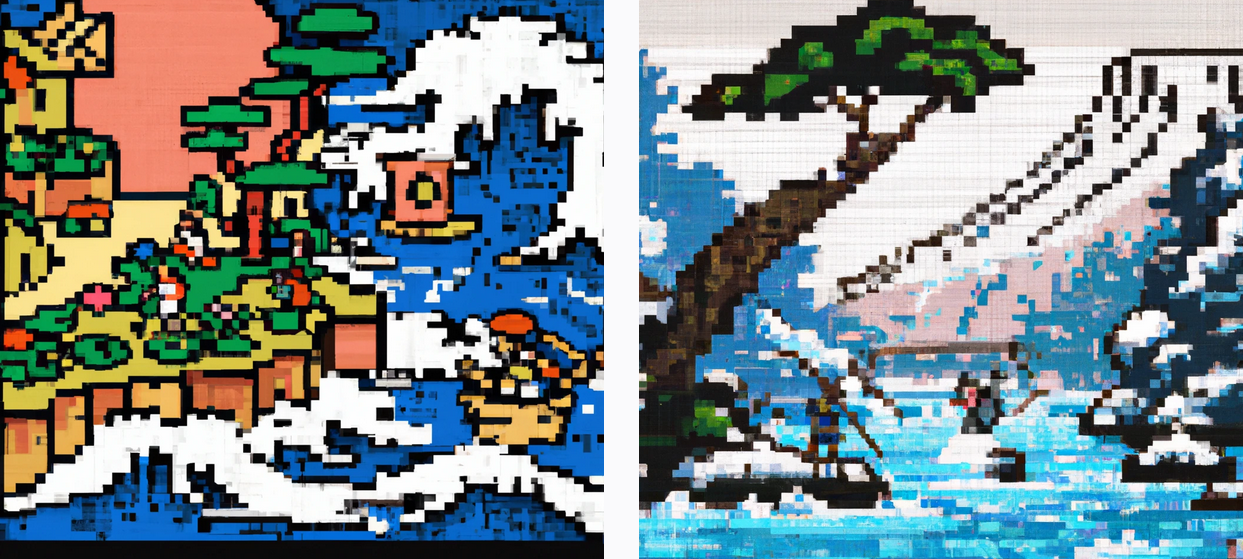
“Even the creators of DALL‑E 2 don’t know what the tool knows and doesn’t know. Instead, users have to work out what it’s capable of doing and how to get it to do what they want.” And indeed, that’s the part of the fun. DALL-E’s own interface recommends that you “start with a detailed description,” and with a little experimentation you’ll discover that specificity is key. The renderings of “an eight-bit Nintendo game designed by Hiroshige” and “a cyberpunk downtown Los Angeles scene painted by Rembrandt” strike me as credible enough for a first effort, but adding just a few more words opens up entirely new realms of surprise and incongruity.
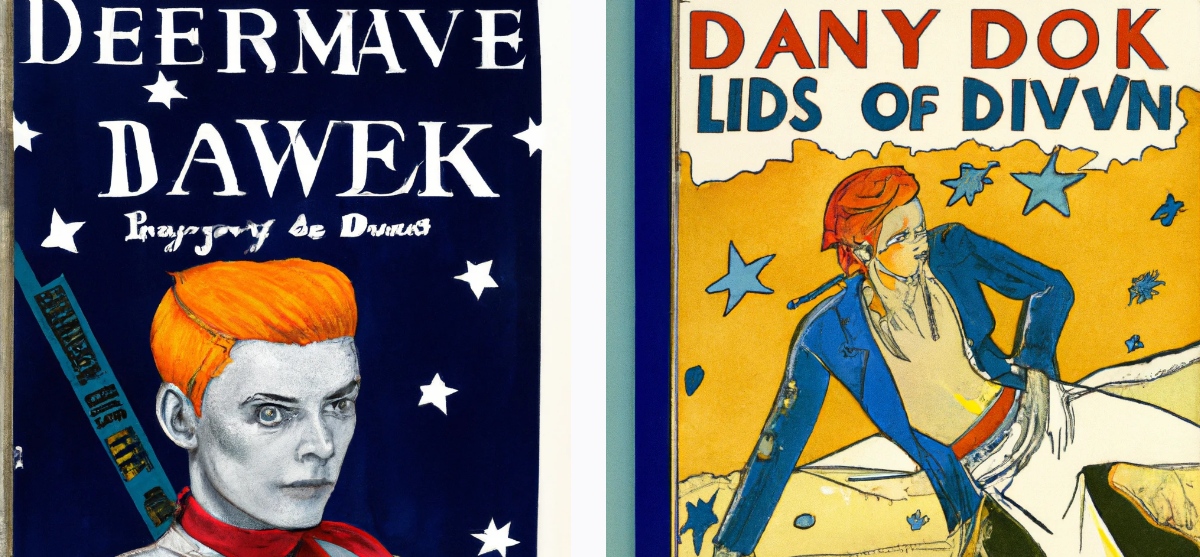
Just above, we have two of DALL-E’s infinitely many possible attempts to visualize “the cover of an old Ernest Hemingway pulp novel about the adventures of David Bowie.” Though the designs look entirely plausible, the titles highlight the technology’s already-notorious inability to come up with intelligible text. Other limitations of the newly public DALL‑E, according to Ars Technica’s Benj Edwards, include the requirement to provide your phone number and other information in order to sign up, the ownership of the generated images by OpenAI, and the necessity to purchase “credits” to generate more images after you’ve run through your initial free 50. Still, there’s nothing quite like typing in a few words and summoning up works of art no one has ever seen before to make you feel like you’re living in the twenty-first century. You can sign up here.
Related content:
Discover DALL‑E, the Artificial Intelligence Artist That Lets You Create Surreal Artwork
Based in Seoul, Colin Marshall writes and broadcasts on cities, language, and culture. His projects include the Substack newsletter Books on Cities, the book The Stateless City: a Walk through 21st-Century Los Angeles and the video series The City in Cinema. Follow him on Twitter at @colinmarshall or on Facebook.
Read More...How Rick Astley’s “Never Gonna Give You Up” Went from 80s Pop Smash to Bastion of Internet Culture: A Short Documentary
It was an isolating existence, being a Rick Astley fan at the turn of the millennium. I was in high school at the time, and it was on a weekend-morning cable-TV binge that I happened first to hear his music — albeit just a few seconds of it — on a commercial for one of those order-by-phone nostalgia compilations. Intrigued by the contrast of the unabashed nineteen-eighties production, equally energetic and synthetic, against Astley’s powerful, unusually textured voice, I went straight to AudioGalaxy for the MP3. Even before I’d heard its whole three and a half minutes, I was hooked. The song of which I speak is, of course, “Together Forever.”
You’ve got to remember that, two decades ago, Astley’s debut single “Never Gonna Give You Up” hadn’t yet racked up a billion views on Youtube. Nor could you even find it on Youtube; nor, come to that, could you find anything on Youtube, since it didn’t exist. It was then quite easy to be unaware of the song, and indeed of Astley himself, given that he’d burnt out and retired from the music business in the mid-nineteen-nineties. If you’d heard of him, you might well have written him off as an eighties flash-in-the-pan. (Yet to be resurrected by the retro gods, the aesthetics of that decade were still at their nadir of fashionability.) But in its day, “Never Gonna Give You Up” was a pop phenomenon of rare distinction.
The short Vice documentary above recounts how Astley became an overnight sensation, bringing in the singer himself as well as his original production team: Mike Stock, Matt Aitken, and Pete Waterman, the trio who created the sound of British eighties pop. It was while playing with a band in his small northern hometown that Astley caught Stock Aitken Waterman’s ear, and soon thereafter he found himself working as a “tea boy” in their London studio. At that time he lived at Waterman’s home, and after overhearing the latter screaming at his girlfriend through his giant eighties phone, he made a fateful remark: “You’re never gonna give her up, are you?”
From there, “Never Gonna Give You Up” seems practically to have written itself, though its producers admit to having ill sensed its potential during recording. Shelved for a time, the song was finally included on a magazine mix tape, at which point it went the eighties equivalent of viral: airplay on the independent Capital London soon crossed over to a variety of mainstream radio formats. “They hadn’t got a clue that he was a white guy,” says Waterman, nor, as Astley himself adds, that he “looked about eleven years old.” All was soon revealed by the music video — then still a novel form — hastily and somewhat amateurishly produced in the wake of the single’s chart-topping success.
These not-unappealing incongruities inspired one of my fellow Millennials, a young enlisted man named Sean Cotter, to relaunch Astley’s hit into the zeitgeist in 2007. “I immediately knew I wanted to make this thing into a meme,” he says, and so he invented “rickrolling,” the prank of sending an unrelated-looking link that actually leads to the “Never Gonna Give You Up” video. Despite originating in a spirit of mockery, it enabled the comeback Astley had been tentatively attempting in the preceding years. Today, at a distance from the eighties and the two-thousands alike, we can finally hear “Never Gonna Give You Up” for what it is: an inspired work of pop songcraft that reflects the distinctive appeal of both its era and its performer — or as Astley puts it, “a bloody hit, man.”
Related content:
Rick Astley Sings an Unexpectedly Enchanting Cover of the Foo Fighters’ “Everlong”
Student Rickrolls Teacher By Sneaking Rick Astley Lyrics into Quantum Physics Paper
Based in Seoul, Colin Marshall writes and broadcasts on cities, language, and culture. His projects include the Substack newsletter Books on Cities, the book The Stateless City: a Walk through 21st-Century Los Angeles and the video series The City in Cinema. Follow him on Twitter at @colinmarshall or on Facebook.
Read More...Winston Churchill Goes Backward Down a Water Slide & Loses His Trunks (1934)
World-changing figures can have their lighter moments too. Just witness Winston Churchill above, taking a trip to the French Riviera in 1934 and sliding backward down a water slide, only to lose his swim trunks at the end. The previously unseen clip comes from the Churchill family archives and founds its way into a Smithsonian documentary in 2021.
If you would like to support the mission of Open Culture, consider making a donation to our site. It’s hard to rely 100% on ads, and your contributions will help us continue providing the best free cultural and educational materials to learners everywhere. You can contribute through PayPal, Patreon, and Venmo (@openculture). Thanks!
Related Content
Winston Churchill’s Paintings: Great Statesman, Surprisingly Good Artist
Read More...Simone de Beauvoir Speaks on American TV (in English) About Feminism, Abortion & More (1976)
France has long been known for the cultural prominence it grants to its philosophers. Even so, such prominence doesn’t simply come to every French philosopher, and some have had to work tirelessly indeed to achieve it. Take Simone de Beauvoir, who most powerfully announced her arrival on the intellectual scene with Le Deuxième Sexe and its famous declaration, “On ne naît pas femme, on le devient.” Those words remain well known today, 36 years after their author’s death, and their implications about the nature of womanhood still form the intellectual basis for many observers of the feminine condition, in France and elsewhere.
Le Deuxième Sexe was first published in English in 1953, as The Second Sex. By that point de Beauvoir had already traveled extensively in the United States (and even written a book, America Day by Day, about the experience), but her readership in that country had only just begun to grow. An avowed feminist, she would through the subsequent decades become a more and more oft-referenced figure among American writers and readers who sought to apply that label to themselves as well.
One such feminist was the psychologist Dorothy Tennov, who’s best remembered for coining the term limerence. A few years before she did that, she traveled to France to conduct an interview with de Beauvoir — and indeed “in her Paris apartment, provided the TV crew was all-female.”
Aired on public television station WNED in 1976, this wide-ranging conversation has Beauvoir laying out her views on a host of subjects, from abortion to homosexuality to feminism itself. “What do you think women feel most about feminism?” Tennov asks. “They are jealous of the women who are not just the kind of servant and the slaves and objects — they are themselves,” de Beauvoir says. “They fear to feel an infériorité in regard with the women who work outside, and who do as they want and who are free. And maybe they are afraid of the freedom which is made possible for them, because freedom is something very precious, but in a way a little fearful, because you don’t know exactly what to do with it.” Here we see one reason de Beauvoir’s work has endured: she understood that man’s fear of freedom is also woman’s.
Related content:
An Animated Introduction to the Feminist Philosophy of Simone de Beauvoir
The Meaning of Life According to Simone de Beauvoir
Simone de Beauvoir’s Philosophy on Finding Meaning in Old Age
Lovers and Philosophers — Jean-Paul Sartre & Simone de Beauvoir Together in 1967
Simone de Beauvoir Tells Studs Terkel How She Became an Intellectual and a Feminist (1960)
Simone de Beauvoir & Jean-Paul Sartre Shooting a Gun in Their First Photo Together (1929)
Based in Seoul, Colin Marshall writes and broadcasts on cities, language, and culture. His projects include the Substack newsletter Books on Cities, the book The Stateless City: a Walk through 21st-Century Los Angeles and the video series The City in Cinema. Follow him on Twitter at @colinmarshall or on Facebook.
Read More...Watch Vintage Videos Capturing Life in Japan from the 1960s Through Today
Just yesterday, Japan fully re-opened its borders to tourism after a long period of COVID-19-motivated closure. This should prove economically invigorating, given how much demand to visit the Land of the Rising Sun has built up over the past couple of years. Even before the pandemic, Japan had been a country of great interest among world travelers, and for more than half a century at that. Much of that attractiveness has, of course, to do with its distinctive nature, which manifests both deep tradition and hyper-modernity at once.
But some of it also has to do with the fact that, since rising from the devastation of the Second World War, Japan has hardly shied away from self-promotion. “A Day in Tokyo,” the short film at the top of the post, was produced by the Japan National Tourism Organization in 1968.
Its vivid color footage of Japan’s great metropolis, “the world’s largest and liveliest,” captures everyday life as it was then lived in Tokyo’s department stores, stock exchanges, construction sites, and zoos.
The film puts a good deal of emphasis on the capital’s still-ongoing postwar transformation: “In a constant metabolic cycle of destruction and creation, Tokyo progresses at a dizzying pace,” declares the film’s narrator. “People who haven’t seen Tokyo for ten years, or even five, would scarcely recognize it today.” And if Tokyo was dizzying in the late nineteen-sixties, it became positively disorienting in the eighties. On the back of that era’s economic bubble, Japan looked about to become the wealthiest country in the world, and Tokyoites both worked and played accordingly hard.
This two-part compilation of scenes from Japan in the eighties conveys that time with footage drawn from a variety of sources, including feature films (not least Itami Jūzō’s beloved 1985 ramen comedy Tampopo.) “It was a magical place at a magical time,” remembers one American commenter who lived in Japan back then. “Everything seemed possible. Everybody was prospering. Almost every crazy business idea seemed to succeed. People were happy and shared their happiness and good fortune with others. It was like no other place on earth.”
As dramatically as the bubble burst at the end of the eighties, Japanese life in the subsequent “lost decades” has also possessed a richness of its own. You can see it in this compilation of footage of Japan in the nineties and two-thousands from the same channel, TRNGL. Though it no longer seemed able to buy up the rest of the world, the country had by that era built up a global consciousness of its culture by exporting its films, its animation, its music, its video games, and much more besides. Even if you haven’t seen this Japan in person, you’ve come to know it through its art and media.
If you’re considering making the trip, this video of “Japan nowadays” will give you a sense of what you’ve been missing. The Tokyo of the twenty-first century shown in its clips certainly isn’t the same city it was in 1968. Yet it remains “an intermingling of Orient and Occident, seemingly new, but actually old,” as the narrator of “A Day in Tokyo” puts it. “Beneath its modern exterior, there still lingers an atmosphere of past glories. The citizens remain unalterably Japanese, and yet this great city is able to accommodate and understand people of all races, languages, and beliefs” — people now arriving by the thousands once again.
Related content:
The Entire History of Japan in 9 Quirky Minutes
1850s Japan Comes to Life in 3D, Color Photos: See the Stereoscopic Photography of T. Enami
Hand-Colored 1860s Photographs Reveal the Last Days of Samurai Japan
Based in Seoul, Colin Marshall writes and broadcasts on cities, language, and culture. His projects include the Substack newsletter Books on Cities, the book The Stateless City: a Walk through 21st-Century Los Angeles and the video series The City in Cinema. Follow him on Twitter at @colinmarshall or on Facebook.
Read More...What’s the Best Audio Book You’ve Ever “Read”?

We were looking for a good audiobook. So we asked our friends on Twitter for their audiobook recommendations, and recommendations we got. Good ones, and more than a few. So we thought we would share the twitter thread/recommendations with you.
I, Claudius narrated by Nelson Runger; Lolita read by Jeremy Irons; Last Chance Texaco by Rickie Lee Jones; The Iliad as read by Alfred Molina; The Odyssey read by Ian McKellen; Anna Karenina narrated by Maggie Gyllenhaal, and the list goes on.
If you find any titles you like, you can always sign up for a free trial with Audible.com.
Please feel free to add any of your own favorites to the comments section below. Enjoy…
If you would like to support the mission of Open Culture, consider making a donation to our site. It’s hard to rely 100% on ads, and your contributions will help us continue providing the best free cultural and educational materials to learners everywhere. You can contribute through PayPal, Patreon, and Venmo (@openculture). Thanks!
Related Content
1,000 Free Audio Books: Download Great Books for Free
Hear Benedict Cumberbatch Reading Letters by Kurt Vonnegut, Alan Turing, Sol LeWitt, and Others https://www.openculture.com/2022/01/hear-benedict-cumberbatch-reading-letters-by-kurt-vonnegut-alan-turing-sol-lewitt-and-others.html
Read More...Support Us
We're hoping to rely on loyal readers, rather than erratic ads. Please click the Donate button and support Open Culture. You can use Paypal, Venmo, Patreon, even Crypto! We thank you!

About Us

Open Culture scours the web for the best educational media. We find the free courses and audio books you need, the language lessons & educational videos you want, and plenty of enlightenment in between.
Advertise With Us
FREE UPDATES!
GET OUR DAILY EMAIL
Get the best cultural and educational resources on the web curated for you in a daily email. We never spam. Unsubscribe at any time.
FOLLOW ON SOCIAL MEDIA
Open Culture editor Dan Colman scours the web for the best educational media. He finds the free courses and audio books you need, the language lessons & movies you want, and plenty of enlightenment in between.
Advertise With Us



.jpg)