Download The Harvard Classics as Free eBooks: A “Portable University” Created in 1909
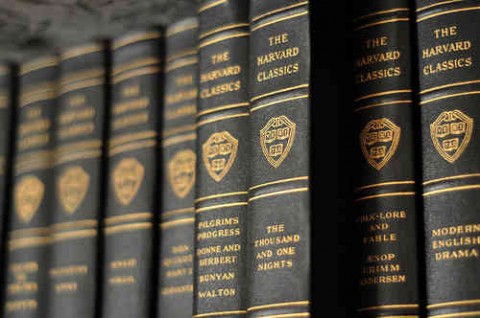
Every revolutionary age produces its own kind of nostalgia. Faced with the enormous social and economic upheavals at the nineteenth century’s end, learned Victorians like Walter Pater, John Ruskin, and Matthew Arnold looked to High Church models and played the bishops of Western culture, with a monkish devotion to preserving and transmitting old texts and traditions and turning back to simpler ways of life. It was in 1909, the nadir of this milieu, before the advent of modernism and world war, that The Harvard Classics took shape. Compiled by Harvard’s president Charles W. Eliot and called at first Dr. Eliot’s Five Foot Shelf, the compendium of literature, philosophy, and the sciences, writes Adam Kirsch in Harvard Magazine, served as a “monument from a more humane and confident time” (or so its upper classes believed), and a “time capsule…. In 50 volumes.”
What does the massive collection preserve? For one thing, writes Kirsch, it’s “a record of what President Eliot’s America, and his Harvard, thought best in their own heritage.” Eliot’s intentions for his work differed somewhat from those of his English peers. Rather than simply curating for posterity “the best that has been thought and said” (in the words of Matthew Arnold), Eliot meant his anthology as a “portable university”—a pragmatic set of tools, to be sure, and also, of course, a product. He suggested that the full set of texts might be divided into a set of six courses on such conservative themes as “The History of Civilization” and “Religion and Philosophy,” and yet, writes Kirsch, “in a more profound sense, the lesson taught by the Harvard Classics is ‘Progress.’” “Eliot’s [1910] introduction expresses complete faith in the ‘intermittent and irregular progress from barbarism to civilization.’”
In its expert synergy of moral uplift and marketing, The Harvard Classics (find links to download them as free ebooks below) belong as much to Mark Twain’s bourgeois gilded age as to the pseudo-aristocratic age of Victoria—two sides of the same ocean, one might say.
The idea for the collection didn’t initially come from Eliot, but from two editors at the publisher P.F. Collier, who intended “a commercial enterprise from the beginning” after reading a speech Eliot gave to a group of workers in which he “declared that a five-foot shelf of books could provide”
a good substitute for a liberal education in youth to anyone who would read them with devotion, even if he could spare but fifteen minutes a day for reading.
Collier asked Eliot to “pick the titles” and they would publish them as a series. The books appealed to the upwardly mobile and those hungry for knowledge and an education denied them, but the cost would still have been prohibitive to many. Over a hundred years, and several cultural-evolutionary steps later, and anyone with an internet connection can read all of the 51-volume set online. In a previous post, we summarized the number of ways to get your hands on Charles W. Eliot’s anthology:
You can still buy an old set off of Amazon for $750. But, just as easily, you can head to the Internet Archive and Project Gutenberg, which have centralized links to every text included in The Harvard Classics (Wealth of Nations, Origin of Species, Plutarch’s Lives, the list goes on below). Please note that the previous two links won’t give you access to the actual annotated Harvard Classics texts edited by Eliot himself. But if you want just that, you can always click here and get digital scans of the true Harvard Classics.
In addition to these options, Bartleby has digital texts of the entire collection of what they call “the most comprehensive and well-researched anthology of all time.” But wait, there’s more! Much more, in fact, since Eliot and his assistant William A. Neilson compiled an additional twenty volumes called the “Shelf of Fiction.” Read those twenty volumes—at fifteen minutes a day—starting with Henry Fielding and ending with Norwegian novelist Alexander Kielland at Bartleby.
What may strike modern readers of Eliot’s collection are precisely the “blind spots in Victorian notions of culture and progress” that it represents. For example, those three harbingers of doom for Victorian certitude—Marx, Nietzsche, and Freud—are nowhere to be seen. Omissions like this are quite telling, but, as Kirsch writes, we might not look at Eliot’s achievement as a relic of a naively optimistic age, but rather as “an inspiring testimony to his faith in the possibility of democratic education without the loss of high standards.” This was, and still remains, a noble ideal, if one that—like the utopian dreams of the Victorians—can sometimes seem frustratingly unattainable (or culturally imperialist). But the widespread availability of free online humanities certainly brings us closer than Eliot’s time could ever come.
If you would like to support the mission of Open Culture, consider making a donation to our site. It’s hard to rely 100% on ads, and your contributions will help us continue providing the best free cultural and educational materials to learners everywhere. You can contribute through PayPal, Patreon, and Venmo (@openculture). Thanks!
Related Content:
The Harvard Classics: A Free, Digital Collection
975 Free Online Courses from Top Universities
Josh Jones is a writer and musician based in Durham, NC. Follow him at @jdmagness
Read More...The Entire Archives of Radical Philosophy Go Online: Read Essays by Michel Foucault, Alain Badiou, Judith Butler & More (1972–2022)
On a seemingly daily basis, we see attacks against the intellectual culture of the academic humanities, which, since the 1960s, have opened up spaces for leftists to develop critical theories of all kinds. Attacks from supposedly liberal professors and centrist op-ed columnists, from well-funded conservative think tanks and white supremacists on college campus tours. All rail against the evils of feminism, post-modernism, and something called “neo-Marxism” with outsized agitation.
For students and professors, the onslaughts are exhausting, and not only because they have very real, often dangerous, consequences, but because they all attack the same straw men (or “straw people”) and refuse to engage with academic thought on its own terms. Rarely, in the exasperating proliferation of cranky, cherry-picked anti-academia op-eds do we encounter people actually reading and grappling with the ideas of their supposed ideological nemeses.
Were non-academic critics to take academic work seriously, they might notice that debates over “political correctness,” “thought policing,” “identity politics,” etc. have been going on for thirty years now, and among left intellectuals themselves. Contrary to what many seem to think, criticism of liberal ideology has not been banned in the academy. It is absolutely the case that the humanities have become increasingly hostile to irresponsible opinions that dehumanize people, like emergency room doctors become hostile to drunk driving. But it does not follow therefore that one cannot disagree with the establishment, as though the University system were still beholden to the Vatican.
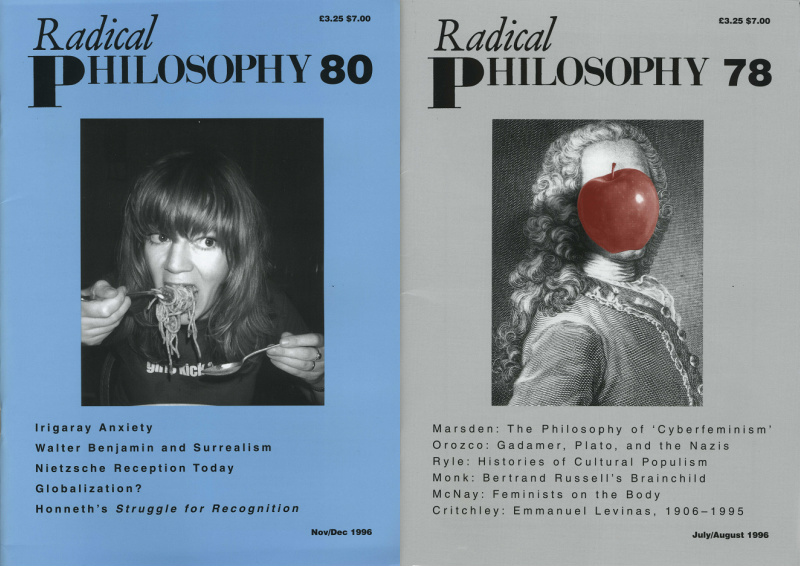
Understanding this requires work many people are unwilling to do, either because they’re busy and distracted or, perhaps more often, because they have other, bad faith agendas. Should one decide to survey the philosophical debates on the left, however, an excellent place to start would be Radical Philosophy, which describes itself as a “UK-based journal of socialist and feminist philosophy.” Founded in 1972, in response to “the widely-felt discontent with the sterility of academic philosophy at the time,” the journal was itself an act of protest against the culture of academia.
Radical Philosophy has published essays and interviews with nearly all of the big names in academic philosophy on the left—from Marxists, to post-structuralists, to post-colonialists, to phenomenologists, to critical theorists, to Lacanians, to queer theorists, to radical theologians, to the pragmatist Richard Rorty, who made arguments for national pride and made several critiques of critical theory as an illiberal enterprise. The full range of radical critical theory over the past 45 years appears here, as well as contrarian responses from philosophers on the left.
Rorty was hardly the only one in the journal’s pages to critique certain prominent trends. Sociologists Pierre Bourdieu and Loic Wacquant launched a 2001 protest against what they called “a strange Newspeak,” or “NewLiberalSpeak” that included words like “globalization,” “governance,” “employability,” “underclass,” “communitarianism,” “multiculturalism” and “their so-called postmodern cousins.” Bourdieu and Wacquant argued that this discourse obscures “the terms ‘capitalism,’ ‘class,’ ‘exploitation,’ ‘domination,’ and ‘inequality,’” as part of a “neoliberal revolution,” that intends to “remake the world by sweeping away the social and economic conquests of a century of social struggles.”
One can also find in the pages of Radical Philosophy philosopher Alain Badiou’s 2005 critique of “democratic materialism,” which he identifies as a “postmodernism” that “recognizes the objective existence of bodies alone. Who would ever speak today, other than to conform to a certain rhetoric? Of the separability of our immortal soul?” Badiou identifies the ideal of maximum tolerance as one that also, paradoxically, “guides us, irresistibly” to war. But he refuses to counter democratic materialism’s maxim that “there are only bodies and languages” with what he calls “its formal opposite… ‘aristocratic idealism.’” Instead, he adds the supplementary phrase, “except that there are truths.”
Badiou’s polemic includes an oblique swipe at Stalinism, a critique Michel Foucault makes in more depth in a 1975 interview, in which he approvingly cites phenomenologist Merleau-Ponty’s “argument against the Communism of the time… that it has destroyed the dialectic of individual and history—and hence the possibility of a humanistic society and individual freedom.” Foucault made a case for this “dialectical relationship” as that “in which the free and open human project consists.” In an interview two years later, he talks of prisons as institutions “no less perfect than school or barracks or hospital” for repressing and transforming individuals.
Foucault’s political philosophy inspired feminist and queer theorist Judith Butler, whose arguments inspired many of today’s gender theorists, and who is deeply concerned with questions of ethics, morality, and social responsibility. Her Adorno Prize Lecture, published in a 2012 issue, took up Theodor Adorno’s challenge of how it is possible to live a good life in bad circumstances (under fascism, for example)—a classical political question that she engages through the work of Orlando Patterson, Hannah Arendt, Ludwig Wittgenstein, and Hegel. Her lecture ends with a discussion of the ethical duty to actively resist and protest an intolerable status quo.
You can now read for free all of these essays and hundreds more at the Radical Philosophy archive, either on the site itself or in downloadable PDFs. The journal, run by an ‘Editorial Collective,” still appears three times a year. The most recent issue features an essay by Lars T. Lih on the Russian Revolution through the lens of Thomas Hobbes, a detailed historical account by Nathan Brown of the term “postmodern,” and its inapplicability to the present moment, and an essay by Jamila M.H. Mascat on the problem of Hegelian abstraction.
If nothing else, these essays and many others should upend facile notions of leftist academic philosophy as dominated by “postmodern” denials of truth, morality, freedom, and Enlightenment thought, as doctrinaire Stalinism, or little more than thought policing through dogmatic political correctness. For every argument in the pages of Radical Philosophy that might confirm certain readers’ biases, there are dozens more that will challenge their assumptions, bearing out Foucault’s observation that “philosophy cannot be an endless scrutiny of its own propositions.”
Enter the Radical Philosophy archive here.
Note: This post was originally published on our site in March, 2018.
Related Content:
Introducing Ergo, the New Open Philosophy Journal
History of Modern Philosophy: A Free Online Course
On the Power of Teaching Philosophy in Prisons
Josh Jones is a writer and musician based in Durham, NC. Follow him at @jdmagness
Read More...How to Predict What the World Will Look Like in 2122: Insights from Futurist Peter Schwartz
“It’s very easy to imagine how things go wrong,” says futurist Peter Schwartz in the video above. “It’s much harder to imagine how things go right.” So he demonstrated a quarter-century ago with the Wired magazine cover story he co-wrote with Peter Leyden, “The Long Boom.” Made in the now techno-utopian-seeming year of 1997, its predictions of “25 years of prosperity, freedom, and a better environment for a whole world” have since become objects of ridicule. But in the piece Schwartz and Leyden also provide a set of less-desirable alternative scenarios whose details — a new Cold War between the U.S. and China, climate change-related disruptions in the food supply, an “uncontrollable plague” — look rather more prescient in retrospect.
The intelligent futurist, in Schwartz’s view, aims not to get everything right. “It’s almost impossible. But you test your decisions against multiple scenarios, so you make sure you don’t get it wrong in the scenarios that actually occur.” The art of “scenario planning,” as Schwartz calls it, requires a fairly deep rootedness in the past.
His own life is a case in point: born in a German refugee camp in 1946, he eventually made his way to a place then called Stanford Research Institute. “It was the early days that became Silicon Valley. It’s where technology was accelerating. It was one of the first thousand people online. It was the era when LSD was still being used as an exploratory tool. So everything around me was the future being born,” and he could hardly have avoided getting hooked on the future.
That addiction remains with Schwartz today: most recently, he’s been forecasting the shape of work to come for Salesforce. The key question, he realized, “was not what did I think about the future, but what did everybody else think about the future?” And among “everybody else,” he places special value on the abilities of those possessed of imagination, collaborative ability, and “ruthless curiosity.” As for the greatest threat to scenario planning, he names “fear of the future,” calling it “one of the worst problems we have today.” There will be more setbacks, more “wars and panics and pandemics and so on.” But “the great arc of human progress, and the gain of prosperity, and a better life for all, that will continue.” Despite all he’s seen – and indeed, because of all he’s seen — Peter Schwartz still believes in the long boom.
Related content:
Pioneering Sci-Fi Author William Gibson Predicts in 1997 How the Internet Will Change Our World
In 1926, Nikola Tesla Predicts the World of 2026
M.I.T. Computer Program Predicts in 1973 That Civilization Will End by 2040
Why Mapmakers Once Thought California Was an Island
Based in Seoul, Colin Marshall writes and broadcasts on cities, language, and culture. His projects include the Substack newsletter Books on Cities, the book The Stateless City: a Walk through 21st-Century Los Angeles and the video series The City in Cinema. Follow him on Twitter at @colinmarshall or on Facebook.
Read More...John Oliver’s Show on World-Class Art Museums & Their Looted Art: Watch It Free Online
From John Oliver comes a comic take on a serious subject–how Western museums have often built their collections, especially in antiquities, through looting art from colonized nations. In this 34 minute episode, Oliver discusses “some of the world’s most prestigious museums, why they contain so many stolen goods, [and] the market that continues to illegally trade antiquities.” It’s one of the latest episodes from HBO’s Last Week Tonight with John Oliver.
If you would like to support the mission of Open Culture, consider making a donation to our site. It’s hard to rely 100% on ads, and your contributions will help us continue providing the best free cultural and educational materials to learners everywhere. You can contribute through PayPal, Patreon, and Venmo (@openculture). Thanks!
Related Content
The British Museum is Full of Looted Artifacts
Take a Virtual Reality Tour of the World’s Stolen Art
When Pablo Picasso and Guillaume Apollinaire Were Accused of Stealing the Mona Lisa (1911)
Read More...How Plants Move in a 24-Hour Period
Neat to watch. Learn more about how plants move over on this Penn State web site.
If you would like to support the mission of Open Culture, consider making a donation to our site. It’s hard to rely 100% on ads, and your contributions will help us continue providing the best free cultural and educational materials to learners everywhere. You can contribute through PayPal, Patreon, and Venmo (@openculture). Thanks!
Read More...Behold a 21st-Century Medieval Castle Being Built with Only Tools & Materials from the Middle Ages
Construction sites are hives of specialized activity, but there’s no particular training needed to ferry 500 lbs of stone several stories to the masons waiting above. All you need is the stamina for a few steep flights and a medieval treadwheel crane or “squirrel cage.”
The technology, which uses simple geometry and human exertion to hoist heavy loads, dates to ancient Roman times.
Retired in the Victorian era, it has been resurrected and is being put to good use on the site of a former sandstone quarry two hours south of Paris, where the castle of an imaginary, low ranking 13th-century nobleman began taking shape in 1997.
There’s no typo in that timeline.
Château de Guédelon is an immersive educational project, an open air experimental archeology lab, and a highly unusual working construction site.
With a project timeline of 35 years, some 40 quarrypeople, stonemasons, woodcutters, carpenters, tilers, blacksmiths, rope makers and carters can expect another ten years on the job.
That’s longer than a medieval construction crew would have taken, but unlike their 21st-century counterparts, they didn’t have to take frequent breaks to explain their labors to the visiting public.
A team of archeologists, art historians and castellologists strive for authenticity, eschewing electricity and any vehicle that doesn’t have hooves.
Research materials include illuminated manuscripts, stained glass windows, financial records, and existing castles.
The 1425-year-old Canterbury Cathedral has a non-reproduction treadmill crane stored in its rafters, as well as a levers and pulleys activity sheet for young visitors that notes that operating a “human treadmill” was both grueling and dangerous:
Philosopher John Stuart Mill wrote that they were “unequalled in the modern annals of legalized torture.”
Good call, then, on the part of Guédelon’s leadership to allow a few anachronisms in the name of safety.
Guédelon’s treadmill cranes, including a double drum model that pivots 360º to deposit loads of up to 1000 lbs wherever the stonemasons have need of them, have been outfitted with brakes. The walkers inside the wooden wheels wear hard hats, as are the overseer and those monitoring the brakes and the cradle holding the stones.
The onsite worker-educators may be garbed in period-appropriate loose-fitting natural fibers, but rest assured that their toes are steel-reinforced.
Château de Guédelon guide Sarah Preston explains the reasoning:
Obviously, we’re not trying to discover how many people were killed or injured in the 13th-century.
Learn more about Château de Guédelon, including how you can arrange a visit, here.
Explore the history of treadmill cranes here.
And see how the Château de Guédelon has housed Ukrainian refugees here.
Related Content
The Medieval City Plan Generator: A Fun Way to Create Your Own Imaginary Medieval Cities
A Medieval Book That Opens Six Different Ways, Revealing Six Different Books in One
- Ayun Halliday is the Chief Primatologist of the East Village Inky zine and author, most recently, of Creative, Not Famous: The Small Potato Manifesto. Follow her @AyunHalliday.
Read More...1950s Pulp Comic Adaptations of Ray Bradbury Stories Getting Republished

Growing up, there was always a special transgressive thrill in reading EC Comics, especially titles like Tales from the Crypt, The Vault of Horror, and The Haunt of Fear. That must have been even truer when they were first published in the nineteen-fifties than it was when they were reprinted in the nineteen-nineties, the period in which I myself thrilled to their distinctive mixture of grotesquerie, suggestiveness, moralism, and dark humor. By no means above indulging in either shock or schlock value, the publishers EC Comics also knew literary value when they saw it: in the work of Ray Bradbury, for example, to which they paid the ultimate tribute by swiping.
“EC Comics writer-editor Al Feldstein combined two science-fiction stories he’d read into a single tale, adapted it into the comics form, and assigned it to artist Wally Wood,” writes J. L. Bell at Oz and Ends, apparently “working on the belief that stealing from two stories at once wasn’t plagiarism but research.”
Bradbury’s response came swiftly: “You have not as of yet sent on the check for $50.00 to cover the use of secondary rights on my two stories THE ROCKET MAN and KALEIDOSCOPE which appeared in your WEIRD-FANTASY May-June ’52, #13, with the cover-all title of HOME TO STAY,” he wrote to EC. “I feel this was probably overlooked in the general confusion of office-work, and look forward to your payment in the near future.”
Bradbury’s “reminder” resulted in not just payment but a series of legitimate adaptations thereafter. His other stories to get the EC treatment include “A Sound of Thunder,” “Mars Is Heaven,” and the classic “There Will Come Soft Rains…” All of these stories are included in Fantagraphics’ new single-volume Home to Stay!: The Complete Ray Bradbury EC Stories, which you can see reviewed in this video. The book includes not just the 35 original comic-book stories (one of which you can read free here), but also “essays by leading scholars, EC experts, some big-name fans,” says the reviewer, whose channel EC Fan-Addict reveals him to be no casual enthusiast himself. Generations of kids have found in EC comics a gateway to “higher” reading material, Bradbury and much else besides, but those who get the taste for EC’s lighthearted grimness and earnest irony never really lose it.
You can pick up a copy of Home to Stay!: The Complete Ray Bradbury EC Stories here. It will be officially released on October 18.
Related content:
The Essential Bradbury: The 25 Finest Stories by the Beloved Writer
Soviet Animations of Ray Bradbury Stories: ‘Here There Be Tygers’ & ‘There Will Come Soft Rain’
Hear Ray Bradbury’s Beloved Sci-Fi Stories as Classic Radio Dramas
Based in Seoul, Colin Marshall writes and broadcasts on cities, language, and culture. His projects include the Substack newsletter Books on Cities, the book The Stateless City: a Walk through 21st-Century Los Angeles and the video series The City in Cinema. Follow him on Twitter at @colinmarshall or on Facebook.
Read More...Why Goya Made His Haunting “Black Paintings” at the End of His Life
Though most of us see Francisco Goya’s Saturno devorando a su hijo, or Saturn Devouring His Son, at least every few months, we were never meant to see it all. The same is true of all fourteen of the so-called “Black Paintings,” which Goya executed late in his life on the walls of his villa outside Madrid. They now hang at the Prado where, as one tour guide put it to the Guardian’s Stephen Phelan, “some people can hardly even look at them.” When visitors enter the room that contains these often grim and bizarre visions, “they are always surprised. I don’t think I’ve ever seen a visitor whose expression hasn’t changed.”
What could have moved Goya to create such paintings? In the new Great Art Explained video essay above, gallerist and Youtuber James Payne lays out the relevant factors in Goya’s life and the turbulent society in which he lived. His Enlightenment views and penchant for brazen satire drew suspicion, as did his willingness to paint for French and pro-French clients during that country’s occupation of Spain.
At the age of 72 he ended up putting himself into a kind of countryside exile, taking up residence in an estate called the Quinta del Sordo (the “Villa of the Deaf,” and suitably enough, since Goya himself happened to have lost his hearing by that point).
It was in the Quinta del Sordo, and indeed on it, that Goya (or, according to certain theories, Goya’s son) set his artistic worldview free to realize its most grotesque and jaundiced forms. Even apart from Saturn’s act of cannibalistic filicide, Phelan writes, “a humanoid billy goat in a monkish cassock bleats a satanic sermon to a gasping congregation of witches. A desperately expressive little dog appears to plead for rescue, submerged up to its neck in a mud-colored mire beneath a gloomy, void-like firmament of negative space.” Known as El Perro, or The Dog, that last artwork is one of the most beloved in Spain — and, in its ascetic way, the most haunting Black Painting of all.
Related content:
The Most Disturbing Painting: A Close Look at Francisco Goya’s Saturn Devouring His Son
Art Lovers Rejoice! New Goya and Rembrandt Databases Now Online
Based in Seoul, Colin Marshall writes and broadcasts on cities, language, and culture. His projects include the Substack newsletter Books on Cities, the book The Stateless City: a Walk through 21st-Century Los Angeles and the video series The City in Cinema. Follow him on Twitter at @colinmarshall or on Facebook.
Read More...Lizzo Plays James Madison’s Priceless, 200-Year-Old Crystal Flute
In the annals of modern popular music, one does not find a surfeit of flautists. Tim Weisberg, in partnership with singer-songwriter Dan Fogelberg, did score a modest his or two in the seventies. More incongruously, Jethro Tull’s Ian Anderson set his band apart with his decision to take up the flute not long before their earliest performances. But today, outside the realm of orchestral music, there is surely no higher-profile flautist than Lizzo. Though best known as a pop singer, she continues to put to use the flute skills she honed at the University of Houston, without which she wouldn’t have been able to handle a precious piece of American history.
Last month, writes the Library of Congress’ April Slayton, one of that institution’s librarians Carla Hayden “saw that the one and only Lizzo was coming to D.C. for a concert.” Given that “the Library has the world’s largest flute collection,” Hayden took the opportunity to point out that fact to the pop star on Twitter. “One of about 1,700 flutes in the collection, she teased, is the crystal flute made for President James Madison by Claude Laurent — a priceless instrument that Dolley Madison rescued from the White House in April 1814 as the British entered Washington, DC during the War of 1812.. Might she want to drop by and play a few bars?”
Indeed she did, with results you can see in the video above: at the Library itself, Lizzo tries out one of the collection’s many flutes; then she plays the crystal flute itself on onstage at Capitol One Arena, having been handed it by the instrument’s own security detail. “It’s like playing out of a wine glass,” she tells her thrilled audience. One wonders if the comparison would ever have occurred to its first owner: “It’s not clear if Madison did much with the flute other than admire it,” Slayton writes, “but it became a family heirloom and an artifact of the era.” Now it has become a uniting symbol of American culture past and present: however forward-looking the Founding Fathers were, we can safely say they never imagine twerking.
The Library of Congress has posted pictures of Lizzo’s visit on Flickr. See them here.
Related content:
Butterfly Lands on Flutist’s Face During Flute Competition: The Show Must Go On
Hear the World’s Oldest Instrument, the “Neanderthal Flute,” Dating Back Over 43,000 Years
Hear a 9,000 Year Old Flute — the World’s Oldest Playable Instrument — Get Played Again
The Library of Congress Makes 25 Million Records From Its Catalog Free to Download
Based in Seoul, Colin Marshall writes and broadcasts on cities, language, and culture. His projects include the Substack newsletter Books on Cities, the book The Stateless City: a Walk through 21st-Century Los Angeles and the video series The City in Cinema. Follow him on Twitter at @colinmarshall or on Facebook.
Read More...What It’s Like to Work in Frank Lloyd Wright’s Iconic Office Building
Frank Lloyd Wright, who drew so much inspiration from the wide open spaces of middle America, designed just two high-rise buildings. The second, completed late in his long career, was 1956’s Price Tower in Bartlesville, Oklahoma. The first opened six years before that, as an addition to one of his already-famous projects. That was the headquarters of S. C. Johnson & Son, better known as Johnson Wax, in Racine, Wisconsin. Seen at a distance, the Research Tower stands out as the signal feature of the complex, but it’s the earlier Administration Building that offered the world a glimpse of the future of work.
The Administration Building’s construction finished in 1939. Back then, says Vox’s Phil Edwards (himself an established Wright fan) in the video above, “offices were small and cramped, or private. This building had a spacious central room instead, meant to encourage the spread of ideas.” Such a concept may sound familiar — perhaps all too familiar — to anyone who’s ever worked in what we now call an “open-plan office.” But it was daring at the time, and it seems that no architect has ever implemented it quite as strikingly again. What other office makes you “feel like you’re underwater, that you’re in, maybe, a lily pond”?
That description comes from architect and Wright scholar Jonathan Lipman, one of the experts Edwards consults on his own pilgrimage to Johnson Wax Headquarters. He wanted to spend some time working there himself, something easily arranged since S. C. Johnson has by now moved most of its operations into other facilities. But however satisfying it feels to sit in the shade of Wright’s “dendriform columns” sprouting throughout the Great Workroom, the experience proves unsatisfying. “It wasn’t a real thing without any people around,” Edwards says, “without the energy of being in that office.”
Wright spoke of his intentions to create “as inspiring a place to work in as any cathedral ever was to worship in.” Today, amid the silent absence of typists on the ground floor and managers on the mezzanine, the Administration Building must feel holier than ever. The space exudes a magnificent loneliness, and opening a MacBook to log into Slack surely intensifies the loneliness rather than the magnificence. “In 1939, this was the future of work,” Edwards says. “These big corporate campuses, the Googles and Metas and Amazons: they owe a debt to this campus here.” But for the increasingly many living the remote-work life, even those twenty-first-century big-tech headquarters have begun to seem like temples from a passing era.
Related content:
When Frank Lloyd Wright Designed a Doghouse, His Smallest Architectural Creation (1956)
The Modernist Gas Stations of Frank Lloyd Wright and Mies van der Rohe
Based in Seoul, Colin Marshall writes and broadcasts on cities, language, and culture. His projects include the Substack newsletter Books on Cities, the book The Stateless City: a Walk through 21st-Century Los Angeles and the video series The City in Cinema. Follow him on Twitter at @colinmarshall or on Facebook.
Read More...Support Us
We're hoping to rely on loyal readers, rather than erratic ads. Please click the Donate button and support Open Culture. You can use Paypal, Venmo, Patreon, even Crypto! We thank you!

About Us

Open Culture scours the web for the best educational media. We find the free courses and audio books you need, the language lessons & educational videos you want, and plenty of enlightenment in between.
Advertise With Us
FREE UPDATES!
GET OUR DAILY EMAIL
Get the best cultural and educational resources on the web curated for you in a daily email. We never spam. Unsubscribe at any time.
FOLLOW ON SOCIAL MEDIA
Open Culture editor Dan Colman scours the web for the best educational media. He finds the free courses and audio books you need, the language lessons & movies you want, and plenty of enlightenment in between.
Advertise With Us

