Never Too Small: Architects Give Tours of Tiny Homes in Paris, Melbourne, Milan, Hong Kong & Beyond
There was a time when few had a taste for tiny homes — indeed, a time when millions of us tuned in to television shows like Lifestyles of the Rich and Famous expressly to revel in residential expanse and opulence. This is not to say that such straightforward “real estate porn” has vanished: like all twenty-first-century media, it’s just taken a variety of new forms. In its more than twenty-year run, HGTV’s House Hunters and its many spin-offs have catered to viewers who slaver over mansions, but also to those whose tastes run from houseboats and tropical islands to recreational vehicles and off-the-grid compounds. The inevitable debut of Tiny House Hunters came in 2014.
For a variety of reasons, many members of the last couple of generations have come of age without the desire — and often, not coincidentally, without the means — for a large living space. Over the past fifteen years or so, popular culture has metabolized this condition into an enthusiasm, and for some an obsession.
The die-hard tiny-home enthusiast watches Youtube channels like Never Too Small: since its launch five years ago, it has uploaded more than a hundred videos so far, each of which offers a brief guided tour of a different tiny home led by the architect who designed it. These include diminutive residences in cities the world over, from Paris and Amsterdam to Hong Kong and Tokyo to Melbourne and Sydney.
Based in Australia, Never Too Small has produced a great many episodes in that country — a country known, ironically, for its vast tracts of undeveloped land. But there, as everywhere else, space in major cities comes at a premium, and it falls to the tiny-house architect to employ and articulate that space with an absolute maximum of efficiency. (They also face the same basic challenge in the occasional rural setting, building “tiny cabins” and repurposing shipping containers.) The details may vary, but watch enough episodes in a row and you tend to notice that, located though they may be in New York, Buenos Aires, Antwerp, or Milan, these apartments have much in common aesthetically.
No matter their own cultural origins, most of these architects have evidently looked for inspiration to Japan, whose traditions of residential architecture have long developed within small plots of land. They also tend to make liberal use of light wood and white paint, which make these spaces look more expansive than they are, as well as at once modern and organic. (These choices carry a degree of retro appeal as well, harking back as they do to the design trends of the mid-sixties.) The best of Never Too Small’s videos provide a clear view of its subject’s context, whether it be a hip old urban neighborhood or a hillside in the wilderness. There are many reasons to want a tiny home, none based on wanting to stay inside it all the time.
Related content:
The Tiny Transforming Apartment: 8 Rooms in 420 Square Feet
The First House Powered by Coffee
When Frank Lloyd Wright Designed a Doghouse, His Smallest Architectural Creation (1956)
Based in Seoul, Colin Marshall writes and broadcasts on cities, language, and culture. His projects include the Substack newsletter Books on Cities, the book The Stateless City: a Walk through 21st-Century Los Angeles and the video series The City in Cinema. Follow him on Twitter at @colinmarshall, on Facebook, or on Instagram.
Read More...A Tour of All the Pizza Styles You Can Eat in the United States (and the History Behind Your Favorite Slices)
When it comes to chili, Texas, Kansas City and Cincinnati, will cede no quarter, each convinced that their particular regional approach is the only sane option.
Hot dogs? Put New York City and Chicago in a pit and watch them tear each other to ribbons.
But pizza?
There are so many geographic variations, even an impartial judge can’t see their way through to a clear victor.
The playing field’s thick as stuffed pizza, a polarizing Chicago local specialty that’s deeper than the deepest dish.
Weird History Food’s whirlwind video tour of Every Pizza Style We Could Find In the United States, above, savors the ways in which various pizza styles evolved from the Neapolitan pie that Italian immigrant Gennaro Lombardi introduced to New York City in 1905.
Wait, though. We all have an acquaintance who takes perverse pleasure in offbeat topping choices — looking at you, California — but other than that, isn’t pizza just sauce, dough, and cheese?
How much room does that leave for variation?
Plenty as it turns out.
Crusts, thick or thin, fluctuate wildly according to the type of flour used, how long the dough is proofed, the type of oven in which they’re baked, and philosophy of sauce placement.
(In Buffalo, New York, pizzas are sauced right up to their circumference, leaving very little crusty handle for eating on the fly, though perhaps one could fold it down the middle, as we do in the city 372 miles to the south.)
Sauce can also swing pretty wildly — sweet, spicy, prepared in advance, or left to the last minute — but cheese is a much hotter topic.
Detroit’s pizza is distinguished by the inclusion of Wisconsin brick cheese.
St. Louis is loyal to Provel cheese, a homegrown processed mix of cheddar, Swiss, and provolone and liquid smoke.
Miami pizzas cater to the palates of its Cuban population by mixing mozzarella with gouda, a cheese that was both widely available and popular before 1962’s rationing system was put in place.
Rhode Island’s aptly named Red Strips have no cheese at all…which might be preferable to the Altoona, Pennsylvania favorite that arrives topped with American cheese slices or — the horror — Velveeta.
(This may be where we part ways with the old saw equating pizza with sex — even when it’s bad, it’s still pretty good.)
Cut and size also factor in to pizza pride.
Washington DC’s Jumbo slices are pretty much the standard issue New York-style thin crust slice, writ large.
Not only does size matter here, it may be the only thing that matters…to the point where a local business improvement district had to intervene on behalf of sidewalk rubbish bins hard pressed to handle the volume of greasy super-sized slice boxes Washingtonians were tossing away every evening.
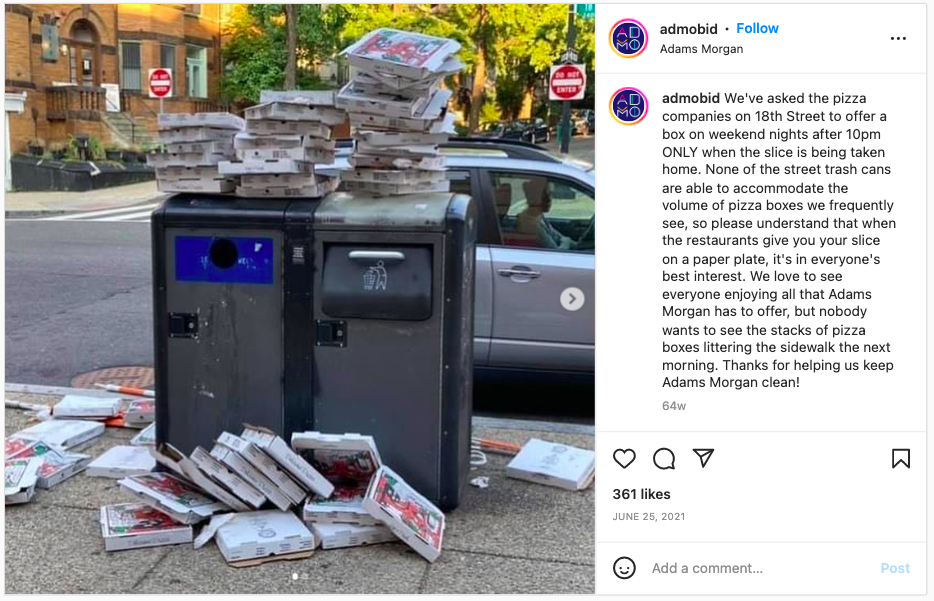
In the land of opportunity, where smaller towns are understandably eager to claim their piece of pie, Weird History Food gives the nod to Old Forge, Pennsylvania, optimistically dubbed “the Pizza Capital of the World by Uncovering PA’s Jim Cheney, and Steubenville Ohio, home of the “oversized Lunchable” Atlas Obscura refers to as America’s most misunderstood pizza.
For good measure, watch the PBS Idea Channel’s History of Pizza in 8 slices, below, then rep your favorite local pizzeria in the comments.
We want to try them all!
Related Content
The First Pizza Ordered by Computer, 1974
When Mikhail Gorbachev, the Last Soviet Leader, Starred in a Pizza Hut Commercial (1998)
Pizza Box Becomes a Playable DJ Turntable Through the Magic of Conductive Ink
- Ayun Halliday is the Chief Primatologist of the East Village Inky zine and author, most recently, of Creative, Not Famous: The Small Potato Manifesto. Follow her @AyunHalliday.
Read More...Getting Dressed Over the Centuries: 35 Videos Show How Women & Men Put on Clothes During Ancient, Medieval & Modern Times
Across vast swathes of the world, many of us — arguably too many of us — have grown accustomed to putting on little more than a T‑shirt and jeans every morning, regardless of our status in society. We all know it wasn’t always this way, but we may not fully understand just how much it wasn’t always this way. Throughout most of civilized human history, dressing didn’t just reflect one’s way of life, it practically constituted a way of life in itself. Thanks to Youtube channel Crow’s Eye Productions, we here in the twenty-first century can enjoy detailed, even cinematic re-creations of the dressing process in various eras and places the West, from Roman Britain to Renaissance Florence to 1969 London.
You can watch all 35 of these dressing videos in chronological order with this playlist. Many of the dressers, including such august personages as Prince Albert and Queen Victoria (on Christmas Day, no less), occupy elevated social positions.
But the maids and gardeners of the Victorian era had to get dressed too, and though their clothing may be simpler than that worn by the royals — or even by the middle class — it’s no less revealing of history. One could no doubt tell an even richer story of technological, economic, and cultural change over the centuries through the clothing of “the masses” than through the clothing of the elites.
Even war, that most traditional historical subject of all, has its connections with dress. This playlist features three videos on the dressing routines of soldiers, nurses, and young women during the First World War, as well as one on the members of the Women’s Land Army during the Second World War. Established in 1917, the WLA organized “Land Girls” to take over the agricultural work while the men who’d been doing it were out fighting on the front.
This was just the kind of effort necessitated by total war, as well as one that could only have been performed by women. It’s also, therefore, engagingly approachable by a series like this, with its primary focus on women’s dress — which, at least since the Great Male Renunciation, has had a pretty spectacular history of its own.
Related content:
How Wealthy Women (Like the Mona Lisa) Got Dressed in Renaissance Florence
How Fashionable Dutch Women (Like the Girl with a Pearl Earring) Got Dressed in 1665
Author Imagines in 1893 the Fashions That Would Appear Over the Next 100 Years
Fashion Designers in 1939 Predict How People Would Dress in the Year 2000
Life Magazine Predicts in 1914 How People Would Dress in the 1950s
Based in Seoul, Colin Marshall writes and broadcasts on cities, language, and culture. His projects include the Substack newsletter Books on Cities, the book The Stateless City: a Walk through 21st-Century Los Angeles and the video series The City in Cinema. Follow him on Twitter at @colinmarshall, on Facebook, or on Instagram.
Read More...5 Ways to Build an Alzheimer’s-Resistant Brain: Neuroscientist Lisa Genova Explains
Though not easily dealt with in mainstream entertainment, Alzheimer’s disease has inspired popular works of fiction. Take the 2007 novel Still Alice by Lisa Genova, later adapted into a feature film starring Julianne More. As a neuroscientist, Genova brought an understanding of the subject by no means common among novelists in general. Since her debut she has published four more novels, all of them built around characters suffering from neurological impairments of one kind or another. But her latest book, last year’s Remember: The Science of Memory and the Art of Forgetting, is a work of nonfiction, and in the video above she discusses a few of its points about how to build an “Alzheimer’s-resistant brain.”
After briefly explaining the biological processes behind Alzheimer’s (and assuring her older viewers that their day-to-day forgetfulness is probably nothing to worry about), Genova offers five ways to ward off their effects. The first is sleeping, which gives glial cells, “the janitors of your brain,” time to clear away the amyloid plaque that sets the disease in motion if left to accumulate.
Keeping a Mediterranean diet — full of “green leafy vegetables, the brightly colored fruits and berries, fatty fishes, nuts, beans, olive oils” — has similarly salutary effects. So does engaging in regular exercise, which also comes with the benefit of reducing chronic stress, a condition that inhibits the formation of neurons involved in making new memories.
Genova names yoga, meditation, mindfulness, and “being with people” as other elements of an Alzheimer’s-resistant life. But she saves for last the strategy perhaps most relevant to Open Culture readers. “If you’ve lived a life where you’re cognitively active, you’re regularly learning new things. You are building what we call a ‘cognitive reserve.’ Every time you learn something new, you’re building new synapses.” All the neural connections thus established will help you “dance around those roadblocks” put up by the early effects of Alzheimer’s or other deleterious mental conditions. This means that no matter how young you are, you’ll benefit later from forming the habit of learning new things on a daily basis. As for which new things you learn — 1,700 free courses worth of which we’ve gathered here — that’s entirely up to you.
Related content:
How Yoga Changes the Brain and May Guard Against Alzheimer’s and Dementia
How Music Can Awaken Patients with Alzheimer’s and Dementia
Former Ballerina with Dementia Gracefully Comes Alive to Tchaikovsky’s Swan Lake
Based in Seoul, Colin Marshall writes and broadcasts on cities, language, and culture. His projects include the Substack newsletter Books on Cities, the book The Stateless City: a Walk through 21st-Century Los Angeles and the video series The City in Cinema. Follow him on Twitter at @colinmarshall, on Facebook, or on Instagram.
Read More...Sally Schmitt, the Creator of the French Laundry & Unsung Hero of California Cuisine, Gets Her Due in a Poignant, Short Documentary
One of the New York Times’ most compelling regular features is Overlooked, which gives remarkable individuals whose deaths passed unremarked by the Times obit column a rousing, overdue sendoff.
Sally Schmitt — “one of the great unsung heroes of California Cuisine” as per Michael Bauer, the San Francisco Chronicle’s fearsome former food critic — is not one of those.
When Schmitt died earlier this spring at the age of 90, a few weeks shy of the release of her book, Six California Kitchens: A Collection of Recipes, Stories, and Cooking Lessons From a Pioneer of California Cuisine, the Times took note.
Schmitt received a grand obituary that delved into her personal history, philosophy, and her connection to Napa Valley’s The French Laundry, a three star Michelin restaurant which Anthony Bourdain hailed as the best in the world.
The French Laundry’s renown is such that one needn’t run in foodie circles to be aware of it, and its award-winning chef/owner, Thomas Keller.
Keller, however, did not found the restaurant that brought him fame.
Schmitt did, with the help of her husband, Don and their five children, who pitched in in both the kitchen and the front of the house.
Family was important to Schmitt, and having deferred her dreams for the many years it took to raise hers, she was determined to maintain balance between home and work lives.
In Ben Proudfoot’s New York Times op-doc, above, Schmitt recalls growing up outside of Sacramento, where her mother taught her how to cook using in-season local produce.
Meanwhile, her father helped California produce make it all the way to the East Coast by supplying ice to the Southern Pacific Railroad, an innovation that Schmitt identifies as “the beginning of the whole supermarket situation” and a distressing geographic disconnect between Americans and food.
The Schmitts launched The French Laundry in 1978, with a shockingly affordable menu.
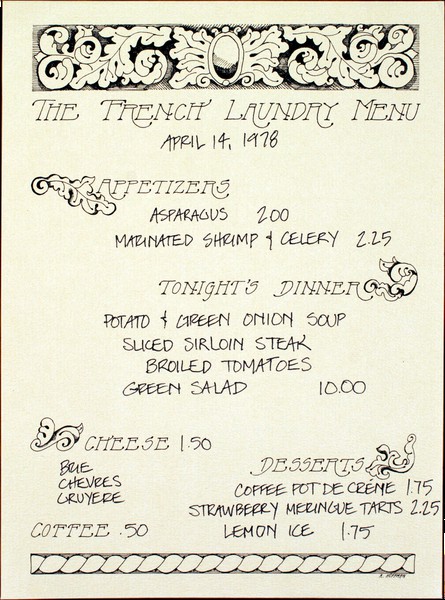
Julia Child, a fan, once “burst into the kitchen,” demanding, “My dear, what was in that dessert sauce?”
(Answer: sugar, butter and cream)
Sixteen years after its founding, The French Laundry was for sale.
Schmitt’s facial expressions are remarkably poignant describing the transfer of power. There’s a lot at play — pride, nostalgia, fondness for Keller, a “really charming young chef, who’d made a name for himself in New York…and was down on his luck.”
Schmitt is gracious, but there’s no question she feels a bit of a twinge at how Keller took her dream and ran with it.
“In high school, I was always the vice president…vice president of everything,” Schmitt says, before sharing a telling anecdote about her best friend beating her out for the highest academic honor:
I went home and cried. Yeah, I thought that I should have it, you know. And my mother said, “Let her have her moment of glory. Don’t worry. There will be moments of glory for you.”
This documentary is one, however posthumous.
Accompanying it is a brief essay in which Proudfoot contrasts the lives of his workaholic late father and Schmitt, with her “delightfully coy candor a message about the rewards of balance and the trap of ambition:”
I made this film for all of us who struggle “to stir and taste the soup” that already sits in front of us.
Another moment of glory:
In Keller’s landmark The French Laundry Cookbook, the final recipe is Sally Schmitt’s Cranberry and Apple Kuchen (with the hot Cream Sauce that so captivated Julia Child.)
Sally Schmitt’s Cranberry and Apple Kuchen with hot Cream Sauce
Serves 8
KUCHEN:
6 tablespoons (3/4 stick) unsalted butter, room temperature, plus more for the pan
3/4 cup sugar
1 large egg
1 1/2 cups all-purpose flour
2 teaspoons baking powder
1/4 teaspoon kosher salt
1/4 teaspoon freshly grated nutmeg
1/2 cup milk or light cream
3 to 4 Gravenstein or Golden Delicious apples
1 cup cranberries or firm blueberries
Cinnamon sugar: 1 tablespoon sugar mixed with 1/4 teaspoon cinnamon
HOT CREAM SAUCE:
2 cups heavy cream
1/2 cup sugar
8 tablespoons (1 stick) unsalted butter
1. Preheat oven to 350 degrees. Butter a 9‑inch round cake pan.
2. For the kuchen: Using an electric mixer, beat butter, sugar and egg together until the mixture is fluffy and lightened in texture.
3. Combine the flour, baking powder, salt and nutmeg. Add dry ingredients and the milk alternately to the butter mixture; mix just until combined.
4. Peel and core apples. Slice them into 1/4‑inch wedges
5. Spoon batter into the pan. Press apple slices, about 1/4‑inch apart and core side down, into the batter, working in a circular pattern around the outside edge (like the spokes of a wheel. Arrange most of the cranberries in a ring inside the apples and sprinkle remainder around the edges of the kuchen. Sprinkle kuchen with the cinnamon sugar.
6. Bake for 40 to 50 minutes, or until a cake tester inserted into the center of the kuchen comes out clean. Set on a rack to cool.
7. Combine the cream sauce ingredients in a medium saucepan. Bring to a boil, lower heat and simmer for 5 to 8 minutes, to reduce and thicken it slightly.
8. Serve the cake warm or at room temperature, drizzled with the hot cream sauce
Related Content
Watch Anthony Bourdain’s First Food-and-Travel Series A Cook’s Tour Free Online (2002–03)
Watch 26 Free Episodes of Jacques Pépin’s TV Show, More Fast Food My Way
Watch Werner Herzog Eat His Shoe, Cooked by Chef Alice Waters (1980)
- Ayun Halliday is the Chief Primatologist of the East Village Inky zine and author, most recently, of Creative, Not Famous: The Small Potato Manifesto. Follow her @AyunHalliday.
Read More...Rage Against the Machine’s “Killing In The Name” Performed By the North Korean Military Chorus : A Clever Fake
Want to see North Korea’s Military Chorus perform Rage Against the Machine’s “Killing In The Name”? You really do? This may be the closest you’ll ever get. Watch it, and thank YouTuber Lars von Retriever for the clever edit…
If you would like to support the mission of Open Culture, consider making a donation to our site. It’s hard to rely 100% on ads, and your contributions will help us continue providing the best free cultural and educational materials to learners everywhere. You can contribute through PayPal, Patreon, and Venmo (@openculture). Thanks!
Related Content
Hip Hop Fan Freaks Out When He Hears Rage Against the Machine’s Debut Album for the Very First Time
A List of 132 Radical, Mind-Expanding Books from Rage Against the Machine
When Rage Against the Machine Interviewed Noam Chomsky (1999)
Read More...The Evolution of the Electric Guitar: An Introduction to Every Major Variety of the Instrument That Made Rock-and-Roll
The past century has seen many stylistic changes in popular culture, none more dramatic than in music. We need only hear a few measures of a song to place it in the right decade. The sound of an era’s music reflects the state of its technology: whenever engineering can make possible tools like multitrack recorders, tape loops, samplers, and synthesizers — to say nothing of listening media like cylinders, vinyl records, and online streaming — the soundtrack of the zeitgeist has been transformed. But in living memory, surely no development has made quite so powerful an impact on popular music as the electric guitar.
“Almost all guitars currently on the market are either a direct descendant of, or very similar to, a handful of instruments that came to life during the span of one decade: the fifties.” With these words, Dutch Youtuber Paul Davids launches into a video journey through the evolution of the electric guitar as we know it, beginning in 1950 with the Fender Telecaster.
Davids doesn’t just explain the components and construction of that venerable instrument, he plays it — just as he does a variety of other electric guitars, each with a sound representative of its era. Even if you don’t know them by name, they’ll all sound familiar from a variety of musical contexts.
The invention of the electric guitar made possible the birth of rock and roll, which shows no few signs of frailty even here in the twenty-first century. The earliest models produced are ever more highly valued for their sound, their feel, and their apparent simplicity, a quality many rockers hold in the utmost regard. But despite long adhering to the same basic form, the electric guitar has incorporated a great variety of innovations — in its pickups, its vibrato systems, and much else besides — whose combinations and permutations have given rise to entire subgenres like surf, heavy metal, rockabilly, and grunge. Like rock itself, the electric guitar arrived having already attained a kind of perfection, but possessed too much vitality to stand still.
Related content:
Behold the First Electric Guitar: The 1931 “Frying Pan”
The World’s First Bass Guitar (1936)
The Story of the Guitar: The Complete Three-Part Documentary
Oxford Scientist Explains the Physics of Playing Electric Guitar Solos
Based in Seoul, Colin Marshall writes and broadcasts on cities, language, and culture. His projects include the Substack newsletter Books on Cities, the book The Stateless City: a Walk through 21st-Century Los Angeles and the video series The City in Cinema. Follow him on Twitter at @colinmarshall, on Facebook, or on Instagram.
Read More...The Clock That Changed the World: How John Harrison’s Portable Clock Revolutionized Sea Navigation in the 18th Century
In the early eighteenth century, a pocket watch could keep reasonably accurate time, give or take a minute per day. This may not sound too bad, given how we now regard even the most advanced technology of that era. But it certainly wasn’t good enough for marine navigation: each day, a ship could tolerate its clocks gaining or losing only a couple of seconds. Without proper reliable information about the time, sailors on the open sea had no way of knowing quite where they were. More specifically, the sun told them how far north or south they were, their latitude, but they didn’t know how far east or west they were, their longitude.
Theoretically speaking, the “longitude problem” was easily solvable. You could calculate it, writes Gear Patrol’s Ed Estlow, “by sighting the sun at high noon where you were, and if you had a good enough clock for the time back home, you could compare the two and, with some simple mathematics, determine your position.” But engineering such a good-enough clock in reality took about half a century. “In 1714, the British government offered the huge prize of £20,000 (roughly £2 million today) to anyone who could solve the longitude problem once and for all.” But the money wasn’t fully claimed until 1773, by a Yorkshire clockmaker John Harrison.
Harrison’s name looms large in the annals of chronometry, and not without reason. His work of inventing an accurate ship clock involved the creation of five different models, known by historians as H1 through H5. H1 was a portable version of the kind of sizable wooden clock with which he’d already made his name. It was only in with H4, in 1765, that he realized small is beautiful, or rather accurate, at least if equipped with oversized internal balance wheels to hold up more reliably against the constant movement of a ship at sea. This design worked without a hitch, but even so, the Board of Longitude only saw fit to award him half the money offered.
Neither Harrison’s solving of the longitude problem nor his receipt of a disappointingly halved prize seem to have stopped his obsession with building ever-better timekeeping devices. This comes as no surprise given the qualities of mind that emerge in “The Clock That Changed the World,” the episode of BBC’s A History of the World at the top of the post. While working on H5, Harrison “sought the support of King George III” (he of the famous madness). “The King, a natural philosopher in his own right, tested H5 himself and promised Harrison his support.” That support finally got the elderly Harrison his promised amount and then some, but one senses that — like any pursuit worthy of one’s lifelong dedication — it was never really about the money.
Related content:
How Clocks Changed Humanity Forever, Making Us Masters and Slaves of Time
How Did Cartographers Create World Maps before Airplanes and Satellites? An Introduction
Based in Seoul, Colin Marshall writes and broadcasts on cities, language, and culture. His projects include the Substack newsletter Books on Cities, the book The Stateless City: a Walk through 21st-Century Los Angeles and the video series The City in Cinema. Follow him on Twitter at @colinmarshall, on Facebook, or on Instagram.
Read More...When Is a Joke “Too Soon”? — Comedians Discuss on Pretty Much Pop: A Culture Podcast #132

To honor the death of Gilbert Gottfried, Pretty Much Pop addresses jokes like the 9–11 one he was pilloried for. Can comedy really be “too soon” in relation to tragic subject matter? Is comedy really tragedy plus time, or are jokes most needed immediately when pain and discomfort are most acute?
Your host Mark Linsemayer is joined by three comedians: Adam Sank (of the LGBTQ-themed Adam Sank Show), Twitch-streaming songster Meri Amber, and returning guest Daniel Lobell (graphic novelist and podcaster). We get into tailoring jokes for an audience, coping with grief, and of course some talk about triggering, hyper-sensitive audiences, and cancellation (Chapelle, anyone?).
Watch Gottfried’s infamous joke yourself:
A few perspectives we may have reviewed before talking:
- “Remembering Gilbert Gottfried” by Daniel Lobell
- “When is a joke too soon? A scientific inquiry” by Peter McGraw and Joel Warner
- “When and what kind of joke is ‘too soon’?” by Maddy Kunz
- “When is too soon for a joke?” by Bridget Jones
- “When is it ‘too soon’ to tell a joke?” By Peter McGraw
- “Louis C.K. Mocks Parkland School Shooting Survivors in Recent Set” by Sopan Deb
- “Comedian Hannah Gadsby’s ‘Ten Steps to Nanette’ ” from NPR
Follow us @AdamSank, @meriamber, @dannylobell, and @MarkLinsenmayer.
So maybe instead of the “Maccabees,” my Bible camp’s Polish jokes instead made the “Canaanites” the butt of their humor. (Unless that actually again refers some modern, extant people…)
Hear more Pretty Much Pop. Support the show and hear bonus talking for this and nearly every other episode at patreon.com/prettymuchpop or by choosing a paid subscription through Apple Podcasts. This podcast is part of the Partially Examined Life podcast network.
Pretty Much Pop: A Culture Podcast is the first podcast curated by Open Culture. Browse all Pretty Much Pop posts.
Read More...How The Cabinet of Dr. Caligari Invented Psychological Horror Film & Brought Expressionism to the Screen (1920)
Even if you’ve never actually watched The Cabinet of Dr. Caligari, you’ve seen it. You’ve seen it throughout the century of cinema history since the film first came out, during which its influence has manifested again and again: in Fritz Lang’s Metropolis, Dario Argento’s Suspiria, Terry Gilliam’s Fear and Loathing in Las Vegas, Tarsem Singh’s The Cell, and Guillermo del Toro’s Nightmare Alley — not to mention much of the filmographies of auteurs like David Lynch and Tim Burton. These are just some of the films referenced by Tyler Knudsen, better known as CinemaTyler, in the video essay above, “Dr. Caligari Did More Than Just Invent Horror Movies.”
“A case can be made that Caligari was the first true horror film,” writes Roger Ebert. In earlier cinematic scary stories, “characters were inhabiting a recognizable world. Caligari creates a mindscape, a subjective psychological fantasy. In this world, unspeakable horror becomes possible.”
The techniques employed to that end have also convinced certain historians of the medium to call the picture “the first example in cinema of German Expressionism, a visual style in which not only the characters but the world itself is out of joint.” Knudsen places this style in historical context, specifically that of Germany’s Weimar Republic, which was established after World War I and lasted until the rise of the Nazis.
Politically unstable but artistically fruitful, the Weimar period gave rise to a variety of new artistic attitudes, at once enthusiastic and overwhelmed. “Whereas impressionism tries to depict the real world, but only from a first glance or impression instead of focusing on details,” Knudsen says, “expressionism tries to get at the artist’s inner feelings rather than the actual appearance of the subject matter.” Hence the bizarre sets of Caligari, whose every angle looks designed to be maximally unconvincing. And yet the film is entirely faithful to its particular reality: not the one occupied by Weimar-era Germans or anyone else, but the one it conjures up in a manner only motion pictures can. 102 years later, The Cabinet of Dr. Caligari remains a haunting viewing experience — and one expressive of the sheer potential of cinema. You can watch it above.
Related content:
10 Great German Expressionist Films: From Nosferatu to The Cabinet of Dr. Caligari
How German Expressionism Influenced Tim Burton: A Video Essay
Based in Seoul, Colin Marshall writes and broadcasts on cities, language, and culture. His projects include the Substack newsletter Books on Cities, the book The Stateless City: a Walk through 21st-Century Los Angeles and the video series The City in Cinema. Follow him on Twitter at @colinmarshall, on Facebook, or on Instagram.
Read More...Support Us
We're hoping to rely on loyal readers, rather than erratic ads. Please click the Donate button and support Open Culture. You can use Paypal, Venmo, Patreon, even Crypto! We thank you!

About Us

Open Culture scours the web for the best educational media. We find the free courses and audio books you need, the language lessons & educational videos you want, and plenty of enlightenment in between.
Advertise With Us
FREE UPDATES!
GET OUR DAILY EMAIL
Get the best cultural and educational resources on the web curated for you in a daily email. We never spam. Unsubscribe at any time.
FOLLOW ON SOCIAL MEDIA
Open Culture editor Dan Colman scours the web for the best educational media. He finds the free courses and audio books you need, the language lessons & movies you want, and plenty of enlightenment in between.
Advertise With Us

