Texas School Board Bans Illustrated Edition of The Diary of Anne Frank

According to a recent survey conducted by the Texas State Teachers Association, 70% of surveyed teachers said they were seriously thinking about leaving the teaching profession. “Lingering stress from the pandemic is a factor, but it isn’t the only one. Inadequate pay, political attacks on educators and the failure of state leaders to protect the health and safety of students and school employees also have combined to drive down the morale of teachers to the lowest level in recent memory and endanger our public school system,” TSTA President Ovidia Molina said.
We recently saw how Texas’ educational system has become a vast political minefield, with conservative legislators attempting to ban 800+ books from school libraries–primarily because the books make students feel “uncomfortable.” This week, the Keller Independent School District in Fort Worth, Texas decided to cancel an acclaimed illustrated adaptation of The Diary of Anne Frank, echoing the recent decision by a Tennessee School board to ban Maus, the Pulitzer-Prize winning graphic novel on the Holocaust. The ban of The Diary of Anne Frank was triggered by a parent complaint, which the right-leaning school board decided to honor. Why would thinking people want to opt out of teaching in the Texas educational system? It’s not hard to imagine.
If you would like to support the mission of Open Culture, consider making a donation to our site. It’s hard to rely 100% on ads, and your contributions will help us continue providing the best free cultural and educational materials to learners everywhere. You can contribute through PayPal, Patreon, and Venmo (@openculture). Thanks!
Related Content
The 850 Books a Texas Lawmaker Wants to Ban Because They Could Make Students Feel Uncomfortable
Umberto Eco Makes a List of the 14 Common Features of Fascism
Read More...The Brilliantly Nightmarish Art & Troubled Life of Painter Francis Bacon
The paintings of Francis Bacon continue to trouble their viewers, not least those viewers who try to slot his work into a particular genre or movement. Bacon rose to prominence painting the human body, hardly an uncommon subject, but he did so in the middle of the twentieth century, just when abstraction had achieved near-complete domination of Western art. Though his work may not have been deliberately fashionable, it wasn’t straightforwardly realistic either. Even as they incorporated humanity, his artistic visions twisted it out of shape, often in complicatedly grotesque or bloody ways. What could have inspired such enduringly nightmarish work?
That question underlies Francis Bacon: A Brush with Violence, the 2017 BBC Two documentary above. Some answers are to be found in the painter’s life, whose fragile and asthmatic early years were shadowed by the formidable presence of the elder Bacon, a Boer War veteran and racehorse trainer. As Bacon’s friend and dealer Lord Gowrie says, “His father got his stable boys to whip him, and I think that started one or two things off.” Like many studies, the film draws connections between Bacon’s harrowing artworks and his even more harrowing sex life, conducted in shadowy underworlds at great — and to him, seemingly thrilling — risk of physical harm.
Bacon proceeded down his long life’s every avenue in the same deliberately reckless manner. As with men, money, and drink, so with art: he would gamble everything, as another interviewee puts it, on the next brushstroke. His impulsive creation often preceded equally impulsive destruction, as evidenced by one assistant’s memories of following the artist’s orders to destroy a great many paintings that would now command serious prices at auction. When Bacon realized what he needed to paint — a process that began with a youthful trip to Paris, where he first encountered the work of Pablo Picasso — he knew he could accept nothing else.
Those paintings attract ever more intense critical scrutiny, an enterprise that has recently produced Francis Bacon: A Tainted Talent, the four-part documentary series just above from Youtube channel Blind Dweller (recently featured here on Open Culture for a video essay on Jean-Michel Basquiat). Almost wholly untrained in the classical sense, Bacon developed not just a distinctive set of techniques for making visible his tantalizingly appalling inner world, but also kept refining those techniques to make his work ever less outwardly shocking yet ever more affecting on subtler levels. In his lifetime, this made him the highest-paid artist in the world; more than thirty years after his death, he remains a movement of one.
Related content:
Francis Bacon on the South Bank Show: A Singular Profile of the Singular Painter
William Burroughs Meets Francis Bacon: See Never-Broadcast Footage (1982)
The Revolutionary Paintings of Jean-Michel Basquiat: A Video Essay
Based in Seoul, Colin Marshall writes and broadcasts on cities, language, and culture. His projects include the Substack newsletter Books on Cities, the book The Stateless City: a Walk through 21st-Century Los Angeles and the video series The City in Cinema. Follow him on Twitter at @colinmarshall, on Facebook, or on Instagram.
Read More...Behold a Secret Gallery of Art Created Using Discarded Gum on London’s Millennium Bridge
Throughout history, determined artists have worked on available surfaces — scrap wood, cardboard, walls…
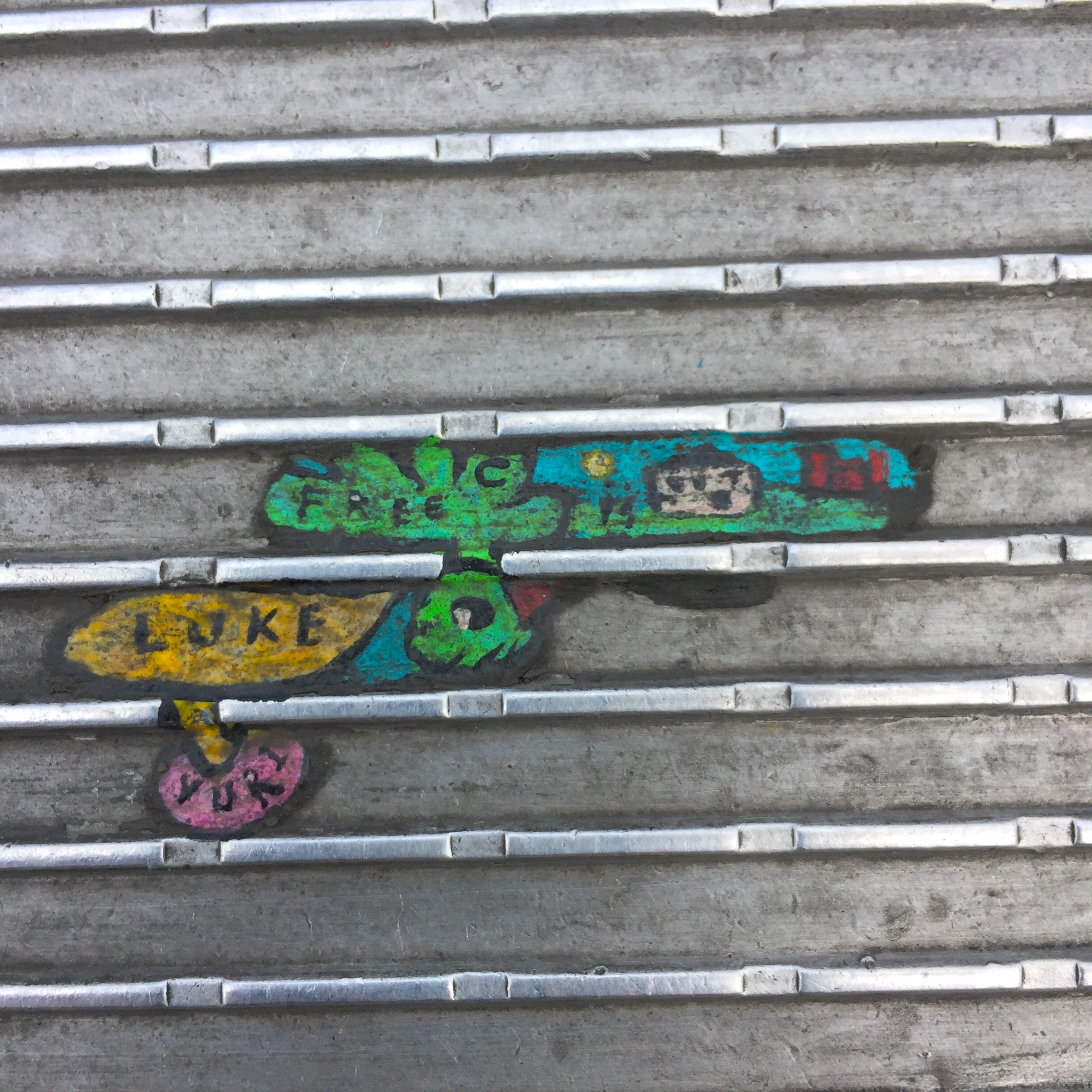
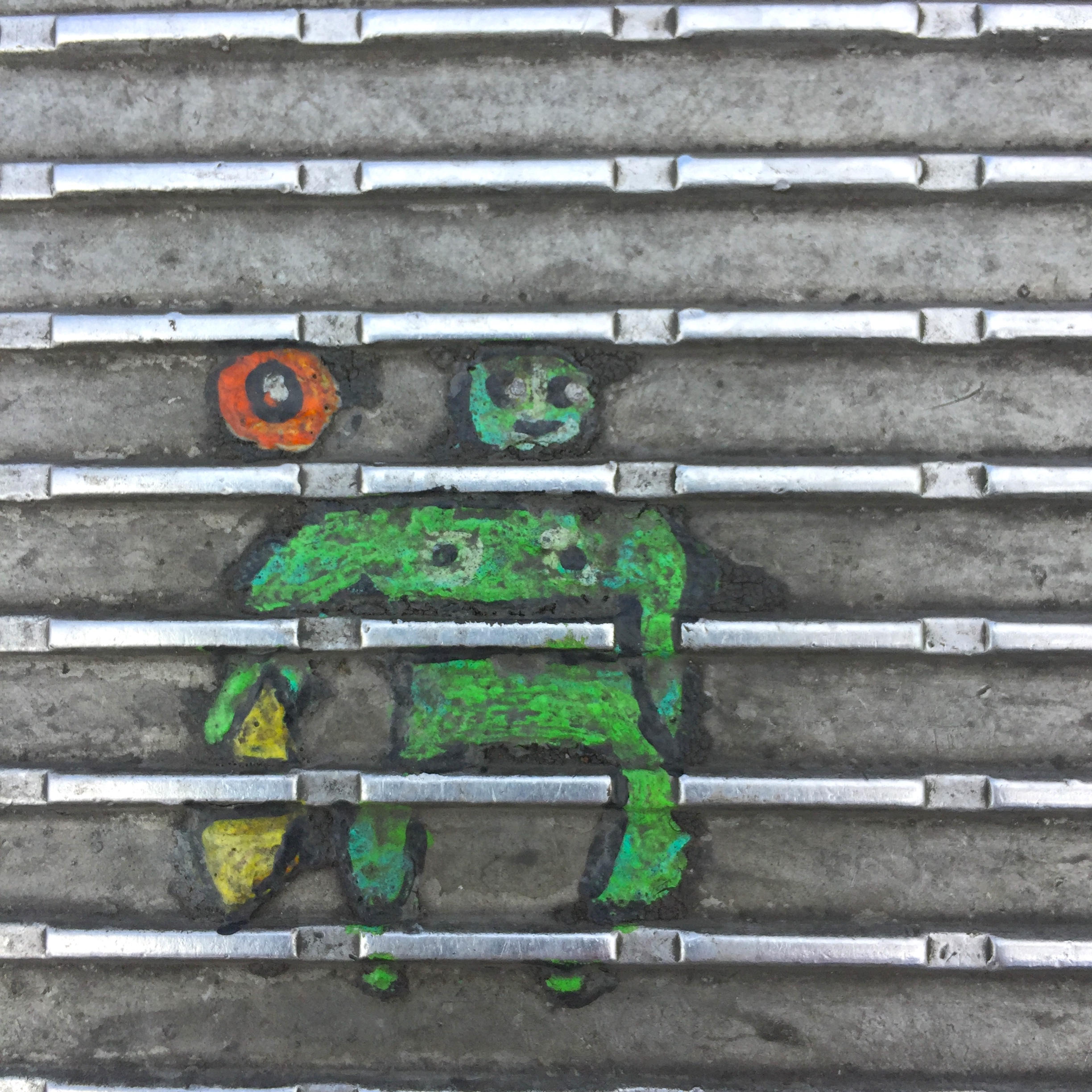
Ben Wilson has created thousands of works using chewing gum as his canvas.
Specifically, chewing gum spat out by careless strangers.
His work has become a defining featuring of London’s Millennium Bridge, a modern structure spanning the Thames, and connecting such South Bank attractions as Tate Modern and the Shakespeare’s Globe with St. Paul’s Cathedral to the north.


A 2021 profile in The Guardian documents the creation process:
The technique is very precise. He first softens the oval of flattened gum a little with a blowtorch, sprays it with lacquer and then applies three coats of acrylic enamel, usually to a design from his latest book of requests that come from people who stop and crouch and talk. He uses tiny modelers’ brushes, quick-drying his work with a lighter flame as he goes along, and then seals it with more lacquer. Each painting takes a few hours and can last for many years.
Unsurprisingly, Wilson works very, very small.
For every Millennium Bridge pedestrian who’s hip to the ever-evolving solo exhibition underfoot, there are several hundred who remain completely oblivious.

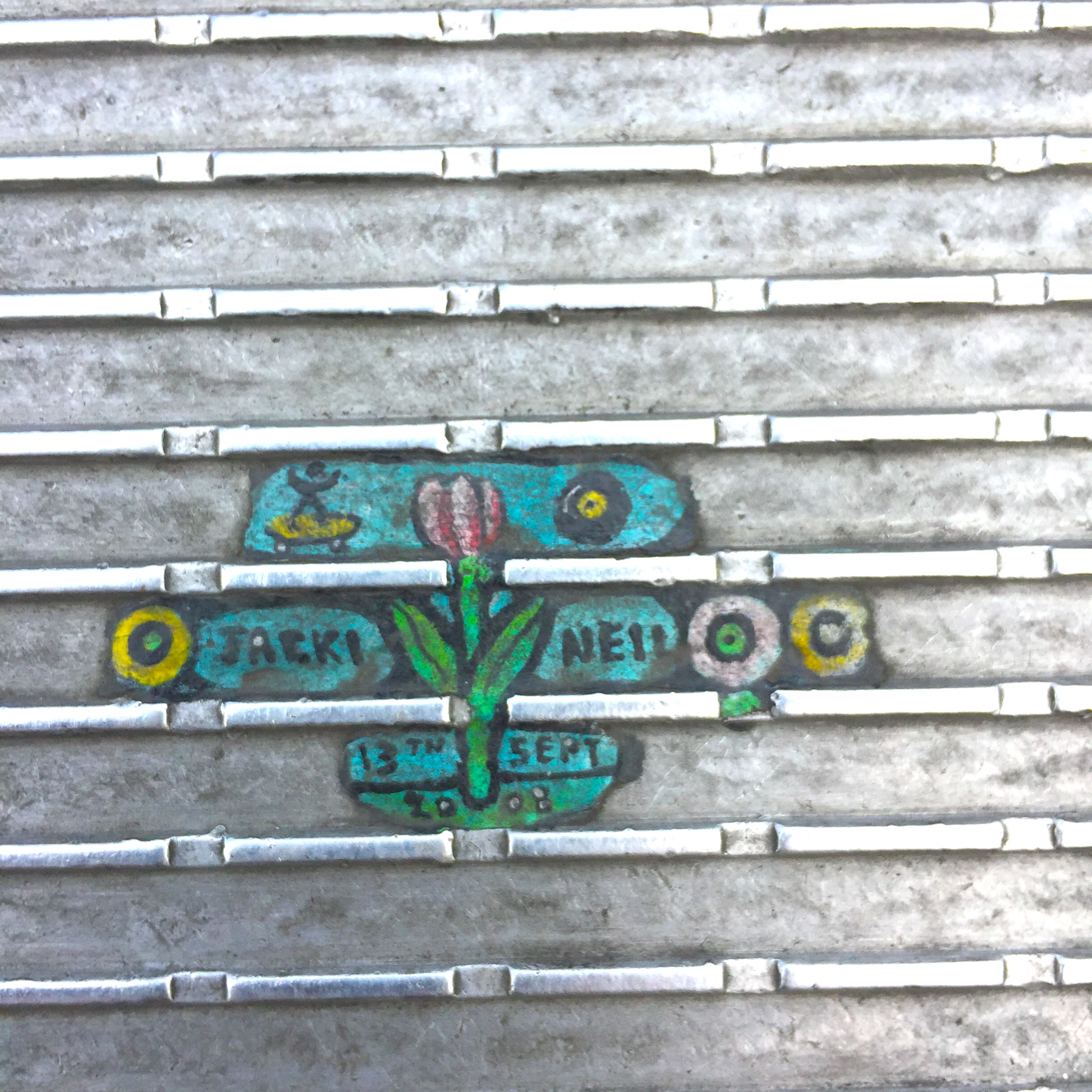


Stoop to admire a miniature portrait, abstract, or commemorative work, and the bulk of your fellow pedestrians will give you a wide berth, though every now and then a concerned or curious party will stop to see what the deal is.
Wilson, who works sprawled on the bridge’s metal treads, his nose close to touching his tiny, untraditional canvas, receives a similar response, as described in Zachary Denman’s short documentary, Chewing Gum Man:
They make think I’ve fallen over and they may think I’ve had a cardiac arrest or something, so I’ve had lots of ambulances turning up…I’ve had loads of police.
His subjects are suggested by the shape of the spat out gum, by friends, by strangers who stop to watch him work:
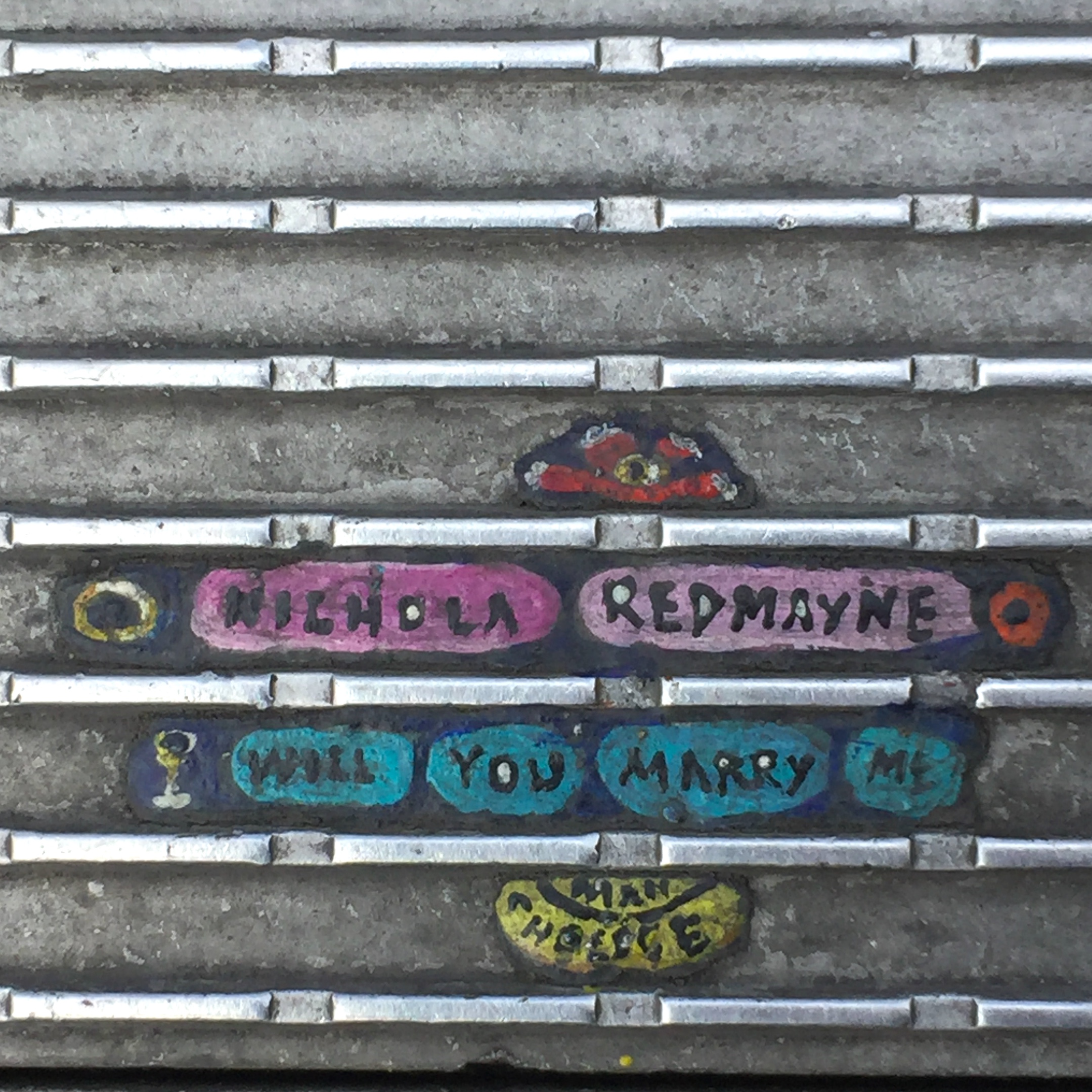
I’ve had to deal with people memorializing people who have been murdered. People who have been so lonely, or remembering favorite pets; people who are destitute in all sorts of ways. It goes from proposal pictures, ‘Will you marry me?’, to people who I drew when they were kids and they now have their own kids.
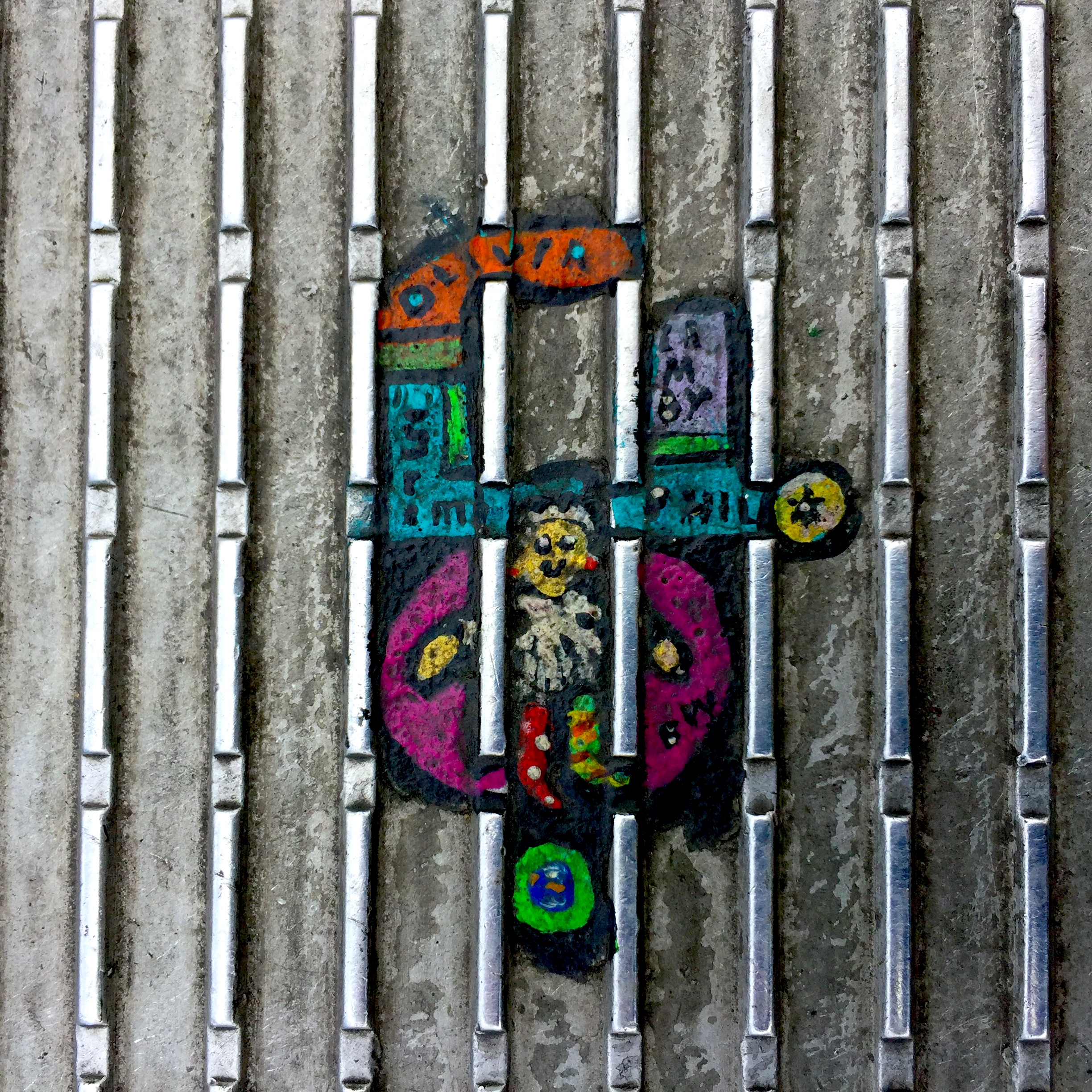

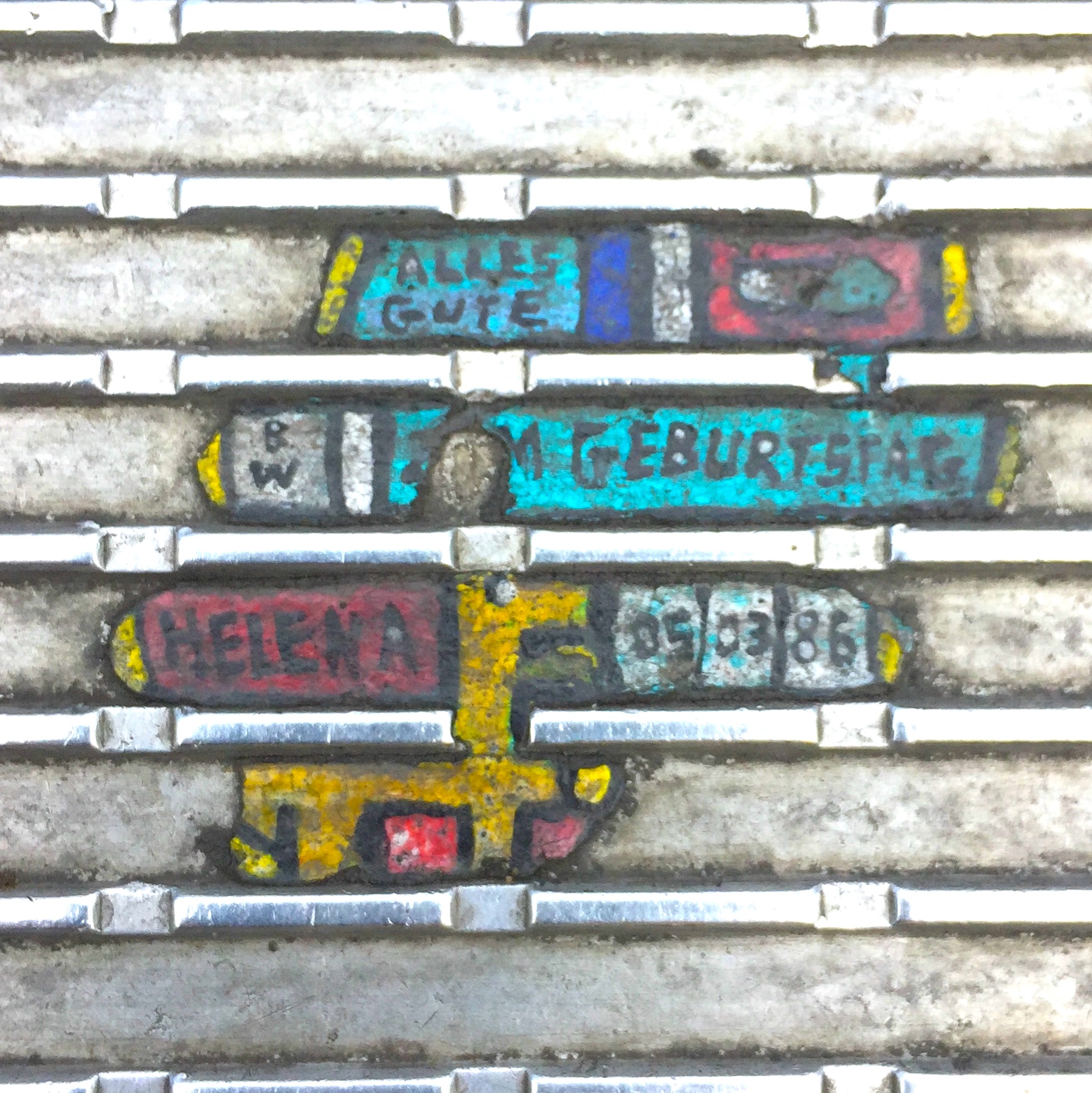
Like any street artist, Wilson’s had his share of run ins with the law, including a wrongful 2010 arrest for criminal damage, when a crowd of schoolchildren who’d been enthusiastically watching an itty bitty St. Pauls taking shape on a blob of gum witnessed him being dragged off by his feet. (He asked if he could finish the picture first…)
He may not get permission to create the public works he goes out daily to create, but he contributes by clearing the area of litter, and as he points out, painting on discarded gum doesn’t constitute defacing anyone’s actual property:
Technically in one sense, I’m working within the law …if I paint on chewing gum, it’s like finding No Man’s Land or common ground. It’s a space which is not under the jurisdiction of a local or national government.



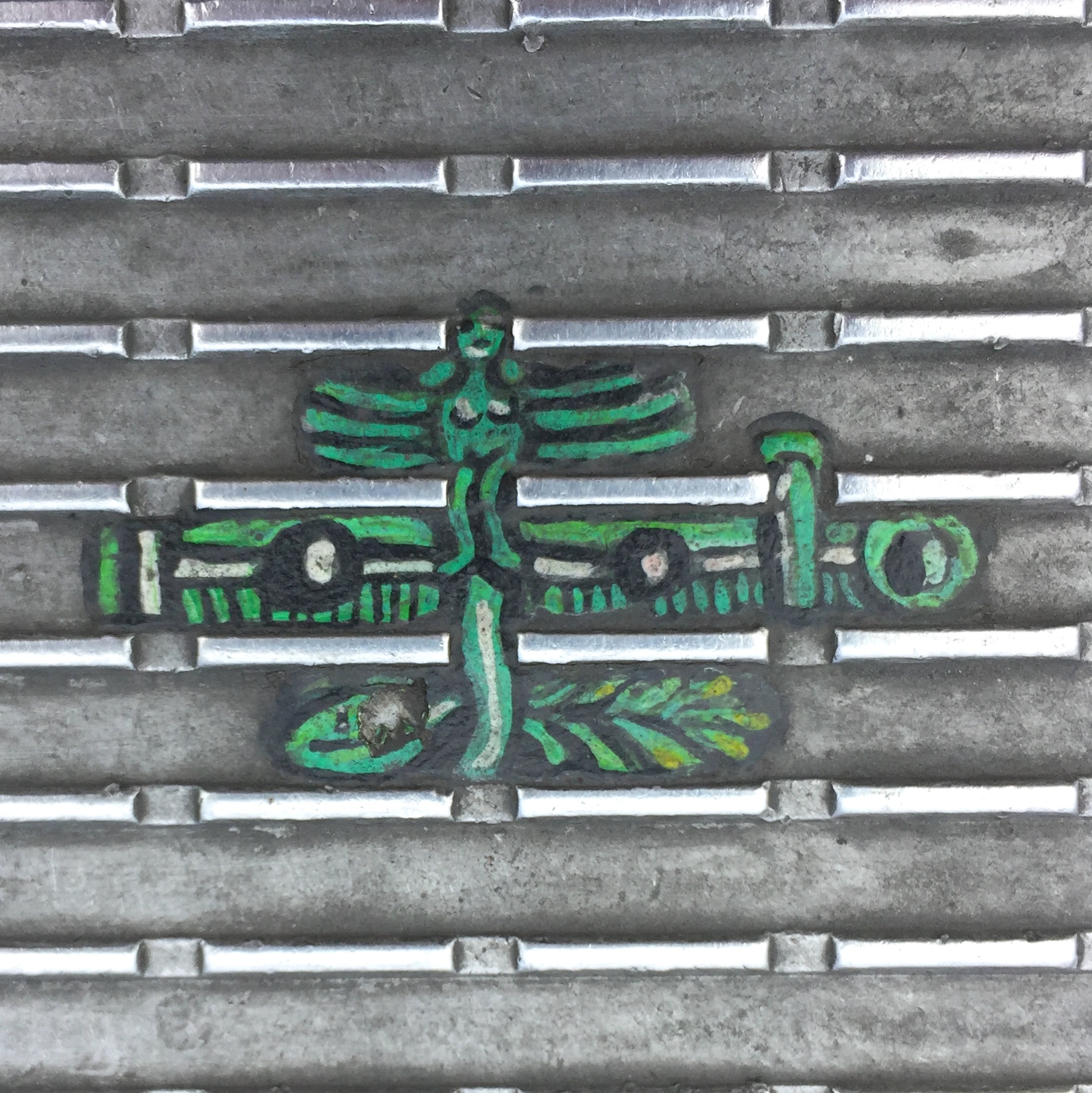


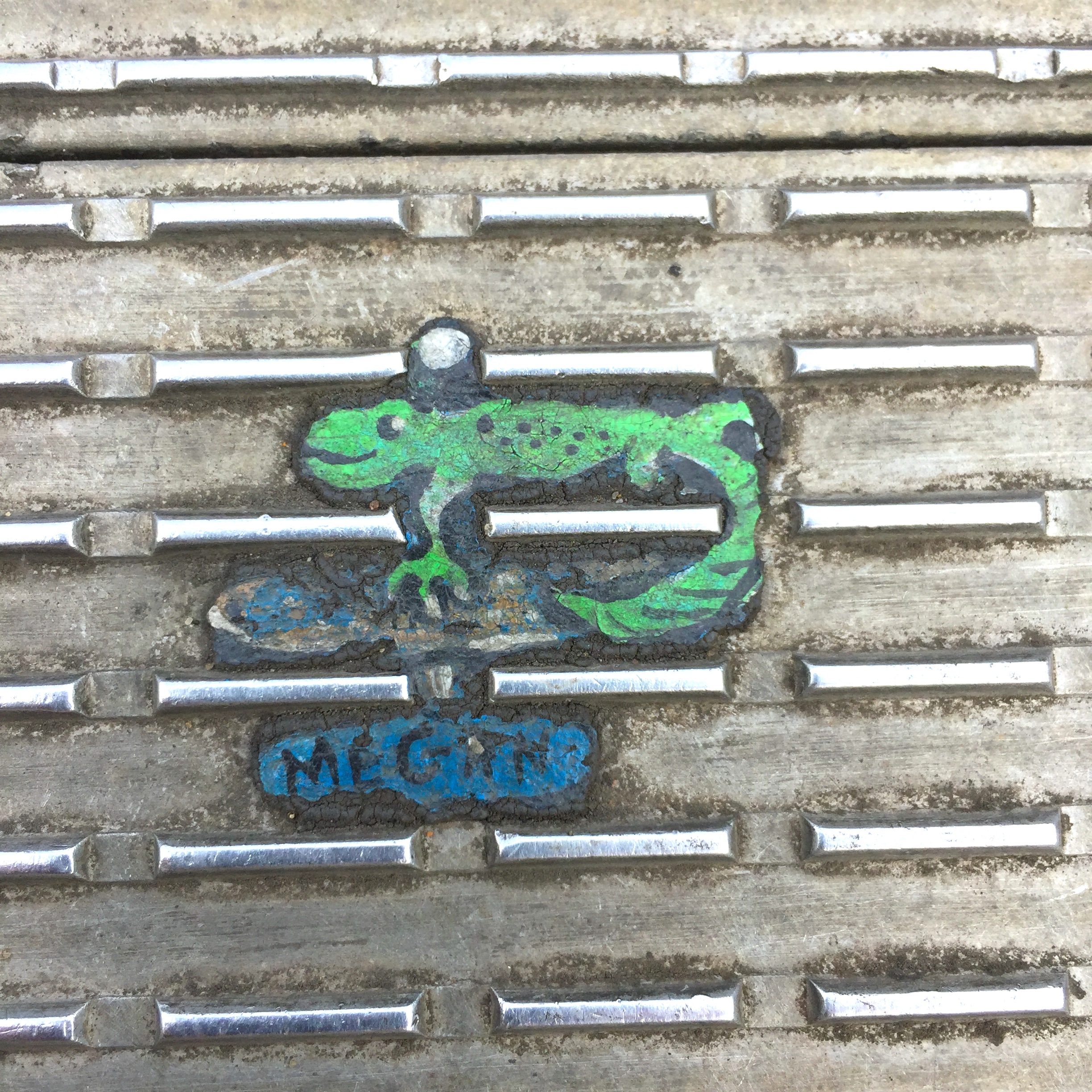




See more of Ben Wilson’s work in his online Gum Gallery.
Photos in this article taken by Ayun Halliday, 2022. All rights reserved.
- Ayun Halliday is the Chief Primatologist of the East Village Inky zine and author, most recently, of Creative, Not Famous: The Small Potato Manifesto. Follow her @AyunHalliday.
Read More...When Christopher Hitchens Vigilantly Defended Salman Rushdie After the Fatwah: “It Was a Matter of Everything I Hated Versus Everything I Loved”
I have often been asked if Christopher defended me because he was my close friend. The truth is that he became my close friend because he wanted to defend me. –Salman Rushdie
Salman Rushdie remains in critical condition after suffering multiple stab wounds while on stage in New York, a shocking occurrence but not quite surprising given that the author has lived with a death sentence over his head since 1989. (You can read the history of that controversy here.) The nation of Iran has denied any responsibility for the attack on the author, but it’s probably safe to assume that his 1988 novel The Satanic Verses has something to do with it, over thirty years after the fact.
“Even before the fatwa,” Steven Erlanger writes in The New York Times, “the book was banned in a number of countries, including India, Bangladesh, Sudan and Sri Lanka.” Protests of the novel resulted in several deaths and attacks on booksellers. Rushdie had not set out to enrage much of the Islamic world, but neither had he any interest in appeasing its conservative leaders. Always outspoken, and a ferocious critic of British Empire as well as Islamic theocracy, his career since the fatwa has demonstrated a commitment to freeing the literary arts from the dictates of church and state.
On the subject of imperialism, Rushdie and the late Christopher Hitchens came to disagree after the U.S.‘s invasion of Iraq and Hitchens’ “U‑turn across the political highway to join forces with the war-makers of George W. Bush’s administration,” Rushdie writes in a Vanity Fair appreciation for Hitchens’ after the latter’s death. But his book God is Not Great “carried Hitch away from the American right and back toward his natural, liberal, ungodly constituency”; a collection of people who see the free expression of ideas as a far preferable condition to the existence of theocratic death squads.
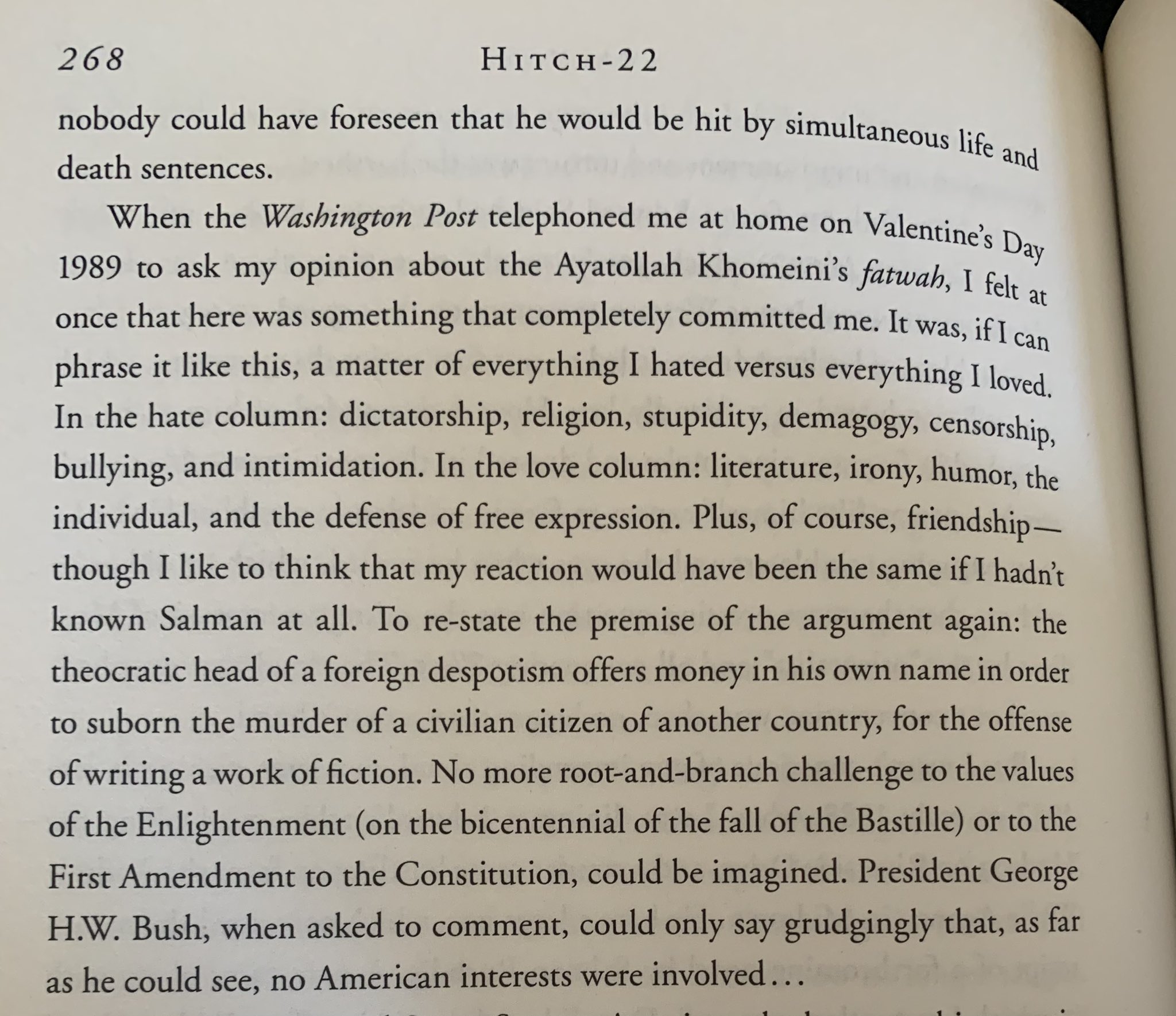
Wherever he fell at any given time on the political spectrum, Hitchens never gave up his defense of Rushdie, one in which, as he wrote in his memoir, Hitch-22, he was completely committed from the start:
It was, if I can phrase it like this, a matter of everything I hated versus everything I loved. In the hate column: dictatorship, religion, stupidity, demagogy, censorship, bullying, and intimidation. In the love column: literature, irony, humor, the individual, and the defense of free expression. Plus, of course, friendship–
Hitchens was gravely disappointed in liberal writers like Arthur Miller who refused to publicly support Rushdie out of fear, as he says in the television interview at the top of the post. The ambivalent response of many on the left struck him as gross political cowardice and hypocrisy. He went on the attack, arguing roundly on popular shows like Question Time (below, with his brother Peter, Baroness Williams, and recently deposed prime minister Boris Johnson).
Hitchens “saw that the attack on The Satanic Verses was not an isolated occurrence,” Rushdie writes, “that across the Muslim world, writers and journalists and artists were being accused of the same crimes — blasphemy, heresy, apostasy, and their modern-day associates, ‘insult’ and ‘offense.’ ” Rushdie had meant no offense, he writes, “I had not chosen the battle.” But it seems to have chosen him:
It was at least the right battle, because in it everything that I loved and valued (literature, freedom, irreverence, freedom, irreligion, freedom) was ranged against everything I detested (fanaticism, violence, bigotry, humorlessness, philistinism, and the new offense culture of the age). Then I read Christopher using exactly the same everything-he-loved-versus-everything-he-hated trope, and felt… understood.
If the fatwa against Rushdie made him infamous, it did not make him universally beloved, even among his fellow writers, but he always had a fierce ally in Hitchens. Let’s hope Rushdie can pick up the fight for free expression once again when he recovers from this brutal stabbing.
Related Content:
Hear Salman Rushdie Read Donald Barthelme’s “Concerning the Bodyguard”
Josh Jones is a writer and musician based in Durham, NC. Follow him at @jdmagness
Read More...What Frank Lloyd Wright’s Unusual Windows Tell Us About His Architectural Genius
There could be few more American styles of dwelling than the tract house, and few more American architects than Frank Lloyd Wright. But Wright, of course, never designed a tract house. Each of his dwellings, to say nothing of his public buildings, was in every sense a one-off, not just in its layout and its details but in its relationship to its context. Wright believed, as he declared in his book The Natural House, that a building should be “as dignified as a tree in the midst of nature.” This he held true even for relatively modest residences, as evidenced by the series of “Usonian houses” he began in the late nineteen-thirties.
The Vox video above features the “cypress-and-brick masterpiece” that is Pope-Leighey House in Alexandria, Virginia, which Wright completed in 1941. “Bounded by the humble budget of the Pope family” — Loren Pope, its head was working as a newspaper copy editor at the time — “this structure nonetheless exhibits the distinct features characteristic of his formidable vision and style.”
So says the house’s page at the Frank Lloyd Wright Foundation, which adds that “the architectural element of compression and release, the cantilevered roofs, and the windows that open to the outside create an immediate interaction with the surrounding landscape.”
Video producer Phil Edwards pays special attention to those windows. He cites Wright’s conviction that “the best way to light a house is God’s way — the natural way, as nearly as possible in the daytime and at night as nearly like the day as may be, or better.” In the case of the Pope-Leighey house, achieving this ideal involved the use of not just nearly floor-to-ceiling windows, but also clerestory windows perforated in a distinctive geometric pattern and positioned so as to cast “light hung like pictures on the wall.” The effect is so strong that the house’s two relocations appear not to have diminished it — and so singular that, despite the enthusiasm of post-war tract-house developers for Wright’s innovations in housing, it never did make it into Levittown.
Related content:
Take a 360° Virtual Tour of Taliesin, Frank Lloyd Wright’s Personal Home & Studio
That Far Corner: Frank Lloyd Wright in Los Angeles – A Free Online Documentary
Based in Seoul, Colin Marshall writes and broadcasts on cities, language, and culture. His projects include the Substack newsletter Books on Cities, the book The Stateless City: a Walk through 21st-Century Los Angeles and the video series The City in Cinema. Follow him on Twitter at @colinmarshall, on Facebook, or on Instagram.
Read More...The Oakland Public Library Puts Online a Collection of Items Forgotten in Library Books: Love Notes, Doodles & More

Librarians are champions of organization, and among its best practitioners.
Books are shelved according to the Dewey Decimal system.
Categories are assigned using Library of Congress Rule Interpretations, Library of Congress Subject Headings, and Library of Congress Classification.
And Sharon McKellar, the Teen Services Department Head at the Oakland Public Library, collects ephemera she and other staffers find in books returned to the OPL’s 18 locations.
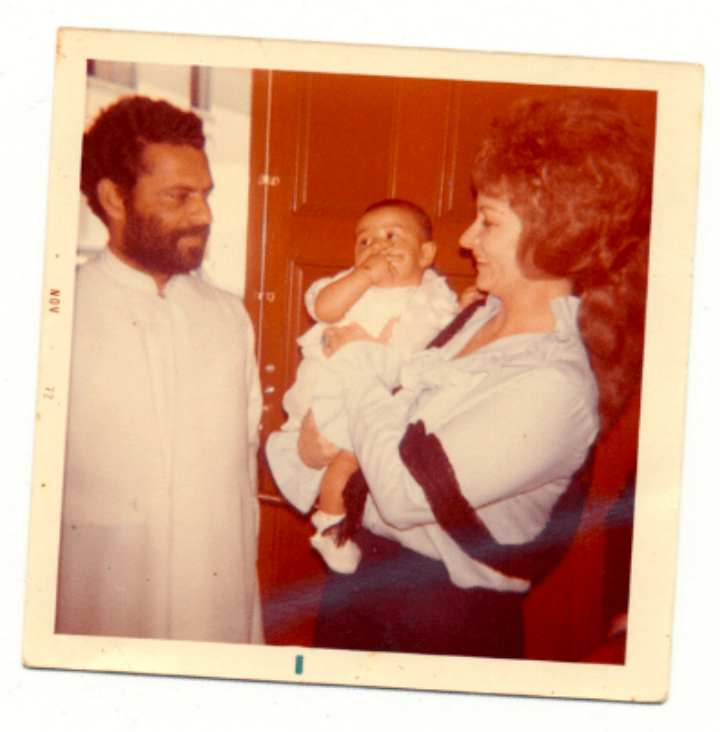
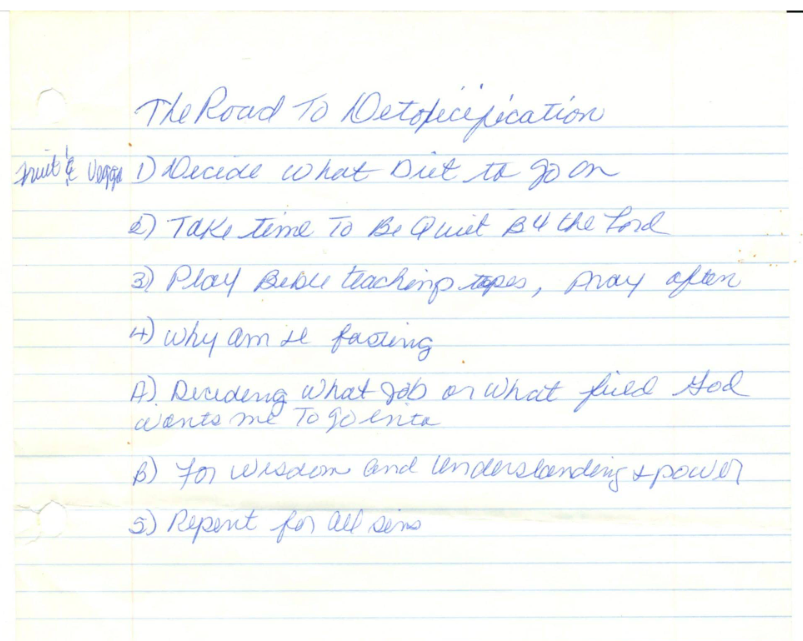

It’s an impulse many share.
Eventually, she began scanning them to share on her employer’s website, inspired by Found Magazine, a crowdsourced collection of found letters, birthday cards, kids’ homework, to-do lists, handwritten poems, doodles, dirty pictures, etc.
As Found’s creators, Davy Rothbart and Jason Bitner, write on the magazine’s website:
We certainly didn’t invent the idea of found stuff being cool. Every time we visit our friends in other towns, someone’s always got some kind of unbelievable discovered note or photo on their fridge. We decided to make a bunch of projects so that everyone can check out all the strange, hilarious and heartbreaking things people have picked up and passed our way.
McKellar told NPR that her project “lets us be a little bit nosy. In a very anonymous way, it’s like reading people’s secret diaries a little bit but without knowing who they are.”
The finds, which she stores in a box under her desk prior to scanning and posting, are pushing 600, with more arriving all the time.
Searchable categories include notes, creative writing, art, and photos.
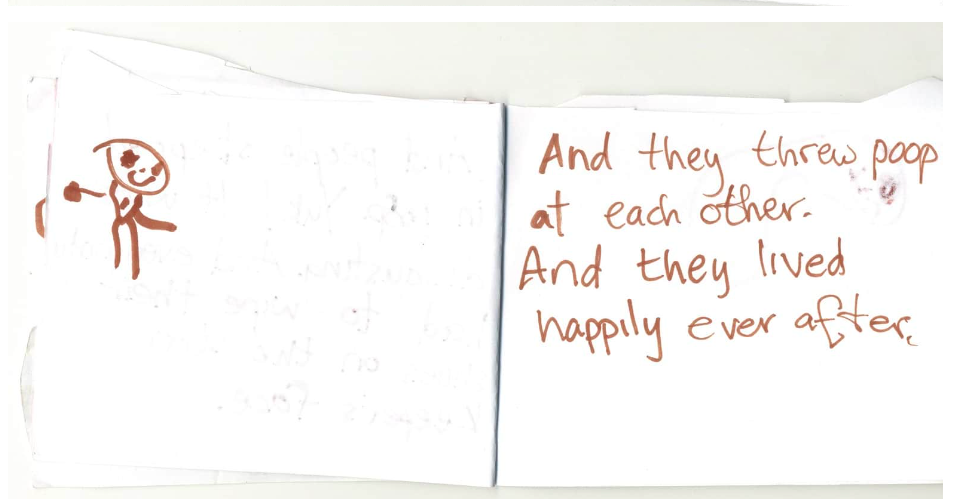
One artifact, the scatological one-of-a-kind zine Mr Men #48, excerpted above, spans four categories, including kids, a highly fertile source of both humor and heartbreak.
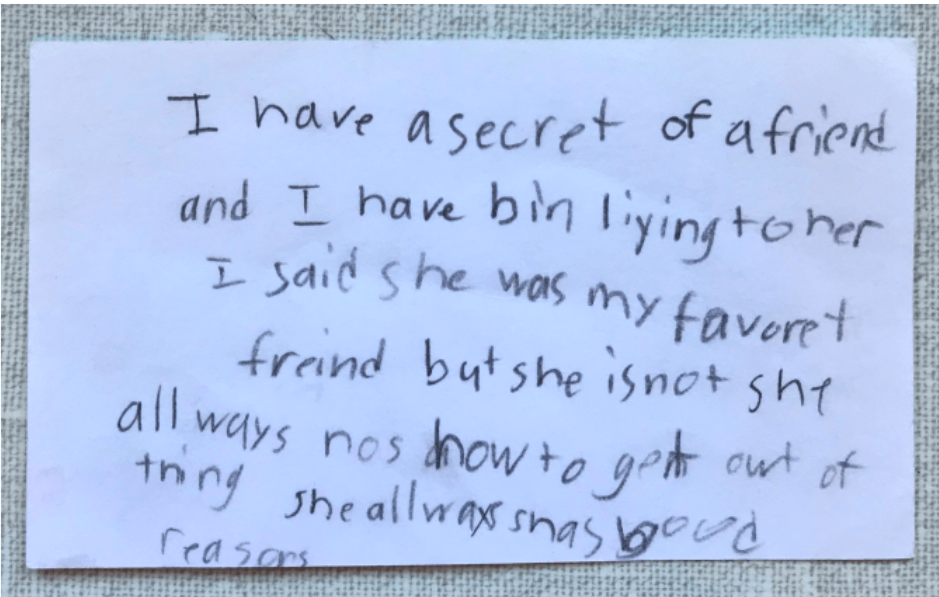
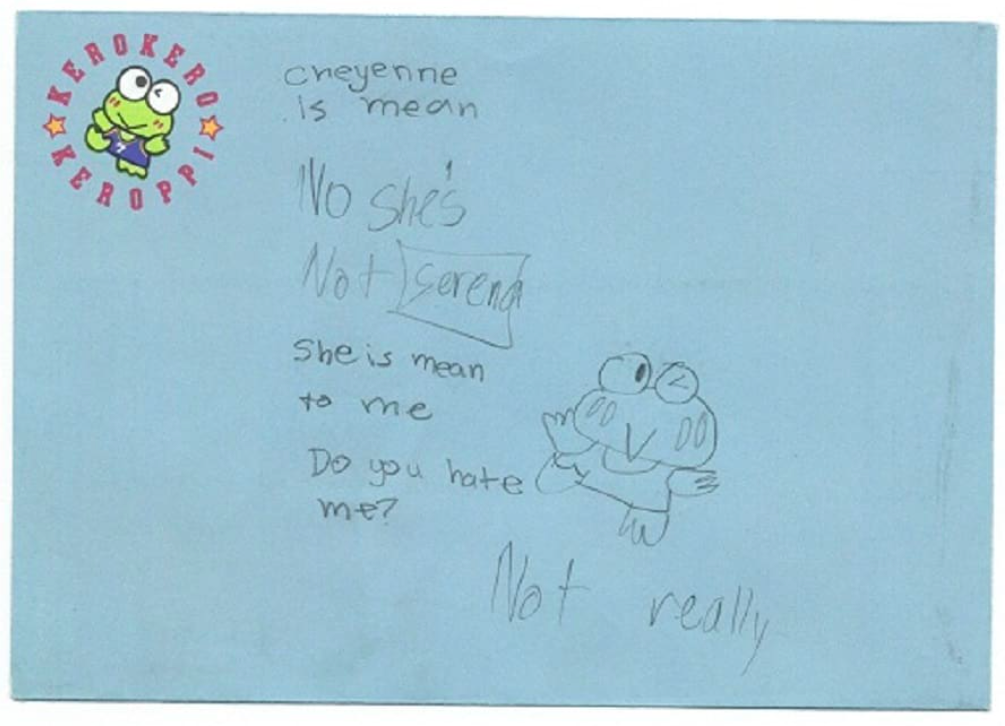
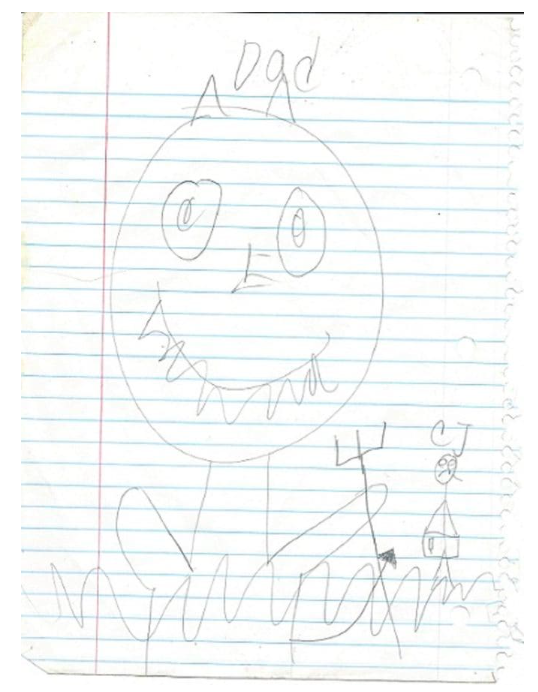
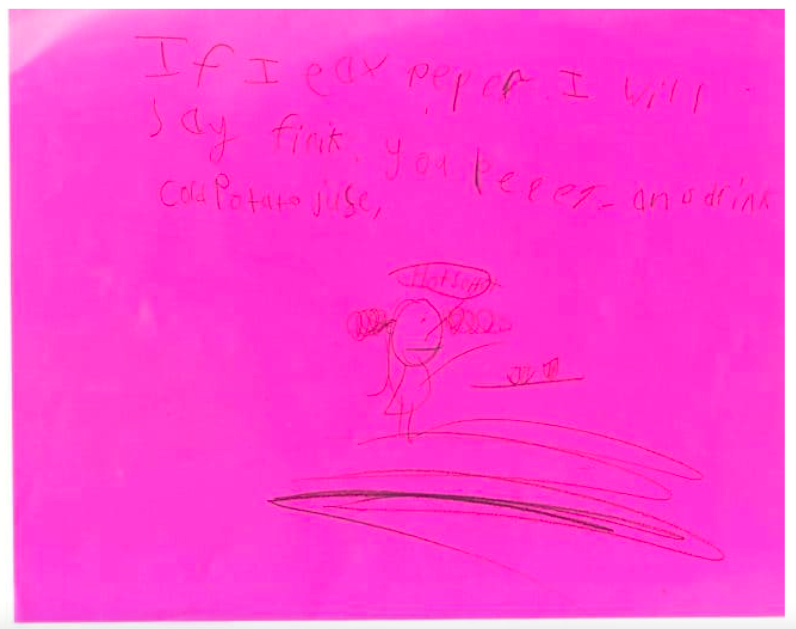
There’s a distinctly different vibe to the items that children forge for themselves or each other, as opposed to work created for school, or as presents for the adults in their lives.
McKellar admits to having a sweet spot for their inadvertent contributions, which comprise the bulk of the collection.
She also catalogues the throwaway flyers, ticket stubs and lists that adult readers use to mark their place in a book, but when it comes to placeholders with more obvious potential for sentimental value, she finds herself wondering if a library patron has accidentally lost track of a precious object:
Does the person miss that item? Do they regret having lost it or were they careless with it because they actually didn’t share those deep and profound feelings with the person who wrote [it]?
Actual bookmarks are not exempt…
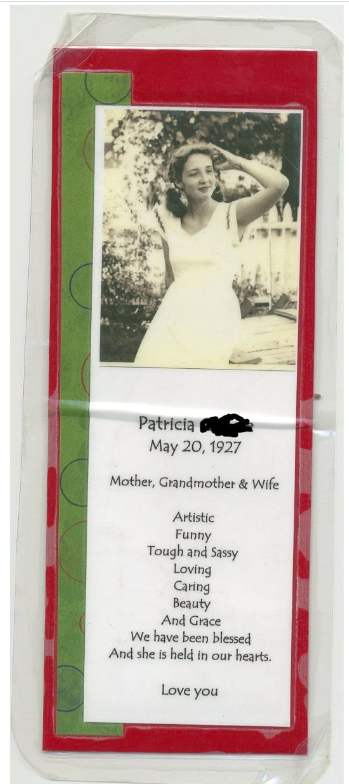
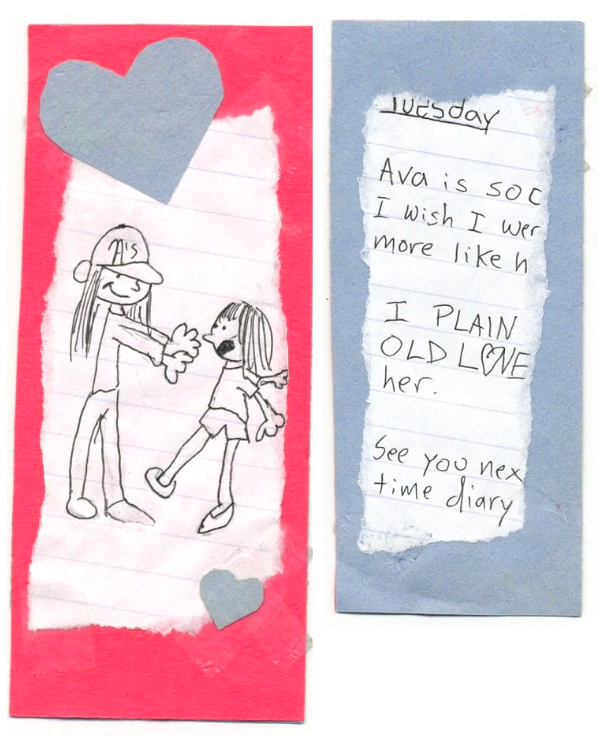
Future plans include a possible writing contest for short stories inspired by items in the collection.
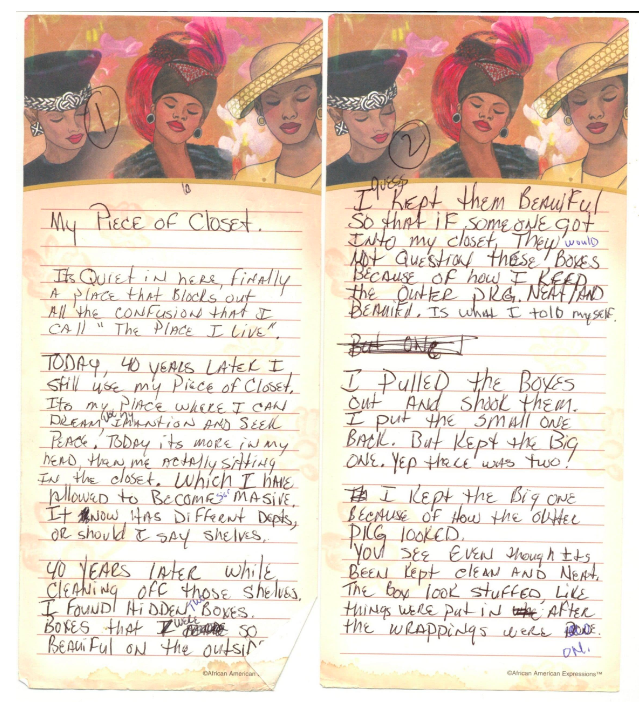
Browse the Found in a Library Book collection here.
Related Content
The New York Public Library Creates a List of 125 Books That They Love
- Ayun Halliday is the Chief Primatologist of the East Village Inky zine and author, most recently, of Creative, Not Famous: The Small Potato Manifesto. Follow her @AyunHalliday.
Read More...How a Simple, Bauhaus-Designed Chair Ended Up Everywhere Over the Past 100 Years
If you don’t believe chairs can be art, you’ll have to take it up with the curators, gallerists, collectors, architects, and designers around the world who spend their lives obsessing over chair design. Every major museum has a furniture collection, and every collection displaying furniture gives special pride of place to the radical innovations of modernist chairs, from early artisan creations of the Bauhaus to mass-produced mid-century chairs of legend. Chairs are status symbols, art objects, and physical manifestations of leisure, power, and repose.
Who could forget Charles and Ray Eames’ iconic lounge chair, Arne Jacobsen’s “Egg,” the elegantly simple side chairs of Eero Saarinen and Charles Eames, or even the more recent corner office staple, the Aeron Chair — the Herman Miller original that has been part of the Museum of Modern Art’s permanent collection since 1992? “In chairs more than in any other object, human beings are the unit of measure,” says Museum of Modern Art curator Paola Antonelli, “and designers are forced to walk a line between standardization and personalization.”
Artist Marcel Breuer, a Bauhaus designer, architect, and instructor, applied more than his share of innovative ideas to a series of chairs and tables designed and built in the 1920s and 30s. The most iconic of these, from a design perspective, may be the “Wassily,” a club chair-shaped contraption made of steel tubing and canvas straps. (The chair acquired the name because Breuer’s Bauhaus colleague Wassily Kandinsky so admired it.) One rarely encounters this chair outside the environs of upscale furniture galleries and the finer homes and waiting rooms.
Breuer’s Cesca, however, the Wassily’s smaller, more utilitarian cousin from 1928, seems to show up all over the place. Also called the B32 (with an armchair version called the B64), the Cesca’s one-piece, steel tube design was, like Breuer’s full line of Bauhaus furniture, inspired by his experiments in bike-building and interest in “mass production and standardization,” he said. Unlike the Wassily, which might set you back around $3,300 for a quality reproduction, a Cesca comes in at around 1/10th the price, and seems ubiquitous, the Vox video above points out.
No, it’s still not cheap, but Breuer’s rattan chair design is widely beloved and copied. “The cantilevered cane-and-chrome chair is all over the place,” Vox writes, “in trendy homes, in movies and on TV shows, even tattooed on people’s bodies.… [This] somewhat unassuming two-legged chair is the realization of a manifesto’s worth of utopian ideals about design and functionality.” It satisfies the school’s brief, that is to say, for the utilitarian as utopian, as Breuer himself later commented on his design:
I already had the concept of spanning the seat with fabric in tension as a substitute for thick upholstery. I also wanted a frame that would be resilient and elastic [as well as] achieve transparency of forms to attain both visual and physical lightness.… I considered such polished and curved lines not only symbolic of our modern technology, but actually technology itself.
Learn more about the practical, comfortable, beauty of the Cesca — and the ideals of the Bauhaus — in the video at the top. Learn more about the chair’s designer, Marcel Breuer, in this online MoMA monograph by Christopher Wilk.
Related Content:
How the Iconic Eames Lounge Chair Is Made, From Start to Finish
Josh Jones is a writer and musician based in Durham, NC. Follow him at @jdmagness
Read More...What Does a $275,000 Classical Guitar Sound Like?
The highest quality classical guitars handmade in the 21st century can run into the tens of thousands of dollars. This is no frivolous expense for a professional player. Put such an instrument in the hands of an amateur and you may not hear much difference between it and a $150 factory-made budget model. In the hands of a seasoned player, a high-end guitar truly sings. Tone resides in the fingers — or 90% of it anyway — but a skilled guitarist knows how to discover and make use of all an instrument’s best qualities. For a musician who makes a living doing so, spending the cost of a car on a guitar makes economic sense (as does a good insurance policy).
The tonal qualities of the instrument below, a handmade classical guitar from 1888, are clearly abundant; it’s also clear that guitarist Brandon Acker — who has appeared in many of our previous posts on the guitar — knows how to exploit them. At times, he brings out such rich resonance, the instrument sounds like a piano; at others, it is almost harp-like. We have a confluence of rarity: a highly skilled player with deep knowledge of classical stringed instruments, and an instrument like no other — so rare, in fact, that it’s valued at over a quarter of a million dollars, roughly the average cost of a moderately-priced house in the U.S., the largest investment most people make in their lifetime.
To understand why the instrument carries such a high price tag, see Acker and YouTuber and guitarist Rob Scallon visit with father-and-son luthier team R.E. and M.E. Bruné at their shops in Illinois in the video at the top. The Brunés are specialists in classical and flamenco guitars. (The elder Bruné tells a charming story of making his first flamenco guitar for himself from his parents’ first dining room table.) In their shop’s storage area, they have ready access to some of the rarest guitars in the world, and they give us a lively tour — starting with a “bit of a letdown,” the “low-end,” 1967 Daniel Friederich concert model valued at $50,000.
In Acker’s hands, each guitar delivers the full potential of its sustain and resonance. Finally, at 16:00, we come to the 1888 Antonio de Torres guitar valued at $275,000. There are many older guitars in existence, even guitars made by Antonio Stradivari and his heirs. But it was this guitar, or one of the few others made by the legendary Torres around the same time, that revolutionized what a guitar looked and sounded like. When Andrés Segovia arrived on stages playing his Torres, the Brunés tell us, guitarists around the world decided that the old style, small-bodied guitars in use for centuries were obsolete.
There are perhaps 90 to 100 of the Torres classical guitars in existence, and this extravagantly-priced number 124 is “as close as you’re going to get to original,” says the elder Bruné, while his son makes the fascinating observation, “older instruments that have been played a lot, especially by great players… learn the music.” Acker expresses his surprise at the “sweetness” of the very touch of the guitar.
If you had attended the 2016 Guitar Foundation of America conference in Denver, where M.E. Bruné exhibited several of his shop’s rare guitars, you would have been able to play the Torres yourself — or even purchase it for the lesser price of $235,000.
In the video interview above from the GFA conference, M.E. Bruné describes the year plus-long restoration process on the guitar, one that involved some disassembly, extra bracing, and a replacement fingerboard, but preserved the beautiful spruce and birdseye maple of the guitar, wood that “doesn’t grow on trees like this anywhere” these days, says Bruné. It is, he says, “the best-sounding Torres” he’s ever heard. Coming from someone who has heard, and restored, the sweetest-sounding guitars in existence, that’s saying a lot. $275,000 worth? Maybe. Or maybe it’s impossibly arbitrary to put any price on such an artifact.
Related Content:
Hear Musicians Play the Only Playable Stradivarius Guitar in the World: The “Sabionari”
The History of the Guitar: See the Evolution of the Guitar in 7 Instruments
Encore! Encore! An Hour of the World’s Most Beautiful Classical Guitar
Josh Jones is a writer and musician based in Durham, NC. Follow him at @jdmagness
Read More...Olivia Newton-John (RIP) Reunites with Grease Co-Star John Travolta to Sing “You’re The One That I Want” (2002)
American nostalgia as we know it was invented in the nineteen-seventies. Consider that decade’s preponderance of backward-looking pop-cultural phenomena: Sha Na Na; Happy Days; “Yesterday Once More”; American Graffiti, whose tagline asked “Where were you in ’62?”, a time just eleven years before the release of the picture itself. But no piece of work stands more iconically for the seventies revival of the late fifties and early sixties than Grease. First produced as a stage musical in Chicago in 1971, it graduated to Broadway the next year. But Grease wouldn’t take its most enduring form until 1978, the year that brought Randal Kleiser’s film adaptation starring John Travolta and the late Olivia Newton-John.
A 28-year-old Australian might have seemed an unconventional choice for the part of Sandy Dombrowski, the new girl at midwestern Rydell High School. But after the alteration of a few details in the character and story, she made the role entirely her own. “It was Newton-John’s dulcet intimacy as a singer that set her up perfectly to play the naïve Sandy onscreen,” writes the New Yorker’s Rachel Syme.
Her “squeaky prudishness and moony innocence as she wails ‘Hopelessly Devoted to You’ stands in such sharp, silly contrast to her vampy fallen-woman persona at the end of the film that the whole thing feels like a camp commentary on the power of costuming and collective fantasy (not to mention a good perm).”
It didn’t hurt that Newton-John was already established as a singer: she’d represented the United Kingdom in 1974’s Eurovision Song Contest (losing, ultimately, to ABBA), and that very same year scored country hits in the United States. Her skills did much not just to make the Grease soundtrack America’s second-best-selling album of 1978 (second to the soundtrack of Travolta’s own vehicle Saturday Night Fever), but to keep it enduringly popular throughout the decades since. At Grease’s 2002 DVD release party, Newton-John and Travolta reunited onstage to sing “You’re the One That I Want,” much to the delight of the audience — all of whom must still remember where they were in ’02, at least for those three minutes.
Related content:
Jimmy Page and Robert Plant Reunite in Exotic Marrakesh, 1994
In Touching Video, Artist Marina Abramović & Former Lover Ulay Reunite After 22 Years Apart
The “West Side Story” Story — Pretty Much Pop: A Culture Podcast #114
Based in Seoul, Colin Marshall writes and broadcasts on cities, language, and culture. His projects include the Substack newsletter Books on Cities, the book The Stateless City: a Walk through 21st-Century Los Angeles and the video series The City in Cinema. Follow him on Twitter at @colinmarshall, on Facebook, or on Instagram.
Read More...All the Music Played on MTV’s 120 Minutes: A 2,500-Video Youtube Playlist
The mid-nineteen-nineties was not a time without irony. You may recall that, back then, “alternative” rock had not only gone mainstream, but, in certain regions, had even become the most popular genre of music on the radio. That was certainly true in the Seattle area, where I grew up. And if you wanted to start a rock band there, as writer Adam Cadre remembers, you knew what steps you had to take: “get a record deal, make a video, get it on 120 Minutes, have it become a Buzz Clip, wonder why massive success doesn’t ease the aching void inside.”
If you got into bands like 10,000 Maniacs, Smashing Pumpkins, R.E.M., The Replacements, the Pixies, the Offspring, or Sonic Youth in the mid-nineties (to say nothing of a certain trio called Nirvana), chances are — statistically speaking, at least — that you first saw them on 120 Minutes.
At the peak of its popularity on MTV, the show defined the alternative-rock zeitgeist, introducing new bands as well as bringing new waves of listeners to existing ones. Though most strongly associated with the nineties, it premiered in 1986, hosted by three of the first MTV VJs, J. J. Jackson, Martha Quinn, and Alan Hunter. 36 years later, you can relive the entirety of 120 Minutes’ seventeen-year run (with a brief revival in the twenty-tens) on Youtube.
A user named Chris Reynolds has created a playlist that appears to contain every song ever aired on 120 Minutes. (Those have been documented by The 120 Minutes Archive, previously featured here on Open Culture.) Among the playlist’s more than 2,500 videos are songs — Violent Femmes’ “Kiss Off,” The Psychedelic Furs’ “Love My Way,” Pearl Jam’s “Alive,” Fishbone’s “Everyday Sunshine,” R.E.M.‘s “Stand” — that will take you back to the pop-cultural eras 120 Minutes spanned. But there are even more — Manufacture’s “As the End Draws Near,” Lloyd Cole and the Commotions’ “Jennifer She Said,” Helmet’s “Milquetoast,” Cause and Effect’s “You Think You Know Her” — that you may well have missed, even if you rocked your way through the eighties and nineties.
Related content:
Watch the First Two Hours of MTV’s Inaugural Broadcast (August 1, 1981)
Nirvana Refuses to Mime Along to “Smells Like Teen Spirit” on Top of the Pops (1991)
William S. Burroughs — Alternative Rock Star — Sings with Kurt Cobain, Tom Waits, REM & More
Based in Seoul, Colin Marshall writes and broadcasts on cities, language, and culture. His projects include the Substack newsletter Books on Cities, the book The Stateless City: a Walk through 21st-Century Los Angeles and the video series The City in Cinema. Follow him on Twitter at @colinmarshall, on Facebook, or on Instagram.
Read More...Support Us
We're hoping to rely on loyal readers, rather than erratic ads. Please click the Donate button and support Open Culture. You can use Paypal, Venmo, Patreon, even Crypto! We thank you!

About Us

Open Culture scours the web for the best educational media. We find the free courses and audio books you need, the language lessons & educational videos you want, and plenty of enlightenment in between.
Advertise With Us
FREE UPDATES!
GET OUR DAILY EMAIL
Get the best cultural and educational resources on the web curated for you in a daily email. We never spam. Unsubscribe at any time.
FOLLOW ON SOCIAL MEDIA
Open Culture editor Dan Colman scours the web for the best educational media. He finds the free courses and audio books you need, the language lessons & movies you want, and plenty of enlightenment in between.
Advertise With Us

