Discover The Key of Hell, an Illustrated 18th-Century Guide to Black Magic (1775)
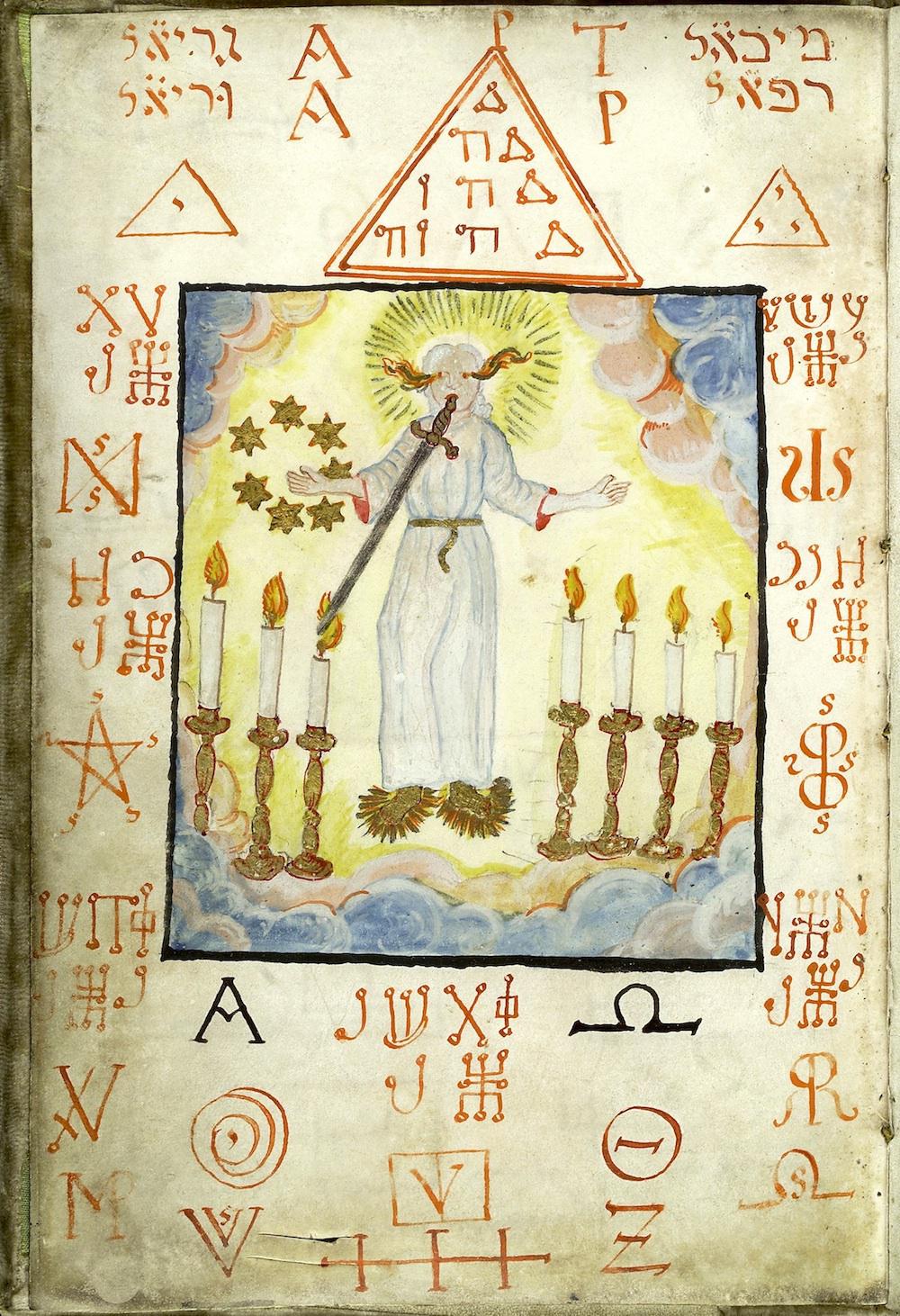
According to the Book of Revelation, the returning Christ arrives surrounded by seven candlesticks. In its author’s prophetic dream, “his head and his hairs were white like wool, as white as snow; and his eyes were as a flame of fire.” From his mouth issues “a sharp sword with which to strike down the nations.” It’s a startling image, created for symbolic purposes. Without a key to what those symbols mean, the text remains obscure. It is, after all, a vision given to a mystic hermit exiled on an island.
Many a Revelation-inspired magical grimoire from succeeding centuries also remains nearly incomprehensible to non-adepts. Such is the case with the “strange 18th-century manuscript called Clavis Inferni (key of hell),” as Benjamin Breen writes at Slate. “Filled with invocations, cryptic sigils, and paintings of supernatural beings” — such as the illustration from Revelation above — “the book defies interpretation — as it was meant to do.” Also, like Revelation, the text’s authorship is mysterious, and yet significant to our understanding of its intent.

The Key of Hell is attributed to a Cyprianus, a name that “probably refers to St. Cyprian of Antioch (d. 304 CE),” Breen writes in a post at Atlas Obscura, “a very common apocryphal attribution for medieval magical texts, since Cyprian was reputed to have been a powerful magician and demon-summoner before converting to Christianity.” The use of pseudoepigraphy — an author assuming the name of a long-dead figure — was common practice throughout the history of both theological and alchemical writing. Rather than an attempt at deception, it could signal the continuation of a tradition of occult knowledge.
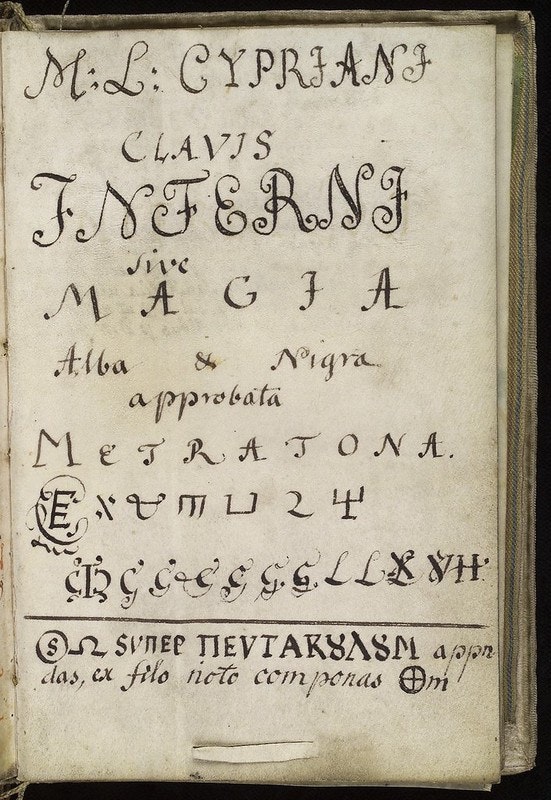
The title page of the Key of Hell “seems to date it to 1717,” writes Breen, but a Sotheby’s catalogue entry claims, “the script seems to be of the late 18th century” and dates it to 1775. At the Wellcome Library — who host the text online in its entirety — we find this “Harry Potter-esque” origin story:
Also known as the Black Book, [the Key of Hell] is the textbook of the Black School at Wittenberg, the book from which a witch or sorcerer gets his spells. The Black School at Wittenberg was purportedly a place in Germany where one went to learn the black arts.
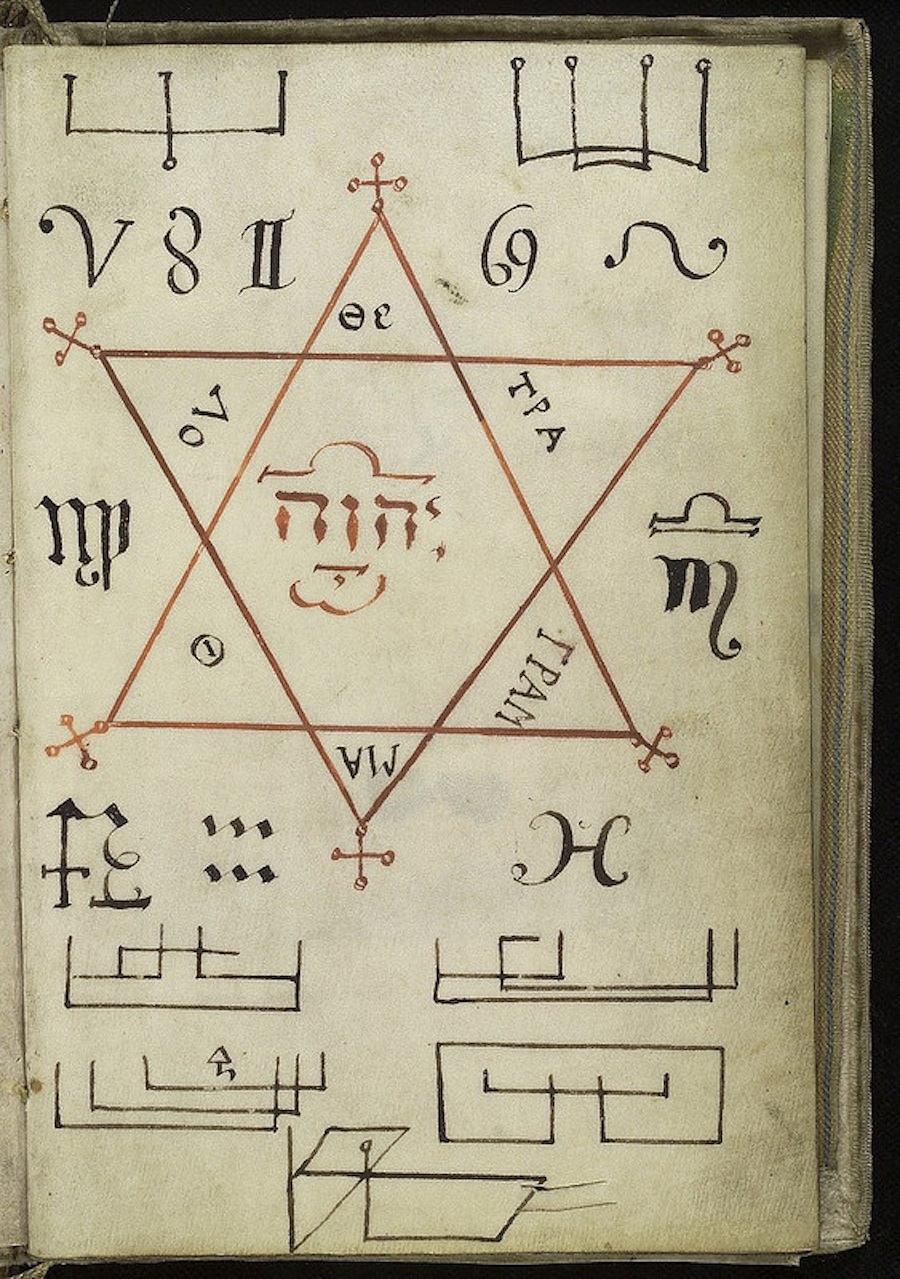
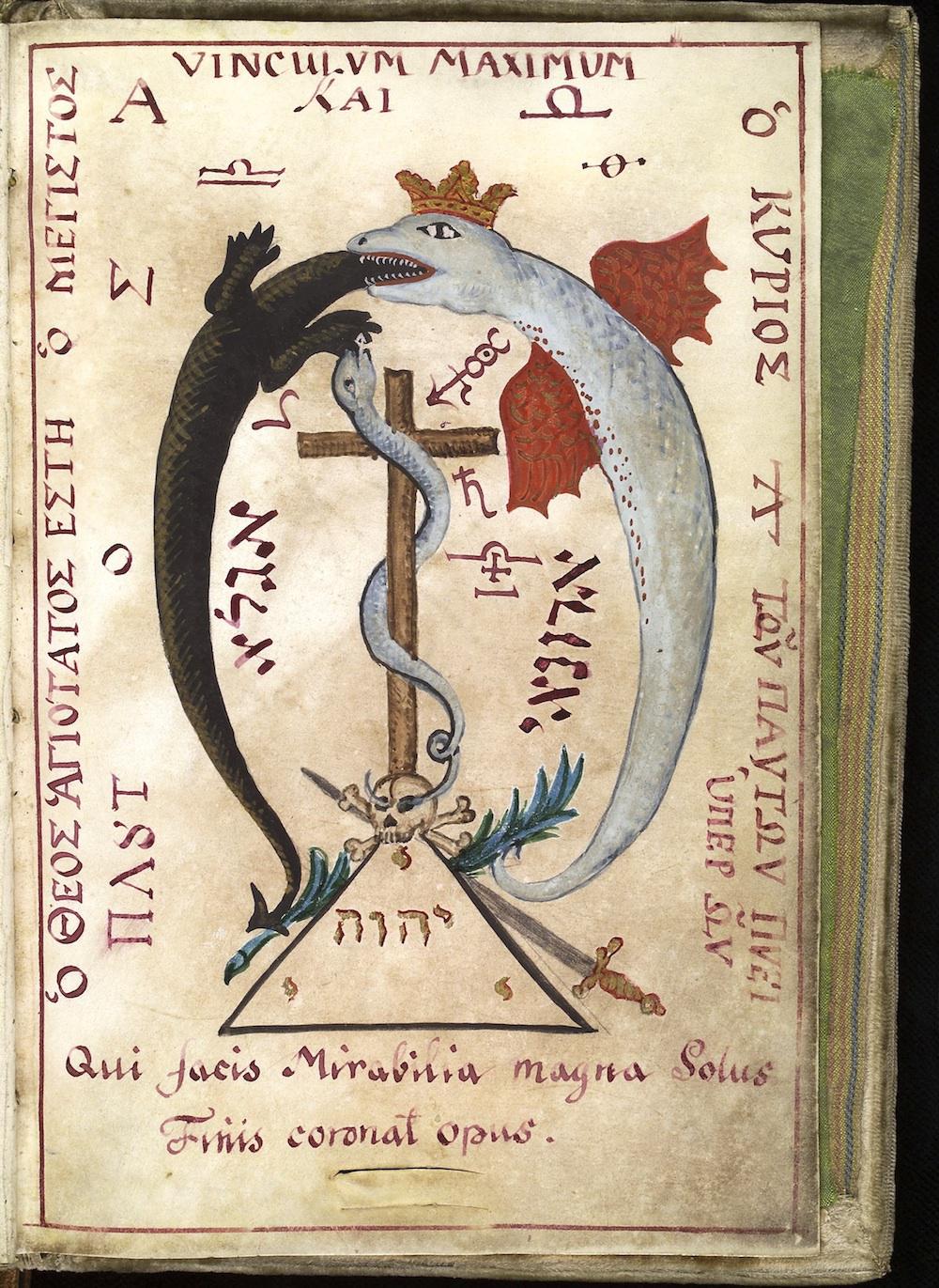
Written in Latin, Greek, Hebrew, and “the Magical Alphabet devised by occultist Cornelius Agrippa in his Third Book of Occult Philosophy from 1510,” notes Flashbak, the manuscript is “filled with invocations to spirits and demons — including a Hebrew invocation for summoning God.” (It also includes helpful instructions for banishing summoned spirits.) The manuscript’s full Latin title — Clavis Inferni sive magic alba et nigra approbata Metatrona — translates to “The Key of Hell with white and black magic approved by Metatron,” an archangel in the Talmudic and Kabbalist traditions. The use of this name suggests the spells within come from a higher authority.
Breen, however, found some unusual commentary on the book’s possible author, including the idea in Denmark that Cyprianus was “a fellow Dane so evil during his lifetime that when he died the devil threw him out of Hell,” writes professor of Norwegian literature Kathleen Stokker. Cyprianus was so enraged by this treatment that “he dedicated himself to writing the nine Books of Black Arts that underlie all subsequent Scandinavian black books.” Another apocryphal story identifies Cyprianus as a “ravishingly beautiful” Mexican nun from 1351 (?!) who met a “gory” end.
Whoever wrote the Key of Hell, and for whatever reason, they left behind a fascinating book of sorcery full of curious illustrations and a cryptic cosmology. See Breen’s attempts to decipher some of its key symbols here and make your own with the full text at the Wellcome Library.
Related Content:
Josh Jones is a writer and musician based in Durham, NC. Follow him at @jdmagness
Read More...How German Artist John Heartfield Pioneered the Use of Art as a Political Weapon, and Took on Hitler
The story of artist John Heartfield — born Helmut Franz Josef Herzfeld in Berlin in 1891 — begins like a German fairy tale. In 1899, his parents, ill and poverty-stricken, abandoned Helmut and his three siblings in a mountain cabin at Aigen, near Salzburg. The hungry children were discovered four days later by the mayor of the town and his wife, who took them in and fostered them. Meanwhile, their uncle, a lawyer, appeared with a trust from their wealthy grandfather’s estate to fund their educations.
Helmut trained at several art schools in Germany, eventually arriving at the School of Arts and Crafts in the bohemian Berlin of the 1910s, where he abandoned his dream of becoming a painter and instead invented hugely effective anti-war propaganda art during World War I and the rise of the Nazis. As The Canvas video above explains, Heartfield’s work pointedly encapsulates the “anti-bourgeois, anti-capitalist, anti-fascist” attitudes of radical Berlin Dadaists. He was “one of Hitler’s most creative critics.”
Herzfeld began his anti-war art campaign by anglicizing his name to counter rising anti-British sentiment at the start of World War I. As John Heartfield, he collaborated with his brother, Weiland, and satirical artist George Grosz on the leftist journal New Youth and the revolutionary publishing house, Malik Verlag. After the war, they joined the German Communist party. (Heartfield “received his party book,” writes Sybille Fuchs, “from KPD leader Rosa Luxemburg herself.”); they also became “founding members of the Berlin Dadaists,” developing the photomontage style Heartfield used throughout his graphic design career.
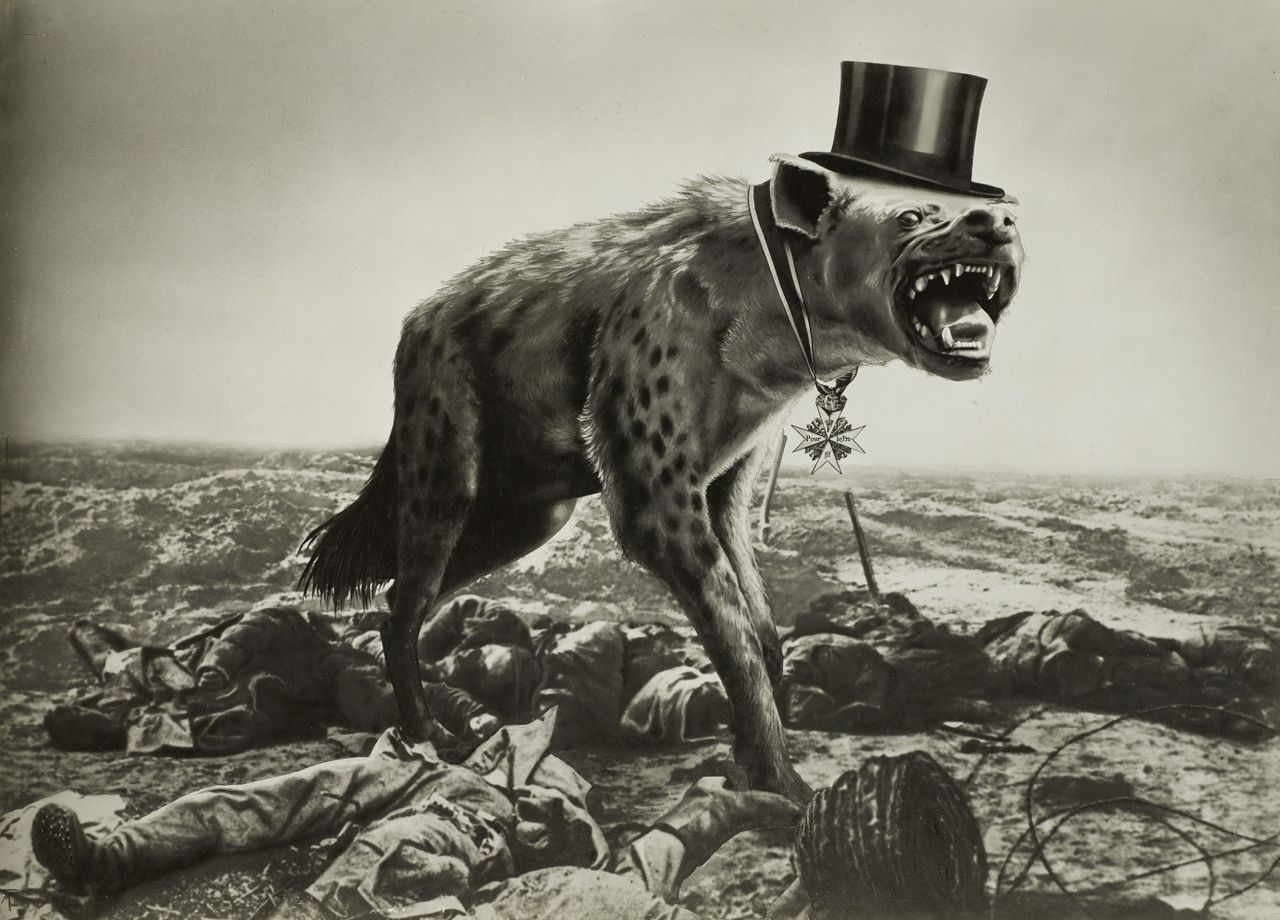
John Heartfield, War and Corpses, the Last Hope of the Rich
“Photomontage allowed Heartfield to create loaded and politically contentious images,” the Getty writes. “To compose his works, he chose recognizable press photographs of politicians or events from the mainstream illustrated press.… Heartfield’s strongest work used variations of scale and stark juxtapositions to activate his already gruesome photo-fragments. The result could have a frightening visual impact.” They also had widespread influence, becoming an almost standard style of radical protest art throughout Europe in the early part of the 20th century.
On rare occasions, Heartfield included photographs of himself, as in the self-portrait below with scissors clipping the head of the Berlin police commissioner; or he used his own photography, as in an unglamorous shot a young pregnant woman behind whose head Heartfield places what appears to be the body of a dead young man. The 1930 work protested Weimar’s anti-abortion laws with the title “Forced Supplier of Human Material Take Courage! The State Needs Unemployed People and Soldiers!”
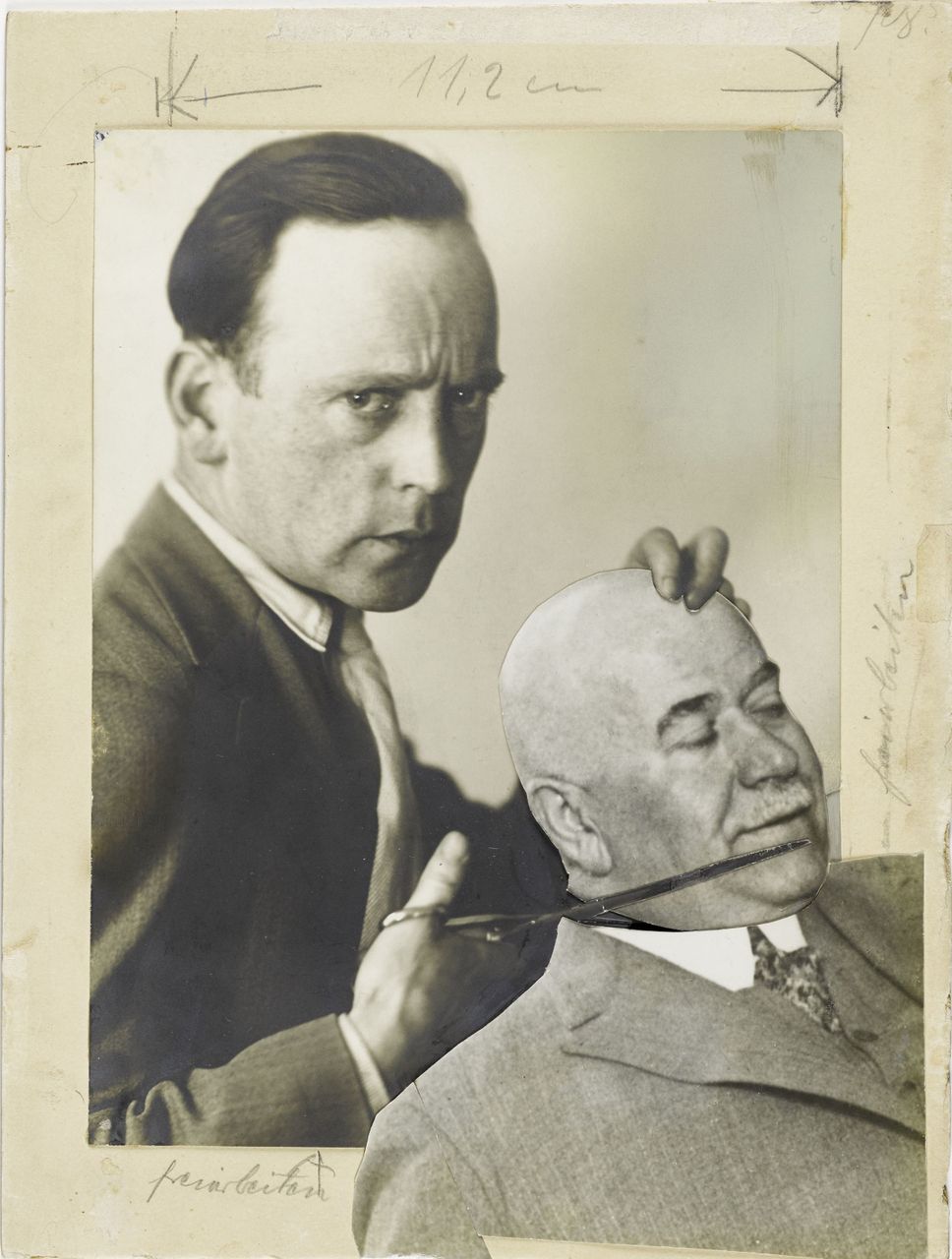
John Heartfield, Self-Portrait with the Police Commissioner Zörgiebel
Heartfield’s direct attacks on state power were allied with his support for worker movements. “In 1929, following ten years of activity in photomontage and publishing,” The Art Institute of Chicago writes, “John Heartfield began working for the left-wing periodical Worker’s Illustrated Magazine (Arbeiter-Illustrierte-Zeitung [AIZ]).” This weekly publication “served from the first as a major organ of opposition to the rising National Socialist Party.” Heartfield’s provocative covers mocked Hitler and portrayed the power of organized labor against the fascist threat. He traveled to the Soviet Union in 1931 under the magazine’s auspices and gave photomontage courses to the Red Army. His style spread internationally until the lifeless propaganda painting of Socialist Realism purged modernist art from the party style.
Unfortunately for Heartfield, and for Europe, the German left failed to present a unified front against Nazism as the KPD also became increasingly dogmatic and Stalinist. The artist and the editors of the AIZ were forced to flee to Prague when Hitler took power in 1933. (Heartfield reportedly escaped a “gang of Nazi thugs,” writes Fuchs, by leaping from his balcony in Berlin). In Czechoslovakia, he continued his counter-propaganda campaign against Hitler through the covers of the AIZ. When the Nazis occupied Prague in 1938, he fled again, to London but never stopped working through the war. He would eventually return to Berlin in the early 1950s and take up a career as a professor of literature.
Heartfield is a complicated figure — an overlooked yet key member of the German avant garde who, with his brother Weiland and artists like George Grosz revolutionized the media of photography, typography, and printing in order to virulently oppose war, oppression, and Nazism, despite the dangers to their livelihoods and lives. You can learn more about the artist’s life and work at the Official John Heartfield Exhibition site, which features many of the collages shown in the Canvas video at the top. (See especially the feature on Heartfield’s relevance to our current moment.) Also, don’t miss this interactive online exhibition from the Akademie Der Künste in Berlin, which controls the artist’s estate and has put a number of rare photos and documents online.
Related Content:
Education for Death: The Making of the Nazi–Walt Disney’s 1943 Film Shows How Fascists Are Made
Watch a Gripping 10-Minute Animation About the Hunt for Nazi War Criminal Adolf Eichmann
Josh Jones is a writer and musician based in Durham, NC. Follow him at @jdmagness
Read More...The Photo That Triggered China’s Disastrous Cultural Revolution (1966)
In 1958, Mao Zedong launched the Great Leap Forward. Eight years later, he announced the beginning of the Great Proletarian Cultural Revolution. Between those two events, of course, came the Great Chinese Famine, and historians now view all three as being “great” in the same pejorative sense. Though Chairman Mao may not have understood the probable consequences of policies like agricultural collectivization and ideological purification, he did understand the importance of his own image in selling those policies to the Chinese people: hence the famous 1966 photo of him swimming across the Yangtze River.
By that point, “the Chinese leader who had led a peasant army to victory in the Chinese Civil War and established the communist People’s Republic of China in 1949 was getting old.” So says Coleman Lowndes in the Vox Darkroom video above. Worse, Mao’s Great Leap Forward had clearly proven calamitous. The Chairman “needed to find a way to seal his legacy as the face of Chinese communism and a new revolution to lead.” And so he repeated one of his earlier feats, the swim across the Yangtze he’d taken in 1956. Spread far and wide by state media, the shot of Mao in the river taken by his personal photographer illustrated reports that he’d swum fifteen kilometers in a bit over an hour.
This meant “the 72-year-old would have shattered world speed records,” a claim all in a day’s work for propagandists in a dictatorship. But those who saw photograph wouldn’t have forgotten what happened the last time he took such a well-publicized dip in the Yangtze. “Experts feared that Mao was on the verge of kicking off another disastrous period of turmoil in China. They were right.” The already-declared Great Proletarian Cultural Revolution, now widely known as the Cultural Revolution, saw millions of Chinese youth — ostensibly radicalized by the image of their beloved leader in the flesh — organize into “the fanatical Red Guards,” a paramilitary force bent on extirpating, by any means necessary, the “four olds”: old culture, old ideology, old customs, and old traditions.
As with most attempts to usher in a Year Zero, Mao’s final revolution wasted little time becoming an engine of chaos. Only his death ended “a decade of destruction that had elevated the leader to god-like levels and resulted in over one million people dead.” The Chinese Communist’s Party has subsequently condemned the Cultural Revolution but not the Chairman himself, and indeed his swim remains an object of yearly commemoration. “Had Mao died in 1956, his achievements would have been immortal,” once said CCP official Chen Yun. “Had he died in 1966, he would still have been a great man but flawed. But he died in 1976. Alas, what can one say?” Perhaps that, had the aging Mao drowned in the Yangtze, Chinese history might have taken a happier turn.
Related content:
Wonderfully Kitschy Propaganda Posters Champion the Chinese Space Program (1962–2003)
Based in Seoul, Colin Marshall writes and broadcasts on cities, language, and culture. His projects include the Substack newsletter Books on Cities, the book The Stateless City: a Walk through 21st-Century Los Angeles and the video series The City in Cinema. Follow him on Twitter at @colinmarshall, on Facebook, or on Instagram.
Read More...Oscar-Winner CODA and Deaf Representation in Film — Pretty Much Pop: A Culture Podcast #130
The 2022 Oscar winner for Best Picture was CODA, a story about a musically inclined girl with a deaf family. Kambri Crews, herself a CODA and author of a much darker story about this called Burn Down the Ground, joins your Pretty Much Pop host Mark Linsenmayer, writer Sarahlyn Bruck, and jack-of-many-intellectual-trades Al Baker to talk about how deaf culture interacts with film.
Films tend to show deafness as tragic, which is not necessarily how the deaf community views themselves. We talk about balancing the demands of a story, how real life works, and the need for positive representation. Also, deaf bowling!
In addition to CODA, we talk about The Sound of Metal, A Quiet Place, Children of a Lesser God, Mr. Holland’s Opus, See No Evil Hear No Evil, Eternals, Drive My Car, and more.
Note that this discussion was recorded in May but got bumped with all the shows wrapping up at that time and summer movies launching.
If you liked this, see our previous episode on disability representation.
Hear more Pretty Much Pop. Support the show at patreon.com/prettymuchpop or by choosing a paid subscription through Apple Podcasts. This podcast is part of the Partially Examined Life podcast network.
Pretty Much Pop: A Culture Podcast is the first podcast curated by Open Culture. Browse all Pretty Much Pop posts.
Read More...When Helen Keller Met Charlie Chaplin and Taught Him Sign Language (1919)
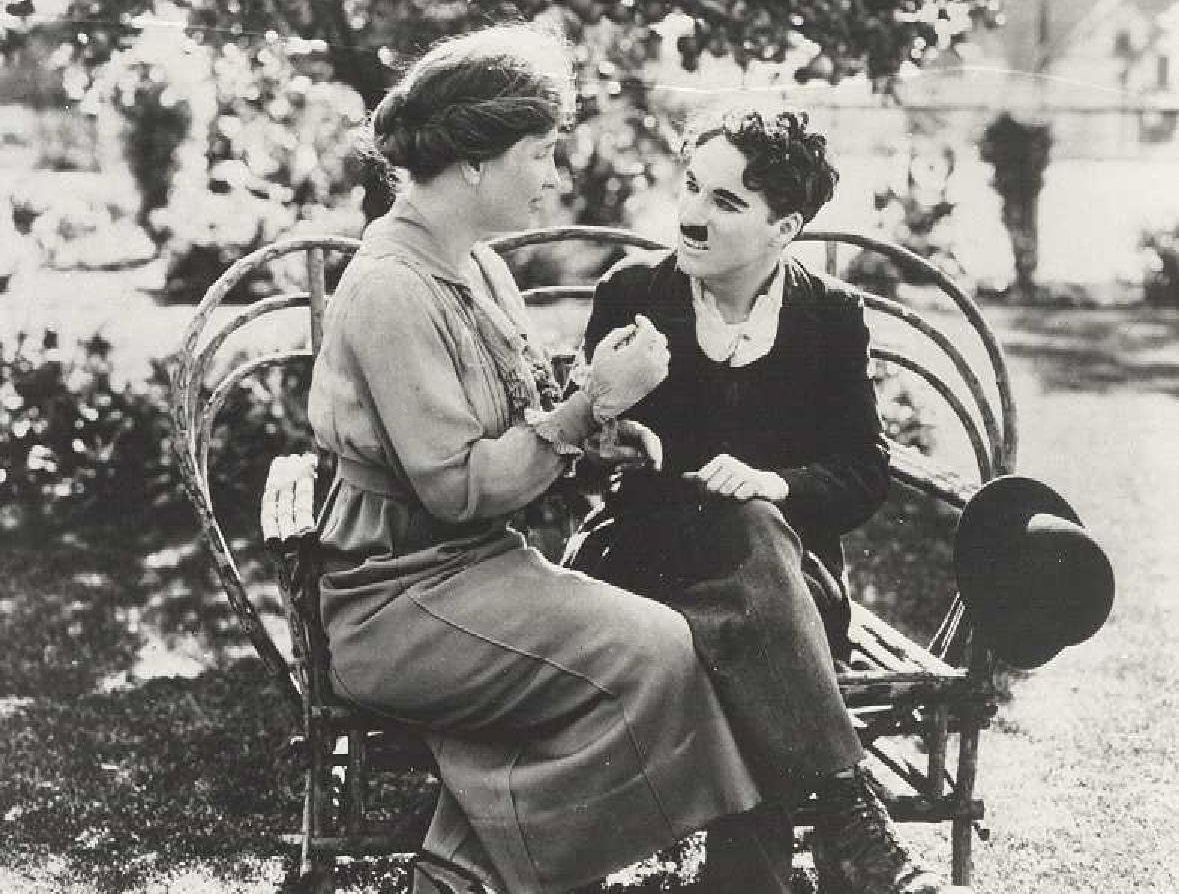
Charlie Chaplin had many high-profile fans in his day, including some of the luminaries of the early twentieth century. We could perhaps be forgiven for assuming that the writer and activist Hellen Keller was not among them, given the limitations her condition of deafness and blindness — or “deafblindness” — would naturally place on the enjoyment of film, even the silent films in which Chaplin made his name. But making that assumption would be to misunderstand the driving force of Keller’s life and career. If the movies were supposedly unavailable to her, then she’d make a point of not just watching them, but befriending their biggest star.
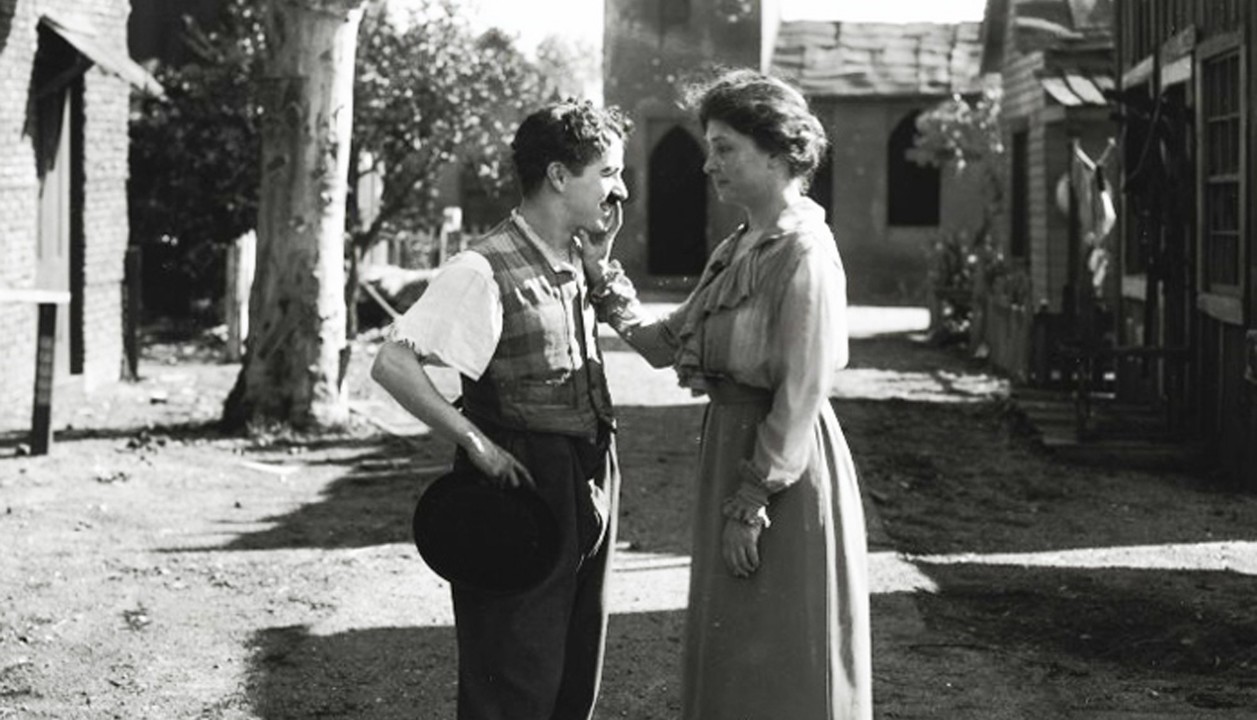
Keller met Chaplin in 1919 at his Hollywood studio, during the filming of Sunnyside. This, as biographers have revealed, was not one of the smoothest-going periods in the comedian-auteur’s life, but that didn’t stop him from enjoying his time with Keller, and even learning from her.
In her 1928 autobiography Midstream, she would remember that he’d been “shy, almost timid,” and that “his lovely modesty lent a touch of romance to the occasion that might otherwise have seemed quite ordinary.” The pictures that have circulated of the meeting, seen here, include one of Keller teaching Chaplin the tactile sign-language alphabet she used to communicate.
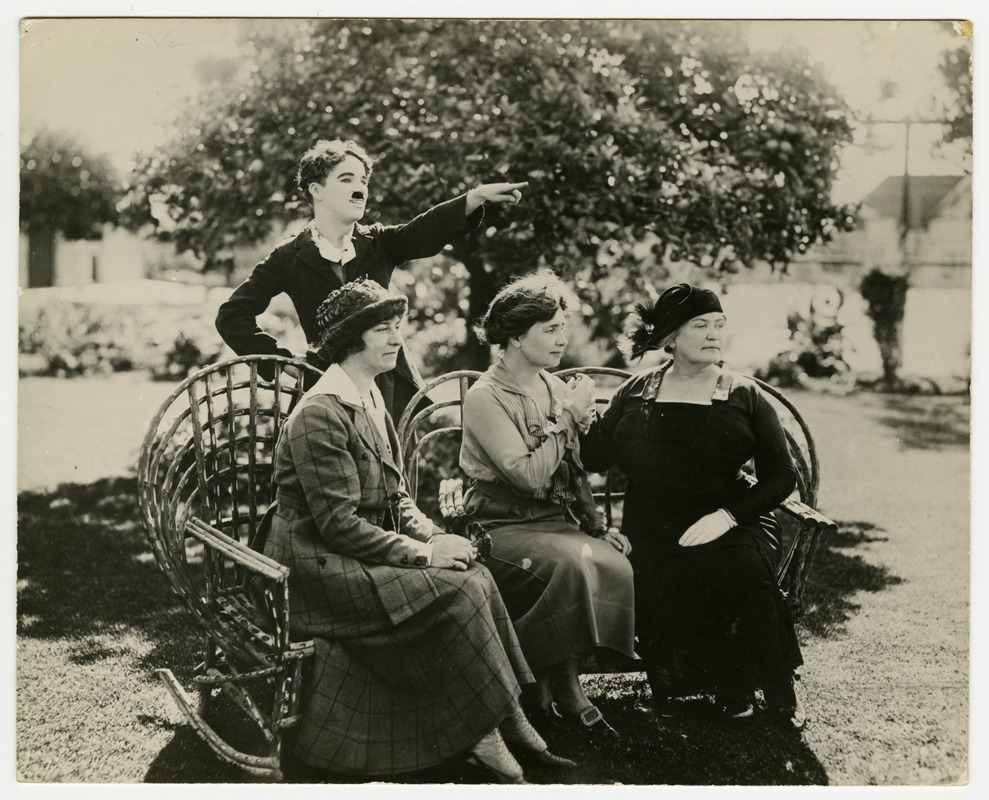
It was also the means by which, with the assistance of companion Anne Sullivan, she followed the action of Chaplin’s films A Dog’s Life and Shoulder Arms when they were screened for her that evening. When Keller and Chaplin met again nearly thirty years later, he sought her feedback on the script for his latest picture, Monsieur Verdoux. “There is no language for the terrifying power of your message that sears with sarcasm or rends apart coverts of social hypocrisy,” Keller later wrote to Chaplin. A politically charged black comedy about a bigamist serial killer bearing little resemblance indeed to the beloved Little Tramp, Monsieur Verdoux met with critical and commercial failure upon its release. The film has since been re-evaluated as a subversive masterwork, but it was perhaps Keller who first truly saw it.
Related content:
When Albert Einstein & Charlie Chaplin Met and Became Fast Famous Friends (1930)
When Mahatma Gandhi Met Charlie Chaplin (1931)
Based in Seoul, Colin Marshall writes and broadcasts on cities, language, and culture. His projects include the Substack newsletter Books on Cities, the book The Stateless City: a Walk through 21st-Century Los Angeles and the video series The City in Cinema. Follow him on Twitter at @colinmarshall, on Facebook, or on Instagram.
Read More...Damien Hirst’s NFT Experiment Comes to an End: How Many Buyers Chose Digital Tokens Over Physical Artworks?
Damien Hirst is into NFTs. Some will regard this as a reflection on the artist, and others a reflection on the technology. Whether you take those reflections to be positive or negative reveals something about your own concept of how the art world, the business world, and the digital world intersect. So will your reaction to The Currency, Hirst’s just-completed art project and technological experiment. Launched in July of last year, it produced 10,000 unique non-fungible tokens “that were each associated with corresponding artworks the British artist made in 2016,” as Artnet’s Caroline Goldstein writes. “The digital tokens were sold via a lottery system for $2,000.”
Hirst also laid down an unprecedented condition: he announced “that his collectors would have to make a choice between the physical artwork and its digital version, and set a one-year deadline — asking them, in effect, to vote for which had more lasting value.” For each buyer who chooses the original work, Hirst would assign its NFT to an inaccessible address, the closest thing to destroying it. And for each buyer who chooses the NFT, Hirst would throw the paper version onto a bonfire. The final numbers, as Hirst tweeted out at the end of last month, came to “5,149 physicals and 4,851 NFTs (meaning I will have to burn 4,851 corresponding physical Tenders).” Hirst also retained 1,000 copies for himself.
“In the beginning I had thought I would definitely choose all physical,” Hirst explains. “Then I thought half-half and then I felt I had to keep all my 1,000 as NFTs and then all paper again and round and round I’ve gone, head in a spin.” In the end he went wholly digital, having decided that “I need to show my 100 percent support and confidence in the NFT world (even though it means I will have to destroy the corresponding 1000 physical artworks).” Perhaps this was a victory of Hirst’s neophilia, but then, those instincts have served him well before: few living artists have managed to draw such public fascination, enamored or hostile, for so many years straight — let alone such formidable sale prices, and not just for his stuffed shark.
“I’ve never really understood money,” Hirst says to Stephen Fry in the video above. (You can watch an extended version of their conversation here.) “All these things — art, money, commerce — they’re all ethereal,” ultimately based on nothing more than “belief and trust.” Returning to the techniques of his early “spot paintings” — those he made himself before farming the task out to steadier-handed assistants — and minting the results into unique digital objects for sale was perhaps an attempt to get his head around the even less intuitive concept of the NFT. All told, The Currency brought in about $89 million in revenue. More telling will be the price of its tokens on the secondary market, where they’re changing hands at the moment for around $7,000: a price impossible properly to evaluate for now, and thus not without the thrilling ambiguity of certain modern artworks.
Related content:
What are Non-Fungible Tokens (NFTs)? And How Can a Work of Digital Art Sell for $69 Million
Brian Eno Shares His Critical Take on Art & NFTs: “I Mainly See Hustlers Looking for Suckers”
The Art Market Demystified in Four Short Documentaries
Mark Rothko Is Toast… and More Edible Art from SFMOMA
Damien Hirst Takes Us Through His New Exhibition at Tate Modern
Based in Seoul, Colin Marshall writes and broadcasts on cities, language, and culture. His projects include the Substack newsletter Books on Cities, the book The Stateless City: a Walk through 21st-Century Los Angeles and the video series The City in Cinema. Follow him on Twitter at @colinmarshall, on Facebook, or on Instagram.
Read More...13 Glorious Minutes of The Ramones in Kansas City, Captured on a Super‑8 Camera (1978)
Thirteen minutes was an awful long time for The Ramones, since they could play an entire album of songs in a quarter of an hour. Thus, when Ramones fan Mark Gilman snuck a Super‑8 sound camera into the Grenada Theater in Kansas City in July of 1978 to secretly film the band, he managed to capture an awful lot of The Ramones on film before he was forced to shut it down. The band, as you can see above, was in top form.
I exaggerate a little.… Ramones albums are longer than this film clip. Their self-titled 1976 debut is over twice the length at 29 minutes, which is still three or four minutes shy of the shortest LPs of the time (back when albums only meant vinyl). Into that almost-half-hour, the ultimate 70s New York punk band crammed 14 songs, at an average of two minutes each: no solos, no filler, no extended intros, outros, or remixes.…
That’s exactly what we see above: mops of hair and a sweaty, leather-and-denim-clad wall of pure, dumb rock ’n’ roll, played blisteringly fast with maximum attitude. It’s quality, audience-level footage of about half a classic Ramones show, which usually spanned around 30 minutes: no banter, chatter, tuning up, requests, or encores. This is what you came for, and this — full-on assault of bubblegum melodies, thudding chants of “I wanna” and “I don’t wanna” played with chainsaw precision — is what you get.
They seemed fully-formed, walking and talking right of the womb when they hit stages outside the New York clubs that nurtured them. But four years earlier, their first audiences didn’t see a disciplined rock ’n’ roll machine; they saw a shambling mess. Ryan Bray describes the impressions of longtime tour manager Monte Melnick on first seeing them in 1974:
Musically, songs like “Now I Wanna Sniff Some Glue” were already in the band’s repertoire, but the songs were plagued by erratic tempos, blown notes, and other sorted sonic miscues. Between-song bickering also marred the band’s earliest shows. For a second, Dee Dee and Tommy seem like they’re almost ready to come to blows when they can’t agree on what song to play next.
“I didn’t like them at all,” Melnick remembers. “It was pretty raw. They were stopping and starting and fighting. They could barely play.” They didn’t meet a devil at a crossroads in the years between these early gigs and their 1978 live album It’s Alive (recorded at London’s Rainbow Theatre on the last day of the year as the band finished a 1977 UK tour). They played a hell of a lot of gigs, and pushed themselves hard for a rock stardom they’d never really achieve until their founding members died.
Allmusic’s Mark Deming describes the band in 1978 as “relentless.… a big-block hot rod thrown in to fifth gear” and calls their live album of the time “one of the best and most effective live albums in the rock canon.” Watch them play “I Wanna Be Well” at the Rainbow Theatre, just above, and catch a rare bit of stage banter from Joey regarding the previous night’s chicken vindaloo.
via Boing Boing
Related Content:
Josh Jones is a writer and musician based in Durham, NC. Follow him at @jdmagness
Read More...A Brief History of Dumplings: An Animated Introduction
Dumplings are so delicious and so venerable, it’s understandable why more than one country would want to claim authorship.
As cultural food historian Miranda Brown discovers in her TED-Ed animation, dumplings are among the artifacts found in ancient tombs in western China, rock hard, but still recognizable.
Scholar Shu Xi sang their praises over 1,700 years ago in a poem detailing their ingredients and preparation. He also indicated that the dish was not native to China.
Lamb stuffed dumplings flavored with garlic, yogurt, and herbs were an Ottoman Empire treat, circa 1300 CE.
The 13th-century Mongol invasions of Korea resulted in mass casualties , but the silver lining is, they gave the world mandoo.
The Japanese Army’s brutal occupation of China during World War II gave them a taste for dumplings that led to the creation of gyoza.
Eastern European pelmeni, pierogi and vareniki may seem like variations on a theme to the uninitiated, but don’t expect a Ukrainian or Russian to view it that way.
Is the history of dumplings really just a series of bloody conflicts, punctuated by periods of relative harmony wherein everyone argues over the best dumplings in NYC?
Brown takes some mild potshots at cuisines whose dumplings are closer to dough balls than “plump pockets of perfection”, but she also knows her audience and wisely steers clear of any positions that might lead to playground fights.
Relax, kids, however your grandma makes dumplings, she’s doing it right.
It’s hard to imagine sushi master Naomichi Yasuda dialing his opinions down to preserve the status quo.
A purist — and favorite of Anthony Bourdain — Chef Yasuda is unwavering in his convictions that there is one right way, and many wrong ways to eat and prepare sushi.
He’s far from priggish, instructing customer Joseph George, for VICE Asia MUNCHIES in the proper handling of a simple piece of sushi after it’s been lightly dipped, fish side down, in soy sauce:
Don’t shake it. Don’t shake it! Shaking is just to be finished at the men’s room.
Other takeaways for sushi bar diners:
- Use fingers rather than chopsticks when eating maki rolls.
- Eating pickled ginger with sushi is “very much bad manners”
- Roll sushi on its side before picking it up with chopsticks to facilitate dipping
- The temperature interplay between rice and fish is so delicate that your experience of it will differ depending on whether a waiter brings it to you at a table or the chef hands it to you across the counter as soon as it’s assembled.
Explore TED-Ed’s Brief History of Dumplings lesson here.
For a deeper dumpling dive, read the Oxford Symposium’s Wrapped and Stuffed Foods: Proceedings on the Symposium: Foods and Cookery, 2012, available as a free Google Book.
Related Content
How to Make Sushi: Free Video Lessons from a Master Sushi Chef
- Ayun Halliday is the author of Creative, Not Famous: The Small Potato Manifesto and the Chief Primatologist of the East Village Inky zine. Follow her @AyunHalliday.
Read More...Watch the Sinking of the Lusitania Animated in Real Time (1915)
If you are a graduate of a U.S. school system, the words “Remember the Lusitania” may be as vaguely familiar to you as “Remember the Alamo.” And you may be just as fuzzy about the details. We learn roughly that the sinking of the British luxury liner was an act of German aggression that moved the U.S. to enter World War I. That lesson is largely the result of a propaganda effort launched at the time to inflame anti-German sentiments and push the U.S. out of isolationism. But it would take almost two years after the attack before the country entered the war. The Lusitania did not change President Woodrow Wilson’s position. While the “sinking of the Lusitania was a crucial moment in helping to sway the American public in support of the Allied cause,” it was only kept in the public eye by those who wanted the U.S. in the war.
Mainstream U.S. coverage immediately afterward was not overly belligerent. A week after the disaster, in a May 16th, 1915 issue, the Sunday New York Times ran a two-page spread entitled “Prominent Americans Who Lost Their Lives on the S.S. Lusitania.” Two weeks later, another photo spread honored the ship’s dead, reflecting a “panorama of responses to the disaster,” the Library of Congress writes, including “sorrow, heroism, ambivalence, consolation, and anger.”
These were emotional surveys of a tragedy, not investigative journalism of an act of war. “Remarkably,” the attack had “dominated the headlines for only about a week before being overtaken by a newer story.” We might compare this to news of the Titanic disaster three years earlier, credited as “one of the first and most significant international news stories of the 20th century.” There is much about the Lusitania the public did not learn, leading to later accusations of a British Naval Intelligence cover-up.
For one thing, stories reported that the ship had been hit by two torpedoes when there was only one. Immediately after its impact, however, a secondary explosion from inside the ship caused the Lusitania to list perilously to one side (rendering most lifeboats useless) and take on water. Where the Titanic had taken 2 hours and 40 minutes to go down, the Lusitania sank in 18 minutes — as you can see in the real-time animation above — killing approximately 1,200 passengers including around 120 Americans. The second explosion lent credibility to German accusations that the passenger ship was carrying munitions from New York to Britain. (Divers in a 1993 National Geographic expedition found four million U.S.-made Remington bullets on board.) While this could not be proven at the time, the British had taken to hiding arms on passenger ships, and the Lusitania was outfitted to be commandeered for war.
Not only did British authorities put the Lusitania in harm’s way by allowing civilian passengers to sail through blockaded waters in which German submarines had been sinking merchant ships, but passengers knowingly put themselves in danger. The German High Command had warned of attacks in American newspapers in days before the ship set sail. Yet “only a couple of people actually canceled,” says Erik Larson, author of the book Dead Wake: The Last Crossing of the Lusitania. No war at sea or recent memory of the Titanic could dissuade them.
They saw this ship as so fast it could outrun any submarine. They saw it as being so immense, so well built, so safe, and so well equipped with lifeboats in the wake of the Titanic disaster that even if it were hit by a torpedo, no one imagined this thing actually sinking. But no one could imagine a submarine going after the Lusitania in the first place.
Larson’s last point signals the critical difference between this attack and all of those previous: the sinking of the Lusitania was a shocking turning point in the war, even if it didn’t force Wilson’s hand as Churchill hoped. No one had expected it. “In the history of modern warfare,” the Library of Congress notes, the Lusitania signaled “the end of the ‘gentlemanly’ war practice of the nineteenth century and the beginning of a more ominous and vicious era of total warfare.” While the Germans ceased the practice after British outcry, they resumed the targeting of passenger and merchant ships in 1917, finally prompting U.S. involvement. The era that began with the Lusitania continues over a century later. Indeed, the wanton destruction of civilian life no longer seems like tragic collateral damage in current war zones, but the very point of waging modern war.
Related Content:
Watch the Titanic Sink in Real Time in a New 2‑Hour, 40 Minute Animation
Titanic Survivor Interviews: What It Was Like to Flee the Sinking Luxury Liner
The First Color Photos From World War I: The German Front
Josh Jones is a writer and musician based in Durham, NC. Follow him at @jdmagness
Read More...What a Disney Version of A Clockwork Orange Would Look Like
“Family-friendly entertainment” means different things to different people, despite nearly a century of the Walt Disney Company attempting to associate the concept exclusively with its own brand. And on the business level, Disney has become increasingly identified with entertainment itself. “With Marvel, Star Wars, Pixar, and their princess content tucked safely in their portfolio,” writes Boing Boing’s Devin Nealy, “Disney is only a few studios away from having a monopoly on nostalgia. At this point, it’d be easier to count the IPs that Disney doesn’t own.”
When it comes to extracting all possible value from IP — that is, intellectual property — no company shows quite as much determination as Disney. This goes for the creations it has lately acquired as well as those it already owned.
Witness, for instance, its recent spate of live-action remakes: The Jungle Book directed by Jon Favreau, Aladdin by Guy Ritchie, Dumbo by Tim Burton. That these are hardly the least plausible products to be put out by Disney Studios in the twenty-first century sends the imagination toward ever more incongruous possibilities for IP-reusage. What if Disney remade, say, Stanley Kubrick’s A Clockwork Orange?
Such is the premise of the uncanny trailer above, created by Youtuber JabaToons. Using audio taken straight from Kubrick’s eclectically nightmarish vision of Anthony Burgess’ dystopian novel, it also renders a host of its scenes not in the style of the CGI extravaganzas Disney puts out today, but the more traditional, two-dimensional animated pictures it still did in the nineteen-nineties. The trailer announces the film as “Disney’s 35th animated classic,” a position occupied in reality by Hercules: also a hero’s journey, albeit with a much different tone, to say nothing of outcome, than A Clockwork Orange. Alex Delarge may look strangely plausible as a Disney character, but a protagonist with a less family-friendly set of interests would be hard to imagine.
Related content:
A Lccokrkow Garneo: All 245,000 Frames of Kubrick’s A Clockwork Orange Randomized
Monty Python and the Holy Grail Re-Imagined as an Epic, Mainstream Hollywood Film
The Shining and Other Complex Stanley Kubrick Films Recut as Simple Hollywood Movies
Donald Duck Discovers Glenn Beck: A Remix
The Making of Stanley Kubrick’s A Clockwork Orange
Based in Seoul, Colin Marshall writes and broadcasts on cities, language, and culture. His projects include the Substack newsletter Books on Cities, the book The Stateless City: a Walk through 21st-Century Los Angeles and the video series The City in Cinema. Follow him on Twitter at @colinmarshall, on Facebook, or on Instagram.
Read More...Support Us
We're hoping to rely on loyal readers, rather than erratic ads. Please click the Donate button and support Open Culture. You can use Paypal, Venmo, Patreon, even Crypto! We thank you!

About Us

Open Culture scours the web for the best educational media. We find the free courses and audio books you need, the language lessons & educational videos you want, and plenty of enlightenment in between.
Advertise With Us
FREE UPDATES!
GET OUR DAILY EMAIL
Get the best cultural and educational resources on the web curated for you in a daily email. We never spam. Unsubscribe at any time.
FOLLOW ON SOCIAL MEDIA
Open Culture editor Dan Colman scours the web for the best educational media. He finds the free courses and audio books you need, the language lessons & movies you want, and plenty of enlightenment in between.
Advertise With Us

