What Great Archaeological Sites Used To Actually Look Like: Machu Picchu, the Colossus of Rhodes, Hadrian’s Wall & More in All Their Glory
With national border restrictions now loosening up, many of us are reviving our years-dormant world travel plans. For some, the pandemic-induced suspension of easy access to other countries has even inspired journeys they might not otherwise have taken. Stuck at home, they realized that they’d never seen the wonders of the ancient world — or at any rate, what remains of the wonders of the ancient world. Ruin tourism has a long and prestigious history, of course, but it also has the undesirable side effect of subconsciously convincing us that our ancient forebears lived amid a more shambolic built environment than they really did. To see these ruins as they were before their ruination demands a strong imagination.
Alternatively, you can watch the video above, which presents artistic reconstructions of such still-frequented sites as Pompeii, Machu Picchu, Chichen Itza, the Parthenon, and the Great Pyramid of Giza. You can still see some these structures for yourself, of course, albeit only now that the ravages of time — as well as those of various plunderers, scavengers, and institutions — have taken their terrible toll.
(The food hall of Nero’s palace still stands, but the water-powered rotation system that made it history’s first revolving restaurant has long since gone out of order.) Others of them nobody has seen since antiquity itself: the Colossus of Rhodes once stood a hundred feet tall over that Greek island, but it only did so for 54 years until its toppling by an Earthquake in 226 BC.
Yet over the two-and-a-quarter millennia since, the Colossus has come to take on much greater proportions in our minds. “The famous imagery of it straddling the harbor,” says the video, only “came about centuries later, and was touted by historians in the Middle Ages who had never seen the monument. The harbor itself is almost the same width as an American football field, so to be proportionally accurate, the statue would have to stand a stupendous 1,640 feet tall. This was firmly impossible at the time.” Even today, nowhere on Earth boasts a statue that’s so much as half that size. And indeed, this may constitute the enduring appeal of ruins: however glorious they would have been when whole, their worn, discolored fragments fire our imaginations to much greater heights.
Related content:
Pompeii Rebuilt: A Tour of the Ancient City Before It Was Entombed by Mount Vesuvius
How Ancient Greek Statues Really Looked: Research Reveals Their Bold, Bright Colors and Patterns
Roman Statues Weren’t White; They Were Once Painted in Vivid, Bright Colors
Based in Seoul, Colin Marshall writes and broadcasts on cities, language, and culture. His projects include the Substack newsletter Books on Cities, the book The Stateless City: a Walk through 21st-Century Los Angeles and the video series The City in Cinema. Follow him on Twitter at @colinmarshall or on Facebook.
Read More...In 1968, Stanley Kubrick Makes Predictions for 2001: Humanity Will Conquer Old Age, Watch 3D TV & Learn German in 20 Minutes
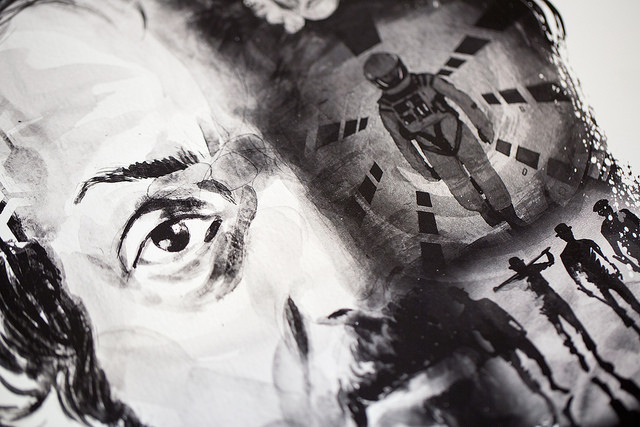
Image by Moody Man, via Flickr Commons
1968. Revolution was in the air and the future seemed bright. That year, Stanley Kubrick released his masterpiece 2001: A Space Odyssey – a big-budget, experimental rumination on the evolution of mankind. The film was a huge box office hit when it came out; its mind-bending metaphysics resonated with the culture’s newfound interest in chemically altered states and in spirituality.
In the September issue from that year, Playboy magazine published a lengthy interview with Kubrick. Even at a time when public figures were supposed to sound like intellectuals (boy, times have changed), Kubrick comes across as insanely well read. During the course of the interview, he quotes from the likes of media critic Marshall McLuhan, Winston Churchill, and 19th Century poet Matthew Arnold along with a handful of prominent academics.
Kubrick is characteristically cagey about offering any explanations of his enigmatic movie but he does readily expound on philosophical questions about God, the meaning of life (or lack thereof) and the possibility of extraterrestrial life. But perhaps the most interesting part of the 17-page interview is his vision of what 2001 might look like. It’s fascinating to see what he got right, what might be right a bit further into the future, and what’s completely wrong. Check them out below:
“Within ten years, in fact, I believe that freezing of the dead will be a major industry in the United States and throughout the world; I would recommend it as a field of investment for imaginative speculators.”
“Perhaps the greatest breakthrough we may have made by 2001 is the possibility that man may be able to eliminate old age.”
“I’m sure we’ll have sophisticated 3‑D holographic television and films, and it’s possible that completely new forms of entertainment and education will be devised.”
“You might have a machine that taps the brain and ushers you into a vivid dream experience in which you are the protagonist in a romance or an adventure. On a more serious level, a similar machine could directly program you with knowledge: in this way, you might, for example, easily be able to learn fluent German in 20 minutes.”
“I believe by 2001 we will have devised chemicals with no adverse physical, mental or genetic results that can give wings to the mind and enlarge perception beyond its present evolutionary capacities…there should be fascinating drugs available by 2001; what use we make of them will be the crucial question.”
“The so-called sexual revolution, mid-wifed by the pill, will be extended. Through drugs, or perhaps via the sharpening or even mechanical amplification of latent ESP functions, it may be possible for each partner to simultaneously experience the sensations of the other; or we may eventually emerge into polymorphous sexual beings, with male and female components blurring, merging and interchanging. The potentialities for exploring new areas of sexual experience are virtually boundless.”
“Looking into the distant future, I suppose it’s not inconceivable that a semisentient robot-computer subculture could evolve that might one day decide it no longer needed man.”
For such a famously pessimistic filmmaker, Kubrick’s vision of the future is remarkably groovy – lots of sex, drugs and holographic television. He wasn’t, of course, the only one out there who thought about the future. You can see more bold predictions below:
Isaac Asimov Predicts in 1964 What the World Will Look Like Today — in 2014
Arthur C. Clarke Predicts the Future in 1964 … And Kind of Nails It
Walter Cronkite Imagines the Home of the 21st Century … Back in 1967
The Internet Imagined in 1969
Marshall McLuhan Announces That The World is a Global Village
Note: Note: An earlier version of this post appeared on our site in November 2014.
Jonathan Crow is a Los Angeles-based writer and filmmaker whose work has appeared in Yahoo!, The Hollywood Reporter, and other publications. You can follow him at @jonccrow.
Read More...Behold 3D Recreations of Pompeii’s Lavish Homes–As They Existed Before the Eruption of Mount Vesuvius
“I pray that to their share of noble fortunes [Zeus] send no Nemesis of jealous will, but in prosperity and free from ills, exalt them and their city.” Pindar, Olympian Ode 8
Why are humans awestruck by natural disaster? Or — more to the point — why are we dumbfounded when disasters destroy cities? We should hardly be surprised at this point when nature does what it invariably does: tectonic plates shift, volcanoes erupt, hurricanes and typhoons sweep the coasts…. These things have always happened on Earth, with or without our help, and for many millions of years before anything like us showed up.
Like the mythical Narcissus, we can only see ourselves and assume everything that happens must be for us. After the Great Lisbon Earthquake in Portugal in 1755, “Lisbon’s devout Catholic population saw the ruined city as divine punishment,” writes Laura Trethewey.
“The Protestant countries of Europe also saw the destruction as punishment, but for backward Catholic behavior.” Meanwhile, philosophers like Voltaire, who wrote Candide to satirize responses to the quake, saw the catastrophe as more evidence that a creator, if such a being had ever cared, cared no more.
In Greek and Roman mythology, the gods never stop meddling, punishing, rewarding, etc. Narcissus is tempted to gaze at himself by Nemesis, the goddess who meets hubris with swift retribution. While generally invoked as a leveler of individuals who overstep, she also levels cities, as fifth century BC Greek poet Pindar suggests when he begs Zeus to spare the island city of Aegina from her wrath. Perhaps, then, it was Nemesis, winged vengeance herself, that the citizens of Pompeii believed bore down upon them, as molten lava, smoke, and ash.
From its earliest status as a Roman-allied city (then Roman colony), Pompeii grew into a very wealthy area, its surrounding lands rich with villas and farms, its city center anchored by its Amphitheater, Odeon, Forum Baths and temples, its running water arriving from the Serino Aqueduct. Maybe they had it too good? Maybe their extravagant good fortune caused too much jealously in the neighbors? Maybe the gods demanded balance. It’s very human to think so — to ascribe divine will, in the lack of explanation, for why something so filled with teeming life should be destroyed for no reason at all.
It must have been the gods, who looked down on Pompeii’s wealth and grew jealous themselves. In these 3D animated videos, see why ancient Pompeiians would have been proud of their city, recreated here in part by Sweden’s Lund University and Storied Past Productions. “While in Pompeii few could reach the elite,” notes the latter in their description of the video above, “many tried to recreate ‘the good life’ in their own ways.… From grand urban villas, to small private homes, to smaller apartments.” In these walkthroughs, you can “see all the different things ‘home’ could mean in ancient Pompeii.” You might also, if you aren’t careful, find yourself getting a little envious of these doomed ancient urbanites.
Related Content:
Pompeii Rebuilt: A Tour of the Ancient City Before It Was Entombed by Mount Vesuvius
The Little-Known Bombing of Pompeii During World War II
Archaeologists Discover an Ancient Roman Snack Bar in the Ruins of Pompeii
A Drone’s Eye View of the Ruins of Pompeii
Josh Jones is a writer and musician based in Durham, NC. Follow him at @jdmagness
Read More...Discover 18 Underground Bands From Ukraine
When it comes to supporting the Ukrainian people in their battle against the Russian invasion, it helps when an opportunity matches our own interest. On this site that means directly funding the artists of Ukraine if possible. Fortunately, this new video from YouTube creator Bandsplaining will point you in the direction of 18 Ukrainian underground bands that deserve a listen and your money (if so choose).
While his channel is devoted to “Weird stories and lesser-known genres that don’t get covered by Pitchfork,” Bandsplaining doesn’t usually go in for current events, but as he explains, he is interested in music history, and bands that have continued to create under extreme and dangerous conditions.
“Music scenes that existed six weeks ago are now at risk of vanishing completely,” he says. The list is completely subjective, and only hints at the Ukrainian music scene. Each major city has its clubs, and its fans, and its own homegrown labels. The sadness of watching the video is wondering what might have been bombed out of existence.
I suspect none of the bands or musicians will be well known to most readers, though DakhaBrakha might be—they performed an excellent set for NPR’s Tiny Desk Concert series.
Including a band well-known enough for public radio might not be that “underground” but Bandsplaining really means musicians who don’t sound mainstream.
Ukraine has its own particular psych/metal sound, exemplified here by Shiva the Destructor, La Horsa Bianca, Stone Jesus, and Somali Yacht Club. Lviv’s Sherpa the Tiger play modern Krautrock grooves. For electronica it has the coldwave of Kurs Valüt, Voyage Future’s ambient music, and the low-fi hip-hop of Provod.
There’s also older music history dug up here—the tale of Valentina Goncharova, the classically trained violinist who turned to free jazz and musique concrete, or pianist Ihort Tsymbrovsky, whose 1995 private cassette release is now considered way ahead of its time.
Bandsplaining checks in with some of these bands to see their current fates. Some have moved, some are fighting, saving refugees, and doing what they can. His genuine interest in their lives makes this video more than just a listsicle.
Most of this music is available through Bandcamp, which does mean a majority of the money is going back to the musicians themselves. And any YouTube revenue from the video will go back to the bands too, Bandsplaining says, or Ukrainian charities.
Lastly, the YouTube comments for the video contains hundreds more recommendations from fans of Ukrainian music. Bandsplaining has opened the floodgates.
Related Content
How Ukraine’s Works of Art Are Being Saved in Wartime–Using the Lessons of World War II
Russian Invasion of Ukraine Teach-Out: A Free Course from the University of Michigan
Pink Floyd Releases Its First New Song in 28 Years to Help Support Ukraine
Ted Mills is a freelance writer on the arts who currently hosts the Notes from the Shed podcast and is the producer of KCRW’s Curious Coast. You can also follow him on Twitter at @tedmills, and/or watch his films here.
Read More...Draw Along with Beloved Cartoonist & Educator Lynda Barry: Free Drawing Exercises Online
How do you rescue a day that’s gone pear shaped?
Stopping to drink a glass of water is one of our longtime go tos.
If there’s a box of matches handy, we might perform Yoko Ono’s Lightning Piece.
Most recently, we’ve taken to grabbing some paper and a trusty black felt tip to spend a few minutes doing one of beloved cartoonist and educator Lynda Barry’s all-ages draw-alongs.
Barry began uploading these videos early in the pandemic, for “friends at home who are about to turn four or five or six or seven or any age really.”
Each demonstration begins with an oval. There’s no prologue. Just dive on in and copy the motions of Barry’s slow moving, refreshingly unmanicured hands, captured in a DIY god shot.
Less than four minutes later, voila! A smiling crocodile! (It’s magical how a facial expression can be changed with one simple line.)
The soundtracks to these little narration-free exercises are an extra treat. We’ve always admired Barry’s musical taste. It’s a real mood booster to cover a cheetah in spots to the tune of a marimba orchestra.
Barry’s also a big cumbia fan, conjuring a kitty to Lito Barrientos’ Cumbia En Do Menor, a lion to Los Mirlos’ Cumbia de los Pajaritos, and a Stegosaurus to Romulo Caicedo’s Cumbia Cavela.
Now that you’ve got a cheetah under your belt, you’re ready to progress to a ScorpionLeopard, one of Draw Along with Lynda B’s “strange animals.”
Barry does offer some commentary as these cryptids take shape.
We suspect her pioneering work with a group of four-year-olds in the University of Wisconsin’s Draw Bridge program leads her to anticipate the sorts of burning questions a pre-schooler might have with regard to these beasts. Her classroom experience is evident. Whereas others might think a steady stream of bright chatter is necessary to keep very young participants engaged, Barry’s thoughtful words develop in real time along with her drawing:
This is a tough animal. It has a big stinger on the back. This is a rough animal… angry. Put the eyebrows like this. It makes them look angry. What kind of teeth do you think this animal has? I don’t think they have little bitty teeth. I think they have big fangs.
Others in the “strange animal” family: a CatDogSealFish, an octophant, and a catterfly (featuring a cameo by Barry’s inquisitive pooch’s snout.)
Draw along with Lynda Barry on this YouTube playlist.
Related Content
Watch Cartoonist Lynda Barry’s Two-Hour Drawing Workshop
- Ayun Halliday is the Chief Primatologist of the East Village Inky zine and author, most recently, of Creative, Not Famous: The Small Potato Manifesto. Follow her @AyunHalliday.
Read More...The New York Public Library Provides Free Online Access to Banned Books: Catcher in the Rye, Stamped & More
Each year in mid-September, we celebrate Banned Books Week, and each year I see a handful of people arguing that the celebration, or memorial, is self indulgent and out of touch. No one in the U.S. seriously tries to ban books, right? Book banning — as Gayle King said last September on CBS Mornings — is “an issue we tend to associate with the past.”
Yet even before the recent moral panics over “critical race theory” and gender and sexuality issues, teachers and librarians would have strongly disagreed that attempts to ban books ever went away. Books are challenged all the time in front of school boards, and have, many times in the recent past, appeared on lists handed around by state and federal legislators.
The latest round of book bannings represents an escalation, rather than a return, of the tactic. Not that lawmakers are likely to have read any of 850 or so books on a recent list of suspects. But too many seem eager to endorse bills that restrict what students can read, teachers can teach, and libraries can lend — legislation solely based on the standard of “comfort.” As in… if the facts of American history make some students (or their parents) uncomfortable, then damn the facts of American history.….
Ta-Nahasi Coates — whose Between the World and Me was banned in some communities in 2020 — tells King that this is no coincidence. “For most of American history,” he says, “African American authors have not had the purchase on the American conscience that they do right now.” The same goes for LGBTQ authors and writers from other marginalized groups, whose books are challenged and banned in schools and libraries with aggressive frequency.
What Coates calls a “purchase on the American conscience” is what we might also call empathy — a quality that good writing inspires in curious readers, and that many people seem to find threatening. Every democracy, however, must learn that it is “ignorance [that] is dangerous,” as president of the New York Public Library Tony Marx writes, “breading hate and division.” Learning about, and caring about, the experiences of others does the opposite.
To keep banned books freely available to readers who want access to them, the New York Public Library has partnered with publishers in a project called Books for All to reach readers wherever they may be. Marx emphatically states the need for such an effort:
The recent instances of both attempted and successful book banning — primarily on titles that explore race, LGBTQ+ issues, religion, and history — are extremely disturbing and amount to an all-out attack on the very foundation of our democracy.… The Library’s role is to make sure no perspective, no idea, no identity is erased.
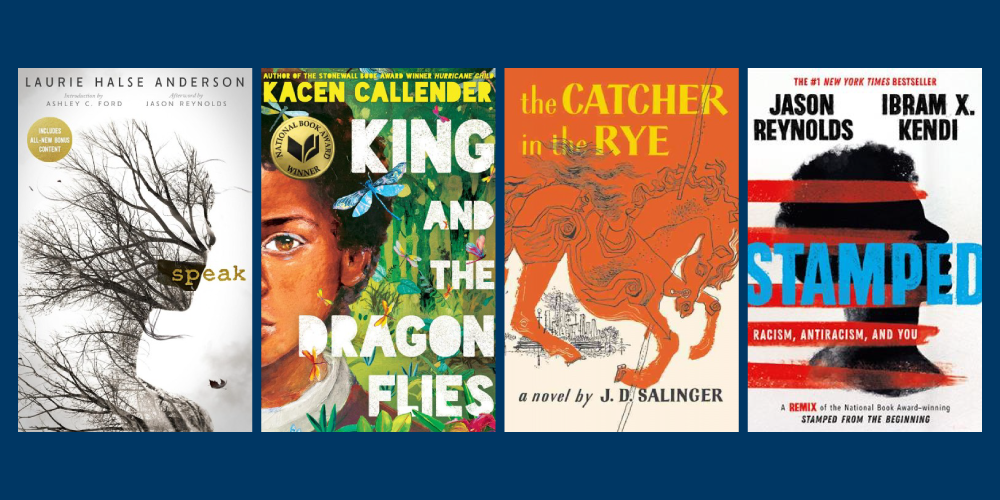
There are currently four books offered under the project’s aegis through the end of May, and they’re available to readers across the United States:
Speak | Laurie Halse Anderson (Square Fish / Macmillan Publishers)
King and the Dragonflies | Kacen Callender (Scholastic)
Stamped: Racism, Antiracism, and You | Jason Reynolds and Ibram X. Kendi (Little, Brown Books for Young Readers / Hachette Book Group)
The Catcher in the Rye | J.D. Salinger (Little, Brown and Company / Hachette Book Group)
To access these titles, all of which have faced bans or challenges, you will need to download the NYPL’s free reader app, SimplyE, for iOS or Android–all from the Books for All site. Then you can read the book right away “with our without a library card,” the library notes. “No waits, no fines.”
One hopes the Books for All project will expand to offer more titles from the increasingly greater number of books being pushed out of public view because they make those in power uncomfortable. Or, better yet, one hopes that dozens of similar projects will arise; that the slogan “books for all” can become a reality, regardless of who makes policy. Learn more and sign up for your free SimplyE account at the Books for All site.
Related Content:
The 850 Books a Texas Lawmaker Wants to Ban Because They Could Make Students Feel Uncomfortable
America’s First Banned Book: Discover the 1637 Book That Mocked the Puritans
Read 14 Great Banned & Censored Novels Free Online: For Banned Books Week 2014
Josh Jones is a writer and musician based in Durham, NC. Follow him at @jdmagness
Read More...The Library of Esoterica: Taschen’s Visual History of Tarot, Astrology & Witchcraft
Generations and generations of Americans dissatisfied with life in their hometowns have acted on the same migratory impulse: to go west. Many have done so in order to make their fortunes, but a fair few have been seeking varieties of satisfaction altogether less tangible. In the human spirt in general and the American spirit in particular, there is a yearning for “secret knowledge” of reality’s hidden workings. Those whose spirits most yearn for that knowledge tend to end up in California, the logical end of American civilization. There they’ve found vibrant communities of yogis, spiritualists, Aenerians, theosophists, healers, Unarians, alchemists, Rosicrucians, witches, tarot readers, astrologers… the list goes on.
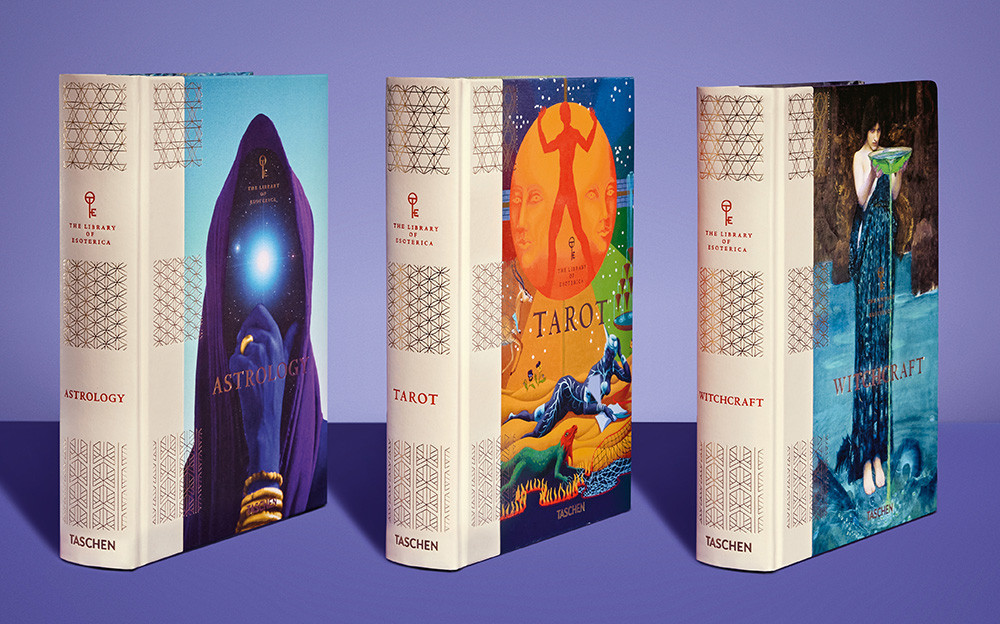
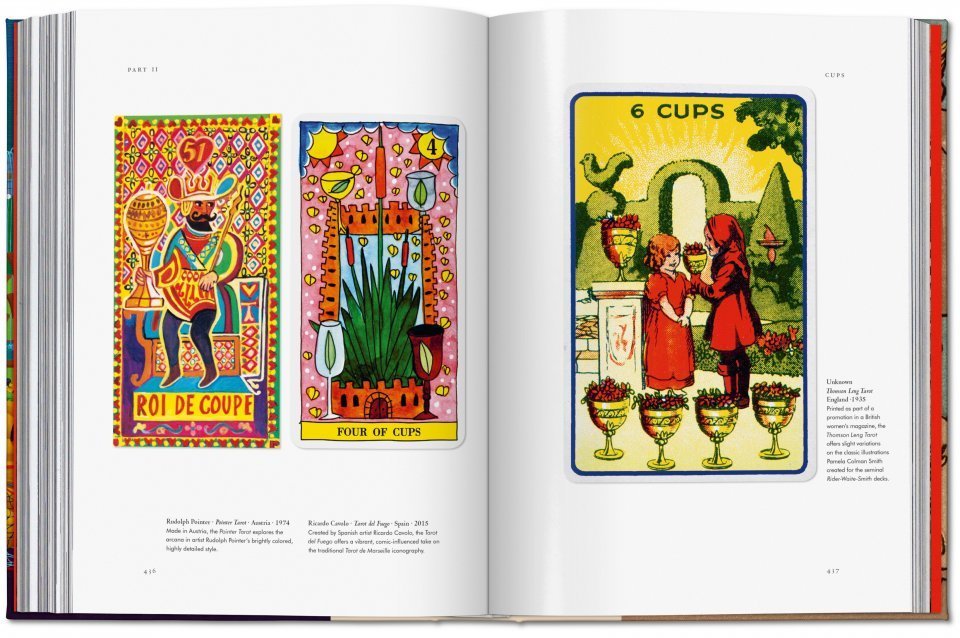
More recently, California has also been home to Taschen’s American headquarters, the acclaimed publishers of lavishly produced books on art and culture with no compunction about exploring the fringes of human experience. A couple of years ago we featured their visual history of tarot Divine Decks here on Open Culture; now they’ve put out a three-volume coffee-table Library of Esoterica that includes books on not just tarot but astrology and witchcraft as well.
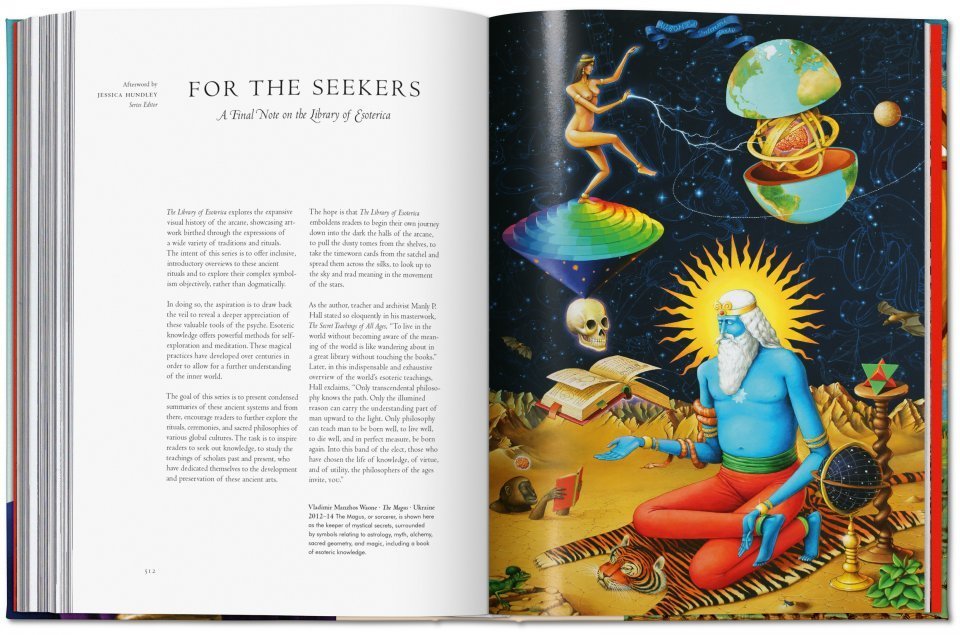
Assembled and designed to Taschen’s usual aesthetically painstaking standard, the set comes edited by writer and filmmaker Jessica Hundley, who used the opportunity to open the most “inclusive and seductive way into these practices, which is through the art” they’ve inspired.
That’s what she told Los Angeles Times’ Steffie Nelson, who writes that “Hundley has been fascinated by alternative spiritualities and the occult since she was a goth-punk teenager on the East Coast.” Later she moved to Los Angeles, “drawn to the city’s legacy of esoteric exploration and its renown as a place where dreams are made manifest and identity is mutable.” This project’s worldwide search for art and other materials related to these fields of esoterica began at Los Angeles’ own Philosophical Research Society, founded in the nineteen-thirties by mystic Manly P. Hall. With its richly reproduced imagery and accompanying explanatory essays, the Library of Esoterica offers a reading experience liable to open anyone’s doors of perception. The age of Aquarius may be over, but there’s a seeker born every minute.
The Library of Esoterica can be purchased as a complete collection. Or you can purchase separate installments on Astrology, Tarot and Witchcraft.
Related content:
Atheists & Agnostics Also Frequently Believe in the Supernatural, a New Study Shows
Based in Seoul, Colin Marshall writes and broadcasts on cities, language, and culture. His projects include the Substack newsletter Books on Cities, the book The Stateless City: a Walk through 21st-Century Los Angeles and the video series The City in Cinema. Follow him on Twitter at @colinmarshall or on Facebook.
Read More...How France Hid the Mona Lisa & Other Louvre Masterpieces During World War II
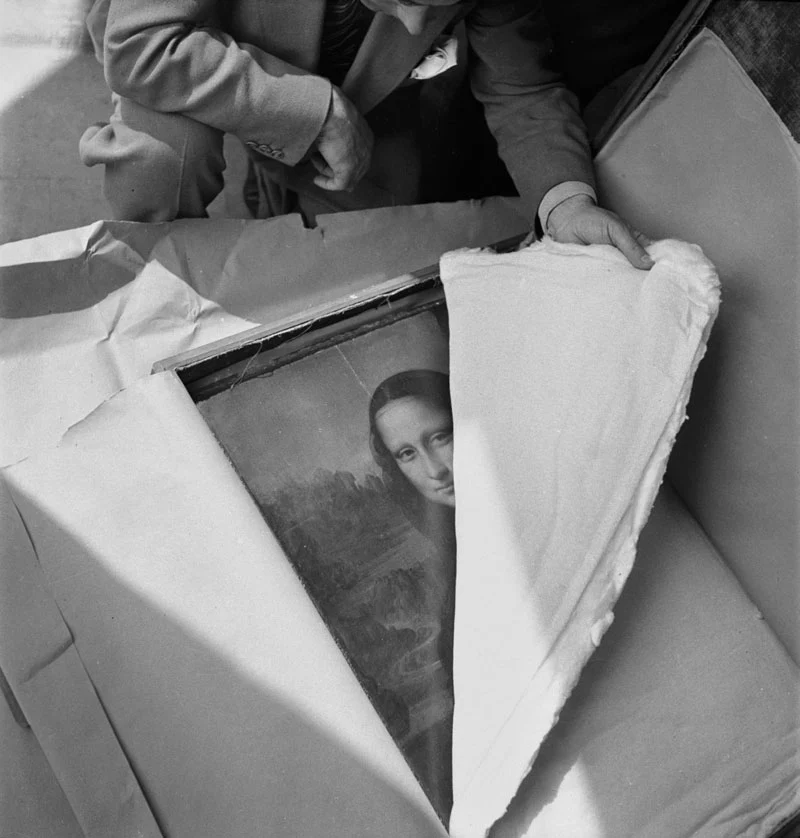
Photograph by Pierre Jahan/Archives des museés nationaux
Twice, we’ve brought you posts explaining how the Mona Lisa – the most famous painting in the world – went from near obscurity to global notoriety almost overnight, after an employee of the Louvre purloined and tried to hide it in 1911. Accusations flew – including very public accusations against Pablo Picasso; salacious rumors circulated; the enigmatic smile of Lisa del Gioconda — the Florentine silk merchant’s wife depicted in the painting – appeared in black and white photographs in newspapers around the globe. When she returned to the museum, visitors couldn’t, and still cannot, wait to see her in person. As great as that story is, what happened a few decades later under the Nazi-controlled Vichy government makes for an even better tale.
By the 1930s, the Mona Lisa was deemed the most important work of art in France’s most important museum. With due respect to the Monuments Men (and unsung Monuments Women), before the Allies arrived to rescue many of Europe’s priceless works of art, French civil servants, students, and workmen did it themselves, saving most of the Louvre’s entire collection. The hero of the story, Jacques Jaujard, director of France’s National Museums, has gone down in history as “the man who saved the Louvre” — also the title of an award-winning French documentary (see trailer below). Mental Floss provides context for Jaujard’s heroism:
After Germany annexed Austria in March of 1938, Jaujard… lost whatever small hope he had that war might be avoided. He knew Britain’s policy of appeasement wasn’t going to keep the Nazi wolf from the door, and an invasion of France was sure to bring destruction of cultural treasures via bombings, looting, and wholesale theft. So, together with the Louvre’s curator of paintings René Huyghe, Jaujard crafted a secret plan to evacuate almost all of the Louvre’s art, which included 3600 paintings alone.
On the day Germany and the Soviet Union signed the Nonaggression Pact, August 25, 1939, Jaujard closed the Louvre for “repairs” for three days while staff, “students from the École du Louvre, and workers form the Grands Magazines du Louvre department store took paintings out of their frames… and moved statues and other objects from their displays with wooden crates.”
The statues included the three ton Winged Nike of Samothrace (see a photo of its move here), the Egyptian Old Kingdom Seated Scribe, and the Venus de Milo. All of these, like the other works of art, would be moved to chateaus in the countryside for safe keeping. On August 28, “hundreds of trucks organized into convoys carried 1000 crates of ancient and 268 crates of paintings and more” into the Loire Valley.
Included in that haul of treasures was the Mona Lisa, placed in a custom case, cushioned with velvet. Where other works received labels of yellow, green, and red dots according to their level of importance, the Mona Lisa was marked with three red dots — the only work to receive such high priority. It was transported by ambulance, gently strapped to a stretcher. After leaving the museum, the painting would be moved five times, “including to Loire Valley castles and a quiet abbey.” The Nazis would loot much of what was left in the Louvre, and force it to re-open in 1940 with most of its galleries starkly empty. But the Mona Lisa — at the top of Hitler’s list of artworks to expropriate — remained safe, as did many thousands more artworks Jaujard believed were the “heritage of all humanity,” as Inge Laino, Paris Muse Director, says in the France 24 segment above.
Related Content:
How Did the Mona Lisa Become the World’s Most Famous Painting?: It’s Not What You Think
The Louvre’s Entire Collection Goes Online: View and Download 480,00 Works of Art
Josh Jones is a writer and musician based in Durham, NC. Follow him at @jdmagness
Read More...Ergonomics Experts Explain How to Set Up Your Desk
Ergonomics aren’t a joke, Jim. — Dwight Schrute, The Office
Technological innovations are snowballing faster than ever in the third decade of the 21st-century. A home office set-up that would have been cause for pride in 2019 seems woefully inadequate now.
Just ask anyone whose desk job pivoted to virtual in March of 2020.
So, perhaps don’t take physical therapist’s Jon Cinkay’s nearly three year old advice in the above Wall Street Journal video as gospel, but rather as a chance to check in with your carpal tunnels, your aching neck and back, and your favorite refurbished office furniture outlet.
Cinkay assumes that your desk is a standard 29 — 30” tall, which is not the case here, but okay…
Our bodies’ unique dimensions mean that no desk can be a one-size-fits-all proposition, and Cinkay makes a robust case for making modifications:
1. Adjust your desk chair
Cinkay recommends adjusting the seat height until your elbows are bent at a 90-degree angle when your fingers are on the keyboard. (As of this writing, keyboards have not yet become obsolete.)
In a 2020 article for the Hospital of Special Surgery, he also recommends making sure your chair’s armrests can fit under your desk to avoid postural compromises when reaching for your keyboard or mouse.
He also wisely advises looking for a chair with a minimum 30-day warranty so you don’t get stuck with an expensive mistake.
2. Consider a footstool
If cranking your desk chair to the perfect height leaves your feet dangling, you’ll need a footstool to help your knees maintain a proper 90-degree bend. If you can’t invest in a high tech adjustable footstool, a ream of paper will do in a pinch.
Tech expert David Zhang, who we’ll hear from soon below, rests his cute striped socks on a yoga mat.
Who among us does not have dozens of things that could be pressed into service as a footstool?
I am left to ponder the fate of the decorative needlepointed footstools my late grandmother and her sisters scattered around their living rooms.
Can an actual footstool be considered a footstool hack?
3. Adjust the height of your monitor
To avoid neck pain, use a monitor stand to position the top of the screen level with your eyes. If you’re working with a laptop, you’ll need a stand, a separate keyboard and and a mouse.
Cinkay’s monitor stand hack is — you guessed it — a ream of paper.
Mine is 5000 Years of the Art of India which is about the same thickness as a ream of paper and was in easy reach at the library where I work.
To judge by some of the comments on Cinkay’s Wall Street Journal video, his keyboard dates to the Stone Age.
Whatever his keyboard vintage, the aforementioned article did suggest gel wrist rests to relieve pressure on the sensitive carpal tunnel area, but watch out! Zhang is not a fan!
4. Get a Headset
Leaving aside the fact that the phone in question appears to be a landline, a headset allows you to keep your head on straight, thus minimizing neck and shoulder pain.
5. Remember that you’re not chained to your desk
Of all the ergonomic advice offered above, this seems likeliest to remain evergreen.
Take a snack break, a water break, a bathroom break, and while you’re at it toss in a couple of the stretches Cinkay recommends.
(The Mayo Clinic has more, including our favorite shoulder stretch.)
Zhang’s desk-centric video was uploaded in 2017, when keyboard trays were already becoming a relic of a bygone era.
As mentioned, he’s anti-wrist rest. If your wrists are in need of support, and they are, get a palm rest!
Zhang’s also critical of drawers and — unusual for 2017 — standing desks though like Cirkay, he’s a big fan of standing up and moving around.
His video description includes some common sense, ass-covering encouragement for viewers with irregular symptoms or pain to seek professional help. We think this means medical professional, though unsurprisingly, ergonomic assessment is a fast growing field. It’s expensive but possibly costs less in the long run than rushing out to buy whatever a stranger on the internet tells you to.
To that end, we appreciate Zhang’s transparency regarding his channel’s participation in the Amazon Services LLC Associates affiliate advertising program.
Related Content
Why Sitting Is The New Smoking: An Animated Explanation
Who Wrote at Standing Desks? Kierkegaard, Dickens and Ernest Hemingway Too
Behold the Elaborate Writing Desks of 18th Century Aristocrats
- Ayun Halliday is the Chief Primatologist of the East Village Inky zine and author, most recently, of Creative, Not Famous: The Small Potato Manifesto. Follow her @AyunHalliday.
Read More...Make Your Own Medieval Memes with a New Tool from the Dutch National Library
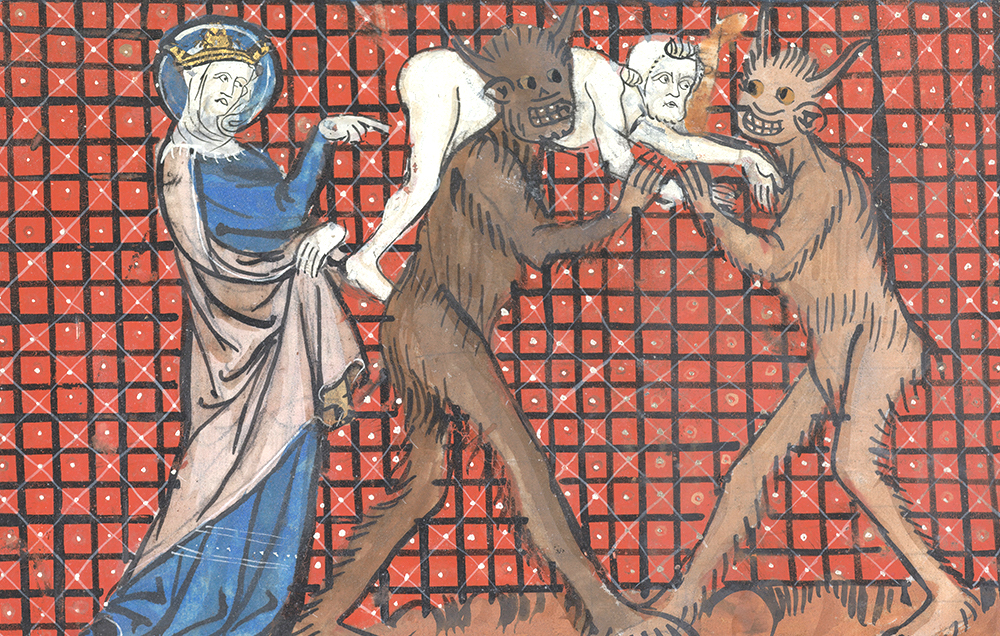
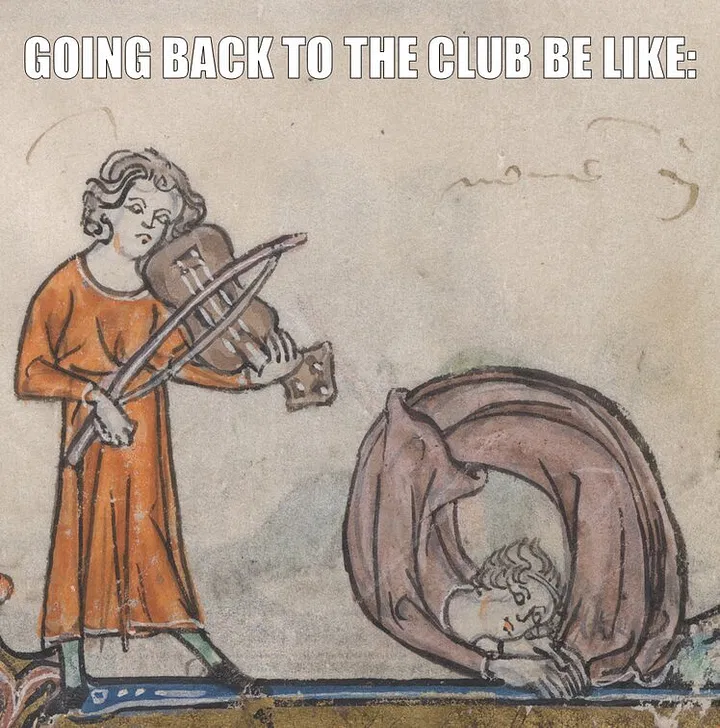
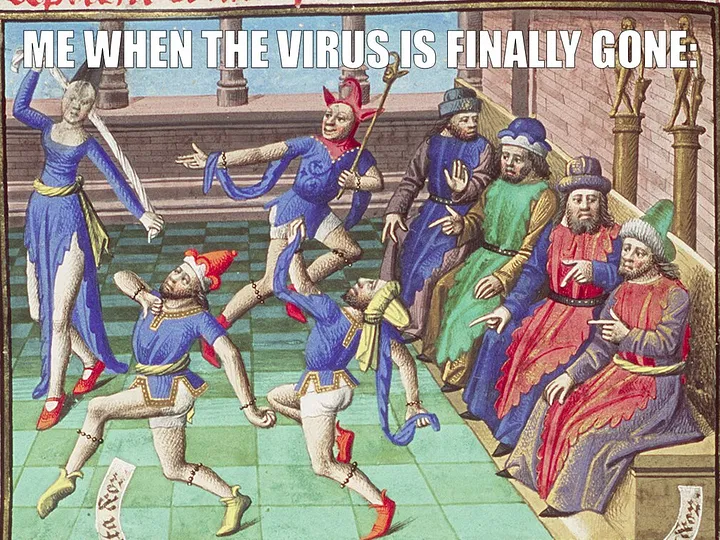
As much joy as internet memes have given you over the years, you may have struggled to explain them to those unfamiliar with the concept. But if you’ve found it a tall order to articulate the power of found images crudely overlaid with text to, say, your parents, imagine attempting to do the same to an ancestor from the fourteenth century. Introducing memes to a medieval person, the best strategy would presumably be to begin not with sardonic Willy Wonka, the guy distracted by another girl, or The Most Interesting Man in the World, but memes with familiar medieval imagery. Thanks to KB, the national library of the Netherlands, you can now make some of you own with ease.
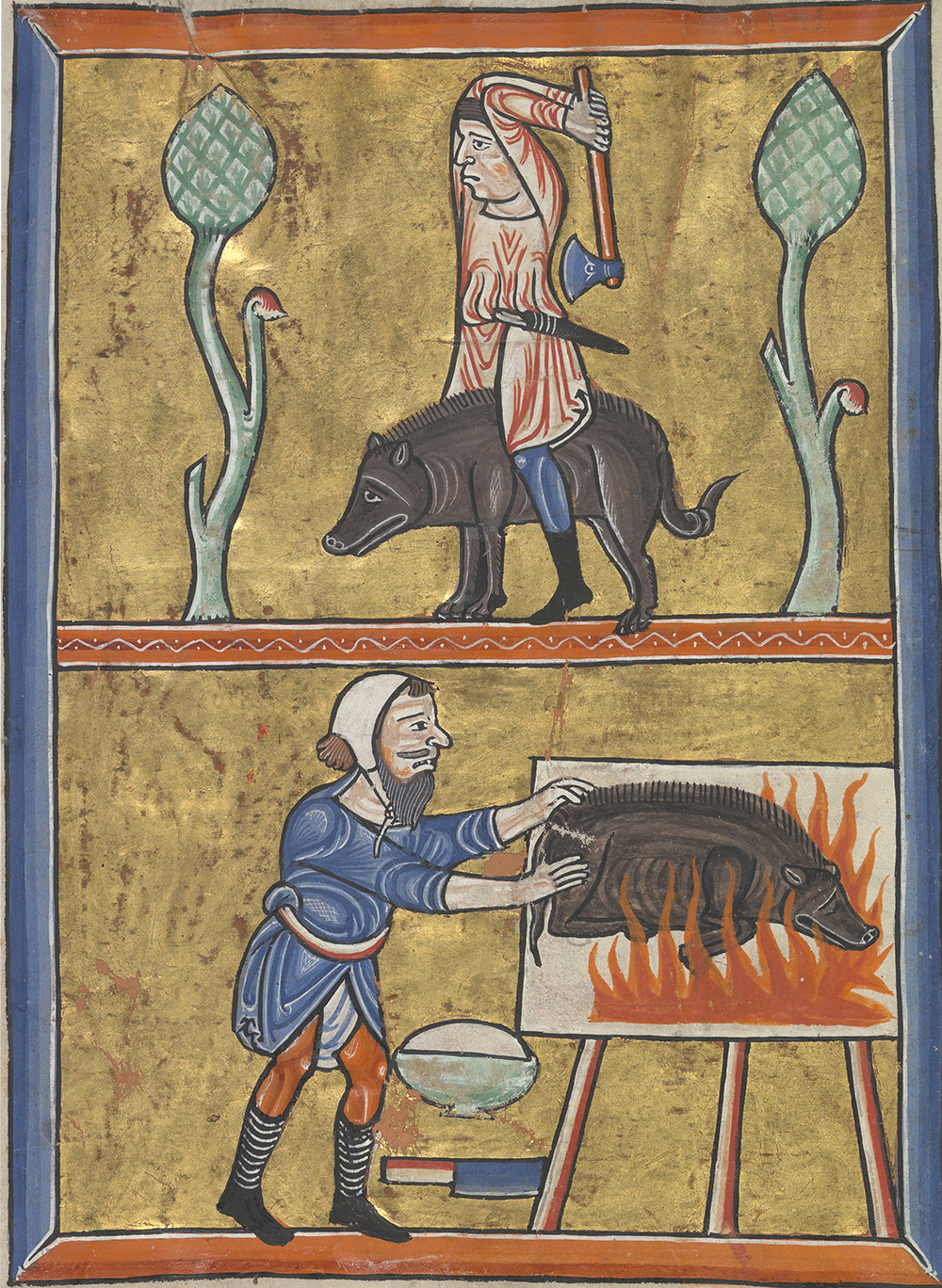
“On www.medievalmemes.org visitors can use images taken from the Dutch national library’s medieval collection and turn them into memes,” says Medievalists.net. “When using the meme generator, people actively create new contexts for these historic images by adding current captions. The available images are accompanied by explanatory videos, providing viewers with background information and showing them that, much like today, people in the Middle Ages used images to comment on their surroundings and current affairs.” You might repurpose these lively pieces of medieval art for such twenty-first-century topics as clubbing, online shopping, or the COVID-19 pandemic.
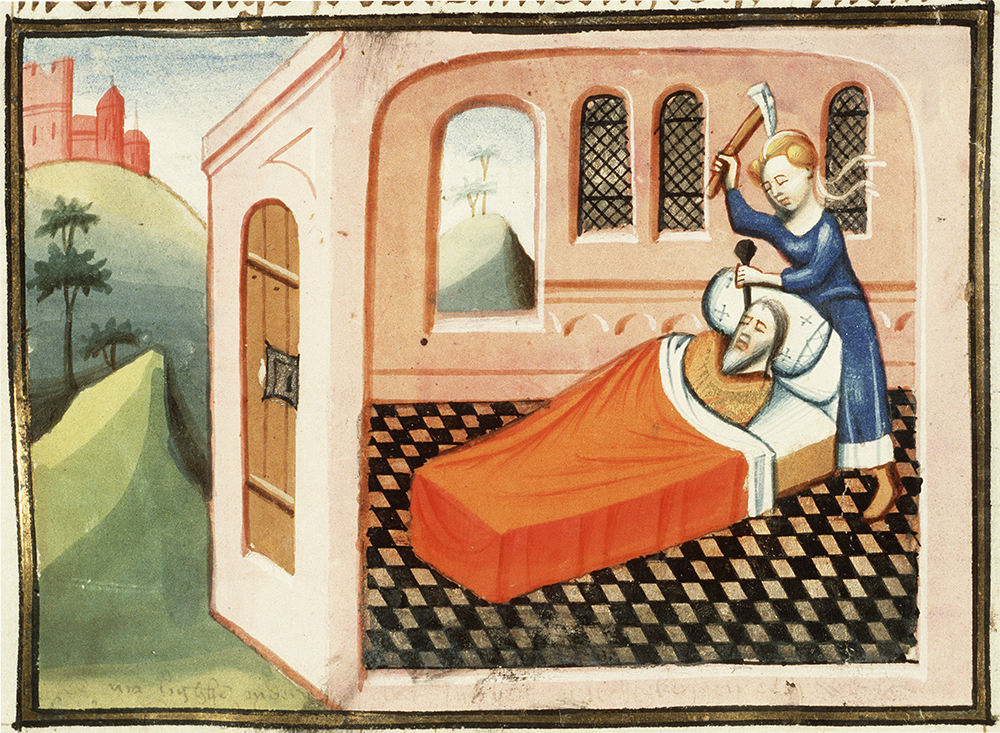
At the top of this post appears an image from 1327, originally created for a book of miracles King Charles IV ordered for his queen. As KB explains, it offers “a warning of what can happen if you don’t learn your prayers properly.” Below that is “a sort of Mediaeval cartoon” from 1183 about the techniques involved in properly slaughtering a pig. And just above, we see what happened when “the Kenite Jael lured the leader of the army, Sisera, into her tent. Sisera had been violently oppressing the Kenites for 20 years. While he slept, she whacked a tent peg straight through his head.” Though created for a picture Bible 592 years ago, this picture surely has potential for transposition into commentary on the very different perils of life in the twenty-twenties. But when you deploy it as a meme, you can do so in the knowledge that even your medieval forebears would have known that feel.
Related content:
Why Butt Trumpets & Other Bizarre Images Appeared in Illuminated Medieval Manuscripts
Why Knights Fought Snails in Illuminated Medieval Manuscripts
Based in Seoul, Colin Marshall writes and broadcasts on cities, language, and culture. His projects include the Substack newsletter Books on Cities, the book The Stateless City: a Walk through 21st-Century Los Angeles and the video series The City in Cinema. Follow him on Twitter at @colinmarshall or on Facebook.
Read More...Support Us
We're hoping to rely on loyal readers, rather than erratic ads. Please click the Donate button and support Open Culture. You can use Paypal, Venmo, Patreon, even Crypto! We thank you!

About Us

Open Culture scours the web for the best educational media. We find the free courses and audio books you need, the language lessons & educational videos you want, and plenty of enlightenment in between.
Advertise With Us
FREE UPDATES!
GET OUR DAILY EMAIL
Get the best cultural and educational resources on the web curated for you in a daily email. We never spam. Unsubscribe at any time.
FOLLOW ON SOCIAL MEDIA
Open Culture editor Dan Colman scours the web for the best educational media. He finds the free courses and audio books you need, the language lessons & movies you want, and plenty of enlightenment in between.
Advertise With Us