Frank Lloyd Wright: America’s Greatest Architect? –A Free Streaming Documentary
From Timeline comes a free streaming documentary called Frank Lloyd Wright: America’s Greatest Architect?:
Frank Lloyd Wright is America’s greatest ever architect. But few people know about the Welsh roots that shaped his life and world-famous buildings. Now, leading Welsh architect Jonathan Adams sets off across America to explore Frank Lloyd Wright’s masterpieces for himself. Along the way, he uncovers the tempestuous life story of the man behind them, and the secrets of his radical Welsh background . In a career spanning seven decades, Frank Lloyd Wright built over 500 buildings, and changed the face of modern architecture.
Frank Lloyd Wright: America’s Greatest Architect? will be added to our list of Free Documentaries, a subset of our collection 4,000+ Free Movies Online: Great Classics, Indies, Noir, Westerns, Documentaries & More.
Related Content
How Frank Lloyd Wright’s Son Invented Lincoln Logs, “America’s National Toy” (1916)
Frank Lloyd Wright Creates a List of the 10 Traits Every Aspiring Artist Needs
Frank Lloyd Wright Reflects on Creativity, Nature and Religion in Rare 1957 Audio
The Modernist Gas Stations of Frank Lloyd Wright and Mies van der Rohe
The Frank Lloyd Wright Lego Set
Read More...Stunningly Elaborate Ottoman Calligraphy Drawn on Dried Leaves
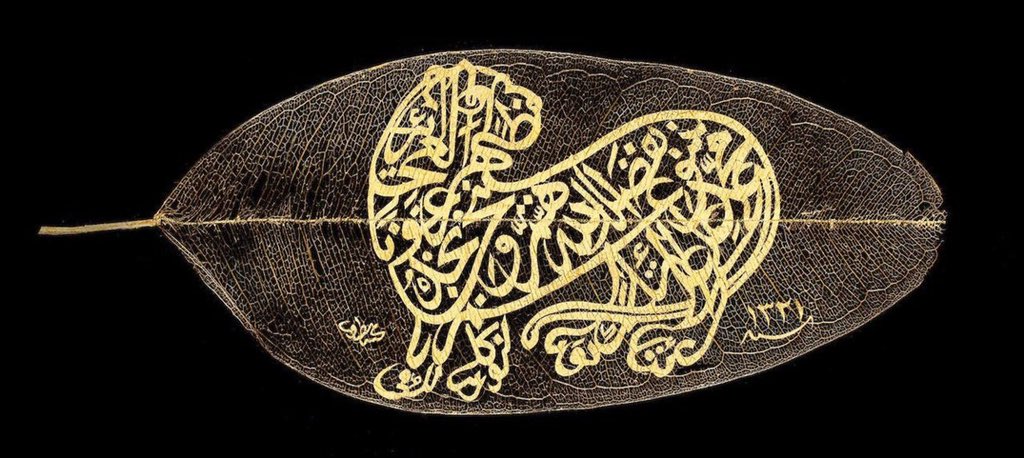
The study of Islamic calligraphy is “almost inexhaustible,” begins German-born Harvard professor Annemarie Schimmel’s Calligraphy and Islamic Culture, “given the various types of Arabic script and the extension of Islamic culture” throughout the Arabian Peninsula, Persia, Africa, and the Ottoman Empire. The first calligraphic script, called Ḥijāzī, allegedly originated in the Hijaz region, birthplace of the Prophet Muhammad himself. Another version called Kūfī, “one of the earliest extant Islamic scripts,” developed and flourished in the “Abbasid Baghdad,” Anchi Hoh writes for the Library of Congress, “a major center of culture and learning during the classical Islamic age.”
Despite the long and venerable history of calligraphy around the Islamic world, there is good reason for the saying that the Qur’an was “revealed in Mecca, recited in Egypt, and written in Istanbul.” The Ottomans refined Arabic calligraphy to its highest degree, bringing the art into a “golden age… unknown since the Abbasid era,” Hoh writes.
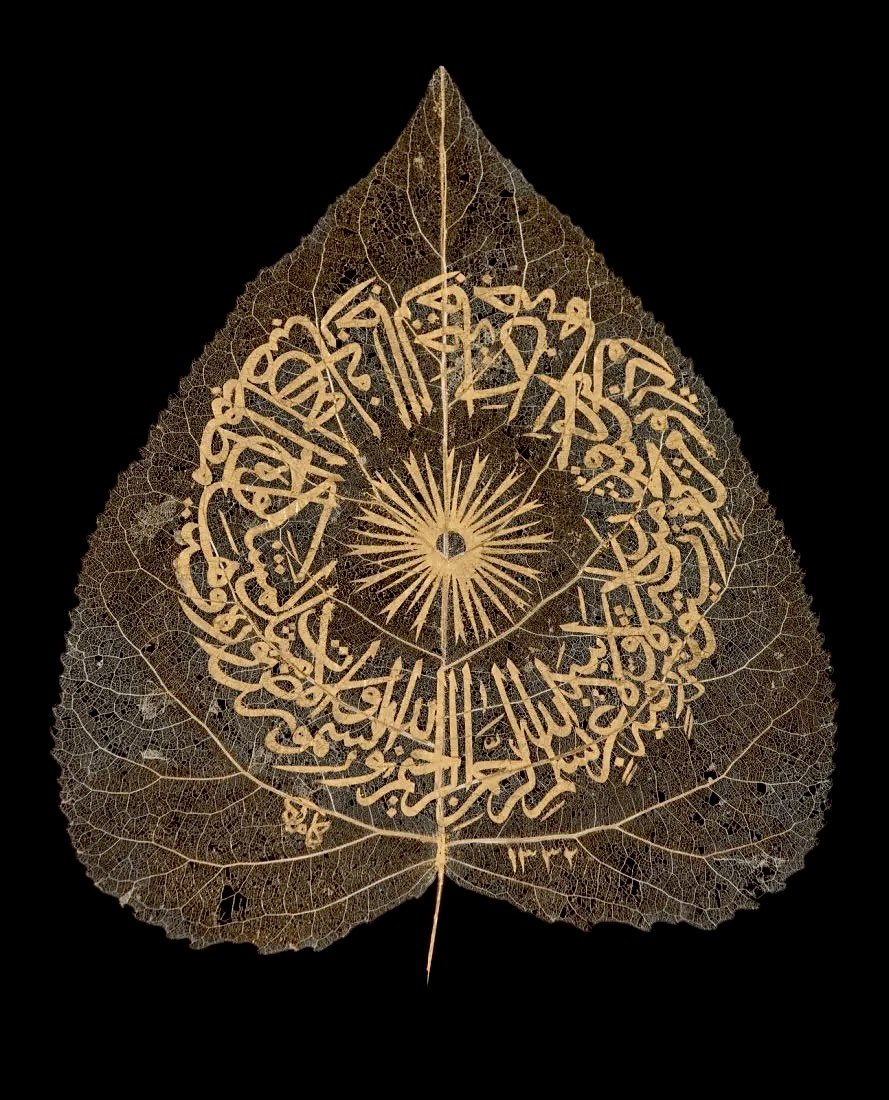
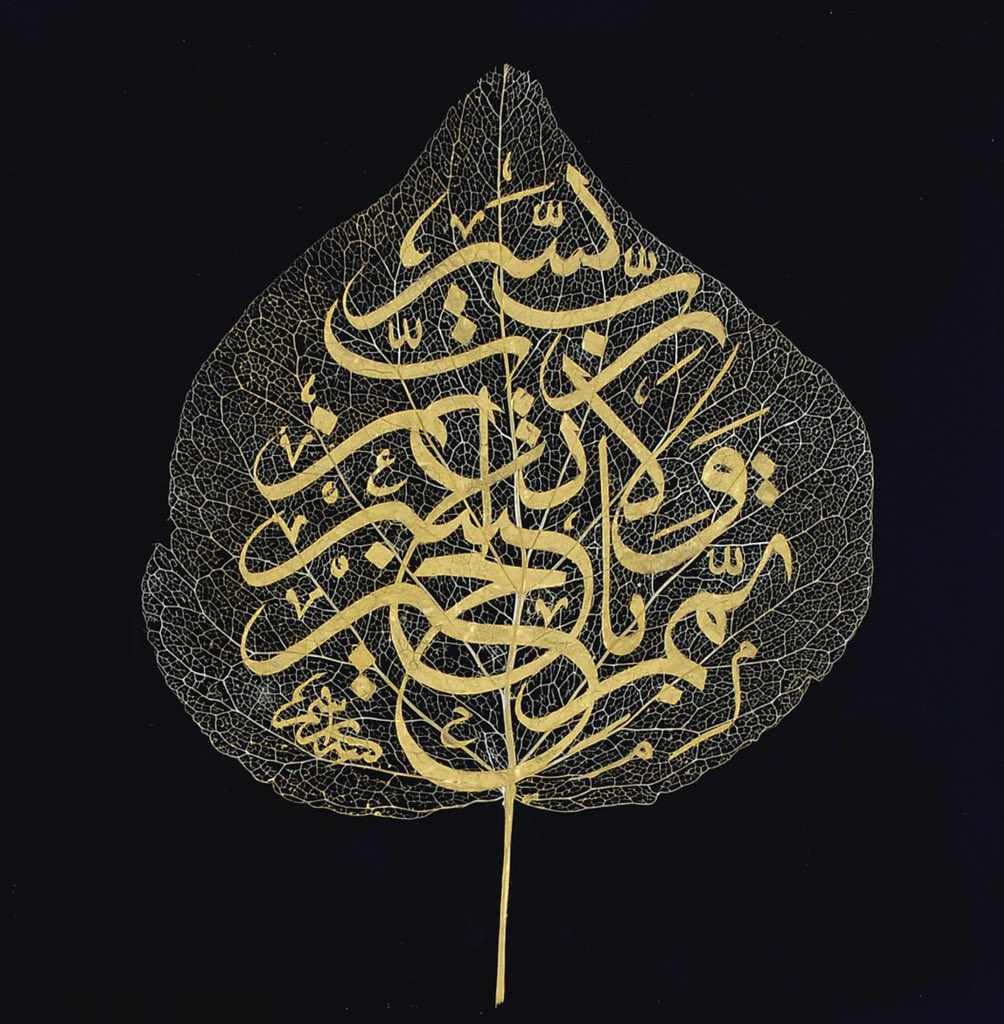
“Ottoman calligraphers adopted [master Abbasid calligrapher] Ibn Muqlah’s six styles and elevated them to new peaks of beauty and elegance.” One of the peaks of this refinement can be seen here in these delicately preserved dead leaves covered with golden Arabic script.
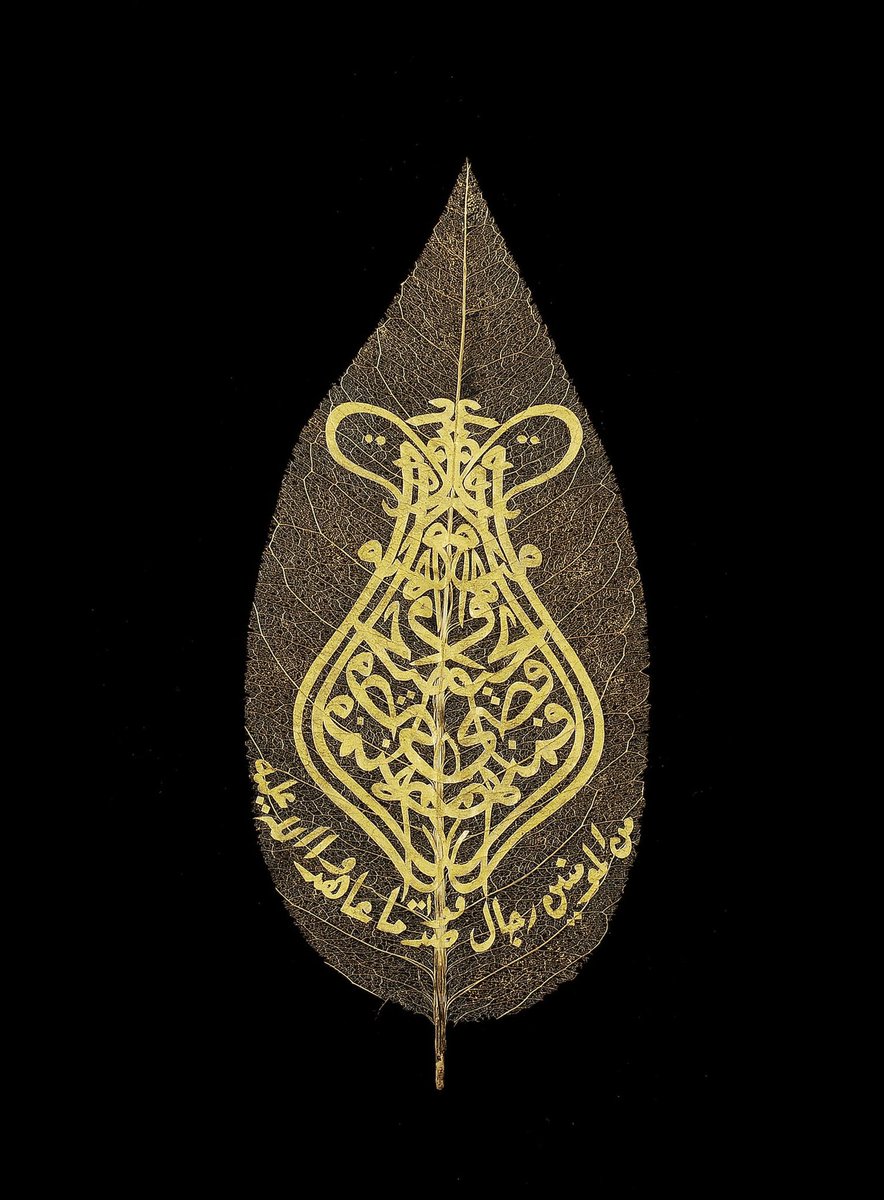
This particular application of the art is, needless to say, “difficult and delicate work,” say the notes on one such leaf in Singapore’s Asian Civilisation Museum:
The leaf has to be dried, and the tissue has to be removed slowly so as to leave the skeletal membrane. The stencil of the composition is placed behind the leaf and the gold ink with gum Arabic is applied over it. This art of producing calligraphy of a dried leaf, is one that was practised most widely in Ottoman Turkey during the 19th century. During this period, Ottoman calligraphers were interested in producing compositions which took the shape of fruits, animals and even inanimate objects like ships and houses.
The examples here come from a Twitter thread by Bayt Al Fann, an artist collective “exploring art & culture inspired by Islamic tradition.” There you can find many more elaborate examples and translations and descriptions of the calligraphic script — generally verses from the Qur’an, Hadith prayers, and poetry. Learn much more about Islamic calligraphy in Schimmel’s book; in her Metropolitan Museum of Art bulletin “Islamic Calligraphy” with Barbara Rivolta (free here); and in Hoh’s three-part Library of Congress series here. And find out how Turkish calligraphers like Nick Merdenyan and Saliha Aktaş have reinvented the art in the 21st century.…
via MetaFilter
Related Content:
Free: Download Thousands of Ottoman-Era Photographs That Have Been Digitized and Put Online
Josh Jones is a writer and musician based in Durham, NC. Follow him at @jdmagness
Read More...Why Does This Lady Have a Fly on Her Head?: A Curious Look at a 15th-Century Portrait
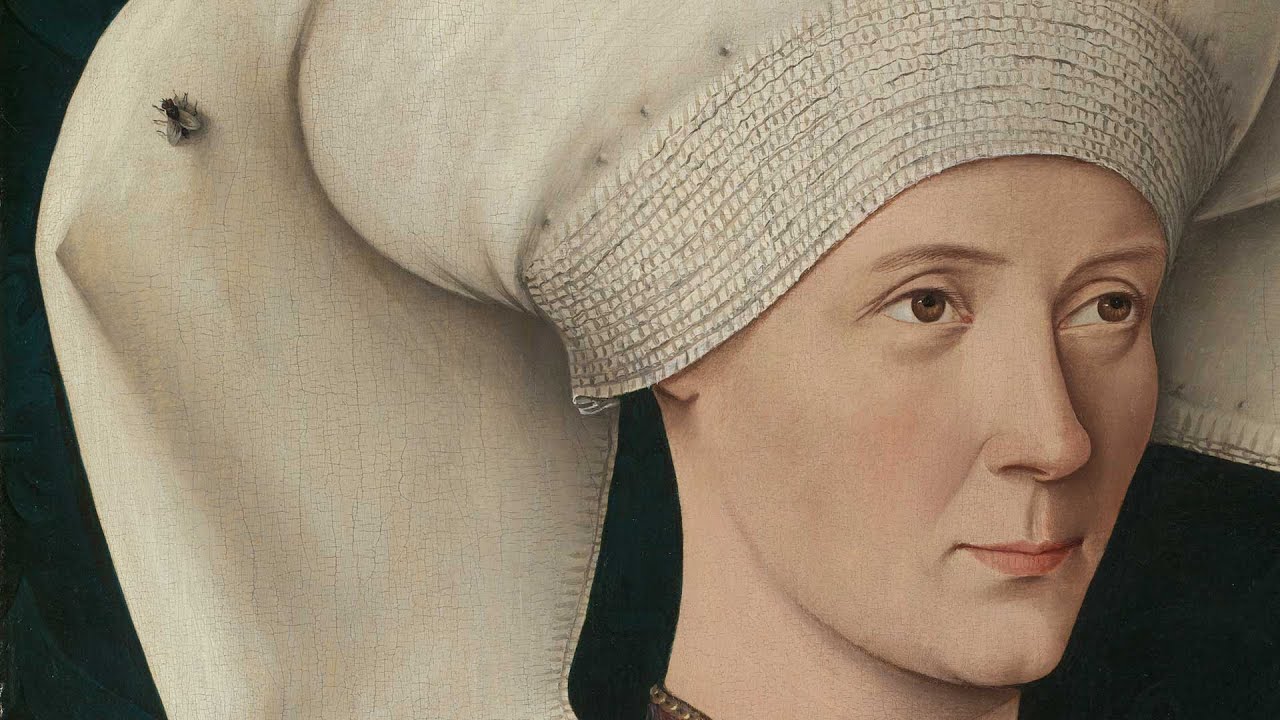
In the National Gallery there hangs a portrait of an unknown woman, painted by an unknown artist around 1470 somewhere in southwestern Germany. This may sound like an artwork of little note, but it does boast one highly conspicuous mark of distinction: a housefly. It’s not that the portraitist was in such thrall to realism that he included an insect that happened to drop into the sitting; at first glance, the fly looks as if it belongs to our reality, and has alighted on the canvas itself. Why would a painter, presumably commissioned at the considerable expense of the sitter’s family, include such a seemingly bizarre detail? National Gallery curator Francesca Whitlum-Cooper offers answers in the video below.
“It’s a joke,” says Whitlum-Cooper. “And it’s a joke that works on different levels, because on the one hand, the fly has been tricked into thinking this is a real headdress,” fooled by the painter’s mastery of that most difficult color for light and shadow, white.
“But obviously there’s a double joke, because we, looking at it, think, ‘Oh my gosh, there’s a fly on that painting!’ ” It is our very instinct to shoo the bug away that tells us “we’ve been duped, because actually, everything here is two-dimensional. This is just paint. And the skill of the artist is that they’ve been able to take that paint, and brush, and a bit of wood, and conjure it into something that feels so lifelike, we do believe — even just for a second — that’s a fly sitting on that picture.”
Five centuries later the joke still works, though it could well be more than a joke. One theory put forth here and there in the comments holds that the fly functions as a reminder of impermanence, of decay, of mortality. If so, it suggests that the subject of this portrait may already have been dead by the time of its painting, a notion supported by the symbolic weight of the forget-me-nots in her hand. (One commenter even argues that the artist is none other than the famed Albrecht Dürer, and that the woman depicted is his late mother.) Though it may not rank among the great works of art, this mysterious image nevertheless shares with them the quality of multivalence. The fly could be a gag, and it could be a memento mori — but why not both?
Related Content:
A Restored Vermeer Painting Reveals a Portrait of a Cupid Hidden for Over 350 Years
What Made Botticelli’s The Birth of Venus a Revolutionary Painting
The Genius of Albrecht Dürer Revealed in Four Self-Portraits
What Makes the Mona Lisa a Great Painting: A Deep Dive
Based in Seoul, Colin Marshall writes and broadcasts on cities, language, and culture. His projects include the Substack newsletter Books on Cities, the book The Stateless City: a Walk through 21st-Century Los Angeles and the video series The City in Cinema. Follow him on Twitter at @colinmarshall, on Facebook, or on Instagram.
Read More...How Thomas Edison & Henry Ford Envisioned a Low-Priced Electric Vehicle in 1914, Almost Changing the Direction of Automobile History

Few inventions have come to define twenty-first century mobility as much as the electric car. As reported at EVBox by Joseph D. Simpson and Wesley van Barlingen, the number of electric vehicles on the road has exploded from “negligible” in 2010 to “as many as 10 million” by the end of 2021. Electric vehicle manufacturer Tesla “is the most valuable automotive company on the planet,” worth “an estimated $1 trillion.” That company takes its name from inventor and alternating-current pioneer Nikola Tesla, but it was under the influence of Tesla’s rival Thomas Edison that the electric car went through much of its early evolution.
“At about the time Ford Motor Co. was founded in 1903, Edison had made inroads with battery technology and started offering nickel-iron batteries for several uses, including automobiles,” writes Wired’s Dan Strohl. At the turn of the 20th century, the vehicles on American roads ran on three different kinds of power: 40 percent used steam, almost as many used electricity, and round 20 percent used gasoline.
Never hesitant to promote his own technologies, Edison declared that “electricity is the thing,” with its lack of “whirring and grinding gears with their numerous levers to confuse,” of “that almost terrifying uncertain throb and whirr of the powerful combustion engine,” of a “water-circulating system to get out of order,” of “dangerous and evil-smelling gasoline.”
As BBC Future Planet’s Allison Hirschlag tells it, “Edison claimed the nickel-iron battery was incredibly resilient, and could be charged twice as fast as lead-acid batteries.” He even had a deal in place with Ford Motors to produce this purportedly more efficient electric vehicle.” Alas, “by the time Edison had a more refined prototype” — one that could be driven from Scotland to London — “electric vehicles were on the way out in favor of fossil-fuel-powered vehicles that could go longer distances before needing to refuel or recharge.” It didn’t help, as Simpson and van Barlingen add, that “after the discovery of oil in Texas, gasoline became cheap and readily available for many, while electricity only remained available in cities.” As a result, electric vehicles had “almost completely disappeared from the market” by the mid-nineteen-thirties.
By the mid-twenty-thirties, however, electric vehicles will quite possibly dominate the market, and 200 years after their invention at that. “It is said that the first electric vehicle was displayed at an industry conference in 1835 by a British inventor by the name of Robert Anderson,” write Simpson and van Barlingen. The twentieth century century saw its development set back by the slow development of battery technology, combined with the sudden development of gasoline-related technologies and infrastructure. But economic, environmental, and political factors have converged to make it seem as if electricity is, indeed, the thing after all, and cars powered by it are positioned to come roaring — or at least humming — back.
Related content:
A Flying Car Took to the Skies Back in 1949: See the Taylor Aerocar in Action
Newly Unearthed Footage Shows Albert Einstein Driving a Flying Car (1931)
The Timeless Beauty of the Citroën DS, the Car Mythologized by Roland Barthes (1957)
A Harrowing Test Drive of Buckminster Fuller’s 1933 Dymaxion Car: Art That Is Scary to Ride
Behold the First Electric Guitar: The 1931 “Frying Pan”
Based in Seoul, Colin Marshall writes and broadcasts on cities, language, and culture. His projects include the Substack newsletter Books on Cities, the book The Stateless City: a Walk through 21st-Century Los Angeles and the video series The City in Cinema. Follow him on Twitter at @colinmarshall, on Facebook, or on Instagram.
Read More...The History of Birth Control: From Alligator Dung to The Pill
The history of birth control is almost as old as the history of the wheel.
Pessaries dating to Mesopotamia and ancient Egypt provide the launching pad for documentarian Lindsay Holiday’s overview of birth control throughout the ages and around the world.
Holiday’s History Tea Time series frequently delves into women’s history, and her pledge to donate a portion of the above video’s ad revenue to Pathfinder International serves as reminder that there are parts of the world where women still lack access to affordable, effective, and safe means of contraception.
One goal of the World Health Organization’s Ending Preventable Maternal Mortality initiative is for 65% of women to be able to make informed and empowered decisions regarding sexual relations, contraceptive use, and their reproductive health by 2025.
As Holiday points out, expense, social stigma, and religious edicts have impacted ease of access to birth control for centuries.
The further back you go, you can be certain that some methods advocated by midwives and medicine women have been lost to history, owing to unrecorded oral tradition and the sensitive nature of the information.
Holiday still manages to truffle up a fascinating array of practices and products that were thought — often erroneously — to ward off unwanted pregnancy.
Some that worked and continue to work to varying degrees, include barrier methods, condoms, and more recently the IUD and The Pill.
Definitely NOT recommended: withdrawal, holding your breath during intercourse, a post-coital sneezing regimen, douching with Lysol or Coca-Cola, toxic cocktails of lead, mercury or copper salt, anything involving alligator dung, and slugging back water that’s been used to wash a corpse.
As for silphium, an herb that likely did have some sort of spermicidal properties, we’ll never know for sure. By 1 CE, demand outstripped supply of this remedy, eventually wiping it off the face of the earth despite increasingly astronomical prices. Fun fact: silphium was also used to treat sore throat, snakebite, scorpion stings, mange, gout, quinsy, epilepsy, and anal warts
The history of birth control can be considered a semi-secret part of the history of prostitution, feminism, the military, obscenity laws, sex education and attitudes toward public health.
From Margaret Sanger and the 60,000 women executed as witches in the 16th and 17th centuries, to economist Thomas Malthus’ 1798 Essay on the Principle of Population and legendary adventurer Giacomo Casanova’s satin ribbon-trimmed jimmy hat, this episode of History Tea Time with Lindsay Holiday touches on it all.
- Ayun Halliday is the Chief Primatologist of the East Village Inky zine and author, most recently, of Creative, Not Famous: The Small Potato Manifesto. Follow her @AyunHalliday.
Related Content
The Story Of Menstruation: Watch Walt Disney’s Sex Ed Film from 1946
Read More...A Master List of 1,700 Free Courses From Top Universities: A Lifetime of Learning on One Page
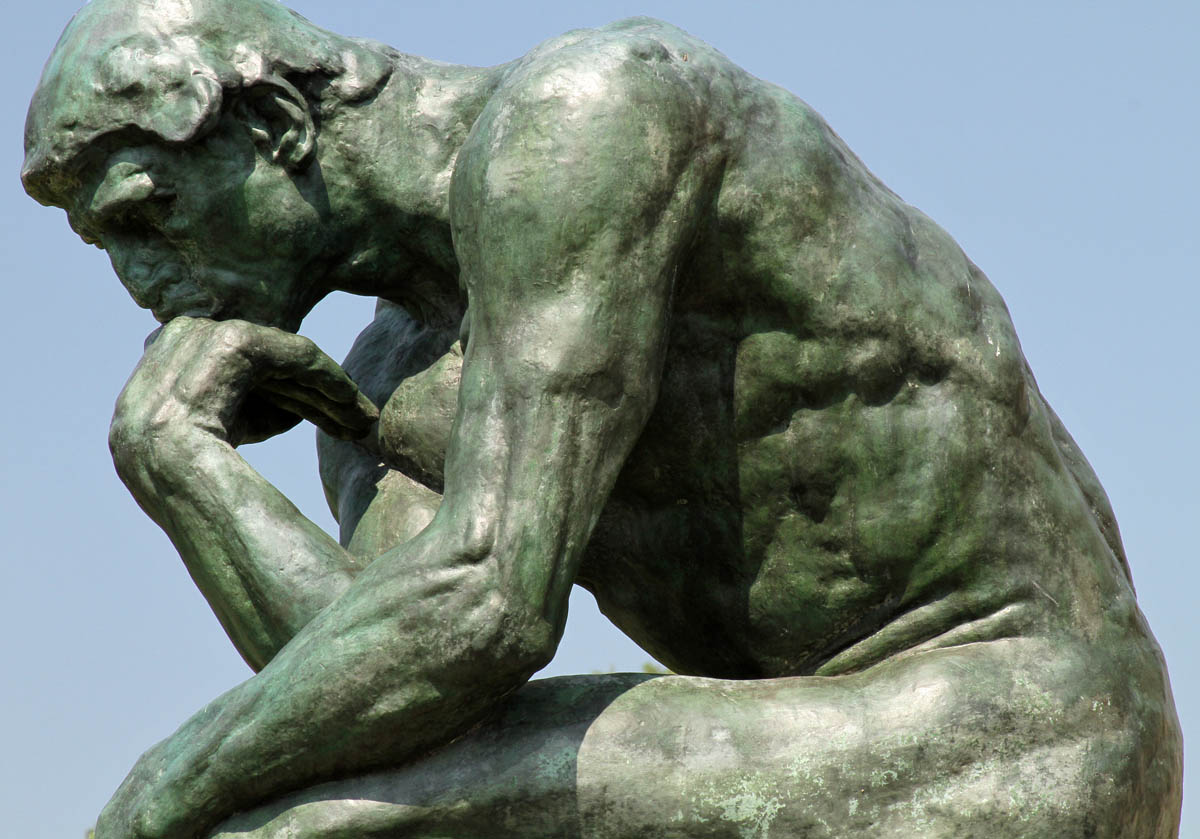
For the past 15 years, we’ve been busy rummaging around the internet and adding courses to an ever-growing list of Free Online Courses, which now features 1,700 courses from top universities. Let’s give you the quick overview: The list lets you download audio & video lectures from schools like Stanford, Yale, MIT, Oxford, Harvard and many other institutions. Generally, the courses can be accessed via YouTube, iTunes or university web sites, and you can listen to the lectures anytime, anywhere, on your computer or smart phone. We haven’t done a precise calculation, but there’s about 50,000 hours of free audio & video lectures here. Enough to keep you busy for a very long time–something that’s useful during these socially distant times.
Right now you’ll find 200 free philosophy courses, 105 free history courses, 170 free computer science courses, 85 free physics courses and 55 Free Literature Courses in the collection, and that’s just beginning to scratch the surface. You can peruse sections covering Astronomy, Biology, Business, Chemistry, Economics, Engineering, Math, Political Science, Psychology and Religion.
Here are some highlights from the complete list of Free Online Courses. We’ve added a few unconventional/vintage courses in the mix just to keep things interesting.
- A History of Philosophy in 81 Video Lectures: From Ancient Greece to Modern Times — Free Online Video — Arthur Holmes, Wheaton College
- A Romp Through Ethics for Complete Beginners - Various Formats – Marianne Talbot, Oxford University
- Ancient Greek History — Various Formats — Donald Kagan, Yale
- Creative Reading and Writing by William S. Burroughs — Free Online Audio — Naropa University
- Critical Reasoning for Beginners — Various Formats – Marianne Talbot, Oxford
- Deep Learning — Free Online Video — Vincent Vanhoucke, Google
- Edible Education 101 – Free Online Video – Michael Pollan, UC Berkeley
- Financial Markets — Various Formats — Robert Shiller, Yale
- Growing Up in the Universe – Free Online Video – Richard Dawkins, Oxford
- Harvard’s Introductory Computer Science Course - Free Online Course — David Malan, Harvard
- Hemingway, Fitzgerald, Faulkner – Various Formats – Wai Chee Dimock, Yale
- How to Listen to Music — Various Formats — Craig Wright, Yale
- Human Behavioral Biology – Various Formats – Robert Sapolsky, Stanford
- Introduction to the Old Testament (Hebrew Bible) – Free Online Video — Christine Hayes, Yale.
- Lectures on Digital Photography — Free Online Video — Marc Levoy, Stanford/Google
- Physics for Future Presidents – Free Online Video – Richard Muller, UC Berkeley
- Science and Cooking: From Haute Cuisine to the Science of Soft Matter — Various Formats — Team taught, Harvard
- Speak Italian with Your Mouth Full - Various Formats — MIT, Dr. Paola Rebusco
- The American Novel Since 1945 – Various Formats – Amy Hungerford, Yale
- The Central Philosophy of Tibet — Free Online Audio – Robert Thurman, Columbia University
- The Character of Physical Law (1964) - Free Online Video — Richard Feynman, Cornell
- The Tempest - Free Online Audio — Allen Ginsberg, Naropa
- Walter Kaufmann Lectures on Nietzsche, Kierkegaard and Sartre — Free Online Audio
The complete list of courses can be accessed here: 1,700 Free Online Courses from Top Universities. For more enriching material, see our other collections below.
Related Content:
1,000 Free Audio Books: Download Great Books for Free.
4,000+ Free Movies Online: Great Classics, Indies, Noir, Westerns, Documentaries & More.
Learn 45+ Languages Online for Free: Spanish, Chinese, English & More.
200 Online Certificate & Microcredential Programs from Leading Universities & Companies.
Read More...
The Sistine Chapel: A $22,000 Art-Book Collection Features Remarkable High-Resolution Views of the Murals of Michelangelo, Botticelli & Other Renaissance Masters
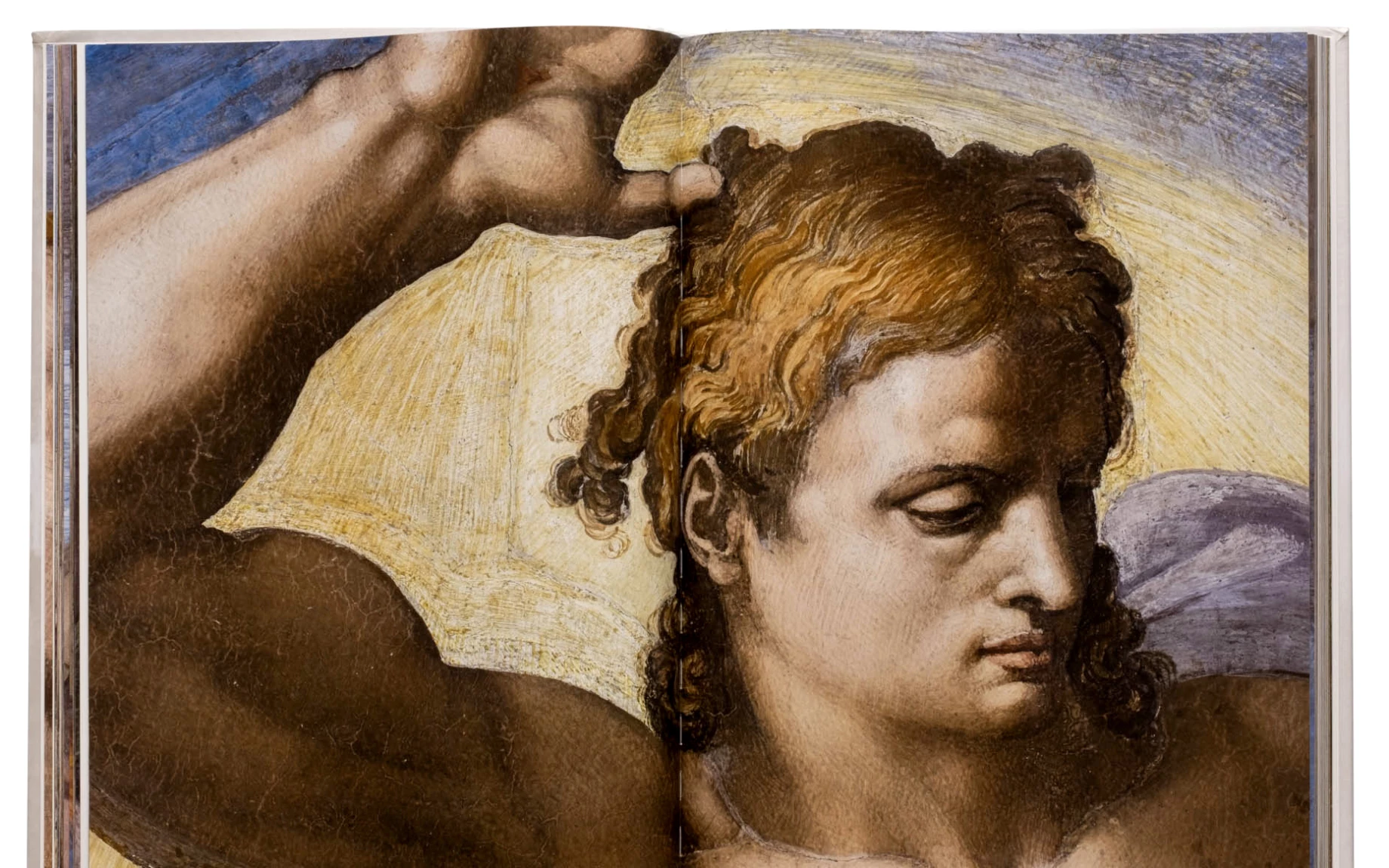
Michelangelo didn’t want to paint the ceiling of the Sistine Chapel. Having considered himself more of a sculptor than a painter — and, given his skill with stone, not without cause — he felt that taking on such an ambitious project could bring him to ruin. But one does not simply turn down a job offer from the Vatican, and especially not when one is among the most respected artists in sixteenth-century Italy. In the event, Michelangelo proved equal to the task, or rather, much more than equal: he completed his ceiling frescoes in 1512 for Pope Julius II, and 23 years later was commissioned again by Pope Paul III to paint the Last Judgment over the altar.
Long before Michelangelo touched a brush to the Sistine Chapel’s ceiling, a team of painters including Sandro Botticelli, Pietro Perugino, and Pinturicchio had already adorned the building’s interior with frescoes depicting the lives of Moses and Jesus Christ.
Taken together, the Sistine Chapel has long been regarded as one of the greatest achievements in Western art, if not the greatest of them all. Hence the six million tourists who visited it each year before COVID-19; hence, more recently, the painstaking care that has gone into the production of The Sistine Chapel, a three-volume at-book set that brings the building’s Biblical visions as close as any earthly reader cold hope to see them.
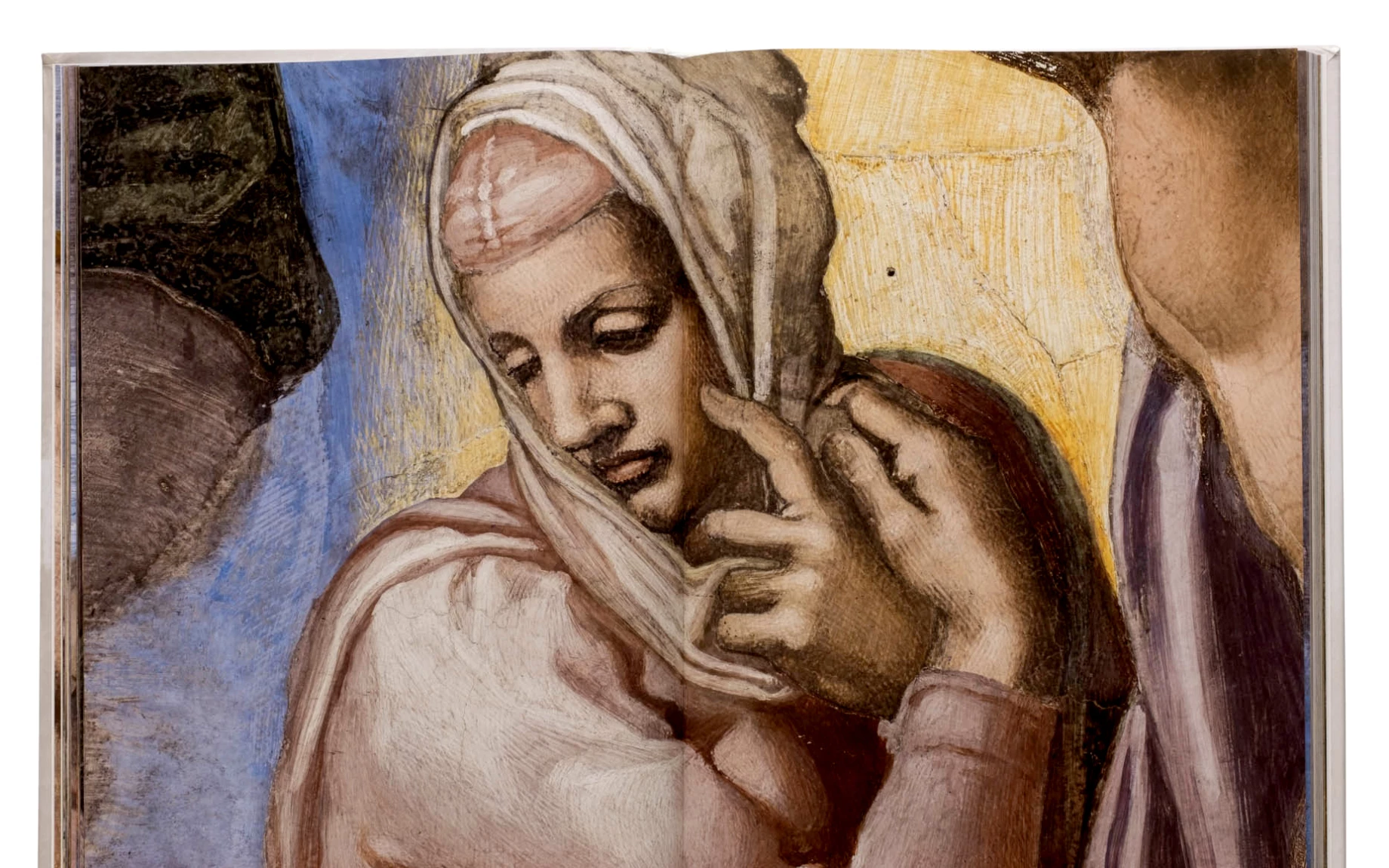
The fruit of a half-decade-long collaboration between the Vatican and two publishers, Callaway Arts & Entertainment and Scripta Maneant, The Sistine Chapel demanded 65 nights of consecutive work from its photographers, who shot 270,000 high-resolution images. Capturing the masterworks on the walls and ceiling down to the textures of their paint and brushstrokes necessitated climbing up on scaffolding, just as Michelangelo himself famously did to make his contributions in the first place. Limited by the Vatican to a print run of 1,999 copies, the set is now available for purchase at AbeBooks, though it will cost you $22,000. In a sense that’s a small price to pay, for as Goethe put it, “without having seen the Sistine Chapel one can form no appreciable idea of what one man is capable of achieving.” Find The Sistine Chapel book collection here.
Related Content:
Michelangelo’s David: The Fascinating Story Behind the Renaissance Marble Creation
New Video Shows What May Be Michelangelo’s Lost & Now Found Bronze Sculptures
Michelangelo’s Handwritten 16th-Century Grocery List
Based in Seoul, Colin Marshall writes and broadcasts on cities, language, and culture. His projects include the Substack newsletter Books on Cities, the book The Stateless City: a Walk through 21st-Century Los Angeles and the video series The City in Cinema. Follow him on Twitter at @colinmarshall or on Facebook.
Read More...The History of Iron Maiden: A Documentary Streaming Free Online
From the official Iron Maiden YouTube channel comes the two-part documentary The History of Iron Maiden. Released in 2004, Part 1: The Early Days (above) moves from the band’s beginnings in London’s East End in 1975, to the Piece of Mind album and tour in 1983. Part 2 (below) was later included on the Live After Death DVD release in 2008.
The History of Iron Maiden will be added to our collection of Free Documentaries, a subset of our collection 4,000+ Free Movies Online: Great Classics, Indies, Noir, Westerns, Documentaries & More.
If you would like to support the mission of Open Culture, consider making a donation to our site. It’s hard to rely 100% on ads, and your contributions will help us continue providing the best free cultural and educational materials to learners everywhere. You can contribute through PayPal, Patreon, and Venmo (@openculture). Thanks!
Related Content
1980s Metalhead Kids Are Alright: Scientific Study Shows That They Became Well-Adjusted Adults
Who Invented Heavy Metal Music?: A Search for Origins
Read More...100-Year-Old Music Recordings Can Now Be Heard for the First Time, Thanks to New Digital Technology
If you were listening to recorded music around the turn of the twentieth century, you listened to it on cylinders. Not that anyone alive today was listening to recorded music back then, and much of it has since been lost. Invented by Alexander Graham Bell (better known for his work on an even more popular device known as the telephone), the recording cylinder marked a considerable improvement on Thomas Edison’s earlier tinfoil phonograph. Never hesitant to capitalize on an innovation — no matter who did the innovating — Edison then began marketing cylinders of his own, soon turning his own name into the format’s most popular and recognizable brand.
“Edison set up coin-operated phonograph machines that would play pre-recorded wax cylinders in train stations, hotel lobbies, and other public places throughout the United States,” writes Atlas Obscura’s Sarah Durn. They also became the medium choice for hobbyists. “One of the most famous is Lionel Mapleson,” says Jennifer Vanasco in an NPR story from earlier this month.
“He recorded his family,” but “he was also the librarian for the Metropolitan Opera. And in the early 1900s, he recorded dozens of rehearsals and performances. Listening to his work is the only way you can hear pre-World War I opera singers with a full orchestra”: German soprano Frieda Hempel, singing “Evviva la Francia!” above.
The “Mapleson Cylinders” constitute just part of the New York Public Library’s collection of about 2,700 recordings in that format. “Only a small portion of those cylinders, around 175, have ever been digitized,” writes Durn. “The vast majority of the cylinders have never even been played in the generations since the library acquired them.” Most have become too fragile to withstand the needles of traditional players. Enter Endpoint Audio Labs’ $50,000 Cylinder and Dictabelt Machine, which uses a combination of needle and laser to read and digitize even already-damaged cylinders without harm. Only seven of Endpoint’s machines exist in the world, one of them a recent acquisition of the NYPL’s, which will now be able to play many of its cylinders for the first time in more than a century.
Some of these cylinders are unlabeled, their contents unknown. Curator Jessica Wood, as Velasco says, is hoping to “hear a birthday party or something that tells us more about the social history at the time, even someone shouting their name and explaining they’re testing the machine, which is a pretty common thing to hear on these recordings.” She knows that the NYPL’s collection has “about eight cylinders from Portugal, which may be some of the oldest recordings ever made in the country,” as well as “five Argentinian cylinders that have preserved the sound of century-old tango music.” In the event, from the first cylinder she puts on for NPR’s microphone issue familiar words: “Hello, my baby. Hello, my honey. Hello, my ragtime gal.” This listening experience perhaps felt like something less than time travel. But then, were you really to go back to 1899, what song would you be more likely to hear?
Related content:
Hear Singers from the Metropolitan Opera Record Their Voices on Traditional Wax Cylinders
A Beer Bottle Gets Turned Into a 19th Century Edison Cylinder and Plays Fine Music
400,000+ Sound Recordings Made Before 1923 Have Entered the Public Domain
Based in Seoul, Colin Marshall writes and broadcasts on cities, language, and culture. His projects include the Substack newsletter Books on Cities, the book The Stateless City: a Walk through 21st-Century Los Angeles and the video series The City in Cinema. Follow him on Twitter at @colinmarshall or on Facebook.
Read More...The Woman Who Theorized Color: An Introduction to Mary Gartside’s New Theory of Colours (1808)
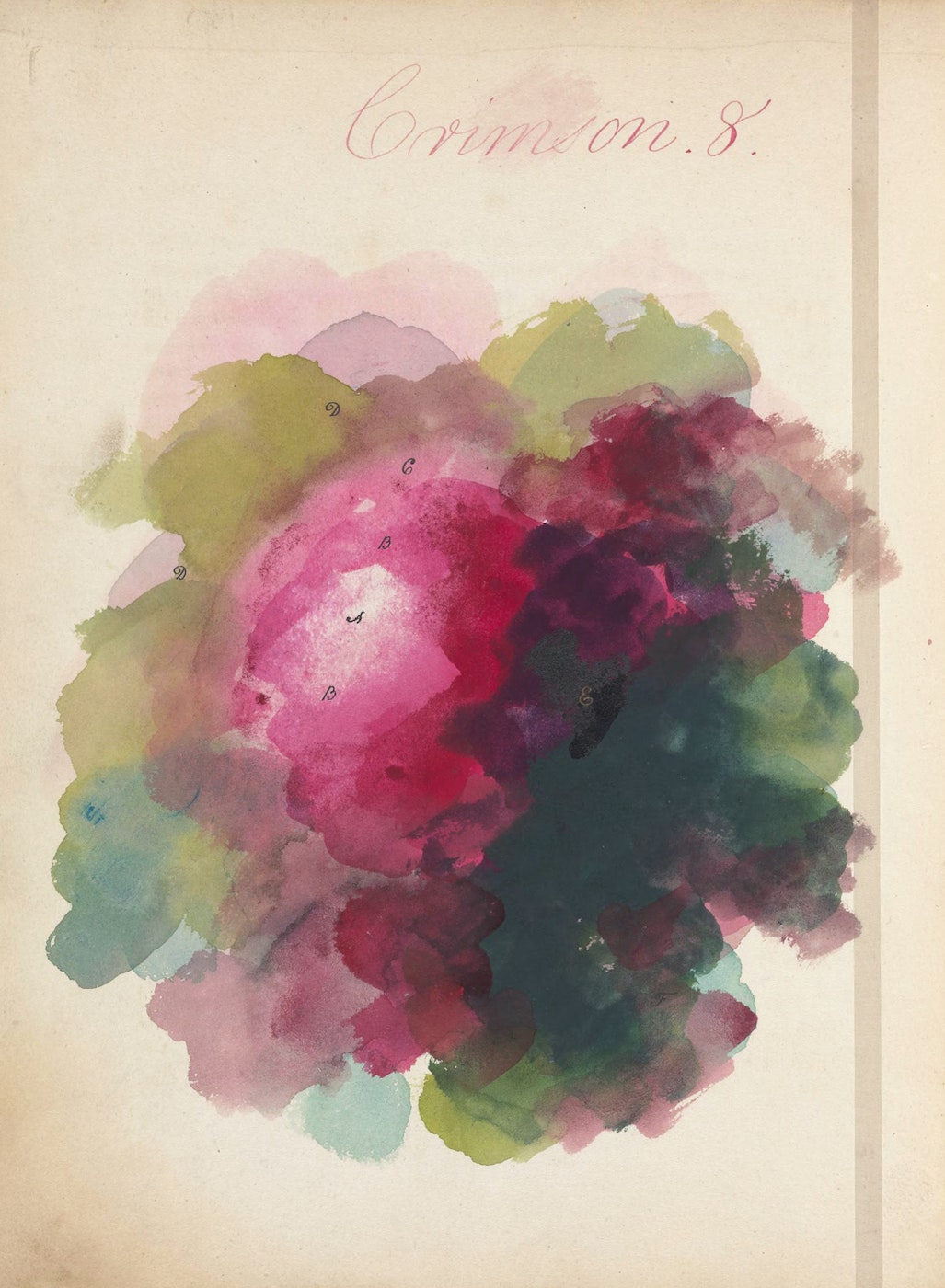
“I shall only say that those ladies who study the rules of the art, secure a never-ceasing source of pleasure to themselves, which is always at their own command.… while those who pursue the practical part alone, can make no progress whenever their teacher or copy is withdrawn.”
The history of color theory is a story we tell based on available facts. Like many histories, it has mostly been a story by and about men. Isaac Newton’s experiments with optics inspired the broader inquiry. Johann Wolfgang von Goethe’s 1810 Theory of Colors set a standard — visually and philosophically — for books about color in the following centuries. A series of lesser-known names surround them, to the founders of color monopolist Pantone and beyond.
Maybe the story would be different if Mary Gartside’s work had been more readily available to her contemporaries and successors. Gartside, an English watercolor teacher and painter of botanical subjects, published An Essay on Light and Shade in 1805, and an expanded edition, An Essay on a New Theory of Colours in 1808. The obscure study constitutes “one of the rarest and most unusual books about color ever published,” says Alexandra Loske, curator at Brighton’s Royal Pavilion and herself a historian of color.
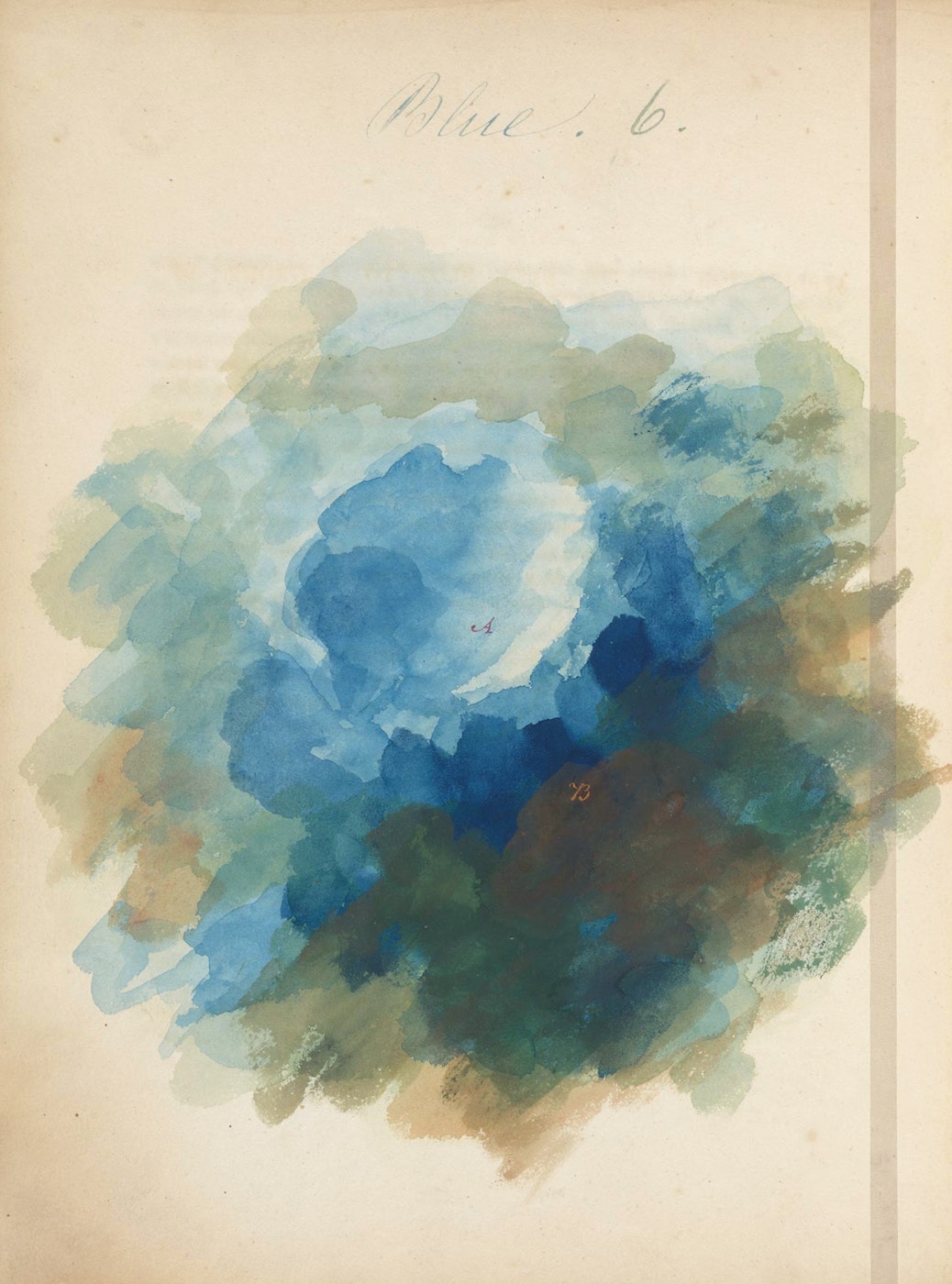
Loske found that Gartside is “one of the only nineteenth-century women to have composed ‘theoretical treatises on colour,’ ” as Public Domain Review writes, “nearly a century before Emily Noyes Vanderpoel published her Color Problems (1902).”
Gartside wrote in conversation with Newton and in critique of “eighteenth-century theories proposed by Gerard de Lairesse and William Herschel.” Gartside’s book anticipates Goethe and James Sowerby’s 1809 A New Elucidation of Colours and draws “parallel conclusions” about “the eye of the beholder as the centre and origin of colour perception.”
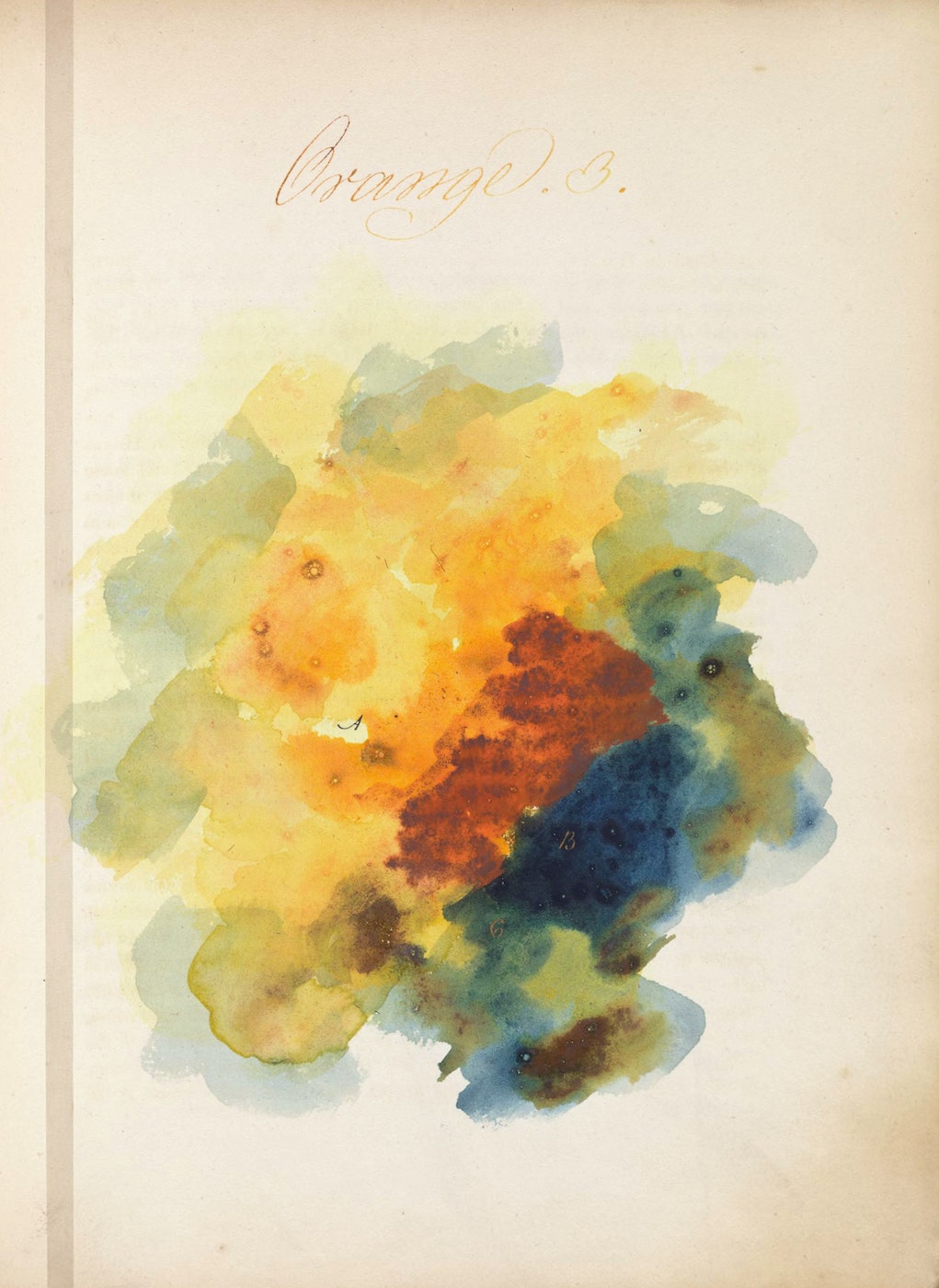
Gartside dressed her philosophy in what Ann Bermingham calls “the very modesty of the genre” of watercolor painting guides, the writing of which constituted a respectable outlet for women, where critical thought was not. The author gestures toward this state of affairs in her introduction, stating that she does not “offer my opinion unasked,” and noting emphatically she can only teach “to the best of my knowledge.” Her knowledge turns out to be considerable. Moreover, Public Domain Review writes, her “hand colored illustrations for the Essay, unique to each volume, have been deemed some of the earlier examples of abstraction in painting.”
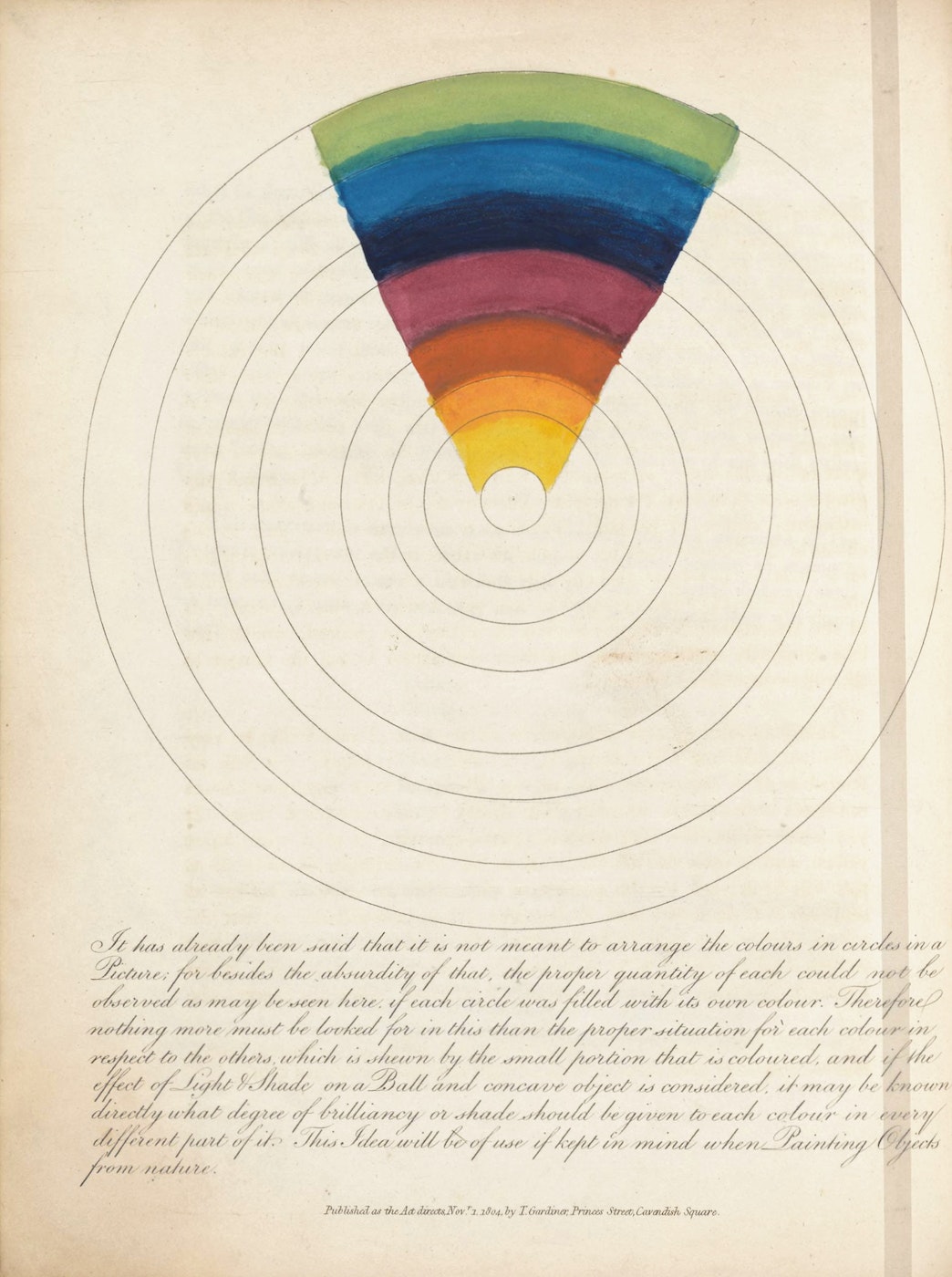
Indeed, Gartside’s detailed instructions on the practical application of theory seem to presage the abstractions of Vasily Kandinsky, who brought his personal metaphysics to the formulae in the 1923 book Concerning the Spiritual in Art. Unlike the Romantics of her time — and like the Modernists of two hundred years later — Gartside de-emphasized individual genius while stressing the importance of theoretical understanding. Only through a knowledge of color theory and psychology, she writes boldly, could one achieve “command” of the art and make it their own, as she surely did in her illustrations. Joseph Litts points out in an essay for Material Matters:
Gartside used her medium of watercolor painting to engage with contemporary debates on color. Her understanding of color and color theory is the significant contribution of her book. She recasts both Isaac Newton’s theory of prismatic color and Sir William Herschel’s theory of radial color by creating a “color ball” that wraps the chromatic prism into a continual spectrum. Such a color ball anticipates Goethe’s attempts to put color into wheels, a shift from earlier grid representations.
Though Gartside would not claim the mantle of genius for herself or her readers (and she avoids fuzzy talk of inspiration, the muses, and so forth), we may place her confidently in the company of great color theorists and illustrators. And we might also see how her work shows an approach not taken, or not taken until a couple centuries later.
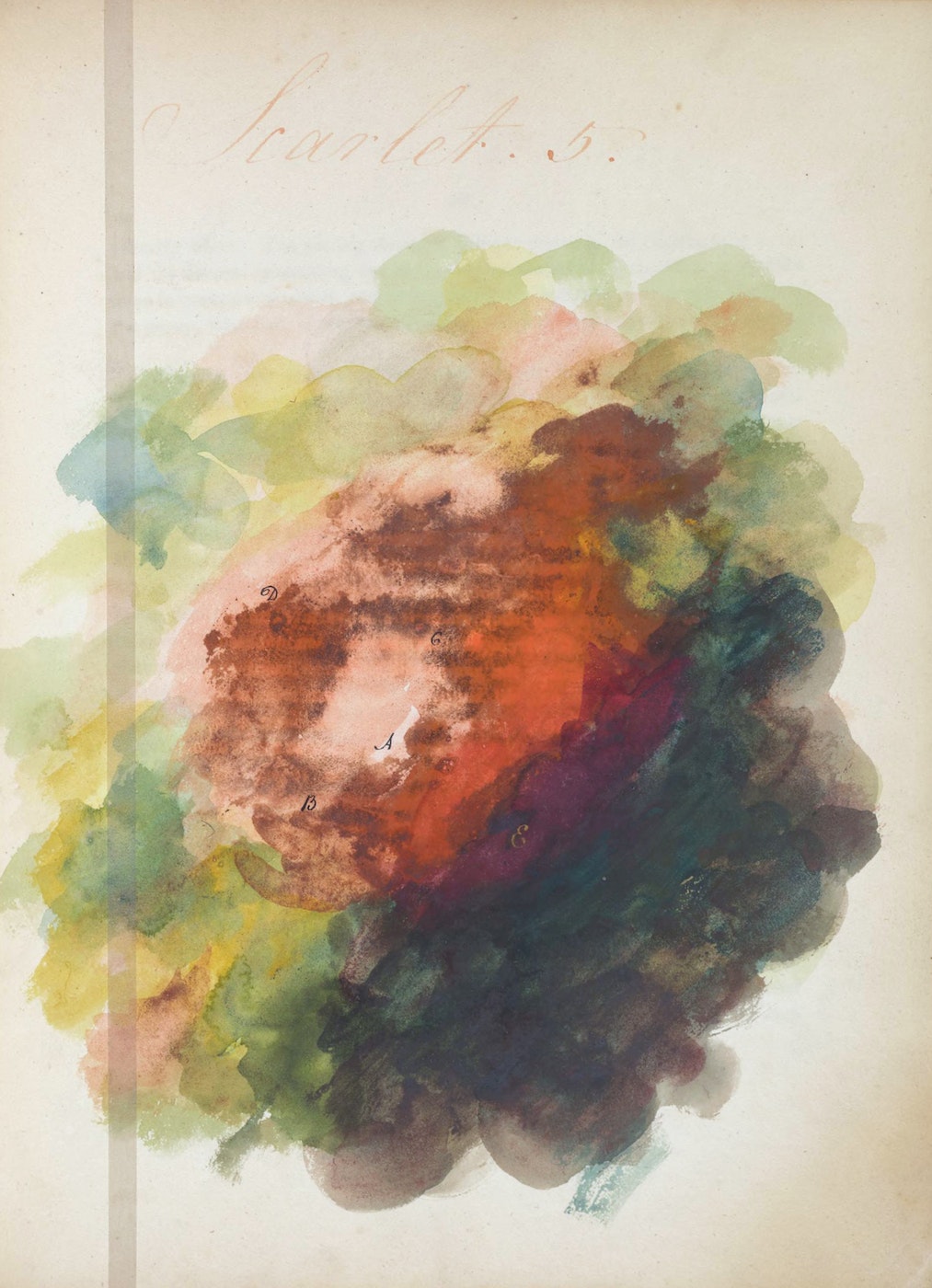
“There is no other example of a representation of colour systems,” Loske writes, “that is as inventive and radical as Gartside’s colour blots.” Learn more about Loske’s discovery of Gartside’s work in Kelly Grover’s BBC essay “The Women Who Redefined Colour.” See more of Gartside’s watercolors at the Public Domain Review.
Related Content:
The Vibrant Color Wheels Designed by Goethe, Newton & Other Theorists of Color (1665–1810)
Josh Jones is a writer and musician based in Durham, NC. Follow him at @jdmagness
Read More...Support Us
We're hoping to rely on loyal readers, rather than erratic ads. Please click the Donate button and support Open Culture. You can use Paypal, Venmo, Patreon, even Crypto! We thank you!

About Us

Open Culture scours the web for the best educational media. We find the free courses and audio books you need, the language lessons & educational videos you want, and plenty of enlightenment in between.
Advertise With Us
FREE UPDATES!
GET OUR DAILY EMAIL
Get the best cultural and educational resources on the web curated for you in a daily email. We never spam. Unsubscribe at any time.
FOLLOW ON SOCIAL MEDIA
Open Culture editor Dan Colman scours the web for the best educational media. He finds the free courses and audio books you need, the language lessons & movies you want, and plenty of enlightenment in between.
Advertise With Us

