Jim Morrison Accurately Predicts the Future of Electronic Music in 1969
Jim Morrison didn’t fare particularly well, health-wise, in the last years of his life. Alcoholism took a heavy toll, as we know. “Images of him with the shaggy beard, hair receding at the temples, and excess flesh gathering around the armpits,” writes Rob Fischer at Rolling Stone, “can resemble, in retrospect, T.J. Miller more than Father John Misty. This is the out-to-seed drunkard that Val Kilmer portrays in Oliver Stone’s iconic film The Doors.” It is also an unfortunate caricature that leaves out the creative and intellectual energy still left in the artist once called “the first major male sex symbol since James Dean died and Marlon Brando got a paunch.”
There was always more to Morrison than that, and in the 1969 interview above, filmed over a week in L.A. with Rolling Stone’s Jerry Hopkins, he is still “remarkably sharp,” Fischer writes.
Even though the conversations included many rounds of whiskey, scotch and beer, his responses give the impression of a thoughtful and engaged artist struggling to realize the full extent of his already colossal powers of expression. He was reading widely, writing poetry, gravitating more towards filmmaking, all while longing to reconnect with the explosive energy that comes with playing small venues and clubs like the Whiskey a Go Go.
Morrison and the Doors were experimental artists, taking musical risks and selling them with sex. The Doors were the first rock band, for example, to use the new Moog synthesizer on an album. Even before Wendy Carlos’ Switched-On Bach introduced popular audiences to the technology of audio synthesis in 1968, the band brought jazz musician Paul Beaver into the 1967 recordings sessions for Strange Days to use Moog for effects on several tracks and to distort Morrison’s voice.
Beaver, an early adopter of the synthesizer, produced two seminal Moog records in the late sixties: The Zodiac: Cosmic Sounds (1967) with Mort Garson and double album The Nonesuch Guide to Electronic Music (1968) with Bernie Krause.
Therefore, when Morrison, in his astute analysis of American music, “predicts” the future of electronic music in 1969 during the course of his interview with Hopkins, he knows of what he speaks. He’s already seen it, and being the hip guy that he was, he had likely heard the work of electronic pioneers Silver Apples and maybe even of the band White Noise, a side project of BBC Radiophonic Workshop composer Delia Derbyshire that produced music far ahead of its time that very year — music made almost exactly the way he describes:
I can kind of envision one person with a lot of machines, tapes and electronics set up, singing or speaking while using machines.…
At the end of the brief clip at the top, we hear Hopkins ignore this idea and move Morrison back to talking about rock. But Jim had already moved on — and so had the culture, he knew. The music he describes was happening all around him, and we might imagine he was a little frustrated that other people couldn’t hear it. What Morrison brought to it, however — or might have, had he lived — was the lyrical, the sensual, the performative, the melodramatic, and the truly frightening, all qualities it would take new wave and goth acts like Echo and Bunnymen, Depeche Mode, and a host of Doors-influenced dark wave bands to bring to fruition in the electronic music of future past.
Related Content:
How the Moog Synthesizer Changed the Sound of Music
This Is “The End”: A Video Exploration of The Doors’ Existential Epic
Josh Jones is a writer and musician based in Durham, NC. Follow him at @jdmagness
Read More...The Story of Googie Architecture, the Iconic Architectural Style of Los Angeles
When I lived in Los Angeles, I enjoyed no breakfast spot more than Pann’s. The place had it all: not just signature plates ranging from biscuits and gravy to chicken and waffles, but tropical landscaping, stone walls, a slanted roof, banquettes in burgundy and counter seats in cream, and as the pièce de résistance, a neon sign that lit up one letter at a time. Built in 1958, Pann’s stands today as quite possibly the most immaculate surviving example of Googie, a mid-twentieth-century aesthetic that takes its name from another Los Angeles coffee shop opened nearly a decade earlier. Though designed by no less serious a modern architect than Frank Lloyd Wright protégé John Lautner, Googie’s gave rise to perhaps the least serious of all architectural movements.
“It’s a style built on exaggeration; on dramatic angles; on plastic and steel and neon and wide-eyed technological optimism,” writes Matt Novak at Smithsonian magazine. “It draws inspiration from Space Age ideals and rocketship dreams. We find Googie at the 1964 New York World’s Fair, the Space Needle in Seattle, the mid-century design of Disneyland’s Tomorrowland, in Arthur Radebaugh‘s postwar illustrations, and in countless coffee shops and motels across the U.S.”
But the acknowledged cradle of Googie is Los Angeles, whose explosive development alongside that of mid-twentieth-century American “car culture” encouraged the ultra-commercial architectural experimentation whose first priority was to catch the eye of the motorist — and ideally, the hungry motorist.
You can hear the history of Googie told in the Cheddar Explain video “How Los Angeles Got Its Iconic Architecture Style,” which adapts Novak’s Smithsonian piece. In “Googie Architecture: From Diners to Donuts,” photographer Ahok Sinha goes into more detail about how the style turned “architecture into a form of advertising.” Like all the most effective advertising, Googie drew from the zeitgeist, incorporating the striking shapes and advanced materials connected in the public mind with notions of speed and technology embodied not just by automobiles but even more so by rockets. For Googie was the architecture of the Space Race: it’s no accident that the creators of The Jetsons, which aired in 1962 and 1963, rendered all the show’s settings in the same style.
It could fairly be said that no one architect invented Googie, that it emerged almost spontaneously as a product of American popular culture. But “for some reason, we got stuck with the name,” says architect Victor Newlove, of Armet Davis Newlove and Associates, in the interview clip above. For good reason, perhaps: to that firm’s credit are several locations of the diner chains Bob’s Big Boy (where for years David Lynch’s took his daily milkshake) and Norms, both of which are still in business in Los Angeles today. Its architects Eldon Davis and Helen Liu Fong also designed Pann’s, which for many Googie enthusiasts remains an unsurpassable achievement — and one whose competition, since the moon landing and the end it put to not just the Space Race but the sensibility it inspired, has been dwindling one demolition at a time.
Related content:
The Modernist Gas Stations of Frank Lloyd Wright and Mies van der Rohe
1,300 Photos of Famous Modern American Homes Now Online, Courtesy of USC
That Far Corner: Frank Lloyd Wright in Los Angeles – A Free Online Documentary
Based in Seoul, Colin Marshall writes and broadcasts on cities, language, and culture. His projects include the Substack newsletter Books on Cities, the book The Stateless City: a Walk through 21st-Century Los Angeles and the video series The City in Cinema. Follow him on Twitter at @colinmarshall or on Facebook.
Read More...The Little Prince: Footage Gets Unearthed Of the Pop Star at Age 11
Prince left us a vast body of work, with much rumored still to be awaiting release in his vault. But among his many albums already available, I still hold in especially high regard For You, the debut he recorded while still a teenager. Not only did he put out this first LP at an unusually young age, he produced it and played nearly all its instruments. Though Prince seemed to have emerged into the world as a fully formed pop-music genius, he had to come from somewhere. Indeed, he came from Minneapolis, a city with which he remained associated all his life. Now, nearly six years after his death, a Minneapolis television station has discovered a previously unknown artifact of the Purple One’s adolescence.
In April 1970 the teachers of Minneapolis’ public schools went on strike, and a reporter on the scene asked a crowd of nearby schoolchildren whether they were in favor of the picketing. “Yup,” replies a particularly small one who’d been jumping to catch the camera’s attention. “I think they should get a better education, too.”
Not only that, “they should get some more money ’cause they be workin’ extra hours for us and all that stuff.” None of this was audible to the producer at WCCO TV, a Minneapolis-native Prince fan, who’d brought the half-century-old footage out of the archive in order to contextualize another teachers strike just last month. But in the young interviewee’s face and mannerisms he saw not just a local boy, but one particular local boy made enormously good.
No one who’s seen Prince in action early in his career could fail to recognize him in this long-unseen footage. But it took more than fans to confirm his identity, as you can see in the WCCO news broadcast and behind-the-scenes segment here. A local Prince historian could provide highly similar photographs of the star-to-be in the same year, when he would have been eleven. Eventually the investigation turned up a childhood neighbor and former bandmate named Terry Jackson, who watches the clip and breaks at once into laughter and tears of recognition. “That’s Skipper!” Jackson cries, using the nickname by which his family and friends once knew him. “I never referred to him as Prince. He might even have got mad at me when he got famous.” Ascend to the pantheon of pop music, it seems, and you still can’t quite make it out of the old neighborhood.
Related content:
Read Prince’s First Interview, Printed in His High School Newspaper (1976)
Prince’s First Television Interview (1985)
The Life of Prince in a 24-Page Comic Book: A New Release
Based in Seoul, Colin Marshall writes and broadcasts on cities, language, and culture. His projects include the Substack newsletter Books on Cities, the book The Stateless City: a Walk through 21st-Century Los Angeles and the video series The City in Cinema. Follow him on Twitter at @colinmarshall or on Facebook.
Read More...All Espresso Drinks Explained: Cappuccino, Latte, Macchiato & Beyond
What separates the Cappuccino from the Latte, and the Macchiato from the Double Espresso? These are some important questions–questions that demand answers. And European Coffee Trip–a YouTube channel run by two Czech guys with a love for specialty coffee–has answers. Above, they break it all down for you. Find timestamps for the different variations below.
0:58 Single Espresso
1:35 Double Espresso
1:55 Americano
2:18 Lungo
2:37 Filter coffee (no espresso!)
3:16 Cappuccino
3:46 Espresso Macchiato
4:07 Cortado/Piccolo
4:30 Flat White
4:54 Caffé Latte
To delve deeper, you can also watch James Hoffman’s always informative video. It covers similar ground, but also touches on some other variations of espresso drinks.
If you would like to support the mission of Open Culture, consider making a donation to our site. It’s hard to rely 100% on ads, and your contributions will help us continue providing the best free cultural and educational materials to learners everywhere. You can contribute through PayPal, Patreon, and Venmo (@openculture). Thanks!
Related Content
The Birth of Espresso: The Story Behind the Coffee Shots That Fuel Modern Life
The Life & Death of an Espresso Shot in Super Slow Motion
Read More...
The Depths of Wikipedia: Enjoy a Compendium of the Online Encyclopedia’s Most Bizarre Pages
@depthsofwikipedia If the authorities kill me for making this tiktok just know I loved you guys #learnontiktok #tiktokpartner ♬ original sound — Annie Rauwerda
What’s your stance on Wikipedia, the free, open content online encyclopedia?
Students are often discouraged or disallowed from citing Wikipedia as a source, a bias that a Wikipedia entry titled “Wikipedia should not be considered a definitive source in and of itself” supports:
As a user-generated source, it can be edited by anyone at any time, and any information it contains at a particular time could be vandalism, a work in progress, or simply incorrect. Biographies of living persons, subjects that happen to be in the news, and politically or culturally contentious topics are especially vulnerable to these issues…because Wikipedia is a volunteer-run project, it cannot constantly monitor every contribution. There are many errors that remain unnoticed for hours, days, weeks, months, or even years.
(Another entry counsels those who would persist to cite the exact time, date, and article version they are referencing.)
Wikipedia has a clearly stated policy prohibiting contributors from close paraphrasing or outright copying and pasting from outside sources, though in a bit of a circle-in-a-circle situation, several noted authors and journalists have been caught plagiarizing Wikipedia articles.
A list of Wikipedia controversies, published on — where else? — Wikipedia is a hair raising litany of political sabotage, character assassination, and “revenge edits”. (The list is currently substantiated by 338 reference links, and has been characterized as in need of update since October 2021, owing to a lack of edits regarding the “controversy about Mainland Chinese editors.”)
It can be a pretty scary place, but University of Michigan senior Annie Rauwerda, creator of the Instagram account Depths of Wikipedia is unfazed. As she wrote in an article for the tech publication Input:
Wikipedia is a splendidly extensive record of almost everything that matters; a modern-day Library of Alexandria that’s free, accessible, and dynamic. But Wikipedia is characterized not only by what it is but also by what it is not. It’s not a soapbox, a battleground, nor a blog.
It’s also becoming famous as Rauwerda’s playground, or more accurately, a packed swap shop in which millions of bizarre items are tucked away.
If your schedule limits the amount time you can spend down its myriad rabbit holes, Rauwerda will do the digging for you.
Turning a selection of Wikipedia excerpts into a collage for a friend’s quaran-zine inspired her to keep the party going with screenshots of oddball entries posted to a dedicated Instagram account.
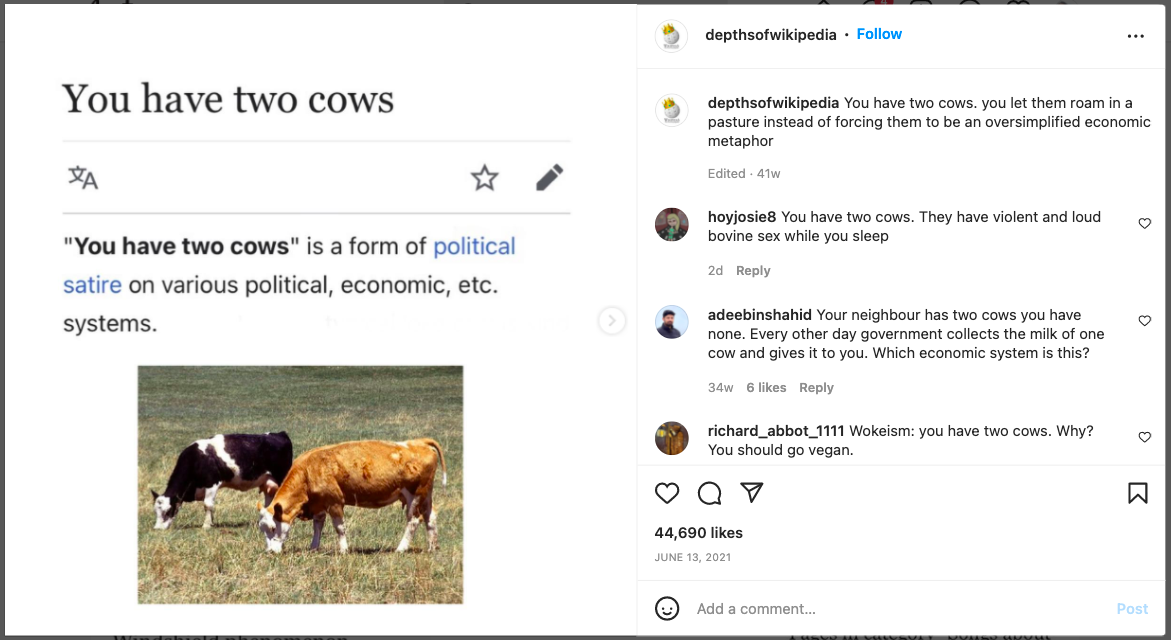
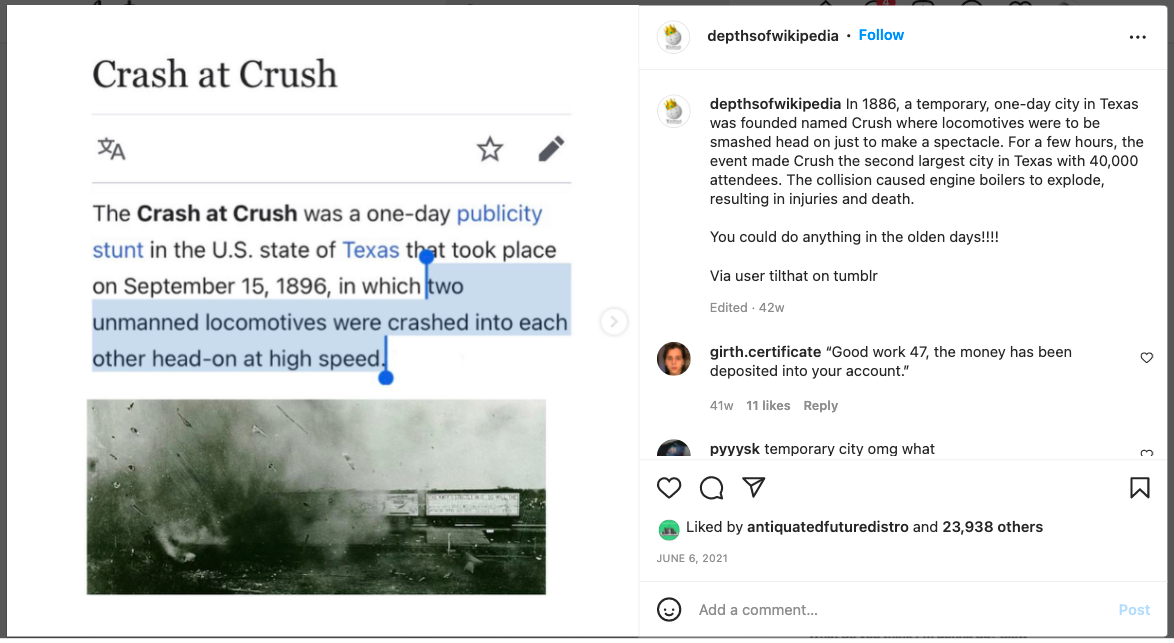
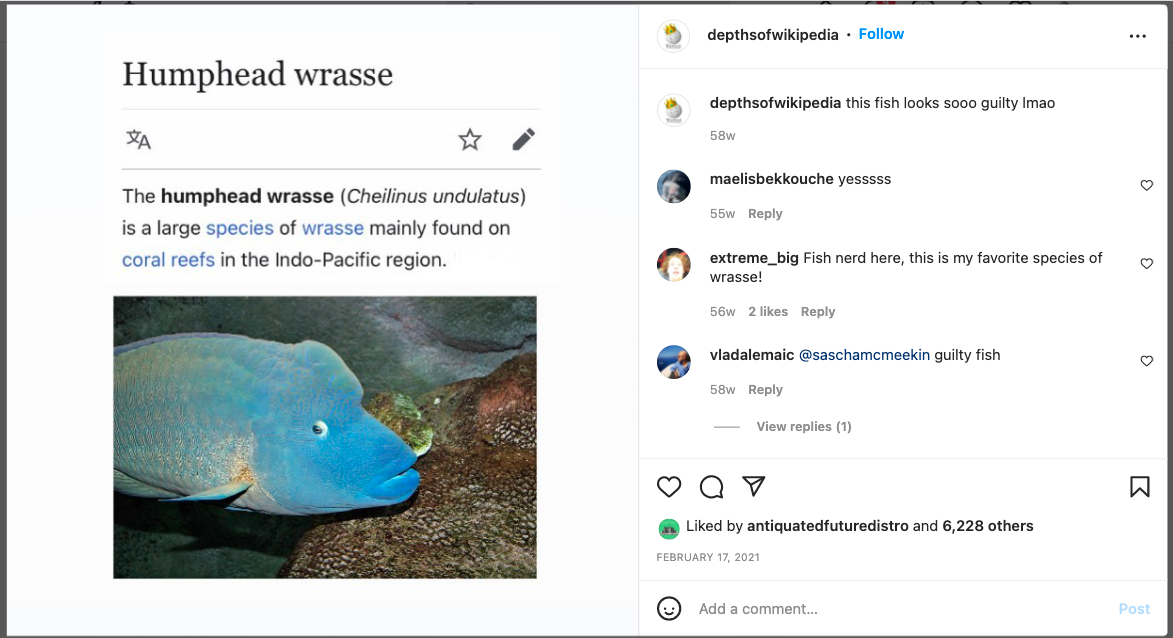
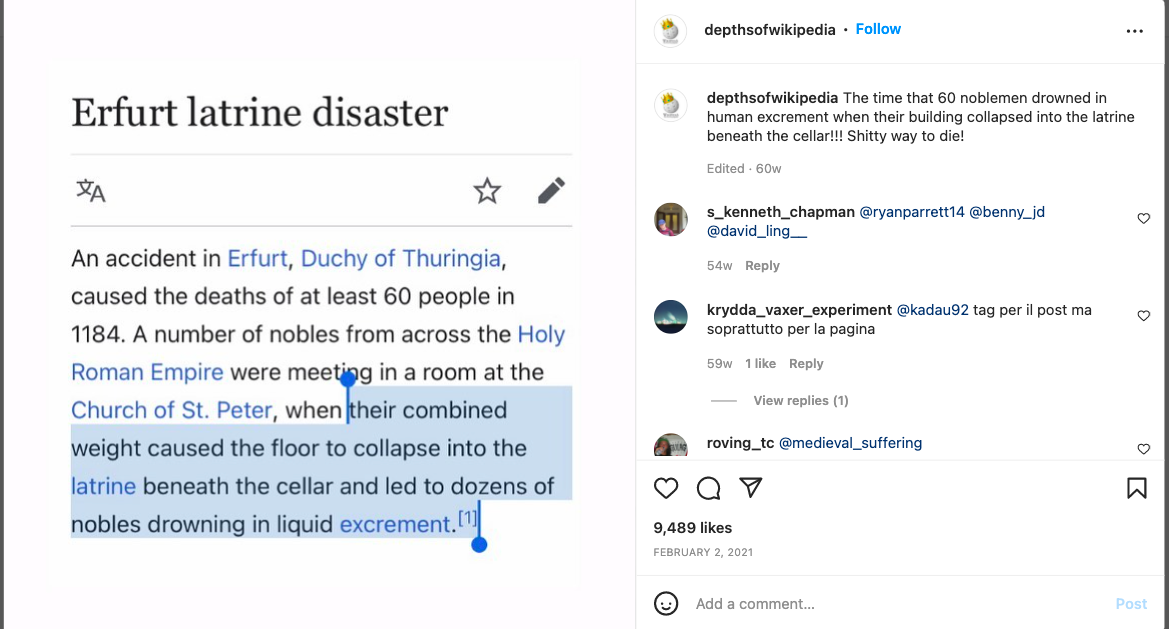
Her followers don’t seem to care whether a post contains an image or not, though the neuroscience major finds that emotional, short or animal-related posts generate the most excitement. “I used to post more things that were conceptual,” she told Lithium Magazine, “like mind-blowing physics concepts, but those didn’t lend themselves to Instagram as well since they require a few minutes of thinking and reading.”
The bulk of what she posts come to her as reader submissions, though in a pinch, she can always turn to the “holy grail” — Wikipedia’s own list of unusual articles.
In addition to Instagram, her discoveries find their way into an infrequently published newsletter, and onto TikTok and Twitter, where some of our recent faves include the definition of humster, a list of games that Buddha would not play, and the Paul O’Sullivan Band, “an internationally based, pop-rock band consisting of four members, all of whom are named Paul O’Sullivan.”
Along the way, she has found ways to give back, co-hosting a virtual edit-a-thon and bringing some genuine glamour to a livestreamed Wikipedia trivia contest.
And she recently authored a serious article for Slate about Russians scrambling to download a 29-gigabyte file containing Russian-language Wikipedia after the Federal Service for Supervision of Communications, Information Technology and Mass Media (Roskomnadzor) threatened to block it over content related to the invasion of Ukraine.
(You can read more about how that’s going on Wikipedia…)
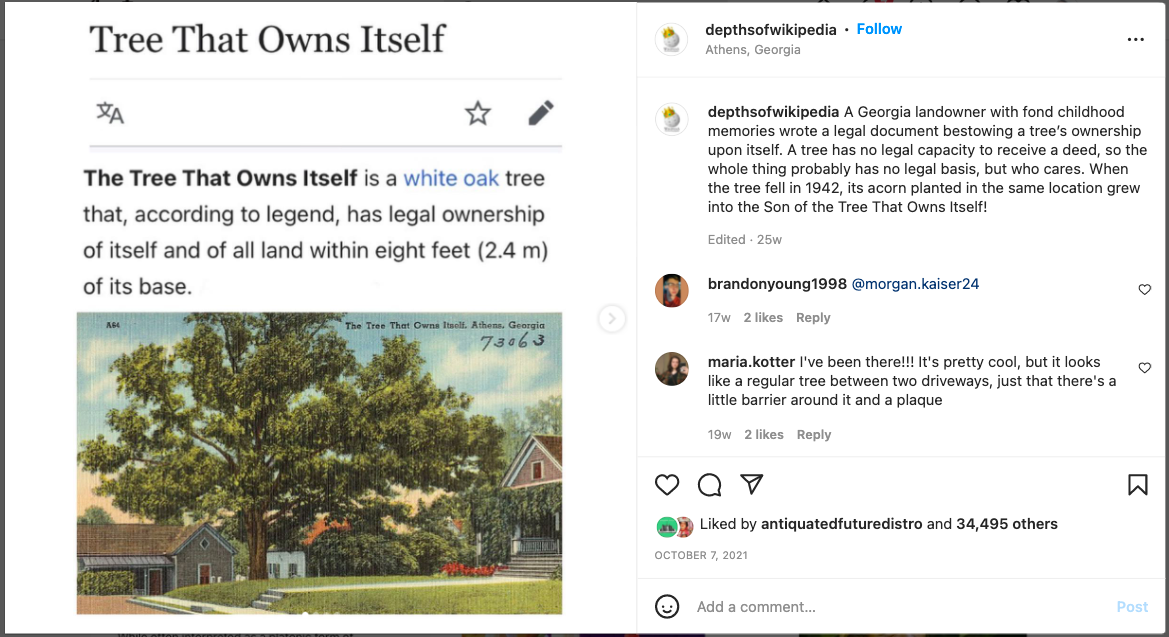
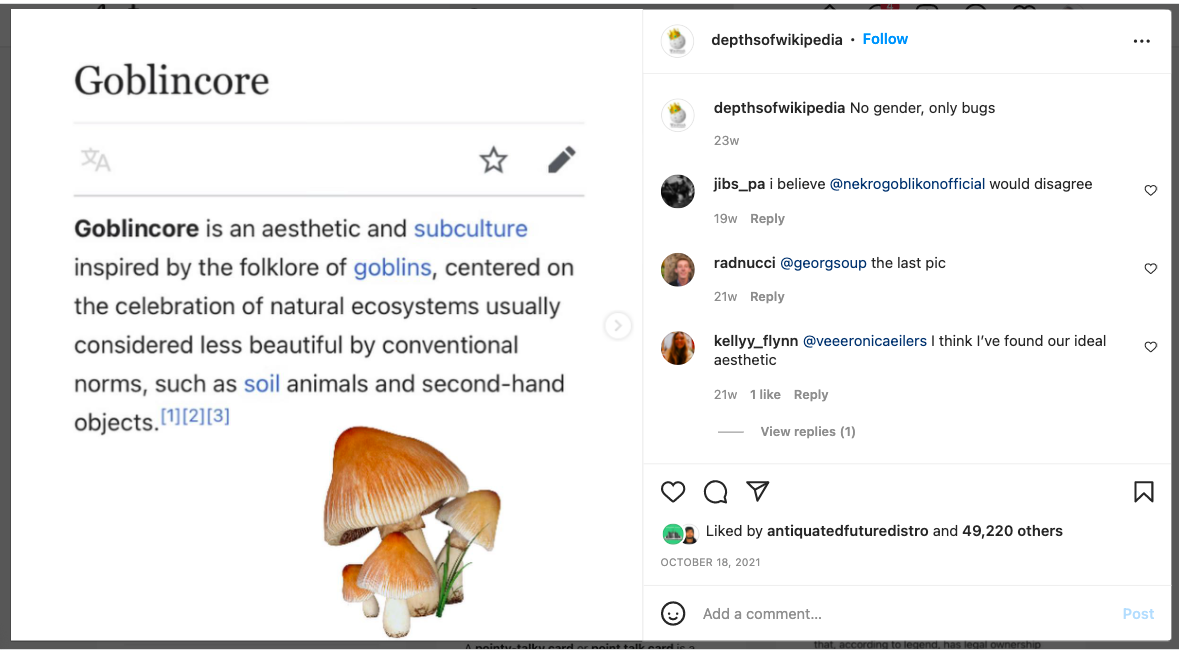
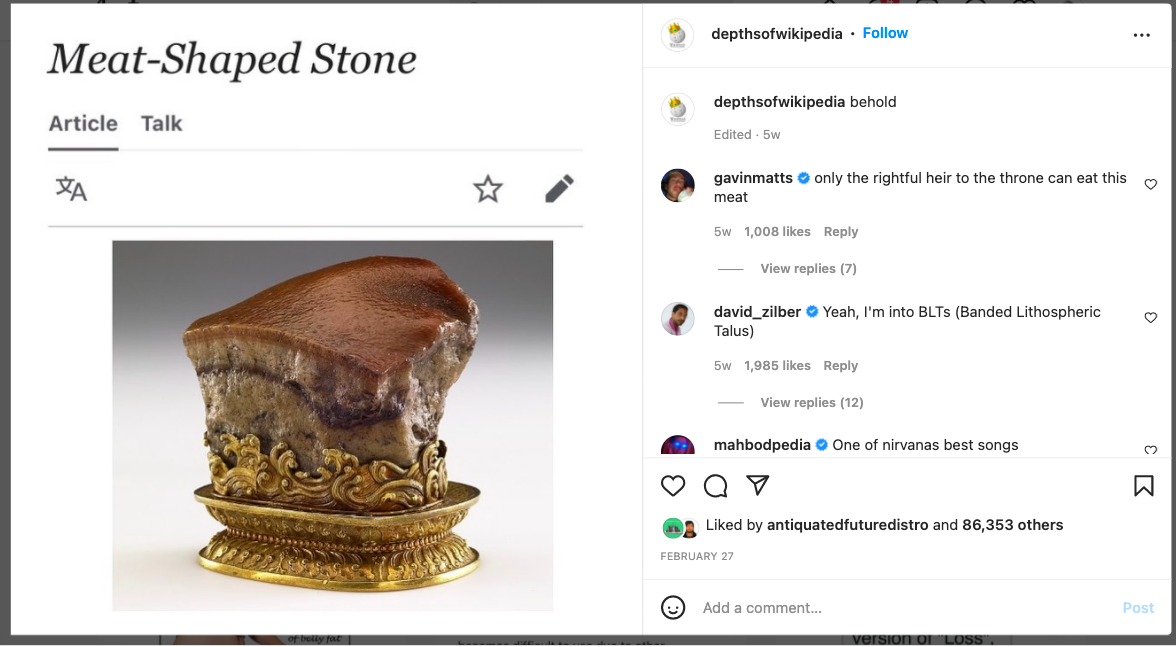
Submit a link to Wikipedia page for possible inclusion on the Depths of Wikipedia here.
Follow Annie Rauwinda’s Depths of Wikipedia on Instagram and TikTok.
Related Content
Listen to Wikipedia: A Web Site That Turns Every Wikipedia Edit Into Ambient Music in Real Time
- Ayun Halliday is the Chief Primatologist of the East Village Inky zine and author, most recently, of Creative, Not Famous: The Small Potato Manifesto. Follow her @AyunHalliday.
Read More...A Survival Guide to the Biblical Apocalypse
The Book of Revelation is a strong competitor for weirdest text in all of ancient literature. Or, at least, it is “the strangest and most disturbing book in the whole Bible,” says the narrator of the video above from a channel called hochelaga, which features “obscure topics that deserve more attention.” Most of these are supernatural or religious in nature. But if you’re looking for a religious or theological interpretation of St. John of Patmos’ bizarre prophetic vision, look elsewhere. The examination above proceeds “from a secular, non-religious perspective.”
Instead, we’re promised a survival guide in the unlikely (but who knows, right) event that the prophecy comes true. But what, exactly, would that look like? Revelation is “highly symbolic” and very “non-literal.” The meanings of its symbols are rather inscrutable and have seemed to shift and change each century, depending on how its interpreters wanted to use it to forward agendas of their own.
This has, of course, been no less true in the 20th and 21st centuries. If you grew up in the 1970s and 80s, for example, you were bound to have come across the works of Hal Lindsay – author of The Late Great Planet Earth (turned into a 1977 film narrated by Orson Welles). And if you lived through the 1990s, you surely heard of his entertaining successors: the bloody-minded Left Behind series by Tim LaHaye and Jerry Jenkins.
The Apocalypse has been big business in publishing and other media for 50 plus years now. Revelation itself is an incredibly obscure book, but the use of its language and imagery for profit and proselyting “made the Apocalypse a popular concern,” as Erin A. Smith writes for Humanities. Lindsay’s book sold both as religious fact and science fiction, a genre later evangelical writers like LaHaye and Jenkins exploited on purpose. The influence has always gone both ways. “A kind of secular apocalyptic sensibility pervades much contemporary writing about our current world,” Paul Boyer, Professor of History at the University of Wisconsin, Madison, tells PBS.
Whether it’s a discussion of climate catastrophe, viral pandemic, economic collapse, the rise of artificial intelligence, or civil strife and international warfare, the apocalyptic metaphors stack up in our imaginations, often without us even noticing. Get to know one of their primary sources in the video introduction to Revelation just above.
Related Content:
Christianity Through Its Scriptures: A Free Course from Harvard University
Free Online Religion Courses
Josh Jones is a writer and musician based in Durham, NC. Follow him at @jdmagness
Read More...Watch Brian Cox of “Succession” Read Hunter S. Thompson’s Profanity-Laden Letter
Brian Cox has maneuvered over four decades of acting while remaining a bit anonymous from one role to the next. Or at least that was the case until his star turn as Logan Roy, the stentorian patriarch at the center of HBO’s Succession. Now it is hard to separate Cox from his character. His way of delivering the delicious insults of the show’s scripts are both frightening and hilarious–as is his way of punctuating a scene with two simple words: “Fuc& Off.”
Look, we try to keep swearing to a minimum on this site, but Cox does wonders with that phrase. Just watch one of the many supercuts of Logan Roy saying it, and hear a master at work.
So the clip above, from a UK event series called Letters Live, shows why Cox is a perfect fit to read Hunter S. Thompson’s letter to a certain Dave Allen, director of programming at the writer’s local network affiliate, KREX-TV. Allen had taken the CBS news off the local station, and Thompson was having none of it.
Thompson wrote many blistering, profanity-laden letters from his Colorado home. The above was collected in Hunter S. Thompson, Fear and Loathing in America: The Brutal Odyssey of an Outlaw Journalist (Gonzo Letters, Volume II, 1968–1976). Allen joins a list of recipients of Thompson’s venom that includes his editor at Random House, Loren Jenkins of Newsweek, Paul Gorman of WBAI-FM, and many others, most of whom owed him money for this or that writing assignment.
Letters Live keeps its epistles short, and Brian Cox acts out Thompson’s short note, pouring contempt through every turn of phrase.
The project’s YouTube channel offers many other letters from history, read by actors like Olivia Coleman, Benedict Cumberbatch, Stephen Fry, Matt Berry, Carey Mulligan, Gillian Anderson, Ian McKellen, and many more. It’s worth checking out, especially if historical swearing is your thing.
Related Content:
Hunter S. Thompson Writes a Blistering, Over-the-Top Letter to Anthony Burgess (1973)
Hunter S. Thompson Calls Tech Support, Unleashes a Tirade Full of Fear and Loathing (NSFW)
Shakespearean Actor Brian Cox Teaches Hamlet’s Soliloquy to a 2‑Year-Old Child
The History of Ancient Greece in 18 Minutes: A Brisk Primer Narrated by Brian Cox
Ted Mills is a freelance writer on the arts who currently hosts the Notes from the Shed podcast and is the producer of KCRW’s Curious Coast. You can also follow him on Twitter at @tedmills, and/or watch his films here.
Read More...Can We Still Consume the Work of Disgraced Artists — Pretty Much Pop: A Culture Podcast #119
Comedian Genevieve Joy, philosopher/NY Times entertainment writer Lawrence Ware, and novelist Sarahlyn Bruck join your host Mark Linsenmayer to discuss how we as spectators deal with entertainers like R. Kelly, Michael Jackson, Woody Allen, et al. We all watched W. Kamau Bell’s Showtime documentary We Need to Talk About Cosby, so most of our discussion is around that.
None of us seem able to separate the art from the artist, but this varies by art form, how much of the person’s personality and values went into the art, and the specifics of the alleged crimes or bad behavior. Cosby presents such a dramatic, unambiguous case because he was so universally beloved, and vitally important to the black community, yet his crimes were so numerous, heinous, well documented, and thoroughly undermine the image that he sought to convey. Does our disillusionment with him perhaps reflect not just on rape culture but the importance we put on celebrity itself that made Cosby for a long time “too big to fail”?
It’s fine if you haven’t seen the documentary. You can experience Bell talking about it on WTF and in Slate. For in-depth info on the charges against Bill Cosby, try the Chasing Cosby podcast.
Follow us @CAtFightJOy, @law_writes, @sarahlynbruck, and @MarkLinsenmayer.
This episode includes bonus discussion featuring all of our guests that you can access by supporting the podcast at patreon.com/prettymuchpop or by choosing a paid subscription through Apple Podcasts. This podcast is part of the Partially Examined Life podcast network.
Pretty Much Pop: A Culture Podcast is the first podcast curated by Open Culture. Browse all Pretty Much Pop posts.
Read More...How To Build a 13th-Century Castle, Using Only Authentic Medieval Tools & Techniques
It’s the rare Englishman who will readily defer to a Frenchman — except, of course, in the field of castle-building. This was true after the Norman Conquest of 1066, which introduced French castles to Britain, and it remains so today, especially under the demands of period accuracy. In order to learn first-hand just what materials and technical skills went into those mightiest structures of the Middle Ages, the BBC Two series Secrets of the Castle had to go all the way to Burgundy. There Château de Guédelon has been under construction for the past 25 years, with its builders adhering as closely as possible to the way they would have done the job back in the thirteenth century, the “golden age of castle-building.”
Hosted by historian Ruth Goodman along with archaeologists Peter Ginn and Tom Pinfold, Secrets of the Castle comprises five episodes that cover a variety of aspects of the medieval castle: its tools, its defense, its architecture, its stonemasonry, and its connections to the rest of the world.
The work of “experimental archaeology” that is Guédelon demands mastery of nearly millennia-old building methods, the simple ingeniousness of some of which remains impressive today. So, in our increasingly disembodied age, does their sheer physicality of it all: apart from the horses carting stone in from the quarry (itself a strong determinant in the siting of a castle), everything was accomplished with sheer human muscle.
Much of that manpower was leveraged with machines, often elaborate and sometimes amusing: take, for example, the pair of human-sized hamster wheels in which Gill and Pinfold run in order to operate a crane. Such a hard day’s work can only be fueled by a hearty meal, and so Goodman learns how to cook a simple vegetable stew. Same with how to clean and indeed craft the cooking pots needed to do so. For a castle wasn’t just a fortified symbol of a kingdom’s strength, but a place where all manner of life went on, as well as a stone embodiment of human knowledge in the Middle Ages. Secrets of the Castle originally aired in 2014, and since then a great deal more period-accurate work has gone into Guédelon. Scheduled for completion next year, the castle will presumably — as long as the skills of its builders prove equal to those of their forebears — still be standing in the 29th century.
Related content:
A Virtual Time-Lapse Recreation of the Building of Notre Dame (1160)
What Did People Eat in Medieval Times? A Video Series and New Cookbook Explain
Based in Seoul, Colin Marshall writes and broadcasts on cities, language, and culture. His projects include the Substack newsletter Books on Cities, the book The Stateless City: a Walk through 21st-Century Los Angeles and the video series The City in Cinema. Follow him on Twitter at @colinmarshall or on Facebook.
Read More...Exploring the Greatest of Italy’s 6,000 Ghost Towns: Take a Tour of Craco, Italy
When Americans think of ghost towns, we think tumbleweeds and crumbling Old West saloons. These abandoned settlements are mere babies compared to Italy’s ancient necropolises. We know, of course, the famous dead cities and towns of antiquity – Pompeii, the ruins of Rome, etcetera. Such famous sites are only the most obvious haunted ruins on any itinerary through the venerable boot-shaped country. Can they be considered ghost towns? The first fell prey to a natural disaster that encased its residents in ash before they had the time to leave; the second thrives as the eighth-most populous city in Europe. It may be full of ghosts, but it’s hard to catch them in the throngs, traffic, and noise.
That said, there are no shortage of towns that fit the bill. Italy contains “more than 6,000 abandoned villages,” the video above explains, and “according to conservative estimates, another 15,000 have lost more than 95 percent of their residents.” That’s an awful lot of abandonment. In the video tour above, we get to explore the “Capital of all Ghost Towns,” Craco, a towering village on the high cliffs of a region known as Basilicata in Southern Italy, nestled in the instep of the boot. Founded in the 8th century AD by Greek settlers, the village survived Black Plague, “bands of marauding thieves,” writes Atlas Obscura, and the usual political instability and internecine conflict of Italian towns, duchies, city states, etc. before the country’s 19th century unification. In the end, “a landslide finally forced residents from Craco in 1991.”
The very location that kept the town safe for centuries from those who would sack it also exposed it to the elements. “Once a monastic center, a feudal town and center of education with a university, castle, church, and plazas,” Ancient Origins writes, Craco has now become a destination for adventurers and a set for several films, “including Saving Grace, James Bond’s Quantum of Solace and the hanging of Judas scene in Mel Gibson’s The Passion of the Christ.” Charming, no? While such towns are hardly found in the usual history text or guidebook, ancient Italian ghost towns and abandoned castles have inspired actual ghost stories for hundreds of years and are the very origin of the gothic as a literary genre, via Horace Walpole’s haunted castle novel, The Castle of Otranto.
Walpole might just as well have written about the castle of Craco, which you can explore above with Marco, Till, Tobi, and Sam, hosts and producers of Abandoned Italy, a web series devoted to exactly that. In several seasons online, they travel to other ghostly towns, villages, and islands, asking questions like, “what if humans go extinct?” Answering that one is a bit like pondering the tree-falling-in-the-forest question. If no one’s there to see it.… ?
Related Content:
A Data Visualization of Every Italian City & Town Founded in the BC Era
The Changing Landscape of Ancient Rome: A Free Online Course from Sapienza University of Rome
Josh Jones is a writer and musician based in Durham, NC. Follow him at @jdmagness
Read More...Support Us
We're hoping to rely on loyal readers, rather than erratic ads. Please click the Donate button and support Open Culture. You can use Paypal, Venmo, Patreon, even Crypto! We thank you!

About Us

Open Culture scours the web for the best educational media. We find the free courses and audio books you need, the language lessons & educational videos you want, and plenty of enlightenment in between.
Advertise With Us
FREE UPDATES!
GET OUR DAILY EMAIL
Get the best cultural and educational resources on the web curated for you in a daily email. We never spam. Unsubscribe at any time.
FOLLOW ON SOCIAL MEDIA
Open Culture editor Dan Colman scours the web for the best educational media. He finds the free courses and audio books you need, the language lessons & movies you want, and plenty of enlightenment in between.
Advertise With Us


