How To Build a 13th-Century Castle, Using Only Authentic Medieval Tools & Techniques
It’s the rare Englishman who will readily defer to a Frenchman — except, of course, in the field of castle-building. This was true after the Norman Conquest of 1066, which introduced French castles to Britain, and it remains so today, especially under the demands of period accuracy. In order to learn first-hand just what materials and technical skills went into those mightiest structures of the Middle Ages, the BBC Two series Secrets of the Castle had to go all the way to Burgundy. There Château de Guédelon has been under construction for the past 25 years, with its builders adhering as closely as possible to the way they would have done the job back in the thirteenth century, the “golden age of castle-building.”
Hosted by historian Ruth Goodman along with archaeologists Peter Ginn and Tom Pinfold, Secrets of the Castle comprises five episodes that cover a variety of aspects of the medieval castle: its tools, its defense, its architecture, its stonemasonry, and its connections to the rest of the world.
The work of “experimental archaeology” that is Guédelon demands mastery of nearly millennia-old building methods, the simple ingeniousness of some of which remains impressive today. So, in our increasingly disembodied age, does their sheer physicality of it all: apart from the horses carting stone in from the quarry (itself a strong determinant in the siting of a castle), everything was accomplished with sheer human muscle.
Much of that manpower was leveraged with machines, often elaborate and sometimes amusing: take, for example, the pair of human-sized hamster wheels in which Gill and Pinfold run in order to operate a crane. Such a hard day’s work can only be fueled by a hearty meal, and so Goodman learns how to cook a simple vegetable stew. Same with how to clean and indeed craft the cooking pots needed to do so. For a castle wasn’t just a fortified symbol of a kingdom’s strength, but a place where all manner of life went on, as well as a stone embodiment of human knowledge in the Middle Ages. Secrets of the Castle originally aired in 2014, and since then a great deal more period-accurate work has gone into Guédelon. Scheduled for completion next year, the castle will presumably — as long as the skills of its builders prove equal to those of their forebears — still be standing in the 29th century.
Related content:
A Virtual Time-Lapse Recreation of the Building of Notre Dame (1160)
What Did People Eat in Medieval Times? A Video Series and New Cookbook Explain
Based in Seoul, Colin Marshall writes and broadcasts on cities, language, and culture. His projects include the Substack newsletter Books on Cities, the book The Stateless City: a Walk through 21st-Century Los Angeles and the video series The City in Cinema. Follow him on Twitter at @colinmarshall or on Facebook.
Read More...Exploring the Greatest of Italy’s 6,000 Ghost Towns: Take a Tour of Craco, Italy
When Americans think of ghost towns, we think tumbleweeds and crumbling Old West saloons. These abandoned settlements are mere babies compared to Italy’s ancient necropolises. We know, of course, the famous dead cities and towns of antiquity – Pompeii, the ruins of Rome, etcetera. Such famous sites are only the most obvious haunted ruins on any itinerary through the venerable boot-shaped country. Can they be considered ghost towns? The first fell prey to a natural disaster that encased its residents in ash before they had the time to leave; the second thrives as the eighth-most populous city in Europe. It may be full of ghosts, but it’s hard to catch them in the throngs, traffic, and noise.
That said, there are no shortage of towns that fit the bill. Italy contains “more than 6,000 abandoned villages,” the video above explains, and “according to conservative estimates, another 15,000 have lost more than 95 percent of their residents.” That’s an awful lot of abandonment. In the video tour above, we get to explore the “Capital of all Ghost Towns,” Craco, a towering village on the high cliffs of a region known as Basilicata in Southern Italy, nestled in the instep of the boot. Founded in the 8th century AD by Greek settlers, the village survived Black Plague, “bands of marauding thieves,” writes Atlas Obscura, and the usual political instability and internecine conflict of Italian towns, duchies, city states, etc. before the country’s 19th century unification. In the end, “a landslide finally forced residents from Craco in 1991.”
The very location that kept the town safe for centuries from those who would sack it also exposed it to the elements. “Once a monastic center, a feudal town and center of education with a university, castle, church, and plazas,” Ancient Origins writes, Craco has now become a destination for adventurers and a set for several films, “including Saving Grace, James Bond’s Quantum of Solace and the hanging of Judas scene in Mel Gibson’s The Passion of the Christ.” Charming, no? While such towns are hardly found in the usual history text or guidebook, ancient Italian ghost towns and abandoned castles have inspired actual ghost stories for hundreds of years and are the very origin of the gothic as a literary genre, via Horace Walpole’s haunted castle novel, The Castle of Otranto.
Walpole might just as well have written about the castle of Craco, which you can explore above with Marco, Till, Tobi, and Sam, hosts and producers of Abandoned Italy, a web series devoted to exactly that. In several seasons online, they travel to other ghostly towns, villages, and islands, asking questions like, “what if humans go extinct?” Answering that one is a bit like pondering the tree-falling-in-the-forest question. If no one’s there to see it.… ?
Related Content:
A Data Visualization of Every Italian City & Town Founded in the BC Era
The Changing Landscape of Ancient Rome: A Free Online Course from Sapienza University of Rome
Josh Jones is a writer and musician based in Durham, NC. Follow him at @jdmagness
Read More...How Previous Decades Predicted the Future: The 21st Century as Imagined in the 1900s, 1950s, 1980s, and Other Eras
All of us alive today perceive recent history as a series of decades. There exists, as far as we know, no quality of reality dictating that everything must recognizably change every ten years. But throughout the 21st century, it seems to have been thus: even if we weren’t alive at the time, we can tell at a glance the cultural artifacts of the nineteen-thirties from the nineteen-forties, for example, or those of the nineteen-eighties from the nineteen-nineties. Each decade has its own distinct fashions, which arose from its distinct worldview; that worldview arose from a vision of the future; and that vision of the future arose from changes in technology.
Back in the nineteen-tens, says history Youtuber Hochelaga in the video above, “the invention of the first airplane opened massive potential in transportation, and sparked the imagination of the public.” The development of aviation encouraged predictions that one day “the world would go airborne; people would take to the skies in their very own personal airships and gliders.” Popular artists dreamed of a kind of “steampunk genre: a future vision and aesthetic, but stuck in victorian technologies like steam power and industrial machinery, as well as goggles and top hats.” By the twenties, this optimistic vision would be displaced by darker but more stylish ones, such as the Art-Deco dystopia of Fritz Lang’s Metropolis.
It was the nineteen-fifties, specifically the triumphant and abundant American nineteen-fifties, that introduced the idea that “the future will be one of convenience and luxury.” As the Space Race progressed, this notional world of picture-phones and flying cars evolved into the one of interstellar freeways, robot maids, and Googie architecture exemplified by The Jetsons. But as far as personal technology was concerned, the real world had seen nothing yet. The rapid popularization of the personal computer in the eighties brought with it a vast expansion of ideas of what computers could do. According to the Terminator films, we were supposed to have an artificially intelligent defense network that attained self-awareness by 1997 — though our having blown past the deadline is probably for the best.
Here in the twenty-first century — an impossibly distant future in most of the decades discussed here — very few elements of these futures have been fully realized. For that matter, few of the technologies we actually do use in our everyday lives were accurately predicted in the twentieth century. (Imagine how social media would have looked on a color postcard from 1915.) “Each present moment imagines a future with themselves clearly in it, taking advantage of the newest technology of the day to its furthest limits,” says Hochelaga. In other words, each of these decades regards the future as an extreme version of itself. In this view, how many of us today think of the future as dull, grim, and even nonexistent tells us nothing about what will actually happen in decades ahead. It does, however, tell us a great deal about the twenty-twenties.
Related content:
How French Artists in 1899 Envisioned Life in the Year 2000: Drawing the Future
In 1900, Ladies’ Home Journal Publishes 28 Predictions for the Year 2000
1930s Fashion Designers Predict How People Would Dress in the Year 2000
Arthur C. Clarke Predicts the Future in 1964 … and Kind of Nails It
Walter Cronkite Imagines the Home of the 21st Century … Back in 1967
Based in Seoul, Colin Marshall writes and broadcasts on cities, language, and culture. His projects include the Substack newsletter Books on Cities, the book The Stateless City: a Walk through 21st-Century Los Angeles and the video series The City in Cinema. Follow him on Twitter at @colinmarshall or on Facebook.
Read More...When Stalin Starved Ukraine
Since its launch last month, Russia’s invasion of Ukraine has sent observers around the world scrambling for context. It is a fact, for example, that Russia and Ukraine were once “together” in the communist mega-state that was the Union of Soviet Socialist Republics. But it is also a fact that such Soviet togetherness hardly ensured warm feelings between the two lands. An especially relevant chapter of their history is known in Ukraine as the Holodomor, or “death by starvation.” Spanning the years 1932 and 1933, this period of famine resulted in three to six million lives lost — and that according to the lower accepted estimates.
“It was genocide,” says the narrator of the Vox “Missing Chapter’ video above, “carried out by a dictator who wanted to keep Ukraine under his control, and would do everything in his power to cover it up for decades. That dictator was, of course, Joseph Stalin, who accompanied brutal methods of rule with tight control of information. “In 1917, after the fall of the Russian Empire, Ukraine briefly gained freedom,” the video explains. “But by 1922, it was forcibly integrated into the newly formed Soviet Union.” A rural and highly fertile land, Ukraine was known as “the breadbasket of the Soviet Union” — hence Stalin’s desire to nip any potential revolution there in the bud.
First came a “widespread, violent purge of Ukrainian intellectuals along with priests and religious structures.” At the same time as they advanced this attempted dismantling of Ukrainian culture, Soviet higher-ups were also implementing Stalin’s five-year plan of industrialization, consolidation, and collectivization, including that of all agriculture. This was the time of the kulak, or “wealthy peasant,” the label invented to disgrace anyone resistant to this process. Any kulaks known to Stalin faced a terrible fate indeed, including exile, imprisonment, and even execution; those farmers who remained then fell victim to the dictator’s engineered famine.
Under the pretext of enforcing deliberately unrealistic grain-production quotas, Stalin’s enforcers seized farms across Ukraine in order to sell their products to the West. Before long, “Soviet police began seizing not just grain, but anything edible.” Farmers were stopped from leaving their homeland, where Stalin intended them to starve, “but even in this unimaginable suffering, Ukrainians fought for their lives and each other.” This video incorporates interviews with a grandson and granddaughter of two such Ukrainians who left behind personal records of the Holodomor. A story of endurance and survival under the very worst circumstances, and ultimately a return to national independence, it goes some way to explaining how and why Ukraine continues to put up such a valiant fight against the forces that have descended upon it.
Related content:
Putin’s War on Ukraine Explained in 8 Minutes
Why Russia Invaded Ukraine: A Useful Primer
Russian Invasion of Ukraine Teach-Out: A Free Course from the University of Michigan
Joseph Stalin, a Lifelong Editor, Wielded a Big, Blue, Dangerous Pencil
Based in Seoul, Colin Marshall writes and broadcasts on cities, language, and culture. His projects include the Substack newsletter Books on Cities, the book The Stateless City: a Walk through 21st-Century Los Angeles and the video series The City in Cinema. Follow him on Twitter at @colinmarshall or on Facebook.
Read More...A Field Guide to Strange Medieval Monsters
What should you do if you come across a manticore? Would you even know how to identify it? An unlikely occurrence, you say? Perhaps. But if you lived in Europe in the Middle Ages – and you were the type to believe such tales – you might expect to see one someday. Wouldn’t it be useful to have a field guide? You’d want it on paper (or parchment): no one’s carrying smartphones in misty 13th century York or over the rocky highlands of 15th century Lombardy. You could consult a reigning expert of the time, such as Sir John Mandeville, who either saw such things as blemmyae (headless humans with faces in their chests) near Ethiopia, or made them up. But this didn’t matter much. Truth and fiction didn’t have such rigid boundaries. Yet books were rare, and anyway, few people could read. If only there were YouTube.…
“Medieval zoology is bizarre,” says the narrator of the video above — a brief “Field Guide to Bizarre Medieval Monsters” — “because half the creatures don’t even exist, and those that do look very, very strange.” Your average medieval European couldn’t visit zoos full of exotic animals (rare exceptions like the Tower of London Menagerie notwithstanding), nor could they travel the world and see what creatures thrived in other climes.
They were forced to rely on the garbled accounts, or outright lies, of sailors, merchants, and other travelers, and the odd illustrations found in illuminated manuscripts. These blended travelogue, native folk elements, the weird imaginings of alchemy and demonology, and the myths and legends of medieval romance to create “a world where mythology and biology blend together.”
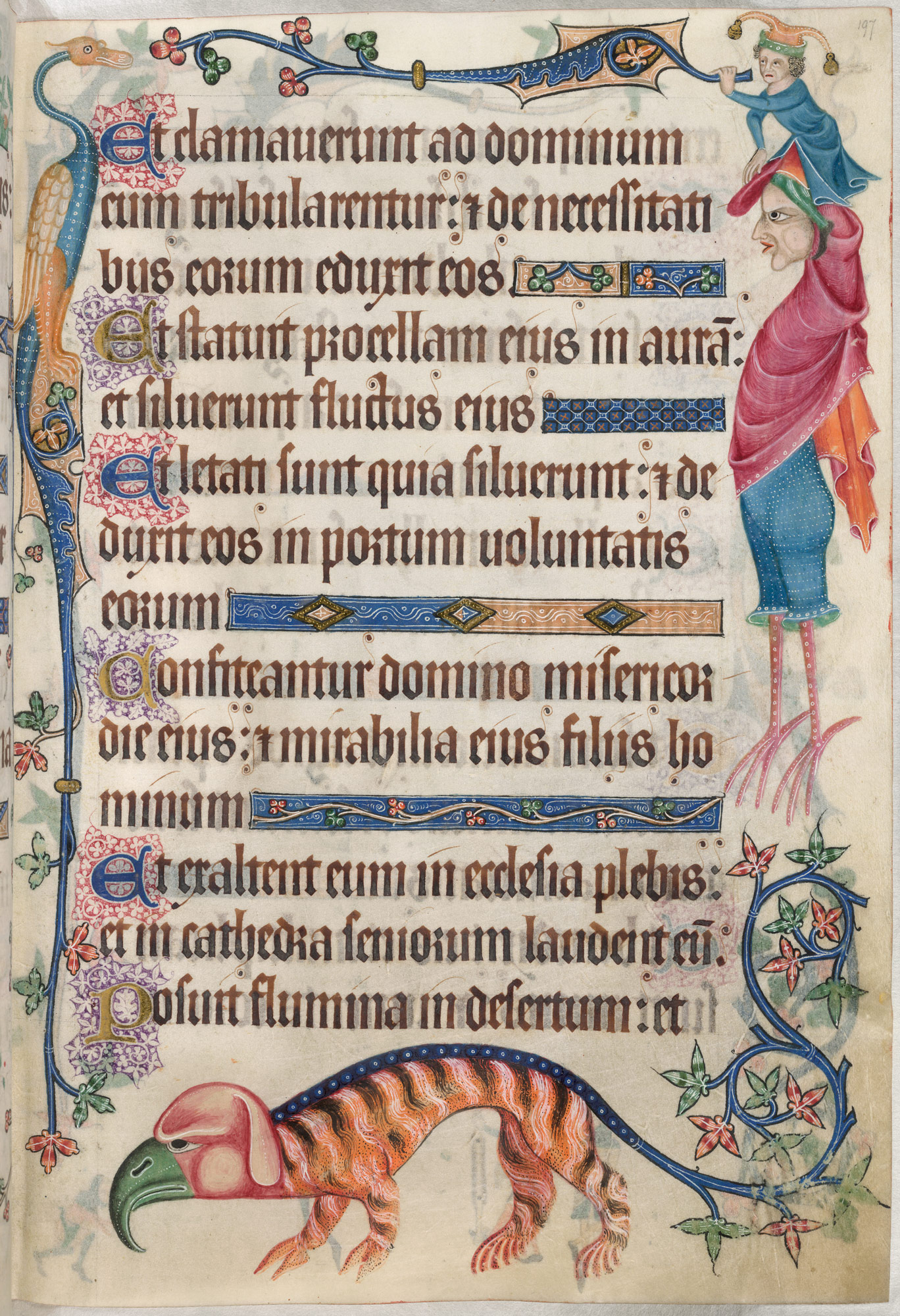
Dragons, unicorns, dog-headed saints.… You’ll find these and many more in the video field guide at the top and others online from the Cleveland Museum of Art and Medievalists.net, which describes our friend the manticore as a creature “having the head of a man, the body of a lion, and the tail of a scorpion.”
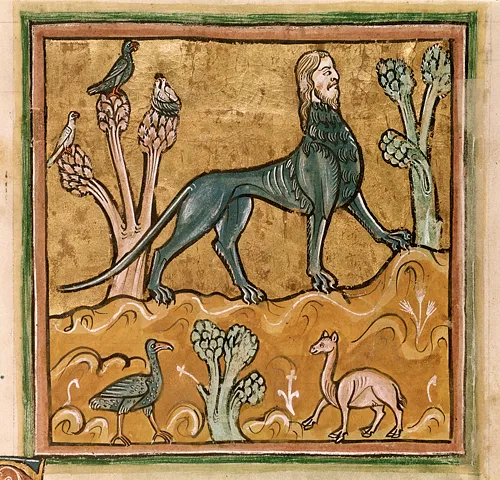
Many ancient and medieval monsters were hybrids of different animals, such as the Tarasque, which our field guide narrator explains lies “somewhere between a dragon and a tortoise.”
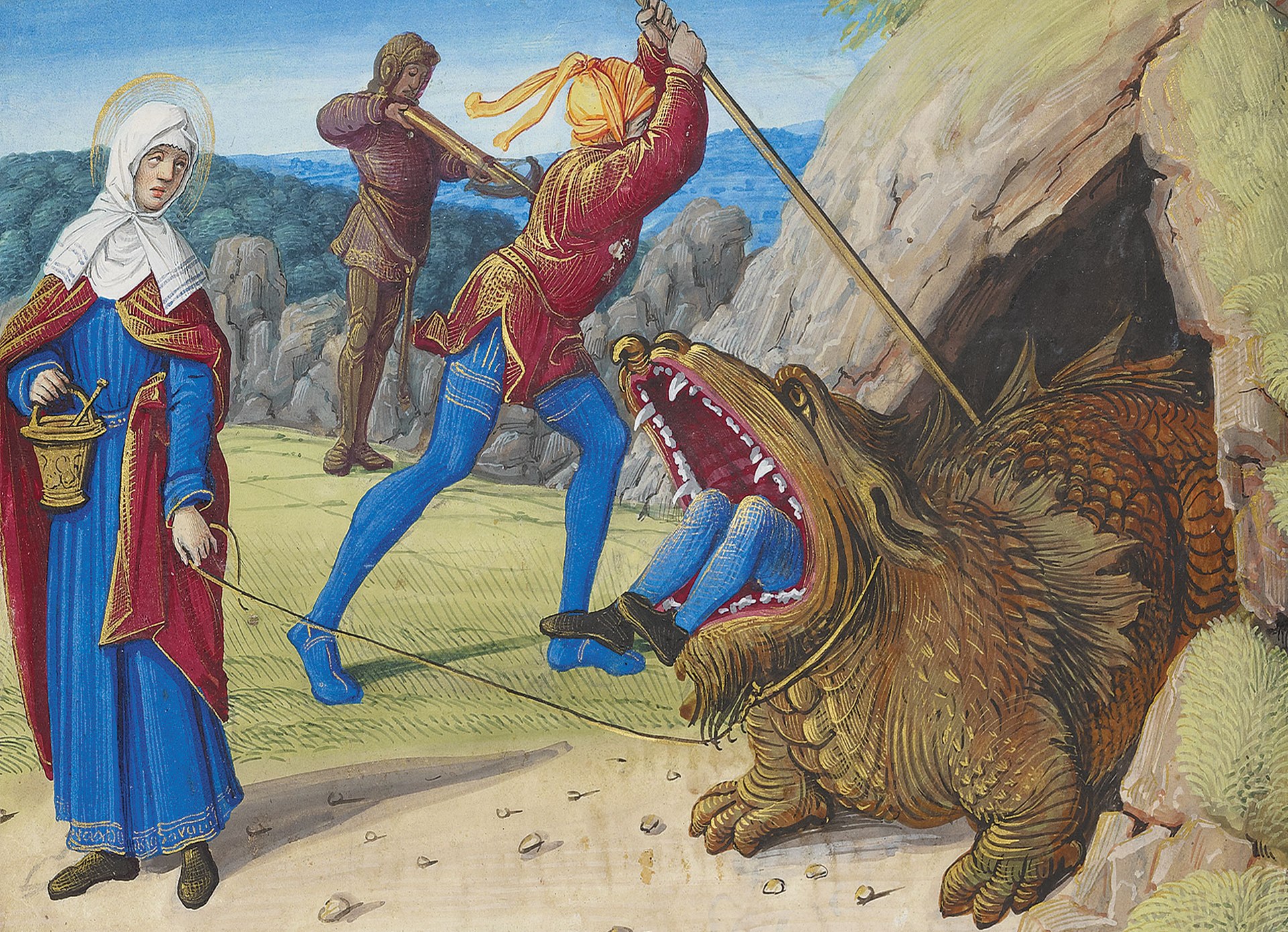
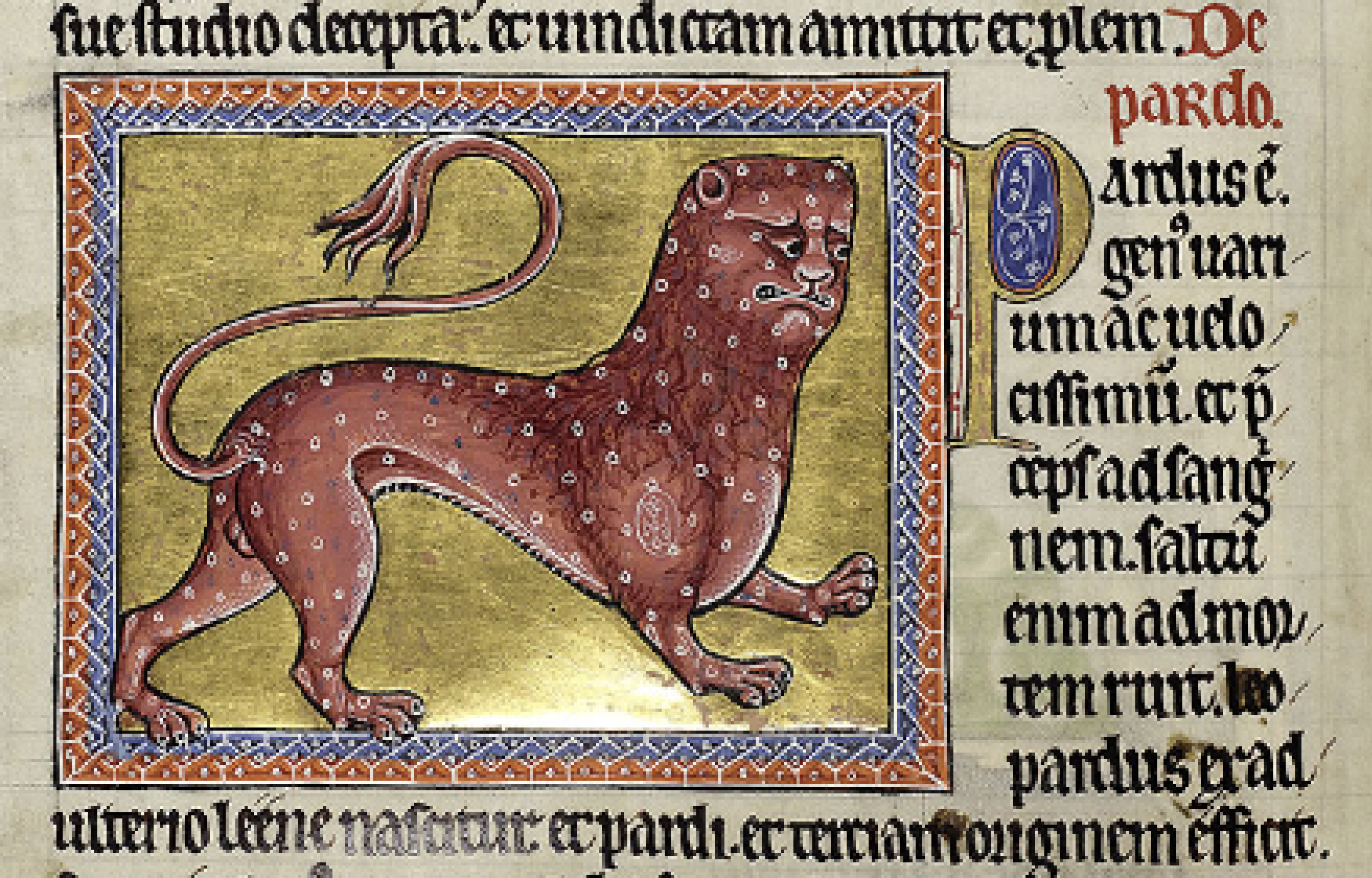
To find out its origins, you’ll have to keep watching. To read the original sources of this bizarre medieval zoology, see the British Library’s Medieval Monster’s collection, which includes aviaries, bestiaries, miscellanies, books of hours, and psalters, like the big page above from the Luttrell Psalter, a striking example of monstrous illustration. While we may never expect to see any of these creatures in the flesh, we can see more of them on the page (or screen) than anyone who lived in medieval Europe.
Related Content:
1,000-Year-Old Illustrated Guide to the Medicinal Use of Plants Now Digitized & Put Online
Wonderfully Weird & Ingenious Medieval Books
Josh Jones is a writer and musician based in Durham, NC. Follow him at @jdmagness
Read More...Watch the Foo Fighters’ Taylor Hawkins (RIP) Give a Drumming Masterclass
If you’re going to back Dave Grohl behind the drums, well…. As so many have said, in so many ways over the weekend, in poignant tributes to Foo Fighters’ drummer Taylor Hawkins, who sadly passed away at age 50 on Friday — you’d better be damned good. As the Foo Fighters formed with Grohl on guitar and vocals, the former Nirvana drummer, now frontman “needed someone who would not make fans keep wishing he had stuck with drums,” as NBC’s Daniel Arkin writes.
Grohl almost did stick with drums, at least in the studio, recording the parts himself for the band’s first album, The Colour and the Shape, after conflicts with original drummer William Goldsmith. Hawkins was the touring drummer for Alanis Morissette at the time — a much bigger act than Foo Fighters in the late 90s. But the two kept bumping into each other “back stage at festivals around the world,” as Grohl wrote in his 2021 autobiography, The Storyteller: Tales of Life and Music. “Our chemistry was so obvious that even Alanis herself once asked him, ‘What are you going to do when Dave asks you to be his drummer?’ Part Beavis and Butthead, part Dumb and Dumber, we were a hyperactive blur of Parliament Lights and air drumming wherever we went.”
Not only did Hawkins become Grohl’s “best friend and partner in crime” — his blond, bearded doppelgänger behind the drums — but he was a ferocious musician on his terms, collaborating with Brian May, Dennis Wilson, Slash, and members of Jane’s Addiction, forming his own band, Taylor Hawkins and the Coattail Riders, and getting voted “Best Rock Drummer” in a 2005 readers poll by drumming magazine Rhythm. The accolade, if highly subjective, is still highly deserved.
Revisit Hawkins’ greatness above in the BBC Radio 6 Drumming Masterclass above, a nearly hour-long special in which the man himself walks us through his early life, his influences, his drumming techniques, and his behind-the-scenes experiences playing with Morissette and Dave “Steve Miller on steroids” Grohl. It’s an essential watch for fans and perhaps one of the best ways to remember the only drummer who could successfully back Nirvana’s former drummer for over two decades. He will be dearly missed for far longer than that.
Related Content:
Dave Grohl Tells the Story of How He Wrote “Everlong”
Josh Jones is a writer and musician based in Durham, NC. Follow him at @jdmagness
Read More...Explore MoMA’s Collection of Modern & Contemporary Art Every Time You Open a New Browser Tab
There are browser extensions designed to increase your productivity every time you open a new tab.
Others use positive affirmations, inspiring quotes, and nature photography to put your day on the right track.
We hereby announce that we’re switching our settings and allegiance to New Tab with MoMA.
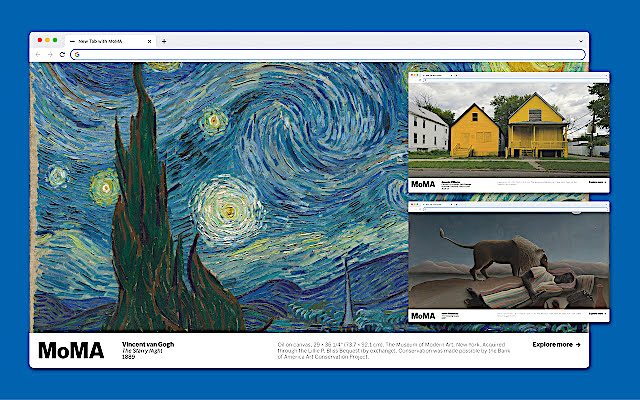
After installing this extension, you’ll be treated to a new work of modern and contemporary art from The Museum of Modern Art’s collection whenever you open a new tab in Chrome.
If you can steal a few minutes, click whatever image comes up to explore the work in greater depth with a curator’s description, links to other works in the collection by the same artist, and in some cases installation views, interviews and/or audio segments.
Expect a few gift shop heavy hitters like Vincent Van Gogh’s The Starry Night, but also lesser known works not currently on view, like Yayoi Kusama’s Violet Obsession, a rowboat slipcovered in electric purple “phallic protrusions.”
Violet Obsession’s New Tab with MoMA link not only shows you how it was displayed in the 2010 exhibition Mind and Matter: Alternative Abstractions, 1940s to Now, you can also toggle around the installation view to explore other works in the same gallery.
You can hear audio of Kusama describing how she “encrusted” the boat in soft sculpture protuberances in her favorite pinkish-purple hue “to conquer my fear of sex:”
Boats can come and go limitlessly and move ahead on the water. The boat, having overcome my obsession would move on forever, carrying me onboard
A link to a 1999 interview with Grady T. Turner in BOMB allows Kusama to give further context for the work, part of a sculpture series she conceives of as Compulsion Furniture:
My sofas, couches, dresses, and rowboats bristle with phalluses. … As an obsessional artist I fear everything I see. At one time, I dreaded everything I was making.
That’s a pretty robust art history lesson for the price of opening a new tab, though such deep dives can definitely come at the expense of productivity.
We weren’t expecting the 3‑dimensional nature of some of the works our tabs yielded up.
Stop, Repair, Prepare: Variations on Ode to Joy for a Prepared Piano, No.12008 by Jennifer Allora and Guillermo Calzadilla required a live musician to play Ode to Joy from Ludwig van Beethoven’s Ninth Symphony upside down and backwards, from a hole carved into the center of a grand piano.
Frances Benjamin Johnston’s platinum print, Stairway of the Treasurer’s Residence: Students at Work from the Hampton Album 1899–1900, is perhaps more easily grasped if you can’t go too far down the rabbit hole with the artwork appearing in your new tab.
An excerpt from the 2019 publication, MoMA Highlights: 375 Works from The Museum of Modern Art, New York provides a brief bio of both Johnston, “a professional photographer, noted for her portraits of Washington politicians and her images of coal miners, ironworkers, and women laborers in New England textile mills” and the Hampton Institute, Booker T Washington’s alma mater.
Bookmark such bite-sized cultural history breaks, and circle back when you have more time.
Speaking of which, allow us to leave you with this thought from artist Felix Gonzalez-Torres, creator of 1991’s time-based installation Untitled (Perfect Lovers), a particularly conceptual offering from New Tab with MoMA:
Time is something that scares me… or used to. This piece I made with the two clocks was the scariest thing I have ever done. I wanted to face it. I wanted those two clocks right in front of me, ticking.
Set your Chrome Browser up to use New Tab with MoMA here.
Related Content
MoMA’s Online Courses Let You Study Modern & Contemporary Art and Earn a Certificate
How to Make Comics: A Four-Part Series from the Museum of Modern Art
The Museum of Modern Art (MoMA) Puts Online 90,000 Works of Modern Art
- Ayun Halliday is the Chief Primatologist of the East Village Inky zine and author, most recently, of Creative, Not Famous: The Small Potato Manifesto. Follow her @AyunHalliday.
Read More...A Vintage Short Film about the Samurai Sword, Narrated by George Takei (1969)
Long before it was a nationalist rallying cry in Japan during WWII, the term Yamato-damashii referred to something less like racial imperialism and more like chivalry — the “Japanese Spirit” or “Old Soul of Japan,” as Greek-Japanese writer Lafcadio Hearn wrote. Perhaps surprisingly, the “Japanese Spirit” was not based in the martial arts of the samurai at first, but in the scholarship of China, as the ancient novel The Tale of Genji explains when defining Yamato-damashii as “a good, solid fund of knowledge… a fund of Chinese learning.” This would change when the code of Bushidō evolved, and the samurai, with his elaborate armor and elegant swords, became a central figure of honor in Japanese society.
In The Japanese Sword as the Soul of the Samurai, the nearly half-hour documentary above by traveling American documentary filmmaker Ken Wolfgang, George Takei narrates the tale of the samurai’s sword. The film begins with the legendary character Yamato Takeru (who one scholar speculates may share a common origin with King Arthur). This ur-samurai inherited the first sword from the tail of a eight-headed dragon that was slain by a god.
The sword, nicknamed “grass-mower,” Takei tells us, is enshrined near Nagoya, “the second of the three sacred symbols of Shinto, the national religion of Japan.” When we turn from myth to history, Takei says, we find that the “earliest known swords are found in the… tombs of the ancient Yamato people, who are believed to have inhabited Japan between the 2nd and 8th centuries AD,” and who are the origin of Yamato-damashii.
“As Japan developed, so did the sword,” becoming ever more refined in the country’s Middle Ages, where the weapon reached its “peak of perfection.… Its quality has never been surpassed to this day.” The sword became a soul — and we, as viewers, are treated to an insider’s view of the methods of its forging. The smithing of swords is no mere craft; it is a “religious ritual” that begins with prayers and offerings — fervent imprecations to the gods that the new sword may approach the perfection of a “grass-mower.” The forge is lit from the alter’s fire, and it can take months, or even years, to make just one sword. Don’t miss the rare opportunity to see the process in just over twenty minutes in this short documentary film.
Related Content:
An Origami Samurai Made from a Single Sheet of Rice Paper, Without Any Cutting
How to Be a Samurai: A 17th Century Code for Life & War
The 17th Century Japanese Samurai Who Sailed to Europe, Met the Pope & Became a Roman Citizen
Josh Jones is a writer and musician based in Durham, NC. Follow him at @jdmagness
Read More...Adapting Agatha Christie for the Screen — Pretty Much Pop: A Culture Podcast #118

In light of the newly released, Kenneth Branagh-directed film Death on the Nile, Pretty Much Pop discusses the continuing appearance of the works of the world’s most successful mystery writer in film and TV.
Your host Mark Linsenmayer is joined by repeat guests Sarahlyn Bruck, Al Baker, and Nicole Pometti to discuss the recent films, the Sarah Phelps TV adaptations (like The ABC Murders), the Poirot BBC TV series, and some older adaptations.
We take on the different characterizations of Poirot and how recent, grittier interpretations compare with those of James Bond and Sherlock Holmes. Also, how should a screenwriter adapt such fact-heavy novels? What works and doesn’t in terms of modernizing them to current audience expectations? How did Christie keep things interesting for herself writing so many mysteries? How deep do her meditations on psychology and ethics run in these books, and can that be adequately conveyed on screen? What’s the future of the mystery genre?
Here are a few relevant sources:
- “What Makes a Good Hercule Poirot? (It’s More Than the Little Gray Cells.)” by Calum Marsh
- “Death on the Nile is a good old-fashioned mess of a movie” by Joshua Rivera
- “10 Agatha Christie Film Adaptations to Watch Ahead of ‘Death on the Nile’ ” by Sara Century
- “The best Agatha Christie movies and TV shows to satiate your murder/mystery cravings” by Karen Rought
Listen to Nicole’s Remakes, Reboots and Revivals podcast. Look into Sarahlyn’s book and other writings. Check out Al’s work fighting disinformation at Logically.
Follow our guests at @remakespodcast (Nicole), @sarahlynbruck, and @ixisnox (Al).
This episode includes bonus discussion featuring all of our guests that you can access by supporting the podcast at patreon.com/prettymuchpop or by choosing a paid subscription through Apple Podcasts. This podcast is part of the Partially Examined Life podcast network.
Pretty Much Pop: A Culture Podcast is the first podcast curated by Open Culture. Browse all Pretty Much Pop posts.
Read More...Patti Smith Talks with Malcolm Gladwell About Her Life as an Artist
Broken Record–the podcast hosted by Rick Rubin, Malcolm Gladwell, and Bruce Headlam–has released its latest episode featuring an in-depth interview with Patti Smith. Here, Gladwell talks with Smith “about her writing in the studio Jimi Hendrix built, Electric Lady,” where “she met Hendrix in 1970—just weeks before he passed away. Patti also talks about hanging out with and writing lyrics for Janis Joplin, and she recalls the fun she had during a failed attempt to cover Adele in concert.” The conversation also naturally covers her time with Robert Mapplethorpe in the Chelsea Hotel (see vintage footage here); her relationship with William Burroughs and Allen Ginsberg; and the challenges she faced writing Just Kids.
Stream the interview above, or find their podcast on Apple, Spotify and Stitcher. Also be sure to check out Patti Smith’s daily musings on Substack.
If you would like to support the mission of Open Culture, consider making a donation to our site. It’s hard to rely 100% on ads, and your contributions will help us continue providing the best free cultural and educational materials to learners everywhere. You can contribute through PayPal, Patreon, and Venmo (@openculture). Thanks!
Related Content
New York’s Famous Chelsea Hotel and Its Creative Residents Revisited in a 1981 Documentary
Patti Smith and David Lynch Talk About the Source of Their Ideas & Creative Inspiration
Patti Smith’s List of Favorite Books: From Rimbaud to Susan Sontag
Patti Smith Sings “People Have the Power” with a Choir of 250 Fellow Singers
Read More...Support Us
We're hoping to rely on loyal readers, rather than erratic ads. Please click the Donate button and support Open Culture. You can use Paypal, Venmo, Patreon, even Crypto! We thank you!

About Us

Open Culture scours the web for the best educational media. We find the free courses and audio books you need, the language lessons & educational videos you want, and plenty of enlightenment in between.
Advertise With Us
FREE UPDATES!
GET OUR DAILY EMAIL
Get the best cultural and educational resources on the web curated for you in a daily email. We never spam. Unsubscribe at any time.
FOLLOW ON SOCIAL MEDIA
Open Culture editor Dan Colman scours the web for the best educational media. He finds the free courses and audio books you need, the language lessons & movies you want, and plenty of enlightenment in between.
Advertise With Us

