Japanese Researcher Sleeps in the Same Location as Her Cat for 24 Consecutive Nights!

Cross cat napping with bed hopping and you might end up having an “adventure in comfort” similar to the one that informs student Yuri Nakahashi’s thesis for Tokyo’s Hosei University.
For 24 consecutive nights, Nakahashi forwent the comforts of her own bed in favor of a green sleeping bag, unfurled in whatever random location one of her five pet cats had chosen as its sleeping spot that evening.
(The choice of which cat would get the pleasure of dictating each night’s sleeping bag coordinates was also randomized.)
As the owner of five cats, Nakahashi presumably knew what she was signing up for…
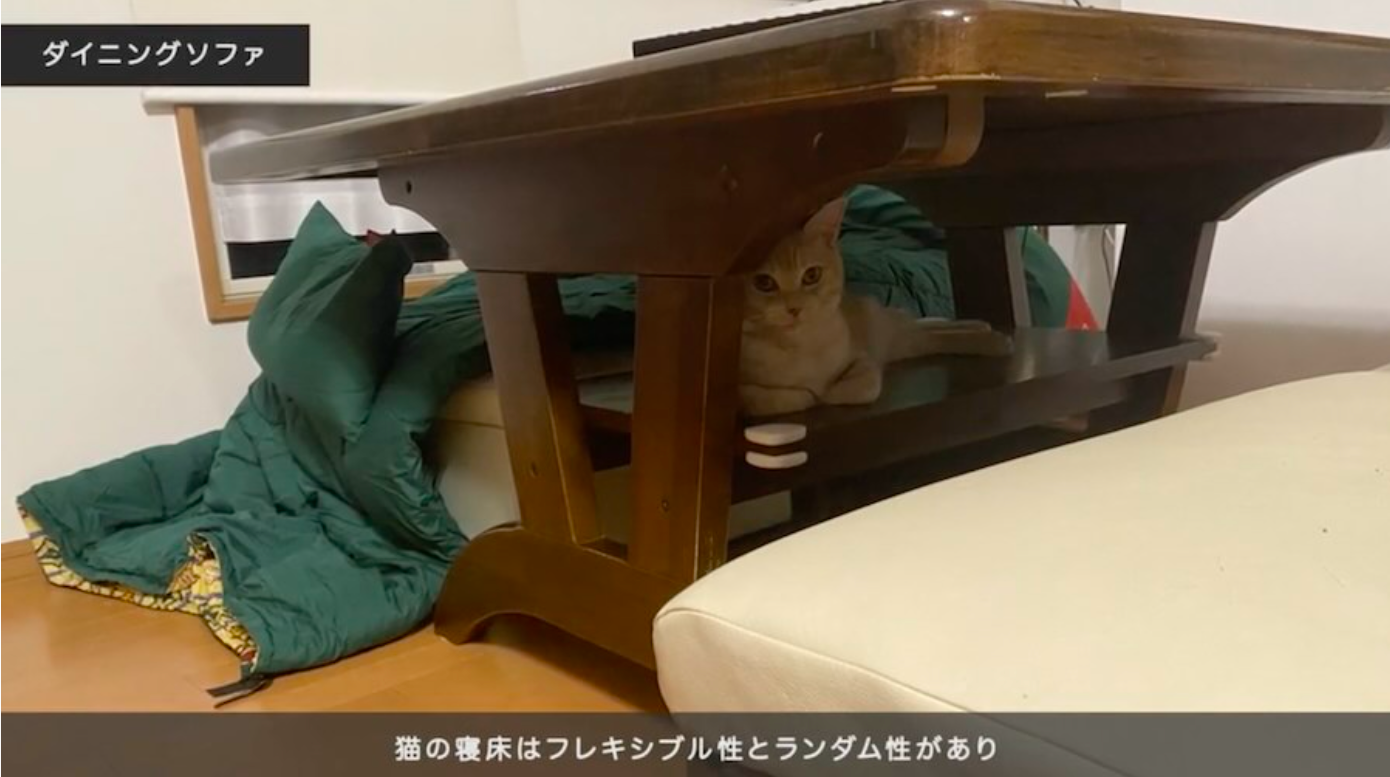

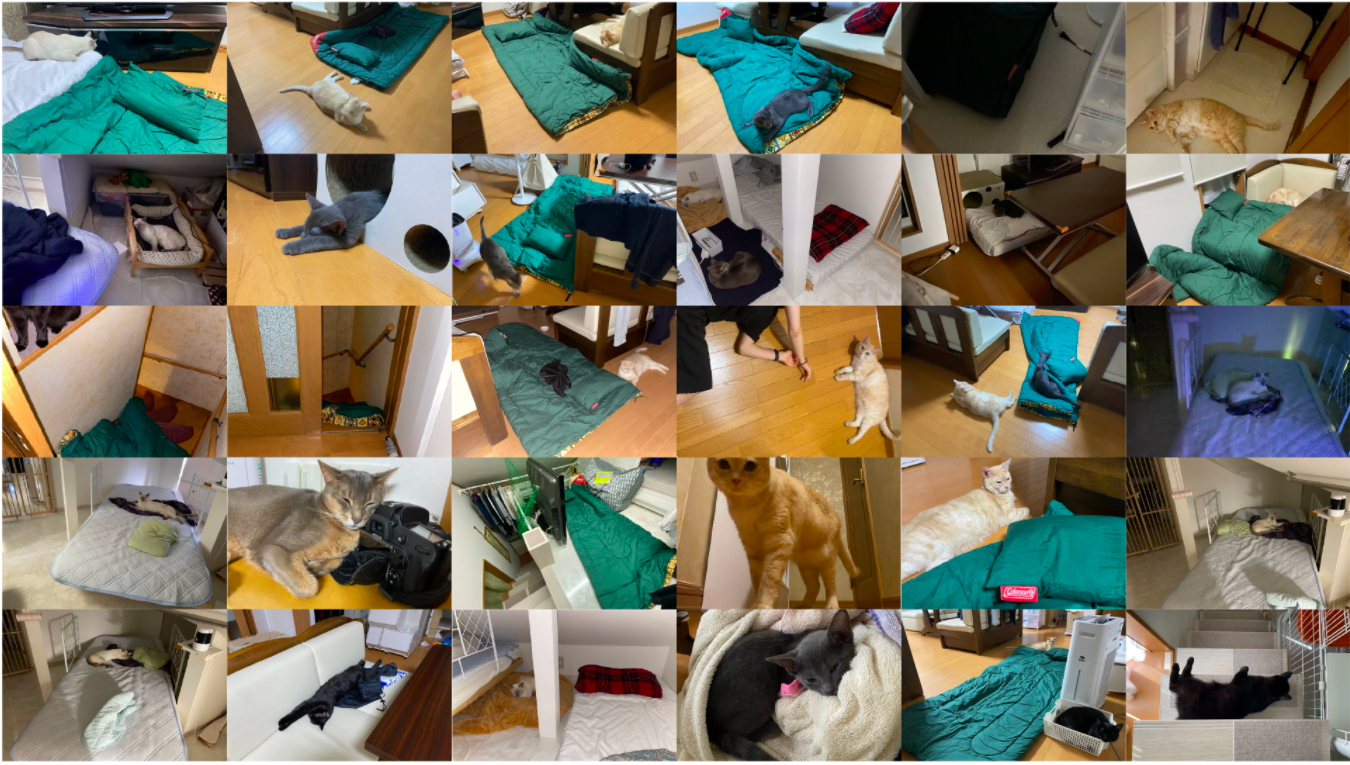
Cats rack out atop sofa backs, on stairs, and under beds…and so did Nakahashi.
Her photos suggest she logged a lot of time on a bare wooden floor.
A FitBit monitored the duration and quality of time spent asleep, as well as the frequency with which she awakened during the night.
She documented the physical and psychological effects of this experiment in an interactive published by the Information Processing Society of Japan.
She reports that she eagerly awaited the revelation of each night’s coordinates, and that even when her sleep was disrupted by her pets’ middle of the night grooming routines, bunking next to them had a “relaxing effect.”
Meanwhile, our research suggests that the same experiment would awaken a vastly different response in a different human subject, one suffering from ailurophobia, say, or severe allergies to the proteins in feline saliva, urine, and dander.
What’s really surprising about Nakahashi’s itinerant, and apparently pleasure-filled undertaking is how little difference there is between her average sleep score during the experiment and her average sleep score from the 20 days preceding it.

At left, an average sleep score of 84.2 for the 20 days leading up to experiment. At right, an average sleep score 83.7 during the experiment.
Nakahashi’s entry for the YouFab Global Creative Awards, a prize for “work that attempts a dialogue that transcends the boundaries of species, space, and time” reflects the playful spirit she brought to her slightly off-kilter experiment:
Is it possible to add diversity to the way we enjoy sleep? Let’s think about food. In addition to the taste and nutrition of the food, each meal is a special experience with diversity depending on the people you are eating with, the atmosphere of the restaurant, the weather, and many other factors. In order to bring this kind of enjoyment to sleep, we propose an “adventure in comfort” in which the cat decides where to sleep each night, away from the fixed bedroom and bed. This project is similar to going out to eat with a good friend at a restaurant, where the cat guides you to sleep.
She notes that traditional beds have an immobility owing to “their physical weight and cultural concepts such as direction.”
This suggests that her work could be of some benefit to humans in decidedly less fanciful, involuntary situations, whose lack of housing leads them to sleep in unpredictable, and inhospitable locations.
Nakahashi’s time in the green sleeping bag inspired her to create the below model of a more flexible bed, using a polypropylene bag, rice and nylon film.

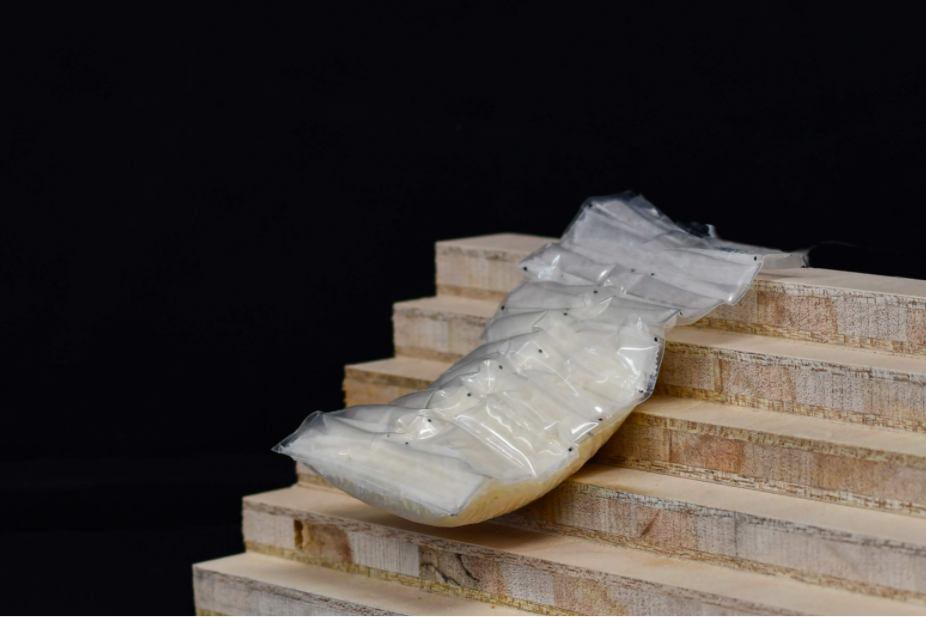
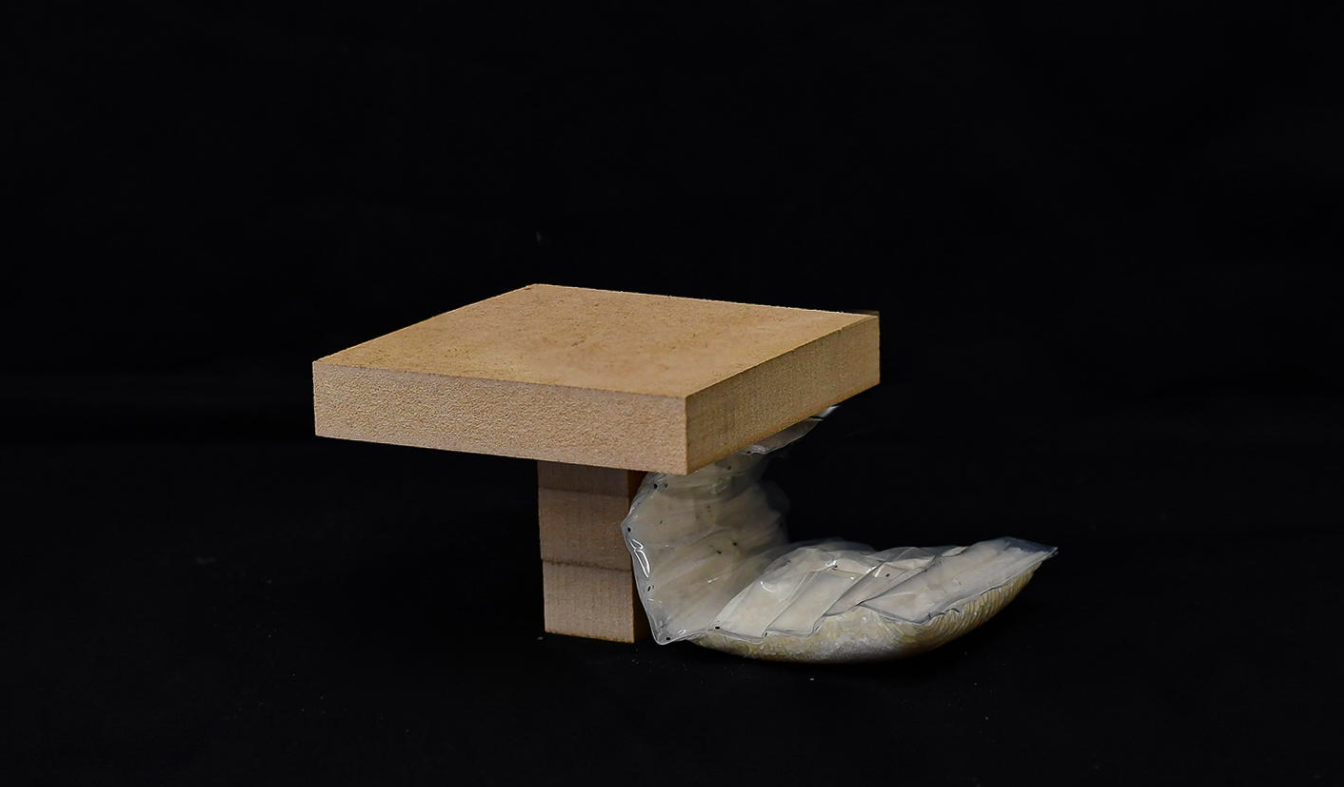
We have created a prototype of a double-layered inflatable bed that has a pouch structure that inflates with air and a jamming structure that becomes hard when air is compressed. The pouch side softly receives the body when inflated. The jamming side becomes hard when the air is removed, and can be firmly fixed in an even space. The air is designed to move back and forth between the two layers, so that when not in use, the whole thing can be rolled up softly for storage.
It’s hard to imagine the presence of a pussycat doing much to ameliorate the anxiety of those forced to flee their familiar beds with little warning, but we can see how Nakahashi’s design might bring a degree of physical relief when sleeping in subway stations, basement corners, and other harrowing locations.
Via Spoon & Tomago
- Ayun Halliday is the Chief Primatologist of the East Village Inky zine and author, most recently, of Creative, Not Famous: The Small Potato Manifesto. Follow her @AyunHalliday.
Related Content
A 110-Year-Old Book Illustrated with Photos of Kittens & Cats Taught Kids How to Read
GPS Tracking Reveals the Secret Lives of Outdoor Cats
Read More...How Yayoi Kusama, Obsessed with Polka Dots, Became One of the Most Radical Artists of All Time
Yayoi Kusama turned 93 this past Tuesday, and she remains not just artistically productive but globally beloved. Her work itself continues to appeal to an ever wider range of viewers of all nationalities and ages. “Yayoi Kusama is a Japanese artist who is sometimes called ‘the princess of polka dots’,” says the brief introduction to her life and work offered at Take Kids. “Although she makes lots of different types of art – paintings, sculptures, performances and installations – they have one thing in common, DOTS!” That’s certainly one way of describing her, though anyone who’s followed her 70-year-long career will notice the conspicuous absence of other, equally important elements of her art’s development: mental illness, for instance, or enormous numbers of phalluses.
Yet even the new video essay on Kusama from Great Art Explained, a Youtube channel very much pitched to an adult viewership, takes as its focus the artist’s relationship with variously sized two-dimensional solid circles. At the age of ten, says the channel’s creator James Payne, she “had her first hallucination, which she described as flashes of light, auras, or dense fields of dots. The dots would come to life and consume her and she would find herself obliterated.” Since then, and though her art has “crossed from art to fashion and from filmmaking to performance art, her continuing exploration of the polka dot has remained the one consistent motif.”
In approaching an artist through a single motif rather than a single work, this video breaks from the standard Great Art Explained format, but that doesn’t stop Payne from telling Kusama’s story with his usual succinctness. He begins with her discomfiting upbringing in a well-off rural Japanese household and continues to her discovery of and subsequent correspondence with Georgia O’Keeffe, who made Kusama the necessary introductions in the New York art world. Through her rigorous work habits and continuous pushing of aesthetic and political boundaries, Kusama eventually became a figure of some renown in that city’s avant-garde scene of the nineteen-sixties — a milieu that proved receptive to the “soft-sculpture phalluses” with which many of her creations then bristled.
Kusama returned to her homeland in the early 1970s, and soon thereafter only those with the sharpest memories of the avant-garde sixties remembered her work. Only a 1989 retrospective at New York’s Center for International Contemporary Arts returned her to the international fame she has enjoyed ever since. Many of us now have vivid memories of stepping into her completely mirrored, densely dot-lit “infinity rooms” over the years and in different museums around the world. Though Kusama began making them in the mid-nineteen-sixties, they’ve turned out to be ideally suited to the social-media era. “People queue up for hours for just sixty seconds in one of her infinity-room installations,” says Payne. “Each image they take of infinity joins millions more on the internet — itself infinite.” Only now, in Kusama’s tenth decade, has the rest of the world caught up with her.
Related content:
The MoMA Teaches You How to Paint Like Pollock, Rothko, de Kooning & Other Abstract Painters
Based in Seoul, Colin Marshall writes and broadcasts on cities, language, and culture. His projects include the Substack newsletter Books on Cities, the book The Stateless City: a Walk through 21st-Century Los Angeles and the video series The City in Cinema. Follow him on Twitter at @colinmarshall or on Facebook.
Read More...Footage of George Harrison & Bob Dylan Rehearsing “If Not For You” at the Concert for Bangladesh (1971)
“Dylan… was really into the whole idea of it for the refugees.…” says George Harrison over the restored footage above from 1971’s Concert for Bangladesh. The quiet Beatle’s scouser lilt will surely tug at your heartstrings, as will Harrison and Dylan’s careful rehearsal take of “If Not for You,” a song they did not end up playing together during the concert. It’s a significant shared moment nonetheless. As fans know, “If Not for You” became a keystone song for both artists at the turn of the 70s.
Dylan wrote the song the year previous as the first track on his 1970 New Morning, a record critics heralded as a return to form after the panned double album, Self Portrait. Harrison himself sat in on a session for the song and recorded a “languid early version,” notes Beatles Bible, “at Columbia’s Studio B in New York.”
The track is “thought to be Harrison’s first recorded instance of slide guitar,” a technique that would characterize the sound of his double debut, All Things Must Pass. His presence arguably helped shape the direction of Dylan’s recording, which Dylan himself would later describe as “sort of Tex-Mex.”
Harrison’s album, released in the same year as New Morning, features his — perhaps better known — version of “If Not for You,” a song that has been covered dozens of times since. (All Things Must Pass also features a 1968 collaboration between Harrison and Dylan: namely, the opening track, “I’d Have You Anytime.”) It’s a song that seems to sum up the two musicians’ contentment with their marriages and lives at the time. The performance, though only a soundcheck, provides “an intimate glimpse,” critic Simon Leng comments, “of the warm friendship between two major cultural figures at a point when both were emotionally vulnerable.”
On one hand, the Concert for Bangladesh was a world-historical event, providing inspiration for Live Aid and other stadium-sized benefit shows. “In one day,” as Ravi Shankar put it, “the whole world knew the name of Bangladesh.” NME called it “The Greatest Rock Spectacle of the Decade” and Rolling Stone’s editors described “a brief incandescent revival of all that was best about the Sixties.”
But on the other hand, in moments like these, we can see the concert as a turn into a more mature, sensitive seventies. “Instead of crying ‘I want you so bad,” wrote Ed Ward in his 1970 New Morning review, Dylan is “celebrating the fact that not only has he found her, but they know each other well, and get strength from each other, depend on each other.” In the take at the top, Jack Whatley observes, Harrison and Dylan “spend the entire song looking at each other, as if they’re singing about their own relationship.”
Related Content:
Bob Dylan’s Famous Televised Press Conference After He Went Electric (1965)
How Bob Dylan Created a Musical & Literary World All His Own: Four Video Essays
Josh Jones is a writer and musician based in Durham, NC. Follow him at @jdmagness
Read More...Japanese Toy Designs from the Late 19th & Early 20th Century: Explore an Online Archive
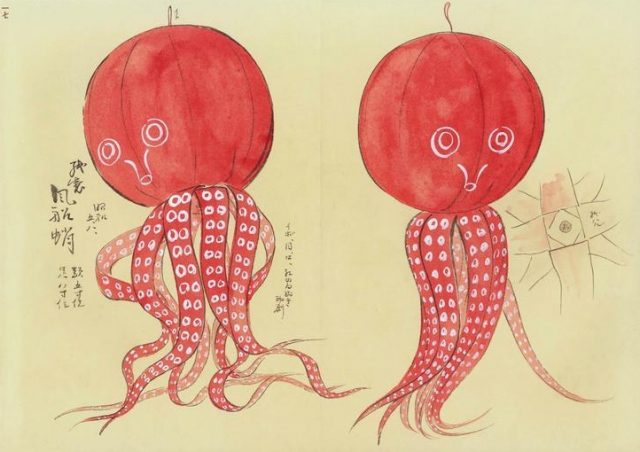
After two centuries of isolation, Japan re-opened to the world in the 1860s, at which point Westerners immediately became enamored with things Japanese. It was in that very same decade that Vincent Van Gogh began collecting ukiyo‑e woodblock prints, which inspired him to create “the art of the future.” But not every Westerner was drawn first to such elevated fruits of Japanese culture. When the American educator William Elliot Griffis went to Japan in 1876 he marveled at a country that seemed to be a paradise of play: “We do not know of any country in the world in which there are so many toy-shops, or so many fairs for the sale of things which delight children,” he wrote.
That quote comes from Matt Alt’s Pure Invention: How Japan’s Pop Culture Conquered the World. “While Western tastemakers voraciously consumed prints, glassware, textiles, and other grown-up delights, it was in fact toys that formed the backbone of Japan’s burgeoning export industry in the late nineteenth century,” Alt writes.
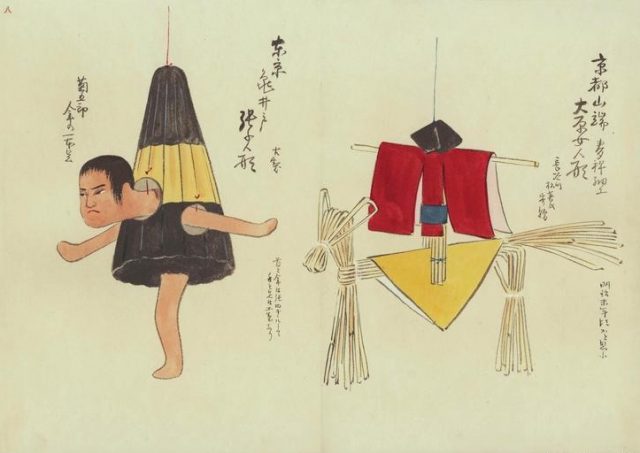
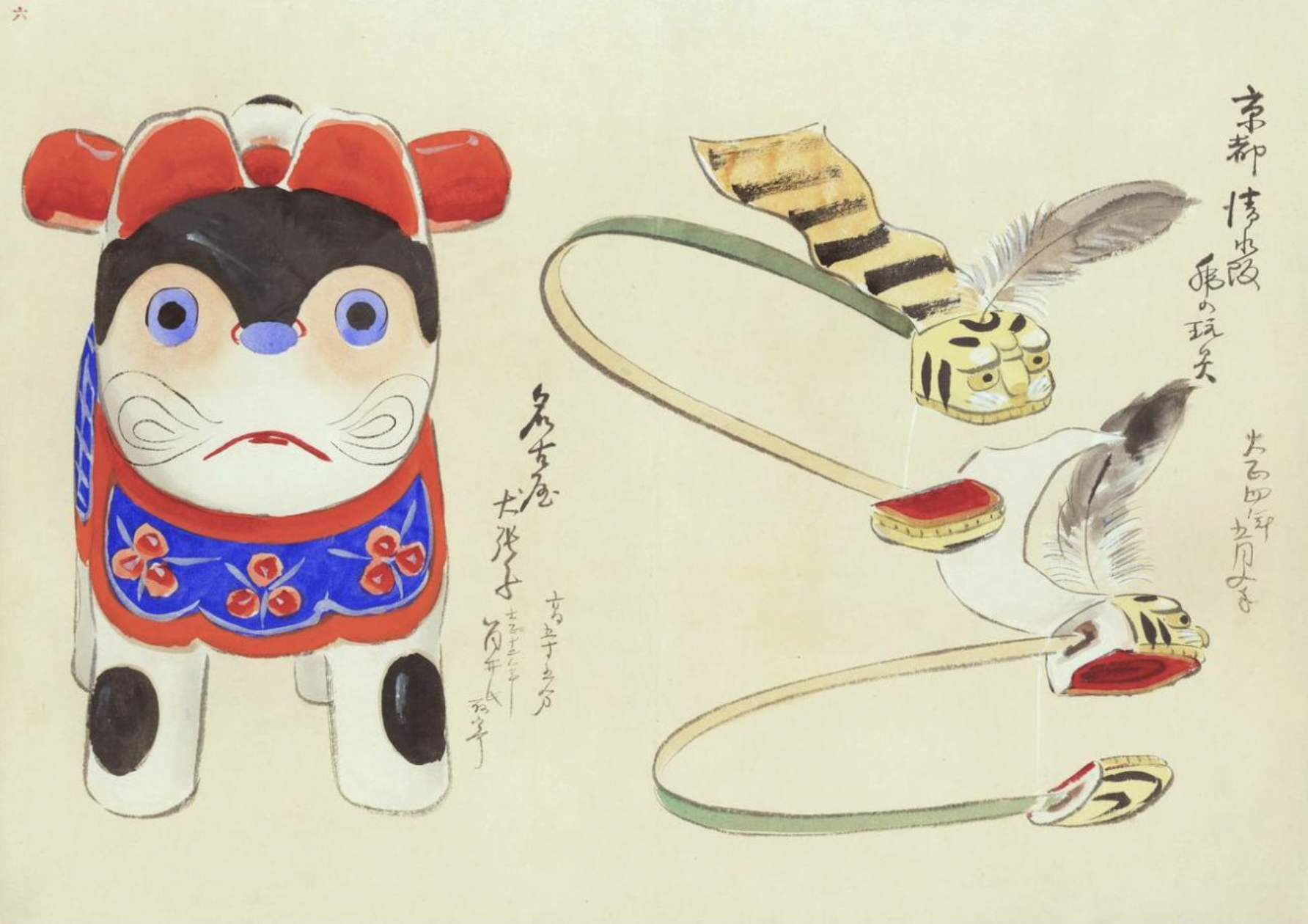
You can experience some of the pleasures of that period’s Japanese visual art along with some of the pleasures of that period’s Japanese toy culture in the Ningyo-do Bunko database. This digital archive’s more than 100 albums of watercolor toy-design renderings from the late nineteenth and early twentieth centuries are, in the words of BibliOdyssey’s Paul Kerrigan, “by turns scary and intriguing.”
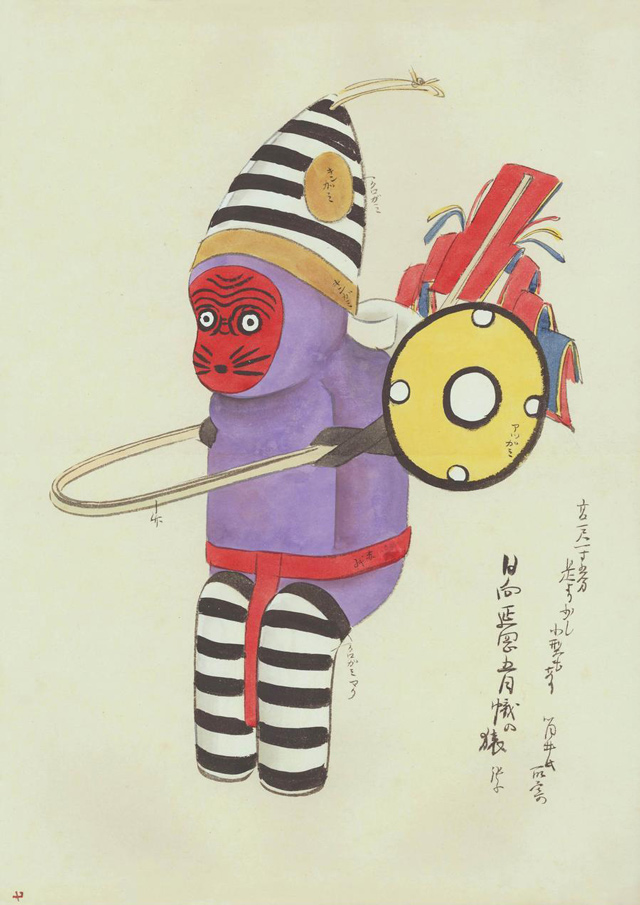
These masks, dolls, tops, and other fanciful works of the toymaker’s craft may not immediately appeal to a generation raised with smartphones. But their designs, rooted in Japanese mythology and regional cultures, nevertheless exude both a still-uncommon artistry and a still-fascinating “otherness.” If this seems like kid’s stuff, bear in mind the causes of Japan’s transformation from a post-World War II shambles to perhaps the most advanced country in the world. As Alt tells the story of this astonishing development, Japan went from making simple tin jeeps to transistor radios to karaoke machines to Walkmen to vast cultural industries of comics, film, television, and related merchandise: all toys, broadly defined, and we in the rest of the world underestimate their power at our peril. Rummage through the designs here.
Related content:
Wagashi: Peruse a Digitized, Centuries-Old Catalogue of Traditional Japanese Candies
How Frank Lloyd Wright’s Son Invented Lincoln Logs, “America’s National Toy” (1916)
Watch Battered & Bruised Vintage Toys Get Mesmerizingly Restored to Near Mint Condition
On Christmas, Browse A Historical Archive of More Than 50,000 Toys
Based in Seoul, Colin Marshall writes and broadcasts on cities, language, and culture. His projects include the Substack newsletter Books on Cities, the book The Stateless City: a Walk through 21st-Century Los Angeles and the video series The City in Cinema. Follow him on Twitter at @colinmarshall or on Facebook.
Read More...Watch David Hockney Paint with Light, Using the Quantel Paintbox Graphics System (1986)
Think of the television graphics you remember from the nineteen-eighties — or, perhaps more likely, the nineteen-eighties television graphics you’ve seen lately on Youtube. Much of it looks cheesy today, but some examples have become appealingly retro over the decades, and certain works remain genuinely impressive as pieces of digital art. Nowadays we can, in theory, replicate and even outdo the finest TV imagery of the eighties on our computers, or even our phones. But in the days before high-powered personal computing, let alone smartphones, how did such brilliantly colored, energetically animated, and sometimes genuinely artistic graphics get made? The answer, nine times out of ten, was on the Quantel Paintbox.
Introduced in 1981, the Paintbox was a custom-designed digital graphic workstation that cost about $250,000 USD, or more than $623,000 today. To major television stations and networks that money was well spent, buying as it did the unprecedentedly fast production of images and animations for broadcast. ”It used to be that we had a staff of artists who drew and drew,” the New York Times quotes ABC’s director of production development as saying in an article on graphics for the 1984 Olympics.
“But with the Paintbox an artist can come up with a graphic in fifteen minutes that used to take two days.” Its capabilities did much to influence the look and feel of that decade, for better or for worse: looking back, designer Steven Heller rues its propagation of “shadow-ridden, faux-handmade eighties aesthetics.”
As a cutting-edge piece of hardware, the Paintbox was beyond the reach of most artists, due not just to its cost but also the considerable kn0w-how required to use it. (Skilled “operators,” as they were called, could in the eighties command a wage of $500 per hour.) But for David Hockney, who was already famous, successful, and known for his interest in bright colors as well as new technology, the chance came in 1986 when the BBC invited him to participate in a television series called Painting with Light. A showcase for the creative potential of the Paintbox, it also brought on such luminaries as collage artist Richard Hamilton and “grandfather of Pop Art” Larry Rivers, sitting them down at the workstation and filming as they experimented with its possibilities.
“You’re not drawing on a piece of paper,” Hockney explains in his episode. “You’re drawing, actually, directly onto this TV screen where you’re seeing it now.” By now we’ve all done the same in one way or another, but in the eighties the concept was novel enough to be hard to articulate. Hockney emphasizes that the Paintbox produces “honest” images, in that the electronic medium in which the artist works is the very same medium through which the viewer perceives that work. The eagerness with which he takes up its groundbreaking pressure-sensitive stylus (“a bit like a kind of old-fashioned ballpoint pen”), sometimes with a cigarette in the other hand, shows that Hockney’s penchant for drawing on the iPhone and iPad over the past decade or so is hardly an isolated late-career lark. Even in 1986 he understood what you could do with digital technology, and could also sense one of its prime dangers: you’re never sure when to stop doing it.
Related content:
David Hockney’s iPad Art Goes on Display
David Hockney Shows Us His Sketch Book, Page by Page
Andy Warhol Digitally Paints Debbie Harry with the Amiga 1000 Computer (1985)
Time Travel Back to 1926 and Watch Wassily Kandinsky Make Art in Some Rare Vintage Video
Based in Seoul, Colin Marshall writes and broadcasts on cities, language, and culture. His projects include the Substack newsletter Books on Cities, the book The Stateless City: a Walk through 21st-Century Los Angeles and the video series The City in Cinema. Follow him on Twitter at @colinmarshall or on Facebook.
Read More...Marina Abramović Brings Back Her Iconic Performance Art Piece, The Artist Is Present, to Raise Money for Ukraine
For a couple of months in 2010, Marina Abramović spent her days wordlessly and motionlessly sitting at a table in the atrium of the Museum of Modern Art. Any visitor could sit in the chair opposite her, for as long as they liked. In response, Abramović said nothing and did almost nothing (even during visits from Lou Reed, Bjork, or her long-ago lover and collaborator, the late Ulay). The whole experience constituted a piece of performance art, titled The Artist Is Present. As with many works of that form, to ask why Abramović did it is to miss the point. Nothing like it had been done before, and it thus promised to enter uncharted artistic, social, and emotional territory.
A dozen years later, the artist will be present again, but this time with a highly specific motive in mind: to raise money for the besieged nation of Ukraine. “Abramović has partnered with New York’s Sean Kelly Gallery and Artsy to offer a performance art meet-and-greet… or at least meet-and-silently-stare,” writes Hyperallergic’s Sarah Rose Sharp.
“Through March 25, interested parties can bid on one of two opportunities for a limited restaging of Abramović’s epic performance The Artist Is Present.” These meet-and-silently-stares “will be captured by photographer Marco Anelli, who documented almost all of the 1,500 participants in the original performance.”
Proceeds “will go to Direct Relief, which is working with Ukraine’s Ministry of Health to provide urgent medical assistance as well as long-term aid to the many lives devastated by the war.” Last month, when Russia launched its invasion, Abramović released the video statement above. In it she explains having done some work in Ukraine last year, which afforded her an opportunity to get to know some of its people. “They’re proud, they’re strong, and they’re dignified,” she says, and an attack on their country “is an attack to all of us,” an “attack to humanity.” If you feel the same way, have some money to spend, and missed out on the first The Artist Is Present — and if you think you can hold your own across from the formidable presence glimpsed in the video — consider making a bid of your own.
via Hyperallergic
Related content:
In Touching Video, Artist Marina Abramović & Former Lover Ulay Reunite After 22 Years Apart
Marina Abramović and Ulay’s Adventurous 1970s Performance Art Pieces
Performance Artist Marina Abramović Describes Her “Really Good Plan” to Lose Her Virginity
Advice to Young Aspiring Artists from Patti Smith, David Byrne & Marina Abramović
Based in Seoul, Colin Marshall writes and broadcasts on cities, language, and culture. His projects include the Substack newsletter Books on Cities, the book The Stateless City: a Walk through 21st-Century Los Angeles and the video series The City in Cinema. Follow him on Twitter at @colinmarshall or on Facebook.
Read More...Hear Aldous Huxley Narrate His Dystopian Masterpiece, Brave New World
The CBS Radio Workshop was an “experimental dramatic radio anthology series” that aired between 1956 and 1957. And it started with style–with a dramatized adaptation of Brave New World, narrated by Aldous Huxley himself. The broadcast aired on January 27 and February 3 1956. The remaining 84 programs in the CBS Radio Workshop series drew on the work of Antoine de Saint-Exupéry, James Thurber, H.L. Mencken, Mark Twain, Robert Heinlein, Eugene O’Neil, Balzac, Carl Sandburg, and so many more. You can hear many of those episodes online here.
If you would like to support the mission of Open Culture, consider making a donation to our site. It’s hard to rely 100% on ads, and your contributions will help us continue providing the best free cultural and educational materials to learners everywhere. You can contribute through PayPal, Patreon, and Venmo (@openculture). Thanks!
Related Content
Aldous Huxley Predicts in 1950 What the World Will Look Like in the Year 2000
Aldous Huxley to George Orwell: My Hellish Vision of the Future is Better Than Yours (1949)
Read More...
What Was Actually Lost When the Library of Alexandria Burned?
The Library of Alexandria has been physically gone for about eighteen centuries now, but the institution endures as a powerful symbol. Today we have the internet, which none can deny is at least well on its way to becoming a digital store of all human knowledge. But despite having emerged from an ever more enormously complex technological infrastructure, the internet is difficult to capture in a legible mental picture. The Library of Alexandria, by contrast, actually stood in Egypt for some 300 years after its commissioning by Ptolemy I and II, and early in the second century B.C. it bid fair to hold practically all written knowledge in existence within its walls (and those of its “daughter library” the Serapeum, constructed when the main building ran out of space).
Interesting enough as a lost work of ancient architecture, the Library of Alexandria is remembered for its contents — not that history has been able to remember in much detail what those contents actually were. “Some ancient authors claimed that it contained 700,000 books,” says ancient-history scholar Garret Ryan in the video above.
“Books, in this context, meaning papyrus scrolls,” and their actual number was almost certainly smaller. By the time the Library itself — or at least part of it — was burned down by Julius Caesar in 48 B.C., it had been falling into disuse for quite some time. “It is sometimes said that the destruction of the Library of Alexandria set civilization back by centuries,” Ryan tells us. “This is a wild exaggeration.”
The Library of Alexandria might have been the most impressive intellectual repository in the ancient world, but it was hardly the only one. Most of the works in its collection, Ryan explains, would also have been held by other libraries, though they would also decline along with the general interest in classical culture. “Although there were certainly many works of mathematics and physics, the most important of these were widely disseminated elsewhere. What perished with the Library were, overwhelmingly, lesser-known works of literature and philosophy, commentaries and monographs: all the residue and introspection of an extremely sophisticated literary culture.” To scholars of ancient literature, of course, such a loss is incalculable. And in our own culture today, we’ll still do well to hold up the Library of Alexandria as an image of what it is to amass human knowledge — as well as what it is to let that knowledge decay.
Related content:
The Rise and Fall of the Great Library of Alexandria: An Animated Introduction
How Arabic Translators Helped Preserve Greek Philosophy … and the Classical Tradition
Based in Seoul, Colin Marshall writes and broadcasts on cities, language, and culture. His projects include the Substack newsletter Books on Cities, the book The Stateless City: a Walk through 21st-Century Los Angeles and the video series The City in Cinema. Follow him on Twitter at @colinmarshall or on Facebook.
Read More...Aldous Huxley Predicts in 1950 What the World Will Look Like in the Year 2000
I’ve been thinking lately about how and why utopian fiction shades into dystopian. Though we sometimes imagine the two modes as inversions of each other, perhaps they lie instead on a continuum, one along which all societies slide, from functional to dysfunctional. The central problem seems to be this: Utopian thought relies on putting the complications of human behavior on the shelf to make a maximally efficient social order—or of finding some convenient way to dispense with those complications. But it is precisely with this latter move that the trouble begins. How to make the mass of people compliant and pacific? Mass media and consumerism? Forced collectivization? Drugs?
Readers of dystopian fiction will recognize these as some of the design flaws in Aldous Huxley’s utopian/dystopian society of Brave New World, a novel that asks us to wrestle with the philosophical problem of whether we can create a fully functional society without robbing people of their agency and independence. Doesn’t every utopia, after all, imagine a world of strict hierarchies and controls? The original—Thomas More’s Utopia—gave us a patriarchal slave society (as did Plato’s Republic). Huxley’s Brave New World similarly situates humanity in a caste system, subordinated to technology and subdued with medication.
While Huxley’s utopia has eradicated the nuclear family and natural human reproduction—thus solving a population crisis—it is still a society ruled by the ideas of founding fathers: Henry Ford, H.G. Wells, Freud, Pavlov, Shakespeare, Thomas Robert Malthus. If you wanted to know, in the early 20th century, what the future would be like, you’d typically ask a famous man of ideas. Redbook magazine did just that in 1950, writes Matt Novak at Paleofuture; they “asked four experts—curiously all men, given that Redbook was and is a magazine aimed at women—about what the world may look like fifty years hence.”
One of those men was Huxley, and in his answers, he draws on at least two of Brave New World’s intellectual founders, Ford and Malthus, in predictions about population growth and the nature of work. In addition to the ever-present threats of war, Huxley first turns to the Malthusian problems of overpopulation and scarce resources.
During the next fifty years mankind will face three great problems: the problem of avoiding war; the problem of feeding and clothing a population of two and a quarter billions which, by 2000 A.D., will have grown to upward of three billions, and the problem of supplying these billions without ruining the planet’s irreplaceable resources.
As Novak points out, Huxley’s estimation is “less than half of the 6.1 billion that would prove to be a reality by 2000.” In order to address the problem of feeding, housing, and clothing all of those people, Huxley must make an “unhappily… large assumption—that the nations can agree to live in peace. In this event mankind will be free to devote all its energy and skill to the solution of its other major problems.”
“Huxley’s predictions for food production in the year 2000,” writes Novak, “are largely a call for the conservation of resources. He correctly points out that meat production can be far less efficient than using agricultural lands for crops.” Huxley recommends sustainable farming methods and the development of “new types of synthetic building materials and new sources for paper” in order to curb the destruction of the world’s forests. What he doesn’t account for is the degree to which the overwhelming greed of a powerful few would drive the exploitation of finite resources and hold back efforts at sustainable design, agriculture, and energy—a situation that some might consider an act of war.
But Huxley’s utopian predictions depend upon putting aside these complications. Like many mid-century futurists, he imagined a world of increased leisure and greater human fulfillment, but he “sees that potential for better working conditions and increased standards of living as obtainable only through a sustained peace.” When it comes to work, Huxley’s forecasts are partly Fordist: Advances in technology are one thing, but “work is work,” he writes, “and what matters to the worker is neither the product nor the technical process, but the pay, the hours, the attitude of the boss, the physical environment.”
To most office and factory workers in 2000 the application of nuclear fission to industry will mean very little. What they will care about is what their fathers and mothers care about today—improvement in the conditions of labor. Given peace, it should be possible, within the next fifty years, to improve working conditions very considerably. Better equipped, workers will produce more and therefore earn more.
Unfortunately, Novak points out, “perhaps Huxley’s most inaccurate prediction is his assumption that an increase in productivity will mean an increase in wages for the average worker.” Despite rising profits and efficiency, this has proven untrue. In a Freudian turn, Huxley also predicts the decentralization of industry into “small country communities, where life is cheaper, pleasanter and more genuinely human than in those breeding-grounds of mass neurosis…. Decentralization may help to check that march toward the asylum, which is a threat to our civilization hardly less grave than that of erosion and A‑bomb.”
While technological improvements in materials may not fundamentally change the concerns of workers, improvements in robotics and computerization may abolish many of their jobs, leaving increasing numbers of people without any means of subsistence. So we’re told again and again. But this was not yet the pressing concern in 2000 that it is for futurists just a few years later. Perhaps one of Huxley’s most prescient statements takes head-on the issue facing our current society—an aging population in which “there will be more elderly people in the world than at any previous time. In many countries the citizens of sixty-five and over will outnumber the boys and girls of fifteen and under.”
Pensions and a pointless leisure offer no solution to the problems of an aging population. In 2000 the younger readers of this article, who will then be in their seventies, will probably be inhabiting a world in which the old are provided with opportunities for using their experience and remaining strength in ways satisfactory to themselves, and valuable to the community.
Given the decrease in wages, rising inequality, and loss of home values and retirement plans, more and more of the people Huxley imagined are instead working well into their seventies. But while Huxley failed to foresee the profoundly destructive force of unchecked greed—and had to assume a perhaps unobtainable world peace—he did accurately identify many of the most pressing problems of the 21st century. Eight years after the Redbook essay, Huxley was called on again to predict the future in a television interview with Mike Wallace. You can watch it in full at the top of the post.
Wallace begins in a McCarthyite vein, asking Huxley to name “the enemies of freedom in the United States.” Huxley instead discusses “impersonal forces,” returning to the problem of overpopulation and other concerns he addressed in Brave New World, such as the threat of an overly bureaucratic, technocratic society too heavily dependent on technology. Four years after this interview, Huxley published his final book, the philosophical novel Island, in which, writes Velma Lush, the evils he had warned us about, “over-population, coercive politics, militarism, mechanization, the destruction of the environment and the worship of science will find their opposites in the gentle and doomed Utopia of Pala.”
The utopia of Island—Huxley’s wife Laura told Alan Watts—is “possible and actual… Island is really visionary common sense.” But it is also a society, Huxley tragically recognized, made fragile by its unwillingness to control human behavior and prepare for war.
Note: An earlier version of this post appeared on our site in 2016.
via Paleofuture
Related Content:
Huxley to Orwell: My Hellish Vision of the Future is Better Than Yours (1949)
Zen Master Alan Watts Discovers the Secrets of Aldous Huxley and His Art of Dying
Josh Jones is a writer and musician based in Durham, NC. Follow him at @jdmagness
Read More...
‘Kyiv Calling:’ Ukrainian Punk Band Rerecords The Clash’s Anthem as a Call to Arms
According to The Guardian, the surviving members of The Clash have given their blessing to the Ukrainian punk band, Beton, to record a new version of their 1979 classic London Calling. Recorded near the frontline of the battle in Ukraine, Kyiv Calling (above) “has lyrics that call upon the rest of the world to support the defence of the country from Russian invaders. All proceeds of what is now billed as a ‘war anthem’ will go to the Free Ukraine Resistance Movement (FURM) to help fund a shared communications system that will alert the population to threats and lobby for international support.”
You can donate to the Free Ukraine Resistance Movement here.
If you would like to support the mission of Open Culture, consider making a donation to our site. It’s hard to rely 100% on ads, and your contributions will help us continue providing the best free cultural and educational materials to learners everywhere. You can contribute through PayPal, Patreon, and Venmo (@openculture). Thanks!
Related Content
The Story Behind the Iconic Bass-Smashing Photo on the Clash’s London Calling
“Joe Strummer’s London Calling”: All 8 Episodes of Strummer’s UK Radio Show Free Online
Mick Jones Plays Three Classics by The Clash at the Public Library
Read More...Support Us
We're hoping to rely on loyal readers, rather than erratic ads. Please click the Donate button and support Open Culture. You can use Paypal, Venmo, Patreon, even Crypto! We thank you!

About Us

Open Culture scours the web for the best educational media. We find the free courses and audio books you need, the language lessons & educational videos you want, and plenty of enlightenment in between.
Advertise With Us
FREE UPDATES!
GET OUR DAILY EMAIL
Get the best cultural and educational resources on the web curated for you in a daily email. We never spam. Unsubscribe at any time.
FOLLOW ON SOCIAL MEDIA
Open Culture editor Dan Colman scours the web for the best educational media. He finds the free courses and audio books you need, the language lessons & movies you want, and plenty of enlightenment in between.
Advertise With Us

