Rare Arabic 78 RPM Records Enter the Public Domain
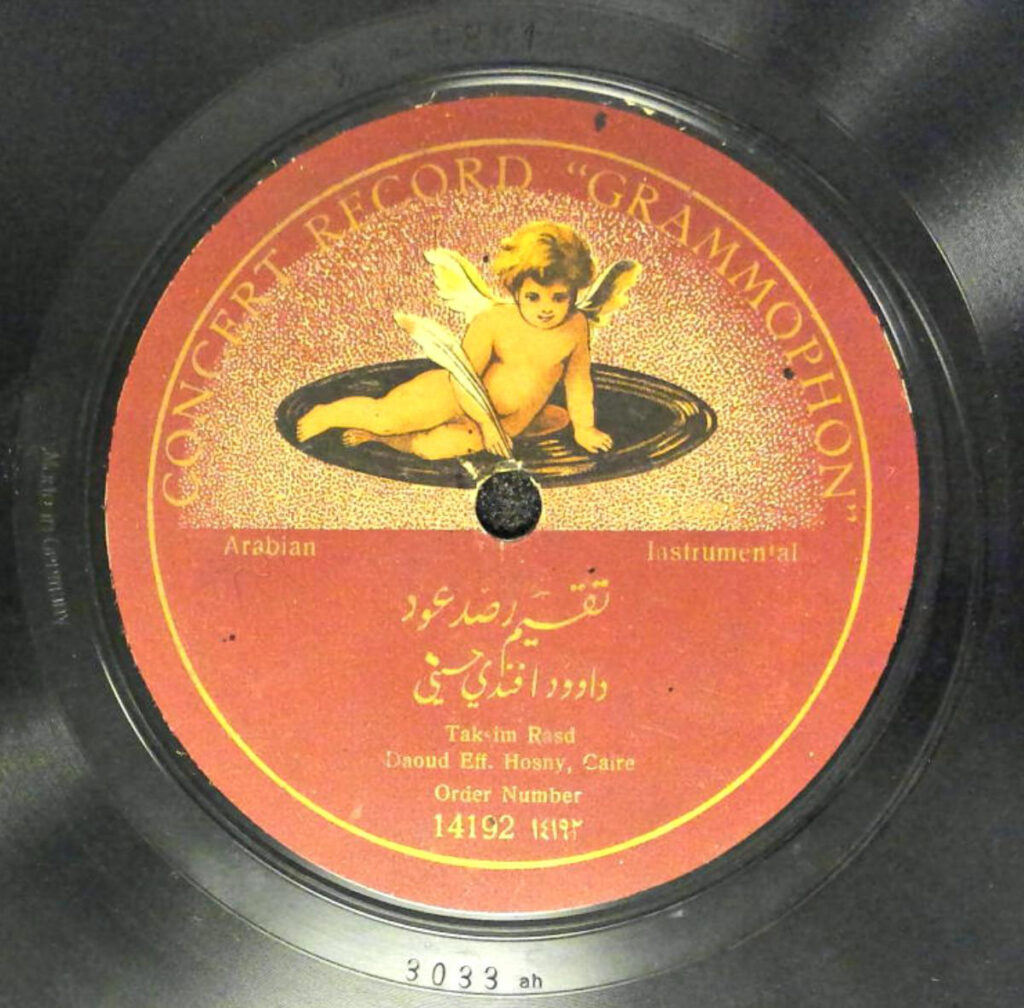
Public Domain Day is not just about the famous works that get released—-this year Milne’s Winnie-the-Pooh and Hemingway’s The Sun Also Rises were the best known-—but the archives that suddenly open up when any potential argument over copyright bypasses its sell-by date.
For example, Harvard’s Loeb Music Library has just released a selection from its 600-volume 78rpm collection of Arab and Arab-American music from the early 20th Century. The Library’s collection spans roughly 1903 to the 1950s and is not just a record of the aesthetics and the time of the Nahdah Era (the Arab Renaissance), but it also serves as a history of the still-young music industry. Among the RCA, Columbia, and Victor labels, you will also find many independent (and bootleg!) labels.
Harvard’s website notes:
Arab record companies, such as Baidaphon and Cairophon, are only a few among many other American (Columbia, Victor), European (Odeon, Orfeon), and Arab-American companies (Al-Chark, Alamphon) that recorded and released these notable Arab voices. Songs and performers from Egypt, Syria, Lebanon, Palestine, Iraq and Al-Maghrib exhibit the rich tradition of Arabic musical forms, namely the art of al-mawwāl (vocal improvisation), qaṣīdah (sung poems), muwashshaḥ (Andalusian sung poetry), ṭaqṭūqah (pop songs) and taqsīm (instrumental improvisation. Religious chants are also an important piece of the Arabic musical tradition. The collection includes Qur’anic recitation of Al-shaykh Ṭāhā Al-Fashnī and a rare record of a woman reciter Wadūdah Al-Minyalawī alongside Christian hymns of Father Gigis ʻAzīz Al-Jizzīnī.
A selection of recordings are available here for both online listening and download, using the Aviary Platform.
All this is happening due to the Music Modernization Act of 2018, which differs in its public-domain release dates by a few years compared to print and film. According to Citizen DJ, a website we told you about several years ago, “all sound recordings published before January 1, 1923 entered the public domain on January 1, 2022.”
The trick of course is getting access to all of these recordings. The Library of Congress runs a site called The National Jukebox, with access to thousands of 78rpm records from Victor and Columbia labels. That allows you to listen but not download.
The Association for Recorded Sound Collections also has a page noting “Ten Notable Pre-1923 Recordings”, which benefits from its curation. It features important early works like Mamie Smith’s “Crazy Blues,” one of the most popular “race records” (i.e. vocal blues sung by Black performers) of 1920; Enrico Caruso’s “Vesti La Giubba,” which features the tenor at the height of his career; and Vess L. Ossman’s recording of Joplin’s “Maple Leaf Rag,” which helped popularize the composer. Also see our recent post: 400,000+ Sound Recordings Made Before 1923 Have Entered the Public Domain.
Related Content:
The Great Gatsby Is Now in the Public Domain and There’s a New Graphic Novel
Ted Mills is a freelance writer on the arts who currently hosts the Notes from the Shed podcast and is the producer of KCRW’s Curious Coast. You can also follow him on Twitter at @tedmills, and/or watch his films here.
Read More...17th-Century Buddhist Texts for the Illiterate: How “Buddhist Emoji” Made the Sūtra Legible for Those Who Couldn’t Read
Even with 21st-century teaching aids, the written Japanese language isn’t the sort of thing one picks up in a few weeks’ study. A few hundred years ago it would’ve been much more difficult still, especially for those engaged in learning the sūtras or scriptures of Buddhism. “The stakes of correct recitation were high in the pre- and early modern era,” writes The Public Domain Review’s Hunter Dukes, “with strict rules for pronunciation existing since the 1100s, and sūtra recitation (dokyō) becoming an art form in the following century.” Imported from India and rewritten in classical Chinese with few clues as to how its words should actually be spoken, the Buddhist canon of east Asia set a mighty challenge even before the perfectly literate.
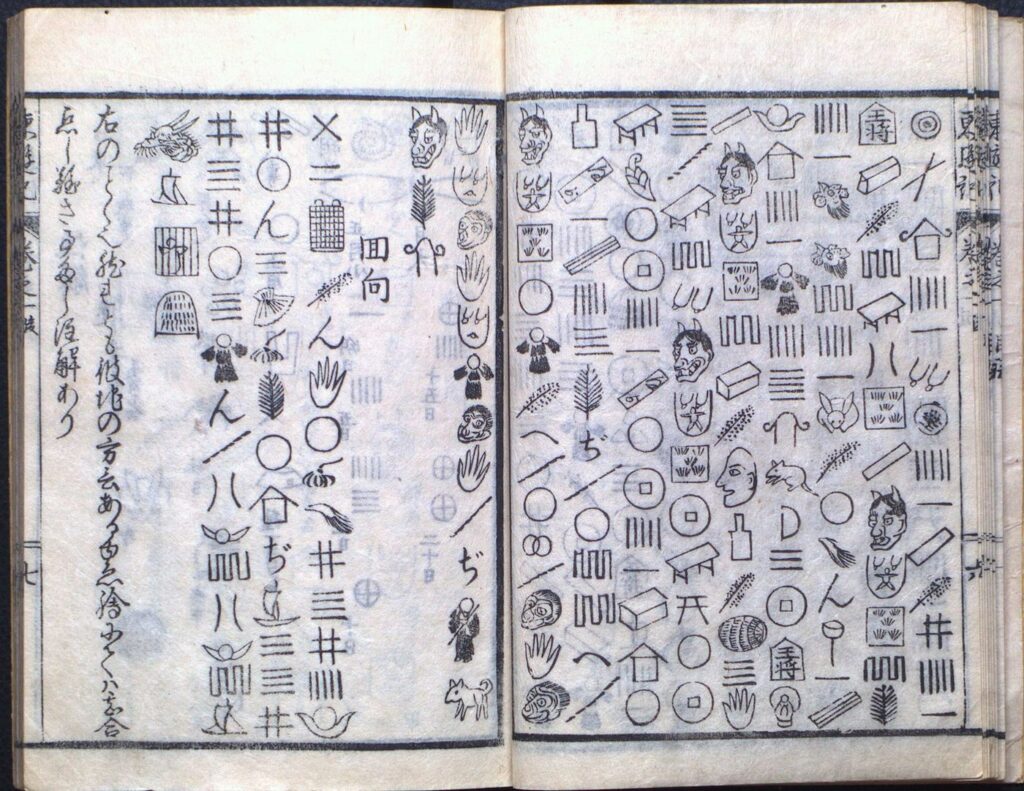
As for the illiterate — of whom, in complete contrast to modern-day Japan, there were many — what chance did they stand? Salvation, or at any rate a chance at salvation, arrived in the 17th century in the form of texts written just for them. “Japanese printers began creating a type of book for the illiterate, allowing them to recite sūtras and other devotional prayers, without knowledge of any written language,” writes Dukes. “The texts work by a rebus principle (known as hanjimono), where each drawn image, when named aloud, sounds out a Chinese syllable.” Geared toward an agricultural “readership,” this system drew its imagery from what they knew: farming tools, domestic animals, and even figures of myth.
The sections here come from a 20th-century example of this type of publication, variously Mekura-kyō or Monmō-kyō, held by the British Library. It contains a rendition of the text of the Heart Sūtra, the most widely known piece of scripture in the canon of Mahāyāna Buddhism, and as the Kyoto National Musem’s Eikei Akao puts it, “probably the best-known, most well-loved sutra in Japan.” (You may also remember the 37-minute version performed by beatboxing Buddhist monk Yogetsu Akasaka, which we previously featured here on Open Culture.) Not long ago, the United States Library of Congress posted this Heart Sūtra for the illiterate to its Facebook page. The occasion? World Emoji Day.
“Because these pictures represent sounds, rather than objects or ideas, they don’t really act as pictograms the way emoji do,” admits the writer of the Library of Congress’ post. “But in their icon-like appearance, succinct and functional, they do bear a resemblance to our use of emoji today.” It was then reblogged on Language Log, one of whose commenters offered some explanation of the system as seen in the pictures: “The Sanskrit phrase ‘Prajñāpāramitā’ is rendered ‘Hannyaharamita’ in Japanese. ‘Hannya’ here is written with a drawing of the hannya demon mask from Noh. ‘Harami’ appears to be a picture of a body (mi) in an abdomen (hara), and then ‘ta’ is a picture of a ricefield (tanbo, the “ta” of many Japanese names, like Tanaka and Toyota).” Hands have been wringing about the potential of internet communication to deliver us into a “post-literate” society; perhaps these curious chapters in the history of the Japanese language show us where to go from there.
Related contrast:
Breathtakingly Detailed Tibetan Book Printed 40 Years Before the Gutenberg Bible
The World’s Largest Collection of Tibetan Buddhist Literature Now Online
A Beatboxing Buddhist Monk Creates Music for Meditation
Based in Seoul, Colin Marshall writes and broadcasts on cities and culture. His projects include the book The Stateless City: a Walk through 21st-Century Los Angeles and the video series The City in Cinema. Follow him on Twitter at @colinmarshall or on Facebook.
Read More...Scandinavian Film & Television: A Free Online Course from the University of Copenhagen
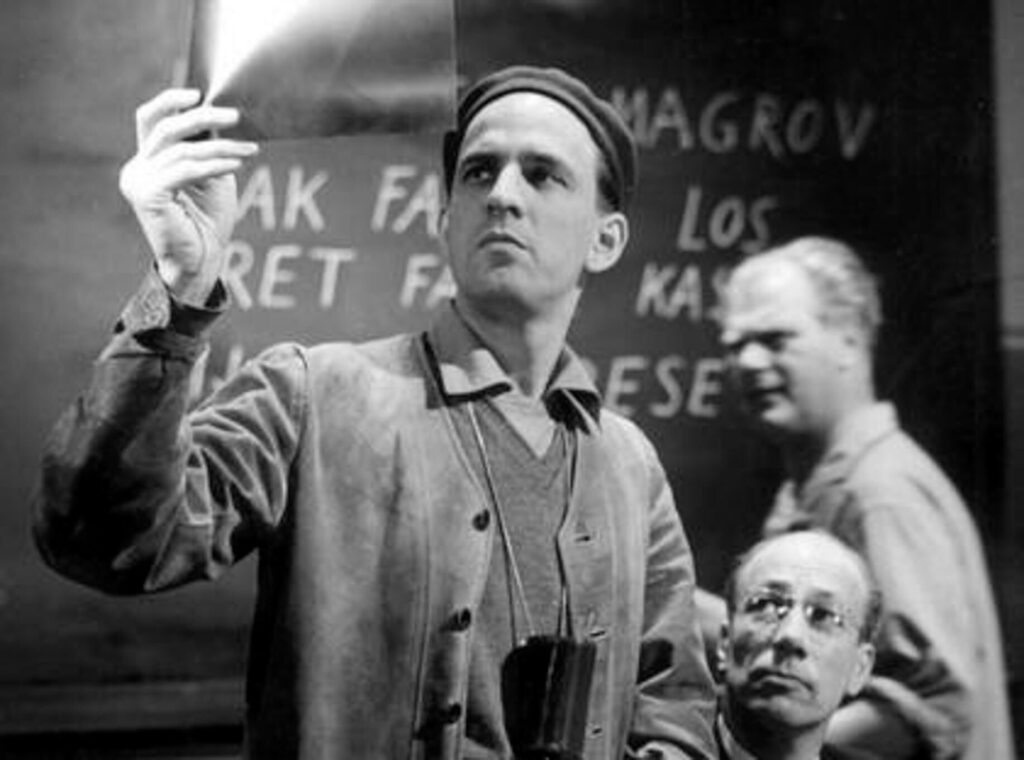
Image via Wikimedia Commons
“In many ways Scandinavian film and television is a global cultural brand, connected with and exporting some of the cultural and social values connected to a liberal and progressive welfare society.” From the University of Copenhagen, this free course deals with the social, institutional and cultural background of film and television in Scandinavia and in a broader European and global context. Spanning 5 weeks and taught by professor Eva Novrup Redvall, Scandinavian Film and Television covers the early cinematic work of Danish director Carl Dreyer, the films of Ingmar Bergman and Lars von Trier, Scandinavian new wave cinema, and finally more contemporary productions. You can enroll for free here.
Scandinavian Film and Television will be added to our list 1,700 Free Online Courses from Top Universities.
Related Content
Ingmar Bergman’s Soap Commercials Wash Away the Existential Despair
Read More...An Opera Singer & Cabaret Artist Record an Astonishing Version of David Bowie & Queen’s “Under Pressure”
On the surface of things, Anthony Roth Costanzo, the internationally-recognized countertenor and Justin Vivian Bond, the subversive performance artist best known for their creation Kiki DuRane, “an alcoholic battle-axe with a throat full of razor-blades,” would have little reason to share a mic, let alone inhabit the same stage.
Leave surfaces behind!
Their genre-defying, just released album, Only An Octave Apart, explores the depths that lurk beneath them, finding common cause between their chosen art forms and then some. The album’s title, a nod to the opening number of a Metropolitan Opera television special starring comedian Carol Burnett and operatic soprano Beverly Sills, is just the tip of the iceberg.
As they state in the program notes for a recent appearance with the New York Philharmonic at Jazz at Lincoln Center:
We each sound different from what you would expect when you look at us. The juxtaposition of our voices, personalities, and repertoire subverts notions of high and low, be it in terms of pitch, cultural echelon, or degrees of camp — not to mention the difference in height.
If you thought David Bowie and Freddie Mercury sent things into the stratosphere when they joined forces on “Under Pressure,” listen to Costanzo and Bond’s take, above.
Their Dido’s Lament / White Flag Medley smashes the musical binary with a delicacy that is given room to grow.
Costanzo begins with two and a half soaring minutes from Henry Purcell’s Dido & Aeneas.
Introducing the number at Jazz at Lincoln Center, he recalled how Dido & Aeneas was one of his first professional opera gigs at 19. No, he wasn’t cast as the fatally distraught Queen of Carthage, a diva role he’s eyed for years, but rather the Second Woman and First Witch.
(“Second Woman / First Witch…sounds like the story of my life,” Bond marveled. “I own it! Can you imagine if you were First Woman and Second Witch?”)
Costanzo got his chance at Dido in the summer of 2020 when, with performance venues still closed due to the pandemic, he hatched an idea to cart Philharmonic musicians and guest singers around the city’s five Boroughs in a rented pickup dubbed the NY Phil Bandwagon. 80-some free performances later, he felt ready to record.
When Bond joins in, it’s with English singer-songwriter Dido’s 2003 chart topper, White Flag, which also speaks to the pains of love. The sincerity of the performers causes a gorgeous alchemical reaction to soften the positions of more than a few staunch opera-phobes and pop-deniers.
(“The wonderful thing about the opera,” Bond cracks, “is when you wake up, you’re at the opera!”)
Their Egyptian Sun mash up is born of an even cannier pairing — The Bangles’ mid-80s hit, Walk Like An Egyptian and Philip Glass’ ancient Egypt-themed minimalist modern opera, Akhnaten, in which Costanza recently starred, making his first entrance nude and flecked with gold.
Other treasures from this fruitful collaboration include skillful intertwinings of Tom Jobim’s Bossa nova favorite Águas de Março (Waters of March) with Gioachino Rossini’s Cinderella-themed confection La Cenerentola, and Gluck’s 18th-century masterpiece, Orfeo ed Euridice with Don’t Give Up, a “message of hope in the bleakest of moments” and a hit for Peter Gabriel and Kate Bush when Bond was a year out of college…and Costanzo was four.
Listen to Only an Octave Apart in its entirety on YouTube or Spotify.
Anthony Ross Costanzo will reprise his role as the revolutionary pharaoh, Akhnaten, at the Metropolitan Opera later this spring.
- Ayun Halliday is the Chief Primatologist of the East Village Inky zine and author, most recently, of Creative, Not Famous: The Small Potato Manifesto. Follow her @AyunHalliday.
Read More...Tennessee School Board Bans Maus, the Pulitzer-Prize Winning Graphic Novel on the Holocaust; the Book Becomes #1 Bestseller on Amazon
Last week, a Tennessee school board voted unanimously to ban Maus, the Pulitzer-winning graphic novel about the Holocaust, citing instances of profanity and nudity. Specifically, the McMinn County school board objected to utterances of the words “God damn” and a small, barely-perceptible breast. (Look closely, and you may eventually find it.) Rather uncomfortably, the banning came on the eve of International Holocaust Remembrance Day, and it figures into a larger right-leaning effort to ban books countrywide.
Happily, bad decisions can have good unintended consequences. In recent days, Art Spiegelman’s Maus has soared to #1 on Amazon’s bestseller list. (Another edition of the book sits at #3 on the list.) Elsewhere, a college professor has created a free online course on Maus designed solely for students from McMinn County. And within Tennessee itself, bookstores are giving away free copies of Spiegelman’s classic, while a church has decided to convene conversations on the groundbreaking book.
Above, you can watch Spiegelman respond to the ban and wonder whether it’s “a harbinger of things to come,” a step in a larger effort to efface the memory of the Holocaust.
Related Content
How Art Spiegelman Designs Comic Books: A Breakdown of His Masterpiece, Maus
The 850 Books a Texas Lawmaker Wants to Ban Because They Could Make Students Feel Uncomfortable
America’s First Banned Book: Discover the 1637 Book That Mocked the Puritans
Read More...A Brief Animated History of Martin Luther’s 95 Theses & the Reformation–Which Changed Europe and Later the World
Whatever our religious background, we all sooner or later have occasion to speak of nailing theses to a door. Most of us use the phrase as a metaphor, but seldom entirely without awareness of the historical events that inspired it. On October 31, 1517, a German priest and theologian named Martin Luther nailed to the door of Wittenberg’s All Saints’ Church his own theses, 95 of them, which collectively made an argument against the Roman Catholic Church’s practice of selling indulgences, or pardons for sins. Luther could not accept that the poor should “spend all their money buying their way out of punishment so they can go to heaven,” nor that it should be “easier for the rich to avoid a long time in purgatory.”
In other words, Luther believed that the Church in his time had become “way too much about money and too little about God,” according to the narration of the short film above. Created by Tumblehead Studios and showcased by National Geographic for the 500th anniversary of the original thesis-nailing, its five playfully animated minutes tell the story of the Reformation, which saw Protestantism split off from Catholicism as a result of Luther’s agitation. It also manages to include such events as Luther’s own translation of the New Testament, previously available only in Greek and Latin, into his native German, the publication of which created the basis of the modern German language as spoken and written today.
Luther’s translation gave ordinary people “the opportunity to read the Bible in their own language,” free from the interpretations of the priests and the Church. It also gave them, perhaps less intentionally, the ability to “use the words of the Bible as an argument for all sorts of things.” Luther’s thoughts were soon marshaled “in the power struggles of princes, in revolts, and in the struggle between kings, princes, and the Pope about who actually decides what.” Squabbles, battles, and full-scale wars ensued. The consequent institutional schisms changed the world in ways visible half a millennium later — but they first changed Europe, where traces of that transformation still reveal themselves most strikingly. Few travelers can be trusted to find and explain those traces more ably than public-television host Rick Steves.
In Luther and the Reformation, his 2017 special above, Steves visits all the important sites involved in the central figure’s life journey, a representation in microcosm of Europe’s grand shift from medievalism into modernity. In more than 40 years of professional travel, Steves has paid countless visits to the monuments of Catholic Europe. Appreciating them, he admitted in a recent New York Times Magazine profile, required him to “park my Protestant sword at the door.” His story-of-the-Reformation tour, however, lets him draw on his own Lutheran tradition with his characteristic enthusiasm. That enthusiasm, in part, that has made him a such a successful travel entrepreneur, though he presumably knows when to stop amassing wealth: after all, it’s easier for a camel to go through the eye of a needle than for a rich man to enter the kingdom of God. Or so the New Testament has it.
Related content:
60-Second Adventures in Religion: Watch New Animations by The Open University
Animated Map Shows How the Five Major Religions Spread Across the World (3000 BC – 2000 AD)
The Religious Affiliation of Comic Book Heroes
Christianity Through Its Scriptures: A Free Course from Harvard University
Rick Steves’ Europe: Binge Watch 11 Seasons of America’s Favorite Traveler Free Online
Based in Seoul, Colin Marshall writes and broadcasts on cities and culture. His projects include the book The Stateless City: a Walk through 21st-Century Los Angeles and the video series The City in Cinema. Follow him on Twitter at @colinmarshall or on Facebook.
Read More...Subscription Successful
You have successfully subscribed to the Open Culture Daily mail! Thank you for being part of our community. If you ever wish to unsubscribe, you will find the link at the bottom of our daily mail.
Read More...Watch a Human White Blood Cell Chase Bacteria Through a Field of Red Blood Cells
Watch above a classic movie made by David Rogers at Vanderbilt University in the 1950s. It shows “a neutrophil (a type of white blood cell) chasing a bacterium through a field of red blood cells in a blood smear. After pursuing the bacterium around several red blood cells, the neutrophil finally catches up to and engulfs its prey. In the human body, these cells are an important first line of defense against bacterial infection. The speed of rapid movements such as cell crawling can be most easily measured by the method of direct observation.” This comforting video comes courtesy of the estate of David Rogers, Vanderbilt University.
If you would like to support the mission of Open Culture, consider making a donation to our site. It’s hard to rely 100% on ads, and your contributions will help us continue providing the best free cultural and educational materials to learners everywhere. You can contribute through PayPal, Patreon, and Venmo (@openculture). Thanks!
Related Content:
Watch Bacteria Become Resistant to Antibiotics in a Matter of Days: A Quick, Stop-Motion Film
An Artistic Portrait of Stephen Fry Made From His Own Bacteria
How a Virus Invades Your Body: An Eye-Popping, Animated Look
Read More...The Marcel Duchamp Research Portal Opens, Making Available 18,000 Documents and 50,000 Images Related to the Revolutionary Artist
Marcel Duchamp made films, composed music, painted Nude Descending a Staircase, No. 2, designed an art deco chess set, and of course — the first thing most of us learn about him, as well as the last thing many of us learn about him — he put a urinal in an art galley. But as you might expect of an artist who spent the early 20th century at the heart of the avant-garde, there’s more to him than that. This notion is backed up by the more than 18,000 documents and 50,000 images made available at the Duchamp Research Portal, a newly opened archive dedicated to the life and work of the revolutionary conceptual artist.
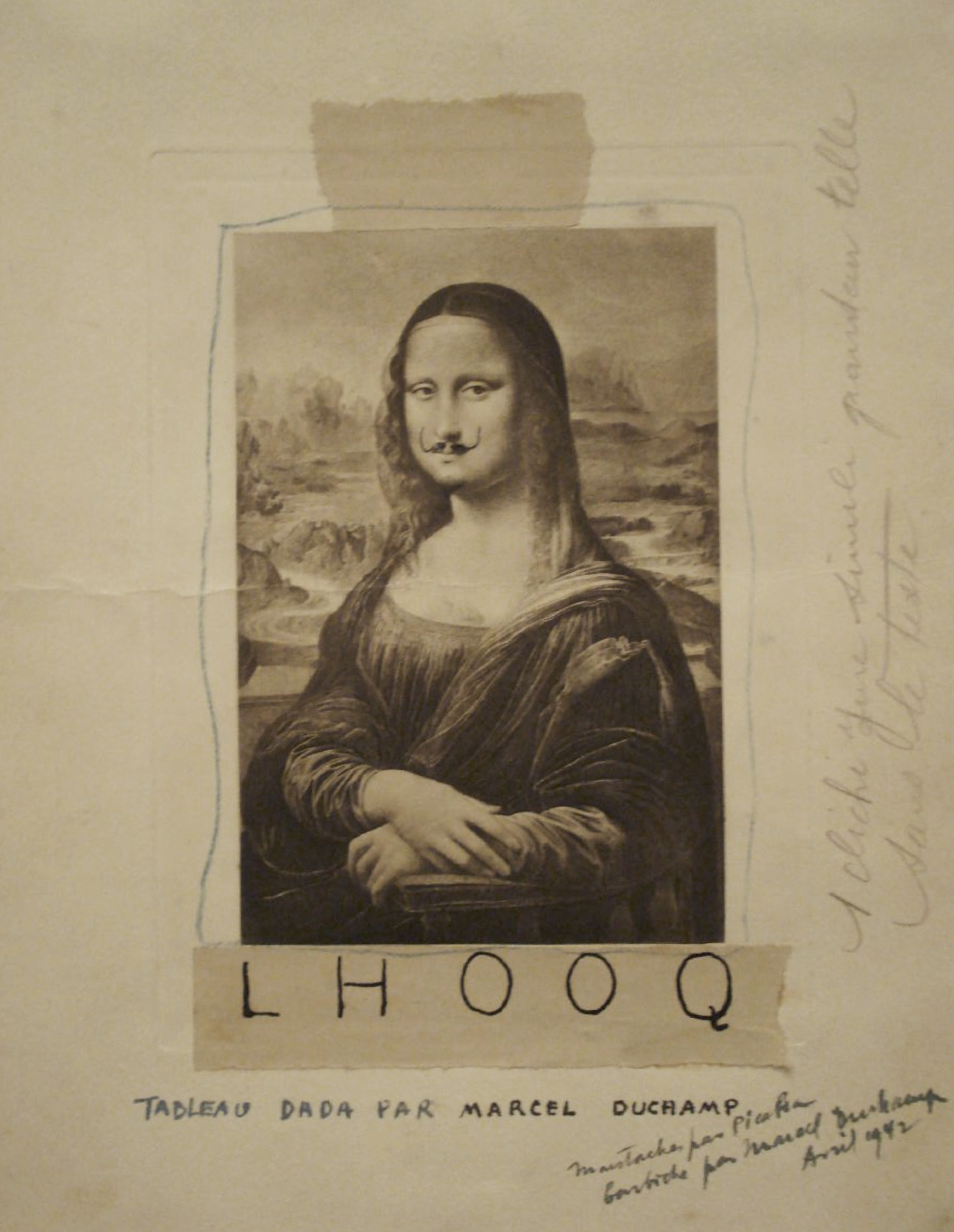
The fruit of a seven-year collaboration between the Philadelphia Museum of Art, the Association Marcel Duchamp, and the Centre Pompidou, this formidable digital collection includes many artifacts related to the artist’s best-known work: the “large glass” of The Bride Stripped Bare by Her Bachelors, Even; the mustachioed Mona Lisa; the shocking attempts to commit physical motion to canvas; and that urinal, Fountain.
But its “most interesting items,” writes The Art Newspaper’s Daniel Cassady, “are often the most intimate and involve other major players in the evolution of 20th-century art. A 1950 letter — with enigmatic marginalia — from Breton. A 1933 postcard to Constantin Brâncuși. Many candid photographs by Duchamp’s friend and fellow giant of the era, Man Ray.”

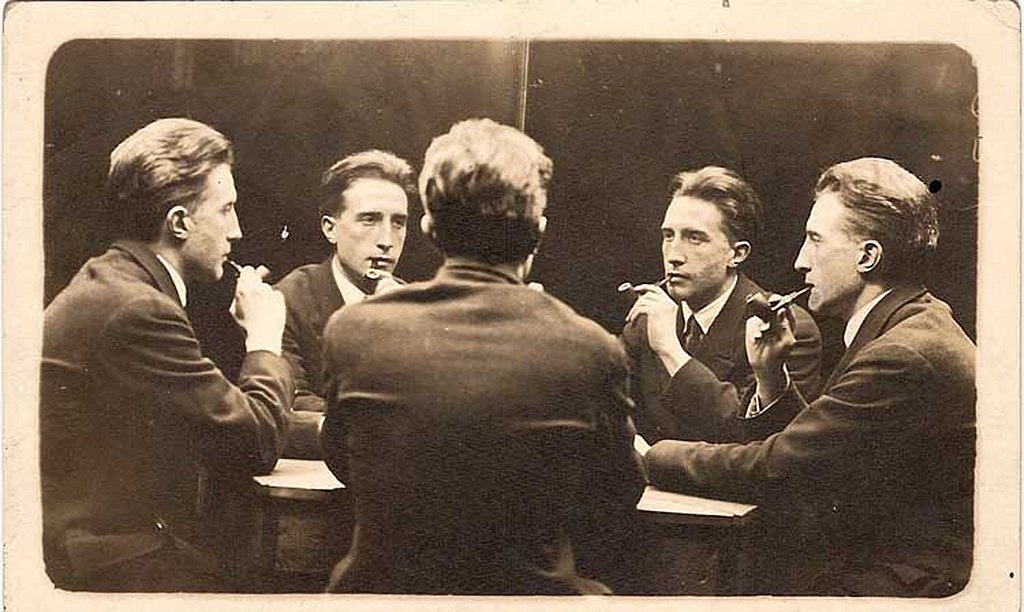
These names will be familiar to readers of Open Culture, where we’ve previously featured Brâncuși on film and portraits of 1920s cultural icons by Man Ray — who, as we can see from the above snapshot of Duchamp at his Spanish home, didn’t always work so formally. But then, no artist can fully be understood through what makes it into the art-history textbooks alone. Browse the Duchamp Research Portal (or click “show me more” to change up the images on its front page) and you’ll see pieces of an artistic life fully lived: the floor plan of his West 67th Street studio; a 1940 telegram to American patron Walter Conrad Arensberg (“HOLDING SHIPMENT OF MASK AWAITING CONFIRMATION OF INSURANCE AND ADDRESS”); a 1954 French newspaper profile; and a series of images juxtaposing Duchamp with an unclothed Eve Babitz, the late Los Angeles “it-girl” — not just the famous one of them playing chess.
Related Content:
Hear Marcel Duchamp Read “The Creative Act,” A Short Lecture on What Makes Great Art, Great
Anémic Cinéma: Marcel Duchamp’s Whirling Avant-Garde Film (1926)
Hear the Radical Musical Compositions of Marcel Duchamp (1912–1915)
What Made Marcel Duchamp’s Famous Urinal Art — and an Inventive Prank
Based in Seoul, Colin Marshall writes and broadcasts on cities and culture. His projects include the book The Stateless City: a Walk through 21st-Century Los Angeles and the video series The City in Cinema. Follow him on Twitter at @colinmarshall or on Facebook.
Read More...Great Art Cities: Visit the Fascinating, Lesser-Known Museums of London & Paris
Gallerists James Payne and Joanne Shurvell understand that institutional big gorillas like the Louvre, the Musee d’Orsay, Tate Britain, and London’s National Gallery require no introduction. Their new art and travel series, Great Art Cities Explained, concentrates instead on the wonderful, smaller museums the biggies often overshadow.
First time visitors to London and Paris may be left scrambling to rearrange their itineraries.
The first two episodes have us persuaded that Sir John Soane’s Museum, Kenwood House, the Wallace Collection, Le Musée National Eugène Delacroix, Le Musée de Montmartre à Paris, and Atelier Brancusi are the true “don’t miss” attractions if time is tight.
Credit Payne, whose flair for dishy, far ranging, highly accessible narration made his other web series, Great Art Explained in Fifteen Minutes, an instant hit.
The three British institutions featured above were once grand private homes, whose owners decided to donate them and the magnificent art collections they contained to the public good.
Whatever motivated these wealthy men’s generosity — vanity, the quest for immortality, or, in one case, the desire to cut off a churlish and morally lax son whom Payne compares to the central figure in William Hogarth’s A Rake’s Progress, a Sir John Soane’s Museum favorite — Payne holds them in higher regard than today’s investment-obsessed art collectors:
The world needs more men like (William) Murray, (Sir John) Soane, and (Sir Richard) Wallace, men who saw that art can transcend social class. They understood that art should enrich the soul, not the bank balance.
His peeks into their circumstances are every bit as fascinating as the tidbits he drops about the artists whose work he includes.
Rather than giving a sweeping overview of each collection, he focuses on a few key works, sharing his curatorial perspective on their history, acquisition, subject matter, creation, and reception:
Rembrandt’s Self Portrait with Two Circles (1669)
Vermeer’s The Guitar Player (1672)
Hogarth’s A Rake’s Progress (1732)
Canaletto’s Venice: the Bacino di San Marco from San Giorgio Maggiore and Venice: the Bacino di San Marco from the Canale della Giudecca (c. 1735 — 1744)
Fragonard’s The Swing (1767)
Frans Hal’s Laughing Cavalier (1624)
Payne’s rollicking approach means each episode is crammed with plenty of artwork residing outside of the featured museums, too, as he compares, contrasts, and contextualizes.
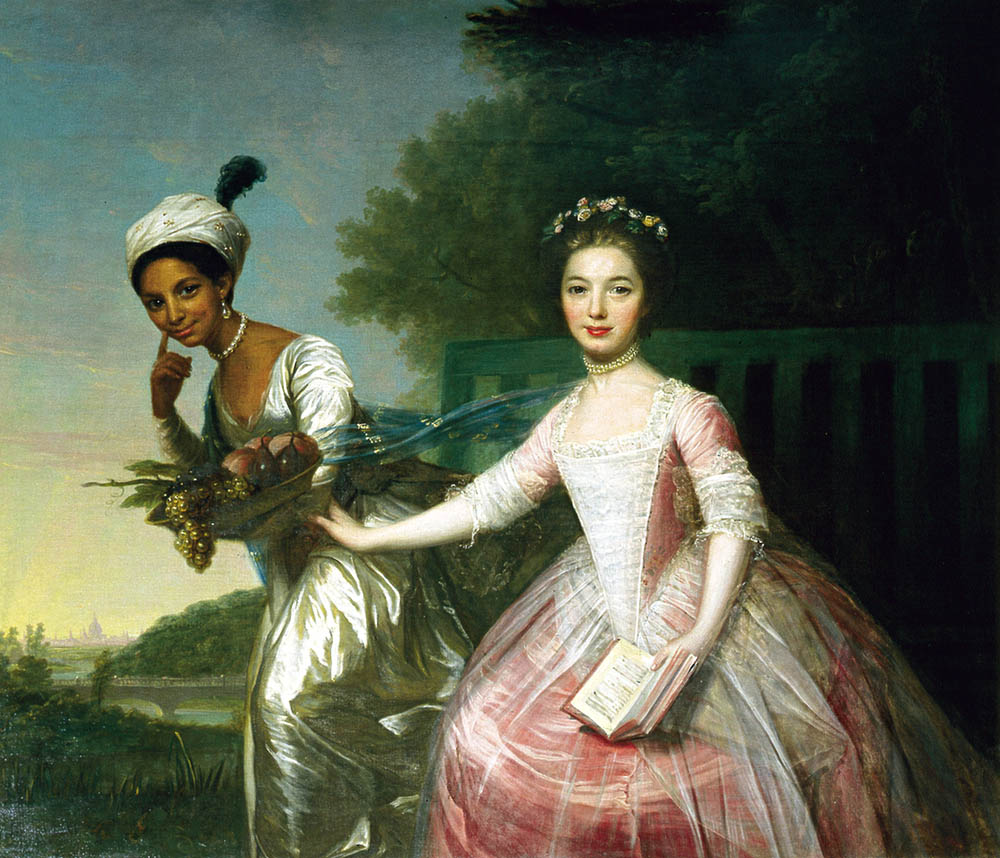
One of his most interesting tales in the London episode concerns an 18th-century portrait of William Murray’s great-nieces, Dido Belle and Elizabeth Murray, raised by their abolitionist great-uncle at Kenwood House:
Dido Belle was the illegitimate daughter of a Black slave and William Murray’s nephew and was raised by Murray as part of the aristocracy. By all accounts, Dido and her cousin were raised as equals and this portrait of the two was seen as an image of sisterhood, reflecting their equal status. But looking at it with modern eyes, we can see it more in the vein of traditional servant and master portraits of the time. Belle’s exotic clothing is designed to differentiate her from her cousin and the painting reflects the conservative views of the time.
Artist David Martin places the cousins on a bench outside the Hampstead Heath mansion, with St. Paul’s Cathedral in the background. For years, it was the only known portrait of Belle.
It hangs, not in Kenwood House, but in Scone Palace’s Ambassador’s Room.
Meanwhile, one of Kenwood House’s latest acquisitions is a 2021 portrait of Belle by young Jamaican artist Mikéla Henry-Lowe, on display in the library.
Next up on Great Art Cities Explained: New York. Look for it on this playlist on Great Art Explained’s YouTube channel.
Related Content:
Mark Rothko’s Seagram Murals: What Makes Them Great Art
Ayun Halliday is the Chief Primatologist of the East Village Inky zine and author, most recently, of Creative, Not Famous: The Small Potato Manifesto. Follow her @AyunHalliday.
Read More...Support Us
We're hoping to rely on loyal readers, rather than erratic ads. Please click the Donate button and support Open Culture. You can use Paypal, Venmo, Patreon, even Crypto! We thank you!

About Us

Open Culture scours the web for the best educational media. We find the free courses and audio books you need, the language lessons & educational videos you want, and plenty of enlightenment in between.
Advertise With Us
FREE UPDATES!
GET OUR DAILY EMAIL
Get the best cultural and educational resources on the web curated for you in a daily email. We never spam. Unsubscribe at any time.
FOLLOW ON SOCIAL MEDIA
Open Culture editor Dan Colman scours the web for the best educational media. He finds the free courses and audio books you need, the language lessons & movies you want, and plenty of enlightenment in between.
Advertise With Us



