Watch the Renaissance Painting, The Battle of San Romano, Get Brought Beautifully to Life in a Hand-Painted Animation
Before the advent of the motion picture, humanity had the theater — but we also had paintings. Though physically still by definition, paint on canvas could, in the hands of a sufficiently imaginative master, seem actually to move. Arguably this could even be pulled off with ochre and charcoal on the wall of a cave, if you credit the theory that paleolithic paintings constitute the earliest form of cinema. More famously, and much more recently, Rembrandt imbued his masterpiece The Night Watch with the illusion of movement. But over in Italy another painter, also working on a large scale, pulled it off differently two centuries earlier. The artist was Paolo Uccello, and the painting is The Battle of San Romano.
“The set of three paintings depicts the harrowing details of an epic confrontation between Florentine and Sienese armies in 1432,” writes Meghan Oretsky at Vimeo, which selected Swiss filmmaker Georges Schwizgebel’s short animated adaptation of the triptych as a Staff Pick Premiere. Completed in 2017, the film’s beginnings go back to 1962, when Schwizgebel was a gallery-touring art student in Italy.
“Even though I wasn’t normally moved by old paintings, this one made a strong impression on me and still does today,” he tells Vimeo. “I was also inspired by the use of cycles, or loops, which suited a moving version of this image perfectly.” Schwizgebel executed the animation itself over the course of six months, foregoing computer technology and painting each frame with acrylic on glass.
Scored by composer Judith Gruber-Stitzer, Schwizgebel’s “The Battle of San Romano” constitutes a kind of shape-shifting tour of the painting that first captivated him half a century ago. But what he would have seen at the Uffizi Gallery is only one third of Uccello’s composition, albeit the third that art historians consider central. The other two reside at the Louvre and the National Gallery, and you can see the latter’s piece discussed by Director of Collections and Research Caroline Campbell in the video above. Schwizgebel is hardly the first to react boldly to The Battle of San Romano; in the 15th century, Lorenzo de’ Medici was sufficiently moved to buy one part, then have the other two stolen and brought to his palace. If that’s the kind of act it has the power to inspire, perhaps it’s for the best that the triptych’s union didn’t last.
Related Content:
Edvard Munch’s Famous Painting “The Scream” Animated to Pink Floyd’s Primal Music
13 Van Gogh’s Paintings Painstakingly Brought to Life with 3D Animation & Visual Mapping
William Blake’s Paintings Come to Life in Two Animations
Late Rembrandts Come to Life: Watch Animations of Paintings Now on Display at the Rijksmuseum
Dripped: An Animated Tribute to Jackson Pollock’s Signature Painting Technique
Based in Seoul, Colin Marshall writes and broadcasts on cities and culture. His projects include the book The Stateless City: a Walk through 21st-Century Los Angeles and the video series The City in Cinema. Follow him on Twitter at @colinmarshall or on Facebook.
Read More...Watch a Joyful Video Where 52 Renowned Choreographers Link Together to Create a Dance Chain Letter
Dance videos are having a moment, fueled in large part by TikTok.
Professionals and amateurs alike use the platform to showcase their work, and while the vast majority of performers seem to be in or barely out of their teens, a few dancing grandmas have become viral stars. (One such notable brushes off the attention, saying she’s just “an elderly lady making a fool of herself.”)
You’ll find a handful of dancers happy to make similar sport of themselves among the 52 celebrated, mostly middle-aged and older choreographers performing in And So Say All of Us, Mitchell Rose’s chain letter style dance film, above. Witness:
John Heginbotham’s spritely bowling alley turn, complete with refreshment stand nachos (4:10)…
Doug Varone’s determination to cram a bit of breakfast in before wafting out of a diner booth (5:15)…
And the responses David Dorfman, who both opens and closes the film, elicits aboard the 2 train and waiting on the platform at Brooklyn’s Atlantic Avenue stop … conveniently situated near commissioning body BAM (Brooklyn Academy of Music).
In the summer of 2017 — the same year TikTok launched in the international market — BAM asked filmmaker and former choreographer Rose to create a short film that would feature a number of choreographers whom outgoing Executive Producer Joseph V. Melillo had nurtured over the course of his 35-year tenure.
The result takes the form of an Exquisite Corpse, in which each performer picks up where the performer immediately before left off . Quite a feat when one considers that the contributors were spread all over the globe, and Rose had barely a year to ready the film for its premiere at a gala honoring Melillo.
To get an idea of the degree of coordination and precision editing this entailed, check out Rose’s detailed instructions for Globe Trot, a crowd-sourced “hyper match cut” work in which 50 filmmakers in 23 countries each contributed 2 second clips of non-dancers performing a piece choreographed by Bebe Miller (who appears fourth in And So Say All of Us).
A great pleasure of And So Say All of Us — and it’s a surprising one given how accustomed we’ve grown to peering in on work recorded in artists’ private spaces – is seeing the locations. Terraces and interior spaces still fascinate, though the lack of masks in populous public settings identify this as a decidedly pre-pandemic work.
Other highlights:
The comparative stillness of Eiko and Koma, the only performers to be filmed together (2:19)
Meredith Monk singing creekside in an excerpt of Cellular Songs, a nature-based piece that would also premiere at BAM in 2018 (5:51)
Mark Morris’ glorious reveal (6:59)
As with any Exquisite Corpse, the whole is greater than the sum of its (excellent) individual parts. Rose ties them together with a red through line, and an original score by Robert Een.
Participating choreographers in order of appearance:
David Dorfman
Reggie Wilson
Trey McIntyre
Bebe Miller
Kate Weare
Sean Curran
Faye Driscoll
David Rousseve
Gideon Obarzanek
Jodi Melnick
Jawole Willa Jo Zollar
Rodrigo Pederneiras
Eiko Otake
Koma Otake
Angelin Preljocaj
Brenda Way
Lin Hwai-min
Brian Brooks
Sasha Waltz
Donald Byrd
Stephen Petronio
William Forsythe
Nora Chipaumire
Karole Armitage
John Heginbotham
Miguel Gutierrez
Elizabeth Streb
Zvi Gotheiner
Ron K. Brown
Larry Keigwin
Annie‑B Parson
Doug Varone
Bill T. Jones
Rennie Harris
Ralph Lemon
Meredith Monk
Lucinda Childs
Meryl Tankard
Ohad Naharin
Daniele Finzi Pasca
Ivy Baldwin
Mark Morris
Susan Marshall
John Jasperse
Solo Badolo
Abdel Salaam
Martin Zimmermann
Aurélien Bory
Benjamin Millepied
Brenda Angiel
James Thierrée
Kenneth Kvarnström
Related Content:
Watch Awesome Human Choreography That Reproduces the Murmurations of Starling Flocks
The Mistake Waltz: Watch the Hilarious Ballet by Legendary Choreographer Jerome Robbins
A Dancer Pays a Gravity-Defying Tribute to Claude Debussy
Ayun Halliday is the Chief Primatologist of the East Village Inky zine and author, most recently, of Creative, Not Famous: The Small Potato Manifesto. Follow her @AyunHalliday.
Read More...How Bob Dylan Created a Musical & Literary World All His Own: Four Video Essays
More than two decades ago, New Yorker music critic Alex Ross published a piece on Bob Dylan in what many would then have considered his “late” period. “In the verbal jungle of rock criticism, Dylan is seldom talked about in musical terms,” Ross writes. “His work is analyzed instead as poetry, punditry, or mystification.” Despite having long possessed exalted cultural status, and been subject to the attendant intensity of scrutiny and exegesis that comes along with it, “Dylan himself declines the highbrow treatment — though you get the sense that he wouldn’t mind picking up a Nobel Prize.” As it happened, he picked one up seventeen years later, in a clear institutional affirmation of his work’s being, indeed, literature. But what (as many have asked about the work itself) does that mean?
In the video essay at the top of the post, Evan Puschak, better known as the Nerdwriter, examines Dylan’s literary powers through the microcosm of one song. “All Along the Watchtower” first appeared on the austere 1967 album John Wesley Harding, a seeming repudiation of both the increasingly psychedelic pop-cultural zeitgeist and his own persona as a prophetic folk singer-turned-rocker. “Dylan spent much of his early career fighting off the label of prophet,” says Puschak, “but here he seems to accept the role, laying down an apprehensive, apocalyptic scenario, as if to say, ‘You want a prophecy? Okay, I’ll give you a prophecy, but it comes at a price: the price is mystery and entrapment, a prophecy the meaning of which is forever out of reach.”
A short folk ballad, “All Along the Watchtower” is told “as a conversation that aims to convey a message. But the fingerprints of the blues are everywhere on this song: namely, of one of Dylan’s heroes, Robert Johnson, who, the legend has it, sold his sold to the Devil for musical genius.” In addition to dealing with longer musical traditions, the song also finds Dylan employing timeless archetypes like the joker and the thief, drawing as well from the Bible (to which John Wesley Harding contains some 70 references) as he tells their story. These sound like the qualities of a literary enterprise, but as PBS Idea Channel host Mike Rugnetta argues in the video above, “When we label something literature, we’re not making a simple factual statement about the characteristics of a work of art. We’re communicating about what we consider worthwhile.”
In considering whether Dylan’s work is “really literature,” Rugnetta cites literary theorist Terry Eagleton’s essay “What Is Literature?” In it Eagleton writes that “literature transforms and intensifies ordinary language, deviates systematically from everyday speech” — but also that “one can think of literature less as some inherent quality or set of qualities displayed by certain kinds of writing, all the way from Beowulf to Virginia Woolf, than as a number of ways in which people relate themselves to writing.” Participated in by critics, academics, and amateurs, the ever-growing industry of “Dylanology” attests to a particularly intimate and long-lasting relationship between Dylan’s music and its listeners. The adjective literary, here, seems to imply the existence of ambition, complexity, ambiguity, and extended cultural centrality.
Nothing evidences cultural centrality like parody, and as the Polyphonic video above shows, Dylan has inspired more than a few astute send-ups over the decades. “With so much conversation around him and such a distinct style,” says its narrator, “it’s perhaps unsurprising that he’s been a frequent target of satire.” That includes songs by other famous and well-regarded musicians. In “A Simple Desultory Philippic (or How I Was Robert McNamara’d into Submission),” Paul Simon “mocks Dylan’s lyrical habits and proclivity for referencing historical and fictional figures in his music.” In addition to its “nasal folk-rock style,” Stealers Wheel’s “Stuck in the Middle with You” uses “the archetypal figures of the clown and the joker,” much like “All Along the Watchtower.” (To say nothing of Weird Al’s palindromic “Bob.”)
Like many a literary master, Dylan has dished it out as well as taken it. But his best-known acts of mockery seem to have been directed not toward his peers but the press, whose ravenousness in the 20th century of ever-more-mass media did so much to both build him up and cramp his style. “In his early days, Dylan used the media as a tool for self-mythmaking,” says Polyphonic’s narrator in the video above. But “soon enough, be became the icon for a growing counterculture,” and the title of “voice of a generation” began to weigh heavily. Throwing it off required getting adversarial, not least through songs like “Ballad of a Thin Man,” a j’accuse against an unspecified “Mr. Jones,” representative — so it’s been proposed — of the legions of badgering squares sent by newspapers, television, and so on.
Dylan could also have intended Mr. Jones to stand more broadly for “people out of touch with him and his movement, people who pestered him for his beliefs without truly understanding where they came from,” members of “old society, trying to pass blanket moralistic judgments on his culture and lifestyle.” Like a character out of F. Scott Fitzgerald, “inauthentic on all levels,” Mr. Jones is “faking his way through intellectual circles while fetishizing the counterculture.” 57 years after “Ballad of a Thin Man,” the now-octogenarian Dylan continues to record and perform, and to engage with the media when and how he sees fit. He’s somehow avoided joining the establishment, let alone becoming a Mr. Jones; he remains the joker who, asked in a 1960s press conference whether he considered himself a songwriter or a poet, replied, “Oh, I consider myself more of a song and dance man.”
Related Content:
“Tangled Up in Blue”: Deciphering a Bob Dylan Masterpiece
Bob Dylan Reads From T.S. Eliot’s Great Modernist Poem The Waste Land
Hear Bob Dylan’s Newly Released Nobel Lecture: A Meditation on Music, Literature & Lyrics
Bob Dylan’s Famous Televised Press Conference After He Went Electric (1965)
Kurt Vonnegut on Bob Dylan: He “Is the Worst Poet Alive”
Based in Seoul, Colin Marshall writes and broadcasts on cities and culture. His projects include the book The Stateless City: a Walk through 21st-Century Los Angeles and the video series The City in Cinema. Follow him on Twitter at @colinmarshall or on Facebook.
Read More...An 8‑Minute Animated Flight Over Ancient Rome
“At roof-top level, Rome may seem a city of spires and steeples and towers that reach up towards eternal truths,” said Anthony Burgess of the great city in which he lived in the mid-70s. “But this city is not built in the sky. It is built on dirt, earth, dung, copulation, death, humanity.” For all the city’s ancient grandeur, the real Rome is to be found in its brothels, bathhouses, and catacombs, a sentiment widely shared by writers in Rome since Lucilius, often credited as Rome’s first satirist, a genre invented to bring the lofty down to earth.
“The Romans … proudly declared that satire was ‘totally ours,’ ” writes Robert Cowan, senior lecturer in classics at the University of Sydney. “Instead of heroes, noble deeds, and city-foundations recounted in elevated language,” ancient Romans constructed their literature from “a hodgepodge of scumbags, orgies, and the breakdown of urban society, spat out in words as filthy as the vices they describe.” Little wonder, perhaps, that the author of A Clockwork Orange found Rome so much to his liking. For all the Christianity overlaid atop the ruins, “the Romans are not a holy people; they are pagans.”
In the video above, see an 8‑minute rooftop-level flight above the ancient imperial city, “the most extensive, detailed and accurate virtual 3D reconstruction of Ancient Rome,” its creators, History in 3D, write. They are about halfway through the project, which currently includes such areas as the Forum, the Colosseum, Imperial Forums, “famous baths, theaters, temples and palaces” and the Trastevere, where Burgess made his home millennia after the period represented in the CGI reconstruction above and where, he wrote in the 1970s, antiquity had been preserved: “Trasteverini… regard themselves as the true Romans.”
The language of this Rome, like that of Juvenal, the ancient city’s greatest satirist, offers “a ground-level view of a Rome we could barely guess at from the heroism of the Aeneid,” writes Cowan. “The language of the Trasteverini is rough,” writes Burgess, “scurrilous, blasphemous, obscene, the tongue of the gutter. Many of them are leaders of intensity, rebels agains the government. They have had two thousand years of bad government and they must look forward to two thousand more.”
As we drift over the city’s rooftops in the impressively rendered animation above, we might imagine its streets below teeming with profane, disgruntled Romans of all kinds. It may be impossible to recreate Ancient Rome at street level, with all of its many sights, smells, and sounds. But if we’ve been to Rome, or ever get the chance to visit, we may marvel, along with Burgess, at its “continuity of culture.… Probably Rome has changed less in two thousand years than Manhattan has in twenty years.” The Empire may have been fated to collapse under its own weight, but Rome, the Eternal City, may indeed endure forever.
Related Content:
The History of Ancient Rome in 20 Quick Minutes: A Primer Narrated by Brian Cox
Josh Jones is a writer based in Durham, NC. Follow him at @jdmagness
Read More...Lou Reed Turns Rock Critic, Sizing Up Everyone from the “Amazingly Talented” Beatles to the “Two Bit, Pretentious” Frank Zappa
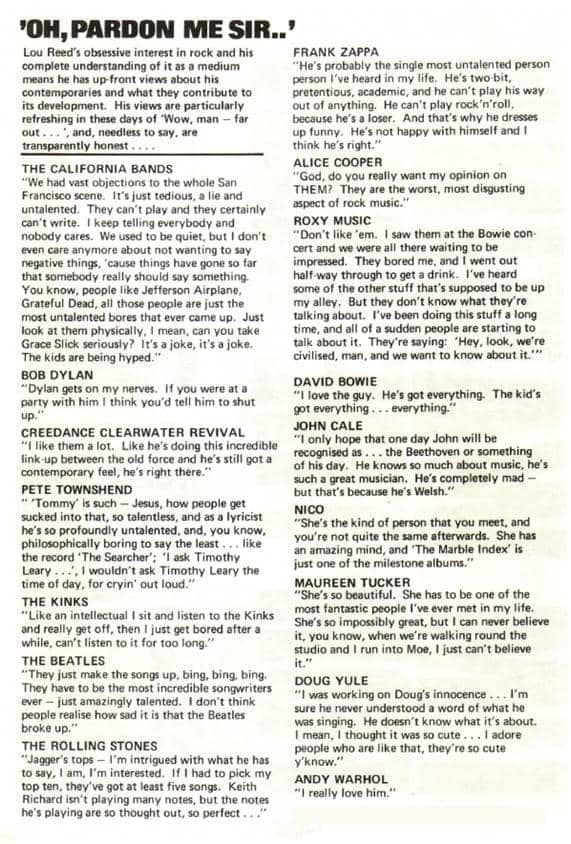
A signal characteristic of powerful criticism is that it keeps people talking years after the death of the critic himself. Think, for example, of Lester Bangs, who despite having been gone for nearly 40 years left behind judgments that still resonate through the halls of rock and roll. The vitality of his work wasn’t hurt by a tendency to get unusually close to some of his subjects, especially Lou Reed. “The things he wrote and sang and played in the Velvet Underground were for me part of the beginning of a real revolution in the whole scheme between men and women, men and men, women and women, humans and humans,” Bangs wrote in 1980.
Five years earlier, Bangs had called Reed “a completely depraved pervert and pathetic death dwarf,” as well as “a liar, a wasted talent, an artist continually in flux, and a huckster selling pounds of his own flesh. A panderer living off the dumbbell nihilism of a seventies generation that doesn’t have the energy to commit suicide.”
All this he meant, of course, in praise. Reed, for his part, displayed such elaborate disdain for Bangs that it could only have been motivated by respect. “What other rock artist would put up with an interview by the author of this article,” Bangs rhetorically asked, “read the resultant vicious vitriol-spew with approval, and then invite me back for a second round because of course he’s such a masochist he loved the hatchet in his back?”
A magazine page now circulating on Twitter collects Reed’s own opinions on a variety of other rock acts and countercultural figures of the 1960s and 70s. The Beatles, who’d just broken up? “The most incredible songwriters ever” (though Reed’s judgment of the Fab Four would change with time). The Rolling Stones? “If I had to pick my top ten, they’ve got at least five songs.” Creedence Clearwater Revival? “I like them a lot.” David Bowie? “The kid’s got everything… everything.” Fellow Velvets Doug Yule (“so cute”), Nico (“the kind of person that you meet, and you’re not quite the same afterwards”), and John Cale (“the next Beethoven or something”) get compliments; as for Andy Warhol, out of whose “factory” the band emerged, “I really love him.” (“Lou learned a lot from Andy,” wrote Bangs, “mainly about becoming a successful public personality by selling your own private quirks to an audience greedy for more and more geeks.”)
But as a connoisseur of the hatchet, Reed also plants a few himself. Of “California bands” like Jefferson Airplane and the Grateful Dead, he said “they can’t play and they certainly can’t write.” Nor, evidently, could the Who’s Pete Townshend: “as a lyricist he’s so profoundly untalented and, you know, philosophically boring to say the least.” Reed does “get off” on the Kinks, “then I just get bored after a while.” Alice Cooper represents “the worst, most disgusting aspect of rock music”; Roxy Music “don’t know what they’re talking about.” Frank Zappa is “the single most untalented person I’ve heard in my life. He’s two-bit, pretentious, academic, and he can’t play his way out of anything.” Yet at Zappa’s posthumous induction into the Rock and Roll Hall of Fame in 1995, the laudatory speech was delivered by none other than… Lou Reed. In rock, as in the other arts, resentment can become the seed of admiration.
Related Content:
Lou Reed Creates a List of the 10 Best Records of All Time
Hear Ornette Coleman Collaborate with Lou Reed, Which Lou Called “One of My Greatest Moments”
Based in Seoul, Colin Marshall writes and broadcasts on cities and culture. His projects include the book The Stateless City: a Walk through 21st-Century Los Angeles and the video series The City in Cinema. Follow him on Twitter at @colinmarshall or on Facebook.
Read More...The Queen’s Guard Pays Tribute to Meatloaf, Playing a Brass Version of “I’d Do Anything for Love (But I Won’t Do That)”
Marvin Lee Aday, aka Meatloaf, died late last week, reportedly after falling ill with Covid. At Buckingham Palace, the Queen’s Guard paid tribute to the musician and his 1993 hit “I’d Do Anything for Love (But I Won’t Do That)” on Sunday. It’s a nice touch.
Read More...How French Music Teacher Nadia Boulanger Raised a Generation of Composers: Aaron Copland, Leonard Bernstein, Quincy Jones, Philip Glass & More
One of my favorite quotes about creativity comes from 20th-century electric bass virtuoso Jaco Pastorius: “You don’t get better, you grow.” The aspiration to get “better” implies a category of “best” – a height artists frequently despair of ever reaching. Pastorius rejected a state of perfection, which would mean stopping, going no further, freezing in place. “One can always learn more. One can always understand more. The question is to provide yourself with confidence.” That wisdom comes not from Jaco Pastorius but from 20th century French music teacher and composer Nadia Boulanger, who might not have approved of the libertine jazz phenom’s life, given her aristocratic conservatism, but heartily endorsed his wisdom about continuous creative growth.
Although deeply rooted in a classical tradition which strove for perfection, Boulanger taught, influenced, and championed some of the century’s most avant-garde composers, such as Igor Stravinsky, who broke violently with the past, as well as jazz greats like Quincy Jones, who took her lessons in an entirely different modern pop direction.
Indeed, Boulanger presided over “one of the most expansive periods in music history, particularly for America,” says the narrator of the Inside the Score documentary above, “How Nadia Boulanger Raised a Generation of Composers.” Aaron Copland, Leonard Bernstein, Charles Strauss, and even minimalists like Philip Glass… all studied with Boulanger at some point in their career.
Boulanger also took on many female students, like composer Lousie Talma, but she preferred to work with men. (The famously stern teacher once complimented a female student by calling her “Monsieur”). She had little regard for Romantic ideas about “genius,” and certainly not all of her students were as talented as the list of famous names associated with her, but for those with aspirations in the classical world, a visit to Boulanger’s Paris apartment constituted a rite of passage. “Aaron Copland and Virgil Thomson led the way in the ’20s,” notes Red Bull Music Academy, “transforming Boulanger’s clear, tart tonal exactness into a new version of hardy Americana.” She became such a stalwart presence in the world of 20th century composition that composer Ned Rorem once joked, “Myth credits every American town with two things: a 10-cent store and a Boulanger student.”
At age 90, in 1977, Boulanger was well known as the most famous music teacher in the world when director Bruno Monsaingeon caught up with her for the nearly hour-long interview above. See the aged but still incredibly sharp (no pun intended) legend still teaching, and struggling to put into words exactly how it is that music keeps us growing past mathematical limitations. “Can one actually define that?” she asks mid-sentence while instructing a student. “I am using words such as tenderness or tension. It’s all wrong. It is what the music itself is.…”
Learn much more about Boulanger’s extraordinary life and work as a music teacher and composer in the documentary Madamoiselle: A Portrait of Nadia Boulanger, further up, and in our previous post at the link below.
Related Content:
A Minimal Glimpse of Philip Glass
Josh Jones is a writer based in Durham, NC. Follow him at @jdmagness
Read More...New Study Finds That Humans Are 33,000 Years Older Than We Thought

photo by Céline Vidal
“Where’re you from?” one character asks another on the Firesign Theatre’s classic 1969 album How Can You Be in Two Places at Once When You’re Not Anywhere at All. “Nairobi, ma’am,” the other replies. “Isn’t everybody?” Like most of the countless multi-layered gags on their albums, this one makes a cultural reference, presumably to the discoveries made by famed paleoanthropologists Louis and Mary Leakey over the previous 20 years. Their discovery of fossils in Kenya and elsewhere did much to advance the thesis that humankind evolved in Africa, and that the process was happening more than 1.75 million years before.
Like all scientific breakthroughs, the Leakeys’ work only prompted more questions — or rather, created more opportunities for refining and adding detail to the relevant body of knowledge. Subsequent digs all over Africa have produced further evidence of how far our species and its predecessors go back, and where exactly the evolutionary progress happened.
Just this month, Nature published a new paper on the “age of the oldest known Homo sapiens from eastern Africa.” These new findings about known fossils, originally discovered in southwestern Ethiopia in 1967, suggest that the time has come for another revision of the long pre-history of humanity.

photo by Céline Vidal
The paper’s authors, writes Reuters’ Will Dunham, “used the geochemical fingerprints of a thick layer of ash found above the sediments containing the fossils to ascertain that it resulted from an eruption that spewed volcanic fallout over a wide swathe of Ethiopia roughly 233,000 years ago.” These fossils “include a rather complete cranial vault and lower jaw, some vertebrae and parts of the arms and legs.” After their initial discovery by the late Richard Leakey, son of Louis and Mary (and a man genuinely from Nairobi, born and raised), the fossils buried by this prehistoric Vesuvius were previously believed to be “no more than about 200,000 years old.”
Dunham quotes the paper’s lead author, University of Cambridge volcanologist Celine Vidal, as saying this discovery aligns with “the most recent scientific models of human evolution placing the emergence of Homo sapiens sometime between 350,000 to 200,000 years ago.” Though Vidal and her team’s analysis of the ash’s geochemical composition has determined the minimum age of Omo I, as these fossils are known, the maximum age remains an open question. Or at least, it awaits the efforts of researchers to date the “ash layer below the sediment containing the fossils” and render a more precise estimate. And when that’s established, it will then, ideally, become material for the next big absurdist comedy troupe.
via Hyperallergic
Related Content:
Where Did Human Beings Come From? 7 Million Years of Human Evolution Visualized in Six Minutes
Richard Dawkins Explains Why There Was Never a First Human Being
How Humans Migrated Across The Globe Over 200,000 Years: An Animated Look
The Life & Discoveries of Mary Leakey Celebrated in an Endearing Cutout Animation
Based in Seoul, Colin Marshall writes and broadcasts on cities and culture. His projects include the book The Stateless City: a Walk through 21st-Century Los Angeles and the video series The City in Cinema. Follow him on Twitter at @colinmarshall or on Facebook.
Read More...How to Open a Door: A Finnish Instructional Video from 1979
Before you get started, turn on the subtitles by clicking the “CC” button on the lower right side of the video.
Did you know that one out of every three people opens a door incorrectly. You–yes, you–might be doing it all wrong. But this Finnish instructional video from 1979 has you covered. Watch and learn. This clip will–as they say–open so many doors to you…
If you would like to support the mission of Open Culture, consider making a donation to our site. It’s hard to rely 100% on ads, and your contributions will help us continue providing the best free cultural and educational materials to learners everywhere. You can contribute through PayPal, Patreon, and Venmo (@openculture). Thanks!
Related Content
Why Finland & Denmark Are Happier Than the United States
How to Open a Wine Bottle with Your Shoe
Read More...The Great Chicago Book Sale: Get Up to 90% Off Books from UChicago Press

FYI: The University of Chicago Press is running a big sale. They write:
Now through June 15th, 2022 you can get thought-provoking, independently published books for up to 90% off with code AD1958.
Our annual sale is one of the biggest university press book sales in the country. Every year we go through our overstock inventory and offer deep discounts on hundreds of books in subjects like history, fiction, art, science, travel, cooking, and more. Shop below or download a copy of our PDF catalog to get these amazing deals on scholarly and trade titles from the University of Chicago Press and our distributed publishers. Hurry! Supplies are limited on some books.
Enter the sale here and remember to use code AD1958 …
If you would like to support the mission of Open Culture, consider making a donation to our site. It’s hard to rely 100% on ads, and your contributions will help us continue providing the best free cultural and educational materials to learners everywhere. You can contribute through PayPal, Patreon, and Venmo (@openculture). Thanks!
Related Content
Global Warming: A Free Course from UChicago Explains Climate Change
Kurt Vonnegut Diagrams the Shape of All Stories in a Master’s Thesis Rejected by U. Chicago
Read More...Support Us
We're hoping to rely on loyal readers, rather than erratic ads. Please click the Donate button and support Open Culture. You can use Paypal, Venmo, Patreon, even Crypto! We thank you!

About Us

Open Culture scours the web for the best educational media. We find the free courses and audio books you need, the language lessons & educational videos you want, and plenty of enlightenment in between.
Advertise With Us
FREE UPDATES!
GET OUR DAILY EMAIL
Get the best cultural and educational resources on the web curated for you in a daily email. We never spam. Unsubscribe at any time.
FOLLOW ON SOCIAL MEDIA
Open Culture editor Dan Colman scours the web for the best educational media. He finds the free courses and audio books you need, the language lessons & movies you want, and plenty of enlightenment in between.
Advertise With Us

