The Fiendishly Complicated Board Game That Takes 1,500 Hours to Play: Discover The Campaign for North Africa

Monopoly is notoriously time-consuming. On the childhood Christmas I received my first copy of that Parker Brothers classic, my dad and I started a game that ended up spreading over two or three days. That may have had to do with my appreciation for Monopoly’s aesthetic far exceeding my grasp of its aim, and I’ve since realized that it can be played in about an hour. That’s still a good deal longer than, say, a game of checkers, but it falls somewhat short of the league occupied by The Campaign for North Africa — which is, in fact, a league of its own. Since its publication in 1979, it’s been known as the longest board game in existence, requiring 1,500 hours (or 62 days) to complete.
We are, of course, talking about a war game, and that genre has its own standards of complexity — standards The Campaign for North Africa leaves in the dust. “The game itself covers the famous WWII operations in Libya and Egypt between 1940 and 1943,” writes Kotaku’s Luke Winkle. “You’ll need to recruit 10 total players, (five Allied, five Axis,) who will each lord over a specialized division. The Front-line and Air Commanders will issue orders to the troops in battle, the Rear and Logistics Commanders will ferry supplies to the combat areas, and lastly, a Commander-in-Chief will be responsible for all macro strategic decisions over the course of the conflict. If you and your group meets for three hours at a time, twice a month, you’d wrap up the campaign in about 20 years.”
You can get an idea of what you’d be dealing with over those two decades in the video below from Youtuber Phasing Player, an overview that itself takes about an hour and a half. “Honestly, if I’m being straight-up here, this game does sound, broadly speaking, like a fun time,” he says, half an hour deep into the explanation. “Imagine setting up a giant map of Africa,” getting your friends together, “Sarah’s in charge of the air force and Jim is in charge of logistics. You have all these people in charge of different things, and you’re communicating strategies, and the commander-in-chief is formulating plans and doing all this stuff. That sounds like a real hoot, right?” Alas, “the big asterisk comes in when that good time has to last literally a thousand hours,” involving what another player quoted by Winkle calls “doing tedious calculations all the time.”
Those calculations necessitate paying close attention, on every single turn, to not just quantities like fuel reserves but the historically accurate size of the barrels containing those reserves. Note also that, as Winkle adds, “the Italian troops in World War II were outfitted with noodle rations, and in the name of historical dogma, the player responsible for the Italians is required to distribute an extra water ration to their forces, so that their pasta may be boiled.” The Campaign for North Africa’s designer, the late Richard Berg, claimed that the so-called “pasta rule” was a joke, and that the game’s fiendish overall complexity was in keeping with the style of the times, a “golden age” of war gaming with high sales and ever-escalating ambitions. As with so many other seemingly inexplicable artifacts of cultural history, one falls back on a familiar explanation: hey, it was the 70s.
via Kotaku
Related content:
Learn to Play Senet, the 5,000-Year Old Ancient Egyptian Game Beloved by Queens & Pharaohs
The Fear and Loathing in Las Vegas Board Game, Inspired by Hunter S. Thompson’s Rollicking Novel
Monopoly: How the Original Game Was Made to Condemn Monopolies & the Abuses of Capitalism
Download & Play the Shining Board Game
Board Game Ideology — Pretty Much Pop: A Culture Podcast #108
Based in Seoul, Colin Marshall writes and broadcasts on cities, language, and culture. His projects include the Substack newsletter Books on Cities, the book The Stateless City: a Walk through 21st-Century Los Angeles and the video series The City in Cinema. Follow him on Twitter at @colinmarshall or on Facebook.
Read More...Pink Floyd’s Debut on American TV, Restored in Color (1967)
Several years ago, Josh Jones took you inside Pink Floyd’s first appearance on American television. In 1967, after releasing their first album Piper at the Gates of Dawn, the band came to the States and made their unlikely TV debut on Dick Clark’s American Bandstand, performing “Apples and Oranges.” That’s the “third single and the final song Barrett wrote for the band before he suffered a psychotic break onstage and was replaced by David Gilmour.”
Our original post featured grainy black and white footage of the appearance. Above, you can watch a restored, colorized version that took nearly a year to create. According to the YouTube channel “Artist on the Border,” each “frame of the 3350 required frames had to be uploaded individually, downloaded again and individually named.” Enjoy the fruits of their labor above.
If you would like to support the mission of Open Culture, consider making a donation to our site. It’s hard to rely 100% on ads, and your contributions will help us continue providing the best free cultural and educational materials to learners everywhere. You can contribute through PayPal, Patreon, and Venmo (@openculture). Thanks!
Related Content
Pink Floyd Performs on US Television for the First Time: American Bandstand, 1967
Read More...Tate Kids Presents Introductions to Art Movements: Cubism, Impressionism, Surrealism & More
Tate Kids has a solid grasp on the sort of hands on art-related content that appeals to children — Make a mud painting! Make a spaghetti sculpture! Photo filter challenge!
Children of all ages, grown ups who skipped out on art history included, will benefit from their breakneck overviews of entire art movements.
Take cubism.
The Tate Kids’ animation, above, provides a solid if speedy overview, zipping through eight canvases, six artists, and explanations of the movement’s two phases — analytical and synthetic. (Three phases if you count Orphism, the abstract, cubist influenced painting style married artists Robert and Sonia Delaunay hatched around 1912.)
Given the intended audience, the fond friendship between the fathers of cubism, Georges Braque and Pablo Picasso looms large, with nary a peep about Picasso’s narcissism and misogyny. And it must be said that the narrator’s tone grates a bit — a bit too loud, a bit too wowed.
The Impressionists come off as the real cool kids, with a different narrator, and nifty collage animations that find Camille Pissarro throwing horns and a Mohawked Alfred Sisley as they reject the Salon’s insistence on “myths, battles and paintings of important people.”
Their defiant spirit is supported by criticism that most definitely has not stood the test of time:
Pure evil!
Wallpaper!
Like a monkey has got hold of a box of paints!
Kid presenters seize the controls for an introduction to the mid-century Japanese avant-garde movement, Gutai.
Their conclusion?
Smashing things up is fun!
As are manifestos:
Let’s bid farewell to the hoaxes piled up on the altars and in the palaces, the drawing rooms and the antique shops…Lock up these corpses in the graveyard!
Yay!
Those who are poorly equipped to stomach the narrators’ whizbang enthusiasm should take a restorative minutes to visit the museum oranges in hand, with 12-year-old Jaeda and 9‑year-old Fatimatu. Their calm willingness to engage with conceptual art is a tonic:
When I started art, I though art was just about making it perfect, but you don’t have to care what other people say. That could still mean an art to you.
Watch a Tate Kids Art Movements playlist on YouTube. Supplement what you’ve learned with a host of Tate Kids activities, coloring pages, games, quizzes, artist bios and a gallery of crowdsourced kid art.
Related Content
The Tate Digitizes 70,000 Works of Art: Photos, Sketchbooks, Letters & More
A 110-Year-Old Book Illustrated with Photos of Kittens & Cats Taught Kids How to Read
- Ayun Halliday is the Chief Primatologist of the East Village Inky zine and author, most recently, of Creative, Not Famous: The Small Potato Manifesto. Follow her @AyunHalliday.
Read More...Mystical Photographs Taken Inside a Cello, Double Bass & Other Instruments

“If God had designed the orchestra,” remarks a character in Rick Moody’s Hotels of North America, “then the cello was His greatest accomplishment.” I couldn’t agree more. The cello sounds sublime, looks stately… even the word cello evokes regal poise and grace. If orchestral instruments were chess pieces, the cello would be queen: shapely and dignified, prime mover on the board, majestic in symphonies, quartets, chamber pop ensembles, post rock bands….
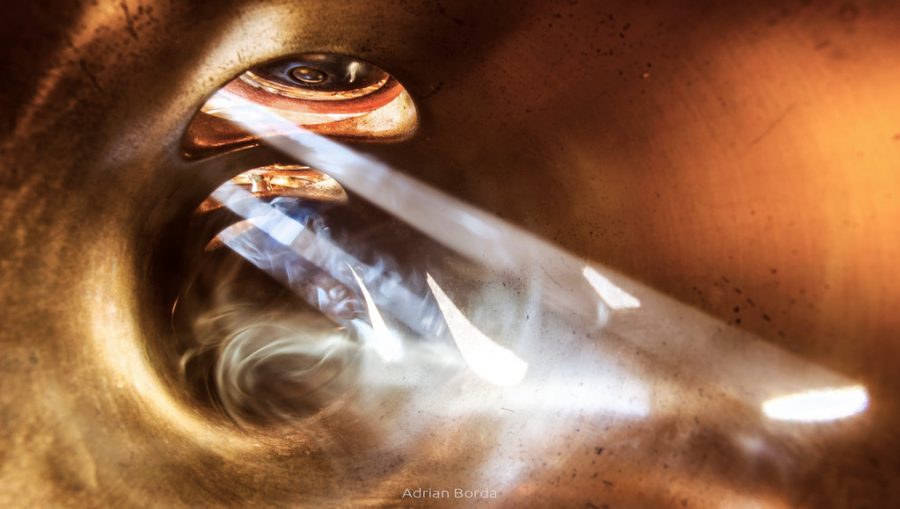
With all its many sonic and aesthetic charms, I didn’t imagine it was possible to love the cello more. Then I saw Romanian artist Adrian Borda’s magnificent photos taken from inside one. The photo above, Borda tells us at his Deviant Art page, was taken from inside “a very old French cello made in Napoleon’s times.” It looks like the belly of the HMS Victory mated with the nave of Chartres Cathedral. The light descending through the f‑holes seems of some divine origin.

Borda has also taken photos from inside an old double bass (above), as well as a guitar, sax, and piano. The stringed orchestral instruments, he says, yielded the best results. He was first inspired by a 2009 ad campaign for the Berliner Philharmoniker that “captured the insides of instruments,” writes Twisted Sifter, “revealing the hidden landscapes within.” Without any sense of how the art director created the images, Borda set about experimenting with methods of his own.
He was lucky enough to have a luthier friend who had a contrabass open for repairs. Later he traveled to Amiens, where he found the French cello, also open. “To achieve these shots,” Twisted Sifter notes, “Borda fit a Sony NEX‑6 camera equipped with a Samyang 8mm fisheye lens inside the instrument and then used a smart remote so he could preview the workflow on his phone.” Depending on the angle and the play of light within the instrument, the photos can look eerie, somber, ominous, or angelic—mirroring the cello’s expressive range.

Borda gives the cello interior shot above the perfect title “A Long, Lonely Time….” Its play of smoke and light is ghostly noir. His photo below, of the inside of a saxophone, pulls us into a haunted, alien tunnel. If you want to know what’s on the other side, consider the strange surrealist worlds of Borda’s main gig as a surrealist painter of warped fantasies and nightmares. Unlike these photos, his paintings are full of lurid, violent color, but they are also filled with mysterious musical motifs. See more of Borda’s interior instrument photos at Deviant Art and Twister Sifter.
Note: An earlier version of this post appeared on our site in 2018.
Related Content:
Watch a Luthier Birth a Cello in This Hypnotic Documentary
Why Violins Have F‑Holes: The Science & History of a Remarkable Renaissance Design
Hear the Amati “King” Cello, the Oldest Known Cello in Existence (c. 1560)
Josh Jones is a writer and musician based in Durham, NC. Follow him at @jdmagness
Read More...Space Sex is Serious Business: A Hilarious Short Animation Addresses Serious Questions About Human Reproduction in Space
Back in the late 80s, there was a rumor floating around that Earth Girls Are Easy.
40 some years of scientific and social advancement have shifted the conversational focus.
We’re just now beginning to understand that Space Sex is Serious Business.
Particularly if SpaceX CEO Elon Musk achieves his goal of establishing a permanent human presence on Mars.
Surely at some point in their long travels to and residence on Mars, those pioneers would get down to business in much the same way that rats, fruit flies, parasitic wasps, and Japanese rice fish have while under observation on prior space expeditions.
Meanwhile, we’re seriously lacking in human data.
A pair of human astronauts, Jan Davis and Mark Lee, made history in 1992 as the first married couple to enter space together, but NASA insisted their relations remained strictly professional for the duration, and that a shuttle’s crew compartment is too small for the sort of antics a nasty-minded public kept asking about.
In an interview with Mens Health, Colonel Mike Mullane, a veteran of three space missions, confirmed that a spacecraft’s layout doesn’t favor romance:
The only privacy would have been in the air lock, but everybody would know what you were doing. You’re not out there doing a spacewalk. There’s no reason to be in there.
Shortly after Davis and Lee returned to earth, NASA formalized an unspoken rule prohibiting husbands and wives from venturing into space together. It did little to squelch public interest in space sex.
One wonders if NASA’s rule has been rewritten in accordance with the times. Air lock aside, might same sex couples remain free to swing what hetero-normative marrieds (arguably) cannot?
This is but one of hundreds of space sex questions begging further consideration.
Some of the most serious are raised in Tom McCarten’s witty collage animation for FiveThirtyEight, above.
Namely how damaging will cosmic radiation and microgravity prove to human reproduction? As more humans toy with the possibility of leaving Earth, this question feels less and less hypothetical.
Maggie Koerth-Baker, who researched and narrates the animated short, notes that Musk portrayed the risks of radiation as minor during a presentation at the 67th International Astronautical Congress in Guadalajara, Mexico, and breathed not a peep as to the effects of microgravity.
Yet scientific studies of non-human space travelers document a host of reproductive issues including lowered libido, atypical hormone levels, ovulatory dysfunction, miscarriages, and fetal mutations.
On its webpage, NASA provides some information about the Reproduction, Development, and Sex Differences Laboratory of its Space Biosciences Research Branch, but remains mum on topics of pressing concern to, say, students in a typical middle school sex ed class.
Like achieving and maintaining erections in microgravity.
In Physiology News Magazine, Dr. Adam Watkins, associate professor of Reproductive and Developmental Physiology at the University of Nottingham, suggests that internal and external atmospheric changes would make such things, pardon the pun, hard:
Firstly, just staying in close contact with each other under zero gravity is hard. Secondly, as astronauts experience lower blood pressure while in space, maintaining erections and arousal are more problematic than here on Earth.
The exceptionally forthright Col Mullane has some contradictory first hand experience that should come as a relief to all humankind:
A couple of times, I would wake up from sleep periods and I had a boner that I could have drilled through kryptonite.
Related Content
Free Online Astronomy Courses
Watch Family Planning, Walt Disney’s 1967 Sex Ed Production, Starring Donald Duck
The Story Of Menstruation: Watch Walt Disney’s Sex Ed Film from 1946
- Ayun Halliday is the Chief Primatologist of the East Village Inky zine and author, most recently, of Creative, Not Famous: The Small Potato Manifesto. Follow her @AyunHalliday.
Read More...Bob Dylan Goes Punk on Late Night with David Letterman, Playing “Jokerman” with the Latino Punk Band, the Plugz (1984)
Listen to Bob Dylan’s studio albums all you like; you don’t know his music until you hear the live versions. That, at least, is the conclusion at which I’ve arrived after spending the better part of the past year listening through Dylan’s studio discography. This is not to put him into the mold of the Grateful Dead, whose studio albums come a distant second in importance to their vast body of live recordings. It was surely the songs preserved on the likes of Highway 61 Revisited, Blood on the Tracks, and Love and Theft, after all, that won Dylan the Nobel Prize. But in a sense he’s never stopped writing these same songs, often subjecting them to brazen stylistic and lyrical changes when he launches into them onstage.
This self-reinterpretation occasionally produces what Dylan’s fans consider a new definitive version. Perhaps the most agreed-upon example is “Jokerman,” the opener to his 1983 album Infidels (and the basis for one of his earliest MTV music videos), which he performed the following year on the still-new Late Night with David Letterman.
As Vulture’s Matthew Giles puts it, Letterman was fast becoming “a comedy sensation, bringing a new level of sarcasm, irony, and Bud Melman-centric humor to a late-night format still reliant on the smooth unflappability of Johnny Carson.” Dylan had been going in the other direction, “having frustrated his audience with the musically slick, lyrically hectoring series of evangelical Christian albums that he’d released in the late 70s and early 80s.”
By 1984, “Dave was far more of a counterculture hero than Bob.” But Dylan had been surreptitiously preparing for his next musical transformation: many were the nights he would “leave his Malibu home and slip into shows by the likes of L.A. punk stalwarts X, or check out the Santa Monica Civic Center when the Clash came to town.” For accompaniment on the Letterman gig he brought drummer J.J. Holiday, as well as Charlie Quintana and bassist Tony Marsico of the LA punk band the Plugz, with whom he’d been spent the previous few months jamming. It isn’t until they take Letterman’s stage that Dylan tells the band what to open with: bluesman Sonny Boy Williamson’s “Don’t Start Me Talking.”
Just above, you can see Dylan’s rehearsal for the Letterman show. It features five tracks–“I Once Knew a Man,” “License to Kill,” “Treat Her Right,” “My Guy,” and a rendition of “Jokerman” that turns the original’s reggae into stripped-down, hard-driving rock. The stylistic change seems to infuse the 42-year-old Dylan with a new sense of musical vitality. As for the song itself, its lyrics — cryptic even by Dylan’s standards — take on new meanings when charged by the young band’s energy. But even in this highly contemporary musical context, Dylan keeps it “classic” by bringing out the harmonica for a final solo, though not without some confusion as to which key he needed. If anything, that mix-up makes the song even more punk — or maybe post-punk, possibly new wave, but in any case thoroughly Dylan.
Related content:
Bob Dylan & The Grateful Dead Rehearse Together in Summer 1987: Hear 74 Tracks
How Bob Dylan Created a Musical & Literary World All His Own: Four Video Essays
Based in Seoul, Colin Marshall writes and broadcasts on cities, language, and culture. His projects include the Substack newsletter Books on Cities, the book The Stateless City: a Walk through 21st-Century Los Angeles and the video series The City in Cinema. Follow him on Twitter at @colinmarshall or on Facebook.
Read More...Google’s UX Design Professional Certificate: 7 Courses Helps Prepare Students for an Entry-Level Job in 6 Months
During the pandemic, Google launched a series of Career Certificates that will “prepare learners for an entry-level role in under six months.” One such certificate focuses on User Experience Design, or what’s called UX Design, the process design teams use to create products that provide meaningful experiences to users.
Offered on the Coursera platform, the User Experience (UX) Design Professional Certificate features seven courses, including the Foundations of User Experience, Start the UX Design Process, Build Wireframes and Low-Fidelity Prototypes, and Conduct UX Research and Test Early Concepts. In total, this program “includes over 200 hours of instruction and hundreds of practice-based activities and assessments that simulate real-world UX design scenarios and are critical for success in the workplace. The content is highly interactive and developed by Google employees with decades of experience in UX design.” Upon completion, students can directly apply for jobs with Google and over 130 U.S. employers, including Walmart, Best Buy, and Astreya. You can start a 7‑day free trial and explore the courses. If you continue beyond that, Google/Coursera will charge $39 USD per month. That translates to about $235 after 6 months.
Explore the User Experience (UX) Design Professional Certificate by watching the video above. Learn more about the overall Google career certificate initiative here. And find other Google professional certificates here.
Note: Open Culture has a partnership with Coursera. If readers enroll in certain Coursera courses and programs, it helps support Open Culture.
Related Content:
Read More...Read the Original Serialized Edition of James Joyce’s Ulysses (1918)
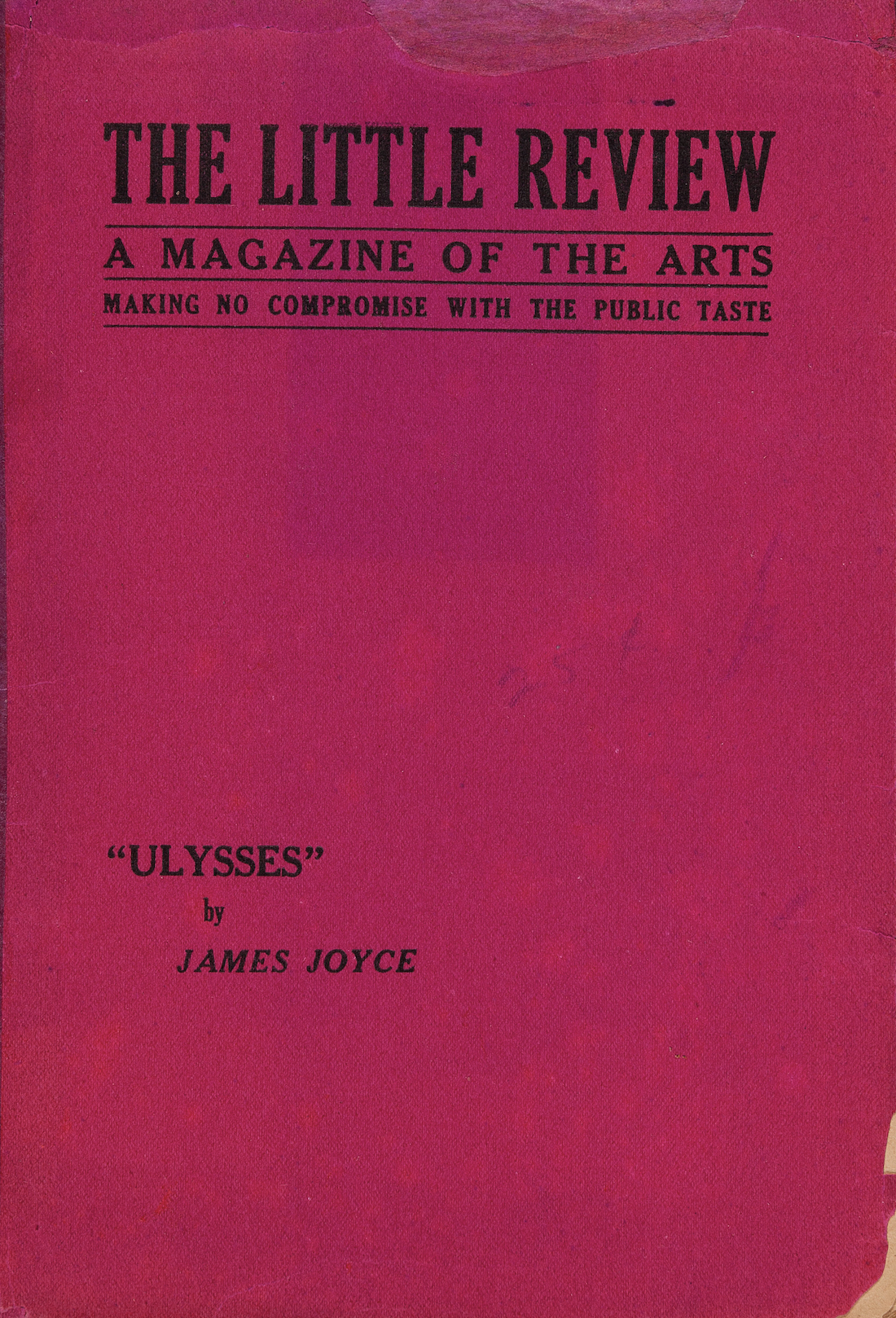
In the second decade of the 20th century, American editor Margaret C. Anderson published The Little Review, a monthly literary journal of modernist and experimental prose, poetry, and art. Four years into its existence, at the beginning of 1918, Anderson announced to her readers this:
“I have just received the first three instalments [sic] of James Joyce’s new novel which is to run serially in The Little Review, beginning with the March number.
It is called “Ulysses”.
It carries on the story of Stephen Dedalus, the central figure in ‘A Portrait of the Artist as a Young Man”.
It is, I believe, even better than the “Portrait”.
So far it has been read by only one critic of international reputation. He says: “It is certainly worth running a magazine if one can get stuff like this to put in it. Compression, intensity. It looks to me rather better than Flaubert”.
This announcement means that we are about to publish a prose masterpiece.”
February 2, 2022 marked the 100th anniversary of Ulysses, the day on which the full novel, first serialized in The Little Review, was published. Joyce, like many of The Little Review’s British and European writers, came to Anderson through her fellow editor Ezra Pound. Anderson might have sensed the greatness that was to come and she knew the danger in that greatness. In the end, publishing Ulysses would make her an enemy of the state.
Over at the Modernist Journals Project, you can read every single issue of The Little Review (and other such magazines) to place this revolutionary novel in context. The March 1918 issue which begins the journey of Dedalus and Leopold Bloom also features works by Wyndham Lewis and Ezra Pound, Ford Madox Ford, Jessica Dismorr, and Arthur Symons; letters (and some hate mail) from readers; advertisements for other literary magazines like The Quill, The Pagan, and The Egoist; ads for restaurants in Greenwich Village, and one for the Berlitz School of Languages; and a final appeal for more readers.
The most interesting of these sections is Pound’s screed against American obscenity laws. The Little Review had already had an issue confiscated by the US Post Office. In 1917, a Wyndham Lewis story about a soldier who gets a girl pregnant and abandons her was declared obscene, both for “lewdness” and its anti-war stance. Pound suspected the government was targeting Anderson and her co-editor (and lover) Jane Heap for their support of anarchists Emma Goldman and Alexander Berkman, along with their anti-war stances.
The Wyndham Lewis incident had made it difficult for Anderson and Heap to find a publisher, so they knew some of the risks in beginning the serial. Soon enough they ran into trouble. Ulysses consists of 18 chapters or “Episodes”. The US government seized the issues featuring Episode 8 (“Lestrygonians”), Episode 9 (“Scylla and Charybdis”), and Episode 12 (“Cyclops”) and burned them. But it was Episode 13, “Nausicaa,” that led to charges being filed against the publishers. The chapter, which features a girl exposing herself and Leopold Bloom masturbating to orgasm (but written in such a, well, Joycean way that most would just miss it), was too much for some.
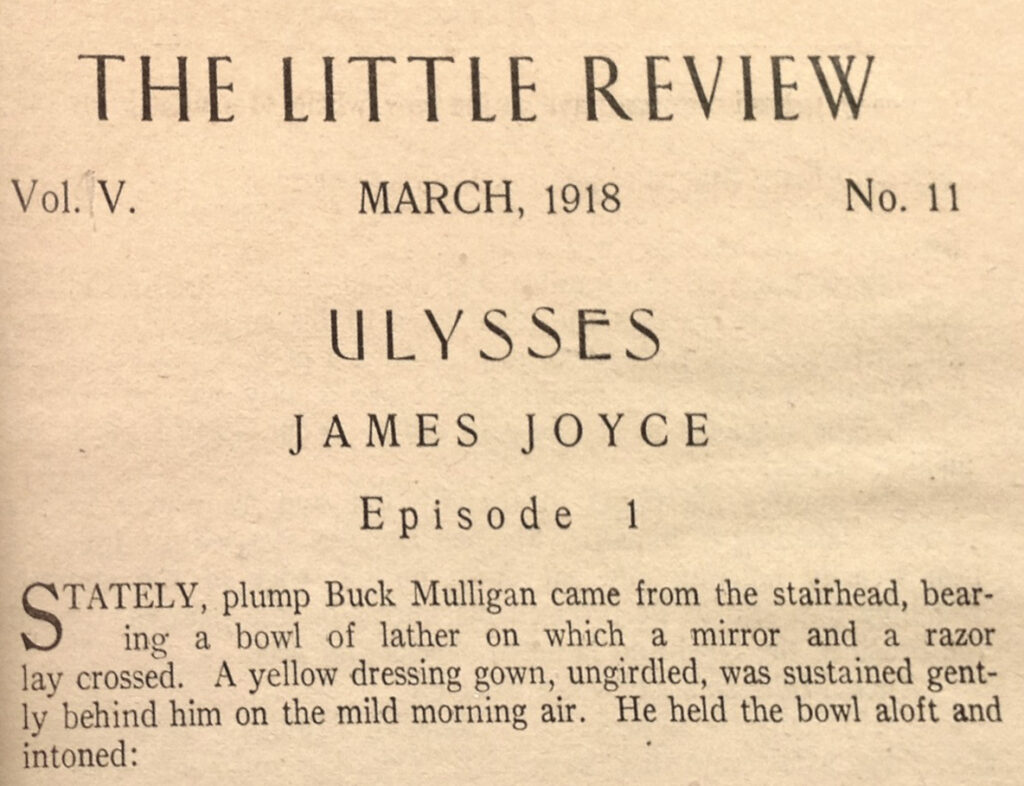
The trial that followed was a travesty, including a judge ruling that the offensive sections of “Nausicaa” not be read out loud because a woman was present. When it was pointed out that the woman was the publisher Anderson herself, he declared “she didn’t know the significance of what she was publishing”. Anderson and Heap were found guilty, forced to discontinue publishing “Ulysses” and fined one hundred dollars.
The Little Review printed a section of Episode 14 (“Oxen of the Sun”) and then stopped. Anderson thought of giving up the magazine, but turned over control to Heap. The magazine continued publishing until 1929, but removed their motto: “Making No Compromise with the Public Taste.”
James Joyce did not stop, however, and Sylvia Beach—an ex-pat living in Paris and running the bookstore Shakespeare and Co.—published the full novel in 1922. Americans would have to wait one more year, 1923, to read this “obscene” novel.
Anderson was correct however—-she had a major role in promoting this “prose masterpiece.” And one hundred years later, Puritanical Americans are still banning and burning books, which is only resulting, like it did for Joyce’s novel, in sending the works into the Best Seller lists.
Related content:
James Joyce’s Ulysses: Download as a Free Audio Book & Free eBook
James Joyce’s Crayon Covered Manuscript Pages for Ulysses and Finnegans Wake
Ted Mills is a freelance writer on the arts who currently hosts the Notes from the Shed podcast and is the producer of KCRW’s Curious Coast. You can also follow him on Twitter at @tedmills, and/or watch his films here.
Read More...Everything You Ever Wanted to Know about the Bialetti Moka Express: A Deep Dive Into Italy’s Most Popular Coffee Maker
Which coffee maker is most deeply embedded in American culture? I would nominate the humble Mr. Coffee, a device referenced on Cheers as well as Seinfeld, in the work of Raymond Carver as well as that of the Bloodhound Gang (to say nothing of the 1970s mass-media phenomenon that was its commercials starring Joe DiMaggio). But I would also urge my fellow Americans to ask themselves when last they actually used one, or at least used one to satisfying results. Italy, by contrast, knows what it is to take a coffee maker to heart. As one study found, nine out of ten Italian households possesses, in one form or another, the same basic model: the Bialetti Moka Express.
As Ted Mills wrote here with confidence last month, “many an Open Culture reader has a Bialetti Moka Express in their kitchen. I know I do, but I must add that I knew little about its history and apparently even less about how to properly use one.” Enter coffee Youtuber and The World Atlas of Coffee author James Hoffmann, whose introductory video proved popular enough to launch a mini-series that takes a deep dive into the mechanics and variations on the nearly 90-year-old “moka pot.”
In the second episode, just above, Hoffman performs a series of experiments varying elements of the simple device — starting temperature, grind size, heat power — in order to determine how it makes the best cup of coffee.
In episode three, Hoffman (who clearly knows a thing or two about not just coffee, but how to name a Youtube video to algorithmic advantage) refines “the ultimate moka pot technique.” Much depends, of course, on factors like what sort of beans you buy, as well as subjective considerations like how you want your coffee to taste — your preferred “flavor profile,” as they now say. The longtime moka pot user will inevitably feel his/her way to his/her own idiosyncratic procedure and set of accessories, and will more than likely also accrue a formidable collection of moka pots themselves. Here Hoffman lines up ten of them, half of which are just different sizes of the classic Moka Express, its silhouette recognizable at any scale.
Less familiar models take center stage in the fourth episode, “The Moka Pot Variations.” In it Hoffman puts to the test the Bialetti’s double-cream espresso-making Brikka; their cappuccino-capable Mukka; the tiny, discontinued Cuor di Moka, with its correspondingly avid fan base; and finally something called the Kamira, which looks less like a coffee maker than a piece of recycled industrial art. Even apart from these, a variety of companies now make a variety of moka pots, every single one of which has no doubt at least a few serious coffee drinkers swearing by it. I myself have a weakness for Bialetti’s Moka Alpina; whether it makes a superior brew I couldn’t say, but the jauntiness of that Tyrolean feather is hardly debatable.
Related content:
Life and Death of an Espresso Shot in Super Slow Motion
How to Make the World’s Smallest Cup of Coffee, from Just One Coffee Bean
The Birth of Espresso: How the Coffee Shots The Fuel Our Modern Life Were Invented
Based in Seoul, Colin Marshall writes and broadcasts on cities and culture. His projects include the book The Stateless City: a Walk through 21st-Century Los Angeles and the video series The City in Cinema. Follow him on Twitter at @colinmarshall or on Facebook.
Read More...In 1922, a Novelist Predicts What the World Will Look Like in 2022: Wireless Telephones, 8‑Hour Flights to Europe & More
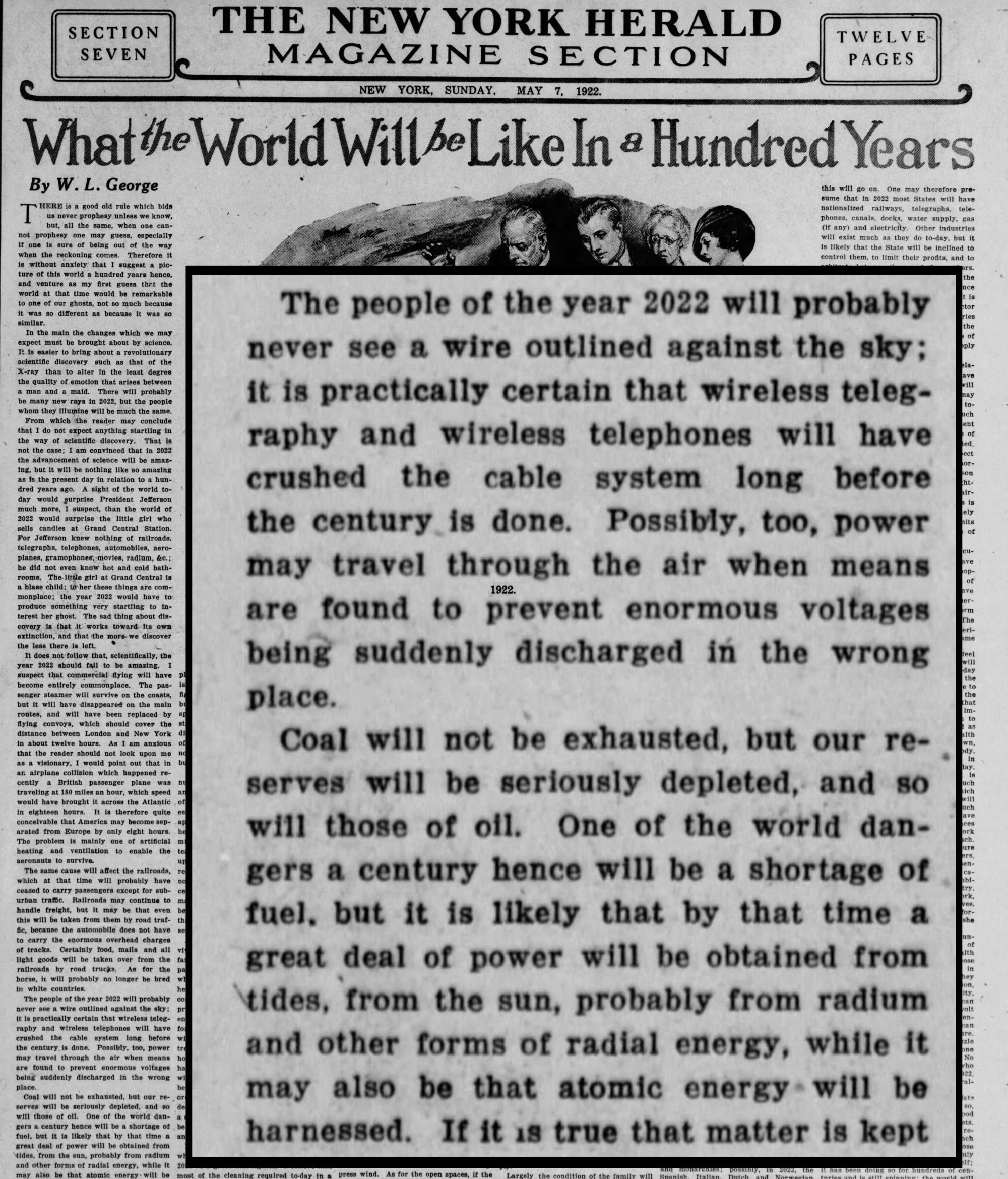
A century ago, the popular English novelist W.L. George sat down and put his mind to envisioning the world we live in today. That world has not, alas, turned out to be one in which his books are much read, but in his day a great many readers were moved by his social cause-driven fiction and reportage. One might compare him to Upton Sinclair, his contemporary on the other side of the Atlantic. In the Paris-born-and-raised George’s ancestral homeland, George Orwell described him as an author of what G.K. Chesterton called “good bad books,” singling out for praise his 1920 novel Caliban amid the “shoddy rubbish” of his wider oeuvre.
Still even authors of rubbish — and perhaps especially authors of rubbish — can sense the shape of things to come. For its edition of May 7, 1922, the New York Herald commissioned George to share that sense with their readers. In response he described a world in which “commercial flying will have become entirely commonplace,” reducing the separation of America and Europe to eight hours, and whose passenger steamers and railroads will have consequently fallen into obsolescence. “Wireless telegraphy and wireless telephones will have crushed the cable system,” resulting in generations who’ll never have seen “a wire outlined against the sky.”

That goes for the transmission of electricity as well, since George credits (a bit hastily, it seems) the possibility of wireless power systems of the kind researched by Nikola Tesla. In 2022, coal will take a distant backseat to the tides, the sun, and radium, and “it may also be that atomic energy will be harnessed.” As for the cinema, “the figures on the screen will not only move, but they will have their natural colors and speak with ordinary voices. Thus, the stage as we know it to-day may entirely disappear, which does not mean the doom of art, since the movie actress of 2022 will not only need to know how to smile but also how to talk.”
Other women, however, have proven just as capable as George had imagined: “All positions will be open to them and a great many women will have risen high. The year 2022 will probably see a large number of women in Congress, a great many on the judicial bench, many in civil service posts, and perhaps some in the President’s Cabinet.” Georges foresees the birth-control pill, but also the “pill lunch.” Unlike some reformers, he hesitates to declare the abolition of the family, but he does imagine the “majority of mankind” occupying modular homes in high-rise communal dwellings (“I have a vision of walls, furniture, and hangings made of more or less compressed papier-mâché”), all gathered in climate-controlled cities set under glass.
On the whole, in 2022, “the advancement of science will be amazing, but it will be nothing like so amazing as is the present day in relation to a hundred years ago.” Indeed, he suspects that a glimpse of our reality wouldn’t much surprise “the little girl who sells candies at Grand Central Station.” It could even be dull, what with complete settlement and development leaving “no more opportunity in America than there is in England to-day.” In 1922, George could write that “in fiction, America leads the world by sincerity, faith and fearlessness,” and believe that “in 2022 American literature will be a literature of culture. The battle will be over and the muzzle off. There will be no more things one can’t say, and things one can’t think.” Whatever the inspirations of his prophecy, they must not have told him about social media.
You can find a copy of George’s original article over at the Library of Congress.
If you would like to support the mission of Open Culture, consider making a donation to our site. It’s hard to rely 100% on ads, and your contributions will help us continue providing the best free cultural and educational materials to learners everywhere. You can contribute through PayPal, Patreon, and Venmo (@openculture). Thanks!
Related Content:
In 1900, Ladies’ Home Journal Publishes 28 Predictions for the Year 2000
In 1926, Nikola Tesla Predicts the World of 2026
Based in Seoul, Colin Marshall writes and broadcasts on cities and culture. His projects include the book The Stateless City: a Walk through 21st-Century Los Angeles and the video series The City in Cinema. Follow him on Twitter at @colinmarshall or on Facebook.
Read More...Support Us
We're hoping to rely on loyal readers, rather than erratic ads. Please click the Donate button and support Open Culture. You can use Paypal, Venmo, Patreon, even Crypto! We thank you!

About Us

Open Culture scours the web for the best educational media. We find the free courses and audio books you need, the language lessons & educational videos you want, and plenty of enlightenment in between.
Advertise With Us
FREE UPDATES!
GET OUR DAILY EMAIL
Get the best cultural and educational resources on the web curated for you in a daily email. We never spam. Unsubscribe at any time.
FOLLOW ON SOCIAL MEDIA
Open Culture editor Dan Colman scours the web for the best educational media. He finds the free courses and audio books you need, the language lessons & movies you want, and plenty of enlightenment in between.
Advertise With Us


