A 10-Course Introduction to Data Science from Johns Hopkins
Data is now everywhere. And those who can harness data effectively stand poised to innovate and make impactful decisions. This holds true in business, medicine, healthcare, education and other spheres of life.
Enter the 10-course Introduction to Data Science from Johns Hopkins. Offered on the Coursera platform, this course sequence covers “the concepts and tools you’ll need throughout the entire data science pipeline, from asking the right kinds of questions to making inferences and publishing results.” The program includes courses covering The Data Scientist’s Toolbox, R Programming, Getting and Cleaning Data, Developing Data Products and more. There’s also a Capstone Project where students can build a data product using real-world data.
Students can formally enroll in the Introduction to Data Science specialization and receive a certificate for each course they complete–a certificate they can share with prospective employers and their professional networks. They’ll also leave with a portfolio demonstrating mastery of the material covered in the sequence. Hopkins estimates that most learners can complete the sequence in 3–7 months, during which time students will be charged $49 per month.
Alternatively, students can audit individual courses for free. When you enroll in a course, look carefully for the Audit option. Note: Auditors cannot receive a certificate for each completed course.
If would like to formally enroll in the Introduction to Data Science sequence, you can start a 7‑Day Free Trial and size things up here.
Open Culture has a partnership with Coursera. If readers enroll in certain Coursera courses and programs, it helps support Open Culture.
Related Content:
Read More...William Blake’s 102 Illustrations of The Divine Comedy Collected in a Beautiful Book from Taschen
In his book on the Tarot, Alejandro Jodorowsky describes the Hermit card as representing mid-life, a “positive crisis,” a middle point in time; “between life and death, in a continual crisis, I hold up my lit lamp — my consciousness,” says the Hermit, while confronting the unknown. The figure recalls the image of Dante in the opening lines of the Divine Comedy. In Mandelbaum’s translation at Columbia’s Digital Dante, we see evident similarities:
When I had journeyed half of our life’s way,
I found myself within a shadowed forest,
for I had lost the path that does not stray.Ah, it is hard to speak of what it was,
that savage forest, dense and difficult,
which even in recall renews my fear:so bitter—death is hardly more severe!
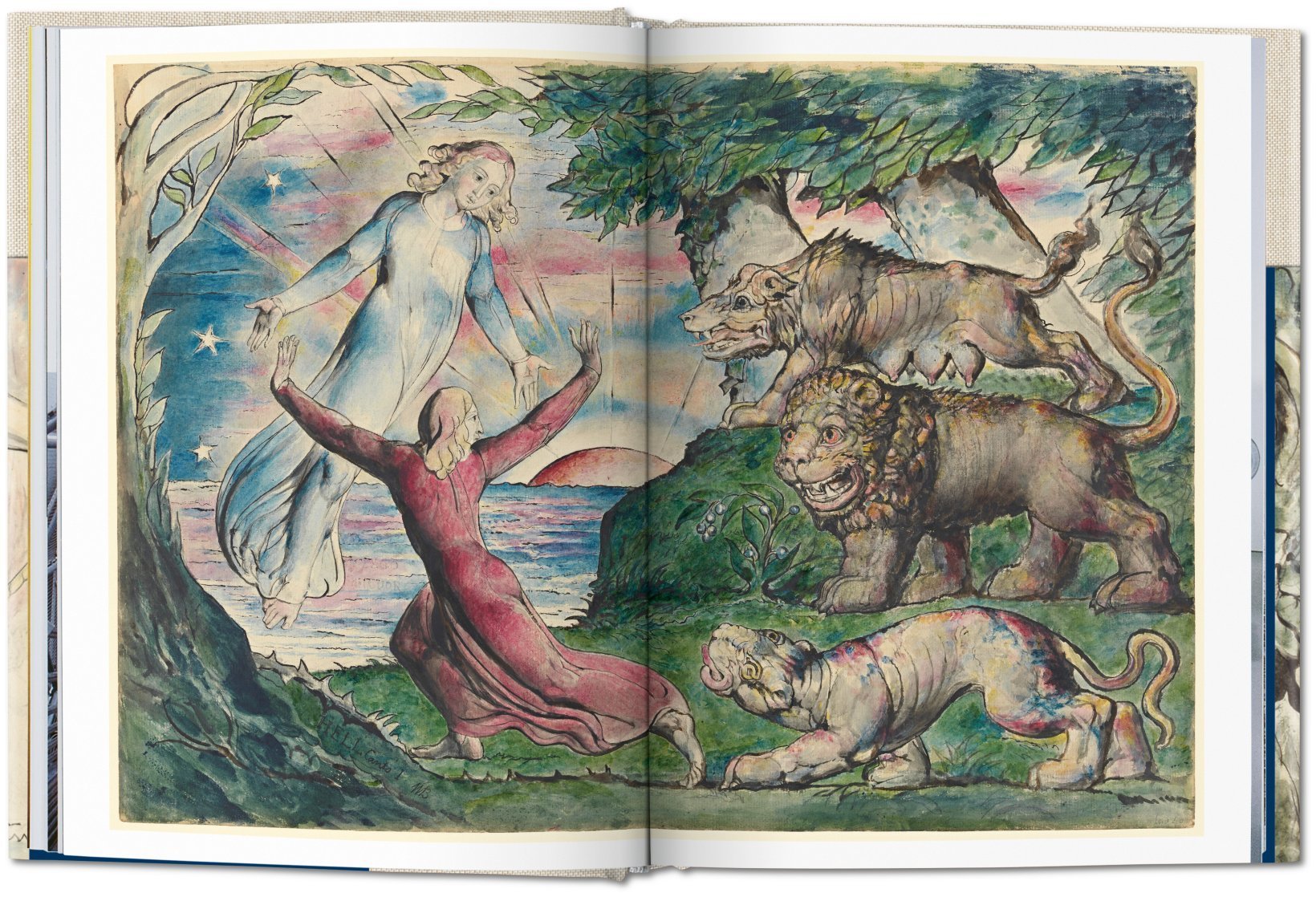
This is not to say the literary Dante and occult Hermeticism are historically related; only they emerged from the same matrix, a medieval Catholic Europe steeped in mysterious symbols. The Hermit is a portent, messenger, and guide, an aspect represented by the poet Virgil, whom William Blake — in 102 watercolor illustrations made between 1824 and 1827 — dressed in blue to represent spirit, while Dante wears his usual red — the color, in Blake’s system, of experience.
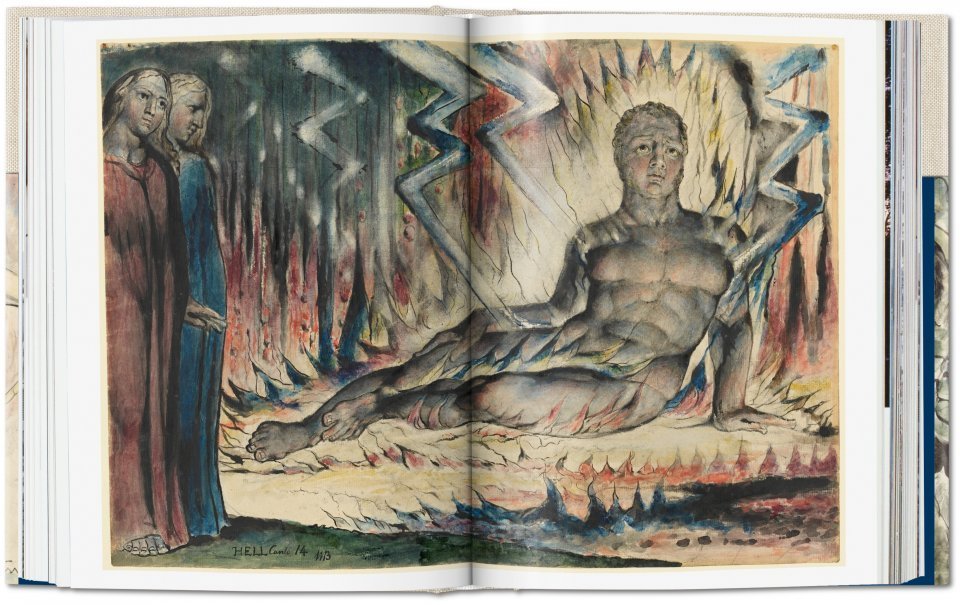
Blake did not read the Divine Comedy as a medieval Catholic believer but as a visionary 18th and 19th century English artist and poet who invented his own religion. He “taught himself Italian in order to be able to read the original” and had a “ complex relationship” with the text, writes Dante scholar Silvia De Santis.
His interpretation drew from a “widespread ‘selective use’” of the poet,” dating from 16th century English Protestant readings which saw Dante’s satirical skewering of corrupt individuals as indictments of the institutions they represent — the church and state for which Blake had no love.
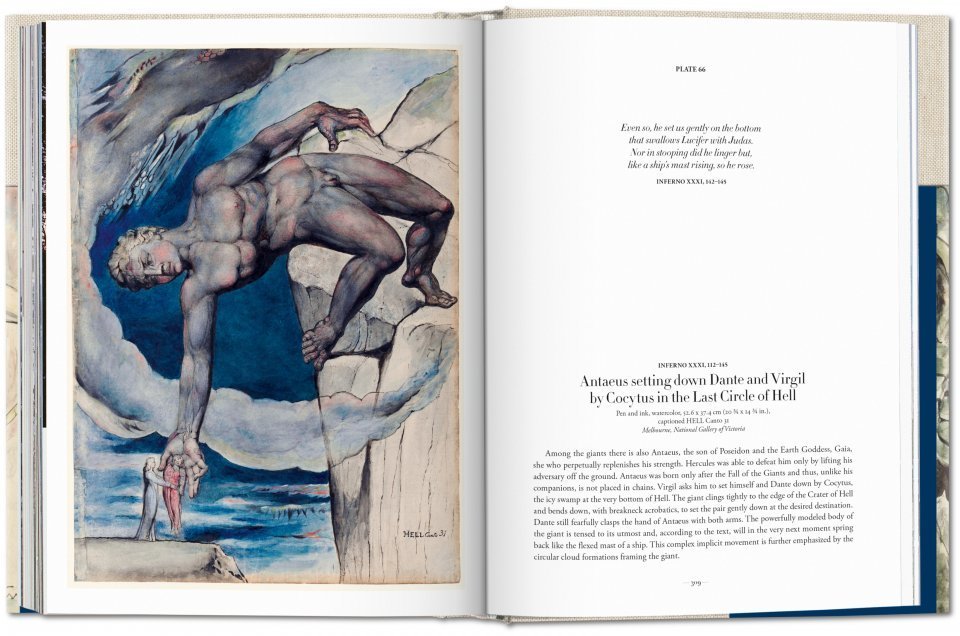
Approaching the project at the end of his life, not the middle, Blake drew primarily on themes that Dante scholar Robin Kilpatrick describes as a “searching analysis of all of the political and economic factors that had destroyed Florence .… Hell is a diagnosis of what, in so many ways, can prove to be divisive in human nature. Sin, for Dante, is not transgression of an ordinary kind … against some law… it’s a transgression against love.”
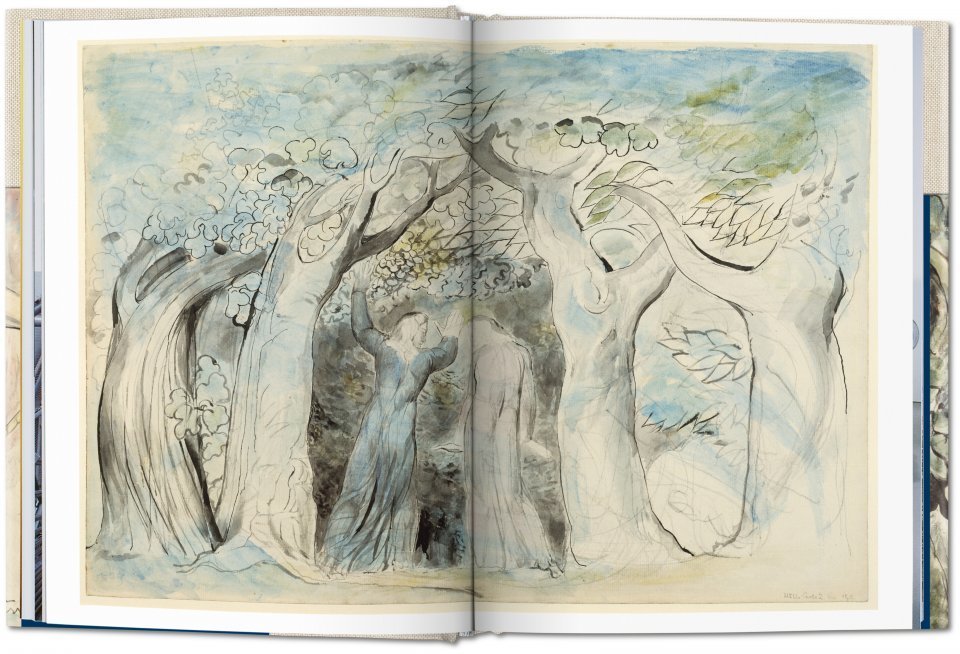
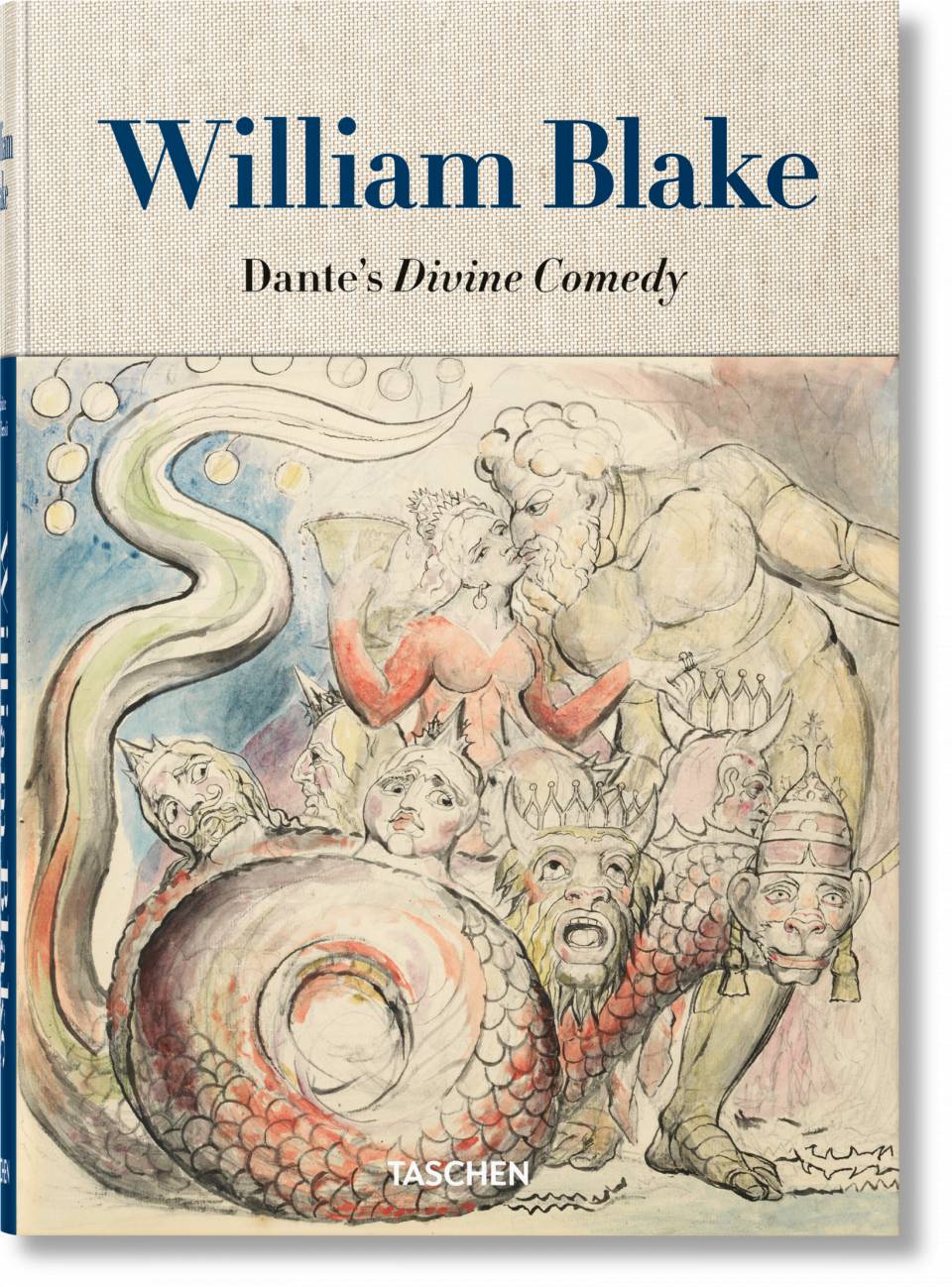
Blake died before he could finish the series, commissioned by his friend John Linnell in 1824. He had intended to engrave all 102 illustrations, conceived, he wrote, “during a fortnight’s illness in bed.” You can see all of his stunning watercolors online here and find them lovingly reproduced in a new book published by Taschen with essays by Blake and Dante experts, helping contextualize two poets who found a common language across a span of 500 years. The book, originally priced at $150, now sells for $40. A beautiful XL edition sells at a higher price.
Related Content:
A Digital Archive of the Earliest Illustrated Editions of Dante’s Divine Comedy (1487–1568)
Josh Jones is a writer and musician based in Durham, NC. Follow him at @jdmagness.
Read More...Exercise Extreme Mindfulness with These Calming Zen Rock Garden Videos
The Internet is a place where the ancient past and the modern and trend-driven can collide and produce wondrous things. The concept of ASMR (autonomous sensory meridian response) took off in 2007, describing the pleasurable tingling response from various stimuli, such as whispering, or quietly being read a story, or listening to the closely mic’d sounds of paper. There are currently some 13 million ASMR video channels on YouTube.
Meanwhile, the idea of the Zen garden is about 800 years old, and at the center of its care and upkeep is a quiet, mindful practice that mirrors meditation. Unlike classic Western gardens that brought symmetry and mathematics into their design, Japanese gardens recreated a sort of curated chaos. A Zen garden takes this idea further, making its centerpiece a rock garden that is raked into patterns to mimic water. They are also small and meant for individual contemplation.
Artist-Designer Yuki Kawae combines the two with his series of videos on his YouTube channel. In close frames, he takes his rakes and creates patterns and fractals in sand around a series of stones. The sound of sand and rake and ringing bowl make for a very meditative experience. The confidence and beauty of his steady hand are mesmerizing, but you could also just listen to the audio.
Kawae is based in the Bay Area and told Colossal that the practice came out of the anxiety of life in 2019:
I was quite overwhelmed with day-to-day tasks and what are the ‘expected’ next steps in life…One day, I realized all of those thoughts were completely gone when I was gardening, pruning, watering, and re-potting the soil. That process let me be clear-minded somehow, and it was very calming and refreshing.
You don’t have to be a Zen monk to realize the calming effects of gardening—-ask anybody who tends to their garden weekly. But there is something special in the minimalism of the sand and the rake and the rock. Kawae’s “garden” is only coffee table sized.
Sand is also a good material in which to practice mutability, says Kawae: “All the zen garden patterns are not permanent, and they get erased to start a new one. It is temporary like many things in life. It taught me about what not to overthink as what I am stressing about may also be temporary.”
Meanwhile on YouTube there are others working on Zen gardens. The Kikiyaya Forest Dwelling and Zen Garden is actually located in the Netherlands and the owner posts her raking adventures on YouTube.
And for those who would like to hear from an actual Zen master and gardener, this hour-long presentation from Shunmyo Masuno—one of Japan’s leading landscape architects and an 18th-generation Zen Buddhist priest—will fill in the philosophical details.
I’ll leave the last word to 13th century Japanese Zen master, writer, poet, and philosopher, Dogen Zenji: “Working with plants, trees, fences, and walls, if they practice sincerely they will attain enlightenment.”
See you in the garden!
via Colossal
Related Content:
What Is a Zen Koan? An Animated Introduction to Eastern Philosophical Thought Experiments
Take a Break from Your Frantic Day & Let Alan Watts Introduce You to the Calming Ways of Zen
The Zen of Bill Murray: I Want to Be “Really Here, Really in It, Really Alive in the Moment”
Ted Mills is a freelance writer on the arts who currently hosts the Notes from the Shed podcast and is the producer of KCRW’s Curious Coast. You can also follow him on Twitter at @tedmills, and/or watch his films here.
Read More...Paul McCartney vs. Brian Wilson: A Rivalry That Inspired Pet Sounds, Sgt. Pepper, and Other Classic Albums
One could argue that the album as we know it didn’t exist before the mid-1960s. As a medium of recorded music, the “long-playing” 33 1⁄3 rpm record was introduced in 1948, and the market proved quick to take it up. A great many musicians recorded LPs over the following decade and a half, but these were produced and consumed primarily as bundles of individual songs. The heyday of radio, which lasted into the 1950s, imbued the single — especially the hit single — with enormous cultural power. Through that zeitgeist rose the Liverpudlian quartet known as the Beatles, the very band who would go promptly on to transcend it.
In this version of music history, the first true album was the Beatles’ Rubber Soul. When it came out in 1965, it introduced to a vast listening public the possibilities of the LP as a coherent art form in itself. At that point the Beatles had already been making hit records for a few years, as, on the other side of the pond, had a southern Californian singing group called the Beach Boys.
Given each act’s ever-growing prominence and the unprecedented internationalization of pop culture then underway, it was only a matter of time before their musical worlds would collide. Decades later, Beach Boys mastermind Brian Wilson would remember his first listen to Rubber Soul as follows: “It just totally took my mind away” — a sensation back then sought along many avenues, chemical as well as cultural.
Though Paul McCartney has credited the effervescence of the 1960s to “drugs, basically,” the music he and fellow Beatles made was also enhanced by friendly competition with the Beach Boys, as detailed in the Jeffrey Stillwell video essay above. To Rubber Soul the Beach Boys responded with Pet Sounds. “Oh dear me, this is the album of all time,” McCartney later recalled thinking upon hearing it. “What the hell are we going to do?” Their return volley took the form of Sgt. Pepper’s Lonely Heart’s Club Band, which in turn sent Wilson into an Icarus-like flight toward the ill-fated Smile project. More than half a century later, some say we live in a post-album era. Even if so, the heights of ambition to which the Beatles and the Beach Boys put each other inspire artists still today — and their fruits will be listened to as long as recorded music exists in any form at all.
Related Content:
How the Beach Boys Created Their Pop Masterpieces: “Good Vibrations,” Pet Sounds, and More
How The Beatles’ Sgt. Pepper’s Lonely Hearts Club Band Changed Album Cover Design Forever
Based in Seoul, Colin Marshall writes and broadcasts on cities, language, and culture. His projects include the Substack newsletter Books on Cities, the book The Stateless City: a Walk through 21st-Century Los Angeles and the video series The City in Cinema. Follow him on Twitter at @colinmarshall or on Facebook.
Read More...Is the Famous Photo of Lee Harvey Oswald Posing with the Gun Used to Kill JFK a Fake?: 3D Forensic Analysis Reveals the Answer
As long as the 20th century remains in living memory, the assassination of President John F. Kennedy will continue to draw public interest. A great many Americans feel they still haven’t heard the “whole story” behind what happened on November 22, 1963; a few have dedicated their lives to finding out, growing less inclined to accept the possibility of a lone gunman the deeper they get into the documents. But that gunman, Lee Harvey Oswald, does figure directly into some of the material held up as evidence of a conspiracy. Take the “backyard photos” that depict him posing with what was ultimately found to be the very gun used to kill JFK.
Such images would seem strongly to implicate Oswald in the assassination, and the Warren Commission seems to have regarded them in just that way. But for nearly six decades now, some theorists have argued that the backyard photos are fake — an idea that began with Oswald himself, who before his own assassination insisted that he’d never seen them in his life, and that someone had “superimposed” his face onto another body.
The Vox video above lays out the main elements of one particular picture that have been called repeatedly into question: the angles of the shadows, the shape of Oswald’s chin, the length of the gun, and Oswald’s unusual posture.
“In the 1960s and 1970s, forensic experts tried just about everything to test the authenticity of this photo,” says the video’s narrator. They couldn’t find any evidence of fakery, but they didn’t have the 21st-century technology at the command of the UC Berkeley School of Information’s Hany Farid, a well-known specialist in the analysis of digital images. Farid and a team of researchers reconstructed Oswald’s body and weaponry (though not the copies of The Militant and The Worker, two ideologically opposed newspapers, he brandished in his other hand) and found that everything added up, from the seemingly misaligned shadows cast by the sun to the stability of his odd stance. If there was indeed a conspiracy to kill JFK, then, it wasn’t a conspiracy of proto-Photoshoppers.
Related Content:
2,800 JFK Assassination Documents Just Released by the National Archives
November 22, 1963: Watch Errol Morris’ Short Documentary About the Kennedy Assassination
Noam Chomsky on Commemorating the JFK Assassination: It “Would Impress Kim Il-Sung”
Based in Seoul, Colin Marshall writes and broadcasts on cities, language, and culture. His projects include the Substack newsletter Books on Cities, the book The Stateless City: a Walk through 21st-Century Los Angeles and the video series The City in Cinema. Follow him on Twitter at @colinmarshall or on Facebook.
Read More...Tove Jansson, Beloved Creator of the Moomins, Illustrates The Hobbit
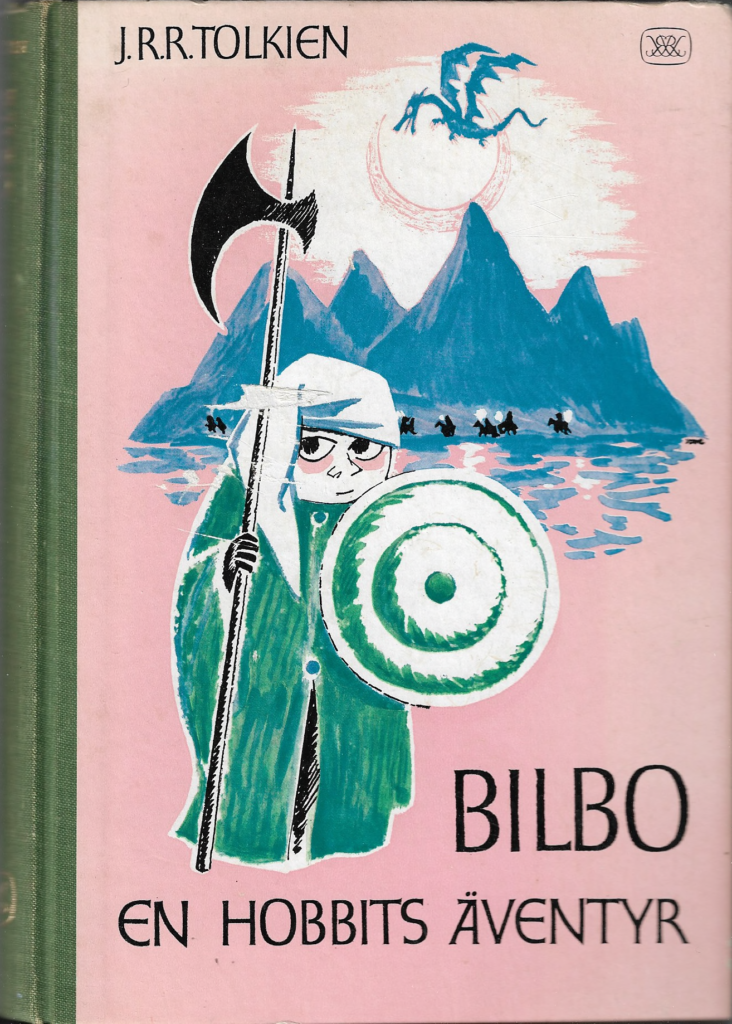
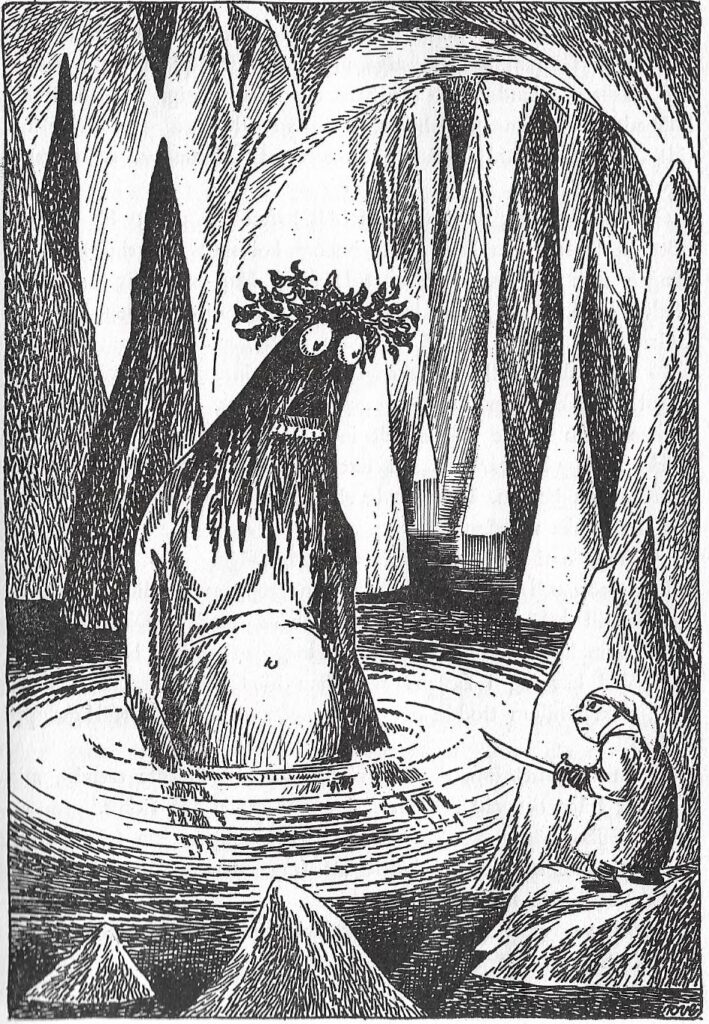
What is a Hobbit? A few characters in J.R.R Tolkien’s classic work of children’s fantasy wonder themselves about the diminutive title characters who don’t get out much. Tolkien describes them thoroughly, a handful of well-known British and American actors immortalized them on screen, but the last word on what a Hobbit looks like belongs to the reader. Or — in an edition as richly illustrated as the Swedish and Finnish editions of the book were in 1962 and 1973 — to the Swedish/Finnish artist, Tove Jansson, most famous for her creation of internationally beloved children’s characters, the Moomins.
Like Bilbo Baggins himself, The Hobbit is full of surprises — while presenting itself as a book for kids, it contains adult lessons one never outgrows. So, too, was Jansson, “an acerbic and witty anti-fascist cartoonist during the Second World War,” write James Williams at Apollo.
“She wrote a picture book for children about the imminent end of the world and spare, tender fiction for adults about love and family.” Jansson had exactly the sensibility to bridge Tolkien’s worlds of imaginative fancy and adult danger and moral ambiguity. But first, she wanted to cast off all associations with her most famous creation.
As Jansson wrote to a friend when she ended the Moomins, “I never spare them a thought now it’s over. I’ve completely drawn a line under all that. Just as you wouldn’t want to think back on a time you had a toothache.” The Moomins were a creative millstone, and she struggled to get their style from around her neck.
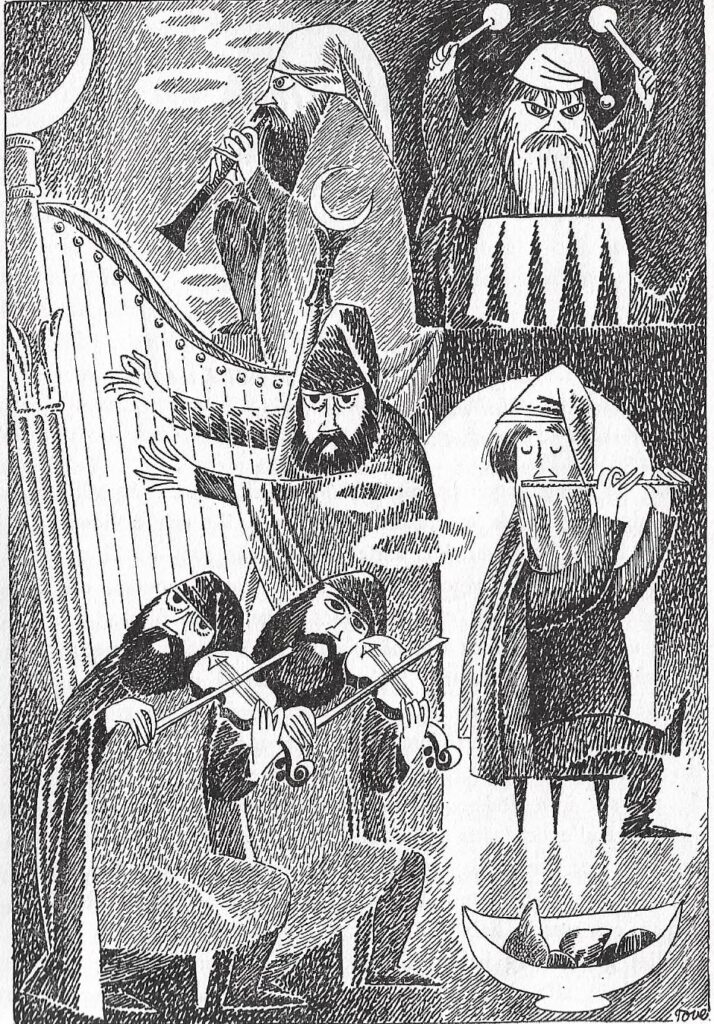
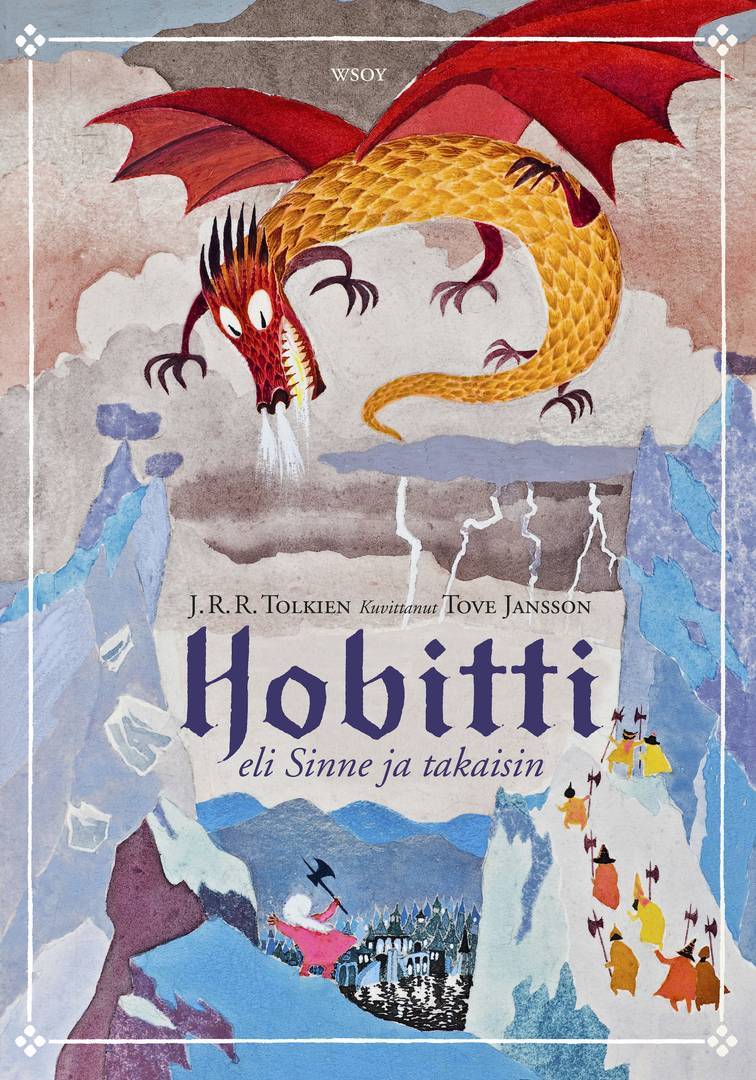
“This led to an attempt to change the way in which she drew,” notes Moomin.com. “Tove tried different techniques and drew each figure freely again and again 20–60 times until she was happy with the result. From the book vignette illustrations, it is impossible to notice how the individual figures are pasted together into ‘a patchwork’ that made up each vignette.”
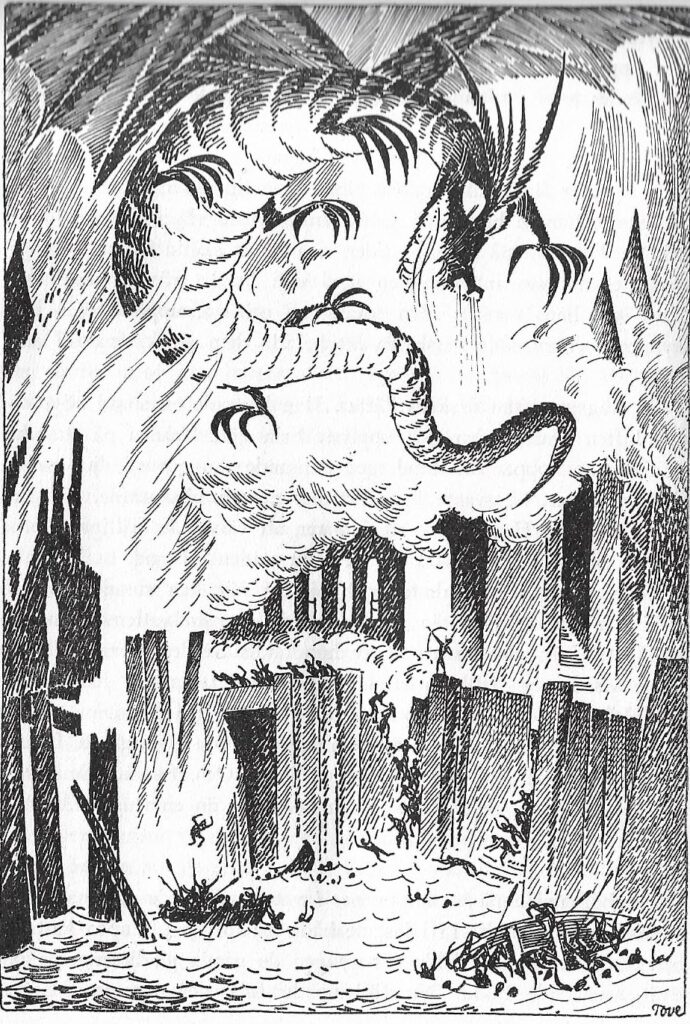
Despite her best efforts to escape her previous characters, however, “the majority of the full-page illustrations follow the characteristic style of Tove’s illustrations for the Moomin books.” Her own reservations aside, this is all to the good as Jansson’s Moomin books and comic strips were built from the same mix of sensibility — childlike wonder, grown-up ethics, and a respect for the deep ecology of myth. Both Tolkien and Jansson wrote during, after, and in response to Hitler’s rise to power and drew on “a Nordic folk tradition of trolls and forests, light and dark,” writes Williams. But Jansson brought her own artistic vision to The Hobbit. See more of her illustrations at Lithub.
Related Content:
Before Creating the Moomins, Tove Jansson Drew Satirical Art Mocking Hitler & Stalin
The Only Drawing from Maurice Sendak’s Short-Lived Attempt to Illustrate The Hobbit
Illustrations Of J. R. R. Tolkien’s The Hobbit from the Soviet Union (1976)
Read More...How Agnès Varda Explores Beauty in Cléo from 5 to 7: a Video Essay
“We don’t see things as they are; we see them as we are.” That quote is usually attributed to Anaïs Nin, who counts among the most famous Parisiennes despite only having spent a relatively short stretch of her life there. Cléo Victoire must also occupy those same ranks, despite being a wholly fictional character. We know her as the protagonist of 1962’s Cléo from 5 to 7, the breakout feature by French New Wave auteur Agnès Varda — another of the great Parisiennes of our time, if one reluctant enough to have arrived for her education at the Sorbonne seeing Paris as a “grey, inhumane, sad city.” Still, as Cléo’s perambulations through and interactions with Paris reveal, Varda certainly knew how to use the place.
As the film plays out in real time, “we follow Cléo through an afternoon as she journeys across real locations in Paris, waiting for her dreaded test results to be ready.” So says Evan Puschak, better known as the Nerdwriter, in his new video essay “Through Agnes Varda’s Looking Glass.” A promising singer, Cléo has undergone a medical examination to determine whether or not she has cancer, and not until the final scene will she have the answer.
In the meantime, Varda takes the opportunity to “paint a complex picture of a complex woman on a stressful day in her life.” This stress prompts Cléo “to examine and ultimately confront her self-image,” a journey that takes her past, among other things, more than a few mirrors.
Beginning the film as a self-regarding character — in the most literal sense — Cléo never passes up a chance to check her own reflection, and thus confirm her own existence. “If she’s not a beautiful, healthy, up-and-coming singer,” as Puschak articulates the question that descends upon her, “who is she?” Composed only of outside perceptions, Cléo’s center cannot hold; eventually “she discards the identity she’s made for others. She ceases to be an object, looked at even by herself and becomes a subject, the one who looks.” Her crisis forces her to “observe the world as it is, not as a reflection of people’s expectation of her.” Varda’s cinematic vision of her transformation shows what it is to see things not as we are, but as they are.
Related Content:
How David Lynch Manipulates You: A Close Reading of Mulholland Drive
Based in Seoul, Colin Marshall writes and broadcasts on cities, language, and culture. His projects include the Substack newsletter Books on Cities, the book The Stateless City: a Walk through 21st-Century Los Angeles and the video series The City in Cinema. Follow him on Twitter at @colinmarshall or on Facebook.
Read More...Dante’s Divine Comedy: A Free Course from Columbia University
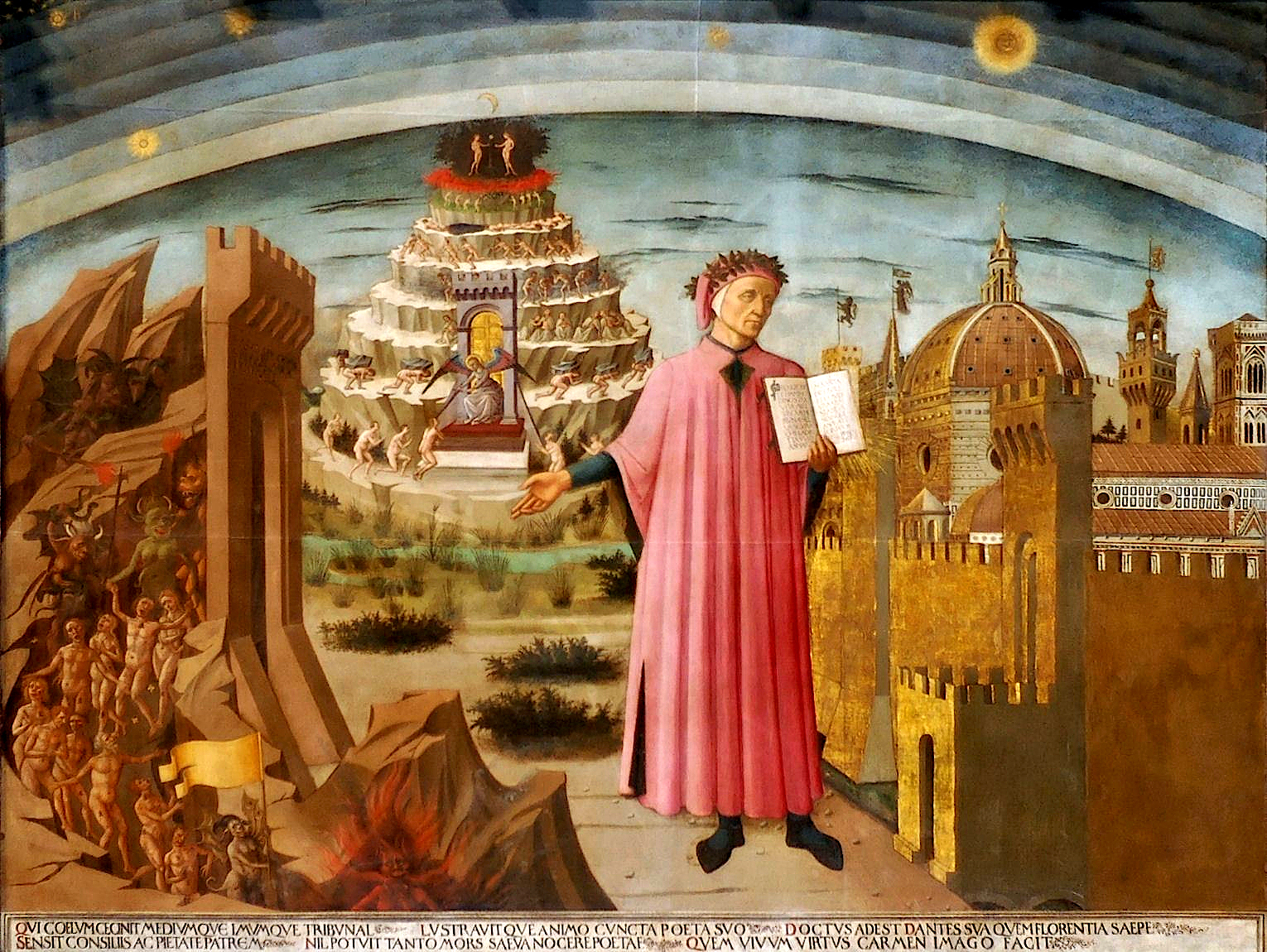
As we approach the 700th anniversary of Dante Alighieri’s death (September 14), we wanted to feature a timely resource: Teodolinda Barolini, a professor at Columbia University, has posted online a course for anyone who wishes to read Dante’s Commedia from beginning to end. It features 54 recorded lectures, covering Inferno, Purgatorio and Paradiso, with each cantica being read in its entirety. Barolini also oversees a related web site, Digital Dante, where you can find Dante’s text in the Petrocchi edition with English translations by Mandelbaum and Longfellow. Plus the site features commentary on Dante’s text.
Barolini’s Dante course will be added to our list of Free Literature Courses, a subset of our collection, 1,700 Free Online Courses from Top Universities.
If you would like to support the mission of Open Culture, consider making a donation to our site. It’s hard to rely 100% on ads, and your contributions will help us continue providing the best free cultural and educational materials to learners everywhere. You can contribute through PayPal, Patreon, and Venmo (@openculture). Thanks!
Related Content:
A Free Online Course on Dante’s Divine Comedy from Yale University
Botticelli’s 92 Illustrations of Dante’s Divine Comedy
Alberto Martini’s Haunting Illustrations of Dante’s Divine Comedy (1901–1944)
Hear Dante’s Inferno Read Aloud by Influential Poet & Translator John Ciardi (1954)
Physics from Hell: How Dante’s Inferno Inspired Galileo’s Physics
Read More...A Restored Vermeer Painting Reveals a Portrait of a Cupid Hidden for Over 350 Years
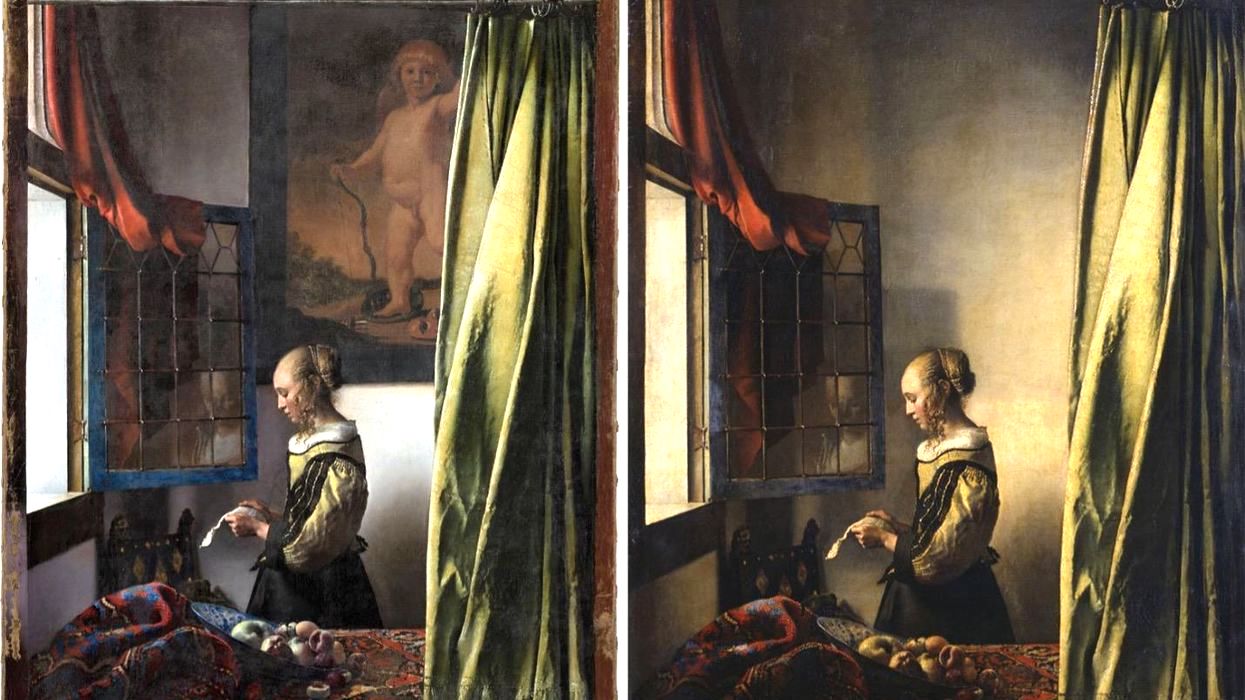
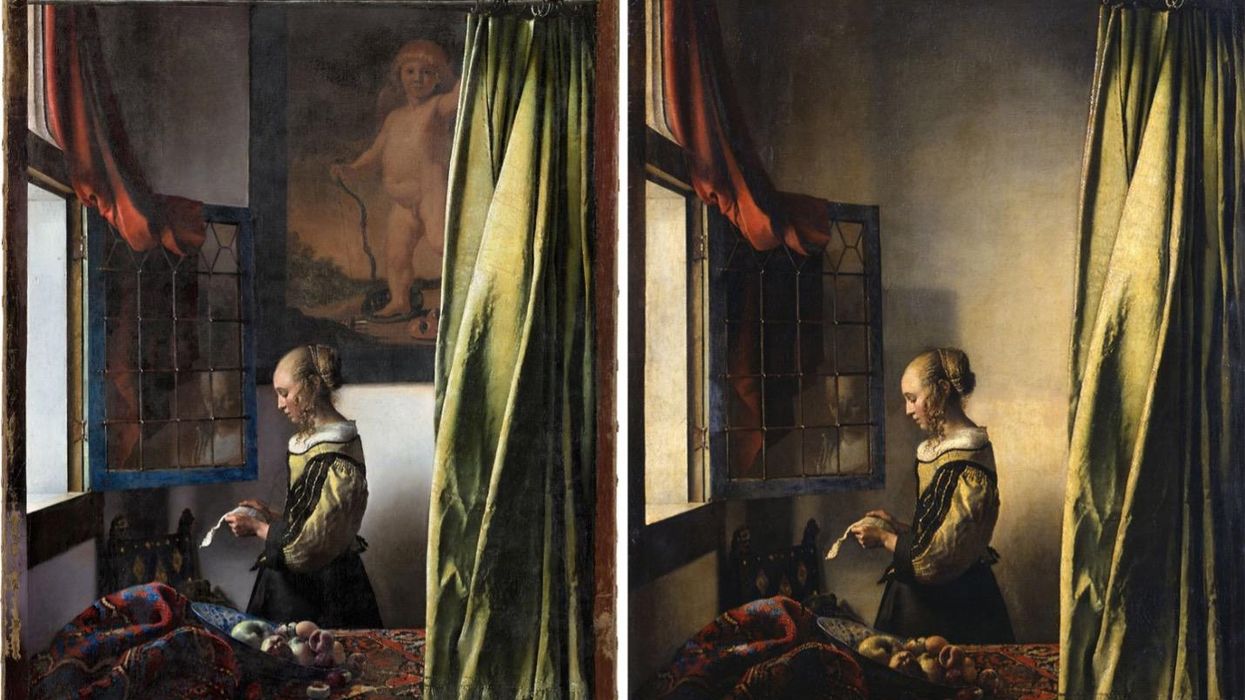
Botched art restorations make good headlines, but rarely are we asked to consider if a posthumous change to a great master’s work represents an improvement. And yet, when images of a restored Girl Reading a Letter at an Open Window by Jan Vermeer circulated recently, the world had the chance to compare the restored original painting, at the left, with an unknown painter’s revision, long thought to be Vermeer’s work. (Click here to view the paintings side by side in a larger format.) Several people announced that they preferred the doctored painting on the right, first attributed to Vermeer in 1880 (and previously attributed to Dutch masters Rembrandt and Hals).
As conservators found at the conclusion of a restoration project begun in 2017, it is the painting on the left that Vermeer intended as his final statement on the subject of a girl reading a letter at an open window. That painting puts the subject in a very different light. The naked Cupid behind the young woman — in place of an ambiguously dour patch of beige — revises over a century of art historical interpretation. “With the recovery of Cupid in the background, the actual intention of the Delft painter becomes recognizable,” says Stephan Koja, director of the Old Masters Picture Gallery.
Art historians and conservators had long known the other painting was underneath, having discovered it via X‑ray in 1979. But they assumed it was Vermeer himself who made the change. “As it was not uncommon for artists to paint over their work,” My Modern Met writes, “scholars initially accepted that Vermeer had simply changed his mind and decided to keep the wall bare.” Instead, thanks to the 2017 restoration project, “researchers were able to conclude that the overpainting was completed over several decades after the canvas was finished.”
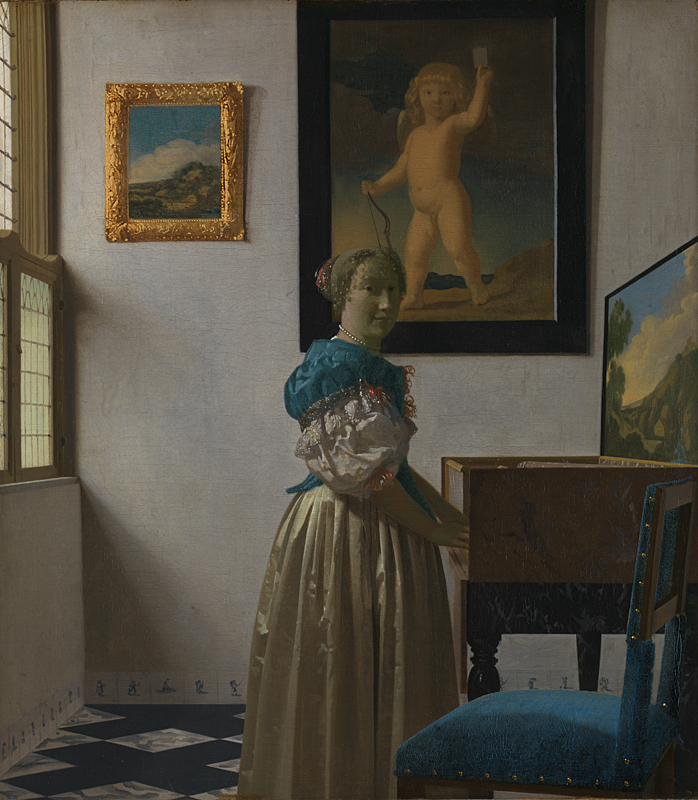
“Vermeer often incorporated empty backgrounds in his genre paintings,” a feature that has become something of a hallmark thanks to the fame of paintings like The Milkmaid. This is one reason the Cupid went undercover for so long, despite an unbalanced composition without it. But Vermeer also incorporated backgrounds filled with art, including the same Cupid painting, which appears in his lesser known A Young Woman Standing at a Virginal and may have been a painting he himself owned. “There has been much speculation,” the National Gallery notes, that this painting (and another, similarly titled work) represent “fidelity” and “a venal, mercenary approach to love.” What approach might be suggested by the newly restored Girl Reading a Letter at an Open Window?
via Colossal
Related Content:
A 10 Billion Pixel Scan of Vermeer’s Masterpiece Girl with a Pearl Earring: Explore It Online
Josh Jones is a writer and musician based in Durham, NC. Follow him at @jdmagness
Read More...Darth Vader’s Voice: The Original Voice Versus the Vocals of James Earl Jones
The hulking black-caped figure, “a walking iron lung,” as George Lucas called him in 1977, Darth Vader more than rightly tops a list of the 50 best movie villains of all time as the “gold standard of villainy,” but it took more than inspired costuming to make him so. Vader is a composite creation of several different talents. The quality by which we most know (and fear) him – the booming voice that commands and kills from afar — came, of course, from James Earl Jones. As one of the 20th century’s greatest actors, it’s fair to say that Jones not only provided Vader’s voice, but he also provided the villains soul, inasmuch as the Sith Lord had one left.
Although he redeemed himself at the end of Return of the Jedi, Vader’s humanity was an open question throughout most of the trilogy. When he “naturally … wanted to make Darth Vader more interesting, more subtle, more psychologically oriented,” Jones says,” Lucas reportedly replied, “No, no. What we’re finding out is you’ve got to keep his voice on a very narrow band of inflection because he ain’t human, really.”
While he worried about casting the only Black actor in the first Star Wars film in the role of a dehumanized villain, Lucas ultimately decided that no one else, not even Orson Welles, could convey Vader’s serious intent.
But first, actor David Prowse understandably thought he had the role when he put on the heavy black suit, helmet, and cape. Best known for his role as the Green Cross Code Man, a well-loved public service announcement hero in the UK, the former bodybuilder Prowse performed Vader’s lines from inside the costume, his voice muffled, as you can hear in the clips above, by the mask. During the filming of Star Wars: A New Hope, Prowse was told that Vader’s lines would be re-recorded. He did not know that someone else would play the role.
Jones himself asked for no credit and did not receive any until Return of the Jedi. Paid $7,500, he thought of the 2 ½ hours spent in the recording booth for the first film as “just special effects.” (The real effects artist, sound designer Ben Burtt, created Vader’s iconic mechanical breathing sound by syncing recordings of his scuba gear to Jones’ breaths.) Jones once told Star Wars Insider that David Prowse “is Vader.” And while the six-foot-seven Prowse, who passed away last November, might have been perfectly cast as the imposing form, no one on set could hear him as Darth Vader.
“With a strong Devonshire accent that earned him the nickname ‘Darth Farmer’ from the crew,” Force Material notes, “the reality is that Dave Prowse was never going to be called upon to provide the voice of Darth Vader.” We might digress on the distribution of accents in the Star Wars universe. Maybe Prowse wasn’t the right Englishman to play the part, but why didn’t Lucas cast another British actor, as he had for every other major bad guy in the film, beginning a tradition that continues in Star Wars movies and related media over forty years later?
There’s hardly any question. No one can command attention with his voice like James Earl Jones. And perhaps no other actor could give such enduringly human menace to a character described by its creator as a walking iron lung.
Related Content:
James Earl Jones Reads Edgar Allan Poe’s “The Raven” and Walt Whitman’s “Song of Myself”
The Original Star Wars Trilogy Adapted into a 14-Hour Radio Drama by NPR (1981–1996)
Josh Jones is a writer and musician based in Durham, NC. Follow him at @jdmagness
Read More...Support Us
We're hoping to rely on loyal readers, rather than erratic ads. Please click the Donate button and support Open Culture. You can use Paypal, Venmo, Patreon, even Crypto! We thank you!

About Us

Open Culture scours the web for the best educational media. We find the free courses and audio books you need, the language lessons & educational videos you want, and plenty of enlightenment in between.
Advertise With Us
FREE UPDATES!
GET OUR DAILY EMAIL
Get the best cultural and educational resources on the web curated for you in a daily email. We never spam. Unsubscribe at any time.
FOLLOW ON SOCIAL MEDIA
Open Culture editor Dan Colman scours the web for the best educational media. He finds the free courses and audio books you need, the language lessons & movies you want, and plenty of enlightenment in between.
Advertise With Us