The First Air Raid Happened When Austria Dropped Bombs on Venice from Pilotless Hot-Air Balloons (1849)
We surround the phrase “ahead of its time” with a mystical aura. But just because an idea shows up earlier than we expect does not mean it was ever a good idea for human progress. Take, for example, the idea to rain incendiary devices on the heads of civilian populations in wartime. Recent iterations of this technology — unmanned drones surgically bombing weddings and funerals — may be an improvement over Hiroshima or napalm-happy helicopter pilots like Apocalypse Now’s Bill Kilgore. But drones have not, thereby, rendered the nuclear option or trigger-happy death from above obsolete, or made mass civilian casualties less tragic and unnecessary, comparisons of raw numbers aside.
Drone bombing is one of those ideas that showed up ahead of its time — at the very first use of aerial bombing of any kind. Unmanned Aerial Vehicles (UAVs) were launched in the service of a military operation 30 years before Edison harnessed electricity for home use.
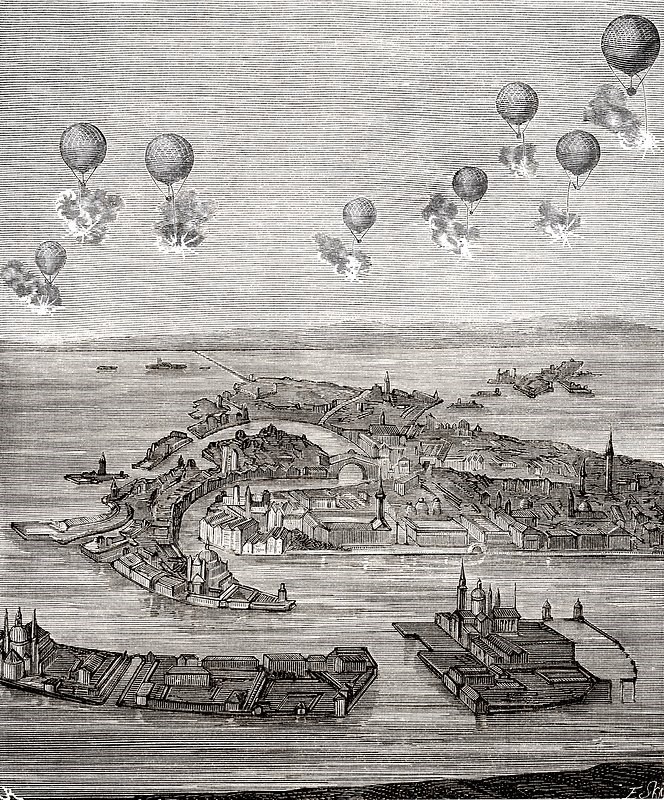
In 1849, remote piloting was hardly possible. But it was possible to launch a fleet of hot air balloons loaded with explosives from a ship and send them in the general direction of a target. That’s what the Austrian army did — twice — over Venice, in a campaign to recapture the city when its citizens rebelled against imperial rule and built their own republic. Luckily for Venice, the first use of naval air power was also the least effective.
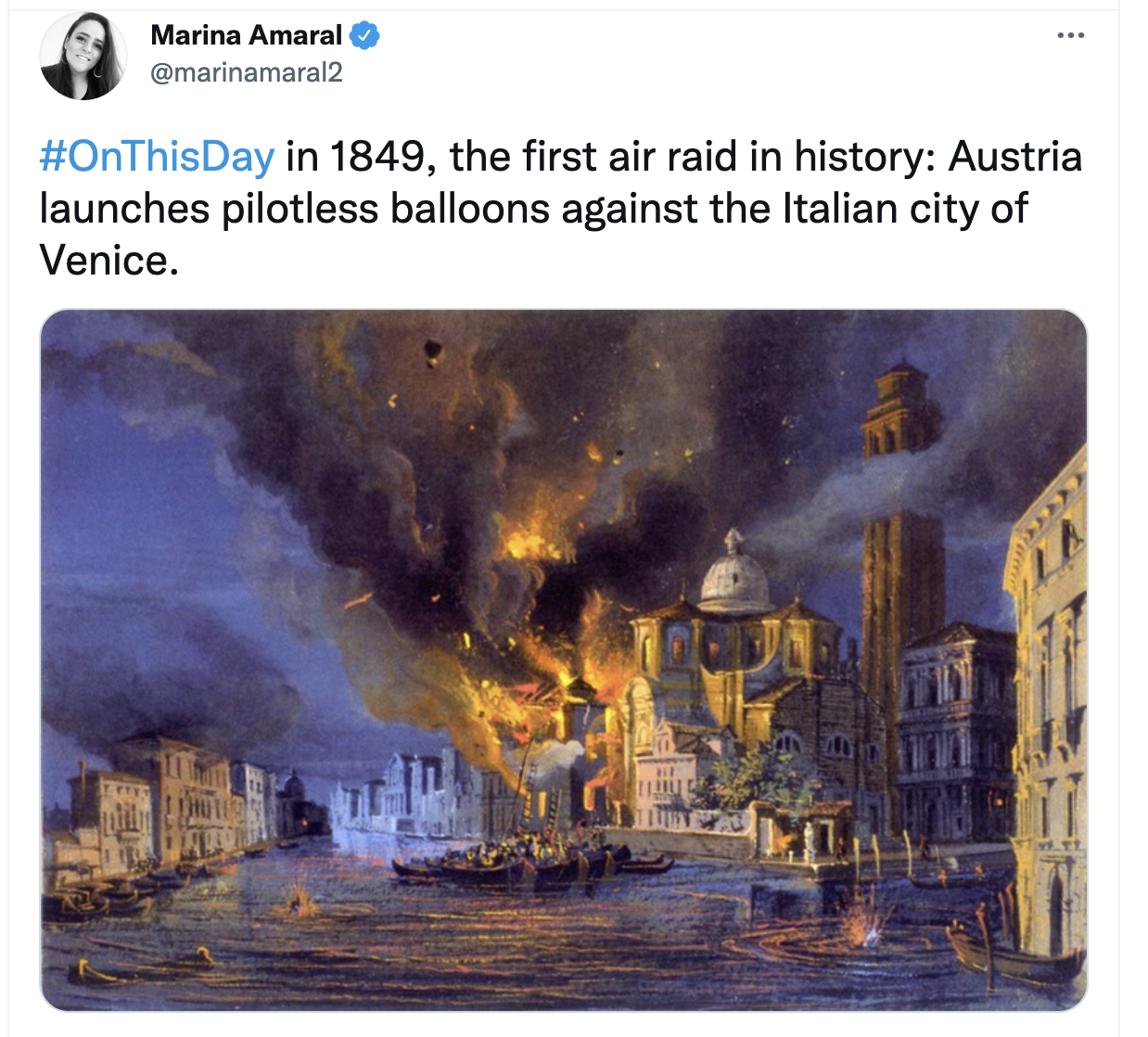
The balloons “carried 33 pounds of explosives,” writes Monash University professor Russell Naughton, “set with a half-hour time fuse, and troops scurried around with them to launch them into the proper wind currents.” The idea for the bombardment came from an Austrian artillery lieutenant named Franz von Uchatius and was initially carried out on July 12, 1849. This attempt “failed because the wind was not in Austria’s favor,” writes Weapons and Warfare, quoting from a contemporary account in Time magazine:
The balloons appeared to rise to about 4,500 ft. Then they exploded in midair or fell into the water, or, blown by a sudden southeast wind, sped over the city and dropped on the besiegers. Venetians, abandoning their homes, crowded into the streets and squares to enjoy the strange spectacle. … When a cloud of smoke appeared in the air to make an explosion, all clapped and shouted. Applause was greatest when the balloons blew over the Austrian forces and exploded, and in such cases the Venetians added cries of ‘Bravo!’ and ‘Good appetite!’
More spectacle than threat, the balloon bombs might have been abandoned as a failed experiment, but the Austrians were persistent; they had besieged the city, determined to subdue it. Another attack on August 22 seems to have also done more damage to the Austrians than their targets. Although the balloons could not be piloted, the detonation of their charges was controlled, Scientific American wrote that year, “by electro magnetism by means of a long isolated copper wire with a large galvanic battery placed on the shore. The bomb falls perpendicularly, and explodes on reaching the ground” … theoretically.
It is not clear from the sources how many bombs were launched. Numbers range from 2 to 200. In any case, the bombing would have little effect on ending the siege, which went on for five more months afterward, and they received little notice in the press. They did, however, have the effect after their second appearance of producing “extreme terror,” the British Morning Chronicle reported, documenting the first appearance of “shock and awe.” And terror was “clearly what was intended,” Brett Holman writes at Airminded, rather than a strategic offensive. “The bombs used were filled with shrapnel, which isn’t much use for anything but killing and maiming people. So there were few qualms on the part of the Austrians about targeting and killing civilians.” They were simply killed more efficiently with conventional artillery and starvation.

The example of the Austrians was not followed by other armies, who weren’t eager to have explosive balloons blow back on their own lines. The idea of bombing cities from the air, writes Holman, “had to be invented all over again. Which it was, of course, and Venice’s next air raid was on 24 May 1915.”
Just last year, the entire city shut down — “even planes were barred from flying to and from Venice’s Marco Polo Airport,” DW reported — as authorities led an effort to “remove and defuse a World War II-era bomb” on what local media dubbed “Bomba Day.”
via Marina Amaral
Related Content:
Watch Venice’s New $7 Billion Flood Defense System in Action
How Venice Works: 124 Islands, 183 Canals & 438 Bridges
A Drone’s Eye View of the Ruins of Pompeii
Josh Jones is a writer and musician based in Durham, NC. Follow him at @jdmagness
Read More...Watch Prince Appear on the Muppets Tonight Show & Reveal His Humble, Down-to-Earth Side (1997)
From Frog to Prince: We will always love your music and you. Our hearts are yours. Thanks for being a friend.
– Kermit the Frog, April 21, 2016
There was a time when sharing the screen with the Muppets was the ultimate celebrity status symbol.
Prince never appeared on The Muppet Show – 1999, the 1982 album that made him a household name, was released the year after the series concluded its run — but he got his chance fifteen years later, with an appearance on the shorter lived Muppets Tonight.
In a tribute written shortly after Prince’s death, Muppets Tonight writer Kirk Thatcher recalled:
We were very excited that Prince had agreed to do our Muppet comedy and variety show but had been told by his managers and support staff before we met with him that we must never look at him directly or call him anything but, “The Artist” or just, “Artist”. As the writers of the show, we were wondering how we were going to work or collaborate with someone you can’t even look at, especially while trying to create comedy with puppets!
His staff sent an advance team to make sure the working environment would be to his liking, special food and drink was laid in at his request, and the scripts of sketches that had been written for him were sent ahead for his approval.
The Muppets’ crew grew even more nervous when Prince asked for a meeting the night before the scheduled shoot day. Thatcher had “visions of him trashing everything and forcing us to start over,” adding that it would not have been the first time a guest star would have insisted on a total overhaul at zero hour.
Instead of the monster they’d been bracing for, Prince — who Thatcher described as “only half again bigger than most of the Muppets” — proved a game if somewhat “bemused” and “quiet” collaborator:
He had fun additions and improvs and loved playing and ad-libbing with the puppets and was very easy to talk to and work with. The whole situation with his advance team and management reminded me of the relationship I had created between Kermit and Sam the Eagle in Muppet Treasure Island. Sam had convinced everyone that Kermit, playing Captain Smollet, was a furious and angry tyrant, beset by inner demons and outer tirades. But when we meet him, he was just good, old, sweet-natured Kermit the Frog… just in a captains outfit. The same for Prince. He was just a nice, fun, creative guy who had built this persona around himself, and had a team there to reinforce it, probably to protect his art, his personal life and even his sanity.
The episode riffed on his established image, shoehorning Muppets into a “leather and lace” look that Prince himself had moved on from, and cracking jokes related to the unpronounceable “Love Symbol” to which he’d changed his name four years earlier.
Naturally, they plumbed his catalogue for musical numbers, having particular fun with “Starfish and Coffee,” which features a proto-Prince Muppet and an alternate origin story.
(The actual origin story is pretty great, and provides another tiny glimpse of this mysterious artist’s true nature.)
The show also afforded Prince the opportunity to chart some unexpected territory with Hoo Haw, a spoof of the countrified TV variety show Hee Haw.
If you’ve ever wondered how The Purple One would look in overalls and a plaid button down, here’s your chance to find out.
Related Content:
Prince’s First Television Interview (1985)
Ayun Halliday is an author, illustrator, theater maker and Chief Primatologist of the East Village Inky zine. Follow her @AyunHalliday.
Read More...RIP Jean-Paul Belmondo: The Actor Who Went from the French New Wave to Action Superstardom
For quite a stretch, the late Jean-Paul Belmondo was France’s biggest movie star. He also, in what now looks like the greater achievement, stubbornly remained the most French of all movie stars. In France of the 1960s, an actor of Belmondo’s generation and level of success would have been expected to try making a go of it in Hollywood. And as he himself admitted at the time, “every Frenchman dreams of making a Western.” But “America has plenty of good actors. I’m not being falsely modest, but why would they need me? I prefer a national film to an international film.” When a cinema detaches from its country, “something is lost. Look at what happened to Italy when they went international.”
Though he never did time as Hollywood’s token Frenchman, Belmondo did appear in a few Italian pictures (including the work of such masters as Vittorio De Sica and Mauro Bolognini) early in the 1960s, right after he shot to stardom. His launch vehicle was, of course, Jean-Luc Godard’s Breathless, a harbinger of La Nouvelle Vague and its exhilaratingly deliberate breakage of cinema’s rules.
Belmondo would go on to make two more features with Godard: A Woman Is a Woman and Pierrot le Fou, in both of which he starred alongside Anna Karina (another of the French New Wave icons we’ve lost in this decade). Other auteurs also came calling: François Truffaut, Alain Resnais, Jean-Pierre Melville.
Melville sits alongside Belmondo in the 1962 interview clip above to discuss their collaboration Le Doulos, “a good old gangster film.” But Belmondo’s protagonist, the titular police informer, is hardly a conventional gangster. “He’s an elegant guy,” says the actor. “He’s elegant in everything he does, in his gestures and actions, despite appearances to the contrary.” The same could be said of many of the characters Belmondo played throughout his career, even during his time as a Burt Reynolds-style action hero in the 1970s and 80s (during which, it must be noted, he did all his own stunts). We’re unlikely to see his like of national superstar again — and certain not to see another with such savoir-faire.
Related Content:
How Anna Karina (RIP) Became the Mesmerizing Face of the French New Wave
Based in Seoul, Colin Marshall writes and broadcasts on cities, language, and culture. His projects include the Substack newsletter Books on Cities, the book The Stateless City: a Walk through 21st-Century Los Angeles and the video series The City in Cinema. Follow him on Twitter at @colinmarshall or on Facebook.
Read More...Meet Brushy One String, the One String Guitar Player Who Will Blow Your Mind
When Jamaican musician Andrew Chin, better known as Brushy One String first told friends about his vision — “a dream in which he was told to play the one-string guitar” — they responded with mockery — all but one, who “insisted it was fate,” writes Playing for Change, “and that he had to make that dream come true.” So Brushy set out to do just that, playing on streetcorners and in the market, “in a big broad hat and sunglasses,” he says. The music came to him naturally. He is no ordinary street musician, however, and his one-string guitar is not a gimmick. Brushy is a talented singer-songwriter, with a powerful voice and a musical sensibility that transcends his bare-bones minimalism.
He doesn’t look particularly flashy, perched on the street with his beat-up guitar in the video at the top for “Chicken in the Corn.” Brushy came of age in a scene “where most performers long to be hip-hop MCs or dancehall style DJs.”
Brushy’s one-string technique reaches back to the origins of the blues in the Diddley Bow (from which Bo Diddley took his name), and even further back into musical history, recalling what musicologists would call a “monochord zither.” One-string players in history have included Mississippi bluesman Eddie “One String” Jones, Lonnie Pitchford, and Willie Joe Duncan, who invented the Unitar, an electrified one-string guitar and scored a hit in the 1950s.
Whether or not Brushy fits himself into this tradition, he “came by his musical abilities honestly,” playing a reggae infused soul-meets-Delta Blues inspired by his parents. His father was Jamaican soul singer Freddy McKay and his mother, Beverly Foster, toured as a backup singer with Tina Turner. Unfortunately, he was orphaned at a young age and unable to finish his education. He didn’t learn to read at all until he became an adult. Brushy tried to learn guitar, but “I didn’t really know how to play,” he says, “and I played so hard, all the strings broke. So the guitar went under the bed” until his one string epiphany. As he began to sing and play, his one, low‑E string and the wooden body of his acoustic guitar became a rhythm section, his expansive voice rising up between beats, “a voice so rich and full,” NPR writes, “all it wants is a bit of rhythmic and melodic underpinning.”
Brushy names both soul legend Teddy Pendergrass and dancehall legend Shabba Ranks as influences, a key to the range of his songwriting, which comes “from the situations I’m in,” he says. “It’s like magic: From the situation, I don’t search for something, not in my head or nowhere else. The song just comes.” He had some early modest success, did a tour of Japan, then returned to his hometown of Ochoa Rios to kick around and play locally. It was then that filmmaker Luciano Blotta encountered him while finishing the 2007 Jamaican music documentary, Rise Up. “Chicken in the Corn” made the soundtrack, and it turned into Brushy’s big break.
He’s since played South by Southwest, New Orleans House of Blues, and the New Orleans Jazz & Heritage Festival, had a documentary made about him — The King of One String (2014) — and released three studio albums and a live album. It’s well deserved success for a musician who was ready to quit music until he had a dream — and who then found the courage (and the good luck) to make it real.
Related Content:
Keith Richards Shows Us How to Play the Blues, Inspired by Robert Johnson, on the Acoustic Guitar
The History of the Guitar: See the Evolution of the Guitar in 7 Instruments
The Encyclopedia Of Alternate Guitar Tunings
Josh Jones is a writer and musician based in Durham, NC. Follow him at @jdmagness
Read More...Hear Charlie Watts Inimitable Isolated Drum Tracks on “Gimme Shelter,” “Beast of Burden,” and “Honky Tonk”
When I was a kid in New Jersey, if you were looking for work, there’d be ads for musicians. In the mid-60s and 70s, they would invariably say: “Wanted: Charlie Watts type drummer” — Max Weinberg
Since Charlie Watts passed away last month, tribute upon tribute has poured in to celebrate his style, his austere simplicity, his role as the calm, steady eye of the Rolling Stones’ roiling storm. “Drumming is often ugly,” Amanda Petrusich wrote at The New Yorker, “but Watts looked so beautiful when he played … His posture alone suggested a preternatural elegance … there is always poetry in restraint.”
This is the way Watts’ playing looks to non-musicians, and most Rolling Stones fans are not musicians, and do not listen to rock drumming alone. “It’s possible to find Watts’s isolated drum tracks online,” Petrusich writes, “If you’re into that sort of thing. They’re not always perfect in the technical sense, but they are deeply perfect in other, less quantifiable ways.” Watts himself described his drumming as non-technical and decried his lack of training. It was all about the band, he said repeatedly.
But ask other drummers to quantify Watts’ perfection and they’ll do so happily. Watts taught himself to play by listening to his favorite jazz drummers, writes Max Weinberg, “among them the great English jazz drummer Phil Seamen, and Dave Tough, an American drummer who even looked like Charlie: a fastidious dresser, apparently with the most incredible groove and sound.” Weinberg, who incorporated Watts’ influence on Springsteen songs like “Born to Run,” elaborates further.
One way Watts commanded a room, he says, was as a proponent “of a style of rock drumming popularized by the late, great Al Jackson, the famous Stax drummer, where you deliberately play behind the direct backbeat. The way you do that — which is a little technical — is not by focusing on the two and the four beat, but the one and the three. Another example is James Brown’s music, which is heavily focused on landing on the one. It takes a long time to be able to do that.” He developed the skill as a blues and jazz drummer even before Mick and Keith seduced him to the Stones.
Another drum celebrity admirer, Stewart Copeland, writes about Watts’ unique dynamics. As a rock drummer trained on jazz, he “went for groove, and derived power from relaxation. Most rock drummers are trying to kill something; they’re chopping wood. Jazz drummers instead tend to be very loose to get that jazz feel, and he had that quality.” While Mick strutted and dripped across the stage, Charlie “hardly broke a sweat.” From this, Copeland learned that “you can actually get a better sound out of your drums, and a better groove, if you relax.”
In the classic drum tracks here, listen for some of Watts’ distinctive, subtle moves, and read more about his technique in Copeland and Weinberg’s reminisces here. It’s fair to say that every rock drummer who came after Charlie Watts learned something from Charlie Watts, whether they knew it or not. But while “you can analyze Charlie Watts,” Copeland writes, “that still won’t get you to his feel and his distinct personality. It’s an X‑factor, it’s a charisma, it’s an undefinable gift of God.” Petrusich concludes her tribute with a similar expression of non-technical awe: “Watching Watts play is still one of the best ways I know to check in with the riddle and thrill of art — to witness something miraculous but not to understand it.”
Related Content:
Saying Goodbye to Charlie Watts (RIP), the Engine of the Rolling Stones for Half a Century
Josh Jones is a writer and musician based in Durham, NC. Follow him at @jdmagness
Read More...100 Days of Dante: Join the Largest Divine Comedy Reading Group in the World (Starts September 8)

This year marks the 700th anniversary of Dante Alighieri’s death — which means it also marks the 701st anniversary of his great work the Divina Commedia, known in English as the Divine Comedy. We’ve all got to go some time, and it’s somehow suitable that Dante went not long after telling the tale of his own journey through the afterlife, complete with stops in Hell, Purgatory, and Paradise. It remains a journey we can all take and re-take — and interpretively grapple with — still these seven centuries later. Starting this month, you can take it as a group tour, so to speak, by joining 100 Days of Dante, the largest Dante reading group in the world.
A project of Baylor University’s Honors College (with support from several other American educational institutions), 100 Days of Dante has launched a web site “through which modern seekers and pilgrims can follow the great epic poem with free video presentations three times a week.”
So writes Aleteia’s John Burger, who explains that “the three books of the Divine Comedy, known in Italian as Inferno, Purgatorio, and Paradiso, are divided into 33 chapters known as cantos. [Inferno actually had 34.] Each video will present one canto, with commentary on it from leading experts in Dante studies.” You can also read the entire work on 100 Days of Dante’s web site, in English or Italian — a language Dante’s own poetry did much to shape.
Nobody interested in the language of Italy, let alone the country’s history and culture, can do without experiencing the Divine Comedy. One of 100 Days of Dante’s aims is a re-emphasis of its nature as a thoroughly religious work, one that renders in vivid, sometimes harrowing detail the worldview held by Christians of Dante’s place and time. But believer or otherwise, you can join in the reading from when it begins on September 8, to when it concludes on Easter 2022. You may well find, as the long Italy-resident English writer and translator Tim Parks observes, that Dante has a way of slipping through convenient interpretative frameworks cultural, historical, and even religious. “Long after the fires of Hell have burned themselves out,” he writes, “the debate about the Divina Commedia rages on.” Find more educational resources on Dante and The Divine Comedy below.
Related Content:
A Free Online Course on Dante’s Divine Comedy from Yale University
A Digital Archive of the Earliest Illustrated Editions of Dante’s Divine Comedy (1487–1568)
Why Should We Read Dante’s Divine Comedy? An Animated Video Makes the Case
Based in Seoul, Colin Marshall writes and broadcasts on cities, language, and culture. His projects include the Substack newsletter Books on Cities, the book The Stateless City: a Walk through 21st-Century Los Angeles and the video series The City in Cinema. Follow him on Twitter at @colinmarshall or on Facebook.
Read More...Google Data Analytics Certificate: 8 Courses Will Help Prepare Students for an Entry-Level Job in 6 Months
During the pandemic, Google launched a series of Career Certificates that will “prepare learners for an entry-level role in under six months.” The new career initiative includes certificates concentrating on Project Management and UX Design. And now also Data Analytics, a burgeoning field that focuses on “the collection, transformation, and organization of data in order to draw conclusions, make predictions, and drive informed decision making.”
Offered on the Coursera platform, the Data Analytics Professional Certificate consists of eight courses, including “Foundations: Data, Data, Everywhere,” “Prepare Data for Exploration,” “Data Analysis with R Programming,” and “Share Data Through the Art of Visualization.” Overall this program “includes over 180 hours of instruction and hundreds of practice-based assessments, which will help you simulate real-world data analytics scenarios that are critical for success in the workplace. The content is highly interactive and exclusively developed by Google employees with decades of experience in data analytics.”
Upon completion, students–even those who haven’t pursued a college degree–can directly apply for jobs (e.g., junior or associate data analyst, database administrator, etc.) with Google and over 130 U.S. employers, including Walmart, Best Buy, and Astreya. You can start a 7‑day free trial and explore the courses here. If you continue beyond the free trial, Google/Coursera will charge $39 USD per month. That translates to about $235 after 6 months, the time estimated to complete the certificate.
Explore the Data Analytics Certificate by watching the video above. Learn more about the overall Google career certificate initiative here. And find other Google professional certificates here.
Note: Open Culture has a partnership with Coursera. If readers enroll in certain Coursera courses and programs, it helps support Open Culture.
Related Content:
Read More...ABBA Set to Release Their First Album in 40 Years: Hear Two New Tracks, and Get a Glimpse of Their Digital Live Show
45 years ago, ABBA’s music was inescapable. 25 years ago, it had become a seemingly unwelcome reminder of the inanities of the 1970s in general and the days of disco in particular. But now, it’s revered: rare is the 21st-century music critic who absolutely refuses to acknowledge the Swedish foursome’s mastery of pure pop songwriting and studio production. With current musicians, too, naming ABBA among their inspirations without embarrassment, the time has surely come for ABBA themselves to return to the spotlight — a spotlight that first illuminated them for the world in 1974, when their performance of “Waterloo” won the Eurovision Song Contest.
ABBA’s streak lasted until the early 1980s, ending in a hiatus that ultimately stretched out to some 40 years. Pop culture has changed quite a bit in that time, but technology much more so. The band have thus put together a thoroughly modern comeback involving not just a new album, but also a live show starring computer-generated versions of members Björn Ulvaeus, Benny Andersson, Agnetha Fältskog, and Anni-Frid Lyngstad — “Abbatars,” as Ulvaeus calls them.
Beginning next year, they’ll play ABBA’s hits in a custom-built 3,000-seat arena in London’s Olympic park, engineered to accompany each song with their own elaborate light show. Animated with motion-captured performances by the real ABBA, their appearance has been modeled after the way the band looked in the 1970s (if not quite the way they dressed).
Titled Voyage, this digital ABBA experience will open in 2022, thus solving the problem of touring that had long discouraged a reunion. “We would like people to remember us as we were,” Ulvaeus said in the late 2000s. “Young, exuberant, full of energy and ambition.” But with all four now-septuagenarian members still alive and able to make music, remaining wholly inactive seems to have started feeling like a shame. They made their return to the studio in 2018, recording the new songs “I Still Have Faith in You” and “Don’t Shut Me Down,” both of which will appear on the new album, also called Voyage, coming out in November. All this will bring back memories for longtime fans, as well as provide a thrilling experience for their many listeners too young to have experienced an ABBA show or album release before. But I can’t be the only member of my generation wondering if, twenty years from now, we’ll be buying tickets for a digitally re-created Ace of Base.
Related Content:
How ABBA Won Eurovision and Became International Pop Stars (1974)
Listen to ABBA’s “Dancing Queen” Played on a 1914 Fairground Organ
This Man Flew to Japan to Sing ABBA’s “Mamma Mia” in a Big Cold River
Based in Seoul, Colin Marshall writes and broadcasts on cities, language, and culture. His projects include the Substack newsletter Books on Cities, the book The Stateless City: a Walk through 21st-Century Los Angeles and the video series The City in Cinema. Follow him on Twitter at @colinmarshall or on Facebook.
Read More...How Mushroom Time-Lapses Are Filmed: A Glimpse Into the Pioneering Time-Lapse Cinematography Behind the Netflix Documentary Fantastic Fungi
Mushrooms are having a moment, thanks in part to pioneering time-lapse cinematographer Louie Schwartzberg’s documentary Fantastic Fungi.
Now streaming on Netflix, the film has given rise to a bumper crop of funghi fantatics, who sprang up like, well, mushrooms, to join the existing ranks of citizen scientists, culinary fans, weekend foragers, amateur growers, and spiritual seekers.
Schwartzberg, who earlier visualized pollination from the flower’s point of view in the Meryl Streep-narrated Wings of Life, is a true believer in the power of mushrooms, citing funghi’s role in soil creation and health, and their potential for remedying a number of pressing global problems, as well as a host of human ailments.
Fantastic Funghi focuses on seven pillars of benefits brought to the table by the fungal kingdom and its Internet-like underground network of mycelium:
A number of projects are exploring the ways in which the mycelium world can pull us back from the bring of desertization, water shortage, food shortage, bee colony collapse, toxic contaminants, nuclear disasters, oil spills, plastic pollution, and global warming.
Mushroom-related industries are eager to press funghi into service as environmentally sustainable faux leather, building materials, packaging, and meat alternatives.
From fine dining to foraging off-the-grid, mushrooms are prized for their culinary and nutritional benefits.
Will the humble mushroom prove mighty enough to do an end run around powerful drug companies as a source of integrative medicine to help combat diabetes, liver disease, inflammation, insomnia and cognitive decline?
Researchers at Johns Hopkins, UCLA, and NYU are running clinical trials on the benefits of psychedelic psilocybin mushrooms as a tool for treating addiction, depression, anxiety, PTSD and suicidal ideation.
Of course, there’s also a rich tradition of religions and individual seekers deploying mind altering psychoactive mushrooms as a form of sacrament or a tool for plumbing the mysteries of life.
Director Schwartzberg understandably views mushrooms as muse, a fitting subject for photography, music, film, poetry, art and other creative endeavors.
With regard to this final pillar, many viewers may be surprised to learn how much of the 15 years Schwartzberg dedicated to capturing the exquisite cycle of fungal regeneration and decomposition took place indoors.
As he explains in the Wired video above, his precision equipment excels at capturing development that’s invisible to the human eye, but is no match for such natural world disruptions as insects and wind.
Instead, he and his team built controlled growing environments, where highly sensitive time lapse cameras, dollies, timed grow lights, and more cinematic lighting instruments could be left in place.
Set dressings of moss and logs, coupled with a very short depth of field helped to bring the Great Outdoors onscreen, with occasional chromakeyed panoramas of the natural world filling in the gaps.
Even in such lab-like conditions, certain elements were necessarily left to chance. Mushrooms grow notoriously quickly, and even with constant monitoring and calculations, there was plenty of potential for one of his stars to miss their mark, shooting out of frame.
Just one of the ways that mushrooms and humans operate on radically different timelines. The director bowed to the shrooms, returning to square one on the frequent occasions when a sequence got away from him.
Providing viewers an immersive experience of the underground mycelium network required high powered microscopes, a solid cement floor, and a bit of movie magic to finesse. What you see in the final cut is the work of CGI animators, who used Schwartzberg’s footage as their blueprint.
Netflix subscribers can stream Fantastic Fungi for free.
From October 15 — 17, filmmaker Louie Schwartzberg is hosting a free, virtual Fantastic Fungi Global Summit. Register here.
You can also browse his collection of community mushroom recipes and submit your own, download Fantastic Fungi’s Stoned Ape poster, or have a ramble through a trove of related videos and articles in the Mush Room.
Related Content:
John Cage Had a Surprising Mushroom Obsession (Which Began with His Poverty in the Depression)
Algerian Cave Paintings Suggest Humans Did Magic Mushrooms 9,000 Years Ago
Ayun Halliday is an author, illustrator, theater maker and Chief Primatologist of the East Village Inky zine. Brood X Cicadas are her mushrooms. Follow her @AyunHalliday.
Read More...The Brilliant 19th-Century Astronomical Drawings of Étienne Léopold Trouvelot
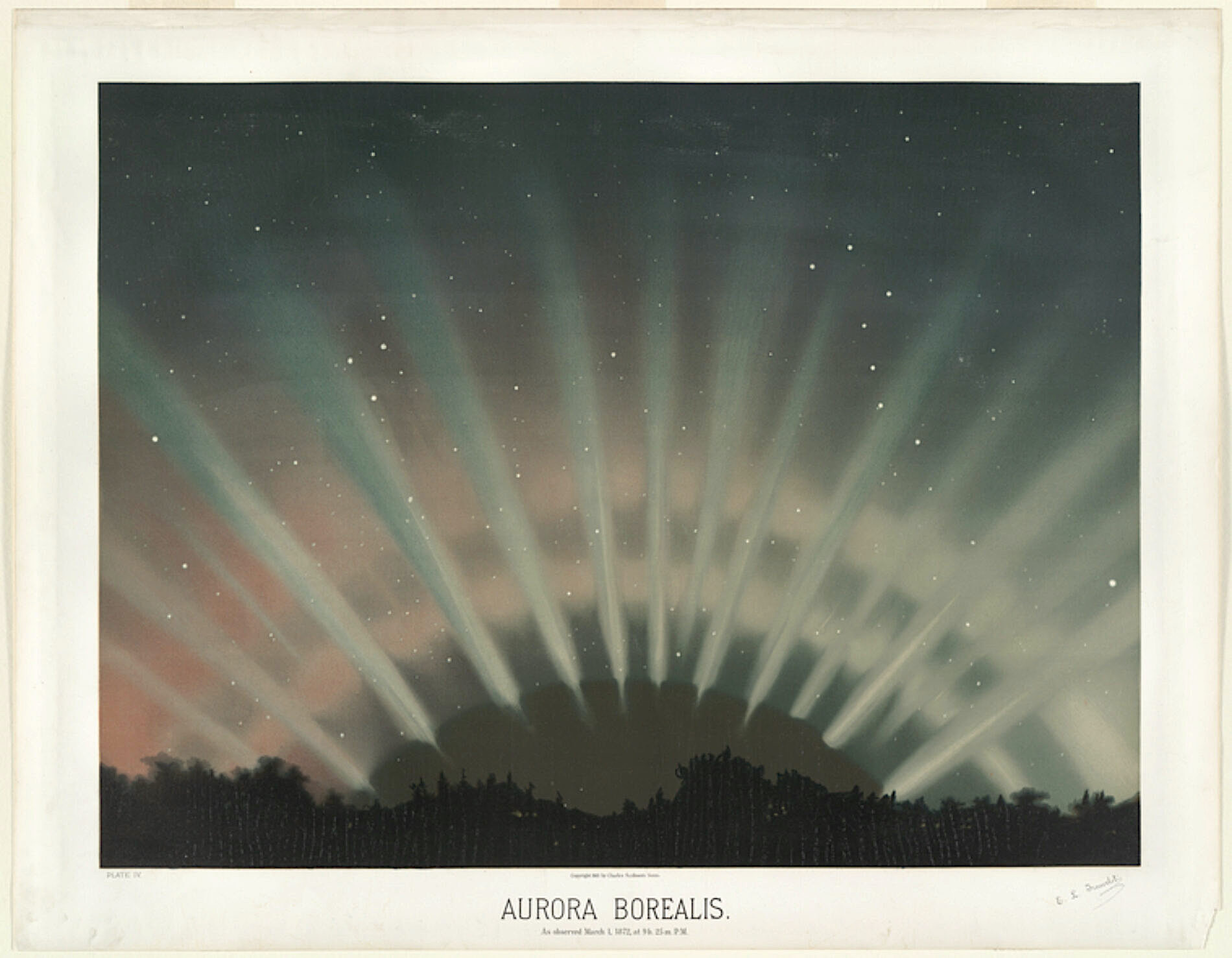
The first photo of the moon was taken in 1850 by Louis Daguerre, from whom the daguerrotype gets its name. We have no idea what that first image looked like as it was lost in a studio fire. But the need to catalog the heavens with modern tools had started, and was both fascinating as it was lacking. Into this evolution of science and art stepped Étienne Léopold Trouvelot, the French immigrant, living in the States, an amateur scientist and an illustrator. He would dismiss photography of the heavens as “so blurred and indistinct that no details of any great value can be secured.” And by illustrating instead by he saw through telescopes, he secured a place in art *and* science history.
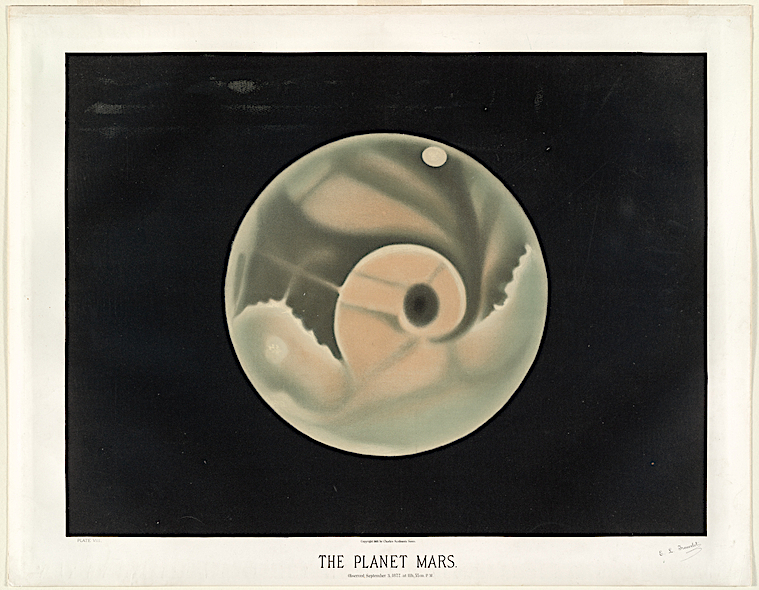
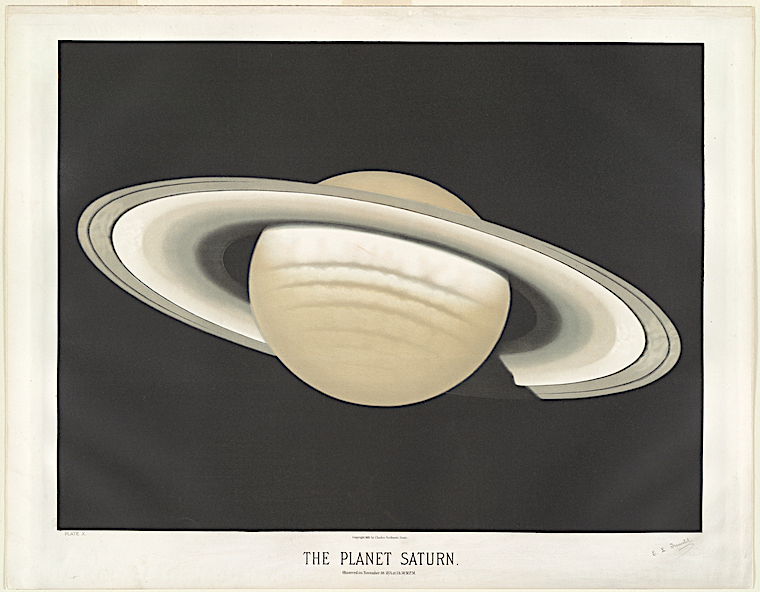
Trouvelot might have thought his scientific papers would be his legacy. He wrote fifty in his lifetime. Instead it is his roughly 7,000 illustrations of planets, comets, and other phenomena that still please us to this day. The New York Public Library has put 15 of his best up on their site, and over at this page, you can compare what Trouvelot saw—-the great astronomer Emma Converse called Trouvelot the “prince of observers”—-to photos from NASA’s archive.
Even if his Mars is a bit fanciful, looking translucent like a fish egg, his understanding of the planet echoes in the following century of sci-fi paranoia. Something strange must be there, he suggests.

Harvard hired him to sketch at their college’s observatory, and he used pastels to bring the planets to life. Engraving or ink would not have worked as well as these soft shapes and determined lines. His rendering of the moon surface is accurate but also fanciful, like whipped cream. And his sun spots might not be accurate, but they replicated the god-like forces at work on its tumultuous surface. His Saturn is the most realistic of them all. Even the NASA image doesn’t look too different to Trouvelot’s art.

These images also help rehabilitate Trouvelot’s other legacy—-the dreaded Gypsy Moth. Before his stint as amateur scientist, he was also an amateur entomologist, and while researching silkworms and silk production, accidentally let European gypsy moths into North America, where they wreaked havoc on the forests of North America. Saturn’s rings may look the same back then as they do now, but so does the damage of the gypsy moth, which according to Wikipedia is up to $868 million in damages per year.
Related Content:
A 9th Century Manuscript Teaches Astronomy by Making Sublime Pictures Out of Words
Jocelyn Bell Burnell Changed Astronomy Forever; Her Ph.D. Advisor Won the Nobel Prize for It
Ted Mills is a freelance writer on the arts who currently hosts the Notes from the Shed podcast and is the producer of KCRW’s Curious Coast. You can also follow him on Twitter at @tedmills, and/or watch his films here.
Read More...Support Us
We're hoping to rely on loyal readers, rather than erratic ads. Please click the Donate button and support Open Culture. You can use Paypal, Venmo, Patreon, even Crypto! We thank you!

About Us

Open Culture scours the web for the best educational media. We find the free courses and audio books you need, the language lessons & educational videos you want, and plenty of enlightenment in between.
Advertise With Us
FREE UPDATES!
GET OUR DAILY EMAIL
Get the best cultural and educational resources on the web curated for you in a daily email. We never spam. Unsubscribe at any time.
FOLLOW ON SOCIAL MEDIA
Open Culture editor Dan Colman scours the web for the best educational media. He finds the free courses and audio books you need, the language lessons & movies you want, and plenty of enlightenment in between.
Advertise With Us

