The Velvet Underground: Get a First Glimpse of Todd Haynes’ Upcoming Documentary on the Most Influential Avant-Garde Rockers
To the question of the most influential band formed in the 1960s a list of easy answers unfolds, beginning with the Beatles, the Beach Boys, and the Rolling Stones. As three of the makers of the best-selling records of all time, those bands all lay fair claim to the title. But even within the commercial dynamo of postwar America, it was also possible to exert great influence without topping the charts, or indeed without even reaching them. This is proven by the story of avant-garde rockers the Velvet Underground, whose meager success in their day as compared with their formidable cultural legacy inspired Brian Eno to sum them up with a quip now so well-known as to have become a cliché.
But not even a mind like Eno’s can truly sum up the Velvet Underground. Better to tell the band’s story — the story, in its way, of art and popular culture in mid-to-late 20th-century America — in a feature-length documentary, as Todd Haynes has done with The Velvet Underground, which premiered at this year’s Cannes Film Festival and debuts on AppleTV+ on October 15th.
“Haynes appears to have vacuumed up every last photograph and raw scrap of home-movie and archival footage of the band that exists and stitched it all into a coruscating document that feels like a time-machine kaleidoscope,” writes Variety critic Owen Gleiberman. He introduces the Velvets and their associates “by playing their words off the flickering black-and-white images of their Warhol screen tests.”
The Velvets were, in a sense, a product of Warhol’s Factory. The pop-art icon managed the band himself early on, connecting them with the singer who would become the second titular figure on their debut The Velvet Underground & Nico and designing that album’s oft-visually-referenced banana-sticker cover. Having died in 1987, Warhol couldn’t grant Haynes an interview; having followed Warhol the next year, neither could Nico. Band leader Lou Reed, too, has now been gone for the better part of a decade, but he does have plenty to say in the 1986 South Bank Show documentary above. Haynes’ The Velvet Underground includes Reed in archival footage, but also features new reminiscences from surviving members like Maureen Tucker and John Cale. Like all human beings, the Velvets are mortal; but their expansion of rock’s sonic possibilities will outlast us all.
Related Content:
The Velvet Underground Captured in Color Concert Footage by Andy Warhol (1967)
Based in Seoul, Colin Marshall writes and broadcasts on cities, language, and culture. His projects include the Substack newsletter Books on Cities, the book The Stateless City: a Walk through 21st-Century Los Angeles and the video series The City in Cinema. Follow him on Twitter at @colinmarshall or on Facebook.
Read More...The Evolutionary History of Fat: Biologists Explain Why It’s Necessary for Our Survival & Why We’re Biased Against It
The Fat Acceptance movement may seem like a 21st century phenomenon, rising to public consciousness with the success of high-profile writers, actors, filmmakers, and activists in recent years. But the movement can date its origins to 1967, when WBAI radio personality Steve Post held a “fat-in” in Central Park, bringing 500 people together to protest, celebrate, and burn diet books and photos of Twiggy. “That same year,” notes the Center for Discovery, “a man named Llewelyn ‘Lew’ Louderback wrote an article for the Saturday Evening Post titled, ‘More People Should be FAT.’” These early sallies led to the founding of the National Association to Advance Fat Acceptance (NAAFA) two years later and more radical groups in the 70s like the Fat Underground.
There would be no need for fat activism, of course, if there were no biases against fat people. This raises the question: where did those biases come from? They are not innate, says Harvard University evolutionary biologist Daniel Lieberman in the Slate video above, but are a product of a history that tracks, coincidentally, with the rise of mass marketing and mass consumerism. We have been sold the idea that thin bodies are better, healthier, more attractive, and more desirable, and that fat is something to be warred against. “However, as an evolutionary biologist, “says Lieberman, I’ve come to appreciate that without fat, we’d be dead. Humans wouldn’t really be the way we are. Fat is really life.”
A quick perusal of art history shows us that larger bodies have been valued around the world in much of human history. We now associate fat with poor health, but it has also signaled the opposite — a storehouse of caloric wealth and healthy fertility. “Our bodies have all sorts of tricks to make sure we never run out of energy,” says Lieberman, “and the main way that we store energy is fat.” Leiberman and other biologists in the video survey the role of fat in human survival and thriving. “Fat is an organ,” and scientists are learning how it communicates with other systems in the body to regulate energy consumption and feed our comparatively enormous brains.
Among animals, “humans are especially adapted to be fat.” Even the thinnest among us are corpulent compared to most primates. Still, the average human did not have any opportunity to become obese until relatively recent historical developments — in the grand evolutionary scheme of things — like agriculture, heavy industry, and the science to preserve and store food. When Europeans discovered sugar, then mass produced it on plantations and exported it around the world, sugar consumption magnified exponentially. The average American now eats 100 pounds of sugar per year. The average hunter-gatherer might have struggled the eat “a pound or two a year” from natural sources.
The over-abundance of calories has led to a type-II diabetes epidemic worldwide that is closely related to sugar consumption. It isn’t necessarily related to having a larger body, although fat deposits in the heart and elsewhere can worsen insulin resistance (and heart disease); the problem is almost certainly linked to excess sugar, the constant availability of high-calorie foods, and low incentives to exercise. Our hunger for sweets and love of comfort are not character flaws, however. They are evolutionary drives that allow us to acquire and conserve energy, operating in a food economy that often punishes us for those very drives. Dieting not only doesn’t work, as neuroscientist Sandra Aamodt explains in her TED Talk above, but it often backfires, making us even hungrier because our brains perceive us as deprived.
As scientists like Lieberman gain a better understanding of the role of fat in human biology, those in the medical community are realizing that doctors and nurses are hardly free from the societal biases against fat. Studies show those biases can translate to poorer medical care and bad advice about dieting, a vicious cycle in which health conditions unrelated to weight go untreated, and are then blamed on weight. Evolutionary biology explains the role of fat in human development, and human history explains its increase, but the question of where the hatred of fat comes from is a trickier one for these scientists to answer. They barely mention the role of advertising and entertainment.
In 1979, activists in the “Fat Liberation Manifesto” identified the problem as fat people’s “mistreatment by commercial and sexist interests” that have “exploited our bodies as objects of ridicule, thereby creating an immensely profitable market selling the false promise of avoidance of, or relief from, that ridicule.” Despite decades of resistance, the diet industry thrives. A Google search of the phrase “body fat” yields page upon page of unscientific advice about ideal body fat percentages, as though reminding the majority of Americans (7 in 10 are classified as overweight or obese) that they should feel there’s something wrong with them.
Blame, shame, and ridicule won’t solve medical problems, say the biologists in the video above, and it certainly doesn’t help people lose weight, if that’s what they need to do. If we better understood the role of fat in keeping us healthy, happy, and alive, maybe we could overcome our hatred of it and accept others, and ourselves, in whatever bodies we’re in.
Related Content:
How the Food We Eat Affects Our Brain: Learn About the “MIND Diet”
Exercise May Prove an Effective Natural Treatment for Depression & Anxiety, New Study Shows
Why Sitting Is The New Smoking: An Animated Explanation
Josh Jones is a writer and musician based in Durham, NC. Follow him at @jdmagness
Read More...What Is “Queering” in Video Game Design? Naomi Clark on Pretty Much Pop: A Culture Podcast #103
While LGBTQ+ representation in video games has been improving (as with other media), Naomi Clark (who designed games for LEGO, Gamelab, Fresh Planet, Rebel Monkey, et al) has something more disruptive in mind when arguing for game “queerification.” The prototypical video game includes a more-or-less linear progression through a pre-defined story to a defined win condition, and anything that challenges that tradition to allow more self-expression is a step in the direction of queering. Many popular games now include a sandbox aspect that allows players to make their own decisions, and this gestures at a continuum of freedom in player-game relations, with the extreme being a game that just provides a platform for players to create their own games.
Your host Mark Linsenmayer and guest co-host Tyler Hislop engage Naomi about topics like how games train us, character creation, glitches, speed runs, gamifying tasks, and economic and industry pressures in game design. Some games we touch on include The Sims, The Last of Us, Cyberpunk, and Mass Effect.
Read Naomi’s presentation on “Queering Human-Game Relations.” Get involved with the NYU Gamecenter where Naomi works. You can also play her early game Sissyfight 2000 free online. A couple of her other creations that come up in our discussion include Wonder City and the card game Consentacle. Read her wisdom on Quora and follow her on Twitter @metasynthie.
Some sources reviewed to prepare for this episode include:
- “Just Making Things and Being Alive About It: The Queer Games Scene” (2013) by Brendan Keogh
- “The 15 Queerest Video Games, Ranked” by Alley Hector (2018)
- “How Video Games Can Help LGBTQ+ Players Feel Like Themselves” by Laken Brooks
- “Press A, Be Gay: LGBTQ Representation in Video Games” by Jason Villemiz
- “15 Games With Non-Binary Friendly Character Creation” by Allison Stalberg
- “Can We Do Better Than Zelda? Queer Tropes in Video Games” a video from Feminist Frequency
- “The trans narrative in ‘The Last of Us Part II’ is compelling. There’s so much more to be done.” by Julie Muncy
- “ ‘Am I Trans?’: One Teen’s Quest and How Gaming Helped” (2015) from Note to Self podcast (which features Naomi)
- There are several specifically gay video game podcasts worth checking out, including Gay for Play and The Gayming Podcast.
This episode includes bonus discussion you can access by supporting the podcast at patreon.com/prettymuchpop. This podcast is part of the Partially Examined Life podcast network.
Pretty Much Pop: A Culture Podcast is the first podcast curated by Open Culture. Browse all Pretty Much Pop posts.
Read More...What Makes Rodin’s The Thinker a Great Sculpture: An Introduction to Rodin Life, Craft & Iconic Work
Auguste Rodin’s The Thinker exists in about 28 full-size bronze casts, each approximately 73 inches high, in museums around the world, as well as several dozen castings of smaller size and plaster models and studies. The Thinker also exists as one of the most copied and parodied artworks in world history, perhaps because of its ubiquity. “Unfortunately,” Joseph Phelan writes at the Artcyclopedia, “there is a side of Rodin’s work that has become kitsch through cheap reproductions and commercial rip-offs.”
In popular interpretations, The Thinker represents philosophical abstraction. But Rodin’s figure doesn’t contemplate Plato’s forms or Kant’s categories. He dreams of hell, and brings a vision of eternal torment into being. He is a representation of the poet Dante (hence his original name, The Poet) in Rodin’s most ambitious masterwork, The Gates of Hell, made on commission from the Museum of Decorative Arts in Paris. The subject, “bas-reliefs representing The Divine Comedy,” was “surely suggested by Rodin himself, as he was an avid reader of Dante,” the Association for Public Art points out.
Divorced from its original context — a work begun in 1880 and only completed after the artist’s death in 1917 — The Thinker becomes “a universal image,” the National Gallery of Art writes — one that “reveals in physical terms the mental effort and even physical anguish of creativity.” As Rodin himself put it, “what makes my Thinker think is that he thinks not only with his brain, with his knitted brow, his distended nostrils and compressed lips, but with every muscle of his arms, back, and legs, with his clenched fist and gripping toes.” If we can see his thoughtful posture with fresh eyes, we’ll notice his extreme stress, tension, and pain.
Rodin worked on The Gates of Hell for the final 37 years of his life, and didn’t live to see it cast in full during his lifetime. The massive bronze doors — which also produced such famous Rodin sculptures as The Three Shades and The Kiss — contain around 200 individual figures and groups of sufferers from the Inferno. “For Rodin,” notes the Rodin Museum, “the chaotic population on The Gates of Hell enjoyed only one final freedom — the ability to express their agony with complete abandon … The figures on the doors poignantly and heart-rending evoke universal human emotions and experiences.”
While hell’s denizens writhe and burn below him, The Thinker, perched atop the door, curls in on himself with the strain of imagination. Whatever his original inspiration, he came unglued from the Inferno, his modular nature part of the sculptor’s original design. The Thinker is Dante, but also “in a very real sense,” the Met writes, “The Thinker is Rodin. Brutishly muscled yet engrossed in thought, coiled in tension yet loose in repose.” As a universal symbol for contemplation, he is also an image of bringing art into being through the sheer force of one’s mind.
Rodin, after all, “never produced a work of plaster, bronze, or even marble with his own hands,” says the Great Art Explained video above, preferring “an industrial approach to producing art” that meant a supervisory role over crews of workers, raising questions about “authenticity and originality.” Perhaps Rodin “shows us that an artist should be judged by what’s in his head, not in his hands,” but The Thinker shows us that what’s in the head is also in the hands, the gnarled back, tense sinewy arms, and curled up toes.
Related Content:
Rare Film of Sculptor Auguste Rodin Working at His Studio in Paris (1915)
A Free Online Course on Dante’s Divine Comedy from Yale University
The Story Behind Rodin’s ‘The Kiss’
Josh Jones is a writer and musician based in Durham, NC. Follow him at @jdmagness
Read More...A 94-Year-Old English Teacher and Her Former Students Reunite in Their Old Classroom & Debate the Merits of Bob Dylan’s Nobel Prize
In fiction the inspirational high-school English teacher is a cliché, despite (or indeed due to) the fact that so many of us have had at least one of them in real life. For generations of students who passed through San Francisco’s prestigious Lowell High School, that teacher was Flossie Lewis. Long after her retirement, she went surprisingly viral in a 2016 PBS interview clip about her thoughts on aging. It seemed she retained her power to inspire, not just for her more than seven million online viewers, but also for the PBS producers who later reunited her with her former students in the very same classroom where she once taught them.
You can see this reunion take place in the video above, which also includes Flossie telling her own story of having fled Brooklyn spinsterhood on a Greyhound bus headed west. “I could command the attention of a class,” she says of the source of her power as a teacher. “I had a voice. I had that kind of personality that did not seem teacherly, but was provocative.”
Onetime student Daniel Handler, better known as the novelist Lemony Snicket, credits Flossie with an “ability to startle.” Another, now an architect, remembers “gravitas” — and his having been “intimidated by her name. Flossie is a very unusual name.” Or at least it is today, its popularity (driven, it seems, by the Bobbsey Twins books) having peaked in the early 20th century.
Flossie is also representative of her generation in another way: not particularly caring for the music of Bob Dylan. Though she can’t have been thrilled with that guitar-playing (relative) youngster’s 2016 Nobel Prize for Literature, she’s willing to hear her students out on the subject. “The trivial task before us is to decide whether Bobby Dylan is worth the laureate,” she declares to the group of Lowell alumni gathered in her old classroom. Now all middle-aged, her former students include Dylan defenders and Dylan deniers alike, but what unites them are their undimmed memories of their teacher’s mixture of rigor, compassion, and sheer eccentricity. As one of them recalls, “You read us a sonnet from Shakespeare and said, ‘It’s no good.’ ” Whatever his generational relevance, the poet from Hibbing may never have stood a chance.
Related Content:
Hear Bob Dylan’s Newly-Released Nobel Lecture: A Meditation on Music, Literature & Lyrics
Bob Dylan Reads From T.S. Eliot’s Great Modernist Poem The Waste Land
“Tangled Up in Blue”: Deciphering a Bob Dylan Masterpiece
David Foster Wallace’s 1994 Syllabus: How to Teach Serious Literature with Lightweight Books
Comedian Ricky Gervais Tells a Serious Story About How He Learned to Write Creatively
Based in Seoul, Colin Marshall writes and broadcasts on cities, language, and culture. His projects include the Substack newsletter Books on Cities, the book The Stateless City: a Walk through 21st-Century Los Angeles and the video series The City in Cinema. Follow him on Twitter at @colinmarshall or on Facebook.
Read More...Chinese Youth Announce That They’re “Lying Flat” and Resisting the Pressures of Modern Life
The “Lying Flat” movement taking hold among young people in China involves doing exactly what it suggests: working little, resting a lot, and cultivating the most minimalist lifestyle possible. Unlike Timothy Leary’s 1960’s mantra, “turn on, tune in, drop out,” lying flat, or tang ping (躺平), takes no stance on a countercultural ethos or the consumption of mind-altering drugs. But it has caused the authorities alarm, even among English-language observers. Consider the Brookings Institute headline, “The ‘lying flat’ movement standing in the way of China’s innovation drive.” Standing in the way of innovation is a cardinal sin of capitalism, one reason the “niche Chinese Gen Z meme” of tang ping, Jane Li writes, “is ringing alarm bells for Beijing.”

The phenomenon began — where else — on social media, when 31-year-old former factory worker Luo Huazhong “drew the curtains and crawled into bed,” Cassady Rosenblum writes at The New York Times. Luo then “posted a picture of himself [in bed] to the Chinese website Baidu along with a message: ‘Lying Flat is Justice.’”
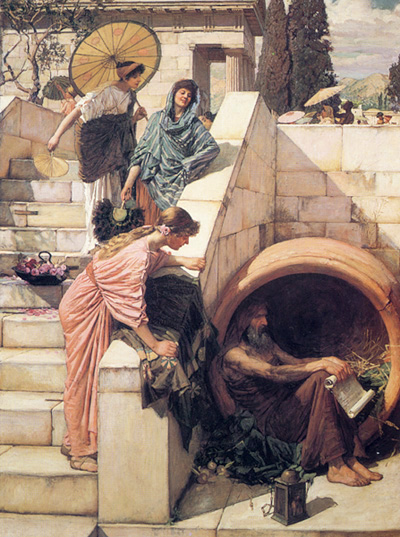
His manifesto (above) claimed the “right to choose a slow lifestyle” by doing little work to get by, reading, gardening, exercising, and, yes, lying supine as often as he liked. To further elaborate, Luo wrote, “lying flat is my sophistic movement,” with a reference to Diogenes the Cynic, the Greek philosopher “said to have lived inside a barrel to criticize the excesses of Athenian aristocrats.”

Diogenes did more than that. He and his followers rejected everything about Athenian society, from work and marriage to the abstract reasoning of Plato. Luo might have turned to a more traditional source for “lying flat” — the Daoist principle of wu-wei, or non-doing. But lying flat is not so much about living in harmony with nature as it is a state of exhaustion, a full-body admission that the promises of capitalism — work hard now, rest hard later — have not and will not materialize. They are phantoms, mirages, precisely the kind of fictions that made Diogenes bark with laughter. The truth, Rosenblum writes, is that for “essential” workers at the bottom all the way up to the “inner sanctums” of Goldman Sachs, “work has become intolerable. Rest is resistance.”

In a work culture that celebrates “996” — 12-hour days, six days a week– rest may be the only form of resistance. Political repression and lack of upward mobility have fostered “an almost monastic outlook” in China, writes Li, “including not getting married, not having children, not having a job, not owning property, and consuming as little as possible.” Since picking up tens of thousands of followers online, the lying flat movement has become the target of a censorship campaign aimed at stopping young Chinese workers from checking out. One government-backed newspaper called the movement “shameful,” and news agency Xinhua unfavorably compared “lying flattists” to front-line medical workers. The original manifesto, Lying Flat groups, and message boards where users posted photos of seals, cats, and themselves lying flat have been taken down.
Zijia Song writes of tang ping as partly a response to a traditional Chinese culture of competitiveness and overwork, but notes that there are similar movements in Japan, Korea, and the U.S., where “Black activists, writers and thinkers are among the clearest voices articulating this spiritual malaise and its solutions,” writes Rosenblum, “perhaps because they’ve borne the brunt of capitalism more than other groups of Americans.” Whatever their national origin, each of these statements defiantly claims the right to rest, posing a threat not only to the Party but to an ideal of human life as endless overwork for shiny trinkets and empty promises, during a global pandemic and climate crisis that have revealed to us like nothing else the need to slow down, rest, and completely reimagine the way we live.
Related Content:
Bertrand Russell & Buckminster Fuller on Why We Should Work Less, and Live & Learn More
Brian Eno’s Advice for Those Who Want to Do Their Best Creative Work: Don’t Get a Job
Josh Jones is a writer and musician based in Durham, NC. Follow him at @jdmagness
Read More...An Archaeologist Creates the Definitive Guide to Beer Cans

Image via Wikimedia Commons
As a beverage of choice and necessity for much of the population in parts of the ancient world, beer has played an important role in archaeology. Beer cans, on the other hand, have not. Unlike millennia-old recipes, beer cans seem like no more than trash, even in a field where trash is highly treasured. This is a mistake, says archeologist Jane Busch. “The historical archaeologist who ignores the beer can at his site is like the prehistoric archeologist who ignores historic pottery.”
David Maxwell, an expert in animal bones who trained as a Mayanist, has recognized the truth of this statement by turning his passion for beer can collecting into beer can archaeology, a tiny niche within the smaller field of “tin can archaeology.” Maxwell became the reigning expert on beer can dating when “in 1993, he published a field-identification guide in Historical Archaeology,” notes Jessica Gingrich at Atlas Obscura, “which has since become an industry standard and his most-read work.”
The first commercial canned beer appeared in 1935, after several unsuccessful experiments starting in 1909. Experiments in beer canning took a hiatus during Prohibition, and canned beer itself went off the market during WWII as supplies of tin plate were rerouted to the war effort. During that interregnum, only the military shipped canned beer, to soldiers overseas in olive and camo-colored cans. When sales resumed after the war, beer cans assumed more routinized design elements. Maxwell himself became fascinated with beer cans from afar. “While canned beer sales exploded in the United States after World War II, Gingrich writes, “the industry failed to take off in Canada until the 1980s.”
As a child in Canada, Maxwell collected bottle caps. “All the beer came in the same shape bottle,” he says. Cans seemed exotic, especially those of an older vintage. “They had punches to open them instead of pull rings, and all I knew was that they predated me.” The value of disposable artifacts less than 100 years old isn’t immediately apparent to most people, says Jim Rock, a pioneer of tin can studies who calls cans “the Rodney Dangerfield of archeology. They just don’t get any respect.” But the fact is “all archeology is garbage,” says Maxwell.
Dating cans gives archeologists a picture of modern consumption patterns — and patterns of ecological destruction — in the refuse tossed on highways and the strata of trash found in construction sites, landfills, and even ancient dig sites, where dating beer cans can tell archeologists when earlier trespassers might have arrived, removed or altered artifacts, and left their trash behind. Maxwell, who has recently downsized his collection from 4500 to 1700 cans to save space, admits that a narrow focus on the beer can takes a special combination of skills.
“Collectors are a fabulous resource for academics,” he says. “These are the guys who do the grunt work” — the endlessly curious citizen scientists of archaeology. “I can’t think of anyone else who would do that except someone who is obsessive about what it is that they are collecting.” In Maxwell, the obsessive collector and rigorous academic just happened to come together to produce the definitive guide. (See Beer Cans: A Guide for the Archaeologist online.) But even he has had to “face the question of what deserves to be archived and kept,” Nicola Jones writes at Sapiens. In discarding 3,000 of his own cans, most of them acquired through collectors online, he had to admit that “though the rusty cans were a part of history, they weren’t worth much to the rest of the world.”
Related Content:
Beer Archaeology: Yes, It’s a Thing
The First Known Photograph of People Sharing a Beer (1843)
Josh Jones is a writer and musician based in Durham, NC. Follow him at @jdmagness
Read More...Build Wooden Models of Frank Lloyd Wright’s Great Building: The Guggenheim, Unity Temple, Johnson Wax Headquarters & More

Frank Lloyd Wright had his eccentricities, in not just his personal and professional conduct but also the very language with which he described the world. Among the enduringly fascinating elements of his idiolect is the word Usonian, which refers to things of or pertaining to the United States of America. Wright didn’t coin the term: its earliest recorded user is the early 20th-century writer James Duff Law, who declared that “We of the United States, in justice to Canadians and Mexicans, have no right to use the title ‘Americans’ when referring to matters pertaining exclusively to ourselves.” The most famous architect in American history took Usonian further, using it to label an American architectural sensibility — of, naturally, his own design.

Though Wright did envision an ideally Usonian city, his clearest expressions of the aesthetic stand today in the form of the Usonian houses. Built between 1934 and 1958, these sixty or so residences take advantage, as Wright saw it, of the range of distinctive settings offered up by the landscapes of the United States.
Designed with features like garden terraces, clerestory windows, flat roofs with wide overhangs, and easy visual and physical passage between the indoors and outdoors, these urban-rural hybrids still today draw the admiration of architects and non-architects alike. But truly to understand a Usonian house, perhaps you must build one yourself: luckily, the Little Building Company offers a model kit that lets you do just that.

Their Wright lineup also includes miniature wooden versions of his 1908 Unity Temple in Oak Park, his 1937 Johnson Wax Headquarters in Racine, and his 1937 Solomon R. Guggenheim Museum in New York. The differences in scale and complexity between these buildings make for a natural model-building difficulty curve: once you’ve done a Wright house, you’ll be ready for a Wright temple; once you’ve done a Wright temple, you’ll be ready for a Wright corporate headquarters, and so on. Not only will the effort hone your manual dexterity, it will heighten your appreciation for the American architecture-defining innovations Wright pulled off in the early 20th century. But do you have to be from the United States to understand the Usonian? Based in Australia and selling to the world, the Little Building Company suggests not.
Related Content:
Frank Lloyd Wright Designs an Urban Utopia: See His Hand-Drawn Sketches of Broadacre City (1932)
The Modernist Gas Stations of Frank Lloyd Wright and Mies van der Rohe
How Frank Lloyd Wright’s Son Invented Lincoln Logs, “America’s National Toy” (1916)
That Far Corner: Frank Lloyd Wright in Los Angeles – a Free Online Documentary
Omoshiroi Blocks: Japanese Memo Pads Reveal Intricate Buildings As The Pages Get Used
Based in Seoul, Colin Marshall writes and broadcasts on cities, language, and culture. His projects include the Substack newsletter Books on Cities, the book The Stateless City: a Walk through 21st-Century Los Angeles and the video series The City in Cinema. Follow him on Twitter at @colinmarshall or on Facebook.
Read More...Watch Lost Studio Footage of Brian Wilson Conducting “Good Vibrations,” The Beach Boys’ Brilliant “Pocket Symphony”
After Brian Wilson created what Hendrix called the “psychedelic barbershop quartet” sound of the Beach Boys’ Pet Sounds, he moved on to what he promised would be another quantum leap beyond. “Our new album,” Smile, he claimed, “will be as much an improvement over Sounds as that was over Summer Days.” But in his pursuit to almost single-handedly surpass the Beatles in the art of studio perfectionism, Wilson overreached. He famously scrapped the Smile sessions, and instead released the hastily-recorded Smiley Smile to fulfill contract obligations in 1967.
Smiley Smile’s peculiar genius went unrecognized at the time, particularly because its centerpiece, “Good Vibrations,” had set expectations so high. Recorded and released as a single in 1966, the song would be referred to as a “pocket symphony” (a phrase invented either by Wilson himself or publicist Derek Taylor). Even the jaded session players who sat in for the hours of recording — veterans from the famed “Wrecking Crew” — knew they were making something that transcended the usual rut of pop simplicity.
“We were doing two, three record dates a day,” says organ player Mike Melvoin, “and the level of sophistication was, like, not really sophisticated at all.” The “Good Vibrations” sessions were another experience entirely. “All of a sudden, you walk in, and here’s run-on songs. It’s like this section followed by that section followed by this section, and each of them with a completely different character. And you’re going, ‘Whoa.’” Wrecking Crew bassist Carol Kay, who sat in for the sessions but didn’t make the final mix, remembers thinking, “that wasn’t your normal rock ‘n’ roll…. You were part of a symphony.”
Wilson’s pop symphonies were created and arranged not on paper but during the recording sessions themselves, which accounted for the 90 hours of tape and tens of thousands of dollars in expenses, the most money ever spent on a pop single. He made creative decisions according to what he called “feels,” fragments of melody and sound that formed his avant-garde pastiches. “Each feel represented a mood or an emotion I’d felt,” he recalled, “and I planned to fit them together like a mosaic.” Not everyone could see the plan at first.
But when Wilson finally emerged from months of isolation after cutting and mixing hours and hours of tape, the rest of the band was “very blown out,” he says. “They were most blown out. They said, ‘Goddamn, how can you possibly do this, Brian?’ I said, ‘Something got inside of me.’… They go, ‘Well, it’s fantastic.’ And so they sang really good just to show me how much they liked it.” In the edited footage at the top, taken over the six months of recording in four different studios, you can see drummer Hal Blaine, organ player Mick Melvoin, double bass player Lyle Ritz, and the Beach Boys themselves all recording their parts.
To the press, Wilson told one story — “Good Vibrations” was “still sticking pretty close to that same boy-girl thing, you know, but with a difference. And it’s a start, it’s definitely a start.” But the song — which he first wanted to call “Good Vibes” — is very much meant to suggest “the healthy emanations that should result from psychic tranquility and inner peace,” wrote Bruce Golden in The Beach Boys: Southern California Pastoral. In that sense, “Good Vibrations” was aspirational, almost tragically so, for Wilson, who could not fulfill its promises. Yet, in another sense, “Good Vibrations” is itself the fulfillment of Wilson’s creative promise, an eternally brilliant “pocket symphony” — and as Wilson told engineer Chuck Britz during the sessions, his “whole life performance in one track.”
Related Content:
How the Beach Boys Created Their Pop Masterpieces: “Good Vibrations,” Pet Sounds, and More
Josh Jones is a writer and musician based in Durham, NC. Follow him at @jdmagness
Read More...Two Haruki Murakami Stories Adapted into Short Films: Watch Attack on a Bakery (1982) and A Girl, She Is 100% (1983)
At this year’s Cannes Film Festival, the Award for Best Screenplay went to Ryusuke Hamaguchi’s Drive My Car, an adaptation of a story by Haruki Murakami. So did FIPRESCI Prize, the Prize of the Ecumenical Jury, and no small amount of critical acclaim, suggesting that the code for translating Murakami onto the screen might finally have been cracked. Every now and again over the past forty years, a bold filmmaker has taken on the challenge of turning a work of that most world-famous Japanese novelist into a feature. But until recently, the results have for the most part not been received as especially consequential in and of themselves.
In general, short fiction tends to produce more satisfying adaptations than full-fledged novels, and Murakami’s work seems not to be an exception (as underscored a few years ago by Korean auteur Lee Chang-dong’s Burning). Hamaguchi’s film spins some 40 pages into a running time of nearly three hours, doing the opposite of what other Japanese filmmakers have done with Murakami’s short stories. In 1982, Naoto Yamakawa made one of them into Attack on a Bakery, a short film running less than twenty minutes; the following year, he made another into the even shorter A Girl, She is 100%, running less than fifteen. Today Murakami fans everywhere can watch them both on Youtube, complete with English subtitles.
The material will feel familiar to English-language Murakami readers. A main character of the story “The Second Bakery Attack” reminisces about a robbery he attempted as a hungry young man that went comically off the rails, in a manner similar to the one in Yamakawa’s first short. (In 2010 “The Second Bakery Attack,” wherein the now-married narrator robs a fast-food joint with his new bride, itself became a short film directed by Carlos Cuarón, brother of Alfonso.) Though “The Bakery Attack” has never been officially published in English, “On Seeing the 100% Perfect Girl One Beautiful April Morning” has, and it now stands as one of Murakami’s representative short works in that language; it also, in the original, provides the basis for A Girl, She Is 100%.
“She doesn’t stand out in any way,” Murakami’s narrator says of the titular figure. “Her clothes are nothing special. The back of her hair is still bent out of shape from sleep. She isn’t young, either — must be near thirty, not even close to a ‘girl,’ properly speaking. But still, I know from fifty yards away: She’s the 100% perfect girl for me.” Yamakawa dramatizes a similar fleeting encounter and the romantic speculations that resonate in the man’s mind. Like the half-baked philosophical and political convictions of the would-be robbers, these inspire the director to the kind of visual and formal inventiveness one would expect given his background in Godard and Scorsese scholarship. But the only filmmaker name-checked is Woody Allen, which fans will recognize as a characteristic Murakami reference. So as are the inclusions of Wagner, D.H. Lawrence, jazz music — and of course, an unexpected cat.
Related Content:
Read 12 Stories By Haruki Murakami Free Online
Haruki Murakami’s Passion for Jazz: Discover the Novelist’s Jazz Playlist, Jazz Essay & Jazz Bar
A 3,350-Song Playlist of Music from Haruki Murakami’s Personal Record Collection
Memoranda: Haruki Murakami’s World Recreated as a Classic Adventure Video Game
Based in Seoul, Colin Marshall writes and broadcasts on cities, language, and culture. His projects include the Substack newsletter Books on Cities, the book The Stateless City: a Walk through 21st-Century Los Angeles and the video series The City in Cinema. Follow him on Twitter at @colinmarshall or on Facebook.
Read More...Support Us
We're hoping to rely on loyal readers, rather than erratic ads. Please click the Donate button and support Open Culture. You can use Paypal, Venmo, Patreon, even Crypto! We thank you!

About Us

Open Culture scours the web for the best educational media. We find the free courses and audio books you need, the language lessons & educational videos you want, and plenty of enlightenment in between.
Advertise With Us
FREE UPDATES!
GET OUR DAILY EMAIL
Get the best cultural and educational resources on the web curated for you in a daily email. We never spam. Unsubscribe at any time.
FOLLOW ON SOCIAL MEDIA
Open Culture editor Dan Colman scours the web for the best educational media. He finds the free courses and audio books you need, the language lessons & movies you want, and plenty of enlightenment in between.
Advertise With Us