An 18-Year-Old Spends a Year Alone Building a Log Cabin in the Swedish Wilderness: Watch from Start to Finish
Henry David Thoreau has at times been upbraided by critics for “everyone’s favorite incriminating biographical factoid,” writes Donovan Hohn at The New Republic: “During the two years he spent at Walden Pond, his mother sometimes did his laundry.” The author who became “America’s original nature boy “played at rugged self-sufficiency,” it is said, “while squatting on borrowed land, in a house built with a borrowed axe”; he played at rugged individualism while relying on friends and family to support him.
Who did Erik Grankvist’s laundry, we might wonder, while he built a log cabin alone during the year he recorded in the edited video above? Grankvist shows how, at 18, he “ventured out alone with only a backpack full of simple hand tools to actualize my dream… [to] build my own traditional off grid log cabin by hand from the materials of the Swedish wilderness. Just like our Forefathers did.” You may notice, or not, the cleanliness of Grankvist’s clothing. You may wonder, “who washed his forefathers’ clothes?”…
Or, you might say, “this isn’t a video about laundry but about building a log cabin!” And you would be correct. As an experiment in building a log cabin from scratch with (mostly) just a few hand tools, it is an extraordinary document: “I had no previous experience in building, gathering materials or filming,” Grankvist writes. “So I started studying myself the old arts and learning from my grandfather and mentor Åke Nilsson. I began to cut down trees and film with my phone, learning as I go.”
The project really picked up steam once Grankvist graduated high school, he writes, suggesting he did not actually live full time in the woods but that someone fed, housed, and clothed him while he worked. We see none of this in the video. We do see a tractor at one point, and Grankvist admits he’d rather the modern extravagance have been a horse.
Does it ruin the magic a little to wonder about the mundane details of the builder’s life — food, clothing, healthcare, etc. — while watching him cut his own timber, clear the land, build a stone foundation and, on top of it, a rustic little cabin? Maybe a little. But as extraordinary as it is to watch an 18-year-old Swede build a log cabin by himself, one also can’t help but remember it takes a village worth of forefathers, and mothers, to make an 18-year-old Swede. But Grankvist does not present his visual Walden as a how-to guide (any more than Thoreau did), but as his own statement of independence, one worth making even if it doesn’t tell the full truth about self-sufficiency.
Related Content:
How Frank Lloyd Wright’s Son Invented Lincoln Logs, “America’s National Toy” (1916)
How to Survive the Coming Zombie Apocalypse: An Online Course by Michigan State
Josh Jones is a writer and musician based in Durham, NC. Follow him at @jdmagness
Read More...Vintage Public Health Posters That Helped People Take Smart Precautions During Past Crises

We subscribe to the theory that art saves lives even in the best of times.
In the midst of a major public health crisis, art takes a front line position, communicating best practices to citizens with eye catching, easy to understand graphics and a few well chosen words.
In March of 2020, less than 2 weeks after COVID-19 brought New York to its knees, Angelina Lippert, the Chief Curator of Poster House, one of the city’s newer museums shared a blog post, considering the ways in which the CDC’s basic hygiene recommendations for helping stop the spread had been touted to previous generations.
As she noted in a lecture on the history of the poster as Public Service Announcement the following month, “mass public health action… is how we stopped tuberculosis, polio, and other major diseases that we don’t even think of today:”
And a major part of eradicating them was educating the public. That’s really what PSAs are—a means of informing and teaching the public en masse. It goes back to that idea … of not having to seek out information, but just being presented with it. Keeping the barrier for entry low means more people will see and absorb the information.
The Office of War Information and the District of Columbia Society for the Prevention of Blindness used an approachable looking raccoon to convince the public to wash hands in WWII.

Artist Seymour Nydorf swapped the raccoon for a blonde waitress with glamorous red nails in a series of six posters for the U.S. Public Health Service of the Federal Security Agency

Coughing and sneezing took posters into somewhat grosser terrain.
The New Zealand Department of Health’s 50s era poster shamed careless sneezers into using a hankie, and might well have given those in their vicinity a persuasive reason to bypass the buffet table.

Great Britain’s Central Council for Health Education and Ministry of Health collaborated with
Her Majesty’s Stationery Office to teach the public some basic infection math in WWII.

Children’s wellbeing can be a very persuasive tool. The WPA Federal Art Project was not playing in 1941 when it paired an image of a cherubic tot with stern warnings to parents and other family members to curb their affectionate impulses, as well as the transmission of tuberculosis.
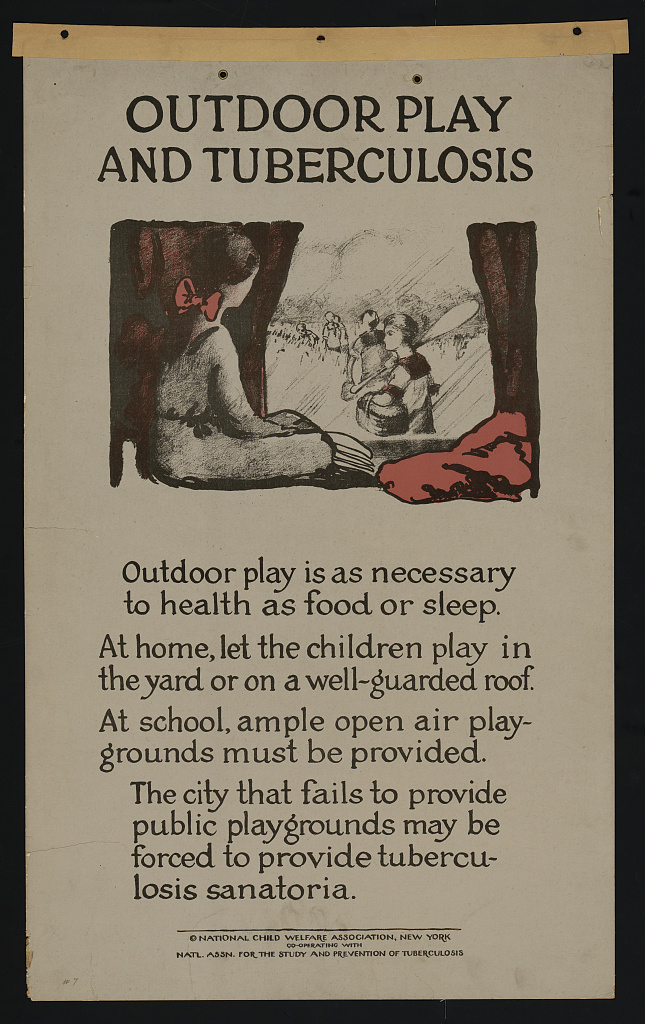
The arresting image packs more of a wallop than this earnest and far wordier, early 20s poster by the National Child Welfare Association and the National Association for the Study and Prevention of Tuberculosis.


Read Poster House Chief Curator Angelina Lippert’s Brief History of PSA Posters here.
Download the free anti-xenophobia PSAs Poster House commissioned from designer Rachel Gingrich early in the pandemic here.

Related Content:
Download Beautiful Free Posters Celebrating the Achievements of Living Female STEM Leaders
Salvador Dalí Creates a Chilling Anti-Venereal Disease Poster During World War II
Ayun Halliday is an author, illustrator, theater maker and Chief Primatologist of the East Village Inky zine. Follow her @AyunHalliday.
Read More...MoMA’s Online Courses Let You Study Modern & Contemporary Art and Earn a Certificate
The labels “modern art” and “contemporary art” don’t easily pull apart from one another. In a strictly historical sense, the former refers to art produced in the era we call modernity, beginning in the mid-19th century. And according to its etymology, the latter refers to art produced at the same time as something else: there is art “contemporary” with, say, the Italian Renaissance, but also art “contemporary” with our own lives. You’ll have a much clearer idea of this distinction — and of what people mean when they use the relevant terms today — if you take the Modern and Contemporary Art and Design Specialization, a set of courses from the Museum of Modern Art (aka MoMA) in New York.
Offered on the online education platform Coursera, the Modern and Contemporary Art and Design Specialization promises to “introduce you to the art of our time.” In its first course, Modern Art & Ideas, you’ll learn “how artists have taken inspiration from their environment and responded to social issues over the past 150 years.”
In the second, Seeing through Photographs (whose trailer appears above), you’ll explore photography “from its origins in the mid-1800s through the present.” The third, What Is Contemporary Art?, introduces works of the past four decades “ranging from 3‑D-printed glass and fiber sculptures to performances in a factory.” The final course, Fashion as Design, affords the opportunity to “learn from makers working with clothing every day — and, in some cases, reinventing it for the future.”
You can view the entire Contemporary Art and Design Specialization for free, by “auditing” its courses. Alternatively, you can join the paid track, which costs $39 USD per month, which at Coursera’s suggested pace of seven months to complete (including a “hands-on project” for each course) comes out to $273 overall. Then, when you finish the specialization, you’ll “earn a Certificate that you can share with prospective employers and your professional network.” Whether you go the audit or certificate route, you’ll earn an understanding of “modern art” and “contemporary art” as they’re created and regarded here in the 21st century: the era deep into modernity in which we live, and one in which the boundaries of art itself — not just the adjectives preceding it — show no sign of ceasing to expand.
Note: Open Culture has a partnership with Coursera. If readers enroll in certain Coursera courses and programs, it helps support Open Culture.
Related Content:
Take Seven Free Courses From the Museum of Modern Art (aka MoMA)
What Is Contemporary Art?: A Free Online Course from The Museum of Modern Art
How to Make a Savile Row Suit: A Short Documentary from the Museum of Modern Art
Art Historian Provides Hilarious & Surprisingly Efficient Art History Lessons on TikTok
Based in Seoul, Colin Marshall writes and broadcasts on cities, language, and culture. His projects include the Substack newsletter Books on Cities, the book The Stateless City: a Walk through 21st-Century Los Angeles and the video series The City in Cinema. Follow him on Twitter at @colinmarshall or on Facebook.
Read More...17th Century Scientist Gives First Description of Alien Life: Hear Passages from Christiaan Huygens’ Cosmotheoros (1698)
Astrobiologists can now extrapolate the evolutionary characteristics of possible alien life, should it exist, given the wealth of data available on interplanetary conditions. But our ideas about aliens have drawn not from science but from what Adrian Horton at The Guardian calls “an engrossing feedback loop” of Hollywood films, comics books, and sci-fi novels. A little over three-hundred years ago — having never heard of H.G. Wells or the X‑Files — Dutch scientist Christiaan Huygens answered the question of what alien life might look like in his work Cosmotheoros, published after his death in 1698.
Everyone knows the names Galileo and Isaac Newton, and nearly everyone knows their major accomplishments, but we find much less familiarity with Huygens, even though his achievements “make him the greatest scientist in the period between Galileo and Newton,” notes the Public Domain Review.
Those achievements include the discovery of Saturn’s rings and its moon, Titan, the invention of the first refracting telescope, a detailed mapping of the Orion Nebula, and some highly notable advancements in mathematics. (Maybe we — English speakers, that is — find his last name hard to pronounce?)
Huygens was a revolutionary thinker. After Copernicus, it became clear to him that “our planet is just one of many,” as scholar Hugo A. van den Berg writes, “and not set apart by any special consideration other than the accidental fact that we happen to be its inhabitants.” Using the powers of observation available to him, he theorized that the inhabitants of Jupiter and Saturn (he used the term “Planetarians”) must possess “the Art of Navigation,” especially “in having so many Moons to direct their Course…. And what a troop of other things follow from this allowance? If they have Ships, they must have Sails and Anchors, Ropes, Pillies, and Rudders…”
“We may well laugh at Huygens,” van den Berg writes, “But surely in our own century, we are equally parochial in our own way. We invariably fail to imagine what we fail to imagine.” Our ideas of aliens flying spacecraft already seem quaint given multiversal and interdimensional modes of travel in science fiction. Huygens had no cultural “feedback loop.” He was making it up as he went. “In contrast to Huygens’ astronomical works, Cosmotheoros is almost entirely speculative,” notes van den Berg — though his speculations are throughout informed and guided by scientific reasoning.
To undermine the idea of Earth as special, central, and unique, “a thing that no Reason will permit,” Huygens wrote — meant posing a potential threat to “those whose Ignorance or Zeal is too great.” Therefore, he willed his brother to publish Cosmotheoros after his death so that he might avoid the fate of Galileo. Already out of favor with Louis XIV, whom Huygens had served as a government scientist, he wrote the book while back at home in The Hague, “frequently ill with depressions and fevers,” writes the Public Domain Review. What did Huygens see in his cosmic imagination of the sailing inhabitants of Jupiter and Saturn? Hear for yourself above in a reading of Huygens’ Cosmotheoros from Voices of the Past.
Huygens’ descriptions of intelligent alien life derive from his limited observations about human and animal life, and so he proposes the necessity of human-like hands and other appendages, and rules out such things as an “elephant’s proboscis.” (He is particularly fixated on hands, though some alien humanoids might also develop wings, he theorizes.) Like all alien stories to come, Huygens’ speculations, however logically he presents them, say “more about ourselves,” as Horton writes, “our fears, our anxieties, our hope, our adaptability — than any potential outside visitor.” His descriptions show that while he did not need to place Earth at the center of the cosmos, he measured the cosmos according to a very human scale.
Related Content:
Richard Feynman: The Likelihood of Flying Saucers
Josh Jones is a writer and musician based in Durham, NC. Follow him at @jdmagness
Read More...Benedict Cumberbatch Reads “the Best Cover Letter Ever Written”
In the 1930s, many a writer journeyed to Hollywood in order to make his fortune. The screenwriter’s life didn’t sit well with some of them — just ask F. Scott Fitzgerald or William Faulkner — but a fair few made more than a go of it out West. Take the Baltimore-born Robert Pirosh, whose studies at the Sorbonne and the University of Berlin landed him a job as a copywriter in New York. This work seems to have proven less than satisfactory, as evidenced by the piece of correspondence that, still in his early twenties, he wrote and sent to “as many directors, producers and studio executives as he could find.” It wasn’t just a request for work; it was what Letters Live today calls “the best cover letter ever written.”
Pirosh’s impressive missive, which you can hear read aloud by favorite Letters Live performer Benedict Cumberbatch in the video above, runs, in full, as follows:
Dear Sir:
I like words. I like fat buttery words, such as ooze, turpitude, glutinous, toady. I like solemn, angular, creaky words, such as straitlaced, cantankerous, pecunious, valedictory. I like spurious, black-is-white words, such as mortician, liquidate, tonsorial, demi-monde. I like suave “V” words, such as Svengali, svelte, bravura, verve. I like crunchy, brittle, crackly words, such as splinter, grapple, jostle, crusty. I like sullen, crabbed, scowling words, such as skulk, glower, scabby, churl. I like Oh-Heavens, my-gracious, land’s‑sake words, such as tricksy, tucker, genteel, horrid. I like elegant, flowery words, such as estivate, peregrinate, elysium, halcyon. I like wormy, squirmy, mealy words, such as crawl, blubber, squeal, drip. I like sniggly, chuckling words, such as cowlick, gurgle, bubble and burp.
I like the word screenwriter better than copywriter, so I decided to quit my job in a New York advertising agency and try my luck in Hollywood, but before taking the plunge I went to Europe for a year of study, contemplation and horsing around.
I have just returned and I still like words.
May I have a few with you?
Though not known as an unsubtle actor, Cumberbatch seizes the opportunity to deliver each and every one of these choice words with its own variety of exaggerated relish. Though none of these terms is especially recherché on its own, they must collectively have given the impression of a formidable mastery of the English language, especially to the ear of the average Hollywood big-shot. One way or another, Pirosh’s letter did the trick: according to Letters of Note, it “secured him three interviews, one of which led to his job as a junior writer at MGM. Fifteen years later,” he “won an Academy Award for Best Original Screenplay for his work on the war film Battleground.”
A World War II picture, Battleground was written at least in part from Pirosh’s own experience: a few years into his Hollywood career, he enlisted and made a return to Europe, this time as a Master Sergeant in the 320th Regiment, 35th Infantry Division, seeing action in France and Germany. After the war he went right back to writing and producing, remaining active in the entertainment industry until at least the 1970s (and in fact, his writing credits include contributions to such programs that defined that decade as Mannix, Barnaby Jones, and Hawaii Five‑O). Pirosh’s was an enviable 20th-century career, and one that began with a suitably brazen — and still convincing — 20th-century advertisement for himself.
Related Content:
Hunter S. Thompson’s Ballsy Job Application Letter (1958)
Benedict Cumberbatch Reads Kurt Vonnegut’s Letter of Advice to People Living in the Year 2088
Based in Seoul, Colin Marshall writes and broadcasts on cities, language, and culture. His projects include the Substack newsletter Books on Cities, the book The Stateless City: a Walk through 21st-Century Los Angeles and the video series The City in Cinema. Follow him on Twitter at @colinmarshall or on Facebook.
Read More...Medieval Scribes Discouraged Theft of Manuscripts by Adding Curses Threatening Death & Damnation to Their Pages

I’ve concluded that one shouldn’t lend a book unless one is prepared to part with it for good. But most books are fairly easy to replace. Not so in the Middle Ages, when every manuscript counted as one of a kind. Theft was often on the minds of the scribes who copied and illustrated books, a laborious task requiring literal hours of blood, sweat and tears each day.
Scribal copying took place “only by natural light — candles were too big a risk to the books,” Sarah Laskow writes at Atlas Obscura. Bent over double, scribes could not let their attention wander. The art, one scribe complained, “extinguishes the light from the eyes, it bends the back, it crushes the viscera and the ribs, it brings forth pain to the kidneys, and weariness to the whole body.”
The results deserved high security, and Medieval monks “did not hesitate to use the worst punishments they knew” for manuscript theft, writes Laskow, namely threats of “excommunication from the church and horrible, painful death.”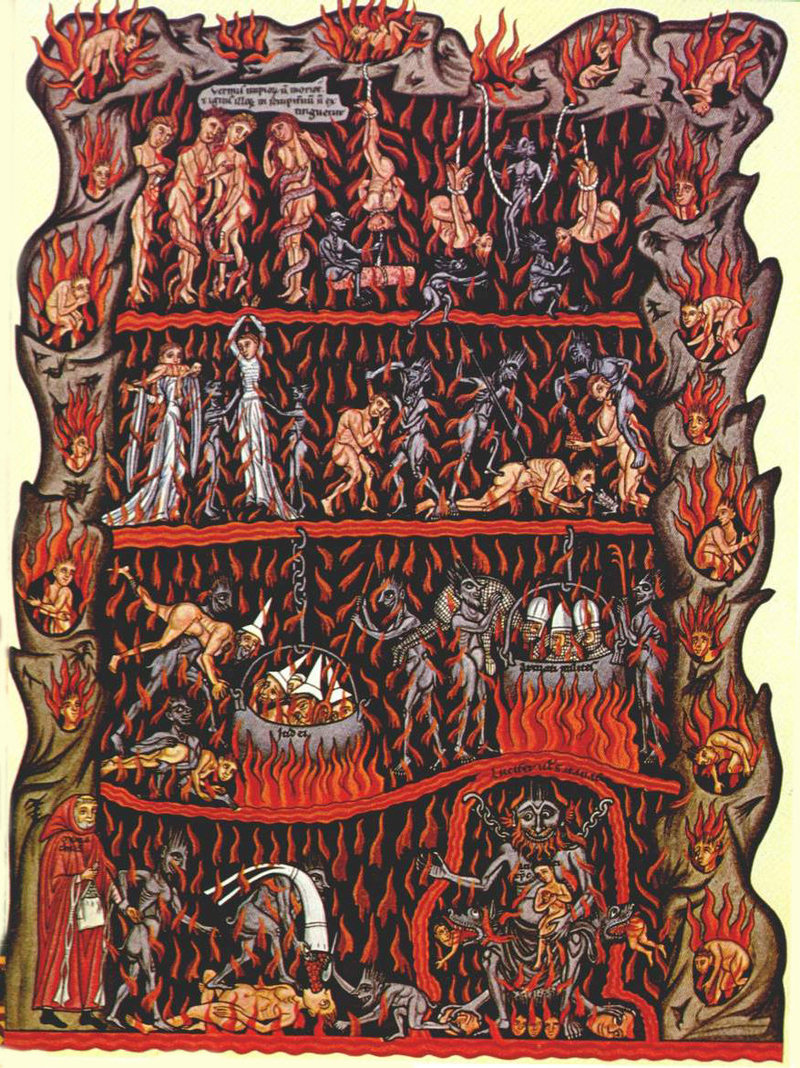
Theft deterrence came in the form of ingenious curses, written into the manuscripts themselves, going “back to the 7th century BCE,” Rebecca Romney writes at Mental Floss. Appearing “in Latin, vernacular European languages, Arabic, Greek, and more,” they came in such creative flavors as death by roasting, as in a Bible copied in Germany around 1172: “If anyone steals it: may he die, may he be roasted in a frying pan, may the falling sickness [epilepsy] and fever attack him, and may he be rotated [on the breaking wheel] and hanged. Amen.”
A few hundred years later, a manuscript curse from 15th-century France also promises roasting, or worse:
Whoever steals this book
Will hang on a gallows in Paris,
And, if he isn’t hung, he’ll drown,
And, if he doesn’t drown, he’ll roast,
And, if he doesn’t roast, a worse end will befall him.
The plucking out of eyes also appears to have been a theme. “Whoever to steal this volume tries, Out with his eyes, out with his eyes!” warns the final couplet in a 13th-century curse from a Vatican Library manuscript. Another curse in verse, found by author Marc Drogin, author of Anathema! Medieval Scribes and the History of Book Curses, gets especially graphic with the eye gouging:
To steal this book, if you should try,
It’s by the throat you’ll hang high.
And ravens then will gather ’bout
To find your eyes and pull them out.
And when you’re screaming ‘oh, oh, oh!’
Remember, you deserved this woe.
The hoped-for consequences were not always so grimly humorous. “Gruesome as these punishments seem,” the British Library writes, “to most medieval readers the worst curses were those that put the eternal fate of their souls at risk rather than their bodily health.” These would often be marked with the Greek word “Anathema,” sometimes “followed by the Aramaic formula ‘Maranatha’ (‘Come, Lord!’).” Both appear in a curse added to a manuscript of letters and sermons from Lesnes Abbey. Yet, unlike most medieval curses, here the thief is given a chance to make restitution. “Anyone who removes it or does damage to it: if the same person does not repay the church sufficiently, may he be cursed.”
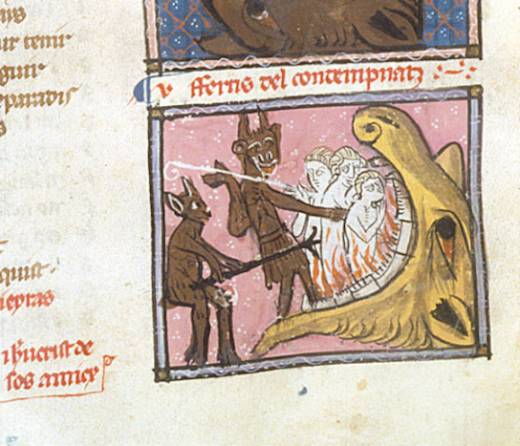
Curses were not the only security solutions of manuscript culture. Medieval monks also used book chains and locked chests to secure the fruit of their hard labor. As the old saying goes, “trust in God, but tie your camel.” But if locks and divine providence should fail, scribes trusted that the fear of punishment – even eternal damnation — down the road would be enough to make would-be book thieves think again.
Related Content:
160,000+ Medieval Manuscripts Online: Where to Find Them
Why Butt Trumpets & Other Bizarre Images Appeared in Illuminated Medieval Manuscripts
Josh Jones is a writer and musician based in Durham, NC. Follow him at @jdmagness
Read More...The Life & Music of the Godmother of Rock and Roll, Sister Rosetta Tharpe
When I was a wee lad I was interested in the history of rock and roll. Where did it come from? Who started it? But also when I was wee, there didn’t seem to be a lot of information around, certainly not in my library downtown. But when Muddy Waters died in 1983, I started to understand that rock and roll was sped-up blues, and pieces started to slot together. However, women weren’t part of the equation. (Blame Rolling Stone Magazine).
That’s a long way of saying the Sister Rosetta Tharpe should be better known than she is, especially as one dubbed the Godmother of Rock and Roll. Playing scratchy, distorted electric guitar and singing as if on a direct line to heaven, Tharpe would go on to influence everybody from Elvis Presley to Chuck Berry, and everybody who came after her. So why is she not more of a household name?
The 2011 BBC documentary above (split into four 15-minute chunks) resuscitates a legend who not only played a mean guitar but set the standard for the gospel-crossover artist, making a name on the gospel circuit, but making her fame in the secular nightclubs of America. Tharpe’s distinction is that she returned to gospel without losing any of her edge.
A precocious youngster in Arkansas during the early 1920s, she became the star of her Pentecostal church starting at four years old. Raised by her mother, then forced into an arranged marriage at 19-years-old to an older preacher, Thomas Tharpe, she kept his name when she left their abusive marriage. She and her mother relocated to Chicago, where blues and jazz were intermingling in a hothouse culture. Decca signed her, and although she told her churchgoing friends that she had to sing these secular songs because of that darned seven-year contract, Tharpe rose to fame quickly. The footage of her singing in front of the Cotton Club band led by Lucky Millinder is one of a cheeky, charming 23 year old.
As the doc makes clear, Tharpe had a rebellious streak, didn’t do what she was told, and pushed boundaries in a very segregated America. She invited the all-white Jordanaires to tour with her, surprising house managers and booking agents alike. And she carried on a love affair and creative partnership with fellow gospel singer Marie Knight for decades, very much on the down low.
So perhaps this is the reason Tharpe has not been on our collective radar—we’ve been slow to admit that rock guitar was created by a queer black woman devoted to the Lord. Nobody in the audience knew this, though, at the abandoned railway station at Wilbraham Road, Manchester, in May 1964. On one side of the station’s tracks, British teenagers were gathered to hear raw, rock and roll from America. On the other side, Tharpe stands with her guitar, wearing a thick coat to protect her from the spring rain. Backed by her band, she channels a holy force and sings about the rain of the Great Flood, the lyrics abstract and repetitive, as if in a trance. The footage opens the documentary and makes as good a case as any of why Tharpe should be part of the pantheon of rock royalty. (You can see the whole clip here.) Back in the States, Tharpe had been eclipsed by Mahalia Jackson, but the Brits didn’t know any of that. They just sense they’ve tapped into one of the sources for the music exploding around them.
It took until 2018 for Tharpe to be inducted into the Rock & Roll Hall of Fame, years after all those white boy copycats. Now is the time to re-discover her and hear what you’ve been missing.
Related Content:
New Web Project Immortalizes the Overlooked Women Who Helped Create Rock and Roll in the 1950s
An Introduction to Sister Rosetta Tharpe
Muddy Waters and Friends on the Blues and Gospel Train, 1964
Watch the Hot Guitar Solos of Sister Rosetta Tharpe
Revisit The Life & Music of Sister Rosetta Tharpe: ‘The Godmother of Rock and Roll’
Ted Mills is a freelance writer on the arts who currently hosts the Notes from the Shed podcast and is the producer of KCRW’s Curious Coast. You can also follow him on Twitter at @tedmills, and/or watch his films here.
Read More...Saying Goodbye to Charlie Watts (RIP), the Engine of the Rolling Stones for Half a Century
Charlie Watts, the Rolling Stones’ iconic drummer since 1962, passed away yesterday from unspecified causes at the age of 80. His death is a great loss for rock and roll. “When Charlie Watts dies, the beat stops,” Rob Harvilla writes at the Ringer, “never to be played again with such mesmerizing force, with such ultra-suave propulsion, with such casually indomitable radness.” These are not technical terms, and Watts was not a technical drummer. “I’m not a paradiddle man,” he said in 2000. “It’s not technical, it’s emotional. One of the hardest things of all is to get that feeling across.”
Watts perfected the indefinable feel of rock and roll by way of jazz, playing along to his favorite records by Charlie Parker — first with a set of wire brushes on an unstrung banjo, then on the first drum kit his father bought him.
From the greats, he learned to swing and mastered dynamics. The commanding martial crack of Watts’ snare held a band of motley pirates together — without him, the Stones might have dissolved into a collection of preening antics and wandering blues licks; with him at the center, they coalesced into a team. “I don’t know how the hell that old sucker got to be so good,” Keef marveled.
Watts would be the last one to talk about how good he was — he hated interviews and stardom in general. “I’ve never been interested in all that stuff and still am not,” he said. “I don’t know what showbiz is and I’ve never watched MTV. There are people who just play instruments, and I’m pleased to know that I’m one of them.” His singular focus came from listening intently to what others were doing, as he says in the interview at the top, and copying what they did, a method he calls “one of my flaws…. I learned by watching.” But the means by which Watts learned to play made him the perfect drummer for the Stones. He watched, listened, learned the songs, then played them perfectly in tune with the band, keeping them in time while responding dynamically to Richards and Jagger’s interplay.
“I should have gone to school and learned how to do it,” Watts says, with typical self-deprecation. Instead, he made his school the jazz clubs of London and Paris, where he went to see Bud Powell’s drummer Kenny Clark. Just as he’d done in his room on his first drum kit, he listened intently and copied what he heard. Watts looked like a man who stood apart from the band, with his world-weary expression, endless collection of sharp suits and reserved demeanor. But when he played with the Stones, they locked together. It was love, he said, “I love this band.”
His life was a testament to the vitality of the music that made him, at 80, still want to go back on the road after announcing just two weeks ago that he’d have to sit out this year’s tour. Forty years ago, Watts couldn’t foresee the band he helped make world famous lasting very much longer. “I never thought it would last five minutes,” he said in 1981, “but I figured I’d live that five minutes to the hilt because I love them. They’re bigger than I am if you really want to know. I admire them, I like them as friends, I argue with them and I love them…. I don’t really care if it stops…. “ Now that he’s gone, it’s hard to see how the Stones can go on.
As nearly every member of the band, especially Richards, has said at one time or another, no Charlie Watts, no Rolling Stones. “Charlie’s the engine,” said Ronnie Wood in the Stones documentary Tip of the Tongue. “We don’t go anywhere without the engine.” Wherever they go now, there’s no question the Rolling Stones would have been a different band entirely without him. See some of his best live moments in the clips above and learn what Charlie himself thought of his playing in the short documentary at the top, “If It Ain’t Got That Swing,” a record of his approach to drumming and life in general that captures the true spirit of a rock legend.
Related Content:
Josh Jones is a writer and musician based in Durham, NC. Follow him at @jdmagness
Read More...How the COVID-19 Vaccines Could Be Created So Quickly: Two Animated Videos Explain the How mRNA Vaccines Were Developed, and How They Work
The world now has COVID-19 vaccines, of which more and more people are receiving their doses every day. A year and a half ago the world did not have COVID-19 vaccines, though it was fast becoming clear how soon it would need them. The subsequent development of the ones now being deployed around the world took not just less than a year and a half but less than a year, an impressive speed even to many of us who never dug deep into medical science. The achievement owes in part to the use of mRNA, a term most of us may recall only dimly from biology classes; through the pandemic, messenger ribonucleic acid, to use its full name, has proven if not the savior of humanity, then at least the very molecule we needed.
One shouldn’t get “the idea that these vaccines came out of nowhere.” On Twitter, Dan Rather — these days a more outspoken figure than ever — calls the prevalence such a notion “a failure of science communication with tragic results,” describing the vaccines as “the result of DECADES of basic research in MULTIPLE fields building on the BREADTH and DEPTH of human knowledge.”
You can get a clearer sense of what that research has involved through videos like the animated TED-Ed explainer above. “In the twentieth century, most vaccines took well over a decade to research, test, and produce,” says its narrator. “But the vaccines for COVID-19 cleared the threshold for use in less than eleven months.” The “secret”? mRNA.
A “naturally occurring molecule that encodes the instructions for occurring proteins,” mRNA can be used in vaccines to “safely introduce our body to a virus.” Researchers first “encode trillions of mRNA molecules with instructions for a specific viral protein.” Then they inject those molecules into a specially designed “nanoparticle” also containing lipids, sugars, and salts. When it reaches our cells, this nanoparticle triggers our immune response: the body produces “antibodies to fight that viral protein, that will then stick around to defend against future COVID-19 infections.” And all of this happens without the vaccine altering out DNA,
While mRNA vaccines will “have a big impact on how we fight COVID-19,” says the narrator of the Vox video above, “their real impact is just beginning.” Their development marked “a turning point for the pandemic,” but given their potential applications in the battles against a host of other, even deadlier diseases (e.g., HIV), “the pandemic might also be a turning point for vaccines.”
Related Content:
How Fast Can a Vaccine Be Made?: An Animated Introduction
How Do Vaccines (Including the COVID-19 Vaccines) Work?: Watch Animated Introductions
How Vaccines Improved Our World In One Graphic
19th Century Maps Visualize Measles in America Before the Miracle of Vaccines
Yo-Yo Ma Plays an Impromptu Performance in Vaccine Clinic After Receiving 2nd Dose
Based in Seoul, Colin Marshall writes and broadcasts on cities, language, and culture. His projects include the Substack newsletter Books on Cities, the book The Stateless City: a Walk through 21st-Century Los Angeles and the video series The City in Cinema. Follow him on Twitter at @colinmarshall or on Facebook.
Read More...The Wicked Scene in Amadeus When Mozart Mocked the Talents of His Rival Antonio Salieri: How Much Does the Film Square with Reality?
Pity the ghost of Antonio Salieri, “one of history’s all-time losers — a bystander run over by a Mack truck of malicious gossip,” writes Alex Ross at The New Yorker. The rumors began even before his death. “In 1825, a story that he had poisoned Mozart went around Vienna. In 1830, Alexander Pushkin used that rumor as the basis for his play ‘Mozart and Salieri,’ casting the former as the doltish genius and the latter as a jealous schemer.” The stories became further embellished in an opera by Nikolai Rimsky-Korsakov, then again in 1979 by British playwright Peter Shaffer, whose Amadeus, “a sophisticated variation on Pushkin’s concept, …became a mainstay of the modern stage.”
In 1984, these fictions became the basis of Miloš Forman’s Amadeus, written by Shaffer for the screen. The film further solidifies Salieri’s villainy in F. Murray Abraham’s Oscar-winning performance of his envy and despair. Like all great cinematic villains, Salieri is shown to have good reason for his hatred of the hero, played as a manic toddler by Thomas Hulce, who was nominated for the same best-actor award Abraham won. In their first meeting (above), Mozart humiliates Salieri in the presence of the Emperor, insulting him several times and showing that Salieri’s years of toil and devotion are worth little more than what the German prodigy mastered as a small child, and could improve upon immeasurably with hardly any effort at all.
Is there truth to this scene? In general, the history of Amadeus is “laughably wrong,” Alex von Tunzelmann writes at The Guardian, though maybe the joke’s on us if we believe it. As Forman’s film takes pains to show, what we see on screen is not an objective point of view, but that of an aged, embittered, insane man remembering his past with regret. Salieri is a most unreliable narrator, and Forman an unreliable storyteller. The supposed “Welcome March” composed for Mozart in the scene above is not a Salieri composition at all, but a simplification of the aria from Mozart’s The Marriage of Figaro, which Hulce-as-Mozart then transforms into the actual tune of the aria.
Other inaccuracies abound. The Salieri of history was not “a sexually frustrated, dried-up old bachelor,” von Tunzelmann notes. “He had eight children by his wife, and is reputed have had at least one mistress.” He was also more colleague and friendly competitor than enemy of the newly-arrived Mozart in Vienna. The two even composed a piece together for singer Nancy Storace, who played the first Susanna in The Marriage of Figaro. While Mozart wrote to his father of a shadowy cabal arrayed against him at court, there is no evidence of a plot, and Mozart could be, by all accounts, just as puerile and obnoxious as his portrayal in the film.
Mozart did die a pauper from a mysterious illness at 34. (He did not dictate the final passages of his Requiem to Salieri). And Salieri did later confess to poisoning Mozart while he was aged and in a temporary state of mental illness, then retracted the claim when he later recovered. (“Let’s be honest,” writes von Tunzelmann, “nobody seriously thinks Salieri murdered Mozart.”) These are the barest historical facts upon which Amadeus’s infamous rivalry rests. The Salieri of the film is a fictional construction, created, as actor Simon Callow said of Shaffer’s play, to serve “a vast meditation on the relationship between genius and talent.”
In Forman’s film, the theme becomes the relationship between genius and mediocrity. But to call Salieri a mediocrity — or the “patron saint of mediocrities,” as Shaffer does in his play — “sets the bar for mediocrity too high,” Ross argues. “His music is worth hearing. Mozart was a greater composer, but not immeasurably greater.” Furthermore, “amid the procession of megalomaniacs, misanthropes, and basket cases who make up the classical pantheon, [Salieri] seems to have been one of the more likable fellows.”
Learn more about Salieri’s life and work in Ross’s New Yorker profile, and hear “4 Operas by Antonio Salieri You Should Listen To” at Opera Wire.
Related Content:
Mozart’s Diary Where He Composed His Final Masterpieces Is Now Digitized and Available Online
The Letters of Mozart’s Sister Maria Anna Get Transformed into Music
Josh Jones is a writer and musician based in Durham, NC. Follow him at @jdmagness
Read More...Support Us
We're hoping to rely on loyal readers, rather than erratic ads. Please click the Donate button and support Open Culture. You can use Paypal, Venmo, Patreon, even Crypto! We thank you!

About Us

Open Culture scours the web for the best educational media. We find the free courses and audio books you need, the language lessons & educational videos you want, and plenty of enlightenment in between.
Advertise With Us
FREE UPDATES!
GET OUR DAILY EMAIL
Get the best cultural and educational resources on the web curated for you in a daily email. We never spam. Unsubscribe at any time.
FOLLOW ON SOCIAL MEDIA
Open Culture editor Dan Colman scours the web for the best educational media. He finds the free courses and audio books you need, the language lessons & movies you want, and plenty of enlightenment in between.
Advertise With Us

