Watch Anthony Bourdain’s First Food-and-Travel Series A Cook’s Tour Free Online (2002–03)
At the time of his death in 2018, Anthony Bourdain was quite possibly the most famous cook in the world. Without question he held the title of the most famous cook-traveler, a status resting primarily on No Reservations and Parts Unknown, the television shows he hosted on the Travel Chanel and CNN, respectively. But it all began with A Cook’s Tour, which the Food Network originally broadcast in 2002 and 2003. That series, Bourdain’s very first, took him from Japan to Morocco to Mexico to Australia to Thailand — and through many points in between — in search of the world’s most stimulating eating experiences.
Now A Cook’s Tour has come available free to watch on Youtube, thanks to the streaming channel GoTraveler (who also offer the show through their own service).
A Portuguese slaughtering-and-roasting party; vodka-fueled ice fishing in St. Petersburg; an exploration of the American “Barbecue Triangle” constituted by Kansas City, Houston, and North Carolina; and a best-faith effort to lose himself in Chiang Mai: if you caught these or other of Bourdain’s early international culinary adventures those nearly twenty years ago, you can relive them, and if you missed out, you can enjoy them for the first time.
During the launch phase of his rise to fame (after decades of restaurant work and years of writing, an effort that first produced a couple of food-themed murder-mystery novels), Bourdain managed to tap into a new wave of gastronomic interest then rising in America. He did so with a street-smart sense of humor that appealed even to viewers with no particular investment in the world of cooking and dining, as long as they had an interest in the world itself. With A Cook’s Tour, he took food television out of the kitchen — way out of the kitchen — and over the eighteen years since its conclusion, the series’ influence has become so pervasive as almost to be invisible. Anthony Bourdain may be gone, but parts of his personality live on in every high-profile traveler out there cooking, eating, and getting lost today.
Related Content:
Anthony Bourdain Talks About the Big Break That Changed His Life — at Age 44
Al Jazeera Travel Show Explores World Cities Through Their Street Food
Watch 26 Free Episodes of Jacques Pépin’s TV Show, More Fast Food My Way
Based in Seoul, Colin Marshall writes and broadcasts on cities, language, and culture. His projects include the Substack newsletter Books on Cities, the book The Stateless City: a Walk through 21st-Century Los Angeles and the video series The City in Cinema. Follow him on Twitter at @colinmarshall or on Facebook.
Read More...How Caffeine Fueled the Enlightenment, Industrial Revolution & the Modern World: An Introduction by Michael Pollan
According to the current research, caffeine, “contributes much more to your health than it takes away.” These words come from a thinker no less vigilant about the state of food-and-drink science than Michael Pollan, and perhaps they’re all you feel you need to know on the subject. In fact, you’re probably taking in some form of caffeine even while reading this now. I know I’m doing so while writing it, and this, according to the Pollan-starring Wired video above, gives us something in common with the central figures of the Enlightenment. “Isaac Newton was a big coffee fan,” says Pollan, and Voltaire “apparently had 72 cups a day. I don’t know quite how you do that.”
The Enlightenment, the Age of Reason, and the Industrial Revolution also owe much to the intellectual and commercial churn of the coffee house, an institution that emerged in 17th-century London. “There were coffee houses dedicated to literature, and writers and poets would congregate there,” says Pollan.
“There was a coffee house dedicated to selling stock, and that turned into the London Stock Exchange eventually. There was another one dedicated to science, tied to the Royal Institution, where great scientists of the period would get together.” Consumed in dedicated houses or elsewhere, the “new, sober, more civil drink was changing the way people thought and the way they worked.”
The relevant contrast is with alcohol, once an element of practically all beverages in Europe. Before caffeine got there, “people were drunk or buzzed most of the day. People would have alcohol with breakfast” — children included, since it was still healthier than contaminated water. This custom hardly encouraged clear, linear thought; Diderot, Pollan tells us, wrote the Encyclopédie while drinking coffee, but imagine the result, if any, had he been drinking wine. More than a quarter-millennium later, we have solid evidence that caffeine “does improve focus and memory, and the ability to learn,” if at the cost of a decent night’s sleep. Not that this seems to have bothered coffee-pounding Enlightenment thinkers: what’s a little tossing and turning, after all, when there’s a worldview to be revolutionized?
Pollan elaborates on the role coffee plays in our lives in his new book, This Is Your Mind on Plants. And separately see his short audio book, Caffeine: How Caffeine Created the Modern World.
Related Content:
The Curious Story of London’s First Coffeehouses (1650–1675)
Philosophers Drinking Coffee: The Excessive Habits of Kant, Voltaire & Kierkegaard
“The Virtues of Coffee” Explained in 1690 Ad: The Cure for Lethargy, Scurvy, Dropsy, Gout & More
Based in Seoul, Colin Marshall writes and broadcasts on cities, language, and culture. His projects include the Substack newsletter Books on Cities, the book The Stateless City: a Walk through 21st-Century Los Angeles and the video series The City in Cinema. Follow him on Twitter at @colinmarshall or on Facebook.
Read More...Philosophy vs. Improv: A New Podcast from The Partially Examined Life and Chicago Improv Studio
The Partially Examined Life Philosophy Podcast has been sharing reading-group discussions on classic philosophy texts for well over a decade, with over 40 million downloads to date.
However, interactive conversations about texts you probably haven’t read can be difficult to follow no matter how much we try to make them accessible, and a decade of history means that many names that might be dropped that those newly checking in may or may not be familiar with.
I’m one of the hosts of that podcast, and while I’m very happy with the format and thrilled to have reached so many people with it, I also appreciate the dynamic of a one-on-one tutoring interchange, and I stand firmly behind one of the original rules of The Partially Examined Life: No name-dropping.
As we read more complicated texts, our interest becomes figuring out what the philosopher meant, and only secondarily whether that meaning actually relates to something in people’s actual lives. Yes, we are critical (some say too critical) of the subject-matter, but we’re also big fans; we could bask in the literary glow of Hegel or Plato or Simone de Beauvoir or Hannah Arendt all day, and have often done so.
My newest podcast, Philosophy vs. Improv, is reciprocal tutoring realized as comedy (or at least performance art?). As someone who studied philosophy for many years in school and has then been hosting The Partially Examined Life for so long, I’m in a good position to come up with particular philosophical points worth teaching to a new learner.
My Philosophy vs. Improv co-host is Bill Arnett, founder of the Chicago Improv Studio, author of The Complete Improviser, and the former training director at Chicago’s famed iO Theater. He has appeared repeatedly on the Hello From the Magic Tavern improv comedy podcast as a character named Metamore who leads the show’s hosts (who are all fantasy characters a la Tolkein or Narnia) in a table-top role-playing game called Offices and Bosses. This and other shows ignited in me an urge to learn the fundamentals of improv comedy, and so each Philosophy vs. Improv episode, Bill comes up with some trick of the trade to try to teach me.
There are two rules of engagement: First, we can’t just state up front what the lesson is. We can ask each other questions, go through exercises, and otherwise discuss the material, but the lesson should emerge naturally. Second, we don’t take turns in trying to teach each other. As he’s making me act out scenes, I’m trying to set up those scenes or have my character react in such a way to exemplify my philosophical point. As we’re discussing philosophy, Bill is relating it to comparable points about improv. Of course, we’re both interested in learning as well as teaching, so the “vs.” in the show’s title is not so much competition between us as between which lesson ends up more nearly producing its intended effect in the other person.
It is surprising how smoothly these dueling lessons often fit together, as lessens about ethics in particular, about the art of living, are very much relevant to the improvisational skills of being present, presenting yourself, discovering the reality of a situation, and exploring truths of character. Fiction is often a very effective vehicle for addressing philosophy, whether the characters themselves are talking philosophically (even if they’re animals, cave men, or otherwise in a non-typical situation for discussion), or perhaps we’re embodying some political situation or thought experiment that we’re subjecting to philosophical analysis.
Likewise, back to the days of Plato, a dose of irony in discussing philosophy can be useful, and this format allows us to not just be ourselves on a podcast discussing philosophy, but at any point to launch into some comedy bit, and in this way show the absurdity of views we’re arguing against or just play with the ideas in a manner that I think enhances mental flexibility, which is essential both for improvisation and for philosophical creativity.
Listen to the latest episode (#7), entitled “Meritocracy Now!”
Start listening with Philosophy vs. Improv episode 1.
For more information, see philosophyimprov.com.
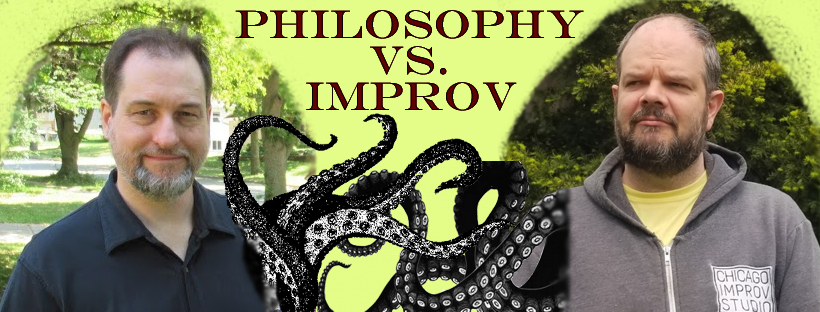
Mark Linsenmayer is the host of four podcasts: Pretty Much Pop: A Culture Podcast, Nakedly Examined Music, The Partially Examined Life, and Philosophy vs. Improv.
Read More...360 Degree Virtual Tours of the Hagia Sophia
Last year, when Turkish president Recep Tayyip Erdoğan announced that Hagia Sophia would be reconverted into a mosque, he assured a concerned UNESCO that changes to the 1,500-year-old former cathedral-turned-mosque would have “no negative impact” on its status as World Heritage Site. “A state must make sure that no modification undermines the outstanding universal value of a site listed on its territory,” the world body has said. Claims to the contrary notwithstanding, the “universal value” of the site does seem to have been undermined.
Designated a museum by the secular Turkish Republic in 1934, the site contains hundreds of years of history for both the Christian and Islamic worlds, and the shared heritage between them in the shifting mix of peoples who conquered, settled, and moved through the city first called Byzantium, then Constantinople, then Istanbul.
“The World Heritage site was at the centre of both the Christian Byzantine and Muslim Ottoman empires and is today one of Turkey’s most visited monuments,” Reuters noted last year.
The mosque is open to the public for prayers, and anyone can visit. What they’ll find — as you can see in this recent tour video — is ugly green carpeting covering the floor, and screens, panels, and plywood obscuring the Byzantine Christian art. (The same thing was done in the smaller Hagia Sophia in the city of Trabzon.) These changes are not only distressing for UNESCO, but also for lovers of art and history around the world, myself included, who had hoped to one day see the millennia-and-a-half of blended religious and aesthetic traditions for themselves.
It’s possible Turkish politics will allow Hagia Sophia to return to its status as a museum in the future, restoring its “universal value” for world history and culture. If not, we can still visit the space virtually — as it was until last year — in the 360 degree video views above, both of which allow you to look around in any direction as they play. You can also swivel around a spherical panoramic image at 360 cities.
The BBC video at the top narrates some of the significant features of the incredible building, once the largest church in the world, including its “colored marble from around the Roman Empire” and “10,000 square meters of gold mosaic.” Learn much more about Hagia Sophia history in the video above from Khan Academy’s executive directors (and former deans of art and history), Dr. Steven Zucker and Dr. Beth Harris.
Related Content:
An Introduction to Hagia Sophia: After 85 Years as a Museum, It’s Set to Become a Mosque Again
Hear the Sound of the Hagia Sophia Recreated in Authentic Byzantine Chant
Josh Jones is a writer and musician based in Durham, NC. Follow him at @jdmagness
Read More...Become a Project Manager Without a College Degree with Google’s Project Management Certificate
As we first mentioned last year, Google has launched a series of Career Certificate programs that allow students to gain expertise in a field, ideally enough to start working without a 4‑year college degree. This initiative now includes a Certificate in Project Management, which consists of six courses.
- Foundations of Project Management
- Project Initiation: Starting a Successful Project
- Project Planning: Putting It All Together
- Project Execution: Running the Project
- Agile Project Management
- Capstone: Applying Project Management in the Real World
Above, a Program Manager talks about “her path from dropping out of high school and earning a GED, joining the military, and working as a coder, to learning about program management and switching into that career track.” An introduction to the Project Management certificate appears below.
The Project Management program takes about six months to complete, and should cost about $250 in total. Students get charged $39 per month until they complete the program.
You can explore the Project Management certificate here. And find other Google career certificates in other fields–e.g. UX Design and Data Analytics–over on this page. All Google career courses are hosted on the Coursera platform.
Note: Open Culture has a partnership with Coursera. If readers enroll in certain Coursera courses and programs, it helps support Open Culture.
Related Content
Read More...Alan Alda: 3 Ways to Express Your Thoughts So That Everyone Will Understand You
In need of someone to perform surgery in a combat zone, you probably wouldn’t choose Alan Alda, no matter how many times you’ve seen him do it on television. This sounds obvious to those of us who believe that actors don’t know how to do anything at all. But a performer like Alda doesn’t become a cultural icon by accident: his particular skill set has enabled him not just to communicate with millions at a time through film and television, but also to navigate his offscreen and personal life with a certain adeptness. In the Big Think video above, he reveals three of his own long-relied-upon strategies to “express your thoughts so that everyone will understand you.”
“I don’t really like tips,” Alda declares. Standard public-speaking advice holds that you should “vary the pace of your speech, vary the volume,” for example, but while sound in themselves, those strategies executed mechanically get to be “kind of boring.” Rather than operating according to a fixed playbook, as Alda sees it, your variations in pace and volume — or your gestures, movements around the stage, and everything else — should occur organically, as a product of “how you’re talking and relating” to your audience. A skilled speaker doesn’t follow rules per se, but gauges and responds dynamically to the listener’s understanding even as he speaks.
But if pressed, Alda can provide three tips “that I do kind of follow.” These he calls “the three rules of three”: first, “I try only to say three important things when I talk to people”; second, “If I have a difficult thing to understand, if there’s something I think is not going to be easy to get, I try to say it in three different ways”; third, ” I try to say it three times through the talk.” He gets deeper into his personal theories of communication in the second video below, beginning with a slightly contrarian defense of jargon: “When people in the same profession have a word that stands for five pages of written knowledge, why say five pages of stuff when you can say one word?” The trouble comes when words get so specialized that they hinder communication between people of different professions.
At its worst, jargon becomes a tool of dominance: “I’m smart; I talk like this,” its users imply, “You can’t really talk like this, so you’re not as smart as me.” But when we actively simplify our language to communicate to the broadest possible audience, we can discover “what are the concepts that really matter” beneath the jargon. All the better if we can tell a dramatic story to illustrate our point, as Alda does at the end of the video. It involves a medical student conveying a patient’s diagnosis more effectively than his supervisor, all thanks to his experience with the kind of “mirroring” exercises familiar to every student of acting. A doctor who can communicate is always preferable to one who can’t; even a real-life Hawkeye, after all, needs to make himself understood once in a while.
Related Content:
Alan Alda Uses Improv to Teach Scientists How to Communicate Their Ideas
What Is a Flame?: The First Prize-Winner at Alan Alda’s Science Video Competition
Based in Seoul, Colin Marshall writes and broadcasts on cities, language, and culture. His projects include the Substack newsletter Books on Cities, the book The Stateless City: a Walk through 21st-Century Los Angeles and the video series The City in Cinema. Follow him on Twitter at @colinmarshall or on Facebook.
Read More...Hear Philip K. Dick’s Famous Metz Speech: “If You Find this World Bad, You Should See Some of the Others” (1977)
A newspaper article about this speech could well be titled: AUTHOR CLAIMS TO HAVE SEEN GOD BUT CAN’T GIVE ACCOUNT OF WHAT HE SAW. — PKD
In 1977, cult writer Philip K. Dick arrived at a science fiction convention in Metz, France to deliver a speech called, “If You Find this World Bad, You Should See Some of the Others.” (Read an edited transcript here.) The audience would leave bewildered, mystified. His talk ranged widely across such topics as cosmological time, the possibility of the universe as a computer simulation, the experience of deja vu, and the oppressive regime of Richard Nixon. It would become a sort of rebus for decoding Dick’s fiction.
If the “Metz address” were only a key to the strange occurrences in novels like A Scanner Darkly, Flow My Tears, The Policeman Said, and The Man in the High Castle, it would be an extraordinary document for Philip K. Dick fans.
But just as Dick claimed that the events of his 1981 novel V.A.L.I.S. were real– he had actually had a visionary encounter with “God” after dental surgery in 1974 — so here he claims to have actually experienced, or remembered, multiple realities and, after said encounter, to have recognized them all as true.
I, in my stories and novels, often write about counterfeit worlds, semi-real worlds, as well as deranged private worlds inhabited, often, by just one person, while, meantime, the other characters either remain in their own worlds throughout or are somehow drawn into one of the peculiar ones. …At no time did I have a theoretical or conscious explanation for my preoccupation with these pluriform pseudoworlds, but now I think I understand. What I was sensing was the manifold or partially actualized realities lying tangent to what evidently is the most actualized one, the one that the majority of us, by consensus gentium, agree on.
“The world of Flow My Tears is an actual (or rather once actual) alternate world, and I remember it in detail. I do not know who else does. Maybe no one else does. perhaps all of you were always — have always been — here. But I was not. In novel after novel, story after story, over a twenty-five year period, I wrote repeatedly about a particular other landscape, a dreadful one. In March 1974, I understood why. …I had good reason to. My novels and stories were, without my realizing it consciously, autobiographical. It was — this return of memory — the most extraordinary experience of my life. …
The narrower subject of his speech, Dick says by way of introduction, is “orthogonal time,” or “right-angle time.” To explain this he calls up an image of parallel universes overlapping at the edges of a “lateral axis.” These blend and “come into focus,” as an entity he calls “the Programer-Reprogrammer” changes the variables, while a “counterentity” he calls the “Dark Counterplayer” tries to mess things up. Despite the use of software terms, Dick’s imagery seems to draw as much from chess, or Taoism, as computer science. The interplay of programmer/counterprogrammer is a dialectic, resulting in new syntheses. God is not an independent, self-existent being but something more akin to Atman, “the view of the oldest religion of India, and to some extent… of Spinoza and Alfred North Whitehead …. God within the universe… The Sufi saying [from Rumi] ‘The workman is invisible within the workshop’ applies here.”
We cannot see the workings of this mystical intelligence except when the illusion of seamlessness breaks down and memories of past or alternate lives intrude. These are not memories of a linear time, but of other possible present times, all existing at once just out of focus. Dystopian police states, an alternate present ruled by Nazi Germany and Imperial Japan… These currently exist, Dick says, on the orthogonal line of time, only we cannot see them because the variables, and our memories, have been changed to suit the latest version of reality, a synthesis and updated improvement. However, it’s entirely possible that we’re all experiencing slightly different realities, depending on the “memories” of alternate presents leaking into our experience.
Thus, the talk’s title: not only could the world be worse, he says, but it is currently worse in the multiverse of rejected alternate worlds we can’t (or can’t quite) see. Here, at the end of his speech, Dick gets theological, and teleological, again, claiming to have seen a vision of a “parklike” world that “was not what my Christian training had prepared me for at all.” His description sounds ripped from the cover of a 70s pulp fantasy novel, complete with a naked goddess and an alien “landscape beyond a golden rectangle doorway.” He takes pains to distance his vision from the Christian garden of Eden, but his final remarks sound more like C.S. Lewis than the paranoid, drug-addled conspiracist his audience might have been prepared to meet:
The best I can do …is to play the role of prophet, of ancient prophets and such oracles as the sibyl at Delphi, and to talk of a wonderful garden world, much like that which once our ancestors are said to have inhabited — in fact, I sometimes imagine it to be exactly that same world restored, as if a false trajectory of our world will eventually be fully corrected and once more we will be where once, many thousands of years ago, we lived and were happy.
…I believe I know a great secret. When the work of restoration is completed, we will not even remember the tyrannies, the cruel barbarisms of the Earth we inhabited… the vast body of pain and grief and loss and disappointment within us will be expunged as if it had never been. I believe that process is taking place now, has always been taking place now. And, mercifully, we are already being permitted to forget that which formerly was. And perhaps in my novels and stories I have done wrong to urge you to remember.
Was Philip K. Dick out of his mind? He sounds perfectly lucid in other interviews he gave at the same time, and dismisses the notion that his ideas are the product of mental illness. Travis Diehl writes at Art Papers that Dick has come to seem more like an actual than a self-styled prophet in the decades since this interview, and his “paranoia comes to seem more and more like prescience,” foreseeing the major themes of The Matrix, Jean Baudrillard’s postmodern classic Simulacra and Simulation, and favorite philosopher of Silicon Valley Nick Bostrom.
Whatever the source of the author’s experiences, “the rupture that pushed Dick’s life toward a knowledge of other worlds — towards gnosis — was an aesthetic one: Dick’s visions appeared accompanied, or induced, by art,” and it was only by means of art that he claimed to apprehend them. “Our God is the deus absconditus: the hidden god.” We cannot know what it is, he says. But this does not exempt us from the making and remaking of the world. No one is — to use a current term of art — a non-playable character. “Concealed though the form is,” Dick says, “the latter will confront us; we are involved in it — in fact, we are instruments by which it is accomplished.”
Related Content:
Hear VALIS, an Opera Based on Philip K. Dick’s Metaphysical Novel
Robert Crumb Illustrates Philip K. Dick’s Infamous, Hallucinatory Meeting with God (1974)
Josh Jones is a writer and musician based in Durham, NC. Follow him at @jdmagness
Read More...Mattel’s Barbie Turns Women of Medicine, Including COVID Vaccine Developer, Into Dolls
The multinational toy manufacturer Mattel is encouraging youngsters to play doctor — not a euphemism — and honoring first responders with the recent release of three healthcare-themed “Career Barbies.”
The company is putting its money where its mouth is by donating $5 to the First Responders Children’s Foundation for every doctor, paramedic, or nurse Barbie purchased at Target through August 28.
Mattel has also identified six female healthcare pioneers whose efforts during the pandemic merit a one-of-a-kind Barbie who shares their likeness.
Vaccinologist Sarah Gilbert, who led the team that developed the Oxford/AstraZeneca vaccine, describes this unexpected honor as “a very strange concept” (presumably as compared to being awarded a damehood or receiving a standing ovation at Wimbledon.)

The 59-year-old Oxford University professor added that she hoped the characteristically smooth plastic doll would be “part of making it more normal for girls to think about careers in science, although, to be honest, when I was a young girl I never believed that I wouldn’t have a career in science.”
If the doll falls short of inspiring girls to consider a career in STEM, Women in Science & Engineering (WISE), the nonprofit organization Professor Gilbert chose to receive a donation from Mattel on her behalf, can take up the slack.
One of the most compelling of the six custom-made Front Line Responder Barbies is based on veteran nurse Amy O’Sullivan, a heavily tattooed, queer mother of three, who cared for the first COVID-19 patient (soon to become New York City’s first official COVID death) in Brooklyn’s Wycoff Hospital.
Soon thereafter, she survived being put on a ventilator with COVID herself, eventually winding up on the cover of Time Magazine, in the same neckerchief, floral socks, eye catching surgical cap and woven bracelets her tiny scrub-suited doppelganger wears.
Surely Amy O’Sullivan is a better all around role model than the similarly inked Tokidoki Barbie or Totally Tattoo Barbie, or for that matter, the non-custom made First Responder Nurse, whose description on Target’s website seems a bit retrograde, given the events of the last year and a half:
Wearing cute scrubs featuring a medical-tool print top, pink pants and white shoes, Barbie nurse doll (12-in/30.40-cm) is ready make her rounds and check on patients!
The real life O’Sullivan, who was very involved in the creation of her custom doll, seems tickled by Mattel’s faithful recreation, telling The New York Post:
When I was younger I always felt like an outsider — nobody ever looked like me, talked like me, walked like me. I had no role model at all when I was growing up. So if I can be some little girl’s role model that feels like this, I would love that.
Nurse O’Sullivan had stronger words for those who have aged out of the demographic, in a recent interview with Time:
I see these young people not wearing masks. And, you know, those are the people that COVID is affecting now, the younger generation. They’re becoming very sick. And it’s never going to go away until we get vaccinated and wear masks.
That might be a bit heavy for those on the younger end of Career Barbie’s recommended 3 and up age group (“especially those interested in caretaking and helping others!”), but hopefully her words will carry some weight with those responsible for protecting those children.
The other custom-made Barbies honor:
Dr. Audrey Cruz, who collaborated with other Asian-American physicians to battle anti-Asian-related bias springing from the pandemic
Canadian psychiatry resident at who battled systemic racism in healthcare a doctor in Las Vegas who is campaigning against racial bias against Asian-American physicians
University of Toronto psychiatry resident, Chika Stacy Oriuwa, whose activism includes creating initiatives to boost the number of Black students applying to medical school and create networks of support for scholarly and professional advancement within the Black community.
Biomedical researcher Dr Jaqueline Goes de Jesus whose team sequenced the SARS-CoV‑2 genome within 48 hours of receiving samples from the first infected Brazilian patient, differentiating the variant from the one that caused infections earlier in the pandemic.
Dr Kirby White, founder of Gowns for Doctors, an Australian initiative that addressed a nationwide shortage of personal PPE by delivering free, washable, volunteer-made reusable gowns to frontline staff.
Related Content:
Women Scientists Launch a Database Featuring the Work of 9,000 Women Working in the Sciences
Ayun Halliday is an author, illustrator, theater maker and Chief Primatologist of the East Village Inky zine.Follow her@AyunHalliday
Read More...
Songs That Use “Word Painting”: The Art of Creating Music That Sounds Like the Lyrics
“There’s no love song finer, but how strange the change from major to minor, everytime we say goodbye.”
In the line above from Cole Porter’s “Every Time We Say Goodbye,” we’re moved from the happiness of love to the sadness of parting, and so too do the chords change, from major to minor, thus subtly changing the mood of the song. The technique is a clever example of a songwriting method called “word painting,” or prosody, when lyrics are accompanied by a rhythmic, melodic, or harmonic shift that complements their meaning. We hear it in pop music all the time, drawing our attention to significant moments, and shaping the emotional impact of words and phrases.
The word “Stop,” for example, appears over and over in pop music, as the video above from David Bennett shows, accompanied by a full stop from the band. Spanish-language hit “Despacito” (which means “slowly”) slows the tempo while the titular word is sung. There are innumerable examples of melodies rising and falling to lyrics like “high, up, down” and “low.” A more sophisticated example of word paining comes from Leonard Cohen’s “Hallelujah,” which tells us exactly what the music’s doing — “It goes like this, the fourth, the fifth, the minor fall, the major lift.”
As ingenious as these moves are, Bennett goes on to show us how word painting can be “even more nuanced” in classics like The Doors’ “Riders on the Storm.” As Ray Manzarek himself explains in an interview clip, his keyboard part led to an onomatopoeia effect: lyrics, melody, and sound effects all coming together to express the entire theme. Bennett shows in his second word painting video, above, how studio effects can also be used to sync music and lyrics, such as the murky eq effect applied to Billie Eilish’s voice on the word “underwater” in her song “Everything I Wanted.”
Examples of effects like this date back at least to Jimi Hendrix, who pioneered the studio as a songwriting tool, but word painting as a songwriting method requires no special technology. The Jackson Five’s “ABC,” for instance, lands on E♭ and C during the line “I before E except after C,” and the famous chorus is sung to the notes A♭, B♭m7, and C. Here, the notes themselves tell the story, simple but undoubtedly effective. All of the examples Bennett adduces may come from popular music, but word painting is as old as poetry, which was once inseparable from song. For as long as humans have communicated with literary epics, funeral rites, tragedies, comedies, and love songs, we have used prosody to shape words with music, and music according to the meaning of our words.
Related Content:
Tom Petty Takes You Inside His Songwriting Craft
How David Bowie Used William S. Burroughs’ Cut-Up Method to Write His Unforgettable Lyrics
Josh Jones is a writer and musician based in Durham, NC. Follow him at @jdmagness
Read More...How Doctor Who First Started as a Family Educational TV Program (1963)
Those who grew up with the BBC sci-fi series Doctor Who watched from “behind the sofa,” a popular phrase associated with the show for the rubbery, bug-eyed monsters it held in store each week for loyal viewers. Although it may be hard for those who didn’t experience it in their formative years to understand, Doctor Who has frequently been voted the scariest TV show of all time, over grislier, big-budget series like The Walking Dead, and has done so without losing its sense of humor, a testament to the conceit of “regeneration” keeping things fresh by updating the Doctor and his companions every few years.
Space monsters, Daleks, Cybermen, and a revolving cast, however, were not part of Doctor Who’s original remit. The show began as an educational program on the BBC, and this explains many of its integral parts, which have remained throughout its first run from 1963 to 1989 and its revival from 2005 to the present. These elements include the TARDIS, companions of various ages, the Coal Hill School, and the Doctor himself, a Time Lord from the planet Gallifrey with interstellar technology and a dodgy memory.
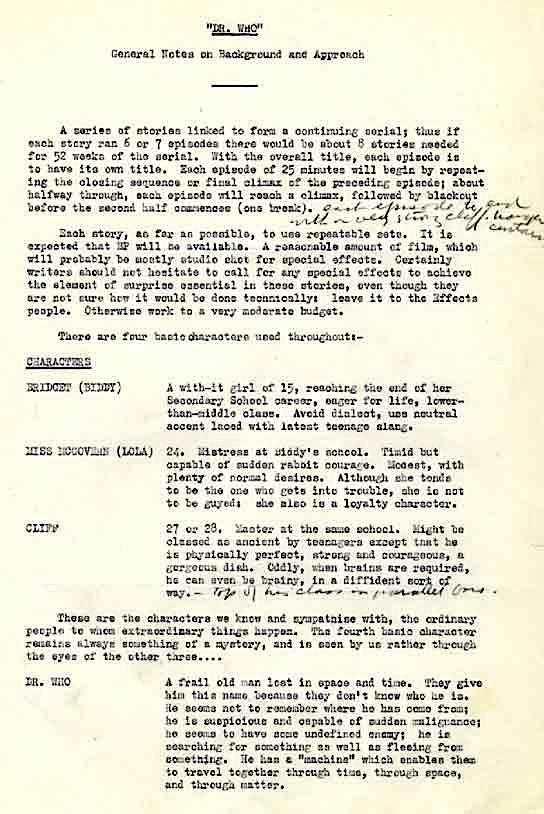
We find the core premise in the show’s pilot episode and original 4‑part series, An Unearthly Child, which introduced William Hartnell as the Doctor, Carole Ann Ford as his granddaughter, Susan Foreman (originally named Barbara, or “Biddy”), and Jaqueline Hill and William Russell as school teachers Barbara Wright and Ian Chesterton. BBC drama head Sydney Newman had tasked writers with creating a family educational show to meet the network’s public service mandate, and came up with the idea of a science fiction show as a way to have characters visit historical periods and talk about science in an entertaining way.
“Doctor Who’s early historical stories emphasize education by downplaying the programme’s fantasy with minimal science-fiction elements,” writes Tom Steward at Deletion. The idea of a time machine bigger on the inside than the outside came from Newman. Writer Anthony Coburn turned it into a police box after a note from Newman asking for a “tangible” symbol. Newman “instructed writers to ‘get across the basis of teaching of educational experience.’ ” When they came back with a story about Daleks, he balked: “No bug-eyed monsters,” he wrote, no alien baddies, no actors in rubber suits. This was to be a serious show about serious educational subjects. Script changes and technical challenges meant months of setback and delays.
It was difficult for some critics to take the resulting four episode arc particularly seriously. The first episode showed Barbara and Ian discovering the TARDIS in a London junkyard. Then they are all transported to the prehistoric past, where they observe (and escape) a power struggle among prehistoric cave people. (Guardian critic Mary Crozier lamented that the “wigs and furry pelts and clubs were all ludicrous.”) The show’s debut was also inauspicious: November 23, 1963, the day after John F. Kennedy’s assassination. The BBC reran the first episode the next week and picked up another 2 million viewers.
Still, it had become clear after the first series that in order to survive, Doctor Who would have “to give the public what they wanted,” Steward writes, “rather than what was good for them.” Thus, the Daleks debuted in the second season, and by the mid-60s, historical stories were replaced with “fantasies in historical costume featuring anachronistic villains or monsters.” The show became a weekly creature feature and introduced terrifying villains like Davros, the Daleks’ creator, a cross between a Strangelove-like Nazi scientist and Star Wars’ clone-happy Emperor Palpatine (Davros came first).
The costumes may look silly in hindsight, but as childhood Who fan Charlie Jane Anders writes at io9, “those of us who are adults now didn’t have huge screen HD televisions when we were kids.” (And those of us who remember it, remember being terrified by equally goofy costuming in The Land of the Lost.) Look past the low-budget effects and Doctor Who becomes pure horror, exploring very dark territory with only a sonic screwdriver, a few friends, and a quirky sense of humor — or 13 quirky senses of humor, including Jodie Whittaker’s as the current Doctor and first woman to fill the role.
As you can see from the clips of the first episode above, Doctor Who established its weird air of existential dread from the start with Delia Derbyshire’s otherworldly theme and some avant-garde camera effects in lieu of bigger-budget spectacles. The show did not retain much from its educational beginnings aside from the key characters and the look and feel of the TARDIS. It was “seen to have failed as pedagogy,” writes Steward, but as a body of science fiction lore that continues to stay relevant, it has all sorts of lessons to teach about courage, companionship, and the value of the right tool for the right job.
Related Content:
30 Hours of Doctor Who Audio Dramas Now Free to Stream Online
The Fascinating Story of How Delia Derbyshire Created the Original Doctor Who Theme
A Detailed, Track-by-Track Analysis of the Doctor Who Theme Music
Josh Jones is a writer and musician based in Durham, NC. Follow him at @jdmagness
Read More...Support Us
We're hoping to rely on loyal readers, rather than erratic ads. Please click the Donate button and support Open Culture. You can use Paypal, Venmo, Patreon, even Crypto! We thank you!

About Us

Open Culture scours the web for the best educational media. We find the free courses and audio books you need, the language lessons & educational videos you want, and plenty of enlightenment in between.
Advertise With Us
FREE UPDATES!
GET OUR DAILY EMAIL
Get the best cultural and educational resources on the web curated for you in a daily email. We never spam. Unsubscribe at any time.
FOLLOW ON SOCIAL MEDIA
Open Culture editor Dan Colman scours the web for the best educational media. He finds the free courses and audio books you need, the language lessons & movies you want, and plenty of enlightenment in between.
Advertise With Us

