Elvis Presley Gets the Polio Vaccine on The Ed Sullivan Show, Persuading Millions to Get Vaccinated (1956)
No one living has experienced a viral event the size and scope of COVID-19. Maybe the unprecedented nature of the pandemic explains some of the vaccine resistance. Diseases of such virulence became rare in places with ready access to vaccines, and thus, ironically, over time, have come to seem less dangerous. But there are still many people in wealthy nations who remember polio, an epidemic that dragged on through the first half of the 20th century before Jonas Salk perfected his vaccine in the mid-fifties.
Polio’s devastation has been summed up visually in textbooks and documentaries by the terrifying iron lung, an early ventilator. “At the height of the outbreaks in the late 1940s,” Meilan Solly writes at Smithsonian, “polio paralyzed an average of more than 35,000 people each year,” particularly affecting children, with 3,000 deaths in 1952 alone. “Spread virally, it proved fatal for two out of ten victims afflicted with paralysis. Though millions of parents rushed to inoculate their children following the introduction of Jonas Salk’s vaccine in 1955, teenagers and young adults had proven more reluctant to get the shot.”
At the time, there were no violent, organized protests against the vaccine, nor was resistance framed as a patriotic act of political loyalty. But “cost, apathy and ignorance became serious setbacks to the eradication effort,” says historian Stephen Mawdsley. And, then as now, irresponsible media personalities with large platforms and little knowledge could do a lot of harm to the public’s confidence in life-saving public health measures, as when influential gossip columnist Walter Winchell wrote that the vaccine “may be a killer,” discouraging countless readers from getting a shot.
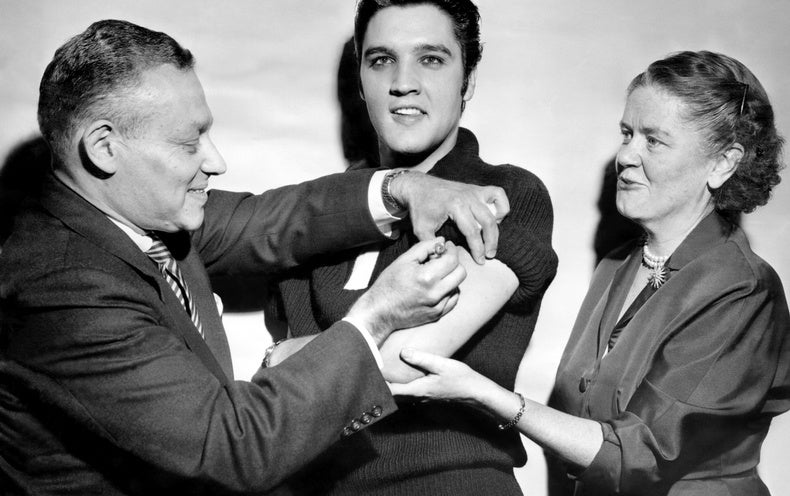
When Elvis Presley made his first appearance on Ed Sullivan’s show in 1956, “immunization levels among American teens were at an abysmal 0.6 percent,” note Hal Hershfield and Ilana Brody at Scientific American. To counter impressions that the polio vaccine was dangerous, public health officials did not solely rely on getting more and better information to the public; they also took seriously what Hershfield and Brody call the “crucial ingredients inherent to many of the most effective behavioral change campaigns: social influence, social norms and vivid examples.” Satisfying all three, Elvis stepped up and agreed to get vaccinated “in front of millions” backstage before his second appearance on the Sullivan show.
Elvis could not have been more famous, and the campaign was a success for its target audience, establishing a new social norm through influence and example: “Vaccination rates among American youth skyrocketed to 80 percent after just six months.” Despite the threat he supposedly posed to the establishment, Elvis himself was ready to serve the public. “I certainly never wanna do anything,” he said, “that would be a wrong influence.” See in the short video at the top how American public health officials stopped millions of preventable deaths and disabilities by admitting a fact propagandists and advertisers never shy from — humans, on the whole, are easily persuaded by celebrities. Sometimes they can even be persuaded for the good.
Related Content:
Yo-Yo Ma Plays an Impromptu Performance in Vaccine Clinic After Receiving 2nd Dose
Dying in the Name of Vaccine Freedom
How Do Vaccines (Including the COVID-19 Vaccines) Work?: Watch Animated Introductions
How Vaccines Improved Our World In One Graphic
Josh Jones is a writer and musician based in Durham, NC. Follow him at @jdmagness
Read More...How Victorian Homes Turned Deadly: Exploding Stoves, Poison Wallpaper, Ever-Tighter Corsets & More
The British have a number of sayings that strike listeners of other English-speaking nationalities as odd. “Safe as houses” has always had a curious ring to my American ear, but it turns out to be quite ironic as well: the expression grew popular in the Victorian era, a time when Londoners were as likely to be killed by their own houses as anything else. That, at least, is the impression given by “The Bizarre Ways Victorians Sabotaged Their Own Health & Lives,” the documentary investigation starring historian Suzannah Lipscomb above.
Throughout the second half of the 19th century, many an Englishman would have regarded himself as living at the apex of civilization. He wouldn’t have been wrong, exactly, since that place and time witnessed an unprecedented number of large-scale innovations industrial, scientific, and domestic.
But a little knowledge can be a dangerous thing, and the Victorians’ understanding of their favorite new technologies’ benefits ran considerably ahead of their understanding of the attendant threats. The hazards of the dark satanic mills were comparatively obvious, but even the heights of domestic bliss, as that era conceived of it, could turn deadly.
Speaking with a variety of experts, Lipscomb investigates the dark side of a variety of accoutrements of the Victorian high (or at least comfortably middle-class) life. These harmed not just men but women and children as well: take the breeding-ground of disease that was the infant feeding bottle, or the organ-compressing corset — one of which, adhering to the experiential sensibility of British television, Lipscomb tries on and struggles with herself. Members of the eventual anti-corset revolt included Constance Lloyd, wife of Oscar Wilde, and it is Wilde’s apocryphal final words that come to mind when the video gets into the arsenic content of Victorian wallpaper. “Either that wallpaper goes, or I do,” Wilde is imagined to have said — and as modern science now proves, it could have been more than a matter of taste.
Related Content:
A 108-Year-Old Woman Recalls What It Was Like to Be a Woman in Victorian England
The Color That May Have Killed Napoleon: Scheele’s Green
Poignant and Unsettling Post-Mortem Family Portraits from the 19th Century
Behold the Steampunk Home Exercise Machines from the Victorian Age
Based in Seoul, Colin Marshall writes and broadcasts on cities, language, and culture. His projects include the Substack newsletter Books on Cities, the book The Stateless City: a Walk through 21st-Century Los Angeles and the video series The City in Cinema. Follow him on Twitter at @colinmarshall or on Facebook.
Read More...The Roman Colosseum Has a Twin in Tunisia: Discover the Amphitheater of El Jem, One of the Best-Preserved Roman Ruins in the World
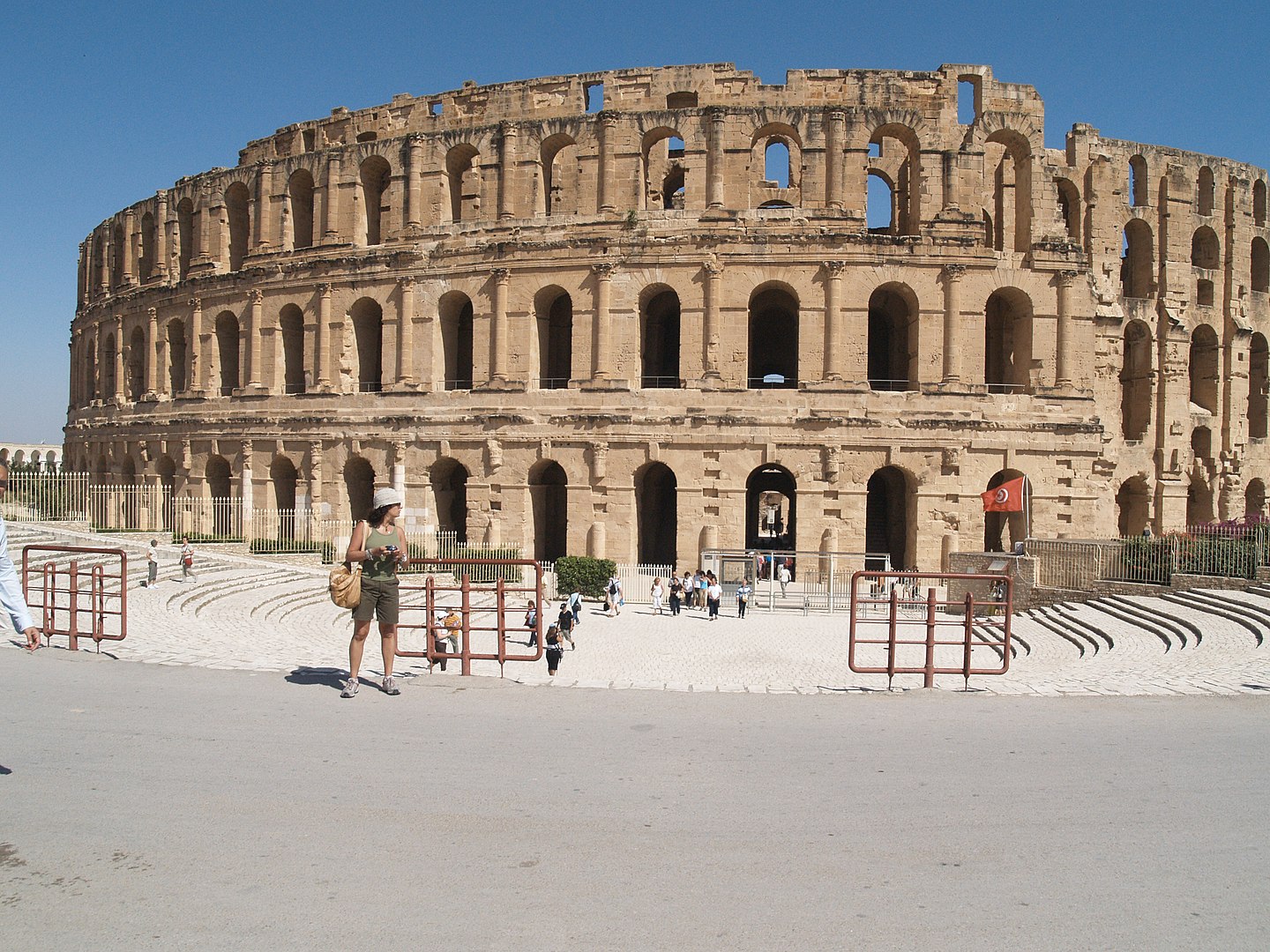
Image via Wikimedia Commons
When Rome conquered Carthage in the Third Punic War (149–146 BC), the Republic renamed the region Africa, for Afri, a word the Berbers used for local people in present-day Tunisia. (The Arabic word for the region was Ifriqiya.) Thereafter would the Roman Empire have a stronghold in North Africa: Carthage, the capital of the African Province under Julius and Augustus Caesar and their successors. The province thrived. Second only to the city of Carthage in the region, the city of Thysdrus was an important center of olive oil production and the hometown of Roman Emperor Septimius Severus, who bestowed imperial favor upon it, granting partial Roman citizenship to its inhabitants.
In 238 AD, construction began on an amphitheater in Thysdrus that would rival its largest cousins in Rome, the famed Amphitheater of El Jem. “Designed to seat a whopping crowd of 35,000 people,” writes Atlas Obscura, El Jem was listed as a UNESCO World Heritage site in 1979. Built entirely of stone blocks, the massive theater was “modeled on the Coliseum of Rome,” notes UNESCO, “without being an exact copy of the Flavian construction…. Its facade comprises three levels of arcades of Corinthian or composite style. Inside, the monument has conserved most of the supporting infrastructure for the tiered seating. The wall of the podium, the arena and the underground passages are practically intact.”

Image via Wikimedia Commons
Although the small city of El Jem hardly features on tours of the classical past, it was, in the time of the Amphitheater’s construction, a prominent site of struggle for control over the Empire. The year 238 “was particularly tumultuous,” Atlas Obscura explains, due to a “revolt by the population of Thysdrus (El Jem), who opposed the enormous taxation amounts being levied by the Emperor Maximinus’s local procurator.” A riot of 50,000 people led to the ascension of Gordian I, who ruled for 21 days during the “Year of the Six Emperors,” when “in just one year, six different people were proclaimed Emperors of Rome.”
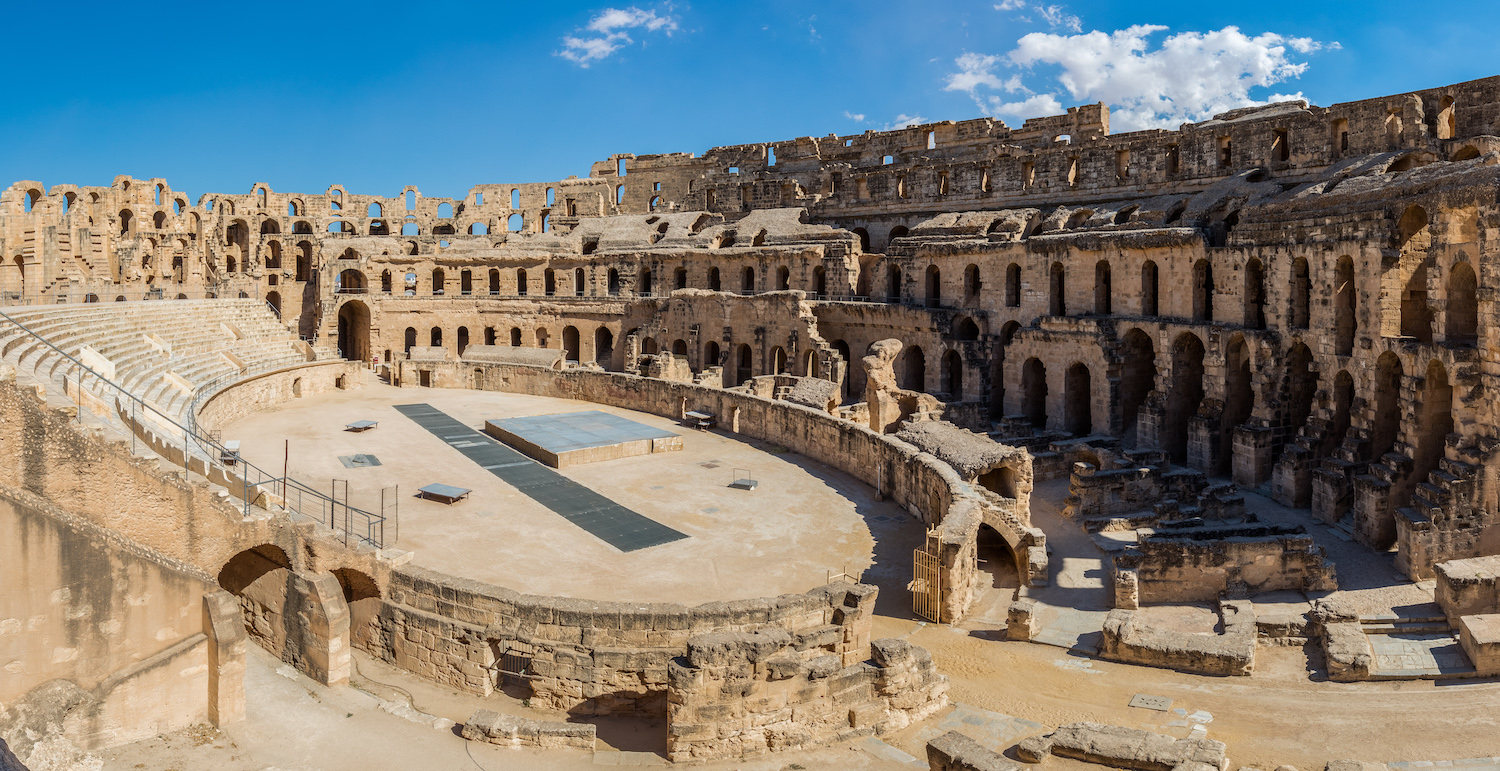
Image via Wikimedia Commons
From such fraught beginnings, the massive stone structure of the El Jem Amphitheater went on to serve as a fortress during invasions of Vandals and Arabs in the 5th-7th centuries. A thousand years after the Islamic conquest, El Jem became a fortress during the Revolutions of Tunis. Later centuries saw the amphitheater used for saltpetre manufacture, grain storage, and market stalls.
Despite hundreds of years of human activity, in violent upheavals and everyday business, El Jem remains one of the best preserved Roman ruins in the world and one of the largest outdoor theaters ever constructed. More importantly, it marks the site of one of North Africa’s first imperial occupations, one that would designate a region — and eventually a continent with a dizzyingly diverse mix of peoples — as “African.”
via @WassilDZ
Related Content:
Explore the Ruins of Timgad, the “African Pompeii” Excavated from the Sands of Algeria
Archaeologists Discover an Ancient Roman Snack Bar in the Ruins of Pompeii
Josh Jones is a writer and musician based in Durham, NC. Follow him at @jdmagness
Read More...King Arthur in Film: Our Most Enduring Popular Entertainment Franchise? Pretty Much Pop: A Culture Podcast #104
With the recent theatrical release of The Green Knight, your Pretty Much Pop host Mark Linsenmayer, returning host Brian Hirt, plus Den of Geek’s David Crow and the very British Al Baker consider the range of cinematic Arthuriana, including Excalibur (1981), Camelot (1967), King Arthur (2004), King Arthur: Legend of the Sword (2017), First Knight (1995), Sword of the Valiant (1983), Sir Gawain and the Green Knight (1973), and Monty Python and the Holy Grail (1975).
Arthuriana encompasses numerous (sometimes contradicting) stories that accrued and evolved for nearly 1000 years after the probable existence of the unknown person who was the historical source for the character before the 14th century poem (author unknown) Sir Gawain and the Green Knight, and then in the 15th century Sir Thomas Malory wrote Le Morte d’Arthur, which provided the template for well-known modern retellings like T.H. White’s The Once and Future King (1958).
The length and complexity of this mythology makes a single film problematic, with most settling on the love triangle between Arthur, Lancelot, and Guinevere leading to Camelot’s downfall. Multiple TV treatments have tried to do it justice, and if Guy Ritchie’s King Arthur: Legend of the Sword had been a box office success, then we’d currently be seeing multiple films in an Arthurian cinematic universe. By picking a smaller story and not trying too hard to tie it to King Arthur (who appears but is not named), The Green Knight is able to be more creative in painting and updating the strange story of Sir Gawain, who in previous cinematic outings (including Sword of the Valiant where Sean Connery played The Green Knight) involved Gawain involved in a series of nonsensical adventures far removed from the events told in the original poem.
We talk through characterization in a mythic story, stylizing the epic (how much violence? how weird?), its status as public domain material (like Robin Hood and Sherlock Holmes), and the moral lesson of the original Gawain poem and what director David Lowery did with that for the new film. Is the new film actually enjoyable, or just carefully thought through and artfully shot? Note that we don’t spoil anything significant about The Green Knight until the last ten minutes, so it’s fine if you haven’t seen it (Al hadn’t either).
Here are song articles by David Crow on our topic:
- “King Arthur in the 21st Century: A Tale of Two Box Office Disappointments”
- “The Green Knight Review: A King Arthur Movie Imbued with Dark Magic”
- “The Green Knight Ending Explained”
- “How Lord of the Rings Influenced The Green Knight”
Other articles we used to prep for this included:
- “15 King Arthur Movies, Ranked by Insufferableness” by Tricia Ennis
- “The Ten Greatest King Arthur (and Arthur-Adjacent) Adaptations, Ranked” by Thomas Barrie
- “Why Are There No Good King Arthur Movies” by Scott Telek
- “The History of King Arthur on Film” by Christopher McKittrick
- “5 Ways David Lowery Boldly Changed “The Green Knight”’s Arthurian Source (and Made Camelot Relevant Again)” by Alisha Grauso
- “The Green Knight, Failure, and Green, Green Growth” by Jacob Oller
- “The Timeless Allure of King Arthur’s Gawain: ‘He feels like the first modern protagonist’” by Xan Brooks
- “5 Reasons Guy Ritchie’s ‘King Arthur: Legend of the Sword’ Actually Rules” by Matt Rooney
The YouTube versions of the source material that Mark listened to are here and here, and the relevant Great Courses offering is here.
This episode includes bonus discussion you can access by supporting the podcast at patreon.com/prettymuchpop. This podcast is part of the Partially Examined Life podcast network.
Pretty Much Pop: A Culture Podcast is the first podcast curated by Open Culture. Browse all Pretty Much Pop posts.
Read More...The Very First Webcam Was Invented to Keep an Eye on a Coffee Pot at Cambridge University
The internet as we know it today began with a coffee pot. Despite the ring of exaggeration, that claim isn’t actually so far-fetched. When most of us go online, we expect something new: often not just something new to read, but something new to watch. This, as those of us past a certain age will recall, was not the case with the early World Wide Web, consisting as it mostly did of static pages of text, updated irregularly if at all. Younger readers will have to imagine even that being a cutting-edge thrill, but we didn’t really feel like we were living in the future until the fall of 1993, when XCoffee first went live.
This groundbreaking technological project “started back in the dark days of 1991,” writes co-creator Quentin Stafford-Fraser, “when the World Wide Web was little more than a glint in CERN’s eye.” At the time, Stafford-Fraser was employed as one of fifteen researchers in the “Trojan Room” of the University of Cambridge Computer Lab. “Being poor, impoverished academics, we only had one coffee filter machine between us, which lived in the corridor just outside the Trojan Room. However, being highly dedicated and hard-working academics, we got through a lot of coffee, and when a fresh pot was brewed, it often didn’t last long.”
It occurred to Stafford-Fraser to train an unused video camera from the Trojan Room on the coffee pot (and thus the amount of coffee available within), then connect it to a computer, specifically an Acorn Archimedes. His colleague Paul Jardetzky “wrote a ‘server’ program, which ran on that machine and captured images of the pot every few seconds at various resolutions, and I wrote a ‘client’ program which everybody could run, which connected to the server and displayed an icon-sized image of the pot in the corner of the screen. The image was only updated about three times a minute, but that was fine because the pot filled rather slowly, and it was only greyscale, which was also fine, because so was the coffee.”

XCoffee, the resulting program, was meant only to provide this much-needed information to Computer Lab members elsewhere in the building. But after the release of image-displaying web browsers in 1993, it found a much wider audience as the world’s first streaming webcam. Stafford-Fraser’s successors “resurrected the system, treated it to a new frame grabber, and made the images available on the World Wide Web. Since then, hundreds of thousands of people have looked at the coffee pot, making it undoubtedly the most famous in the world.” Stafford-Fraser wrote these words in 1995; in the years thereafter XCoffee went on to receive millions of views before its eventual shutdown in 2001.
In the Centre for Computing History video above, Stafford-Fraser shows the very Olivetti camera he originally used to monitor the coffee level. (He’d previously worked at the Olivetti Research Laboratory, whose parent company also owned Acorn Computers.) “We could see things at a distance before,” he says. “We could view television programs, we could look through telescopes.” But only after the Trojan Room’s coffee pot hit the internet could we “see what’s happening now, somewhere else in the world,” on demand. Thirty years after XCoffee’s development, we’re mesmerized by live-streaming stars and surrounded by “smart” home appliances, hoping for nothing so much as way to concentrate on our immediate surroundings again — to wake up, if you like, and smell the coffee.
Related Content:
See Web Cams of Surreally Empty City Streets in Venice, New York, London & Beyond
The Coffee Pot That Fueled Honoré de Balzac’s Coffee Addiction
Based in Seoul, Colin Marshall writes and broadcasts on cities, language, and culture. His projects include the Substack newsletter Books on Cities, the book The Stateless City: a Walk through 21st-Century Los Angeles and the video series The City in Cinema. Follow him on Twitter at @colinmarshall or on Facebook.
Read More...What Makes Basquiat’s Untitled Great Art: One Painting Says Everything Basquiat Wanted to Say About America, Art & Being Black in Both Worlds
They wouldn’t have let Jean-Michel into a Tiffany’s if he wanted to use the bathroom or if he went to buy an engagement ring and pulled a wad of cash out of his pocket.
– Stephen Torton, Jean-Michel Basquiat’s studio assistant
When Jean-Michel Basquiat’s Untitled (Skull) sold for $110.5 million in 2017 to Japanese billionaire Yusaku Maesawa, the artist joined the ranks of Da Vinci, De Kooning, and Picasso as one of the top selling painters in the world, surpassing a previous record set in 2013 by his mentor Andy Warhol’s work. Untitled dates from 1982, during “the young Basquiat’s mercurial early years,” writes Ben Davis at Artnet, “even before his first gallery show at Annina Nosei, when he was still a Caribbean-American kid from Brooklyn energetically bootstrapping himself into the limelight of the downtown art scene.” It is this period that most interests collectors like Maesawa.
Basquiat’s transition from graffiti artist to art world darling was dramatic, celebratory, and self-destructive, all characteristics of his work. But critical primitivism reduced him to a token — an art world attitude saw Basquiats as objects to be stripped of context, turned into decorative badges of authenticity and worldliness. “Maezawa’s head painting possesses a loud, gnashing, and confident aura,” Shannon Lee writes at Artsy. But the artist’s “use of skulls… is deeply rooted in his identity as a Black artist in America. They are strongly evocative of African masks, which have been so fetishized by the art market since modernists like Picasso appropriated them from their native contexts.”
But head/skull motifs in Basquiat’s work are not only statements of diasporic Black identity — they emerge through his thematic play of human embodiment, mental illness/health, the competitions of the graffiti world and the headgames of the art world, which Basquiat both mastered and critiqued as a canny outsider. “No subject is more powerful or more sought after in the oeuvre of Jean-Michel Basquiat,” notes Christie’s New York, “than the singular skull.” Though maybe not the most reproduced of Basquiat’s heads, 1982’s Untitled — argues the Great Art Explained video above — exemplifies the themes.
At only 22 years old, Basquiat produced “a single painting” that said “everything he wanted to say about America, about art and about being black in both worlds.” So singular is Untitled that it became its own one-painting show in 2018 when its new owner sent it on a tour of the world, beginning in the artist’s hometown at the Brooklyn Museum. Maesawa’s decision to share the painting presents a contrast to the way Basquiat has been treated differently by other owners of his work like Tiffany & Co., who explain their purchase and recent, controversial commercial use of his Equals Pi by citing his “affinity for the company’s statement blue color,” writes Tirhakah Love at Daily Beast — a color they trademarked ten years after Basquiat’s death.
The proprietary co-optation of Basquiat’s life and work to sell symbols of colonialism like diamonds, among other luxury goods — and the turning of his work into the ultimate luxury good — debases his purposes. Why show Equals Pi “as a prop to an ad?” asked his friend and former roommate Alexis Adler. “Loan it out to a museum. In a time where there were very few Black artists represented in Western museums, that was his goal: to get to a museum.” Find out in the Great Art Explained video how one of his most famous — and most expensive — works encapsulates that struggle through its vivid color and symbolic visual language.
Related Content:
The Story of Jean-Michel Basquiat’s Rise in the 1980s Art World Gets Told in a New Graphic Novel
Josh Jones is a writer and musician based in Durham, NC. Follow him at @jdmagness
Read More...
Zoom Into a Super High Resolution Photo of Van Gogh’s “The Starry Night”

“Just as we take the train to get to Tarascon or Rouen, we take death to reach a star,” Vincent Van Gogh wrote to his brother from Arles in the summer of 1888:
What’s certainly true in this argument is that while alive, we cannot go to a star, any more than once dead we’d be able to take the train.
The following summer, as a patient in the asylum of Saint-Paul-de-Mausole in Provence, he painted what would become his best known work — The Starry Night.
The summer after that, he was dead of a gunshot wound to the abdomen, commonly believed to be self-inflicted.
Judging from thoughts expressed in that same letter, Van Gogh may have conceived of such a death as a “celestial means of locomotion, just as steamboats, omnibuses and the railway are terrestrial ones”:
To die peacefully in old age would be to go there on foot.

Although his window at the asylum afforded him a sunrise view, and a private audience with the prominent morning star he mentioned in another letter to Theo, Starry Night’s vista is “both an exercise in observation and a clear departure from it,” according to 2019’s MoMA Highlights: 375 Works from The Museum of Modern Art:
The vision took place at night, yet the painting, among hundreds of artworks van Gogh made that year, was created in several sessions during the day, under entirely different atmospheric conditions. The picturesque village nestled below the hills was based on other views—it could not be seen from his window—and the cypress at left appears much closer than it was. And although certain features of the sky have been reconstructed as observed, the artist altered celestial shapes and added a sense of glow.
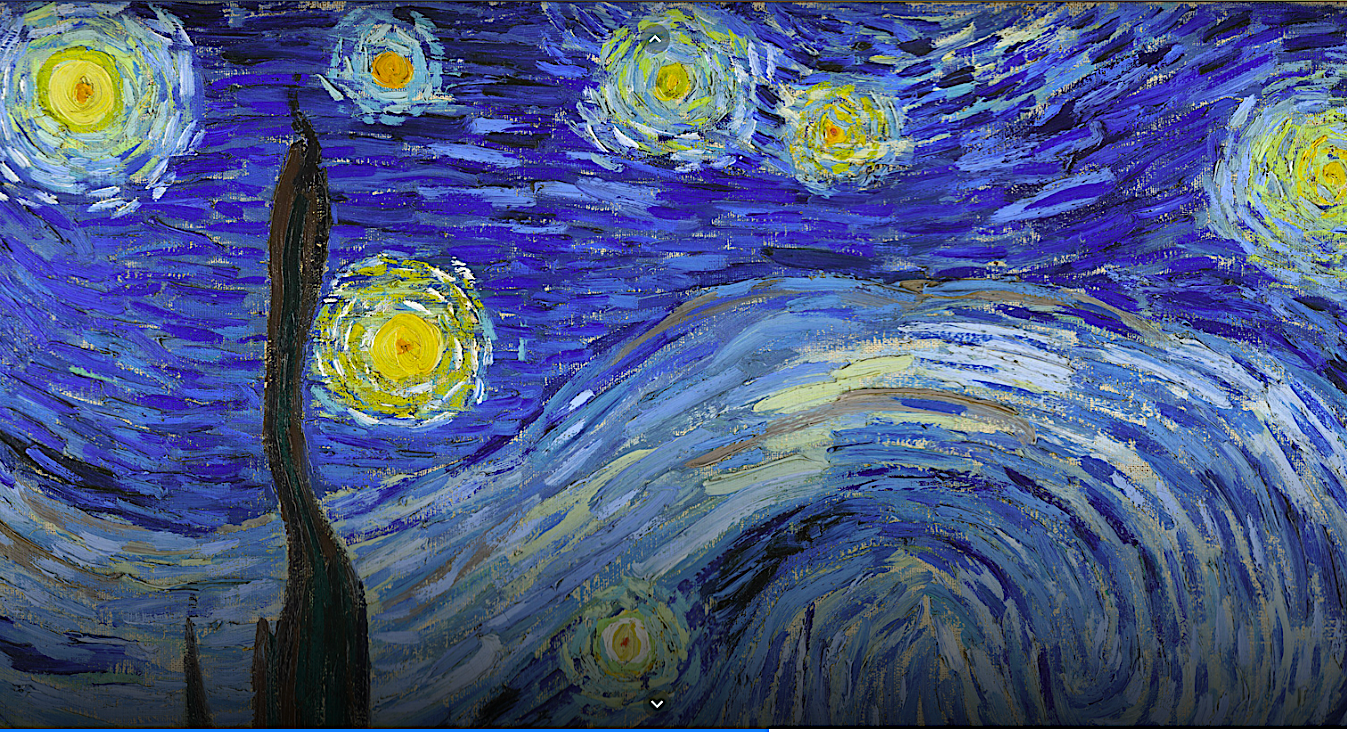
Those who can’t visit MoMA to see The Starry Night in person may enjoy getting up close and personal with Google Arts and Culture’s zoomable, high res digital reproduction. Keep clicking into the image to see the painting in greater detail.
Before or after formulating your own thoughts on The Starry Night and the emotional state that contributed to its execution, get the perspective of singer-songwriter Maggie Rogers in the below episode of Art Zoom, in which popular musicians share their thoughts while navigating around a famous canvas.
Bonus! Throw yourself into a free coloring page of The Starry Night here.
Related Content:
Vincent Van Gogh’s “The Starry Night”: Why It’s a Great Painting in 15 Minutes
Ayun Halliday is an author, illustrator, theater maker and Chief Primatologist of the East Village Inky zine. Follow her @AyunHalliday.
Read More...Art History School: Learn About the Art & Lives of Toulouse-Lautrec, Gustav Klimt, Frances Bacon, Edvard Munch & Many More
Artist and videographer Paul Priestly is an enthusiastic and generous sort of fellow.
His free online drawing tutorials abound with encouraging words for beginners, and he clearly relishes lifting the curtain to reveal his home studio set up and self designed camera rig.
But we here at Open Culture think his greatest gift to home viewers are his Art History School profiles of well-known artists like Henri de Toulouse-Lautrec and Vincent Van Gogh.
An avid storyteller, he’s drawn to those with tragic histories — the decision to pivot from impersonating the artist, as he did with Van Gogh, to serving as a reporter interested in how such details as syphilis and alcoholism informed lives and careers is a wise one.
Priestly makes a convincing case that Lautrec’s aristocratic upbringing contributed to his misery. His short stature was the result, not of dwarfism, but Pyknodysostosis (PYCD) a rare bone weakening disease that surely owed something to his parents’ status as first cousins.
His appearance made him a subject of lifelong mockery, and ensured that the freewheeling artist scene in Montmartre would prove more welcoming than the blueblood milieu into which he’d been born.
Priestly makes a meal of that Demi-monde, introducing viewers to many of the players.
He heightens our appreciation for Lautrec’s masterpiece, At the Moulin Rouge, by briefly orienting us to who’s seated around the table: writer and critic Édouard Dujardin, dancer La Macarona, photographer Paul Secau, and “champagne salesman and debauchee” Maurice Guibert, who earlier posed as a lecherous patron in Lautrec’s At the Café La Mie.
Queen of the Cancan La Goulue hangs out in the background with another dancer, the wonderfully named La Môme Fromage.
Lautrec places himself squarely in the mix, looking very much at home.
Consider that these names, like those of frequent Lautrec subjects acrobatic dancer Jane Avril and chanteuse Yvette Guilbert were as celebrated in Belle Epoque Montmartre as many of the painters Lautrec rubbed shoulders with — Degas, Pissarro, Cézanne, Van Gogh and Manet.
In an article in The Smithsonian, Paul Trachtman recounts how Lautrec discovered the model for Manet’s famous nude Olympia, Victorine Meurent, “living in abject poverty in a top-floor apartment down a Montmartre alley. She was now an old, wrinkled, balding woman. Lautrec called on her often, and took his friends along, presenting her with gifts of chocolate and flowers — as if courting death itself.”
Meanwhile Degas sniffed that Lautrec’s studies of women in a brothel “stank of syphilis.”
Perhaps Priestly will delve into Degas for an upcoming Art History School episode … there’s no shortage of material there.
Above are three more of Paul Priestly’s Art History School profiles that we’ve enjoyed on Frances Bacon, Edvard Munch and Gustav Klimt. You can subscribe to his channel here.
Related Content:
Art Historian Provides Hilarious & Surprisingly Efficient Art History Lessons on TikTok
Free Art & Art History Courses
Ayun Halliday is an author, illustrator, theater maker and Chief Primatologist of the East Village Inky zine. Follow her @AyunHalliday.
Read More...Sci-Fi Pioneer Hugo Gernsback Predicts Telemedicine in 1925
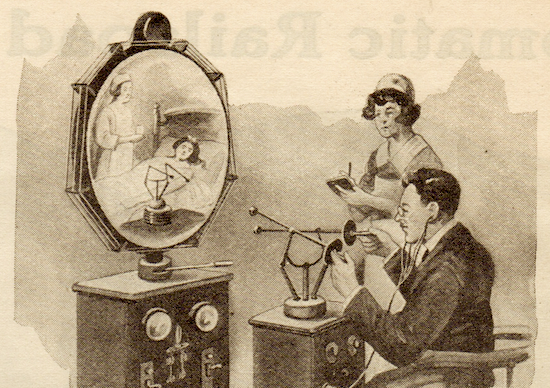
If you’ve ever wondered why one of science fiction’s greatest honors is called the “Hugo,” meet Hugo Gernsback, one of the genre’s most important figures, a man whose work has been variously described as “dreadful,” “tawdry,” “incompetent,” “graceless,” and “a sort of animated catalogue of gadgets.” But Gernsback isn’t remembered as a writer, but as an editor, publisher (of Amazing Stories magazine), and pioneer of science fact, for it was Gernsback who first introduced the earth-shaking technology of radio to the masses in the early 20th century.
“In 1905 (just a year after emigrating to the U.S. from Germany at the age of 20),” writes Matt Novak at Smithsonian, “Gernsback designed the first home radio set and the first mail-order radio business in the world.” He would later publish the first radio magazine, then, in 1913, a magazine that came to be called Science and Invention, a place where Gernsback could print catalogues of gadgets without the bother of having to please literary critics. In these pages he shone, predicting futuristic technologies extrapolated from the cutting edge. He was understandably enthusiastic about the future of radio. Like all self-appointed futurists, his predictions were a mix of the ridiculous and the prophetic.
Case in point: Gernsback theorized in a 1925 Science and Invention article that communications technologies like radio would revolutionize medicine, in exactly the ways that they have in the 21st century, though not quite through the device Gernsback invented: the “teledactyl,” which is not a robotic dinosaur but a telemedicine platform that would allow doctors to examine, diagnose, and treat patients from a distance with robotic arms, a haptic feedback system, and “by means of a television screen.” Never mind that television didn’t exist in 1925. Sounding not a little like his contemporary Buckminster Fuller, Gernsback insisted that his device “can be built today with means available right now.”

It would require significant upgrades to radio technology before it could support the wireless internet that lets us meet with doctors on computer screens. Perhaps Gernsback wasn’t entirely wrong — technology may have allowed for some version of this in the early 20th century, if medicine had been inspired to move in a more sci-fi direction. But the focus of the medical community — after the devastation of the 1918 flu epidemic — had understandably turned toward disease cure and prevention, not distance diagnosis.
Gernsback looked fifty years ahead, to a time, he wrote, when “the busy doctor… will not be able to visit his patients as he does now. It takes too much time, and he can only, at best, see a limited number today.” Home visits did not last another fifty years, but remote medicine didn’t take their place until almost 100 years after Gernsback wrote. Indeed, the webcams that now give doctors access to patients in the pandemic only came about in 1991 for the purpose of making sure the break room in the computer science department at Cambridge had coffee.
Gernsback even anticipated advances in space medicine, which has spent the last several years building the technology he predicted in order to perform surgeries on sick and injured astronauts stuck months or years away from Earth. He would have particularly appreciated this usage, though he isn’t given credit for the idea. Gernsback also deserves credit for poking fun at himself, as he seemed to realize how hard it was for most people to take him seriously.
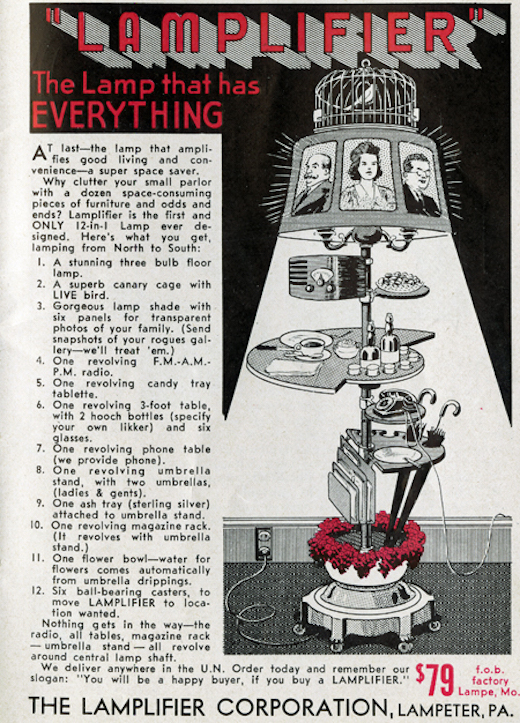
To non-visionaries, the technologies of the future would all seem equally ridiculous today, as in the pages of Gernsback’s satirical 1947 publication, Popular Neckanics Gagazine. Here, we find such objects as the Lamplifier, “the lamp that has EVERYTHING.” Gernsback’s love of gadgets blurred the boundaries between science fiction and fact, always with the strong suggestion that — no matter how useful or how ludicrous — if a machine could be imagined, it could be built and put to work.
Related Content:
A 1947 French Film Accurately Predicted Our 21st-Century Addiction to Smartphones
Sci-Fi Author J.G. Ballard Predicts the Rise of Social Media (1977)
Arthur C. Clarke Predicts in 2001 What the World Will Look By December 31, 2100
Josh Jones is a writer and musician based in Durham, NC. Follow him at @jdmagness
Read More...The Evolution of Kandinsky’s Painting: A Journey from Realism to Vibrant Abstraction Over 46 Years

Like most renowned abstract painters, Wassily Kandinsky could also paint realistically. Unlike most renowned abstract painters, he only took up art in earnest after studying economics and law at the University of Moscow. He then found early success teaching those subjects, which seem to have proven too worldly for his sensibilities: at age 30 he enrolled in the Munich Academy to continue the study of art that he’d left off while growing up in Odessa. The surviving paintings he produced at the end of the 19th century and the beginning of the 20th, displayed on Wikipedia’s list of his works, include a variety of landscapes, most presenting German and Russian (or today Ukrainian) landscapes undisturbed by a single human figure.
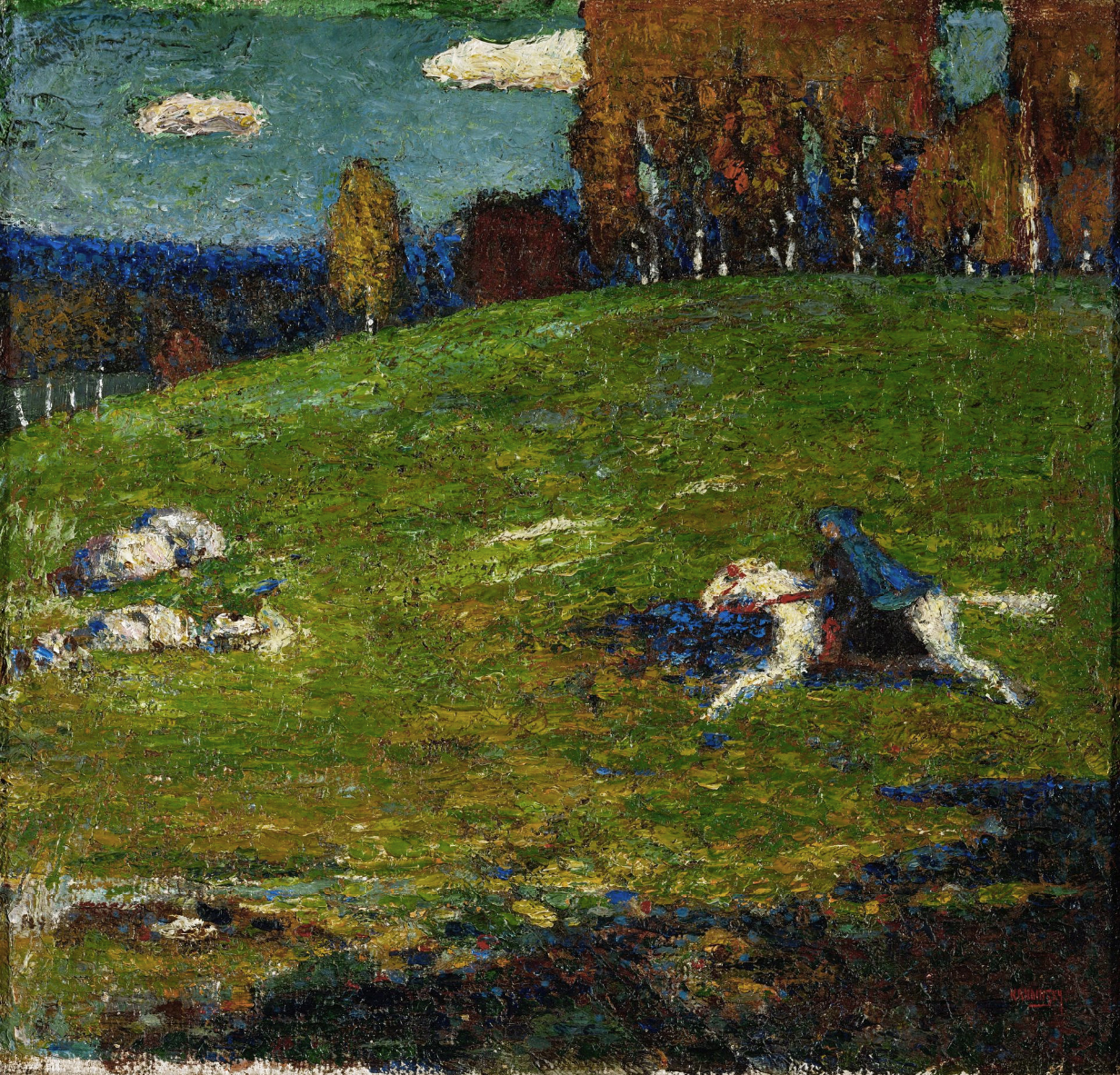
Kandinsky made dramatic change come with 1903’s The Blue Rider (above). The presence of the titular figure made for an obvious difference from so many of the images he’d created over the previous half-decade; a shift in its very perception of reality made for a less obvious one.
This is not the world as we normally see it, and Kandinsky’s track record of highly representative paintings tells us that he must deliberately have chosen to paint it it that way. With fellow artists like August Macke, Franz Marc, Albert Bloch, and Gabriele Münter, he went on to form the Blue Rider Group, whose publications argued for abstract art’s capability to attain great spiritual heights, especially through color.
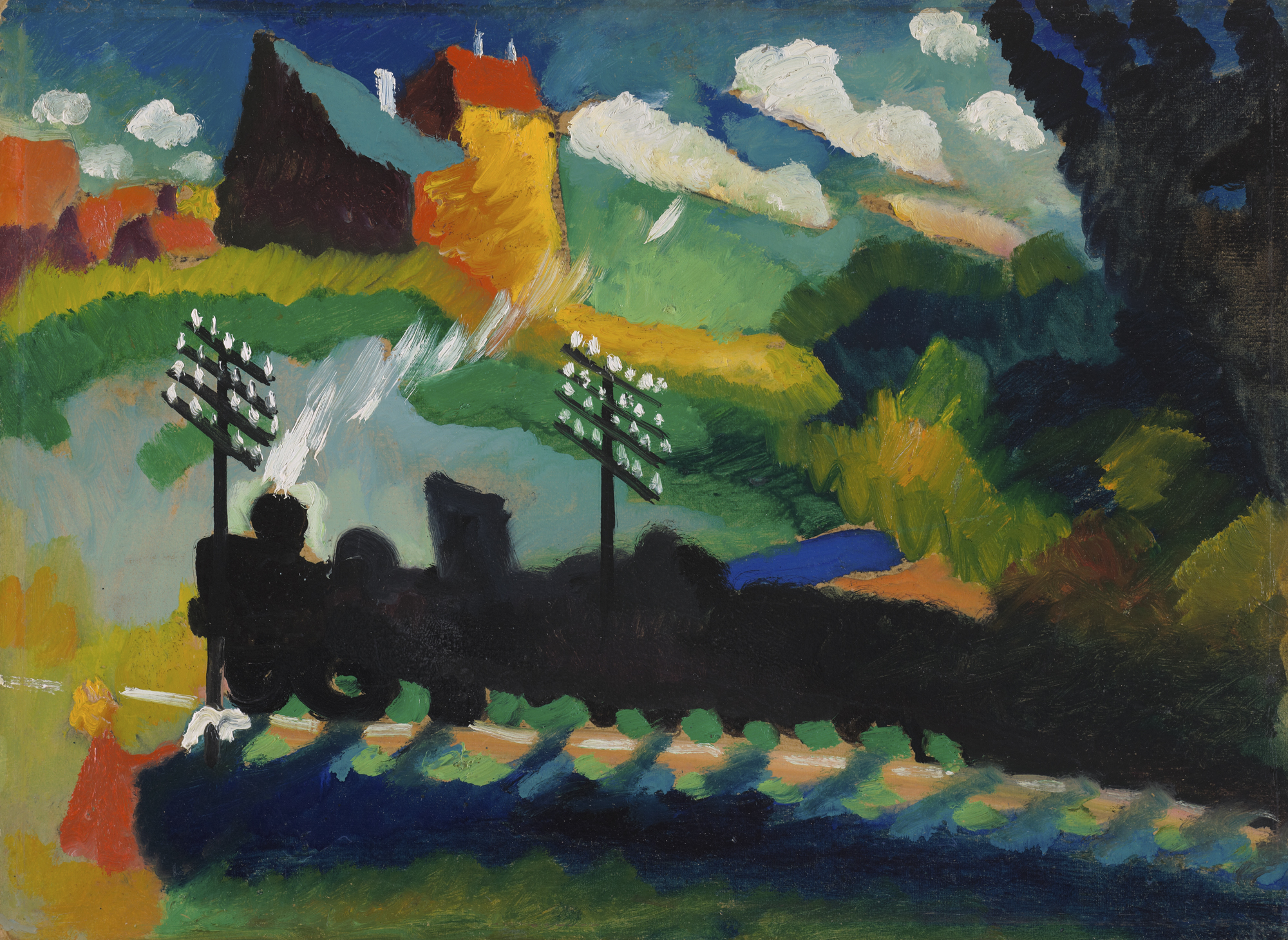
“Gradually Kandinsky makes departures from the external ‘world as a model’ into the world of ‘paint as a thing in itself,’ ” writes painter Markus Ray. “Still depicting ‘worldly scenes,’ these paintings start to take on purer colors and shapes. He reduces volumes into simple shapes, and colors into bright and vibrant hues. One can still make out the scene, but the shapes and colors begin to take on a life of their own.” This is especially true of the scenes Kandinsky painted in Bavaria, such as 1909’s Railway near Murnau above. The outbreak of World War I five years later sent him back to Russia, where he continued his pioneering journey toward a visual art equal in expressive power to music, which he called his “ultimate teacher.” But by the early 1920s it had become clear that his increasingly individualistic and non-representative tendencies wouldn’t sit well with the Soviet cultural powers that be.
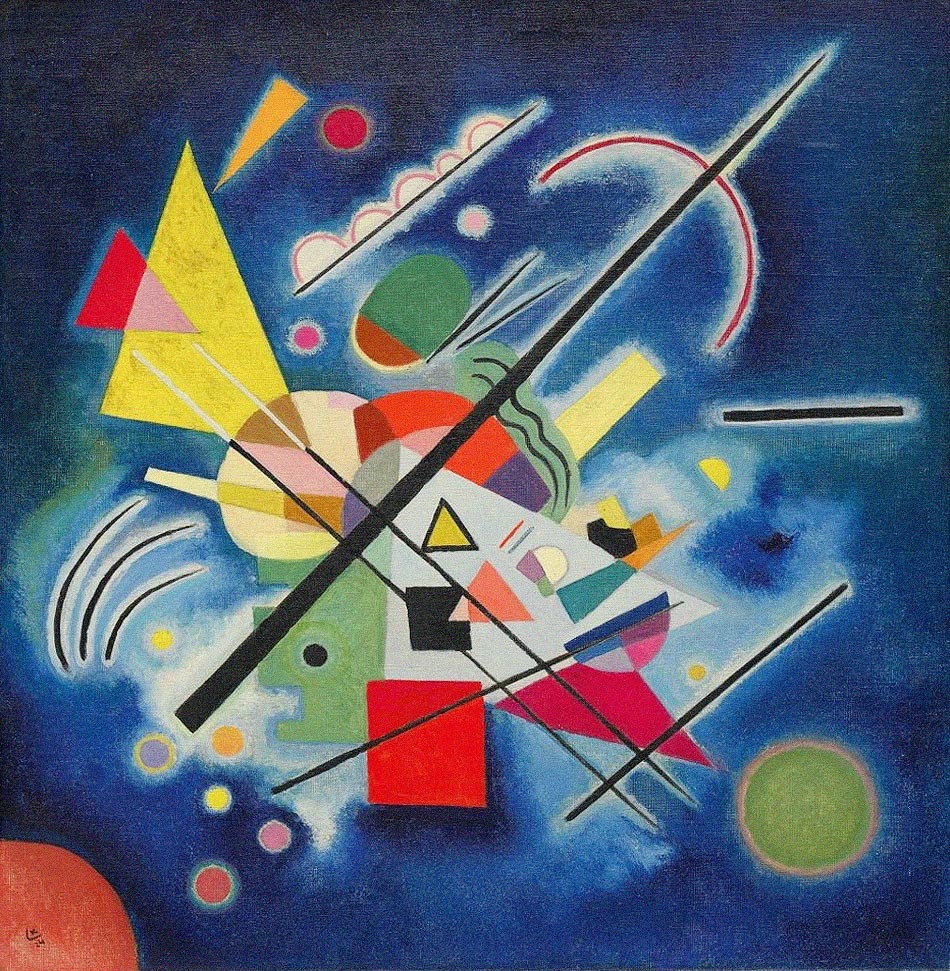
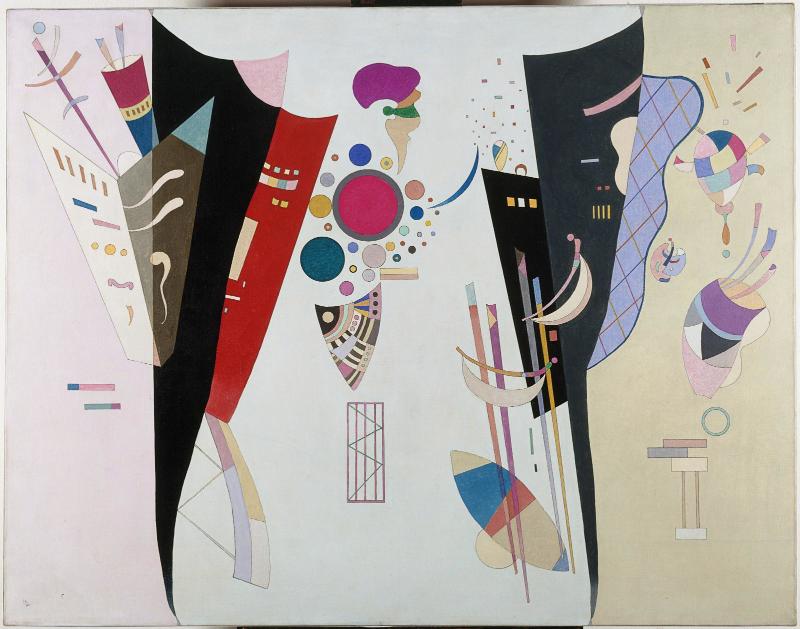
A return to Germany was in order. “In 1921, at the age of 55, Kandinsky moved to Weimar to teach mural painting and introductory analytical drawing at the newly founded Bauhaus school,” says Christie’s. “There he worked alongside the likes of Paul Klee, László Moholy-Nagy and Josef Albers,” and also expanded on Goethe’s theories of color. A true believer in the Bauhaus’ “philosophy of social improvement through art,” Kandinsky also wound up among the artists whose work was exhibited in the Nazi Party’s “Degenerate Art Exhibition” of 1937. By that time the Bauhaus was dissolved and Kandinsky had resettled in Paris, where until his death in 1944 (as evidenced by Wikipedia’s list of his paintings) he kept pushing further into abstraction, seeking ever-purer expressions of the human soul until the very end.
Related Content:
Time Travel Back to 1926 and Watch Wassily Kandinsky Make Art in Some Rare Vintage Video
An Interactive Social Network of Abstract Artists: Kandinsky, Picasso, Brancusi & Many More
How to Paint Like Kandinsky, Picasso, Warhol & More: A Video Series from the Tate
The Guggenheim Puts Online 1700 Great Works of Modern Art from 625 Artists
Based in Seoul, Colin Marshall writes and broadcasts on cities, language, and culture. His projects include the Substack newsletter Books on Cities, the book The Stateless City: a Walk through 21st-Century Los Angeles and the video series The City in Cinema. Follow him on Twitter at @colinmarshall or on Facebook.
Read More...Support Us
We're hoping to rely on loyal readers, rather than erratic ads. Please click the Donate button and support Open Culture. You can use Paypal, Venmo, Patreon, even Crypto! We thank you!

About Us

Open Culture scours the web for the best educational media. We find the free courses and audio books you need, the language lessons & educational videos you want, and plenty of enlightenment in between.
Advertise With Us
FREE UPDATES!
GET OUR DAILY EMAIL
Get the best cultural and educational resources on the web curated for you in a daily email. We never spam. Unsubscribe at any time.
FOLLOW ON SOCIAL MEDIA
Open Culture editor Dan Colman scours the web for the best educational media. He finds the free courses and audio books you need, the language lessons & movies you want, and plenty of enlightenment in between.
Advertise With Us


_(5617770198).jpg)

