The Death of Soap Operas (Is Greatly Exaggerated) — Pretty Much Pop: A Culture Podcast #105
Writers Sarahlyn Bruck and Kayla Dreysse join your host Mark Linsenmayer to discuss how this once very popular TV show type has simultaneously become niche, yet has had a tremendous influence on current prestige TV as well as reality shows. We talk about soaps’ story and structure conventions, the demands on soap actors and writers, and how changing market forces and technology have affected the genre. How much of a role does sexism play in the critical dismissal of soaps?
In addition to the daytime soaps like General Hospital and The Bold and the Beautiful, we touch on nighttime soaps like Dallas, teen soaps like Beverly Hills 90210, Downton Abbey, White Orchid, Breaking Bad, 24, Gray’s Anatomy, and more.
Get Sarahlyn’s novel Daytime Drama and follow her at @sarahlynbruck.
We all watched the 2020 documentary The Story of Soaps, which is available on YouTube. A fun podcast Mark listened to some of is A Trip Down Soap Lane.
Other sources that inspired us included:
- “How Soap Operas Changed TV Forever” by Matt Zoller Seitz
- “How TV Fell Back in Love With Soaps” by Margaret Lyons
- “For 70 Years, the Soap Opera Has Shaped American Pop Culture” by Lorraine Ali
- “How Soap Operas Pioneered the Depiction of LGBTQ Characters” by Lynette Rice
- “Why Don’t Soap Operas Look Like Primetime Shows?” by Calvin Motley
- “ ‘GMA 40 for 40′: Behind the Scenes at General Hospital” at ABC News
Sample the Muppets’ fake soap opera that Mark’s intro references.
This episode includes bonus discussion you can access by supporting the podcast at patreon.com/prettymuchpop or by choosing a paid subscription through Apple Podcasts. This podcast is part of the Partially Examined Life podcast network.
Pretty Much Pop: A Culture Podcast is the first podcast curated by Open Culture. Browse all Pretty Much Pop posts.
Read More...Superstar Violinist Nigel Kennedy Reinvents Jimi Hendrix’s “Purple Haze”: Watch Two Dynamic Performances
Violinists don’t often make the news these days, but when one does, you can be reasonably assured either that a musical controversy is afoot, or that the violinist in question is Nigel Kennedy. This time, both of those are the case: Kennedy, as The Guardian’s Dalya Alberge reports, “has pulled out of a concert at the Royal Albert Hall with only days to go after accusing the radio station Classic FM of preventing him from performing a Jimi Hendrix tribute.” At issue is his intent to perform a version of Hendrix’s “Little Wing,” but even with its “Celtic-sounding melody,” that composition was ultimately deemed “not suitable” for the audience.
It seems that Classic FM’s management would have preferred Vivaldi’s Four Seasons, of which Kennedy recorded the world’s best-selling version in 1989. That a classical radio station famous for concentrating its programming on the “hits” and a classical performer famous for deliberately unorthodox musical turns would fail to see eye-to-eye should not, perhaps, come as a surprise.
But then, Kennedy has long displayed a keen instinct for publicity and a tendency to — well, one would say épater les bourgeois, were Hendrix not now regarded as so thoroughly respectable in his own right. As Kennedy sees it, he was “one of the foremost composers of the 20th century, along with Stravinsky and Duke Ellington.”
The guitarist’s exalted status rests, Kennedy argues, on his having “brought all types of music together.” Even in a song like “Purple Haze” — which you can see Kennedy reinterpret with the Polish Chamber Orchestra in 2005, and again at the 2015 Thanks Jim Festival in Wroclaw — musicologists hear traces of both the American blues and the Mixolydian mode, along with such unconventional-for-1967 touches as the diminished-fifth melodic interval, long known as the “diabolus in musica” and the E7♯9 chord, now known as the “Hendrix chord.” Much of the song only uses two other chords, making “Purple Haze” the rare three-chord, under-three-minute rock hit that contains more than enough substance to inspire an unconventionally minded classical musician. But then, try telling that to a program director.
Related Content:
Japanese Violinist Covers Eddie Van Halen’s “Eruption”: Metal Meets Classical Again
Watch Jimi Hendrix’s “Voodoo Chile” Performed on a Gayageum, a Traditional Korean Instrument
Jimi Hendrix’s “Voodoo Child” Shredded on the Ukulele
How Science Fiction Formed Jimi Hendrix
Based in Seoul, Colin Marshall writes and broadcasts on cities, language, and culture. His projects include the Substack newsletter Books on Cities, the book The Stateless City: a Walk through 21st-Century Los Angeles and the video series The City in Cinema. Follow him on Twitter at @colinmarshall or on Facebook.
Read More...Why Do People Hate Modern Architecture?: A Video Essay
This month brought the 20th anniversary of September 11, 2001, which prompted people around the world to remember all that was lost on that day. The fallen Twin Towers of Minoru Yamasaki’s World Trade Center have only gained symbolic resonance over the past two decades, despite having been unloved when they still stood. “They often appeared to New Yorkers like a pair of middle fingers — to good development, to good economics, to good taste,” writes Gothamist’s Henry Stewart. “They brought all, high and low, rich and poor, together to hate.” Some critics of the World Trade Center made complaints rooted in politics, finance, and urban design; most just didn’t like how the thing looked.
For 28 years, what the World Trade Center in general and its Twin Towers in particular symbolized was all that the American public detested about what it thought of as the outlandish scale, aesthetic dreariness, and sheer inhumanity of “modern architecture.” But as Betty Chen of ARTiculations points out in the video above, there’s modern architecture, and then there’s Modern Architecture.
“A truly Modernist design,” she says, “adheres to a strict set of formal rules that upholds Modernism’s fundamental principle: form follows function.” Such Modernists as Walter Gropius, Ludwig Mies van der Rohe, and Le Corbusier subscribed to the notion that “architectural design should be disassociated from historic reference, be free of unnecessary ornamentation, and be simplified to the essentials of function.”
As versions of these principles for rebuilding a new postwar civilization — vulgarized versions, some might say — caught on in the middle of the 20th century, cities around the world set enthusiastically about putting up “empty boxes of nothingness.” Or so argued Modern Architecture’s detractors, who gained the cultural upper hand shortly thereafter. “If the first half of the 20th century is considered to be the age of Modern Architecture,” says Chen, “then the latter half of the century can be defined by a continual, unrelenting assault on Modern Architecture.” That assault included the demolition of another of Yamasaki’s mid-century projects, the Pruitt-Igoe housing complex, which began on March 16, 1972. Though carried out without murderous intent, it did involve a notable death: the death, as architect Charles Jencks famously declared, of architectural Modernism itself.
Related Content:
A Quick Animated Tour of Iconic Modernist Houses
1,300 Photos of Famous Modern American Homes Now Online, Courtesy of USC
Based in Seoul, Colin Marshall writes and broadcasts on cities, language, and culture. His projects include the Substack newsletter Books on Cities, the book The Stateless City: a Walk through 21st-Century Los Angeles and the video series The City in Cinema. Follow him on Twitter at @colinmarshall or on Facebook.
Read More...Cartoonist Lynda Barry Teaches You How to Make a Visual Daily Diary
Cartoonist and educator Lynda Barry is a favorite here at Open Culture.
We’re always excited to share exercises from her books and intel on her classes at the University of Wisconsin, but nothing beats the warmth and humor of her live instruction… even when it’s delivered virtually.
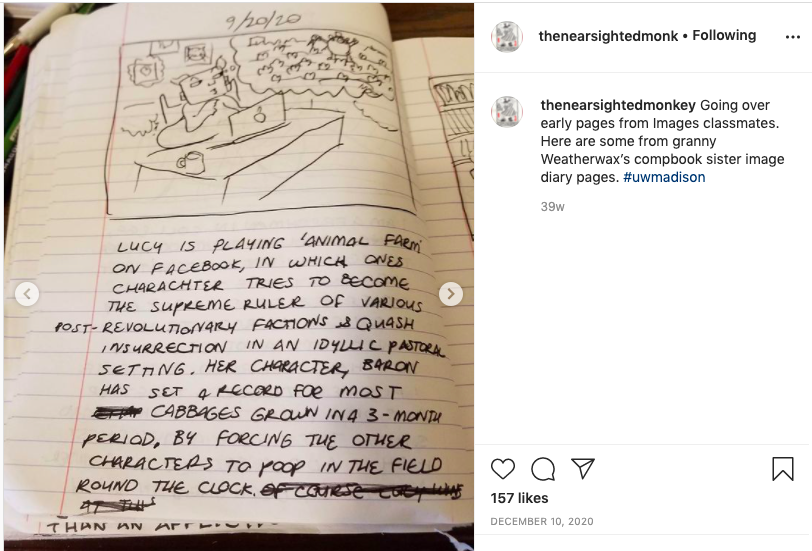
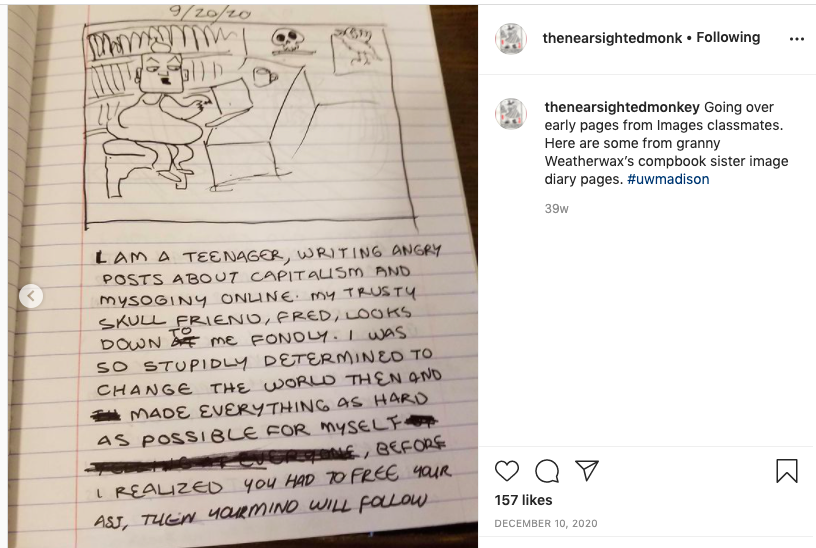
Last week, she took to Instagram to inform the fourteen lucky U of W students enrolled in her fall Making Comics class to prepare for a new way of keeping their required daily diaries, using a technique she calls “sister images.”
Those of us at home can play along, above.
Grab a composition book, or two blank sheets of paper, and a black felt tip pen. (Eventually you’ll need a timer, but not today.)
Rather than describe the ten-minute writing and drawing exercise in advance, we encourage you to jump right in, confident that teacher Barry would approve.
There are plenty of resources out there for those who want to learn how to outline, script, and storyboard comics.
Barry aims to tap a deeper vein of creativity with exercises that help students embrace the unknown.
The sister diary’s purpose, she says, is to “let our hands lead the way in terms of figuring out our stories.”
Whether or not you seek to make comics, it’s an engaging way to document your life. You can also implement the sister diary technique for discovering more about characters in your fictional work.
You’ll also pick up some bonus tips on drawing backgrounds, using all caps, allotting enough space within a panel for full body renderings, and staying in the moment should you find yourself at a temporary loss.
Related Content:
Watch Cartoonist Lynda Barry’s Two-Hour Drawing Workshop
Cartoonist Lynda Barry Teaches You How to Draw
Ayun Halliday is an author, illustrator, theater maker and Chief Primatologist of the East Village Inky zine. Follow her @AyunHalliday
Read More...The Recording Secrets of Nirvana’s Nevermind Revealed by Producer Butch Vig
People figured out that I’d tapped into something in making that record; a lot of labels came calling because they wanted to see if I could bring that magic to whatever artists they had. But I found it sorta annoying in some ways, because people thought I had a formula, that I could take a folk artist or a blues guitarist and make them sound like Nirvana.
The pop cultural phenomenon of Nirvana’s Nevermind caught everyone involved by surprise — from the band, to the label, to Butch Vig, just then making a name for himself as a 90s alt-rock superproducer by releasing Nevermind and Smashing Pumpkin’s Gish the same year and helping define the sound of guitar rock for the 90s. “It was perfect timing coming out when there was a shift in music and it felt like a revolution,” Vig tells Spin. “Despite being a great record, it would not have the same cultural impact” if it were released today.
Vig offers a few reasons why it’s difficult for an album to have the same influence. “Everything is so instant that it’s hard to build up some mystique. When you really want something but can’t quite get your hands on it, that makes it all the more powerful.”
Fans could eventually get their hands on the album without much trouble in 1991. (Geffen originally shipped only 46,521 copies in the U.S. in anticipation of low sales); but they couldn’t get enough of Kurt Cobain, who became a commodity before social media turned everyone into an aspiring commodity, a role contemporary stars like Billie Eilish now talk about openly in terms of the toll it takes on mental health.
Revisiting Nevermind on its 30th anniversary offers an occasion to discuss what made the album, the band, and Cobain so majorly appealing at the time. It also gives us a chance to talk about what happens when media companies and record labels seize on a unique event and drive it right into the ground. These are worthwhile discussions, but if we’re talking to Butch Vig — superproducer and founder and drummer of 90s juggernaut Garbage — our time is better spent asking the question he’s best poised to answer: what, exactly, made Nevermind such a great album? What did Vig hear behind the mixing desk that has so captivated listeners for 30 years?
In the videos here, you can see Vig — with commentary from surviving Nirvana members Krist Novoselic and Dave Grohl — demonstrate how several tracks came together, and how he enhanced and expanded the sound of the trio without needing to do much to make them sound absolutely huge. As he tells Kerrang in a recent interview, when the band first hired him:
A couple days later, a cassette showed up in the mail, with a handwritten letter, and I put it on and heard Kurt going, ‘Hey Butch, it’s Kurt, we’re excited to come and rock out with you. We’re going to play a couple of new songs, and we’ve got Dave Grohl, and he’s the greatest drummer in the world.’ And then I hear the guitar intro to …Teen Spirit, and when Dave hit the drums, it just completely destroyed everything.… I thought, “Wow these songs are great,” even though the recording quality on that cassette was horrible.
The magic was always in the songs, whether captured on a boom box or the studio gear of Geffen records after the band left their indie label Sub Pop. (It’s worth listening to the Sub Pop founders tell their story on the How I Built This podcast.) Hear Vig talk about how he bottled it above, and see more of his Nevermind making-of production videos here.
Related Content:
Josh Jones is a writer and musician based in Durham, NC. Follow him at @jdmagness
Read More...How Technology Is Reshaping Democracy & Our Lives: A Stanford Course with Sal Khan, Thomas Friedman, Kara Swisher, Sasha Baron Cohen, Reid Hoffman & More

This fall, Stanford Continuing Studies presents 150+ courses in the Liberal Arts & Sciences, Creative Writing, and Professional Development, including the new and timely course “Which Side of History? How Technology Is Reshaping Democracy and Our Lives.” Led by James Steyer (CEO, Common Sense Media), the course includes an extensive line-up of guest speakers and thought leaders. Hear from Hillary Clinton, Kara Swisher, Sal Khan, Sasha Baron Cohen, Laurie Santos, Reid Hoffman, Ellen Pao, Thomas Friedman, Jonathan Zittrain, Cory Booker, Nicholas Kristof and more. Together they will explore key questions: How do we protect the privacy of consumers and stop data abuses? How will we ensure the mental health and well-being of our society as we emerge from the pandemic? How can we hold tech platforms accountable for safeguarding basic democratic norms?
This live online course is open to any adult who wants to enroll. Although the Continuing Studies courses aren’t free, they’re timely and bound to engage. Which Side of History? How Technology Is Reshaping Democracy and Our Lives starts September 27. Many other online courses start the week of September 20. Explore the entire Stanford Continuing Studies catalogue here.
Related Content:
1,700 Free Online Courses from Top Universities.
A Free Stanford Course on How to Teach Online: Watch the Lectures Online
Read More...DIY Air Purifiers for Teachers: Free Designs & Step-by-Step Instructions Online
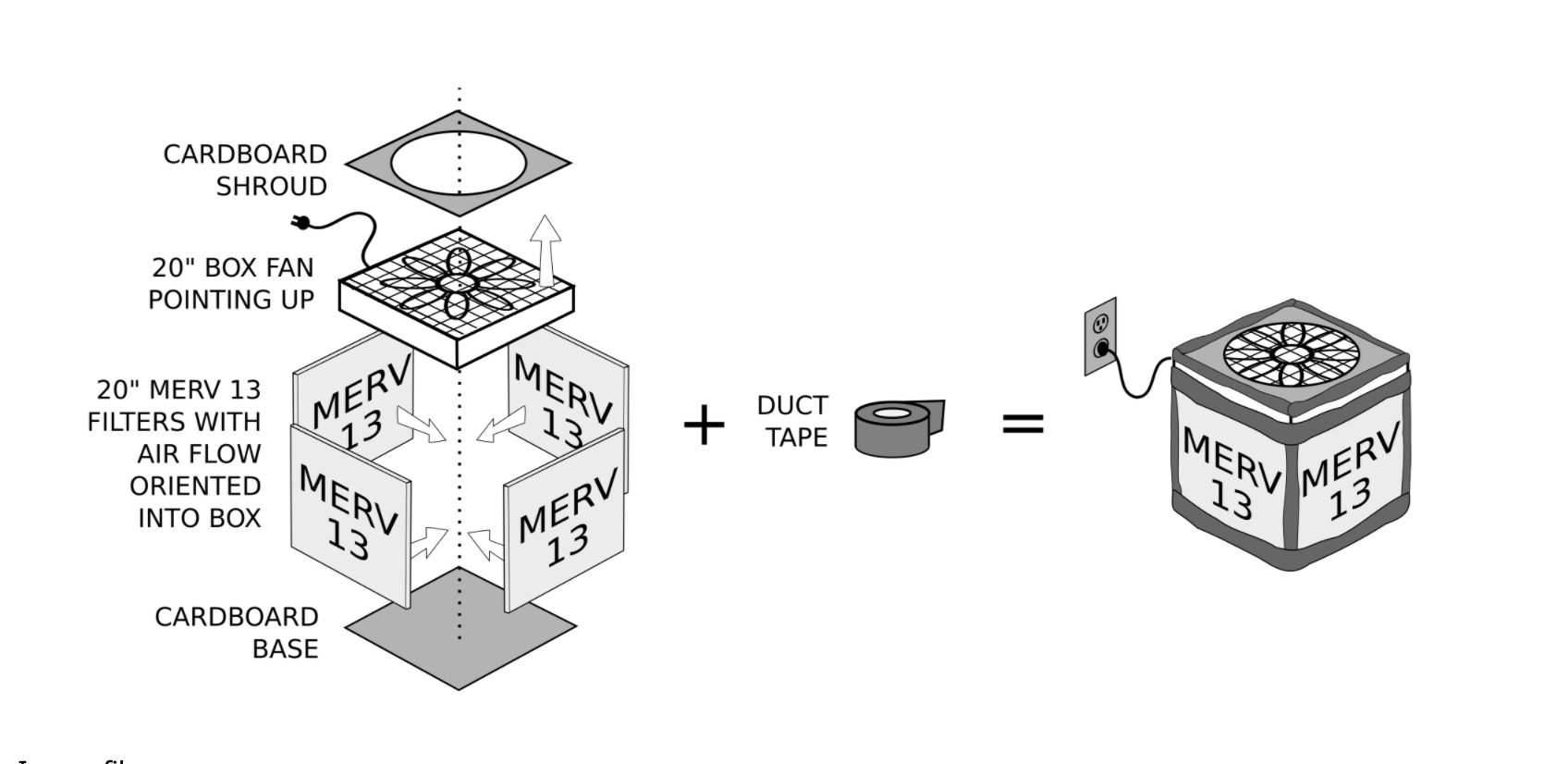
If you’re a teacher returning to the classroom, you may want some extra COVID protection. Thankfully, some researchers and practitioners have created “a design for an in-room air purifier which can remove a significant amount of COVID-19 virus from the air.”
“The design involves making a ‘box’ out of four 20” MERV-13 filters (the ‘sides’ of the box), a 20″ box fan (the ‘top’ of the box), and a cardboard (the ‘bottom’ of the box’). Air flows in through the filter sides, removing particulates of the sizes that can transport COVID-19 particles, and then flows out through the fan at the top.” These devices can be built from parts available at Home Depot, Walmart and other big box stores, and assembled in about 30–60 minutes. Total cost runs $70-$200. Find designs and a step-by-step instructions here. And read more about the purifier at NPR.
Related Content
DEVO Is Now Selling COVID-19 Personal Protective Equipment: Energy Dome Face Shields
Bill Nye Shows How Face Masks Actually Protect You–and Why You Should Wear Them
MIT Presents a Free Course on the COVID-19 Pandemic, Featuring Anthony Fauci & Other Experts
Read More...What It’s Like to Actually Fight in Medieval Armor
Ever wonder what it was like to really fight while wearing a full suit of armor? We’ve featured a few historical reconstructions here on Open Culture, including a demonstration of the various ways combatants would vanquish their foe—including a sword right between the eyes. We’ve also shown you how long it took to create a suit of armor and the clever flexibility built into them. But really, don’t we want to see what it would be like in a full melee? In the above Vice documentary, you can finally sate your bloodlust.
Not that anyone dies in the MMA-like sword-and-chainmail brawls. In these public competitions, the weapons are blunted and contestants fight “not to the death, just until they fall over,” as the narrator somewhat sadly explains. It is just a legit sport as any other fighting challenge, and the injuries are real. There’s no fooling around with these people. They are serious, and a nation’s honor is still at stake.
This mini-doc follows the American team to the International Medieval Combat Federation World Championships in Montemor-o-Velho in Portugal. What looks like a regular Renaissance faire is only the decorations around the main, incredibly violent event. We see battles with longswords, short axes, shields used offensively and defensively, and a lot of pushing and shoving. Contestants go head-to-head, or five against five, or twelve against twelve.
Twenty-six countries take part, and I have to say for all the jingoistic hoo-hah I try to ignore, the American team’s very nicely designed stars and stripes battle gear looked pretty damn cool. The Vice team also discover an interesting cast of characters, like the Texan who wears his cowboy hat when he’s not wearing his combat helmet; the man who describes his fighting style as “nerd rage”; and the couple on their honeymoon who met while brutally beating each other in an earlier competition. (No, the knights here are not all men.).
There are injuries, sprains, broken bones. There’s also the madness of inhaling too much of your own CO2 inside the helmet; and smelling the ozone when a spark of metal-upon-metal flies into the helmet.
Thankfully nobody is fighting to the death or for King/Queen and Country. Just for the fun of adrenalin-based competition and bragging rights.
Related Content:
A Hypnotic Look at How Japanese Samurai Swords Are Made
Ted Mills is a freelance writer on the arts who currently hosts the Notes from the Shed podcast and is the producer of KCRW’s Curious Coast. You can also follow him on Twitter at @tedmills, and/or watch his films here.
Read More...How Italian Physicist Laura Bassi Became the First Woman to Have an Academic Career in the 18th Century
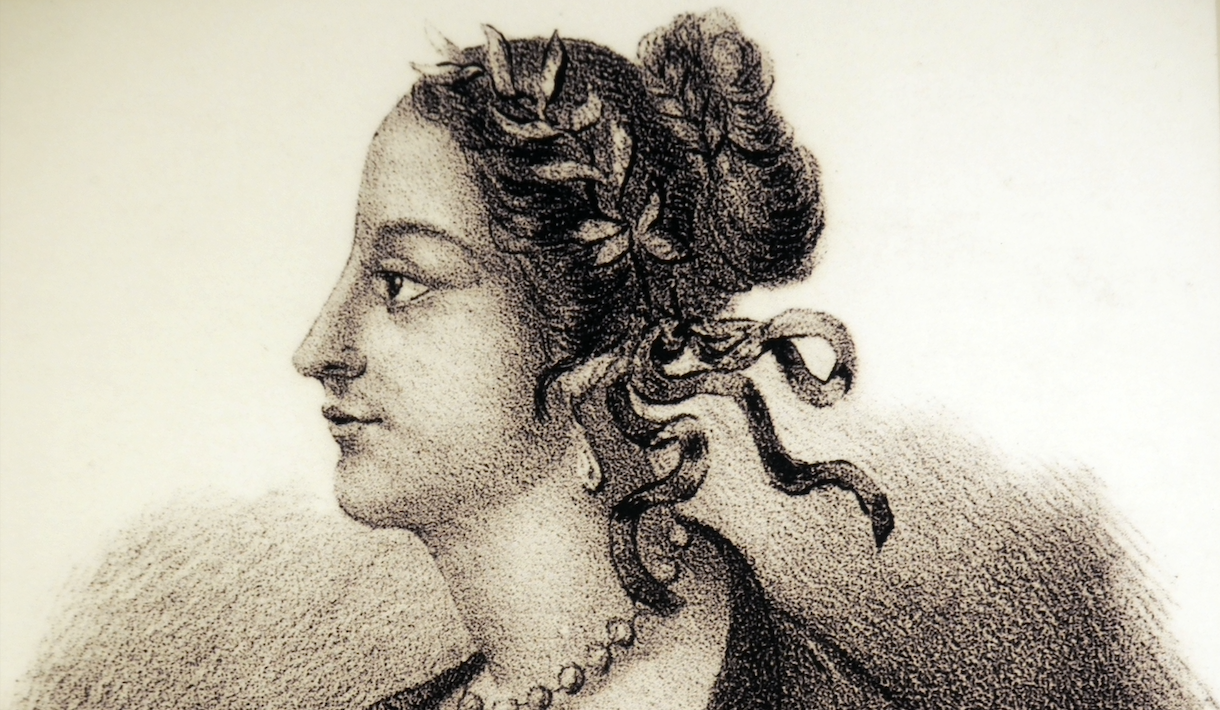
The practice and privilege of academic science has been slow in trickling down from its origins as a pursuit of leisured gentleman. While many a leisured lady may have taken an interest in science, math, or philosophy, most women were denied participation in academic institutions and scholarly societies during the scientific revolution of the 1700s. Only a handful of women — seven known in total — were granted doctoral degrees before the year 1800. It wasn’t until 1678 that a female scholar was given the distinction, some four centuries or so after the doctorate came into being. While several intellectuals and even clerics of the time held progressive attitudes about gender and education, they were a decided minority.
Curiously, four of the first seven women to earn doctoral degrees were from Italy, beginning with Elena Cornaro Piscopia at the University of Padua. Next came Laura Bassi, who earned her degree from the University of Bologna in 1732. There she distinguished herself in physics, mathematics, and natural philosophy and became the first salaried woman to teach at a university (she was at one time the university’s highest paid employee). Bassi was the chief popularizer of Newtonian physics in Italy in the 18th century and enjoyed significant support from the Archbishop of Bologna, Prospero Lambertini, who — when he became Pope Benedict XIV — elected her as the 24th member of an elite scientific society called the Benedettini.
“Bassi was widely admired as an excellent experimenter and one of the best teachers of Newtonian physics of her generation,” says Paula Findlen, Stanford professor of history. “She inspired some of the most important male scientists of the next generation while also serving as a public example of a woman shaping the nature of knowledge in an era in which few women could imagine playing such a role.” She also played the role available to most women of the time as a mother of eight and wife of Giuseppe Veratti, also a scientist.
Bassi was not allowed to teach classes of men at the university — only special lectures open to the public. But in 1740, she was granted permission to lecture at her home, and her fame spread, as Findlen writes at Physics World:
Bassi was widely known throughout Europe, and as far away as America, as the woman who understood Newton. The institutional recognition that she received, however, made her the emblematic female scientist of her generation. A university graduate, salaried professor and academician (a member of a prestigious academy), Bassi may well have been the first woman to have embarked upon a full-fledged scientific career.
Poems were written about Bassi’s successes in demonstrating Newtonian optics; “news of her accomplishments traveled far and wide,” reaching the ear of Benjamin Franklin, whose work with electricity Bassi followed keenly. In Bologna, surprise at Bassi’s achievements was tempered by a culture known for “celebrating female success.” Indeed, the city was “jokingly known as a ‘paradise for women,’” writes Findlen. Bassi’s father was determined that she have an education equal to any of her class, and her family inherited money that had been equally divided between daughters and sons for generations; her sons “found themselves heirs to the property that came to the family through Laura’s maternal line,” notes the Stanford University collection of Bassi’s personal papers.
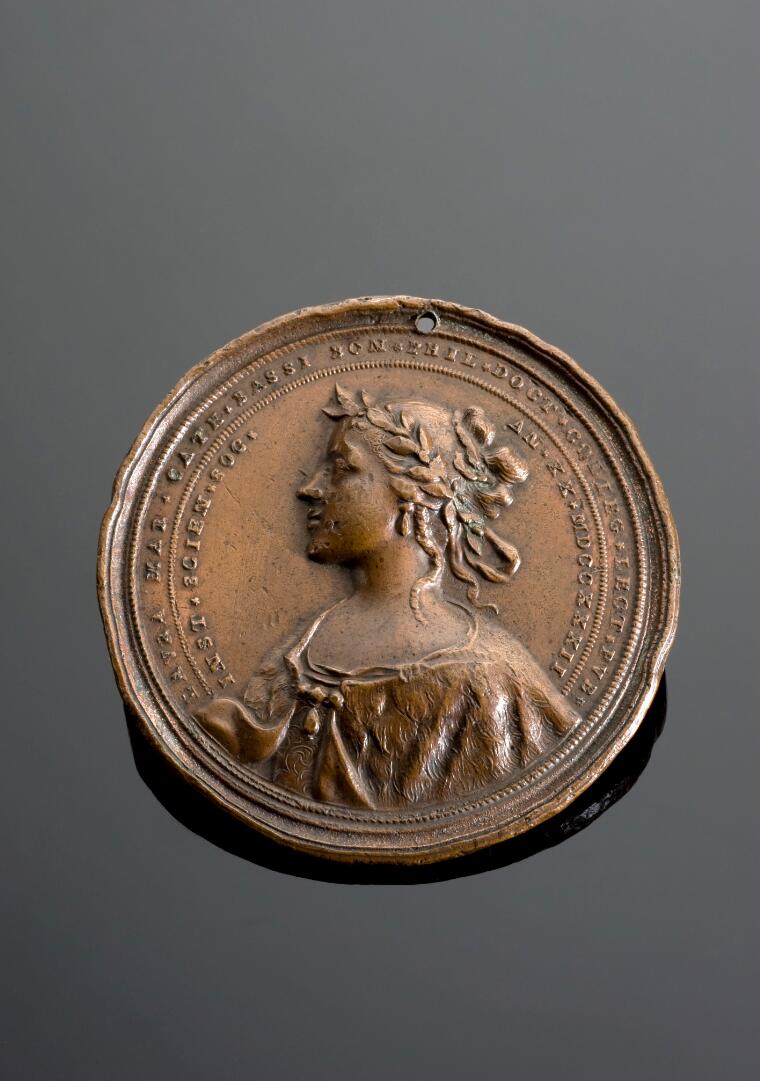
Bassi’s academic work is held at the Academy of Sciences in Bologna. Of the papers that survive, “thirteen are on physics, eleven are on hydraulics, two are on mathematics, one is on mechanics, one is on technology, and one is on chemistry,” writes a University of St. Andrew’s biography. In 1776, a year usually remembered for the formation of a government of leisured men across the Atlantic, Bassi was appointed to the Chair of Experimental Physics at Bologna, an appointment that not only meant her husband became her assistant, but also that she became the “first woman appointed to a chair of physics at any university in the world.”
Bologna was proud of its distinguished daughter, but perhaps still thought of her as an oddity and a token. As Dr. Eleonora Adami notes in a charming biography at sci-fi illustrated stories, the city once struck a medal in her honor, “commemorating her first lecture series with the phrase ‘Soli cui fas vidisse Minervam,’” which translates roughly to “the only one allowed to see Minerva.” But her example inspired other women, like Cristina Roccati, who earned a doctorate from Bologna in 1750, and Dorothea Erxleben, who became the first woman to earn a Doctorate in Medicine four years later at the University of Halle. Such singular successes did not change the patriarchal culture of academia, but they started the trickle that would in time become several branching streams of women succeeding in the sciences.
Related Content:
Jocelyn Bell Burnell Changed Astronomy Forever; Her Ph.D. Advisor Won the Nobel Prize for It
Women Scientists Launch a Database Featuring the Work of 9,000 Women Working in the Sciences
Real Women Talk About Their Careers in Science
Josh Jones is a writer and musician based in Durham, NC. Follow him at @jdmagness
Read More...Alice in Wonderland Syndrome: The Real Perceptual Disorder That May Have Shaped Lewis Carroll’s Creative World
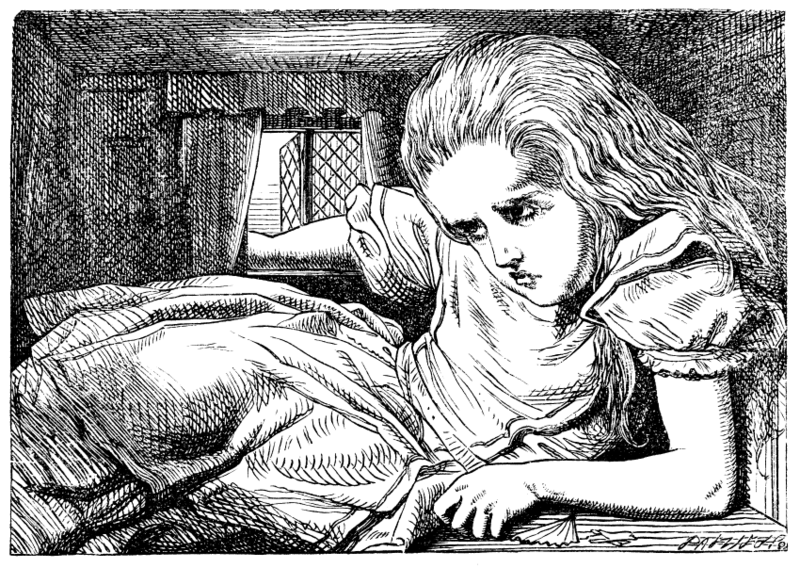
Alice’s Adventures in Wonderland isn’t just a beloved children’s story: it’s also a neuropsychological syndrome. Or rather the words “Alice in Wonderland,” as Lewis Carroll’s book is commonly known, have also become attached to a condition that, though not harmful in itself, causes distortions in the sufferer’s perception of reality. Other names include dysmetropsia or Todd’s syndrome, the latter of which pays tribute to the consultant psychiatrist John Todd, who defined the disorder in 1955. He described his patients as seeing some objects as much larger than they really were and other objects as much smaller, resulting in challenges not entirely unlike those faced by Alice when put by Carroll through her growing-and-shrinking paces.
Todd also suggested that Carroll had written from experience, drawing inspiration from the hallucinations he experienced when afflicted with what he called “bilious headache.” The transformations Alice feels herself undergoing after she drinks from the “DRINK ME” bottle and eats the “EAT ME” cake are now known, in the neuropsychological literature, as macropsia and micropsia.
“I was in the kitchen talking to my wife,” writes novelist Craig Russell of one of his own bouts of the latter. “I was hugely animated and full of energy, having just put three days’ worth of writing on the page in one morning and was bursting with ideas for new books. Then, quite calmly, I explained to my wife that half her face had disappeared. As I looked around me, bits of the world were missing too.”
Though “many have speculated that Lewis Carroll took some kind of mind-altering drug and based the Alice books on his hallucinatory experiences,” writes Russell, “the truth is that he too suffered from the condition, but in a more severe and protracted way,” combined with ocular migraine. Russell also notes that the sci-fi visionary Philip K. Dick, though “never diagnosed as suffering from migrainous aura or temporal lobe epilepsy,” left behind a body of work that has has given rise to “a growing belief that the experiences he described were attributable to the latter, particularly.” Suitably, classic Alice in Wonderland syndrome “tends to be much more common in childhood” and disappear in maturity. One sufferer documented in the scientific literature is just six years old, younger even than Carroll’s eternal little girl — presumably, an eternal seer of reality in her own way.
Related Content:
A Beautiful 1870 Visualization of the Hallucinations That Come Before a Migraine
Lewis Carroll’s Photographs of Alice Liddell, the Inspiration for Alice in Wonderland
Based in Seoul, Colin Marshall writes and broadcasts on cities, language, and culture. His projects include the Substack newsletter Books on Cities, the book The Stateless City: a Walk through 21st-Century Los Angeles and the video series The City in Cinema. Follow him on Twitter at @colinmarshall or on Facebook.
Read More...Support Us
We're hoping to rely on loyal readers, rather than erratic ads. Please click the Donate button and support Open Culture. You can use Paypal, Venmo, Patreon, even Crypto! We thank you!

About Us

Open Culture scours the web for the best educational media. We find the free courses and audio books you need, the language lessons & educational videos you want, and plenty of enlightenment in between.
Advertise With Us
FREE UPDATES!
GET OUR DAILY EMAIL
Get the best cultural and educational resources on the web curated for you in a daily email. We never spam. Unsubscribe at any time.
FOLLOW ON SOCIAL MEDIA
Open Culture editor Dan Colman scours the web for the best educational media. He finds the free courses and audio books you need, the language lessons & movies you want, and plenty of enlightenment in between.
Advertise With Us

