Andy Warhol’s Vibrant, Impractical, Illustrated Cookbook from 1959: A Feast for the Eyes
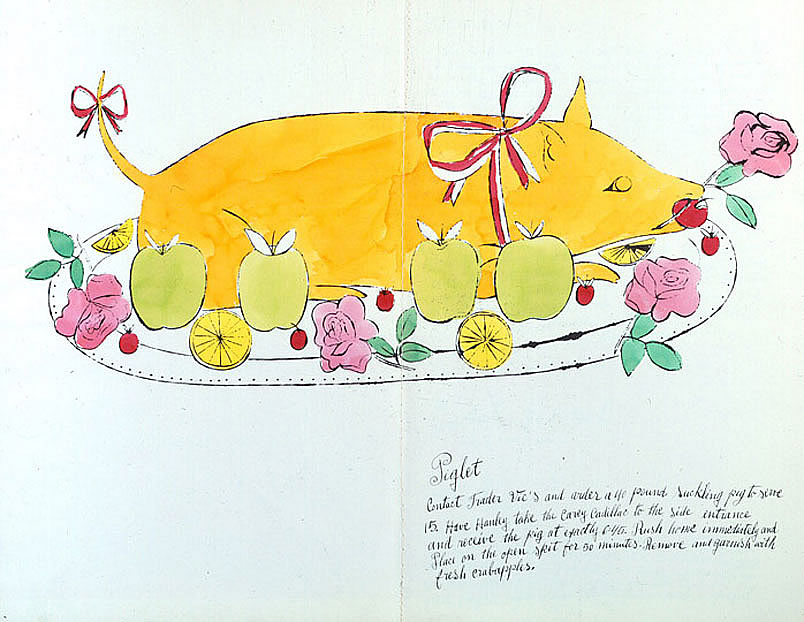
Gorgeously illustrated cookbooks featuring sumptuous images of fancy desserts and other special occasion food can be quite an intimidating proposition to self-doubting beginners.
The recipes themselves are daunting, and as every Great British Baking Show viewer learns, watching the top contestants squirm in advance of co-host Paul Hollywood’s icy judgment, flavor can’t save an edible creation that fails as art.
Andy Warhol’s approach to cookery appears rather more blithe.
His 1959 cookbook, Wild Raspberries — the title is a play on Ingmar Bergman’s Wild Strawberries — displays little interest in its readers’ cooking ability… or, for that matter, its authors.
Fanciful representations of such delicacies as Gardoons a la Mousseline are pretty as a picture… and stress free given that no one is actually expected to make them.
Wild Raspberries is all about attitude… and ambition of a purely social nature.
Warhol’s co-author, interior decorator and society hostess Suzie Frankfurt, recalled hatching the idea for this collaboration, shortly after encountering the young artist at New York City’s fabled sweet spot, Serendipity: “We thought it would be a masterpiece and we’d sell thousands. I think we sold 20.”
It’s possible the endeavor was a few decades ahead of its time. We can imagine Wild Raspberries doing quite well as an impulsive lifestyle type buy at Urban Outfitters.
Secondhand copies of a 1997 reprint occasionally resurface, as do auction lots of the original 34 lithograph sets, hand-colored by four schoolboys who lived upstairs from Warhol, prior to hand-binding by rabbis on the Lower East Side.
After consigning a few copies to Doubleday and Rizzoli bookstores, Warhol and Frankfurt gave the bulk of the first edition away as Christmas presents to friends, who were no doubt well equipped to appreciate the tongue-in-cheek nature of its “recipes,” hand-lettered by Warhol’s mother, Julia — whose spelling boo-boos were purposefully allowed to stand.
The instructions eschew crass mention of measurements or cooking times… perfect for anyone with hired staff, standing reservations at Upper East Side hot spots, or a social X‑Ray diet regimen.
Instead, readers are directed to send the Cadillac round to Trader Vic’s tiki bar for a suckling pig of sufficient size for a party of 15, or to gather morels should they find themselves holidaying in the vicinity of Normandy.
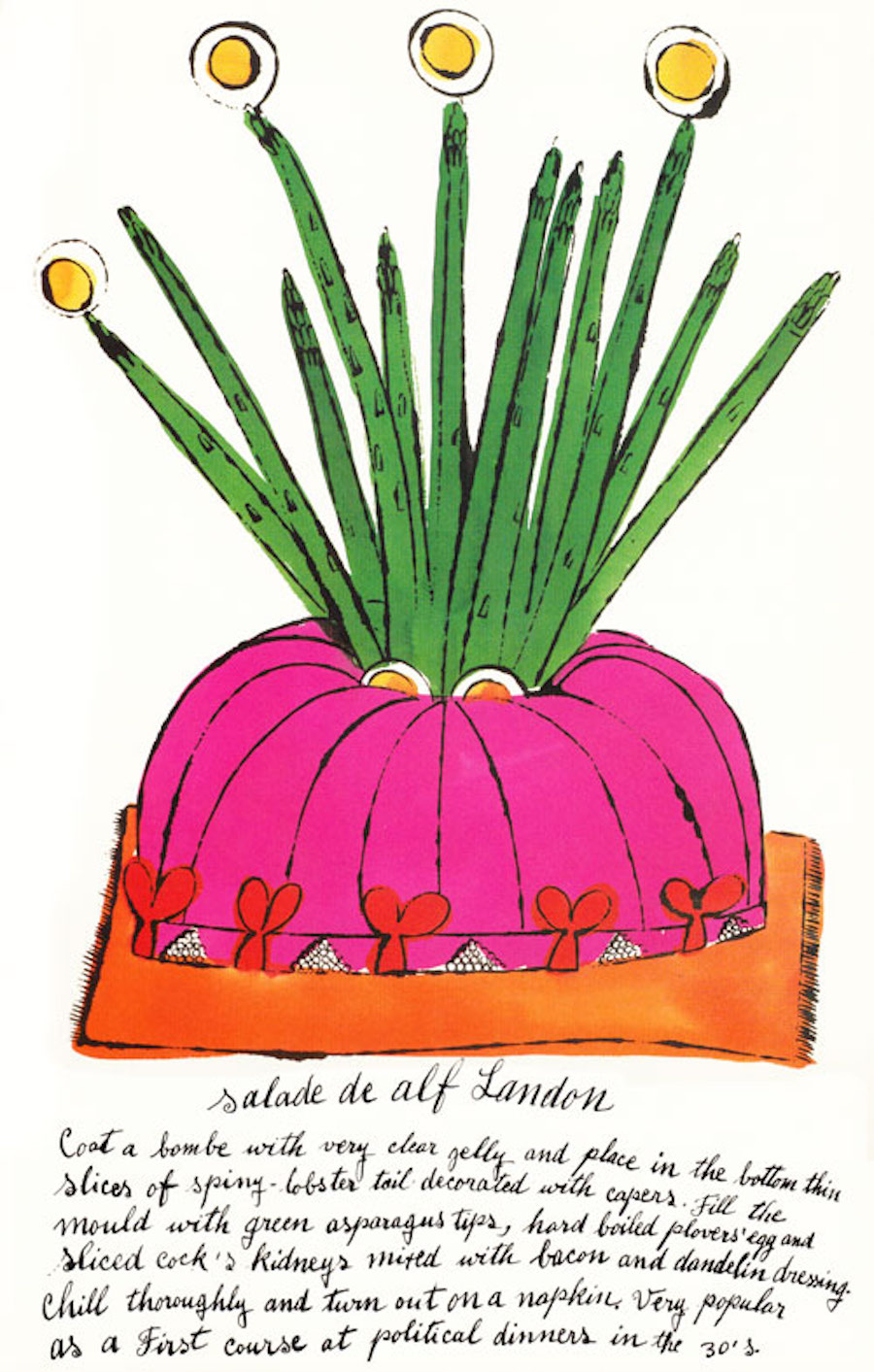
Salade de Alf Landon, a bombe of lobster tails named for FDR’s opponent in the 1936 Presidential election, crowned with asparagus tips and hardboiled plover eggs, seems like it could double as a fetching chapeau, especially when paired with one of Warhol’s whimsical fantasy for footwear company I. Miller’s weekly ads in The New York Times.
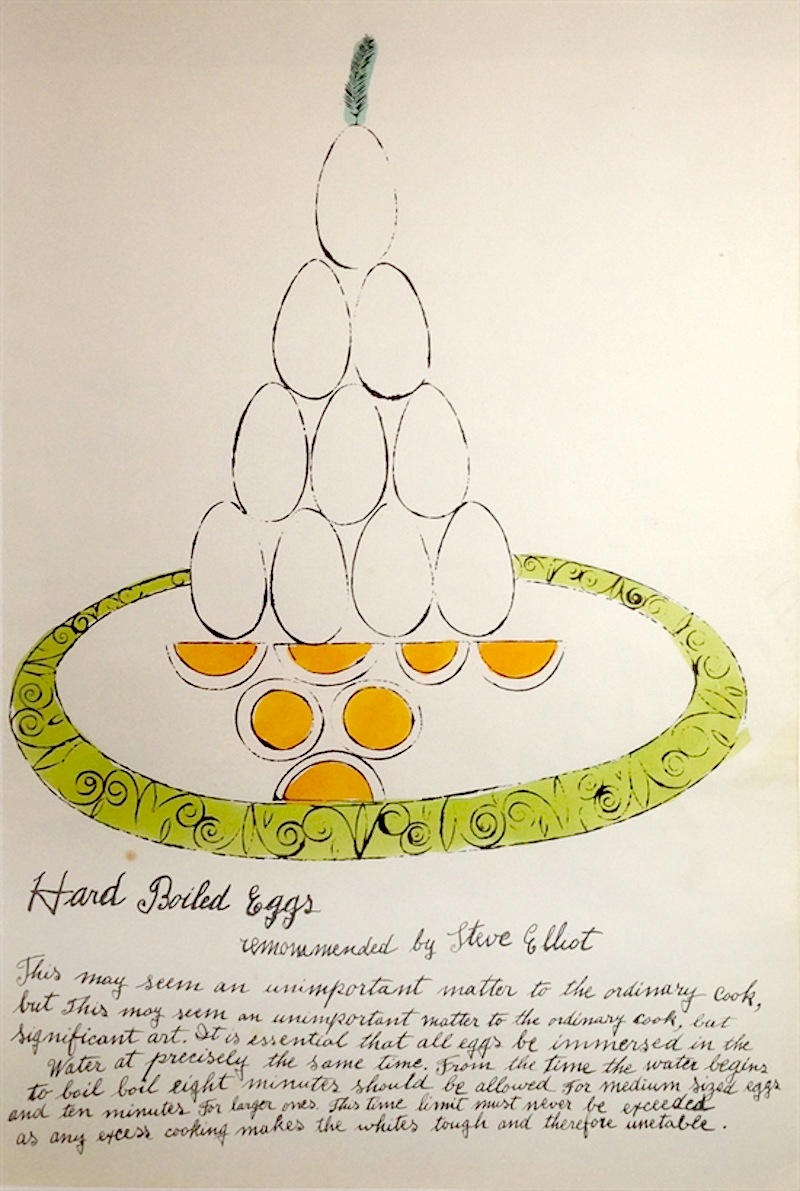
In fact, nearly everything in this vibrantly hand colored “cookbook” makes for plausible mid-century millinery, from Torte a la Dobosch to an impractically vertical arrangement of Hard Boiled Eggs.
Wild Raspberries may have been a swipe at aspirational, hostess-oriented late-50s cookbooks, but Greengages a la Warhol’s reference to hyperlocal produce would fit right in with with Portlandia’s 21st century foodie spoofs.
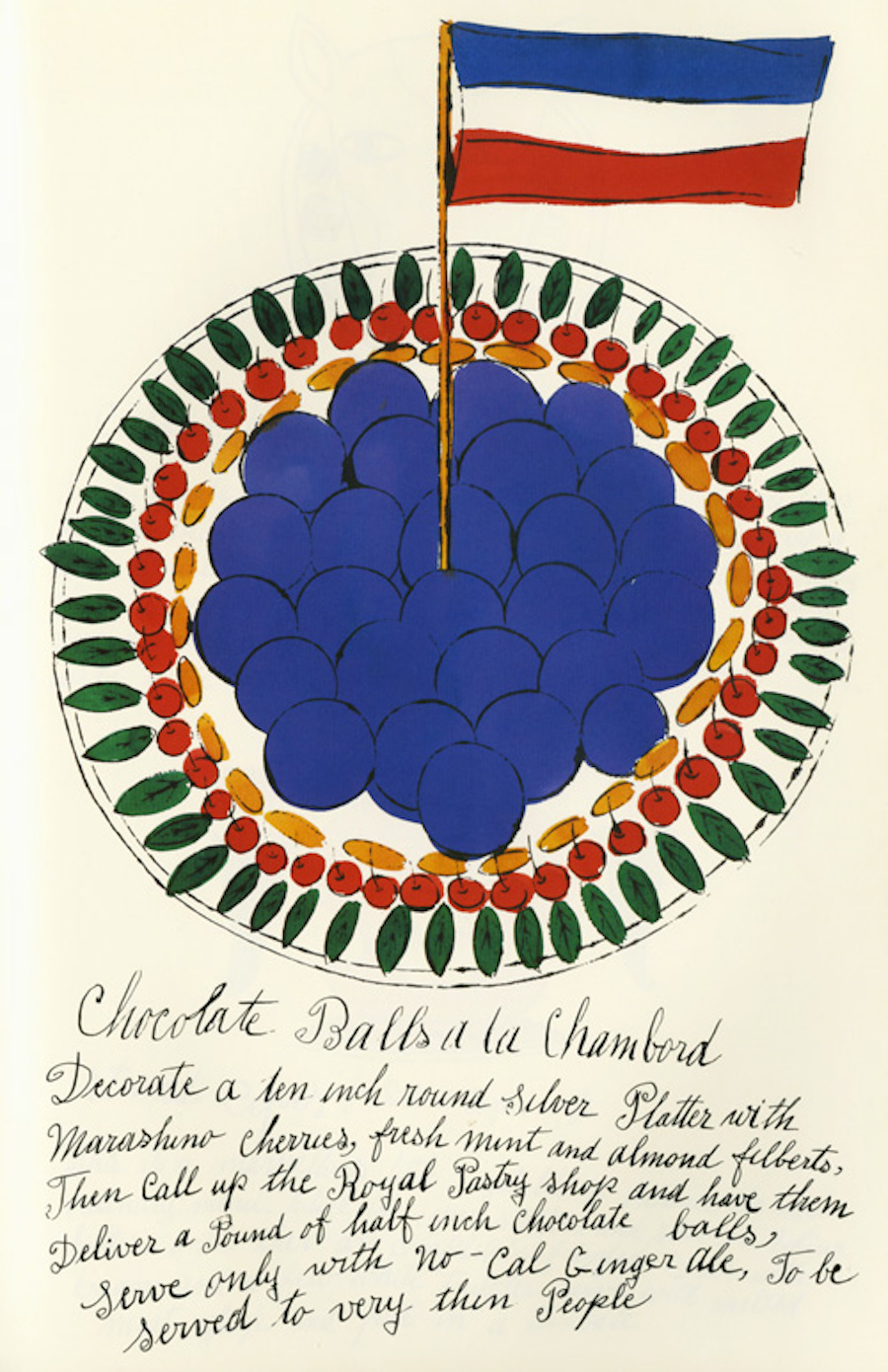
High and low combine to great effect with winking references to Greta Garbo and gossip columnist Dorothy Kilgallen, Lucky Whip dessert topping, a “Seared Roebuck,” and store-bought supermarket sponge cake (the latter in Wild Raspberries’ most legit-sounding recipe, something of an upgrade from the recipe for “cake” Warhol shared in The Philosophy of Andy Warhol — a chocolate bar served between slices of bread.
Related Content:
130,000 Photographs by Andy Warhol Are Now Available Online, Courtesy of Stanford University
Ayun Halliday is an author, illustrator, theater maker and Chief Primatologist of the East Village Inky zine. Follow her @AyunHalliday.
Read More...Watch a Gripping 10-Minute Animation About the Hunt for Nazi War Criminal Adolf Eichmann
In February 2018, the Conference on Jewish Material Claims Against Germany conducted interviews with 1,350 American adults, aged 18 and up.
Their findings, published as the Holocaust Knowledge and Awareness Study, reveal a sharp decline in Americans’ awareness of the state-sponsored extermination of six million Jewish men, women, and children by Nazi Germany and its collaborators.
This knowledge gap was particularly pronounced among the millennial respondents. Sixty-six percent had not heard of Auschwitz — the largest of the German Nazi concentration camps and extermination centers, where over a million perished. Twenty-two percent of them had not heard of (or were unsure if they had heard of) the Holocaust.
This is shocking to those of us who grew up reading The Diary of Anne Frank and attending assemblies where Holocaust survivors — often the older relative of a classmate — spoke of their experiences, rolling up their sleeves to show us the serial numbers that had been tattooed on their arms upon arrival at Auschwitz.
The study did make the heartening discovery that nearly all of the respondents — 93% — believed that the Holocaust should be a topic of study in the schools, many citing their belief that such an education will prevent a calamity of that magnitude from happening again.
(In defense of millennials, it’s worth noting that in the decades since 1977, when more than half of the country tuned in to watch the miniseries Roots, the Civil War and the horrors of slavery had all but disappeared from American curriculums, a direction the Black Lives Matter movement is fighting to redress.)
The Holocaust is such a huge subject that there is a question of how to introduce it, ideally, in such a way that young people’s interest is sparked toward continuing their education.
The Driver is Red, Randall Christopher’s animated short, above, could make an excellent, if somewhat unusual, starting place.
The film’s text is drawn from Israeli Mossad Special Agent Zvi Aharoni’s first person account of the successful manhunt that tracked Adolf Eichmann, a member of Heinrich Himmler’s inner circle and architect of the Nazi’s “final solution,” to Argentina.
This event transpired in 1960, fifteen years after Soviet troops liberated Auschwitz.
Aharoni, voiced by actor Mark Pinter, recalls receiving the tip that Eichmann was living in Argentina under an assumed name, and locating him in a modest dwelling on the outskirts of Buenos Aires.
Filmmaker Christopher builds the tension during the ensuing stakeout with effective, noir-ish, pencil sketches that take shape before our eyes, mapping surveillance points, a couple of happy accidents, and one harrowing moment where Aharoni feared his foreign accent might give him away.
There’s more to the story than can be packed in a fourteen minute film, but those fourteen minutes are as gripping as any tightly plotted spy movie.
Christopher is less interested in directing the next James Bond flick than putting Holocaust education back on the table for all Americans.
A 2016 New York Times article about the handwritten letter Eichmann sent Israeli President Yitzhak Ben-Zvi, begging for clemency, paved the way for the film by motivating Christopher to fill in some gaps in his education with regard to the Holocaust.
As the then-46-year-old told Leorah Gavidor of The San Diego Reader in 2018:
I (felt) so dumb, so ignorant, being an adult in America and not knowing the history of it.
My friends, people I told this story to, they were fascinated. They would start listening very carefully when I started to talk about this Nazi from Germany that was found 15 years after the war, halfway around the world. They didn’t know anything about it. That’s how I knew I was on to something.
Before the film was completed, Christopher staged a live reading of the script at San Diego’s Verbatim Books, then passed the mic to Holocaust survivor Rose Schindler, who told the audience about surviving Auschwitz.
As Christopher recalled:
People were tripping. There’s three lines about Treblinka in the film, and this Nazi war criminal, and then they see someone there, with the tattoo on her arm, in front of them, who experienced this firsthand.
Mrs. Schindler became a Holocaust educator in 1972, when her son’s teacher invited her to share her story with his middle school classmates.
She is now 91.
via The Atlantic
Related Content:
Holocaust in Film and Literature: A Free Online Course from UCLA
96-Year-Old Holocaust Survivor Fronts a Death Metal Band
100-Year-Old Holocaust Survivor Helen Fagin Reads Her Letter About How Books Save Lives
Ayun Halliday is an author, illustrator, theater maker and Chief Primatologist of the East Village Inky zine. Follow her @AyunHalliday
Read More...Masterclass Is Running a “Buy One, Share One Free” Deal Giving You Access to 100+ Courses (Available Until September 29)

Heads up: Masterclass is running a Buy One, Share One Free until Sept 29 at 11:59pm PST.
Here’s the gist: If you buy an All-Access pass to their 100+ courses, you will receive another All-Access Pass to give to someone else at no additional charge. An All-Access pass starts at $180 (or $15 per month), and lasts one year. For that fee, you–and a family member or friend–can watch courses created by Annie Leibovitz, Neil Gaiman, Malcolm Gladwell, Werner Herzog, Martin Scorsese, David Mamet, Jane Goodall, Margaret Atwood, Helen Mirren, Herbie Hancock, Alice Waters, Billy Collins and so many more. The deal is available now.
Note: If you sign up for a MasterClass course by clicking on the links in this post, Open Culture will receive a small fee that helps support our operation.
Read More...A Gigantic Violin Floats Down Venice’s Grand Canal with a String Quartet on Top
It looks like something out of a Fellini movie: a string quartet floating down the canals of Venice on a gigantic violin. Not a boat masquerading as a violin, like when you dress up your pet for Halloween and just slap some funny ears and coat on it, but an actual 39-foot long violin, made of several kinds of wood and metal by master boatbuilder/wood sculptor Livio De Marchi.
“Noah’s Violin,” as it is called, did have a tiny motor inside to propel it, and its trip down the Grand Canal was intended as a portent of a post-COVID world. De Marchi told the New York Times that the violin was a “sign of Venice restarting,” and like Noah’s Ark, would bring hope after the deluge.
Musicians on board played works by Vivaldi, who was also an inspiration to the woodworker/boatmaker, and who was likewise born in Venice. The surprise is not so much that a string quartet is playing on top of the violin, but that it all seems so sturdy and safe. There are no hand rails or life jackets to be seen. (According to the Times, wind blew some of the score into the canal, where it was quickly rescued).
De Marchi has made several surreal boats, starting with a large wooden replica of a paper ship, a floating origami crane, a large high-heeled shoe, and recently an all-wood recreation of a Ferrari that puttered up and and down the canal.
The violin boat was followed by crowds in gondolas and other tourist boats, floated about for an hour, and then was docked, where it was blessed by a priest. A museum in China and an Italian company expressed interest in finding the violin-boat a home.
Who knows what might happen to it, but why not strap some powerboat motors on it, hire Apocalyptica and let ‘er rip?
Related Content:
How Venice Works: 124 Islands, 183 Canals & 438 Bridges
A Relaxing 3‑Hour Tour of Venice’s Canals
Ted Mills is a freelance writer on the arts who currently hosts the Notes from the Shed podcast and is the producer of KCRW’s Curious Coast. You can also follow him on Twitter at @tedmills, and/or watch his films here.
Read More...View 103 Discovered Drawings by Famed Japanese Woodcut Artist Katsushika Hokusai
When westerners first discovered the work of Japanese woodcut artist Katsushika Hokusai, it was primarily through his late-career print The Great Wave off Kanagawa and the series from which it came, Thirty-Six Views of Mount Fuji, after the opening of Japan to international trade and the mass consumption of Japanese art in the late 19th century. Impressionists like Claude Monet and Vincent van Gogh went wild for Japanese prints; Claude Debussy composed La mer; artists, artisans, and architects on both sides of the Atlantic fell for all things Japonisme.
Hokusai died in 1849 and did not live to see this newfound international admiration. When he completed The Great Wave, he was in his seventies — a master of his craft who had himself absorbed significant influence from western painters.
During his “formative experience of European art,” John-Paul Stonard writes at The Guardian, Hokusai “learnt from European prints brought into Japan by Dutch traders.” He took these lessons in directions all his own, however. His Mount Fuji prints “could not have been further from anything being made in Europe at the time.”
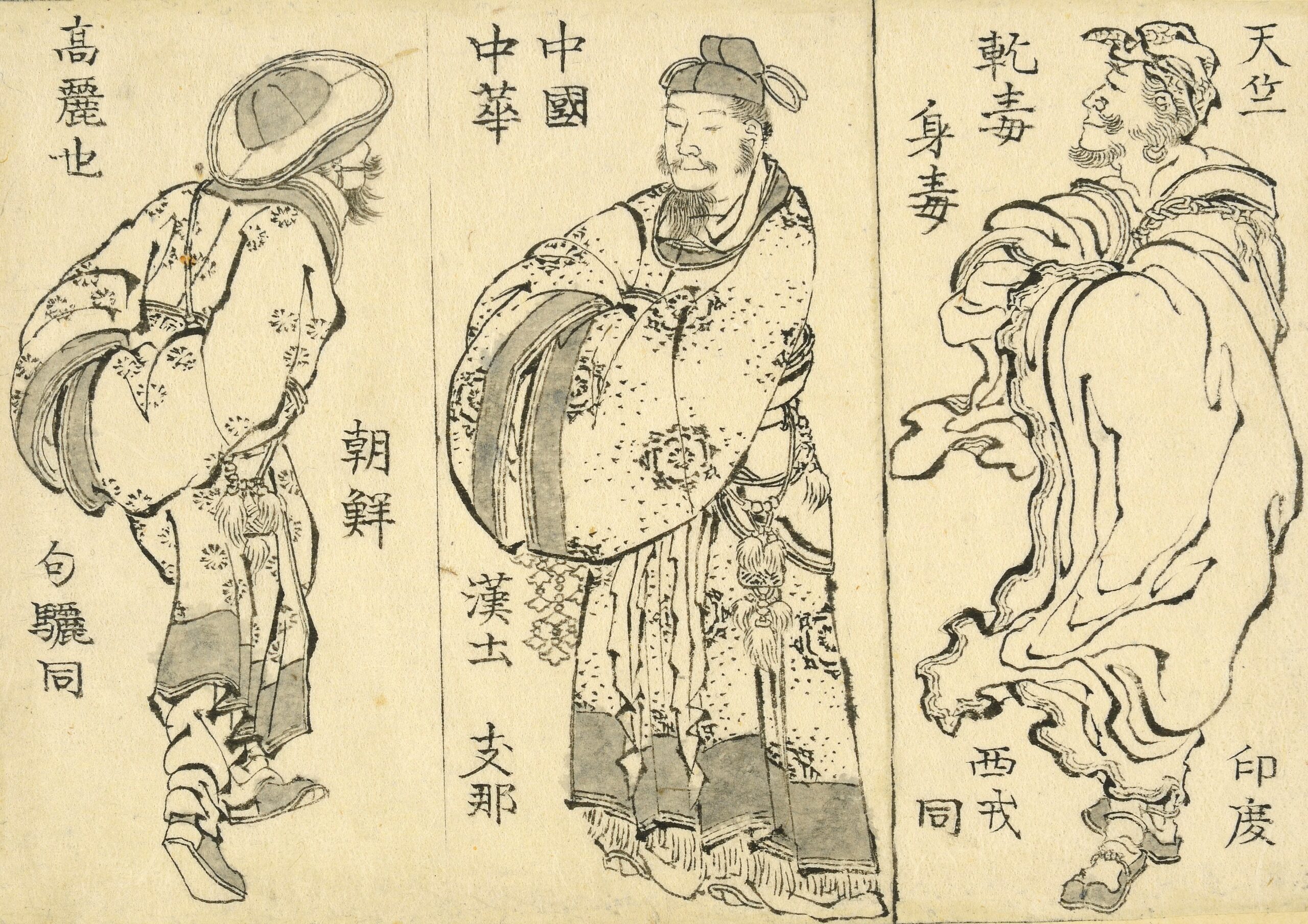
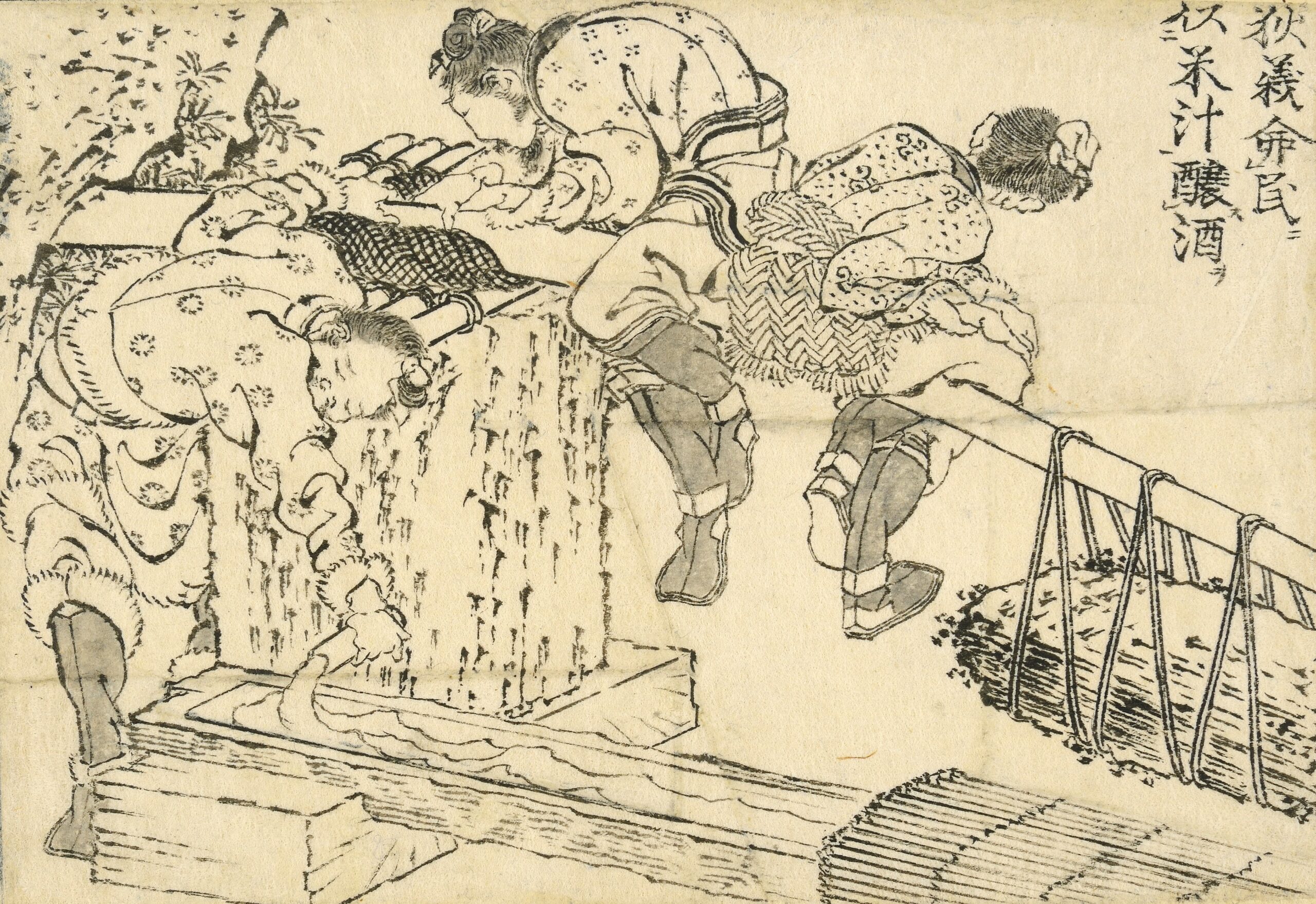
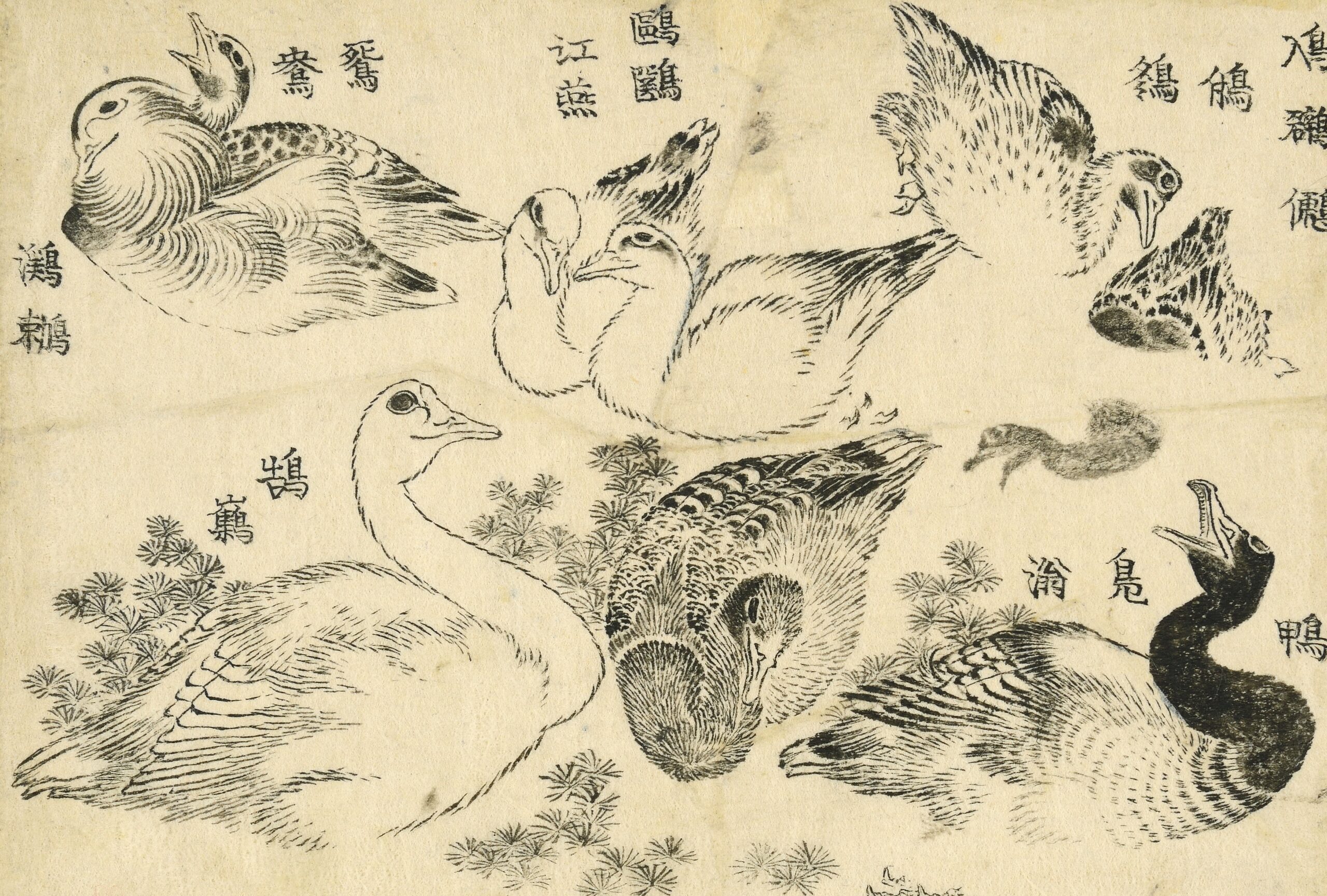
Hokusai’s European and American enthusiasts saw only the barest glimpse of his body of work, which we can now fully appreciate in exhibitions in person and online. And we can now appreciate a series of drawings that have been hidden away for over seventy years and were hardly seen at all in the 200 years since their creation. Made for an unpublished encyclopedia titled Banmotsu eon daises zu (The Great Picture Book of Everything), “The drawings were long thought forgotten,” Valentina Di Liscia writes at Hyperallergic, “last recorded at an auction in Paris in 1948 before they resurfaced in 2019.”
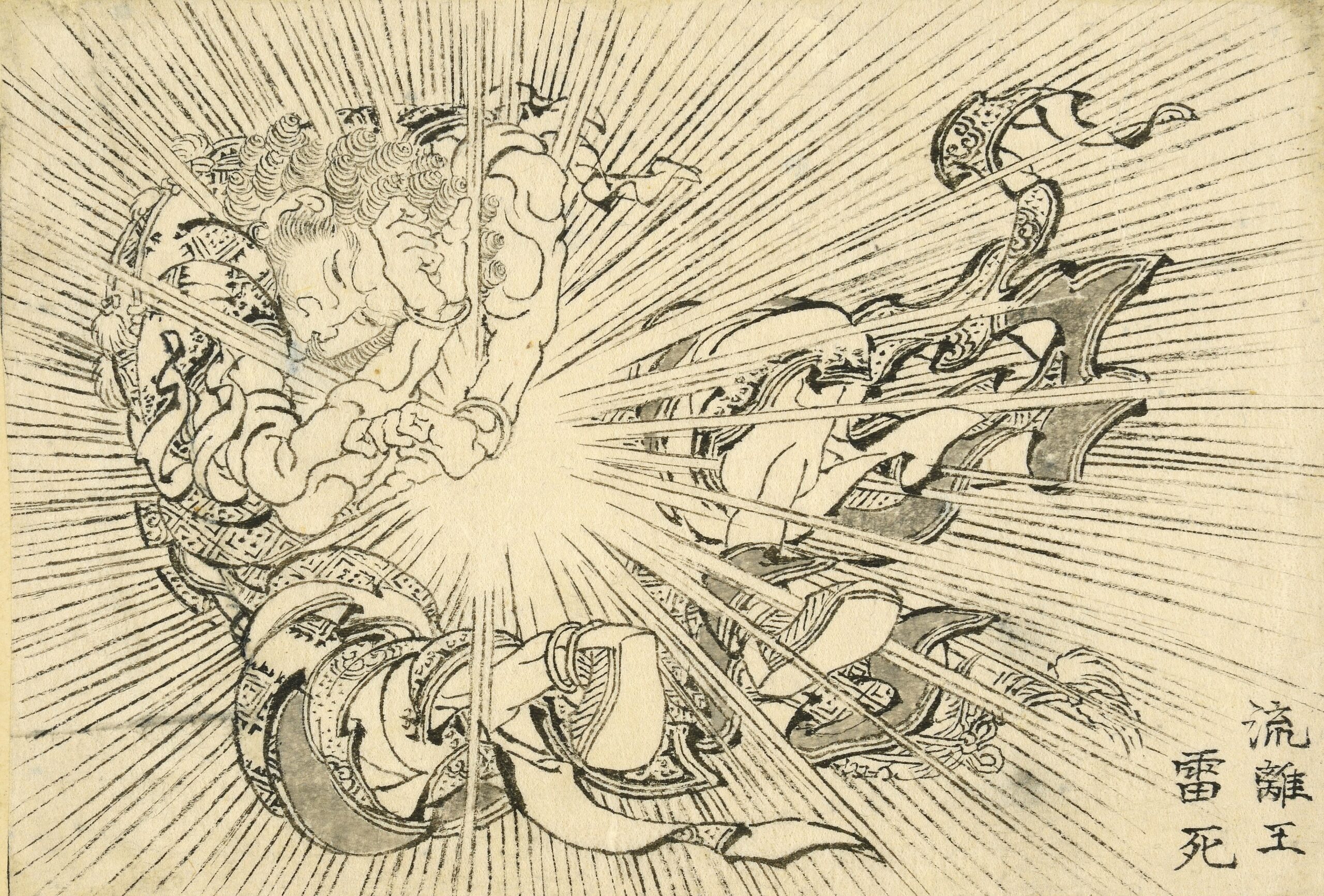
Made sometime between 1820 and the 1840s, “the meticulous, postcard-sized works are known as hanshita‑e, a term for the final drawings used to carve the key blocks in Japanese woodblock printing.” These are usually destroyed in the process, but since the prints were never made, for reasons unknown, “the delicate illustrations remained intact, mounted on cards and stored in a custom-made wooden box.” The drawings depict everything from “the typical inhabitants of lands in East, Southeast, and Central Asian and beyond” to one of the 33 manifestations of the bodhisattva Avalokiteśvara, “Dragon head Kannon.”
At the top, curator Alfred Haft walks us through his favorite drawings from the set, and you can see all 103 of the diminutive illustrations online at the British Museum. Formerly owned by the collector and Art Nouveau jeweler Henri Vever, the prints could have inspired many a western artist, but it seems they were hidden away and have been seen by very few eyes. Discover them yourself for the first time here.
Related Content:
Hokusai’s Iconic Print, “The Great Wave off Kanagawa,” Recreated with 50,000 LEGO Bricks
Josh Jones is a writer and musician based in Durham, NC. Follow him at @jdmagness
Read More...A Rare, Early Version of the King Arthur Legend Found & Translated
The stories of King Arthur and his court took shape over a period of a few hundred years; like most ancient legends, they evolved through many iterations — not a little like the stories in modern-day comic books. “The medieval Arthurian legends were a bit like the Marvel Universe,” explains Laura Campbell, a medieval language scholar at Durham University. “They constituted a coherent fictional world that had certain rules and a set of well-known characters who appeared and interacted with each other in multiple different stories.”
The first account of Arthur comes from a text in Latin called the Historia Brittonum, a compilation of sources assembled sometime in 829 or 830. Here, Arthur is mentioned as a historical figure, “variously described,” notes the British Library, “as a war lord (dux bellorum), as a Christian soldier who carries either an image of the virgin or Christ’s cross, and as a legendary figure associated with miraculous events.”
Merlin the magician — the figure we most associate with miraculous events in the Arthurian legends — doesn’t show up for another two hundred years or so, in Geoffrey of Monmouth’s History of the Kings of Britain. “After Geoffrey,” writes Kathryn Walton at Medievalists.net, “Merlin becomes a fixture of the Arthurian legend and appears in all kinds of different versions of the story across the Middle Ages.” One Merlin story that appears in many versions involves a figure called Nimue, Viviane, and other names in French, English, and Welsh. (She is sometimes identified with the Lady of the Lake).
The Merlin and Vivien stories have “survived throughout the ages in a way that not many other stories have,” the University of Rochester’s Robyn Pollack writes, “because writers have found remarkable ways to transform the characters and the narrative over the centuries.” Now, scholars at the University of Bristol have announced, two years after its discovery, the authentication of a fragment containing yet another version of the story.
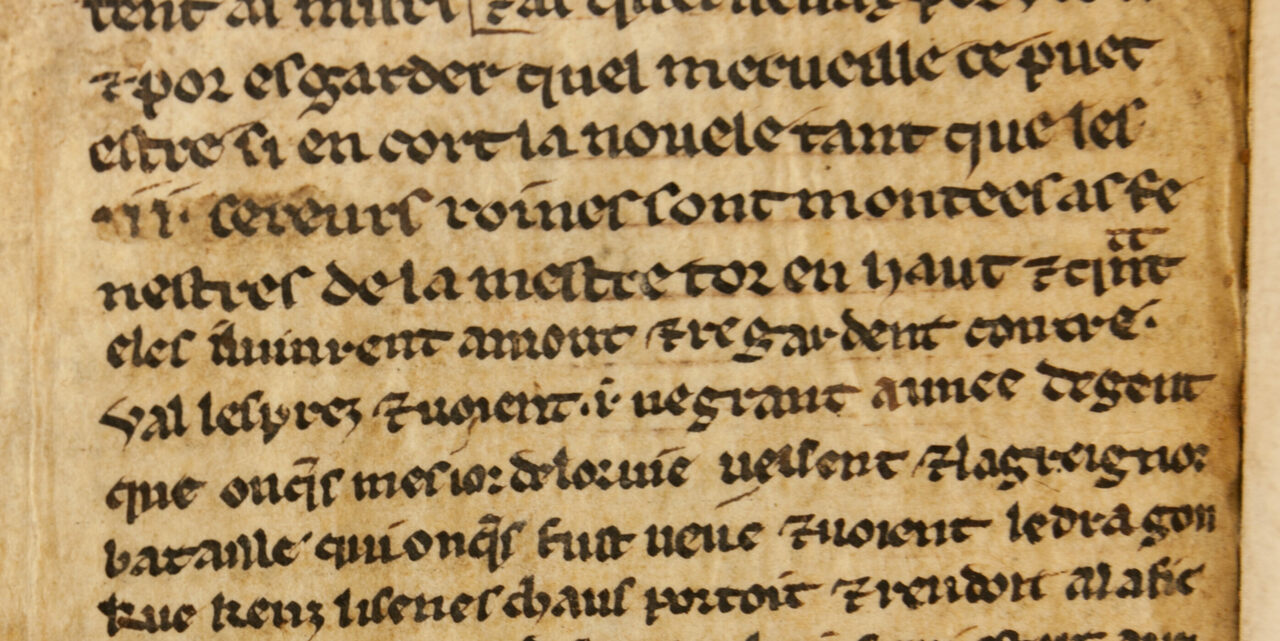
Found glued into the binding of a late 15th century book at the Bristol public library (one of the world’s oldest libraries), the seven fragments in Old French, dated between 1250 and 1275, contain the “most chaste version” of the Merlin and Viviane legend, says Leah Tether, co-author of the new English translation and commentary, The Bristol Merlin: Revealing the Secrets of a Medieval Fragment. “The most significant difference to be found in this particular set of fragments is where Viviane, the enchantress, casts a spell.”
In other versions, her magic inscribes three names on her groin, a spell that keeps Merlin away from the same area. In the re-discovered fragment, which shows evidence of two scribal hands, Viviane engraves the three names on a ring, thereby preventing Merlin from speaking to her. “With medieval texts there was no such thing as copyright,” says Campbell, one of the project’s translators and authors. “So, if you were a scribe copying a manuscript, there was nothing to stop you from just changing things a bit.”
Part of a collection of Arthurian stories known as the Vulgate Cycle, the fragment provides further evidence of the Merlin character’s evolution, and considerable softening, over time. At his first introduction, Merlin was the literal son of Satan, a kind of antichrist sent to earth to wreak havoc. Over the centuries, he became much less sinister, transforming into the wise advisor of the ideal English king, Arthur, a character who did a fair bit of transforming himself as his legend grew and changed.
via Atlas Obscura
Related Content:
Josh Jones is a writer and musician based in Durham, NC. Follow him at @jdmagness
Read More...Behold the Newly-Discovered Sketch by Vincent van Gogh Sketch, “Study for Worn Out” (1882)
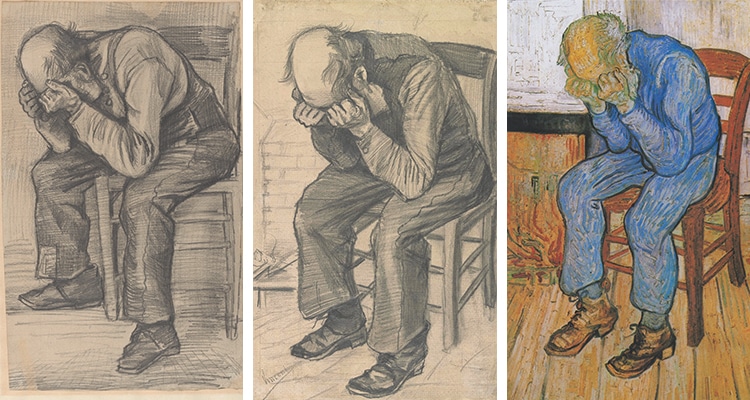
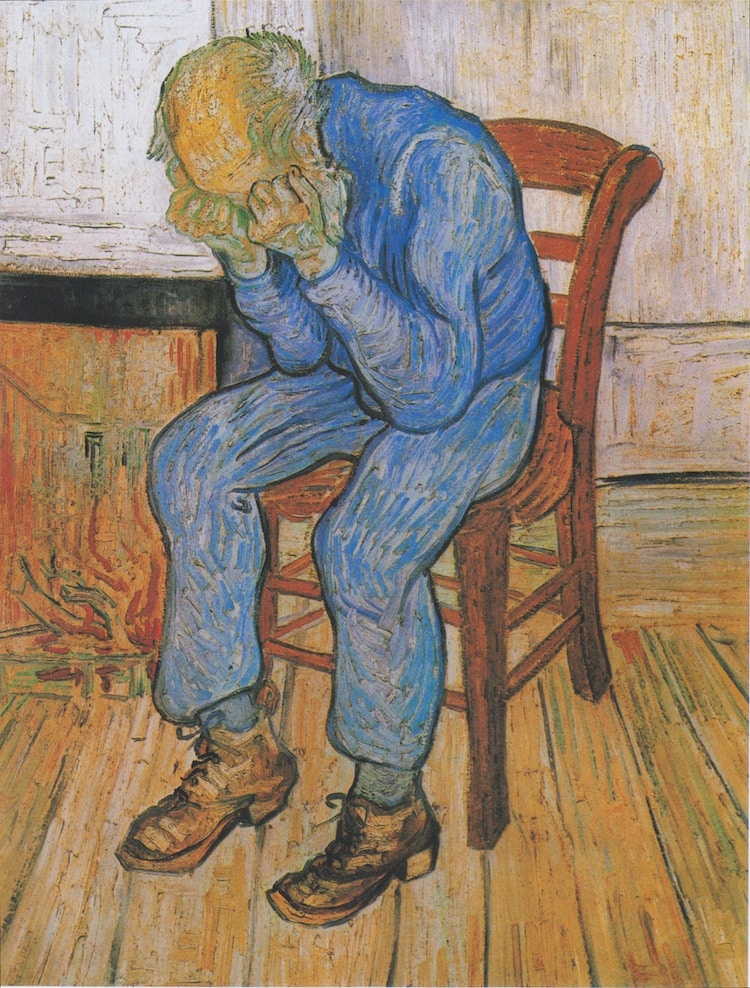
Having been dead for more than 130 years now, Vincent van Gogh seldom comes up with a new piece of work. But when he does, you can be sure it will draw the art world’s attention as few works by living artists could. Such has been the case with the newly discovered Study for Worn Out, an 1882 sketch that recently came into possession of the Van Gogh Museum, according to Margherita Cole at My Modern Met, “when a Dutch family requested that specialists take a look at their unsigned drawing.” The figure in the drawing strongly resembles the one in van Gogh’s 1890 painting At Eternity’s Gate. But it took the experts at the museum to determine that the artist was none other than van Gogh himself.
“Today and yesterday I drew two figures of an old man with his elbows on his knees and his head in his hands,” wrote the 29-year-old van Gogh to his brother in a letter from 1882. “What a fine sight an old working man makes, in his patched bombazine suit with his bald head.” The immediate fruit of these labors was the pencil drawing Worn Out, for which “the artist employed one of his favorite models, an elderly man named Adrianus Jacobus Zuyderland who boasted distinctive sideburns (and who appears in at least 40 of van Gogh’s sketches from this period).” So writes Smithsonian.com’s Nora McGreevy, who adds that van Gogh revisited the work to adapt it as a painting “just two months before his death” in an asylum near Saint-Rémy-de-Provence.
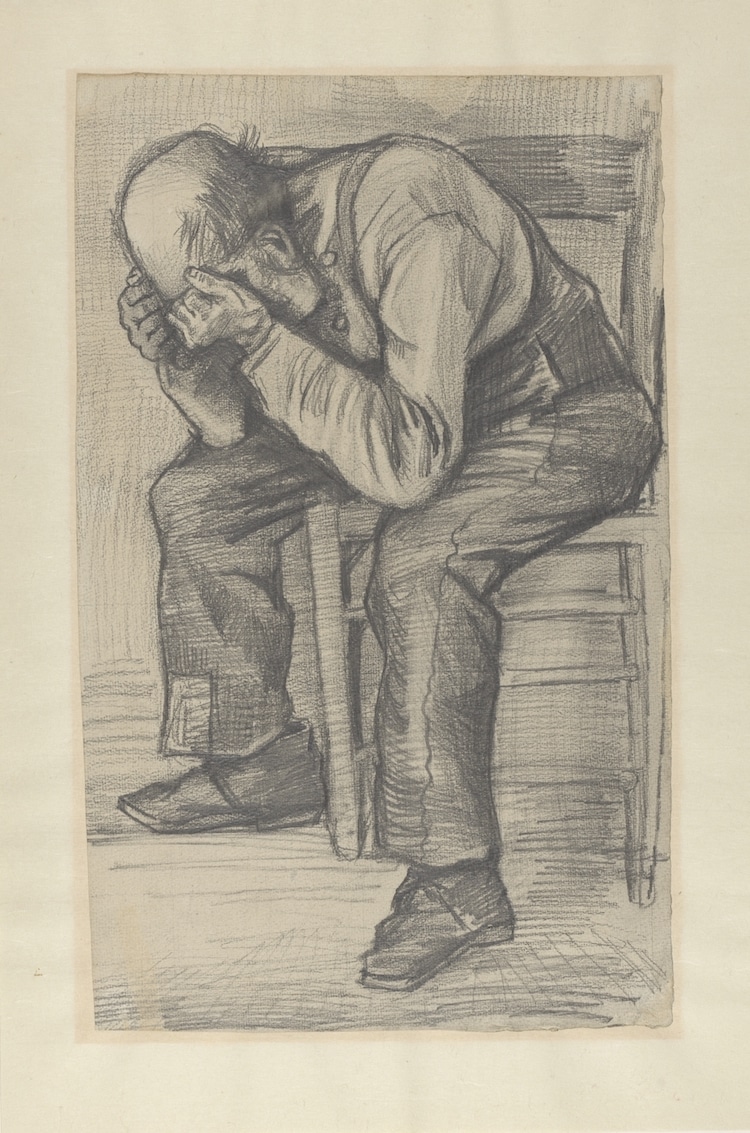
“In drawings like these,” says the Van Gogh Museum, “the artist not only displayed his sympathy for the socially disadvantaged — no way inferior in his eyes to the well-to-do bourgeoisie — he actively called attention to them too.” Another aim with Worn Out, adds McGreevy, was “to seek employment at a British publication, but he either failed to follow through on this idea or had his work rejected.” This would have counted as just another seeming instance of failure, the likes of which characterized the painter’s short life. Little could he, his correspondents, or his models have imagined that his works would one day become some of the most famous in the world — and certainly not that one of his sketches would go on to be enshrined well over a century later, as it has been since last Friday at the museum that bears his name.
via My Modern Met
Related Content:
Download Hundreds of Van Gogh Paintings, Sketches & Letters in High Resolution
Experience the Van Gogh Museum in 4K Resolution: A Video Tour in Seven Parts
Based in Seoul, Colin Marshall writes and broadcasts on cities, language, and culture. His projects include the Substack newsletter Books on Cities, the book The Stateless City: a Walk through 21st-Century Los Angeles and the video series The City in Cinema. Follow him on Twitter at @colinmarshall or on Facebook.
Read More...Hear the Brazilian Metal Band Singing in–and Trying to Save–Their Native Language of Tupi-Guarani
The indigenous languages spoken in Brazil number around 170, a testament to the survival of tribal communities nearly wiped out by colonialism and commerce. Yet 40 of those languages have fewer than 100 speakers, and many more are declining rapidly. For linguists, “it’s a fight against time,” Luisi Destri writes at Pesquisa. Researchers estimate most, if not all, of these languages could disappear within 50 to 100 years, and some believe 30 percent might fade in the next 15 years.
“Knowledge is passed down from generation to generation,” says Luciano Storto, professor of linguistics at the University of São Paulo, “mainly through narratives told by the oldest and most experienced to the community’s youngest members.” What happens when those younger generations are uprooted and leave home. When their elders die without passing on their knowledge? (What happens to language in general as the linguistic gene pool shrinks?) These questions weighed on Zhândio Aquino in 2004 when he founded Brazilian metal band Arandu Arakuaa.
Aquino has a degree in pedagogy and his band has been invited to play in schools and lecture at universities. But they do not use indigenous instrumentation and sing in an indigenous Tupi-Guarani language as a purely academic exercise. Raised in the northern state of Tocantins and descended from a Guarani-speaking tribe, the guitarist and singer says, “I [had] very close contact with indigenous culture because of my grandmother and classmates. When I [began] playing in bands, it just felt natural to put my background on it.”
When he moved to Brasilia in 2004, Aquino searched for like-minded musicians and formed what may be the country’s first folk metal band. While folk metal as a category is hardly new (metal has always incorporated elements of folk music, from its earliest incarnations in Black Sabbath and Led Zeppelin to the bleakest of Scandinavian black metal bands), most folk metal has been European (and Pagan or Viking or Pirate), and some of it has allied, sadly, with the same fascist movements that threaten indigenous existence.
While Arandu Arakuaa — the name translates to “cosmos knowledge” — may be one of the first folk metal bands in Brazil, it isn’t the only one. Along with bands like Aclla, Armahda, and Tamuya Thrash Tribe, the band is part of a movement called the Levante do Metal Nativo, or Native Metal Uprising, a collection of musicians using native instruments, themes, and languages — or all three in the case of Arandu Arakuaa, who incorporate maracas and the guitar-like viola caipira.
How do acoustic indigenous folk and the electric crunch and growl of metal come together? Hear for yourself in the videos here. Aquino knows Arandu Arakuaa doesn’t win everyone over at first. “People are not indifferent to our music,” he says. “They will love it or hate it. Most people think it’s strange at first and then we have to prove that we are good.”
While intelligible lyrics are hardly necessary in metal, the language barrier may turn some listeners away. But subtitled videos help. Arandu Arakuaa might seem to have a different focus than most metal bands, but in songs like “Red People,” we hear the rage and the resistance to war and depredation that bands like Black Sabbath, Iron Maiden, and Metallica — all influences on the Brazilian band –have channeled in their music:
Some of us ran away, we hide in the forest
We still fight
The red people still resisting, while there is land, while there is forest
Everything became different
Our spirits are called demons
Each day less trees, less animals, less histories, less songs…
Related Content:
Native Lands: An Interactive Map Reveals the Indigenous Lands on Which Modern Nations Were Built
Josh Jones is a writer and musician based in Durham, NC. Follow him at @jdmagness
Read More...Hobbes, Locke & Rousseau: An Animated Introduction to Their Political Theories
The phrase “state of nature” doesn’t get much use in philosophy these days, but every political philosopher must grapple with the history of the idea — a foundational conceit of modern Euro-American thought in the work of Thomas Hobbes, John Locke, and Jean-Jacques Rousseau. These three “contractualist” philosophers, often grouped together in syllabi and selected introductory texts, relied on the notion that humans once existed in an anarchic state predating civil society, and that this state might be re-discoverable in indigenous ways of life in the Americas. In the three School of Life videos here, you can learn the basics about each of these philosophers and their political theories.
Unlike the Biblical garden of Eden, the state of nature was hardly perfect, at least for Hobbes and Locke, who saw government as a necessary mediator for competing self-interests. The kinds of governments they theorized were vastly different from each other — one an absolute monarchy and the other a capitalist republic. But in each theorist’s pseudo-prehistory, early humans gave up their independence by making social contracts for protection and mutual interest. These “contracts,” claimed both Hobbes and Locke, were the origin of governments.
Hobbes was the first major thinker to elaborate a version of this story, and his description of life before government is well-known: “solitary, poor, nasty, brutish, and short.” Because of their painful existence, humans would have sought out a powerful ruler to protect them. They were right to do so, Hobbes believed, because only a king, as he argued in Leviathan, could provide the protection people need. It was perhaps no coincidence that Hobbes worked for a king, his former student, Charles II, restored to the throne after the English Civil War that drove Hobbes to his authoritarian views, supposedly.
Despite his defense of divine power, Hobbes stood accused of atheism and blasphemy for, among other things, writing a secular justification for monarchy that was not based on revelation or the divine right of kings. Likewise, the first part of John Locke’s Two Treatises on Government was a forceful refutation of divine right. But Locke’s ideas of toleration were far more threatening to the state, which is why he published anonymously. In his Second Treatise, he laid out his version of the state of nature and the social contract — ideas drawn in part from travelogues written by early colonial adventurers.
Locke’s theory of government is also a theory of private property — the rightful source of political power, he believed — and who should own it. Decades later, Jean-Jacques Rousseau wrote his most salient works, including a book titled The Social Contract, in opposition to the inequality of Hobbesian and Lockean states. Rousseau believed in human perfectibility and claimed that governments imposed a “general will” on individuals, repressing an essentially benevolent state of nature in which resources were shared.
Rousseau’s rejoinder to the myth of vicious savagery gave rise to another: that of the noble savage, an appealing image for the revolutionaries of late-18th century France and later utopian socialists tasked with the difficult project of imagining an alternative to political hierarchy. In social contract theory, the imagined way forward derives from an imagined precolonial past, more “moral fiction” than “historical fact,” as scholar Richard Ashcraft argues. Learn more about the mythical state of nature and the primary theorists of the social contract above.
Related Content:
Leo Strauss: 15 Political Philosophy Courses Online
Social and Political Philosophy: A Free Online Course
Introduction to Political Philosophy: A Free Online Course from Yale University
Josh Jones is a writer and musician based in Durham, NC. Follow him at @jdmagness
Read More...Good with Words: A Series of Writing & Editing Courses from the University of Michigan
We’ve all used words just about as long as we’ve been alive. This obvious truth, alas, has led too many of us into the delusion that we’re good with words: that we’re good speakers and, even more commonly and less justifiably, that we’re good writers. Yet anyone who’s seen or heard much of how words are used in the realms of business and academia — to say nothing of personal correspondence — does understand, on some level, the true rarity of these skills. Now, those of us who recognize the need to shore up our own skills can do so through Good with Words, a specialization in writing and editing now offered by the University of Michigan through online education platform Coursera.
Good with Words comprises individual courses on word choice and word order, structure and organization, drafting, and revising. Here to teach them is Michigan Law School Clinical Assistant Professor of Law Patrick Barry, of whose lecturing style you can get a taste in this Youtube playlist collecting clips of a writing workshop held for Michigan Law students in 2014.
In the clip above, he takes on the common problem of verbal clutter, working from the definition originally laid out by On Writing Well author William Zinsser (whose ten writing tips we previously featured here on Open Culture). In other brief views, Barry touches on everything from the power of description and sentence flow to facts versus truths and zombie nouns.
In one workshop clip, Barry reminds his students that, in order to write good sentences, they must read good sentences. This point bears repeating, and indeed Barry repeats it in his Coursera course, the relevant excerpt of which you can view here. “A young writer must read,” he quotes Colum McCann declaring in the book Letters to a Young Writer. “She must read and read and read. Adventurously. Promiscuously. Unfailingly.” But taking a course as well couldn’t hurt, especially when, as with Good with Words, it can be audited for free. (Coursera also offers a paid option for students who would like to receive a certificate upon completing the specialization.) Barry offers plenty of example sentences, good and less so, but the true writers among us will never stop looking for their own, even after Good with Words’ suggested four-month duration is over.
Related Content:
Free Online Writing & Journalism Courses
10 Writing Tips from Legendary Writing Teacher William Zinsser
Martin Amis Explains His Method for Writing Great Sentences
Jane Austen Used Pins to Edit Her Manuscripts: Before the Word Processor & White-Out
Based in Seoul, Colin Marshall writes and broadcasts on cities, language, and culture. His projects include the Substack newsletter Books on Cities, the book The Stateless City: a Walk through 21st-Century Los Angeles and the video series The City in Cinema. Follow him on Twitter at @colinmarshall or on Facebook.
Read More...Support Us
We're hoping to rely on loyal readers, rather than erratic ads. Please click the Donate button and support Open Culture. You can use Paypal, Venmo, Patreon, even Crypto! We thank you!

About Us

Open Culture scours the web for the best educational media. We find the free courses and audio books you need, the language lessons & educational videos you want, and plenty of enlightenment in between.
Advertise With Us
FREE UPDATES!
GET OUR DAILY EMAIL
Get the best cultural and educational resources on the web curated for you in a daily email. We never spam. Unsubscribe at any time.
FOLLOW ON SOCIAL MEDIA
Open Culture editor Dan Colman scours the web for the best educational media. He finds the free courses and audio books you need, the language lessons & movies you want, and plenty of enlightenment in between.
Advertise With Us

