David Bowie’s Lost Album Toy Will Get an Official Release: Hear the First Track “You’ve Got A Habit Of Leaving”
To the serious Bowie fan, the unreleased self-covers album Toy is not a secret. This collection of reworked pre-“Space Oddity” songs recorded with his touring band from his 2000 Glastonbury appearance was bootlegged a year after it was shelved in 2001. And it has been re-pressed illegally nearly every year since, sometimes as Toy and sometimes as The Lost Album. Some of the fourteen cuts popped up as b‑sides over the years, but the whole album? Maybe, fans thought…one day.
Well, that one day is here, as the first single “You’ve Got a Habit of Leaving” dropped yesterday along with an announcement for a larger 90’s‑encompassing box set release coming soon after.
According to Chris O’Leary’s Pushing Ahead of the Dame webpage—which you really should bookmark if you haven’t yet—the original version of “You’ve Got a Habit of Leaving” was written when he was only 18, and earned him a reprimand from none other than The Who’s Pete Townshend. ”You’re trying to write like me!” said Pete.
You can totally hear the Who influence in the chorus of the version released by Davy Jones and the Lower Third, which apes the fuzz-guitar freak-outs from “My Generation.”
Three and a half decades and multiple Bowie-incarnations later, and the former Davy Jones decided to look back at those hungry early years and redo some of his songs.
The plan in 2000 was to gather his band and record an album old-school, live, in studio, with all the energy and sometimes sloppiness that used to happen in the 1960s, when most bands got at most two days to record their first albums. The first Beatles album was recorded this way, and look where that got them.
But this also afforded Bowie a chance to fix the weaknesses of those original songs in structure and arrangement. Says O’Leary: “The new version is longer, far more elaborately produced, far more professionally played and it still sounds like a Who knock-off, only a knock-off of The Who ca. 1999. That said, Bowie sings it well and it does finally rock out at the end.”
Bowie’s plan was to quickly finish Toy and drop it unannounced as a surprise to his fans. This is commonplace now—Beyonce and Radiohead have done similar secret releases—but EMI freaked out, balked, and their reaction ultimately led Bowie to leave the label.
Other songs reimagined on Toy include “Liza Jane,” Bowie’s debut single from 1964; “Silly Boy Blue” from his first self-titled 1967 LP; and “The London Boys” a 1966 B‑side. The album also includes songs that didn’t make it on the bootlegs: “Karma Man,” the original of which turned up on Bowie at the Beeb from a 1968 session, and “Can’t Help Thinking About Me,” originally released in 1966.
The release will be part of Brilliant Adventure (1992–2001) an 11-CD or 18-LP box set that will focus on Bowie’s third decade. Toy will be released separately as a 3‑CD release called Toy:Box, containing “alternate mixes and outtakes.” Better save your pennies!
Related Content:
When David Bowie Launched His Own Internet Service Provider: The Rise and Fall of BowieNet (1998)
How David Bowie Used William S. Burroughs’ Cut-Up Method to Write His Unforgettable Lyrics
Ted Mills is a freelance writer on the arts who currently hosts the Notes from the Shed podcast and is the producer of KCRW’s Curious Coast. You can also follow him on Twitter at @tedmills, and/or watch his films here.
Read More...See Every Nuclear Explosion in History: 2153 Blasts from 1945–2015
There have been more than 2,000 nuclear explosions in all of history — which, in the case of the technology required to detonate a nuclear explosion, goes back only 76 years. It all began, according to the animated video above, on July 16, 1945, with the nuclear device code-named Trinity. The fruit of the labors of the Manhattan Project, its explosion famously brought to the mind of theoretical physicist Robert J. Oppenhemier a passage from the Bhagavad Gita: “Now I am become Death, destroyer of worlds.” But however revelatory a spectacle Trinity provided, it turned out merely to be the overture of the nuclear age.
Created by Ehsan Rezaie of Orbital Mechanics, the video offers a simple-looking but deceptively information-rich presentation of every nuclear explosion that has so far occurred. It belongs to a perhaps unlikely but nevertheless decisively established genre, the animated nuclear-explosion time-lapse, of which we’ve previously featured examples from Business Insider’s Alex Kuzoian and artist Isao Hasimoto here on Open Culture.
The size of each circle that erupts on the world map indicates the relative power of the explosion in its location (all information also provided in the scrolling text on the lower left); those detonated underground appear in yellow, those detonated underwater in blue, and those detonated in the atmosphere in red.
Trinity created an atmospheric explosion above New Mexico’s Jornada del Muerto desert. (Otherwise Oppenheimer wouldn’t have been able to witness it change the world.) So did Little Boy and Fat Man, the bombs dropped on Japan in World War II. Those remain the only detonations of nuclear weapons in combat, and thus the nuclear explosions everyone knows, but they, too, represent only the beginning. As the Cold War sets in, something of a testing volley emerges between the United States and the Soviet Union, culminating in the colossal red dot of 1961’s Tsar Bomba, still the most powerful nuclear weapon ever tested. With the USSR long gone today, the explosions have only slowed. But in recent years, as the data on which this video is based indicates, nuclear testing has turned into a one-player game — and that player is North Korea.
Related Content:
Every Nuclear Bomb Explosion in History, Animated
53 Years of Nuclear Testing in 14 Minutes: A Time Lapse Film by Japanese Artist Isao Hashimoto
200 Haunting Videos of U.S. Nuclear Tests Now Declassified and Put Online
Watch Chilling Footage of the Hiroshima & Nagasaki Bombings in Restored Color
Haunting Unedited Footage of the Bombing of Nagasaki (1945)
Based in Seoul, Colin Marshall writes and broadcasts on cities, language, and culture. His projects include the Substack newsletter Books on Cities, the book The Stateless City: a Walk through 21st-Century Los Angeles and the video series The City in Cinema. Follow him on Twitter at @colinmarshall or on Facebook.
Read More...Nirvana Refuses to Mime Along to “Smells Like Teen Spirit” on Top of the Pops (1991)
This month marks the 30th anniversary of Nirvana’s Nevermind, first released on September 24, 1991, “the day,” writes Michael Tedder at Stereogum, “that college radio-nurtured types and arty hard rock officially became rebranded as Alternative Rock, and, according to legend, everything changed forever.” You might believe that legend even if you remember the reality. Yes, “Smells Like Teen Spirit” was just as huge as everybody says — and, yes, you likely recall where you were when you first saw the video or heard the song explode with Pixies-inspired quiet-loud ferocity from the radio. But the change was already on the way.
Nirvana emerged in a pop music landscape slowly becoming saturated with alternative music. You might also remember where you were the first time you saw the video for Depeche Mode’s “Enjoy the Silence,” for example, or R.E.M.’s “Losing My Religion,” or Sinéad O’Connor’s “Nothing Compares 2 U” — or when you first experienced the dynamic/melodic assault of the aforementioned Pixies, virtual alt-rock elders by the time they released Trompe Le Monde, their fourth studio album, in the same September week that Nevermind appeared. (You may remember where you were the first time you heard the word “Lollapalooza,” first organized in 1991.)
The fateful week in September also saw the release of 90s-defining albums like Primal Scream’s Screamadelica, Red Hot Chili Peppers’ Blood Sugar Sex Magik, and A Tribe Called Quest’s Low End Theory. In the year that Nevermind supposedly single-handedly invented “grunge,” Soundgarden released Badmotorfinger and Pearl Jam released Ten. It’s fair to say Nirvana were one of just many bands reinventing themselves and the culture. Even the hair metal bands and teen pop idols Nirvana put out of business were already trying to make more serious, “authentic” music before Nevermind turned every executive’s head.
Kurt Cobain was already well aware — and wary — of the dangers of hero worship and blind allegiance to style over substance. It was an attitude he came by naturally given that, in 1991, his friends in Olympia, Washington founded an indie record label called Kill Rock Stars. He’d written an anthem, “In Bloom,” about it before anyone heard the opening power chords of “Smells Like Teen Spirit.” As he pursued, with rigorous ambition, the power of rock stardom, he rejected its trappings and pretensions, as when the band appeared on Top of the Pops and took the piss out of the show, rather than mime along dutifully, as Mark Beaumont writes at NME:
Pretending to strum his guitar like a robot and making no attempt to go anywhere near an actual chord – presumably a statement about being asked to perform like a mechanical puppet – Kurt launches into his vocal in deep, theatrical baritone, an homage to Morrissey that comes across more like Jim Morrison on mogadon. Meanwhile Krist Novoselic flails his bass around his head like he’s wrestling a live wolf and Dave Grohl’s ‘drumming’ is more like an interpretive dance to represent ‘goofy imp’. Oh, and heaven knows what the TOTP censors thought of Kurt changing the opening lyrics to “load up on drugs, kill your friends” before trying to eat the microphone.
In light of the groundswell of alternative bands emerging — or still plugging away — at the time of Nevermind’s release, the myth of Nirvana as the single-handed inventors of 90s alt-rock is more than a little overblown. This is especially so in a decade that saw electronic dance music and hip hop cross over into rock and vice-versa, a trend Nirvana had nothing to do with. They were a thunderingly great band, and Kurt Cobain was a rare and gifted songwriter, but the heart of Nirvana’s popular appeal was extra-musical. The band — meaning, principally, Cobain — most honestly embodied the spirit of the time: painfully ambivalent and at war with its aspirations. “Kurt — I would call him a windmill,” says bassist Krist Novoselic. “He wanted to be a rock star — and he hated it.”
Related Content:
The Recording Secrets of Nirvana’s Nevermind Revealed by Producer Butch Vig
Josh Jones is a writer and musician based in Durham, NC. Follow him at @jdmagness
Read More...America’s First Banned Book: Discover the 1637 Book That Mocked the Puritans
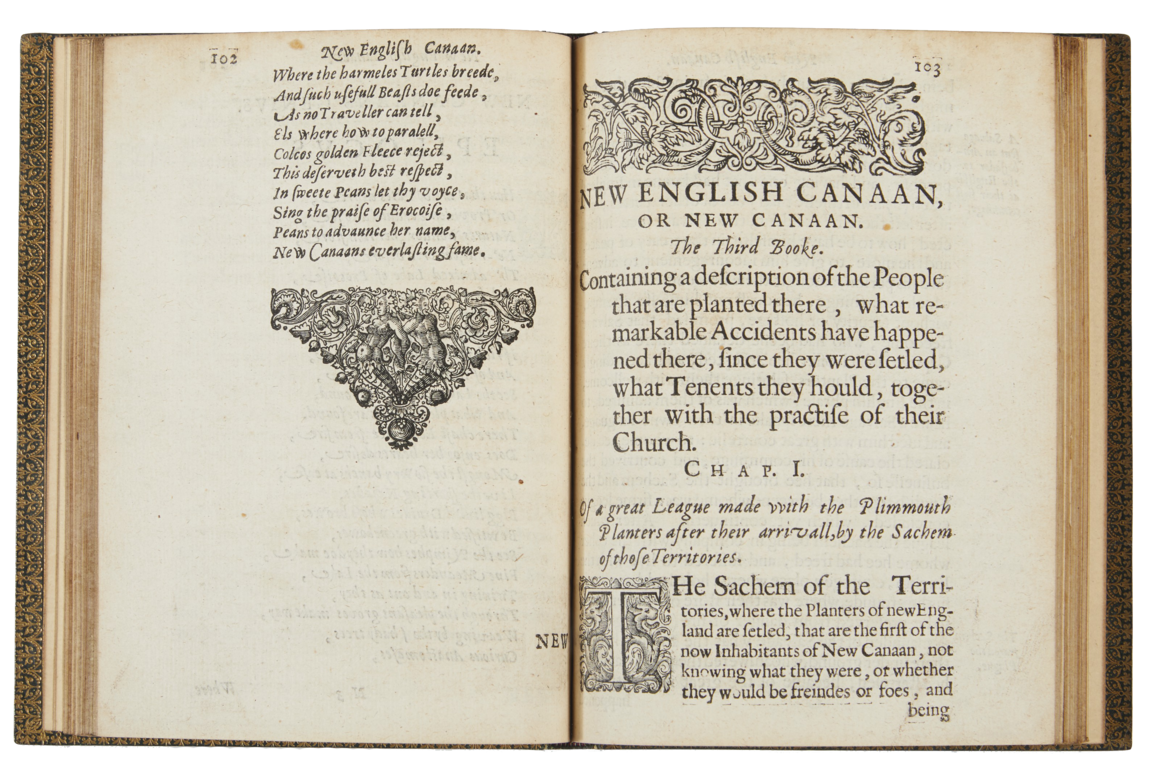
In the contest for the title of the most American historical figure of them all, Thomas Morton’s name can’t be left out. Businesslike, litigious, given to rhapsodies over nature, and not resistant to turning celebrity, he was also — in a characteristically American manner — born elsewhere. Back in Devon, England, he’d made his name as a lawyer, representing members of the lower class in court, but in 1622 he was hired by investor Sir Ferdinando Gorges on a trip to handle his affairs in the North American colonies. This was just two years after the founding of Plymouth Colony, whose success had inspired many an English businessman to contemplate getting in on the New World action himself. In 1624, Gorges sent Morton across the Atlantic again, this time with everything needed to found a colony of his own.
Morton was not a Puritan, nor was he “on board with the strict, insular, and pious society they had hoped to build for themselves,” as Atlas Obscura’s Matthew Taub puts it. Though his own colony of Merrymount became Plymouth’s rival in the fur trade, for the Puritans “the problem wasn’t only that Morton was taking goods and commerce away from Plymouth, but that he was giving that business to the Native Americans, including trading guns to the Algonquins. With Plymouth’s monopoly dissolved and its perceived enemies armed, Morton had perhaps done more than anyone else to undermine the Puritan project in Massachusetts.” And that was before Morton erected Merrymount’s 80-foot, antler-topped maypole, around which he invited residents to “drink, dance, and frolic.”
Obviously, Morton’s reign as a “lord of misrule” (as Plymouth’s governor William Bradford deemed him) could not be borne for long. “During the 1628 festivities, a Puritan militia led by Myles Standish invaded Merrymount and chopped down the maypole,” writes Taub, noting that the incident inspired Nathaniel Hawthorne’s 1832 short story “The May-Pole of Merry Mount.” Morton also turned out to be an able chronicler of the period himself, at least after the subsequent tribulations that saw him sentenced to death by starvation, helped to survive by the Native American tribes with whom he had maintained good relations, safely returned to England, and frustrated in his attempts to return to the colonies. Around 1630, he did what any true American, official or aspiring, would do: put together a lawsuit.
Morton demanded, writes World History Encyclopedia’s Joshua Mark, “that the government of the Massachusetts Bay Colony demonstrate by what authority they exercised their power,” arguing for the revocation of its charter “because the Puritans of Massachusetts Bay Colony had not only misrepresented themselves in obtaining the charter but had no right to colonize the region in the first place as it was legally in Gorges’ patent.” As the long (and in any case futile) legal proceedings dragged on, Morton got the idea of turning his extensive briefs for the trial into “a three-volume work of history, natural history, satire, and poetry” called New English Canaan, a Biblical allusion underscoring Morton’s critical view of the Puritans as “abusing the natives and the land for profit and then justifying their actions in the name of their god and the scriptures.”
Linda Cantoni at Hot off the Press writes that “the first two books of New English Canaan are mostly non-controversial, containing Morton’s observations on the native Americans, whom he respected greatly, and on the rich natural resources in New England. It was in the third book that Morton rolled up his sleeves and got down to his real purpose of skewering the New England Puritans, who, he said, ‘make a great shewe of Religion, but no humanity.’ ” As a result, writes Mental Floss’ Jake Rossen, “his book was perceived as an all-out attack on Puritan morality, and they didn’t take kindly to it. So they banned it,” making New English Canaan what Christie’s called “America’s first banned book” when they auctioned a copy off for $60,000. But you can read it for free at Project Gutenberg, bearing in mind the most American lesson of all from the life of Thomas Morton: when all else fails, publish a tell-all memoir.
via Atlas Obscura
Related Content:
The British Library Digitizes Its Collection of Obscene Books (1658–1940)
Read 14 Great Banned & Censored Novels Free Online: For Banned Books Week 2014
When Christmas Was Legally Banned for 22 Years by the Puritans in Colonial Massachusetts
Based in Seoul, Colin Marshall writes and broadcasts on cities, language, and culture. His projects include the Substack newsletter Books on Cities, the book The Stateless City: a Walk through 21st-Century Los Angeles and the video series The City in Cinema. Follow him on Twitter at @colinmarshall or on Facebook.
Read More...Why Scientists Can’t Recreate the Sound of Stradivarius Violins: The Mystery of Their Inimitable Sound
In his influential 1936 essay, “The Work of Art in the Age of Mechanical Reproduction,” critic Walter Benjamin used the word “aura” to describe an artwork’s “presence in time and space” — an explanation of the thrill, or chill, we get from standing before a Jackson Pollock, say, or a Michelangelo, rather than a photograph of the same. Writing in the age of radio, photography, and newspapers, Benjamin believed that aura could not be transmitted or copied: “Even the most perfect reproduction of a work of art is lacking in one element” — that rare thing that makes art worth preserving and reproducing in the first place.
Let’s grant, for the sake of argument, that musical instruments have aura — that the very sounds they make are its manifestation, and that, no matter how sophisticated our technology, we may never reproduce those sounds perfectly. As Hank Green explains in the SciShow video above: “For centuries, musicians, instrument makers, engineers, and scientists have been trying to understand and reproduce the ‘Stradivarius’ sound. They’ve investigated everything from the materials their maker used to how he crafted the violins. But the mystique is still there.” Can science solve the mystery?
At heart, the question seems to be whether the aural qualities of a Stradivari instrument can be plucked from their time and place of origin and made fungible, so to speak, across the centuries. Antonio Stradivari (his name is often Latinized to “Stradivarius”) began making violins in the 1600s and continued, with his sons Francesco and Omobono, until his death in 1737, producing around 1000 instruments, most of which were violins. About 650 of those instruments survive today, and approximately 500 of those are violins, ranging in value from tens of millions to priceless.
Green surveys the techniques, materials, physics, and chemical composition of Stradivari violins “to understand why Stradivarius violins have been so hard to recreate.” Their sound has been described as “silvery,” says Green, a word that sounds pretty but has little technical meaning. Rather than rely on adjectives, researchers from diverse fields have tried to work from the objects themselves — analyzing and attempting to recreate the violins’ shape, construction, materials, etc. They’ve learned that time and place matter more than they supposed.
The wood of a Stradivari violin “really is different,” Green says, “but because Stradivari never wrote down his process, researchers can’t quite tell why.” That wood itself grew in a process over which Stradivari had no control. The alpine spruce he used came from trees harvested “at the edge of Europe’s Little Ice Age, a 70-year period of unseasonably cold weather … that slowed tree growth and made for even more consistent wood.” We begin to see the difficulties. One researcher, Joseph Nagyvary, a professor emeritus of biochemistry at Texas A&M University, recently made another discovery. As Texas A&M Today notes:
[Stradivari and fellow maker Guarneri] soaked their instruments in chemicals such as borax and brine to protect them from a worm infestation that was sweeping through Italy in the 1700s. By pure accident the chemicals used to protect the wood had the unintended result of producing the unique sounds that have been almost impossible to duplicate in the past 400 years.
Perhaps we cannot duplicate the sound because none of us is Antonio Stradivari, working with his sons in the early 18th century in Cremona, Italy, building violins with a unique crop of alpine spruce while fighting unseasonably cold weather and worms.
Related Content:
Why Stradivarius Violins Are Worth Millions
Josh Jones is a writer and musician based in Durham, NC. Follow him at @jdmagness
Read More...Stand-Up Comedy in the Internet Age — Pretty Much Pop: A Culture Podcast #106

Your host Mark Linsenmayer discusses how Internet culture has changed stand-up with three comedians: past Pretty Much Pop guests Rodney Ramsey (who co-owns the Unknown Comedy Club) and Daniel Lobell (host of Modern Day Philosophers and author of the Fair Enough comic), plus Dena Jackson (also a speaker on yoga and mindfulness and host of The Ego Podcast).
How does the existence of YouTube, social media, and virtual spaces changed the way comedians construct a set, relate to their fans, and make a living? We talk about story-telling vs. one-liners, repping your hometown, comedy cliques, surviving negativity, and more.
Some articles that go into these issues further include:
- “Is Social Media Ruining Comedy?” by Ian Crouch
- “Comedy from a Distance” by Misha Rajani
- “Laugh Out Loud, Virtually” by Shreya Veronica
- “How 5 Chicago Standup Comics Learned to Stop Worrying and Love the Zoom” by Doug George
Follow @TheUnknownVenue, @Denatalks, and @DanielLobell.
This episode includes bonus discussion you can access by supporting the podcast at patreon.com/prettymuchpop or by choosing a paid subscription through Apple Podcasts. This podcast is part of the Partially Examined Life podcast network.
Pretty Much Pop: A Culture Podcast is the first podcast curated by Open Culture. Browse all Pretty Much Pop posts.
Read More...Listen to Freddie Mercury & David Bowie on the Isolated Vocal Track for the Queen Hit ‘Under Pressure,’ 1981
In the summer of 1981, the British band Queen was recording tracks for their tenth studio album, Hot Space, at Mountain Studios in Montreux, Switzerland. As it happened, David Bowie had scheduled time at the same studio to record the title song for the movie Cat People. Before long, Bowie stopped by the Queen sessions and joined in. The original idea was that he would add backup vocals on the song “Cool Cat.” “David came in one night and we were playing other people’s songs for fun, just jamming,” says Queen drummer Roger Taylor in Mark Blake’s book Is This the Real Life?: The Untold Story of Freddie Mercury and Queen. “In the end, David said, ‘This is stupid, why don’t we just write one?’ ”
And so began a marathon session of nearly 24-hours–fueled, according to Blake, by wine and cocaine. Built around John Deacon’s distinctive bass line, the song was mostly written by Mercury and Bowie. Blake describes the scene, beginning with the recollections of Queen’s guitarist:
‘We felt our way through a backing track all together as an ensemble,’ recalled Brian May. ‘When the backing track was done, David said, “Okay, let’s each of us go in the vocal booth and sing how we think the melody should go–just off the top of our heads–and we’ll compile a vocal out of that.” And that’s what we did.’ Some of these improvisations, including Mercury’s memorable introductory scatting vocal, would endure on the finished track. Bowie also insisted that he and Mercury shouldn’t hear what the other had sung, swapping verses blind, which helped give the song its cut-and-paste feel.
“It was very hard,” said May in 2008, “because you already had four precocious boys and David, who was precocious enough for all of us. Passions ran very high. I found it very hard because I got so little of my own way. But David had a real vision and he took over the song lyrically.” The song was originally titled “People on Streets,” but Bowie wanted it changed to “Under Pressure.” When the time came to mix the song at Power Station studios in New York, Bowie insisted on being there. “It didn’t go too well,” Blake quotes Queen’s engineer Reinhold Mack as saying. “We spent all day and Bowie was like, ‘Do this, do that.’ In the end, I called Freddie and said, ‘I need help here,’ so Fred came in as a mediator.” Mercury and Bowie argued fiercely over the final mix.
At one point Bowie threatened to block the release of the song, but it was issued to the public on October 26, 1981 and eventually rose to number one on the British charts. It was later named the number 31 song on VH1’s list of the 100 greatest songs of the 1980s. “ ‘Under Pressure’ is a significant song for us,” May said in 2008, “and that is because of David and its lyrical content. I would have found that hard to admit in the old days, but I can admit it now.… But one day, I would love to sit down quietly on my own and re-mix it.”
After listening to the isolated vocal track above, you can hear the officially released 1981 mix below:
Note: An earlier version of this classic post appeared on our site in 2013.
Related Content:
Watch David Bowie & Annie Lennox in Rehearsal, Singing “Under Pressure,” with Queen (1992)
Watch Queen’s “Bohemian Rhapsody” Acted Out Literally as a Short Crime Film
Read More...Quentin Tarantino Reviews Movies: From Dunkirk and King of New York, to Soul Brothers of Kung Fu & More
Some of the most influential directors of the French New Wave, like Jean-Luc Godard, François Truffaut, and Éric Rohmer, first stepped into the world of film as critics. They found their voices by publishing in the Paris cinephile institution of Cahiers du cinéma; a few decades later, Quentin Tarantino found his own by working at the Manhattan Beach cinephile institution of Video Archives. Stories of all the myriad ways in which he would express his enthusiasm for and expertise on cinema there have passed into legend. But just like the critics Godard, Truffaut, and Rohmer, the video-store clerk Tarantino ultimately seems to have signed on to the old proposition that the best response to a work of art is another work of art.
Tarantino’s endorsements of and introductions to the work of other directors (for example, the one he recorded for Wong Kar-wai’s Chungking Express) have given us a sense of his cinematic taste. So, in an even more telling manner, do the elements he steals — by his own admission — from other movies.
A look at the dance scene in Pulp Fiction, for example, reveals a filmmaker well acquainted with the French New Wave, and even more so with the work of Italia master Federico Fellini that came out in the same era. And even if you think you could go head-to-head with Tarantino on midcentury European auteurs, could you match his understanding of A Man Called Tiger, Fatal Needles vs. Fatal Fists, or Soul Brothers of Kung Fu?
Those are just three of the films Tarantino has reviewed at the web site of the New Beverly Cinema, the theater he owns in Los Angeles. Published in a low-profile manner, these short essays on the kind of 1970s Hong Kong martial-arts pictures that rightfully belong on downtown triple-bills (and that Tarantino surely first saw on downtown triple-bills) exude the kind of fan-critic energy that brings to mind bygone days of the internet.
Not that Tarantino eschews more recent movies and movie media. In late 2019 and early 2010, he appeared three times on The Ringer’s The Rewatchables podcast to share his thoughts on three pictures worth seeing again: Christopher Nolan’s Dunkirk from 2017, Tony Scott’s Unstoppable from 2010, and Abel Ferrara’s King of New York from 1990. Listen and you may just feel like a Video Archive customer in the 1980s, getting recommendations from an oddly persuasive clerk.
Related Content:
Quentin Tarantino Picks the 12 Best Films of All Time; Watch Two of His Favorites Free Online
Quentin Tarantino’s Handwritten List of the 11 “Greatest Movies”
An Analysis of Quentin Tarantino’s Films Narrated (Mostly) by Quentin Tarantino
Based in Seoul, Colin Marshall writes and broadcasts on cities, language, and culture. His projects include the Substack newsletter Books on Cities, the book The Stateless City: a Walk through 21st-Century Los Angeles and the video series The City in Cinema. Follow him on Twitter at @colinmarshall or on Facebook.
Read More...Building Without Nails: The Genius of Japanese Carpentry
Traditional Japanese carpentry impresses us today, not so much with the tools its practitioners use as with the ones they don’t: nails, for example. Or glue, for that matter. Here on Open Culture we’ve previously featured introductions to Japanese wood joinery, the art of cutting wood in a manner such that pieces slide together and solidly interlock without the aid of any other materials. Though it may seem like magic, it’s really just physics — or rather, physics, and engineering, and the branches of biology relevant to growing the right wood. For the traditional Japanese carpenter himself, it all comes down to extensive training and practice.
Traditional Japanese carpentry need not even be done in Japan. Take Miya Shoji, the New York City shop profiled in the China Uncensored video above. Under current owner Hisao Hanafusa, who came to the United States in 1963, it makes and sells furniture crafted using canonical techniques, but in service of particular pieces quite unlike any found in Japan.
Part of the difference comes from the wood itself: as it would be sourced only locally in Japan, so it’s sourced only locally in the United States. This video shows the felling of a 300-year-old tree, killed by Dutch elm disease, and its transformation into slabs destined to become Miya Shoji tables.
Thereafter, the drying process could take twenty years. “By the time the wood hits the cutting bench, it is already nearing the end of its journey.” But the carpenter still has to craft the joints needed to hold the finished piece together “like a three-dimensional puzzle” — and with a set of hand tools, at that. The very same techniques have been used to construct temples in Japan that can stand for a millennium, and indeed go back even deeper into history than that, having evolved from carpentry performed in 6th- and 7th-century China. Here in the 21st century, connoisseurs of every nationality have come to appreciate the wabi-sabi aesthetic and transcendent simplicity of furniture so constructed — a simplicity that surely doesn’t come cheap.
Related Content:
See How Traditional Japanese Carpenters Can Build a Whole Building Using No Nails or Screws
Based in Seoul, Colin Marshall writes and broadcasts on cities, language, and culture. His projects include the Substack newsletter Books on Cities, the book The Stateless City: a Walk through 21st-Century Los Angeles and the video series The City in Cinema. Follow him on Twitter at @colinmarshall or on Facebook.
Read More...Beethoven’s Unfinished Tenth Symphony Gets Completed by Artificial Intelligence: Hear How It Sounds
Few symphonies are as well-known as Beethoven’s Ninth, an assertion supported by the fact that it’s no doubt playing in your head even as you read this. Few symphonies are less well-known — at least by Beethoven’s standards — than his Tenth, primarily because he never actually got the thing finished. He did make a start on it, however, and at his death in 1827 left behind notes and drafts composed alongside the Ninth, which had also been commissioned by the Royal Philharmonic Society. Such is Beethoven’s stature that his enthusiasts have been speculating ever since on what his incomplete symphony would sound like if completed, employing any techniques to do so that their time put at hand.
“In 1988, musicologist Barry Cooper ventured to complete the first and second movements,” writes Rutgers University Art & AI Lab director Ahmed Elgammal at The Conversation. “He wove together 250 bars of music from the sketches to create what was, in his view, a production of the first movement that was faithful to Beethoven’s vision. Yet the sparseness of Beethoven’s sketches made it impossible for symphony experts to go beyond that first movement.”
When Beethoven’s milestone 250th year approached, however, the age of artificial intelligence was well underway. To Matthias Röder, the director of Salzburg’s Karajan Institute, uniting this towering composer and this promising technology had become an irresistible proposition.
Elgammal and Röder were just two of the team that came together to take on the formidable task of engineering a form of machine learning capable of helping to complete Beethoven’s Tenth. The others included composer Walter Werzowa (“famous for writing Intel’s signature bong jingle”), computational music expert Mark Gotham, and musicologist-pianist Robert Levin, who “had previously finished a number of incomplete 18th-century works by Mozart and Johann Sebastian Bach.” Deutsche Telekom provided funding for the project, and also produced the short documentary video on its result above. However conceptually intriguing, this A.I.-driven musical endeavor could finally be put to the test in only one way: hearing it performed by a 100-percent human orchestra. As Werzowa puts it, looking skyward, “We hope when he hears it now that he smiles.”
Related Content:
Stream the Complete Works of Bach & Beethoven: 250 Free Hours of Music
The Story of How Beethoven Helped Make It So That CDs Could Play 74 Minutes of Music
Based in Seoul, Colin Marshall writes and broadcasts on cities, language, and culture. His projects include the Substack newsletter Books on Cities, the book The Stateless City: a Walk through 21st-Century Los Angeles and the video series The City in Cinema. Follow him on Twitter at @colinmarshall or on Facebook.
Read More...Support Us
We're hoping to rely on loyal readers, rather than erratic ads. Please click the Donate button and support Open Culture. You can use Paypal, Venmo, Patreon, even Crypto! We thank you!

About Us

Open Culture scours the web for the best educational media. We find the free courses and audio books you need, the language lessons & educational videos you want, and plenty of enlightenment in between.
Advertise With Us
FREE UPDATES!
GET OUR DAILY EMAIL
Get the best cultural and educational resources on the web curated for you in a daily email. We never spam. Unsubscribe at any time.
FOLLOW ON SOCIAL MEDIA
Open Culture editor Dan Colman scours the web for the best educational media. He finds the free courses and audio books you need, the language lessons & movies you want, and plenty of enlightenment in between.
Advertise With Us

