How to Make Comics: A Four-Part Series from the Museum of Modern Art
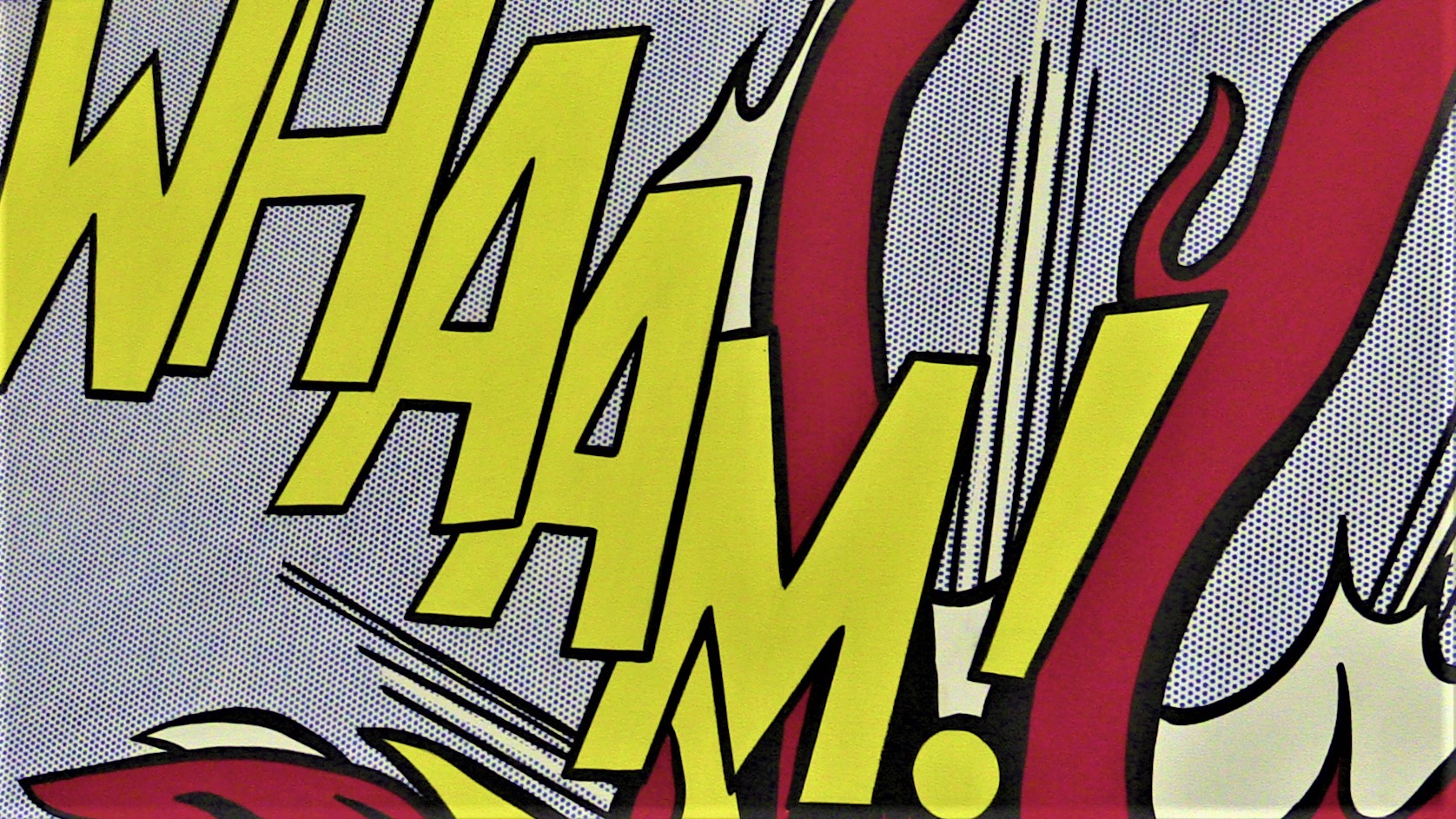
A painting? “Moving. Spiritually enriching. Sublime. ‘High’ art.” The comic strip? “Vapid. Juvenile. Commercial hack work. ‘Low’ art.” A painting of a comic strip panel? “Sophisticated irony. Philosophically challenging. ‘High’ art.” So says Calvin of Bill Watterson’s Calvin and Hobbes, whose ten-year run constitutes one of the greatest artistic achievements in the history of the newspaper comic strip. The larger medium of comics goes well beyond the funny pages, as any number of trend pieces have told us, but as an art form it remains less than perfectly understood. Perhaps, as elsewhere, one must learn by doing: hence “How to Make Comics,” a “four-part journey through the art of comics” from the Museum of Modern Art.
Created by comics scholar and writer Chris Gavaler, this educational series begins with the broadest possible question: “What Are Comics?” That section offers two answers, the first being that comics are “cartoons in the funnies sections of newspapers and the pages of comic books” telling stories “about superheroes or talking animals” — or they’re longer-format “graphic novels,” which “can be more serious and include personal memoirs.”
The second, broader answer conceives of comics as nothing more specific than “juxtaposed images. Any work of art that divides into two or more side-by-side parts is formally a comic. So if an artist creates two images and places them next to each other, they’re working in the comics form.”
That second definition of comics includes, say, Andy Warhol’s Jacqueline Kennedy III — a work of art that conveniently happens to be owned by MoMA. The museum’s visual resources figure heavily into the whole “How to Make Comics,” in which Gavaler explains not just the process of creating comics but the relationship between comics and other (often longer institutionally approved) forms of art. And to whatever degree they juxtapose images, the works of art in MoMA’s online collection — rich as so many of them are with action, character, narrative, humor, and even words — offer inspiration to comic artists budding and experienced alike. The better part of two centuries into its development, this thoroughly modern medium has the power to incorporate ideas from any other art form; the high-and-low distinctions can take care of themselves. Enter “How to Make Comics” here.
Related Content:
Watch Cartoonist Lynda Barry’s Two-Hour Drawing Workshop
Download Over 22,000 Golden & Silver Age Comic Books from the Comic Book Plus Archive
Download 15,000+ Free Golden Age Comics from the Digital Comic Museum
MoMA’s Online Courses Let You Study Modern & Contemporary Art and Earn a Certificate
Based in Seoul, Colin Marshall writes and broadcasts on cities, language, and culture. His projects include the Substack newsletter Books on Cities, the book The Stateless City: a Walk through 21st-Century Los Angeles and the video series The City in Cinema. Follow him on Twitter at @colinmarshall or on Facebook.
Read More...A Guitarist Rocks Out on Guitars Made from Shovels, Cigar Boxes, Oil Cans & Whisky Barrels
When Keith Richards felt he’d gone as far as he could go with the six-string guitar, he took one string off and played five, a trick he learned from Ry Cooder. These days, the trend is to go in the opposite direction, up to seven or eight strings for highly technical progressive metal compositions and downtuned “djent.” Traditionalists may balk at this. A five-string, after all, is a modification easily accomplished with a pair of wire-cutters. But oddly shaped eight-string guitars seem like weirdly rococo extravagances next to your average Stratocaster, Tele, or Les Paul.
Ideas we have about what a guitar should be, however, come mostly from the marketing and public relations machinery around big brand guitars and big name guitarists. The truth is, there is no Platonic ideal of the guitar, since no one is quite sure where the guitar came from.
It’s most easily recognized ancestors are the oud and the lute, which themselves have ancient heritages that stretch into prehistory. The six-string arrived rather late on the scene. In the renaissance, guitars had eight strings, tuned in four “courses,” or pairs, like the modern 12-string, and baroque guitars had 10 strings in five courses.
Closer in time to us, “the jazz guitarist George Van Eps had a seven-string guitar built for him by Epiphone Guitars in the late 1930s,” notes one brief history, “and a signature Gretsch seven-string in the late 60s and early 70s…. Several others began using seven-string guitars after Van Eps.” Russian folk guitars had seven strings before the arrival of six-string Spanish classical instruments (two hundred years before the arrival of Korn).
Meanwhile, in the hills, hollars, and deltas of the U.S. south, folk and blues musicians built guitars out of whatever was at hand, and fit as many, or as few, strings as needed. From these instruments came the powerfully simple, timeless licks Keef spent his career emulating. Guitarist Justin Johnson has cultivated an online presence not only with his slick electric slide playing, but also with his tributes to odd, old-time, homemade guitars. At the top, he plays a three-string shovel guitar, doing Keith two better.
Further up, some “Porch Swing Slidin’” with a six-string cigar box-style guitar engraved with a portrait of Robert Johnson. Above, hear a stirring rendition of George Harrison’s “While My Guitar Gently Weeps” on an oil can and a slide solo on a whiskey barrel guitar. Finally, Johnson rocks out Ray Charles on a three string cigar box guitar, made mostly out of ordinary items you might find around the shed.
You might not be able to pluck out Renaissance airs or complicated, sweep-picked arpeggios on some of these instruments, but where would even the most complex progressive rock and metal be without the raw power of the blues driving the evolution of the guitar? Finally, below, see Johnson play a handmade one-string Diddley Bow (and see the making of the instrument as well). Originally a West African instrument, it may have been the very first guitar.
Related Content:
Meet Brushy One String, the One String Guitar Player Who Will Blow Your Mind
The History of the Guitar: See the Evolution of the Guitar in 7 Instruments
Josh Jones is a writer and musician based in Durham, NC. Follow him at @jdmagness
Read More...Gustav Klimt’s Iconic Painting The Kiss: An Introduction to Austrian Painter’s Golden, Erotic Masterpiece (1908)
Not long ago I stayed in a hotel by the train station of a small Korean city. In the room hung a reproduction of Gustav Klimt’s Die Umarmung, or The Embrace. This at first struck me as just another piece of culturally incongruous décor — a phenomenon hardly unknown in this country — but then I realized that its sensibility wasn’t entirely inappropriate. For the room was in what belonged, broadly speaking, to the category of South Korea’s “love hotels,” and Klimt, as Great Art Explained creator James Payne puts it, “placed sexuality at the forefront of his work.” The artist had that in common with Sigmund Freud, his fellow denizen of fin de siècle Vienna.
With paintings like Die Umarmung, Klimt pushed the boundaries of what Freud called “the misunderstood and much-maligned erotic.” Payne cites those very words in his new video on Klimt’s much better-known work Der Kuss, or The Kiss.
Completed in 1908, the painting shows both the artist’s penchant for “allegory and symbolism” carried over from his younger days, as well as his mature ability to transform allegory and symbolism “into a new language that was more overtly sexual and more disturbing.” For these and other reasons — its nearly life-size dimensions, its liberal use of actual gold — The Kiss has for more than a century been an un-ignorable work of art, even “an icon for the post-religious age.”
As in his other fifteen-minute videos, Payne manages to discuss both technique and context. Here the “deliberate contrast between the realistically rendered flesh and the two-dimensional abstract ornamentation creates an effect almost like photo montage.” The figures’ clothes offer “a visual metaphor for the emotional and physical expression of erotic love,” and their close framing echoes Japanese woodblock prints, from which Payne notes that Klimt (like Van Gogh) drew great inspiration. He also traces the aesthetic roots of The Kiss through Edvard’s Munch’s eponymous painting, and Auguste Rodin’s even earlier sculpture. “Once considered pornographic and deviant,” Klimt’s was later “put on display in one of the imperial palaces” — and even today, on the other side of the world and in a much humbler context, it retains its romantic power.
Related Content:
Explore 7,600 Works of Art by Edvard Munch: They’re Now Digitized and Free Online
The Story Behind Rodin’s The Kiss
Based in Seoul, Colin Marshall writes and broadcasts on cities, language, and culture. His projects include the Substack newsletter Books on Cities, the book The Stateless City: a Walk through 21st-Century Los Angeles and the video series The City in Cinema. Follow him on Twitter at @colinmarshall or on Facebook.
Read More...Albert Camus on the Responsibility of the Artist: To “Create Dangerously” (1957)

Literary statements about the nature and purpose of art constitute a genre unto themselves, the ars poetica, an antique form going back at least as far as Roman poet Horace. The 19th century poles of the debate are sometimes represented by the dueling notions of Percy Shelley — who claimed that poets are the “unacknowledged legislators of the world” — and Oscar Wilde, who famously proclaimed, “all art is quite useless.” These two statements conveniently describe a conflict between art that involves itself in the struggles of the world, and art that is involved only with itself.
In the mid-twentieth century, Albert Camus put the question somewhat differently in a 1957 speech entitled “Create Dangerously.”
Of what could art speak, indeed? If it adapts itself to what the majority of our society wants, art will be a meaningless recreation. If it blindly rejects that society, if the artist makes up his mind to take refuge in his dream, art will express nothing but a negation.
And yet, grandiose ideas about the artist’s role seemed absurd in the mid-twentieth century, when the question becomes whether artists should exist at all. “Such amazing optimism seems dead today,” writes Camus. “In most cases the artist is ashamed of himself and his privileges, if he has any. He must first of all answer the question he has put to himself: is art a deceptive luxury?”
Women artists have also had to consider the question, of course. Brain Pickings’ Maria Popova quotes Audre Lorde’s call for artists to “uphold their responsibility toward ‘the transformation of silence into language and action.” Ursula Le Guin believed that art expanded the imagination, and thus the possibilities for human freedom. Both of these writers were politically engaged artists, and so it’s little wonder that we find similar sentiments in Camus’ speech from decades earlier.
To make art, Camus writes, is to make choices. Artists are already involved, as Shelley declared, in shaping the world around them, whether they acknowledge it or not:
Reality cannot be reproduced without exercising a selection… The only thing needed, then, is to find a principle of choice that will give shape to the world. And such a principle is found, not in the reality we know, but in the reality that will be — in short, the future. In order to reproduce properly what is, one must depict also what will be.
The most eloquent, enduring expressions of future thinking are that which we call art. Even art that seeks to depict the fleetingness of nature freezes itself for posterity.
Art, in a sense, is a revolt against everything fleeting and unfinished in the world. Consequently, its only aim is to give another form to a reality that it is nevertheless forced to preserve as the source of its emotion. In this regard, we are all realistic and no one is. Art is neither complete rejection nor complete acceptance of what is. It is simultaneously rejection and acceptance, and this is why it must be a perpetually renewed wrenching apart.
To understand art as purposelessly divorced from the world is to misunderstand it, Camus argues. This is the misunderstanding of “a fashionable society in which all troubles [are] money troubles and all worries [are] sentimental worries” — the self-satisfied bourgeois society “about which Oscar Wilde, thinking of himself before he knew prison, said that the greatest of all vices was superficiality.”
Art for art’s sake is the doctrine of a “society of merchants… the artificial art of a factitious and self-absorbed society,” Camus declared. “The logical result of such a theory is the art of little cliques.” Or, to a degree Camus could not have imagined, we have the entertainment industrial complex of art for commerce’s sake, which in the 21st century can make it nearly impossible for art to thrive. (As actor Stellan Skarsgård recently said in public comments, the problem with the film industry is “that we have for decades believed that the market should rule everything.”)
Therefore, the question before Camus, and no less before artists today, is how to “create dangerously” in a society “that forgives nothing.” The question of whether or not art serves a purpose is a false one, he suggests, since “every publication is a deliberate act,” and therefore purposeful. The real question, for Camus the philosopher, “is simply to know — given the strict controls of countless ideologies (so many cults, such solitude!) — how the enigmatic freedom of creation remains possible.” If only arriving at such knowledge were so simple. Camus’ lecture has recently been translated by Sandra Smith and published in the short volume, Create Dangerously: The Power and Responsibility of the Artist. You can read a section of the lecture at Lithub.
Camus’ speech was presented on December 14, 1957 at the University of Uppsala in Sweden, shortly after he won the Nobel Prize.
via Brain Pickings
Related Content:
Hear Albert Camus Deliver His Nobel Prize Acceptance Speech (1957)
See Albert Camus’ Historic Lecture, “The Human Crisis,” Performed by Actor Viggo Mortensen
Josh Jones is a writer and musician based in Durham, NC. Follow him at @jdmagness
Read More...Facebook Whistleblower Offers an Unprecedented Look at How the Company “Chooses Profits Over Safety”
On Sunday night, Frances Haugen, a former Facebook data scientist, appeared on 60 Minutes and revealed that she left the company with a trove of private Facebook research–research which shows, she contends, that the company knowingly amplifies hate, misinformation and political unrest, all to keep people engaged and outraged, and thus their advertising money machine rolling. And that’s just the tip of the iceberg.
Initially, she gave the company’s leaked documents to the Wall Street Journal, and they became the basis of the podcast series The Facebook Files. According to the Journal, “Time and again, the documents show, Facebook’s researchers have identified the platform’s ill effects. Time and again, despite congressional hearings, its own pledges and numerous media exposés, the company didn’t fix them. The documents offer perhaps the clearest picture thus far of how broadly Facebook’s problems are known inside the company, up to the chief executive himself.”
Watch the 60 Minutes interview above. Then stream the Facebook Files on WSJ’s site, Spotify and/or Apple. The episodes all appear below:
Episode 1
Episode 2
Episode 3
Episode 4
Episode 5
Episode 6
Related Content
The Problem with Facebook: “It’s Keeping Things From You”
New Animation Explains Sherry Turkle’s Theories on Why Social Media Makes Us Lonely
Read More...
The Medieval Ban Against the “Devil’s Tritone”: Debunking a Great Myth in Music Theory
Music lives deep within us, in the marrow of our evolutionary bones, tapping into “this very primitive system,” says British musicologist John Deathridge, “which identifies emotion on the basis of a violation of expectancy.” In other words, our brains are predisposed to hear certain combinations of sounds as soothing and others as disturbing. When we plot those sounds on a staff, we find one of the most dissonant, yet intriguing, combinations, what can be called an augmented 4th or diminished 5th but isn’t quite either one. But it’s much better known by its medieval nickname, “the devil’s tritone” (or “devil’s interval”), a sequence of notes so sinister, they were once banned in the belief that they might conjure Lucifer himself…. Or so the story goes.
The truth is less sensational. “To the chagrin of many a musician wanting to tap into a badass rebel streak in music’s DNA,” James Bennett writes at WQXR, “there aren’t any records to suggest any rogue medieval composers took a hike to Perdition after using this spooky, devilish interval.” In other words, no one seems to have been tortured, imprisoned, or excommunicated for a musical arrangement, all internet assertions to the contrary notwithstanding. But the association with the devil is historical. In the 18th century, the tritone acquired the name diabolus in musica, or “the devil in music,” part of a mnemonic: “Mi contra fa est diabolus in musica” or “mi against fa is the devil in music.”
If you’re already versed in music theory, you’ll find this technical explanation of the “devil’s interval” by musician Jerry Tachoir helpful. In the video above, bass player Adam Neely debunks the myth of the devil’s tritone as an actual curse. But his explanation is more than “one long, ‘Um, Actually,’ ” he says. Instead, he tells us why the tritone is a musical blessing, and was thought of as such a thousand years ago. His explanation also gets a little technical, but his visual and musical demonstrations make it fairly easy to follow, and if you don’t absorb the theory, you’ll pick up the true history of the “devil’s tritone,” beginning with the Greek thinker Aristoxenus of Tarentum, one of the first to write about the uncomfortable dissonance of a note sitting between two others.
The tritone is what musicologist Carl E. Gardner called a “dependent” chord, one characteristic of tension. We may not register it consciously, but it primes our brains with anxious expectation. “The reason it’s unsettling is that it’s ambiguous, unresolved,” says Gerald Moshell, Professor of Music at Trinity College in Hartford, Conn. “It wants to go somewhere. It wants to settle here, or [there]. You don’t know where it’ll go, but it can’t stop where it is.” We hear this irresolution, this “devil” of musical doubt in compositions ranging from The Simpsons theme to the chorus of Pearl Jam’s “Evenflow” to Camille Saint-Saëns’ “Danse macabre,” a piece of music that may not actually conjure evil, but sure sounds like it could if it wanted to.
Related Content:
How to Listen to Music: A Free Course from Yale University
John Coltrane Draws a Picture Illustrating the Mathematics of Music
How Ornette Coleman Freed Jazz with His Theory of Harmolodics
Josh Jones is a writer and musician based in Durham, NC. Follow him at @jdmagness
Read More...DEVO Co-Founder Jerry Casale Muses on Songwriting & Social Protest: Stream the Nakedly Examined Music Interview Online

This week’s Nakedly Examined Music podcast features a discussion of songwriting and social protest with Jerry Casale, the co-frontman of Devo since its formation in 1973.
Jerry developed the idea of “devolution” with his friend Bob Lewis in the late ’60s when attending Kent State University, and by his own account was radicalized to political action by the Kent State shootings in 1970. This took the form of what was originally a partnership with Mark Mothersbaugh to create visual art, but this quickly became a musical partnership as well. Mark had used his synthesizer skills to ape British progressive rock, while Jerry was more influenced by blues, having played bass in The Numbers Band and other outfits. The two started recording independently, bringing in Mark’s brother Bob (“Bob 1”) to play lead guitar and later adding Jerry’s brother Bob (“Bob 2”) to play rhythm guitar and more keyboards as well as drummer Alan Myers. Buoyed by heralded live shows in Ohio that included a particularly idiosyncratic and catchy take on The Rolling Stones’ “Satisfaction,” Devo was signed to a major label and released seven albums before coming to a gradual stop in after their album sales declined in the late ’80s given that Mark was doing more and more music for TV and film.
This created a dilemma for Jerry, who has regarded Devo as his life’s work and also regarded it as essentially a partnership with Mark. There have been many Devo live reunions (including one happening now), and there was a full new Devo album in 2010, but that leaves a lot of time to merely collect residuals from “Whip It” and run a winery in Napa.
In reaction to the falsehoods that launched the 2003 Iraq War, Jerry recorded a limited-release solo album under the name “Jihad Jerry and the Evildoers.” This work has now been repackaged to accompany the release of a brand new single (attributed to “DEVO’s Gerald V. Casale”) called “I’m Gonna Pay U Back,” written with current Devo drummer Josh Freese and featuring guitars by Oingo Boingo’s Steve Bartek. As Jerry has always thought of his videos as integral to his musical output, this new song features an elaborately storyboarded and textured video co-directed with Davy Force of Force! Extreme Ani-Mation.
This revival of the Jihad Jerry character created to criticize America’s paranoid post‑9/11 mindset allowed Jerry to visualize a conflict between Jihad Jerry and DEVO Jerry, in the Nakedly Examined Music interview, host Mark Linsenmayer engages Jerry about what these characters amount to and how exactly irony does (or does not) play into them. It was both a blessing and a curse for Devo that their various militaristic and/or robotic personas were so funny. The humor (and fun danceability) involved in songs like “Whip It,” “Mongoloid,” and “Freedom of Choice” meant they could gain an enduring foothold in popular culture, but on the other hand, they’ve been dismissed as merely jokes. Including themselves in the critique, acknowledging themselves as subject to the same human foibles, allowed them to create minimalist, anthemic songs that had a self-conscious stupidity and lampooned the pretensions of art rock. There was a clear connection between the musical styles that Devo sported and the message of this critique: They could all chant in unison that we are all degenerate conformists and use synthesizers and jerky rhythms to act out our dehumanization.
Jihad Jerry, i.e. Jerry wearing a theatrical turban and sunglasses, was given a specific backstory involving escaping Iranian theocracy, determined to use music as a weapon to fight prejudice and ignorance everywhere. Whatever the virtues of this character as a narrative device, it was a marketing disaster, raising ire both with American conservatives and with Muslims who felt they were being mocked, and so the character was retired in 2007. Jerry’s Nakedly Examined Music interview discusses “The Owl,” a track written during Jihad Jerry’s initial run, which confusingly has Jihad Jerry (a character) speaking narratively through the voice of a superhero character “The Owl,” who threatens physical violence on all boorish, selfish American evildoers. Now, given that there’s a character named Nite Owl in Alan Moore’s comic Watchmen, which is explicitly about the mental instability of those who appoint themselves the moral and physical guardians of society, it would be natural to think that irony is playing ask thickly in this new portrayal as it was for the Devo “smart patrol” characters, but in this interview, Jerry urges us to take the critique at face value, as a straightforward condemnation of American arrogance. Does the critique land better without the explicit self-incrimination? Or is the fact that Jihad Jerry is obviously a joke, the Owl as a superhero is obviously a joke, and the fact that we’re talking about characters talking through characters give Jerry Casale enough of a framework to be able to launch very direct attacks without being dismissed as shrill or condescending?
The latter portion of the interview turns to a lesser known Devo track “Fountain of Filth,” which Jerry says he wrote with his brother Bob Casale (who passed away in early 2014) during the recording sessions for Devo’s most famous album, 1980s Freedom of Choice. The song (in the form presented in the podcast) was included in the Hardcore Devo: Volume Two CD in 1991, and was performed live for the first time as part of the 2014 Hardcore Devo Live! tour. In Jerry’s introduction to the song in that concert and in this interview, he describes the “fountain” as all the misinformation and other commercial garbage that makes up much of American media. However, the lyrics of the song are ambiguous: “I’ve got a hunger that makes me want things… Nowhere are we safe… from the appeal of the eternal fountain of filth.” Like one of Devo’s well-known songs “Uncontrollable Urge” (written by Mark without Jerry), this could be a song not actually condemning the temptations, but laughing at prurient hysteria about temptation, i.e. a firmly ironic missive. The technique here is most likely irony that cuts in all directions: One can condemn the overreaction while still condemning the thing it was a reaction to, and a prudish fear of sexuality and full immersion in it are two sides of the same degenerate (i.e. “de-evolved”) coin.
The interview concludes with a 2016 single attributed to Jerry Casale with Italy’s Phunk Investigation that explicitly states this totalizing condemnation/celebration: “It’s All Devo.” Again, the song was released with an elaborate, evocative video, in this case using the art of Max Papeschi and direction by Maurizio Temporin.
Get more links related to this episodes on the Nakedly Examined Music website. Nakedly Examined Music is a podcast hosted by Mark Linsenmayer, who also hosts The Partially Examined Life Philosophy Podcast, Pretty Much Pop: A Culture Podcast, and Philosophy vs. Improv. He releases music under the name Mark Lint.
Read More...Ai Weiwei Creates Hand-Silkscreened Scarves Drawing on a Chinese Paper Cutting Tradition

FYI: Ai Weiwei has created handwoven and hand-silkscreened scarves that aesthetically draw on a 2,000-year-old Chinese paper cutting tradition. “The colored, intricately cut papers are used as a story-telling medium in festivities, for prayers, and as everyday decoration.” The scarves are 100% silk. You can find versions in blue, red and black. (Here’s Ai Weiwei sporting one in red.) Or find them all here on Taschen’s web site.
Note: Taschen is a partner of ours. So if you purchase a scarf, it helps support Open Culture.
Related Content:
Who’s Afraid of Ai Weiwei: A Short Documentary
Artist Ai Weiwei Gives the Finger to Symbols of Authority Around the World
Read More...Encore! Encore! An Hour of the World’s Most Beautiful Classical Guitar
When it comes to encores, most musicians like to slate in a guaranteed crowdpleaser to send the audience out on a high. Conventional wisdom holds that an encore should be short, and change the mood created by the piece preceding it.
Classical guitarist Ana Vidović takes a different approach.
For the last few years, she has concluded most concerts by taking audience suggestions for the piece that will take it on home, viewing it as an opportunity to make an extra connection with fans:
It’s like a gift to me, also… sometimes I get nervous because I don’t know what they will ask me to play and I may not have practiced that particular piece, but you know, whatever! I think it’s just more of a gesture of appreciation. Of course there’s a connection through music, but obviously we don’t speak to each other.
The live audience for her March 2021 appearance at San Francisco’s St. Mark’s Lutheran Church, above, was unusually small due to COVID-19 protocols — just a few staffers from the Omni Foundation for the Performing Arts, an organization that brings the world’s finest acoustic guitarists to the San Francisco Bay Area.
Their applause was enthusiastic, helped by St. Mark’s excellent acoustics, but it feels thin in contrast to the wall of sound that would greet a musician of Vidović’s caliber when she performs to a packed house.
Despite the extremely intimate setting, after her final piece, Nocturno by fellow Croatian Slavko Fumic, Vidović observed her own tradition, opening the floor to requests with a bit of a giggle:
If you have any encores, please feel free to ask. No, seriously, requests! Hopefully I practiced it … Richard?
One of her listeners promptly suggests 19th-century Spanish composer Isaac Albéniz’s Asturias, originally written for piano and now considered one of the most essential works in the classical guitar repertoire.
Although she has been known to politely decline if she’s feeling too rusty, on this occasion, Vidović obliged, and beautifully so.
The complete program, which includes her customary healthy dose of her childhood favorite Bach, is below.
Flute Partita in A minor, BWV 1013
by Johann Sebastian Bach
(Transcribed by Valter Despalj)
-Allemande (3:06)
-Corrente (8:40)
Violin Sonata No. 1, BWV 1001
by Johann Sebastian Bach
(arr. by Manuel Barrueco)
-Adagio (12:44)
-Fuga (16:38)
-Siciliana (21:19)
-Presto (24:25)
Un Dia de Noviembre (27:36)
by Leo Brouwer
Gran Sonata Eroica, Op. 150 (32:17)
by Mauro Giuliani
Sonata in E major, K. 380, L. 23 (41:39)
Sonata in D minor K.1, L. 366 (46:28)
by Domenico Scarlatti
Nocturno (48:55)
by Slavko Fumic
Encore -
Asturias (53:49)
by Isaac Albeniz
San Francisco has now resumed live concerts (including Vidović’s scheduled return to St. Mark’s in April 2022), but the pandemic led Omni to expand its mission, with virtual concerts by top guitarists in various locations around the world, including Xuefei Yang playing in Beijing’s 15th-Century Zhizhu Temple, Marko Topchii playing in Ukraine’s St. Andrew’s Cathedral, and David Russell in the monastery of Celanova, Spain. Watch a playlist of Omni On Location virtual events, including Q&As with performers here.
Related Content:
Andrés Segovia, Father of Classical Guitar, at the Alhambra
Hear Musicians Play the Only Playable Stradivarius Guitar in the World: The “Sabionari”
Ayun Halliday is an author, illustrator, theater maker and Chief Primatologist of the East Village Inky zine. Follow her @AyunHalliday.
Read More...Japanese Guided Tours of the Louvre, Versailles, the Marais & Other Famous French Places (English Subtitles Included)
“As tourist season here in Paris winds to a close and the air once again becomes crisp, fresh, and new,” writes The Atlantic’s Chelsea Fagan, “we must unfortunately acknowledge that it does not end without a few casualties.” That piece was published at this time of year, albeit a decade ago, when “tourist season” anywhere had a bit more bustle. But the worldwide downturn in travel hasn’t done away with the object of her concern: Paris Syndrome, “a collection of physical and psychological symptoms experienced by first-time visitors realizing that Paris isn’t, in fact, what they thought it would be.” This disorder, one often hears, is especially prevalent among the Japanese.
Japan, writes Fagan, is rich with portrayals of the French capital as a city “filled with thin, gorgeous, unbelievably rich citizens. The three stops of a Parisian’s day, according to the Japanese media, are a cafe, the Eiffel Tower, and Louis Vuitton.” To someone who knows it only through such images, a confrontation with the real Paris — with its service-industry workers who treat tourists “like something they recently scraped from the bottom of their shoes” to its subway cars “filled with groping couples, screaming children, and unimaginably loud accordion music” — can trigger “acute delusions, hallucinations, dizziness, sweating, and feelings of persecution.”
Not all Japanese visitors to Paris, of course, come down with Paris Syndrome. Some plunge into an even more overwhelming condition of love for the City of Light, as might well have been the case with the Youtuber France Guide Nakamura. “I studied art history at a university in France and was amazed at how interesting it was,” he writes on his about page. “When you study art, there is a moment of revelation! Something that was not visible until now suddenly appears. It is the ‘pleasure’ of ‘knowing’ and ‘understanding.’ I think this is the ‘core’ of tourism.” It is on that basis that he creates videos like the hour-long Louvre tour above, a smooth first-person walk through the world’s most famous museum that he narrates with a high degree of articulacy, knowledge, and enthusiasm.
Experienced in leading tours for his countrymen, he describes all his videos in his native Japanese. But in the case of his Louvre tour, you can turn on English subtitles by clicking the CC button in the toolbar at the bottom of the video. His other popular English-subtitled videos include walks through Montmartre, Marais, and the Latin Quarter, as well as certain excursions outside of Paris, such as this visit to Versailles. If you do speak Japanese, you’ll also be able to enjoy Nakamura’s many previous videos digging into the nature, history, and cultural context of other things French, from neighborhoods to works of art to convenience stores, but not, as yet, the Eiffel Tower — or for that matter, Louis Vuitton.
Related Content:
Take a Long Virtual Tour of the Louvre in Three High-Definition Videos
The Louvre’s Entire Collection Goes Online: View and Download 480,00 Works of Art
Based in Seoul, Colin Marshall writes and broadcasts on cities, language, and culture. His projects include the Substack newsletter Books on Cities, the book The Stateless City: a Walk through 21st-Century Los Angeles and the video series The City in Cinema. Follow him on Twitter at @colinmarshall or on Facebook.
Read More...Support Us
We're hoping to rely on loyal readers, rather than erratic ads. Please click the Donate button and support Open Culture. You can use Paypal, Venmo, Patreon, even Crypto! We thank you!

About Us

Open Culture scours the web for the best educational media. We find the free courses and audio books you need, the language lessons & educational videos you want, and plenty of enlightenment in between.
Advertise With Us
FREE UPDATES!
GET OUR DAILY EMAIL
Get the best cultural and educational resources on the web curated for you in a daily email. We never spam. Unsubscribe at any time.
FOLLOW ON SOCIAL MEDIA
Open Culture editor Dan Colman scours the web for the best educational media. He finds the free courses and audio books you need, the language lessons & movies you want, and plenty of enlightenment in between.
Advertise With Us



