The Samurai Who Became A Roman Citizen
Last year, we featured here on Open Culture the story of how a samurai ended up in the unlikely setting of seventeenth-century Venice. But as compellingly told as it was in video essay form by Evan Puschak, better known as the Nerdwriter, it ended just as things were getting interesting. We last left Hasekura Rokuemon Tsunenaga as he was setting out on a mission to Europe in order to meet the Pope and facilitate the brokering of a deal for his feudal lord, Date Masamune. Having struck up a friendship with a Japanese-speaking Franciscan friar called Luis Sotelo, whose missionary hospital had saved the life of one of his concubines, Date got it in his head that he should establish a direct relationship with the mighty Spanish empire.
Of course, in 1613, it wasn’t quite as easy as catching a flight from Tokyo (or rather, in those days, Edo) to Rome. Making the long passage by ship were about 180 Japanese, Portuguese, and Spanish men, many of whom had never been out on the open ocean before. After two less-than-smooth months, they landed 200 miles north of what we now call San Francisco, then made their way down the coast to Acapulco, then a city in what was known as the colony of New Spain. From there, Date’s embassy went inland to the power center of Mexico City, then to Veracruz on the east coast, from whose port it could take another ship all the way across the Atlantic from New Spain to old.
The Spanish king Philip had his reservations about opening trade relationships with Japan, as granting that distant land “access to the Pacific would risk turning this exclusive imperial corridor into a shared commercial space.” The prospect of limited integration, controlled by the hand of Spain, had appealed to him, but the disruption caused by the embassy’s arrival soured him on even that idea. To Hasekura’s mind, the way forward lay in bolstering Japanese Catholicism. Though baptized in 1615 in Philip’s presence, the samurai retainer found that he could prevail upon the king no further. Onward, then, to the Eternal City, where, on the night of October 25th, 1615, Hasekura managed to kiss the feet of the Pope.
A few days thereafter, Hasekura was officially made a citizen of Rome. Alas, the Pope proved either unwilling or unable to help establishing the desired trade links, and meanwhile, back in Japan, the new shōgun Tokugawa Ieyasu had expelled all missionaries from Japan and ordered the destruction of all the institutions they’d built. Hasekura, it turns out, never actually made it to Venice; his letters, whose discovery opened part one of this series, had just been sent there in a futile appeal for funds. After the embassy’s return to Japan, Sotelo fulfilled his expectation of achieving martyrdom there. How Hasekura lived out the rest of his unusual life back in his homeland is only sketchily known, but one suspects that, whatever happened, he never imagined himself becoming an object of worldwide fascination four centuries after his death.
Related content:
The Mystery of How a Samurai Ended up in 17th Century Venice
21 Rules for Living from Miyamoto Musashi, Japan’s Samurai Philosopher (1584–1645)
A Mischievous Samurai Describes His Rough-and-Tumble Life in 19th Century Japan
How to Be a Samurai: A 17th Century Code for Life & War
Meet Yasuke, Japan’s First Black Samurai Warrior
The 17th Century Japanese Samurai Who Sailed to Europe, Met the Pope & Became a Roman Citizen
Based in Seoul, Colin Marshall writes and broadcasts on cities, language, and culture. He’s the author of the newsletter Books on Cities as well as the books 한국 요약 금지 (No Summarizing Korea) and Korean Newtro. Follow him on the social network formerly known as Twitter at @colinmarshall.
Read More...The Powerful Messages That Woody Guthrie & Pete Seeger Inscribed on Their Guitar & Banjo: “This Machine Kills Fascists” and “This Machine Surrounds Hate and Forces it to Surrender”

Photo by Al Aumuller, via Wikimedia Commons
Like another famous Okie from Muskogee, Woody Guthrie came from a part of Oklahoma that the U.S. government sold during the 1889 land rush away from the Quapaw and Osage nations, as well as the Muscogee, a people who had been forcibly relocated from the Southeast under Andrew Jackson’s Indian Removal Act. By the time of Guthrie’s birth in 1912 in Okfuskee County, next to Muskogee, the region was in the hands of conservative Democrats like Guthrie’s father Charles, a landowner and member of the revived KKK who participated in a brutal lynching the year before Guthrie was born.
Guthrie was named after president Woodrow Wilson, who was highly sympathetic to Jim Crow (but perhaps not, as has been alleged, an admirer of the Klan). While he inherited many of his father’s attitudes, he reconsidered them to such a degree later in life that he wrote a song denouncing the notoriously racist New York landlord Fred Trump, father of the current president. “By the time he moved into his new apartment” in Brooklyn in 1950, writes Will Kaufman at The Guardian, Guthrie “had traveled a long road from the casual racism of his Oklahoma youth.”
Guthrie was deeply embedded in the formative racial politics of the country. While some people may convince themselves that a time in the U.S. past was “great”—unmarred by class conflict and racist violence and exploitation, secure in the hands of a benevolent white majority—Guthrie’s life tells a much more complex story. Many Indigenous people feel with good reason that Guthrie’s most famous song, “The Land is Your Land,” has contributed to nationalist mythology. Others have viewed the song as a Marxist anthem. Like much else about Guthrie, and the country, it’s complicated.
Considered by many, Stephen Petrus writes, “to be the alternative national anthem,” the song “to many people… represents America’s best progressive and democratic traditions.” Guthrie turned the song into a hymn for the struggle against fascism and for the nascent Civil Rights movement. Written in New York in 1940 and first recorded for Moe Asch’s Folkways Records in 1944, “This Land is Your Land” evolved over time, dropping verses protesting private property and poverty after the war in favor of a far more patriotic tone. It was a long evolution from embittered parody of “God Bless America” to “This land was made for you and me.”
But whether socialist or populist in nature, Guthrie’s patriotism was always subversive. “By 1940,” writes John Pietaro, he had “joined forces with Pete Seeger in the Almanac Singers,” who “as a group, joined the Communist Party. Woody’s guitar had, by then, been adorned with the hand-painted epitaph, THIS MACHINE KILLS FASCISTS.” (Guthrie had at least two guitars with the slogan scrawled on them, one on a sticker and one with ragged hand-lettering.) The phrase, claims music critic Jonny Whiteside, was originally “a morale-boosting WWII government slogan printed on stickers that were handed out to defense plant workers.” Guthrie reclaimed the propaganda for folk music’s role in the culture. As Pietaro tells it:
In this time he also founded an inter-racial quartet with Leadbelly, Sonny Terry and Cisco Houston, a veritable super-group he named the Headline Singers. This group, sadly, never recorded. The material must have stood as the height of protest song—he’d named it in opposition to a producer who advised Woody to “stop trying to sing the headlines.” Woody told us that all you can write is what you see.
You can hear The Headline Singers above, minus Lead Belly and featuring Pete Seeger, in the early 1940’s radio broadcast of “All You Fascists Bound to Lose.” “I’m gonna tell you fascists,” sings Woody, “you may be surprised, people in this world are getting organized.” Upon joining the Merchant Marines, Guthrie fought against segregation in the military. After the war, he “stood shoulder to shoulder with Paul Robeson, Howard Fast, and Pete Seeger” against violent racist mobs in Peekskill, New York. Both of Guthrie’s anti-fascist guitars have seemingly disappeared. As Robert Santelli writes, “Guthrie didn’t care for his instruments with much love.” But during the decade of the 1940’s he was never seen without the slogan on his primary instrument.
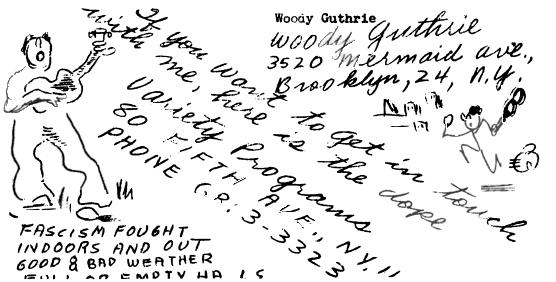
“This Machine Kills Fascists” has since, writes Motherboard, become Guthrie’s “trademark slogan… still referenced in pop culture and beyond” and providing an important point of reference for the anti-fascist punk movement. You can see another of Guthrie’s anti-fascist slogans above, which he scrawled on a collection of his sheet music: “Fascism fought indoors and out, good & bad weather.” Guthrie’s long-lived brother-in-arms Pete Seeger, carried on in the tradition of anti-fascism and anti-racism after Woody succumbed in the last two decades of his life to Huntington’s disease. Like Guthrie, Seeger painted a slogan around the rim of his instrument of choice, the banjo, a message both playful and militant: “This machine surrounds hate and forces it to surrender.”

Photo by “Jim, the Photographer”
Seeger carried the message from his days playing and singing with Guthrie, to his Civil Rights and anti-war organizing and protest in the 50s and 60s, and all the way into the 21st century at Occupy Wall Street in Manhattan in 2011. At the 2009 inauguration of Barack Obama, Seeger sang “This Land is Your Land” onstage with Bruce Springsteen and his son, Tao-Rodriquez Singer. In rehearsals, he insisted on singing the two verses Guthrie had omitted from the song after the war. “So it was,” writes John Nichols at The Nation, “that the newly elected president of the United States began his inaugural celebration by singing and clapping along with an old lefty who remembered the Depression-era references of a song that took a class-conscious swipe at those whose ‘Private Property’ signs turned away union organizers, hobos and banjo pickers.”
Both Guthrie and Seeger drew direct connections between the fascism and racism they fought and capitalism’s outsized, destructive obsession with land and money. They felt so strongly about the battle that they wore their messages figuratively on their sleeves and literally on their instruments. Pete Seeger’s famous banjo has outlived its owner, and the colorful legend around it has been mass-produced by Deering Banjos. Where Guthrie’s anti-fascist guitars went off to is anyone’s guess, but if one of them were ever discovered, Robert Santelli writes, “it surely would become one of America’s most valued folk instruments.” Or one of its most valued instruments in general.

Photo by “Jim, the Photographer”
Note: An earlier version of this post appeared on our site in 2017.
Related Content:
Bruce Springsteen Won’t Back Down: Performs “Streets of Minneapolis” Live in Minneapolis
Hear Two Legends, Lead Belly & Woody Guthrie, Performing on the Same Radio Show (1940)
The Nazis’ 10 Control-Freak Rules for Jazz Performers: A Strange List from World War II
Josh Jones is a writer and musician based in Durham, NC.
Read More...Bruce Springsteen Won’t Back Down: Performs “Streets of Minneapolis” Live in Minneapolis
When the history books are written, we’ll remember the politicians, law firms, and CEOs who quickly bent the knee to Donald Trump. We’ll also remember the scant few American figures who refused to back down. Bruce Springsteen will be high on that short list.
Touring in Europe last summer, Springsteen warned his audience: “The America that I love, the America I have written about, that has been a beacon of hope and liberty for 250 years, is currently in the hands of a corrupt, incompetent and treasonous administration.” Those words seem particularly prescient given the chaos and violence now unfolding in Minnesota.
Following the shootings of Renee Good and Alex Pretti, Springsteen made his voice heard again—this time through music. Last week, he released the protest song “Streets of Minneapolis” and soon afterward traveled to Minnesota to perform the song live at a benefit concert arranged by Tom Morello. Speaking to the crowd, Springsteen said, “I wrote Streets of Minneapolis and recorded it the next day.” When he wondered if the song sounded too ‘soapboxy,’ he turned to Morello, and the Rage Against the Machine guitarist replied, “Bruce, nuance is wonderful, but sometimes you need to kick them in the teeth.” We’ll say amen to that.
After “Streets of Minneapolis,” Springsteen and Morello performed “The Ghost of Tom Joad.” Watch it above. The start of the show began with “Killing In The Name Of.” Catch it below.
Related Content
Bruce Springsteen Revives the Protest Song, Condemns ICE Violence in “Streets of Minneapolis”
Read More...Scott Galloway Unveils “Resist and Unsubscribe,” an Action Plan for Consumers to Push Back Against Government Overreach
As mentioned here last week, Scott Galloway argued that Americans have one way to reverse the violent overreach of the federal government: launch a one-month economic strike aimed at major tech and AI companies, with the goal of reducing America’s GDP and making the markets wobble. When the markets gyrated after “Liberation Day,” President Trump immediately rolled back many tariffs. Now, if Americans can flex their economic muscles in February, Galloway wagers the administration will rethink whether it wants to keep arresting journalists and letting masked ICE agents shoot civilians in the streets—with impunity.
Today, Galloway has launched a new website, Resist and Unsubscribe, that provides an action plan for a monthlong strike. In the “Ground Zero” section of the site, Galloway lists subscription services from America’s largest technology companies—Amazon, Meta, Google, Apple, Netflix, OpenAI, and Microsoft—and provides links that let users unsubscribe quickly. He also suggests holding off on buying new hardware and products from these companies (e.g. iPhones). If you use February to review your subscriptions and find ones to cut, you’ll clean up your personal finances. You’ll also get the attention of the major technology companies that account for one-third of the S&P 500. When the tech CEOs get “yippy,” so too will Trump.
In the “Blast Zone” section of Resist and Unsubscribe, Galloway lists consumer‑facing companies he has “identified as active enablers of ICE,” naming AT&T, Comcast, Lowe’s, Marriott, and Spotify among others. He explains how these companies support ICE and recommends specific services you can cancel or avoid. Scroll down the page to see these suggestions.
Visit Resist and Unsubscribe, find some services to cancel (it’s not a large sacrifice), and spread the word. You can also find more information about the Resist and Unsubscribe movement on Galloway’s blog, “No Mercy/No Malice.”
Related Content
Scott Galloway Explains How YOU Can Stop Government Overreach Using the Power of Your Purse
Bruce Springsteen Revives the Protest Song, Condemns ICE Violence in “Streets of Minneapolis”
Read More...How the Incas Performed Skull Surgery More Successfully Than U.S. Civil War Doctors

Granted access to a time machine, few of us would presumably opt first for the experience of skull surgery by the Incas. Yet our chances of survival would be better than if we underwent the same procedure 400 years later, at least if it took place on a Civil War battlefield. In both fifteenth-century Peru and the nineteenth-century United States, surgeons were performing a lot of trepanation, or removal of a portion of the skull. Since the Neolithic period, individuals had been trepanned for a variety of reasons, some of which now sound more medically compelling than others, but the Incan civilization took it to another level of frequency, and indeed sophistication.
Anyone with an interest in the history of technology would do well to study the Incas, who were remarkable in both what they developed and what they didn’t. Though there was no Incan alphabet, there was khipu, (or quipu), previously featured here on Open Culture, a system of record-keeping that used nothing but knotted cords.
The Incas may not have had wheeled vehicles or mechanical devices as we know them today, but they did have precision masonry, an extensive road system, advanced water management for agricultural and other uses, high-quality textiles, and plant-derived antiseptic — something more than a little useful if you also happen to be cutting a lot of holes in people’s skulls.
Studying the history of trepanation, neurologist David Kushner, along with bioarchaeologists John Verano and Anne Titelbaum, examined more than 600 Peruvian skulls dating from between 400 BC and the mid-sixteenth-century, which marked the end of the Incans’ 133-year-long run. As Science’s Lizzie Wade reports, the oldest evidence shows an unenviable 40% survival rate, but the surgical technique evolved over time: by the Inca era, the number rises to between 75% and 83%, as against 46% to 56% in Civil War military hospitals. Some Incan skulls even show signs of having undergone up to seven successful trepanations — or non-fatal ones, at any rate. Though that venerable form of surgery may no longer be practiced, modern neurosurgeons today use techniques based on the same principles. Should we find ourselves in need of their services, we’ll no doubt prefer to keep our distance from the time machine.
Related content:
Discover Khipu, the Ancient Incan Record & Writing System Made Entirely of Knots
Artificial Intelligence & Drones Uncover 303 New Nazca Lines in Peru
Based in Seoul, Colin Marshall writes and broadcasts on cities, language, and culture. He’s the author of the newsletter Books on Cities as well as the books 한국 요약 금지 (No Summarizing Korea) and Korean Newtro. Follow him on the social network formerly known as Twitter at @colinmarshall.
Read More...Bruce Springsteen Revives the Protest Song, Condemns ICE Violence in “Streets of Minneapolis”
If there’s a silver lining to our tumultuous times, it’s that musicians are reviving the protest song, a tradition that has withered since the end of the Vietnam War. Credence Clearwater Revival’s “Fortunate Son,” Arlo Guthrie’s “Alice’s Restaurant,” Jimi Hendrix’s “Machine Gun”—these songs all took aim at the Johnson and Nixon administrations’ increasingly misguided war effort. But it was Neil Young who wrote the most damning protest song. When the Ohio National Guard shot and killed four students at Kent State in 1970, Young disappeared for a few hours and returned with the haunting lyrics of “Ohio.”
Tin soldiers and Nixon coming,
We’re finally on our own.
This summer I hear the drumming,
Four dead in Ohio.Gotta get down to it
Soldiers are cutting us down
Should have been done long ago.
What if you knew her
And found her dead on the ground
How can you run when you know?
With his new song released this week, Bruce Springsteen picks up this thread. “Streets Of Minneapolis” documents the murder of civilians in Minnesota’s largest city. On January 7, ICE agent Jonathan Ross shot Renee Good repeatedly in the head, leaving the mother of three dead. On January 24, two federal agents fired at least 10 shots at Alex Pretti, killing the ICU nurse instantly. Days later, the identity of these murderers remains hidden—something that news organizations oddly don’t seem troubled by, almost as if we’re quietly accepting that we’re living in a police state. When was the last time American agents could wear masks before killing civilians, and then hide behind a veil of anonymity after? Yeah, that’s normal.
On social media, Springsteen wrote: “I wrote this song on Saturday, recorded it yesterday and released it to you today in response to the state terror being visited on the city of Minneapolis. It’s dedicated to the people of Minneapolis, our innocent immigrant neighbors and in memory of Alex Pretti and Renee Good.” You can read the lyrics below.
Through the winter’s ice and cold
Down Nicollet Avenue
A city aflame fought fire and ice
‘Neath an occupier’s boots
King Trump’s private army from the DHS
Guns belted to their coats
Came to Minneapolis to enforce the law
Or so their story goes
Against smoke and rubber bullets
By the dawn’s early light
Citizens stood for justice
Their voices ringing through the night
And there were bloody footprints
Where mercy should have stood
And two dead left to die on snow-filled streets
Alex Pretti and Renee Good
Oh our Minneapolis, I hear your voice
Singing through the bloody mist
We’ll take our stand for this land
And the stranger in our midst
Here in our home they killed and roamed
In the winter of ’26
We’ll remember the names of those who died
On the streets of Minneapolis
Trump’s federal thugs beat up on
His face and his chest
Then we heard the gunshots
And Alex Pretti lay in the snow, dead
Their claim was self defense, sir
Just don’t believe your eyes
It’s our blood and bones
And these whistles and phones
Against Miller and Noem’s dirty lies
Oh our Minneapolis, I hear your voice
Crying through the bloody mist
We’ll remember the names of those who died
On the streets of Minneapolis
Now they say they’re here to uphold the law
But they trample on our rights
If your skin is black or brown my friend
You can be questioned or deported on sight
In chants of ICE out now
Our city’s heart and soul persists
Through broken glass and bloody tears
On the streets of Minneapolis
Oh our Minneapolis, I hear your voice
Singing through the bloody mist
Here in our home they killed and roamed
In the winter of ’26
We’ll take our stand for this land
And the stranger in our midst
We’ll remember the names of those who died
On the streets of Minneapolis
We’ll remember the names of those who died
On the streets of Minneapolis
Related Content
Nina Simone’s Live Performances of Her Poignant Civil Rights Protest Songs
Read More...Why Jerry Seinfeld Lives by the Stoic Philosophy of Marcus Aurelius
Having previously considered whether comedians are the philosophers of our time, we must now ask whether they, too, build upon the work of other philosophers. Few of today’s most prominent funny men and women live a philosophical life — or have cultivated the temperament necessary to live a philosophical life — more publicly than Jerry Seinfeld. This has been suggested by, among other things, a 2012 New York Times Magazine profile by Jonah Weiner. “Seinfeld will nurse a single joke for years, amending, abridging and reworking it incrementally, to get the thing just so,” writes Weiner. “It’s similar to calligraphy or samurai,” Seinfeld says. “I want to make cricket cages. You know those Japanese cricket cages? Tiny, with the doors? That’s it for me: solitude and precision, refining a tiny thing for the sake of it.”
Or, as Seinfeld puts it in the more recent interview above with podcaster Graham Bensiger, he wants to know what time it is, but he wants even more to take the watch apart in order to learn how it works. This has become his lifelong quest, in his professional arena of comedy and with his other obsessions as well.
Cultivating both his understanding and himself has entailed indulging his taste for difficult situations, or rather, challenges within what he calls the appropriate “bracket of struggle.” At this point in the journey, he’s found what could at first sound like a surprising guide: second-century Roman emperor Marcus Aurelius, whose book the Meditations, along with Epictetus’ Enchiridion and the writings of Seneca the Younger, constitute the core texts of Stoicism.
To live Stoically in the Aurelian sense is to bear always in mind that, as Seinfeld puts it, “everything that you’re worried about is going to be gone like that. The people that are criticizing you, they’re going to be gone. You’re going to be gone. All this hand-wringing, worry, and concern over ‘How are people viewing me,’ ‘Someone said something bad about me’ — and you get so upset about it — is wasted time and energy.” In the view of Marcus Aurelius, “your only focus should be on getting better at what you’re doing. Focus on what you’re doing, get better at what you’re doing. Everything else is a complete waste of time.” It’s not hard to understand why such a worldview would appeal to the man Sarah Silverman, in the Times Magazine Profile, calls “the ultimate craftsman” among comedians.
In addition to the Meditations, Seinfeld also relies on the practice of actual meditation, which he credits with providing him both the physical and mental energy necessary to keep pursuing his goals into his seventies. “Meditation is like if I said to you, ‘I’m going to need you to get in the hot tub once a day, and just sit there for five minutes. Could you do that? That’s pretty easy. Meditation is even easier than that.” Exercise is the opposite, since it “takes more effort than anything,” but it’s become just as important a part of his life, the three keys to whose success he enumerates as follows: “Transcendental meditation, lift weights, espresso.” One likes to imagine that, had Marcus Aurelius installed a Marzocco up on Palatine Hill, he’d have enjoyed a few shots throughout the day too.
Related Content:
Marcus Aurelius’ 9 Rules for Living a Stoic Life
What’s the Deal with Pop Tarts? Jerry Seinfeld Explains How to Write a Joke
Seinfeld, Louis C.K., Chris Rock, and Ricky Gervais Dissect the Craft of Comedy (NSFW)
The Stoic Wisdom of Roman Emperor Marcus Aurelius: An Introduction in Six Short Videos
Based in Seoul, Colin Marshall writes and broadcasts on cities, language, and culture. He’s the author of the newsletter Books on Cities as well as the books 한국 요약 금지 (No Summarizing Korea) and Korean Newtro. Follow him on the social network formerly known as Twitter at @colinmarshall.
Read More...RIP Gladys Mae West, the Pioneering Black Mathematician Who Helped Lay the Foundation for GPS
Gladys Mae West was born in rural Virginia in 1930, grew up working on a tobacco farm, and died earlier this month a celebrated mathematician whose work made possible the GPS technology most of us use each and every day. Hers was a distinctively American life, in more ways than one. Seeking an escape from the agricultural labor she’d already gotten to know all too well, she won a scholarship to Virginia State College by becoming her high school class valedictorian; after earning her bachelor’s and master’s degrees in mathematics, she taught for a time and then applied for a job at the naval base up in Dahlgren. She first distinguished herself there by verifying the accuracy of bombing tables with a hand calculator, and from there moved on up to the computer programming team.
This was the early nineteen-sixties, when programming a computer meant not coding, but laboriously feeding punch cards into an enormous mainframe. West and her colleagues used IBM’s first transistorized machine, the 7030 (or “Stretch”), which was for a few years the fastest computer in the world.
It cost an equivalent of $81,860,000 in today’s dollars, but no other computer had the power to handle the project of calculating the precise shape of Earth as affected by gravity and the nature of the oceans. About a decade later, another team of government scientists made use of those very same calculations when putting together the model employed by the World Geodetic System, which GPS satellites still use today. Hence the tendency of celebratory obituaries to underscore the point that without West’s work, GPS wouldn’t be possible.
Nor do any of them neglect to point out the fact that West was black, one of just four such mathematicians working for the Navy at Dahlgren. Stories like hers have drawn much greater public interest since the success of Hidden Figures, the Hollywood adaptation of Margot Lee Shetterly’s book about the black female mathematicians at NASA during the Space Race. When that movie came out, in 2016, even West’s own children didn’t know the importance of the once-classified work she’d done. Only in 2018, when she provided that information on a biographical form she filled out for an event hosted by her college sorority, did it become public. She thus spent the last years of her long life as a celebrity, sought out by academics and journalists eager to understand the contributions of another no-longer-hidden figure. But to their questions about her own GPS use, she reportedly answered that she preferred a good old-fashioned paper map.
Related content:
Black History in Two Minutes: Watch 93 Videos Written & Narrated by Henry Louis Gates Jr.
Based in Seoul, Colin Marshall writes and broadcasts on cities, language, and culture. He’s the author of the newsletter Books on Cities as well as the books 한국 요약 금지 (No Summarizing Korea) and Korean Newtro. Follow him on the social network formerly known as Twitter at @colinmarshall.
Read More...Walter Benjamin Explains How Fascism Uses Mass Media to Turn Politics Into Spectacle (1935)

Image via Wikimedia Commons
In his 1935 essay, “The Work of Art in the Age of Mechanical Reproducibility,” influential German-Jewish critic Walter Benjamin introduced the term “aura” to describe an authentic experience of art. Aura relates to the physical proximity between objects and their viewers. Its loss, Benjamin argued, was a distinctly 20th-century phenomenon caused by mass media’s imposition of distance between object and viewer, though it appears to bring art closer through a simulation of intimacy.
The essay makes for potent reading today. Mass media — which for Benjamin meant radio, photography, and film — turns us all into potential actors, critics, experts, he wrote, and takes art out of the realm of the sacred and into the realm of the spectacle. Yet it retains the pretense of ritual. We make offerings to cults of personality, expanded in our time to include influencers and revered and reviled billionaires and political figures who joust in the headlines like professional wrestlers, led around by the chief of all heels. As Benjamin writes:
The film responds to the shriveling of the aura with an artificial build-up of the “personality” outside the studio. The cult of the movie star, fostered by the money of the film industry, preserves not the unique aura of the person but the “spell of the personality,” the phony spell of a commodity.
Benjamin’s focus on the medium as not only expressive but constitutive of meaning has made his essay a staple on communications and media theory course syllabi, next to the work of Marshall McLuhan. Many readings tend to leave aside the politics of its epilogue, likely since “his remedy,” writes Martin Jay — “the politicization of art by Communism — was forgotten by all but his most militant Marxist interpreters,” and hardly seemed like much of a remedy during the Cold War, when Benjamin became more widely available in translation.
Benjamin’s own idiosyncratic politics aside, his essay anticipates a crisis of authorship and authority currently surfacing in the use of social media as a dominant form of political spectacle.
With the increasing extension of the press, which kept placing new political, religious, scientific, professional, and local organs before the readers, an increasing number of readers became writers—at first, occasional ones. It began with the daily press opening to its readers space for “letters to the editor.” And today there is hardly a gainfully employed European who could not, in principle, find an opportunity to publish somewhere or other comments on his work, grievances, documentary reports, or that sort of thing. Thus, the distinction between author and public is about to lose its basic character.
Benjamin’s analysis of conventional film, especially, leads him to conclude that its reception required so little of viewers that they easily become distracted. Everyone’s a critic, but “at the movies this position requires no attention. The public is an examiner, but an absent-minded one.” Passive consumption and habitual distraction do not make for considered, informed opinion or a healthy sense of proportion.
What Benjamin referred to (in translation) as mechanical reproducibility we might now just call The Internet (and the coteries of “things” it haunts poltergeist-like). Later theorists influenced by Benjamin foresaw our age of digital reproducibility doing away with the need for authentic objects, and real people, altogether. Benjamin himself might characterize a medium that can fully detach from the physical world and the material conditions of its users — a medium in which everyone gets a column, public photo gallery, and video production studio — as ideally suited to the aims of fascism.
Fascism attempts to organize the newly created proletarian masses without affecting the property structure which the masses strive to eliminate. Fascism sees its salvation in giving these masses not their right, but instead a chance to express themselves. The masses have a right to change property relations; Fascism seeks to give them an expression while preserving property. The logical result of Fascism is the introduction of aesthetics into political life.
The logical result of turning politics into spectacle for the sake of preserving inequality, writes Benjamin, is the romanticization of war and slaughter, glorified plainly in the Italian Futurist manifesto of Filippo Marinetti and the literary work of Nazi intellectuals like Ernst Jünger. Benjamin ends the essay with a discussion of how fascism aestheticizes politics to one end: the annihilation of aura by more permanent means.
Under the rise of fascism in Europe, Benjamin saw that human “self-alienation has reached such a degree that it can experience its own destruction as an aesthetic pleasure of the first order. This is the situation of politics which Fascism is rendering aesthetic.” Those who participate in this spectacle seek mass violence “to supply the artistic gratification of a sense perception that has been changed by technology.” Distracted and desensitized, they seek, that is, to compensate for profound disembodiment and the loss of meaningful, authentic experience.
You can read Benjamin’s essay here, or find it in this collected volume.
Note: An earlier version of this post appeared on our site in 2022.
Related Content:
Umberto Eco Makes a List of the 14 Common Features of Fascism
Toni Morrison Lists the 10 Steps That Lead Countries to Fascism (1995)
Read More...Lessons in Creativity from Rick Rubin: Focus on Your Art, Not the Audience
If you’ve heard Run‑D.M.C.‘s Raising Hell, Rage Against the Machine’s self-titled debut, Johnny Cash’s American Recordings, or Adele’s 21, you’ve heard the work of Rick Rubin. Yet even if you’ve listened closely to every song on which he’s been credited as a producer over the past 45 years, you may have trouble pinning down what, exactly, the work of Rick Rubin is. Though his résumé includes such professional achievements as co-founding both Def Jam Recordings and American Recordings, as well as sharing the presidency of Columbia Records for a stretch, he’s become best known in recent years as a kind of barefoot sage of creativity.
Rubin has proven ready to dispense sometimes-cryptic wisdom in whatever contexts he finds himself, and in the twenty-twenties, that role naturally involves appearing on a lot of long-form interview podcasts.
For Rubin in particular, the publication of his book The Creative Act: A Way of Being constituted an incentive — or perhaps an excuse — to take a seat across from popular podcasters like Lex Fridman, Jay Shetty, and Andrew Huberman. Naturally, these conversations spend a good deal of time on questions of what it takes to create a work of art, great or otherwise, in music or whichever medium it may be.
One of the most surprising points to which Rubin returns again and again is that the best art is never made to please an audience. Instead of trying to anticipate the tastes of others, you must first satisfy yourself with your work. Think back to your first encounter with your very favorite albums, films, or books, and you’ll realize the truth of Rubin’s words. Even then, it must have felt like the musician, the director, or the author didn’t guess what you wanted, but worked to create something personally resonant that went on to resonate with you — and, perhaps, millions of others as well.
The factors involved in such an artistic connection are many and inscrutable, in Rubin’s telling, and attempts at their explanation tend to verge on the mystical. But they can’t be reduced to a formula that applies always and everywhere, which means that creators of all kinds have to go through experience after long experience of trial and error throughout their careers. For many, this can necessitate getting a day job, Rubin’s advocacy of which puts him at odds with another of the most famous music producer/gurus of all time. But then, there’s more than one way to get creative in this world.
Related content:
Rick Rubin: The Invisibility of Hip Hop’s Greatest Producer
The Beastie Boys & Rick Rubin Reunite and Revisit Their Formative Time Together in 1980s NYC
Rick Rubin Revisits the Origins of Def Jam Records & the NYU Dorm Room Where It All Began
Malcolm Gladwell and Rick Rubin Launch a New Music Podcast, Broken Record: Listen Online
Based in Seoul, Colin Marshall writes and broadcasts on cities, language, and culture. He’s the author of the newsletter Books on Cities as well as the books 한국 요약 금지 (No Summarizing Korea) and Korean Newtro. Follow him on the social network formerly known as Twitter at @colinmarshall.
Read More...Support Us
We're hoping to rely on loyal readers, rather than erratic ads. Please click the Donate button and support Open Culture. You can use Paypal, Venmo, Patreon, even Crypto! We thank you!

About Us

Open Culture scours the web for the best educational media. We find the free courses and audio books you need, the language lessons & educational videos you want, and plenty of enlightenment in between.
Advertise With Us

FREE UPDATES!
GET OUR DAILY EMAIL
Get the best cultural and educational resources on the web curated for you in a daily email. We never spam. Unsubscribe at any time.
FOLLOW ON SOCIAL MEDIA

Open Culture editor Dan Colman scours the web for the best educational media. He finds the free courses and audio books you need, the language lessons & movies you want, and plenty of enlightenment in between.
Advertise With Us


