Authors
All
Administrator|User role
Author|User role
Contributor|User role
Editor|User role
Premium Subscriber
Subscriber|User role
s2Member Level 1
s2Member Level 2
s2Member Level 3
s2Member Level 4
SEO Manager
SEO Editor
Read More...Lou Reed Concert Film Berlin Streaming Free Online for the Next Week
Last laughs can be sweet, and according to music journalist, Anthony DeCurtis, his friend, the late Lou Reed, “reveled” in the critical drubbing that greeted his 3rd solo album, 1973’s Berlin.
Not immediately, however.
Berlin, which followed hard on the heels of Reed’s widely adored Transformer, had a painful, protracted delivery.
This was due in part due to RCA execs getting cold feet about releasing Reed’s grim concept record as a double album. This necessitated a lot of pruning, a week before deadline.
Producer Bob Ezrin, who had planted the idea for a concept album based on a track from Reed’s eponymous first solo effort, was detoxing in the hospital, and thus not present for the final mastering.
But much of the hell leading to Berlin’s release was a hell of Reed’s own making.
His dependence on drugs and alcohol hampered the writing process, as per Reed’s first wife, Bettye Kronstad, who filed for divorce midway through the process.
If you want a glimpse of what that marriage’s final days might have been like, look to Berlin.
Kronstad was distressed to find many private details from their relationship on display in the tragic rock opera. There was some fictionalization, but Reed also put his thumb on the scales when it suited him, in songs like “The Kids,” which recast Kronstad’s late mother in a particularly unfair way.
Reed once took a shot at the album’s critical reception, suggesting that people didn’t like it because its depiction of a miserable couple, whose union is marred by infidelity, domestic abuse, addiction, and suicide, was “too real”:
It’s not like a TV program where all the bad things that happen to people are tolerable. Life isn’t like that. And neither is the album.
Sometimes he bluffed:
I have never been interested in critical receptions, deceptions, hellos, goodbyes, huzzahs, hurrahs. I don’t read them, so I don’t care.
At other times, he raged:
There are people I’ll never forgive for the way they fucked me over with Berlin. The way that album was overlooked was the biggest disappointment I ever faced.
In a more vulnerable mood, he admitted:
Berlin was a big flop and it made me very sad. The way that album was overlooked was probably the biggest disappointment I ever faced. I pulled the blinds shut at that point, and they’ve remained closed.
Unsurprisingly, his early plans for staging a theatrical companion piece to the album, with possible participation by Andy Warhol, were shelved.
34 years later…
Cue director Julian Schnabel, the Brooklyn Youth Chorus, and St. Ann’s Warehouse, the New York City venue that had previously co-commissioned Songs for Drella, a musical Warhol tribute by Reed and John Cale.
In 2006, Reed took centerstage in Brooklyn for a 5‑night theatrical run of Berlin that also featured a 35-piece ensemble, original guitarist Steve Hunter, and dreamy videos by the director’s daughter, Lola, starring Emmanuelle Seigner as an abstract sketch of the doomed protagonist, Caroline.
The resulting concert film, which St. Ann’s Warehouse is streaming for free through November 29, proved far more popular with critics than the 1973 record had been. (Three years prior to the St Ann’s staging, Rolling Stone upgraded its original opinion of the album from career ending disaster to 344th Greatest Album of All Time.)
Stephen Holden’s glowing New York Times review of the film made multiple mention of angels and demons, as is perhaps to be expected when a work combines Lou Reed, a Sid and Nancy-ish romance, a children’s choir, and the ethereal voice of Anohni, late of Antony and the Johnsons.
Readers, see for yourself, and let us know—did RCA’s promotional poster for the original album get something right nearly 50 years ago? Is this “a film for the ears?”
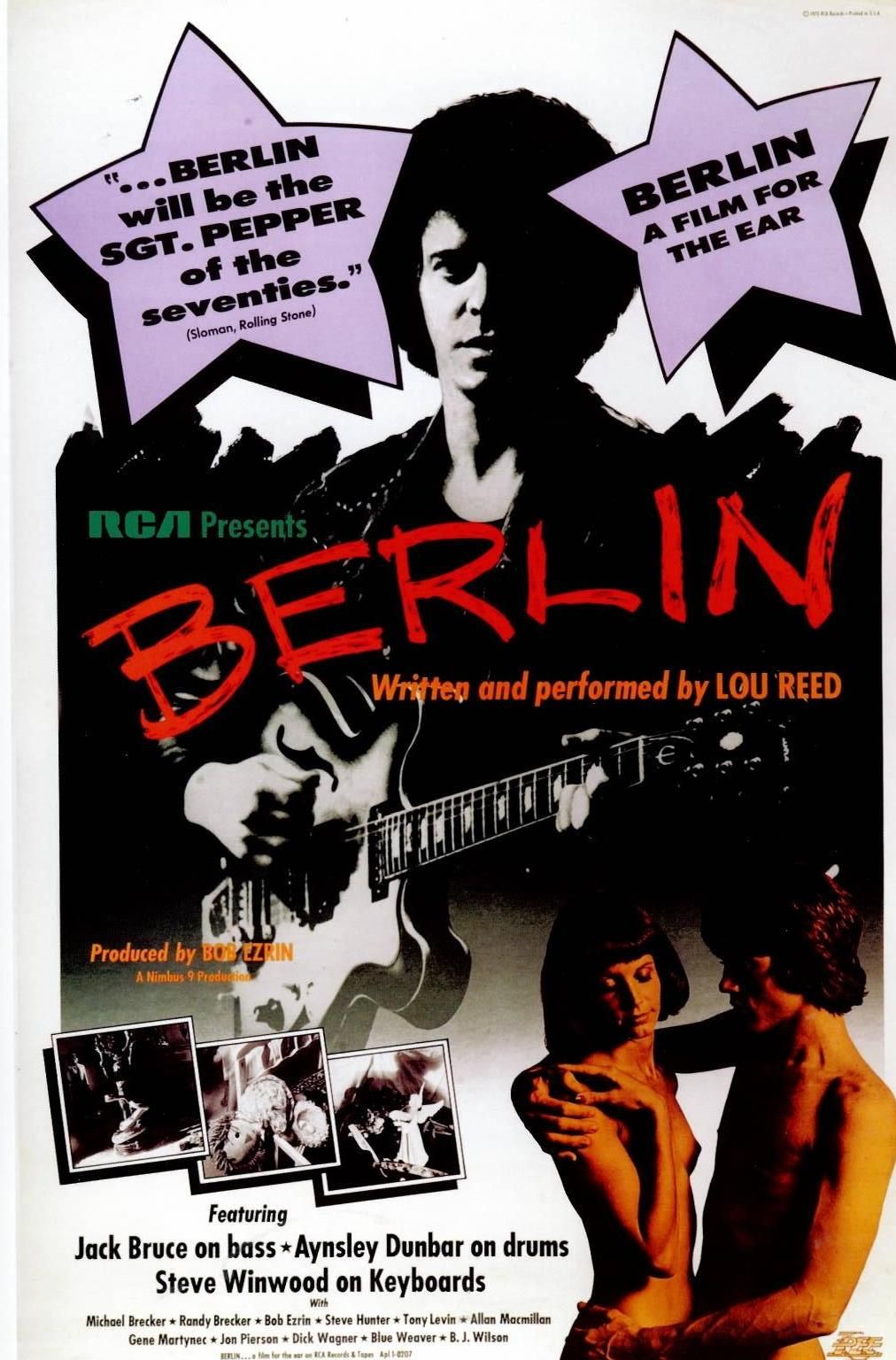
Listen to the original 1973 album and the live concert version at St. Ann’s for free on Spotify.
Stream Julian Schnabel’s Lou Reed’s Berlin, Live at St. Ann’s Warehouse here through November 29.
Related Content:
Lou Reed Sings “Sweet Jane” Live, Julian Schnabel Films It (2006)
Lou Reed Creates a List of the 10 Best Records of All Time
Ayun Halliday is an author, illustrator, theater maker and Chief Primatologist of the East Village Inky zine. Follow her @AyunHalliday.
Read More...How Errol Morris Became Obsessed with — and Figured Out — the Truth of a Famous War Photograph
Errol Morris didn’t go all the way to the Crimean Peninsula just because of a sentence written by Susan Sontag. “No,” he once explained to a friend, “it was actually two sentences.” Found in Regarding the Pain of Others, Sontag’s late book-length essay on war photography, these lines deal with the fact that “many of the canonical images of early war photography turn out to have been staged, or to have had their subjects tampered with.” Take Valley of the Shadow of Death, pioneering war photographer Roger Fenton’s famously desolate 1855 image from the Crimean War. Fenton actually shot this landscape twice: in one picture, “cannonballs are thick on the ground to the left of the road, but before taking the second picture — the one that is always reproduced — he oversaw the scattering of the cannonballs on the road itself.”
Or did he? Morris had his doubts — and, as the maker of such acclaimed documentaries on the nature of truth and its representation as The Thin Blue Line and Standard Operating Procedure and the author of the book Believing is Seeing: Observations on the Mysteries of Photography — he clearly has an intellectual investment in the subject.
“I spent a considerable amount of time looking at the two photographs and thinking about the two sentences,” Morris writes in a 2007 New York Times blog post. “How did Sontag know that Fenton altered the landscape or, for that matter, ‘oversaw the scattering of the cannonballs on the road itself?’ ” How, for that matter, “did Sontag know the sequence of the photographs? How did she know which photograph came first?”
Unable to turn up any persuasive evidence, Morris launched an investigation of his own, interviewing experts, digging into Fenton’s letters, and eventually making his way to the Valley of the Shadow of Death itself (not to be confused with the other, better-known valley across which Tennyson’s Light Brigade charged). All of this Morris did in the name of finding out which came first, the photo with the cannonballs beside the road, or the one with the cannonballs on the road. You can hear him discuss this increasingly obsessive quest for the truth in the video above from Vox’s Darkroom, the series that previously gave us a breakdown of the very first faked photograph. But then, as this and other investigations by Morris into the relationship between images, language, and reality have underscored, there is no such thing as a true photograph.
Related Content:
Errol Morris: Two Essential Truths About Photography
Errol Morris Meditates on the Meaning and History of Abraham Lincoln’s Last Photograph
The First Faked Photograph (1840)
Based in Seoul, Colin Marshall writes and broadcasts on cities, language, and culture. His projects include the Substack newsletter Books on Cities, the book The Stateless City: a Walk through 21st-Century Los Angeles and the video series The City in Cinema. Follow him on Twitter at @colinmarshall, on Facebook, or on Instagram.
Read More...The Beautiful Video for David Gilmour’s “The Girl in the Yellow Dress,” Featuring 9,000 Hand-Drawn Frames of Animation
The animated video for David Gilmour’s “The Girl in the Yellow Dress” opens on a saxophonist with a familiar story—one so well-known to his bandmates they can read it on his face. But then the perspective shifts, and we follow instead the woman (or “girl”) of his woes, as she comes to see him play, gets ogled and turned into a fantasy by the men in the club, pursues the resident lothario, crushing the hearts of them all, including the saxophonist, who plays his blues instead of collapsing into a drink.
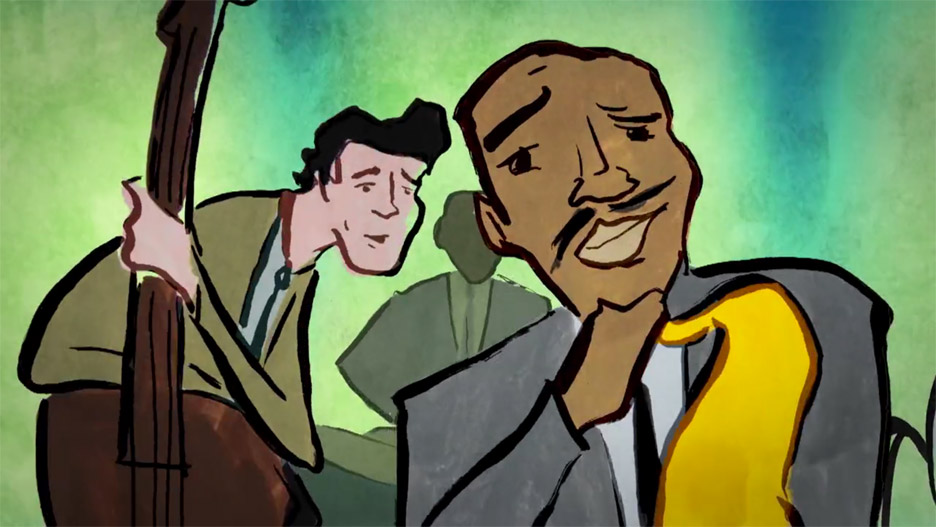
At least that seems to be the story, a typical nightlife scene rendered in a very dynamic, atypical way. The video, from a track off Gilmour’s 2015 album Rattle that Lock, was directed by Danny Madden for Ornana Films, who write, “The music video is made of about 9,000 frames of animation that were touched by several hands to get the layered contours, vibrant colors, and exaggerated character design of old French Lithograph posters. We wanted to create a moving version of that look, as if each frame had all the layers stamped on the page.”
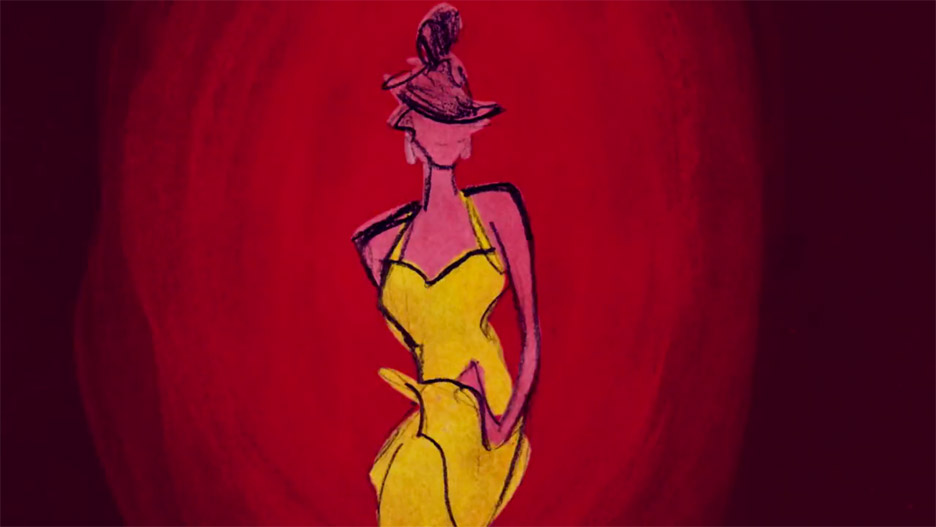
An incredible amount of intensive artistic labor went into creating the boozy, swirling effects in each scene. “We animated with pencil, then contour lines were gone over with a brush tip marker. We used gouache to get nice life in the varying brushstrokes, then we layered the contours over the paint layer in the compositing step so that the colours would do interesting things when they ran together.” Maybe these images could be recreated convincingly with digital effects… but I suspect not.
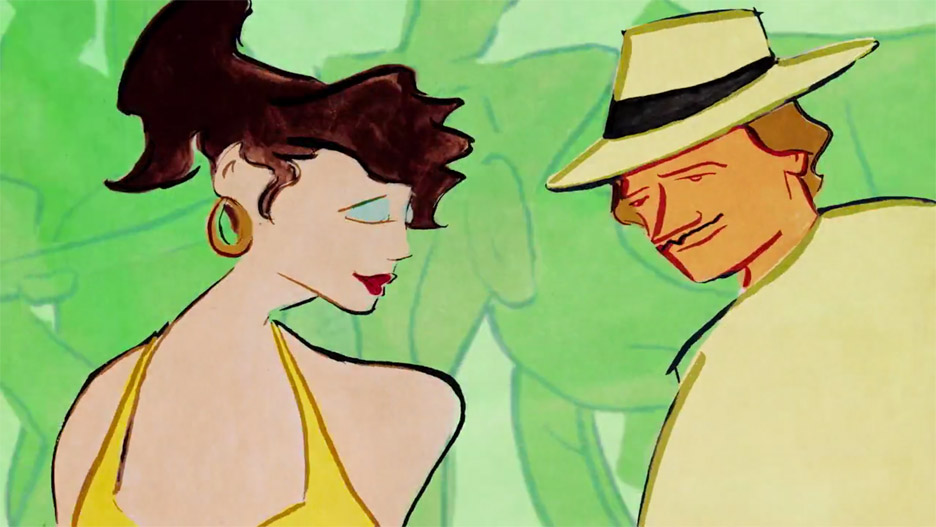
The song “looks back at [Gilmour’s] earliest musical influence,” writes a Guardian review of the Rattle that Lock. If so, it’s a nascent influence that did not emerge often in his Pink Floyd playing, though the song may also indirectly pay tribute to the jazz-trained Richard Wright, memorialized elsewhere on the album. You can see several more scenes from this extraordinary video at Dezeen.
via Laughing Squid
Related Content:
David Gilmour Talks About the Mysteries of His Famous Guitar Tone
Watch Tom Waits For No One, the Pioneering Animated Music Video from 1979
Josh Jones is a writer and musician based in Durham, NC. Follow him at @jdmagness
Read More...Discover the Cyanometer, the Device Invented in 1789 Just to Measure the Blueness of the Sky
English astronomer and physicist James Jeans’ 1931 essay “Why the Sky is Blue” has become a classic of concise expository writing since it was first published in a series of talks. In only four paragraphs and one strikingly detailed, yet simple analogy, Jeans gave millions of students a grasp of celestial blueness in prose that does not substitute nature’s poetry for scientific jargon and diagrams.
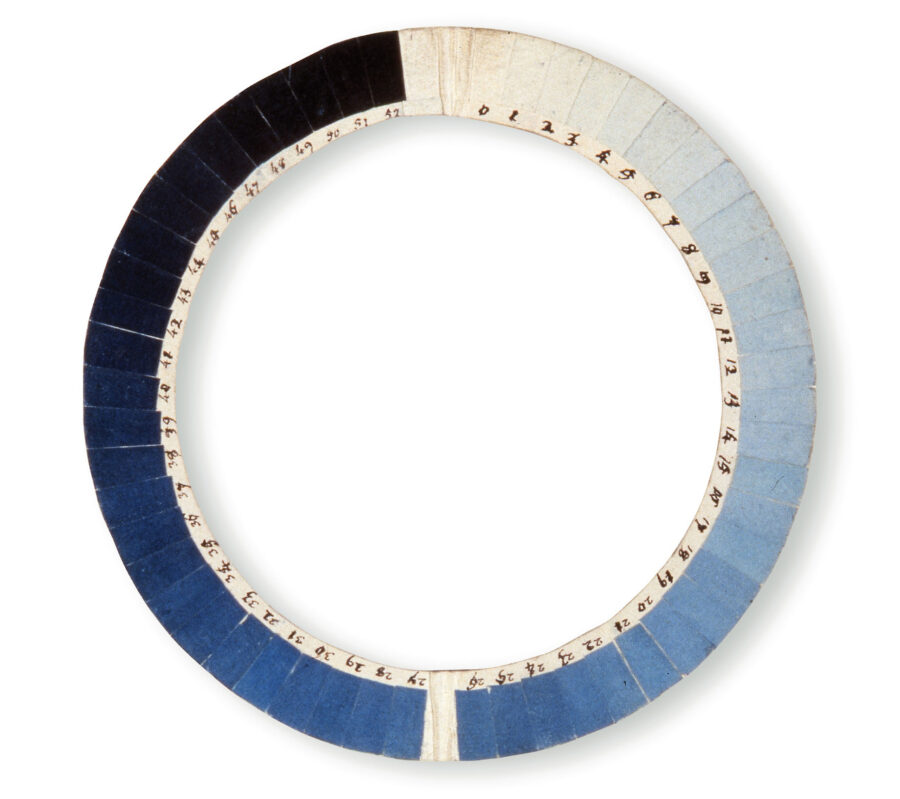
Over a hundred years earlier, another scientist created a similarly poetic device; in this case, one which attempted to depict how the sky is blue. Swiss physicist Horace Bénédict de Saussure’s 1789 Cyanometer, “a circle of paper swatches dyed in increasingly deep blues, shading from white to black,” Sarah Laskow writes at Atlas Obscura, “included 52 blues… in its most advanced iteration,” intended to show “how the color of the sky changed with elevation.”
Saussure’s fascination with the blueness of the sky began when he was a young student and traveled to the base of Mont Blanc. Overawed by the summit, he dreamt of climbing it, but instead used his family’s wealth to offer a reward to the first person who could. Twenty-seven years later, Saussure himself would ascend to the top, in 1786, carrying with him “pieces of paper colored different shades of blue, to hold up against the sky and match its color.”
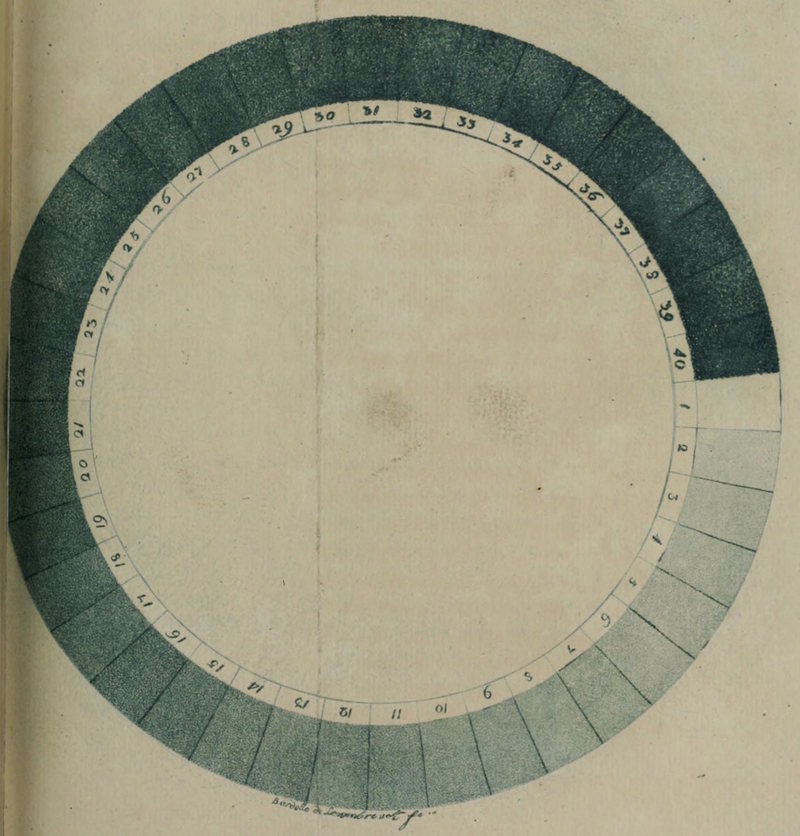
Saussure was taken with a phenomenon reported by mountaineers: as one climbs higher, the sky turns a deeper shade of blue. He began to formulate a hypothesis, the Royal Society of Chemistry Explains:
Armed with his tools and a small chemistry set, he trekked round the valleys and beyond. As his trips carried him ever higher, he puzzled about the colour of the sky. Local legend had it that if one climbed high enough it turned black and one would see, or even fall into, the void — such terrors kept ordinary men away from the peaks. But to Saussure, the blue colour was an optical effect. And because on some days the blue of the sky faded imperceptibly into the white of the clouds, Saussure concluded that the colour must indicate its moisture content.
At the top of Mont Blanc, the physicist measured what he deemed “a blue of the 39th degree.” The number meant little to anyone but him. “Upon its invention, the cyanometer rather quickly fell into disuse,” as Maria Gonzalez de Leon points out. “After all, very little scientific information was given.”
The tool did, however, accompany the famed geographer Alexander von Humboldt across the Atlantic, “to the Caribbean, the Canary Islands, and South America,” writes Laskow, where Humboldt “set a new record, at the 46th degree of blue, for the darkest sky ever measured” on the summit of the Andean mountain Chimborazo. This would be one of the only notable uses of the poetic device. “When the true cause of the sky’s blueness, the scattering of light, was discovered decades later, in the 1860s, Saussure’s circle of blue had already fallen into obscurity.”
via MessyNessy/Colossal
Related Content:
A 900-Page Pre-Pantone Guide to Color from 1692: A Complete Digital Scan
The Vibrant Color Wheels Designed by Goethe, Newton & Other Theorists of Color (1665–1810)
Josh Jones is a writer and musician based in Durham, NC. Follow him at @jdmagness
Read More...Experience Blade Runner Like You Never Have Before Through a Feature-Length Remastered Soundtrack
There is no one Blade Runner. Ridley Scott’s influential “neo-noir” has appeared in several different versions over the past 38 years, both official — the “director’s cut,” the “final cut,” and lest we forget, the now-derided first theatrical cut — and unofficial. So has Blade Runner’s soundtrack, the first official release of which lagged the film by about a dozen years, and even then didn’t include all the music so integral to the unprecedented aesthetic richness of the futuristic setting. Then, about a dozen more years later, followed an expanded soundtrack album, which for many fans still proved unsatisfying. In the name of completeness and sonic fidelity, at least five widely distributed bootlegs have attempted to fill the gap.
Now, in our 21st-century age of streaming, we have fan-made “remasters” of the Blade Runner soundtrack like the above, the 5.7‑million-times-viewed work of a user called Greendragon861. Running just over one hour and 52 minutes — nearly the length of the various cuts of Blade Runner itself — this sonic experience includes, of course, the well-known electronic pieces by composer Vangelis, those that come right to mind when you envision the flame-belching industrial landscape of 21st-century Los Angeles or a police “spinner” taking to the skies. But it also incorporates background music, sound effects, and even snatches of dialogue from the movie. The result feels a great deal like watching Blade Runner without actually watching Blade Runner.
Despite initially flopping, at least in the West, Blade Runner has exerted an enormous influence on other art and media — indeed, on the way humanity envisions the future — and one still spreading nearly four decades later. The film seems unsurpassable in that regard, an achievement creditable to a range of creators: director Ridley Scott, of course; but also Philip K. Dick, author of its source material; the late Syd Mead, who as a “visual futurist” gave focus to the world’s look and feel; model master Douglas Trumbull, thanks in part to whom its built and mechanical environment has aged so well. The list goes on, and it shouldn’t fail to include Vangelis as well as everyone else responsible for this intricate soundscape, without which Blade Runner wouldn’t be Blade Runner, no matter the cut.
Related Content:
How Blade Runner Captured the Imagination of a Generation of Electronic Musicians
Sean Connery (RIP) Reads C.P. Cavafy’s Epic Poem “Ithaca,” Set to the Music of Vangelis
Stream 72 Hours of Ambient Sounds from Blade Runner: Relax, Go to Sleep in a Dystopian Future
Drone Footage of San Francisco Set to the Music of Blade Runner 2049
Based in Seoul, Colin Marshall writes and broadcasts on cities, language, and culture. His projects include the Substack newsletter Books on Cities, the book The Stateless City: a Walk through 21st-Century Los Angeles and the video series The City in Cinema. Follow him on Twitter at @colinmarshall, on Facebook, or on Instagram.
Read More...Pop Songs with Narrative: Pretty Much Pop (#69) Discusses Tunes Ranging from Bob Dylan’s “Hurricane” to “The Pina Colada Song” with Songwriter/Author Rod Picott
Plenty of songs purport to tell stories, and the narrative ballad of course has a long enough history that the two forms certainly aren’t alien. But how do our listening practices conditioned by pop music jibe with recognizing and understanding narrative?
Singer/songwriter and short story author Rod Picott joins your hosts Mark Linsenmayer, Erica Spyres, and Brian Hirt to talk about classics by writers like Bob Dylan and Johnny Cash, formative nightmares like “Leader of the Pack” and “Escape (The Pina Colada Song), borderline cases like “Bohemian Rhapsody,” and more. We also consider how this form relates to musical theater, music videos, soundtracks, and commercials.
We tried to stick to popular songs, but most of us are pretty old. You can listen and read the lyrics if you’re not following:
- “Mack the Knife” by Bobby Darin
- “The Long Black Veil” by Johnny Cash
- “Coward of the Country” by Kenny Rogers
- “Leader of the Pack” by The Shangri-Las
- “Bohemian Rhapsody” by Queen
- “Hurricane” by Bob Dylan
- “Scenes from an Italian Restaurant” by Billy Joel
- “Escape (The Pina Colada Song)” by Rupert Holmes (Watch him on Burt Sugarman’s Midnight Special. Yes, there was a Taco Bell commercial that used this song.)
- “Paradise by the Dashboard Light” by Meat Loaf (written by Jim Steinman). Read Tim Quirk’s extensive analysis of this disturbing song.
- “Famous Blue Raincoat” by Leonard Cohen
- “Jack and Diane” by John Cougar Mellencamp
- “Glory Days” by Bruce Springsteen
- “Fortunate Son” by Creedence Clearwater Revival
- “Tiger Tom Dixon’s Blues” by Rod Picott
Why these songs? Well, we found a few lists online:
- “Inventory: 26 Songs That are Just as Good as Short Stories” from the AV Club
- “15 Songs That Tell Better Stories Than Your Favorite Novel” by Josue Brocca
- “168 Favorite Pop, Rock, and Country Songs That Tell a Story” from FlourishAnyway
Hear Mark interview Rod on Nakedly Examined Music. Learn more at rodpicott.com.
Hear more of this podcast at prettymuchpop.com. This episode includes bonus discussion you can access by supporting the podcast at patreon.com/prettymuchpop. This time, an update on Rod’s music plus political discussion and more.
This podcast is part of the Partially Examined Life podcast network.
Pretty Much Pop: A Culture Podcast is the first podcast curated by Open Culture. Browse all Pretty Much Pop posts.
Read More...A Free Stanford Course on How to Teach Online: Designed for Middle & High School Teachers

Update: You can find the video recording of the workshop here.
This past spring, teachers and students everywhere got an abrupt introduction to online learning. When classrooms moved online in March, many teachers experimented with online pedagogy for the first time, often without much training or support. To help ease this transition, the Stanford Online High School–an independent high school that operates entirely online–launched a free course designed to help teachers get comfortable teaching in this new medium. 7,000 teachers signed up. To continue providing support, an updated version of this free course will be offered again this weekend.
“Teaching Your Class Online” will take place this Saturday (November 21) and Sunday (November 22), and run from 9:00 am — 11:00 am Pacific time each day. (Update: The lectures are now available online.) Designed mainly for instructors teaching grades 7–12, the course can be helpful for elementary and college instructors as well. Topics covered will include “challenges [such] as student engagement and discussion (including for large groups, breakout rooms, and hybrid groups), effective communication with students and parents, assessment and curriculum adaptation for online pedagogy, and strategies for supporting both students and yourselves.”
“Teaching Your Class Online” is supported by Stanford Online High School and Stanford Continuing Studies. You can enroll in the course on the Continuing Studies website here.
If you know any teachers who could benefit from this free course, please feel free to share this post with them.
Related Content:
1,700 Free Online Courses from Top Universities200 Free Kids Educational Resources: Video Lessons, Apps, Books, Websites & More
“I Will Survive,” the Coronavirus Version for Teachers Going Online
Read More...What Happens When You Spend Weeks, Months, or Years in Solitary Confinement
The loneliness and isolation of quarantine is nothing to laugh about, though we might have heard grim jokes about solitary confinement in the last few months. We’ve also seen overwrought comparisons of social distancing to prison. These are, I think, release valves for real pain. One hopes the harrowing experience of the pandemic will give Americans some compassion for the lives of prisoners, a shocking number of whom spend years, even decades, in solitary, mostly deprived of natural light, human contact, entertainment, education, or a change of scenery. It seems, inarguably, like a form of torture.
Unsurprisingly, solitary confinement does real harm to the body and brain. Even inmates placed in solitary for a few days experience symptoms of acute anxiety and depression. “Isolated inmates often report symptoms similar to those of hypertension, such as chronic headaches, trembling sweaty palms, extreme dizziness and heart palpitations,” Mary Murphy Corcoran writes at NYU’s Applied Psychology Opus. “Inmates in isolation may also have difficulty sleeping, and some may experience insomnia…. Consequently, inmates report feelings of chronic lethargy.” Over the years, this stress exacts its long-term toll.
In the Slate video at the top, former inmate Five Mualimm-Ak describes the five years he spent in solitary during a 12-year prison sentence. His account and those of others were recently collected in a book with the grimly evocative title Hell is a Very Small Place. Former solitary inmate Terrence Slater describes a kind of further solitary of the mind: how important it is to limit the amount of time one thinks about loved ones during a 23-hour day alone in a cell, or “you’re going to lose your mind in there.” It’s estimated that roughly 80,000 inmates in the U.S. are placed in such conditions every year.
Given enough time, one may literally lose one’s mind, as Robert King discovered. King was “confined in a 6x9-foot cell for almost 30 years,” Elana Blanco-Suarez writes at Psychology Today. “King knew that solitary confinement was changing the way his brain worked. When he finally left his cell, he realized he had trouble recognizing faces and had to retrain his eyes to learn what a face was like.” He could no longer follow simple directions. “It was as if his brain had erased all those capabilities that were no longer necessary for survival in a cell no bigger than the back of a pick-up truck.”
Prolonged periods of sensory deprivation can be especially injurious for prisoners who go into solitary with pre-existing mental health issues, and “mentally impaired prisoners are disproportionately represented in solitary confinement,” Kirsten Weir notes at the American Psychological Association. One 2005 study found that the “prevalence of mental illness in administrative segregation” in Colorado “was greater than 35 percent, compared with a mental illness rate of less than 25 percent among the general prison population.”
Clinical professor of psychiatry at the University of Colorado Jeffrey Metzner argues that the “correctional system has become our mental health care system for too many people,” using abusive, barbaric practices that haven’t existed in mental health wards for decades. The effects of solitary confinement suggest that “it doesn’t make facilities safer, doesn’t make our communities safer, and that people are developing mental and physical ailments because of this practice.”
So says James Burns, a formerly incarcerated filmmaker who voluntarily entered solitary confinement for 30 days in 2016 and livestreamed the whole experience. See his last four hours above and read at Vice about his reasons for submitting himself to hell—not a “dark dungeon,” he writes, but “a very sterile, bright hell” which is, “more than anything… a mind fuck.”
Related Content:
Prisons Around the U.S. Are Banning and Restricting Access to Books
Inmates in New York Prison Defeat Harvard’s Debate Team: A Look Inside the Bard Prison Initiative
Josh Jones is a writer and musician based in Durham, NC. Follow him at @jdmagness.
Read More...How Soy Sauce Has Been Made in Japan for Over 220 Years: An Inside View
Soy sauce has figured into the cuisine of east Asia for more than two millennia. By that standard, the two-century-old Fueki Shoyu Brewing hasn’t been in the game long. But in running the operation today, Masatsugu Fueki can hardly be accused of failing to uphold tradition: he adheres to just the same practices for making soy sauce (shoyu, in Japanese) as the company’s founders did back in 1879. You can see the entire process in the Eater video above, shot at the Fueki factory in Saitama Prefecture, just northwest of Tokyo. Fueki himself guides the tour, explaining first the sheer simplicity of the ingredients — soybeans, flour, and salt — and then the intricate biological interactions between them that must be properly managed if the result is to possess a suitably rich umami flavor.
That we all know what umami is today owes in part to the propagation of soy sauce across the world. One of the “five basic flavors,” this distinctive savoriness manifests in certain fish, cheeses, tomatoes, and mushrooms, but if you need a quick shot of umami, you reach for the soy sauce. In bottles small and large, it had already become a common product in the United States by the time I was growing up there in the 1980s and 90s.
It must be said, however, that Americans then still had some odd ways of using it: the now-acknowledged Western faux pas, for instance, of liberally drizzling the stuff over rice. But wider awareness of soy sauce has led to a wider understanding of its proper place in food, and also of what sets the best apart from the mediocre — as well as a curiosity about what it takes to make the best.
Fueki and his workers take pains every step of the way, from steaming the soybeans to decomposing the wheat with a mold called koji to heating the raw soy sauce in tanks before bottling. But the key is the kioke, a large wooden fermentation barrel, the oldest of which at Fueki Shoyu Brewing goes back 150 years. Today, Fueki explains, fewer that 50 craftsmen in all of Japan know how to make them: hence the launch of the in-house Kioke Project, a series of workshops meant to revitalize the craft. As he climbs down into an empty kioke, Fueki describes it as “filled with invisible yeast fungus that’s unique to our place” — far from a contaminant, “the most important element, or treasure and our heart.” The care and sensitivity required, and indeed the industrial techniques themselves, aren’t so different from those involved in the making of fine wines. But it surely takes a palate as experienced as Fueki’s to taste “chocolate, vanilla, coffee, rose, hyacinth” in the final product.
Related Content:
Short Fascinating Film Shows How Japanese Soy Sauce Has Been Made for the Past 750 years
How Japanese Things Are Made in 309 Videos: Bamboo Tea Whisks, Hina Dolls, Steel Balls & More
Cookpad, the Largest Recipe Site in Japan, Launches New Site in English
20 Mesmerizing Videos of Japanese Artisans Creating Traditional Handicrafts
The Right and Wrong Way to Eat Sushi: A Primer
Based in Seoul, Colin Marshall writes and broadcasts on cities, language, and culture. His projects include the Substack newsletter Books on Cities, the book The Stateless City: a Walk through 21st-Century Los Angeles and the video series The City in Cinema. Follow him on Twitter at @colinmarshall, on Facebook, or on Instagram.
Read More...Support Us
We're hoping to rely on loyal readers, rather than erratic ads. Please click the Donate button and support Open Culture. You can use Paypal, Venmo, Patreon, even Crypto! We thank you!

About Us

Open Culture scours the web for the best educational media. We find the free courses and audio books you need, the language lessons & educational videos you want, and plenty of enlightenment in between.
Advertise With Us

FREE UPDATES!
GET OUR DAILY EMAIL
Get the best cultural and educational resources on the web curated for you in a daily email. We never spam. Unsubscribe at any time.
FOLLOW ON SOCIAL MEDIA

Open Culture editor Dan Colman scours the web for the best educational media. He finds the free courses and audio books you need, the language lessons & movies you want, and plenty of enlightenment in between.
Advertise With Us

