Rubens’ Cupid Escapes His Painting & Flies Around Brussels Airport, Thanks to Projection Mapping Technology
Peter Paul Rubens’ zaftig beauties and plump little angels burst with health. His “powerful and exuberant style,” notes one analysis of his technique, “came to characterize the Baroque art of northern Europe.” Rubens’ name became synonymous with figures who were “realistic, fleshy and indeed corpulent… set in dynamic compositions that echo the grand organizations of the Renaissance masters.”
An excellent example of such a composition is The Feast of Venus (1636), painted in the “ecstatic intensity” of Rubens’ own style, writes the Kunsthistorisches Museum Wien, after a “description in antiquity of a Greek painting in which a cult image of Aphrodite is decorated by nymphs, with winged cupids dancing around it.” Venus may be at the center of the huge piece, but the cupids’ roly-poly arms and legs upstage her.
Rubens’ cupids already look like they’re going to pop off the canvas. In the video at the top, one of them does—breaks right through the frame, scampers across the top and takes flight around the gallery over the heads of awed onlookers. Cupid retrieves a bow and arrows and begins firing love darts around the room. The scene is Brussels Airport, where a selection of Rubens’ paintings recently hung in an art-themed lounge.
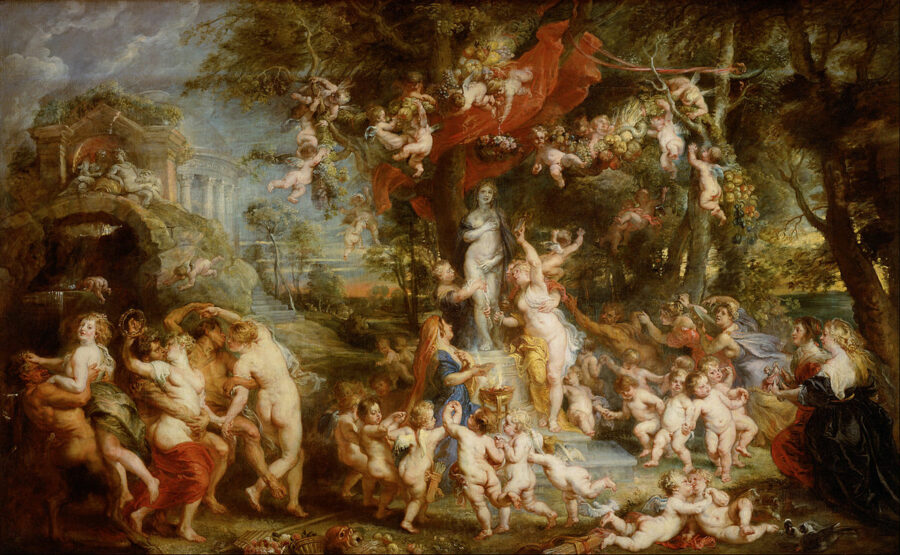
The spectators are passengers waiting for their flights, and the escaped cupid is a trick of projection mapping, created by the Belgian company SkullMapping and commissioned by the tourist agency VisitFlanders. The cupid flew until April of last year, when the paintings were replaced by work from Brueghel as part of a larger project to promote Flemish art and culture in places where people are most likely to encounter it.
Would such small-scale projection maps, “mini-mapping,” as it’s called, ever be employed in an actual gallery, to the work of revered old masters? Might this be something of an art world heresy? Or might we see in the near future huge, detailed canvases of painters like Rubens and his role model, Titian, suddenly burst into three dimensions, their subjects given life, of some kind, and invited to walk or fly around the halls?
Do these gimmicks trivialize great art or renew appreciation for it? I’d wager that, if he were alive, Rubens might thrill to see his well-fed cupids and angels in motion, and he might just take to building projection maps himself. We have some small idea, at least, of what they might look like, above.
Related Content:
Batman & Other Super Friends Sit for 17th Century Flemish Style Portraits
Artist Nina Katchadourian Creates Flemish Style Self-Portraits in Airplane Lavatory
Josh Jones is a writer and musician based in Durham, NC. Follow him at @jdmagness
Read More...Watch Sassy Justice, the New Deepfake Satire Show Created by the Makers of South Park
If any cultural, political, or technological phenomenon of the past couple of decades hasn’t been lampooned by South Park, it probably didn’t happen. But the 21st century has brought forth so much nonsense that even Trey Parker and Matt Stone, creators of that at once crude and multidimensionally satirical cartoon show, have had to expand into feature films and even onto Broadway to ridicule it all. The latest project takes the humbler but undeniably more relevant form of a Youtube series, and one modeled on the form of ultra-local television news. Sassy Justice comes hosted by anchor Fred Sassy, a flamboyant “consumer advocate” for the people of Cheyenne, Wyoming — and one possessed, come to think of it, of an oddly familiar face.
Fred Sassy is based on Sassy Trump, a creation of voice actor Peter Serafinowicz. Despite his formidable skills as an impressionist, the trouble Serafinowicz had nailing the sound and manner of the current U.S. President gave him the idea of dubbing over real footage of the man with deliberately invented character voices. This led to an interest in deepfakes, videos created using digital likenesses of real people without their actual participation.
The increasingly convincing look of these productions once had a lot of people spooked, as you’ll recall if you can cast your mind back to 2019. Deepfakes thus made perfect subject matter for a Parker-Stone project, but not long after they began collaborating with Serafinowicz on a deepfake-saturated Fred Sassy movie, the coronavirus pandemic put an end to production. From the ashes of that project rises Sassy Justice, which premiered last month.
This first episode (with a clip playlist here) also provides a glimpse of the surely enormous all-deepfake cast to come. Uncanny versions of Al Gore, Mark Zuckerberg (now a dialysis-center magnate), and Julie Andrews (as computer technician “Lou Xiang,” a reference that if you get, you get) all make appearances, as do those of White House regulars Jared Kushner, Ivanka Trump, and even Donald Trump, on whose voice Serafinowicz seems to have made progress. But “it’s impossible for a human to accurately mimic someone else’s voice to 100 percent,” as Sassy is assured by a Zoom interviewee, the oft-imitated actor Michael Caine — or is it? Less able than ever to tell real from the fake, let alone the deepfake, “we’re all going to have to trust our gut, that inner voice,” as Sassy advises in the episode’s final segment. “It’s all we have now.” But then, all effective satire is a little frightening.
Related Content:
The Zen Wisdom of Alan Watts Animated by the Creators of South Park, Trey Parker and Matt Stone
American History: An Off-Kilter 1992 Student Film from South Park Creator Trey Parker
Artificial Intelligence Creates Realistic Photos of People, None of Whom Actually Exist
Based in Seoul, Colin Marshall writes and broadcasts on cities, language, and culture. His projects include the Substack newsletter Books on Cities, the book The Stateless City: a Walk through 21st-Century Los Angeles and the video series The City in Cinema. Follow him on Twitter at @colinmarshall, on Facebook, or on Instagram.
Read More...Dr. Fauci’s Lecture from MIT’s Free Course on COVID-19: It’s Now Online
Back in September, we gave you a heads up on MIT’s free course on COVID-19. As we mentioned, “COVID-19, SARS-CoV‑2 and the Pandemic” runs from September 1, 2020 through December 8, 2020. And it features a combination of MIT faculty and guest speakers, including Dr. Anthony Fauci, covering the science of the pandemic. Since our original post, Dr. Fauci’s presentation, “Insights from the COVID-19 pandemic,” has gone online. You can watch it above. Then find all of the other lectures here.
MIT’s course has been added to the Biology section of our meta collection, 1,700 Free Online Courses from Top Universities.
If you would like to support the mission of Open Culture, consider making a donation to our site. It’s hard to rely 100% on ads, and your contributions will help us continue providing the best free cultural and educational materials to learners everywhere. You can contribute through PayPal, Patreon, and Venmo (@openculture). Thanks!
Read More...Constantly Wrong: Filmmaker Kirby Ferguson Makes the Case Against Conspiracy Theories
Discordian writer and prankster Robert Anton Wilson celebrated conspiracy theories as decentralized power incarnate. “Conspiracy is just another name for coalition,” he has a character say in The Historical Illuminatus Chronicles. According to Wilson, any sufficiently imaginative group of people can make a fiction real. Another statement of his sounds more ominous, read in the light of how we usually think about conspiracy theory: “Reality is what you can get away with.”
When historian Richard Hofstadter diagnosed what he called “the paranoid style in American politics,” he was quick to point out that it predated the “extreme right-wingers” of his time by several hundred years. Where Wilson thinks of conspiracy theory as a shining example of rational thought against a conspiracy of Kings and Popes, Hofstadter saw it as anti-Enlightenment, an extreme reaction in the U.S. to Illuminism, “a somewhat naive and utopian movement,” Hofstadter writes dismissively.
Perhaps the utopian and the paranoid style are not so easily distinguishable, in that they both “promise to deliver powerful insights, promise to transform how you see for the better,” says Kirby Ferguson, creator of the Everything is a Remix Series episode below. But no matter how dark or illuminated they may be, he suggests, all conspiracy theories share the common feature of being “constantly wrong.” Ferguson’s new film series, This is Not a Conspiracy Theory digs deeper into the “role of conspiracy theories in American culture,” he writes on his site.
Despite its ostensible subject, the project’s “ultimate purpose is to introduce people to the realms of systems science, which is where we can better understand the hidden forces that shape our lives.” Produced over eight years in an entertaining “conspiracy-like style,” the film champions skepticism and complexity over the certainty and pat, closed-circle narratives offered by conspiracists. Conspiracy theories—like the innumerable permutations of the JFK assassination, Chemtrails, or Roswell—are “too much like movies,” he says, to contain very much reality.
Ferguson’s vision of the world resembles Wilson’s, who wrote most of his work before the internet. Reality, he says, is a “massive, decentralized hive of activity.” Power and control exist, of course, but there is no man behind the curtain, no secret hierarchies. Just billions of people pulling their own levers to make things happen, creating a reality that is a sum, at any given moment, of all those lever-pulls. Are there no such thing as conspiracies? “To be sure,” as Michael Parenti argues, “conspiracy is a legitimate concept in law,” and actual conspiracies, like Watergate or Iran-Contra, “are a matter of public record.”
What differentiates suspicion about events like these from what Parenti calls “wacko conspiracy theories”? Maybe a section Ferguson left out of his “Constantly Wrong” episode at the top will illuminate. A conspiracy theory, he writes, “is a claim of secret crimes by a hidden group, and this claim is driven by a community of amateurs” who are more eager to believe than to apply critical thinking. Learn more about Ferguson’s new film here.
Related Content:
Stanley Kubrick’s Daughter Vivian Debunks the Age-Old Moon Landing Conspiracy Theory
The Paul McCartney is Dead Conspiracy Theory, Explained
Josh Jones is a writer and musician based in Durham, NC. Follow him at @jdmagness
Read More...John Waters Gives Art Collection to The Baltimore Museum Of Art in Exchange for Getting Its Bathrooms Named After Him
It’s not unusual for an institution to recognize a major benefactor’s generosity by naming something in their honor — a wing, an atrium, a library, a gymnasium, a concert hall…
But bathrooms?
It’s a fitting tribute for the Pope of Trash, filmmaker John Waters.
So fitting that he himself suggested it when donating 372 prints, paintings, and photographs from his personal collection to the Baltimore Museum Of Art.
With Harvard, the University of Pennsylvania, and the University of Colorado at Boulder, New York City’s New Museum of Contemporary Art and famed downtown performance venue Dixon Place all boasting restrooms that double as temples to philanthropy, Waters is not the first donor to be lionized in latrine form…
But he is surely the most famous, thanks to a career that spans six decades, includes numerous books and exhibitions of his photography and sculptures, in addition to his infamous cult films.
Waters got his start as an art collector at the age of 12: he spent $2 on a Joan Miró poster in the Baltimore Museum’s gift shop:
After taking it home and hanging it on my bedroom wall at my parents’ house, I realized from the hostile reaction of my neighborhood playmates that art could provoke, shock, and cause trouble. I became a collector for life. It’s only fitting that the fruits of my 60-year search for new art that could startle, antagonize, and infuriate even me, ends up where it all began—in my hometown museum.
Museum director Christopher Bedford calls Waters a “man of extraordinary refinement” as well as “a local treasure.”
Curator Asma Naeem adds that Waters’ donation, in addition to being one of the largest gifts of art in recent history, is also one of the “most personal and individualized, showing the true stamp of the donor’s taste, eye, and predilections.”
Among the 125 artists represented are Mike Kelley, Cindy Sherman, Roy Lichtenstein, Diane Arbus, Nan Goldin, Cy Twombly, Andy Warhol, and Waters himself. (The museum hosted a retrospective of his visual art two years ago.)
Waters is personally acquainted with many of the artists in his collection, and has a strong preference for early work. “They were never blue-chip artists,” he told The New York Times. “They became that later.”
In an interview with the CBC’s Carol Off, Waters reflected that he loves art that inspires outrage:
…because I’m in on it. You finally learn to see differently if you like art. And it’s a secret club. It’s like a biker gang where you learn a special language, you have to dress a certain way. I love all the ridiculous elitism about the art world. I think it’s hilarious.
In addition to the two bathrooms in the East Lobby, a rotunda in the European art galleries will also bear Waters’ name.
The museum has pledged to never deaccession the works in the collection, and Waters speculates that it’s only a matter of time until a gender-neutral bathroom bearing his name will also be made available to patrons.
“I loved going [to the BMA],” he told Baltimore Fishbowl:
When I was a kid, that was a huge world that I was turned onto. Thank God my parents took me.
Related Content:
John Waters Designs a Witty Poster for the New York Film Festival
John Waters’ RISD Graduation Speech: Real Wealth is Life without A*Holes
Ayun Halliday is an author, illustrator, theater maker and Chief Primatologist of the East Village Inky zine. Follow her @AyunHalliday.
Read More...The Biblical Sci-Fi of “Raised by Wolves”–Pretty Much Pop: A Culture Podcast #68

What happens when a male android loves a female android VERY much, and they nurse human embryos together on a distant planet after fleeing from war-torn Earth? Why the female android flies and makes a bunch of people explode with her eyes, that’s what happens! …In the first episode of this bonkers HBO Max series by Aaron Guzikowski (with notable assistance from Ridley Scott of Alien and Blade Runner fame).
Your hosts Brian Hirt, Erica Spyres, and Mark Linsenmayer reflect on how much we’re supposed to understand, what if any character we’re supposed to identify with, whether the imagery is just TOO heavy-handed, and how this show compares with related sci-fi like Westworld or post-apocalyptic shows like The Walking Dead. Beware: Spoilers abound in this one, so you might want to watch the show, or just let us reveal its weirdness to you.
Here are some articles to feast on:
- “‘Raised by Wolves’ Finale Explained by Showrunner: WTF Was That?” by Adam Chitwood
- “‘Raised by Wolves’ Showrunner Aaron Guzikowski on Crafting an Ambitious Science Fiction World” by Jack Giroux
- “‘Raised by Wolves’: Ridley Scott Explains That Monstrous Finale” by Jennifer Vineyard
- “‘Raised by Wolves’ Season 2 Theories That May (or May Not) Happen” by Meghan O’Keefe
- “5 (Spoiler-Free) Themes Underlying Season 1 of the Sci-Fi Series, ‘Raised by Wolves’” by Frumentarious at Sandboxx
- “The Aspirational Android Parenting of ‘Raised by Wolves’ ” by Lydia Kiesling
Learn more at prettymuchpop.com. This episode includes bonus discussion that you can only hear by supporting the podcast at patreon.com/prettymuchpop. This podcast is part of the Partially Examined Life podcast network.
Pretty Much Pop: A Culture Podcast is the first podcast curated by Open Culture. Browse all Pretty Much Pop posts.
Read More...Experience a Video Painting of Brian Eno’s Thursday Afternoon That Has Soothed & Relaxed Millions of People
Brian Eno may not have invented ambient music, but he did give it a name. What better to call an album like his 1978 Music for Airports, whose slowly shifting pieces forego not just melody but all then-accepted methods of composition and performance? The result, as its title suggests, is meant not to occupy the intention of the listener but to color the atmosphere of a space. This marked one evolutionary step for an idea Eno first essayed in 1975’s Discreet Music, issued on his own label Obscure Records in an era when much of the music people listened to was anything but discreet. Recording technology first made ambient music possible; by the mid-1980s, video technology had developed to the point that it could possess a visual dimension as well.
Just as Eno’s ambient music wasn’t made for listening, Eno’s “video paintings,” as he called them, weren’t made for viewing. 1981’s Mistaken Memories of Medieval Manhattan, previously featured here on Open Culture, captures the urban landscape outside from Eno’s New York window — ironically, with a portrait orientation, so that any TV displaying it had to be turned on its side.
Thursday Afternoon, the next in the series, looks not to the built environment but that other traditional subject of painting, the female form: specifically that of Eno’s friend, photographer Christine Alicino. Here video making possible something truly new, with no artistic connection to, as Eno put it, “Sting’s new rock video” or “boring, grimy ‘Video Art.’ ”
But just like a Hollywood movie, Thursday Afternoon had an eponymous soundtrack album. Released in 1985, it cut the 80-minute video painting’s ambient score down to an unbroken track of nearly 61 minutes, a length made possible by the recently introduced Compact Disc. “Played” on an acoustic piano and synthesizers, the music shifts subtly in texture throughout the hour, creating a sonic environment that many have found highly congenial for working, thinking, and relaxing. I myself have listened to it hundreds of times over the past twenty years, and in the form of a Youtube video painting made by fan Jonathan Jolly, it’s racked up more than four million views. The color-treated time-lapse footage of passing clouds fits right in with the spirit of the music, and it certainly seems to do the trick for the video’s commenters, grateful as they are for reduced anxieties, recovered memories, increased focus, and even altered consciousness.
Related Content:
A Six-Hour Time-Stretched Version of Brian Eno’s Music For Airports: Meditate, Relax, Study
Watch Brian Eno’s “Video Paintings,” Where 1980s TV Technology Meets Visual Art
Brian Eno Explains the Loss of Humanity in Modern Music
Brian Eno on Creating Music and Art As Imaginary Landscapes (1989)
The “True” Story Of How Brian Eno Invented Ambient Music
Based in Seoul, Colin Marshall writes and broadcasts on cities, language, and culture. His projects include the Substack newsletter Books on Cities, the book The Stateless City: a Walk through 21st-Century Los Angeles and the video series The City in Cinema. Follow him on Twitter at @colinmarshall, on Facebook, or on Instagram.
Read More...The Five Minute Museum: A Stop Motion Animation Shows the History of Civilization at Breakneck Speed
Experimental director and animator Paul Bush’s 2015 short film The Five-Minute Museum, above, is the dizzying antidote to standing, footsore, in front of a vitrine crowded with Ancient Greek amphoras or exquisitely crafted pocket watches and wondering, not about history, culture or the nature of time, but whether you can justify spending $15 for an underwhelming cheese and tomato sandwich in the museum cafe.
It’s a breakneck stop motion journey through the history of civilization via six museum collections—three in London and three in Switzerland.
Presented primarily as stills that flash by at a rate of 24 per second, Bush groups like objects together, “thereby allowing the triumphs of human endeavor to be seen even in far corners of the land, by the bedridden, the infirm and the lazy.”
His sense of humor asserts itself the minute an assortment of ancient shards appear to render themselves into not just a state of wholeness, but an entire up close society in close-up. It doesn’t take long for these vessels’ clashing of warriors to give way to a composite portrait of idle youth, whose flirtations are stoked by a number of manic pipers in rapid succession, and Andy Cowton’s original music and sound design.
It’s a shock when Bush slows down and pulls back to show the source objects in their museum cases, quiet as a tomb, the sort of display most visitors blow past en route to something sexier, like a dinosaur or a blockbuster exhibit requiring timed entry tickets.
Other highlights include a lively assortments of guns, hats, chairs, and plastic toys.
If you start feeling overwhelmed by the visual intensity, don’t worry. Bush builds in a bit of a breather once you hit the clocks, the bulk of which presumably hail from the Beyer Clock and Watch Museum in Zurich.
The ingenious animated short was 10 years in the making, a fact the artist modestly downplays:
It’s very simple. Simple story, a simple technique and that’s what I like. Poetry should be a little bit stupid. This is what Pushkin says, and I try and make my films a little bit stupid as well.
In addition to the Beyer Clock and Watch Museum, you’ll find the featured artifacts housed in the British Museum, the Victoria and Albert Museum, London’s Museum of the Home (formerly known as the Geffrye Museum) as well as the Lucerne Historical Museum and the Bern Historical Museum.
Expect a much slower experience.
via Aeon
Related Content:
A Virtual Tour Inside the Hayao Miyazaki’s Studio Ghibli Museum
Watch Art on Ancient Greek Vases Come to Life with 21st Century Animation
Take a Virtual Tour of 30 World-Class Museums & Safely Visit 2 Million Works of Fine Art
Ayun Halliday is an author, illustrator, theater maker and Chief Primatologist of the East Village Inky zine. Help yourself to her free downloadable poster series, encouraging citizens to wear masks. Follow her @AyunHalliday.
Read More...How Akira Kurosawa Used Movement to Tell His Stories: A Video Essay
The history books say that there were three Japanese filmmakers to emerge in the 1950s – Kenji Mizoguchi, Yasujiro Ozu and Akira Kurosawa. Never mind that Mizoguchi and Ozu made many of their best movies in the 1930s. Never mind that masterful, innovative directors like Mikio Naruse and Keisuke Kinoshita have been unfairly overshadowed by the brilliance of these three greats.
Mizoguchi was an early modernist who by the end of his career made meditative movies about how women suffer at the hands of men. His masterpieces like Ugetsu and Sansho Dayu feel like Buddhist scroll paintings come to life. Ozu, “the most Japanese” of all filmmakers, made quietly moving dramas about families, like Tokyo Story, but did so in a way that discarded such Hollywood principles as continuity editing and the 180 degree rule. Ozu was a quiet radical.
Compared to Ozu and Mizoguchi, Kurosawa’s movies are noisy, masculine and vital. Unlike Ozu, he didn’t challenge Hollywood film form but improved on it. Born roughly a decade after the other two filmmakers, Kurosawa spent his youth watching Western movies, absorbing the lessons of his cinematic heroes like John Ford, Howard Hawks and Frank Capra. At his creative height, in the 1950s and 60s, Kurosawa produced masterpiece after masterpiece. Hollywood would remake or reference Kurosawa constantly in the years that followed but few of those films had Kurosawa’s inventiveness.
Tony Zhou, who has made a career of dissecting movies in his excellent video series Every Frame a Picture, argues that the key to Kurosawa is movement. “A Kurosawa movie moves like no one else’s,” Zhou notes in his video. “Each one is a master class in different types of motion and also ways to combine them.”
Kurosawa had an innate understanding that there is inherent drama in the wind blowing in the trees. Like Andrei Tarkovsky and later Terrence Malick, he liked to place human drama squarely in the realm of nature. The rain falls, a fire rages and that movement makes an image compelling. He understood that graphic considerations outweighed psychological ones – he simplified and exaggerated a character’s movement with the frame to make character traits and emotions easy to register for the audience. His camera movements were clear, motivated and fluid. Zhou compares Seven Samurai with The Avengers. You might have thought that The Avengers was uninspired and soulless but after watching Zhou’s video, you’ll understand why – aside from the silly plot and characters – the movie was uninspired and soulless. The piece should be required viewing for filmmakers everywhere. You can watch it above.
And below you can see another video Zhou did on Kurosawa, focusing on his 1960 movie The Bad Sleep Well.
Note: This post originally appeared on our site in 2015.
Related Content:
David Lynch Lists His Favorite Films & Directors, Including Fellini, Wilder, Tati & Hitchcock
Andrei Tarkovsky Creates a List of His 10 Favorite Films (1972)
Stanley Kubrick’s List of Top 10 Films (The First and Only List He Ever Created)
Akira Kurosawa & Francis Ford Coppola Star in Japanese Whisky Commercials (1980)
Jonathan Crow is a Los Angeles-based writer and filmmaker whose work has appeared in Yahoo!, The Hollywood Reporter, and other publications. You can follow him at @jonccrow. And check out his blog Veeptopus, featuring lots of pictures of badgers and even more pictures of vice presidents with octopuses on their heads. The Veeptopus store is here.
Read More...Peter Milton Walsh of The Apartments Rejects Assembly-Line Recording: A Nakedly Examined Music Conversation (#135)
Australian singer-songwriter Peter Milton Walsh started The Apartments in the late ’70s, and our interview begins with a snippet of the opening track from, “Help” from his 1979 Return of the Hypnotist EP. He also around this time played with the Go Betweens and other groups, and released The Apartments’ first LP, The Evening Visits…and Stays for Years, in 1985, a heart-wrenching affair which made it onto the New Music Express “albums of the year” list. This led to some singles, one of which–“The Shyest Time”–made it onto the soundtrack of the 1987 John Hughes film Some Kind of Wonderful.
The band had all the moody jangling of early REM, the Smiths, and The Psychedelic Furs, with a unique front man, strong melodies, and the mood of the moment? So why (presumably) have you not heard of this group? Their 1993 album drift (the first full album since their debut) was apparently a big hit in France, but none of their work sold particularly well in the English-speaking world. As Peter reveals on this episode of Nakedly Examined Music, he didn’t much like high-pressure studio recording, resulting in whole eras of his songwriting left largely undocumented.
Personal tragedy also derailed his career from the late ’90s until the late ’00s when he returned to live performing and eventually released a couple of really devastating albums, including 2015’s No Song, No Spell, No Madrigal and the newly released In and Out of the Light.
On each episode of the Nakedly Examined Music Podcast, host Mark Linsenmayer plays four of an artist’s songs in full and discusses them with the songwriter at length. Here Mark and Peter discuss the structure and recording of two songs off the new album: “What’s Beauty to Do?” and “Where You Used to Be.” They then look back to the middle of The Apartments’ ’90s output with “Sunset Hotel” from Fête Foraine (1996), a song capturing his observations of a group of heroin addicts. Finally you’ll hear “Looking for Another Town” from that 2015 come-back album.
For more Apartments: The first come-back song was really 2011’s “Black Ribbon,” which you can watch him play solo. Perhaps my favorite song he’s done is the doom-epic “What’s Left of Your Nerve” from drift. You can watch a recent live version of “Sunset Hotel” and catch the official video for “What’s Beauty to Do.” More at theapartmentsmusic.com.
Nakedly Examined Music is a podcast hosted by Mark Linsenmayer, who also hosts The Partially Examined Life Philosophy Podcast and Pretty Much Pop: A Culture Podcast. He releases music under the name Mark Lint.
Read More...Support Us
We're hoping to rely on loyal readers, rather than erratic ads. Please click the Donate button and support Open Culture. You can use Paypal, Venmo, Patreon, even Crypto! We thank you!

About Us

Open Culture scours the web for the best educational media. We find the free courses and audio books you need, the language lessons & educational videos you want, and plenty of enlightenment in between.
Advertise With Us

FREE UPDATES!
GET OUR DAILY EMAIL
Get the best cultural and educational resources on the web curated for you in a daily email. We never spam. Unsubscribe at any time.
FOLLOW ON SOCIAL MEDIA

Open Culture editor Dan Colman scours the web for the best educational media. He finds the free courses and audio books you need, the language lessons & movies you want, and plenty of enlightenment in between.
Advertise With Us