David Sedaris Teaches Storytelling & Humor His New Masterclass
For more than 25 years, the holiday season has brought to the radio not just Christmas carols but a diaristic monologue by a writer with, in every sense, a distinctive voice. When it first aired on Morning Edition, “Santaland Diaries” made David Sedaris’ name, not that he holds the piece in esteem as high as some of his fans do. “People will say, ‘Oh, I loved that Santaland thing,’ ” Sedaris said in a recent interview, but “that thing is so clunkily written. I mean, it’s just horribly written, and people can’t even see it.” Most are “listening to the story, but they’re not paying attention to how it’s constructed, or they’re not paying attention to the words that you used. They’re not hearing the craft of it.” Sedaris fans who do hear the craft of it may well be in the target audience for a new Masterclass taught by the man himself.
Here on Open Culture we’ve previously featured Masterclasses by writers as intellectually and stylistically various as Joyce Carol Oates, Malcolm Gladwell, Margaret Atwood, and Dan Brown. But we’ve never conducted investigations into any of their writing processes in the same way we have into Sedaris’ writing process, his own view of which constitutes the core of his Masterclass’ content. “If you write about people, you have to be interested in people,” he says in the trailer above. For him that means asking unexpected questions, like “Do your children shower?” or “Who’s the drunkest customer you’ve had today?” It also means keeping a diary in which to record the answers, and with which, even more importantly, to maintain a daily writing habit.
Even now, with a full schedule of readings to give around the world, Sedaris writes every day without fail. But he also did it for fifteen years before “The Santaland Diaries” brought him the attention that got his first book published. “I meet a lot of young writers and I say, ‘Do you write every day?’ ” he mentions in one lesson. “They say, ‘No, but just — you know, I write when it strikes me.’ I don’t know. I suppose that might work for some people.” But it certainly wouldn’t work for him, nor would doing fewer than his customary twelve to eighteen rewrites of each piece. In other lessons he covers such aspects of the craft as “observing the world,” “connecting with the reader,” “ending with weight,” and “writing about loved ones.”
For that last lesson Sedaris brings in a special guest: his sister Lisa, there to talk about what it feels like to be written about by her famously observant brother. That will come as a special treat for anyone who recognizes her from all her appearances in Sedaris’ family stories, but each lesson seems to play to Sedaris’ strengths as a writer as well as a performer: he gives readings of diary entries and published pieces, but also gives his students advice on how to handle readings of their own in the future. Sedaris makes no promises that the course will bestow upon all who take it a worldview as distinctive as his, to say nothing of a fan base as lucrative as his, but it will surely make them better at “hearing the craft of it,” a skill as worthy of cultivation as it is rare. You can sign up for Sedaris’ course here.
You can take this class by signing up for a MasterClass’ All Access Pass. The All Access Pass will give you instant access to this course and 85 others for a 12-month period.
Note: If you sign up for a MasterClass course by clicking on the affiliate links in this post, Open Culture will receive a small fee that helps support our operation.
Related Content:
20 Free Essays & Stories by David Sedaris: A Sampling of His Inimitable Humor
Why David Sedaris Hates America’s Favorite Word, “Awesome”
David Sedaris Creates a List of His 10 Favorite Jazz Tracks: Stream Them Online
Steve Martin Teaches His First Online Course on Comedy
Based in Seoul, Colin Marshall writes and broadcasts on cities and culture. He’s at work on a book about Los Angeles, A Los Angeles Primer, the video series The City in Cinema, and the crowdfunded journalism project Where Is the City of the Future? Follow him on Twitter at @colinmarshall or on Facebook.
Read More...What the Great Pyramid of Giza Would’ve Looked Like When First Built: It Was Gleaming, Reflective White
The Great Pyramid at Giza—the oldest and most intact of the seven ancient wonders of the ancient world—became a potent symbol of the sublime in the 19th century, a symbol of power so absolute as to eclipse human understanding. After Napoleon’s first expedition to Giza, “Egytomania… swept through European culture and influenced the plastic arts, fashion, and design,” writes Miroslav Verner in The Pyramids: The Mystery, Culture, and Science of Egypt’s Great Monuments.
At the end of the century, Herman Melville satirized the trend that would eventually give rise to Ancient Aliens, asking in an 1891 poem, “Your masonry—and is it man’s? More like some Cosmic artisan’s.” Egyptomaniacs saw otherworldly magic in the pyramid. For Melville, it “usurped” nature’s greatness, standing as “evidence of humankind’s monumental will to power,” as Dawid W. de Villiers writes.
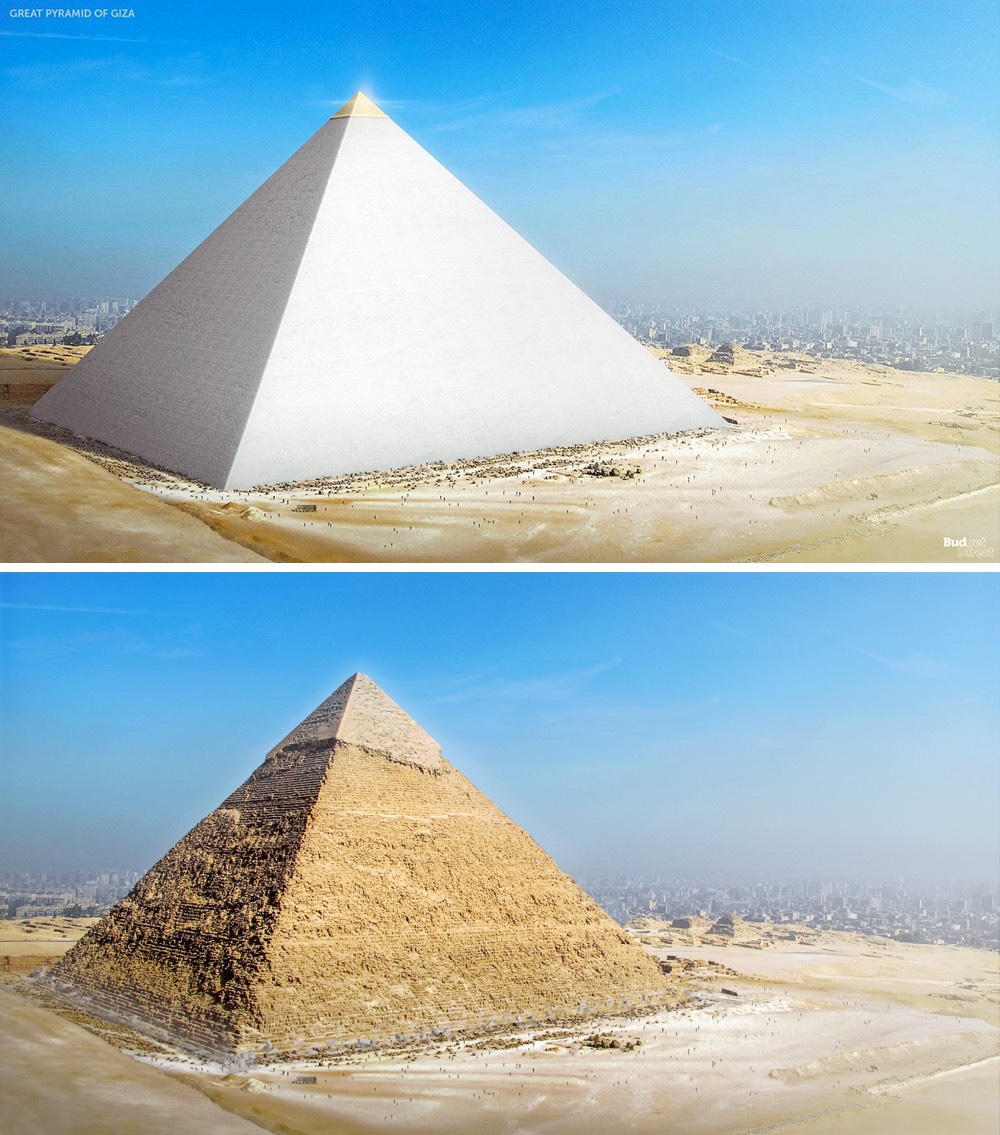
The ancient Greeks believed the pyramids were built with a massive slave labor force, a theory that has persisted. As Verner exhaustively argues in his book, however, they were not only built by humans—instead of aliens or gods—but they were constructed by tradesmen and artisans whose skills were in high demand and who were paid wages and organized under a complex bureaucracy.
And as you can see reconstructed in the Smithsonian video at the top, one of those artisanal tasks was to polish the monument’s outer limestone to a gleaming white finish that reflected “the powerful Egyptian sun with a dazzling glare.” Once the pyramid was completed, “it must have truly added to the impression of Giza as a magical port city, bathed in sunlight,” says archaeologist Mark Lehner in the clip.
In addition to its glowing, polished limestone sides, “the structure would have likely been topped with a pyramidion, a capstone made of solid granite and covered in a precious metal like gold,” writes Kottke. “No wonder they thought their rulers were gods.” Or did ancient Egyptians see the Great Pyramid as a masterpiece of human engineering, built with the skill and sweat of thousands of their compatriots?
Who can say. But it’s likely that 19th-century European explorers and artists might have characterized things differently had the Great Pyramid still scattered the sun over the desert like an ancient beacon of light instead of sitting “dumb,” as Melville wrote, stripped of its facade, waiting to have all sorts of mysterious meanings wrapped around it.
via Kottke
Related Content:
How the Egyptian Pyramids Were Built: A New Theory in 3D Animation
The Grateful Dead Play at the Egyptian Pyramids, in the Shadow of the Sphinx (1978)
Josh Jones is a writer and musician based in Durham, NC. Follow him at @jdmagness
Read More...For the First Time, Studio Ghibli’s Entire Catalog Will Soon Be Available for Digital Purchase

Some describe Studio Ghibli, the animation company founded by Hayao Miyazaki and Isao Takahata, as “the Japanese Disney.” That does justice to the true nature of neither Ghibli nor Disney, though both ventures have displayed an uncanny ability to produce beloved animated films — and beloved animated films that haven’t always been easy to see on demand. Just this past summer we featured the release of Ghibli’s Spirited Away in China, eighteen years after its premiere, but even in less politically sensitive territories, fans have had their challenges: finding a way to stream Ghibli movies, for instance, which (at least in North America) will become much easier on December 17th.
On that date, reports Variety’s Dave McNary, “GKids will release the entire Studio Ghibli catalog of animated films for digital purchase.” From Nausicaä of the Valley of the Wind and My Neighbor Totoro to From Up on Poppy Hill and The Tale of the Princess Kaguya, Ghibli’s films “will be available to purchase in both English and Japanese languages on all major digital transactional platforms.”
This marks “the first time the Studio Ghibli films will be available for digital purchase anywhere in the world,” including the studio’s homeland of Japan — a country, in any case, with a slightly different relationship to the internet than most, and one that tends to result in a preference for physical distribution over digital.
If you’ve never seriously watched Studio Ghibli’s films, don’t be fooled by the name GKids: the American distributor specializes in artisanal animation, mostly but not entirely Japanese (its catalog also includes Nina Paley’s Sita Sings the Blues), and those in charge there know full well the draw of Ghibli for demographics far beyond those still in childhood. One can fairly argue, in fact, that youngsters aren’t Ghibli’s primary audience; whereas Disney makes animation for kids that many grown-ups can enjoy, Ghibli in some sense does the opposite. The films of Miyazaki, Takahata, and Ghibli’s other stalwarts will thus make ideal material for the all-ages at-home movie marathons without which no holiday season is complete, seeing as their animated magic will arrive in the realm of on-demand not a moment too soon.
Related Content:
How the Films of Hayao Miyazaki Work Their Animated Magic, Explained in 4 Video Essays
Watch Hayao Miyazaki’s Beloved Characters Enter the Real World
Based in Seoul, Colin Marshall writes and broadcasts on cities and culture. He’s at work on a book about Los Angeles, A Los Angeles Primer, the video series The City in Cinema, and the crowdfunded journalism project Where Is the City of the Future? Follow him on Twitter at @colinmarshall or on Facebook.
Read More...Kabuki Star Wars: Watch The Force Awakens and The Last Jedi Reinterpreted by Japan’s Most Famous Kabuki Actor
The appeal of Star Wars transcends generation, place, and culture. Anyone can tell by the undiminishing popularity of the ever more frequent expansions of the Star Wars universe more than 40 years after the movie that started it all — and not just in the English-speaking West, but all the world over. The vast franchise has produced “cinematic sequels, TV specials, animated spin-offs, novels, comic books, video games, but it wasn’t until November 28 that there was a Star Wars kabuki play,” writes Sora News 24’s Casey Baseel. Staged one time only last Friday at Tokyo’s Meguro Persimmon Hall, Kairennosuke and the Three Shining Swords retells the events of recent films The Force Awakens and The Last Jedi in Japan’s best-known traditional theater form.
To even the hardest-core Star Wars exegete, Kairennosuke may be an unfamiliar name — though not entirely unfamiliar. It turns out to be the Japanese name given to the character of Kylo Ren, the power-hungry nephew of Luke Skywalker portrayed by Adam Driver in The Force Awakens, The Last Jedi, and the upcoming The Rise of Skywalker.
In Kairennosuke and the Three Shining Swords he’s played by Ichikawa Ebizō XI, not just the most popular kabuki actor alive but an avowed Star Wars enthusiast as well. “I like the conflict between the Jedi and the Dark Side of the Force,” Baseel quotes Ichikawa as saying. “In kabuki too, there are many stories of good and evil opposing each other, and it’s interesting to see how even good Jedi can be pulled towards the Dark Side by fear and worry.”
The thematic resonances between kabuki and Star Wars should come as no surprise, given all Star Wars creator George Lucas has said about the series’ grounding in elements of universal myth. Lucas also actively drew from works of Japanese art, including, as previously featured here on Open Culture, the samurai films of Akira Kurosawa. And so in Kairennosuke and the Three Shining Swords, which you can watch on Youtube and follow along in Baseel’s play-by-play description in English, we have the kind of elaborate cultural reinterpretation — bringing different eras of Western and Japanese art together in one strangely coherent mixture — in which modern Japan has long excelled. No matter what country they hail from, Star Wars fans can appreciate the highly stylized adventures of Kairennosuke, Hanzo, Reino, Sunokaku, Ruku and Reian — and of course, R2-D2 and C‑3PO.
via Neatorama
Related Content:
Watch a New Star Wars Animation, Drawn in a Classic 80s Japanese Anime Style
How Star Wars Borrowed From Akira Kurosawa’s Great Samurai Films
The Cast of Avengers: Endgame Rendered in Traditional Japanese Ukiyo‑e Style
High School Kids Stage Alien: The Play and You Can Now Watch It Online
Based in Seoul, Colin Marshall writes and broadcasts on cities and culture. He’s at work on a book about Los Angeles, A Los Angeles Primer, the video series The City in Cinema, and the crowdfunded journalism project Where Is the City of the Future? Follow him on Twitter at @colinmarshall or on Facebook.
Read More...Interactive Periodic Table of Elements Shows How the Elements Get Used in Making Everyday Things
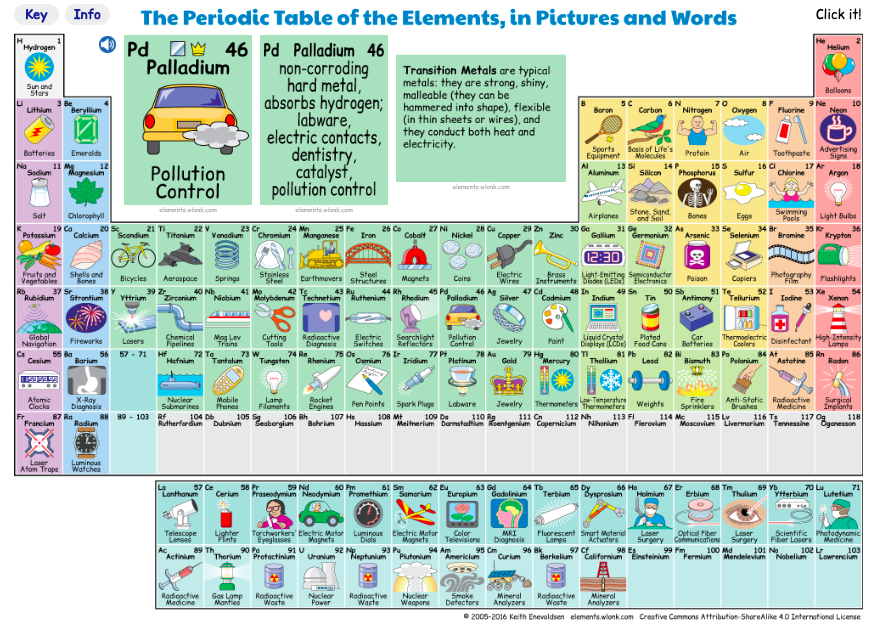
“The discovery of the periodic system for classifying the elements represents the culmination of a number of scientific developments, rather than a sudden brainstorm on the part of one individual,” writes Eric Scerri at Scientific American. And yet, while several scientists over the course of the nineteenth century invented systems for classifying the elements, “ask most chemists who discovered the periodic table and you will almost certainly get the answer Dmitri Mendeleev,” notes the Royal Society of Chemistry. That’s for good reason, since the basis of the table we know today came from the design Mendeleev created in 1869.
This past March saw the 150th anniversary of his achievement, which has hardly remained a historical artifact. Every generation has its table. Mendeleev’s rudimentary beginnings have taken on new shape and have been supplemented with annotations and illustrations in eye-catching color in textbooks and on classroom walls around the world. It’s only fitting, then, that the 21st century has its digital versions of the table, like the interactive design by Boeing software engineer Keith Enevoldsen.
The Interactive Periodic Table of the Elements, in Pictures and Words, adapts itself to different learning styles while providing students of chemistry, of all ages and levels, instant facts about each of the elements it illustrates. Click on Palladium, for example, and you’ll learn about its role in pollution control. The non-corroding hard metal absorbs hydrogen and is used in labware, electric contacts, and dentistry. Rhenium, we learn, is a dense metal used in rocket engines, heater coils, and electric contacts, among other things.
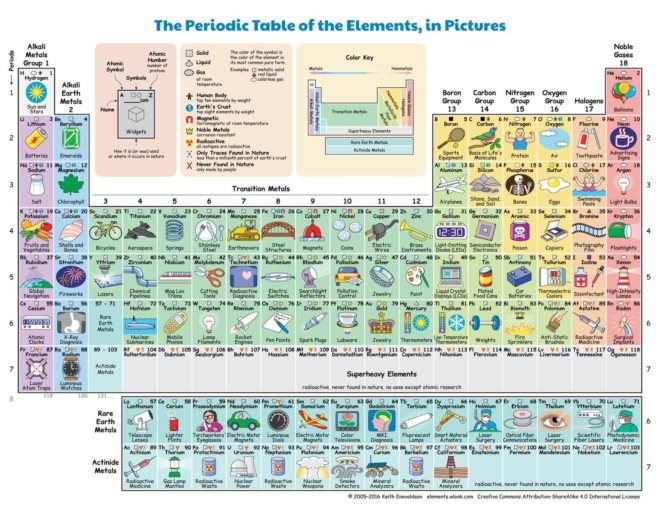
Other “seemingly obscure” elements we may never have heard of, like Gallium and Tantalum, influence our daily lives “quite a bit, it turns out,” as Lacy Cooke writes at Inhabit, serving as components in LEDs and mobile phones. We gather such facts at a glance, as well as the other endlessly useful functions of the table. Enevoldsen further adapts his designs for home or classroom use with printable PDFs, including a version with only words and a simplified table with only pictures. Beginning students may be thrilled to find print-your-own elements cards, as well as other periodic-table-related visual aids like Atomic Orbitals, a color-coded chart that “shows what atoms look like.”
The groupings on the periodic chart so familiar to us today came about when Mendeleev “realized that, by putting [the elements] in order of increasing atomic weight, certain types of element regularly occurred,” the Royal Society points out. But his “real genius… was to leave gaps for undiscovered elements. He even predicted the properties of five of these elements and their compounds.” Enevoldsen’s interactive table makes for an easy format to update. When new elements are named, he adds them to his charts immediately.
Periodic tables like Enevoldsen’s may only barely resemble Mendeleev’s spare original, but the Russian chemist’s classification system still provides the organizing principles by which we understand the fundamental elements that make up the material world. View and download PDF copies of all of these highly informative, and up-to-date periodic tables here. Or purchase posters/prints here.
via Inhabit
Related Content:
The Map of Chemistry: New Animation Summarizes the Entire Field of Chemistry in 12 Minutes
A Periodic Table Visualizing the Year & Country in Which Each Element Was Discovered
The Periodic Table of Elements Presented as Interactive Haikus
Josh Jones is a writer and musician based in Durham, NC. Follow him at @jdmagness
Read More...A New Digitized Menu Collection Lets You Revisit the Cuisine from the “Golden Age of Railroad Dining”

The coming of the railroad in the U.S. of the 19th century meant unprecedented opportunity for millions—a triumph of transportation and commerce that changed the country forever. For many more—including millions of American bison—it meant catastrophe and near extinction. This complicated history has provided a rich field of study for scholars of the period—who can tie the railroad to nearly every major historical development, from the Civil War to presidential campaigns to the spread of the Sears merchandising empire from coast to coast.

But as time wore on, passenger trains became both more commonplace and more luxurious, as they competed with air and auto travel in the early 20th century. It is this period of railroad history that most attracted Ira Silverman as a graduate student at Northwestern University in the 1960s. While enrolled at Northwestern’s Transportation Center in Evanston, Illinois, Silverman and his classmates found endless “opportunities for research, adventure, and unparalleled feasting,” writes Claire Voon at Atlas Obscura.
Silverman especially took to the dining cars—and more to the point, to the menus, which he collected by the dozens, “eventually amassing an archive of 238 menus and related pamphlets. After a long career in transit, he donated the collection to his alma mater’s Transportation Library, which recently digitized it in its entirety.” Silverman’s collection represents “35 United States and Canadian railroads,” points out Northwestern, and its contents mostly date from the early 60s to the 1980s—from his most active years riding the rails in style, that is.
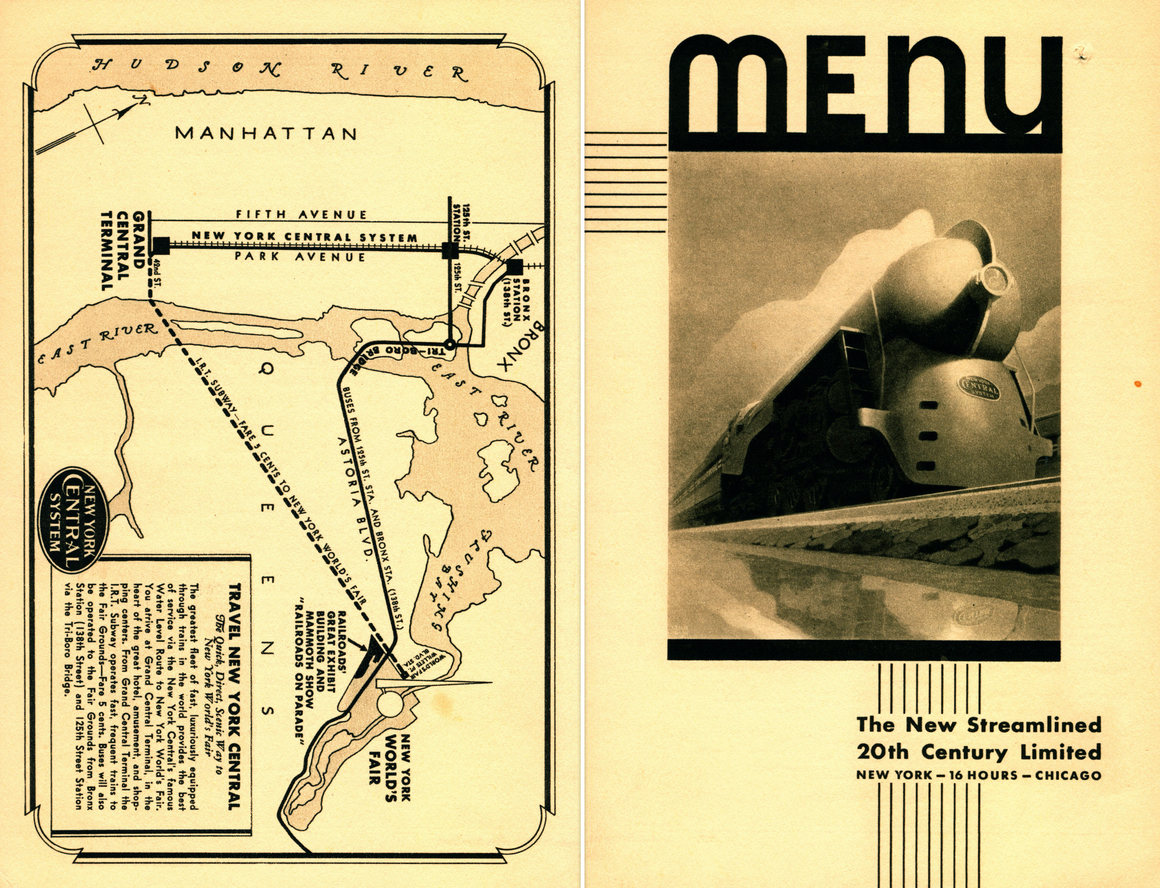
But Silverman was also able to acquire earlier examples, such as a 1939 menu “once perused by passengers aboard the famed 20th Century Limited train,” Voon writes, “which traveled between New York City and Chicago.” Twenty years after this menu’s appearance, Cary Grant, “playing an adman in Alfred Hitchcock’s North by Northwest, orders a brook trout with his Gibson” while riding the same line. The Art Deco menu for the “new streamlined” line features such delicacies as “genuine Russian caviar on toast and grilled French sardines.”

Even kids’ menus—now reliably dominated by chicken fingers, pizza, PB&Js, and mac & cheese—offered far more sophisticated dining than we might expect to find, with “items such as grilled lamb chops, roast beef, and seasonal fish” on the North Coast Limited menu below. “The mid-20th century seems to have been a golden age of railroad dining,” remarks Northwestern Transportation Librarian Rachel Cole. “It was never something that railroads profited on, but they used it to compete against each other and attract passengers,” taking pride in “selections that would be rivaled in restaurants.”
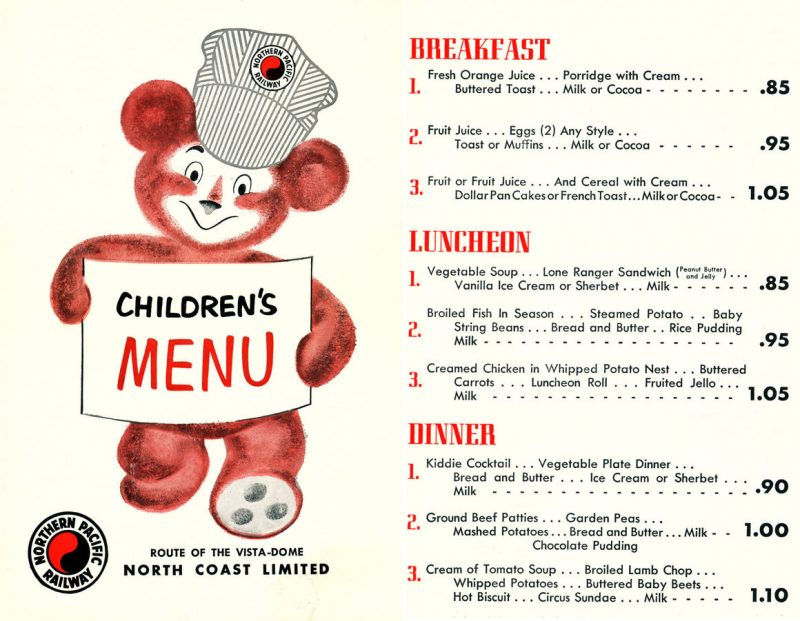
The fine dining-car experience might also include novelty items passengers would be unlikely to find anywhere else, such as Northwestern Pacific’s Great Baked Potato, “a monstrous spud,” Voon explains, “that could weigh anywhere between two to five pounds” and came served with “an appropriately sized butter pat.” One can see the appeal for a food and travel enthusiast like Silverman, who had the privilege of trying dishes on most of these menus for himself.
The rest of us will have to rely on our gustatory imaginations to conjure what it might have been like to eat prime rib on the Western Star in the Pacific Northwest in the early 60s, or braised smoked pork loin on an Amtrak train in 1972. If your memories of dining on a train mostly consist of pulling soggy, microwaved “food” from steaming hot plastic bags, or munching on packaged, processed salty snacks, expand your sense of what railroad dining could be at the Ira Silverman Railroad Menu Collection here.

Related Content:
Foodie Alert: New York Public Library Presents an Archive of 17,000 Restaurant Menus (1851–2008)
Mark Twain Makes a List of 60 American Comfort Foods He Missed While Traveling Abroad (1880)
What Prisoners Ate at Alcatraz in 1946: A Vintage Prison Menu
Josh Jones is a writer and musician based in Durham, NC. Follow him at @jdmagness
Read More...Pretty Much Pop: A Culture Podcast #21 Considers Role-Playing Video Games

What constitutes a video RPG? Is there any actual role-playing involved?
Our audio editor Tyler Hislop rejoins hosts Mark Linsenmayer, Erica Spyres, and Brian Hirt to discuss those video games that are supposed to make you feel like you’re contributing to the story, that your choices matter, in which you can maybe, you know, choose to wear a funny hat or just craft potions all day instead of advancing the plot. We compare solo vs. social games, compare video to table-top role playing, think about how we relate to the character we’re playing, and more.
We touch on Ultima, Final Fantasy, World of Warcraft, Horizon Zero Dawn, Skyrim, Fallout, Outward, Death Stranding, Erica, Hellblade: Sakura’s Sacrifice, The Witcher, and more. Also from TV: Bandersnatch, The Guild, and that D&D Key & Peele sketch.
Some sources we looked at included:
- “What Are Role-Playing Games Even? How Are They That?” by Sam Liberty
- “RPGs Took Over Every Video Game Genre” by Marc Nix
- “Why My Videogame Chooses Your Character’s Race and Gender for You” by Garry Newman
- “The History of RPGs” by Richard Cobbett
- History of Western Role-Playing Games on Wikipedia
- Video: The Evolution of RPG Games
- The Psychology of Games podcast and site
This episode includes bonus discussion that you can only hear by supporting the podcast at patreon.com/prettymuchpop. This podcast is part of the Partially Examined Life podcast network.
Pretty Much Pop: A Culture Podcast is the first podcast curated by Open Culture. Browse all Pretty Much Pop posts or start with the first episode.
Read More...160,000 Pages of Glorious Medieval Manuscripts Digitized: Visit the Bibliotheca Philadelphiensis
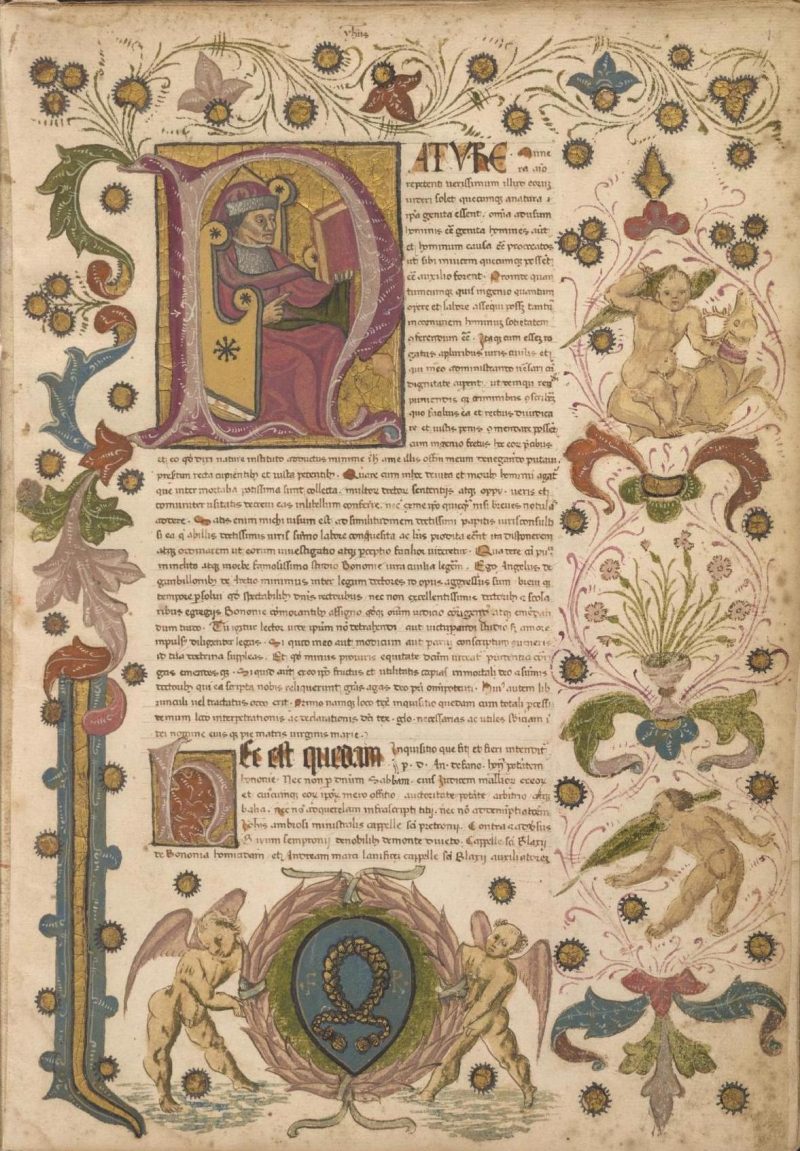
We might think we have a general grasp of the period in European history immortalized in theme restaurant form as “Medieval Times.” After all, writes Amy White at Medievalists.net, “from tattoos to video games to Game of Thrones, medieval iconography has long inspired fascination, imitation and veneration.” The market for swordplay, armor, quests, and sorcery has never been so crowded.
But whether the historical period we call medieval (a word derived from medium aevum, or “middle age”) resembled the modern interpretations it inspired presents us with another question entirely—a question independent and professional scholars can now answer with free, easy reference to “high-resolution images of more than 160,000 pages of European medieval and early modern codices”: richly illuminated (and amateurishly illustrated) manuscripts, musical scores, cookbooks, and much more.
The online project, called Bibliotheca Philadelphiensis, houses its digital collection at the Internet Archive and represents “virtually all of the holdings of PACSCL [Philadelphia Area Consortium of Special Collections Libraries],” a wealth of documents from Princeton, Bryn Mawr, Villanova, Swarthmore, and many more college and university libraries, as well as the American Philosophical Society, National Archives at Philadelphia, and other august institutions of higher learning and conservation.
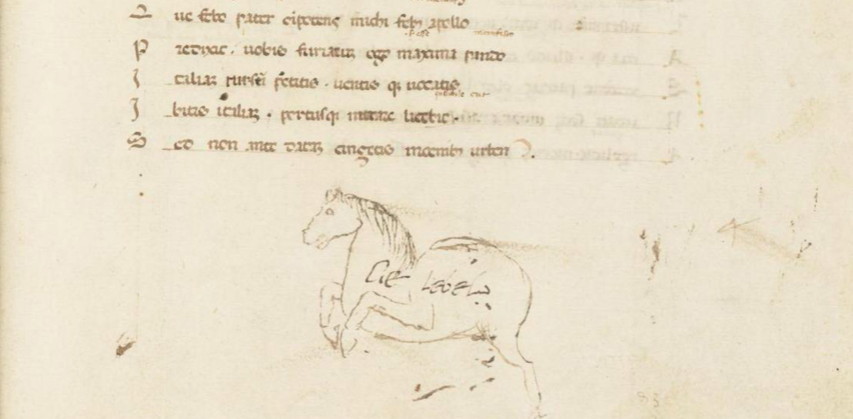
Lehigh University “contributed 27 manuscripts amounting to about 5,000 pages,” writes White, including “a 1462 handwritten copy of Virgil’s Aeneid with penciled sketches in the margins” (see above). There are manuscripts from that period like the Italian Tractatus de maleficiis (Treatise on evil deeds), a legal compendium from 1460 with “thirty-one marginal drawings in ink” showing “various crimes (both deliberate and accidental) being committed, from sword-fights and murders to hunting accidents and a hanging.”
The Tractatus’ drawings “do not appear to be the work of a professional artist,” the notes point out, though it also contains pages, like the image at the top, showing a trained illuminator’s hand. The Bibliotheca Philadelphiensis archive includes 15th and 16th-century recipes and extracts on alchemy, medical texts, and copious Bibles and books of prayer and devotion. There is a 1425 edition of Chaucer’s Canterbury Tales in Middle English (lacking the prologue and several tales).
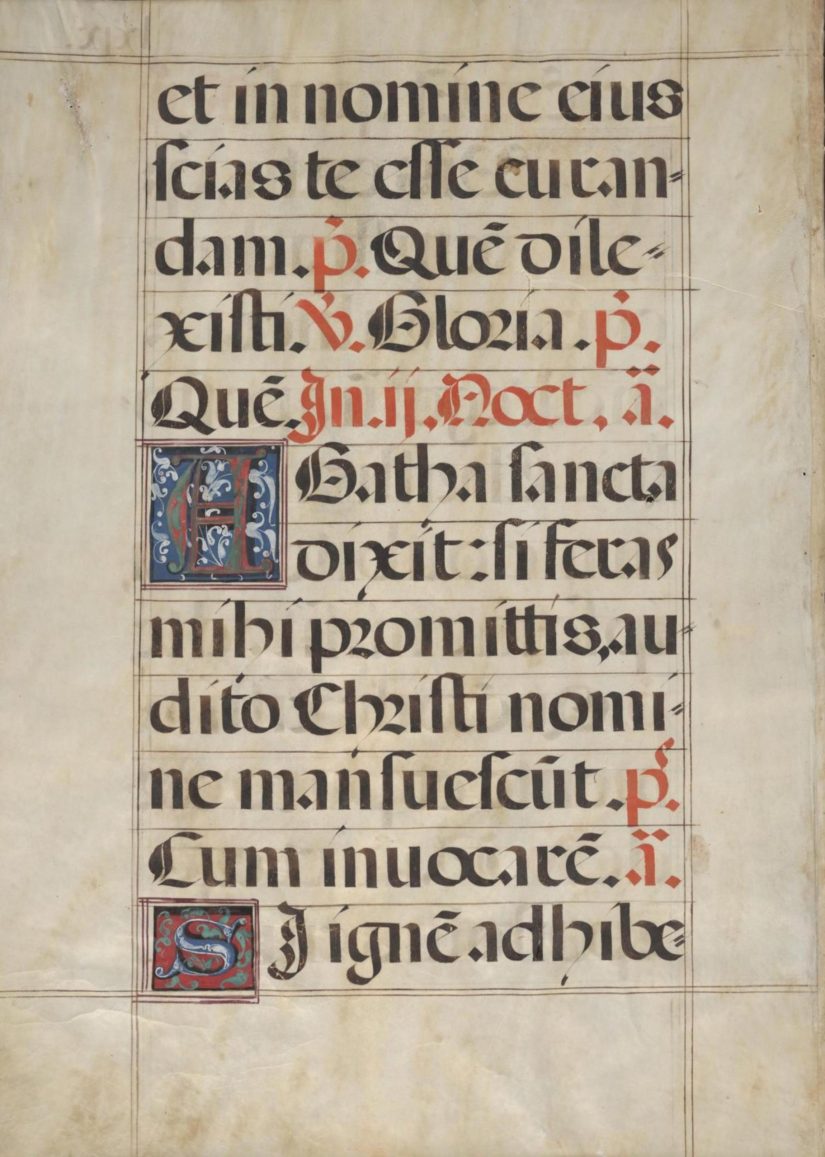
These may all seem of recent vintage, relatively speaking, for a medieval archive, but the collection reaches back to the 9th century, with hundreds of documents, like the 1000 AD music manuscript above, from a far earlier time. “Users can view, download and compare manuscripts in nearly microscopic detail,” notes White. “It is the nation’s largest regional online collection of medieval manuscripts,” a collection scholars can draw on for centuries to come to learn what life was really like—at least for the few who could read and write—in Medieval Times.
via Medievalists.net
Related Content:
Why Knights Fought Snails in Illuminated Medieval Manuscripts
The Medieval Masterpiece, the Book of Kells, Is Now Digitized & Put Online
A Free Yale Course on Medieval History: 700 Years in 22 Lectures
Josh Jones is a writer and musician based in Durham, NC. Follow him at @jdmagness
Read More...How Maslow’s Hierarchy of Needs Helps Us Understand the Meaning of Life
Abraham Maslow’s 1943 paper “A Theory of Human Motivation” was “written as pure psychology,” notes the BBC, but “it has found its main application in management theory.” It has also become one of the best-known theories of human well-being. But whether you first encountered it in an Intro Psych class or a business training seminar, you’ll immediately recognize the triangular scheme of the “hierarchy of needs,” leading upward from basic physical necessities to full self-actualization.
Maslow’s theory had great explanatory power, offering what he called a “third force” between idealism and materialism. He was in line, he wrote, with the more spiritually-minded pragmatists, or what he called “the functionalist tradition of James and Dewey… fused with the holism of Wertheimer, Goldstein, and Gestalt Psychology, and with the dynamicism of Freud and Adler.” Against the general trend in psychology to pathologize, Maslow offered his paper as “an attempt to formulate a positive theory of motivation.”
His work helped inspire managers to “shape the conditions that create people’s aspirations,” says Gerald Hodgkinson, psychologist at the Warwick Business School,” in order to influence productivity and loyalty in their employees. If this seems manipulative, perhaps Maslow can be held no more responsible than can Freud for the use of his work by his nephew Edward Bernays, who almost single-handedly invented modern advertising and propaganda using Freudian appeals.
Maslow had in mind something grander than managing human capital—“no less,” says Alain de Botton in the School of Life video above, “than the meaning of life.” His quest came itself from a personal motivation. “I was awfully curious,” he once remarked, “to find out why I didn’t go insane.” Or, as de Botton says, he wanted to know “what could make life purposeful for people, himself included, in modern-day America, a country where the pursuit of money and fame seemed to have eclipsed any more interior or authentic aspirations.”
De Botton walks us through the hierarchy, which divides into two dimensions, the material—basic biological needs (including sex) and the need for safety—and the psychological. In this last category, we find the social needs for belonging (“the love needs,” Maslow called them) and esteem, capped with the apex need—self-actualization—the realization of one’s true purpose. “A musician must make music,” wrote Maslow, “an artist must paint, a poet must write, if he is to be ultimately happy. What a man can be, he must be.”
“How do we arrange our priorities and give due regard to the different and competing claims we have on our attention?” De Botton asks. In an increasingly disembodied culture, we may ignore or neglect the needs of the body, even if we have the means to meet them, an unsustainable course over the long term. Even those on the path of the “starving artist” will sadly have to reevaluate after a time, Maslow argued, giving priority to their need to eat over their creative aspirations. But Maslow’s is not, or not only, a theory of rational choice.
On the contrary, he had a compassionate response to alienation and poverty of all kinds: “the bold postulation,” he wrote “that a man who is thwarted in any of his basic needs may fairly be envisaged simply as a sick man…. Who is to say that a lack of love is less important than a lack of vitamins?” The material needs in Maslow’s scheme must be consistently met in order to create a stable base for all the others. Yet, while self-actualization may sit at the top, its lack, according to Maslow, may still affect us as much as much if we suffered from “pellagra or scurvy.”
It’s possible to read in the hierarchy of needs a psychological elaboration of Marx’s slogan “from each according to his ability, to each according to his needs,” but Maslow was no dialectical materialist. He valued spirituality, and if he was “ambivalent about business,” he also held out hope that companies would market products to meet consumers’ higher desires as well as their needs for food, shelter, and physical comfort. Maslow died in 1970, and in the ensuing decades, his wish has become a hugely profitable reality.
From religious broadcasting companies to social media to dating and meditation apps, marketers find ever-new ways to sell promises of belonging, esteem, and self-actualization. Perhaps Maslow would see this as progress. In any case, commerce aside, his theory continues to address pressing sociological and existential problems. And as an aid to personal reflection, it can help us notice how we “haven’t arranged and balanced our needs as wisely and elegantly as we might,” says de Botton. We may have denied ourselves, or been denied, important experiences we need in order to become who we truly are.
Related Content:
The Causes & Prevalence of Suicide Explained by Two Videos from Alain de Botton’s School of Life
The Neuroscience & Psychology of Procrastination, and How to Overcome It
Josh Jones is a writer and musician based in Durham, NC. Follow him at @jdmagness
Read More...Clive James & Jonathan Miller (Both RIP) Talk Together About How the Brain Works
“Were they the last representatives of a special kind of public intellectual?” asks John Mullen in the Guardian. He writes of Clive James and Jonathan Miller, two figures who exemplified “the polymath as entertainer.” The Australian-born James became famous on the back of the television criticism that turned him into a television fixture himself. The combined TV critic and TV host also played the same dual role in the realm of poetry, and as his life and career went on — and his bibliography greatly expanded — it came to seem that there were few forms, traditions, time periods, or languages his cultural omnivorousness didn’t reach. Trained as a doctor before he redefined British comedy as a member of Beyond the Fringe, Miller retained his scientific interests, using his fame to write books and present a television show on anatomy, psychology, and language, and much more besides.
Since the deaths of both James and Miller were announced last Friday, the outpouring of tributes (most of them lamenting the seeming loss, in our time, of high-profile roles for entertaining polymaths free to move between “high” and “low”) has been accompanied by a renewed enthusiasm for both men’s considerable bodies of work.
Despite having known each other, James and Miller seem never to have explicitly collaborated on anything — except, that is, an episode of Talking in the Library, an early example of what we would now call an interview web series. Produced from 2006 to 2008, the show has James pioneering a form that has now become standard among podcasters: recording the conversations he wanted to have with his friends anyway.
In James’ case, his friends include the likes of not just Miller but Martin Amis, Ruby Wax, Ian McEwan, Stephen Fry, and Terry Gilliam. With Miller, James spends the half-hour talking science, and specifically neuroscience. Miller, who specialized in neurology while studying medicine (and who counted Oliver Sacks as a close friend since age 12), returned to the subject in the early 1980s for his book and BBC series States of Mind. Not long thereafter he returned at the age of 50 to his medical studies, diving into neuropsychology at McMaster University and becoming a research fellow at the University of Sussex.
Though James abandoned his own university studies in psychology by 1960, his curiosity about the workings of the human brain — and how it could produce all the art, literature, film, and indeed television to whose appreciation he dedicated his life — never abandoned him, as evidenced by the eagerness with which he asks questions of his more neuroscientifically savvy friend. “The brain is the most complicated thing in the universe,” says Miller, “so complicated, in fact, that by contrast the universe itself it not much more complicated than a cuckoo clock.” Fair to say that both Miller and James had the good luck to possess more complicated, or at least more interesting, brains than average — and that it’s our good luck to be able to enjoy their work in perpetuity.
Related Content:
Atheism: A Rough History of Disbelief, with Jonathan Miller
The Drinking Party, 1965 Film Adapts Plato’s Symposium to Modern Times
Join Clive James on His Classic Television Trips to Paris, LA, Tokyo, Rio, Cairo & Beyond
Your Brain on Art: The Emerging Science of Neuroaesthetics Probes What Art Does to Our Brains
Based in Seoul, Colin Marshall writes and broadcasts on cities and culture. He’s at work on a book about Los Angeles, A Los Angeles Primer, the video series The City in Cinema, and the crowdfunded journalism project Where Is the City of the Future? Follow him on Twitter at @colinmarshall or on Facebook.
Read More...Support Us
We're hoping to rely on loyal readers, rather than erratic ads. Please click the Donate button and support Open Culture. You can use Paypal, Venmo, Patreon, even Crypto! We thank you!

About Us

Open Culture scours the web for the best educational media. We find the free courses and audio books you need, the language lessons & educational videos you want, and plenty of enlightenment in between.
Advertise With Us

FREE UPDATES!
GET OUR DAILY EMAIL
Get the best cultural and educational resources on the web curated for you in a daily email. We never spam. Unsubscribe at any time.
FOLLOW ON SOCIAL MEDIA

Open Culture editor Dan Colman scours the web for the best educational media. He finds the free courses and audio books you need, the language lessons & movies you want, and plenty of enlightenment in between.
Advertise With Us


