The Isamu Noguchi Museum Puts Online an Archive of 60,000 Photographs, Manuscripts & Digitized Drawings by the Japanese Sculptor

No matter how unfamiliar you may be with the work of Isamu Noguchi, you’re likely to have encountered it, quite possibly more than once, in the form of a Noguchi table. Designed in the 1940s for the Herman Miller furniture company (in a catalog that also included the work of George Nelson, Paul László, and Charles Eames of the eponymous chair), it shows off Noguchi’s distinctive aesthetic as well as many of his most acclaimed sculptures, set designs, and public spaces. That aesthetic could only have arisen from a singular artistic life like Noguchi’s, which began in Los Angeles where he was born to an American mother and a Japanese father, and soon started crossing back and forth across both the Pacific and the Atlantic: a childhood spent around Japan, schooling and apprenticeship back in the U.S., a Guggenheim Fellowship in Paris, periods of study in China and Japan — and all that before age 30.

Now, thanks to the Noguchi Museum, we can take a closer look at not just the Noguchi table but all the fruits of Noguchi’s long working life, which began in the 1910s and continued until his death in the 1980s. (He executed his first notable work, the design of the garden for his mother’s house in Chigasaki, at just eight years old.)
The institution that bears his name recently digitized and made available 60,000 archival photographs, manuscripts, and digitized drawings, and also launched a digital catalogue raisonné designed to be updated with discoveries still to come about Noguchi’s life and work. “The completion of a multiyear project, the archive now features 28,000 photographs documenting the artist’s works, exhibitions, various studios, personal photographs, and influential friends and colleagues,” writes Hyperallergic’s Alissa Guzman. “The wealth of imagery is overwhelming and also surprising, bringing attention to works we might not often associate with Noguchi.”

Indeed, as the project’s managing editor Alex Ross tells Guzman, the research process revealed “several significant artworks which were assumed to have been lost or destroyed,” as well as “previously unattributed pieces that the archive is now able to confirm as works by Noguchi.” The difficulty of confirming the authenticity of certain works speaks to the protean quality of Noguchi’s art that goes hand-in-hand with its distinctiveness, a balance struck by few major artists of any era. And though quite a few of Noguchi’s creations (and not just the table) have been described as timeless, no other body of work reflects quite so clearly the intermingling of East and West – a West that included the Old World as well as the New — that, having begun on economic and social levels, reached the aesthetic one in the century through which Noguchi lived. Explore his catalogue raisonné, and you may find that, no matter what part of the world you’re from, you have more experience with Noguchi’s work than you thought.

via Hyperallergic
Related Content:
The Getty Digital Archive Expands to 135,000 Free Images: Download High Resolution Scans of Paintings, Sculptures, Photographs & Much Much More
Download 2,500 Beautiful Woodblock Prints and Drawings by Japanese Masters (1600–1915)
Based in Seoul, Colin Marshall writes and broadcasts on cities, language, and culture. His projects include the book The Stateless City: a Walk through 21st-Century Los Angeles and the video series The City in Cinema. Follow him on Twitter at @colinmarshall or on Facebook.
Read More...Watch the Hot Guitar Solos of Sister Rosetta Tharpe, “America’s First Gospel Rock Star”
Many of us first encounter Sister Rosetta Tharpe—now deservedly known as the “Godmother of Rock and Roll”—in footage from her 1964 appearance on a Manchester railway platform. She arrives by carriage, struts out before a dilapidated train station, plugs in her custom Gibson SG, and belts out in her powerful soprano, “Didn’t it rain, children!” for an audience of spellbound Brits. The televised performance, part of The American Folk Blues Festival that toured the country between 1963 and 1966, made a significant impression on blues and rock guitarists of the Invasion generation.
Yet Tharpe’s influence extends a generation further back, to rock and roll’s acknowledged forefathers. She was 49 when Keith Richards and Eric Clapton had the chance to see her on TV, and had been touring Europe since 1957, reviving a career she launched in 1938 when she released her first single, “Rock Me,” and took the stage as a regular performer at the Cotton Club.
Born Rosetta Nubin in Arkansas in 1915, she started performing in churches and revivals at 6, and scandalized many of her gospel fans by singing secular music. But her forceful, soaring voice and innovative guitar playing mostly drew them back again, along with thousands of secular admirers.
She was a rock and roll pioneer in every respect: a gospel singer who crossed over onto the popular charts, a black queer woman playing the fierce lead for mixed audiences during segregation, fronting touring bands that included the all-white Jordanaires, best known for later backing Elvis. She was “America’s first gospel rock star,” notes the Rock & Roll Hall of Fame introduction above, before there were such things as rock stars. Her 1945 single “Strange Things Happening Every Day,” with its “hot guitar solo,” Will Hermes writes at Rolling Stone, “was the first gospel single to cross over on the Billboard race charts” and is sometimes cited as the first rock and roll song.
The following year, she met singer and piano player Marie Knight. The two became lovers, recorded “Up Above My Head,” and toured together in the late 40s as a team before Tharpe married her third husband at Washington, D.C.’s Griffith Stadium in front of 25,000 fans. At the height of her fame, “she influenced innumerable… people who we recognize as foundational figures in rock and roll,” says biographer Gayle Wald. Johnny Cash named her as his favorite singer. “Everyone from Jerry Lee Lewis to Aretha Franklin” to Little Richard “credit her musicianship as an important influence on them,” writes Erin White at Afropunk.
But it was her guitar skills that most awed musicians like Chuck Berry and Elvis. Presley “loved Sister Rosetta,” the Jordanaires’ Gordon Stoker remembers, especially her playing. “That’s what really attracted Elvis: her pickin’.” Tharpe’s style contains within it a treasury of the early 20th-century American popular music that would transmute into R&B, rockabilly, and rock and roll—from western swing to country to gospel to jazz to the blues. At the top of the post, see a compilation of solos from her televised appearances, including some serious shredding in later concerts in the late sixties, broadcast in color.
Tharpe continued to tour the continent until 1970, when she played her last concert in Copenhagen. She died three years later, nearly obscure in her home country, her legacy overshadowed by male artists. But we should hear her in Chuck Berry’s first records, and “when you see Elvis Presley singing early in his career,” says Wald, “imagine he is channeling Sister Rosetta Tharpe.” Thanks to revived interest in Tharpe herself—from Wald’s 2008 biography to her 2018 induction in the Rock & Roll Hall of Fame—the “Godmother of Rock and Roll” continues inspiring new players to pick up the guitar, especially those who aren’t used to seeing guitarists who look like them in guitar hero history.
Related Content:
Watch Rock Pioneer Sister Rosetta Tharpe Wow Audiences With Her Gospel Guitar
Revisit The Life & Music of Sister Rosetta Tharpe: ‘The Godmother of Rock and Roll’
New Web Project Immortalizes the Overlooked Women Who Helped Create Rock and Roll in the 1950s
Muddy Waters and Friends on the Blues and Gospel Train, 1964
Josh Jones is a writer and musician based in Durham, NC. Follow him at @jdmagness.
Read More...Watch Life-Affirming Performances from David Byrne’s New Broadway Musical American Utopia
It’s time, writes Kim Stanley Robinson in his essay “Dystopia Now,” to put aside the dystopias. We know the future (and the present) can look bleak. “It’s old news now,” and “perhaps it’s self-indulgence to stay stuck in that place any more.” Of course, David Byrne has never been a dystopian artist. Even his catchy deconstructions of the banality of modern life, in “This Must Be the Place,” for example—or Love Lies Here, his disco musical about Imelda Marcos—are filled with empathetic poignancy and an earnest desire to rehumanize contemporary culture.
Still his oblique take on things has always seemed too skewed to call utopian. Lately, however, Byrne has become unambiguously sunny in his outlook, and not in any kind of starry-eyed Pollyannish way. His web project Reasons to Be Cheerful backs up its optimistic title with incisive longform investigative journalism.
His latest stage project, the musical American Utopia, which he performs with a cast of dancers and musicians from around the world, announces its intentions on the sleeves of the matching monochromatic suits its cast wears.
Barefoot and holding their instruments, Byrne and his backup singers, musicians, and dancers march on the “Road to Nowhere” with smiles hinting it might actually lead to someplace good, They perform this song (see them on Jimmy Fallon at the top), and a couple dozen more from Talking Heads and Byrne solo albums, especially last year’s American Utopia. In the course of the show, Byrne “lets his moralist outrage explode” yet “balances it with levity,” writes Stacey Anderson at Pitchfork. “There is a political engine to this performance… with a clearly humming progressive core… but Byrne’s goal is to urge kinder consideration of how we process the stressors of modernity.”
The musical doesn’t simply urge, it enacts, and proclaims, in spoken interludes, the story of an individual who opens up to the wider world. “Here’s a guy who’s basically in his head at the beginning,” Byrne told Rolling Stone. “And then by the end of the show he’s a very different person in a very different place.” The road to utopia, Byrne suggests, takes us toward community and out of isolation. American Utopia’s minimalist production communicates this idea with plenty of polished musicianship—especially from its six drummers working as one—but also a rigorous lack of spectacle. “I think audiences appreciate when nobody’s trying to fool them,” says Byrne.
See several performances from American Utopia, the musical, above, from The Tonight Show Starring Jimmy Fallon, Late Night with Stephen Colbert, and the Hudson Theatre, where it’s currently running. The musical debuted in England last June, causing NME to exclaim it may “just be the best live show of all time.” Its Broadway run has received similar acclaim. Below, see a trailer for the show arriving just in time, The Fader announces in a blurb, to “fight your cynicism.”
Related Content:
David Byrne Creates a Playlist of Eclectic Music for the Holidays: Stream It Free Online
Josh Jones is a writer and musician based in Durham, NC. Follow him at @jdmagness
Read More...The Cameraman’s Revenge (1912): The Truly Weird Origin of Modern Stop-Motion Animation
These days, ever more ambitions computer-animated spectacles seem to arrive in theaters every few weeks. But how many of them capture our imaginations as fully as works of the thoroughly analog art of stop-motion animation? The uncanny effect (and immediately visible labor-intensiveness) of real, physical puppets and objects made to move as if by themselves still captivates viewers young and old: just watch how the Wallace and Gromit series, Terry Gilliam’s Monty Python shorts, The Nightmare Before Christmas, and even the original King Kong as well as Ray Harryhausen’s monsters in Jason and the Argonauts and The 7th Voyage of Sinbad have held up over the decades.
The filmmakers who best understand the magic of cinema still use stop-motion today, as Wes Anderson has in The Fantastic Mr. Fox and Isle of Dogs. They all owe something to a Polish-Russian animator of the early-to-mid-20th century by the name of Ladislas Starevich. Longtime Open Culture readers may remember the works of Starevich previously featured here, including the Goethe adaptation The Tale of the Fox and the much earlier The Cameraman’s Revenge, a tale of infidelity and its consequences told entirely with dead bugs for actors. Starevich, then the Director of the Museum of Natural History in Kaunas, Lithuania, pulled off this cinematic feat “by installing wheels and strings in each insect, and occasionally replacing their legs with plastic or metal ones,” says Phil Edwards in the Vox Almanac video above.
“How Stop Motion Animation Began” comes as a chapter of a miniseries called Almanac Hollywouldn’t, which tells the stories of “big changes to movies that came from outside Hollywood.” It would be hard indeed to find anything less Hollywood than a man installing wheels and strings into insect corpses at a Lithuanian museum in 1912, but in time The Cameraman’s Revenge proved as deeply influential as it remains deeply weird. Starevich kept on making films, and singlehandedly furthering the art of stop-motion animation, until his death in France (where he’d relocated after the Russian Revolution) in 1965.
And though Starevich may not be a household name today, Edwards reveals while tracing the subsequent history of stop-motion animation that cinema hasn’t entirely failed to pay him tribute: Anderson’s The Fantastic Mr. Fox is in a sense a direct homage to The Tale of the Fox, and Gilliam has called Starevich’s work “absolutely breathtaking, surreal, inventive and extraordinary, encompassing everything that Jan Svankmajer, Walerian Borowczyk and the Quay Brothers would do subsequently.” He suggests that, before we enter the “mind-bending worlds” of more recent animators, we “remember that it was all done years ago, by someone most of us have forgotten about now” — and with little more than a few dead bugs at that.
Related Content:
The Mascot, a Pioneering Stop Animation Film by Wladyslaw Starewicz
The History of Stop-Motion Films: 39 Films, Spanning 116 Years, Revisited in a 3‑Minute Video
Ray Harryhausen’s Creepy War of the Worlds Sketches and Stop-Motion Test Footage
Based in Seoul, Colin Marshall writes and broadcasts on cities, language, and culture. His projects include the book The Stateless City: a Walk through 21st-Century Los Angeles and the video series The City in Cinema. Follow him on Twitter at @colinmarshall or on Facebook.
Read More...Hannah Arendt Explains Why Democracies Need to Safeguard the Free Press & Truth … to Defend Themselves Against Dictators and Their Lies

Image by Bernd Schwabe, via Wikimedia Commons
Two of the most trenchant and enduring critics of authoritarianism, Hannah Arendt and Theodor Adorno, were also both German Jews who emigrated to the U.S. to escape the Nazis. The Marxist Adorno saw fascist tendencies everywhere in his new country. Decades before Noam Chomsky coined the concept, he argued that all mass media under advanced capitalism served one particular purpose: manufacturing consent.
Arendt landed on a different part of the political spectrum, drawing her philosophy from Aristotle and St. Augustine. Classical democratic ideals and an ethics of moral responsibility informed her belief in the central importance of shared reality in a functioning civil society—of a press that is free not only to publish what it wishes, but to take responsibility for telling the truth, without which democracy becomes impossible.
A press that disseminates half-truths and propaganda, Arendt argued, is not a feature of liberalism but a sign of authoritarian rule. “Totalitarian rulers organize… mass sentiment,” she told French writer Roger Errera in 1974, “and by organizing it articulate it, and by articulating it make the people somehow love it. They were told before, thou should not kill; and they didn’t kill. Now they are told, thou shalt kill; and although they think it’s very difficult to kill, they do it because it’s now part of the code of behavior.”
This breakdown of moral norms, Arendt argued, can occur “the moment we no longer have a free press.” The problem, however, is more complicated than mass media that spreads lies. Echoing ideas developed in her 1951 study The Origins of Totalitarianism, Arendt explained that “lies, by their very nature, have to be changed, and a lying government has constantly to rewrite its own history. On the receiving end you get not only one lie—a lie which you could go on for the rest of your days—but you get a great number of lies, depending on how the political wind blows.”
Bombarded with contradictory and often incredible claims, people become cynical and give up trying to understand anything. “And a people that no longer can believe anything cannot make up its mind. It is deprived not only of its capacity to act but also of its capacity to think and to judge. And with such a people you can then do what you please.” The statement was anything but theoretical. It’s an empirical observation from much recent 20th century history.
Arendt’s thought developed in relation to totalitarian regimes that actively censored, controlled, and micromanaged the press to achieve specific ends. She does not address the current situation in which we find ourselves—though Adorno certainly did: a press controlled not directly by the government but by an increasingly few, and increasingly monolithic and powerful, number of corporations, all with vested interests in policy direction that preserves and expands their influence.
The examples of undue influence multiply. One might consider the recently approved Gannett-Gatehouse merger, which brought together two of the biggest news publishers in the country and may “speed the demise of local news,” as Michael Posner writes at Forbes, thereby further opening the doors for rumor, speculation, and targeted disinformation. But in such a condition, we are not powerless as individuals, Arendt argued, even if the preconditions for a democratic society are undermined.
Though the facts may be confused or obscured, we retain the capacity for moral judgment, for assessing deeper truths about the character of those in power. “In acting and speaking,” she wrote in 1975’s The Human Condition, “men show who they are, reveal actively their unique personal identities…. This disclosure of ‘who’ in contradistinction to ‘what’ somebody is—his qualities, gifts, talents, and shortcomings, which he may display or hide—is implicit in everything somebody says and does.”
Even if democratic institutions let the free press fail, Arendt argued, we each bear a personal responsibility under authoritarian rule to judge and to act—or to refuse—in an ethics predicated on what she called, after Socrates, the “silent dialogue between me and myself.”
Read Arendt’s full passage on the free press and truth below:
The moment we no longer have a free press, anything can happen. What makes it possible for a totalitarian or any other dictatorship to rule is that people are not informed; how can you have an opinion if you are not informed? If everybody always lies to you, the consequence is not that you believe the lies, but rather that nobody believes anything any longer. This is because lies, by their very nature, have to be changed, and a lying government has constantly to rewrite its own history. On the receiving end you get not only one lie—a lie which you could go on for the rest of your days—but you get a great number of lies, depending on how the political wind blows. And a people that no longer can believe anything cannot make up its mind. It is deprived not only of its capacity to act but also of its capacity to think and to judge. And with such a people you can then do what you please.
via Michio Kakutani
Related Content:
Josh Jones is a writer and musician based in Durham, NC. Follow him at @jdmagness
Read More...Prisons Around the U.S. Are Banning and Restricting Access to Books

“We live,” wrote philosopher Alain Badiou, “in a contradiction.” Dehumanization must be normalized in order to keep the economy going. “A brutal state of affairs… where all existence is evaluated in terms of money alone—is presented to us as ideal.” Yet the market that promises freedom just as often strips it away, in public-private partnerships that bring censorship and rent-seeking into happy symbiosis.
In recent years, free market opportunism has taken hold in the most unfree places in the U.S., the country’s prisons, which hold more people proportionally than in any other nation in the world: a huge, previously untapped market for sales of hygiene products and visits with family. “Like the military,” writes Adam Bluestein at Inc., “the corrections system is a big, well-capitalized customer.”
One recent commercial encroachment on prisoners’ freedoms arrived this year when the West Virginia Division of Corrections issued inmates tablets, under a contract with a company called Global Tel Link, who charge them by the minute to read books online. One might make the argument that forcing inmates to pay for basic needs satisfies some ideal of punishment. But to restrict access to books seems to dispense with the pretense that prison might also be a place of rehabilitation.
“Any inmates looking to read Moby Dick,” reports Reason, “may find that it will cost them far more than it would have if they’d simply gotten a mass market paperback.” Katy Ryan of the Appalachian Prison Book Project, which donates free books and materials to prisons, points out how limiting the scheme is: “If you pause to think or reflect, that will cost you. If you want to reread a book, you will pay the entire cost again.”
West Virginia is not banning print books, purchased or donated. It is, however, charging inmates for already free material. The books they pay per minute to read online are all on Project Gutenberg, the open platform for thousands of free eBooks. That the program amounts to a kind of economic-based censorship may hardly be coincidence. Other states around the country have begun limiting, or outright banning, books in prisons.
The Washington State Department of Corrections has prohibited all books donated by nonprofits, presumably because they might be used to smuggle contraband. Prison officials at the Danville Correctional Center in Illinois made clear what they considered contraband—books about black history, 200 of which were removed from the prison library—including W.E.B. Du Bois The Souls of Black Folk and Harriet Beecher Stowe’s Uncle Tom’s Cabin—after they were deemed “too racial.”
These are only a few examples of a widespread phenomenon PEN America details in a new report, “Literature Locked Up: How Prison Book Restriction Policies Constitute the Nation’s Largest Book Ban.” Paradoxically, some restrictions can seem at odds with market demands—such as limits on inmates’ ability to order books from online retailers. But like many contradictions in the system, perhaps these also serve a larger goal—preventing prisoners from educating themselves may ensure a steady stream of repeat customers in the hugely profitable carceral industry.
Related Content:
Inmates in New York Prison Defeat Harvard’s Debate Team: A Look Inside the Bard Prison Initiative
On the Power of Teaching Philosophy in Prisons
Josh Jones is a writer and musician based in Durham, NC. Follow him at @jdmagness.
Read More...Doris Kearns Goodwin Teaches U.S. Presidential History & Leadership
FYI: Presidential historian Doris Kearns Goodwin–author of Leadership: In Turbulent Times, Team of Rivals: The Political Genius of Abraham Lincoln, and No Ordinary Time: Franklin & Eleanor Roosevelt–has just released a new online course on MasterClass. Here’s the ground that the course covers:
Altogether, she’s spent more than 50 years studying great American presidents and leaders of the past, writing several award-winning, bestselling biographies, including No Ordinary Time: Franklin and Eleanor Roosevelt: The Home Front in World War II, which won the Pulitzer Prize for History. Now she’s sharing her knowledge and teaching you to lead like a president.
In Doris’s MasterClass, you can learn to develop the characteristics and human skills of exceptional American leadership, from Lincoln to Obama. Doris brings to life the stories and experiences of four presidents she knows by heart—Lincoln, Teddy Roosevelt, FDR, and LBJ—and shares a template of human skills that make great leaders: humility, empathy, resilience, self-awareness, self-reflection, the ability to create a team and communicate through stories, and sharing your ambition for the greater good. She also uses examples from other historical figures, including Eleanor Roosevelt, Winston Churchill, and Martin Luther King Jr., to teach effective leadership qualities and practical wisdom for every day. Learn how to make better decisions, manage a crisis, and get a message across, whether you’re interacting with the media, communicating to a team at work, or delivering a speech meant to inspire and empower thousands of people.
In this class, you’ll learn about:
• Developing emotional intelligence
• Experiences and stories of U.S. presidents
• Building resilience
• Building and leading a team
• Making better decisions, big or small
• Navigating a crisis
• Delivering a message and considering an audience
• The power of speeches
• Replenishing your energy
• Civic engagement
You can sign up for Kearns Goodwin’s course here.
As a free unrelated bonus, you can stream Kearns Goodwin’s long interview with Tim Ferris. There, she takes an engaging look at the leadership skills of four American presidents–Lincoln, FDR, Teddy Roosevelt and LBJ. It’s well worth a listen…
FYI: If you sign up for a MasterClass course by clicking on the affiliate links in this post, Open Culture will receive a small fee that helps support our operation.
Related Content:
Free Online History Courses
How to Take Every MasterClass Course For Less Than a Cup of Good Coffee
The 2,000+ Films Watched by Presidents Nixon, Carter & Reagan in the White House
Read More...
London Calling: A New Museum Exhibition Celebrates The Clash’s Iconic Album
In 1983, Rolling Stone proclaimed it the year of the “second British Invasion,” a “golden age” of music from the likes of Duran Duran, Spandau Ballet, Culture Club, the Human League, Depeche Mode, and other radio-friendly synth pop hitmakers. The label stuck. Thirty years later, CBS News commemorated the year “a slew of [New Wave] acts came over to the states with their synthesizer-driven/R&B‑inspired music.”
Amidst this frenzy of praise, no one mentions the Clash, who played their final show in 1983. The year previous they hit number 8 on the Billboard Hot 100 with “Rock the Casbah.” Combat Rock arguably proved that punk was still relevant in the early 1980s, though a punk transfigured into dancefloor-friendly funk, dub, and spoken word experimentation. Just as arguably, the Clash should be properly seen as leaders of the true second British Invasion—an invasion of British punk and post-punk bands in the late 70s.
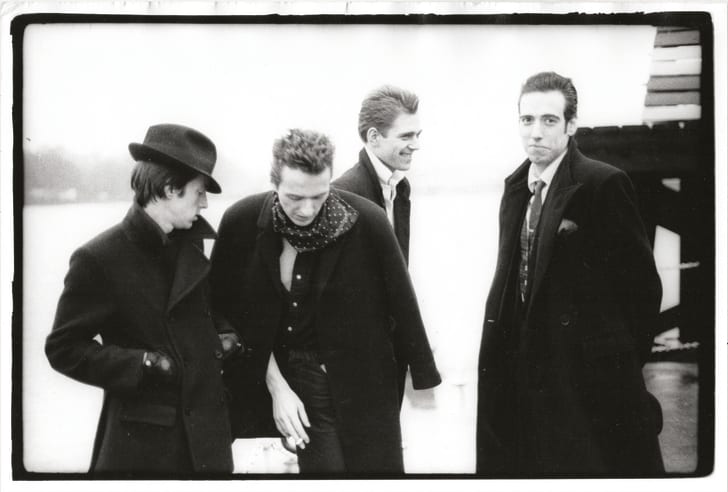
Four charming lads who’d grown up playing in the clubs, they spoke a working-class idiom, wrote in a number of different voices, took a consistently anti-war stance, and took punk where it had not gone before with studio and world music experiments. One needn’t compare their 1979 double album London Calling to Sgt. Pepper’s—though it does top several critics best-of-all-time lists—to see its similar influence on contemporary music.
Its title track even hit number 30 on the Billboard Disco Top 100 chart in 1980, a move that helped open the door for several dozen punk-inspired British New Wave bands to come. London Calling wasn’t universally beloved. The commercial aims and more polished delivery divided punk fans, and some critics panned the album. None of that has mattered at all to the millions of devoted fans worldwide. Its iconic cover has become just as recognizable as the original that inspired it.
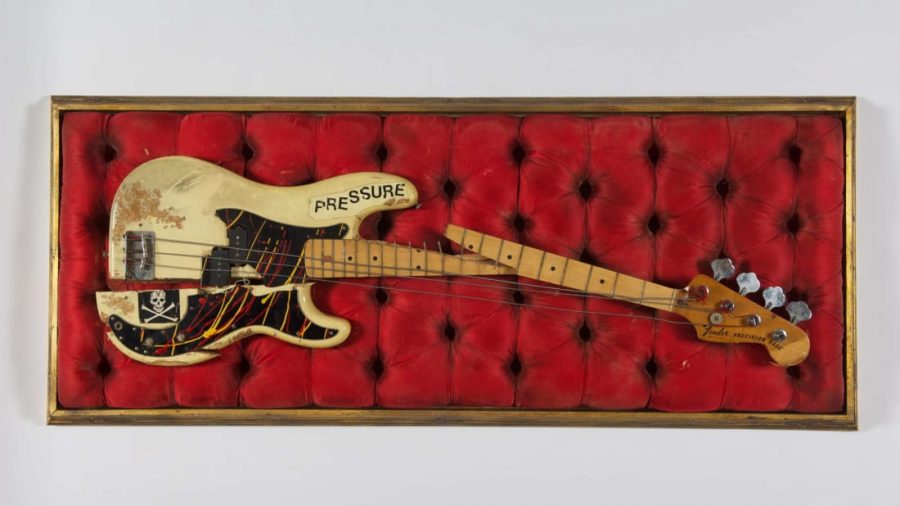
Now, and until April 2020, truly devoted fans can experience that album as no one has before by seeing in person, the actual Fender Precision bass that Paul Simenon smashed in the cover photo—only one of the many historic artifacts on display at the Museum of London in a free exhibition celebrating the album’s 40th anniversary. Visitors can also see “Mick Jones’s 1950s Gibson ES-295,” writes Ellen Gotoskey at Mental Floss, “Joe Strummer’s white 1950s Fender Esquire,” and a pair of Topper Headon’s drumsticks.
Also on display are “sketches from artist Ray Lowry that depict scenes from the London Calling tour,” as well as an early sketch by Lowry of the album cover, and “photos taken by Pennie Smith (who snapped the London Calling cover image).” Viewers can see Strummer’s typewriter, his notebook from the rehearsal and recording of the record, and Simenon’s weathered late-70s leather jacket.
The exhibition may be free, but tickets to London are pricey. Still, fans can play along at home with the London Calling Scrapbook, a 120-page hardback book full of archival material and included in Sony’s anniversary re-release of the album. But no lover of the Clash is without their own copy of London Calling. Put it on in celebration and judge whether, as the Museum of London writes, its “music and lyrics remain as relevant today as they were on release.”
via Mental Floss
Related Content:
Hear The Clash’s Vanilla Tapes, Demos of Nearly Every Song From London Calling
“Stay Free: The Story of the Clash” Narrated by Public Enemy’s Chuck D: A New 8‑Episode Podcast
The Clash Play Their Final Show (San Bernardino, 1983)
Josh Jones is a writer and musician based in Durham, NC. Follow him at @jdmagness
Read More...What Is Higher Consciousness?: How We Can Transcend Our Petty, Day-to-Day Desires and Gain a Deeper Wisdom
Each of us has a normal state of mind, as well as our own way of reaching a different state of mind. As the School of Life video above reminds us, such habits go back quite deep into recorded history, to the eras when, then as now, “Hindu sages, Christian monks and Buddhist ascetics” spoke of “reaching moments of ‘higher consciousness’ – through meditation or chanting, fasting or pilgrimages.” In recent years, the practice of meditation has spread even, and perhaps especially, among those of us who don’t subscribe to Buddhism, or indeed to any religion at all. Periodic fasting has come to be seen as a necessity in certain circles of wealthy first-worlders, as has “dopamine fasting” among those who feel their minds compromised by the distractions of high technology and social media. (And one needs only glance at that social media to see how seriously some of us are taking our pilgrimages.)
Still, on top of our mountain, deep into our sitting-and-breathing sessions, or even after having consumed our mind-altering substance of choice, we do feel, if only for a moment, that something has changed within us. We understand things we don’t even consider understanding in our normal state of mind, “where what we are principally concerned with is ourselves, our survival and our own success, narrowly defined.”
When we occupy this “lower consciousness,” we “strike back when we’re hit, blame others, quell any stray questions that lack immediate relevance, fail to free-associate and stick closely to a flattering image of who we are and where we are heading.” But when we enter a state of “higher consciousness,” however we define it, “the mind moves beyond its particular self-interests and cravings. We start to think of other people in a more imaginative way.”
When we rise from lower to higher consciousness, we find it much harder to think of our fellow human beings as enemies. “Rather than criticize and attack, we are free to imagine that their behavior is driven by pressures derived from their own more primitive minds, which they are generally in no position to tell us about.” The more time we spend in our higher consciousness, the more we “develop the ability to explain others’ actions by their distress, rather than simply in terms of how it affects us. We perceive that the appropriate response to humanity is not fear, cynicism or aggression, but always — when we can manage it — love.” When our consciousness reaches the proper altitude, “the world reveals itself as quite different: a place of suffering and misguided effort, full of people striving to be heard and lashing out against others, but also a place of tenderness and longing, beauty and touching vulnerability. The fitting response is universal sympathy and kindness.”
This may all come across as a bit new-age, sounding “maddeningly vague, wishy washy, touchy-feely – and, for want of a better word, annoying.” But the concept of higher consciousness is variously interpreted not just across cultural and religious traditions but in scientific research as well, where we find a sharp distinction drawn between the neocortex, “the seat of imagination, empathy and impartial judgement,” and the “reptilian mind” below. This suggests that we’d benefit from understanding states of higher consciousness as fully as we can, as well as trying to “make the most of them when they arise, and harvest their insights for the time when we require them most” — that is to say, the rest of our ordinary lives, especially their most stressful, trying moments. The instinctive, unimaginative defensiveness of the lower consciousness does have strengths of its own, but we can’t take advantage of them unless we learn to put it in its place.
Related Content:
Meditation for Beginners: Buddhist Monks & Teachers Explain the Basics
How Meditation Can Change Your Brain: The Neuroscience of Buddhist Practice
The Neuronal Basis of Consciousness Course: A Free Online Course from Caltech
Medieval Monks Complained About Constant Distractions: Learn How They Worked to Overcome Them
Based in Seoul, Colin Marshall writes and broadcasts on cities, language, and culture. His projects include the book The Stateless City: a Walk through 21st-Century Los Angeles and the video series The City in Cinema. Follow him on Twitter at @colinmarshall or on Facebook.
Read More...Neuroscience & Jazz Improvisation: How Improvisation Shapes Creativity and What Happens Inside Our Brain
Jazz improvisation has become a hot topic in neuroscience lately, and little wonder. “Musical improvisation is one of the most complex forms of creative behavior,” write the authors of a study published in April in Brain Connectivity. Research on the brains of improvisers offers “a realistic task paradigm for the investigation of real-time creativity”—an even hotter topic in neuroscience.
Researchers study jazz players for the same reason they take MRI scans of the brains of freestyle rappers—both involve creating spontaneous works “where revision is not possible,” and where only a few formal rules govern the activity, whether rhyme and meter or chord structure and harmony. Those who master the basics can leap into endlessly complex feats of improvisatory bravado at any moment.
It’s a power most of us only dream of possessing—though it’s also the case that many a researcher of jazz improvisations also happens to be a musician, including study author Martin Norgaard, a trained jazz violinist who “began studying the effects of musical improvisation… while earning his Ph.D. from the University of Texas at Austin,” notes Jennifer Rainey Marquez at Georgia State University Research Magazine.
Norgaard interviewed both students and professional musicians, and he analyzed the solos of Charlie Parker to find patterns related to specific kinds of brain activity. In this recent study, Norgaard, now at Georgia State University, worked with Mukesh Dhamala, associate professor of physics and astronomy, using an fMRI to measure the brain activity of “advanced jazz musicians” who sang both standards and improvisations while being scanned.
The researchers’ findings are consistent with similar studies, like those of John Hopkins surgeon Charles Limb, who also considers jazz a key to understanding creativity. While improvising, musicians show decreased activity in the prefrontal cortex, the area of the brain that generates planning and overthinking, and gets in the way of what psychologists call a state of “flow.” Improvising might engage “a smaller, more focused brain network,” says Norgaard, “while other parts of the brain go quiet.”
Training and practice in improvisation may also have longer-term results as well. A study contrasting the brain activity of jazz and classical players found that the former were much quicker and more adaptable in their thinking. The researchers attributed these qualities to changes in the brain wrought by years of improvising. Norgaard and his team are much more circumspect in their conclusions, but they do suggest a causal link.
In a study of 155 8th graders enrolled in a jazz for kids program, Norgaard found that the half who were given training in improvisation showed “significant improvement in cognitive flexibility.” Research like this not only validates the intuitions of jazz musicians themselves; it also helps define specific questions about the cognitive benefits of playing music, which are generally evident in study after study.
“For nearly three decades,” Norgaard says, “scientists have explored the idea that learning to play an instrument is linked to academic achievement.” But there are “many types of music learning.” It’s certainly not as simple as studying Bach to work on accuracy or Coltrane for flexibility, but different kinds of music creates different structures in the brain. We might next wonder about the mathematical properties of these structures, or how they interact with modern theories of physics. Rest assured, there are jazz-playing scientists out there working on the question.
Related Content:
This is Your Brain on Jazz Improvisation: The Neuroscience of Creativity
Josh Jones is a writer and musician based in Durham, NC. Follow him at @jdmagness.
Read More...Support Us
We're hoping to rely on loyal readers, rather than erratic ads. Please click the Donate button and support Open Culture. You can use Paypal, Venmo, Patreon, even Crypto! We thank you!

About Us

Open Culture scours the web for the best educational media. We find the free courses and audio books you need, the language lessons & educational videos you want, and plenty of enlightenment in between.
Advertise With Us

FREE UPDATES!
GET OUR DAILY EMAIL
Get the best cultural and educational resources on the web curated for you in a daily email. We never spam. Unsubscribe at any time.
FOLLOW ON SOCIAL MEDIA

Open Culture editor Dan Colman scours the web for the best educational media. He finds the free courses and audio books you need, the language lessons & movies you want, and plenty of enlightenment in between.
Advertise With Us


