The Medieval Manuscript That Features “Yoda”, Killer Snails, Savage Rabbits & More: Discover The Smithfield Decretals

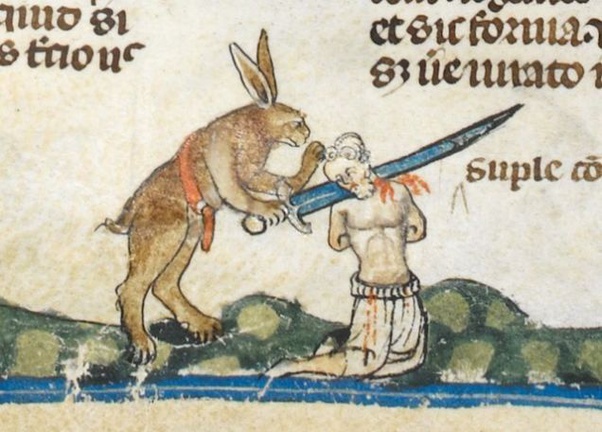
As much as you may enjoy a night in with a book, you might not look so eagerly forward to it if that book comprised 314 folios of 1,971 papal letters and other documents relating to ecclesiastical law, all from the thirteenth century. Indeed, even many specialists in the field would hesitate to take on the challenge of such a manuscript in full. But what if we told you it comes with illustrations of demons running amok, knights battling snails, killer rabbits and other animals taking their revenge on humanity, a dead ringer for Yoda, and the penitent harlot Thäis?
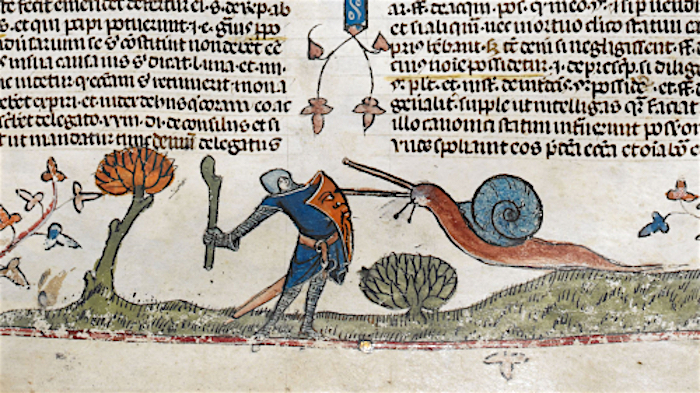
These are just a few of the characters that grace the pages of the Smithfield Decretals, the most visually notable of all extant copies of the Decretales of Pope Gregory IX. When it was originally published as an already-illuminated manuscript in the 1230s, writes Spencer McDaniel at Tales of Times Forgotten, “the margins of the text were deliberately left blank by the original French scribes so that future owners of the text could add their own notes and annotations.” Thus “the manuscript would have originally had a lot of blank space in it, especially in the margins.”
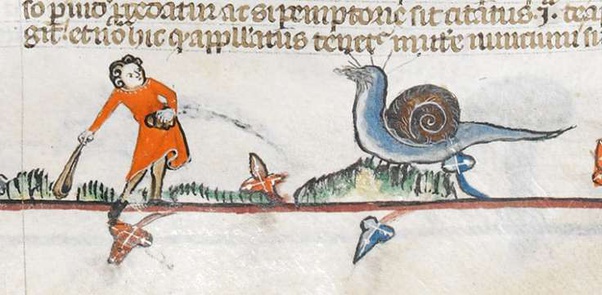
“At some point before around 1340, however, the Smithfield Decretals fell into the possession of someone in eastern England, probably in London, who paid a group of illustrators to add even more extensive illustrations to the text.”
They “drew elaborate borders and illustrations on every page of the manuscript, nearly completely filling up all the margins,” adhering to the contemporary “trend among manuscript illustrators in eastern England for drawing ‘drolleries,’ which are bizarre, absurd, and humorous marginal illustrations.”
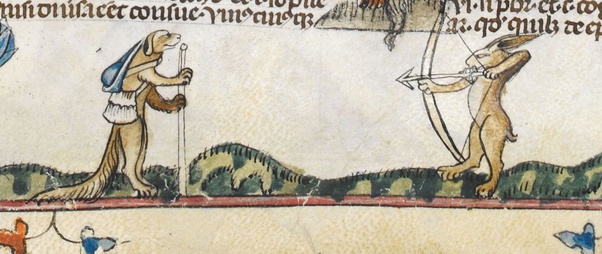
Bearing no direct relation to the text of the Decretals, some of these elaborate works of fourteenth-century marginalia appear to tell stories of their own. “These tales have analogues in a dizzying variety of textual and visual sources, including the bible, hagiography, romance, preachers’ exempla, and fabliau” (a humorous and risqué form of early French poetry), writes Alixe Bovey at the British Library’s medieval manuscripts blog. “Some of the narratives have no surviving literary analogues; others constitute isolated visual renditions of once-popular tales.”
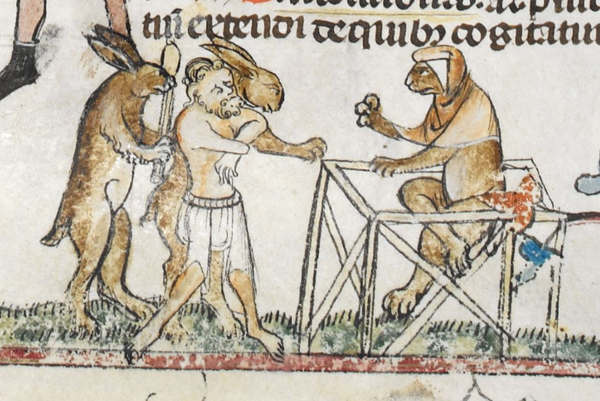
If you view the Smithfield Decretals’ illustrations here or in the British Library’s digitization at the Internet Archive, you’ll also see the medieval satirical impulse at work. Take the aforementioned, by now much-circulated “Yoda,” who, as McDaniel writes, “is probably supposed to be a representation of the Devil as a professor of canon law.” It seems that “legal scholars in Middle Ages had a similar reputation to lawyers today; they were seen as slimy, dishonest, and more interested in personal gain than in justice.” They might have been good for a cryptic turn of phrase, but those in need of benevolently dispensed wisdom would have done better to ask elsewhere.
Related content:
Why Knights Fought Snails in Illuminated Medieval Manuscripts
Why Butt Trumpets & Other Bizarre Images Appeared in Illuminated Medieval Manuscripts
Make Your Own Medieval Memes with a New Tool from the Dutch National Library
Based in Seoul, Colin Marshall writes and broadcasts on cities, language, and culture. His projects include the Substack newsletter Books on Cities and the book The Stateless City: a Walk through 21st-Century Los Angeles. Follow him on the social network formerly known as Twitter at @colinmarshall.
Read More...Isaac Asimov Describes How Artificial Intelligence Will Liberate Humans & Their Creativity: Watch His Last Major Interview (1992)
Artificial intelligence may be one of the major topics of our historical moment, but it can be surprisingly tricky to define. In the more than 30-year-old interview clip above, Isaac Asimov describes artificial intelligence as “a phrase that we use for any device that does things which, in the past, we have associated only with human intelligence.” At one time, not so very long before, “only human beings could alphabetize cards”; in the machines that could even then do it in a fraction of a second, “you’ve got an example of artificial intelligence.” Not that humans were ever especially good at card alphabetization, nor at arithmetic: “the cheapest computer in the world can multiply and divide more accurately than we can.”
You could see artificial intelligence as a kind of frontier, then, which moves forward as computerized machines take over the tasks humans previously had to do themselves. “Every industry, the government itself, tax-collecting agencies, airplanes: everything depends on computers. We have personal computers in the home, and they are constantly getting better, cheaper, more versatile, capable of doing more things, so that we can look into the future, when, for the first time, humanity in general will be freed from all kinds of work that’s really an insult to the human brain.” Such work “requires no great thought, no great creativity. Leave all that to the computer, and we can leave to ourselves those things that computers can’t do.”
This interview was shot for Isaac Asimov’s Visions of the Future, a television documentary that aired in 1992, the last year of its subject’s life. One wonders what Asimov would make of the world of 2025, and whether he’d still see artificial and natural intelligence as complementary, rather than in competition. “They work together,” he argues. “Each supplies the lack of the other. And in cooperation, they can advance far more rapidly than either could by itself.” But as a science-fiction novelist, he could hardly fail to acknowledge that technological progress doesn’t come easy: “Will there be difficulties? Undoubtedly. Will there be things that we won’t like? Undoubtedly. But we’ve got to think about it now, so as to be prepared for possible unpleasantness and try to guard against it before it’s too late.”
These are fair points, though it’s what comes next that most stands out to the twenty-first-century mind. “It’s like in the old days, when the automobile was invented,” Asimov says. “It would’ve been so much better if we had built our cities with the automobile in mind, instead of building cities for a pre-automobile age and finding we can hardly find any place to put the automobiles or allow them to drive.” Yet the cities we most enjoy today aren’t the new metropolises built or greatly expanded in the car-oriented decades after the Second World War, but precisely those old ones whose streets were built to the seemingly obsolete scale of human beings on foot. Perhaps, upon reflection, we’d do best by future generations to keep as many elements of the pre-AI world around as we possibly can.
Related Content:
Based in Seoul, Colin Marshall writes and broadcasts on cities, language, and culture. His projects include the Substack newsletter Books on Cities and the book The Stateless City: a Walk through 21st-Century Los Angeles. Follow him on the social network formerly known as Twitter at @colinmarshall.
Read More...Dante’s Divine Comedy: A Visitor’s Guide to Hell, Purgatory & Paradise
In most places across the world, speak the name of Dante, and your listeners will think of Inferno. Since its first publication more than 700 years ago, its depiction of Hell has become influential enough to shape the perceptions of even those who don’t believe that such a place exists. Take the thoroughly Dantean idea that Hell is constructed of nine concentric circles, each inhabited by a different kind of sinner being eternally punished in a manner that reflects the nature of the offense. The gluttons on level three, for example, “are doomed to grovel endlessly in thick, putrid mud” while “bombarded by icy rain.”
So explains Tommie Trelawny, creator of the YouTube channel Hochelaga, in his twenty-minute explanation of Inferno at the top of the post. While going over the broad outlines of Dante’s Virgil-guided journey into the underworld, he addresses questions you may not have considered even if you’ve read this super-canonical poem before.
Why, for instance, was it written in the first place? “In Dante’s day, the topic of sin and punishment was a major issue in the Church,” he says. Thus, “ideas around Hell were becoming more and more sophisticated” in art and literature, not least in order to send a cautionary message to the common people.
For Dante, however, the matter was somewhat more personal. The poet “was embroiled in a conflict between rival factions in his native city of Florence. He backed the wrong side, leading to his exile.” Launching into the composition of Inferno thereafter, he set about “putting people he disliked into his vision of Hell,” like the “clergymen who used their positions to amass wealth through church donations rather than serving their flock faithfully.” They were consigned to the circle of greed. It’s certainly not without satisfaction that Dante watches his real-life political rival Filippo Argenti get torn apart in the river Styx of circle five, reserved for the wrathful.
Surely Dante — or at least the fictional Dante — was also committing some kind of sin by relishing in the suffering of others, even others more sinful than himself. But that’s less relevant to the second and third parts of the story, Purgatorio and Paradiso, which together with Inferno make up what we now know as Dante’s Divina Commedia, or Divine Comedy. The latter two-thirds of the work may be less widely read than Inferno, but they’re no less imaginative; when we today describe an experience as purgatorial, we’re evoking on some level the in-between realm for the mildly unvirtuous that Dante envisioned on a far-flung island on the other side of the earth. And if you never did get around to reading Paradiso, this video summary may pique your curiosity about it, describing as it does a storyline in which Dante goes to outer space: a place very nearly as interesting as Hell.
Related content:
Dante’s Divine Comedy: A Free Course from Columbia University
Beautiful 19th-Century Maps of Dante’s Divine Comedy: Inferno, Purgatory, Paradise & More
Based in Seoul, Colin Marshall writes and broadcasts on cities, language, and culture. His projects include the Substack newsletter Books on Cities and the book The Stateless City: a Walk through 21st-Century Los Angeles. Follow him on the social network formerly known as Twitter at @colinmarshall.
Read More...Who Really Built the Egyptian Pyramids—And How Did They Do It?
Although it’s certainly more plausible than hypotheses like ancient aliens or lizard people, the idea that slaves built the Egyptian pyramids is no more true. It derives from creative readings of Old Testament stories and technicolor Cecil B. Demille spectacles, and was a classic whataboutism used by slavery apologists. The notion has “plagued Egyptian scholars for centuries,” writes Eric Betz at Discover. But, he adds emphatically, “Slaves did not build the pyramids.” Who did?
The evidence suggests they were built by a force of skilled laborers, as the Veritasium video above explains. These were cadres of elite construction workers who were well-fed and housed during their stint. “Many Egyptologists,” including archaeologist Mark Lehner, who has excavated a city of workers in Giza, “subscribe to the hypotheses that the pyramids were… built by a rotating labor force in a modular, team-based kind of organization,” Jonathan Shaw writes at Harvard Magazine. Graffiti discovered at the site identifies team names like “Friends of Khufu” and “Drunkards of Menkaure.”
The excavation also uncovered “tremendous quantities of cattle, sheep, and goat bone, ‘enough to feed several thousand people, even if they ate meat every day,’ adds Lehner,” suggesting that workers were “fed like royalty.” Another excavation by Lehner’s friend Zahi Hawass, famed Egyptian archaeologist and expert on the Great Pyramid, has found worker cemeteries at the foot of the pyramids, meaning that those who perished were buried in a place of honor. This was incredibly hazardous work, and the people who undertook it were celebrated and recognized for their achievement.
Laborers were also working off an obligation, something every Egyptian owed to those above them and, ultimately, to their pharaoh. But it was not a monetary debt. Lehner describes what ancient Egyptians called bak, a kind of feudal duty. While there were slaves in Egypt, the builders of the pyramids were maybe more like the Amish, he says, performing the same kind of obligatory communal labor as a barn raising. In that context, when we look at the Great Pyramid, “you have to say ‘This is a hell of a barn!’’’
The evidence unearthed by Lehner, Hawass, and others has “dealt a serious blow to the Hollywood version of a pyramid building,” writes Shaw, “with Charlton Heston as Moses intoning, ‘Pharaoh, let my people go!’” Recent archeology has also dealt a blow to extraterrestrial or time-travel explanations, which begin with the assumption that ancient Egyptians could not have possessed the know-how and skill to build such structures over 4,000 years ago. Not so. Veritasium explains the incredible feats of moving the outer stones without wheels and transporting the granite core of the pyramids 620 miles from its quarry to Giza.
Ancient Egyptians could plot directions on the compass, though they had no compasses. They could make right angles and levels and thus had the technology required to design the pyramids. What about digging up the Great Pyramid’s 2 million blocks of yellow limestone? As we know, this was done by a skilled workforce, who quarried an “Olympic swimming-pool’s worth of stone every eight days” for 23 years to build the Great Pyramid, notes Joe Hanson in the PBS It’s Okay to Be Smart video above. They did so using the only metal available to them, copper.
This may sound incredible, but modern experiments have shown that this amount of stone could be quarried and moved, using the technology available, by a team of 1,200 to 1,500 workers, around the same number of people archaeologists believe to have been on-site during construction. The limestone was quarried directly at the site (in fact the Sphinx was mostly dug out of the earth, rather than built atop it). How was the stone moved? Egyptologists from the University of Liverpool think they may have found the answer, a ramp with stairs and a series of holes which may have been used as a pulley system.
Learn more about the myths and the realities of the builders of Egypt’s pyramids in the It’s Okay to Be Smart “Who Built the Pyramids, Part 1″ video above.
Note: An earlier version of this post appeared on our site in 2021.
Related Content:
What the Great Pyramids of Giza Originally Looked Like
A Walking Tour Around the Pyramids of Giza: 2 Hours in Hi Def
Take a 360° Interactive Tour Inside the Great Pyramid of Giza
Take a 3D Tour Through Ancient Giza, Including the Great Pyramids, the Sphinx & More
The Grateful Dead Play at the Egyptian Pyramids, in the Shadow of the Sphinx (1978)
Josh Jones is a writer and musician based in Durham, NC. Follow him at @jdmagness
Read More...How Italy Became the Most Divided Country in Europe: Understanding the Great Divide Between North & South
Prada, Alfa Romeo, Pellegrino, Ferrari, Illy, Lamborghini, Gucci: these are a few Italian corporations we all know, though we don’t necessarily know that they’re all from the north of Italy. The same is true, in fact, of most Italian brands that now enjoy global recognition, and according to the analysis presented in the RealLifeLore video above, that’s not a coincidence. More than 160 years after the unification of Italy, the south remains an economic and social under-performer compared to the north, reflected in measures like the Human Development Index, GDP per capita, and even voter turnout. At this point, the disparity between the two halves of the country looks starker than that between the former East and West Germany.
The reasons begin with geography: besides its obvious proximity to the rest of Europe, northern Italy is home to the highly navigable Po River and its surrounding valley, the freshwater (and hydroelectric power) sources of the Alps, and the deep-water ports at Trieste and Genoa. What’s more, it doesn’t much overlap with the fault zone under the Apennine Mountains of central and southern Italy, and thus isn’t as exposed to the earthquakes that have taken such a toll over the centuries. Nor are any of the country’s active volcanoes — including Mt. Vesuvius, which destroyed Pompeii in the year 79 and killed thousands of Neapolitans in 1631 — located in the north.
After the fall of the Roman Empire, the political fates of what would become northern and southern Italy also diverged. Large parts of the south experienced rule by Greeks, Arabs, Normans, Spaniards, and Austrian Habsburgs. As the video’s narration tells the story, “The long reign of foreign powers throughout southern Italy established a culture of absentee landlords, large land holdings worked by peasants, and feudalism that persisted for much longer than it did in the north, which for centuries after the Middle Ages was controlled by various thriving, independently governed communes and city-states that built up large amounts of trust, or social capital, between the people who lived there and the institutions they built.”
Even at the time of unification, southern Italy had less infrastructure than northern Italy, a difference that remains painfully obvious to any travelers attempting to make their way across the country today. It also had quite a lot of catching up to do with regard to industrial output and literacy rates. Though certain gaps have narrowed, the north-south divide has actually become more pronounced in certain ways since, not least due to the recrudescence of Mafia influence since the Second World War (a major factor in the persistent lack of a bridge to Sicily, as recently featured here on Open Culture). Not to say that each half is homogeneous within itself: spend enough time in any of the regions that constitute either one, and it will come to feel like a distinct nation unto itself. Eventually, you may also find yourself in agreement with the Italians who insist that Italy never really unified in the first place.
Related content:
Exploring the Greatest of Italy’s 6,000 Ghost Towns: Take a Tour of Craco, Italy
Built to Last: How Ancient Roman Bridges Can Still Withstand the Weight of Modern Cars & Trucks
A Data Visualization of Every Italian City & Town Founded in the BC Era
Based in Seoul, Colin Marshall writes and broadcasts on cities, language, and culture. His projects include the Substack newsletter Books on Cities and the book The Stateless City: a Walk through 21st-Century Los Angeles. Follow him on the social network formerly known as Twitter at @colinmarshall.
Read More...The Steps a President Would Take to Destroy His Nation, According to Elon Musk’s AI Chatbot, Grok
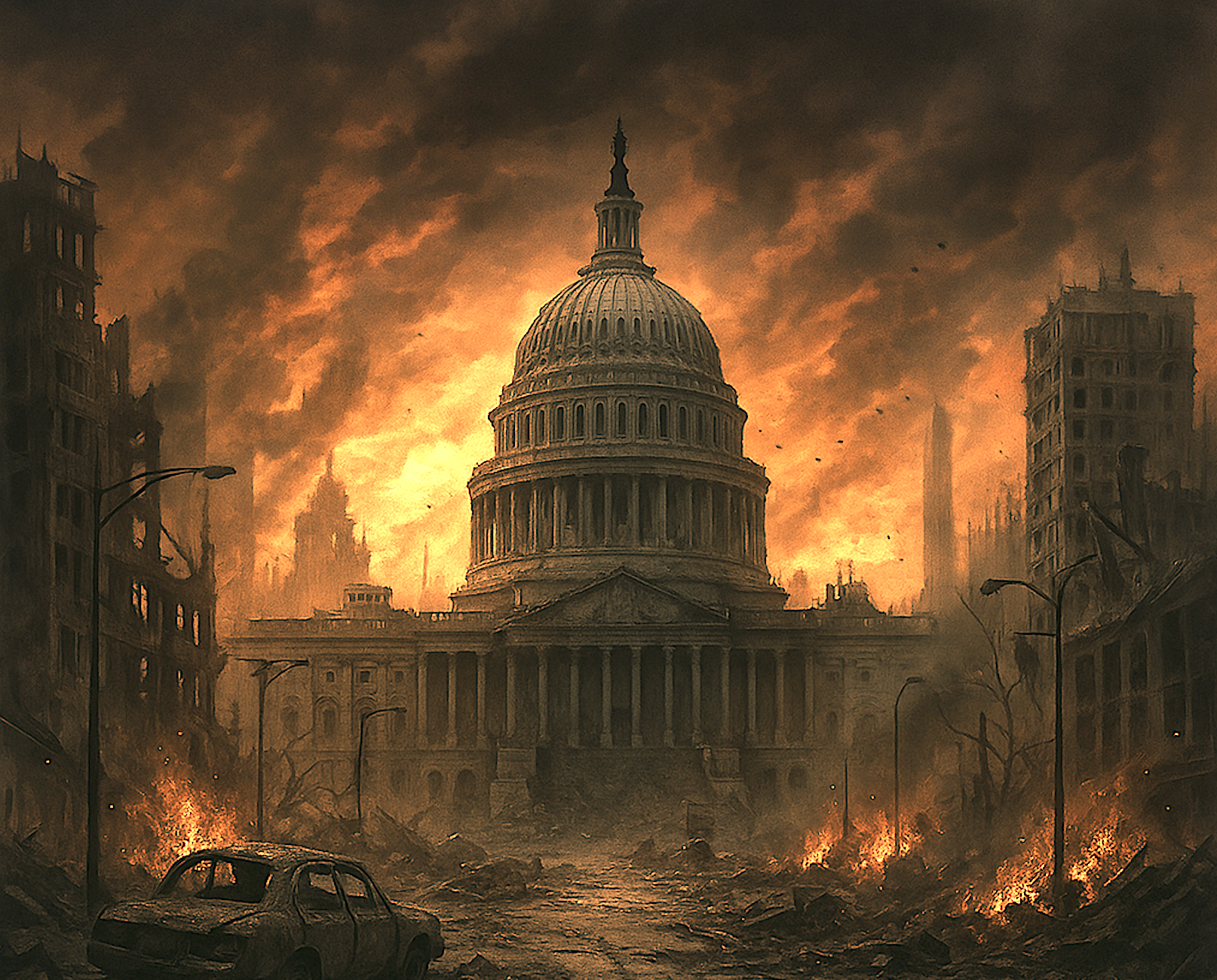
Just out of curiosity, and apropos of nothing, we asked Grok (the AI chatbot created by Elon Musk) the following question: If a president of a superpower wanted to destroy his own country, what steps would he take? Here’s what Grok had to say:
If a president of a superpower aimed to deliberately undermine their own nation, they could theoretically take steps to weaken its economic, social, military, and political foundations. Here’s a hypothetical breakdown of such actions, assuming they have enough influence and control to push them through:
- Economic Sabotage: They could tank the economy by imposing reckless fiscal policies—massive, unsustainable debt through unchecked spending or tax cuts without funding, devaluing the currency by pressuring the central bank to print money excessively, or dismantling key industries through deregulation or punitive tariffs that disrupt trade. Encouraging corruption and cronyism could further drain resources.
- Undermining National Security: Militarily, they might weaken defenses by slashing budgets, pulling out of strategic alliances, or leaking sensitive intelligence to adversaries. Ordering troops into unwinnable, morale-crushing conflicts—or abandoning critical outposts—could erode military strength and global standing.
- Social Division: They could stoke internal conflict by amplifying divisive rhetoric, targeting specific groups with policies that breed resentment, or letting infrastructure and public services crumble to fuel discontent. Misinformation campaigns, either directly or through proxies, could deepen mistrust in institutions.
- Political Erosion: To cripple governance, they might attack the rule of law—pardoning loyalists who break it, stacking courts with unqualified ideologues, or pushing legislation that centralizes power in their hands. Undermining elections through voter suppression or outright fraud could destabilize democracy further.
- International Isolation: They could alienate allies by breaking treaties, insulting partners, or cozying up to hostile regimes, leaving the country diplomatically vulnerable. Withdrawing from global organizations or climate agreements might also diminish soft power and economic leverage.
- Neglecting Crises: In the face of natural disasters, pandemics, or cyberattacks, they could deliberately botch responses—ignoring experts, withholding aid, or spreading confusion—letting chaos compound.
Grok continues: “In practice, any president trying this would face massive resistance: checks and balances, public backlash, legal barriers, and pushback from their own administration or military. It’d take more than intent—sophisticated manipulation and loyal enablers would be key. Historically, no leader has pulled this off fully, but you can see echoes in cases like Venezuela under Maduro, where mismanagement and authoritarianism led to collapse—though even there, self-destruction wasn’t the explicit goal. Intentional ruin would be a slow burn, not a switch flipped overnight.”
As you read this, you might hear a lot of boxes being checked in your mind, and you might wonder if Grok is calling the shots. But, dear reader, this is all purely theoretical. As they say in the movies, any resemblance to actual persons, living or dead, or actual events is purely coincidental.
Related Content
Toni Morrison Lists the 10 Steps That Lead Countries to Fascism (1995)
Umberto Eco Makes a List of the 14 Common Features of Fascism
Read More...The 1927 Film Metropolis Created a Dystopian Vision of What the World Would Look Like in 2026–and It Hits Close to Home
Ultra-tall high-rises against dark skies. A huge distance between the rich and the poor. Robber barons at the helm of large-scale industrial operations that turn man into machine. Machines that have become intelligent enough to displace man. These have all been standard elements of dystopian visions so long that few of us could manage to imagine a grim future without including at least a couple of them. We’ve all seen these elements used before, and they owe much of their staying power to the impact they first made in Fritz Lang’s cinematic spectacle Metropolis, which premiered 98 years ago. Many imitations have since passed through popular culture, most of which haven’t mastered the techniques that gave the original its power.
“Set in a futuristic urban dystopia, the film portrays a divided society where the wealthy elite live in luxurious skyscrapers while the oppressed working class toil underground,” writes Pruethicheth Lert-udompruksa at the IAAC blog. “The film explores themes of class struggle, social inequality, and the dehumanizing effects of industrialization.”
One of those theme’s strongest icons is the Tower of Babel, a looming skyscraper that “symbolizes the stark division between the privileged and the oppressed.” As Paul Batters writes at the Silver Screen Classics blog, “like the ziggurats of Ur, the pyramids and temples of Egypt,” that building and other elements realized by the film’s groundbreaking visual design add up to a titular “city that dominates humanity.”
The loss of humanity is the prime concern of the Junkies video essay at the top of the post, which explains several ways Lang and his collaborators convey that phenomenon through light, shadow, and perspective — light, shadow, and perspective being the main tools available to a black-and-white silent film. The One Hundred Years of Cinema video essay just above covers more such aspects of the picture’s construction, as well as its historical context: “In nineteen-twenties Europe, a radical form of nationalism called fascism was coming to prominence, and six years after the film’s release, Lang found himself exiled to America for his refusal to join the Nazi party.”
For quite some time, the versions of Metropolis that people could see were censored or otherwise incomplete cuts; only in 2008 did it undergo a complete restoration. But now, it’s easier than ever to see that its “winning combination of camera shots and angles, lighting contrasts, and shot composition really do well to depict humanity as becoming subservient to technology. And so, perhaps today, more so than in 1927, it is easier to read the message that Lang is trying to portray through the cinematic devices he employs.” Watching the impoverished workers of Metropolis become part of the machine they work for, while its idle rich “become part of the machine by submission [to] pleasure,” we might reflect upon the astuteness of the choice to set the film’s story in the year 2026.
Related content:
Fritz Lang Invents the Video Phone in Metropolis (1927)
Read the Original 32-Page Program for Fritz Lang’s Metropolis (1927)
Based in Seoul, Colin Marshall writes and broadcasts on cities, language, and culture. His projects include the Substack newsletter Books on Cities and the book The Stateless City: a Walk through 21st-Century Los Angeles. Follow him on the social network formerly known as Twitter at @colinmarshall.
Read More...Watch Bob Dylan Make His Debut at the Newport Folk Festival in Colorized 1963 Footage
In July 1963, Bob Dylan made his first appearance at the Newport Folk Festival. On opening night, he captivated a crowd of 13,000 with a performance of “Blowin’ in the Wind,” accompanied by Joan Baez, Pete Seeger, and Peter, Paul, and Mary. Then, the following day, Dylan delivered a rendition of “With God On Our Side” (a duet with Joan Baez) and performed “North Country Blues” solo, a song that would later appear on The Times They Are a‑Changin’ in 1964. You can watch these historic performances in original black-and-white footage. (Simply click the links in the text.) Or, thanks to the YouTube channel Toca o Disco, you can experience the moment in color. As a 22-year-old Bob Dylan sings, the audience listens in rapt attention, taking in his powerful folk song about the harsh realities of mining and industrialization. Take note above.
Related Content
Bob Dylan Explains Why Music Has Been Getting Worse
How Bob Dylan Created a Musical & Literary World All His Own: Four Video Essays
Read More...The Only Illustrated Manuscript of Homer’s Iliad from Antiquity
Despite its status as one of the most widely known and studied epic poems of all time, Homer’s Iliad has proven surprisingly resistant to adaptation. However much inspiration it has provided to modern-day novelists working in a variety of different traditions, it’s translated somewhat less powerfully to visual media. Perhaps people still watch Wolfgang Petersen’s Troy, the very loose, Brad Pitt-starring cinematic Iliad adaptation from 2004. But chances are, a century or two from now, humanity on the whole will still be more impressed by the 52 illustrations of the Ambrosian Iliad, which was made in Constantinople or Alexandria around the turn of the sixth century.
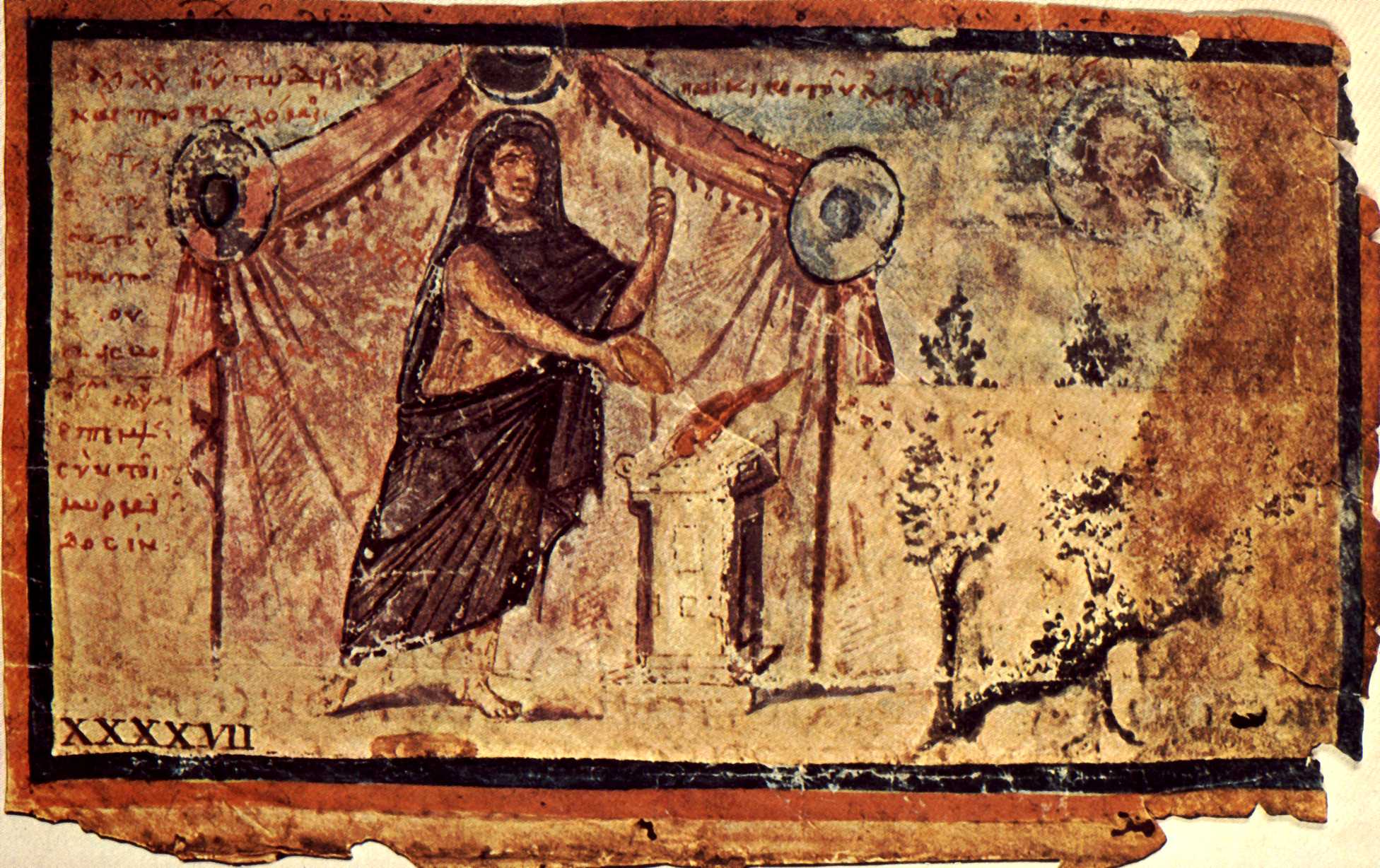
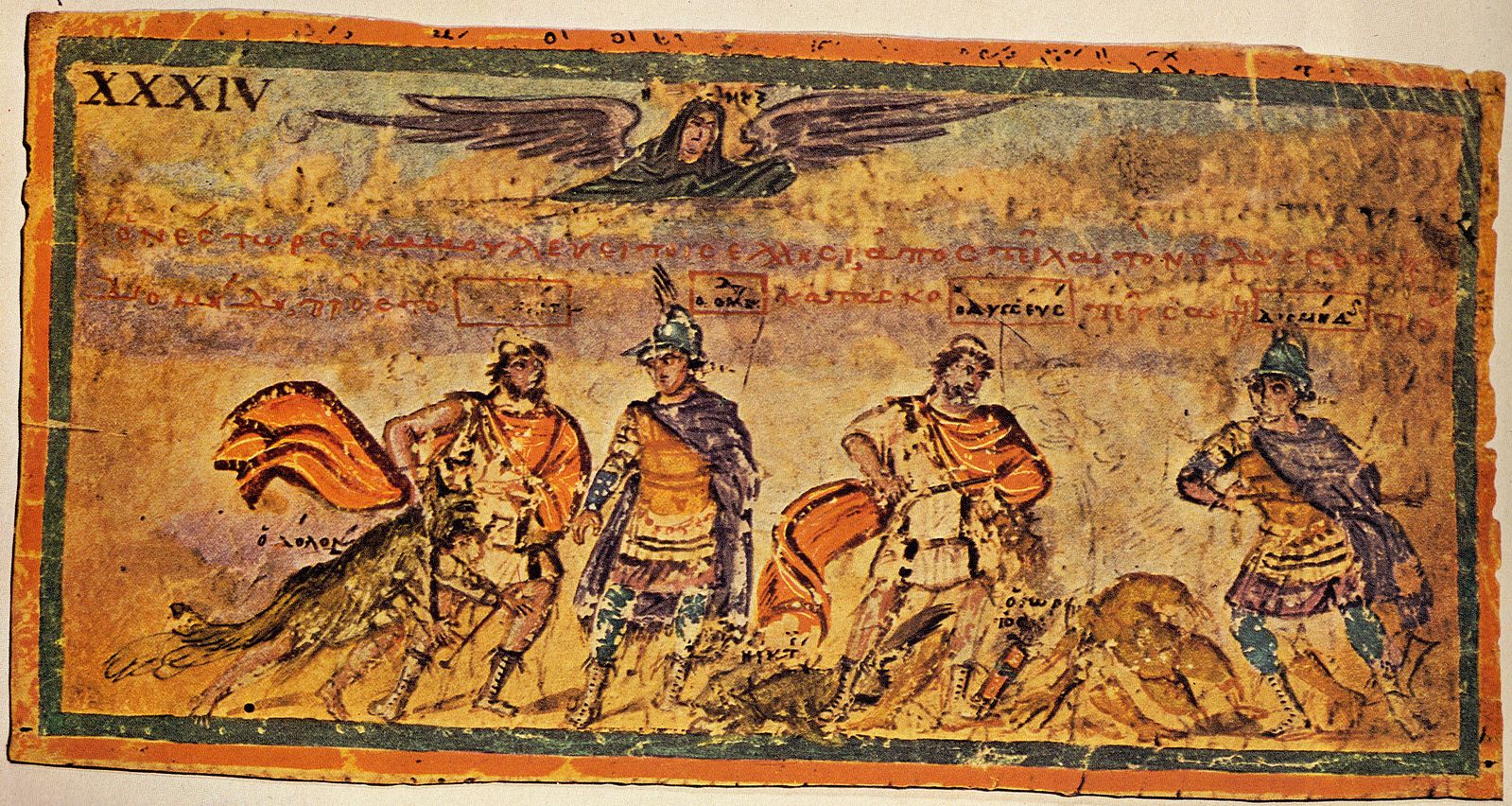
As noted at HistoryofInformation.com, “along with the Vergilius Vaticanus [previously featured on Open Culture] and the Vergilius Romanus, [the Ambrosian Iliad] is one of only three illustrated manuscripts of classical literature that survived from antiquity.” It’s also the only ancient manuscript that depicts scenes from the Iliad. Its illustrations, which “show the names of places and characters,” offer “an insight into early manuscript illumination.” They “show a considerable diversity of compositional schemes, from single combat to complex battle scenes,” as Kurt Weitzmann writes in Late Antique and Early Christian Book Illumination. “This indicates that, by that time, Iliad illustration had passed through various stages of development and thus had a long history behind it.”
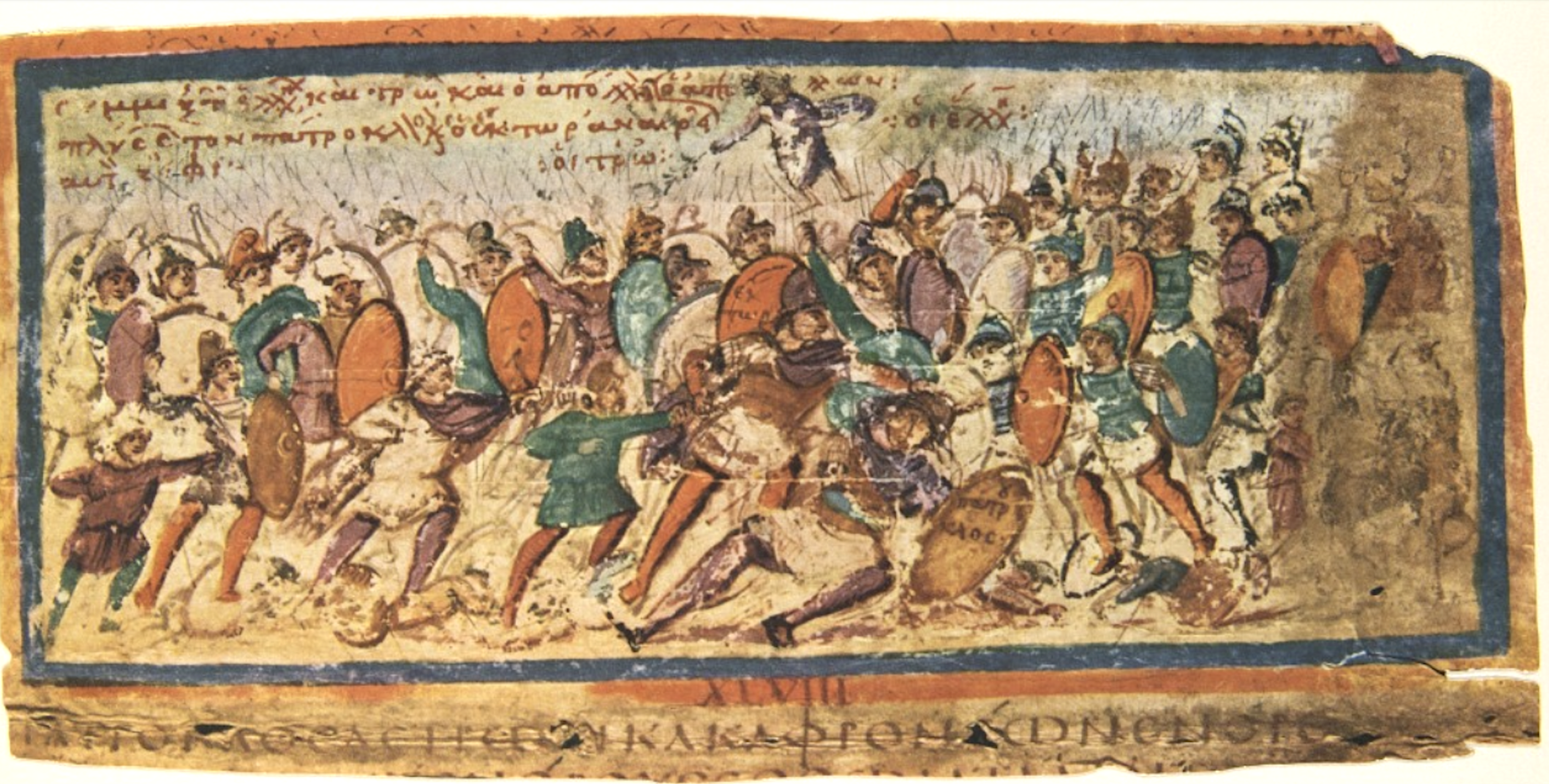
Above, you can see the Ambrosian Iliad’s illustrations of the capture of Dolon (top), Achilles sacrificing to Zeus for Patroclus’ safe return (middle), and Hector killing Patroclus as Automedon escapes (bottom). You can find more scans at the Warburg Institute Iconographic Database, along with other Iliad-related artifacts. Some of the later artistic renditions of Homer in that collection date from the fifteenth, seventeenth, eighteenth, and even the nineteenth centuries, each interpreting these age-old poems for their own time. Indeed, the Iliad and Odyssey have proven enduringly resonant for the better part of three millennia, and there’s no reason to believe that they won’t continue to find new artistic forms for just as long to come. But there’s something especially powerful about seeing Homer rendered by artists who, though they may have come centuries and centuries after the blind poet himself, knew full well what it was to live in antiquity.
Related Content:
The Vatican Digitizes a 1,600-Year-Old Illuminated Manuscript of the Aeneid
A Handy, Detailed Map Shows the Hometowns of Characters in the Iliad
Hear Homer’s Iliad Read in the Original Ancient Greek
Hear Homer’s Iliad Read in the Original Ancient Greek
Greek Myth Comix Presents Homer’s Iliad & Odyssey Using Stick-Man Drawings
Based in Seoul, Colin Marshall writes and broadcasts on cities, language, and culture. His projects include the Substack newsletter Books on Cities and the book The Stateless City: a Walk through 21st-Century Los Angeles. Follow him on the social network formerly known as Twitter at @colinmarshall.
Read More...The Great Gatsby: A Free Audio Book
April 10th will mark the 100th anniversary of F. Scott Fitzgerald’s classic American novel, The Great Gatsby. As A.O. Scott notes in a recent tribute, when first published, The Great Gatsby got off to a slow start. Initially, “Reviewers shrugged. Sales were sluggish. The novel and its author slid toward obscurity.”
It wasn’t until the 1940s that Gatsby underwent a revival. Critics began to re-evaluate Fitzgerald’s novel, and the U.S. military “distributed more than 150,000 copies of ‘Gatsby’ to American servicemen during World War II,” all to help bored soldiers kill time. From there, Gatsby’s “cultural footprint expanded. Paperback editions proliferated, and the novel was name-checked by younger authors, including J.D. Salinger.” Today, with some 30 million copies sold worldwide and at least five film adaptations to its name, The Great Gatsby has established itself as an enduring American classic.
In January 2021, The Great Gatsby finally entered the public domain, allowing creators to make use of the literary work in different ways. As our writer Colin Marshall noted, “Already you can find The Gay Gatsby, B.A. Baker’s slash fiction reinterpretation of all the suppressed longing in the original novel; The Great Gatsby Undead, a zombie version; and Michael Farris Smith’s Nick, a prequel that follows Nick Carraway through World War I and out the other side.” And then there are more straightforward projects–like Project Gutenberg’s e‑book of the original text, or this free audio book version of The Great Gatsby. This five hour recording comes courtesy of Nolan Hennelly, and you can stream it above.
This reading will be added to our collection, 1,000 Free Audio Books: Download Great Books for Free.
Related Content
The Great Gatsby Is Now in the Public Domain and There’s a New Graphic Novel
83 Years of Great Gatsby Book Cover Designs: A Photo Gallery
Haruki Murakami Translates The Great Gatsby, the Novel That Influenced Him Most
Andy Kaufman Reads Earnestly from The Great Gatsby and Enrages His Audience
Read More...Support Us
We're hoping to rely on loyal readers, rather than erratic ads. Please click the Donate button and support Open Culture. You can use Paypal, Venmo, Patreon, even Crypto! We thank you!

About Us

Open Culture scours the web for the best educational media. We find the free courses and audio books you need, the language lessons & educational videos you want, and plenty of enlightenment in between.
Advertise With Us

FREE UPDATES!
GET OUR DAILY EMAIL
Get the best cultural and educational resources on the web curated for you in a daily email. We never spam. Unsubscribe at any time.
FOLLOW ON SOCIAL MEDIA

Open Culture editor Dan Colman scours the web for the best educational media. He finds the free courses and audio books you need, the language lessons & movies you want, and plenty of enlightenment in between.
Advertise With Us

