Watch the Evolution of Manhattan Unfold in a Timelapse Video, from 1600 to 2026
A Manhattan without skyscrapers sounds difficult, if not impossible, to imagine today. But such a place really did exist, at least up until the turn of the twentieth century. While the title of the very first skyscraper ever built may go to the Home Insurance Building in Chicago, New York City caught up so aggressively thereafter — in its characteristic style — that it soon became practically synonymous with tall steel-framed towers. The shape of modern Manhattan would surely have been unimaginable to the first non-native arrivals in the early seventeenth century, the approach of whose ships you can see re-created in the animated timelapse above.
The video is a production of CITY 3D TIMELAPSE, a YouTube channel previously featured here on Open Culture for its similarly accelerated visualization of the evolution of Paris. While that video had 23 centuries to compress into a three-minute runtime, this new one on New York takes a leisurely-by-comparison eight minutes to render “just” 450 years or so of history (at least after about twenty seconds spent in the native era’s millennium and a half).
But it also shows us the urban evolutionary process three times: the first zooms out to the whole of Manhattan, the second focuses on Lower Manhattan, and the third on Midtown Manhattan — a suitable division, as any New Yorker knows, for those mutually incomprehensible civilizations.
Even if we’ve never set foot there, we may well know that even old New York was once New Amsterdam. That Dutch colonial era, as depicted in the timelapse, is when the city begins. There follows densification and expansion under English rule, the maritime infrastructural build-out of early America, the ambitious grid-laying under the Commissioners’ Plan of 1811, the relentless nineteenth-century industrialization that imbued the city with the might its reputation still retains, the rise of the skyscrapers that shaped (and continue to shape) its skyline, and finally the “globalization era” in which we find ourselves today. That “we,” of course, includes not just New Yorkers, but urbanites everywhere, for the evolution of New York produced not just a city, but in many respects, the city: the model by which so many metropolises have been inspired to get a bit of the action for themselves.
Related Content:
A 3D Animation Shows the Evolution of New York City (1524 — 2023)
Watch a Timelapse Video Showing the Creation of New York City’s Skyline: 1500 to Present
Immaculately Restored Film Lets You Revisit Life in New York City in 1911
Watch Manhatta, the First American Avant-Garde Film (1921)
Watch the Evolution of Paris Unfold in a Timelapse Video, from 300 BCE to 2025
Based in Seoul, Colin Marshall writes and broadcasts on cities, language, and culture. He’s the author of the newsletter Books on Cities as well as the books 한국 요약 금지 (No Summarizing Korea) and Korean Newtro. Follow him on the social network formerly known as Twitter at @colinmarshall.
Read More...Watch David Bowie & Annie Lennox in Rehearsal, Singing “Under Pressure,” with Queen (1992)
It’s common to feel like we know our artists, writers, musicians, actors… we want so badly to touch their lives in some way, as their lives touch ours. This overwhelming desire is responsible for a huge market share of our mass media, from the most tasteless tabloid hit jobs to the most respectful longform essays. Since David Bowie’s passing, we’ve seen no shortage of the latter, and thankfully little of the former.
Vulture has collected some of the best of these online tribute articles and obituaries, and one in particular—Judy Berman’s “We Always Knew Who David Bowie Really Was”—has resonated with me. Berman cuts through “all the clichés about how he was a chameleon or a shape-shifter or opaque or unknowable” and shows some of the ways Bowie made himself intimately available in his work.
Bowie’s self-revelation by way of theatrics and costume changes resembles the less intellectual, more emotional, vulnerability of his friend and collaborator Freddie Mercury. Just as musicians around the world celebrate, and mourn, Bowie now, he performed a similar service for Mercury 34 years ago at London’s Wembley Stadium for an audience of 72,000 people, along with the remaining members of Queen and a full roster of superstars. Bowie did four songs in total, but the most poignant was certainly “Under Pressure,” which he’d composed with Mercury 11 years earlier. The song became, of course, a massive hit (twice over, thanks to Vanilla Ice’s appropriation). Its wrenching lyrics also gave us yet more insight into Bowie’s personality: his fears, his sense, as Berman writes, “of how fleeting and insignificant one human life is in the grand scheme of the universe,” and his defiance in the face of that knowledge.
In the video at the top of the post, you can see Bowie, Annie Lennox, John Deacon, Roger Taylor, and Brian May rehearsing “Under Pressure” for the Mercury tribute, with an audience of just themselves and a few crew people. Bowie has one of his regrettably ubiquitous cigarettes in hand and an enormous grin on his face as he watches Lennox belt out Mercury’s parts. The performance on show day, above, is powerful and pitch perfect, but the loose, informal rehearsal footage is more of a treat for those of us eager for as much of the unguarded Bowie as we can get. For even more stripped-down, behind-the-scenes Bowie, listen to an a cappella version of “Under Pressure” with Mercury, and learn all about how that song came to be.
Note: An earlier version of this post appeared on our site in 2016.
Related Content:
The Making of Queen and David Bowie’s 1981 Hit “Under Pressure”: Demos, Studio Sessions & More
David Bowie and Cher Sing Duet of “Young Americans” and Other Songs on 1975 Variety Show
Josh Jones is a writer and musician based in Durham, NC.
Read More...Why Mapmakers Put Fake Towns on Their Maps in the 1920s — and the One That Became Real
Open Culture readers may know John Green best for Crash Course, the YouTube channel that teaches everything you need to know about subjects like world history, U.S. history, big history, literature, and philosophy. Or at least it teaches everything a teenage student facing down the prospect of Advanced Placement subject exams needs to know. Such viewers have always had a decent chance of knowing Green as the author of novels for young readers like Looking for Alaska, The Fault in Our Stars, and Paper Towns. That last takes its title from just the kind of historical phenomenon that would in any case have fascinated Green, in his capacity as a vlogger, enough to inspire a video: the wholly fictional settlements created by mapmakers in order to expose cartographic plagiarists.
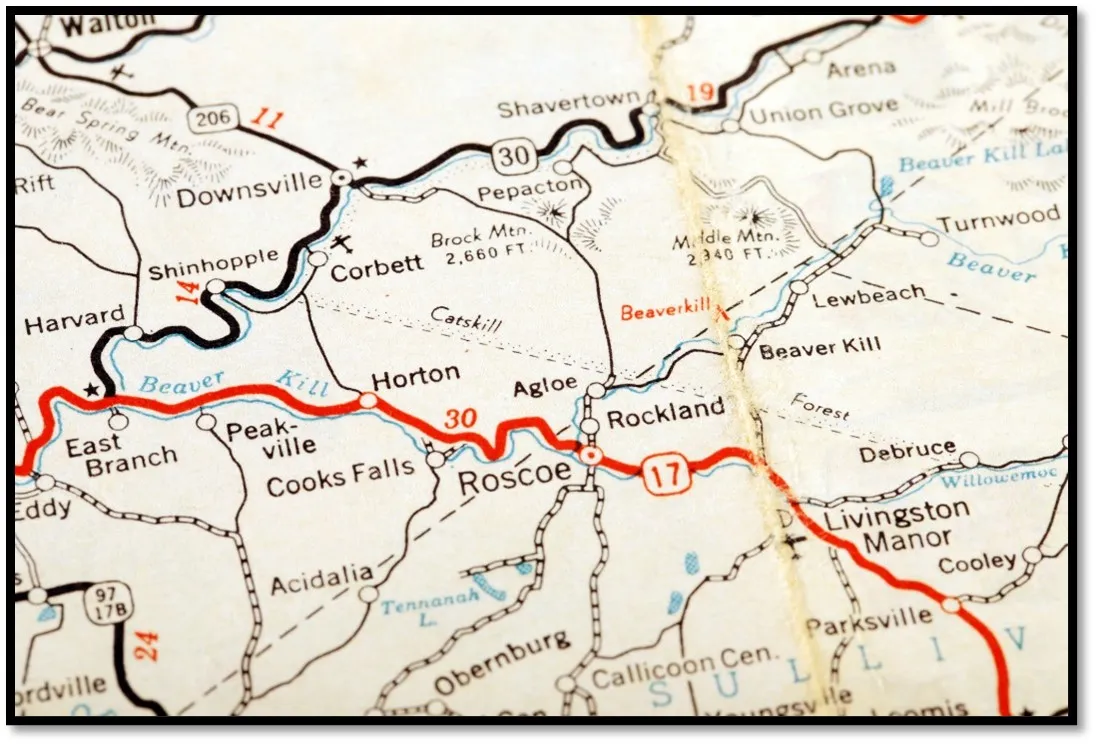
Green discusses one such paper town in the episode of Vlogbrothers, the long-running channel Green runs with his brother Hank, at the top of the post. Agloe, New York, an upstate hamlet in Colchester, Delaware County, was fabricated in the nineteen-twenties by cartographer Otto G. Lindberg and his assistant Ernest Alpers, who’d been commissioned to make maps for the gas-station chain Esso.
Mapmakers (like Lindberg and Alpers) have guarded against plagiarism by inserting “paper towns” — invented streets, landmarks, or other features — into their maps. The logic is simple: two cartographers might easily draw the same real town, but two cartographers can’t independently dream up the same fake one. So if a rival’s map contains the same invented place, it all but proves they copied the map.
Though intended as nothing more than a “copyright trap,” the name of the dot in the road, Agloe, soon manifested in the real world. A business named Agloe Lodge Farms appeared in 1930, and it went on to apply the name to a local fishing lodge it acquired. Thus was Agloe, New York brought into existence, at least in the eyes of the law: by the time they were challenged about its inclusion on their own maps, Rand McNally could cite official county records in their defense.
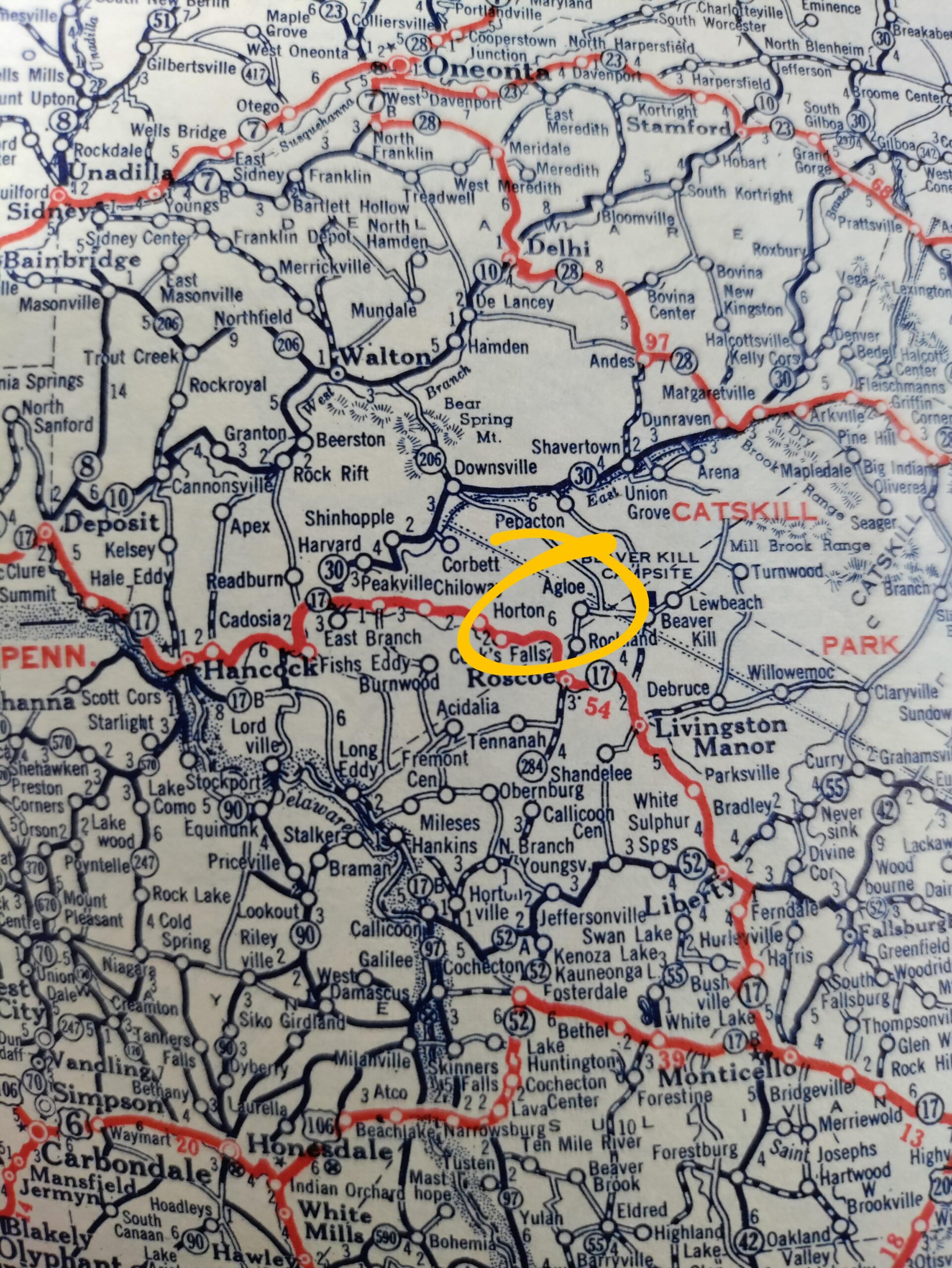
In other words, “a made-up name for a made-up place inadvertently created a real place that, for a time, really existed,” writes NPR’s Robert Krulwich. “Rand McNally, one presumes, was found not guilty. Then the store closed. It isn’t there anymore. Decades passed.” At the time Krulwich was writing, in 2014, an internet search for Agloe, New York would still return a point where Lindberg and Alpers had originally placed it on their map the better part of a century earlier. “But then, just as this story was to be published, to be extra sure, we went to Google Earth, typed in ‘Agloe’ one last time, and, whaddya know? It isn’t there any more!” Adolescent readers imagining themselves running away in the manner of Margo Spiegelman will have to seek out another faraway paper town to dream about — or, more likely these days, a pixel town.
Related Content:
William Faulkner Draws Maps of Yoknapatawpha County, the Fictional Home of His Great Novels
The Biggest Mistakes in Mapmaking History
The Medieval City Plan Generator: A Fun Way to Create Your Own Imaginary Medieval Cities
The History of Cartography, the “Most Ambitious Overview of Map Making Ever,” Is Free Online
The French Designed a Fake Replica of Paris to Fool German Bombers During World War I
John Green’s Crash Course in U.S. History: From Colonialism to Obama in 47 Videos
Based in Seoul, Colin Marshall writes and broadcasts on cities, language, and culture. He’s the author of the newsletter Books on Cities as well as the books 한국 요약 금지 (No Summarizing Korea) and Korean Newtro. Follow him on the social network formerly known as Twitter at @colinmarshall.
Read More...A Guide to Every Major Film Adaptation of Homer’s Odyssey Before Christopher Nolan’s Movie
If you plan on shooting your own adaptation of Homer’s Odyssey, bear in mind how much rests on your choice of leading man. In order to play Odysseus, an actor must summon a real gravitas, but also a still-smoldering vitality: here is a man who led the Greek army to defeat Troy, but still has the doggedness to make the decade-long journey back home to his wife. In the mid-nineteen-fifties, Hollywood had just the chin for the job: Kirk Douglas, who plays Odysseus under his Latin name in the eponymous Ulysses. Though merciless in its excisions to Homer’s text, as explained in the Underrated Cinema video above, it still has more or less everything you’d want in a fantastical Technicolor spectacle — and one shot by The Wizard of Oz veteran Harold Rosson at that.
Those in search of a viewing experience more adherent to the original story should consider L’Odissea: not the Italian silent film from 1911 recently featured here on Open Culture, but the 1968 Italian miniseries directed by Franco Rossi, who would go on to be better known for Quo Vadis? Though no Odyssey adaptation fits everything in, this one gets just about as complete as a classics fan could hope for in its 446-minute runtime.
As Odysseus, the Yugoslav heartthrob Bekim Fehmiu (for a brief moment thereafter, cinema’s next global star) may or may not be to your taste. More acclaimed is Armand Assante, portrayer of figures from John Gotti to Mickey Spillane to Nietzsche, in NBC’s Odyssey miniseries from 1997, which also features the likes of Isabella Rossellini, Bernadette Peters, Christopher Lee, and Vanessa Williams.
Though star-studded, shot in the real Mediterranean, and directed by onetime Tarkovsky collaborator Andrei Konchalovsky, the Odyssey of the nineties isn’t much referenced today, perhaps due to its dated visual effects. Viewers will never have any such objection to Uberto Pasolini’s The Return, not because it only came out the year before last, but because it has practically no visual effects in the first place. Focusing only on the latter half of the Odyssey, the film dramatizes the reunion of Odysseus and his wife: a very human story, especially in that it contains no monsters. Different adaptations have cut out the sirens, say, or Scylla and Charybdis, though it’s a rare production bold enough not to put everything it has into the cyclops scene. But you can get an actor like Ralph Fiennes to play Odysseus — and for that matter, Juliette Binoche to play Penelope — there’s little need for a creature feature.
Related Content:
Watch the First Spectacular Film Adaptation of the Odyssey (1911)
Hear What Homer’s Odyssey Sounded Like When Sung in the Original Ancient Greek
A Walk Through Homer’s Odyssey: A Guide to the Epic Before Seeing Christopher Nolan’s Film
Christopher Hitchens Explains Why Homer’s Odyssey Still Matters to Our World (2000)
The Origins of the Monsters in Homer’s Odyssey: The Cyclops, Sirens, Scylla & More
Greek Myth Comix Presents Homer’s Iliad & Odyssey Using Stick-Man Drawings
Based in Seoul, Colin Marshall writes and broadcasts on cities, language, and culture. He’s the author of the newsletter Books on Cities as well as the books 한국 요약 금지 (No Summarizing Korea) and Korean Newtro. Follow him on the social network formerly known as Twitter at @colinmarshall.
Read More...The Visionary Mystical Art of Carl Jung: See Illustrated Pages from The Red Book
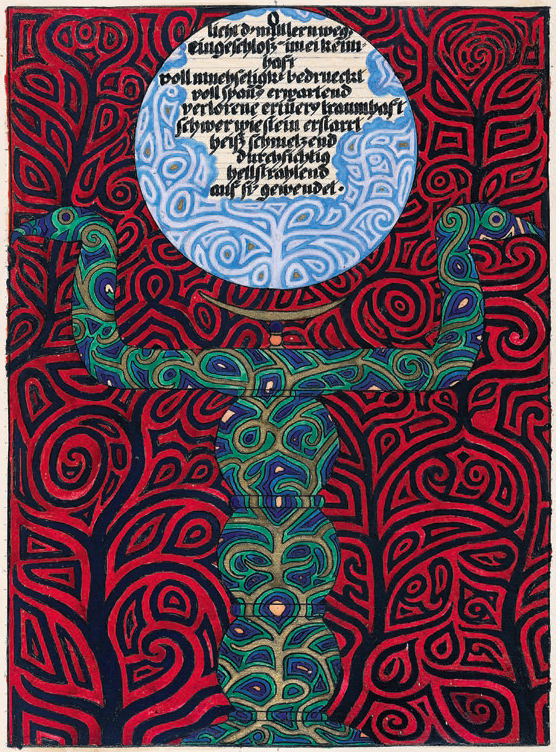
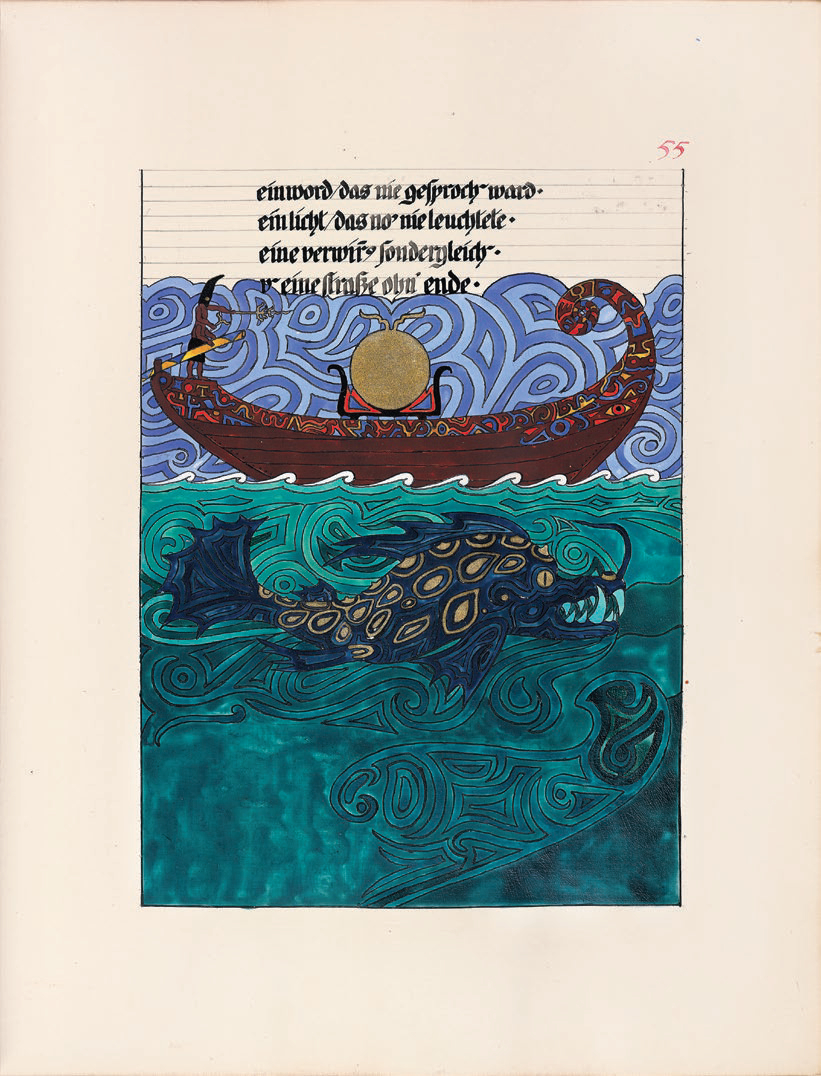
Carl Jung’s Liber Novus, better known as The Red Book, has come to light in a complete English translation, published by Norton in a 2009 facsimile edition and a smaller “reader’s edition” in 2012. The years since have seen several exhibitions of the book, which “could pass for a Bible rendered by a medieval monk,” writes art critic Peter Frank, “especially for the care with which Jung entered his writing as ornate Gothic script.”
Jung “refused to think of himself as an ‘artist’” but “it’s no accident the Liber Novus has been exhibited in museums, or functioned as the nucleus of ‘Encyclopedic Palace,’ the survey of visionary art in the 2013 Venice Biennale.” Jung’s elaborate paintings show him “every bit the artist the medieval monk or Persian courtier was; his art happened to be dedicated not to the glory of God or king, but that of the human race.”
One could more accurately say that Jung’s book was dedicated to the mystical unconscious, a much more nebulous and oceanic category. The “oceanic feeling”—a phrase coined in 1927 by French playwright Romain Rolland to describe mystical oneness—so annoyed Sigmund Freud that he dismissed it as infantile regression.
Freud’s antipathy to mysticism, as we know, did not dissuade Jung, his onetime student and admirer, from diving in and swimming to the deepest depths. The voyage began long before he met his famous mentor. At age 11, Jung later wrote in 1959, “I found that I had been in a mist, not knowing how to differentiate myself from things; I was just one among many things.”
Jung considered his elaborate dream/vision journal—kept from 1913 to 1930, then added to sporadically until 1961—“the central work in his oeuvre,” says Jung scholar Sonu Shamdasani in the Rubin Museum introduction above. “It is literally his most important work.”
And yet it took Dr. Shamdasani “three years to convince Jung’s family to bring the book out of hiding,” notes NPR. “It took another 13 years to translate it.” Part of the reason his heirs left the book hidden in a Swiss vault for half a century may be evident in the only portion of the Red Book to appear in Jung’s lifetime, “The Seven Sermons of the Dead.”
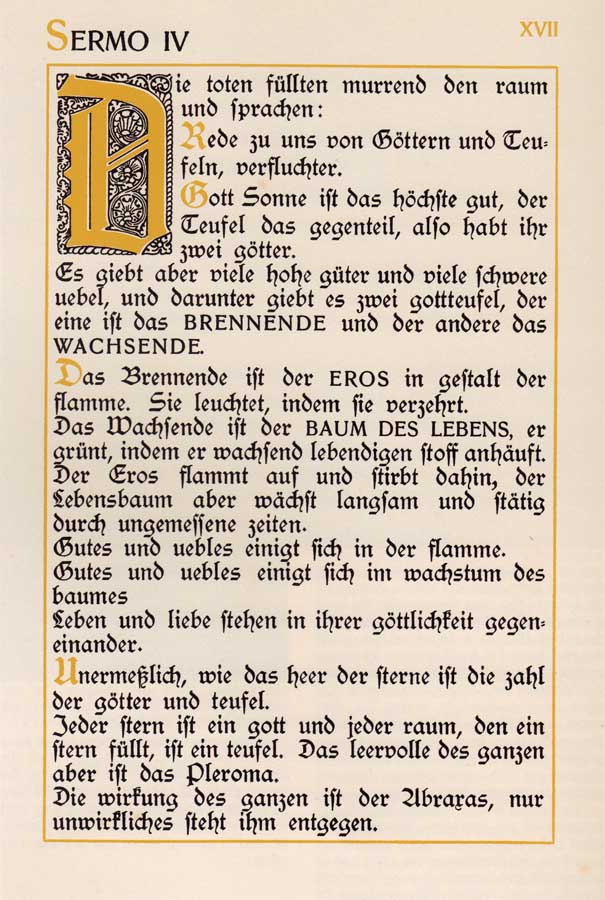
Jung had this text privately printed in 1916 and gave copies to select friends and family members. He composed it in 1913 in a period of Gnostic studies, during which he entered into visionary trance states, transcribing his visions in notebooks called the “Black Books,” which would later be rewritten in The Red Book.
You can see a page of Jung’s meticulously hand-lettered manuscript above. The “Sermons,” he wrote in a later interpretation, came to him during an actual haunting:
The atmosphere was thick, believe me! Then I knew that something had to happen. The whole house was filled as if there were a crowd present, crammed full of spirits. They were packed deep right up to the door, and the air was so thick it was scarcely possible to breathe. As for myself, I was all a‑quiver with the question: “For God’s sake, what in the world is this?” Then they cried out in chorus, “We have come back from Jerusalem where we found not what we sought/’ That is the beginning of the Septem Sermones.
The strange, short “sermons” are difficult to categorize. They are awash in Gnostic theology and occult terms like “pleroma.” The great mystical oneness of oceanic feeling also took on a very sinister aspect in the demigod Abraxas, who “begetteth truth and lying, good and evil, light and darkness, in the same word and in the same act. Wherefore is Abraxas terrible.”
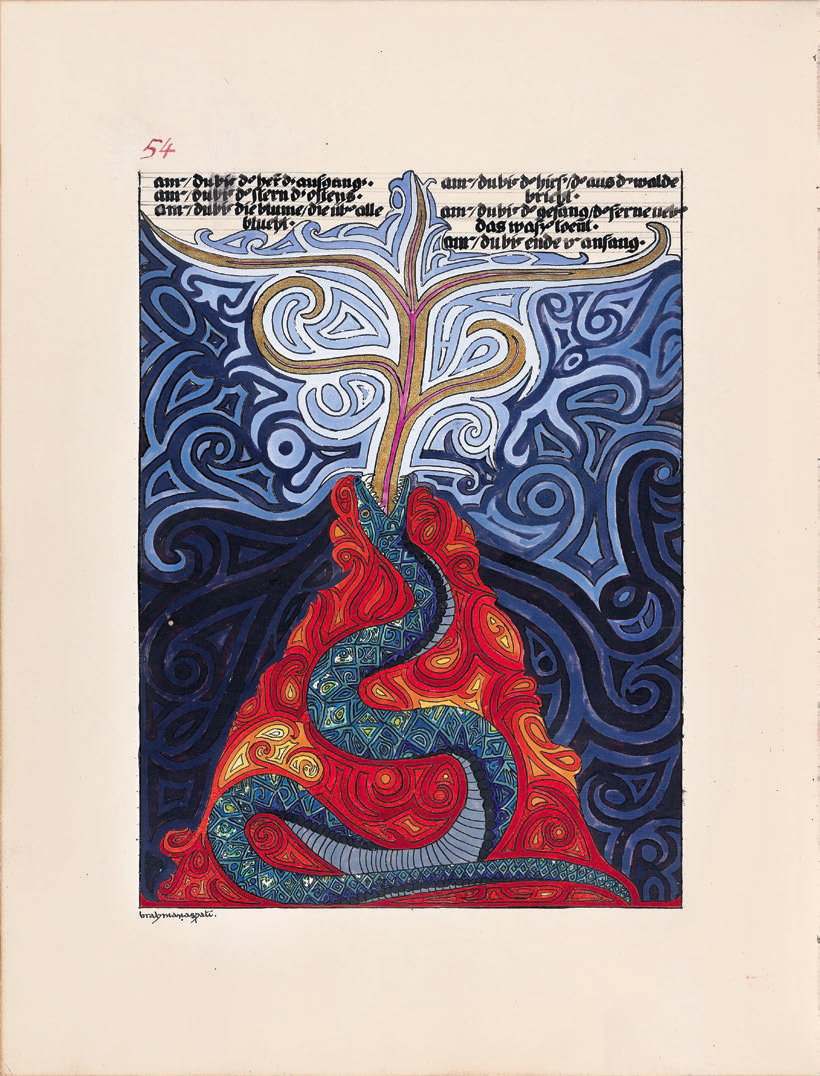
There are tedious, didactic passages, for converts only, but much of Jung’s writing in the “Seven Sermons,” and throughout The Red Book, is filled with strange obscure poetry, complemented by his intense illustrations. Jung “took on the similarly stylized and beautiful manners of non-western word-image conflation,” writes Frank, “including Persian miniature painting and east Asian calligraphy.”
If The Red Book is, as Shamdasani claims, Jung’s most important work—and Jung himself, though he kept it quiet, seemed to think it was—then we may in time come to think of him not only as an inspirer of eccentric artists, but as an eccentric artist himself, on par with the great illuminators and visionary mystic poet/painters.
Note: An earlier version of this post appeared on our site in 2020.
Related Content:
The Famous Breakup of Sigmund Freud & Carl Jung Explained in a New Animated Video
Carl Jung Explains His Groundbreaking Theories About Psychology in a Rare Interview (1957)
Josh Jones is a writer and musician based in Durham, NC.
Read More...How a 13th-Century Monk Created a Prayer Manuscript by Writing Over—and Accidentally Preserving—Archimedes’ Groundbreaking Mathematical Works
In Jerusalem of the year 1229, there lived a Greek Orthodox monk named Johannes Myronas. Needing some parchment for a prayer book, he grabbed some already-used pages, erased their existing content, and over them wrote down “prayers for the dead, prayers for repentance, blessings for the loaves at Easter, and even a prayer for those who were unreasonably excluded,” says math-and-science YouTuber Ben Syversen in the video above. Myronas may have fulfilled his religious duty without using too much valuable parchment, but he couldn’t have known the even greater relevance his actions would turn out to have had in the realm of mathematics. For the pages he’d scrubbed were a Greek compilation containing the only known copy of certain works by the ancient polymath Archimedes.
As it turns out, Myronas committed perhaps the most notable act of inadvertent preservation in the history of mathematics. We get the word palimpsest from the medieval practice of overwriting a page after first erasing what had been on it before, though incompletely; hence the meaning of multiple layers that have remained legible over time.
In the case of what we now know as the Archimedes Palimpsest, that legibility was achieved only with the aid of late twentieth-century and early twenty-first-century technology, in addition to the painstaking conservation effort required to keep this tenth-century document in more or less one piece. (And all of that was only possible thanks to the epic historical journey the Palimpsest took, which ended in 1998 when it sold for $2 million at Christie’s to a tech figure we’re only assured is not Bill Gates.)
You can learn more about that project from the TED Talk just above by its director, the late William Noel of Baltimore’s Walters Art Museum. Thanks to his dedication and that of his team, we now have writings of Archimedes like the Stomachion, which deals with a kind of children’s puzzle that turns out to have considerable similarities with an early problem in the field of combinatorics, and more importantly, The Method of Mechanical Theorems, an explanation of calculus-like procedures for determining area or volume. None of this proves that Archimedes was the inventor of combinatorics or calculus, exactly, but it does show us just how much further he’d managed to push Greek mathematics than we’d previously known. Besides, any work that can bring together historians, classicists, mathematicians, conservators, physicists, and computer scientists more than two millennia after its composition surely merits a place in the canon.
Related content:
How the Ancient Greeks Shaped Modern Mathematics: A Short, Animated Introduction
MIT’s Vintage 1970 Calculus Courses Now Online … And Still Handy
The Only Illustrated Manuscript of Homer’s Iliad from Antiquity
Based in Seoul, Colin Marshall writes and broadcasts on cities, language, and culture. He’s the author of the newsletter Books on Cities as well as the books 한국 요약 금지 (No Summarizing Korea) and Korean Newtro. Follow him on the social network formerly known as Twitter at @colinmarshall.
Read More...Hear What Homer’s Odyssey Sounded Like When Sung in the Original Ancient Greek
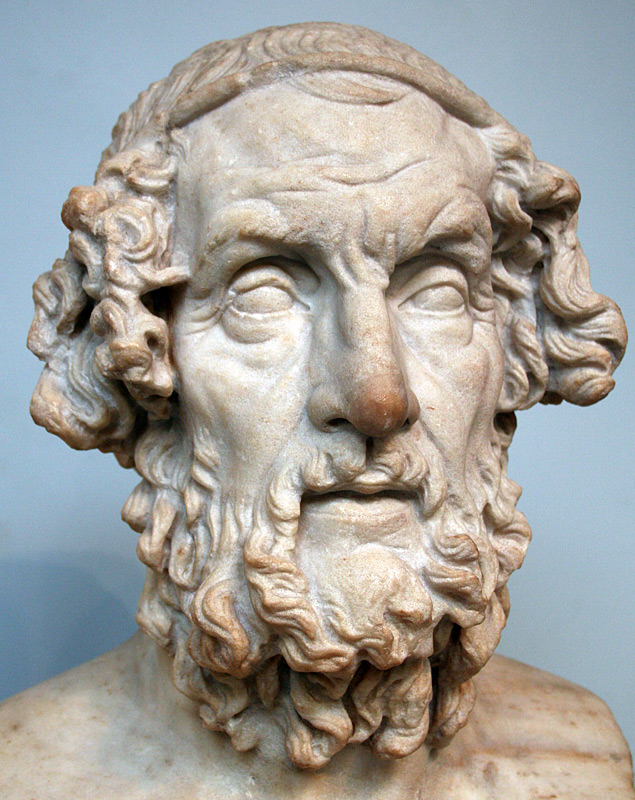
Image via Wikimedia Commons
It’s been a humanist truism for some time to say that Shakespeare speaks to every age, transcending his time and place through the sheer force of his universal genius. But any honest student first encountering the plays will tell you differently, as will many a seasoned scholar who works hard to place the writer and his work in historical context. Even onetime director of London’s National Theatre, Nicholas Hytner, once said, “I’ll admit that I hardly ever go to a performance of one of Shakespeare’s plays without experiencing blind panic during the first five minutes. I sit there thinking… I have no idea what these people are talking about.”
Of course, none of that means we can’t learn to appreciate Shakespeare, and we do not need a graduate-level education to do so. But much of his archaic language and obscure references will always sound foreign to modern ears. How much more so, then, the language of the ancient Greeks, whether in translation or not? Although we’ve also been taught to think of the Homeric epics as containers of universal truth and beauty, the world of Homer was, in many ways, an alien one—and the literature of ancient Greece was far closer to song than even Shakespeare’s musical speeches.
In fact, “before writing was generally known among the Greeks,” the University of Cincinnati notes, “poets recited and sang stories for audiences at the courts of city leaders and at festivals. A poet could actually improvise a tale in the six-beat rhythm of Greek verse if he knew the plot of his story.” We do not know whether Homer was one enterprising scribe or “a group of poets whose works on the theme of Troy were collected” under one name. But in either case, that poet or poets heard the tales of Hector and Achilles, Odysseus and Penelope, and all those meddling gods sung before they wrote them down. Now, thanks to Georg Danek of the University of Vienna and Stefan Hagel of the Austrian Academy of Sciences, we have some idea of what those songs may have sounded like.
“In the course of the last years,” write Danek and Hagel, “we have developed a technique of singing the Homeric epics, which is appropriate for the primarily oral tradition from which these poems emerge.” The two scholars caution that their theoretical recreations are “not to be understood as the exact reconstruction of a given melody, but as an approach to the technique the Homeric singers used to accommodate melodic principles to the demands of the individual verse.” Accompanied by a four-stringed lyre-like instrument called a phorminx, “the Homeric bard” would improvise the “melody at the same time as he improvised his text, which was unique in every performance.” In the audio above, you can hear Danek and Hagel’s melodic recreation of lines 267–366 of book 8 of the Odyssey, in which Demodocus sings about the love of Ares and Aphrodite.
At their site, the two scholars present an abstract of their Homeric singing theory, with musicological and linguistic evidence for the recreation. Their technical criteria will confuse the non-specialist, and none but ancient Greek speakers will understand the recording above. But it brings us a little closer to experiencing Homer’s epic poetry, “the foundation stones of European Literature,” as the ancient Greeks might have experienced it.
If you would like to support the mission of Open Culture, consider making a donation to our site. It’s hard to rely 100% on ads, and your contributions will help us continue providing the best free cultural and educational materials to learners everywhere. You can contribute through PayPal, Patreon, and Venmo (@openculture). Thanks!
Note: An earlier version of this post appeared on our site in 2016.
Related Content:
What Ancient Greek Music Sounded Like: Listen to a Reconstruction That’s “100% Accurate”
How Ancient Greek Statues Really Looked: Research Reveals their Bold, Bright Colors and Patterns
Learn Ancient Greek in 118 Free Lessons: A Free Online Course from Brandeis & Harvard
Hear What Shakespeare Sounded Like in the Original Pronunciation
Josh Jones is a writer and musician based in Durham, NC.
Read More...What Miles Davis Taught Herbie Hancock: In Music, as in Life, There Are No Mistakes, Just Chances to Improvise
One of my favorite Brian Eno quotes, or rather one that became an Oblique Strategy, is “Honor Your Mistake as a Hidden Intention.” (Or to be pedantic, the original version was “Honor Thy Error…”).
As a teenager growing up and trying to make art (at that time music and comics) there was no advice more freeing. It was the opposite of what I thought I knew: mistakes were shameful, the sign of an amateur or of the lack of practice. But the more art I made, the more I referenced Eno’s idea, and the more I read and listened, the more I realized it wasn’t just Eno.
The Beatles left in an alarm clock meant for the musicians on “A Day in the Life” and the sound of empty booze bottles vibrating on a speaker was left in at the end of “Long Long Long” (along with tons more). The Beastie Boys left in a jumping needle intended for a smooth scratch on “The Sounds of Science.” Radiohead left in Jonny Greenwood’s warm-up chord that became essential to “Creep.” (There’s a whole Reddit thread devoted to these mistakes if you choose to go down the rabbit hole.)
But those examples relate to the recording process of rock music. What about jazz? Surely there are “wrong” notes when it comes to playing, especially if you’re not the soloist.
In this very short video based around an interview with pianist Herbie Hancock, the master improviser Miles Davis honored Hancock’s mistake as a hidden intention by playing along with it. It’s both a surprising look into the arcane world of jazz improvisation and a revealing anecdote of Davis, usually known as a difficult collaborator.
“It taught me a very big lesson not only about music,” says Hancock, “but about life.”
Note: An earlier version of this post appeared on our site in 2016.
Related Content:
Saint John Coltrane: The San Francisco Church Built On A Love Supreme
How Jazz Helped Fuel the 1960s Civil Rights Movement
Ted Mills is a freelance writer on the arts.
Read More...Christopher Hitchens Explains Why Homer’s Odyssey Still Matters to Our World (2000)
At the moment, the answer to the question of why we should read Homer’s Odyssey seems rather straightforward: so we can more intelligently voice our opinions on Christopher Nolan’s new blockbuster film adaptation. A quarter-century ago, the matter was somewhat less clear. Still, an occasion had presented itself in the form of a new English translation, by University of Kansas classics professor Stanley Lombardo. That book, and the work of Homer in general, was the subject of a live two-hour roundtable discussion aired on C‑SPAN’s Book TV in the fall of 2000, which, with the Odyssey back in the zeitgeist, appeared on YouTube just days ago.
Apart from Lombardo himself, the participants include Joseph Bottum, then literary editor of the Weekly Standard; journalist and military veteran Debra J. Dickerson; and Christopher Hitchens, who clearly participated not just because he happened to be living in Washington, D.C., but also out of a genuine appreciation for the Odyssey and an understanding of its relevance in the modern world. Early on in the text, he explains, Homer introduces the concepts of hubris and nemesis, which “we cannot do without in ordinary discourse. There are certain punishments that appear to fall on people, for original arrogance or conceit, that we can’t conceive of relating grand stories without.”
There’s the “caprice of the gods,” with which every religion has had to deal, as well as the even more universal feeling of nostalgia, “a very overused and sentimentalized term now, which literally means — and can only really mean — the yearning to go home.” Adducing such re-interpretations by writers from Alexander Pope to James Joyce, Hitchens declares that we think of the Odyssey as “the original narrative of the striving of humanity — and of the need, also, to beware of what you want, in case you ever do, as Cavafy says, finally get home to Ithaca. It may turn out that it’s better to travel hopefully than to arrive.”
The matter of virtue also arises in the conversation, and specifically whether the range of virtues of which Homer sang (up to and including luck) would be recognized in our Christian or post-Christian world. To the avowedly atheist Hitchens’ mind, of course, we should already have been post-religious. Homer’s deities are “anthropomorphic gods; they are invented by us, as all gods are.” But whatever your religion or lack thereof, “if you don’t know something about classical Greece, then you won’t be able, with much profit, to read Shakespeare, or Milton, or Shelley, or Keats, or even Chaucer. It would be like not knowing what the bible story was and then wondering how you puzzle your way through Shakespeare as well. It’s part of the underlay; it’s part of the common heritage.” The translations and re-interpretations have kept coming, but Homer himself still patiently awaits each of us.
Related content:
A Walk Through Homer’s Odyssey: A Guide to the Epic Before Seeing Christopher Nolan’s Film
Christopher Hitchens Creates a Revised List of the 10 Commandments for the 21st Century
An Interactive Map of Odysseus’ 10-Year Journey in Homer’s Odyssey
Hear What Homer’s Odyssey Sounded Like When Sung in the Original Ancient Greek
Ailing Christopher Hitchens Creates a List of Essential Books for an 8‑Year-Old Girl to Read
Albert Einstein Explains Why We Need to Read the Classics
Based in Seoul, Colin Marshall writes and broadcasts on cities, language, and culture. He’s the author of the newsletter Books on Cities as well as the books 한국 요약 금지 (No Summarizing Korea) and Korean Newtro. Follow him on the social network formerly known as Twitter at @colinmarshall.
Read More...The Essence of Hayao Miyazaki Films: A Short Documentary About the Humanity at the Heart of His Animation
Filmmaker Hayao Miyazaki detests being referred to as the Japanese Walt Disney. The great animator and storyteller admires the gorgeous animation of classic Disney films, but finds them lacking in emotional complexity, the element he prizes above all else.
Miyazaki’s films are celebrated for their mystical, supernatural elements, but they take shape around the human characters inhabiting them. Plot comes later, after he has figured out the desires driving his people. “Keep it simple,” he counsels in Lewis Bond’s short documentary The Essence of Humanity above. An interesting piece of advice, given that a hallmark of his 60-year career is his insistence on creating realistic three-dimensional characters, warts and all.
American animators are also taught to simplify. They should all be able to sum up the essence of their proposed features by filling in the blank of the phrase “I want _____,” presumably because such concision is a necessary element of a successful elevator pitch.
As Bond points out, Western animated features often end with a convenient deus ex machina, freeing the characters up for a crowd-pleasing dance party as the credits roll.
Miyazaki doesn’t cotton to the idea of tidy, unearned endings, nor does he feel bound to grant his characters their wants, preferring instead to give them what they need. Spiritual growth is superior to wish fulfillment here.
Such growth rarely happens without time for reflection, and Miyazaki films are notable for the number of non-verbal scenes wherein characters perform small, everyday actions, a number of which can be sampled in Bond’s documentary. The beautifully rendered weather and settings have provided clues as to the characters’ development, ever since the lovely scene of cloud shadows skimming across a field in his first feature, 1979’s The Castle of Cagliostro.
Note: An earlier version of this post appeared on our site in 2015.
Related Content:
Watch Hayao Miyazaki Animate the Final Shot of His Final Feature Film, The Wind Rises
Watch Sherlock Hound: Hayao Miyazaki’s Animated, Steampunk Take on Sherlock Holmes
Hayao Miyazaki’s Masterpieces Spirited Away and Princess Mononoke Imagined as 8‑Bit Video Games
Ayun Halliday is an author, illustrator, and theater maker in NYC.
Read More...Support Us
We're hoping to rely on loyal readers, rather than erratic ads. Please click the Donate button and support Open Culture. You can use Paypal, Venmo, Patreon, even Crypto! We thank you!

About Us

Open Culture scours the web for the best educational media. We find the free courses and audio books you need, the language lessons & educational videos you want, and plenty of enlightenment in between.
Advertise With Us

FREE UPDATES!
GET OUR DAILY EMAIL
Get the best cultural and educational resources on the web curated for you in a daily email. We never spam. Unsubscribe at any time.
FOLLOW ON SOCIAL MEDIA

Open Culture editor Dan Colman scours the web for the best educational media. He finds the free courses and audio books you need, the language lessons & movies you want, and plenty of enlightenment in between.
Advertise With Us


