The Most Controversial Ancient Philosophy: Epicureanism
Over the years, you’ve probably heard at least a few people casually describe themselves as Epicureans. As used today, the label can refer to as little as enjoying the occasional expensive restaurant meal. The bar was a bit higher in the second century, as explained by ancient-history YouTuber Garrett Ryan in the new video above from his channel Told in Stone. But there is, at least, one major aspect of the original doctrine laid out by Epicurus (341–270 BC) with which most any of his self-styled followers in our time would agree: that pleasure is the greatest good. Whether they would follow that premise all the way to the conclusions Epicurus did is another matter.
For that ancient Greek philosopher, Ryan explains, “happiness was the sole legitimate goal of human existence. The essence of happiness is freedom from anxiety. Since the greatest source of mental disturbance is fear about death and the afterlife, it is necessary to understand the true nature of the universe.”
Thereafter come the principles about atoms drifting through the infinite void, a subject of less interest to many twenty-first century “Epicureans” than the mechanics of the Williams-Sonoma rewards program. Still, they would do well to learn at least one relevant Greek term: ataraxia, or the “tranquility that comes from being sufficient in oneself.”
Achieving ataraxia is not a matter of merely indulging the senses. Rather, “all sources of unnecessary mental disturbance should be removed.” That means no politics and probably no marriage, though friendship is acceptable. Though fairly ascetic in its original form, Epicureanism drew quite a few high-profile Romans as adherents — and as detractors. No less a figure than Cicero, for example, attacked both its opposition to traditional Roman religion and, perhaps predictably, its isolation from public life. Plutarch went so far as to write anti-Epicurean treatises, including one titled “It Is Not Possible to Live Pleasurably According to the Doctrines of Epicurus.” That may or may not be true by our modern standards, but the question is worth contemplating over a good dinner.
Related Content:
Memento Mori: How Smiling Skeletons Have Reminded Us to Live Fully Since Ancient Times
How 99% of Ancient Literature Was Lost
Based in Seoul, Colin Marshall writes and broadcasts on cities, language, and culture. He’s the author of the newsletter Books on Cities as well as the books 한국 요약 금지 (No Summarizing Korea) and Korean Newtro. Follow him on the social network formerly known as Twitter at @colinmarshall.
Read More...Watch Stewart Brand’s 6‑Part Series How Buildings Learn, With Music by Brian Eno
Stewart Brand came onto the cultural scene during the 1960s, helping to stage the Acid Tests made famous by Ken Kesey and the Merry Pranksters, and later launching the influential Whole Earth Catalog (something Steve Jobs described as “Google in paperback form, 35 years before Google came along”). He also vigorously campaigned in 1966 to have NASA release a photograph showing the entirety of Earth from space—something we take for granted now, but fired humanity’s imagination back then.
During the 1970s and beyond, Brand founded CoEvolution Quarterly, a successor to the Whole Earth Catalog; the WELL (“Whole Earth ‘Lectronic Link”), “a prototypical, wide-ranging online community for intelligent, informed participants the world over;” and eventually The Long Now Foundation, whose work we’ve highlighted here before. When not creating new institutions, he has poured his creative energies into books and films.
Above you can watch How Buildings Learn, Brand’s six-part BBC TV series from 1997, which comes complete with music by Brian Eno. Based on his illustrated book sharing the same title, the TV series offers a critique of modernist approaches to architecture (think Buckminster Fuller, Frank Gehry, and Le Corbusier) and instead argues for “an organic kind of building, based on four walls, which is easy to change and expand and grow as the ideal form of building.”
Brand made the series available on his YouTube channel, with these words: “Anybody is welcome to use anything from this series in any way they like… Hack away. Do credit the BBC, who put considerable time and talent into the project.” And he added the noteworthy footnote: “this was one of the first television productions made entirely in digital—shot digital, edited digital.”
Find the first three parts above, and the remaining parts below:
- Part 1: Flow
- Part 2: The Low Road
- Part 3: Built for Change
- Part 4: Unreal Estate
- Part 5: The Romance of Maintenance
- Part 6: Shearing Layers
You can find How Buildings Learn added to our list of Free Documentaries, a subset of our collection, 4,000+ Free Movies Online: Great Classics, Indies, Noir, Westerns, Documentaries & More.
Note: An earlier version of this post appeared on our site in 2015.
Related Content:
Stewart Brand’s List of 76 Books for Rebuilding Civilization
The Acid Test Reels: Ken Kesey & The Grateful Dead’s Soundtrack for the 1960s Famous LSD Parties
Brian Eno Explains the Origins of Ambient Music
Read More...How the Beatles Made their Most Acclaimed Album, Revolver, Released 60 Years Ago This Month
Among Beatles connoisseurs, it’s fair game to claim anything from Rubber Soul to Abbey Road as one’s favorite album. But even within that span of the catalog, a hierarchy of acclaim exists, and that hierarchy has been rearranged over the decades. The ecstatic reception of Sgt. Pepper’s Lonely Hearts Club Band lasted at least a decade. By the turn of the nineteen-eighties, its immediate predecessor Revolver had joined it at the top spot of critical regard; twenty years after that, Abbey Road had displaced Sgt. Pepper. Now, a full 60 years after it first came out, Revolver is the single Beatles album held in the highest esteem — which, naturally, makes it a serious contender for the greatest album ever recorded.
In his new video above, music YouTuber David Hartley explains what makes Revolver so beloved by recounting the history of its production. As in his previous Beatles videos, he draws on the library of studio outtakes that make audible the evolution of each song, as well as on contemporary interviews with the Beatles and their collaborators.
Among his most illuminating sources is engineer Geoff Emerick’s memoir Here, There, and Everywhere — titled, incidentally after one of the songs on this very album, the challenge of whose recording he took on at just twenty years old. In the event, his youth proved an asset, granting him as it did the willingness not just to execute the Beatles’ “far-out” sonic ideas, but also to violate EMI Studios’ policies against experimental use of its hardware in the process.
Indeed, if it was possible in 1966, it seems to have been tried in the making of Revolver. As Hartley reveals, “I’m Only Sleeping” once featured a vibraphone, “Yellow Submarine” once began with a spoken-word intro, and “And Your Bird Can Sing” once kept getting interrupted by uncontrollable and quite possibly substance-induced laughter. Neither these nor any of the album’s other now-familiar, much-scrutinized songs took straight paths to their final forms. Into a runtime of only 35 minutes, the Beatles managed to put everything from “a children’s singalong song” to “a song complaining about all the money they were paying in taxes” to “a song about loneliness” to “a song about laziness” — while also transmitting the “great feeling of joy” for which their oeuvre is known. Revolver’s place in the canon of albums is secure, but will it still be considered the band’s best work on its 70th anniversary? Tomorrow, as they say, never knows.
Related content:
How the Beatles Wrote Their Songs: From Early Demos to Final Recordings
Tomorrow Never Knows: How The Beatles Invented the Future With Studio Magic, Tape Loops & LSD
The Kinks’ Ray Davies Reviews the Beatles’ 1966 Album Revolver; Calls It “A Load of Rubbish”
Based in Seoul, Colin Marshall writes and broadcasts on cities, language, and culture. He’s the author of the newsletter Books on Cities as well as the books 한국 요약 금지 (No Summarizing Korea) and Korean Newtro. Follow him on the social network formerly known as Twitter at @colinmarshall.
Read More...How the Bird Sound Effects in Alfred Hitchcock’s The Birds Were Created with a Pioneering Electronic Instrument, the Trautonium
Alfred Hitchcock’s The Birds was nominated for an Academy Award for Best Special Effects, though viewers raised on more recent Hollywood spectacles would hardly find its mechanized and optically printed avian attackers convincing. Still, the picture as a whole has retained its eerie, ominous power over the last six decades, and a decent amount of the credit for that goes to an aspect that hasn’t dated at all: its non-musical “score” by the early electronic composer Oskar Sala. Many of the threatening bird calls on the soundtrack were actually played by Sala on a device called the Mixtur-Trautonium, a pre-synthesizer orchestral electronic instrument of which he wasn’t just the undisputed master, but the only player in existence.
After his acceptance into the Berlin Conservatory in 1929, Sala came into contact with the Trautonium, which had recently been invented by one Dr. Friedrich Trautwein. Inspired to more deeply understand the principles behind the nascent technology of electronic music, and to further it, he went on to study physics at the University of Berlin in the mid-nineteen-thirties.
This positioned him well to develop new models of Trautonium, a series that culminated in 1948 with the Mixtur-Trautonium, which, unlike Trautwein’s monophonic original, could sound multiple voices at once. The instrument proved versatile, and indeed commercial: any German who grew up in the nineteen-fifties will remember its sounds from television advertisements.
The chance to work on The Birds, by far Sala’s most widely heard soundtrack work, “presented itself when a former classmate of Sala who worked at Universal Studios in Hollywood heard that Hitchcock wanted synthetically produced bird sounds for his next movie,” says Google Arts & Culture. “Hitchcock, who deliberately wanted to avoid creating traditional movie music, even flew to Sala’s recording studio in Berlin where he was impressed by the sounds made by the Trautonium, which ultimately produced all the movie’s sound effects.” In collaboration with fellow pioneering electronic composer Remi Gassmann, Sala produced a veritable storm of not just avian shrieks and cackles, but also the harsh swirl of the elements and the creaks and groans of failing man-made infrastructure. Or at least that’s what moviegoers may imagine hearing in a soundtrack that often verges on the otherworldly, even the abstract — and Hitchcock knew that the imagination is the place from which real fear arises.
Related Content:
Daphne Oram Created the BBC’s First-Ever Piece of Electronic Music (1957)
Hear the Evolution of Electronic Music: A Sonic Journey from 1929 to 2019
Based in Seoul, Colin Marshall writes and broadcasts on cities, language, and culture. He’s the author of the newsletter Books on Cities as well as the books 한국 요약 금지 (No Summarizing Korea) and Korean Newtro. Follow him on the social network formerly known as Twitter at @colinmarshall.
Read More...Watch a Band Perform the Sound Effects from Pink Floyd’s “Money,” Using a Money Counter, Torn Sheets of Paper & More
When Pink Floyd recorded “Money” in 1972, Roger Waters spliced into the opening moments the sounds of cash registers, tearing paper, and jingling coins. Half a century later, the German drummer Sina Doering and her band performed those sounds live, using a bowl of loose change, a toy register, a money counter, and a sheet of paper torn on the beat. And they did it all live at Abbey Road Studios, the same place where Pink Floyd recorded Dark Side of the Moon (on which “Money” appears). Watch it above, and enjoy.
Related Content
A Live Studio Cover of Pink Floyd’s The Dark Side of the Moon, Played from Start to Finish
The Dark Side of the Moon Project: Watch an 8‑Part Video Essay on Pink Floyd’s Classic Album
Clare Torry’s Rare Live Performances of “Great Gig in the Sky” with Pink Floyd
Read More...The History of Glam Rock and How It Put an End to the Hippie Era
Cast your mind back to the distant year 2021 and recall, if you will, its music, its fashions, the obsessions of its youth. This probably won’t be a difficult task, since in most respects — the dampening effects of the pandemic notwithstanding — none of those aspects of popular culture seem any different today. Yet roughly the same time span separated Scott McKenzie’s “San Francisco (Be Sure to Wear Flowers in Your Hair)” and David Bowie’s “Starman.” 1967 was the year of the Summer of Love; by 1972, according to most reckonings, the cultural era known as the Sixties was, if not quite over, then at least clearly in its final days. The hippies were on their way down, and glam rockers had arisen to take their place with a vengeance.
In less than half an hour, the new video from Bandsplaining tells the whole story of glam rock, “the gender-bending proto-punk movement that was hated by the press and criminally underplayed in the U.S.” It begins in the 1970s, a time when the market for long-playing records was robust, but singles had fallen behind as a youth-oriented pop-cultural form.
Into that vacuum stepped T. Rex, a onetime avant-garde folk duo reinvented as a straight-ahead rock band bent on reviving that genre as it rowdily was before the Beatles came along. When they hit it big, other acts imitated not just their bluesy sound, but the androgynous, brazenly fabrication-forward image of frontman Marc Bolan. Practically overnight, the name of the game changed from earnest self-expression to outlandish self-creation.
Other bands reshaped by this glam rock movement, as it was soon dubbed in the British media, included Slade, The Sweet, and Mott the Hoople. “My brother’s back at home with his Beatles and his Stones,” sang that last outfit in their breakout hit. “We never got it off on that revolution stuff.” That song, “All the Young Dudes,” had been written by the single most defining glam-rock figure: David Bowie, who himself shot to prominence in the thoroughly anti-Sixties guise of Ziggy Stardust, the bisexual, synthetics-clad rocker from outer space who swaggered as if already famous across the universe. Within a few years, Bowie’s antenna for the zeitgeist would have him retiring Ziggy Stardust and ditching glam rock, a genre whose flame burned as brilliantly — and indeed garishly — as it did briefly. But in pop music, its characteristic lack of sociopolitical ideals, obsession with fame, and casual relationship with reality were here to stay.
Related content:
David Bowie’s Final Gig as Ziggy Stardust Documented in 1973 Concert Film
Freddie Mercury: The Untold Story of the Singer’s Journey From Zanzibar to Stardom
The History of Rock Told in a Whirlwind 15-Minute Video
Based in Seoul, Colin Marshall writes and broadcasts on cities, language, and culture. He’s the author of the newsletter Books on Cities as well as the books 한국 요약 금지 (No Summarizing Korea) and Korean Newtro. Follow him on the social network formerly known as Twitter at @colinmarshall.
Read More...Read 20,000+ Golden Age Comic Books Free Online: Superheroes, Westerns, Romance, Horror, and More
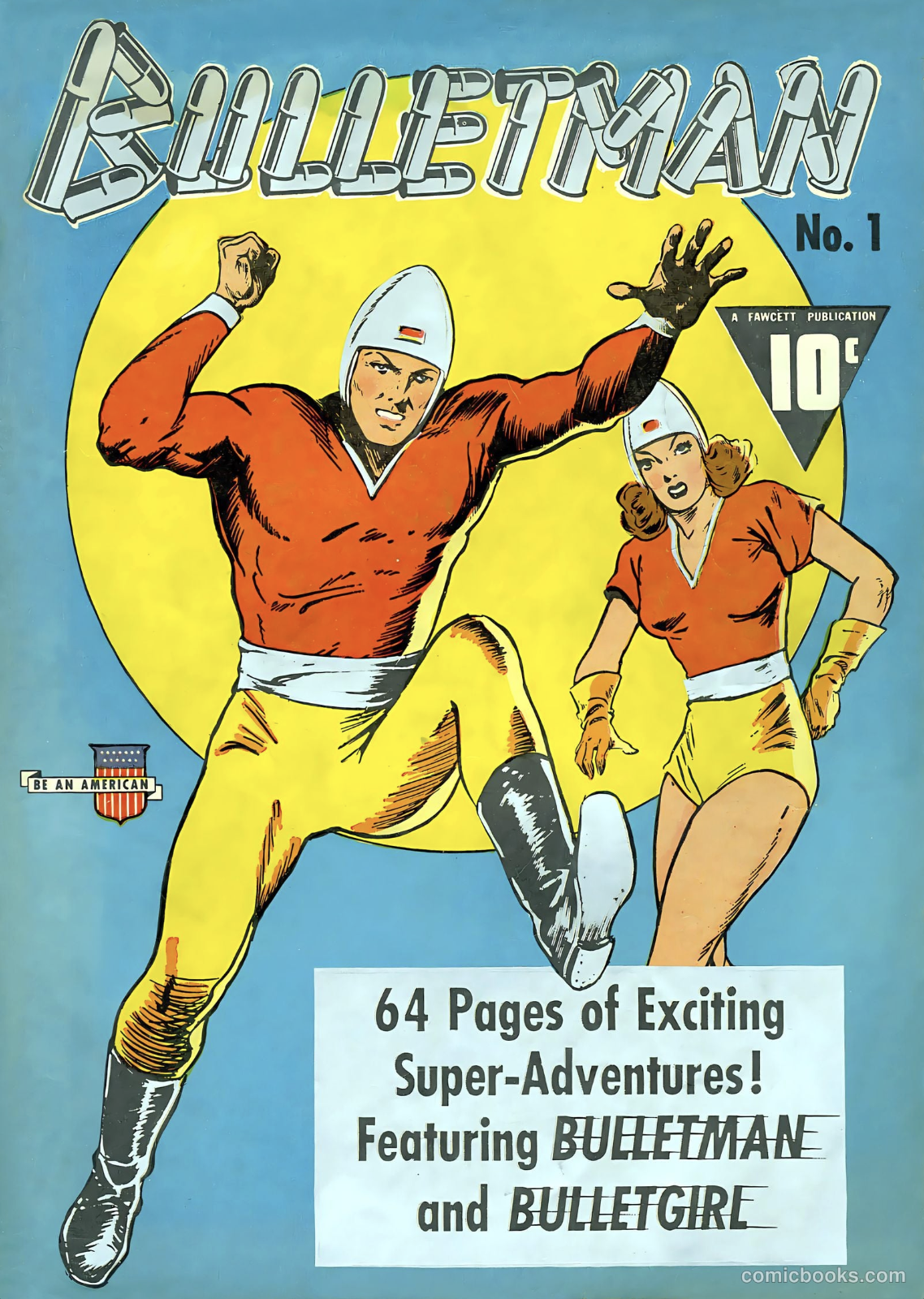
For generations of kids in the twentieth century, few pleasures were as intoxicating as a trip to the comic-book shop with the week’s allowance fresh in hand. Those of us who grew up in the nineties had any number of high-production-value paper superhero spectacles from major publishers on which to blow our money. Personally, I preferred the greater value of Carl Barks’ old Uncle Scrooge and Donald Duck stories then being reprinted. But nothing offered quite so much value as the cardboard boxes, kept below the main shelves, filled as they were with previously owned comic books from the fifties, sixties, seventies, and eighties. As I recall, a couple of dollars could get you a whole afternoon’s reading material.
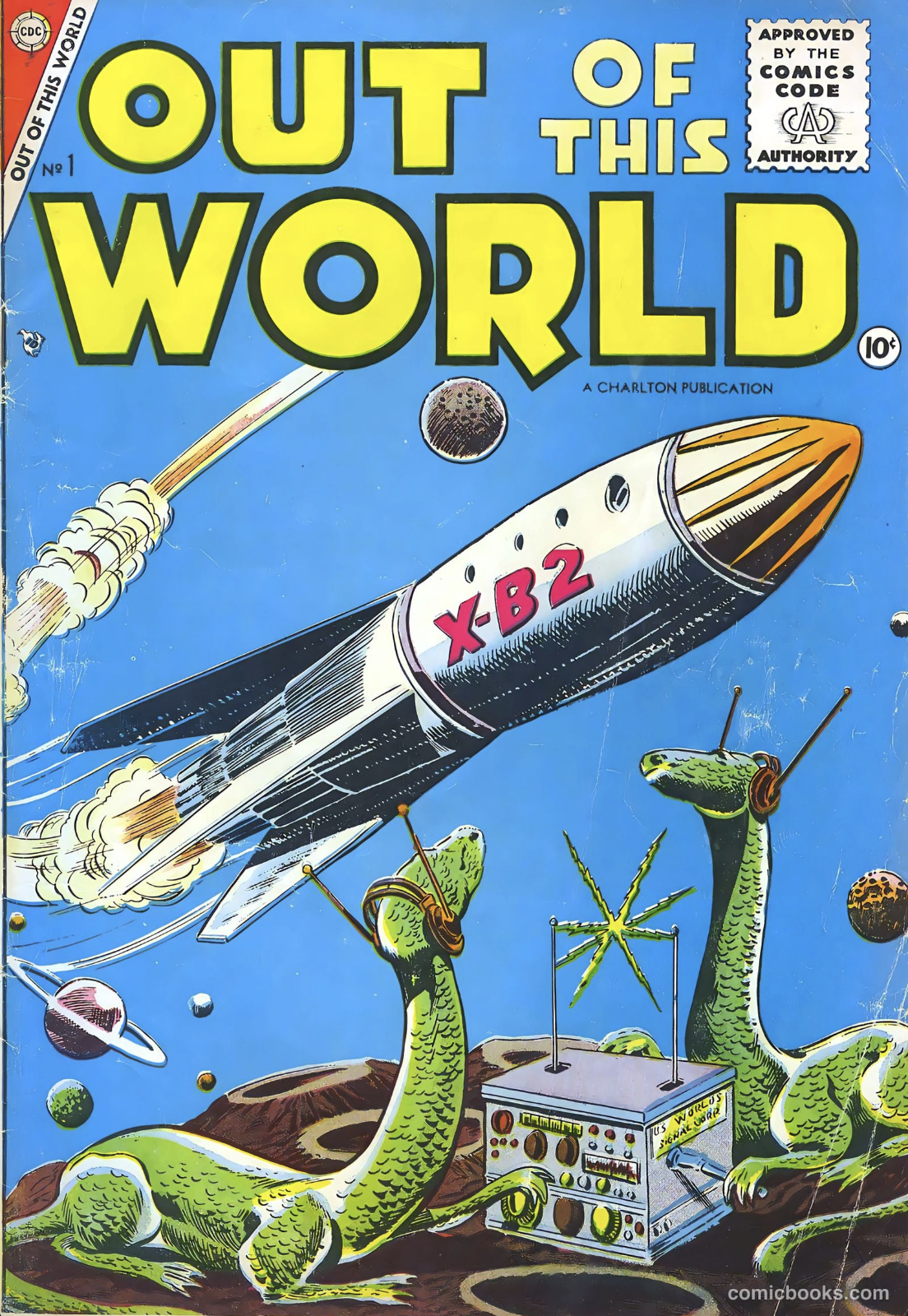
Now you don’t even need the couple of dollars. Comicbooks.com has opened an online reading room stocked with more than 20,000 digitized and restored golden-age comics, with several hundred more issues added every day. Though you may not find Donald Duck there, you will find other “funny animals” — as enthusiasts call them — like Dizzy Duck, Lucky Duck, Super Duck Comics, and Wonder Duck in Adventure at the Rodeo of the Fearless Quacker.
Those already familiar with the all-American exploits of Archie and his Riverdale High coterie might consider such alternatives as Candy, Tippy Teen, and Hap Hazard. And who needs Superman and Batman when you can enjoy the super-heroic adventures of Skyman, Bulletman, Cat-Man, and Strong Man?
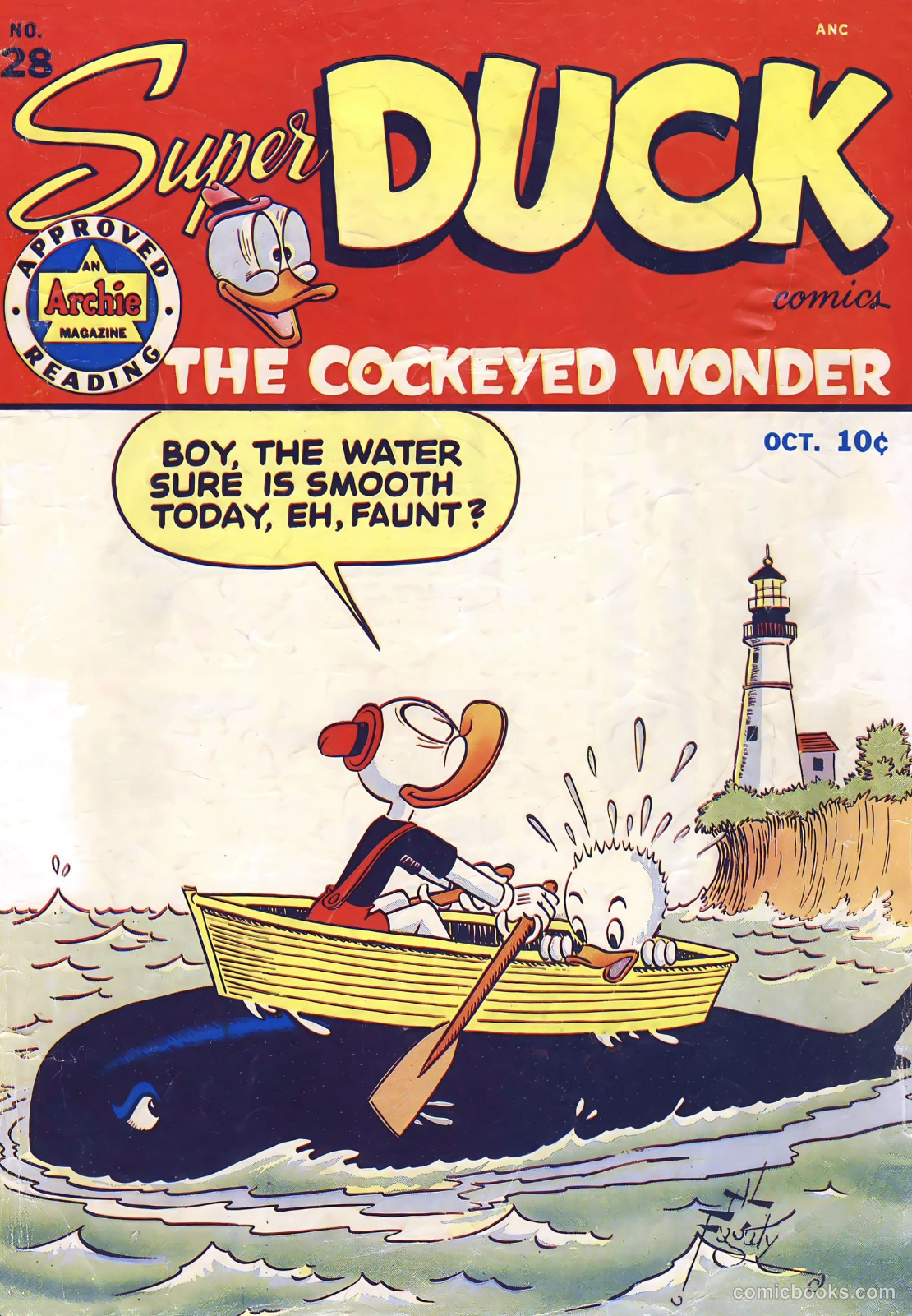
Given the mainstream prominence of comic books in the mid-twentieth century, these mostly forgotten publications now constitute an especially vivid — at times even lurid — means of pop-cultural time travel, through their content as well as their advertisements (for itching powder and other practical joke supplies, muscle-building and jiu-jitsu courses, war bonds, etc.). In any genre, whether superhero, western, romance, funny animal, horror, science fiction, they offer a connection with readers of decades past. In their form, as you can see on Comicbooks.com’s timeline of the evolution of what the French call le neuvième art, they offer a connection with even more distant ones: those of pulp fiction, humor weeklies, chromolithograph cartoons, penny dreadfuls, and twelfth-century Japanese chōjū-giga scrolls — the original funny animals. Enter the free comic collection here.
Related Content:
Free: Download 15,000+ Free Golden Age Comics from the Digital Comic Museum
Download Over 22,000 Golden & Silver Age Comic Books from the Comic Book Plus Archive
Explore a Big Archive of Vintage Early Comics: 1700–1929
Based in Seoul, Colin Marshall writes and broadcasts on cities, language, and culture. He’s the author of the newsletter Books on Cities as well as the books 한국 요약 금지 (No Summarizing Korea) and Korean Newtro. Follow him on the social network formerly known as Twitter at @colinmarshall.
Read More...How Ada Lovelace, Daughter of Lord Byron, Wrote the First Computer Program in 1842–a Century Before the First Computer
I’ve never quite understood why the phrase “revisionist history” became purely pejorative. Of course, it has its Orwellian dark side, but all knowledge has to be revised periodically, as we acquire new information and, ideally, discard old prejudices and narrow frames of reference. A failure to do so seems fundamentally regressive, not only in political terms, but also in terms of how we value accurate, interesting, and engaged scholarship. Such research has brought us fascinating stories about previously marginalized people who made significant contributions to scientific discovery, such as NASA’s “human computers,” portrayed in the book Hidden Figures, then dramatized in the film of the same name.
Likewise, the many women who worked at Bletchley Park during World War II—helping to decipher encryptions like the Nazi Enigma Code (out of nearly 10,000 codebreakers, about 75% were women)—have been getting their historical due, thanks to “revisionist” researchers. And, as we noted in a prior post, we might not know much, if anything, about film star Hedy Lamarr’s significant contributions to wireless, GPS, and Bluetooth technology were it not for the work of historians like Richard Rhodes. These few examples, among many, show us a fuller, more accurate, and more interesting view of the history of science and technology, and they inspire women and girls who want to enter the field, yet have grown up with few role models to encourage them.
We can add to the pantheon of great women in science the name Ada Byron, Countess of Lovelace, the daughter of Romantic poet Lord Byron. Lovelace has been renowned, as Hank Green tells us in the video at the top of the post, for writing the first computer program, “despite living a century before the invention of the modern computer.” This picture of Lovelace has been a controversial one. “Historians disagree,” writes prodigious mathematician Stephen Wolfram. “To some she is a great hero in the history of computing; to others an overestimated minor figure.”
Wolfram spent some time with “many original documents” to untangle the mystery. “I feel like I’ve finally gotten to know Ada Lovelace,” he writes, “and gotten a grasp on her story. In some ways it’s an ennobling and inspiring story; in some ways it’s frustrating and tragic.” Educated in math and music by her mother, Anne Isabella Milbanke, Lovelace became acquainted with mathematics professor Charles Babbage, the inventor of a calculating machine called the Difference Engine, “a 2‑foot-high hand-cranked contraption with 2000 brass parts.” Babbage encouraged her to pursue her interests in mathematics, and she did so throughout her life.
Widely acknowledged as one of the forefathers of computing, Babbage eventually corresponded with Lovelace on the creation of another machine, the Analytical Engine, which “supported a whole list of possible kinds of operations, that could in effect be done in arbitrarily programmed sequence.” When, in 1842, Italian mathematician Louis Menabrea published a paper in French on the Analytical Engine, “Babbage enlisted Ada as translator,” notes the San Diego Supercomputer Center’s Women in Science project. “During a nine-month period in 1842–43, she worked feverishly on the article and a set of Notes she appended to it. These are the source of her enduring fame.” (You can read her translation and notes here.)
In the course of his research, Wolfram pored over Babbage and Lovelace’s correspondence about the translation, which reads “a lot like emails about a project might today, apart from being in Victorian English.” Although she built on Babbage and Menabrea’s work, “She was clearly in charge” of successfully extrapolating the possibilities of the Analytical Engine, but she felt “she was first and foremost explaining Babbage’s work, so wanted to check things with him.” Her additions to the work were very well-received—Michael Faraday called her “the rising star of Science”—and when her notes were published, Babbage wrote, “you should have written an original paper.”
Unfortunately, as a woman, “she couldn’t get access to the Royal Society’s library in London,” and her ambitions were derailed by a severe health crisis. Lovelace died of cancer at the age of 36, and for some time, her work sank into semi-obscurity. Though some historians have seen her as simply an expositor of Babbage’s work, Wolfram concludes that it was Ada who had the idea of “what the Analytical Engine should be capable of.” Her notes suggested possibilities Babbage had never dreamed of. As the Women in Science project puts it, “She rightly saw [the Analytical Engine] as what we would call a general-purpose computer. It was suited for ‘developping [sic] and tabulating any function whatever… the engine [is] the material expression of any indefinite function of any degree of generality and complexity.’ Her Notes anticipate future developments, including computer-generated music.”
In an episode of the BBC’s In Our Time, above, you can hear former-host Melvyn Bragg discuss Lovelace’s importance with historians and scholars Patricia Fara, Doron Swade, and John Fuegi. And be sure to read Wolfram’s biographical and historical account of Lovelace here.
Note: An earlier version of this post appeared on our site in 2017.
Related Content:
The Contributions of Women Philosophers Recovered by the New Project Vox Website
Real Women Talk About Their Careers in Science
Josh Jones is a writer and musician based in Durham, NC.
Read More...What Did Ancient Rome Look Like? A 3D Virtual Tour of the City During the Second Century AD
The description “open-air museum” has often been applied, in various senses both positive and negative, to the country of Italy in general and the city of Rome in particular. Indeed, only the imagination of a truly blinkered (or unusually phone-addicted) tourist could fail to be cast back to antiquity upon entering its historic center, itself an officially designated UNESCO World Heritage Site. Yet it also takes little exposure to the intense culture of tourism and all it has wrought to wonder how Rome was back when, if you like, Rome was Rome: in the second century AD, say, when its built environment reached the height of its glory.
Manuel Bravo can show us. A YouTuber who creates highly informative real, virtual, and hybrid video tours of famous ancient places, he’s previously been featured here on Open Culture for his work on everywhere from the Acropolis to the Sistine Chapel, to Paris and Pompeii.
His “Virtual Rome” takes us on not a walk through the Eternal City of nearly two millennia ago, but a flight: viewers of modern travel documentaries will find its camera movements reminiscent of nothing so much as drone photography. This technique provides views even the most august ancient Roman citizens could never have commanded.
Beginning on the Capitoline Hill, the most sacred of the seven such formations within the original city walls, Bravo’s virtual camera passes the Temples of Jupiter and Juno Moneta; the Tabularium, which stored mail, the Roman Forum and its basilicas; and the Curia Julia, where the senators of the Roman Republic met. Lesser-known locations include the Rostra, named for the sea walls of captured enemy ships with which it was adorned, and from which the likes of Cicero would deliver their speeches; the Regia, home to the Pontifex Maximus, the prefect of Roman priests; and the “dark, stinking” underground facility known as the Tullianum, now called Mamertine Prison. Parts of that last remain open for the appreciation of twenty-first-century tourists — or at least those willing to pay the ten-euro entrance fee.
Related Content:
Rome Reborn: A New 3D Virtual Model Lets You Fly Over the Great Monuments of Ancient Rome
An 8‑Minute Animated Flight Over Ancient Rome
The Changing Landscape of Ancient Rome: A Free Online Course from Sapienza University of Rome
Based in Seoul, Colin Marshall writes and broadcasts on cities, language, and culture. He’s the author of the newsletter Books on Cities as well as the books 한국 요약 금지 (No Summarizing Korea) and Korean Newtro. Follow him on the social network formerly known as Twitter at @colinmarshall.
Read More...Hear the Earliest Known Piece of Polyphonic Music: This Composition, Dating Back to 900 AD, Changed Western Music
Like digging for fossils or panning for gold, the research process can be a tedious affair. But for any researcher, long days of searching and reading will eventually result in discovery. These are the moments scholars cherish. It’s the chance discovery, however rare, that makes the long hours and bleary late nights worthwhile. And some finds can change an entire field. Such was the discovery of St. John’s College PhD student, and now Associate Professor of Musicology at the University of Pavia, Giovanni Varelli, who, in 2014, found what is believed to be, writes Cambridge University, “the earliest known practical example of polyphonic music,” that is, music consisting of two or more melodic lines working together simultaneously.
You can hear the short composition—written in praise of the patron saint of Germany, Saint Boniface—performed above by St. John’s undergraduates Quintin Beer and John Clapham. Prior to Varelli’s discovery of this piece of music, the earliest polyphonic music was thought to date to the year 1000, from a collection called The Winchester Troper. Varelli’s discovery may date to 100 years earlier, around the year 900, and was found at the end of a manuscript of the Life of Bishop Maternianus of Reims. One reason musicologists have so far overlooked the piece, Varelli says, is that “we are not seeing what we expected.”
Typically, polyphonic music is seen as having developed from a set of fixed rules and almost mechanical practice. This changes how we understand that development precisely because whoever wrote it was breaking those rules. It shows that music at this time was in a state of flux and development.
Varelli’s specialization in early music notation also provided him with the training needed to recognize the piece, which was written using “an early form of notation that predates the invention of the stave” (see the piece below). According to former British Library curator Nicolas Bell, “when this manuscript was first catalogued in the 18th century, nobody was able to understand these unusual symbols.” Varelli’s discovery shows a deviation from “the convention laid out in treatises at the time” and points toward the development of a musical technique that “defined most European music up until the 20th century.”
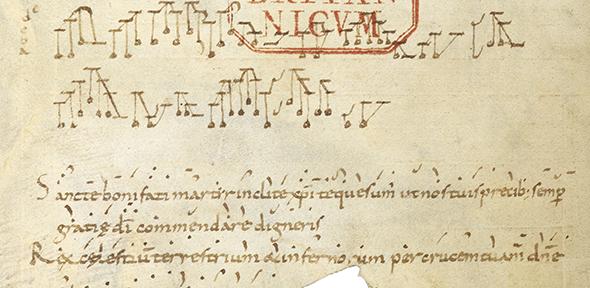
Varelli gives us a sense of how important this discovery is to scholars of early music: “the rules being applied here laid the foundations for those that developed and governed the majority of western music history for the next thousand years. This discovery shows how they were evolving, and how they existed in a constant state of transformation, around the year 900.”
So there you have it. If you’re stuck in the doldrums of a research project, waiting for the wind to pick up, don’t despair. The next rare artifact, treatise, or manuscript may be waiting for someone with exactly your specialized insights to decipher its secrets.
Note: An earlier version of this post appeared on our site in 2017.
Related Content:
Hear a 9,000 Year Old Flute—the World’s Oldest Playable Instrument—Get Played Again
Listen to the Oldest Song in the World: A Sumerian Hymn Written 3,400 Years Ago
Hear the World’s Oldest Instrument, the “Neanderthal Flute,” Dating Back Over 43,000 Years
Josh Jones is a writer and musician based in Durham, NC.
Read More...Support Us
We're hoping to rely on loyal readers, rather than erratic ads. Please click the Donate button and support Open Culture. You can use Paypal, Venmo, Patreon, even Crypto! We thank you!

About Us

Open Culture scours the web for the best educational media. We find the free courses and audio books you need, the language lessons & educational videos you want, and plenty of enlightenment in between.
Advertise With Us

FREE UPDATES!
GET OUR DAILY EMAIL
Get the best cultural and educational resources on the web curated for you in a daily email. We never spam. Unsubscribe at any time.
FOLLOW ON SOCIAL MEDIA

Open Culture editor Dan Colman scours the web for the best educational media. He finds the free courses and audio books you need, the language lessons & movies you want, and plenty of enlightenment in between.
Advertise With Us


