The Daily Routine of Marcus Aurelius: How to Live Like a Stoic
Marcus Aurelius did not have a smartphone. In fact, he didn’t have a phone of any kind, owing to the fact that he lived in the second century, though we can be reasonably certain that he commanded more than enough messengers to keep himself informed around the clock. That’s because he was the Roman emperor at a time when the Roman Empire was at its height. And so, none of us will ever know Marcus’ freedom from digital distraction, nor will we know the intense responsibility he must have felt, no matter how grand a title we attain in our own careers. Still, even here in the twenty-first century, we would all do well to live by the example he left.
So believes Ryan Holiday, a popularizer of Stoicism, the school of thought primarily defined by Marcus’ writings, as well as those of statesman-dramatist Seneca the Younger and former slave Epictetus. In his Meditations, Marcus included enough detail about his own life that Holiday could make the video above for his YouTube channel Daily Stoic, which breaks down the emperor’s daily routine.
He rose at dawn, but not out of natural inclination. He did his reflection, including a realistic adjustment of his expectations for the day, before the siege of duties and requests began. He defined time for what Cal Newport, Holiday’s colleague in the smarter regions of digital-era self-help, would call deep work.
As with any popularization, Holiday conveys Marcus’ life and thought in terms the man himself wouldn’t recognize, even if they were translated into Latin. One fashionable expression he doesn’t use but could have is “work-life balance.” “Marcus was not all about business,” Holiday says. “We know that he was active in physical exercise. We know that he enjoyed boxing and wrestling and hunting and horseback riding. We know that he would take walks.” He would also go to the Colosseum, though without hiding his lack of interest in gladiatorial combat. If he spent more time reading and thinking in his prime seat than getting into the spirit of the games, why attend at all? Perhaps he thought in the manner of Martial, a poet of an earlier generation whose sentiments would nevertheless ring true with Stoics ancient or modern: “These are my times, and I must know them.”
Related Content:
Marcus Aurelius’ 9 Rules for Living a Stoic Life
Why Jerry Seinfeld Lives by the Stoic Philosophy of Marcus Aurelius
How to Be a Stoic in Your Everyday Life: Philosophy Professor Massimo Pigliucci Explains
The Daily Routines of Famous Creative People, Presented in an Interactive Infographic
Based in Seoul, Colin Marshall writes and broadcasts on cities, language, and culture. He’s the author of the newsletter Books on Cities as well as the books 한국 요약 금지 (No Summarizing Korea) and Korean Newtro. Follow him on the social network formerly known as Twitter at @colinmarshall.
Read More...The Women of the Bauhaus: See Hip, Avant-Garde Photographs of Female Students & Instructors at the Famous Art School

Take a look at photos of Bush Tetras — a three-girl-one-guy No Wave/Post-Punk band from the early 1980s downtown Manhattan scene. Now, look at the photograph above, “Marcel Breuer and His Harem,” by Bauhaus photographer Erich Consemüller, taken sometime around 1927. Except for the fact that Breuer looks more like Ron Mael of Sparks sans mustache than drummer Dee Pop, one might mistake this for a photo of the punk band. This raises a few questions: did art students Bush Tetras look to the women of the Bauhaus for their style? Or did the women of the Bauhaus look to the future and see punk? The second scenario seems more likely since the women of the Bauhaus have not, until recently, been terribly well-known.
I personally feel cheated after studying art and art history in college many years ago and only now getting introduced to several significant artists of the radical German art school founded by Walter Gropius. All of its famous exponents and art stars are men, but it seems the gender ratio of the Bauhaus was closer to that of the general population (as was, in many cases, that of the early punk and post-punk scenes).
But we don’t tend to learn the names or see the work of these artists, and, in some cases, their work has been posthumously attributed to their male colleagues. Nor are we familiar with their progressive personal style, essential in the Bauhaus’s total approach to revolutionizing the arts, including fashion, as a way to liberate humanity from the dogmas of the past.
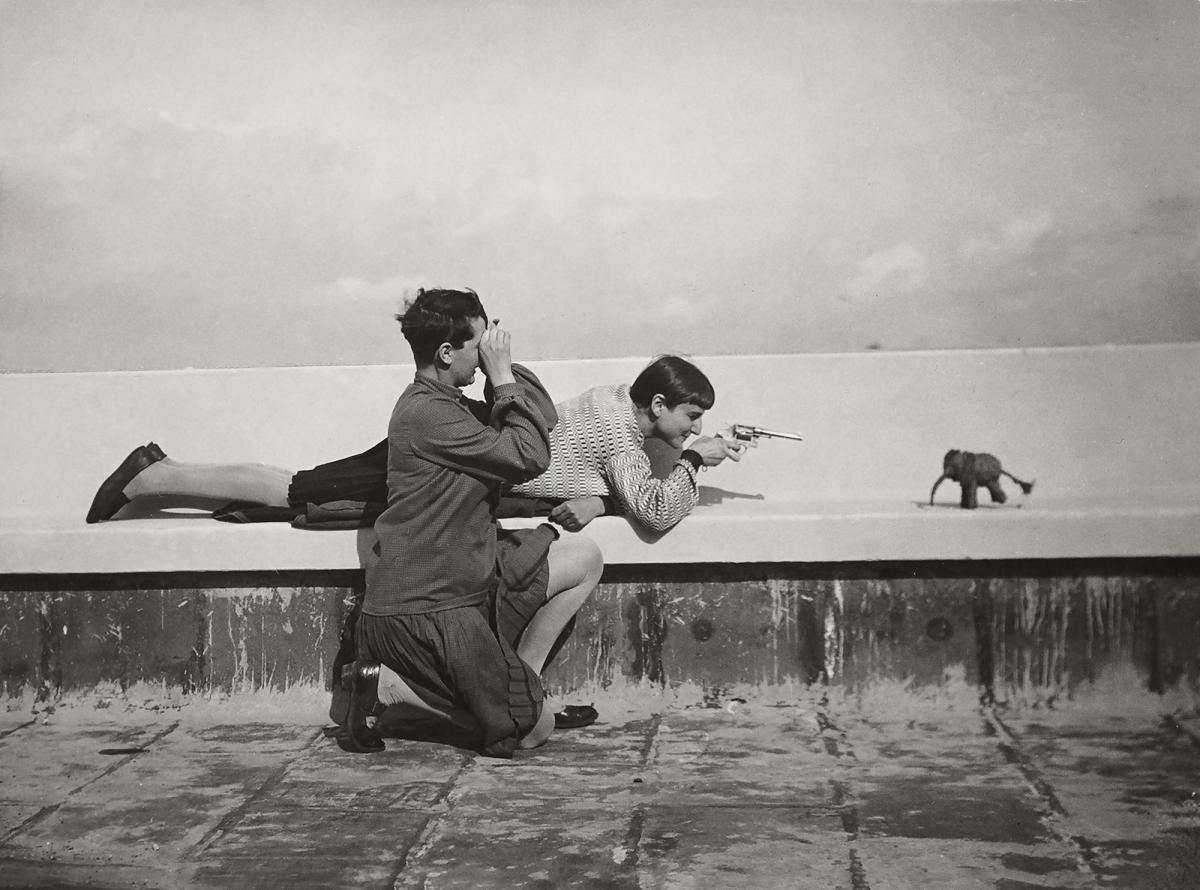
How unfortunate that the memory of the Bauhaus, like the memory of punk, replicated the same old rules its artists broke. The school’s gender equality was radical, hence the photograph’s satirical title, which “expresses the precise opposite of what the photo itself shows,” notes the site Bauhaus Kooperation: “the modernity, emancipation, equality, or even superiority, of the women in it.” The “junior master” of the carpentry workshop, Breuer looks at the three artists to his left “skeptically, with his arms crossed,” as if to say, “ ‘These are ‘my’ women?!’ ” The artists of the “harem,” from left to right, are Breuer’s wife Martha Erps, Katt Both, and the photographer’s wife, Ruth Hollós, who “seems to be suppressing laughter as she looks towards the photographer (her husband).”

Erich Consemüller, who taught architecture at the Bauhaus, had been tasked by Gropius with documenting the school and its life. Gropius partnered him with photographer Lucia Moholy, wife of László Moholy-Nagy (see a photo of her above, taken by her husband sometime between 1924 and 28). Moholy took mostly exterior shots like the photograph by her further up of Erps and Hollós on the roof of the Atelierhaus in Dessau in the mid-1920s. Consemüller mainly focused on interiors in his work, with experimental exceptions like the “Mechanical Fantasy” series seen here, which uses clothing, poses, and double exposures to visually emphasize a kind of uniformity of purpose, placing and joining male and female Bauhaus artists in almost typological arrangements.
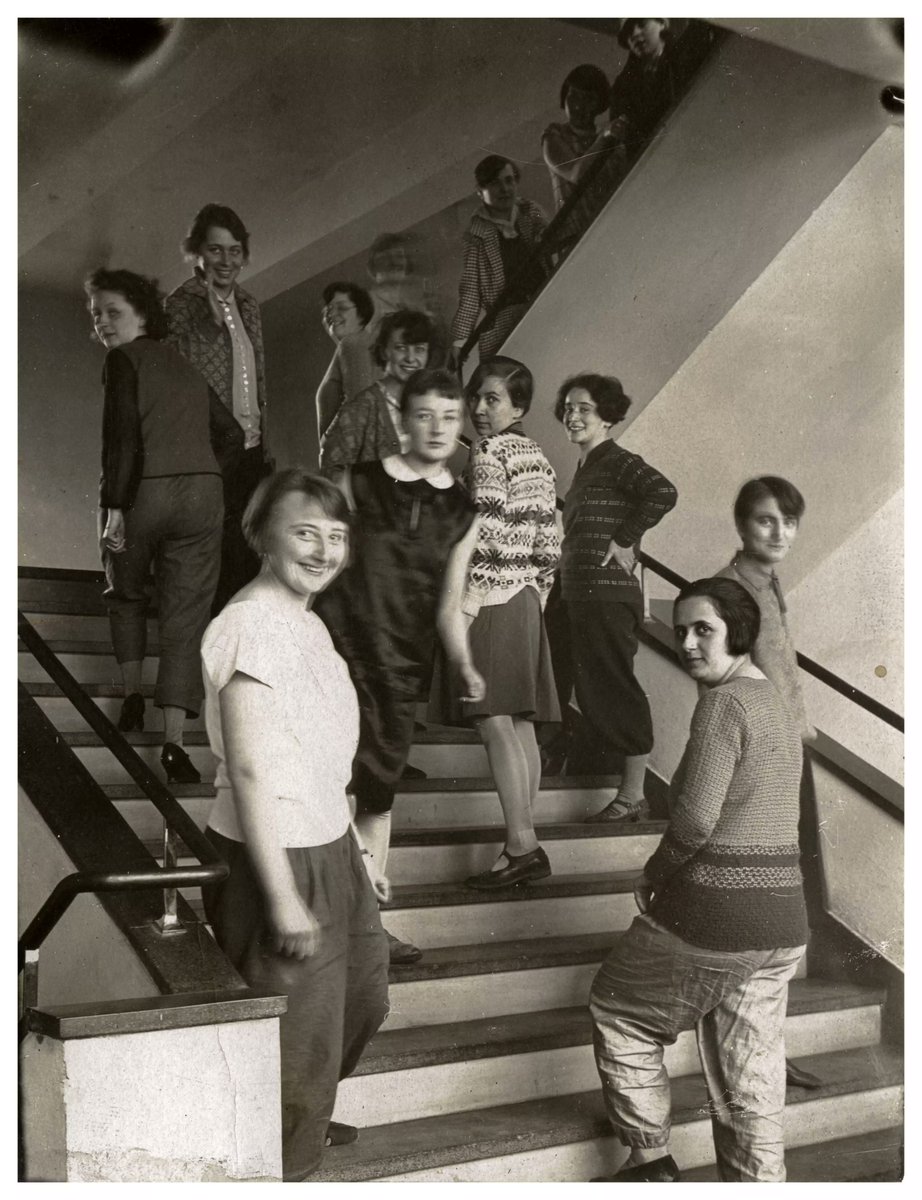
Indeed, nearly all of the artists of the Bauhaus — as was the school’s practice — tried their hand at photography, and many used the medium to document, in ways both casual and deliberate, the Bauhaus’s commitment to gender equity and the full inclusion of women artists in its programs, a statement painter and photographer T. Lux Feininger seems to underline in the group photograph below of the school’s weavers on the steps of the new Bauhaus building in 1927. (Artists in the shot: Léna Bergner, Gunta Stölzl, Ljuba Monastirsky, Otti Berger, Lis Beyer, Elisabeth Mueller, Rosa Berger, Ruth Hollós, and Lisbeth Oestreicher.)
Bauhaus artists, both men and women, were very much like early punks in some ways, inventing new ways to shake up the establishment and break out of prescribed roles. But instead of a downtown alternative to the status quo, they offered a recipe for its full transformation through art. Who can say how far that movement would have progressed had it not been splintered by the Nazis? “Together,” as Gropius wrote, “let us call for, devise, and create the construction of the future, comprising everything in one form, architecture, sculpture and painting,” and most everything else in the built and visual environments, he might have added.
An earlier version of this post appeared on our site in 2022.
Related Content:
The Politics & Philosophy of the Bauhaus Design Movement: A Short Introduction
Josh Jones is a writer and musician based in Durham, NC.
Read More...Discover the Mundaneum, an Early 20th-Century “Internet” That Put the World’s Knowledge on Millions of Index Cards
Pitch to friends or family the idea of a trip to Mons, Belgium to visit the Mundaneum, and you may be met with a less-than-enthusiastic reception. That’s unfortunate, since such an experience could fundamentally change the way they regard technology they use every day. Though its name may seem to promise unrelieved dullness today, the Mundaneum arose out of enormous high-tech ambitions. The idea behind it, as conceived by Belgian lawyers Paul Otlet and Henri La Fontaine, was to gather, classify, centralize, and make universally available all human knowledge. This may sound familiar to anyone who’s used the internet, but it was a rather bolder proposition at the turn of the twentieth century.
Otlet and La Fontaine’s “city of knowledge” may not have been fully realizable at that time, but technology had made it imaginable. The Dewey Decimal System, with its standardized card catalogs, had been around since 1876. Starting in 1895, Otlet adapted that basic tool to a far larger project: the Mundaneum took shape as a vast paper archive. Millions of index cards, each recording bibliographic details about a single book, article, or document, were filed away in row upon row of catalog drawers. (See image below.)
“Otlet made this card central to his system,” writes Sidney Perkowitz at JSTOR. “Aiming to capture every book ever published, the Mundaneum stored bibliographic data for books under the UDC [Universal Decimal Classification], along with magazine articles, images, and more on over 15 million cards crammed into catalog drawers.” Originally housed in Brussels’ Cinquantenaire Palace, the Mundaneum was meant to get its own building designed by the forward-thinking Le Corbusier by the end of the nineteen-twenties. Alas, it was never built, and after the Nazi invasion of 1940, the Mundaneum was scrapped for a Third Reich art exhibition.
Discussions of the Mundaneum in our time often highlight what Otlet (1868–1944), despite the project’s many tribulations, eventually envisioned as “a global ‘réseau’ or network of ‘electric telescopes.’ These early workstations were to be linked to the Mundaneum by telephone and the new technology of television. A user would phone in a query, and the answer in a book or other source would appear displayed on a personal screen, which could be split to show multiple results.” Convinced that all homes would eventually have access to the network, he considered even the possibility of “data sharing and social interactions among its users.” This dream of the internet avant la technologie is now enshrined at the Mundaneum museum, which is open five days a week. Alternatively, you can point your electric telescope to its online catalog any time.
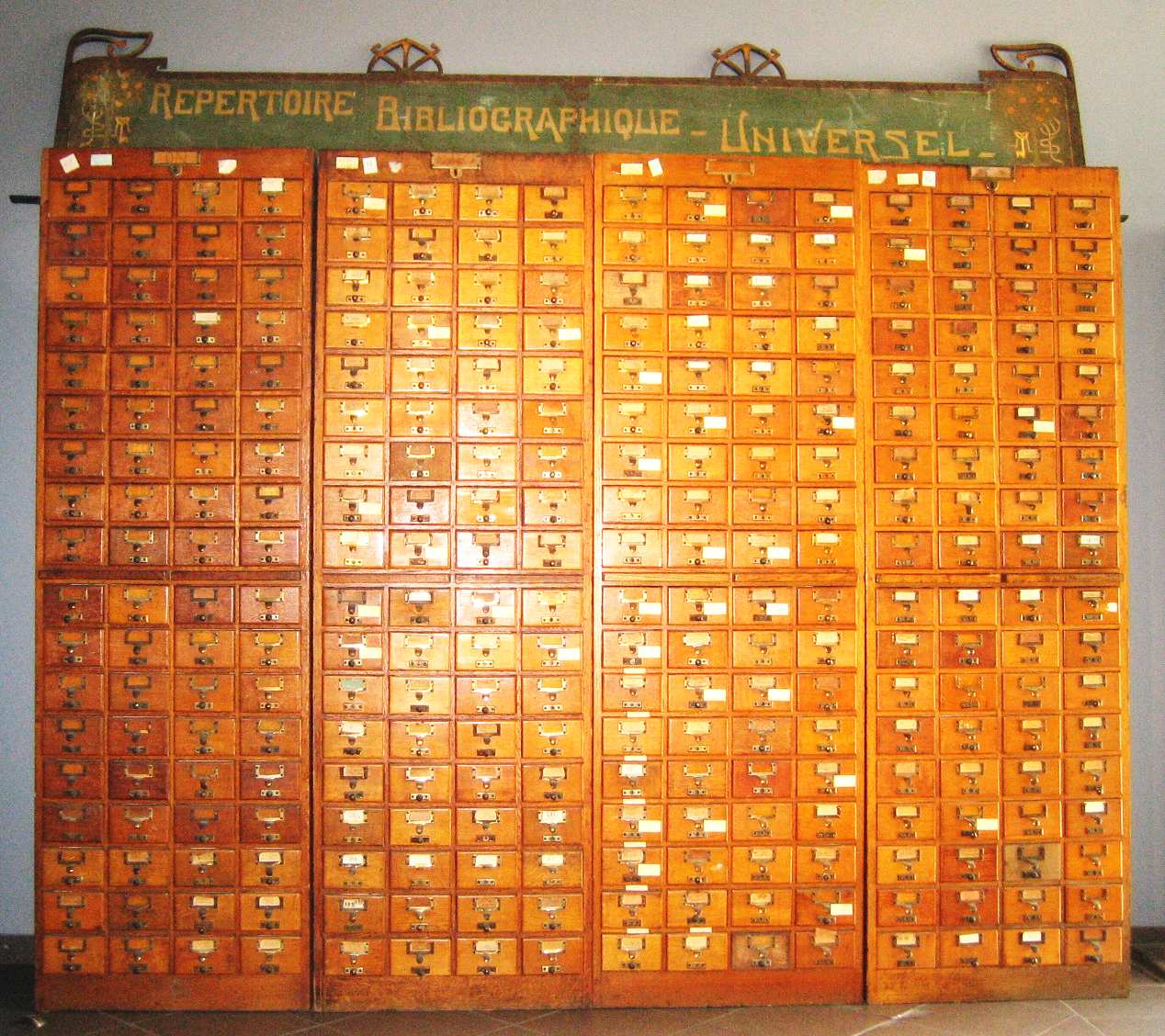
Image by Zinneke, via Wikimedia Commons
Related Content:
The Rise and Fall of the Great Library of Alexandria: An Animated Introduction
The First Music Streaming Service Was Invented in 1881: Discover the Théâtrophone
Meet the Syntopicon: The Ambitious Index That Tried to Organize All of Western Thought (1952)
What the Entire Internet Looked Like in 1973: An Old Map Gets Found in a Pile of Research Papers
Do All Roads Lead to Philosophy on Wikipedia?: They Do About 97.3% of the Time
Based in Seoul, Colin Marshall writes and broadcasts on cities, language, and culture. He’s the author of the newsletter Books on Cities as well as the books 한국 요약 금지 (No Summarizing Korea) and Korean Newtro. Follow him on the social network formerly known as Twitter at @colinmarshall.
Read More...A 1932 Illustrated Map of Harlem’s Night Clubs: From the Cotton Club to the Savoy Ballroom

Harlem’s undergoing another Renaissance, and has been for years now. Crime’s down, real estate prices are up, and throngs of pale-faced hipsters are descending to check the area out.
Sure, something’s gained, but something’s lost, too.
For today’s holiday in Harlem, we’re going to climb in the Wayback Machine. Set the dial for 1932. Don’t forget your map. (Click the image above to view a larger version.)
This delirious artifact comes courtesy of Elmer Simms Campbell (1906–1971), an artist whose race proved an impediment to career advancement in his native Midwest. Not long after relocating to New York City, he had the good fortune to be befriended by the great Cab Calloway, star of the Cotton Club. Hi-de-hi-de-hi-de-ho! Check the lower left corner of your map.
You may notice that the compass rose deviates rather drastically from established norms. As you’ve no doubt heard, the Bronx is up, and the Battery’s down, but not in this case. Were you to choose those trees in the upper left corner as your starting point, you’d be at the top of Central Park, basically equidistant from the east and west sides. (Take the 2 or the 3 to 110th Street…)
But keep in mind that this map is not drawn to scale. I know it looks like the joints are jumping from the second you step off the curb, but in reality, you’ll need to hoof it 21 blocks from the top of Central Park to 131st Street for things to start cookin’. Hopefully, this geographical liberty won’t get you too hot under the collar. And if it does, well, it may be Prohibition, but stress-relieving beverages await you in every location listed, as well as in some 500 speakeasies Campbell allowed to remain on the down low.
If that doesn’t do it for you, there’s a guy selling reefer across the street from Earl “Snakehips” Tucker.
As you stagger back and forth between Seventh Avenue and Lenox (now referred to as Adam Clayton Powell Jr. Boulevard and Malcolm X Boulevard), bear in mind that Campbell was the first African-American cartoonist to be nationally published in the New Yorker, Playboy, and Esquire, whose bug-eyed, now retired mascot, Esky, was a Campbell creation.
In the end, he was an extremely successful illustrator, though few of his creations are reflective of his race.
The map above, which did double duty as endpapers for Calloway’s autobiography, Of Minnie the Moocher and Me, is far closer to home.
Right above, see Cab Calloway perform “Hotcha Razz Ma Tazz” at the famous Cotton Club, in Harlem, 1935.
Note: An earlier version of this post appeared on our site in 2014.
Related Content:
Duke Ellington’s Symphony in Black, Starring a 19-Year-old Billie Holiday
Ayun Halliday is an author, illustrator, and theater maker in NYC.
Read More...NASA Enlists Andy Warhol, Annie Leibovitz, Norman Rockwell & 350 Other Artists to Visually Document America’s Space Program
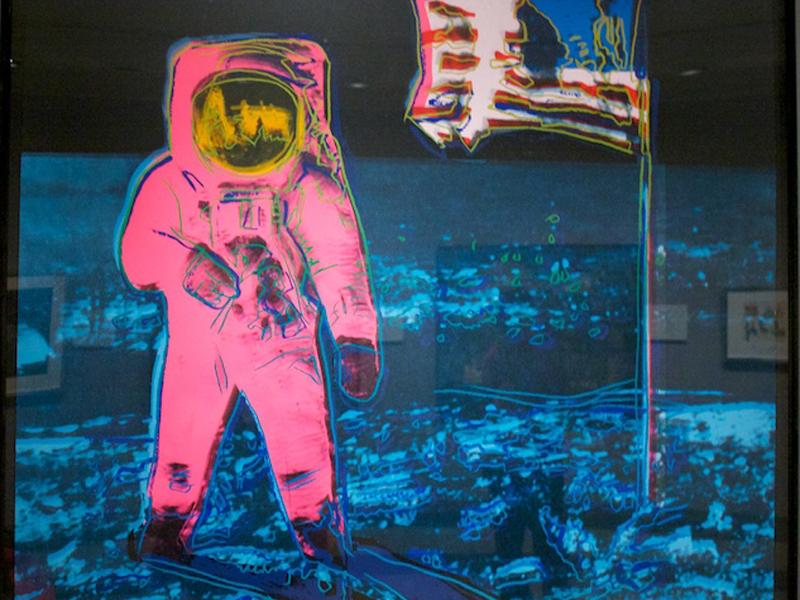
It’s hard to imagine that the space-crazed general public needed any help getting worked up about astronauts and NASA in the early ’60s.
Perhaps the wild popularity of space-related imagery was in part what motivated NASA administrator James Webb to create the NASA Art Program in 1962.
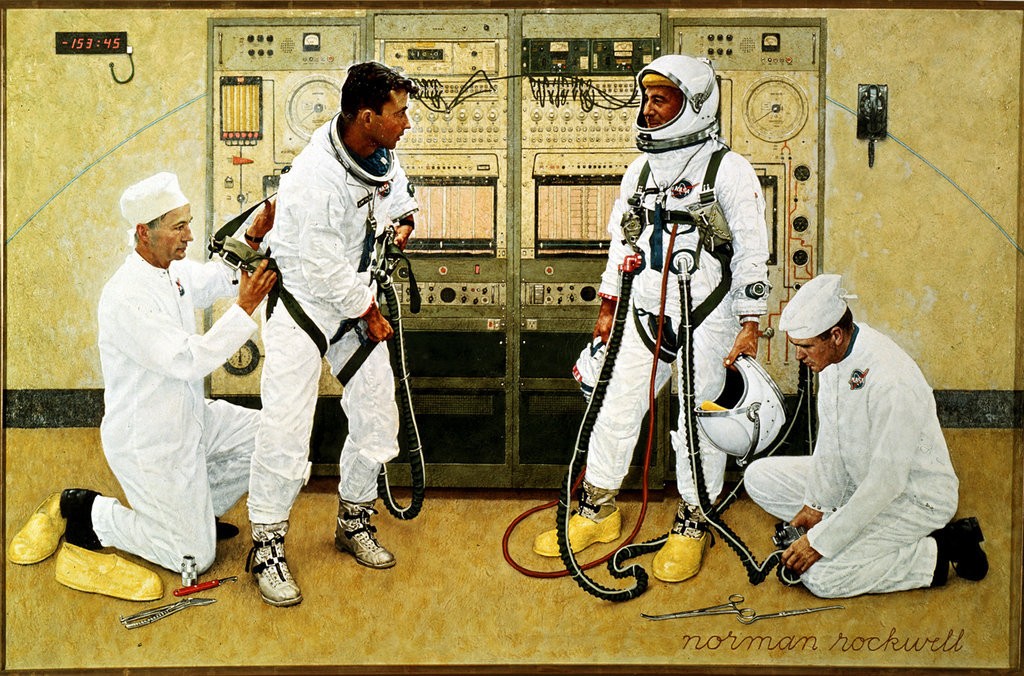
Although the program’s handpicked artists weren’t edited or censored in any way, they were briefed on how NASA hoped to be represented, and which emotions their creations were meant to capture—the excitement and uncertainty of exploring these frontiers.
NASA was also careful to collect everything the artists produced while participating in the program, from sketches to finished work.
In turn, the artists received unprecedented access to launch sites, key personnel, and major events such as Project Mercury and the Apollo 11 Mission.
Hundreds of artists, including Andy Warhol, Norman Rockwell, and Laurie Anderson, have brought their unique sensibilities to the project. (Find NASA-inspired art by Warhol and Rockwell above.)
(And hey, no shame if you mistakenly assumed Warhol’s 1987 Moonwalk 1 was created as a promo for MTV…)
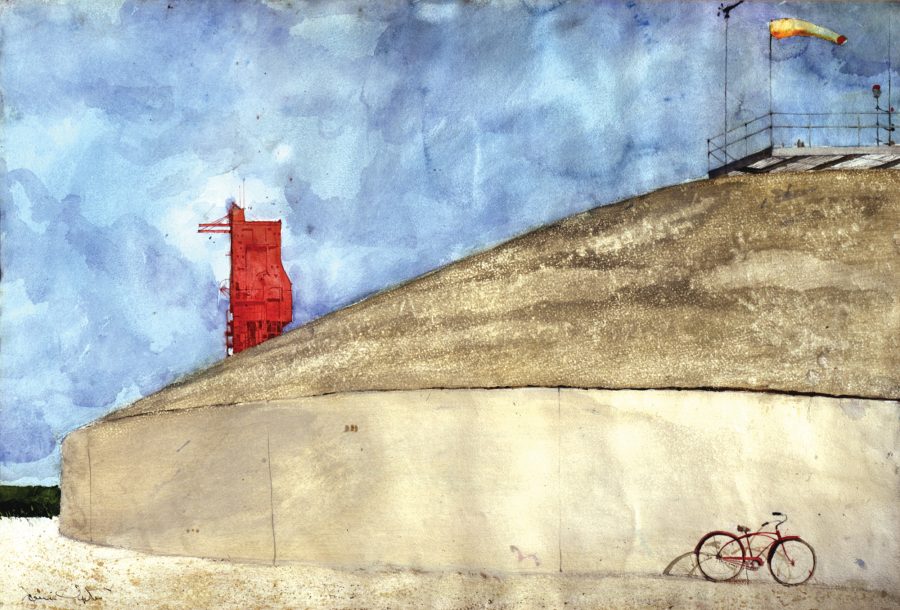
Jamie Wyeth’s 1964 watercolor Gemini Launch Pad includes a humble bicycle, the means by which technicians traveled back and forth between the launch pad and the reinforced-concrete blockhouse where they worked.

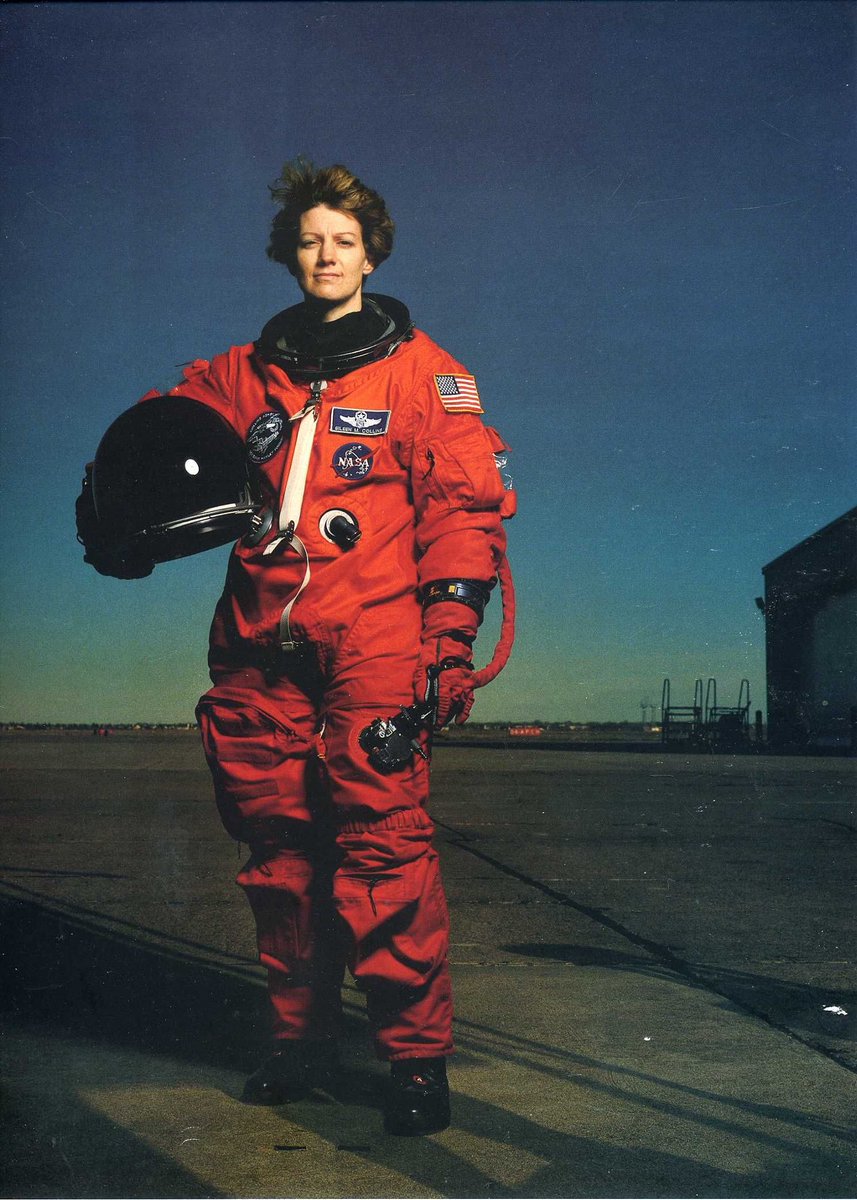
Photographer Annie Leibovitz offers two views of NASA’s first female pilot and commander, Eileen Collins—with and without helmet.
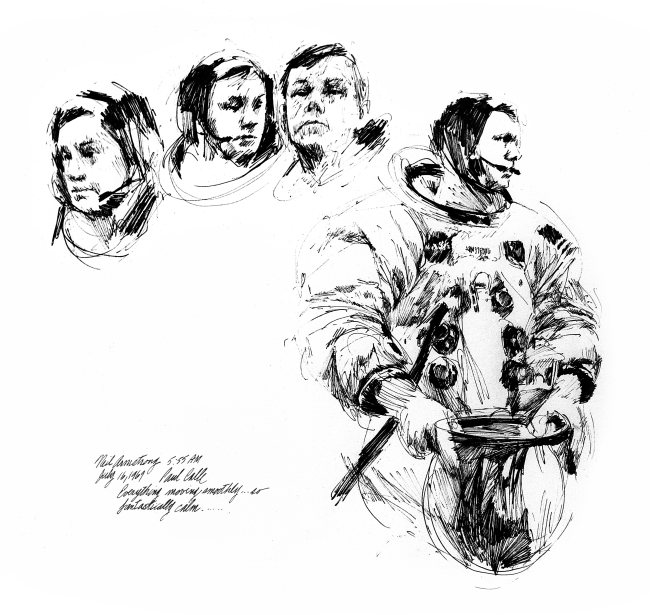
Postage stamp designer, Paul Calle, one of the inaugural group of participating artists, produced a stamp commemorating the Gemini 4 space capsule in celebration of NASA’s 9th anniversary. When the Apollo 11 astronauts suited up prior to blastoff on July 16, 1969, Calle was the only artist present. His quickly rendered felt-tip marker sketches lend a backstage element to the heroic iconography surrounding astronauts Armstrong, Aldrin and Collins. One of the items they carried with them on their journey was the engraved printing plate of Calle’s 1967 commemorative stamp. They hand-canceled a proof aboard the flight, on the assumption that post offices might be hard to come by on the moon.

In 2016, NASA’s Jet Propulsion Laboratory enlisted a team of nine artists, designers, and illustrators to collaborate on 14 posters, a visual throwback to the ones the WPA created between 1938 and 1941 to spark public interest in the National Parks. You can see the results at the Exoplanet Travel Bureau.
More recently, in 2024, NASA and the artist team Geraluz and WERC relaunched the program with space-themed murals in Manhattan.
View an album of 25 historic works from NASA’s Art Program here.
Note: An earlier version of this post appeared on our site in 2019.
Related Content:
Star Trek’s Nichelle Nichols Creates a Short Film for NASA to Recruit New Astronauts (1977)
Ayun Halliday is an author, illustrator, and theater maker in NYC.
Read More...5,000 Classic Movie Posters Digitized & Put Online: Free to Browse & Download
Who hasn’t pinned one of Saul Bass’ elegant film posters on their wall—either with thumbtacks above the dorm room bed or in frame and glass in grown-up environs? Or maybe it’s 70s kitsch you prefer—the art of the grindhouse and sensationalist drive-in exploitation film? Or 20s silent avant-garde, the cool noir of the 30s and 40s, 50s B‑grade sci-fi, 60s psychedelia and French New Wave, or 80s popcorn flicks…? Whatever kind of cinema grabs your attention probably first grabbed your attention through the design of the movie poster, a genre that gets its due in novelty shops and specialist exhibitions, but often goes unheralded in popular conceptions of art.

Despite its utilitarian and unabashedly commercial function, the movie poster can just as well be a work of art as any other form. Failing that, movie posters are at least always essential archival artifacts, snapshots of the weird collective unconscious of mass culture: from Saul and Elaine Bass’ minimalist poster for West Side Story (1961), “with its bright orange-red background over the title with a silhouette of a fire escape with dancers” to more complex tableaux, like the baldly neo-imperialist Africa Texas Style! (1967), “which features a realistic image of the protagonist on a horse, lassoing a zebra in front of a stampede of wildebeest, elephants, and giraffes.”
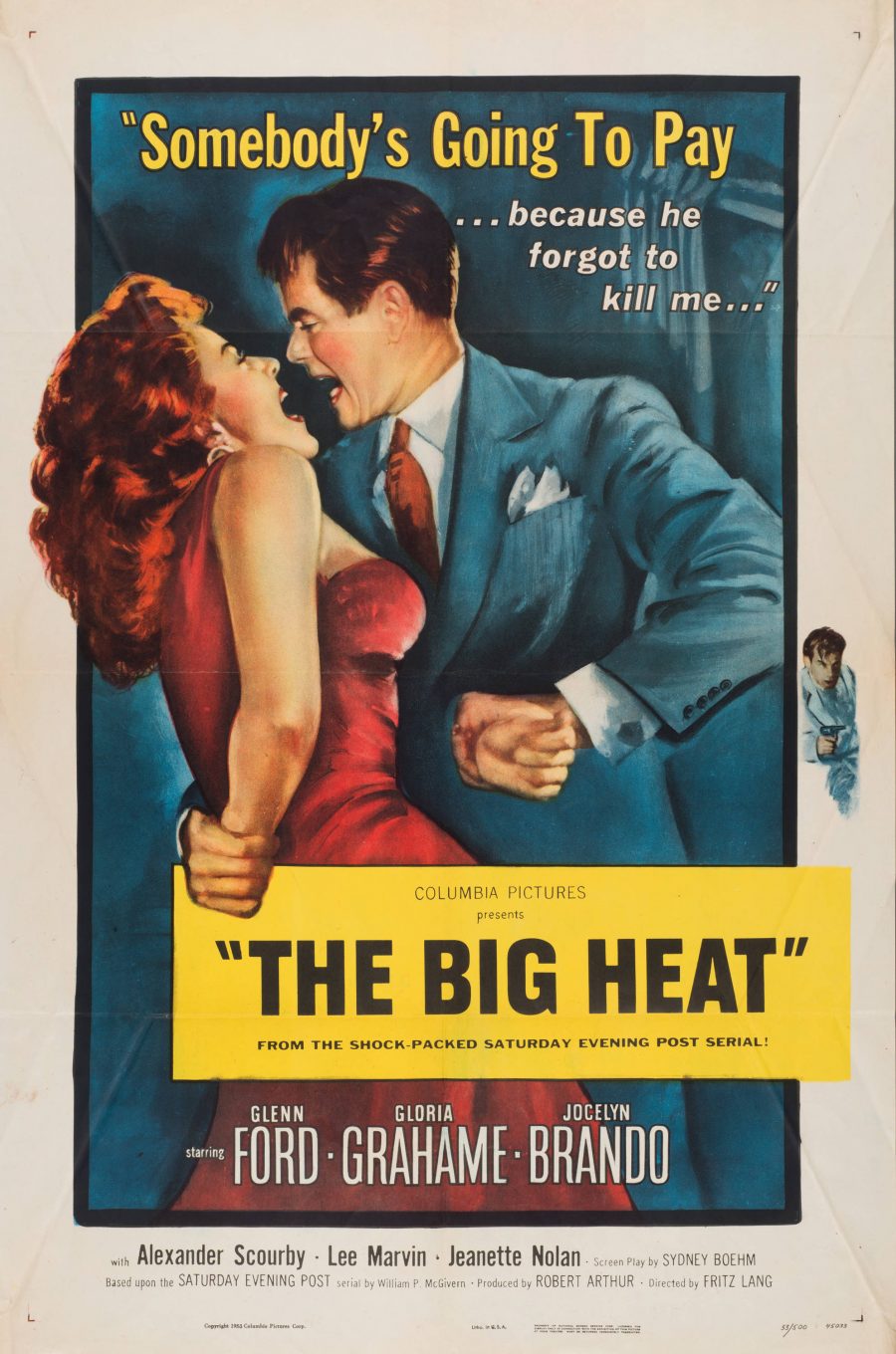
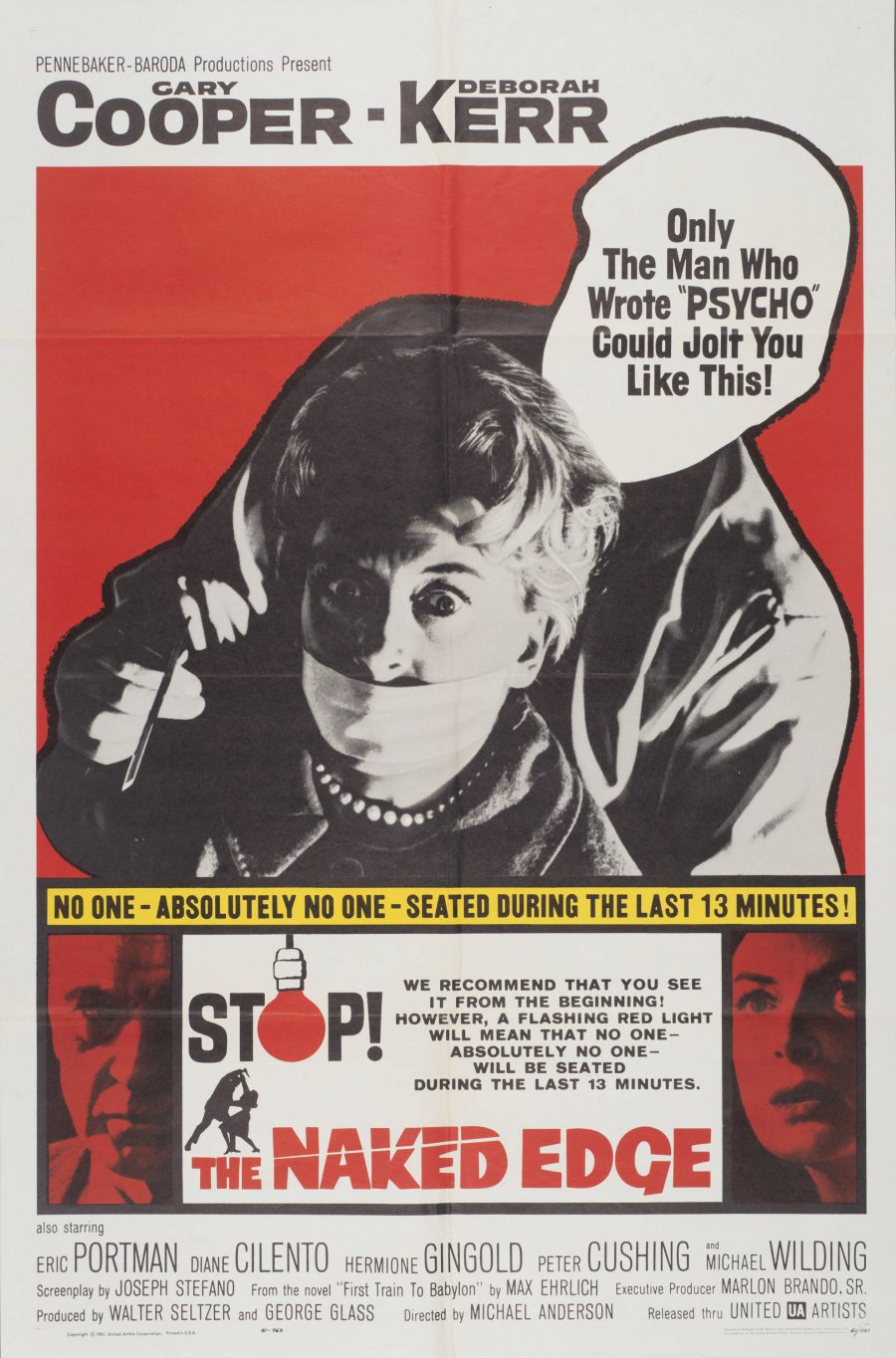
These two descriptions only hint at the range of posters archived at the University of Texas Harry Ransom Center—upwards of 5,000 in all, “from when the film industry was just beginning to compete with vaudeville acts in the 1920s to the rise of the modern megaplex and drive-in theaters in the 1970s.” So wrote Erin Willard in the Ransom Center’s 2018 announcement of the digitization of its massive collection. Thousands of posters have been photographed and are available online, downloadable in “Large” and “Extra Large” resolutions.
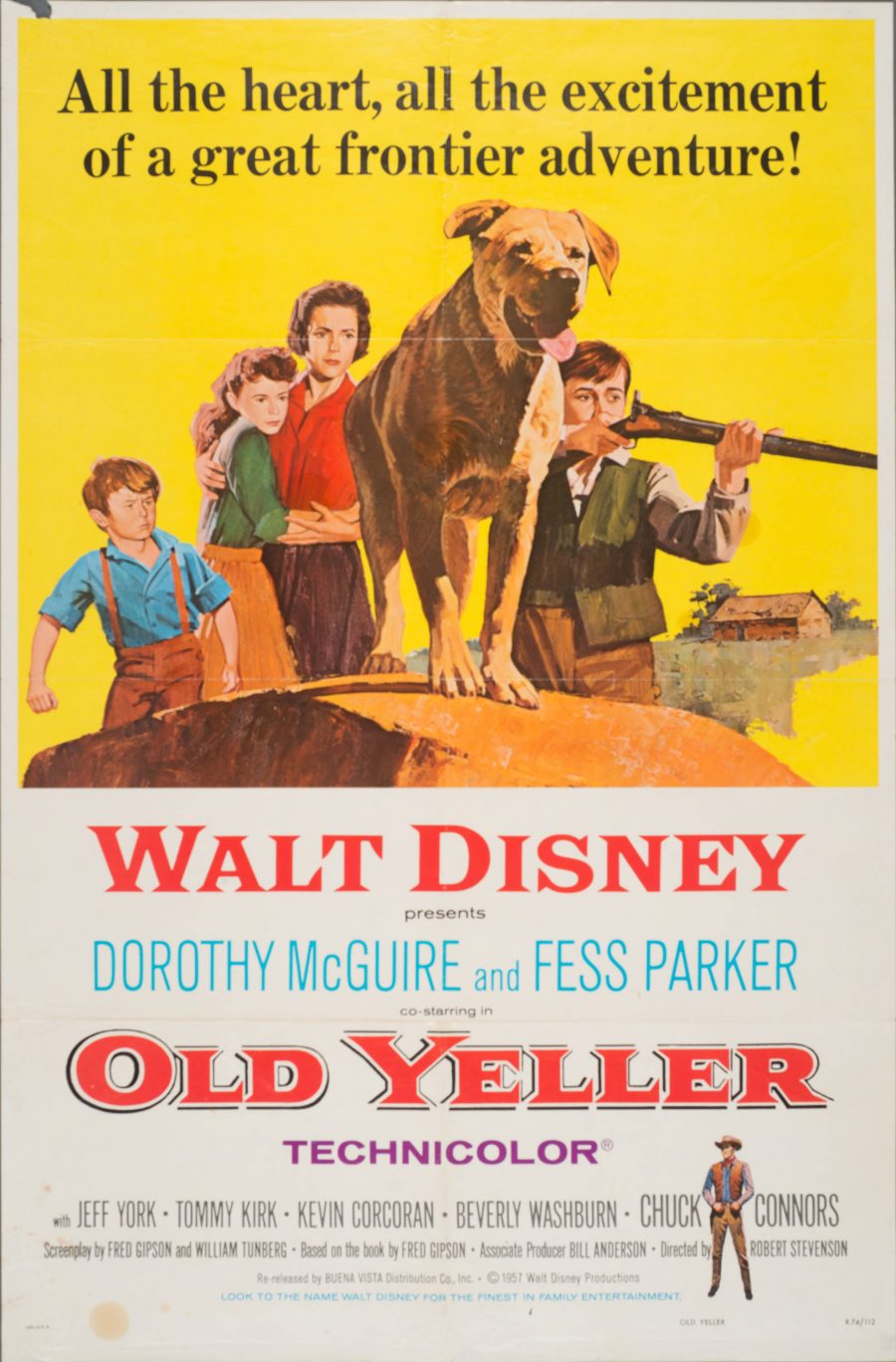
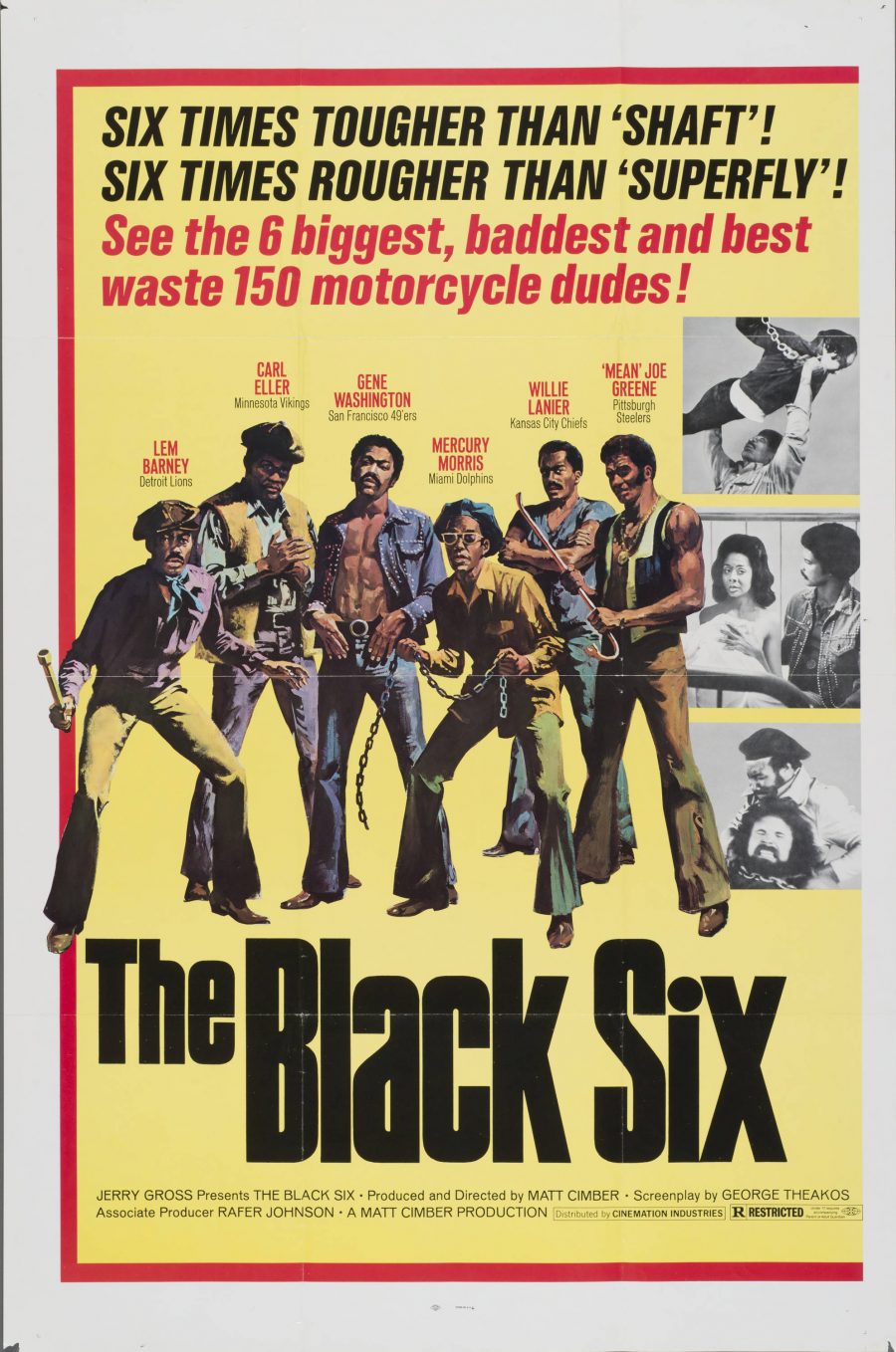
The bulk of the collection comes from the Interstate Theater Circuit—a chain that, at one time, “consisted of almost every movie theater in Texas”—and encompasses not only posters but film stills, lobby cards, and press books from “the 1940s through the 1970s with a particular strength in the films of the 1950s and 60s, including musicals, epics, westerns, sword and sandal, horror, and counter culture films.” Other individual collectors have made sizable donations of their posters to the center, and the result is a tour of the many spectacles available to the mid-century American mind: lurid, violent excesses, maudlin moralizing, bizarre erotic fantasies, dime-store adolescent adventures.…
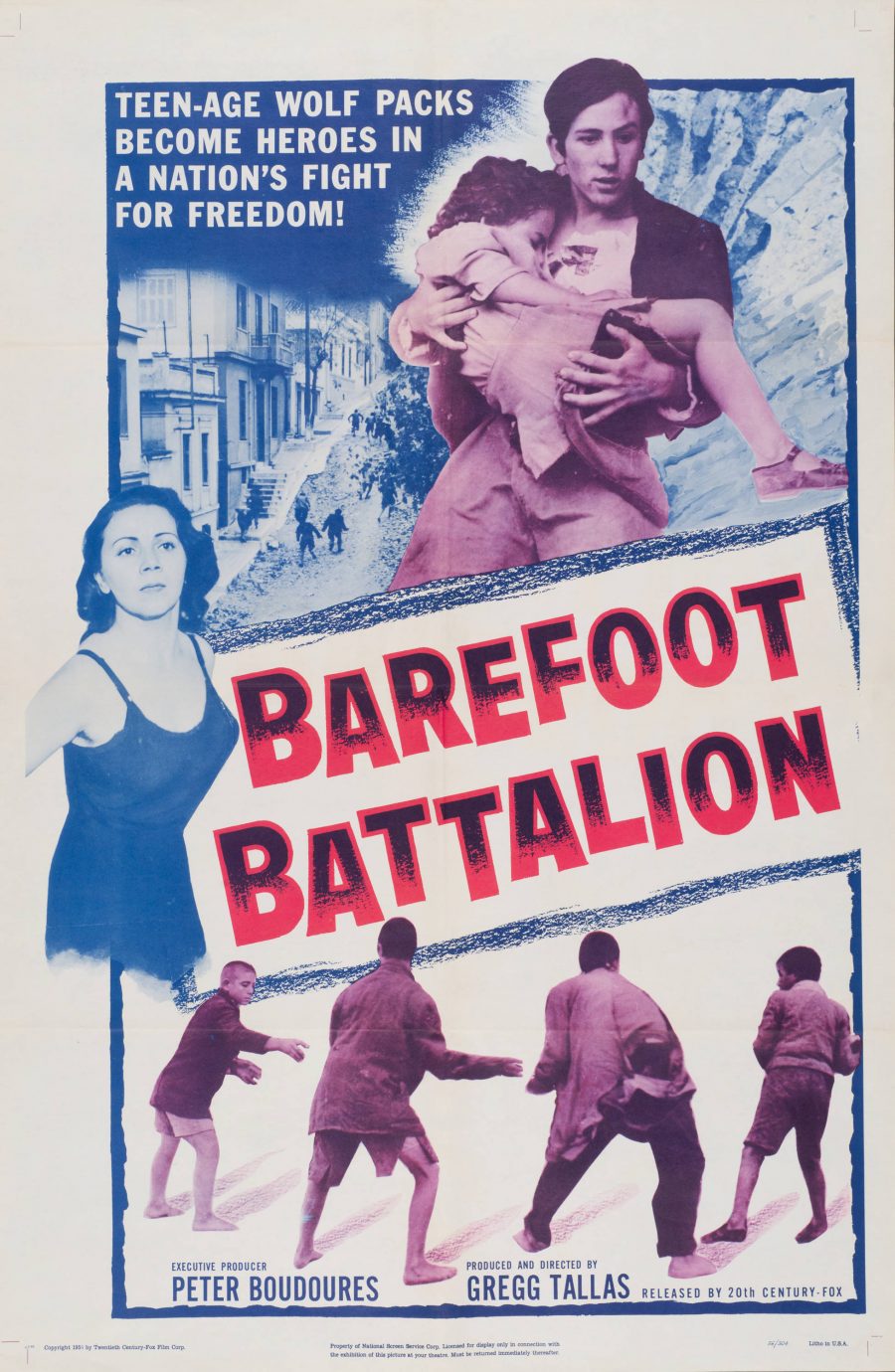
Some of the films are well-known examples from the period; most of them are not, and therein lies the thrill of browsing this online repository, discovering obscure oddities like the 1956 film Barefoot Battalion, in which “teen-age wolf packs become heroes in a nation’s fight for freedom!” The number of quirks and kinks on display offers us a prurient view of a decade too often flatly characterized by its penchant for gray flannel suits. The Mad Men era was a period of institutional repression and rampant sexual harassment, not unlike our own time. It was also a laboratory for a libidinous anarchy that threatened to unleash the pent-up energy and cultural anxiety of millions of frustrated teenagers onto the world at large, as would happen in the decades to come.
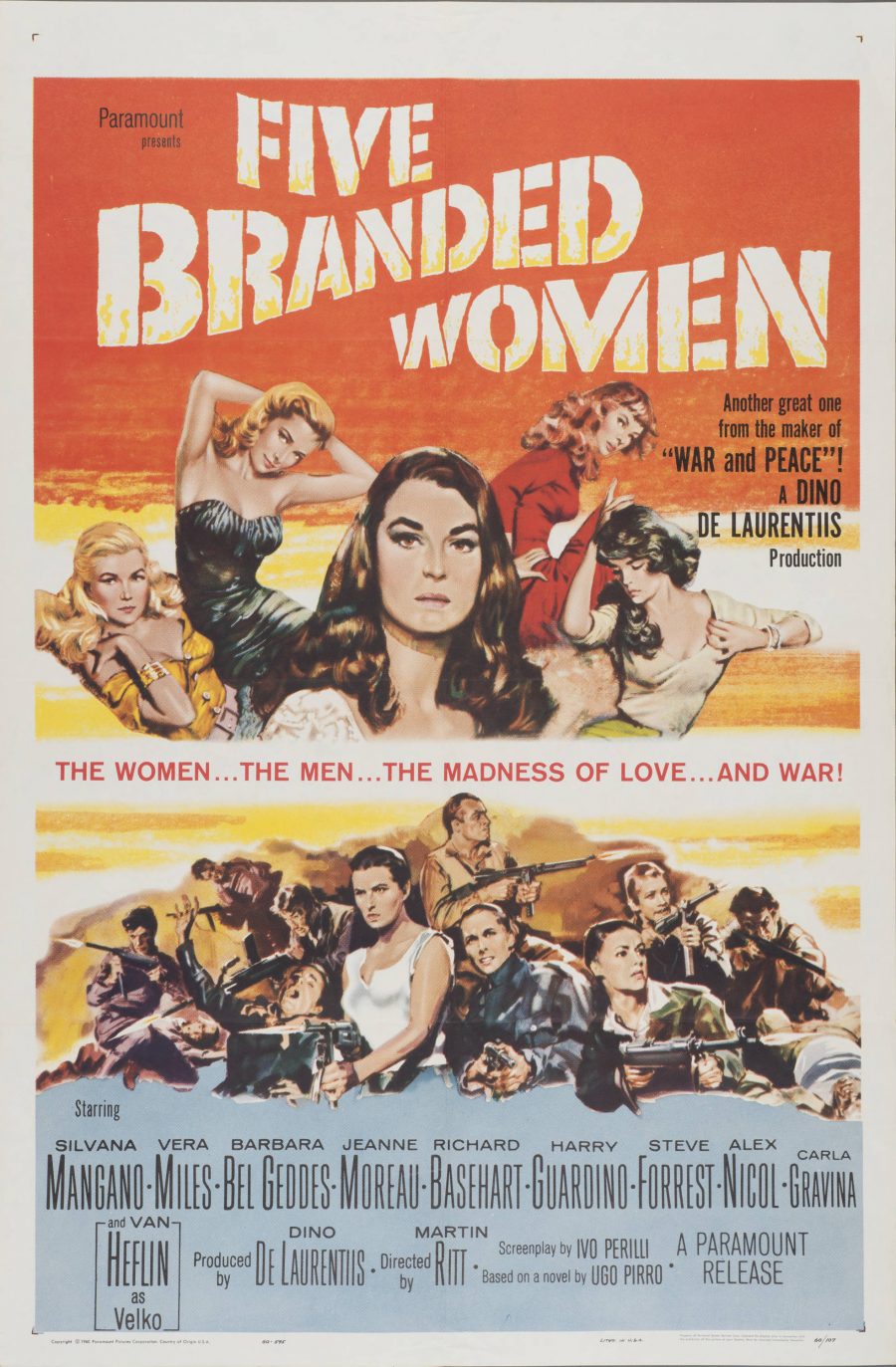
What we see in the marketing of films like Five Branded Women (1960) will vary widely depending on our orientations and political sensibilities. Is this cheap exploitation or an empowering precursor to Mad Max: Fury Road? Maybe both. For cultural theorists and film historians, these pulpy advertisements offer windows into the psyches of their audiences and the filmmakers and production companies who gave them what they supposedly wanted. For the ordinary film buff, the Ransom Center collection offers eye candy of all sorts, and if they happen to own a high-quality printer, the chance to hang posters on their wall that they probably won’t see anywhere else. Enter the online collection here.
Note: An earlier version of this post appeared on our site in 2018.
Related Content:
An Archive of 20,000 Movie Posters from Czechoslovakia (1930–1989)
The Film Posters of the Russian Avant-Garde
A Look Inside Martin Scorsese’s Vintage Movie Poster Collection
Josh Jones is a writer and musician based in Durham, NC.
Read More...The Genius of Airplane!: How to Make a Comedy by Playing Everything Completely Straight
Not every 46-year-old comedy still gets laughs, but Airplane! seems only to get funnier with the decades. Some viewers too young to have caught it in its theatrical release even take the Benjaminian view of it as the kind of great work that creates its own genre: the rapid-fire deadpan joke machine, we could call it. But as the InCinematic video essay above reminds us, Airplane! belongs, at its core, to that venerable comedic form of the parody. The key lies in its titular exclamation point shared with Zero Hour!, a conventional Paramount disaster movie from 1957 also about a disgraced fighter pilot forced to assume command of an airliner, albeit one with nary a laugh in its 81 minutes.
Though it actually runs six minutes longer, Airplane! feels much shorter, thanks in part to its mercilessly constant volley of humor. But unlike so many major parodies of this century, which feel like nothing so much as a tissue of rapidly expiring pop-culture references, it also tells a genuine story with momentum of its own.
The film’s writer-directorial trio of Jim Abrahams, David Zucker, and Jerry Zucker understood that viewers would come for the laughs, but as with Zero Hour! and the countless other disaster pictures at which Airplane! pokes fun, they’d stay to find out what happens. Hence the inspired choice to play the whole thing perfectly straight, no matter how groan-inducing the visual or verbal gags being delivered.
All this works only because Abrahams, Zucker, and Zucker cast the right actors: that is to say, non-funny ones. At the time of Airplane!‘s release, “most comedies relied on actors to be funny, but nobody had really tried making a comedy without comedians before.” This meant that “the comedy had to be there before the camera started rolling,” so that the actors being seemingly unaware of the humor would only make it funnier. The personification of this method is, of course, Leslie Nielsen, who’d already put in a quarter-century of dramatic performances (including in no less a seventies disaster spectacle than The Poseidon Adventure), but whose deadpan turn as Dr. Rumack elevated him into a kind of superstardom of the absurd. Whether a parody like Airplane! would work if made today is difficult to say, but it nevertheless remains a lesson in storytelling for young filmmakers — comedic or otherwise.
Related Content:
Seinfeld, Louis C.K., Chris Rock, and Ricky Gervais Dissect the Craft of Comedy (NSFW)
Buster Keaton: The Wonderful Gags of the Founding Father of Visual Comedy
Why Is Jackie Chan the King of Action Comedy? A Video Essay Masterfully Makes the Case
Based in Seoul, Colin Marshall writes and broadcasts on cities, language, and culture. He’s the author of the newsletter Books on Cities as well as the books 한국 요약 금지 (No Summarizing Korea) and Korean Newtro. Follow him on the social network formerly known as Twitter at @colinmarshall.
Read More...The Rijksmuseum in Amsterdam Has Digitized 840,000 Works of Art, Including Great Works by Rembrandt and Vermeer
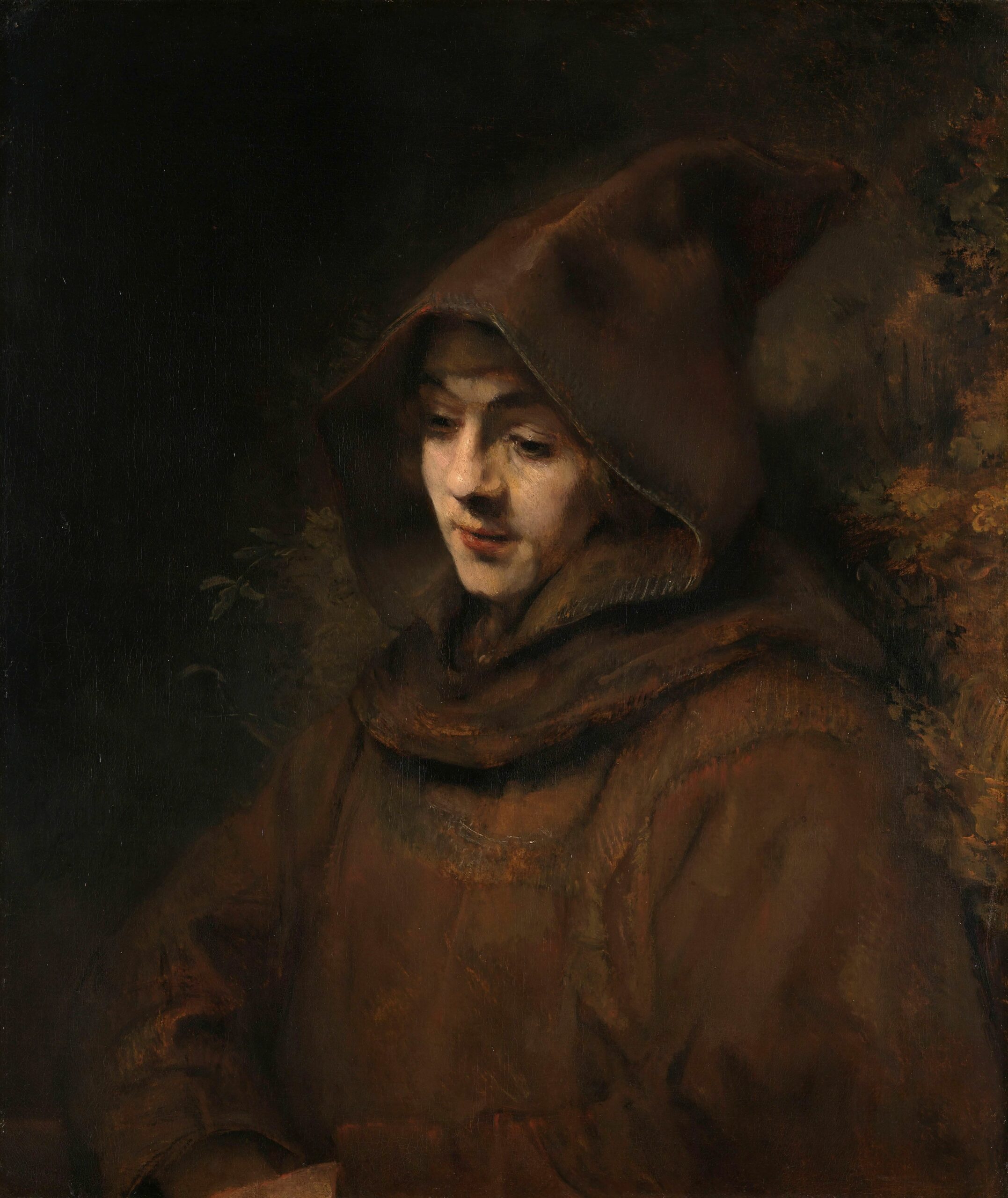
Art may seem inessential to those who make the big decisions in times of crisis. But it never seemed more necessary to artists working in the time of plague. So it was 366 years ago when Rembrandt painted a portrait of his son, Titus, in a monk’s robe in 1660. Eight years later, Titus was dead from plague, which had only a few years earlier killed Hendrickje Stoffels, Rembrandt’s former housekeeper and second wife, who helped raise Titus, Rembrandt’s only child to survive into adulthood.
These unimaginable losses “contributed to the tragedy and anguish we see in Rembrandt’s late self-portraits,” writes The Guardian’s Jonathan Jones. During the plague, Rembrandt also used his work as social critique.
His etching The Rat-Poison Peddler shows, “in a sense,” the Minneapolis Institute of Art’s Tom Rassieur tells the Star Tribune, “the guy who purports to be helping—the exterminator—is probably doing as much to spread the disease as anyone else. That relates to [criticism] of our leadership today.” In his last years, Rembrandt painted self-portraits of his isolation and grief that found a new audience during the COVID lockdown.
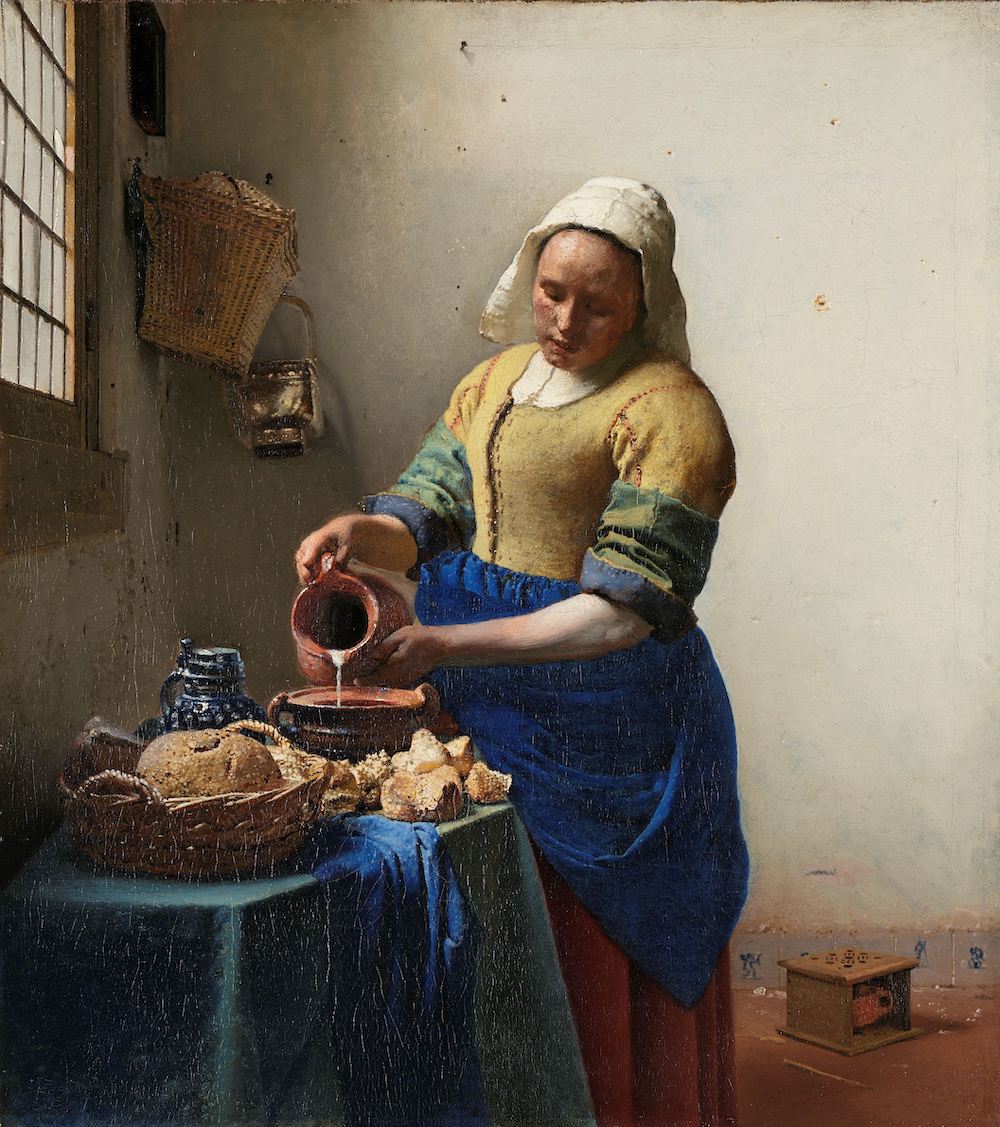
Elsewhere in the Netherlands, Rembrandt’s contemporary Johannes Vermeer was no stranger to the kind of socially isolated world we found ourselves in during COVID. “His hometown of Delft was stricken with plague several times in the artist’s lifetime. In 1635 and 1636 over 2,000 people died, and in the mid-1650s and mid-1660s hundreds more,” notes Breeze Barrington at CNN. The qualities we most associate with Vermeer’s work, the solitude and attentive presence, were developed during time spent in isolation.
“In this time of forced isolation,” Friso Lammertse, curator of 17th-century Dutch painting at the Rijksmuseum in Amsterdam, noted during the pandemic, Vermeer’s work “can point us at the fact that extreme beauty can be found just in our room.” The Rijksmuseum didn’t just recommend art in the pandemic’s state of aloneness, but also doubled its collection of free, high-resolution works online, by Rembrandt, Vermeer, and a host of other artists who used art to cope with loss and loneliness during the plagues of their times. The museum now offers 840,000 digitized images in total.
The museum promised to “bring the museum to you,” and it has delivered not only with its extensive digital collection, free for downloading, sharing and editing with a free Rijksmuseum account, but also with informative series on its website. Art is essential in the best and worst of times, when it shows us how to look closely at ourselves, our loved ones, and our surroundings, and treat life with more care and attention. Enter the Rijksmuseum online collections here.
An earlier version of this post appeared on our site in 2021.
Related Content:
Josh Jones is a writer and musician based in Durham, NC.
Read More...When the US Mail Was Delivered Underground at 35 MPH Through a Network of Pneumatic Tubes (1893–1953)
Twenty years ago, United States senator Ted Stevens drew long-lasting online ridicule by describing the internet as “a series of tubes.” While some commentators noted that the analogy wasn’t quite as outlandish as it seemed, most reacted with nothing more than amused bafflement. Where had Stevens come up with that image? Given that he was born in 1923, perhaps he was drawing on memories of a technological wonder of his childhood: the underground pneumatic systems through which mail was delivered in major American cities from the eighteen-nineties until the early nineteen-fifties, whose story is told in the It’s History video above.
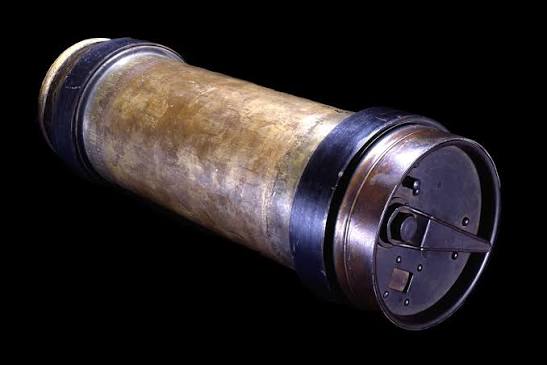
Such series of tubes entered service in London, Paris, and Berlin in the mid-nineteenth century. In 1893, Philadelphia became the first American city to get one, thanks to the advocacy of technologically minded department store magnate-turned-Postmaster General John Wanamaker. At the inauguration, writes Hidden City’s Harry Kyriakodis, Wanamaker “placed a Bible wrapped in an American flag into a canister that went flying (underground) to the Central Post Office with a loud ‘whish’.” Philadelphia’s network expanded apace, eventually including nearly twenty miles of tunnels, and “New York City, Boston, Chicago, and St. Louis adopted similar delivery systems by 1898, all operated by the Post Office Department.”
Operated at a serious loss, that is: when the U.S. got involved in World War I, the Post Office suspended pneumatic service to conserve resources. Only in the twenties did the tubes start whishing again in parts of New York and Boston, whose high volumes of mail could potentially justify the operation. In fact, the sheer amount of mail eventually got to be too much for the steel capsules and the cast-iron tunnels through which compressed air pushed them. As retired U.S. Postal Inspector Robert A. Cohen explains it in his history of these systems, “It takes a certain amount of time for a gallon of liquid to travel through a funnel. Two gallons take twice as long to pass through. The value of the Pneumatic Tube Service decreased as mail volume increased.”
The proliferation of automobiles and the expansion of their supporting infrastructure dealt an even more serious blow: after World War II, delivering mail on the roads had clearly become more efficient than doing it underground. Some “rocketeers,” as the system’s operators were called, stuck it out until December 12, 1953, when pneumatic mail service was officially suspended all across the country.
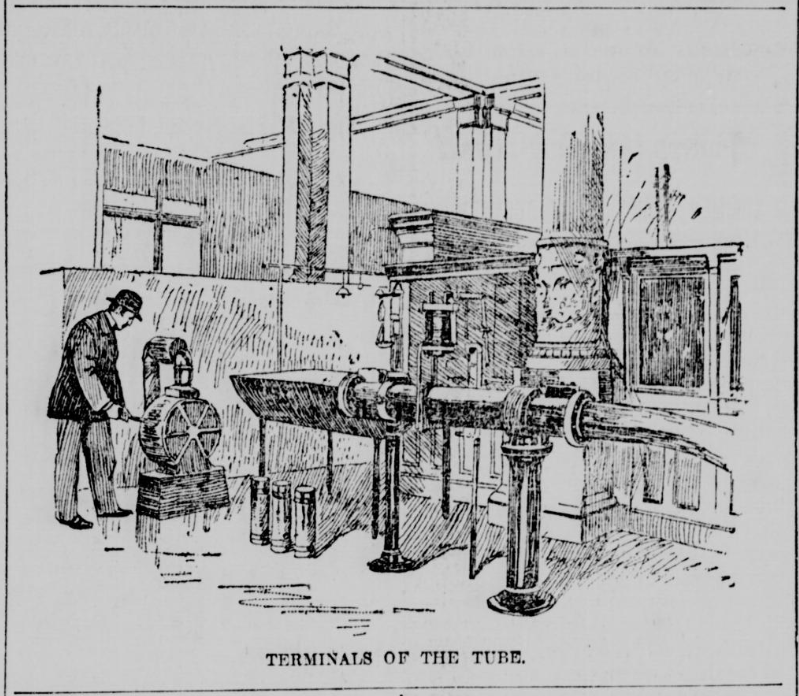
This marked the end of an era, especially for the rocketeers said to have used the network to surreptitiously receive orders from their favorite sandwich shops. Remembering Ted Stevens’ notorious remark, it’s tempting to describe the series of tubes that were pneumatic mail delivery systems as an early version of the internet — and even more so it was already getting people hooked on food delivery.
] 
Related Content:
What’s Under London? Discover London’s Forbidden Underworld
An Architect Breaks Down the Design of New York City Subway Stations, from the Oldest to Newest
Based in Seoul, Colin Marshall writes and broadcasts on cities, language, and culture. He’s the author of the newsletter Books on Cities as well as the books 한국 요약 금지 (No Summarizing Korea) and Korean Newtro. Follow him on the social network formerly known as Twitter at @colinmarshall.
Read More...
One of the Best Preserved Ancient Manuscripts of The Iliad Is Now Digitized: See the “Bankes Homer” Manuscript in High Resolution (Circa 150 C.E.)

Each time I sit through the end credits of a film, I think about how weird auteur theory is—that a work of cinema can be primarily thought of as the singular vision of the director. Typical examples come from artier fare than the usual Hollywood blockbuster in which crews of thousands of stuntpeople, special effects technicians, and animators (and several dozen “producers”) make essential contributions. In the case of, say, Wes Anderson or David Lynch—or earlier directors like Godard or Kubrick—one can’t deny the evidence of a singular mind at work. Even so, we tend to elevate directors to the status of godlike artificers, surrounded by a few angelic helpers behind the camera and a few star actors in front of it. Everyone else is an extra, including, very often, the actual writers of a film.
Of course, the notion of the auteur comes from the general theory of authorship that identifies literary works as the product of a single intellect. French theorists like Michel Foucault and Roland Barthes have cast suspicion on this idea. When it comes to writing from the manuscript age, hundreds or thousands of years old, it can be next to impossible to identify the author of a work.
Many an ancient work comes down to us as the product of “Anonymous.” In the case of the major Greek epics, The Odyssey and The Iliad, we have a name, Homer, that most classics scholars treat as a convenient placeholder. As a University of Cincinnati classics site noted, “Homer” could stand for “a group of poets whose works on the theme of Troy were collected.”
Though written references to Homer date back to the 6th century B.C., giving credence to the historical existence of the legendary blind poet, he might have been more director than author, bringing together into a coherent whole the labor of hundreds of different storytellers. For historian Adam Nicolson, author of Why Homer Matters, “it’s a mistake to think of Homer as a person. Homer is an ‘it.’ A tradition. An entire culture coming up with ever more refined and ever more understanding ways of telling stories that are important to it. Homer is essentially shared.” The narrative poetry attributed to Homer, Nicolson suggests, might go back a thousand years before the poet supposedly put it to papyrus.
You can read this National Geographic interview with Nicolson (or buy his book) to follow the argument. It isn’t particularly original—as Daniel Mendelsohn writes at The New Yorker, “the dominant orthodoxy” for over a hundred years “has been that The Iliad evolved over centuries before finally being written down” sometime around 700 B.C. We have no manuscripts from that early period, and no one knows how much the poem evolved through scribal errors in the transmission from manuscript to manuscript over centuries. This is one of many questions literary historians ask when they approach papyri like that at the top—an excerpt from the so-called “Bankes Homer,” the best-preserved specimen of a portion of The Iliad, containing Book 24, lines 127–804, and dating from circa 150 C.E.
Purchased in Egypt in 1821 by Egyptologist William John Bankes, and acquired by an adventurer named Giovanni Finati on the island of Elephantine, the papyrus scroll, which you can see in full and in high resolution at the British Library site, was created like most other “literary papyri” for hundreds of years. As the British Library describes the process:
Professional scribes made copies from exemplars at the request of clients, transcribing by hand, word by word, letter by letter. Until around the 2nd century CE these manuscript books took the form of rolls composed of papyrus sheets pasted one to the other in succession, often over a considerable length.
In addition to the text itself, notes the site History of Information, the manuscript contains “breathing marks and accents made by an ancient diorthotes or ‘corrector’ to show correct poetic pronunciation.” The ancient practice of “correcting” was a pedagogical technique used for training students to properly read the text. Likely for hundreds of years before there was a text, the poem would be committed to memory, and recited by anonymous bards all over the Greek-speaking world, probably changing in the telling to suit the tastes and biases of different audiences. Who can say how many, if any, of those ancient bards bore the name “Homer”?
Again you can see the Bankes Homer in high resolution here (click the image to view in a larger format).
Note: An earlier version of this post appeared on our site in 2018.
Related Content:
Hear What Homer’s Odyssey Sounded Like When Sung in the Original Ancient Greek
Josh Jones is a writer and musician based in Durham, NC.
Read More...Support Us
We're hoping to rely on loyal readers, rather than erratic ads. Please click the Donate button and support Open Culture. You can use Paypal, Venmo, Patreon, even Crypto! We thank you!

About Us

Open Culture scours the web for the best educational media. We find the free courses and audio books you need, the language lessons & educational videos you want, and plenty of enlightenment in between.
Advertise With Us

FREE UPDATES!
GET OUR DAILY EMAIL
Get the best cultural and educational resources on the web curated for you in a daily email. We never spam. Unsubscribe at any time.
FOLLOW ON SOCIAL MEDIA

Open Culture editor Dan Colman scours the web for the best educational media. He finds the free courses and audio books you need, the language lessons & movies you want, and plenty of enlightenment in between.
Advertise With Us