How Phone Addiction Keeps You from Achieving a Productive “Flow State”
If you have an iPhone, try pushing its side button three times in a row. Just like magic, the screen should turn from color into black-and-white, or rather grayscale. (To do the same on an Android phone, you’ll have to dive into settings, then “accessibility,” “vision enhancements,” and “color correction.”) Why would you want that in the first place? As Harvard Kennedy School and Harvard Business School professor Arthur C. Brooks explains in the Big Think video above, “one of the ways that you can actually get less hooked by social media, or any screen-based technology, is by turning off the color.” When you get only black, white, and the shades of gray in between, “you will care less about your screen, and you will look at it less.”
This may ring true to those of us who remember purely monochromatic cellphones, and how little time we spent staring at them. But no matter your generation, Brooks has plenty of useful advice about how to break the dependency on your phone from which, as a twenty-first-century internet user, you almost certainly suffer.
“You notice when somebody is addicted to heroin, because it’s not that common for ordinary people,” he says. “You don’t notice when somebody’s addicted to their phone, because literally everybody is addicted to their phones.” Therefore, we could all benefit from turning off notifications, setting defined “tech times,” exercising without our devices, and going on multi-day meditation retreats — though we may have to work up to that last one.
The functional phone addict may believe that all his daily scrolling may not have that much of a negative impact on his life, and even that it helps him unwind. What he doesn’t realize, in Brooks’ view, is the extent to which digital distractions keep him out of what psychologist Mihaly Csikszentmihalyi called “flow.” (These comments come around the 27:06 mark.) Flow happens “when you’re involved immersively in something, and hours turn to minutes. You lose track of time. It’s intensely pleasurable,” almost “like a state of Buddhist meditation.” Consciously or unconsciously, we use our phones and other digital devices in a way that prevents flow, “multitasking” between numerous tasks and distractions, never paying sustained attention to any one thing. At the root of this impulse is a fear of boredom, which must be endured in order to accomplish anything meaningful. The irony of our newfound ability to evade boredom every moment is that, if we do so, the whole of life turns out to be pretty boring.
Related content:
How to Enter a ‘Flow State’ on Command: Peak Performance Mind Hack Explained in 7 Minutes
The Surprising Power of Boredom: It Lets You Confront Big Questions & Give Life Meaning
How to Get into a Creative “Flow State”: A Short Masterclass
Based in Seoul, Colin Marshall writes and broadcasts on cities, language, and culture. He’s the author of the newsletter Books on Cities as well as the books 한국 요약 금지 (No Summarizing Korea) and Korean Newtro. Follow him on the social network formerly known as Twitter at @colinmarshall.
Read More...Milton Glaser’s 10 Rules for Life & Work: The Celebrated Designer Dispenses Wisdom Gained Over His Long Life & Career
“None of us has really the ability to understand our path until it’s over,” the celebrated graphic designer Milton Glaser mused less than a minute into the above video.
The late Milton Glaser’s many contributions to pop culture—the I ❤ NY logo, the psychedelic portrait of a rainbow-haired Bob Dylan, DC Comics’ classic bullet logo—conferred undeniable authority. To the outside eye, he seemed to have a pretty firm handle on the path he traveled for lo those many decades. Aspirant designers would do well to give extra consideration to any advice he might have shared.
As would the rest of us.
His “Ten Things I Have Learned,” originally delivered as part of a talk to the AIGA—a venerable membership organization for design professionals—qualifies as solid life advice of general interest.
Yes, the Internet spawns bullet-pointed tips for better living the way spring rains yield mushrooms, but Glaser, a self-described “child of modernism,” did not truck in pithy Instagram-friendly aphorisms. Instead, his list was born of reflection on the various turns of a long and mostly satisfying creative career.
We’ve excerpted some of his most essential points below, and suggest that those readers who are still in training give special emphasis to number seven. Don’t place too much weight on number nine until you’ve established a solid work ethic. (See number four for more on that.)
MILTON GLASER”S TEN RULES FOR WORK AND LIFE (& A BONUS JOKE ABOUT A RABBIT).
1. YOU CAN ONLY WORK FOR PEOPLE THAT YOU LIKE
Some years ago I realized that… all the work I had done that was meaningful and significant came out of an affectionate relationship with a client.
2. IF YOU HAVE A CHOICE NEVER HAVE A JOB
Here, Glaser quotes composer John Cage: Never have a job, because if you have a job someday someone will take it away from you and then you will be unprepared for your old age.
3. SOME PEOPLE ARE TOXIC AVOID THEM.
Glaser recommends putting a questionable companion to a gestalt therapy test. If, after spending time with that person “you are more tired, then you have been poisoned. If you have more energy, you have been nourished. The test is almost infallible and I suggest that you use it for the rest of your life.”
4. PROFESSIONALISM IS NOT ENOUGH (or THE GOOD IS THE ENEMY OF THE GREAT)
Glaser concedes that a record of dependable excellence is something to look for in a brain surgeon or auto mechanic, but for those in the arts, “continuous transgression” is the quality to cultivate. Professionalism does not allow for that because transgression has to encompass the possibility of failure and if you are professional your instinct is not to fail, it is to repeat success.
5. LESS IS NOT NECESSARILY MORE
I have an alternative to the proposition that I believe is more appropriate. ‘Just enough is more.’
6. STYLE IS NOT TO BE TRUSTED
Style change is usually linked to economic factors, as all of you know who have read Marx. Also fatigue occurs when people see too much of the same thing too often.
7. HOW YOU LIVE CHANGES YOUR BRAIN
The brain is the most responsive organ of the body…. Thought changes our life and our behavior. I also believe that drawing works in the same way…. Drawing also makes you attentive. It makes you pay attention to what you are looking at, which is not so easy.
8. DOUBT IS BETTER THAN CERTAINTY
One of the signs of a damaged ego is absolute certainty. Schools encourage the idea of not compromising and defending your work at all costs. Well, the issue at work is usually all about the nature of compromise…. Ideally, making everyone win through acts of accommodation is desirable.
9. IT DOESN’T MATTER
Glaser credits essayist Roger Rosenblatt’s Rules for Aging (misidentifying the title as Aging Gracefully) with helping him articulate his philosophy here. It doesn’t matter what you think. It does not matter if you are late or early, if you are here or there, if you said it or didn’t say it, if you are clever or if you were stupid. If you were having a bad hair day or a no hair day or if your boss looks at you cockeyed or your boyfriend or girlfriend looks at you cockeyed, if you are cockeyed. If you don’t get that promotion or prize or house or if you do – it doesn’t matter.
10. TELL THE TRUTH
It’s interesting to observe that in the new AIGA’s code of ethics there is a significant amount of useful information about appropriate behavior towards clients and other designers, but not a word about a designer’s relationship to the public. If we were licensed, telling the truth might become more central to what we do.
BONUS JOKE
A butcher was opening his market one morning and as he did a rabbit popped his head through the door. The butcher was surprised when the rabbit inquired ‘Got any cabbage?’ The butcher said ‘This is a meat market – we sell meat, not vegetables.’ The rabbit hopped off. The next day the butcher is opening the shop and sure enough the rabbit pops his head round and says ‘You got any cabbage?’ The butcher now irritated says ‘Listen you little rodent, I told you yesterday we sell meat, we do not sell vegetables and the next time you come here I am going to grab you by the throat and nail those floppy ears to the floor.’ The rabbit disappeared hastily and nothing happened for a week. Then one morning the rabbit popped his head around the corner and said ‘Got any nails?’ The butcher said ‘No.’ The rabbit said ‘Ok. Got any cabbage?’’
Read Milton Glaser’s “Ten Things I Have Learned” in its entirety here.
Note: An earlier version of this post appeared on our site in 2017.
Related Content:
Milton Glaser Draws Shakespeare & Explains Why Drawing is the Key to Understanding Life
Ayun Halliday is an author, illustrator, and theater maker in NYC.
Read More...Tim Curry (RIP) Breaks Down His Most Iconic Roles: Rocky Horror, Clue, Muppet Treasure Island & More
Upon hearing of Tim Curry’s death last week, some of us could recall having seen him on stage: in Amadeus or Spamalot on Broadway, perhaps, though he also drew acclaim in the work of Stoppard, Brecht, and Shakespeare. For many more of us — perhaps all of us — it was his most memorable film and television performances that sprang to mind. To an extent, which ones are most memorable depends on the viewer. Some will forever remember Curry as DJ Johnny LaGuardia in Times Square, the deceitful Romanian philanthropist in Congo, the arch-nemesis King Chicken on Duckman, or even as the Bard himself in the series Will Shakespeare.
More will remember him as Dr. Frank-N-Furter, the cross-dressing mad scientist from the planet Transsexual at the center of the stage musical The Rocky Horror Show as well as its film adaptation The Rocky Horror Picture Show. The latter ended up becoming the much larger-scale cultural phenomenon, still screened at midnight to this day, more than half a century after its theatrical release.
In that time, the audience-participation rituals have grown elaborate enough to overshadow the content. Still, if you really try to focus on the action onscreen, you’ll notice the remarkable extent to which — even now that all the tropes of science-fiction B movies, nineteen-fifties teen culture, and deliberate glam-rock excess have become barely recognizable — Curry’s performance remains vital.
Just six months ago, the Academy of Motion Picture Arts and Sciences put up a video in which Curry looks back at his defining roles. The list begins, naturally, with Rocky Horror, but also includes his turns as the Lord of Darkness in Legend (which he was offered after Ridley Scott saw him as Dr. Frank-N-Furter), Pennywise in Stephen King’s It (now regarded as the ne plus ultra of evil clown characters), and Long John Silver in Muppet Treasure Island (his personal favorite of his movies). We’re also told of parts he didn’t get, like Ian Malcolm in Jurassic Park, for which he was considered, or — more tantalizingly — Hannibal Lecter in The Silence of the Lambs, whom he “desperately wanted to play.” He also offhandedly mentions that, in addition to Clue’s three existing endings, he also shot a fourth in which his butler is revealed to have committed all the murders. “Of course, that was my favorite,” he says. Alas, “they never released that ending, because they thought it was too obvious.”
Related content:
How Rocky Horror Became a Cult Phenomenon
1978 News Report on the Rocky Horror Craze Captures a Teenage Michael Stipe in Drag
The Rocky Horror Picture Show Is Now a Retro Video Game
“I Saw the Future”: Rutger Hauer (RIP) Remembers His Most Memorable Role in Blade Runner
Based in Seoul, Colin Marshall writes and broadcasts on cities, language, and culture. He’s the author of the newsletter Books on Cities as well as the books 한국 요약 금지 (No Summarizing Korea) and Korean Newtro. Follow him on the social network formerly known as Twitter at @colinmarshall.
Read More...The Periodic Table of Endangered Elements: Visualizing the Chemical Elements That Could Vanish Before You Know It

The Periodic Table of Elements lists the 118 chemical elements that make up everything in our world. Some you’re familiar with—Hydrogen, Oxygen, Nitrogen, etc. Others maybe less so—Vanadium, Germanium, and Yttrium.
According to the American Chemical Society, 44 of those 118 elements might disappear by century’s end. Enter the Periodic Table of Endangered Elements (shown above). The most endangered ones, highlighted in red, are Zinc, Gallium, Germanium, Arsenic (is this a good or very bad thing?), Silver, Indium, Tellurium, and Hafnium. Made available under a Creative Commons license, the Periodic Table of Endangered Elements can be viewed in a larger format here.
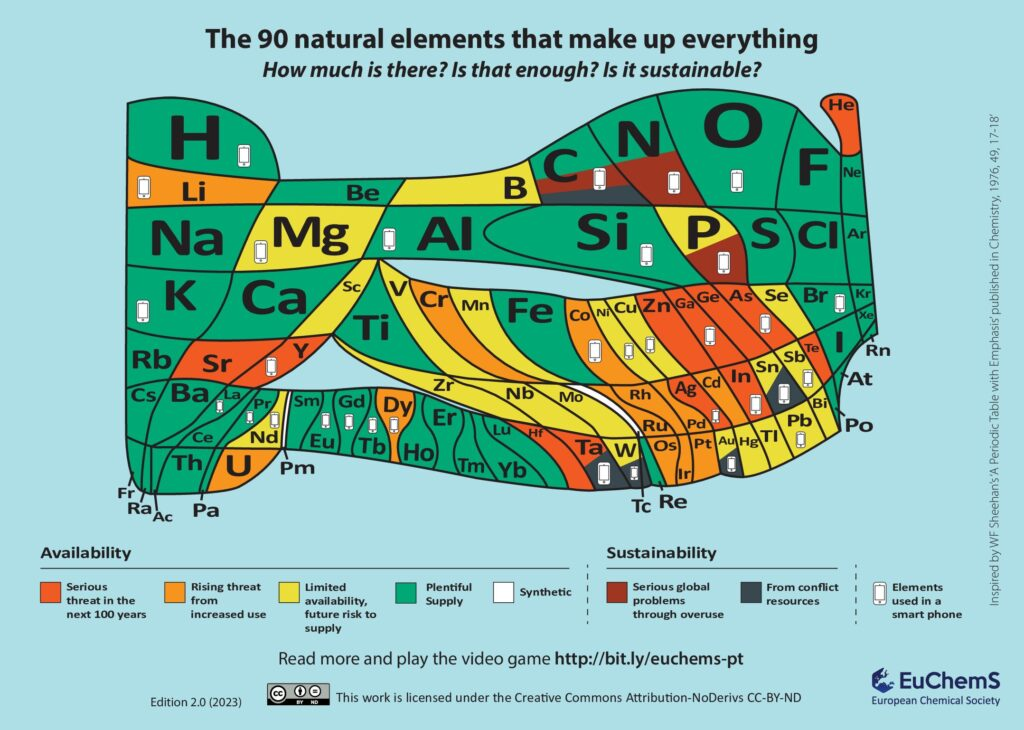
The original image (top of the page), created in 2015, was updated by EuChemS in 2023 (above). The updated table features the current-day availability of all 90 elements, rather than just the endangered 44 elements, adds an axis for sustainability, and flags elements used in smartphone production.
If you would like to support the mission of Open Culture, consider making a donation to our site. It’s hard to rely 100% on ads, and your contributions will help us continue providing the best free cultural and educational materials to learners everywhere. You can contribute through PayPal, Patreon, and Venmo (@openculture). Thanks!
Related Content:
The Periodic Table of Elements Scaled to Show The Elements’ Actual Abundance on Earth
Periodic Table Battleship!: A Fun Way To Learn the Elements
“The Periodic Table Table” — All The Elements in Hand-Carved Wood
World’s Smallest Periodic Table on a Human Hair
“The Periodic Table of Storytelling” Reveals the Elements of Telling a Good Story
Chemistry on YouTube: “Periodic Table of Videos” Wins SPORE Prize
Free Online Chemistry Courses
Read More...Why AI Companies Are Buying—And Then Destroying—Old Books
We’ve long joked about delaying bedtime in order to read the entire internet, but the prospect of actually doing so doesn’t sound as appealing as it used to. An ever-growing proportion of text online, we may sense, hasn’t been written by humans, but generated by artificial intelligence. One solution is to return to reading on paper, and beyond that, spending our time only with books published before the advent — and thus uncorrupted by the output — of large language models. Ironically, that’s what large language models themselves have had to do, and in order to ensure them a steady diet of manmade text, their owners are resorting to controversially destructive methods.
Suspicions first arose when book dealers noticed a spike in their income due to large orders from mysterious buyers for titles they assumed they’d never unload. Books on home oxygen treatment in Italy, marriage litigation in medieval England, Texas civil procedure in the twenty-tens, Swedish comedy in the sixties: these entities bought them all, and for whatever price the seller happened to be asking.
404 Media reporter Emanuel Maiberg tracked the path of one such book, which eventually wound up at a Las Vegas scanning facility run by Amazon. Though undergirded by advanced technology, the work done there is simple: digitize as many books as possible, then destroy them.
“In order to scan them really fast, they cut the spines off the books and fed the pages to the scanner,” Maiberg explained to NPR. Many are technically rare, albeit esoteric obscurities like vanity publications and old instruction manuals rather than first-edition classics. Humans may not value them, but LLMs do: their consumption forestalls “a problem called model collapse, where if an AI trains on AI training data, it gets worse.” Amazon and Anthropic have both been found to use the book-sacrificing method to harvest text, but every company with models to train needs a solution. All this makes for “an unusually on-the-nose example of digital technology devouring literary culture,” as the Wall Street Journal’s Melissa Korn puts it. But when you really have read the entire internet, perhaps extreme measures are inevitable.
Related Content:
How the Internet Archive Digitizes 3,500 Books a Day–the Hard Way, One Page at a Time
How 99% of Ancient Literature Was Lost
Based in Seoul, Colin Marshall writes and broadcasts on cities, language, and culture. He’s the author of the newsletter Books on Cities as well as the books 한국 요약 금지 (No Summarizing Korea) and Korean Newtro. Follow him on the social network formerly known as Twitter at @colinmarshall.
Read More...The Art of Splendor Solis, the Most Glorious Illuminated Alchemical Manuscript of Them All
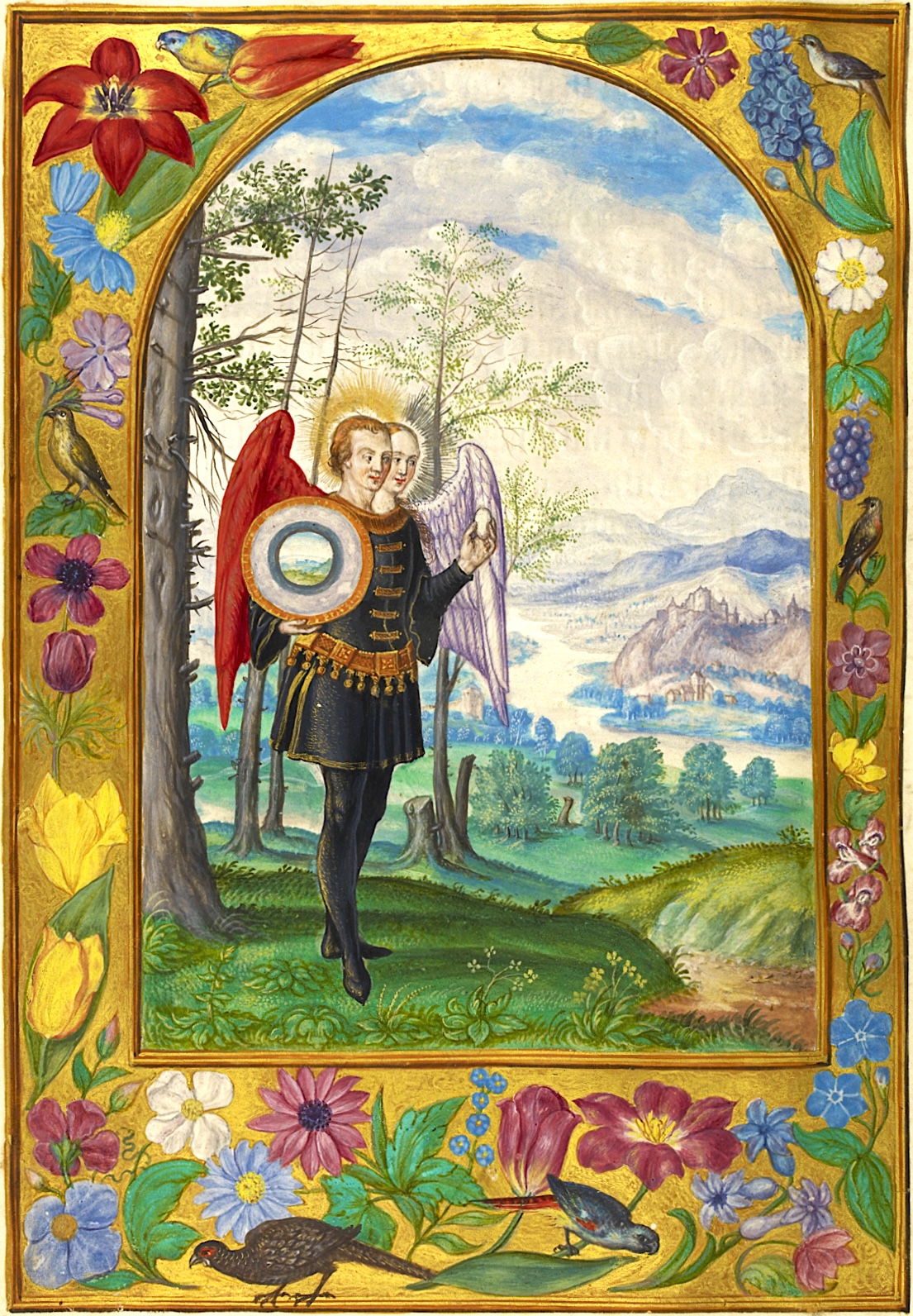
When it was published in the United States in 1998, Harry Potter and the Philosopher’s Stone was retitled Harry Potter and the Sorcerer’s Stone. The jokes about the American reading public’s apparent allergy to the very word philosopher write themselves, but the change was also unfortunate for more substantial reasons. A “sorcerer’s stone” had no cultural resonance at all, whereas the philosopher’s stone had been sought after since, at the very latest, the dawn of the fourth century. Some sources claim that human knowledge of it goes all the way back to Adam, who got the word directly from God. In any case, it’s no mystery why the philosopher’s stone has long captured the collective imagination of humanity, given that it’s reputed to turn lead into gold.
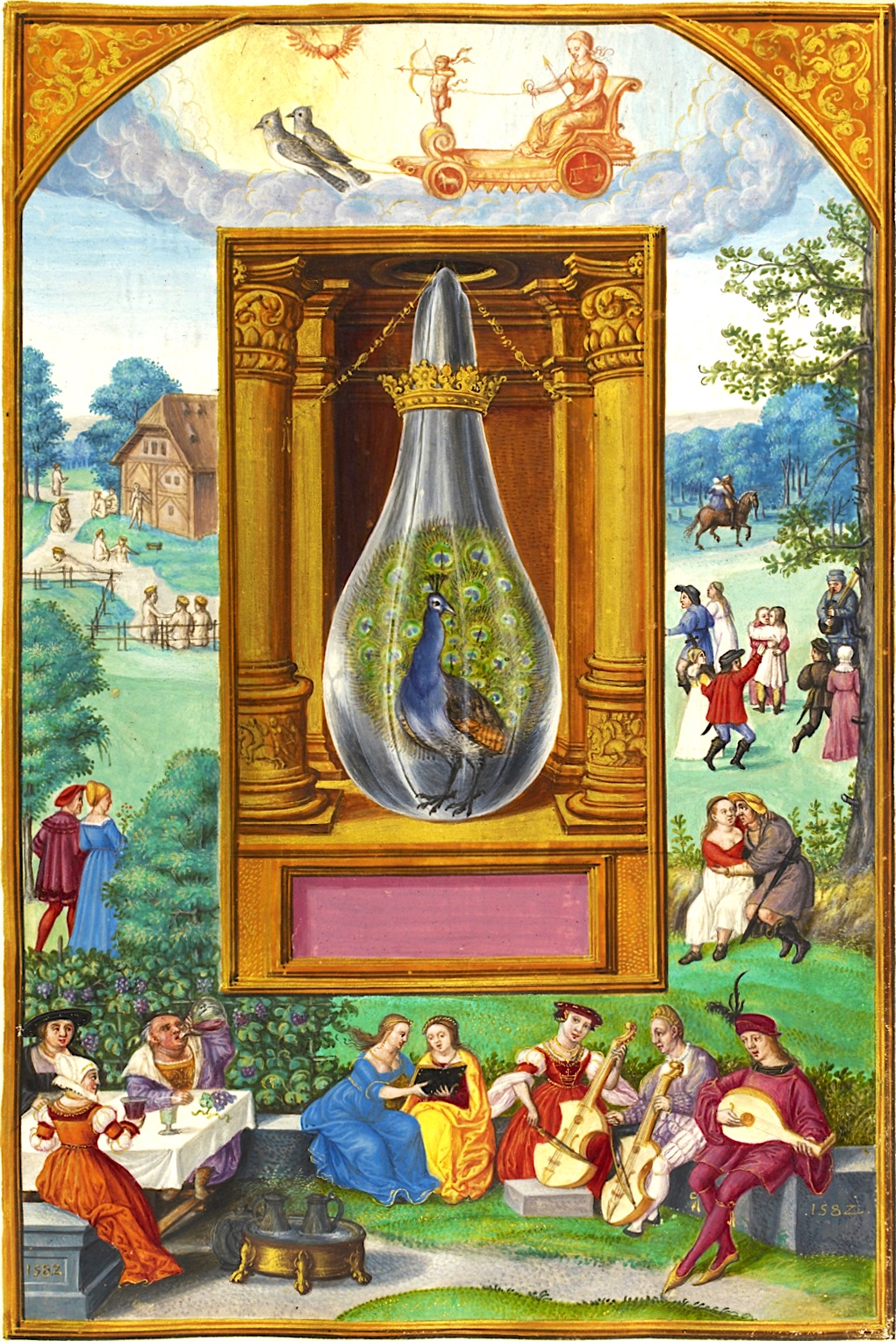
Among the rumored possessors of the philosopher’s stone throughout history is Salomon Trismosin, a sixteenth-century Renaissance alchemist who taught the influential physician Paracelsus. He’s also credited, at least in legends, with writing Splendor Solis, a book once no less desirable than the next Harry Potter volume in that series’ heyday.
Nothing so mundane as “a list of instructions for whipping up a little alchemical soup in the hope of finding a nugget of artificial gold in the pot at the end,” writes Jörg Völlnagel at Medievalists.net, it rather “sets forth the philosophy of alchemy, a world view according to which the human being (the alchemist) exists and acts in harmony with nature, respecting divine creation and at the same time intervening in the processes underlying that creation, all the while supporting its growth with the help of alchemy.”
As “a — or rather the – prime example of an illuminated alchemical manuscript,” Splendor Solis has drawn the fascination of even such modern figures as William Butler Yeats, James Joyce, and Umberto Eco. It also became an important work in the symbolic-cultural universe of Carl Jung, who, according to the Association of Jungian Analysts, “recognized the alchemical motifs and symbols as expressions of the individuation process, the transformation and integration of the psyche. Splendor Solis, with its rich symbolism and profound allegories, resonated with Jung’s understanding of the archetypal imagery and the transformative nature of the human psyche, contributing to his theories on analytical psychology.”
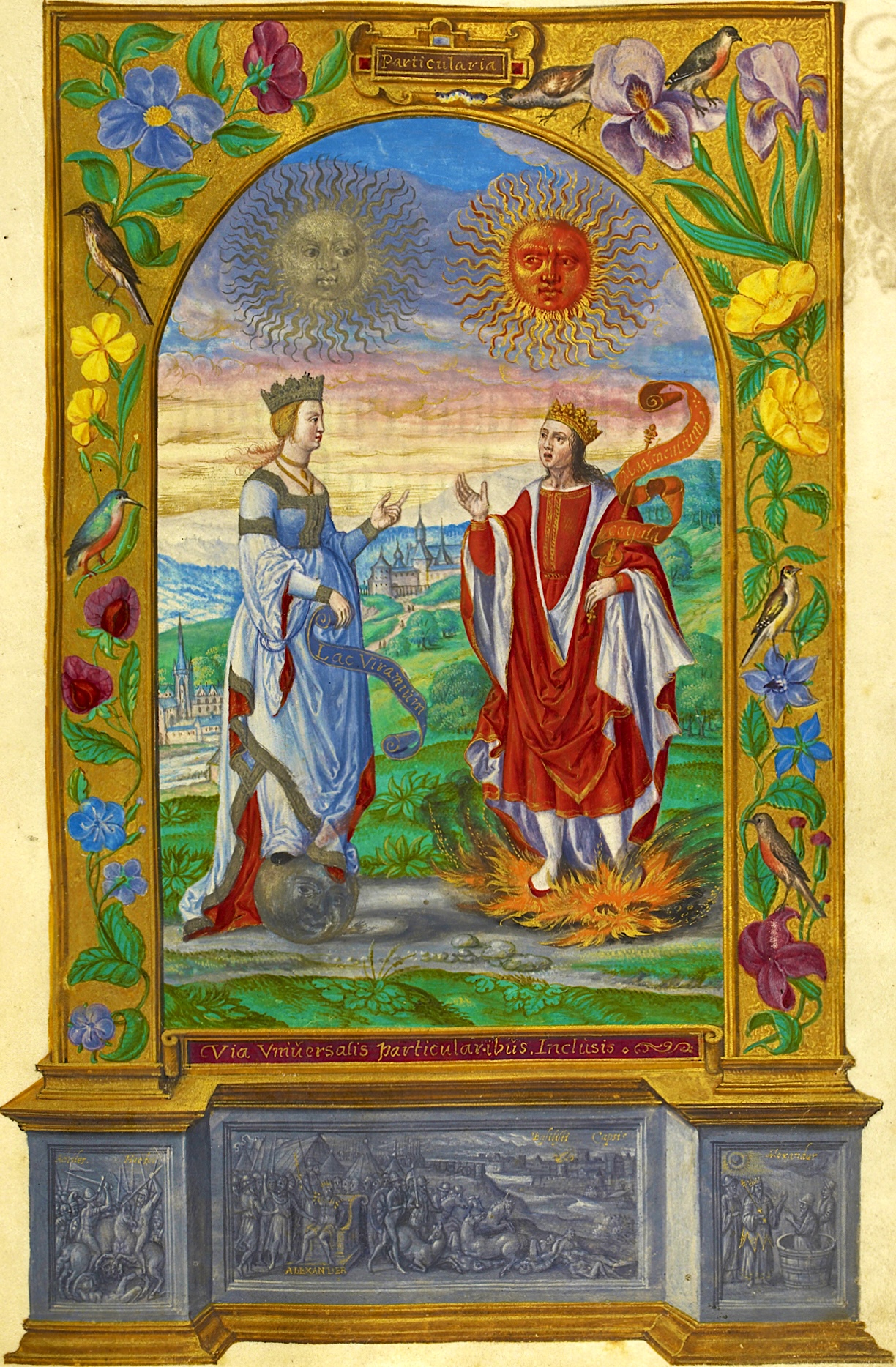
None of this is to say that Jung, or many other esteemed intellectuals of the past couple of centuries, believed that base metals really could be transmuted to gold and silver. But they did understand that the phenomenon of alchemy has much to reveal about the irresolvable existential negotiation between man and the world he inhabits. It resonates so deeply that it’s even worked in children’s literature, and to great commercial success at that. You can even feel some of it just by gazing upon Splendor Solis’ 22 gold-highlighted, book-of-hours-style illustrations at the web site of M. Moleiro, publisher of one facsimile edition. And who knows? If, as in the world of Harry Potter, the philosopher’s stone also grants immortality, perhaps Salomon Trismosin still walks somewhere among us.
You can view pages of Splendor Solis on Wikipedia. Enter the image gallery here.
Related Content:
A Gallery of Fantastical Alchemical Drawings
How the Brilliant Colors of Medieval Illuminated Manuscripts Were Made with Alchemy
Videos Recreate Isaac Newton’s Neat Alchemy Experiments: Watch Silver Get Turned Into Gold
The Visionary Mystical Art of Carl Jung: See Illustrated Pages from the Red Book
Based in Seoul, Colin Marshall writes and broadcasts on cities, language, and culture. He’s the author of the newsletter Books on Cities as well as the books 한국 요약 금지 (No Summarizing Korea) and Korean Newtro. Follow him on the social network formerly known as Twitter at @colinmarshall.
Read More...Isaac Asimov Explains His Three Laws of Robots: Do No Harm, Follow Orders, Survive, in That Order
A number of futurists, philosophers, and technophiles believe we are approaching what they call the “singularity”: a point in time when smart machines become much smarter, stronger, and faster than their creators, and then become self-conscious. Whatever the chance of this occurring, it’s worthwhile to ponder the consequences. But we do already, all the time—in existentially bleak scenarios like Blade Runner, the Terminator series, the rebooted Battlestar Galactica (and its failed prequel Caprica).
The prospects are never pleasant. Robotic engineers in these worlds hardly seem to bother teaching their machines the kind of moral code that would keep them from turning and destroying us (that is, when they aren’t explicitly designed to do so).
I wonder about this conceptual gap—convenient as it may be in narrative terms—given that Isaac Asimov, one of the forefathers of robot fiction invented just such a moral code. In the video above, he outlines it (with his odd pronunciation of “robot”). The code consists of three laws; in his fiction these are hardwired into each robot’s “positronic brain,” a fictional computer that gives robots something of a human-like consciousness.
First Law: A robot may not injure a human being, or, through inaction, allow a human being to come to harm.
Second Law: A robot must obey the orders given it by human beings except where such orders would conflict with the First Law.
Third Law: A robot must protect its own existence as long as such protection does not conflict with the First or Second Law.
Isaac Asimov devoted a good deal of his writing career to the subject of robots, so it’s safe to say, he’d done quite a bit of thinking about how they would fit into the worlds he invented. In doing so, Asimov had to solve the problem of how robots would interact with humans once they had some degree of free will. But are his three laws sufficient? Many of Asimov’s stories—I, Robot, for example—turn on some failure or confusion between them. And even for their chase scenes, explosions, and melodrama, the three screen explorations of artificial life mentioned above thoughtfully exploit philosophical ambiguities and insufficiencies in Asimov’s simple system.
For one thing, while Asimov’s robots were hunks of metal, taking only vaguely humanoid form, the robots of our current imaginings emerge from an uncanny valley with realistic skin and hair or even a genetic code and circulatory system. They are possible sexual partners, friends and lovers, co-workers and superiors. They can deceive us as to their nature (a fourth law by Bulgarian novelist Lyuben Dilov states that a robot “must establish its identity as a robot in all cases”); they can conceive children or desires their creators never intended. These differences beg important questions: how ethical are these laws? How feasible? When the singularity occurs, will Skynet become aware of itself and destroy us?
Unlike Asimov, we now live in a time where the questions have direct applicability to robots living among us, outside the pages of sci-fi. As Japanese and South Korean roboticists have found, the three laws cannot address what they call “open texture risk”— unpredictable interactions in unstructured environments. Humans rely on nuanced and often preconscious readings of complex social codes and the fine shades of meaning embedded in natural language; despite many advances, machines are still catching up. Whether or not they can successfully develop it is an open question, making humanoid robots with artificial intelligence an “open texture risk.” But as you can see from the video below, we’re perhaps much closer to Blade Runner or, of course, artificial intelligence than to the clunky, interstellar mining machines in Asimov’s fiction.
Josh Jones is a writer and musician based in Durham, NC.
Note: An earlier version of this post appeared on our site in 2012.
Related Content
Isaac Asimov Laments the Cult of Ignorance
200-Year-Old Robots That Play Music, Shoot Arrows & Even Write Poems: Watch Automatons in Action
Read More...Why Reading Egyptian Hieroglyphics Is Easier Than You Think
We’ve featured Egyptologist Ilona Regulski here on Open Culture a few times before. Once, she explained how to read ancient Egyptian hieroglyphs; another time, she told us what the Rosetta Stone actually says. It was, perhaps, inevitable that she would cross paths with Rob Watts, creator of the YouTube channel RobWords, whose videos we often post. When he made the journey to Berlin’s Neues Museum, and specifically to its Egyptian Museum, Regulski was the expert he sought out to tell him — and us — all about how hieroglyphs, literally “sacred carvings,” actually make words.
Faced with a stone chiseled full of hieroglyphs, where do we start? Ancient Egyptian texts are all read from top to bottom, but some go left to right, and others right to left. To know which way, Regulski says, we must first look for symbols with a clear front and back, such as those in human or animal shapes.
Some names are written in blocks, themselves read from top to bottom — unless they contain a sign referring to a god, which, of course, gets customarily elevated to the top. But even if we understand the exact order in which we should read a given string of hieroglyphs, the question remains: how do we actually do that reading?
Though many hieroglyphs do appear to be figurative, with their recognizable forms of birds, bugs, arms, legs, and such, only sometimes are they meant to represent what they look like. Regulski explains that some of these signs are letters, and can be pronounced in much the same way as our own alphabet. What looks like a mouth sounds like an r; a highly abstracted bread loaf, t; a horned viper, ph; an owl, m. There is, of course, more to it. Signs can be combined not just to indicate sound, but also to disambiguate meaning. As you may have noticed, hieroglyphic writing is also what Watts calls a “vowel-free zone.” Exactly which of those sounds go where is, like certain other unresolved aspects of hieroglyphs, a matter of ongoing expert inquiry. But Egyptologists, as seeing Regulski in action reminds us, are a dedicated bunch.
Related content:
How to Read Ancient Egyptian Hieroglyphs: A British Museum Curator Explains
How to Carve Hieroglyphs Just Like the Ancient Egyptians Did
You Could Soon Be Able to Text with 2,000 Ancient Egyptian Hieroglyphs
What the Rosetta Stone Actually Says
What Ancient Egyptian Sounded Like & How We Know It
Based in Seoul, Colin Marshall writes and broadcasts on cities, language, and culture. He’s the author of the newsletter Books on Cities as well as the books 한국 요약 금지 (No Summarizing Korea) and Korean Newtro. Follow him on the social network formerly known as Twitter at @colinmarshall.
Read More...Dolly Parton’s “Jolene” Slowed Down to 33 RPM Sounds Great and Takes on New, Unexpected Meanings (RIP)
Note: We were sad to see the news that Dolly Parton passed away. Today we are bringing back one of our favorite Dolly Parton posts. She will be missed.
The Walrus is… Dolly Parton?
Not every record yields gold when played backwards or spun more slowly than recommended, but a 45 of Parton’s 1973 hit “Jolene” played at 33 RPM not only sounds wonderful, it also manages to reframe the narrative.
As Andrea DenHoed notes in The New Yorker, “Slow Ass Jolene,” above, transforms Parton’s “baby-high soprano” into something deep, soulful and seemingly, male.
In its original version, the much-covered “Jolene” is a straight up woman-to-woman chest-baring. Our narrator knows her man is obsessed with the sexy, auburn-haired Jolene, to the point where he talks about her in his sleep.
Apparently she also knows better than to raise the subject with him. Instead, she appeals to Jolene’s sense of mercy:
You could have your choice of men
But I could never love again
He’s the only one for me, Jolene
The song is somewhat autobiographical, though the situation was nowhere near as dire as listeners might assume. In an interview with NPR, Parton recalled a red-haired bank teller who developed a big crush on her husband when she was a young bride:
And he just loved going to the bank because she paid him so much attention. It was kinda like a running joke between us — when I was saying, ‘Hell, you’re spending a lot of time at the bank. I don’t believe we’ve got that kind of money.’ So it’s really an innocent song all around, but sounds like a dreadful one.
For the record, the teller’s name wasn’t Jolene.
Jolene was a pretty little girl who attended an early Parton concert. Parton was so taken with the child, and her unusual name, that she resolved to write a song about her.
Yes, the kid had red hair and green eyes.
Wouldn’t it be wild if she grew up to be a bank teller?
I digress…
In the original version, the irresistible chorus wherein the soon-to-be-spurned party invokes Jolene’s name again and again is plaintive and fierce.
In the slow ass version, it’s plaintive and sad.
The pain is the same, but the situation is much less straightforward, thanks to blurrier gender lines.
Parton told NPR that women are “always threatened by other women, period.”
Jolene’s prodigious feminine assets could also prove worrisome to a gay man whose bisexual lover’s eye is prone to wander.
Or maybe the singer and his man live in a place where same-sex unions are frowned on. Perhaps the singer’s man craves the comfort of a more socially acceptable domestic situation.
Or perhaps Jolene is one hot female-identified tomato, and as far as the singer’s man’s concerned, his pastor and his granny can go to hell! Jolene’s the only one for him.
Or, as one waggish Youtube commenter succinctly put it, “Jolene better stay the hell away from Roy Orbison’s man!”
Jolene, Jolene, Jolene, Jolene
I’m begging of you please don’t take my man
Jolene, Jolene, Jolene, Jolene
Please don’t take him just because you can
Your beauty is beyond compare
With flaming locks of auburn hair
With ivory skin and eyes of emerald green
Your smile is like a breath of spring
Your voice is soft like summer rain
And I cannot compete with you, Jolene
He talks about you in his sleep
There’s nothing I can do to keep
From crying when he calls your name, Jolene
And I can easily understand
How you could easily take my man
But you don’t know what he means to me, Jolene
Jolene, Jolene, Jolene, Jolene
I’m begging of you please don’t take my man
Jolene, Jolene, Jolene, Jolene
Please don’t take him just because you can
You could have your choice of men
But I could never love again
He’s the only one for me, Jolene
I had to have this talk with you
My happiness depends on you
And whatever you decide to do, Jolene
Jolene, Jolene, Jolene, Jolene
I’m begging of you please don’t take my man
Jolene, Jolene, Jolene, Jolene
Please don’t take him even though you can
Jolene, Jolene
Note: An earlier version of this post appeared on our site in 2018.
Related Content:
R.E.M.’s “Losing My Religion” Reworked from Minor to Major Scale
Ayun Halliday is an author, illustrator, and theater maker in NYC.
Read More...The Very First Film Adaptation of Mary Shelley’s Frankenstein, a Thomas Edison Production (1910)
The story of humans creating monstrous beings in their image may have perennial relevance, even if it seems specific to our contemporary cultural moment. What, after all, is Oscar Isaac’s AI inventor in Ex Machina but a 21st-century update of Victor Frankenstein? (Before Isaac went on to portray Victor himself in Guillermo del Toro’s 2025 film adaptation.) And what is Frankenstein’s monster but a Gothic recreation of the Golem, or any number of folkloric automatons in cultures far and wide? It’s an age-old archetypal story that seems to get an update every year.
People have imagined making artificial people, perhaps for as long as people have told stories. But each iteration of that story emerges from a historical matrix of particular technological, philosophical, and metaphysical anxieties. In the case of Ex Machina, we have not only a thinking, feeling humanoid, but one created out of mass data collection and designed to serve the prurient interests of a Nietzschean venture capitalist engineer.
In the original Frankenstein, a novel written by a woman, Mary Shelley, we have a very different kind of monster, born out of a Romantic convergence of interest in alchemy and the occult—the original domains of early modern scientists like Isaac Newton—and more modern, industrial scientific methods (hence the novel’s subtitle, The Modern Prometheus). Many critics have called the novel the first work of science fiction, and many, like Maurice Hindle in the introduction to the Penguin Classics edition, have described its main theme as “the aspiration of modern masculinist scientists to be technically creative divinities.”
And yet, writes Ruth Franklin at the New Republic—drawing convincingly on Shelley’s own traumatic experiences with birth—Frankenstein might “also be a story about pregnancy.” Intriguing as this possibility may be, most interpretations of the novel have seen it as “a fable of masculine reproduction, in which a man creates life asexually.” That tradition continues in the movies with the first film adaptation of Frankenstein, made by Edison studios just over 100 years after the novel’s 1818 publication.
The 1910 short silent film, which you can watch above, bills itself as “a liberal adaptation from Mrs. Shelley’s famous story,” and opens in its first scene with Victor Frankenstein leaving home for college. Two years later, the Faustian mad scientist discovers the mystery of life, uses the knowledge to make his “creature”—a surprisingly grotesque scene—and, appalled at the sight of it, rejects the thing in horror. The rest of the story proceeds along the usual lines, as the monster, in rags and fright wig, seeks recognition from his creator/parent and wreaks havoc when he does not receive it.
This first Frankenstein film, directed by J. Searle Dawley, arrived two years after Edison’s Bronx, New York studios began full and very lucrative operations, and, by this time, writes Rich Drees, motion pictures had begun to receive unwelcome attention from “moral crusaders and reform groups, who decried the new medium as being dangerous and encouraging of immorality.” Edison responded quickly, fearing “a serious threat to his bottom line,” and ordered that his films’ production quality and “moral tone” be improved.
Frankenstein, writes Drees, “was the perfect choice to kick off production under this new moral banner. It’s a story that deals with the extremes of the human condition, life and death, and the dangers of tampering in God’s realm.” Edison released the film with the following disclaimer:
To those familiar with Mrs. Shelley’s story it will be evident that we have carefully omitted anything which might be any possibility shock any portion of the audience. In making the film the Edison Co. has carefully tried to eliminate all actual repulsive situations and to concentrate its endeavors upon the mystic and psychological problems that are to be found in this weird tale. Wherever, therefore, the film differs from the original story it is purely with the idea of eliminating what would be repulsive to a moving picture audience.
Five years after the Edison studio’s short, another silent adaptation, Life Without Soul, appeared. Made by the Ocean Film Corporation, this film is now lost to history, but it qualifies as the first feature-length adaptation at 70 minutes. A review of the film, writes the blog Frankensteinia, “reveals a story that hews fairly close to Mary Shelley’s novel,” making a “bold attempt at capturing the world-spanning sweep of the tale.”
Several dozen film adaptations in the ensuing years have tracked more or less closely to Shelley’s narrative—giving Frankenstein’s monster a bride and having Victor Frankenstein reanimate his dead lover with the mind of a wrongly executed man. But none of these films, so far as I know, has drawn out the subtext of Frankenstein as a novel about pregnancy and childbirth. Such an adaptation remains to be made—although Maggie Gyllenhaal’s 2026 film The Bride! has become the first adaptation by a woman.
You can find Mary Shelley’s Frankenstein in our collections of Free eBooks and Free Audio Books.
The film above will be added to our collection, 4,000+ Free Movies Online: Great Classics, Indies, Noir, Westerns, Documentaries & More.
Note: An earlier version of this post appeared on our site in 2016.
Related Content:
The First Horror Film, George Méliès’ The Manor of the Devil (1896)
Frankenweenie: Tim Burton Turns Frankenstein Tale into Disney Kids Film (1984)
Mary Shelley’s Handwritten Manuscripts of Frankenstein Now Online for the First Time
Josh Jones is a writer and musician based in Durham, NC.
Read More...Support Us
We're hoping to rely on loyal readers, rather than erratic ads. Please click the Donate button and support Open Culture. You can use Paypal, Venmo, Patreon, even Crypto! We thank you!

About Us

Open Culture scours the web for the best educational media. We find the free courses and audio books you need, the language lessons & educational videos you want, and plenty of enlightenment in between.
Advertise With Us

FREE UPDATES!
GET OUR DAILY EMAIL
Get the best cultural and educational resources on the web curated for you in a daily email. We never spam. Unsubscribe at any time.
FOLLOW ON SOCIAL MEDIA

Open Culture editor Dan Colman scours the web for the best educational media. He finds the free courses and audio books you need, the language lessons & movies you want, and plenty of enlightenment in between.
Advertise With Us