Where Did Europe’s Countries—and the United Kingdom—Get Their Names?
The typical student traveling on a Eurail pass will stop in such lands as Österreich, Italia, Česko and Schweiz — also known as Suisse, Svizzera, and Svizra. If that student happens to hail from the English-speaking world, the names Austria, Italy, the Czech Republic (the recent movement for Czechia notwithstanding), and Switzerland will sound more familiar. But the question inevitably comes to mind while riding between one historically and culturally rich capital to another: where did all these countries get their names in English? How on Earth, for example, did Deutschland, known in certain other European languages as Allemagne, Alemania, or Alemanha, get to be called Germany?
Language YouTuber RobWords has an explanation. “To the Romans, it was the land of the Germani, their name for the weird people speaking gibberish languages to the east of the River Rhine,” he says in the video above, standing in a forest conveniently located in Germany itself.
They “also used the word alemanni to describe a confederation of Germanic people, and that’s where a load of other languages get their word for Germany too.” And the meaning of Deutschland? “Land of the Dutch,” that last actually being the descendant of an old Germanic word meaning ‘popular’ or ‘people’ ” — which, before that time, referred not simply to human beings, but the population who spoke the region’s widely understood “popular languages.”
Behind most every European country’s English name lies a story, if sometimes an ambiguous, contested, and controversial one. Most are also historically illuminating: take Belgium, once considered part of the Netherlands (home of the people we now call Dutch), whose name derives from a tribe, or confederation of tribes, known in Latin as the Belgae: a word “adopted by people living in the southern Low Countries during the region’s struggle for independence from Spain in the sixteenth century.” RobWords has more such surprising facts to reveal in the video just above, in which he breaks down the names of all the countries in the United Kingdom, covering Ireland, Scotland, Wales, his native England, and also the word Britain itself, as well as the Great often attached to it. The latter isn’t a boast, he stresses, but rather a means of distinguishing the island from part of France. As for which part, you’ll have to watch to find out.
Related Content:
The Surprising Pattern Behind the Names of Colors Around the World
A Map of How the Word “Tea” Spread Across the World
The History of Europe from 400 BC to the Present, Animated in 12 Minutes
The Entire History of English in 22 Minutes
Based in Seoul, Colin Marshall writes and broadcasts on cities, language, and culture. He’s the author of the newsletter Books on Cities as well as the books 한국 요약 금지 (No Summarizing Korea) and Korean Newtro. Follow him on the social network formerly known as Twitter at @colinmarshall.
Read More...19th Century Japanese Woodblock Prints Creatively Illustrate the Inner Workings of the Human Body
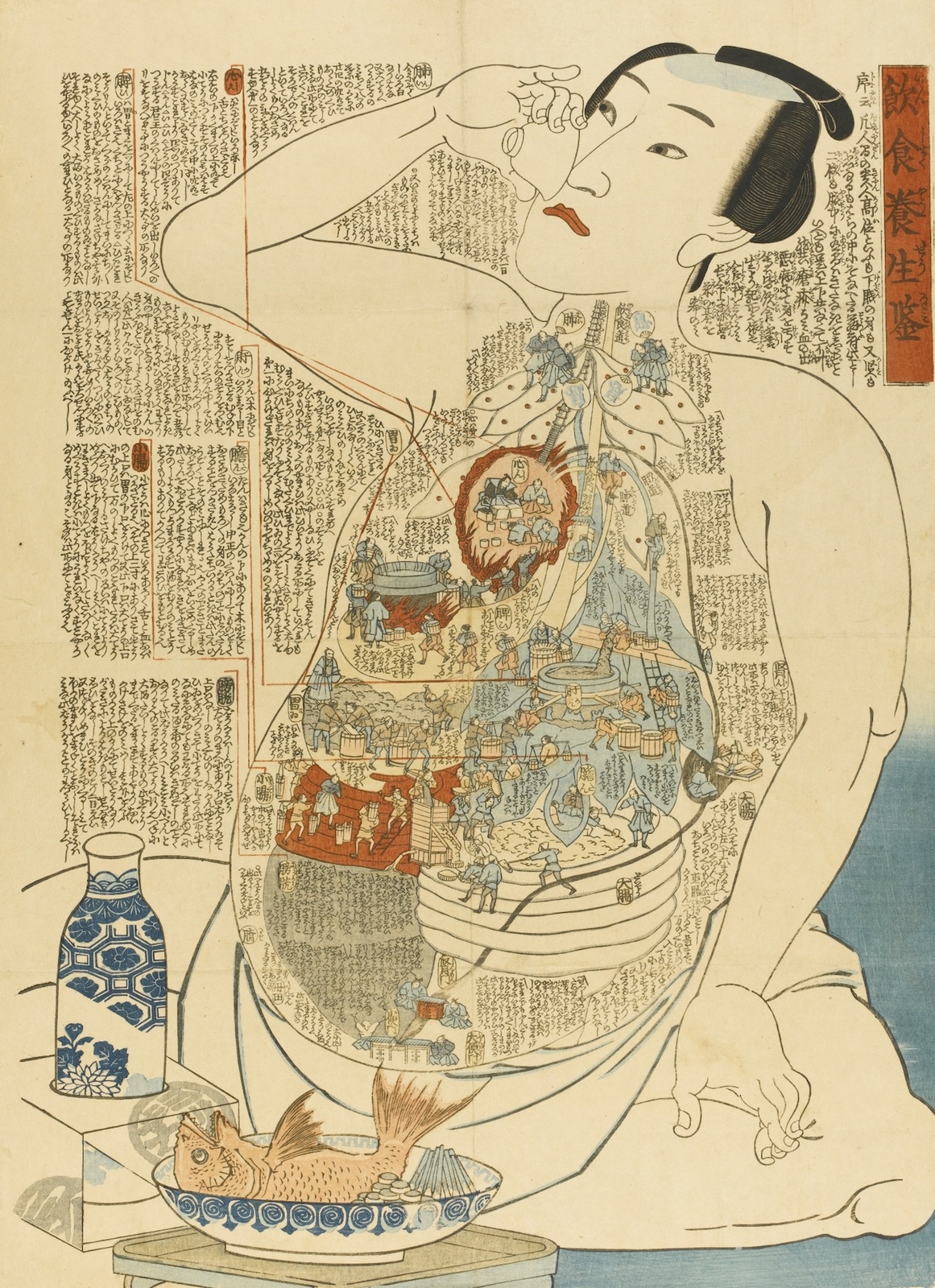
Folks with a passing knowledge of ukiyo‑e, the Japanese woodblock print art form popular in the 17th through 19th centuries, will be familiar with its landscapes, as well as its portraits of courtesans and kabuki actors. But often these prints were educational, as demonstrated by these very odd anatomical prints that promote good health as it relates to our internal workings.
Long before animated monsters warned us about our mucus-filled chests, Japanese artists like Utagawa Kunisada (1786–1865) filled the guts of these men and women with little workers, making sure the human body worked like a functioning village or town.
In the first print, Inshoku Yojo Kagami (“Mirror of the Physiology of Drinking and Eating”), a man dines on fish and drinks sake. Inside, little men scurry about a pool wrapped in intestines, stoke a fire under the heart, all the while a scholar keeps reference materials nearby. Down below lonely figures guard the “urine gate” and the “feces gate,” surely one of the worst jobs in all the body economy.
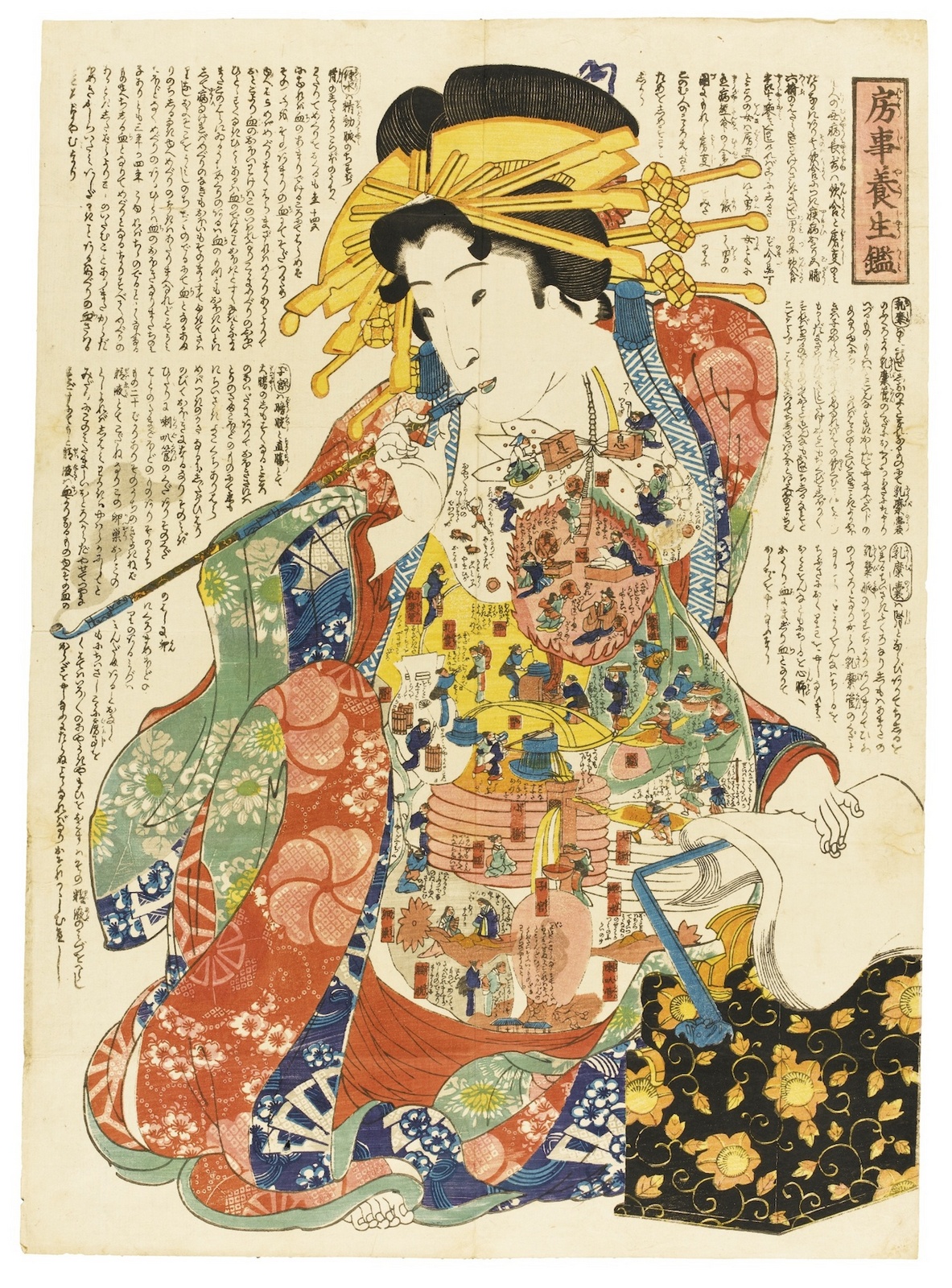
One of Kunisada’s students created a print for the women, focusing on the reproductive organs, called Boji Yojo Kagami (“Rules of Sexual Life”). Keen-eyed viewers will note that the miniature workers here are all women, so at least there’s some equality at play.
The two prints were meant as instructional, pointing out best health practices, and warning against overindulgence and excess.
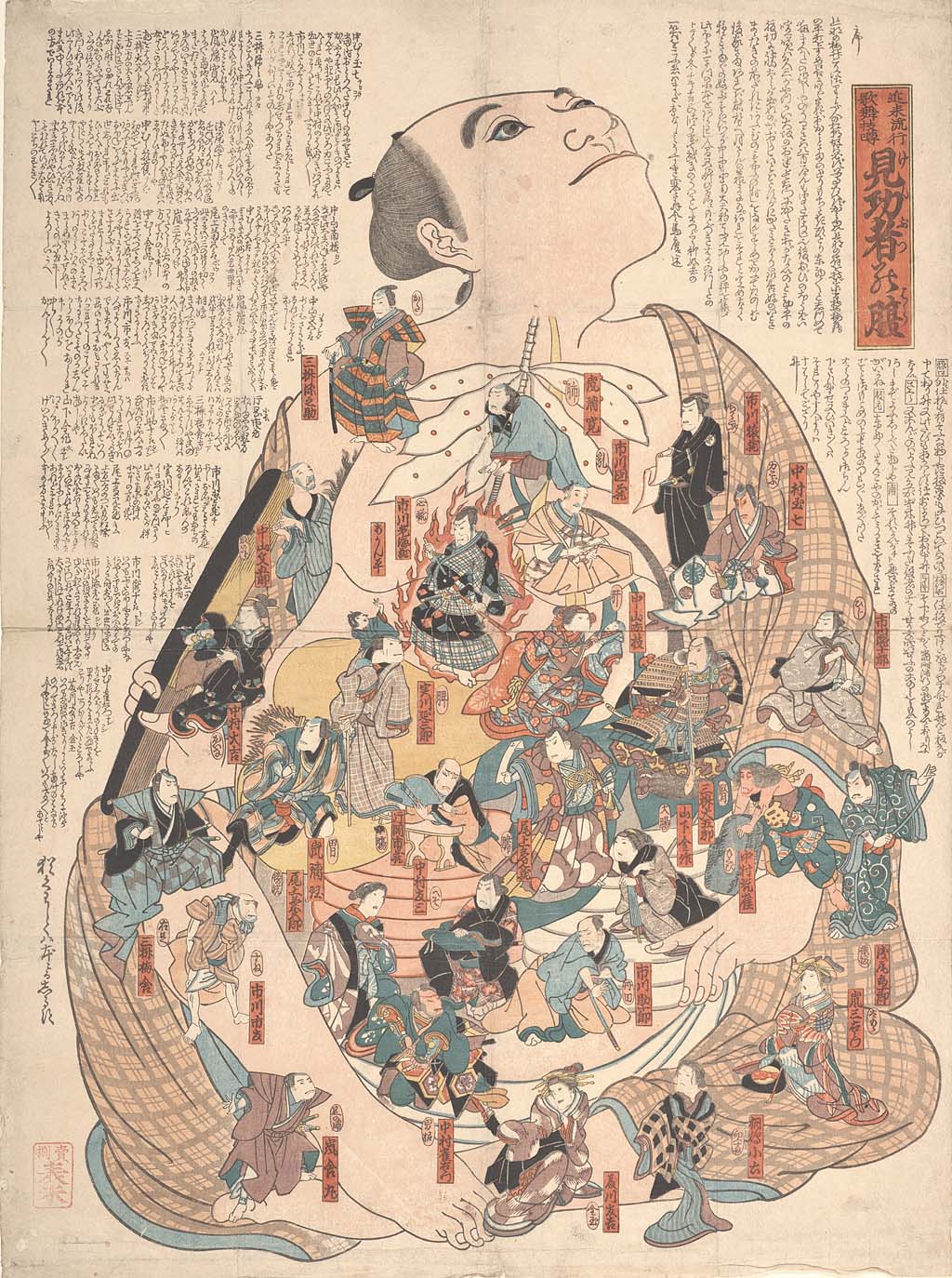
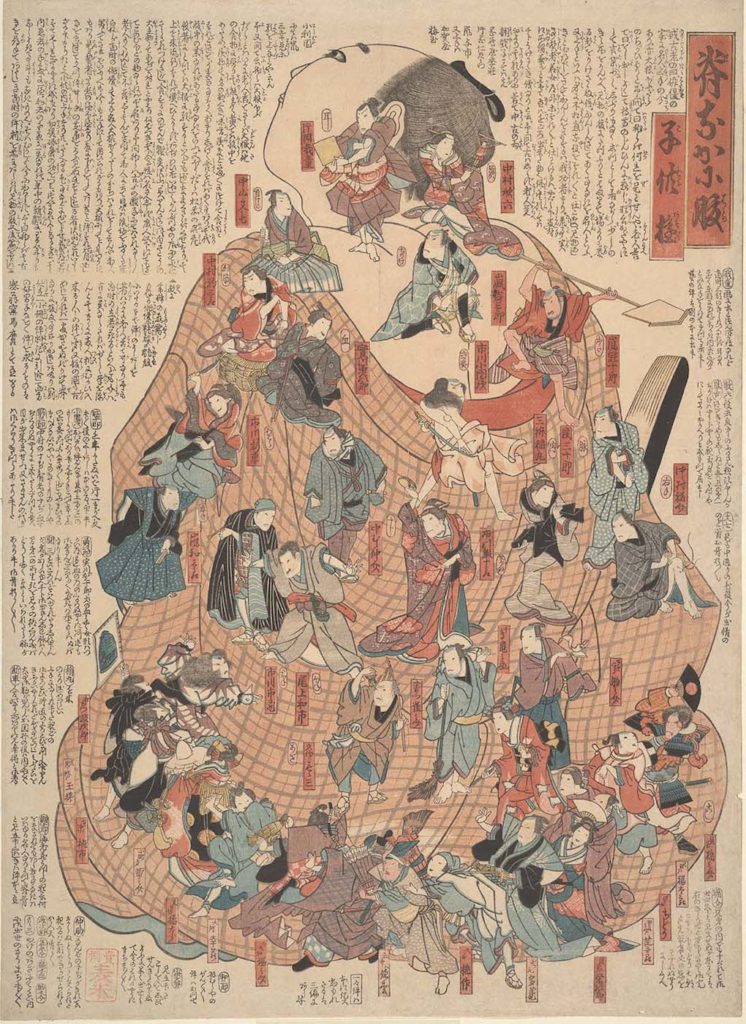
Other prints are just as inventive: a back and abdomen covered in children playing familiar games; another featuring popular kabuki actors standing in for various organs. (Now, that is just crying out for a modern remake). The last print shows a pregnant woman whose belly contains Tainai jukkai no zu (Ten Realms within the body), a Buddhist idea that you can read more about here. As for their function inside the womb, that is for others of a higher consciousness to discern.
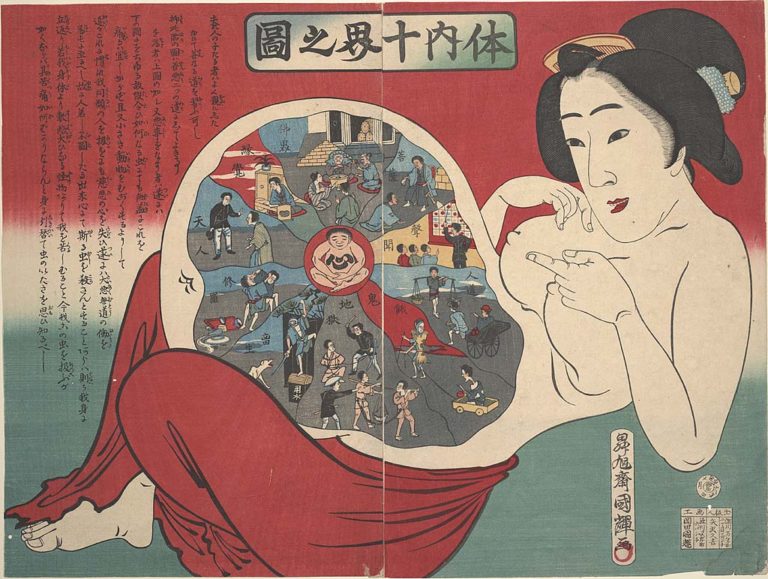
Note: An earlier version of this post appeared on our site in 2019.
Related Content:
Ted Mills is a freelance writer on the arts.
Read More...A Free Online Archive Lets You Explore 5.8 Million Works of Art Spanning 5,000 Years of History

Though it’s traditionally meant “last in a progression or series,” as Merriam-Webster puts it, the word ultimate has been more often used in recent decades to mean “the best or most extreme of its kind.” The name of a recently launched digital archive performs a rare inversion, labeling as last a creation marked not by finality but extremity. Billed as “the largest search engine for museum art,” The Last Museum currently indexes around five million artworks, both those in the public domain and those covered by fair use. Whatever sort of art you wish to see, just describe it in the search bar, hit enter, and enjoy the numerous and diverse results from throughout history and all around the world.
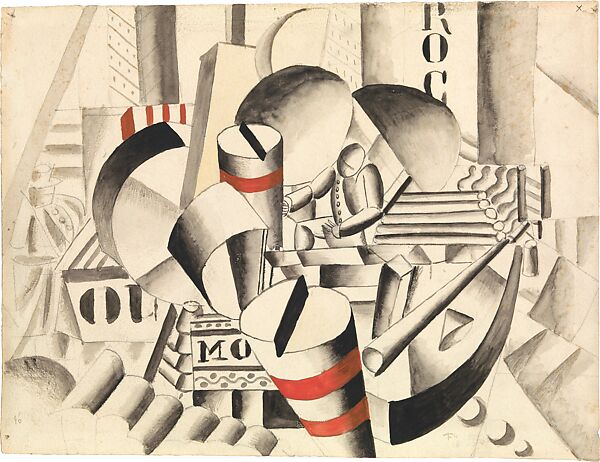
“Rather than functioning as a museum itself, the website aggregates publicly available collection records and images from thousands of institutions, allowing visitors to explore everything from Old Master paintings and ancient Egyptian sculpture to Japanese woodblock prints and vintage comics in one place,” writes Sage Helene at My Modern Met.
“Visitors can search by themes, moods, colors, subjects, or descriptive phrases without knowing an artwork’s title or artist. The system identifies related concepts and returns visually and thematically connected works, making it easy to discover unexpected pieces across cultures, time periods, and collections.” Its creators understand that the value of search lies in not just efficiency, but also surprise — not that the user experience is entirely “vibes-based,” as the kids today might say.
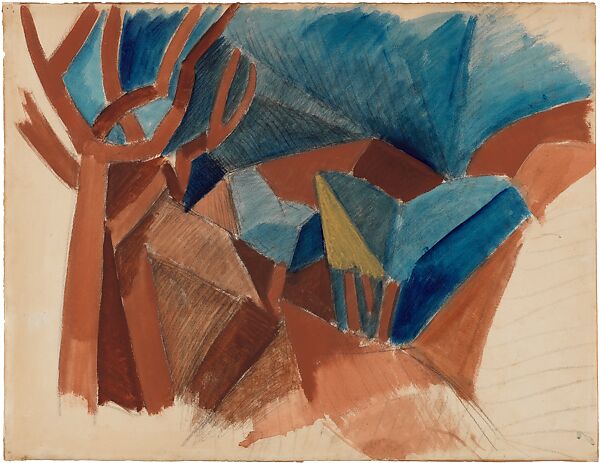
Though the search results can come, by default, from any time between 3000 BC and the current year, you can narrow the historical range by dragging the ends of the blue timeline inward. And if you prefer more specific browsing, you can also navigate through its lists of cultures or museums. The former includes everything from French, Roman, and Japanese (with a strong selection of woodblock prints), to Champa, Tajik, and Basque. The latter includes the British Museum, the Rijksmuseum, and the Metropolitan Museum of Art, as well as the likes of the HNM-PCC Hungarian National Museum, the Turin National University Library, and the Bath Postal Museum: institutions you can never be sure when you’ll visit next. There will, of course, be more museums founded in the future. But if things go according to plan, none of their holdings will escape The Last Museum’s ever-widening digital net. Enter the digital collection here.
via MyModernMet
Related content:
Explore the Newly Launched Public Domain Image Archive with 10,000+ Free Historical Images
Public.Work: A Smoothly Searchable Archive of 100,000+ “Copyright-Free” Images
A Search Engine for Finding Free, Public Domain Images from World-Class Museums
The Getty Makes Nearly 88,000 Art Images Free to Use However You Like
Download Great Works of Art from 40+ Museums Worldwide: Explore Artvee, the New Art Search Engine
Based in Seoul, Colin Marshall writes and broadcasts on cities, language, and culture. He’s the author of the newsletter Books on Cities as well as the books 한국 요약 금지 (No Summarizing Korea) and Korean Newtro. Follow him on the social network formerly known as Twitter at @colinmarshall.
Read More...How Did Everything Begin?: Animations on the Origins of the Universe Narrated by X‑Files Star Gillian Anderson
We previously brought you the BBC series of short animated videos, A History of Ideas. Produced in collaboration with the UK’s Open University and narrated by Harry Shearer, these fun introductions to such philosophers as Simone de Beauvoir and Edmund Burke, and such weighty philosophical topics as free will and the problem of evil, make challenging, abstract concepts accessible to non-philosophers. Now the series is back with a new chapter, How Did Everything Begin?, a survey of several theories of the origins of the universe, from Thomas Aquinas’ philosophical speculations, to Hindu cosmology; and from theologian William Paley’s design argument (below), to the theory of the Big Bang (above).
The two videos here present an interesting counterpoint between the origin theories of astrophysics and theology. Though current-day intelligent design proponents deny it, there is still much of William Paley’s argument, at least in style, in their explanations of creation. First propounded in his 1802 work Natural Theology, the theologian’s famous watchmaker analogy—which he extended to the design of the eye, and everything else—gave Charles Darwin much to puzzle over, though David Hume had supposedly refuted Paley’s arguments 50 years earlier. The Big Bang theory—a term created by its foremost critic Fred Hoyle—offers an entirely naturalistic account of the universe’s origins, one that presupposes no inherent purpose or design.
As with the previous videos, these are scripted by the host of the Philosophy Bites podcast, Nigel Warburton. This time around the videos are narrated by Gillian Anderson, whose voice you may not immediately recognize. Rather than sounding like Dana Scully, her famous X‑Files character, Anderson speaks in a British accent, which she slips into easily, having lived in the UK for much of her childhood and now again as an adult. (You may have seen Anderson in many of the English period dramas she has appeared in, or in British crime drama The Fall or Michael Winterbottom’s uproarious adaptation of Tristram Shandy.)
These fascinating speculative theories—whether scientific or mythological—are sure to appeal to fans of the X‑Files, who can perhaps begin to believe again, or remain skeptical, thanks to Chris Carter’s R‑rated director’s cut of X‑Files: I Want to Believe, coming out this fall.
Watch the remaining videos in the series below:
Thomas Aquinas and the First Mover Argument
Hindu Creation Stories
Note: An earlier version of this post appeared on our site in 2015.
Related Content:
The History of Philosophy Without Any Gaps – Peter Adamson’s Podcast Still Going Strong
Free Online Philosophy Courses
Josh Jones is a writer and musician based in Durham, NC.
Read More...Umberto Eco’s Personal Library Opens to the Public: More Than 32,000 Books, Exactly as He Left Them
Umberto Eco’s The Name of the Rose sold so well that its English translator William Weaver could add an extension onto his Tuscan villa, which he called the “Eco Chamber.” The Biblioteca Eco, or Eco Library, whose ribbon-cutting earlier this month you can see in the Italian news clip just above, may not be as wittily named, but it’s a much more ambitious project. It was opened this year, the tenth anniversary of the famed philosopher, semiotician, novelist, and critic’s death, at the University of Bologna, where he was a professor from 1971 to 2007. Housing more than 32,000 books from his personal library in Milan (previously featured here on Open Culture, and the subject of its own feature-length documentary), it stands as an explorable concrete representation of his capacious mind.
So capacious was that mind, in fact, that the Eco Library actually comprises several libraries, chiefly the Rare Book Library and the much-subdivided Working Library. In them, one encounters sections “dedicated to literary genres, comics and popular culture, works by and about Umberto Eco” — including more than 2,000 editions and translations of his own books — “ancient and medieval philosophy, the history of ideas, semiotics, translation and theories of language,” says the University of Bologna’s magazine Unibo.
There are “Italian, French, English-language, German, Central European, Slavic, Latin American and many other literatures,” including works of “detective fiction and science fiction, popular literature and the feuilleton.” As anyone who’s read Eco’s essay on Peanuts might imagine, “his comic book collection is also of great importance.”
Indeed, as any fan would expect, Eco’s namesake library reflects not just the vast sweep of his humanistic interests and knowledge, but also his playful sense of eccentricity, and even grotesquerie. According to the Fondazione Umberto Eco, most of the volumes it contains “are marked by a distinctive ex libris,” an adaptation of a sixteenth-century woodcut that depicts a donkey on a cornucopia-topped latrine. “The animal plays a small pipe, setting in motion a merry dance of a dozen cavorting monkeys.” The books themselves have been painstakingly arranged just as Eco shelved them, in accordance with the “good neighbor” principle of placing seemingly unrelated titles in close proximity in order to reveal unexpected intellectual connections between them. The volumes from Eco’s country house in Monte Cerignone will also be incorporated into the collection, but as the man himself knew, the best libraries, like the best minds, are never truly complete.
Related content:
Watch Umberto Eco Walk Through His Immense Private Library: It Goes On, and On, and On!
Umberto Eco Explains Why We Make Lists
The Virtue of Owning Books You Haven’t Read: Why Umberto Eco Kept an “Antilibrary”
Darwin’s Personal Library Goes Digital: 330 Books Online
The Largest Bookshelf Tour Ever Filmed: Inside a Classicist’s 20,000-Volume Library
Based in Seoul, Colin Marshall writes and broadcasts on cities, language, and culture. He’s the author of the newsletter Books on Cities as well as the books 한국 요약 금지 (No Summarizing Korea) and Korean Newtro. Follow him on the social network formerly known as Twitter at @colinmarshall.
Read More...Jimi Hendrix Plays “Sgt. Pepper’s Lonely Hearts Club Band” for The Beatles, Just Three Days After the Album’s Release (1967)
There are many ways to celebrate a new album from a band you admire. You can have a listening party alone. You can have a listening party with friends. You can learn the title track in a couple of days and play it onstage while the band you admire sits in the audience. That last one might be overkill. Unless you’re Jimi Hendrix. Hendrix was so excited after the UK release of Sgt. Pepper’s Lonely Hearts Club Band in 1967 that he opened a set at London’s Saville Theatre with his own, Hendrix-ified rendition of the album’s McCartney-penned title song. In the audience: Paul McCartney and George Harrison.
It’s a loose, good-natured tribute that, as you might imagine, made quite an impression on the Beatles in attendance. “It’s still obviously a shining memory for me,” McCartney recalled many years later, “because I admired him so much anyway, he was so accomplished.”
To think that that album had meant so much to him as to actually do it by the Sunday night, three days after the release. He must have been so into it, because normally it might take a day for rehearsal and then you might wonder whether you’d put it in, but he just opened with it. It’s a pretty major compliment in anyone’s book. I put that down as one of the great honours of my career.
McCartney frequently reminisces about that night. See him do so in the clip above from an August, 2010 concert. Macca gushes over Hendrix’s solo, then tells the audience how Jimi—having thrown his guitar out of tune during the solo with his whammy bar dive-bombing—asked Eric Clapton to come onstage and retune for him.
Clapton, who McCartney says was actually in the audience, demurred. It’s a story he continues to tell—in fact.
One lingering question is whether or not Hendrix knew there were Beatles present that night. NME and the BBC both say he did not. In a recreation of the moment, above, from the 2013 fictionalized biopic Jimi: All Is by My Side, Hendrix (played by André Benjamin) knows. Not only that, but he decides to open with “Sgt. Pepper’s” right before the gig, with no rehearsal, over the strenuous objections of Noel Redding, who thinks the Beatles might be insulted. It’s highly doubtful things went down that way at all. (The scene takes other licenses—note the Flying V instead of the white Stratocaster Hendrix actually played). But it makes for some interesting backstage drama in the film.
In any case, I’d guess that Hendrix—“the coolest guy in the world,” as Benjamin called him—would have pulled off the cover with panache, whether he knew McCartney was watching or not. There may be little left to say about Hendrix’s brilliant guitar theatrics, completely innovative playing style, onstage swagger, and powerful songwriting. But his “Sgt. Pepper’s” cover is an example of one of his less-discussed, but highly admirable qualities: his genuinely awesome rock and roll collegiality.
Note: An earlier version of this post appeared on our site in 2016.
Related Content:
Jimi Hendrix Wreaks Havoc on the Lulu Show, Gets Banned From BBC (1969)
Jimi Hendrix’s Final Interview on September 11, 1970: Listen to the Complete Audio
Josh Jones is a writer and musician based in Durham, NC.
Read More...Hear the Haunting Sound of an Ancient Celtic War Trumpet: Silent for 2,000 Years, It Now Sounds Again
Norfolk is known for its network of rivers and lakes, its stock of medieval churches, and for being the home county of Alan Partridge. Last year, it quite literally unearthed another mark of distinction in the form of an iron age war trumpet. “The bronze trumpet or carnyx is only the third ever found in Britain, and the most complete example discovered anywhere in the world,” writes the Guardian’s Esther Addley. “Fashioned in the shape of a snarling wild animal, the object would have been mounted on a long mouthpiece high above the heads of warriors, allowing it to be sounded to intimidate the enemy in battle.” One could hardly hope for a more powerful symbol of Celtic fearsomeness.
Yet “there are many contradictions” in the longer story of the carnyx, says environmental scientist Paul Whitewick in his new video, “from where it’s been found to its intended use, its depiction on art and coins: none of those seem to make sense.” The most famous head of a carnyx was uncovered in a Scottish peat bog; another came out of the River Witham in Lincolnshire.
In addition to those recoveries from non-battlefield settings, one detailed ironwork panel commonly referenced in carnyx reconstruction presents its use in more of a procession. It also became a symbol on Roman-era coinage, and with an apparently wide range of meaning. Perhaps the carnyx was a war horn; perhaps it was much more.
Wherever the ancients typically broke them out, carnyces aren’t for discussing, but for hearing. None was sounded for two millennia, until the reconstruction of the one found in the peat bog, known as the Deskford Carnyx. The first musician to give it a blow, in 1993, was John Kenny, who’s been known as the world’s foremost carnyx player ever since. He does so in the video just above from National Museums Scotland, which offers not just the instrument’s haunting sound, but a close-up view of its wagging tongue. Kenny, too, believes that carnyces have uses beyond war, and even that “they are more impressive when they are played less loudly.” Still, just imagine how intimidated an enemy army would feel upon hearing a whole line of them sounded at once — to say nothing of seeing all those tongues.
Related Content:
Bronze Age Britons Turned Bones of Dead Relatives into Musical Instruments & Ornaments
Hear a Prehistoric Conch Shell Musical Instrument Played for the First Time in 18,000 Years
Hear the World’s Oldest Instrument, the “Neanderthal Flute,” Dating Back Over 43,000 Years
Hear the Trippy Mystical Sounds of Giant Gongs
Based in Seoul, Colin Marshall writes and broadcasts on cities, language, and culture. He’s the author of the newsletter Books on Cities as well as the books 한국 요약 금지 (No Summarizing Korea) and Korean Newtro. Follow him on the social network formerly known as Twitter at @colinmarshall.
Read More...Getting Dressed During World War I: A Fascinating Look at How Soldiers, Nursers & Others Dressed During the Great War
Not to diminish the nightmare of mortars and shrapnel, but as evidenced by Crow’s Eye Productions’ period-accurate dressing video above, one of the greatest horrors of WWI was wet wool.
Decades before the invention of Gore-Tex, Polar Fleece, and other high-performance, all-weather gear, British soldiers relied on their woolies from head to toe.
An army of female knitters sent gloves, scarves, balaclavas, and other such “comforts” to the front, in addition to seamless socks designed to last their boys three whole marching days inside their ankle-high leather boots.
Alas, no amount of waxing and oiling could keep the trenches’ freezing cold puddles from seeping through those boots.
Nothing’s worse than the scent of three layers of wet wool when you’re catching your death in sodden puttees.
The regiments whose uniform bottoms consisted of kilts had it particularly rough, as the wet material would freeze, cutting across the wearers’ legs like knives.
Prevented from joining the combat on the frontlines, British women helped out where they could, achieving a more comfortable level of dress than they’d known before the war.
Torso-smashing corsets were scrapped to preserve steel for the war effort, though decorum decreed that British Red Cross Society Voluntary Aid Detachment nurses, such as Downton Abbey’s fictional Lady Sybil Crawley, maintain a tidy figure with lighter, front-fastening corsets from hips to just below the bust.
Many of the upper-class women swelling the volunteer nursing ranks were unaccustomed to dressing in such utilitarian fashion—cotton dresses, black flat rubber-soled shoes, aprons and sleeve protectors.
Their figures found comparative liberation, while their vanity found humbler outlets in dusting powder and the flattering army-style professional nursing veils they preferred to The Handmaid’s Tale-ish Sister Dora caps.
The greater physical freedom of the nurses’ uniforms extended to ordinary young women as well. Their underwear—a midriff-baring chemise, knickers and petticoat—allowed for easier movement, as shorter skirts led to glamorous stockings and—gasp!—shaved legs!
Trendy cardigans, jumpers and waistcoats weren’t just cute, they helped make up for the lost warmth of those oh-so-restrictive corsets.
View more of Crow’s Eye Productions’ short films on the history of dress here.
Knitters, you can find over 70 patterns for WW1 comforts and necessities in the book Centenary Stitches: Telling the Story of One WW1 Family Through Vintage Knitting and Crochet.
Note: An earlier version of this post appeared on our site in 2018.
Related Content:
The Dresser: The Contraption That Makes Getting Dressed an Adventure
How to Make and Wear Medieval Armor: An In-Depth Primer
Ayun Halliday is an author, illustrator, and theater maker in NYC.
Read More...The World’s Greatest Song That Simply Shouldn’t Exist: The Making of The Beatles’ “A Day in the Life”
Were we to take bets on the single most widely heard alarm clock, the one included on the Beatles’ “A Day in the Life” would surely be a popular choice. It comes, you’ll recall, at the beginning of the song’s middle section, when Paul takes over from John and sings about waking up, combing his hair, catching a bus, and having a smoke. Given the lyrics’ subject matter, its inclusion seems natural, and even like one of the most straightforwardly explicable choices in the entire recording. In fact, the alarm clock was never meant to stay in the mix: the band’s assistant Mal Evans set it off as a gag after doing a placeholder count of 24 measures in the middle of the sessions, but it just happened to work perfectly with the form the song eventually took.
That’s just one of the fortuitous accidents music YouTuber David Hartley recounts in the video above, on the complete making of “A Day in the Life.” As most Beatles fans know, John really did take his initial inspiration from the newspaper, and in particular a couple of articles about a Guinness heir’s fatal car crash and 4,000 holes in Blackburn, Lancashire.
But after he wrote his verses, he found himself at a loss as to how to develop the song from there. Paul offered the bit he’d already written about falling out of bed and dragging a comb across his head. It wasn’t long before the Beatles began recording — and doing so for the first time, Hartley notes, before having finished writing the song. They had disparate pieces of music to join together, but no idea, yet, of how they’d do it.
Hence those 24 empty bars. Playing a series of early takes, Hartley shows how they got to be filled in, drawing heavily on Here, There, and Everywhere: My Life Recording the Music of the Beatles, the memoir of engineer Geoff Emerick. John’s idea of “a sound that began really small, and then gradually expanded into something huge” inspired Paul’s suggestion of a symphony orchestra, in response to which producer George Martin expressed concerns about the cost of hiring one. Ringo, in turn, jokingly proposed hiring half the orchestra and having them play the part twice, which turned out to be a pragmatic solution. As for how to end a song like this, the use of “maybe the most famous single chord in recorded history” — followed by “a high-frequency tone only dogs could hear and a short loop of nonsense sound” — came as the result of a process we can only call Beatlesque.
Related Content:
How John Lennon Wrote the Beatles’ Best Song, “A Day in the Life”
The Amazing Recording History of The Beatles’ “Here Comes the Sun”
The Experimental Movement That Created The Beatles’ Weirdest Song, “Revolution 9”
How “Strawberry Fields Forever” Contains “the Craziest Edit” in Beatles History
Based in Seoul, Colin Marshall writes and broadcasts on cities, language, and culture. He’s the author of the newsletter Books on Cities as well as the books 한국 요약 금지 (No Summarizing Korea) and Korean Newtro. Follow him on the social network formerly known as Twitter at @colinmarshall.
Where Did the Monk’s Haircut Come From? A Look at the Rich and Contentious History of the Tonsure
One might assume from a modern viewpoint that the hairstyles worn by monks arose to deal with male pattern baldness anxiety. As in the school uniform approach, you can’t single out one person’s baldness when everyone is bald. But this, again, would be a modern view, full of the vanity the tonsured—those with religiously shaven heads—ostensibly vowed to renounce. According to the Catholic Encyclopedia, the tonsure (from the Latin verb for “to shear”) began as a “badge of slavery” among Greeks and Romans. It was adopted “on this very account” by early monastic orders, to mark the total surrender of the will.
Would it surprise you, then, to learn that there were tonsure wars? Probably not if you know anything about church history. Every article of clothing and of faith has sparked some major controversy at one time or another. So too with the tonsure, of which—we learn in the Vox video above—there were three styles. The first, the coronal (or Roman or Petrine) tonsure, is the one we see in countless Medieval and Renaissance paintings: a bald pate at the crown surrounded by a fringe of hair, possibly meant to evoke the crown of thorns. Next is the Pauline, a fully shaved head, seen much less in Western art since it was “used more commonly in Eastern Orthodoxy.”
The third style of tonsure caused all the trouble. Or rather, it was this style that served as a visible sign of religious differences between the Roman Catholic Church and the churches in Britain and Ireland. “Celtic Catholicism was ‘out of sync’ with the Roman Catholic Church,” notes Vox. “Roman Catholics would use the differences between them to portray Celtic Catholicism as pagan, or even as an offshoot, celebrating the power-hungry magician, Simon Magus.” The Celtic tonsure fell under a cloud, but how exactly did it differ from the others? Since it disappeared in the early Middle Ages and few images seem to have survived, no one seems sure.
Daniel McCarthy, fellow emeritus at Trinity College, Dublin set out to solve the mystery. He speculates that the Celtic tonsure, as you’ll see on a computer-simulated monk’s head, was a triangular shape, with the apex at the front. When the Roman Catholics took over Ireland, all of the vestments, dates, and haircuts were slowly brought into line with the dominant view. The practice of tonsure officially ended in 1972, and fell out of favor in English-speaking countries centuries earlier, according to the Catholic Encyclopedia. But in any case, McCarthy sees the tonsure not as a spurning of fashion, but as a cult-like devotion to style. In that sense, we can see people who adopt similar haircuts around the world as still visually signaling their membership in some kind of order, religious or otherwise.
Note: An earlier version of this post appeared on our site in 2018.
Related Content:
How a Baltimore Hairdresser Became a World-Renowned “Hair Archaeologist” of Ancient Rome
Animated: Stephen Fry & Ann Widdecombe Debate the Catholic Church
50 Years of Changing David Bowie Hair Styles in One Animated GIF
Josh Jones is a writer and musician based in Durham, NC.
Read More...Support Us
We're hoping to rely on loyal readers, rather than erratic ads. Please click the Donate button and support Open Culture. You can use Paypal, Venmo, Patreon, even Crypto! We thank you!

About Us

Open Culture scours the web for the best educational media. We find the free courses and audio books you need, the language lessons & educational videos you want, and plenty of enlightenment in between.
Advertise With Us

FREE UPDATES!
GET OUR DAILY EMAIL
Get the best cultural and educational resources on the web curated for you in a daily email. We never spam. Unsubscribe at any time.
FOLLOW ON SOCIAL MEDIA

Open Culture editor Dan Colman scours the web for the best educational media. He finds the free courses and audio books you need, the language lessons & movies you want, and plenty of enlightenment in between.
Advertise With Us

