The Radical, Unclassifiable Art of William Blake
William Blake is a household name, or not far from it, but things get more complicated when it comes to professional description. He was a poet, a painter, and a printmaker, at least insofar as he wrote poetry, painted paintings, and made prints. But we can’t hope to attain even a basic understanding of his legacy if we regard him as one man who happened to have the energy to do three different things. In fact, the ostensibly separate artistic pursuits in which he engaged were but three aspects of a unified act of creation, resulting in the likes of Songs of Innocence and of Experience and his illuminated “prophetic books”: unclassifiable works by “the patron saint of unclassifiable artists.”
So Evan Puschak, better known as the Nerdwriter, labels him in his new video above. Blake made books, “which he designed, wrote, etched, colored, and printed himself, using a technique that he invented.” They “mix and synthesize categories, and as a result, the artwork of the late seventeen- and early eighteen-hundreds didn’t really know what to make of them.”
It didn’t help that the Royal Academy of Arts, founded when Blake was in adolescence, had laid down its own strict aesthetic, generic, and formal standards. Officially an engraver and accorded the lowly status thereof, Blake devoted his labors to realizing his elaborately idiosyncratic visions using images and words together in ways that no artist had done before.
This choice “to work as maker of words, maker of images, and crossbreeder of both, amounted to a decision to live in incommensurable neighborhoods of meaning,” writes The Cambridge Companion to William Blake author Morris Eaves as quoted by Puschak. Blake swam against the current “of modern human understanding, whose bedrock is the principle of specialization.” Today, nearly two centuries after his death, that principle still obtains, and in some ways more rigidly than ever. But his work remains, from the Songs and the prophetic books to his illustrations of classics like the Divine Comedy, Paradise Lost, and even the Biblical Book of Job, which he read as “the story of a man who believes, mistakenly, that salvation requires a slavish obedience to words written in a book.” With his rules, divisions, and categories, man has cut reality apart; through his art, Blake sought to make it whole again.
Related content:
The Radical Artistic & Philosophical World of William Blake: A Short Introduction
William Blake’s Hallucinatory Illustrations of John Milton’s Paradise Lost
The Otherworldly Art of William Blake: An Introduction to the Visionary Poet and Painter
William Blake: The Remarkable Printing Process of the English Poet, Artist & Visionary
Based in Seoul, Colin Marshall writes and broadcasts on cities, language, and culture. He’s the author of the newsletter Books on Cities as well as the books 한국 요약 금지 (No Summarizing Korea) and Korean Newtro. Follow him on the social network formerly known as Twitter at @colinmarshall.
Read More...A Walk Through Homer’s Odyssey: A Guide to the Epic Before Seeing Christopher Nolan’s Film
You’re gearing up to see Christopher Nolan’s Odyssey, but you haven’t read the Homeric work. Or you read it so long ago that it feels like you’ve never read it at all. No worries. Above, Tom Holland and Dominic Sandbrook, the hosts of The Rest Is History podcast, take you through the major plot lines of the Odyssey, unpacking the literary and historical meaning of the epic’s different tales. It’s a good primer—just what you need to get ready for one of the bigger cinema releases this year. Enjoy!
If you would like to support the mission of Open Culture, consider making a donation to our site. It’s hard to rely 100% on ads, and your contributions will help us continue providing the best free cultural and educational materials to learners everywhere. You can contribute through PayPal, Patreon, and Venmo (@openculture). Thanks!
Related Content
Watch the First Spectacular Film Adaptation of the Odyssey (1911)
The History of Ancient Greece in 18 Minutes: A Brisk Primer Narrated by Brian Cox
Read More...
Hear Hours of Lectures by Michel Foucault: Recorded in English & French Between 1961 and 1983
Tucked in the afterward of the second, 1982 edition of Hubert Dreyfus and Paul Rabinow’s Michel Foucault: Beyond Structuralism and Hermeneutics, we find an important, but little-known essay by Foucault himself titled “The Subject and Power.” Here, the French theorist offers what he construes as a summary of his life’s work: spanning 1961’s Madness and Civilization up to his three-volume, unfinished History of Sexuality, still in progress at the time of his death in 1984. He begins by telling us that he has not been, primarily, concerned with power, despite the word’s appearance in his essay’s title, its arguments, and in nearly everything else he has written. Instead, he has sought to discover the “modes of objectification which transform human beings into subjects.”
This distinction may seem abstruse, a needlessly wordy matter of semantics. It is not so for Foucault. In this key critical difference lies the originality of his project, in all its various stages of development. “Power,” as an abstraction, an objective relation of dominance, is static and conceptual, the image of a tyrant on a coin, of Thomas Hobbes’ Leviathan seated on his throne.
Subjection, subjectification, objectivizing, individualizing, on the other hand—critical terms in Foucault’s vocabulary—are active processes, disciplines, and practices, relationships between individuals and institutions that determine the character of both. These relationships can be located in history, as Foucault does in example after example, and they can also be critically studied in the present, and thus, perhaps, resisted and changed in what he terms “anarchistic struggles.”
Foucault calls for a “new economy of power relations,” and a critical theory that takes “forms of resistance against different forms of power as a starting point.” For example, in approaching the carceral state, we must examine the processes that divide “the criminals and the ‘good boys,’” processes that function independently of reason. How is it that a system can create classes of people who belong in cages and people who don’t, when the standard rational justification—the protection of society from violence—fails spectacularly to apply in millions of cases? From such excesses, Foucault writes, come two “‘diseases of power’—fascism and Stalinism.” Despite the “inner madness” of these “pathological forms” of state power, “they used to a large extent the ideas and the devices of our political rationality.”
People come to accept that mass incarceration, or invasive medical technologies, or economic deprivation, or mass surveillance and over-policing, is necessary and rational. They do so through the agency of what Foucault calls “pastoral power,” the secularization of religious authority as integral to the Western state.
This form of power cannot be exercised without knowing the inside of people’s minds, without exploring their souls, without making them reveal their innermost secrets. It implies a knowledge of the conscience and an ability to direct it.
In the last years of Foucault’s life, he shifted his focus from institutional discourses and mechanisms—psychiatric, carceral, medical—to disciplinary practices of self-control and the governing of others by “pastoral” means. Rather than ignoring individuality, the modern state, he writes, developed “as a very sophisticated structure, in which individuals can be integrated, under one condition: that this individuality would be shaped in a new form and submitted to a set of very specific patterns.” While writing his monumental History of Sexuality, he gave a series of lectures at Berkeley that explore the modern policing of the self.
In his lectures on “Truth and Subjectivity” (1980), Foucault looks at forms of interrogation and various “truth therapies” that function as subtle forms of coercion. Foucault returned to Berkeley in 1983 and delivered the lecture “Discourse and Truth,” which explores the concept of parrhesia, the Greek term meaning “free speech,” or as he calls it, “truth-telling as an activity.” Through analysis of the tragedies of Euripides and contemporary democratic crises, he reveals the practice of speaking truth to power as a kind of tightly controlled performance. Finally, in his lecture series “The Culture of the Self,” Foucault discusses ancient and modern practices of “self care” or “the care of the self” as technologies designed to produce certain kinds of tightly bounded subjectivities.
- Four Lectures on Truth and Subjectivity (1980)
- Six Lectures on Discourse and Truth (1983)
- Three Lectures on “The Culture of the Self” (1983)
You can hear parts of these lectures or visit our posts with full audio above. Also, over at Ubuweb, download the lectures as mp3s, and hear several earlier talks from Foucault in French, dating all the way back to 1961.
When he began his final series of talks in 1980, the philosopher was asked in an interview with the Daily Californian about the motivations for his critical examinations of power and subjectivity. His reply speaks to both his practical concern for resistance and his almost utopian belief in the limitless potential for human freedom. “No aspect of reality should be allowed to become a definitive and inhuman law for us,” Foucault says.
We have to rise up against all forms of power—but not just power in the narrow sense of the word, referring to the power of a government or of one social group over another: these are only a few particular instances of power.
Power is anything that tends to render immobile and untouchable those things that are offered to us as real, as true, as good.
Read Foucault’s statement of intent, his essay “The Subject and Power,” and learn more about his life and work in the 1993 documentary below.
Foucault’s lecture series will be added to our collection, 1,700 Free Online Courses from Top Universities.
Note: An earlier version of this post appeared on our site in 2018.
Related Content:
Watch a “Lost Interview” With Michel Foucault: Missing for 30 Years But Now Recovered
Michel Foucault and Alain Badiou Discuss “Philosophy and Psychology” on French TV (1965)
Clash of the Titans: Noam Chomsky & Michel Foucault Debate Human Nature & Power on Dutch TV, 1971
Josh Jones is a writer and musician based in Durham, NC.
Read More...Explore 1,300+ Beautiful Wildlife Illustrations from the 19th Century, Now Restored and Available Online

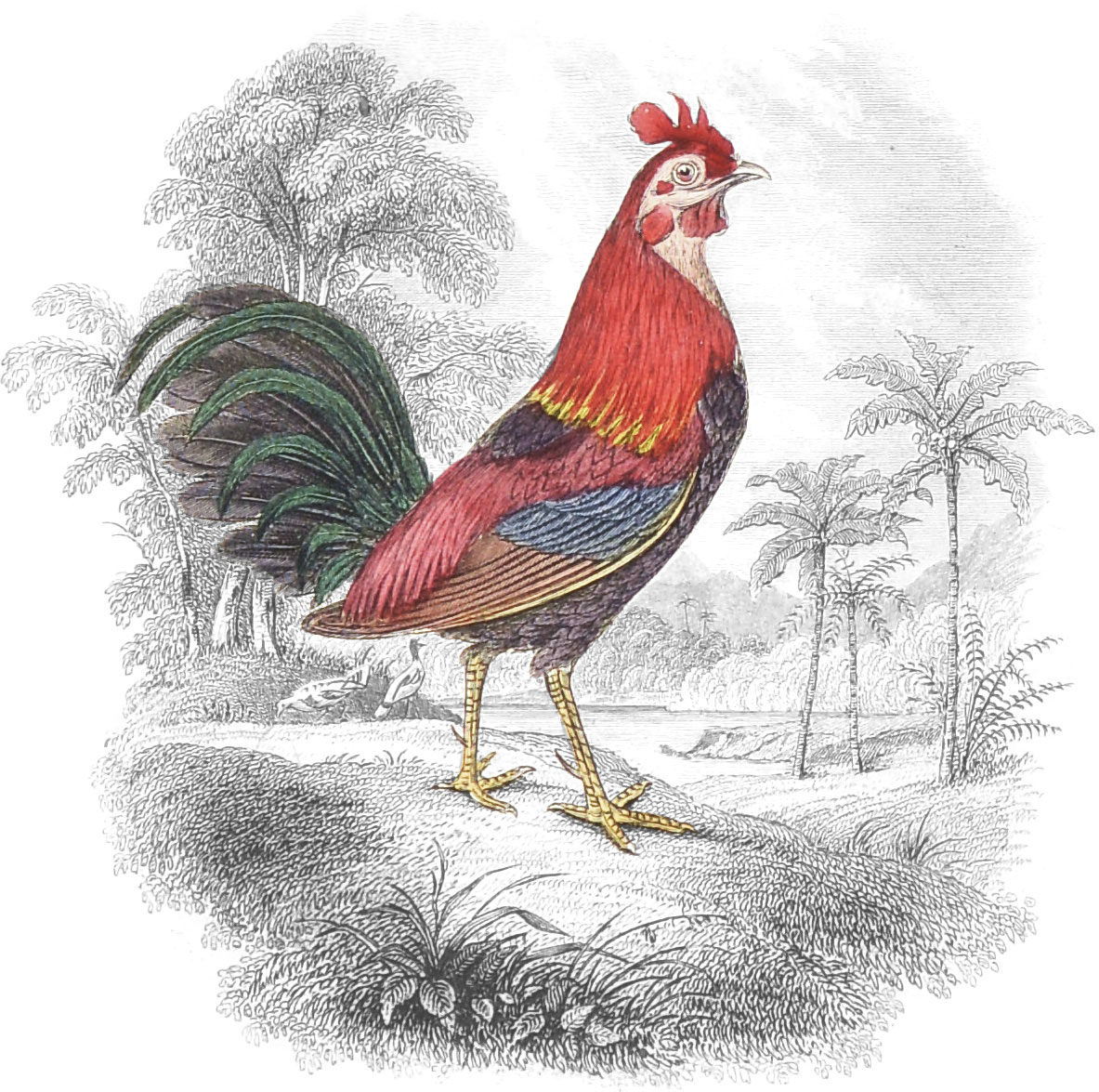
Today, if you want to know about any of the flora or fauna that surround us, you have only to look it up online. After you get your fill of knowledge, you can decide whether or not you want to venture out into the world and see your object of interest in its natural environment (or a controlled simulation thereof). In the Victorian era, things worked a bit differently. Ideally, you’d have grown up in a household, or at least had access to an institution, with the complete set of The Naturalist’s Library, a series of more than 40 volumes on everything from the birds and the bees to the quadrupeds and the marsupialia. Printed in a relatively small format and priced at six shillings each, they brought the intellectual fruits of the naturalist’s enterprise closer to the reach of the everyman than ever before.

While these books offered a good deal of informative text, including memoirs from various famous naturalists of the time, their immediate attraction had more to do with their glorious illustrations, in which colored examples of each species popped right out of its black-and-white habitat. These more than 1,300 color plates, some of the finest that could be seen in any publication of similar scale in the mid-nineteenth century, presented an attractive project to the designer Nicholas Rougeux, whose work we’ve previously featured here on Open Culture.
Having already restored and created digital versions of Euclid’s Elements, Pierre-Joseph Redouté’s Les Roses and Les Liliacées, Elizabeth Twining’s Illustrations of the Natural Orders of Plants, and Daniel Berkeley Updike’s Printing Types, among other books, he’s now put online a complete reproduction of the Naturalist’s Library — with, as usual, a blog post about the painstaking restoration and digital re-creation process.
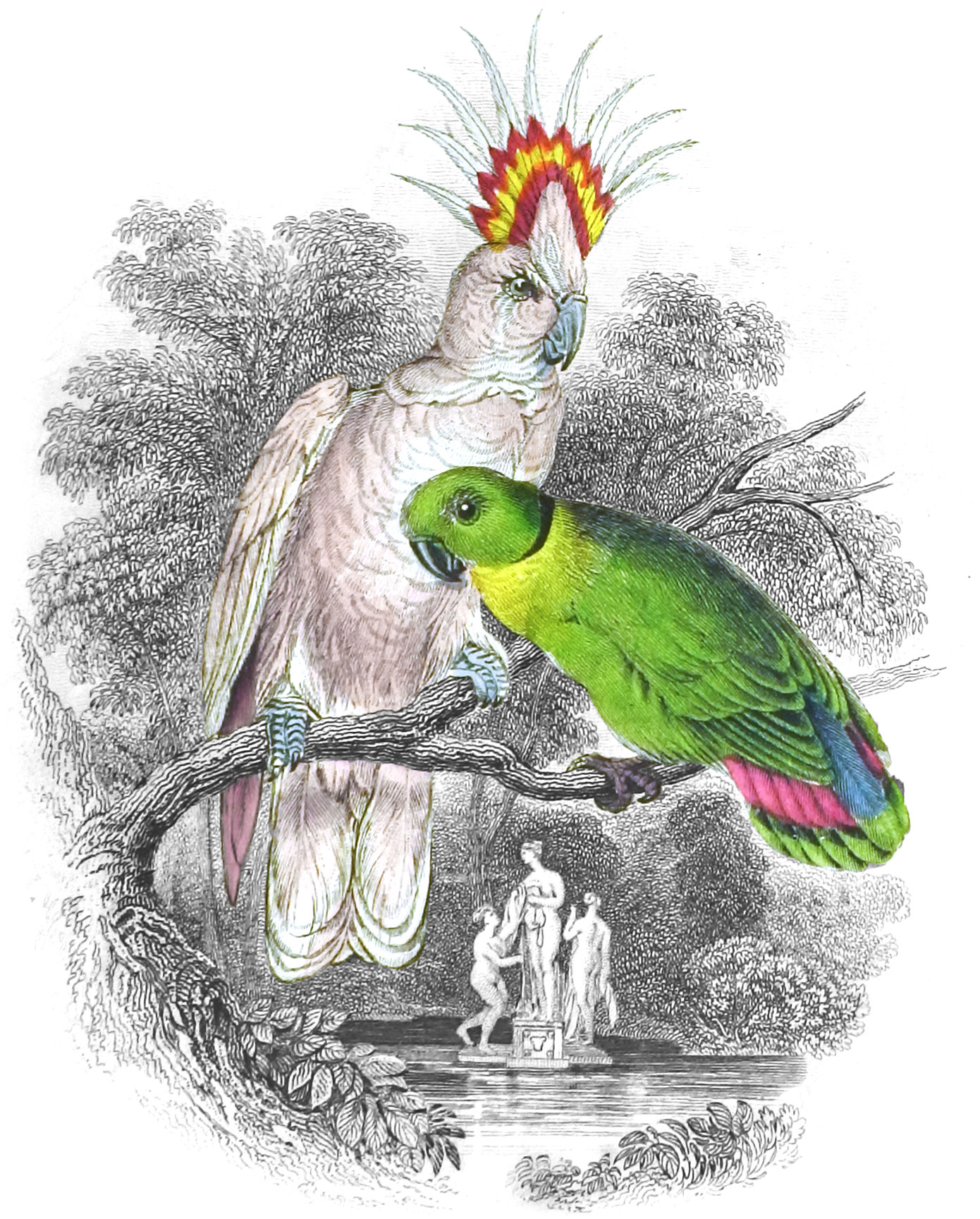
This time, Rougeux has included a section about his use of artificial intelligence, which actually did its part to bring The Naturalist’s Library to his attention in the first place. Not only did AI tools then help him unearth needed sources and fill in visual gaps, they also came in handy when he was brainstorming cover concepts for a printed version. Though Rougeux’s restoration is primarily a web site, free to all to explore, you can also buy your own handsome, large-format physical copy of Plates of the Naturalist’s Library for $295.11 USD.
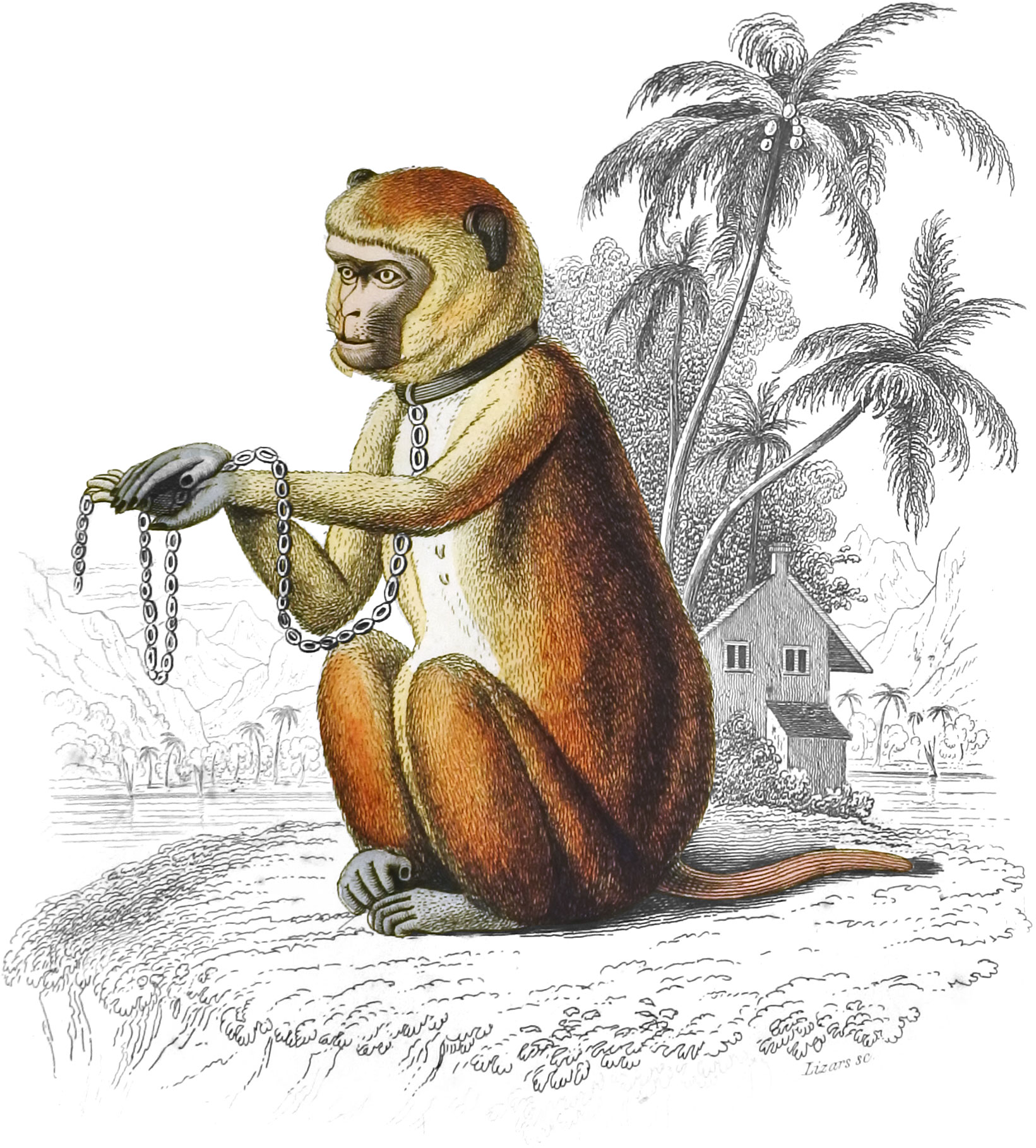
Easier on the wallet is the series of posters he’s made with the same illustrations, each of which presents one of these categories of creatures great or small at a glance. The original Naturalist’s Library inspired generations to dedicate themselves to understanding the natural world; these new versions, whether in print, online, or on the wall, will no doubt encourage the enthusiasm of more than a few budding naturalists in the generations to come. Visit the reproduction of the Naturalist’s Library here.
Related Content:
300,000 Wondrous Nature Illustrations Put Online by The Biodiversity Heritage Library
Based in Seoul, Colin Marshall writes and broadcasts on cities, language, and culture. He’s the author of the newsletter Books on Cities as well as the books 한국 요약 금지 (No Summarizing Korea) and Korean Newtro. Follow him on the social network formerly known as Twitter at @colinmarshall.
Read More...11,700 Free Photos from John Margolies’ Archive of Americana Architecture: Download, Use & Re-Mix
Many connoisseurs of architecture are enthralled by the modernist philosophy of Le Corbusier, Frank Lloyd Wright, and I M Pei, who shared a belief that form follows function, or, as Wright had it, that form and function are one.
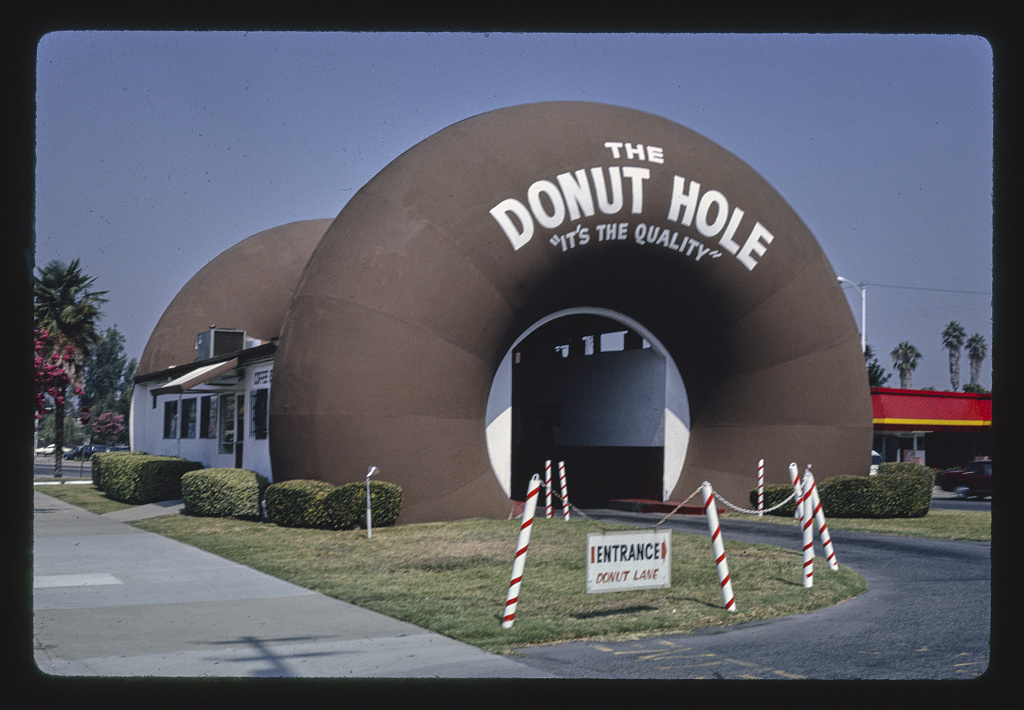
Others of us delight in gas stations shaped like teapots and restaurants shaped like fish or doughnuts. If there’s a philosophy behind these insistently playful visions, it likely has something to do with joy…and pulling in tourists.

Art historian John Margolies (1940–2016), responding to the beauty of such quirky visions, scrambled to preserve the evidence, transforming into a respected, self-taught photographer in the process. A Guggenheim Foundation grant and the financial support of architect Philip Johnson allowed him to log over four decades’ worth of trips on America’s blue highways, hoping to capture his quarry before it disappeared for good.
Despite Johnson’s patronage, and his own stints as an Architectural Record editor and Architectural League of New York program director, he seemed to welcome the ruffled minimalist feathers his enthusiasm for mini golf courses, theme motels, and eye-catching roadside attractions occasioned.
On the other hand, he resented when his passions were labelled as “kitsch,” a point that came across in a 1987 interview with the Canadian Globe and Mail:
People generally have thought that what’s important are the large, unique architectural monuments. They think Toronto’s City Hall is important, but not those wonderful gnome’s‑castle gas stations in Toronto, a Detroit influence that crept across the border and polluted your wonderfully conservative environment.
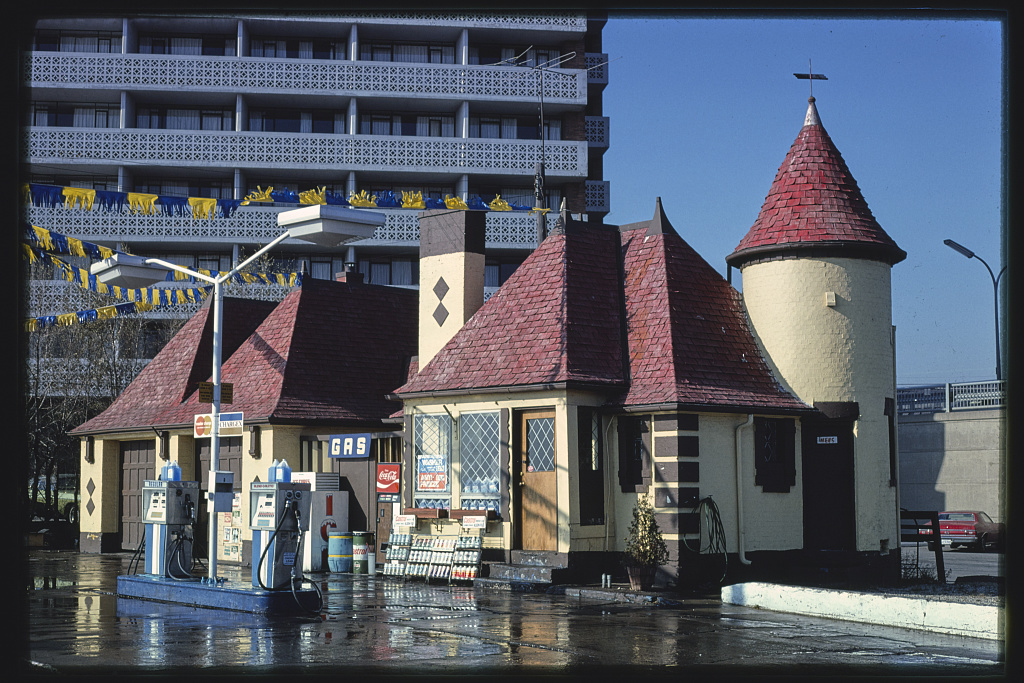
As Margolies foresaw, the type of commercial vernacular architecture he’d loved since boyhood–the type that screams, “Look at me! Look at me”–has become very nearly extinct.
And that is a maximal shame.
Your children may not be able to visit an orange juice stand shaped like an orange or the Leaning Tower of Pizza, but thanks to the Library of Congress, these locales can be pitstops on any virtual family vacation you might undertake.

In July 2017, the library selected the John Margolies Roadside America Photograph Archive as its “free to use and reuse” collection. So linger as long as you’d like and do with these 11,700+ images as you will–make postcards, t‑shirts, souvenir placemats.
(Or eschew your computer entirely—go on a real road trip, and continue Margolies’ work!)
Whatever you decide to do with them, the archive’s homepage has tips for how to best search the 11,710 color slides contained therein. Library staffers have supplemented Margolies’ notes on each image with subject and geographical headings.
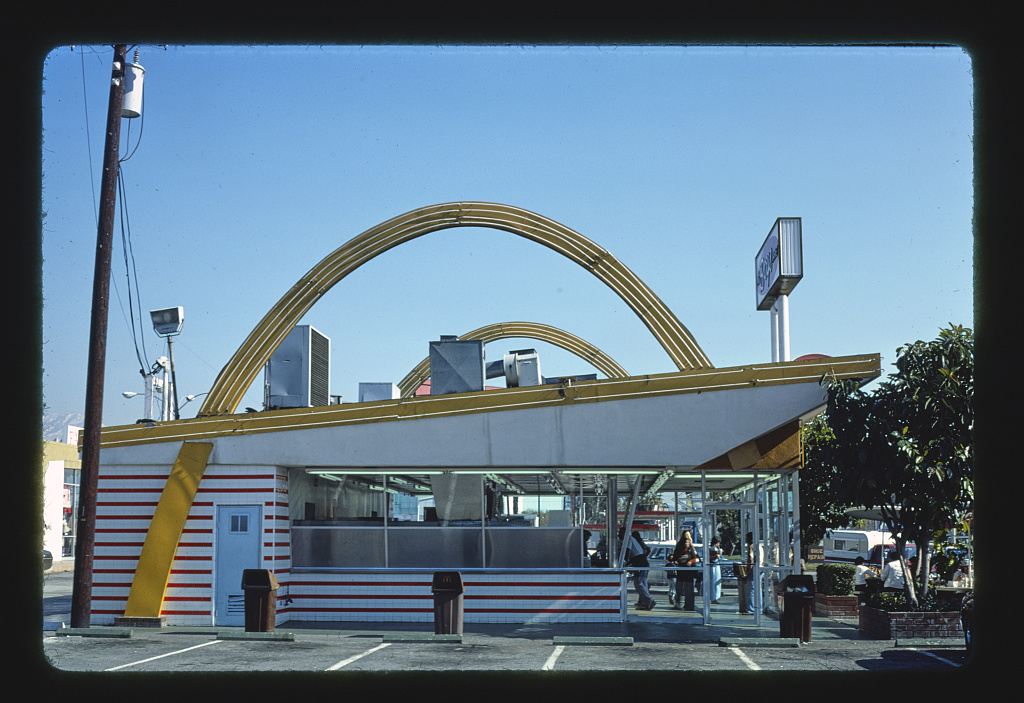
Begin your journey through the Library of Congress’ John Margolies Roadside America Photograph Archive here.
We’d love to see your vacation snaps upon your return.
Note: An earlier version of this post appeared on our site in 2017.
Related Content:
Watch Stewart Brand’s 6‑Part Series How Buildings Learn, With Music by Brian Eno
Frank Lloyd Wright Designs an Urban Utopia: See His Hand-Drawn Sketches of Broadacre City (1932)
Ayun Halliday is an author, illustrator, and theater maker in NYC.
Read More...How Anti-Chinese Immigration Laws Unexpectedly Led to a Chinese Restaurant Boom in America
This past spring, the oldest continuously operated family-owned Chinese restaurant in the United States served its last plate of chop suey. Pekin Noodle Parlor had been an institution in Butte, Montana’s Chinatown since 1911, long outlasting the town’s gold-rush boom, but according to its final, fifth-generation owner, it couldn’t survive changing attitudes toward dining out in the twenty-twenties. Whether or not COVID-influenced habits or delivery-app addiction are to blame, the Pekin’s closure constituted an occasion to reflect on the history of American Chinese food, and its rapid evolution into a distinct cuisine unto itself.
Take chop suey, which was advertised on the Pekin’s neon sign in lettering larger than the name of the restaurant itself. Often cited as an early “Chinese” dish actually invented by Chinese immigrants in the United States, it may have a certain basis in the tsap seui eaten in Guangdong province from which many of them had come.
But even there, it amounted to a technique for throwing together a hodgepodge of leftovers in a palatable manner; only with its Americanization did it acquire a distinct set of flavors and textures. A similar process seems to have produced General Tso’s chicken, broccoli beef, lo mein, and all the other dishes that the movies have convinced the world Americans eat directly from wire-handled paper boxes.
Whatever Hollywood’s tendency to exaggerate, the popularity of domestic Chinese food is real. According to the Business Insider video just above, Chinese restaurants outnumber even McDonald’s franchises in the U.S. How they reached that point owes more than a little to immigration, as anyone would expect, but also, less obviously, to restrictions on immigration. “Anti-Chinese sentiment was rampant in America in the early 20th century — and had been since the latter half of the 19th century, when as many as 300,000 Chinese miners, farmers, railroad and factory workers came to the U.S.,” writes NPR’s Maria Godoy. The negative reaction to that influx underlay the Chinese Exclusion Act of 1882; the Immigration Act of 1917, with its “Asiatic Barred Zone”; and the Immigration Act of 1924, which introduced a national-origin quota system.
Despite the ostensibly severe restriction on Chinese immigration per se, the law allowed that “some Chinese business owners in the U.S. could get special merchant visas that allowed them to travel to China, and bring back employees. Only a few types of businesses qualified for this status. In 1915, a federal court added restaurants to that list. Voila! A restaurant boom was born.” Ditching their traditional businesses like laundries, Chinese in the U.S. would “pool their money to start luxury ‘chop suey palaces,’ then each investor would take turns running the joint for a year or 18 months” in order to earn merchant status. What sustained it all was the increasingly insatiable American demand for the food these immigrants had perfected, from chop suey to kung pao chicken to moo goo gai pan and beyond. The story neatly arrives at an American-style moral: where there’s a will, there’s a way — or rather, yǒu zhì zhě, shì jìng chéng.
Related content:
The 63 Cuisines of China Explained in 40 Minutes: A Complete Primer
A Brief History of Dumplings: An Animated Introduction
Colorful Animation Visualizes 200 Years of Immigration to the U.S. (1820-Present)
Bob Dylan Potato Chips, Anyone?: What They’re Snacking on in China
Based in Seoul, Colin Marshall writes and broadcasts on cities, language, and culture. He’s the author of the newsletter Books on Cities as well as the books 한국 요약 금지 (No Summarizing Korea) and Korean Newtro. Follow him on the social network formerly known as Twitter at @colinmarshall.
Read More...How Russian Artists Imagined in 1914 What Moscow Would Look Like in 2259
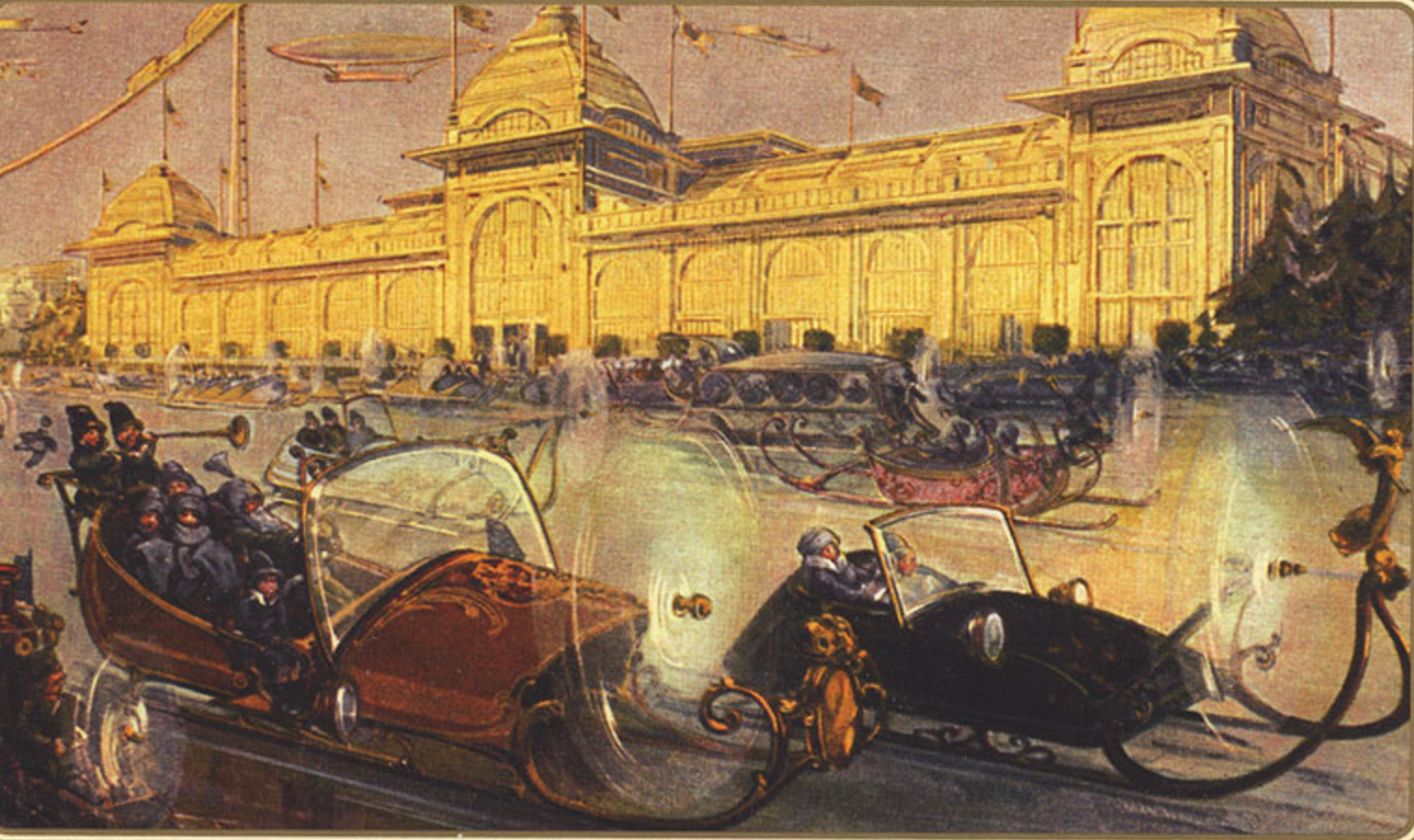
In the days of popular retrofuturism—say, the first half of the twentieth century—people tended to imagine the world of tomorrow looking very much like the world of today, only with a lot more flying cars, monorails, and videophones. This is true whether those doing the imagining were titans of industry, marketing mavens, idealistic Soviets, or subjects of the Tsar, though we might think that people living under an ancient monarchical system might not expect much change. In some ways we might be right, but as we can see in the 1914 postcards here—printed as Russia entered World War I—the country did anticipate a modern, technological future, though one that still closely resembled its present.
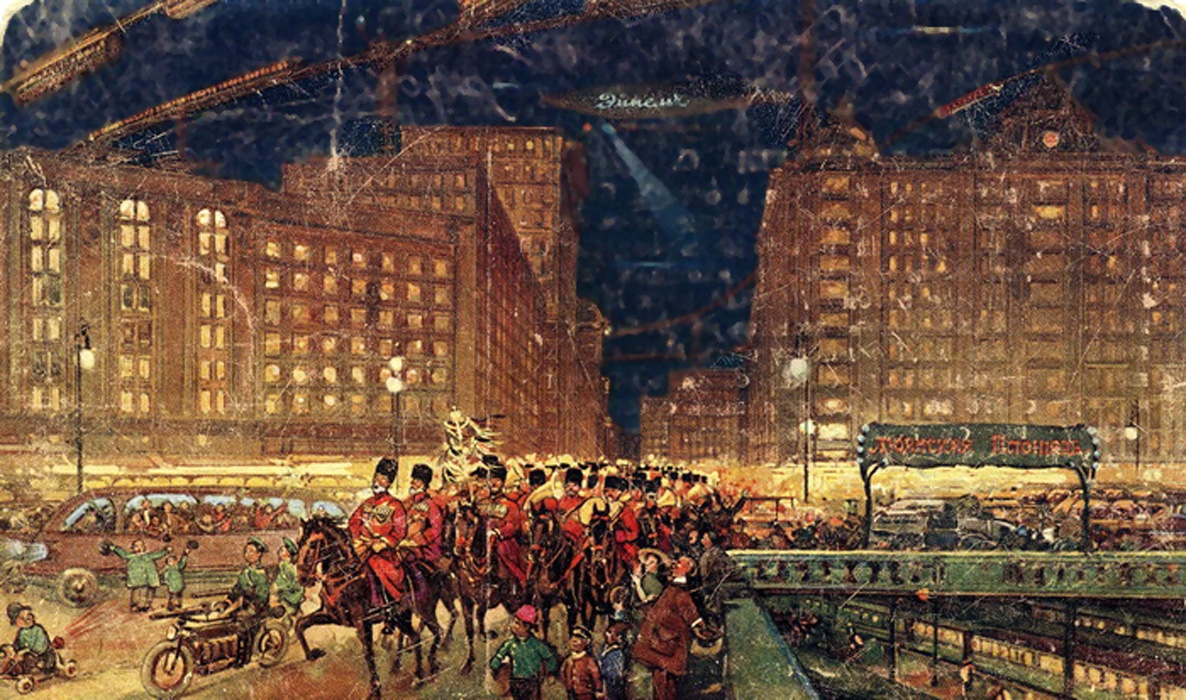
Perhaps few but the most far-sighted of Russians predicted what the ailing empire would endure in the years to come—the disaster of the Great War, and the waves of Revolution and Civil War. Certainly, whoever painted these images foresaw no such catastrophic upheaval.
Although purporting to show us a view of Moscow in the 23rd century, they show the city very happily “still under monarchical rule,” writes A Journey Through Russian Culture, going about its daily life just as it did over three hundred years earlier, “with the addition of everything from subways to airborne public transportation, things probably seen as standard methods of transport for the future.”
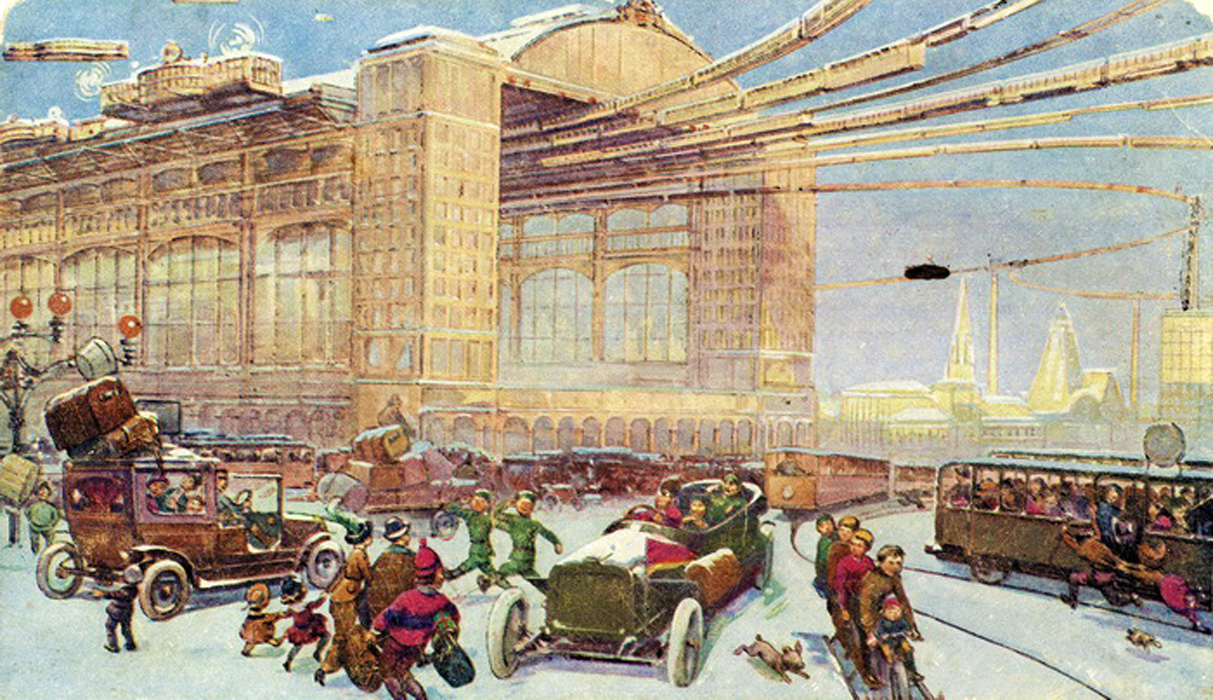
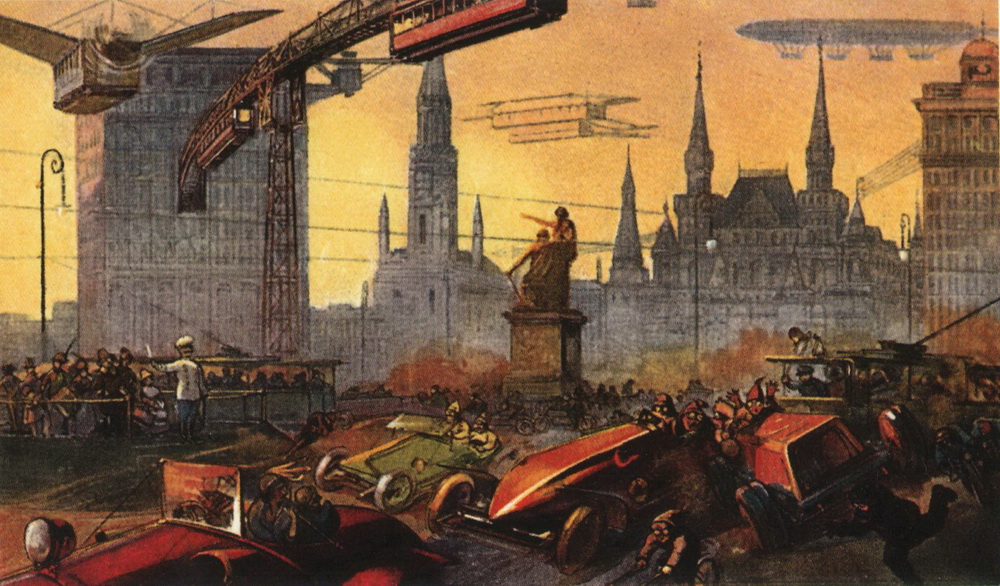
Of course, there would be hot-rodded sleds on St. Petersburg Highway with headlights, fancy windshields, and what look like Christmas elves perched in them. Lubyanska Square, further up, would still host military parades of men on horseback, as children whiz by on motorbikes and subway trains rumble underneath. The Central Railway Station, above, might seem entirely unchanged, until one looks up, and sees elevated trams streaming out of the terminal like spider’s silk. Red Square, however, just below, would apparently host drag races, while people in trams and giant dirigibles look on from above.
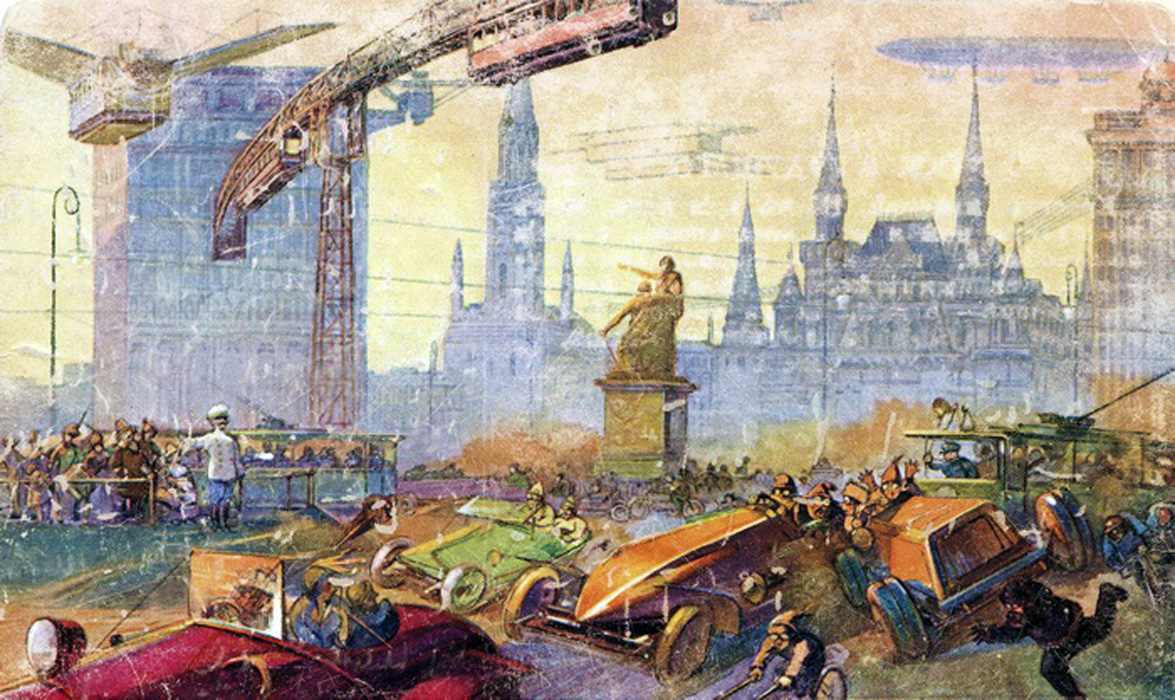
The images have a children’s book quality about them and the festive air of holiday cards. They were apparently rediscovered only recently when a chocolate company called Eyinem reprinted them on their packaging. Like so much retrofuturism, these seem—in their bustling, yet safe, cheerful orderliness—tailor-made for nostalgic trips through Petrovsky Park, rather than imaginative leaps into the great unknown. For that, we must turn to Russian Futurism, which, both before and after World War I and the Revolution, imagined, helped bring about, but didn’t quite survive the massive technological and political disruption of the next two decades.
Note: An earlier version of this post appeared on our site in 2017.
Related Content:
Soviet Artists Envision a Communist Utopia in Outer Space
Josh Jones is a writer and musician based in Durham, NC.
Read More...Tatlin’s Tower, One of the Most Ambitious Buildings That Was Never Built
It’s no small project to found a new society, especially when you’re doing it on the scale of a place like Russia. Apart from the considerable practical challenges it entails, there’s also the need for symbols bold enough to represent the underlying ideal. The avant-garde artist Vladimir Tatlin took it upon himself to create just such a symbol in the years after the Russian Revolution. The result is officially known as the Monument to the Third International, named for the organization tasked with the promotion of world communism (often abbreviated to Comintern). But it’s more commonly referred to as Tatlin’s Tower, perhaps in tribute to the artist’s particular vision — one too ambitious for its real-life construction even to begin.
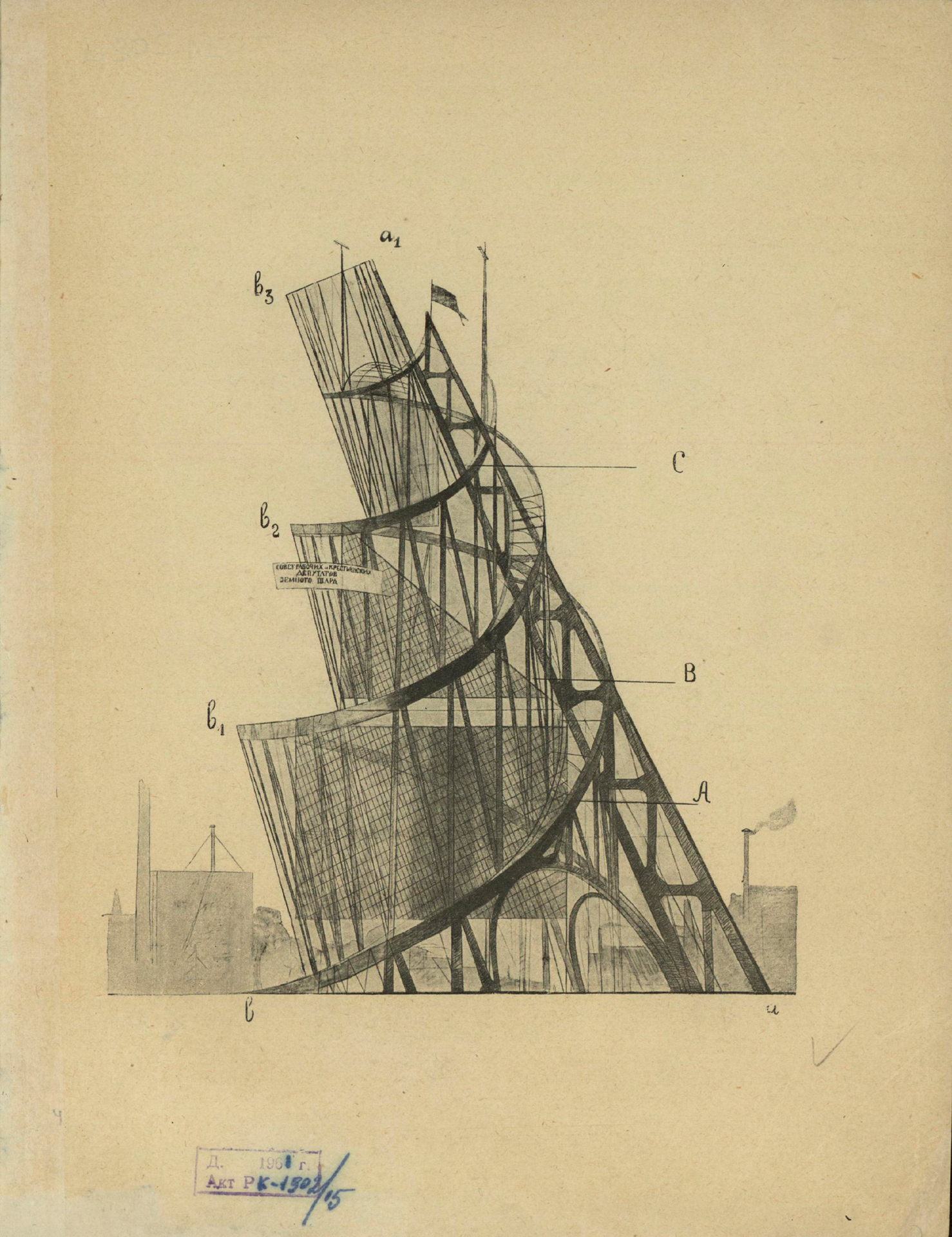
“As part of a large-scale program to replace old czarist monuments with monuments to the revolution, the huge structure was both a symbolic sculpture and functional architecture,” write Smarthistory’s Charles Cramer and Kim Grant. “Designed to straddle the Neva river in St. Petersburg, the 1300 foot (400 meter) iron and glass Monument would surpass Paris’s Eiffel Tower in both scale and complexity.”
Indeed, it would stand taller than the yet-to-be-constructed Empire State Building, at least if you don’t count its antenna. Consisting of “a contracting double helix that spirals upward, supported by a huge diagonal girder,” Tatlin’s Tower would contain four sub-structures, each rotating at a different speed.
Yes, rotating, and “completing a full revolution in accordance with the importance of the institutions conducting their business on the inside,” as Tim Brinkof writes at Big Think. “The cube that contains the legislature would have completed a full rotation once per year. The pyramid above, housing the offices of party executives, would have needed a month. The information center, located at the very peak, would have rotated once a day, offering a 360-degree view of Petrograd,” as St. Petersburg was known in 1920. (It would be re-named Leningrad in 1924 before going back to St. Petersburg in 1991, after the end of the Soviet era.) You can learn more about how it all worked from the Architecture Enthusiast video at the top of the post, and the one from Sideprojects just above.
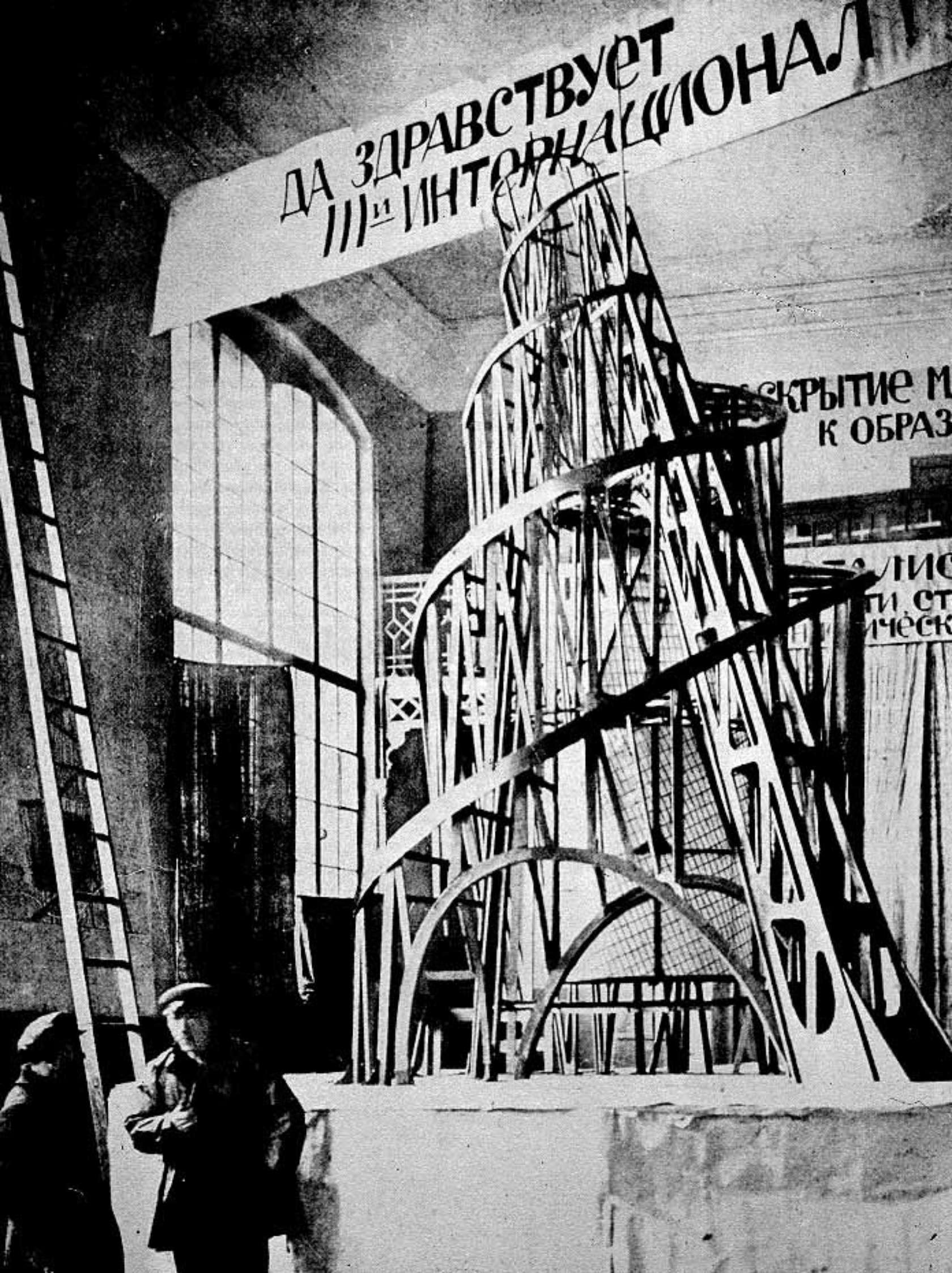
“Tatlin’s Tower was designed during a time when Communist rule was still nascent and party leaders sought to establish a new and distinctly socialist identity through art,” writes Brinkof. Idealized representations of the ruling class having been aggressively scrapped along with the ruling class itself, the Bolsheviks welcomed any style that could shore up their revolutionary cause, total abstraction included. Alas, though many party officials approved of Tatlin’s design, they commanded nothing like the resources to build it: “Russia would go bankrupt if it tried to acquire the insane amounts of steel and iron needed for the tower’s skeletal framework.” Perhaps Leon Trotsky, one of the project’s dissenters, was right when he called it “impractical and romantic” — and perhaps those are the very qualities that keep Tatlin’s Tower an object of fascination more than a century later.
Related content:
The Utopian, Socialist Designs of Soviet Cities
What Makes Kazimir Malevich’s Black Square (1915) Not Just Art, But Important Art
The Futurist Architectural Designs Created by Étienne-Louis Boullée in the 18th Century
Based in Seoul, Colin Marshall writes and broadcasts on cities, language, and culture. He’s the author of the newsletter Books on Cities as well as the books 한국 요약 금지 (No Summarizing Korea) and Korean Newtro. Follow him on the social network formerly known as Twitter at @colinmarshall.
Read More...How Cinemas Taught Early Movie-Goers the Rules & Etiquette for Watching Films (1912): No Whistling, Standing or Wearing Big Hats
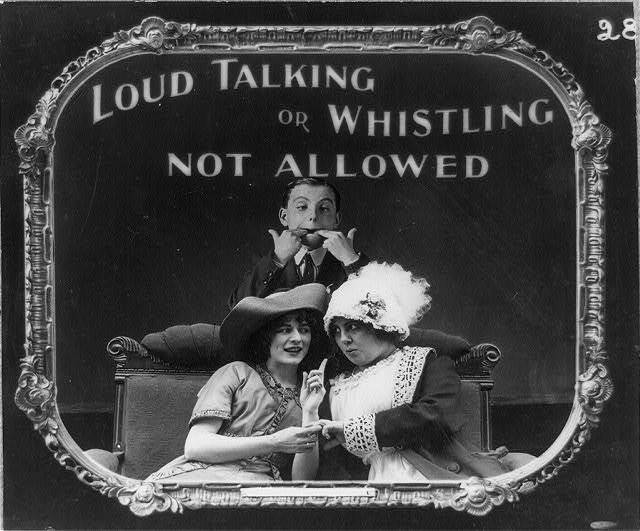
I admit, I sometimes pay a premium at a certain dinner theater chain with a lobby-slash-bar designed to look like classic indie video stores of yore. It’s not only the padded recliners and half-decent grub that keeps me coming back. Nope, it’s the rules. Printed on the menu are a list of disruptive behaviors that will get you unceremoniously tossed out—no refunds and no backsies.
I’ve never seen it happen. Given what people put down for tickets, dinner, drinks, and/or a babysitter, it’s unlikely many risk blowing the evening. But knowing that the theater takes silence seriously brings serious moviegoers peace of mind. What is a movie, after all, without the all-important dialogue, music, and sound cues?
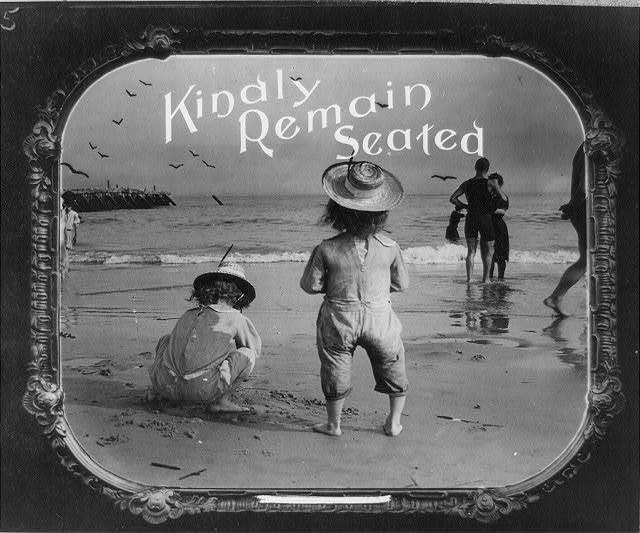
Well, it’s silent film. And even then, when movies were sound-tracked with live accompaniment and dialogue appeared on title cards, people worried very much about distractions. It just so happens that talking and texting (obviously) were the least of early audience’s concerns.
For one thing, the cinema was a place where classes, races, sexes, and ages “mixed much more freely than had been Victorian custom,” notes Rebecca Onion at Slate. There were the usual concerns about corruption of the “delicate sensibilities” of ladies.
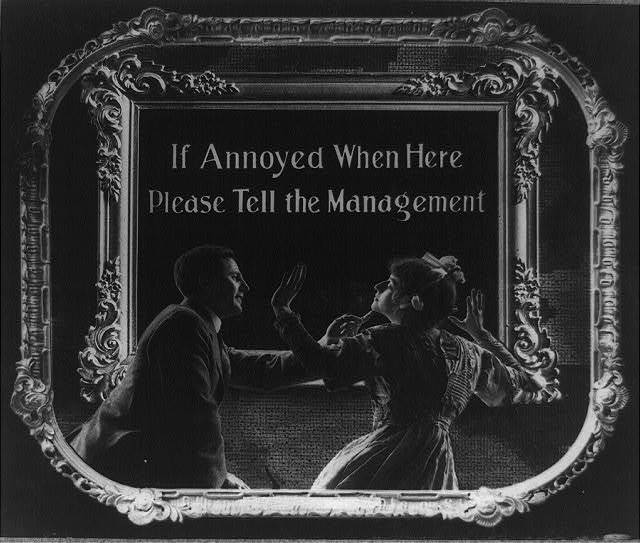
“But female cinema-goers were just as likely to be seen as a problem,” writes Onion, “given their supposed propensity for wearing big hats and chatting.” The melting pot demographic of the nickelodeon could be exhilarating, and audience members found they sometimes lost their inhibitions. “Somehow you enter into the spirit of the thing,” observed author W.W. Winters in 1910. “Don’t you slip away from yourself, lose your reticence, reserve, pride, and a few other things?”
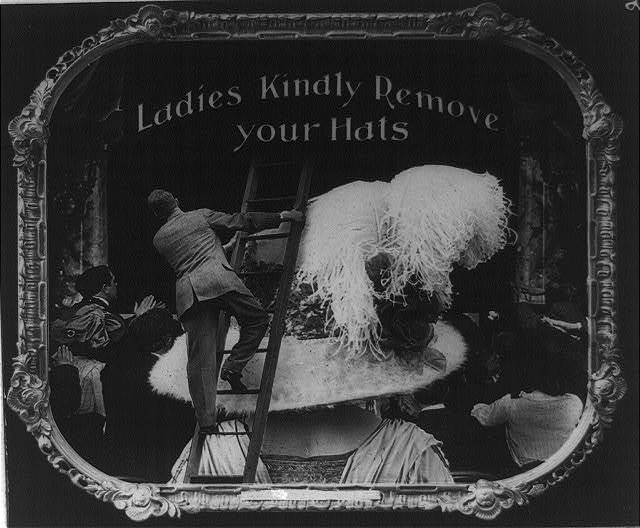
These days we’re accustomed to cramming in elbow-to-elbow next to anyone and everyone, and we mostly heed the onscreen cajoling to put our phones away and keep quiet, even when we aren’t in specialty boutique chains or local arthouse theaters. Then again, if certain behaviors weren’t an issue, there wouldn’t be ads prohibiting them.
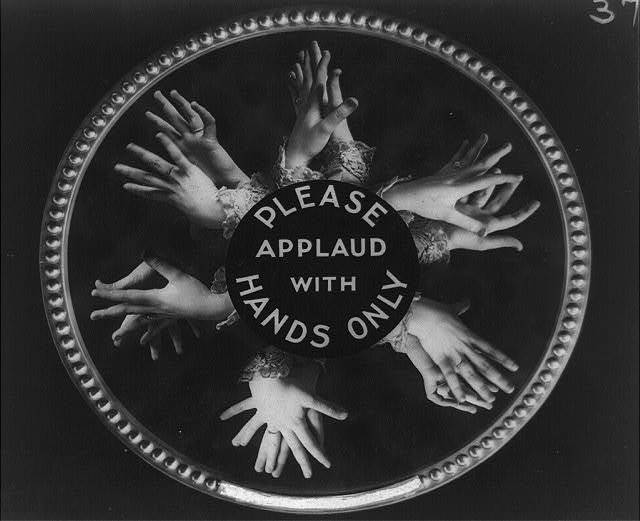
Enormous hats and applause (and applause with things other than hands) may be relics of cinema’s infancy. But swap out those admonitions for others of the smartphone variety and these lantern slides instructing viewers in 1912 about proper movie theater etiquette don’t look so different from today… sort of.
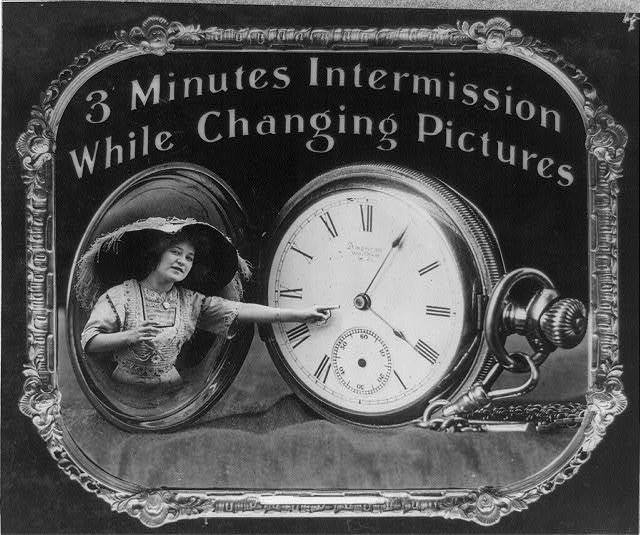
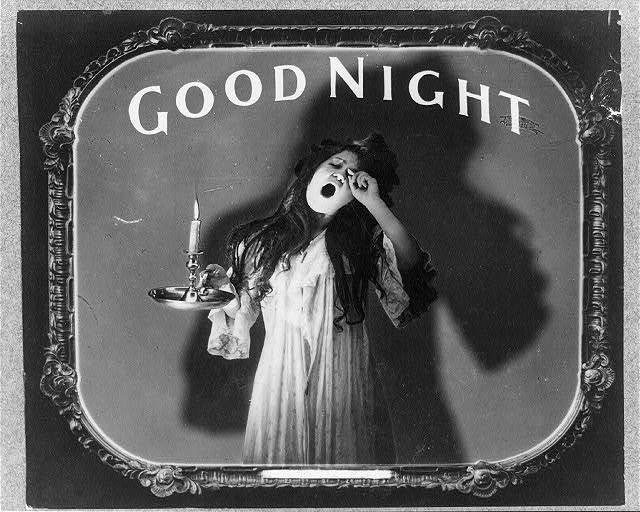
We might want for intermissions to return, especially after the two-hour mark, and wouldn’t it be nice if, instead of keeping us in our seats for post-credit scenes, big blockbuster movies just said “Good Night”? See more of these delightful public service announcements from 1912 nickelodeons at Back Story Radio.
Note: An earlier version of this post appeared on our site in 2019.
Related Content:
The Art of Creating Special Effects in Silent Movies: Ingenuity Before the Age of CGI
Enjoy the Greatest Silent Films Ever Made in Our Collection of 101 Free Silent Films Online
Josh Jones is a writer and musician based in Durham, NC.
Read More...The Bayeux Tapestry Explained: Watch an Animated Retelling of the Norman Conquest
Every time the World Cup comes around, or at least since England first and last won it 60 years ago, there’s talk of whether it’ll be brought “back home.” The idea being, of course, that football (or soccer, as it’s called in a couple of the countries hosting this year’s matches) was made in England. However the showdown with Norway goes this Sunday, and indeed how the rest of the World Cup plays out during the week thereafter, something much older — and of much less debatable origins — will be returned to Blighty: the Bayeux Tapestry, which has been kept in the eponymous Normandy town since at least the fourteen-seventies, and most likely centuries earlier than that.
This sizable and intricate piece of embroidered fabric depicts the events leading up to the Battle of Hastings in 1066, the decisive event of the Norman Conquest of England. Legible today as a kind of “medieval comic strip,” as the narrator of this new animated video from the British Museum puts it, the Bayeux Tapestry also reveals “medieval life in amazing detail,” while at the same time “hinting at secrets in its borders.”
For all the scholarly and popular attention paid to it, the work has yet to yield the answers to anywhere near all of its mysteries, nor to lose its fascination through familiarity. It bears, after all, quite a lot of imagery to get familiar with in the first place.
It’s one thing to behold the Bayeux Tapestry through images, however high-resolution, and quite another to behold the real thing. The English have been able to get fairly close to the latter experience since the Victorian era with the aid of the full-size replica, made in 1885, now displayed at the Reading Museum in Berkshire and previously featured here on Open Culture. But this September, the original Bayeux Tapestry will begin its residence at the British Museum, coinciding with the renovation of the Bayeux Museum. (France, for its part, gets a loan of treasures from the ship buried at Sutton Hoo and the Lewis chessmen.) If you get the opportunity to have a look before it’s returned the following year, don’t turn it down; as the World Cup shows us, you can never be sure when the next homecoming will happen.
Related content:
Behold a Creative Animation of the Bayeux Tapestry
The Story Told on the Famous Bayeux Tapestry Explained from Start to Finish
The Entire History of the British Isles Animated: 42,000 BCE to Today
Construct Your Own Bayeux Tapestry with This Free Online App
Based in Seoul, Colin Marshall writes and broadcasts on cities, language, and culture. He’s the author of the newsletter Books on Cities as well as the books 한국 요약 금지 (No Summarizing Korea) and Korean Newtro. Follow him on the social network formerly known as Twitter at @colinmarshall.
Read More...Support Us
We're hoping to rely on loyal readers, rather than erratic ads. Please click the Donate button and support Open Culture. You can use Paypal, Venmo, Patreon, even Crypto! We thank you!

About Us

Open Culture scours the web for the best educational media. We find the free courses and audio books you need, the language lessons & educational videos you want, and plenty of enlightenment in between.
Advertise With Us

FREE UPDATES!
GET OUR DAILY EMAIL
Get the best cultural and educational resources on the web curated for you in a daily email. We never spam. Unsubscribe at any time.
FOLLOW ON SOCIAL MEDIA

Open Culture editor Dan Colman scours the web for the best educational media. He finds the free courses and audio books you need, the language lessons & movies you want, and plenty of enlightenment in between.
Advertise With Us


