Watch the First Spectacular Film Adaptation of the Odyssey (1911)
Public and commercial spaces around the world are now lined with imagery of a vertebra-studded battle helmet and statues surrounded by flame. It’s all part of the promotional campaign for Christopher Nolan’s adaptation of the Odyssey, which will begin opening in theaters later this month. Much has been said and written about how the project represents the next phase of Nolan’s ever-grander cinematic ambitions, but banking on the spectacle value of Homer has a long history in filmmaking. When the Italian silent adaptation L’Odissea came out in 1911, for example, it was uncertain even whether audiences would tolerate the 44 minutes it took to depict Odysseus’ arduous journey home.
Though it was released in the fall of 1911 in Italy and the following winter in the U.S., L’Odissea now looks like a summer blockbuster avant la lettre, or ante litteram — or then again, given the material, πρὶν ὀνομασθῆναι, though most of us are still waiting to see just how ancient Nolan and his collaborators have allowed themselves to get.
By the standards of their day, the makers of L’Odissea appear to have spared no expense on sets, costumes, and even visual effects, most notably in its portrayal of the cyclops Polyphemus. Technically, none of it may measure up to what Nolan and company have in store, but the theatrical gestures, shifting color tints, and occasionally battered textures do their part to conjure up a reality of their own.
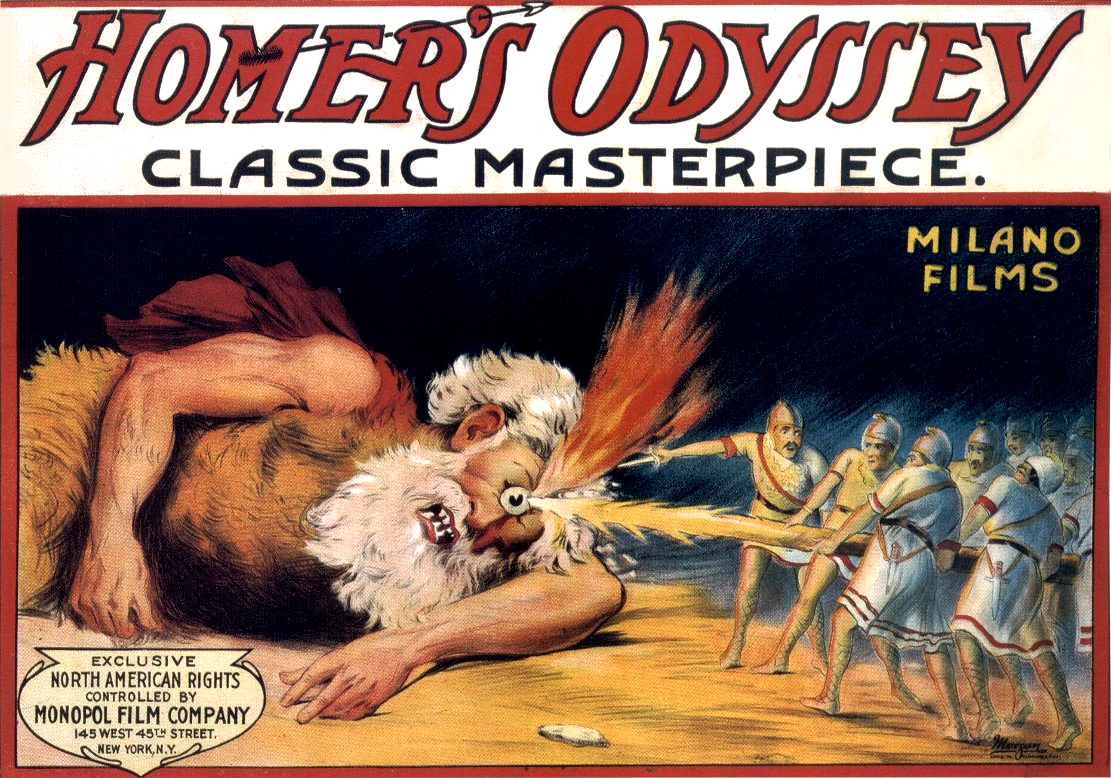
L’Odissea was actually the second major literary adaptation of that year for its directors, the trio of Francesco Bertolini, Adolfo Padovan, and Giuseppe De Liguoro, all working at the studio Milano Films. Here on Open Culture, we’ve previously featured their first, L’Inferno, which dramatizes the first and most famous part of Dante’s Divine Comedy at a length of 73 minutes. That runtime qualified it as the first feature-length film ever produced in Italy, by comparison to which L’Odissea may have actually felt like a more familiar viewing experience to contemporary viewers accustomed to shorts. Now that humanity has been re-acclimated to watching things a few minutes at a time here in the twenty-twenties, Nolan’s nearly three-hour Odyssey looks like a bold move indeed. But then, an epic poem demands an epic interpretation.
Note: If you click “cc” on the YouTube video above, English subtitles will appear.
Related content:
Hear What Homer’s Odyssey Sounded Like When Sung in the Original Ancient Greek
An Interactive Map of Odysseus’ 10-Year Journey in Homer’s Odyssey
Hear the First Book of Homer’s Iliad Read Aloud in the Original Greek
Cinecittà Luce and Google to Bring Italy’s Largest Film Archive to YouTube
Based in Seoul, Colin Marshall writes and broadcasts on cities, language, and culture. He’s the author of the newsletter Books on Cities as well as the books 한국 요약 금지 (No Summarizing Korea) and Korean Newtro. Follow him on the social network formerly known as Twitter at @colinmarshall.
Read More...Albert Einstein Imposes on His First Wife a Cruel List of Marital Demands
Albert Einstein passionately wooed his first wife Mileva Maric, against his family’s wishes, and the two had a turbulent but intellectually rich relationship that they recorded for posterity in their letters. Einstein and Maric’s love letters have inspired the short film above, My Little Witch (in Serbian, I believe, with English subtitles) and several critical re-evaluations of Einstein’s life and Maric’s influence on his early thought. Some historians have even suggested that Maric—who was also trained in physics—made contributions to Einstein’s early work, a claim hotly disputed and, it seems, poorly substantiated.
The letters—written between 1897 and 1903 and only discovered in 1987—reveal a wealth of previously unknown detail about Maric and the marriage. While the controversy over Maric’s influence on Einstein’s theories raged among academics and viewers of PBS’s controversial documentary, Einstein’s Wife, a scandalous personal item in the letters got much better press. As Einstein and Maric’s relationship deteriorated, and they attempted to scotch tape it together for the sake of their children, the avuncular pacifist wrote a chilling list of “conditions,” in outline form, that his wife must accept upon his return. Lists of Note transcribes them from Walter Isaacson’s biography Einstein: His Life and Universe:
CONDITIONS
A. You will make sure:
1. that my clothes and laundry are kept in good order;
2. that I will receive my three meals regularly in my room;
3. that my bedroom and study are kept neat, and especially that my desk is left for my use only.
B. You will renounce all personal relations with me insofar as they are not completely necessary for social reasons. Specifically, You will forego:
1. my sitting at home with you;
2. my going out or travelling with you.
C. You will obey the following points in your relations with me:
1. you will not expect any intimacy from me, nor will you reproach me in any way;
2. you will stop talking to me if I request it;
3. you will leave my bedroom or study immediately without protest if I request it.
D. You will undertake not to belittle me in front of our children, either through words or behavior.
While it may be unfair to judge anyone’s total character by its most glaring defects, there’s no way to read this without shuddering. Although Einstein tried to preserve the marriage, once they separated for good, he did not lament Mileva’s loss for long. Manjit Kumar tells us in Quantum: Einstein Bohr, and the Great Debate about the Nature of Reality that although “Mileva agreed to his demands and Einstein returned”
[I]t could not last. At the end of July, after just three months in Berlin, Mileva and the boys went back to Zurich. As he stood on the platform waving goodbye, Einstein wept, if not for Mileva and the memories of what had been, then for his two departing sons. But within a matter of weeks he was happily enjoying living alone “in my large apartment in undiminished tranquility.”
Einstein prized his solitude greatly. Another remark shows his difficulty with personal relationships. While he eventually fell in love with his cousin Elsa and finally divorced Maric to marry her in 1919, that marriage too was troubled. Elsa died in 1936 soon after the couple moved to the U.S. Not long after her death, Einstein would write, “I have gotten used extremely well to life here. I live like a bear in my den… This bearishness has been further enhanced by the death of my woman comrade, who was better with other people than I am.”
Einstein’s personal failings might pass by without much comment if he had not, like his hero Gandhi, been elevated to the status of a “secular saint.” Yet, it is also the personal inconsistencies, the weaknesses and petty, even incredibly callous moments, that make so many famous figures’ lives compelling, if also confusing. As Einstein scholar John Stachel says, “Too much of an idol was made of Einstein. He’s not an idol—he’s a human, and that’s much more interesting.”
Note: An earlier version of this post appeared on our site in 2013.
Related Content:
Listen as Albert Einstein Reads ‘The Common Language of Science’ (1941)
The Musical Mind of Albert Einstein: Great Physicist, Amateur Violinist and Devotee of Mozart
Einstein Documentary Offers A Revealing Portrait of the Great 20th Century Scientist
Albert Einstein Expresses His Admiration for Mahatma Gandhi, in Letter and Audio
Josh Jones is a writer and musician based in Durham, NC.
Read More...How an Edward Hopper Painting Inspired Norman Bates’ Iconic House in Alfred Hitchcock’s Psycho
Alfred Hitchcock was not American, as even casual viewers of his television show could tell right away. He may have exaggerated his Englishness, but like more than a few high-profile outsiders, he also used his cultural position to render the United States all the more vividly in his work. Growing up, he amassed enough second-hand knowledge of the country in which he would one day live that he already knew his way around New York when first he set foot there. But it was some years after he relocated to Hollywood that his films began to feel American — and, eventually, more American than those made by domestic directors, thanks in part to his unconventional perspective on local sources of inspiration.

Image by Diego Delso, via Wikimedia Commons
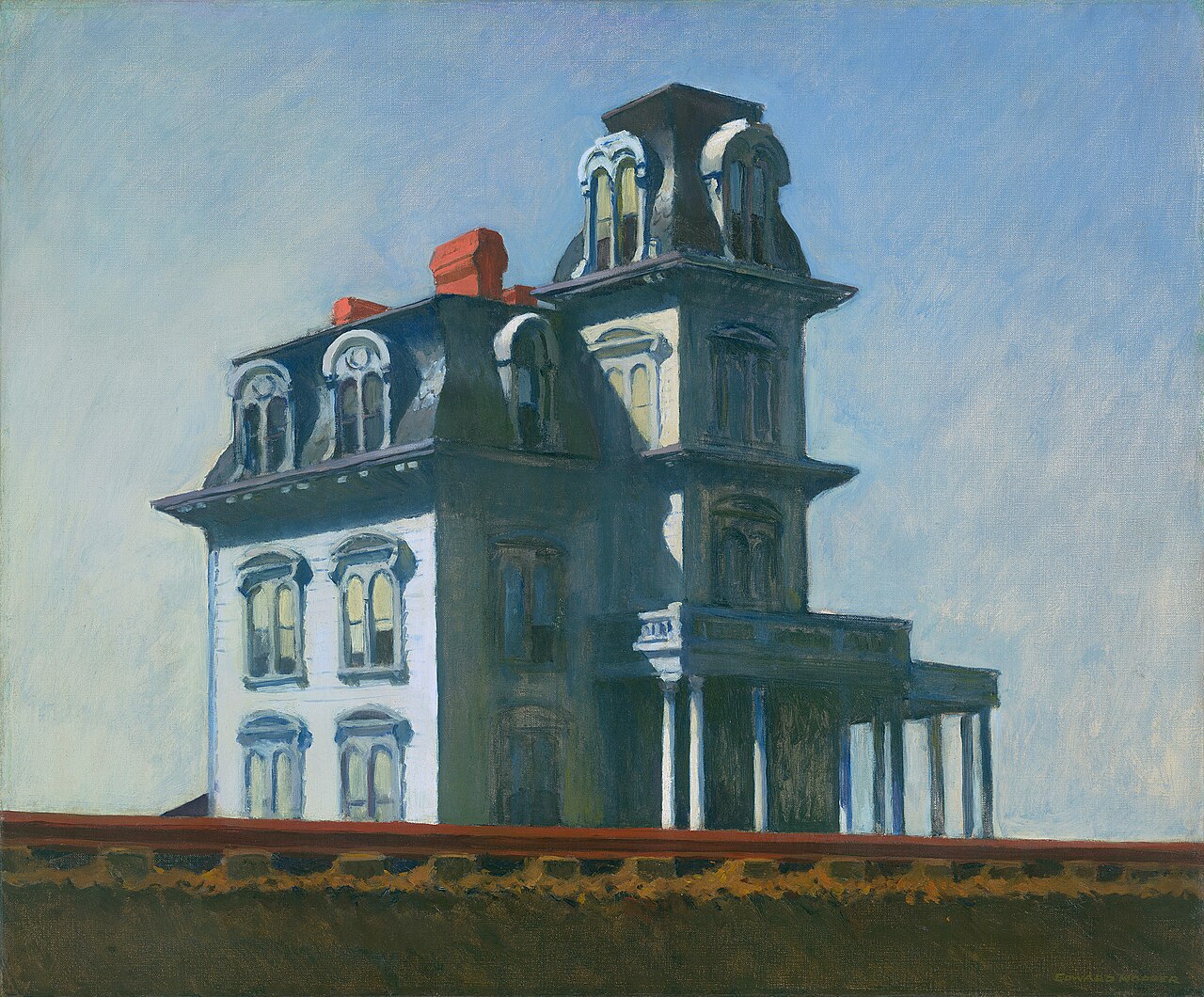
Take the architecture. Asked by François Truffaut about Norman Bates’ “ghostly house” in Psycho, he explained that “the mysterious atmosphere is, to some extent, quite accidental. For instance, the actual locale of the events is in northern California, where that type of house is very common.” He wasn’t trying to “reconstruct an old-fashioned Universal horror picture atmosphere,” but “simply wanted to be accurate.” Yet the house is reported to have been inspired by an east-coast model as well, and one found in art: Edward Hopper’s paintingHouse by the Railroad(top), from 1925, itself made with reference to a real Victorian mansion that still stands in Haverstraw, New York, between a railroad and a cemetery.
Hitchcock had already made use of Hopper, that most cinematic of American painters. Here on Open Culture, we’ve previously featured the visual influence of Hopper paintings from the nineteen-twenties and thirties like Automat, Night Windows, Hotel Room, and Room in New York on Rear Window. “Both artists explored the loneliness that results from modernization,” writes Tim Brinkhof at Artnet. “Hopper’s paintings and Hitchcock’s films explore the extent to which progress and urban modernization have made the world lonelier and, as a result, capable of acts of explosive, irrational violence,” a capability personified in the disturbed motel-keeper Norman Bates.
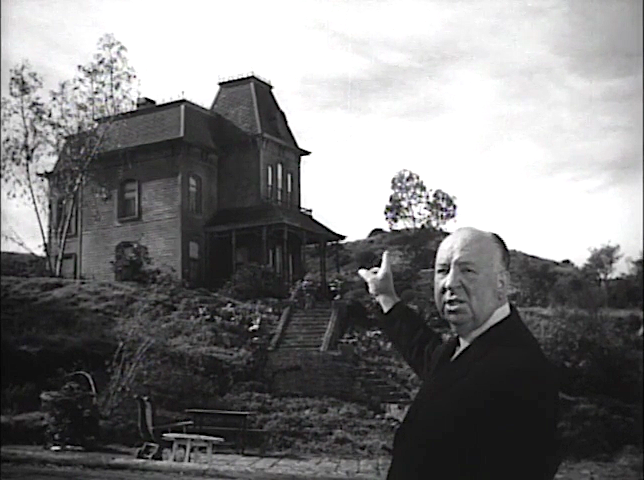
“The [Haverstraw] house was built in 1885, near the crest of a hill that rises steeply from the west bank of the Hudson River,” writes Paul Bochner in the Atlantic. “By the turn of the century it had been abandoned; neighborhood children called it haunted.” It was later purchased by the district attorney of Rockland County, whose eldest daughter remembered that, “when she was thirteen, she looked out her bedroom window and saw a man sitting across the road, painting.” The man was, of course, Edward Hopper. She wouldn’t have known, seventeen years before Nighthawks, that he was on his way to becoming one of the country’s most famous artists. As for what the house would one day become in the hands of Alfred Hitchcock, then just starting his career on the other side of the Atlantic, nobody could have imagined.
Related Content:
16 Free Hitchcock Movies Online
How Edward Hopper’s Paintings Inspired the Creepy Suspense of Alfred Hitchcock’s Rear Window
How Edward Hopper “Storyboarded” His Iconic Painting Nighthawks
Salvador Dalí Goes to Hollywood & Creates a Wild Dream Sequence for Alfred Hitchcock
Based in Seoul, Colin Marshall writes and broadcasts on cities, language, and culture. He’s the author of the newsletter Books on Cities as well as the books 한국 요약 금지 (No Summarizing Korea) and Korean Newtro. Follow him on the social network formerly known as Twitter at @colinmarshall.
Read More...How Nashville Became Home to a Full-Scale Replica of the Parthenon
Asked to identify “the Athens of the South,” many Americans might well point to Athens, Georgia, especially if they happen to be fans of REM, the B‑52s, or Of Montreal. In fact, that title was claimed by Nashville, Tennessee as early as the eighteen-fifties, when the city put into action its ambitious plans for a public education system. By the end of that century, Nashville boasted not just more than 20 colleges and universities (Vanderbilt being the best known today), but also a full-scale replica of the Parthenon, the ancient temple to the goddess Athena. It was built for the state’s Centennial Exhibition in 1897, when no display of local grandeur was too much.
Nearly 130 years later, the Nashville Parthenon remains a major local attraction alongside the likes of the Grand Ole Opry, the Country Music Hall of Fame, and the Honky Tonk Highway. The structure currently situated in Centennial Park (also the home of that modern site of pilgrimage, the Taylor Swift Bench) isn’t the same one at which visitors marveled in 1897.
After a couple of decades of deterioration, writes Artsy’s Isaac Kaplan, “massive renovations were undertaken in 1920, overseen by an architect named Russell Hart, who committed to making the building both enduring and as historically true to the original Parthenon as possible,” an extensive rebuild that even entailed making casts of the original marbles.
Unlike the bombed-out ruin in the Athens of Greece, the Nashville Parthenon stands proudly intact. But does it pass muster with serious enthusiasts of classical civilization? In the video at the top of the post, Garrett Ryan of ancient-history YouTube channel Told in Stone makes the trip. He notes that, though it does contain a gold-plated (or rather, gold-leaf plated) statue of Athena much like the one originally sculpted by Phidias, the building is “not an exact replica. It’s made of concrete, not marble, it has no frieze, the colors are all wrong, and the interior is very different from the original. But it gives a sense of the scale of the Parthenon,” and “captures the experience of visiting a temple of this size.” The parking lot right alongside it does some harm to the illusion, granted, but it does encourage the visitor to reflect upon the nature of civilization: American civilization, that is.
Related content:
A Tour of Athens’ Acropolis, Explained with 3D Reconstructions
A 3D Model Reveals What the Parthenon and Its Interior Looked Like 2,500 Years Ago
How the Ancient Greeks Built Their Magnificent Temples: The Art of Ancient Engineering
A Virtual Tour of Ancient Athens: Fly Over Classical Greek Civilization in All Its Glory
How the Parthenon Marbles Ended Up In The British Museum
Based in Seoul, Colin Marshall writes and broadcasts on cities, language, and culture. He’s the author of the newsletter Books on Cities as well as the books 한국 요약 금지 (No Summarizing Korea) and Korean Newtro. Follow him on the social network formerly known as Twitter at @colinmarshall.
Read More...Benedict Cumberbatch Reads Albert Camus’ Touching Thank You Letter to His Elementary School Teacher
It’s never too late to thank the teacher who changed your life.
Oprah Winfrey fell to pieces when she was reunited on air with Mrs. Duncan, her fourth grade teacher, her “first liberator” and “validator.”
Patrick Stewart used his knighthood ceremony as an occasion to thank Cecil Dormand, the English teacher who told him that Shakespeare’s works were not dramatic poems, but plays to be performed on one’s feet.
And Bill Gates had kind words for Blanche Caffiere, the former librarian at View Ridge Elementary in Seattle, who destigmatized his role as a “messy, nerdy boy who was reading lots of books.”
One of the most heartfelt student-to-teacher tributes is that of Nobel Prize-winning author and philosopher Albert Camus to Louis Germain, a father substitute whose classroom was a welcome reprieve from the extreme poverty Camus experienced at home. Germain persuaded Camus’ widowed mother to allow Camus to compete for the scholarship that enabled him to attend high school.
As read aloud by actor Benedict Cumberbatch, above, at Letters Live, a “celebration of the enduring power of literary correspondence,” Camus’ 1957 message to Germain is an exercise in humility and simply stated gratitude:
Dear Monsieur Germain,
I let the commotion around me these days subside a bit before speaking to you from the bottom of my heart. I have just been given far too great an honour, one I neither sought nor solicited.
But when I heard the news, my first thought, after my mother, was of you. Without you, without the affectionate hand you extended to the small poor child that I was, without your teaching and example, none of all this would have happened.
I don’t make too much of this sort of honour. But at least it gives me the opportunity to tell you what you have been and still are for me, and to assure you that your efforts, your work, and the generous heart you put into it still live in one of your little schoolboys who, despite the years, has never stopped being your grateful pupil. I embrace you with all my heart.
Albert Camus
The letter was gratefully received by his former teacher, who wrote back a year and a half later to say in part:
If it were possible, I would squeeze the great boy whom you have become, and who will always remain for me “my little Camus.”
He complimented his little Camus on not letting fame go to his head, and urged him to continue making his family a priority. He shared some fond memories of Camus as a gentle, optimistic, intellectually curious little fellow, and praised his mother for doing her best in difficult circumstances.
Readers, please use the comments section to share with us the teachers deserving of your thanks.
You can find this letter, and many more, in the great Letters of Note book.
Note: An earlier version of this post appeared on our site in 2017.
Related Content:
Hear Albert Camus Deliver His Nobel Prize Acceptance Speech (1957)
Ayun Halliday is an author, illustrator, theater maker in NYC.
Read More...Alfred Hitchcock Wanted Frank Lloyd Wright to Design the North by Northwest House: An Architect Just Built It for $45 Million
Villains who live in opulent, remote modernist houses may have been a cliché since the last century, but given Hollywood’s addiction to the tried and true, they do still turn up now and again. Unsurprisingly, few filmmakers have managed to use them anywhere near as memorably as Alfred Hitchcock did. Think back to North by Northwest, that showcase of both late-fifties high style and unadulterated Hitchcockery, and any number of images come right to mind: the deadly crop duster bearing down on Cary Grant, the hang off the edge of Mount Rushmore, the cheeky cut to the train entering the tunnel. But on the architecturally inclined, the deepest impression is made by not a shot but a set: the house — modernist, opulent, remote — occupied by James Mason’s villain Phillip Vandamm.
“The pioneering decision to feature a modern house as the villain’s lair in North by Northwest arose from both the practical needs of the script and the desire to explore innovation in architectural representation,” writes Christine Madrid French, author of The Architecture of Suspense: The Built World in the Films of Alfred Hitchcock.
The look of the Vandamm House betrays considerable inspiration from the work of Frank Lloyd Wright, especially his “iconic Fallingwater, best known for its astonishing projected porches cantilevered over a running stream.” As the Hollywood story goes, Hitchcock asked Wright himself about the possibility of designing the house, but when the architect asked for ten percent of the film’s entire budget, the job went to production designer Robert F. Boyle.
Despite the highly un-Wrightian steel beams supporting the cantilevered living room (inserted because Grant needed a way to climb in), moviegoers left the theater assuming that they’d witnessed a showdown in one of his houses. In fact, like so many of Hitchcock’s famous built environments, the structure didn’t actually exist: Boyle and his collaborators constructed pieces on sets, completing the rest with matte paintings. Yet their work did, in a sense, bring the Vandamm House into the world. A North by Northwest fan since childhood, architect John Boccardo just this year achieved his $45 million dream of building it for real. Apart from faithfully replicating onscreen details, he also put in an eighteen-seat home theater, possibly on the safe assumption that the buyer will be a fellow cinephile — who, given that the house overlooks Park City, Utah rather than sits atop Mount Rushmore, will surely rue the day Sundance decided to move to Boulder. See photos here.
If you would like to support the mission of Open Culture, consider making a donation to our site. It’s hard to rely 100% on ads, and your contributions will help us continue providing the best free cultural and educational materials to learners everywhere. You can contribute through PayPal, Patreon, and Venmo (@openculture). Thanks!
Related content:
16 Free Hitchcock Movies Online
Alfred Hitchcock Explains the Plot Device He Called the ‘MacGuffin’
1,300 Photos of Famous Modern American Homes Now Online, Courtesy of USC
A Meditative Tour of Fallingwater, Frank Lloyd Wright’s Architectural Masterpiece
Salvador Dalí Creates a Dream Sequence for Spellbound, Hitchcock’s Psychoanalytic Thriller
Based in Seoul, Colin Marshall writes and broadcasts on cities, language, and culture. He’s the author of the newsletter Books on Cities as well as the books 한국 요약 금지 (No Summarizing Korea) and Korean Newtro. Follow him on the social network formerly known as Twitter at @colinmarshall.
Read More...When Albert Einstein & Charlie Chaplin Met and Became Fast Famous Friends (1930)
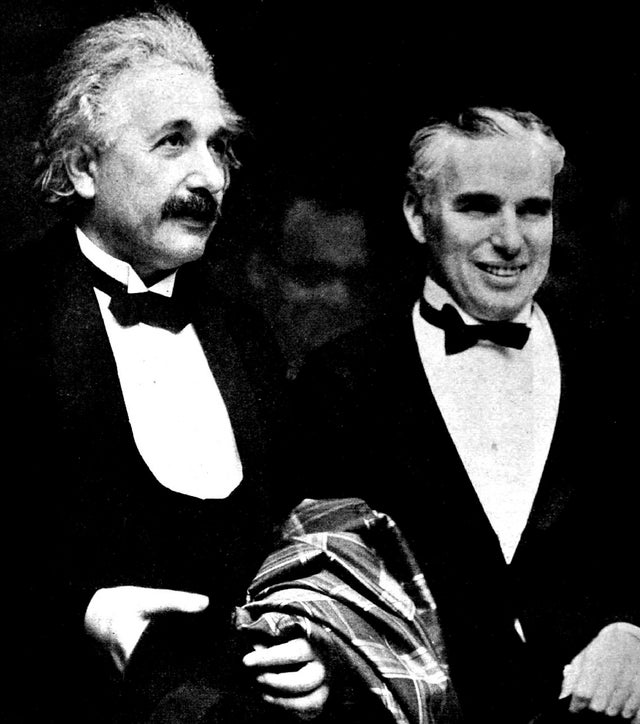
Photo via Wikimedia Commons
“You do not really understand something unless you can explain it to your grandmother,” goes a well-known quote attributed variously to Albert Einstein, Richard Feynman, and Ernest Rutherford. No matter who said it, “the sentiment… rings true,” writes Michelle Lavery, “for researchers in all disciplines from particle physics to ecopsychology.” As Feynman discovered during his many years of teaching, it could be “the motto of all professional communicators,” The Guardian’s Russell Grossman writes, “and especially those who earn a living communicating the tricky business of science.”
Einstein became one of the world’s great science communicators by choice, not necessity, and found ways to explain his complex theories to children and the elderly alike. But perhaps, if he’d had his way, he would rather have avoided words altogether, and preferred acrobatic feats of silent daring to get his message across. We might at least conclude so from his reverence for the work of Charlie Chaplin. Chaplin was the only person Einstein wanted to meet in California during his second, 1930–31 visit to the U.S., when he was “at the height of his fame,” notes Claire Cock-Starkey at Mental Floss, “with newspapers tracking his every move and academics clamoring for explanations of his theories.”
The admiration, of course, was mutual. Their first meetings happened outside the press’s scrutiny, at Universal Studios, “where the pair took a tour and had lunch together. They hit it off straight away, sharing quick wits and curious minds.” In his autobiography, Chaplin writes that Einstein’s wife Elsa finagled an invitation to dinner at Chaplin’s house. And he “was only too happy to oblige,” Cock-Starkey writes, arranging an “intimate dinner, at which Elsa regaled him with the story of when Einstein came up with his world-changing theory, sometime around 1915.”
The two continued to correspond, and the big public unveiling of their friendship came when Chaplin invited Einstein to the premiere of City Lights in 1931 (see photo up top) where the mega-celebrities from very different worlds were greeted by reporters, photographers, and adoring crowds. There are several recorded versions of their conversation. In one account, Einstein expressed bemusement at the cheering, and Chaplin remarked, “the people applaud me because everyone understands me, and they applaud you because no one understands you.”
Chaplin himself wrote in his 1933–34 travelogue, A Comedian Sees the World, that one of Einstein’s sons uttered the line, weeks afterward: “You are popular [because] you are understood by the masses. On the other hand, the professor’s popularity with the masses is because he is not understood.” Yet another version, circulating on the Nobel Prize’s Instagram and collecting tens of thousands of likes, has the exchange take place in a dialogue.
Einstein: “What I most admire about your art, is your universality. You don’t say a word, yet the world understands you!”
Chaplin: “True. But your glory is even greater! The whole world admires you, even though they don’t understand a word of what you say.”
Whatever they really said to each other, it’s clear Einstein saw something in Charlie Chaplin worth emulating. Chaplin left his mark on Existentialist philosophy, lending the name of his film Modern Times to Jean-Paul Sartre and Simone de Beauvoir’s influential journal, Les Temps Modernes. He left a legacy on Beat poetry, lending the name City Lights to Lawrence Ferlinghetti’s infamous San Francisco bookstore and publisher. And it seems he also maybe had some small effect on physics, or on the most famous of physicists, who might have harbored a secret ambition to be a silent film comedian—or to communicate, at least, with the universal effectiveness of one as skilled as Charlie Chaplin, favorite of geniuses and grandmothers (and genius grandmothers) everywhere.
Note: An earlier version of this post appeared on our site in 2020.
Related Content:
60+ Free Charlie Chaplin Films Online
Hear Albert Einstein Read “The Common Language of Science” (1941)
Josh Jones is a writer and musician based in Durham, NC.
Read More...Meet the Syntopicon: The Ambitious Index That Tried to Organize All of Western Thought (1952)
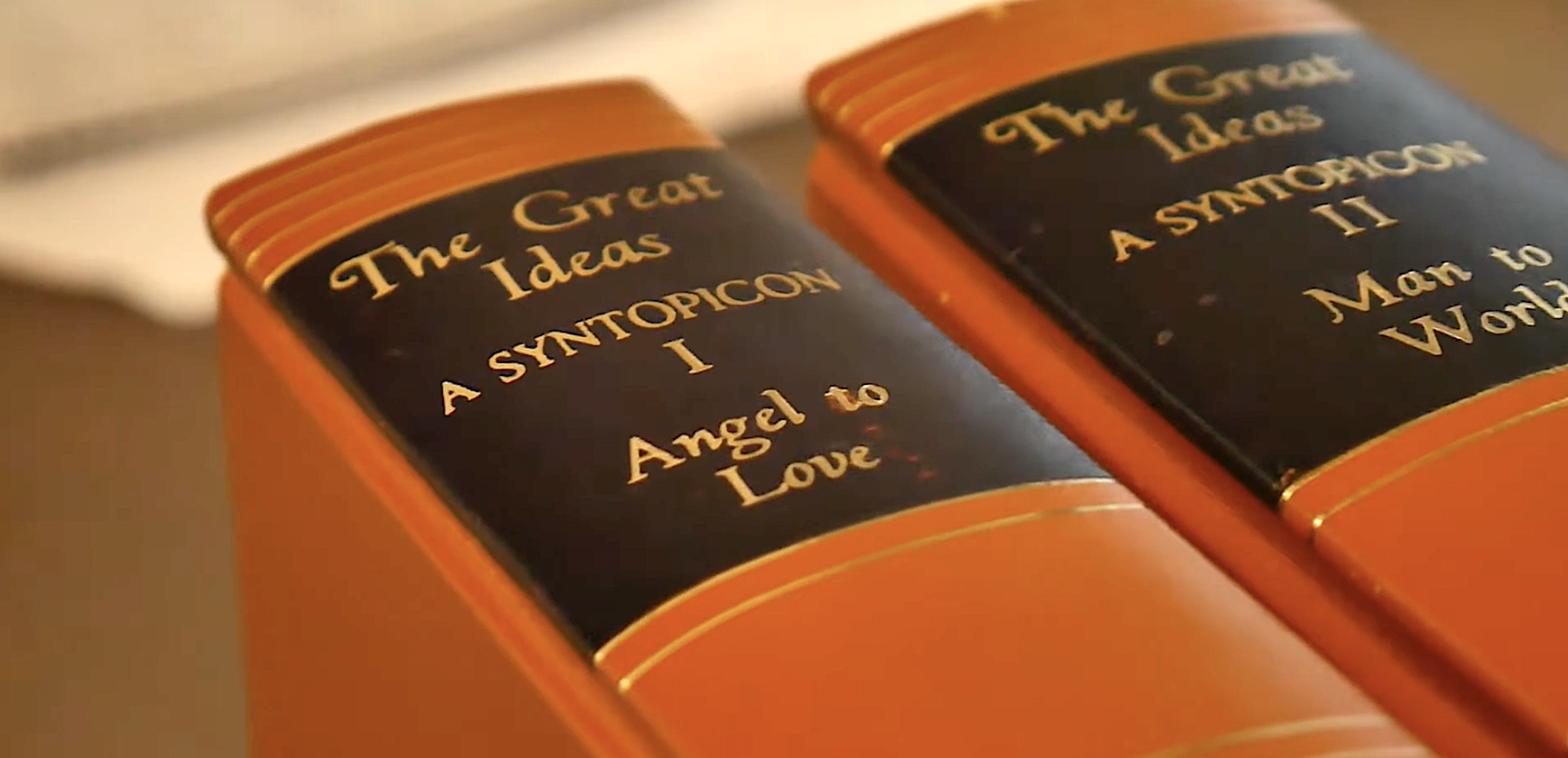
Mortimer J. Adler rose to cultural prominence in the mid-twentieth-century United States, not that a figure like him could have done so in any other place or time. A haphazard professional and intellectual path involving copy-boy work at the New York Sun, night school, and an incomplete Columbia degree eventually led to a faculty position teaching philosophy of law at the University of Chicago. In 1945, he commenced work on what would become the Great Books of the Western World, a 54-volume set published by Encyclopædia Britannica including the works of everyone from Homer to Virgil to Darwin to Hemingway. Sold door-to-door, it became an unlikely success by the early nineteen-sixties, and for a time it was a fairly common, if bookshelf-dominating, sight in the aspirational homes of suburban America.
How many of those families regularly pulled their Great Books off the shelf is another matter. Despite having come through an intensive process of curation, they could still look rather imposing as the wall of knowledge they formed all together. To this problem, Adler offered a characteristically ambitious and idiosyncratic solution: a concept-oriented index called the Syntopicon — or rather, “A Syntopicon.”
“He believed these two volumes to be just the ‘assistance’ that the average man needed to dig into the books that formed Western Civilization,” writes Jonathan White, an alumnus of the similarly Western canon-based St. John’s College. They “comprised an exhaustive catalogue of each time one of the 102 ‘Great Ideas of Western Civilization’ was mentioned in the 431 ‘Great Books’ enshrined in Britannica’s collection.”

Good and evil, logic and love, pleasure and pain, universal and particular: all the big ideas, at least as Adler defined them, were there in A Syntopicon. Customers reportedly found it unwieldy, but the notion behind it holds out a certain appeal still today. It’s even inspired the launch of Syntopi.com, a digital successor that enables you to navigate “the Great Conversation” in a variety of ways including a 3D visualization and a personal curriculum-creation tool. The Great Books of the Western World’s mid-century readers — professionals and businessmen looking to fill the gaps in their general knowledge, veterans ready to learn more after their G.I. Bill-funded college education, housewives hoping to get a handle on what intelligent people were supposed to know about — could have had fun with it. And we could benefit, no doubt, from rediscovering a little of their earnestly self-improving spirit ourselves. You can view an edition of A Syntopicon on the Internet Archive, or this site.
Related Content:
The Western Canon: From Homer to Milton (Free Course)
The Western Tradition by Eugen Weber: 52 Video Lectures
48 Animated Videos Explain the History of Ideas: From Aristotle to Sartre
The 10 Greatest Books Ever, According to 125 Top Authors (Download Them for Free)
Based in Seoul, Colin Marshall writes and broadcasts on cities, language, and culture. He’s the author of the newsletter Books on Cities as well as the books 한국 요약 금지 (No Summarizing Korea) and Korean Newtro. Follow him on the social network formerly known as Twitter at @colinmarshall.
Read More...The Thai Beef Noodle Soup That Has Been Continuously Simmering for 52 Years
As Bangkok rises into the ranks of the world’s great culinary destination cities, its restaurant scene caters to ever more well-heeled travelers. There, you can now visit establishments with not just one, and not just two, but three Michelin stars. Even so, many a Bangkok habitué will surely tell you that the city’s best food is still served in the same humble places as always, or at least whose rent hasn’t been hiked too badly. Even in as hipsterized an area as Ekkamai Road, though, some have been around long enough to own their real estate. Take Wattana Panich, which has been serving beef noodle soup in its own building for more than 50 years — and indeed, using the same broth the whole time.
You can have a look at the process in the Great Big Story video at the top of the post. “Forever soup, also known as perpetual stew or hunter’s pot, is enjoying a moment as adventurous cooks and intrepid diners rediscover the old method in which a broth can simmer for weeks, months or even years,” writes Shan Li in a recent Wall Street Journal article.
Third-generation Wattana Panich owner Nattapong Kaweenuntawong “has tended the broth from morning until night since gaining custody two decades ago. By day, it bubbles in a giant stainless-steel pot about 5 feet across and one foot deep, encased in lava-like concrete and heated by gas. He tweaks the flavor by adding fresh ingredients, including fish sauce, soy sauce, chunks of beef and sachets of Chinese herbs.”
Perhaps you feel you can taste it already. But its regular visitors may insist that you’ll never really know the flavor of the shop’s eponymous broth, continuously refined while being rolled over night after night for five decades, until you try it for yourself. The prospect may put certain Westerners, uncomfortable consuming even last night’s leftovers, ill at ease. But they should rest assured that the solid ingredients are always fresh. It’s just the broth itself, rigorously strained each night and boiled each day, that has been kept in use, tying the establishment to its own past in the same manner as its inherited ownership. As with any family business, of course, each generation gets completely displaced sooner or later, just as every molecule of “forever soup” at one time will, in theory, have been consumed by some later time. Is the broth Wattana Panich uses today really identical to the one it started with in 1974? That’s a philosophical question best saved for after the meal.
Related Content:
Chowda!: Three Centuries of Recipes Reveal the Rise of New England’s Finest Culinary Export
Allen Ginsberg’s Personal Recipe for Cold Summer Borscht
How to Make the Oldest Recipe in the World: A Recipe for Nettle Pudding Dating Back 6,000 BC
Based in Seoul, Colin Marshall writes and broadcasts on cities, language, and culture. He’s the author of the newsletter Books on Cities as well as the books 한국 요약 금지 (No Summarizing Korea) and Korean Newtro. Follow him on the social network formerly known as Twitter at @colinmarshall.
Read More...Isaac Asimov Laments the “Cult of Ignorance” in the United States (1980)
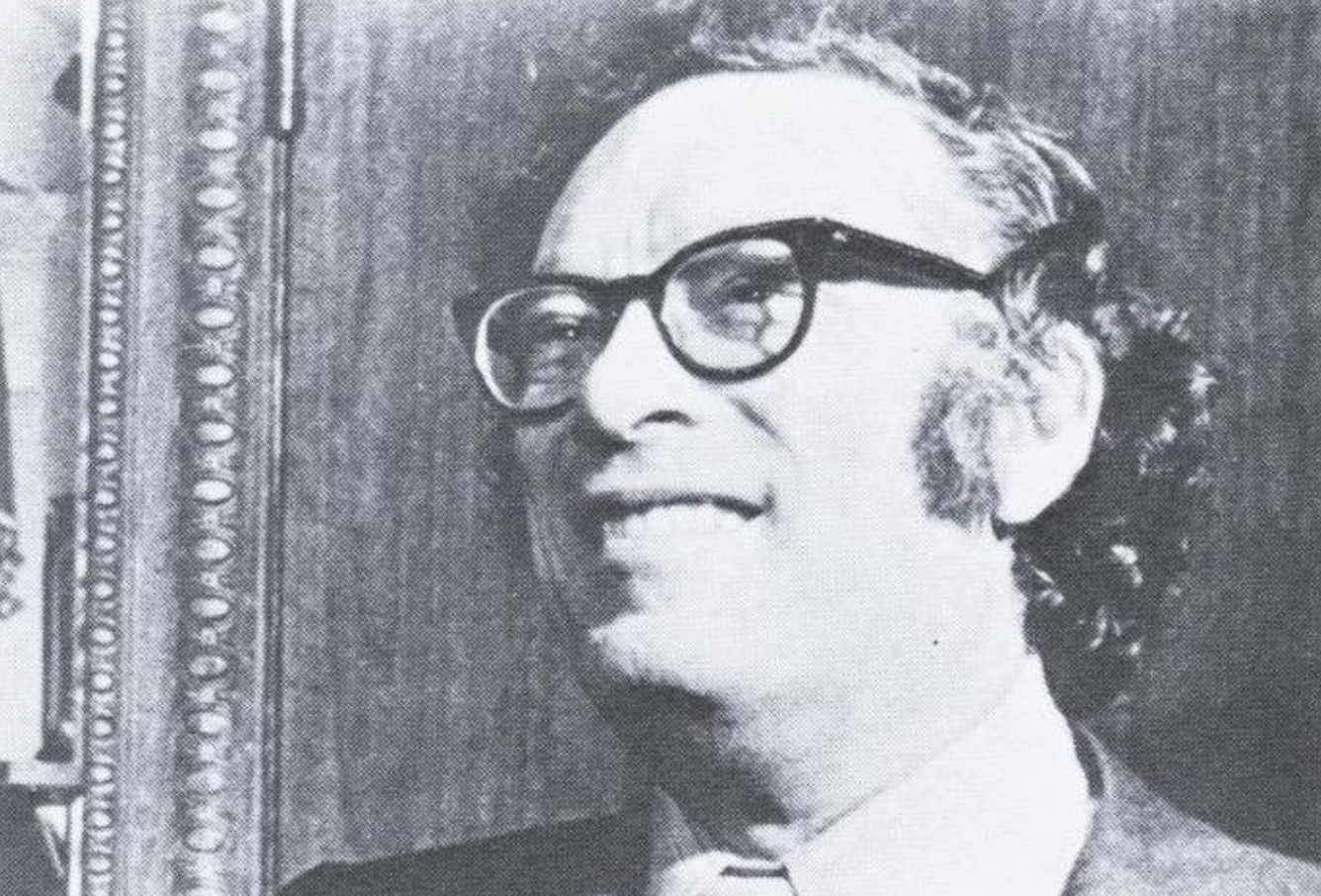
Rochester Institute of Technology, via Wikimedia Commons
In 1980, scientist and writer Isaac Asimov argued in an essay that “there is a cult of ignorance in the United States, and there always has been.” That year, the Republican Party stood at the dawn of the Reagan Revolution, which initiated a decades-long conservative groundswell. Political strategist Steve Schmidt (who has been regretful about choosing Sarah Palin as John McCain’s running mate in 2008) once pointed to what he called “intellectual rot” as a primary culprit, and a cult-like devotion to irrationality among a certain segment of the electorate.
It’s a familiar contention. There have been critiques of American anti-intellectualism since the country’s founding, though whether or not that phenomenon has intensified, as Susan Jacoby alleged in The Age of American Unreason, may be a subject of debate. Not all of the unreason is partisan, as failures to challenge human- and AI-generated misinformation in political news sources and social media outlets over recent years have shown. But “the strain of anti-intellectualism,” writes Asimov, “has been a constant thread winding its way through our political and cultural life, nurtured by the false notion that democracy means that ‘my ignorance is just as good as your knowledge.’”
Asimov’s primary examples happen to come from the political world. However, he doesn’t name contemporary names but reaches back to take a swipe at Eisenhower (“who invented a version of the English language that was all his own”) and George Wallace. Particularly interesting is Asimov’s take on the “slogan on the part of the obscurantists: ‘Don’t trust the experts!’” This language, along with charges of “elitism,” Asimov wryly notes, is so often used by people who are themselves experts and elites, “feeling guilty about having gone to school.” So many of the American political class’ wounds are self-inflicted, he suggests, but that’s because they are beholden to a largely ignorant electorate:
To be sure, the average American can sign his name more or less legibly, and can make out the sports headlines—but how many nonelitist Americans can, without undue difficulty, read as many as a thousand consecutive words of small print, some of which may be trisyllabic?
Asimov’s examples are less than convincing: road signs “steadily being replaced by little pictures to make them internationally legible” has more to do with linguistic diversity than illiteracy, and accusing television commercials of speaking their messages out loud instead of using printed text on the screen seems to fundamentally misunderstand the nature of the medium. Jacoby in her book-length study of the problem looks at educational policy in the United States, and the resistance to national standards that virtually ensures widespread pockets of ignorance all over the country. Asimov’s very short, pithy essay has neither the space nor the inclination to conduct such analysis.
Instead he is concerned with attitudes. Not only are many Americans badly educated, he writes, but the broad ignorance of the population in matters of “science… mathematics… economics… foreign languages…” has as much to do with Americans’ unwillingness to read as their inability.
There are 200 million Americans who have inhabited schoolrooms at some time in their lives and who will admit that they know how to read… but most decent periodicals believe they are doing amazingly well if they have circulation of half a million. It may be that only 1 per cent—or less—of Americans make a stab at exercising their right to know. And if they try to do anything on that basis they are quite likely to be accused of being elitists.
One might in some respects charge Asimov himself of elitism when he concludes, “We can all be members of the intellectual elite.” Such a blithely optimistic statement ignores the ways in which economic elites actively manipulate education policy to suit their interests, cripple education funding, and oppose efforts at free or low cost higher education. Many efforts at spreading knowledge—like the Chautauquas of the early 20th century, the educational radio programs of the 40s and 50s, and the public television revolution of the 70s and 80s—have been ad hoc and nearly always imperiled by funding crises and the designs of profiteers.
Nonetheless, the widespread (though hardly universal) availability of free resources on the internet has made self-education a reality for many people, and certainly for most Americans. But perhaps not even Isaac Asimov could have foreseen the bitter polarization and disinformation campaigns that technology has also enabled. Needless to say, “A Cult of Ignorance” was not one of Asimov’s most popular pieces of writing. First published on January 21, 1980 in Newsweek, the short essay has never been reprinted in any of Asimov’s collections.
Note: An earlier version of this post appeared on our site in 2016.
Related Content:
Isaac Asimov Predicts the Future on The David Letterman Show (1980)
Isaac Asimov on How Libraries Can Radically Change Your Life (1971)
Isaac Asimov Predicts in 1964 What the World Will Look Like in 2014
Josh Jones is a writer and musician based in Durham, NC.
Read More...Support Us
We're hoping to rely on loyal readers, rather than erratic ads. Please click the Donate button and support Open Culture. You can use Paypal, Venmo, Patreon, even Crypto! We thank you!

About Us

Open Culture scours the web for the best educational media. We find the free courses and audio books you need, the language lessons & educational videos you want, and plenty of enlightenment in between.
Advertise With Us

FREE UPDATES!
GET OUR DAILY EMAIL
Get the best cultural and educational resources on the web curated for you in a daily email. We never spam. Unsubscribe at any time.
FOLLOW ON SOCIAL MEDIA

Open Culture editor Dan Colman scours the web for the best educational media. He finds the free courses and audio books you need, the language lessons & movies you want, and plenty of enlightenment in between.
Advertise With Us


