How Carl Jung Inspired the Creation of Alcoholics Anonymous
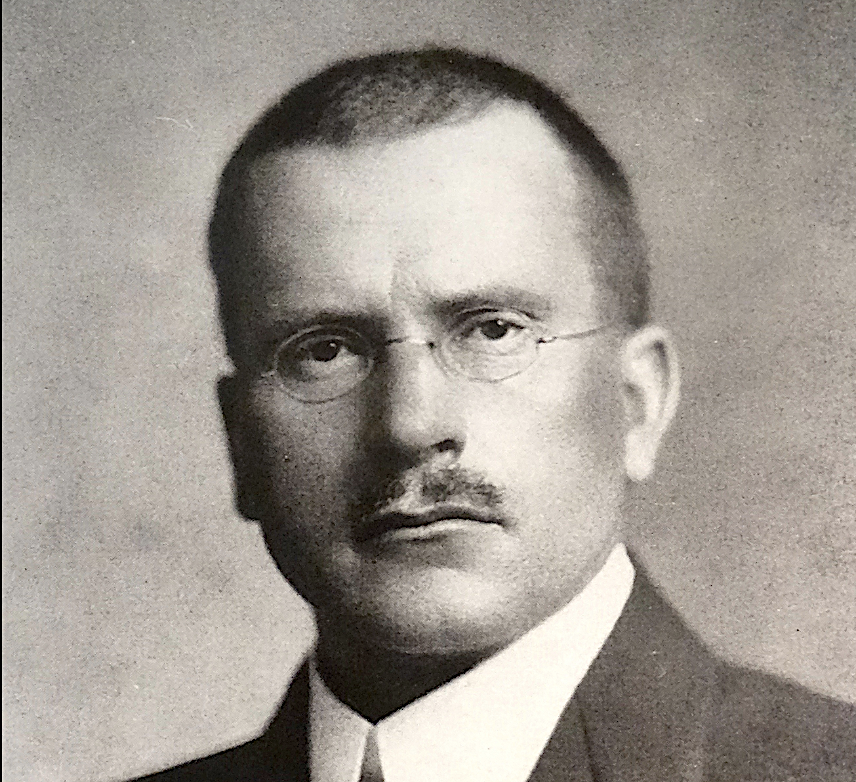
There may be as many doors into Alcoholics Anonymous in the 21st century as there are people who walk through them—from every world religion to no religion. The “international mutual-aid fellowship” has had “a significant and long-term effect on the culture of the United States,” writes Worcester State University professor of psychology Charles Fox at Aeon. Indeed, its influence is global. From its inception in 1935, A.A. has represented an “enormously popular therapy, and a testament to the interdisciplinary nature of health and wellness.”
A.A. has also represented, at least culturally, a remarkable synthesis of behavioral science and spirituality that translates into scores of different languages, beliefs, and practices. Or at least that’s the way it can appear from browsing the scores of books on A.A.’s 12-Steps and Buddhism, Yoga, Catholicism, Judaism, Indigenous faith traditions, shamanist practices, Stoicism, secular humanism, and, of course, psychology.
Historically, and often in practice, however, the (non)organization of worldwide fellowships has represented a much narrower tradition, inherited from the evangelical (small “e”) Christian Oxford Group, or as A.A. founder Bill Wilson called them, “the ‘O.G.’” Wilson credits the Oxford Group for the methodology of A.A.: “their large emphasis upon the principles of self-survey, confession, restitution, and the giving of oneself in service to others.”
The Oxford Group’s theology, though qualified and tempered, also made its way into many of A.A.’s basic principles. But for the recovery group’s genesis, Wilson cites a more secular authority, Carl Jung. The famous Swiss psychiatrist took a keen interest in alcoholism in the 1920s. Wilson wrote to Jung in 1961 to express his “great appreciation” for his efforts. “A certain conversation you once had with one of your patients, a Mr. Rowland H. back in the early 1930’s,” Wilson explains, “did play a critical role in the founding of our Fellowship.”
Jung may not have known his influence on the recovery movement, Wilson says, although alcoholics had accounted for “about 13 percent of all admissions” in his practice, notes Fox. One of his patients, Rowland H.—or Rowland Hazard, “investment banker and former state senator from Rhode Island”—came to Jung in desperation, saw him daily for a period of several months, stopped drinking, then relapsed. Brought back to Jung by his cousin, Hazard was told that his case was hopeless short of a religious conversion. As Wilson puts it in his letter:
[Y]ou frankly told him of his hopelessness, so far as any further medical or psychiatric treatment might be concerned. This candid and humble statement of yours was beyond doubt the first foundation stone upon which our Society has since been built.
Jung also told Hazard that conversion experiences were incredibly rare and recommended that he “place himself in a religious atmosphere and hope for the best,” as Wilson remembers. But he did not specify any particular religion. Hazard discovered the Oxford Group. He might, as far as Jung was concerned, have met God as he understood it anywhere. “His craving for alcohol was the equivalent,” wrote the psychiatrist in a reply to Wilson, “on a low level, of the spiritual thirst of our being for wholeness, expressed in medieval language: the union with God.”
In his reply letter to Wilson, Jung uses religious language allegorically. AA took the idea of conversion more literally. Though it wrestled with the plight of the agnostic, the Big Book concluded that such people must eventually see the light. Jung, on the other hand, seems very careful to avoid a strictly religious interpretation of his advice to Hazard, who started the first small group that would convert Wilson to sobriety and to Oxford Group methods.
“How could one formulate such an insight that is not misunderstood in our days?” Jung asks. “The only right and legitimate way to such an experience is that it happens to you in reality and it can only happen to you when you walk on a path which leads you to a higher understanding.” Sobriety could be achieved through “a higher education of the mind beyond the confines of mere rationalism”—through an enlightenment or conversion experience, that is. It might also occur through “an act of grace or through a personal and honest contact with friends.”
Though most founding members of AA fought for the stricter interpretation of Jung’s prescription, Wilson always entertained the idea that multiple paths might bring alcoholics to the same goal, even including modern medicine. He drew on the medical opinions of Dr. William D. Silkworth, who theorized that alcoholism was in part a physical disease, “a sort of metabolism difficulty which he then called an allergy.” Even after his own conversion experience, which Silkworth, like Jung, recommended he pursue, Wilson experimented with vitamin therapies, through the influence of Aldous Huxley.
His search to understand his mystical “white light” moment in a New York detox room also led Wilson to William James’ Varieties of Religious Experience. The book “gave me the realization,” he wrote to Jung, “that most conversion experiences, whatever their variety, do have a common denominator of ego collapse at depth.” He even thought that LSD could act as such a “temporary ego-reducer” after he took the drug under supervision of British psychiatrist Humphrey Osmond. (Jung likely would have opposed what he called “short cuts” like psychedelic drugs.)
In the letters between Wilson and Jung, as Ian McCabe argues in Carl Jung and Alcoholics Anonymous, we see mutual admiration between the two, as well as mutual influence. “Bill Wilson,” writes McCabe’s publisher, “was encouraged by Jung’s writings to promote the spiritual aspect of recovery,” an aspect that took on a particularly religious character in Alcoholics Anonymous. For his part, Jung, “influenced by A.A.’s success… gave ‘complete and detailed instructions’ on how the A.A. group format could be developed further and used by ‘general neurotics.’” And so it has, though more on the Oxford Group model than the more mystical Jungian. It might well have been otherwise.
Read more about Jung’s influence on AA over at Aeon.
Note: Note: An earlier version of this post appeared on our site in 2019.
Related Content:
Carl Jung Offers an Introduction to His Psychological Thought in a 3‑Hour Interview (1957)
Take Carl Jung’s Word Association Test, a Quick Route Into the Subconscious (1910)
Carl Jung’s Hand-Drawn, Rarely-Seen Manuscript The Red Book
Josh Jones is a writer and musician based in Durham, NC. Follow him at @jdmagness
Read More...About Us

What is Open Culture’s Mission?
Founded in 2006, Open Culture brings together high-quality cultural & educational media for the worldwide lifelong learning community. Web 2.0 has given us great amounts of intelligent audio and video. It’s all free. It’s all enriching. But it’s also scattered across the web, and not easy to find. Our whole mission is to centralize this content, curate it, and give you access to this high quality content whenever and wherever you want it. Some of our major resource collections include:
- 1,700 Free Online Courses from Top Universities
- 4,000+ Free Movies Online: Great Classics, Indies, Noir, Westerns, Documentaries & More
- 1,000 Free Audio Books: Download Great Books for Free
- 800 Free eBooks for iPad, Kindle & Other Devices
- Learn 46 Languages Online for Free: Spanish, Chinese, English & More
How Can I Contact Open Culture?
Feel free to drop us a line at ma**@*********re.com.
Do You Have a Copyright Policy?
Yes and you can find it here.
Do You Have a Privacy Policy?
Yes, read all about it here.
Can I Recommend Materials to List on Open Culture?
Yes. If you would like us to add links to relevant parts of our site, you can suggest materials/links via email and we will be happy to review them. Please read over our editorial guidelines and then let us know where you think your material should be listed, and try to provide all of the information that will help us list your material. For example, if you want us to include a link in one of our podcast directories, please look at the appropriate directory and include all of the information that we typically include in our entries.
Do The Courses Featured Here Give University Credit?
First and foremost, the MOOCs/Online courses appearing on this page sometimes offer students “statements of accomplishment” or “certificates of completion” if they successfully complete a given course. However, most traditional universities won’t give students credit for taking theses online courses, and students typically can’t use these courses as a way to satisfy requirements for a degree. It’s conceivable that some schools will give credit for these classes, but you would really need to check with the registar’s office at your institution.
Second, we should point out (in case it’s not clear) that Open Culture is not the builder/creator of these courses. Our site simply highlights MOOCs/Online Courses created by other educational ventures. You can get more information by reading our MOOC FAQ.
Read More...The Evolution of Hokusai’s Great Wave: A Study of 113 Known Copies of the Iconic Woodblock Print
The most widely known work by the eighteenth- and nineteenth-century Japanese artist Hokusai, 神奈川沖浪裏, is usually translated into English as The Great Wave off Kanagawa. That version of the title reflects the iconic scene depicted in the image well enough, though I can’t help but feel that we should be talking about waves, plural. Granted, the Japanese language hardly makes a fuss about plurality and singularity in the first place, but even by the standards of ukiyo‑e woodblock prints, this is a work of art that takes many forms. It’s not just that there are a lot of parodies floating around, but that no single “original” even exists.
“There’s not just one impression of the Great Wave, as many people think. There were originally thousands of them,” says scientist Capucine Korenberg in the British Museum video above. Back in the mid-nineteenth century, “Japanese prints were very cheap, and you could buy them for the same amount of money you could buy a double helping of soup and noodles.” Demand for the Great Wave in particular was such that experts reckon that at least 8,000 prints were sold, having been made “until the woodblocks just started to be so worn out that they couldn’t be used anymore.” Again, note the plural: if the blocks used to make the image were replaced, we’d expect to see differences in the actual image over time.
We’ve discussed before how the Great Wave went through several iterations over four decades before Hokusai found the form recognized around the world still today. But if you look at a print of the final version closely enough — and know enough about Hokusai’s art — you can tell whether it came from an earlier edition or a later one. It was no less an expert than longtime Tokyo-based printmaker and Hokusai enthusiast David Bull (previously featured here on Open Culture) who noticed that “he could see small differences between the strokes” of the three Great Wave prints owned by the British Museum. Hearing this sent Korenberg on a quest to determine their exact chronological order.
Many factors complicated this task, including the amount of ink and pressure applied to the woodblock during its creation, as well as the chances of modification or partial replacement of particular blocks along the way. In the end, she found it “more certain than ever” that the British Museum’s three Great Waves came from the same key block, which would have been modeled after Hokusai’s drawing. But along the way, she did make a discovery: it was previously thought that 111 identified prints existed, but she confirmed two more, bringing the total up to 113. Determining the fate of the other 7,887 is a task best left to the even more obsessive ukiyo-e-hunters out there.
Related content:
An Introduction to Hokusai’s Great Wave, One of the Most Recognizable Artworks in the World
Watch a Master Japanese Printmaker at Work: Two Unintentionally Relaxing ASMR Videos
Watch Hokusai’s The Great Wave off Kanagawa Get Entirely Recreated with 50,000 LEGO Bricks
Based in Seoul, Colin Marshall writes and broadcasts on cities, language, and culture. His projects include the Substack newsletter Books on Cities and the book The Stateless City: a Walk through 21st-Century Los Angeles. Follow him on Twitter at @colinmarshall or on Facebook.
Read More...16th-Century Japanese Historians Describe the Oddness of Meeting the First Europeans They Ever Saw
Go to Japan today, and the country will present you with plenty of opportunities to buy pan, tabako, and tempura. These products themselves — bread, cigarettes, and deep-fried seafood or vegetables — will be familiar enough. Even the words that refer to them may have a recognizable ring, especially if you happen to be a Portuguese-speaker. Japanese has more than its fair share of naturalized terms, used to refer to everything from the konbini on the corner to the riizanaburu prices found therein, but none of them are as deeply rooted as its terms imported from Portugal.
Relations between Japan and Portugal go back to 1543, when the first Portuguese sailors arrived in the southern Japanese archipelago. Impressions of this encounter are included in the video above, a Voices of the Past compilation of how actual sixteenth-century Japanese historians described their unexpected visitors. “A southern barbarian vessel came to our shores,” writes one of them, anonymously. From it “emerged an unnameable creature, somewhat similar in shape to a human being, but looking rather more like a long-nosed goblin, or the giant demon mikoshi-nyūdō.”
This grotesque, unintelligible creature turned to be a bateren; that is, a padre, a missionary priest come to spread the kirishitan religion in this distant land. In this primary task they faced severe, ultimately insurmountable challenges, but as the first Europeans to make contact with Japan, they also happened much more successfully to disseminate Western concepts and techniques in agriculture, science, and art (not to mention dessert culture). Their introduction of the gun, described in detail by another contemporary historian, also changed the course of Japanese history, doing its part to make possible the unification of Japan in the following century.
Kurusu in hand, these bateren argued that one should devote oneself to Deusu in order to avoid eternal condemnation to inheruno and gain admission to paraiso. There were converts, though perhaps not in numbers as large as expected. Then as now, the Japanese had their own way of going about things, but in the sixteenth century, they had rulers inclined to crack down hard on suspicious foreign influence. The last section of the video contains testimony of a showdown staged between Christianity and Buddhism, a debate in which the bateren seemed to have put on a poor show. Defeated, they were either expelled or executed, and not long thereafter, Japan closed the doa — as they now call it — for a couple more centuries.
Related content:
The 17th-Century Japanese Samurai Who Sailed to Europe, Met the Pope & Became a Roman Citizen
Hear an Ancient Chinese Historian Describe The Roman Empire (and Other Voices of the Past)
Based in Seoul, Colin Marshall writes and broadcasts on cities, language, and culture. His projects include the Substack newsletter Books on Cities and the book The Stateless City: a Walk through 21st-Century Los Angeles. Follow him on Twitter at @colinmarshall or on Facebook.
Read More...What’s Under London? Discover London’s Forbidden Underworld
When the words London and underground come together, the first thing that comes to most of our minds, naturally, is the London Underground. But though it may enjoy the honorable distinction of the world’s first railway to run below the streets, the stalwart Tube is hardly the only thing buried below the city — and far indeed from the oldest. The video above makes a journey through various subterranean strata, starting with the paving stone and continuing through the soil, electric cables, and gas pipelines beneath. From there, things get Roman.
First comes the Billingsgate Roman House and Baths and the Roman amphitheater, two preserved places from what was once called Londinium. Below that level run several now-underground rivers, just above the depth of Winston Churchill’s private bunker, which is now maintained as a museum.
Farther down, at a depth of 66 feet, we find the remains of London’s tube system — not the Tube, but the pneumatic tube, a nineteenth-century technology that could fire encapsulated letters from one part of the city to another. More effective and longer lived was the later, more deeply installed London Post Office Railway, which was used to make deliveries until 2003.
At 79 feet underground, we finally meet with the Underground — or at least the first and shallowest of its eleven lines. The Tube has long become an essential part of the lives of most Londoners, but around the same depth exists another facility known to relatively few: the Camden catacombs, a system of underground passages once used to stable the horses who worked on the railways. Further down are the network of World War II-era “deep shelters,” one of which hosted the planning of D‑Day; below them is a still-functional facility instrumental to the defeat of different enemies, typhus and cholera. That would be London’s sewer system, for which we should spare a thought if we’ve ever walked along the Thames and appreciated the fact that it no longer stinks.
Related content:
The Lost Neighborhood Buried Under New York City’s Central Park
Undercity: Exploring the Underbelly of New York City
Based in Seoul, Colin Marshall writes and broadcasts on cities, language, and culture. His projects include the Substack newsletter Books on Cities and the book The Stateless City: a Walk through 21st-Century Los Angeles. Follow him on Twitter at @colinmarshall or on Facebook.
Read More...Roger Federer’s Dartmouth Commencement Address: “Effortless Is a Myth” & Other Life Lessons from Tennis
In 2006, David Foster Wallace published a piece in the New York Times Magazine headlined “Roger Federer as Religious Experience.” Even then, he could declare Federer, “at 25, the best tennis player currently alive. Maybe the best ever.” Much had already been written about “his old-school stoicism and mental toughness and good sportsmanship and evident overall decency and thoughtfulness and charitable largess.” Less easily commented upon — because much less easily described — was the aesthetic transcendence of his performance on the court, which Wallace thought best witnessed in person.
“If you’ve watched tennis only on television, you simply have no idea how hard these pros are hitting the ball, how fast the ball is moving, how little time the players have to get to it, and how quickly they’re able to move and rotate and strike and recover,” Wallace writes. “And none are faster, or more deceptively effortless about it, than Roger Federer.” Was that one of the observations the champion had in mind this past weekend, eighteen years later — and two years after his own retirement from the game — when he took the tree-stump lectern before Dartmouth’s class of 2024 and declared that “Effortless is a myth”?
That was one of three “tennis lessons” — that is, lessons for life derived from his long and hugely successful experience in tennis — that Federer lays out in the commencement address above. The second, “It’s only a point,” is a notion of which it’s all too easy to lose sight of amid the balletic intensity of a match. The third, “Life is bigger than the court,” is one Federer himself now must learn in the daily life after his own “graduation” that stretches out before him. For a man still considered one of the greatest players ever to pick up a racket, is there life after professional tennis?
Federer acknowledges the irony of his not having gone to college, but choosing instead to leave school at sixteen in order to devote himself to his sport. “In many ways, professional athletes are our culture’s holy men,” Wallace writes in another essay. “They give themselves over to a pursuit, endure great privation and pain to actualize themselves at it, and enjoy a relationship to perfection that we admire and reward.” But when their athletic careers inevitably end, they find themselves in a greatly heightened version of the situation we all do when we come to the end of our institutionalized education, wondering what could or should come next.
Clearly, Federer doesn’t suffer from the kind of inarticulacy and unreflectiveness that Wallace diagnosed over and over in other professional athletes about whom he wrote. In profiling player Michael Joyce, for instance, Wallace saw that Joyce and his colleagues lived in “a world that, like a child’s world, is very serious and very small” — but which Federer has long displayed an uncommon ability to see beyond. Still, as he must know, that guarantees him a satisfying second act no more than even world-beating success in any given field guarantees any of us general well-being in life. Wallace, too, knew that full well — and of course, he was no mean commencement speaker himself.
Related content:
Animations Revive Lost Interviews with David Foster Wallace, Jim Morrison & Dave Brubeck
Marcel Proust Plays Air Guitar on a Tennis Racket (1891)
30 Free Essays & Stories by David Foster Wallace on the Web
Bob Dylan and George Harrison Play Tennis, 1969
Medieval Tennis: A Short History and Demonstration
Based in Seoul, Colin Marshall writes and broadcasts on cities, language, and culture. His projects include the Substack newsletter Books on Cities and the book The Stateless City: a Walk through 21st-Century Los Angeles. Follow him on Twitter at @colinmarshall or on Facebook.
Read More...Hear Edgar Allan Poe Stories Read by Iggy Pop, Jeff Buckley, Christopher Walken, Marianne Faithful & More
In 1849, a little over 175 years ago, Edgar Allan Poe was found dead in a Baltimore gutter under mysterious circumstances very likely related to violent election fraud. It was an ignominious end to a life marked by hardship, alcoholism, and loss. After struggling for years as the first American writer to try and make a living from his art, and failing in several publishing ventures and positions, Poe achieved few of his aims, barely getting by financially and only managing to attract a little—often negative—notice for now-famous poems like “The Raven.” Contemporaries like Ralph Waldo Emerson disparaged the poem and a later generation of writers, including William Butler Yeats, pronounced him “vulgar.”
But of course, as we know, a countercurrent of Poe appreciation took hold among writers, artists, and filmmakers interested in mystery, horror, and the supernatural—to such a degree that in the previous century, nearly every artist even passingly associated with darker themes has interpreted Poe as a rite of passage. We’ve featured a reading of “The Raven” by the often-sinister Christopher Walken.
At the top of the post, you can hear another version of the Queens-born actor reading Poe’s best-known work, a poem designed to produce what the author called a “unity of effect” with its incantatory repetitions. This recording comes from a collection of celebrity Poe readings called Closed on Account of Rabies, which also features such unique takes on the classic horror writer’s work as that above, “The Tell-Tale Heart” as read by Iggy Pop.
Just above, hear a lesser-known poem by Poe called “Ulalume” read by Jeff Buckley, with an accompanying soundtrack of low, pulsing, vaguely Western-inspired music that well suits Buckley’s formal, rhythmic recitation. The use of music on this album has divided many Poe fans, and admittedly, some tracks work better than others. On Buckley’s “Ulalume,” the music heightens tension and provides a perfect atmosphere for imagining “the misty mid region of Weir,” its “ghoul-haunted woodland,” and the “scoriac rivers” of lava pouring from the poet’s heart. On Marianne Faithful’s reading of “Annabelle Lee,” below, a score of keening synths can seem overwrought and unnecessary.
The remainder of the 1997 album, which you can purchase here, treats us to readings from 80s goth-rock stars Diamanda Galas and Gavin Friday, Bad Lieutenant director Abel Ferrara, Blondie singer Debbie Harry, and gravel-voiced New Orleans bluesman Dr. John, among others.
Related Content:
Why Should You Read Edgar Allan Poe? An Animated Video Explains
7 Tips from Edgar Allan Poe on How to Write Vivid Stories and Poems
Josh Jones is a writer and musician based in Durham, NC. Follow him at @jdmagness
Read More...Harvard Removes the Human Skin Binding from a Book in Its Collection Since 1934
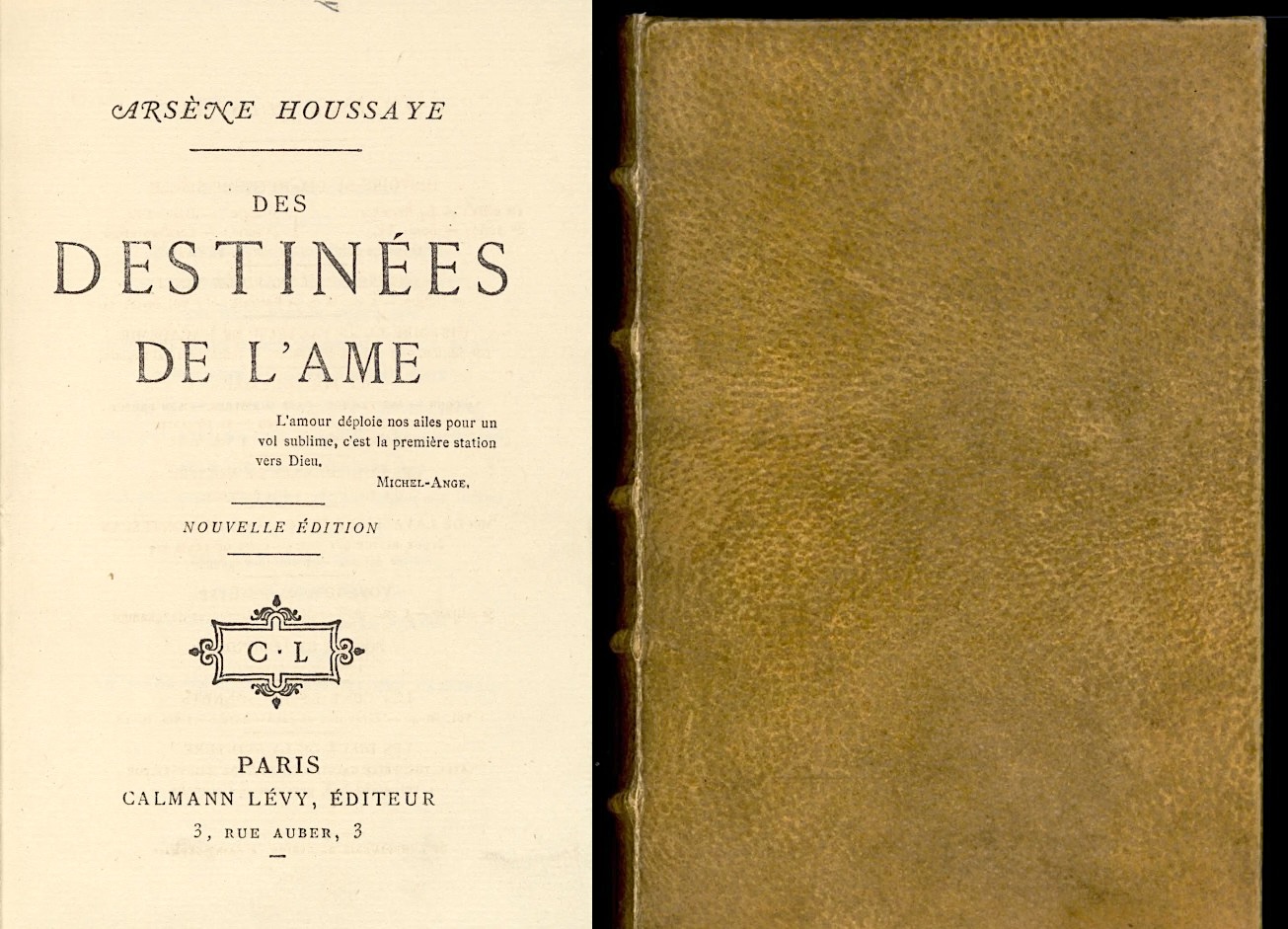
In June of 2014, Harvard University’s Houghton Library put up a blog post titled “Caveat Lecter,” announcing “good news for fans of anthropodermic bibliopegy, bibliomaniacs, and cannibals alike.” The occasion was the scientific determination that a book in the Houghton’s collection long rumored to have been bound in human skin — the task of whose retrieval once served, they say, as a hazing ritual for student employees — was, indeed, “without a doubt bound in human skin.” What a difference a decade makes: not only has the blog post been deleted, the book itself has been taken out of from circulation in order to have the now-offending binding removed.
“Harvard Library has removed human skin from the binding of a copy of Arsène Houssaye’s book Des destinées de l’âme (1880s),” declares a strenuously apologetic statement issued by the university. “The volume’s first owner, French physician and bibliophile Dr. Ludovic Bouland (1839–1933), bound the book with skin he took without consent from the body of a deceased female patient in a hospital where he worked.” Having been in the collection since 1934, the book was first placed there by John B. Stetson, Jr., “an American diplomat, businessman, and Harvard alumnus” (not to mention an heir to the fortune generated by the eponymous hat).
“Bouland knew that Houssaye had written the book while grieving his wife’s death,” writes Mike Jay in the New York Review of Books, “and felt that this was an appropriate binding for it — ‘a book on the human soul merits that it be given human clothing.’ ” He also “included a note stating that “this book is bound in human skin parchment on which no ornament has been stamped to preserve its elegance.” This copy of Des destinées de l’âme isn’t the only book rumored — or, with the peptide mass fingerprinting (PMF) technology developed over the past decade, confirmed — to have been bound in human skin. “The oldest reputed examples are three 13th-century Bibles held at the Bibliothèque Nationale in France, write the New York Times’ Jennifer Schuessler and Julia Jacobs.
Jay also mentions the especially vivid example of “an 1892 French edition of Edgar Allan Poe’s The Gold Bug, adorned with a skull emblem, is genuine human skin: Poe en peau humaine.” In general, Schuessler and Jacobs note, the largest number of human skin-bound books “date from the Victorian era, the heyday of anatomical collecting, when doctors sometimes had medical treatises and other texts bound in skin from patients or cadavers.” Now that this practice has been retroactively judged to be not just deeply disturbing but officially problematic (to use the vogue term of recent years) it’s up to the anthropodermic-bibliopegy enthusiasts out there to determine whether to put the items in their own collections to the PMF test — or to leave a bit of macabre mystery in the world of antiquarian book-collecting.
Related content:
Old Books Bound in Human Skin Found in Harvard Libraries (and Elsewhere in Boston)
When Medieval Manuscripts Were Recycled & Used to Make the First Printed Books
Behold the Codex Gigas (aka “Devil’s Bible”), the Largest Medieval Manuscript in the World
A Mesmerizing Look at the Making of a Late Medieval Book from Start to Finish
Based in Seoul, Colin Marshall writes and broadcasts on cities, language, and culture. His projects include the Substack newsletter Books on Cities and the book The Stateless City: a Walk through 21st-Century Los Angeles. Follow him on Twitter at @colinmarshall or on Facebook.
Read More...How the 13th-Century Sufi Poet Rumi Became One of the World’s Most Popular Writers
The Middle East is hardly the world’s most harmonious region, and it only gets more fractious if you add in South Asia and the Mediterranean. But there’s one thing on which many residents of that wide geographical span can agree: Jalāl al-Dīn Muḥammad Rūmī. One might at first imagine that a thirteenth-century poet and mystical philosopher who wrote in Persian, with occasional forays into Turkish, Arabic, and Greek, would be a niche figure today, if known at all. In fact, Rumi, as he’s commonly known, is now one of the most popular writers in not just the Middle East but the world; English reinterpretations of his verse have even made him the best-selling poet in the United States.
“The transformative moment in Rumi’s life came in 1244, when he met a wandering mystic known as Shams of Tabriz,” writes the BBC’s Jane Ciabattari. She quotes Brad Gooch, author of Rumi’s Secret: The Life of the Sufi Poet of Love, describing them as having an “electric friendship for three years,” after which Shams disappeared. “Rumi coped by writing poetry,” which includes 3,000 poems written for “Shams, the prophet Muhammad and God. He wrote 2,000 rubayat, four-line quatrains. He wrote in couplets a six-volume spiritual epic, The Masnavi.” He did all this work in service of what, in the animated TED-Ed lesson above, Stephanie Honchell Smith calls his ultimate goal: “the reunification of his soul with God through the experience of divine love.”
How is such a love to be accessed? “Love resides not in learning, not in knowledge, not in pages in books,” Rumi declared. “Wherever the debates of men may lead, that is not the lover’s path.” He pursued it through devotion to Shams’ Sufism, “participating in ritualized dancing and preaching the religion of love through lectures, poetry, and prose.” Later in life, he shifted “from ecstatic expressions of divine love to verses that guide others to discover it for themselves,” incorporating “ideas, stories, and quotes from Islamic religious texts, Arabic and Persian literature and earlier Sufi writings and poetry.” Perhaps there can be no full appreciation of Rumi’s work without a scholar’s understanding of the languages and cultures he knew. But if his sales figures are anything to go by, the longing into which his complex work taps is universal.
Related content:
The Mystical Poetry of Rumi Read By Tilda Swinton, Madonna, Robert Bly & Coleman Barks
The Complex Geometry of Islamic Art & Design: A Short Introduction
500+ Beautiful Manuscripts from the Islamic World Now Digitized & Free to Download
The Birth and Rapid Rise of Islam, Animated (622‑1453)
Based in Seoul, Colin Marshall writes and broadcasts on cities, language, and culture. His projects include the Substack newsletter Books on Cities and the book The Stateless City: a Walk through 21st-Century Los Angeles. Follow him on Twitter at @colinmarshall or on Facebook.
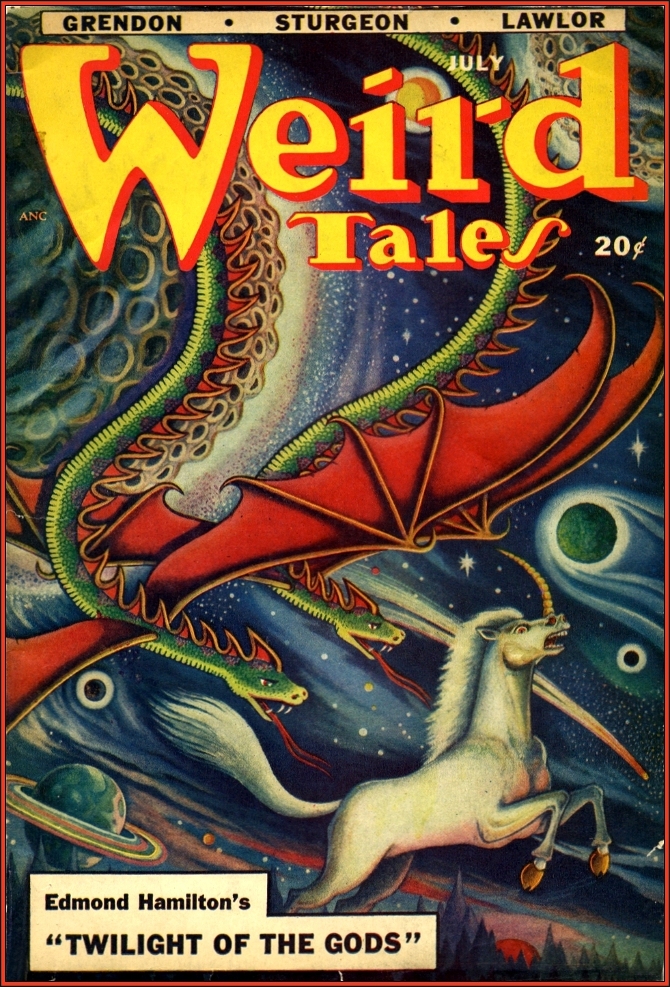
Read More...Download Issues of “Weird Tales” (1923–1954): The Pioneering Pulp Horror Magazine Features Original Stories by Lovecraft, Bradbury & Many More
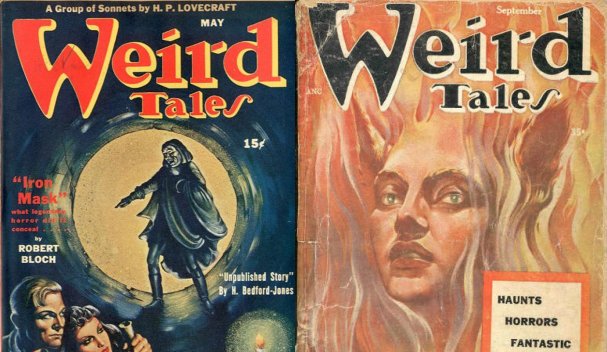
We live in an era of genre. Browse through TV shows of the last decade to see what I mean: Horror, sci-fi, fantasy, superheroes, futuristic dystopias…. Take a casual glance at the burgeoning global film franchises or merchandising empires. Where in earlier decades, horror and fantasy inhabited the teenage domain of B‑movies and comic books, they’ve now become dominant forms of popular narrative for adults. Telling the story of how this came about might involve the kind of lengthy sociological analysis on which people stake academic careers. And finding a convenient beginning for that story wouldn’t be easy.
Do we start with The Castle of Otranto, the first Gothic novel, which opened the door for such books as Dracula and Frankenstein? Or do we open with Edgar Allan Poe, whose macabre short stories and poems captivated the public’s imagination and inspired a million imitators? Maybe. But if we really want to know when the most populist, mass-market horror and fantasy began—the kind that inspired television shows from the Twilight Zone to the X‑Files to Supernatural to The Walking Dead—we need to start with H.P. Lovecraft, and with the pulpy magazine that published his bizarre stories, Weird Tales.
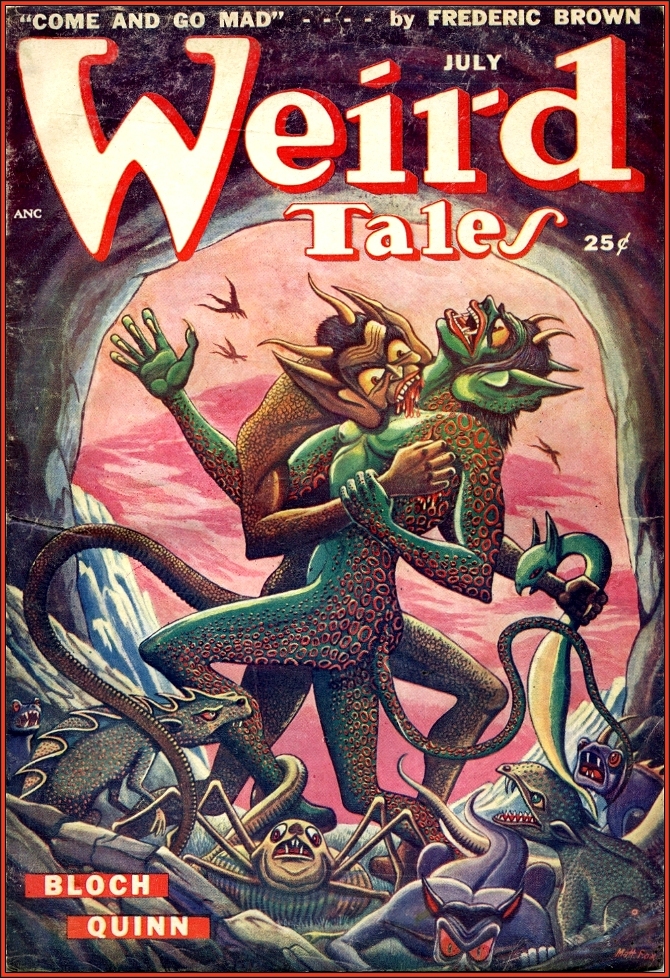
Debuting in 1923, Weird Tales, writes The Pulp Magazines Project, provided “a venue for fiction, poetry and non-fiction on topics ranging from ghost stories to alien invasions to the occult.” The magazine introduced its readers to past masters like Poe, Bram Stoker, and H.G. Wells, and to the latest weirdness from Lovecraft and contemporaries like August Derleth, Ashton Smith, Catherine L. Moore, Robert Bloch, and Robert E. Howard (creator of Conan the Barbarian).
In the magazine’s first few decades, you wouldn’t have thought it very influential. Founder Jacob Clark Hennenberger struggled to turn a profit, and the magazine “never had a large circulation.” But no magazine is perhaps better representative of the explosion of pulp genre fiction that swept through the early twentieth century and eventually gave birth to the juggernauts of Marvel and DC.
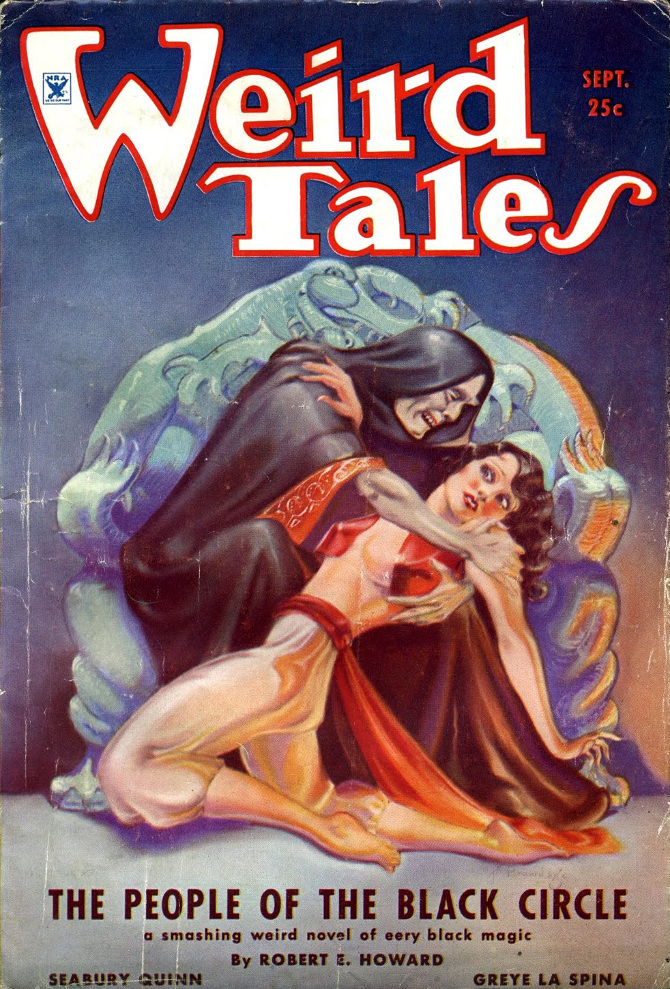
Weird Tales is widely accepted by cultural historians as “the first pulp magazine to specialize in supernatural and occult fiction,” points out The Encyclopedia of Science Fiction (though, as we noted before, an obscure German title, Der Orchideengarten, technically got there earlier). And while the magazine may not have been widely popular, as the Velvet Underground was to the rapid spread of various subgenera of rock in the seventies, so was Weird Tales to horror and fantasy fandom. Everyone who read it either started their own magazine or fanclub, or began writing their own “weird fiction”—Lovecraft’s term for the kind of supernatural horror he churned out for several decades.
Fans of Lovecraft can read and download scans of his stories and letters to the editor published in Weird Tales at the links below, brought to us by The Lovecraft eZine (via SFFaudio).
Letter to the editor of Weird Tales, September 1923 – September 1923
Letter to the editor of Weird Tales, October 1923 – October 1923
Letter to the editor of Weird Tales, January 1924 – January 1924
Letter to the editor of Weird Tales, March 1924 – March 1924
Imprisoned With The Pharaohs – May/June/July 1924
Hypnos – May/June/July 1924
The Tomb – January 1926
The Terrible Old Man – August 1926
Yule Horror – December 1926
The White Ship – March 1927
Letter to the editor of Weird Tales, February 1928 – February 1928
The Dunwich Horror – April 1929
The Tree – August 1938
Fungi From Yuggoth Part XIII: The Port – September 1946
Fungi From Yuggoth Part X: The Pigeon-Flyers – January 1947
Fungi From Yuggoth Part XXVI: The Familiars – January 1947
The City – July 1950
Hallowe’en In A Suburb – September 1952
Fans of early pulp horror and fantasy—–or grad students writing their thesis on the evolution of genre fiction—can view and download dozens of issues of Weird Tales, from the 20s to the 50s, at the links below:
The Internet Archive has digitized copies from the 1920s and 1930s.
The Pulp Magazine Project hosts HTML, FlipBook, and PDF versions of Weird Tales issues from 1936 to 1939
This site has PDF scans of individual Weird Tales stories from the 40s and 50s, including work by Lovecraft, Ray Bradbury, Dorothy Quick, Robert Bloch, and Theodor Sturgeon.
And to learn much more about the history of the magazine, you may wish to beg, borrow, or steal a copy of the pricy collection of essays, The Unique Legacy of Weird Tales: The Evolution of Modern Fantasy and Horror.
Related Content:
Download 15,000+ Free Golden Age Comics from the Digital Comic Museum
Josh Jones is a writer and musician based in Durham, NC. Follow him at @jdmagness
Read More...Support Us
We're hoping to rely on loyal readers, rather than erratic ads. Please click the Donate button and support Open Culture. You can use Paypal, Venmo, Patreon, even Crypto! We thank you!

About Us

Open Culture scours the web for the best educational media. We find the free courses and audio books you need, the language lessons & educational videos you want, and plenty of enlightenment in between.
Advertise With Us
FREE UPDATES!
GET OUR DAILY EMAIL
Get the best cultural and educational resources on the web curated for you in a daily email. We never spam. Unsubscribe at any time.
FOLLOW ON SOCIAL MEDIA
Open Culture editor Dan Colman scours the web for the best educational media. He finds the free courses and audio books you need, the language lessons & movies you want, and plenty of enlightenment in between.
Advertise With Us

