The Romans Stashed Hallucinogenic Seeds in a Vial Made From an Animal Bone
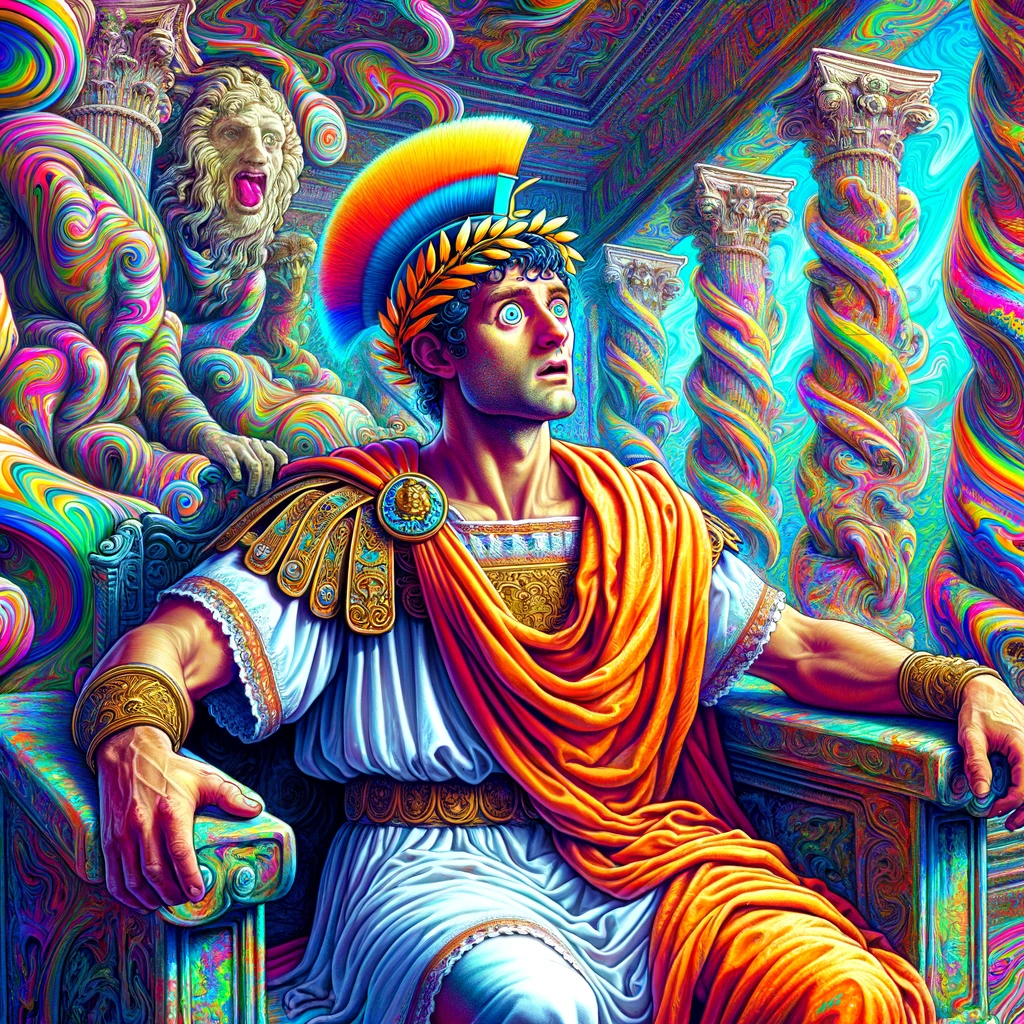
What’s popular in the metropolis sooner or later makes its way out into the provinces. This phenomenon has become more difficult to notice in recent years, not because it’s slowed down, but because it’s sped way up, owing to near-instantaneous cultural diffusion on the internet. Well within living memory, however, are the days when whatever was cool in, say, New York or Los Angeles would take time to catch on in the rest of the US. This went for fashions, movies, and bands, of course, but also for mind-altering substances: distant-future archaeologists are as likely to unearth a Velvet Underground album and the remains of its owner’s stash in the ruins of Cleveland as those of Chelsea.
A roughly analogous discovery from the ancient world was recently made by Dutch zooarchaeologists Maaike Groot and Martijn van Haasteren and archaeobotanist Laura I. Kooistra, who this past February published a paper in the journal Antiquity on “evidence of the intentional use of black henbane (Hyoscyamus niger) in the Roman Netherlands.” A member of the nightshade family, black henbane is “an extremely poisonous plant species that can also be used as a medicinal or psychoactive drug,” the researchers write. It may have been the latter purpose that encouraged the creation of a peculiar artifact: “a sheep/goat bone that had been hollowed out, sealed on one side by a plug of a black material and filled with hundreds of black henbane seeds.”
“Physiological reactions to black henbane were well documented throughout the Ancient Mediterranean world,” writes Hyperallergic’s Elaine Velie. She quotes Greek philosopher Plutarch as describing its effects as “not so properly called drunkenness” but rather “alienation of mind or madness.” Pliny the Elder “discussed the plant’s medicinal, hallucinatory, and potentially lethal effects, noting that although it could be taken to heal ailments ranging from coughs to fever, the drug could also cause insanity and derangement. The Greek and Roman physician Dioscorides wrote that black henbane and its close cousins could alleviate pain, but cause disorientation when boiled.”

It would be natural to assume that this hollowed-out, plugged bone functioned as some kind of pipe for smoking henbane. Though Groot, van Haasteren, and Kooistra don’t find evidence for that, neither do they rule out the possibility that it was the stash box, if you like, of some resident of the Roman Netherlands two millennia ago. Groot points out to Velie the especially fascinating element of a “potential link between medicinal knowledge described by Roman authors in Roman Italy and people actually using the plant in a small village on the edge of the empire.” Though far from Rome itself, this henbane stash’s owner presumably used it however the Romans did. If it met with disapproval, this individual could have resorted to a still-familiar refrain: “Hey, it’s medicinal.”
via Hyperallergic
Related content:
The Drugs Used by the Ancient Greeks and Romans
Humans First Started Enjoying Cannabis in China Circa 2800 BC
1,000-Year-Old Illustrated Guide to the Medicinal Use of Plants Now Digitized & Put Online
Carl Sagan on the Virtues of Marijuana (1969)
Based in Seoul, Colin Marshall writes and broadcasts on cities, language, and culture. His projects include the Substack newsletter Books on Cities and the book The Stateless City: a Walk through 21st-Century Los Angeles. Follow him on Twitter at @colinmarshall or on Facebook.
Read More...How Las Vegas’ Sphere Actually Works: A Looks Inside the New $2.3 Billion Arena
If the United States of America is the Roman empire of our time, surely it must have an equivalent of the Colosseum. A year ago, you could’ve heard a wide variety of speculations as to what structure that could possibly be. Today, many of us would simply respond with “the Sphere,” especially if we happen to be think-piece writers. Since it opened last September, Sphere — to use its proper, article-free brand name — has inspired more than a few reflections on what it says about the intersection of technology and culture here in the twenty-first century, not to mention the considerable ambition and expense of its design and construction.
A $2.3 billion dome whose interior and exterior are both enormous screens — visible, one often hears, even from outer space — Sphere would hardly make sense anywhere in America but Las Vegas, where it makes a good deal of sense indeed. Its location has also made possible such irresistible headlines as “Sphere and Loathing in Las Vegas,” below which the Atlantic’s Charlie Warzel gets into the details of this “architectural embodiment of ridiculousness,” including its surprising origin: “According to James Dolan, the entertainment mogul who financed the Sphere, the inspiration for the building came from ‘The Veldt,’ a 1950 short story by Ray Bradbury” involving a family house with giant screens for walls that can render whatever the children imagine.
Naturally, the kids get hooked, and when Mom and Dad try to intervene, the screens send forth a pack of lions to eat them. “Though the Sphere’s marketing pitch doesn’t explicitly mention being mauled by big digital cats,” Warzel writes, “I got the notion that at least part of the allure of coming to the Sphere is a desire to be overwhelmed.” How, exactly, the venue marshals its advanced technology to do that overwhelming is explained in the MegaBuilds video at the top of the post. With its form not quite like any event space built in human history, it necessitated the invention of everything from a custom camera system to audio-permeable screen surfaces, none of which came cheap.
Hence the cost of seeing a show at Sphere, whether it be the Darren Aronofsky’s “docu-film” Postcard from Earth, U2’s Achtung Baby-based residency earlier this year, or the now-showing Dead & Company, which revives not just the Grateful Dead in their various incarnations over the decades, but also the storied venues in which they played. Its viewers could hardly fail to be astonished by the sheer spectacle, even if they know nothing of the Dead’s colorful history. All of them will no doubt be moved to consider history itself: that of humanity, technology, and civilization, all of which has led up to this rare thing Warzel calls “a brand-new, non-pharmaceutical sensory experience.” Say what you will about the overstimulation and excess represented by Sphere; if you can blow a Deadhead’s mind, you’re definitely on to something.
Related content:
The Absurd Logistics of Concert Tours: The Behind-the-Scenes Preparation You Don’t Get to See
A Virtual Tour of Japan’s Inflatable Concert Hall
Stream a Massive Archive of Grateful Dead Concerts from 1965–1995
Based in Seoul, Colin Marshall writes and broadcasts on cities, language, and culture. His projects include the Substack newsletter Books on Cities and the book The Stateless City: a Walk through 21st-Century Los Angeles. Follow him on Twitter at @colinmarshall or on Facebook.
Read More...Oh My God! Winston Churchill Received the First Ever Letter Containing “O.M.G.” (1917)
Winston Churchill is one of those preposterously outsized historical figures who seemed to be in the middle of every major event. Even before, as Prime Minister, he steeled the resolve of his people and faced down the Third Reich juggernaut; even before he loudly warned of the Nazi menace before it was polite to do so; even before he was pilloried in the press for the disastrous Gallipoli invasion during WWI, Churchill was a famous and controversial figure. As a young cavalry officer, he left his post in India to report on the bloody colonial campaign in the Swat Valley in present-day Pakistan. His hugely popular articles pushed the military slang word “sniper” into popular use. During the second Boer War, Churchill was not only captured at gunpoint by future South African prime minister Louis Botha but he managed to successfully escape from his POW camp. And after being pushed out of the government following Gallipoli, he returned to the military as a Lieutenant Colonel and commanded a battalion of troops in France. He also won a Nobel Prize for Literature in 1953 and was, as we’ve recently seen, a pretty good painter too.
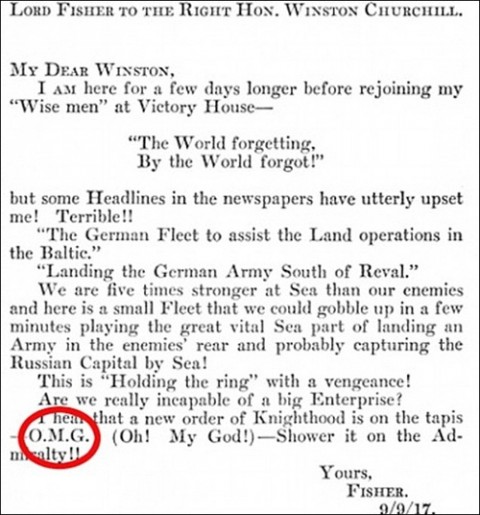
Add to this one more triumph: he unwittingly had a hand in shaping the speech patterns of teenaged girls some 50–60 years after his death. Churchill was the recipient of a missive containing the first ever usage of the oft-texted acronym “O.M.G.”. According to the Oxford English Dictionary, O.M.G.’s origins can be traced back to a letter to Churchill from Admiral John Arbuthnot Fisher, sent on September 9, 1917. After complaining about the state of affairs of the Navy during the war, Fisher closes with the following lame joke: “I hear that a new order of Knighthood is on the tapis – O.M.G. (Oh! My God!) – Shower it on the Admiralty!!”
Churchill’s relationship with Fisher was complex. While he was the First Lord of the Admiralty, Churchill brought Fisher out of retirement in 1911 to head the royal navy. Their relationship went south in 1915 following the failure of the Dardanelles campaign. Churchill was still roundly blamed mostly because of Fisher’s loud, public protestations. (In fact, had the naval officers pushed through the Dardanelles to Constantinople, as Churchill commanded, the war would have likely ended years earlier than it did.) Yet, much to his wife’s dismay, Churchill remained cordial enough with Fisher to exchange friendly notes.
The first online usage of O.M.G., by the way, came on a usenet forum about soap operas in 1994. Churchill does not appear to be connected to that instance.
Related Content:
What Happens When Mortals Try to Drink Winston Churchill’s Daily Intake of Alcohol
Winston Churchill Goes Backward Down a Water Slide & Loses His Trunks (1934)
Jonathan Crow: You can follow him at @jonccrow.
Read More...The Roads of Ancient Rome Visualized in the Style of Modern Subway Maps

Sasha Trubetskoy, formerly an undergrad at U. Chicago, has created a “subway-style diagram of the major Roman roads, based on the Empire of ca. 125 AD.” Drawing on Stanford’s ORBIS model, The Pelagios Project, and the Antonine Itinerary, Trubetskoy’s map combines well-known historic roads, like the Via Appia, with lesser-known ones (in somes cases given imagined names). If you want to get a sense of scale, it would take, Trubetskoy tells us, “two months to walk on foot from Rome to Byzantium. If you had a horse, it would only take you a month.”
You can view the map in a larger format here. And if you follow this link and send Trubetskoy a few bucks, he can email you a crisp PDF for printing. Find more focused, related maps by Trubetskoy right here:
- The Roman Roads of Britain Visualized as a Subway Map
- The Roman Roads of Spain & Portugal Visualized as a Subway Map: Ancient History Meets Modern Graphic Design
- All the Roman Roads of Italy, Visualized as a Modern Subway Map
If you would like to support the mission of Open Culture, consider making a donation to our site. It’s hard to rely 100% on ads, and your contributions will help us continue providing the best free cultural and educational materials to learners everywhere. You can contribute through PayPal, Patreon, and Venmo (@openculture). Thanks!
Related Content:
The Roman Roads and Bridges You Can Still Travel Today
An Interactive Map Shows Just How Many Roads Actually Lead to Rome
How to Make Roman Concrete, One of Human Civilization’s Longest-Lasting Building Materials
Read More...Patti Smith Reads Her Final Letter to Robert Mapplethorpe, Calling Him “the Most Beautiful Work of All”
If you go to hear Patti Smith in concert, you expect her to sing “Beneath the Southern Cross,” “Because the Night,” and almost certainly “People Have the Power,” the hit single from Dream of Life. Like her 1975 debut Horses, that album had a cover photo by Robert Mapplethorpe, whom Smith describes as “the artist of my life” in Just Kids, her memoir of their long and complex relationship. A highly personal work, that book also includes the text of the brief but powerful goodbye letter she wrote to Mapplethorpe, who died of AIDS in 1989. If you go to hear Smith read a letter aloud, there’s a decent chance it’ll be that one.
“Often as I lie awake I wonder if you are also lying awake,” Smith wrote to Mapplethorpe, then in his final hospitalization and already unable to receive any further communication. “Are you in pain, or feeling alone? You drew me from the darkest period of my young life, sharing with me the sacred mystery of what it is to be an artist. I learned to see through you and never compose a line or draw a curve that does not come from the knowledge I derived in our precious time together. Your work, coming from a fluid source, can be traced to the naked song of your youth. You spoke then of holding hands with God. Remember, through everything, you have always held that hand. Grip it hard, Robert, and don’t let it go.”
Smith speaks these words in the Letters Live video at the top of the post, shot just a few weeks ago in The Town Hall in Manhattan. “Of all your work, you are still your most beautiful,” she reads, “the most beautiful work of all,” and it’s clear that, 35 years after Mapplethorpe’s death, she still believes it. That may come across even more clearly than in Smith’s earlier reading of the letter featured here on Open Culture back in 2012. As the years pass, Robert Mapplethorpe remains frozen in time as a culturally transgressive young artist, but Patti Smith lives on, still playing the rock songs that made her name in the seventies while in her seventies. And unlike many cultural figures at her level of fame, she’s remained wholly herself all the while — no doubt thanks to inspiration from her old friend.
Related content:
Patti Smith Remembers Robert Mapplethorpe
Patti Smith’s Award-Winning Memoir Just Kids Now Available in a New Illustrated Edition
Based in Seoul, Colin Marshall writes and broadcasts on cities, language, and culture. His projects include the Substack newsletter Books on Cities and the book The Stateless City: a Walk through 21st-Century Los Angeles. Follow him on Twitter at @colinmarshall or on Facebook.
Read More...Behold the Codex Gigas (aka “Devil’s Bible”), the Largest Medieval Manuscript in the World
Bargain with the devil and you may wind up with a golden fiddle, supernatural guitar-playing ability, or a room full of gleaming alchemized straw.
Whoops, we misattributed that last one. It’s actually Rumpelstiltskin’s doing, but the by-morning-or-else deadline that drives the Brothers Grimm favorite is not dissimilar to the ultimatum posed to disgraced medieval monk Herman the Recluse: produce a giant book that glorifies your monastery and includes all human knowledge by sunrise, or we brick you up Cask of Amontillado-style.
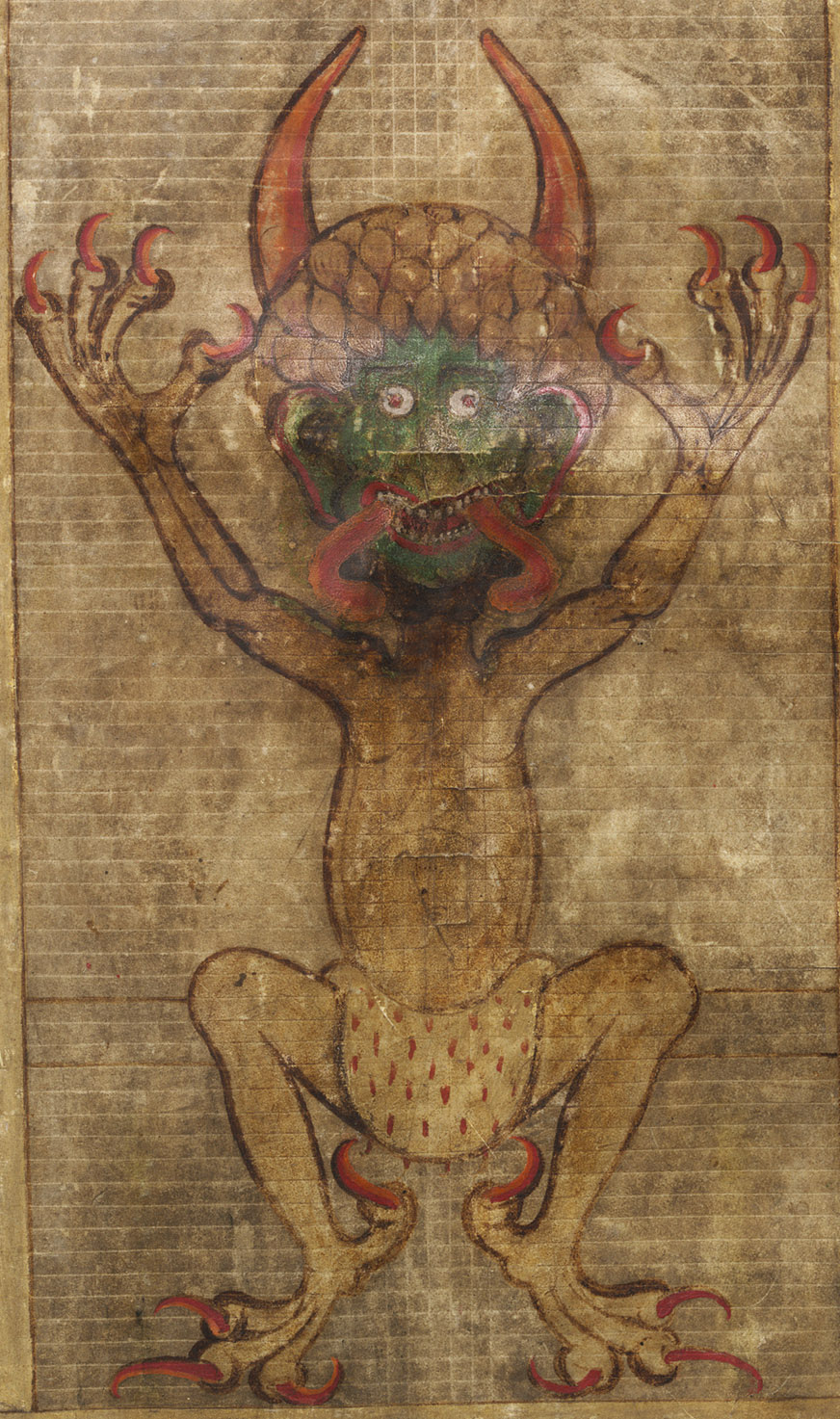
Why else would a book as high-minded as the Codex Gigas (Latin for Giant Book) contain a full-page glamour portrait of the devil garbed in an ermine loincloth and cherry red claws?
Perhaps it’s the 13th-century equivalent of “sex sells.” What better way to keep your book out of the remainder bin of history than to include an eye-catching glimpse of the Prince of Darkness? Hedge your bets by positioning a splendid vision of the Heavenly City directly opposite.
Notable illustrations aside, the Codex Gigas holds the distinction of being the largest extant medieval illuminated manuscript in the world.
Weighing in at 165 lbs, this 3‑foot-tall bound whale required the skins of 160 donkeys, at the rate of two pages per donkey. (Ten pages devoted to St. Benedict’s rules for monastic life were literally cut from the manuscript at an unknown date.)
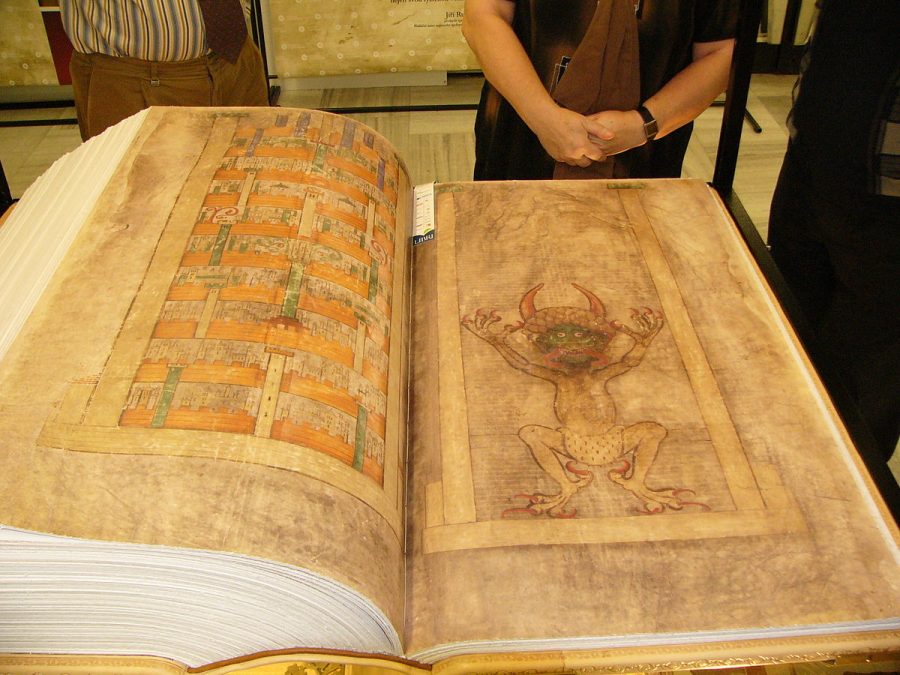
It’s a lot.
A National Geographic documentary concluded that the sprawling manuscript would’ve required a minimum of 5 years of full-time, single-minded labor. More likely, the work was spread out over 25 to 30 years, with various authors contributing to the different sections. In addition to a complete Bible, the “Devil’s Bible” includes an encyclopedia, medical information, a calendar of saints’ days, Flavius Josephus’ histories The Jewish War and Jewish Antiquities and some practical advice on exorcising evil spirits.
The actual lettering does seem to come down to a single scribe with very neat handwriting. Experts at the National Library of Sweden, where the Codex Gigas has come to a rest after centuries of adventures and misadventures, identify it as Carolingian minuscule, a popular and highly legible style of medieval script. Its uniform size would’ve required the scribe to rule each page before forming the letters, after which 100 lines a day would have been a reasonable goal.
You can have a look for yourself on the Library’s website, where the entire work is viewable in digitized form.
Certainly the devil is a great place to start, though his appearance may strike you as a bit comical, given all the fuss.
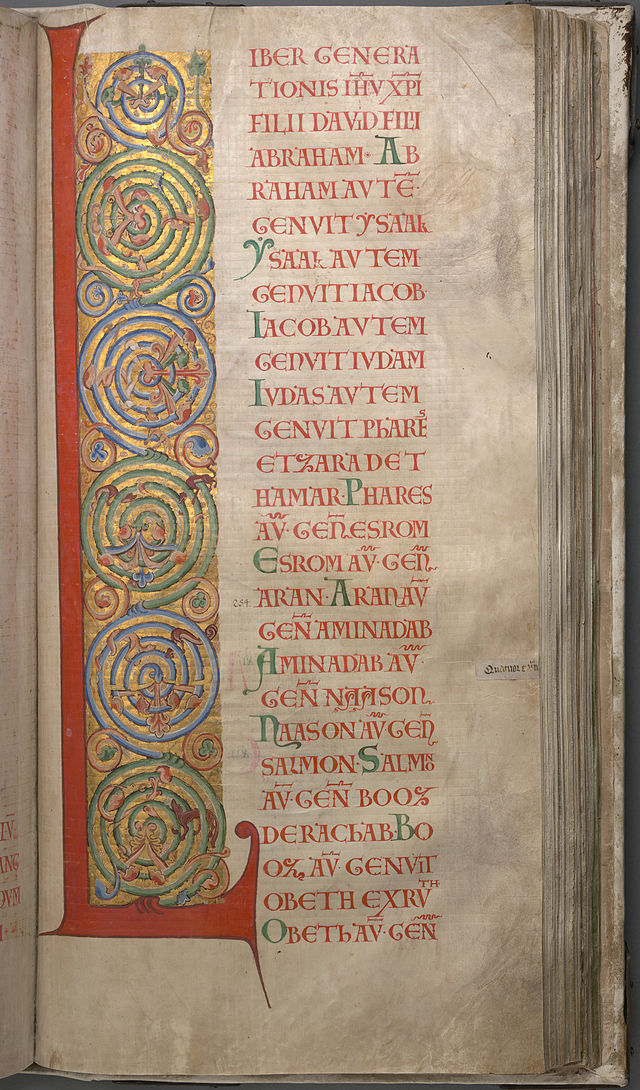
Begin your explorations of the Codex Gigas here.
Related Content:
The Medieval Ban Against the “Devil’s Tritone”: Debunking a Great Myth in Music Theory
Ayun Halliday is an author, illustrator, theater maker and Chief Primatologist of the East Village Inky zine. Follow her @AyunHalliday.
Read More...James Joyce Picked Drunken Fights, Then Hid Behind Ernest Hemingway
Ernest Hemingway seemed to feud with most of the prominent male artists of his time, from Wallace Stevens and T.S. Eliot to F. Scott Fitzgerald. He had a “very strange relationship” with Orson Welles—the two came to blows at least once—and he reportedly slapped Max Eastman in the face with a book. All his bluster and bravado make his warm friendship with James Joyce seem all the more remarkable. They are a literary odd couple if ever there was one: Joyce the labyrinthine thinker of Byzantine thoughts and creator of symbolic systems so dense they constitute an entire field of study; physically weak and—despite his infamous carnal appetites—intellectually monkish, Joyce exemplifies the artist as a reclusive contemplative. Hemingway, on the other hand, well… we know his reputation.
Hemingway’s 1961 obituary in The New York Times characterized Joyce as “a thin, wispy and unmuscled man with defective eyesight” (perhaps the result of a syphilis infection), and also notes that the two writers “did a certain amount of drinking together” in Paris. As the narrator of the rare film clip of Joyce informs us above, the Ulysses author would pick drunken fights, then duck behind his burly friend and say, “Deal with him, Hemingway. Deal with him.” (That scene also gets mentioned in The Times obituary.) Hemingway, who convinced himself at one time he had the makings of a real pugilist, was likely happy to oblige. Joyce, writes Hemingway biographer James R. Mellow, “was an admirer of Hemingway’s adventurous lifestyle” and worried aloud that his books were too “suburban” next to those of his friend, of whom he said in a Danish interview, “he’s a good writer, Hemingway. He writes as he is… there is much more behind Hemingway’s form than people know.”
Joyce, notes Kenneth Schyler Lynn in Hemingway, realized that “neither as a man nor as an artist was [Hemingway] as simple as he seemed,” though he also remarked that Hemingway was “a big powerful peasant, as strong as a buffalo. A sportsman. And ready to live the life he writes about. He would never have written it if his body had not allowed him to live it.” One detects more than a hint of Hemingway in Joycean characters like Dubliners’ Ignatious Gallaher or Ulysses’ Hugh “Blazes” Boylan—strong, adventurous types who overawe introverted main characters. That’s not to say that Joyce explicitly drew on Hemingway in constructing his fiction, but that in the boastful, outgoing American, he saw what many of his semi-autobiographical characters did in their more bullish counterparts—a natural foil.
Hemingway returned Joyce’s compliments, writing to Sherwood Anderson in 1923, “Joyce has a most god-damn wonderful book” and pronouncing Joyce “the greatest writer in the world.” He was “unquestionably… staggered,” writes Lynn, “by the multilayered richness” of Ulysses. But its density may have proven too much for him, as “his interest in the story gave out well before he finished it.” In Hemingway’s copy of the novel, “only the pages of the first half and of Molly Bloom’s concluding soliloquy are cut.” Hemingway tempered his praise with some blunt criticism; unlike Joyce’s praise of his writing, the American did not admire Joyce’s tendency towards autobiography in the character of Stephen Dedalus.
“The weakness of Joyce,” Hemingway opined, was his inability to understand that “the only writing that was any good was what you made up, what you imagined… Daedalus [sic] in Ulysses was Joyce himself, so he was terrible. Joyce was so damn romantic and intellectual.” Of course Stephen Dedalus was Joyce—that much is clear to anyone. How Hemingway, who did his utmost to enact his fictional adventures and fictionalize his real life, could fault Joyce for doing the same is hard to reckon, except perhaps, as Joyce certainly felt, Hemingway led the more adventurous life.
Related Content:
James Joyce Reads a Passage From Ulysses, 1924
Ernest Hemingway to F. Scott Fitzgerald: “Kiss My Ass”
James Joyce’s “Dirty Letters” to His Wife (1909)
Josh Jones is a writer and musician based in Durham, NC. Follow him at @jdmagness
Read More...The Radical Artistic & Philosophical World of William Blake: A Short Introduction
Over the years, we’ve featured the work of William Blake fairly often here on Open Culture: his own illuminated books; his illustrations for everything from the Divine Comedy to Mary Wollstonecraft’s Original Stories from Real Life to the Book of Job; pairs of Doc Martens made out of his paintings Satan Smiting Job with Sore Boils and The House of Death. Blake continues to capture our imaginations, despite having lived in the very different world of the mid-eighteenth century to the mid-nineteenth — but then, he also lived in a world well apart from his contemporaries.
“Blake belonged to the Romantic age, but stands utterly alone in that age, both as an artist and as a poet,” says gallerist-Youtuber James Payne in his new Great Art Explained video above. “He is someone who invented his very own form of graphic art, which organically fused beautiful images with powerful poetry, while he also forged his own distinctive philosophical worldview and created an original cosmology of gods and spirits designed to express his ideas about love, freedom, nature, and the divine.” It wouldn’t be an exaggeration to call him a visionary, not least since he experienced actual visions throughout almost his entire life.
Not just a visual artist but “one of the greatest poets in the English language,” Blake produced a body of work in which word and image are inseparable. Though it “addresses contemporary subjects like social inequality and poverty, child exploitation, racial discrimination, and religious hypocrisy,” its worldliness is exceeded by its otherworldliness. What compels us is as much the power of art itself as the “vast and complicated mythology” underlying the project on which Blake worked until the very end of his life. His ideal was “liberty from tyranny in all forms,” political, religious, scientific, and any other kind besides; in pursuing it, he could hardly have limited himself to just one plane of existence.
Related content:
The Otherworldly Art of William Blake: An Introduction to the Visionary Poet and Painter
William Blake: The Remarkable Printing Process of the English Poet, Artist & Visionary
William Blake’s Hallucinatory Illustrations of John Milton’s Paradise Lost
Based in Seoul, Colin Marshall writes and broadcasts on cities, language, and culture. His projects include the Substack newsletter Books on Cities and the book The Stateless City: a Walk through 21st-Century Los Angeles. Follow him on Twitter at @colinmarshall or on Facebook.
Read More...When a Drunken Charles Bukowski Walked Off the Prestigious French Talk Show Apostrophes (1978)
Charles Bukowski didn’t do TV — or at least he didn’t do American TV. Like a Hollywood movie star shooting a Japanese commercial, he did make an exception for a gig abroad. It happened in 1978, when the poet received an invitation from the popular French literary talk show Apostrophes. Bukowski wasn’t the first foreigner to grace its set: a few years earlier, Vladimir Nabokov had come in advance of the French translation of Ada, but only under the conditions that he be allowed to pre-write his answers and read them off notecards, and to drink whiskey from a teapot during the interview. No such niceties for the author of Ham on Rye, who was set up with earpiece interpretation and Sancerre straight from the bottle.
Or rather, bottles, plural: Bukowski had polished off one of them by the time Apostrophes host Bernard Pivot opened the live broadcast by asking him how it felt to be celebrated on French television. Already drunk, Bukowski responded in a slurred and dismissive fashion. Things deteriorated from there, and Bukowski kept rambling as the other panelists tried to carry on their conversation. At one point François Cavanna ventured a “Bukowski ta gueule”; soon thereafter, Pivot opted for a more direct “Bukowski, shut up,” which prompted the guest of honor’s unsteadily impromptu departure. “Pivot bid him au revoir with a Gallic shrug,” writes Howard Sounes in Charles Bukowski: Locked in the Arms of a Crazy Life.
“The next day, he didn’t remember anything, of course, but the whole of France was running to book shops to buy his books,” says Barfly director Barbet Schroeder in the documentary The Ordinary Madness of Charles Bukowski. “In a few hours they were all sold out.” This succès de scandale made Bukowski even more of a literary rock star in France than he’d already become. The episode has also been widely remembered in the Francophone world since the death of Bernard Pivot earlier this month, never failing to make the much-circulated lists of Apostrophes’ most memorable broadcasts during its fifteen-year run.
?si=w2D1rUFmVIblni97&t=360
“Six million people watched him,” writes Adam Nossiter in Pivot’s New York Times obituary, “and nearly everybody wanted to be on his show. And nearly everybody was, including French literary giants like Marguerite Duras, Patrick Modiano, Jean-Marie Gustave Le Clézio, Marguerite Yourcenar and Georges Simenon.” (One very special episode even brought on “a haggard-looking Aleksandr Solzhenitsyn, not long out of the Soviet Union.”) Apart from Bukowski, Apostrophes’ guest list also included a very different American with an equally enthusiastic French readership: the late Paul Auster, who — like most of the cultural figures whose appearances on the show you can sample on this Youtube playlist — preceded Pivot to that great talk show in the sky.
Related content:
“Don’t Try”: The Philosophy of the Hardworking Charles Bukowski
Hear 130 Minutes of Charles Bukowski’s First-Ever Recorded Readings (1968)
Charles Bukowski Reads His Poem “The Secret of My Endurance”
Based in Seoul, Colin Marshall writes and broadcasts on cities, language, and culture. His projects include the Substack newsletter Books on Cities and the book The Stateless City: a Walk through 21st-Century Los Angeles. Follow him on Twitter at @colinmarshall or on Facebook.
Read More...Ray Bradbury Wrote the First Draft of Fahrenheit 451 on Coin-Operated Typewriters, for a Total of $9.80
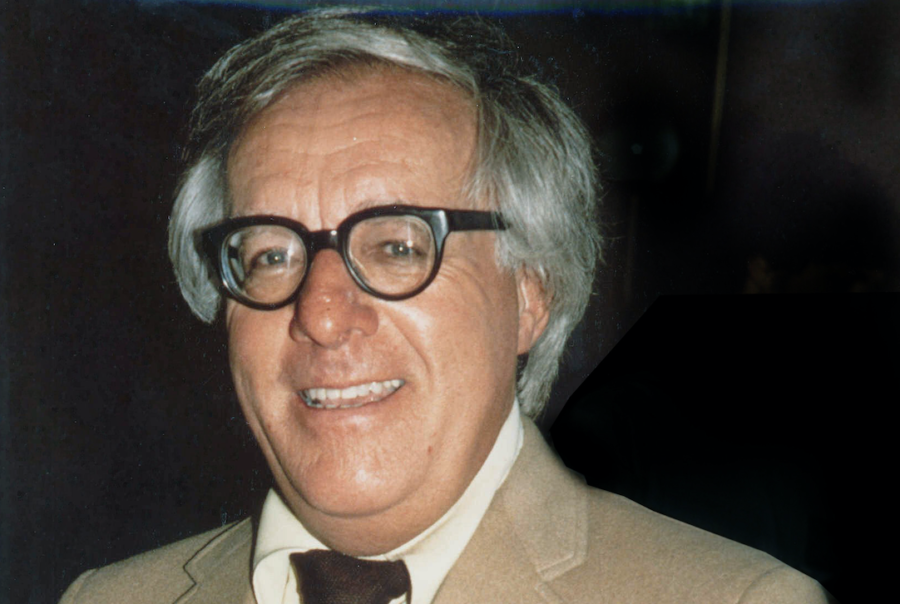
Image by Alan Light, via Wikimedia Commons
It sounds like a third grade math problem: “If Ray Bradbury wrote the first draft of Fahrenheit 451 (1953) on a coin-operated typewriter that charged 10 cents for every 30 minutes, and he spent a total of $9.80, how many hours did it take Ray to write his story?” (If you’re doing the math, that’s great, but you might be in the wrong class.)
Bradbury’s composition of Fahrenheit 451 demonstrates two of the prolific writer’s most insistent demands among his many practical nuggets of writing advice: 1. Always write, all the time; a short story a week, as he told a writer’s symposium in 2001. And, as he told the same group, 2. “Live in the library! Live in the library, for Christ’s sake. Don’t live on your goddamn computer and the internet and all that crap.”
Granted, the library—and the school, and the office, and all the rest of it—now lives in the “goddamn computer” for many of us. But Bradbury’s elaboration of why he ended up in the library in the early 1950s, specifically the basement of UCLA’s Powell Library, will be relatable to any working parent. As he wrote in 1982, he found himself “twice driven; by children to leave at home, and by a typewriter timing device…. Time was indeed money.”
This was a different time, so you’ll need to adjust the currency for 21st century inflation. Also, Bradbury had the 50s’ writer-husband’s prerogative to beg off the childcare. As he explains:
In all the years from 1941 to that time, I had done most of my typing in the family garages… behind the tract house where my wife, Marguerite, and I raised our family. I was driven out of the garage by my loving children, who insisted on coming around to the window and singing and tapping on the panes.
Devoted father Bradbury “had to choose between finishing a story or playing with the girls. I chose to play, of course, which endangered the family income. An office had to be found. We couldn’t afford one.” Bradbury did not write all of Fahrenheit 451 in the library basement. “He ended up with the novella version,” notes UCLA Magazine, “originally called The Fireman and did not come back to it until a publishing company asked if he could add more to the story.”
The speed at which Bradbury wrote, both to save money and to get home to his children, did not cause him to get careless. He looked back on the book 22 years later with pride. “I have changed not one thought or word,” wrote Bradbury in his introduction. He didn’t notice until later that he had named main characters after a paper company, Montag, and pencil company, Faber.
Bradbury told the magazine in 2002, “It was a passionate and exciting time for me. Imagine what it was like to be writing a book about book burning and doing it in a library where the passions of all those authors, living and dead, surrounded me.” When it came to finding the book’s title, however, supposedly the temperature at which books burn, not only did the library fail him, but so too did the university’s chemistry department. To learn the answer, and finish the book, Bradbury finally had to call the fire department.
Related Content:
When François Truffaut Made a Film Adaptation of Ray Bradbury’s Fahrenheit 451 (1966)
Ray Bradbury Gives 12 Pieces of Writing Advice to Young Authors (2001)
Why Should We Read Ray Bradbury’s Fahrenheit 451? A New TED-Ed Animation Explains
Josh Jones is a writer and musician based in Durham, NC. Follow him at @jdmagness.
Read More...Support Us
We're hoping to rely on loyal readers, rather than erratic ads. Please click the Donate button and support Open Culture. You can use Paypal, Venmo, Patreon, even Crypto! We thank you!

About Us

Open Culture scours the web for the best educational media. We find the free courses and audio books you need, the language lessons & educational videos you want, and plenty of enlightenment in between.
Advertise With Us
FREE UPDATES!
GET OUR DAILY EMAIL
Get the best cultural and educational resources on the web curated for you in a daily email. We never spam. Unsubscribe at any time.
FOLLOW ON SOCIAL MEDIA
Open Culture editor Dan Colman scours the web for the best educational media. He finds the free courses and audio books you need, the language lessons & movies you want, and plenty of enlightenment in between.
Advertise With Us



_-cropped-.jpg)