David Foster Wallace’s 1994 Syllabus: How to Teach Serious Literature with Lightweight Books
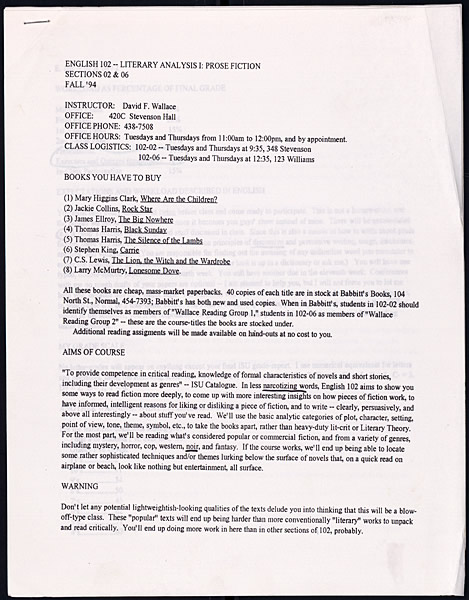
Note: click here to see the full syllabus and other related teaching materials.
As anyone who’s ever done it knows, the art of syllabussing is a fine one. (Yes, it’s a word; don’t look it up, take my word for it—Syllabussing: creating the perfect syllabus for a college-level course). It requires precision planning, stellar formatting and copy-editing skills, and near-perfect knowledge of the college-student psyche. For one, the syllabus must explain in clear terms what students can expect from the class and what the class expects from them. And it must do this without sounding so dry and pedantic that half the class drops in the first week. For another, the perfect syllabus (there’s no such thing, but one must strive) should function as both an FAQ and a contract: need to know how to format your papers? See the syllabus. Forgot when the paper was due? Too bad—see the syllabus. And so on. Most teachers learn over time that a class can stand or fall on the strength of this document.
Which brings us to the syllabussing skills of one David Foster Wallace, encyclopedic literary obsessive, modern-day moralist, English professor. Love his work or hate it, it may be safe to say that Wallace was perhaps one of the most careful (or care-full) writers of his generation. And given the criteria above, you might just have to admire the fine art of his syllabi. Well, so you can, thanks to the University of Texas at Austin’s Harry Ransom Center, which has scans available online of the syllabus for Wallace’s intro course “English 102-Literary Analysis: Prose Fiction” (first page above), along with other course documents. These documents—From the Fall ’94 semester at Illinois State University, where Wallace taught from 1993 to 2002—reveal the professionally pedagogical side of the literary wunderkind, a side every teacher will connect with right away.
The text in the image above is admittedly tiny (you can request higher resolution scans on the UT Austin site), but if you squint hard, you’ll see under “Aims of Course” that Wallace quotes the official ISU description of his class, then translates it into his own words:
In less narcotizing words, English 102 aims to show you some ways to read fiction more deeply, to come up with more interesting insights on how pieces of fiction work, to have informed intelligent reasons for liking or disliking a piece of fiction, and to write—clearly, persuasively, and above all interestingly—about stuff you’ve read.
Having taught my own versions of such a class, I’m a little jealous of his (uncharacteristically?) informal concision.
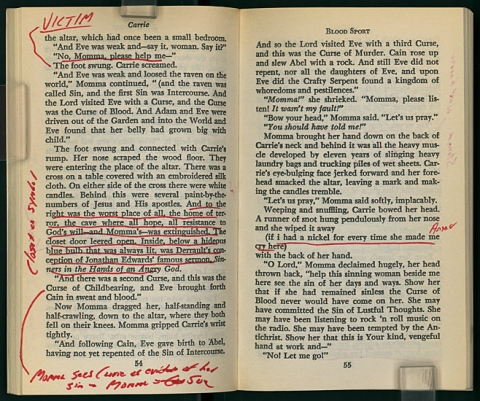
Wallace’s choice of texts is of interest as well—surprising for a writer most detractors call “pretentious.” For his class, Wallace prescribed airport-bookstore standards—what he calls “popular or commercial fiction”—such as Jackie Collins’ Rock Star, Stephen King’s Carrie, Thomas Harris’s The Silence of the Lambs, and James Elroy’s The Big Nowhere. The UT Austin site also has scans of some well-worn paperback teacher’s copies, with the red-ink marginal notes, discussion questions, and underlines one finds behind every podium. In the image above, Wallace has underlined a line of dialogue in Carrie, annotating it with the word “victim” in all-caps. Of the books Wallace requires, he writes in a section of the syllabus above called “Warning”:
Don’t let any potential lightweightish-looking qualities of the texts delude you into thinking that this will be a blow-off-type class. These “popular” texts will end up being harder than more conventionally “literary” works to unpack and read critically. You’ll end up doing more work in here than in other sections of 102, probably.
Something about that “probably” at the end grabs me (again: the precision… the college-student psyche). I admire this brave approach. Having taught conventionally “literary” stuff for years, I can say that some so-called literary fiction is formulaic in the extreme, all but containing checkboxes for the standard lit-crit categories. The commercial stuff isn’t always so careful (which is why it’s so often more fun).
UT Austin’s Harry Ransom Center houses David Foster Wallace’s library and papers, but you’ll have to make a trip to Texas (and present some academic credentials) to access most of the archive. They have scanned a few other choice pieces, however, such as the handwritten first page from a draft of his literary masterpiece/dorm-room doorstop, Infinite Jest.
Related Content:
Download 55 Free Online Literature Courses: From Dante and Milton to Kerouac and Tolkien
Donald Barthelme’s Syllabus Highlights 81 Books Essential for a Literary Education
30 Free Essays & Stories by David Foster Wallace on the Web
David Foster Wallace: The Big, Uncut Interview (2003)
Josh Jones is a writer, editor, musician, and oftentime English teacher to easily-distracted undergraduates. Follow him @jdmagness
Read More...Captivating Collaboration: Artist Hubert Duprat Uses Insects to Create Golden Sculptures
Once upon a time, the larvae of the Caddis Fly were considered pretty unassuming creatures, freshwater dwellers whose appeal was limited to trout and trout fishermen. That is until French artist Hubert Duprat came along with an aesthetic offer they couldn’t refuse.
Left to their own devices, Caddis larvae construct protective cases from natural materials found in their habitat, patching small pieces together with silken thread. A chance encounter with some prospectors at a river in southwestern France led Duprat to wonder how the Caddis larvae might adapt if gold figured more prominently among their building supplies. Thus began The Wonderful Caddis Worm: Sculptural Work in Collaboration with Trichopteras, an ongoing artistic experiment in a carefully controlled, scientific setting.
Basically these birds are spinning their own gilded cages with whatever luxury materials Duprat introduces into their artificial environment. The resulting jewel encrusted creations would not be out of place in a Madison Avenue window, though it’s possible a nearsighted dowager might mistake the tiny jeweler for a cockroach.
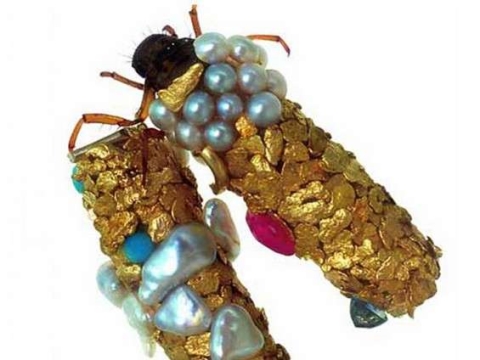
Whether or not one would opt to wear one of these blinged-out insect casings were money no object, one has to admit their engineering is a most unusual feat. It would make for one humdinger of a Science Fair project if only Duprat hadn’t patented the technique in 1983.
via Laughing Squid
Related Content:
Pi in the Sky: The World’s Largest Ephemeral Art Installation over Beautiful San Francisco
Artists Turn Weather Data into Swirling “Living Portraits” of Continental U.S. Wind Patterns
Ayun Halliday is slowly figuring out how a writer homeschools a graphic novel enthusiast in subjects of a scientific nature. Follow her @AyunHalliday
Read More...Eric Clapton Tries Out Guitars at Home and Talks About the Beatles, Cream, and His Musical Roots
“Brownie” Fender Stratocaster:
Eric Clapton recently allowed a camera crew into his London home for an intimate talk. The purpose was to demonstrate a new series of high-priced, limited-edition reproductions of some of his most famous guitars, which will soon go on sale to benefit his Crossroads Centre in Antigua. But as Rolling Stone noted in a recent online piece, the conversation went much deeper.
In the video above, Clapton tries out a replica of an early sunburst Fender Stratocaster, nicknamed “Brownie,” that he purchased in 1967 and played with Derek and the Dominoes. The original guitar, which had a heavily worn maple neck that Clapton attached to a Fender Telecaster body during his days with Blind Faith, was sold at auction in 1999 for $497,500. The replicas were made by the Fender Custom Shop and will sell for $15,000. In the video, Clapton plugs the guitar into a 1950s-era Fender “Tweed Twin” amplifier and tries it out, playing a few blues lines and reminiscing about his early Stratocaster-playing influences: Buddy Holly, Buddy Guy and Jimi Hendrix.
Martin 000–28 and 000–45:
Above, Clapton tries out a pair of acoustic guitars made in his honor by Martin & Co. He talks about his early infatuation with Martin guitars, which he developed after hearing other musicians talk about them and after seeing footage of Big Bill Broonzy playing the 000–28 model. Unlike the other “Crossroads Collection” guitars, the Martins were apparently not modeled after individual guitars Clapton once played, but were instead handmade to his specifications. The Crossroads model 000–28 will sell for $6,000 and the 000–48 will be offered in two editions made with different materials, one for $13,000 and the other for $50,000.
“Lucy” Gibson Les Paul:
Perhaps the most interesting of the three videos involves a guitar Clapton is not usually associated with: a Gibson Les Paul. The guitar is a reproduction of a heavily worn 1957 cherry-red guitar Clapton bought in about 1967, when he was touring America with Cream. He gave the guitar to George Harrison of the Beatles, who nicknamed it “Lucy” and played it on the White Album and Let it Be. When Clapton accepted Harrison’s request to play lead guitar on the recording of “While My Guitar Gently Weeps,” he played it on Lucy. In the video, Clapton reminisces about the Beatles session and talks about the amplifier he used during his days with John Mayall’s Bluesbreakers and the ones he used afterwards. Harrison briefly loaned the original Lucy Les Paul back to Clapton, who played it during his famous Rainbow Concert in 1973, but the guitar still belongs to the Harrison estate. The Gibson-made replicas will sell for $15,000 each.
via Rolling Stone
Related Content:
A Young Eric Clapton Demonstrates the Elements of His Sound
Read More...New Stamp Collection Celebrates Six Novels by Jane Austen
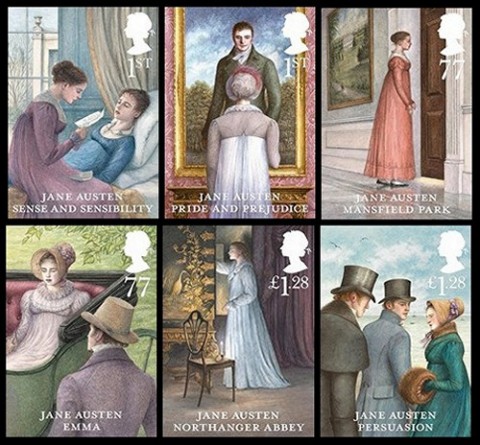 On January 28, 2013, literature fans celebrated the 200th anniversary of Jane Austen’s beloved novel, Pride and Prejudice. The celebration has apparently spilled into February now that the Royal Mail has announced the release of a stamp collection commemorating Jane Austen’s six novels: Sense and Sensibility, Mansfield Park, Emma, Northanger Abbey, Persuasion, and Pride and Prejudice.
Said a spokesman for the postal system: “When you think of great British authors, Jane Austen inevitably comes to mind. Her novels have contributed immeasurably to British culture over the last two centuries.”
Angela Barrett illustrated the new set of stamps, which can be purchased online by UK residents for £5.30 including VAT. A previous stamp set came out in 1975, to mark the bicentennial of Jane Austen’s birth.
Note: Austen’s six novels can be downloaded from our Free Audio Books and Free eBooks collections, along with many other great works.
via Austen Prose
Related Content:
Read Jane Austen’s Manuscripts Online
Jane Austen’s Fight Club, Coming to a Theatre Near You
Read More...Discover Ansel Adams’ 226 Photos of U.S. National Parks (and Another Side of the Legendary Photographer)
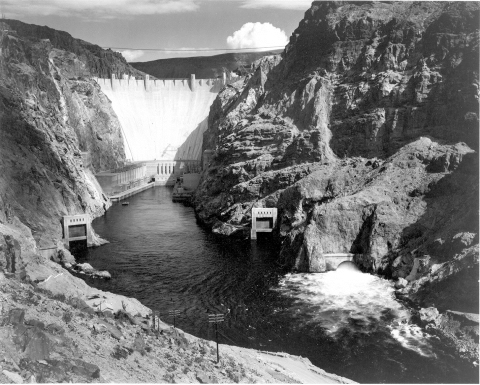
Americans venerate the work of Ansel Adams but tend to get overexposed to the usual Adams prints in dentists’ waiting rooms, corporate offices, and other anesthetic spaces. At least that’s been my experience. It’s easy to forget how much Adams’ work vitally defined the 20th century perception of the American West, as much as Frederic Remington’s defined that of the 19th.
Wednesday, in honor of what would have been Adams 111th birthday, we posted a fascinating 1958 documentary to reintroduce you to the Adams you may have thought you knew—“musician, mountaineer, writer, teacher, photographer.” In the midst of rediscovering Adams ourselves, we stumbled upon an incredible trove of images at the National Archives—226, to be exact—taken at the behest of the National Park Service in 1941.
The purpose was to create a photo mural for the Department of the Interior Building in Washington, DC with the theme “nature as exemplified and protected in the U.S. National Parks.” While WWII put a stop to the project, the photo archive Adams left behind still makes an excellent case for the federal preservation of these landscapes (or what’s left of them today). This is the kind of propaganda I can get behind.
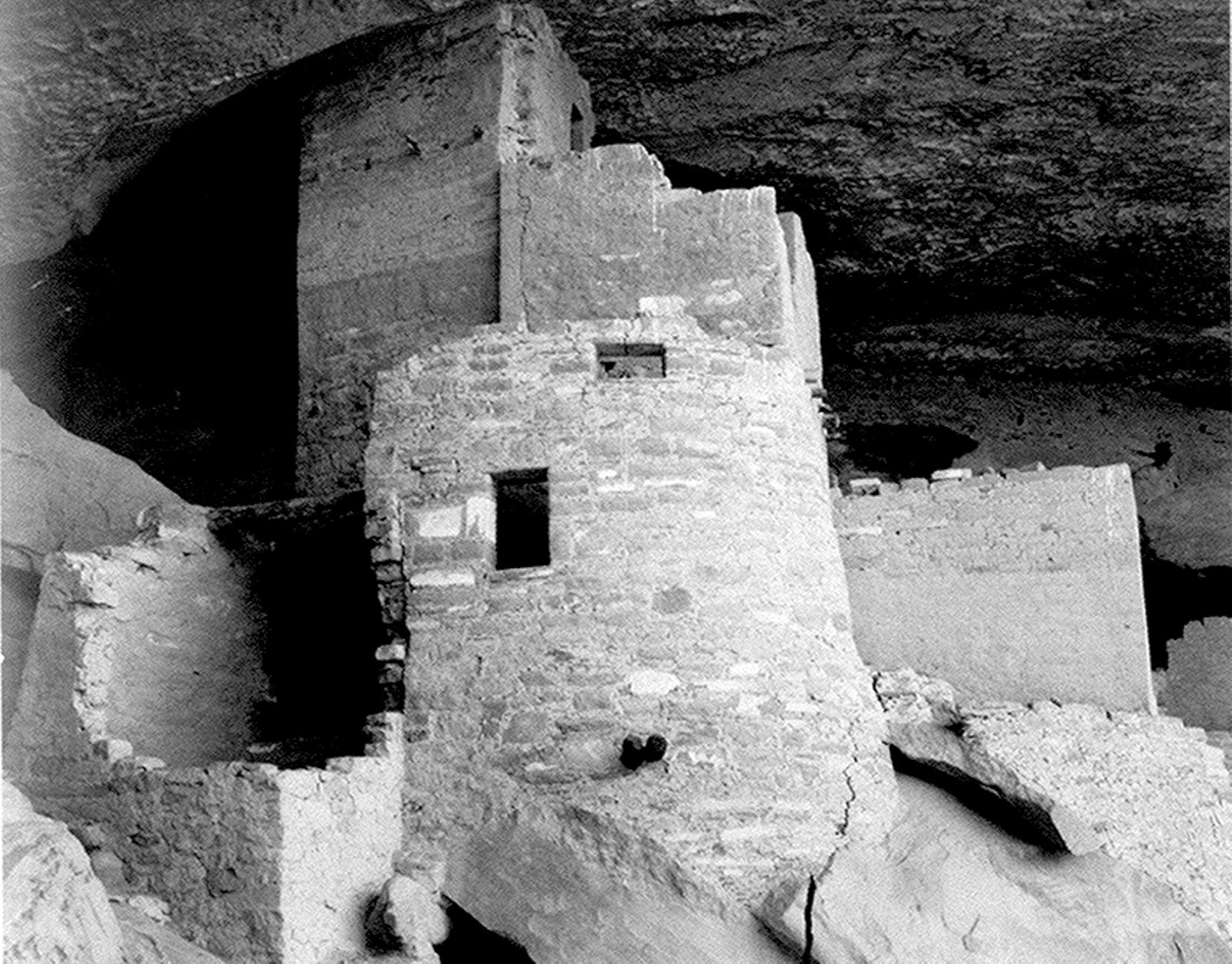
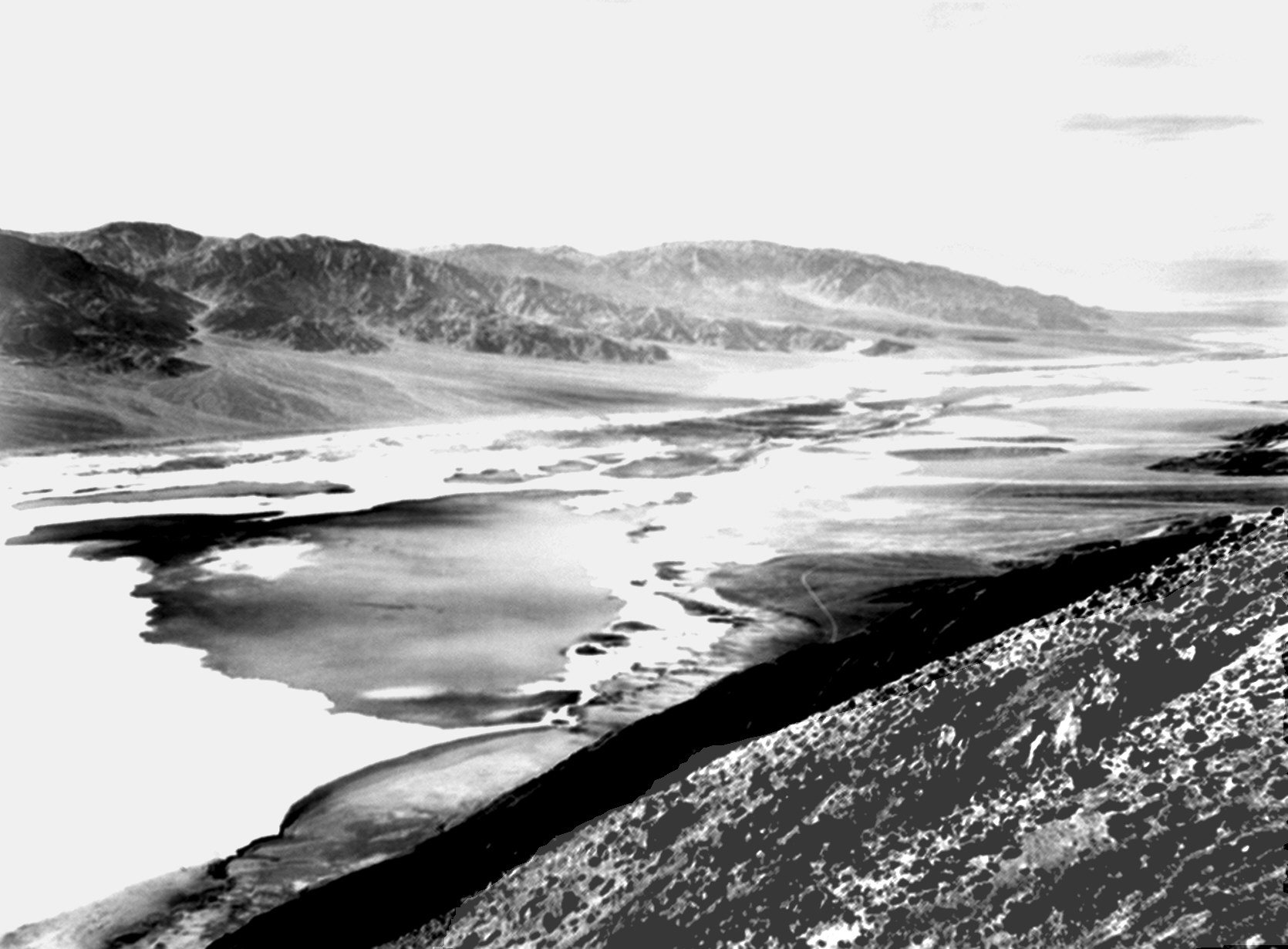
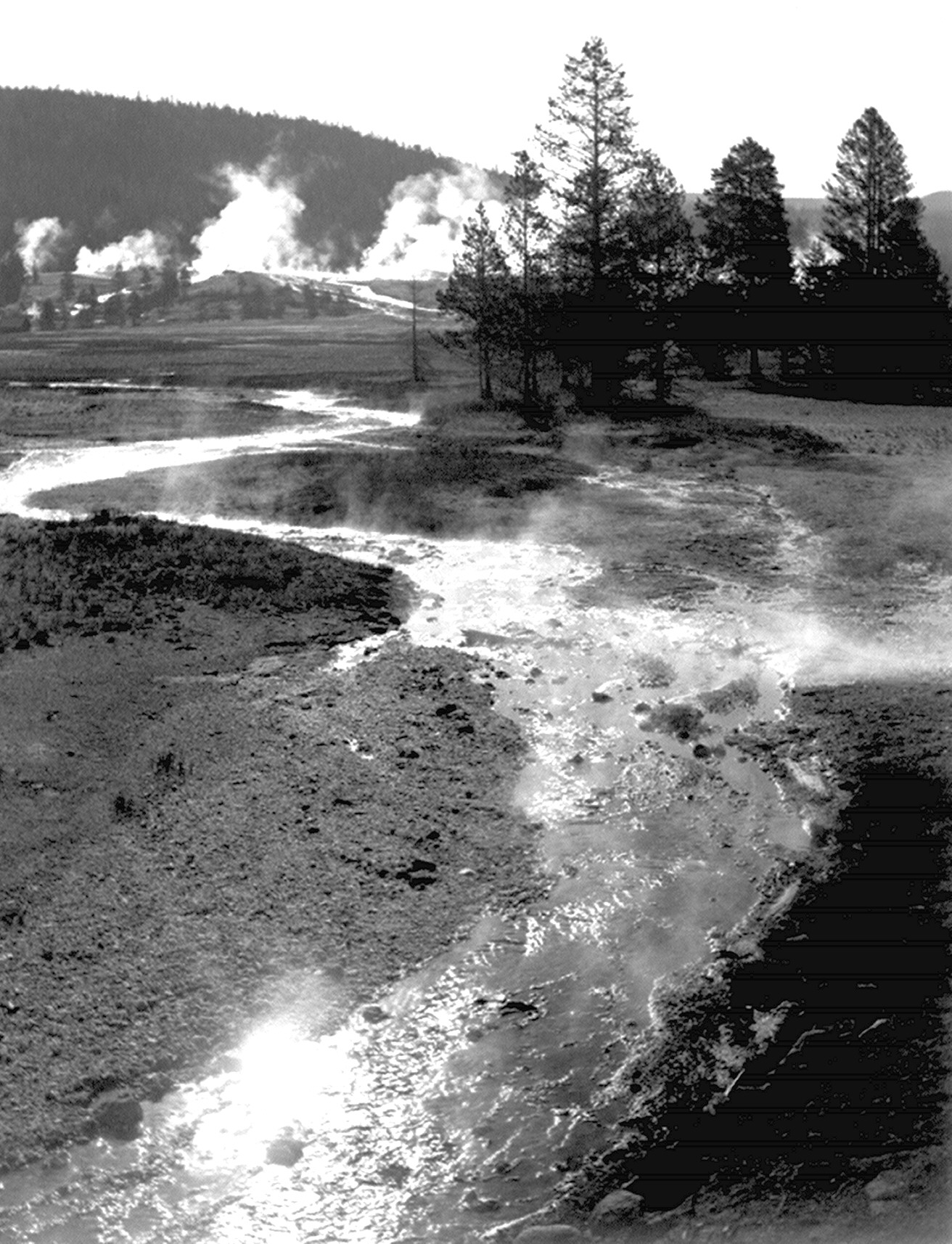
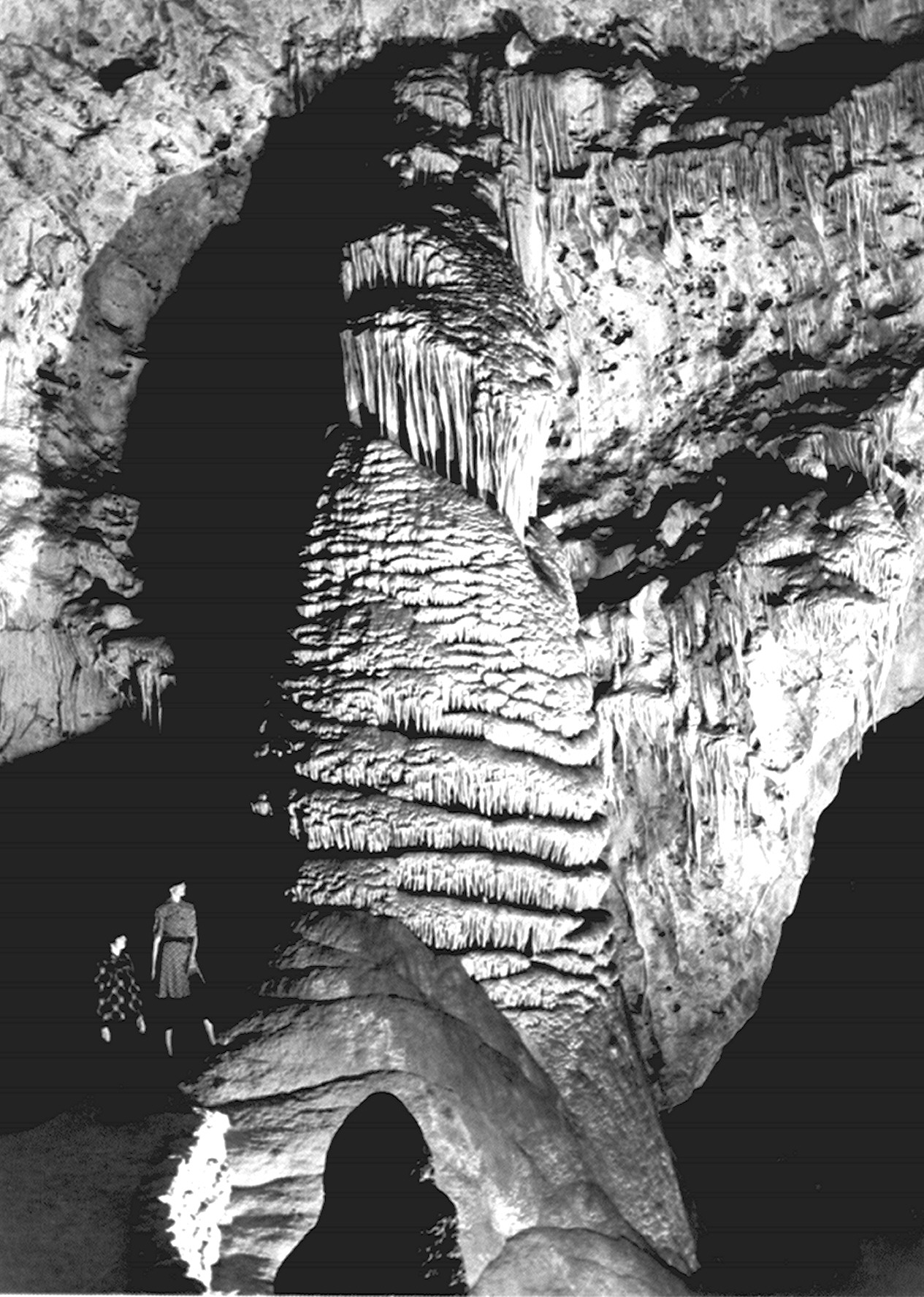
The image above is 79-AAB‑1 in the archive, or more prosaically, “Boulder Dam, 1941.” Adams photographed grand land- and desertscapes all over the West and Southwest, including the Grand Canyon, Mesa Verde, Death Valley, Yellowstone, Yosemite, Carlsbad Caverns, and land belonging to Navajo and Pueblo Indians—such as image #79-AAA‑6 (below), or “Church, Acoma Pueblo,” taken in Acoma Pueblo, New Mexico.
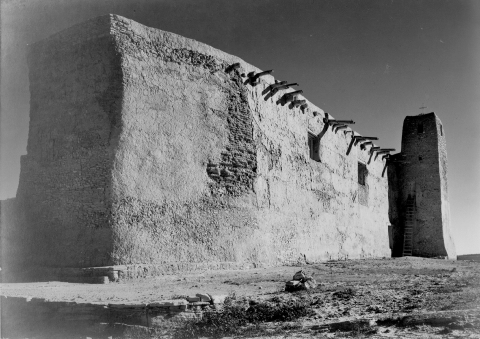
Like most of Adams’ work, these images are monumentally breathtaking in all their high-contrast vastness. Most of them are signed or captioned by Adams. You can browse the archives, view all of the photos, and order prints through the National Archives website.
Related Content:
Extreme Photography: Shooting Big Climbs at Yosemite
Alfred Stieglitz: The Eloquent Eye, a Revealing Look at “The Father of Modern Photography”
Josh Jones is a writer, editor, and musician based in Washington, DC. Follow him @jdmagness
Read More...The Photographer Reveals the Philosophy, Techniques & Artistry of Edward Weston (1948)
He’s been gone 55 years, but the American West we see in our mind’s eye still owes much to Edward Weston’s photographic eye. Yet because he worked in more or less every one of the known forms of his day — portrait, landscape, still-life, scenes in a variety of tones, and beyond — we tend to think we know Weston’s work when we’ve only seen a fraction of it. You can get a sense of the scope of his career by watching The Photographer above. Produced in 1948, the final year of Weston’s career, the half-hour documentary can thus examine nearly his entire body of work. The true Weston aficionado should note that it also examines his home and his cats. (The latter get into the former by way of a cat door made from an old lens board.)
If you have an interest in twentieth-century American photography, Weston’s name often comes up. But you may also recognize the name of the film’s director, Willard Van Dyke. A onetime apprentice of Weston’s, Van Dyke made the introduction between the master and Ansel Adams, thus forming a connection between two men who visually defined America. Along with fellow San Francisco photographer Imogen Cunningham, the three would form the Modernist Group f/64. Van Dyke made The Photographer under the banner of the United States Information Agency, and it has the feel of faintly propagandistic optimism you’d thus expect, but the film has much to show and say about Weston’s methods and the Californian natural world he so strikingly captured.
You will find The Photographer listed in our collection of Free Documentaries Online, part of our collection 4,000+ Free Movies Online: Great Classics, Indies, Noir, Westerns, Documentaries & More.
Related content:
The Creative Process of Ansel Adams Revealed in 1958 Documentary
Henri Cartier-Bresson and the Decisive Moment
Errol Morris: Two Essential Truths About Photography
Colin Marshall hosts and produces Notebook on Cities and Culture and writes essays on literature, film, cities, Asia, and aesthetics. He’s at work on a book about Los Angeles, A Los Angeles Primer. Follow him on Twitter at @colinmarshall.
Read More...Watch Huell Howser’s Decades of Television Travels Online. It’s California Gold!
When television broadcaster Huell Howser passed away last month, we Southern Californians realized just how far his persona reached. The cliché “larger than life” seems, in this light, almost apt; it describes his famously voluble enthusiasm, larger than the broadly local life he explored on camera. Though followers identify California’s Gold as Howser’s flagship series, he hosted specialized ones as well, such as Downtown, focusing on Los Angeles’ historic core, California’s Missions (subject obvious), and Road Trip, which took him farther afield. Above, you’ll find an episode of California’s Gold shot in Palm Springs. Howser happened to own a home out there, but more to the point, so did Frank Sinatra; it’s the Chairman of the Board’s house that Howser devotes his considerable curiosity to walking through and finding out everything about. Below, you can join him for a look at Vincent Price’s art collection on a Visiting… broadcast that contains an interview Howser recorded with Price back in the eighties.
“I don’t have an agent,” said Howser in a 2009 Los Angeles Times profile. “I don’t have a manager, I don’t have a press agent, I don’t have a wardrobe guy, a makeup guy, a parking space, a dressing room. It’s basically me and a cameraman and an editor and a couple of guys in the office. I can go out between now and noon and do a full 30-minute show just talking to people on the street and have it on the air tonight.” You can watch all these shows on Chapman University’s new Huell Howser Archive; just click on a series title under the “Shows” column, then through to each episode’s individual post. For a public television icon, Howser had a production sensibility ideally suited for the internet, domain of the cheap and cheerful — well, domain of the cheap, anyway. “We have shrugged our way into a world where everyone is supposed to be a critic of everything, all the time,” actor Thomas Lennon wrote in a remembrance titled “Why Huell Howser Was the Opposite of the Internet.” “Huell, on the other hand, would get into his car, drive for hours, and show us things… just so he could tell us how wonderful they were.”
Colin Marshall hosts and produces Notebook on Cities and Culture and writes essays on literature, film, cities, Asia, and aesthetics. He’s at work on a book about Los Angeles, A Los Angeles Primer. Follow him on Twitter at @colinmarshall.
Read More...
George Martin, Legendary Beatles Producer, Shows How to Mix the Perfect Song Dry Martini
George Martin knows something about mixing. The Beatles trusted him to mix their albums, deciding which ingredients to leave in, and which ones to leave out. (Take for example this lost guitar solo from “Here Comes The Sun.”) The record producer, sometimes known as the Fifth Beatle, has taste. No one disputes that. So let’s let him mix us the perfect dry gin martini and issue an amusing word of caution. Hope you’re taking careful notes.…
Related Content:
William Faulkner’s Hot Toddy Recipe
Guitarist Randy Bachman Demystifies the Opening Chord of ‘A Hard Day’s Night’
Peter Sellers Reads “A Hard Day’s Night” in Shakespearean Mode
Read More...Queen Documentary Pays Tribute to the Rock Band That Conquered the World
If there were ever a band that perfectly embodied all of the massive excesses of late 70’s arena rock, that band was Queen. Occasionally ridiculous, often sublime, never boring, the four piece overtook The Who for stage spectacle and rock theatrics, and could boast of one of the most adventurous and innovative rock guitarists of all time in Brian May.
The rhythm section of John Deacon and Roger Taylor didn’t slouch either, but as we know, when we’re talking Queen, we’re talking Freddie Mercury, the most charismatic, powerful lead singer in rock history, or as Allmusic’s Greg Plato put it, “one of rock’s greatest all-time entertainers/showmen,” who “possessed one of the greatest voices in all of music and penned some of pop’s most enduring and instantly recognizable compositions.” I suspect there a little hyperbole there, but maybe not much.
In any case, Mercury sold all those “greatests” to hundreds of millions of fans, over a 20 year career spanning 26 albums and many hundreds of operatic megashows. Mercury and the band worked incredibly long and hard to earn every accolade, tribute, box set, and memorial since Mercury’s shockingly sudden (or so it seemed) death from AIDS complications in 1991. One of the most recent of those tributes is the documentary above Queen: The Days of Our Lives.
Released on the 40th anniversary of Queen’s founding in May 2011, the film takes its title not from the long-running soap opera but from the band’s final recording together, “These Are the Days of Our Lives” (below), written by drummer Roger Taylor and issued as a single in the U.S. just one month before Mercury’s death. The song (and video) subsequently became a poignant reminder of Mercury’s talent and presence; it is a fitting reference for a Queen film this comprehensive.
The “plot” of the documentary, so to speak, can roughly be summarized as: rise from band of hungry university students to global rock stars; declining sales, low times, infighting; rise again in triumphant revival after the ’85 Live Aid and the Magic Tour in 1986; and, finally, tragically, the end. Producer Rhys Thomas says of the film:
We have set out to make the definitive Queen documentary. It’s a funny, honest, inspiring and ultimately tragic account of ‘a certain band called Queen,’ as told by the band themselves. We tell the story of four students who met in West London, slogged hard and conquered the world, ultimately changing rock music forever.
Whether you think Queen always changed rock music for the better is a matter of personal taste, but they’ll never be forgotten. Originally released in two parts on UK television, the full version of the documentary above has Dutch subtitles, tons of archival footage and revealing interviews, and enough awesome guitar solos to fill up Wembley Stadium.
Related Content:
Freddie Mercury at Live Aid (1985)
Freddie Mercury: The Untold Story of the Singer’s Journey From Zanzibar to Stardom
Josh Jones is a writer, editor, and musician based in Washington, DC. Follow him @jdmagness
Read More...Ansel Adams Reveals His Creative Process in 1958 Documentary
Today marks what would be the 111th birthday of Ansel Adams, the American photographer who captured the sublime power of the wilderness, taking iconic images of the American West, most notably in Yosemite Valley. (See photo gallery here.) Original footage documenting the creative life of Ansel Adams is surprisingly hard to come by online. So A/V Geeks and Develop Tube did us all a favor when they revived this 1958 documentary revealing Adams’ technical approach to photography, the cameras and related gear he carried to the field, and his thoughts on the artistic horizons of photography.
Ansel Adams, Photographer (1958) is available at YouTube and Archive.org. It will now appear in our collection of Free Documentaries, a subset of our meta collection, 4,000+ Free Movies Online: Great Classics, Indies, Noir, Westerns, Documentaries & More.
If you would like to support the mission of Open Culture, consider making a donation to our site. It’s hard to rely 100% on ads, and your contributions will help us continue providing the best free cultural and educational materials to learners everywhere. You can contribute through PayPal, Patreon, and Venmo (@openculture). Thanks!
Related Content:
Alfred Stieglitz: The Eloquent Eye, a Revealing Look at “The Father of Modern Photography”
1972 Diane Arbus Documentary Interviews Those Who Knew the American Photographer Best
Henri Cartier-Bresson and the Decisive Moment
Read More...Support Us
We're hoping to rely on loyal readers, rather than erratic ads. Please click the Donate button and support Open Culture. You can use Paypal, Venmo, Patreon, even Crypto! We thank you!

About Us

Open Culture scours the web for the best educational media. We find the free courses and audio books you need, the language lessons & educational videos you want, and plenty of enlightenment in between.
Advertise With Us

FREE UPDATES!
GET OUR DAILY EMAIL
Get the best cultural and educational resources on the web curated for you in a daily email. We never spam. Unsubscribe at any time.
FOLLOW ON SOCIAL MEDIA

Open Culture editor Dan Colman scours the web for the best educational media. He finds the free courses and audio books you need, the language lessons & movies you want, and plenty of enlightenment in between.
Advertise With Us