Before Bill Nye, There Was Julius Sumner Miller: Watch Complete Episodes of His Classic Science Show, Why Is It So?, Free Online (1962–73)
“We are approaching a darkness in the land. Boys and girls are emerging from every level of school with certificates and degrees, but they can’t read, write or calculate. We don’t have academic honesty or intellectual rigor.” That quote may sound like a familiar lament today, but it’s actually drawn from an interview conducted about half a century ago with the physicist and television host Julius Sumner Miller. If that name sounds familiar to you, there’s a fair chance you’re an Australian who grew up between the sixties and the eighties — and it’s hardly impossible that, thanks to his program Why Is It So?, you went on to pursue a career in science or engineering.
Generations of young viewers down under and elsewhere learned from Why Is It So? that physics and its principles could be fun. Even if you weren’t among them at the time, you can now watch full episodes of the show uploaded to YouTube by ABC, the Australian Broadcasting Corporation.
As you may notice after just a few seconds of listening to him, Miller himself was American. The Massachusetts-born son of immigrants from Latvia and Lithuania, he studied physics at Boston University and thereafter taught and performed research at various institutions (befriending Albert Einstein along the way) before taking a long-term position at El Camino College in Torrance, California in 1952.
Miller’s popularity at El Camino, the school’s proximity to Hollywood, and television’s rapid expansion into a mass medium led to his launching Why Is It So? on KNXT in Los Angeles in 1959. By the mid-sixties, he was also explaining scientific phenomena on Disney’s Mickey Mouse Club, Great Moments in Science, and Science and Its Magic, as well as on Steve Allen’s late-night talk show. He made his debut on Australian television when the University of Sydney brought him out as a visiting lecturer. The appearance went wrong when he couldn’t perform his standard trick of driving a drinking straw through a potato, but what it nevertheless got him — apart from an office filled with the domestic straws he’d jokingly criticized on-air — was a new home for Why Is It So? on ABC.
ABC has so far made available seven full broadcasts originally aired between the early sixties and the early seventies. Despite their black-and-white production and lack of visual effects, they hold up well today in both educational and entertainment value. However engaging his personality as what we would now call a science communicator, it seems that “Miller could be a terror in the classroom,” according to his Los Angeles Times obituary from 1987, “intolerant of misspelled words or misplaced punctuation” and insistent that “most faculty were not rigid enough and that students were not learning enough.” He’d hardly be pleased with what’s happened to intellectual standards in the nearly four decades since his death, but he’d surely appreciate that his teaching continues to reach “everybody ages four to 94,” as he liked to describe his audience. Age, nationality, and even credentials didn’t matter; what counted was genuine curiosity and the willingness to pursue it, whether in the classroom or the living room.
Related Content:
Watch a Young Carl Sagan Appear in His First TV Documentary, The Violent Universe (1969)
Based in Seoul, Colin Marshall writes and broadcasts on cities, language, and culture. He’s the author of the newsletter Books on Cities as well as the books 한국 요약 금지 (No Summarizing Korea) and Korean Newtro. Follow him on the social network formerly known as Twitter at @colinmarshall.
Read More...How William S. Burroughs Used the Cut-Up Technique to Shut Down London’s First Espresso Bar (1972)
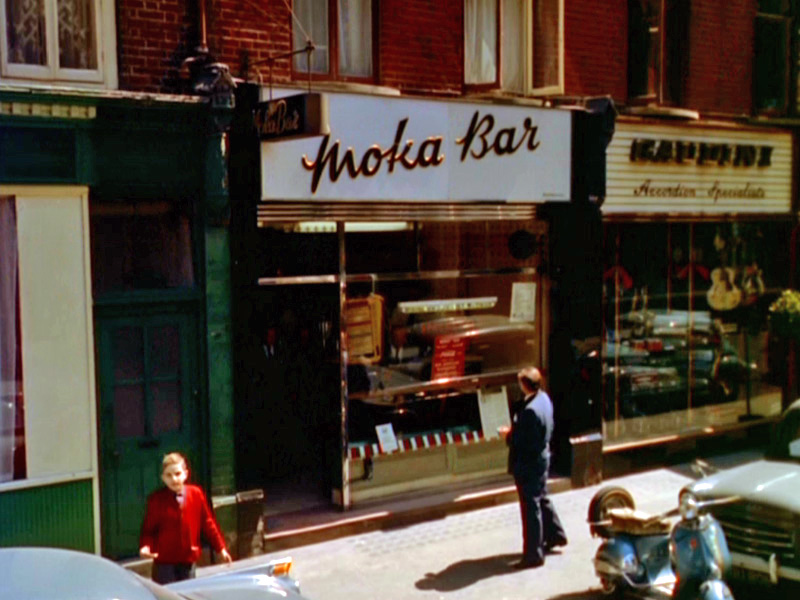
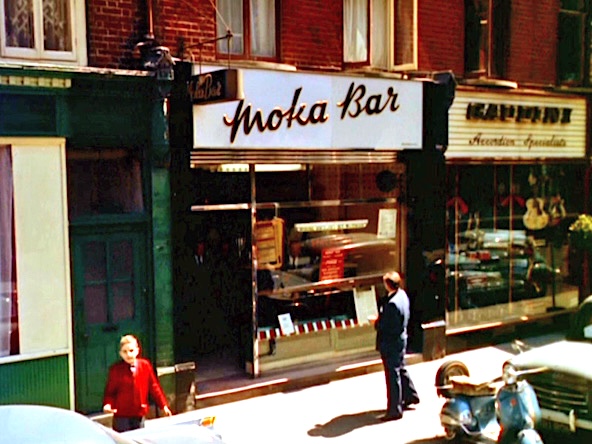
As we’ve noted before, the English coffeehouse has served as a staging ground for radical, sometimes revolutionary social change. Certainly this was the case during the Enlightenment, as it was with the salons in France. And yet, by the early 20th century it seems, coffee shops in London had grown scarcer and more humdrum. That is until 1953 when the Moka Bar, the UK’s first Italian espresso bar, opened in Soho. On his blog The Great Wen, Peter Watts describes its arrival as “a momentous event”:
London’s first proper coffee shop—one equipped with a Gaggia coffee machine—opened at 29 Frith Street. This was a place where teenagers too young for pubs could come and gather, and it is said by some that the introduction of this coffee bar prompted the youth culture explosion that soon changed social life in Britain forever.
“By 1972,” Watts writes, “coffee bars were everywhere and the teenage revolution was firmly established.” Places like the Moka Bar might seem like the ideal place for countercultural maven William S. Burroughs—a London resident from the late sixties to early seventies—to hobnob with young dissidents and outsiders. Burroughs, who so approvingly refers to the possibly apocryphal anarchist pirate colony of Libertatia in his Cities of the Red Night, would, one might think, appreciate the budding anarchism of British youth culture, which would flower into punk soon enough.
But rather than joining the coffee bar scene, the cantankerous Burroughs had taken to frequenting “plush gentlemen’s shops of the area, not to mention the ‘Dilly Boys,’ young male prostitutes who hustled for clients outside the Regent Palace Hotel.”
And he had grown increasingly disillusioned with London, fuming, writes Ted Morgan in Burroughs’ biography Literary Outlaw, “at what he was paying for his hole-in-the-wall apartment with a closet for a kitchen” and at the rising price of utilities. “Burroughs,” Morgan tells us, “began to feel that he was in enemy territory.” And he thought the Moka coffee bar should pay the price for his indignities.
There, “on several occasions a snarling counterman had treated him with outrageous and unprovoked discourtesy, and served him poisonous cheesecake that made him sick.” Burroughs “decided to retaliate by putting a curse on the place.” He chose a means of attack that he’d earlier employed against the Church of Scientology, “turning up… every day,” writes Watts, “taking photographs and making sound recordings.” Then he would play them back a day or so later on the street outside the Moka. “The idea,” writes Morgan, “was to place the Moka Bar out of time. You played back a tape that had taken place two days ago and you superimposed it on what was happening now, which pulled them out of their time position.”
Burroughs also connected the method to the Watergate recordings, the Garden of Eden, and the theories of Alfred Korzybski. The trigger for the magical operation was, in his words, “playback.” In a very strange essay called “Feedback from Watergate to the Garden of Eden,” from his collection Electronic Revolution, Burroughs described his operation in detail, a disruption, he wrote, of a “control system.”
Now to apply the 3 tape recorder analogy to this simple operation. Tape recorder 1 is the Moka Bar itself it is in pristine condition. Tape recorder 2 is my recordings of the Moka Bar vicinity. These recordings are access. Tape recorder 2 in the Garden of Eden was Eve made from Adam. So a recording made from the Moka Bar is a piece of the Moka Bar. The recording once made, this piece becomes autonomous and out of their control. Tape recorder 3 is playback. Adam experiences shame when his discgraceful behavior is played back to him by tape recorder 3 which is God. By playing back my recordings to the Moka Bar when I want and with any changes I wish to make in the recordings, I become God for this local. I effect them. They cannot affect me.
The theory made perfect sense to Burroughs, who believed in a Magical Universe ruled by occult forces and who experimented heavily with Scientology, Crowley-an Magick, and the orgone energy of Wilhelm Reich. The attack on the Moka worked, or at least Burroughs believed it did. “They are seething in there,” he wrote, “I have them and they know it.” On October 30th, 1972 the establishment closed its doors—perhaps a consequence of those rising rents that so irked the Beat writer—and the location became the Queens Snack Bar.
The audio-visual cut-up technique Burroughs used in his attack against the Moka Bar was a method derived by Burroughs and Brion Gysin from their experiments with written “cut-ups,” and Burroughs applied it to film as well. At the top of the post, see an interpretive “meditation” based on Burroughs’ use of audio/visual “magical weapons” and incorporating his recordings. On YouTube, you can watch “The Cut Ups,” a short film Burroughs himself made in 1966 with cinematographer Antony Balch, a disorienting illustration of the cut up technique.
Not limited to attacking annoying London coffeehouse owners, Burroughs’ supposedly magical interventions in reality were in fact the fullest expression of his creativity. As Ted Morgan writes, “the single most important thing about Burroughs was his belief in the magical universe. The same impulse that led him to put out curses was, as he saw it, the source of his writing.” Read much more about Burroughs’ theory and practice in Matthew Levi Stevens’ essay “The Magical Universe of William S. Burroughs,” and hear the author himself discourse on the paranormal, tape cut-ups, and much more in the lecture below from a writing class he gave in June, 1986.
Note: An earlier version of this post appeared on our site in 2014.
Related Content:
How David Bowie, Kurt Cobain & Thom Yorke Write Songs With William Burroughs’ Cut-Up Technique
When William S. Burroughs Joined Scientology (and His 1971 Book Denouncing It)
How to Jumpstart Your Creative Process with William S. Burroughs’ Cut-Up Technique
Josh Jones is a writer and musician based in Durham, NC.
Read More...Hip 1960s Latin Teacher Translated Beatles Songs into Latin for His Students: Read Lyrics for “O Teneum Manum,” “Diei Duri Nox” & More
I’ve interacted with many entertaining language-learning resources in various classes—from miniseries in Spanish to comic books in French—all geared toward making the unfamiliar language relevant to daily life. Learning counterintuitive pronunciations, parsing a new system of grammar, or memorizing the genders of word after word can be laborious and intimidating in the classroom. Doing so in everyday pop cultural settings, not as much.
When it comes to the teaching of dead languages, the resources can seem less approachable. I certainly appreciate the literary and rhetorical genius of Virgil, Ovid, Horace, Cicero, and Julius Caesar. But during my high school years, I did not always find their work easy to read in English, much less in formal classical Latin. The elation I felt after successfully translating a passage was sometimes dampened as I puzzled over historical notes and glosses that often left me with more questions than answers.
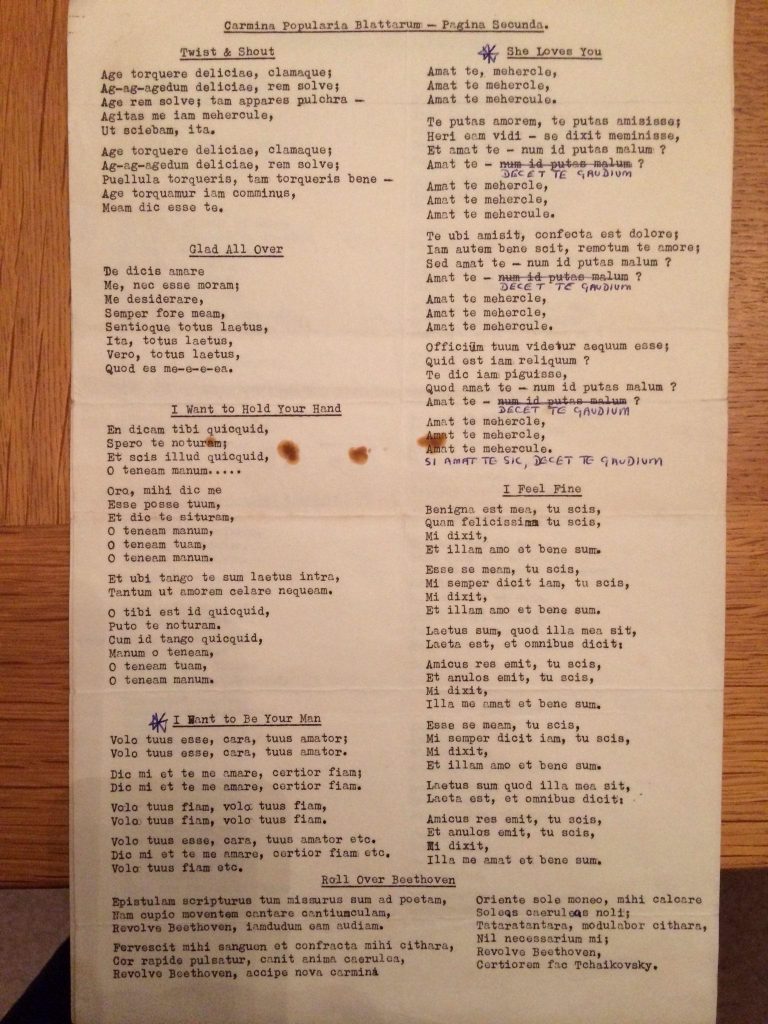
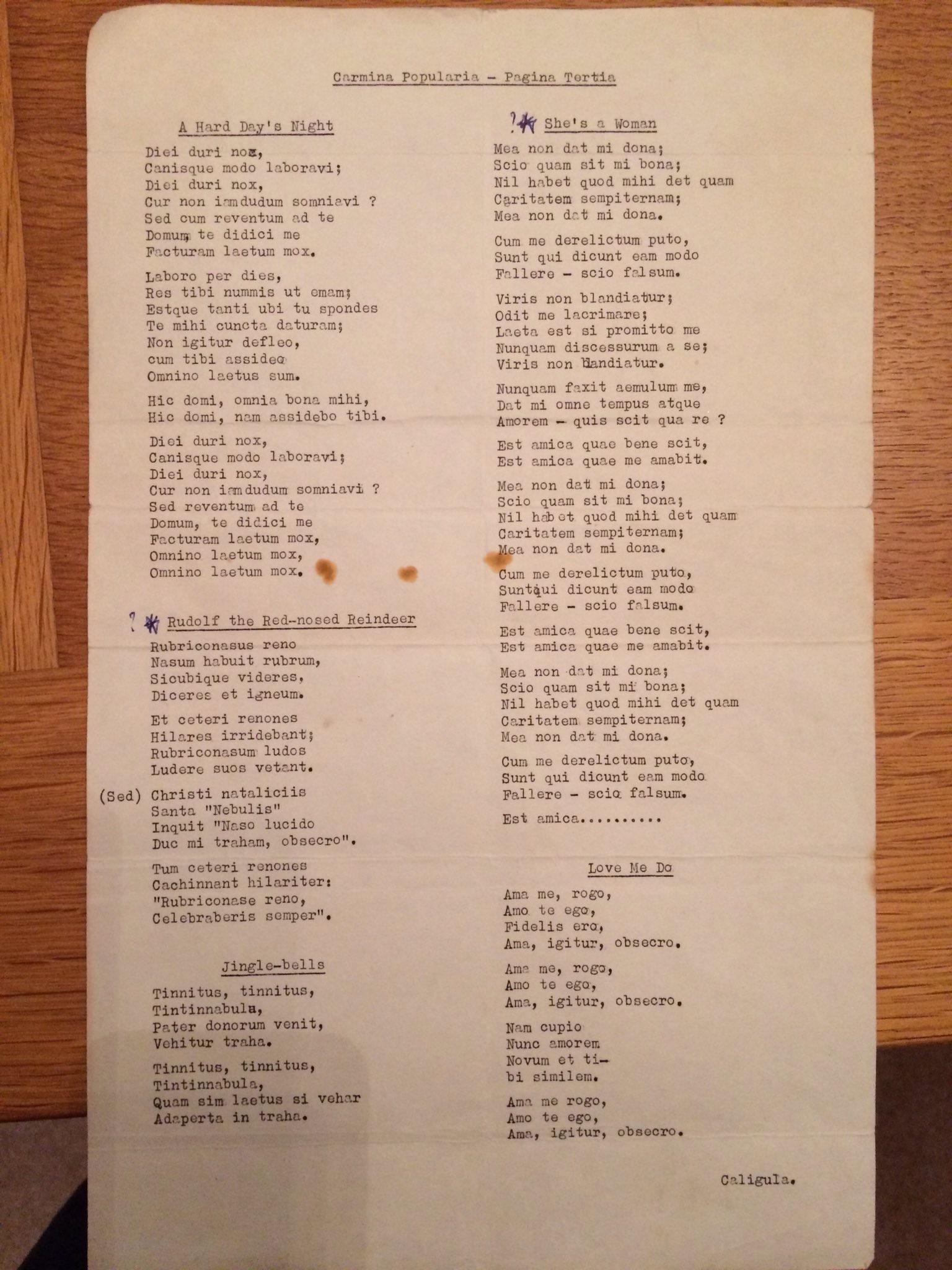
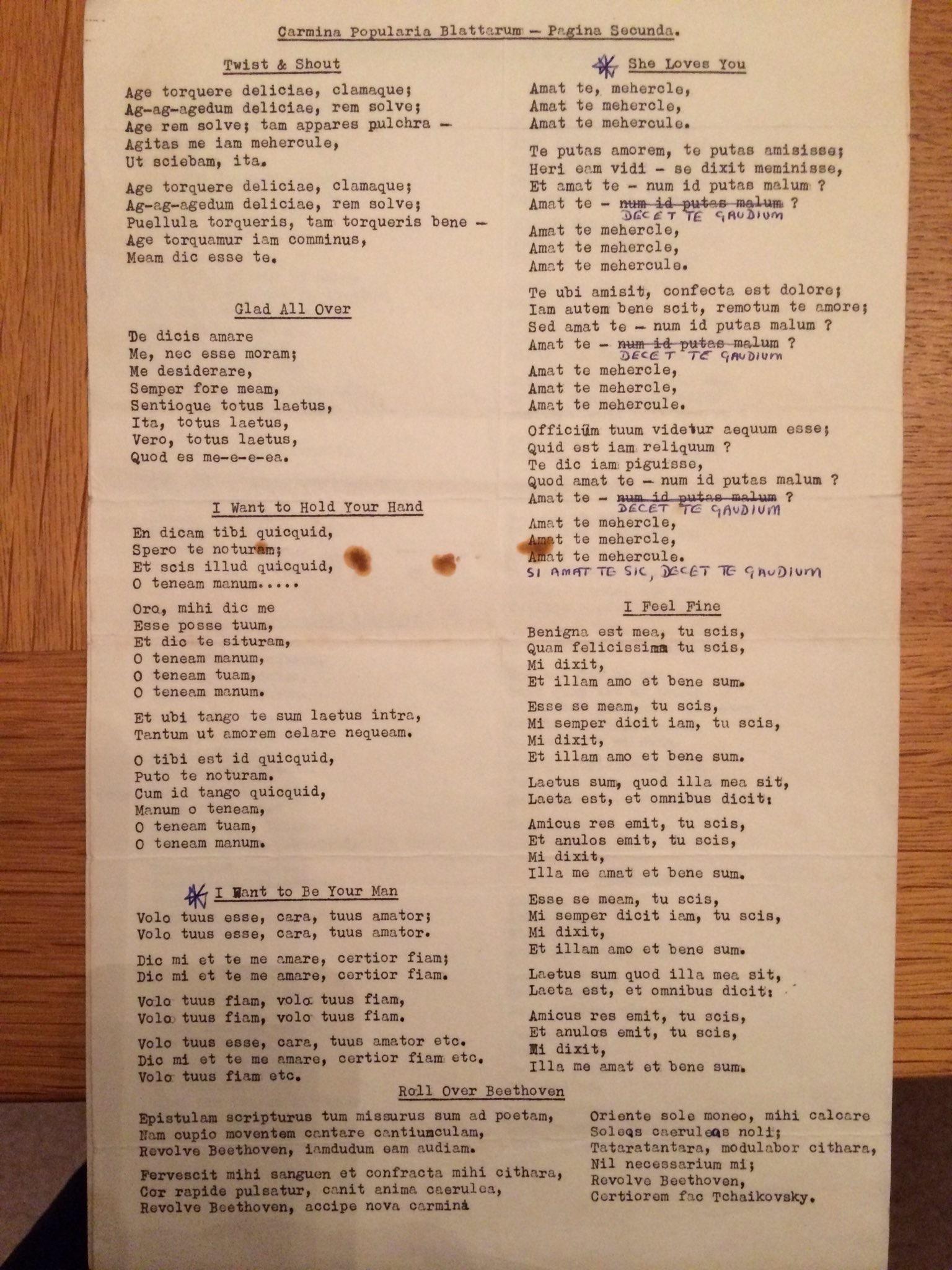
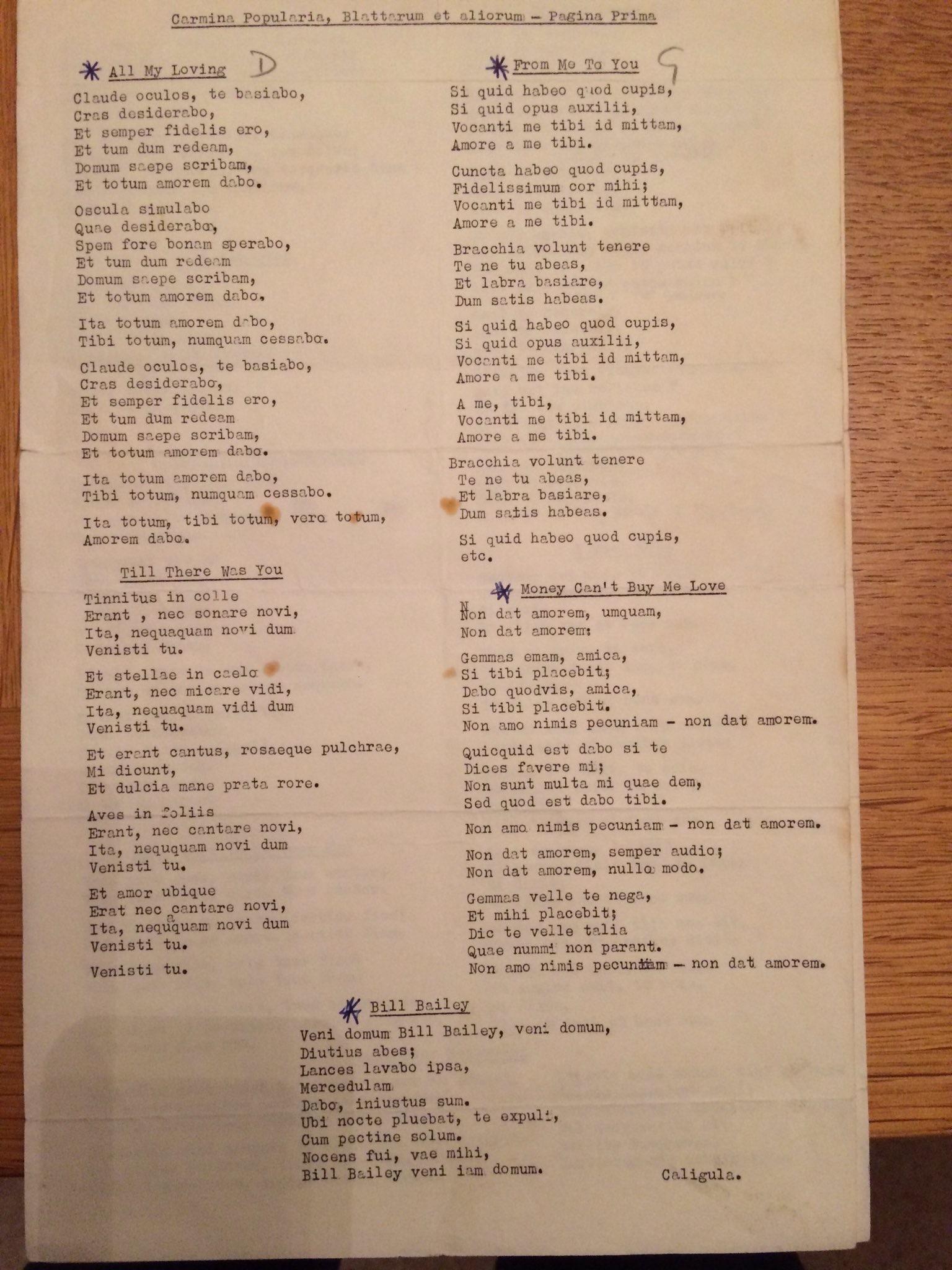
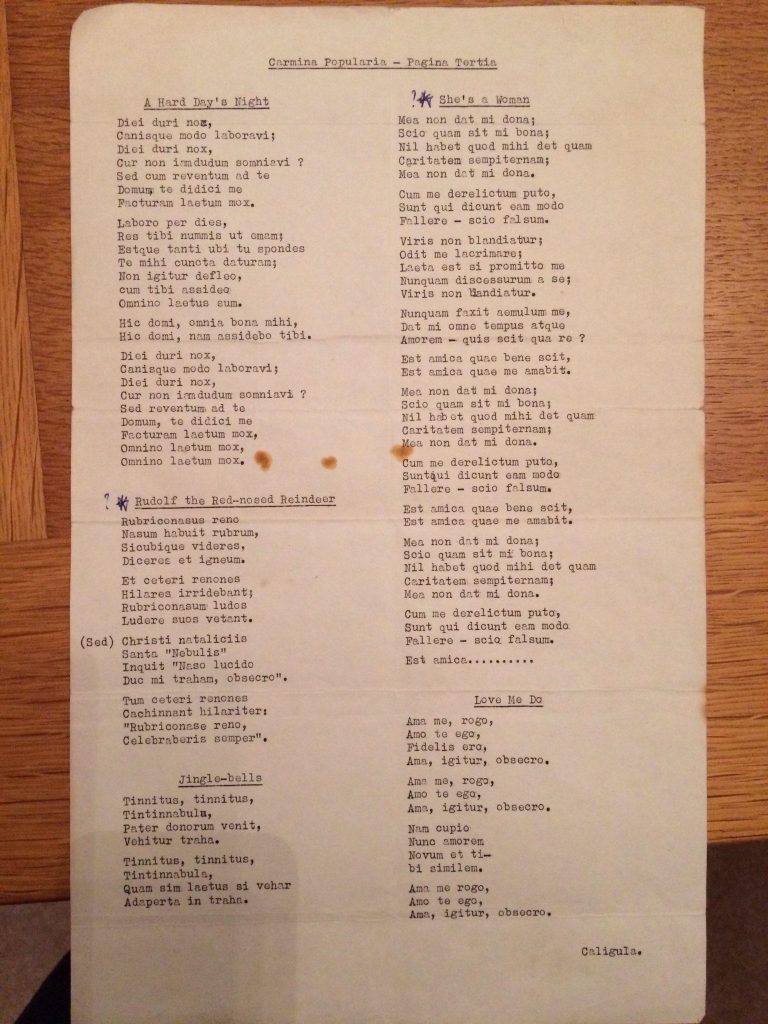
That’s not at all to say that students of Latin shouldn’t be exposed to cultural and historical context or read the finest exemplars of the written language. Only that a break from the heavy stuff now and then goes a long way. Might I submit to Latin instructors one ingenious tool from Eddie O’Hara, former British Labour Party MP and classics teacher? O’Hara passed away in May 2016, and not long after his death, his son Terry O’Hara tweeted these translations of Beatles songs (including two Christmas tunes) his father made in the 60s for his students. At the time, these were the height of pop culture relevance, and, while a far cry from the complexities of the Aeneid, a fun way for Latin learners to relate to a language that can seem cold and imposing.
I will admit, my Latin has fallen into such a state that I can’t immediately vouch for the accuracy or elegance of these translations (“cue fierce arguments among Latin grammarians,” replies one Twitter user), but there’s no reason to doubt Mr. O’Hara knew his stuff. ““He was a born educator,” his son remembers, “He was a teacher and classicist by background and he had a strong interest in educational matters and Greek cultural heritage.” Educated himself at Magdalen College, Oxford, O’Hara taught at Perse School, Cambridge, Birkenhead School, and in the early 70s, C.F. Mott College in the Beatles’ own Liverpool.
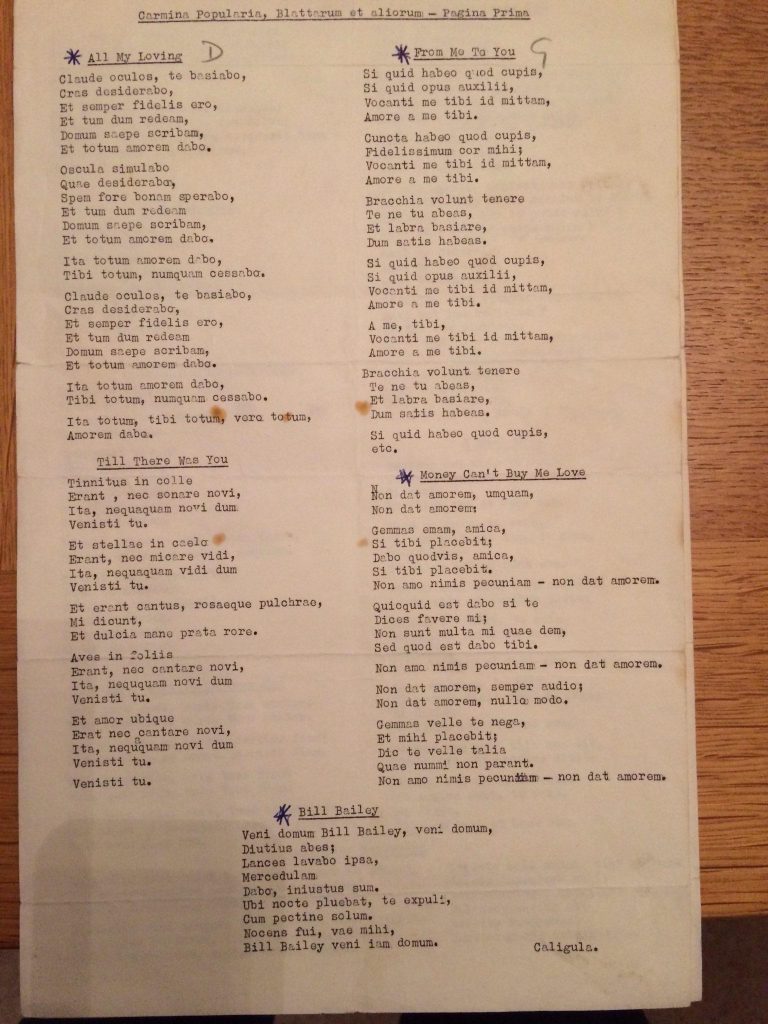
In addition to his role as a statesman, the Liverpool Echo remembers O’Hara’s many decades as “a popular teacher who brought classes to life translating Beatles lyrics into Latin.” We do not have any indication of whether he actually tried to sing the lyrics, though his students surely must have attempted it. What must the chorus of “All My Loving” sound like as “Ita totum amorem dabo, Tibi totum, numquam cessaba”? Or “She Loves You” as “Amat te, mehercle”? Singing them to myself, I can see that O’Hara was sensitive to the meter of the original English in his Latin renderings. But I’d really love to see someone set these to music and make a video. Any of our readers up to the challenge?
Finally, since early sixties Beatles lyrics aren’t as likely to engage students in 2017, what pop cultural material would you translate today—classics teachers out there—to reach the bemused, bewildered, and the bored? If you’re already hard at work using hip resources in the classroom, please do share them with us in the comments!
Note: To view the images in a larger format, please click on the links to these individual images: Image 1 - Image 2 — Image 3. When the image opens, click on it again to zoom in.
Note 2: An earlier version of this post appeared on our site in 2017.
Related Content:
Hear Nirvana’s “Smells Like Teen Spirit” Performed in Classical Latin
Can Modern-Day Italians Understand Latin? A YouTuber Puts It to the Test on the Streets of Rome
They Might Be Giants’ John Linnell Releases an EP of Songs in Latin
The Story of Lorem Ipsum: How Scrambled Text by Cicero Became Used by Typesetters Everywhere
Josh Jones is a writer and musician based in Durham, NC.
Read More...Hear Robert Johnson’s “Come On in My Kitchen” in Remarkably Restored Audio, Taken from a Rare Test Pressing
Robert Johnson died at just 27 years old, some say as a consequence of selling his soul to the devil at a crossroads. But before his time came, he managed to record 29 songs, a scant body of work that nevertheless secured his artistic immortality as one of the most influential blues musicians of all time. It’s unfortunate that his recordings, all of them made between 1936 and 1937 in less-than-ideal studio conditions even for the time, leave something to be desired in the audio quality department. But now, some 90 years later, sound restorer Nick Dellow has been uploading relatively crisp digitized “test pressings” of Johnson’s songs to YouTube: last month, for example, we featured one of “Cross Road Blues” here on Open Culture.
In the video above, you’ll find a similarly higher-quality version of “Come On in My Kitchen,” a song acknowledged as an early demonstration of the young Johnson’s otherworldly musical power. You may notice that the title labels this particular recording as “take one.” Johnson also recorded a much different second take, which his label Vocalion Records released in 1937, possibly because it sounded less mournful and thus — according to record-industry logic — more viable as a hit.
Though take one now seems to be regarded as the “true” rendition of the song by his serious enthusiasts, the public didn’t get to hear it until 1961, when it was included on the compilation King of the Delta Blues Singers that did more than any other release to win Johnson his posthumous fan base.
It is, admittedly, not easy to imagine the first take of “Come On in My Kitchen” sweeping the dance halls, even with this sound quality much improved from the version on King of the Delta Blues Singers. But the reasons Johnson’s music has endured so long have less to do with his ability to get a crowd moving than with his combination of understated virtuosity and preternatural-sounding ability to reach into genuinely haunting emotional realms. Like many canonical singer-songwriters who died young, he seems always to be and remain somehow older than us, his listeners, even as we reach (and indeed pass) middle age. Occasionally, the release of never-before-heard recordings or pressings reveals the true edge of immaturity in such figures; with Johnson, it only deepens his legend.
Related content:
Keith Richards Shows Us How to Play the Blues, Inspired by Robert Johnson, on the Acoustic Guitar
Robert Johnson Finally Gets an Obituary in The New York Times 81 Years After His Death
The Legend of How Bluesman Robert Johnson Sold His Soul to the Devil at the Crossroads
Based in Seoul, Colin Marshall writes and broadcasts on cities, language, and culture. He’s the author of the newsletter Books on Cities as well as the books 한국 요약 금지 (No Summarizing Korea) and Korean Newtro. Follow him on the social network formerly known as Twitter at @colinmarshall.
Read More...The Myth of Sisyphus Wonderfully Animated in an Oscar-Nominated Short Film (1974)
Even if you don’t know the myth by name, you know the story. In Greek mythology, Sisyphus, King of Corinth, was punished “for his self-aggrandizing craftiness and deceitfulness by being forced to roll an immense boulder up a hill, only to watch it roll back down, repeating this action for eternity.” In modern times, this story inspired Albert Camus to write “The Myth of Sisyphus,” an essay where he famously introduced his concept of the “absurd” and identified Sisyphus as the absurd hero. And it provided the creative material for a breathtakingly good animation created by Marcell Jankovics in 1974. The film, notes the annotation that accompanies the animation on YouTube, is “presented in a single, unbroken shot, consisting of a dynamic line drawing of Sisyphus, the stone, and the mountainside.” Fittingly, Jankovics’ little masterpiece was nominated for the Best Animated Short Film at the 48th Academy Awards.
Note: An earlier version of this post appeared on our site in 2015.
If you would like to support the mission of Open Culture, consider making a donation to our site. It’s hard to rely 100% on ads, and your contributions will help us continue providing the best free cultural and educational materials to learners everywhere. You can contribute through PayPal, Patreon, and Venmo (@openculture). Thanks!
Related Content
Mythos: An Animation Retells Timeless Greek Myths with Abstract Modern Designs
Mythology Expert Reviews Depictions of Greek & Roman Myths in Popular Movies and TV Shows
Read More...
What Happens When a Musician Plays Stevie Ray Vaughan’s “Pride and Joy” on a $25 Kids’ Guitar at Walmart
There’s a maxim that says, “It’s not the guitar, it’s the player.” And the video above bears it out.
In this clip, musician Clay Shelburn and his pal Zac Stokes visit a Walmart at 3 a.m. and pick up a Disney Cars 2 toy guitar. Next, they proceed to play Stevie Ray Vaughan’s “Pride and Joy” and unleash the full potential of that $25 guitar. The Barbies all go crazy.
When it comes to the blues, any old guitar will do. That we know. But if you care to watch Shelburn play the same song on a guitar that runs north of $1,000, check out the video below.
If you would like to support the mission of Open Culture, consider making a donation to our site. It’s hard to rely 100% on ads, and your contributions will help us continue providing the best free cultural and educational materials to learners everywhere. You can contribute through PayPal, Patreon, and Venmo (@openculture). Thanks!
Related Content:
Ozzy Osbourne’s Guitarist Zakk Wylde Plays Black Sabbath on a Hello Kitty Guitar
Read More...Watch the Moment When the Wreck of the Titanic Was First Discovered (1985)
The wreck of the RMS Titanic has never ceased to command attention, from pop-cultural fascination to scientific scrutiny and everything in between. That can make it seem, especially to the younger generations, as if humanity has been gazing upon its remains since they first settled at the bottom of the North Atlantic Ocean. In fact, the precise location of the shipwreck went unknown for more than 73 years, between the day of the disaster, April 15th, 1912, and that of the discovery, September 1, 1985. In the video above, you can watch the very moment debris from the Titanic first came into the view of Argo, the unmanned undersea camera used by the researchers seeking it out.
“Somebody should get Bob,” says one of the crew as soon as it becomes clear, even on their low-resolution black-and-white monitor, that they’re looking at man-made objects on the sea floor. And well they should have: the Bob in question is oceanographer and Argo inventor Robert Ballard, who’d been actively thinking about how to find the Titanic since at least the early nineteen-seventies and boarded Woods Hole Oceanographic Institute’s R/V Knorr with intent to find it.
In truth, the voyage was financed by the U.S. Navy, which had much less interest in finding the wreck of the Titanic than those of the USS Scorpion and Thresher, two nuclear submarines lost in the sixties. If Ballard could look for them, so the deal went, he could use the expedition’s spare time and resources on his life’s mission.
After determining that the Scorpion and Thresher had imploded, Ballard and the Knorr crew continued on to the general area in which the Titanic sank. Knowing that the infamously “unsinkable” ocean liner would have been subject to the same mighty undersea pressure, they kept their eyes open, through Argo, for similarly scattered fragments rather than intact sections of the hull. As the video shows us, the strategy worked: only when a trail of debris leads them to an identifiable boiler, proof positive that they’d found what they were looking for, does the cheer go up. Ballard would go on to discover other widely known shipwrecks — the battleship Bismarck, the aircraft carrier USS Yorktown in 1998 — but one suspects that nothing quite matches that first Titanic high.
Related content:
The Fascinating Engineering of the Titanic: How the Great Ocean Liner Was Built
Watch 80 Minutes of Never-Released Footage Showing the Wreckage of the Titanic (1986)
Titanic Survivor Interviews: What It Was Like to Flee the Sinking Luxury Liner
Watch the Titanic Sink in Real-Time
See the Well-Preserved Wreckage of Ernest Shackleton’s Ship Endurance Found in Antarctica
Based in Seoul, Colin Marshall writes and broadcasts on cities, language, and culture. He’s the author of the newsletter Books on Cities as well as the books 한국 요약 금지 (No Summarizing Korea) and Korean Newtro. Follow him on the social network formerly known as Twitter at @colinmarshall.
Read More...Chuck Jones’ The Dot and the Line Celebrates Geometry & Hard Work: An Oscar-Winning Animation (1965)
The animated short above, The Dot and the Line, directed by the great Chuck Jones and narrated by English actor Robert Morley, won an Oscar in 19656 for Best Animated Short Film. Based on a book written by Norton Juster, “The Dot and the Line” tells the story of a romance between two geometric shapes—taking the archetypal narrative trajectory of boy meets girl, loses girl, wins girl in the end (finding himself along the way) and injecting it with some fascinating social commentary that still resonates almost fifty years later. One way of watching “The Dot and the Line” is as a “triumph of the nerd” story, where an anxious square (as in “uncool”) Line has to compete with a hipster beatnik Squiggle of a rival for the affections of a flighty Dot.
The Line begins the film “stiff as a stick… dull, conventional and repressed” (as his love interest says of him) in contrast to the groovy Squiggle and his groovy bebop soundtrack. With the possible suggestion that this love transgresses mid-century racial boundaries, the Line’s friends disapprove and tell him to give it up, since “they all look alike anyway.” But the Line persists in his folly, indulging in some Walter Mitty-like reveries of heroic endeavors that might win over his Dot. Finally, using “great self-control,” he manages to bend himself into an angle, then another, then a series of simple, then very complex, shapes, becoming, we might assume, some kind of mathematical wiz. After refining his talents alone, he goes off to show them to Dot, who is “overwhelmed” and delighted and who “giggles like a schoolgirl.”
Here the subtext of the nerd-gets-the-girl storyline manifests a fairly conservative critique of the “anarchy” of the Squiggle, whom the Dot comes to see as “undisciplined, graceless, coarse” and other unflattering adjectives while the line—who proclaimed to himself earlier that “freedom is not a license for chaos”—is “dazzling, clever, mysterious, versatile, light, eloquent, profound, enigmatic, complex, and compelling.” I can almost imagine that George Will had a hand in the writing, which is to say that it’s enormously clever, and enormously invested in the values of self-control, hard work, and discipline, and distrustful of spontaneity, free play, and general grooviness. At the end of the film, our Dot and Line go off to live “if not happily ever after, at least reasonably so” in some cozy suburb, no doubt. The moral of the story? “To the vector belong the spoils.”
If you would like to support the mission of Open Culture, consider making a donation to our site. It’s hard to rely 100% on ads, and your contributions will help us continue providing the best free cultural and educational materials to learners everywhere. You can contribute through PayPal, Patreon, and Venmo (@openculture). Thanks!
Related Content
Carl Sagan Explains Evolution in an 8‑Minute Animation
Watch “Geometry of Circles,” the Abstract Sesame Street Animation Scored by Philip Glass (1979)
Josh Jones is a writer and musician based in Durham, NC.
Read More...10,000 Chicago Concert Recordings Are Being Uploaded to the Internet Archive: Nirvana, Phish, Sonic Youth, They Might Be Giants & More
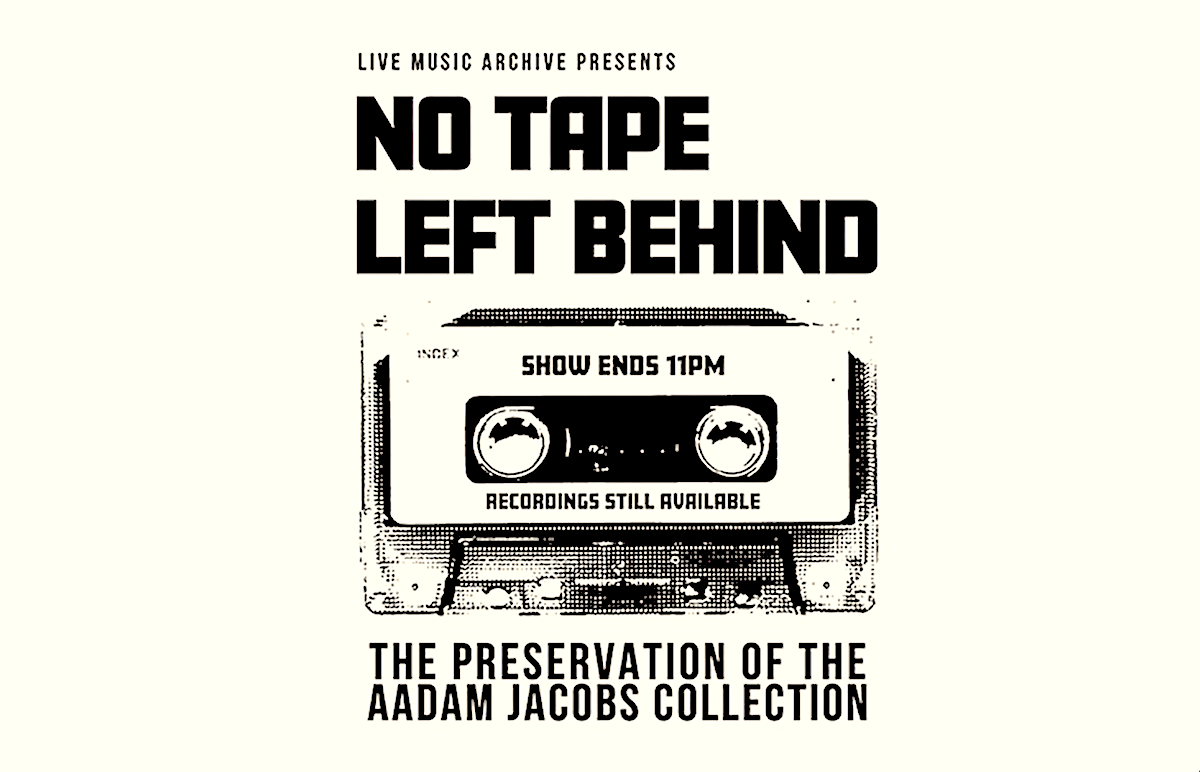
Perhaps you’ve had the experience of moving to a new city and immediately being told that you’ve missed its golden age of live music. To an extent, this has happened in more or less every period of the past fifty or sixty years. But what if the person regaling you with those stories had an archive of more than 10,000 concert recordings to back them up? Chicago’s Aadam Jacobs has made just such an archive, and a few years ago he and it became the subject of Katlin Schneider’s documentary Melomaniac. Apart from their stories of Jacobs’ exploits with his increasingly bulky recording rig, the various rock musicians and club owners interviewed therein express one concern above all: what will become of all his tapes in the future?
As so often, the Internet Archive has come to save the day. At its newly opened Aadam Jacobs Archive, you can now listen to nearly 2,500 of the concert recordings that volunteers have digitized and uploaded so far. In that more than a terabyte of files, you’ll find concerts by Nirvana, Phish, Tracy Chapman, Depeche Mode, Flaming Lips, Stereolab, Liz Phair, Sonic Youth, Nick Cave and the Bad Seeds, Björk, They Might Be Giants (recorded four times in 1988 alone), and the Mekons, among many others.
If you have a certain taste in rock — and especially if you belong to a certain generation — you may well, in the fullness of time, find a Jacobs-recorded show by your favorite band. But you’re just as likely to discover a performance by the best act you’ve never heard of before.
Pursuing his avocation of concert-recording with the industriousness of a professional, and indeed an obsessive one, Jacobs captured multiple shows each night at the height of his activity. He has his particular tastes, as emphasized in Melomaniac, but also demonstrates remarkably little discrimination about which bands are “cool” and which aren’t, to say nothing of their level of commercial success. When Chicago musicians first saw Jacobs’ familiar long-haired, heavy-backpacked figure turn up at their own shows, they knew they had a chance of “making it.” Even so, as Jacobs acknowledges, there’s scant correlation between which bands blew up, which bands he likes as people, and which bands have created his favorite records. His tapes constitute a valuable record of the sound of Chicago between the eighties and the twenty-tens, and it will only grow more so, the more accessible it becomes. But as we enjoy it, we should also bear in mind the efforts of the man who created it, and the love of music he personifies. Enter the archive here.
via Kottke
Related content:
The Live Music Archive Lets You Stream/Download More Than 250,000 Concert Recordings–for Free
Stream a Massive Archive of Grateful Dead Concerts from 1965–1995
Free Archive of Audio Interviews with Rock, Jazz & Folk Legends Now on iTunes
Nirvana Before They Were Nirvana: Watch Their 1988 Performance Recorded in a Radio Shack
Based in Seoul, Colin Marshall writes and broadcasts on cities, language, and culture. He’s the author of the newsletter Books on Cities as well as the books 한국 요약 금지 (No Summarizing Korea) and Korean Newtro. Follow him on the social network formerly known as Twitter at @colinmarshall.
Read More...Isaac Asimov Reviews George Orwell’s Nineteen Eighty-Four and Calls It “Not Science Fiction, But a Distorted Nostalgia for a Past that Never Was”
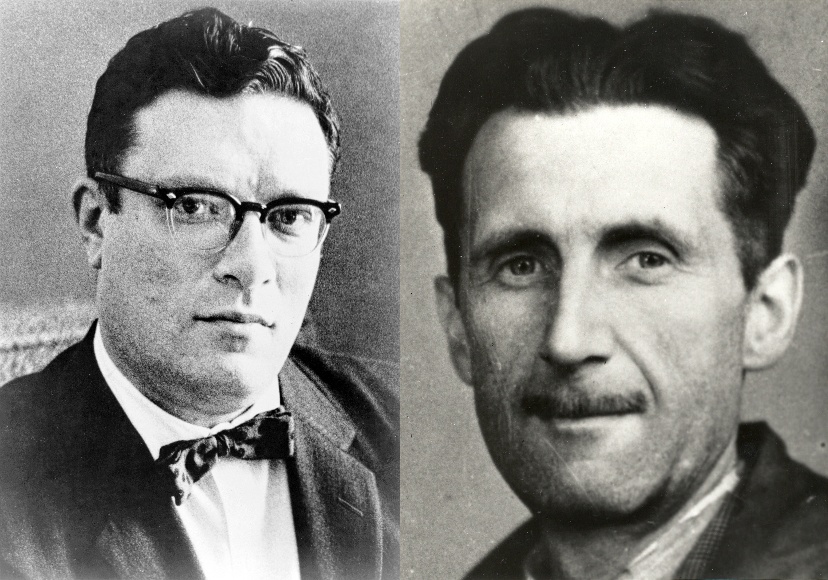
Here in the twenty-twenties, a young reader first hearing of George Orwell’s Nineteen Eighty-Four would hardly imagine it to be a work of science fiction. That wouldn’t have been the case in 1949, when the novel was first published, and when the eponymous year would have sounded like the distant future. Even as the actual nineteen-eighties came around, it still evoked visions of a techno-totalitarian dystopia ahead. “So thoroughly has 1984-ophobia penetrated the consciousness of many who have not read the book and have no notion of what it contains, that one wonders what will happen to us after 31 December 1984,” wrote Isaac Asimov in 1980. “When New Year’s Day of 1985 arrives and the United States is still in existence and facing very much the problems it faces today, how will we express our fears of whatever aspect of life fills us with apprehension?”
The occasion was one of a series of syndicated newspaper columns that Asimov seems to have published each new year. At the dawn of Nineteen Eighty-Four’s decade, the syndicate asked him to revisit Orwell’s novel, which had already been a common cultural reference for decades. As a work of science fiction (the genre for which his own name had practically come to stand), he finds it lacking, to say the least. “The London in which the story is placed is not so much moved thirty-five years forward in time, from 1949 to 1984, as it is moved a thousand miles east in space to Moscow,” he writes. Far from attempting to imagine the future, in Asimov’s view, Orwell simply converted the England he knew into a dreary Stalinist-type state. Apart from certain implausible surveillance systems, the setting is “incredibly old-fashioned when compared with the real world of the 1980s.”
Orwell doesn’t even bother to imagine any new vices: “His characters are all gin hounds and tobacco addicts,” Asimov writes, “and part of the horror of his picture of 1984 is his eloquent description of the low quality of the gin and tobacco.” That telling detail hints at one of Orwell’s major sources of inspiration: the British Ministry of Information, his wife’s employer during World War II, and the source of the material he broadcast to India while working at the BBC around the same time. The Ministry’s canteen, according to his letters, was not of the highest standard. What’s more, the 850-word “Basic English” that it insisted on using in its broadcasts bears more than a passing resemblance to Nineteen Eight-Four’s Newspeak, the pared-down language developed and mandated by the government in order to limit its citizens’ range of thought.
Asimov doesn’t buy that either. “There is no sign that such compressions of the language have ever weakened it as a mode of expression,” he writes. “As a matter of fact, political obfuscation has tended to use many words rather than few, long words rather than short, to extend rather than to reduce.” (This, of course, was something Orwell knew.) Whatever Nineteen Eighty-Four’s shortcomings as prophecy, sci-fi, or indeed literature, Asimov does credit Orwell with a certain geopolitical savvy. Its world-ruling trio of Oceania, Eurasia, and Eastasia “fits in, very roughly, with the three actual superpowers of the 1980s: the United States, the Soviet Union, and China.” Orwell knew, as many didn’t, that the latter two would not join forces, perhaps thanks to his own frustrating experience fighting for factionalism-prone left causes. But not even as future-oriented a mind as Asimov’s would have guessed that, just a few years later, the USSR would be out of the game — and a few decades later, the word Orwellian would be applied most often to China.
Read Asimov’s take on 1984 here.
If you would like to support the mission of Open Culture, consider making a donation to our site. It’s hard to rely 100% on ads, and your contributions will help us continue providing the best free cultural and educational materials to learners everywhere. You can contribute through PayPal, Patreon, and Venmo (@openculture). Thanks!
Related content:
An Animated Introduction to George Orwell
An Introduction to George Orwell’s 1984 and How Power Manufactures Truth
George Orwell Explains in a Revealing 1944 Letter Why He’d Write 1984
George Orwell’s Harrowing Race to Finish 1984 Before His Death
Isaac Asimov Predicts in 1964 What the World Will Look Like in 2014
Based in Seoul, Colin Marshall writes and broadcasts on cities, language, and culture. He’s the author of the newsletter Books on Cities as well as the books 한국 요약 금지 (No Summarizing Korea) and Korean Newtro. Follow him on the social network formerly known as Twitter at @colinmarshall.
Read More...Support Us
We're hoping to rely on loyal readers, rather than erratic ads. Please click the Donate button and support Open Culture. You can use Paypal, Venmo, Patreon, even Crypto! We thank you!

About Us

Open Culture scours the web for the best educational media. We find the free courses and audio books you need, the language lessons & educational videos you want, and plenty of enlightenment in between.
Advertise With Us

FREE UPDATES!
GET OUR DAILY EMAIL
Get the best cultural and educational resources on the web curated for you in a daily email. We never spam. Unsubscribe at any time.
FOLLOW ON SOCIAL MEDIA

Open Culture editor Dan Colman scours the web for the best educational media. He finds the free courses and audio books you need, the language lessons & movies you want, and plenty of enlightenment in between.
Advertise With Us