According to dance/movement therapist Erica Hornthal, “dance/movement therapy operates on the premise that our life experiences are held in the body, and that through the use of movement, memories and emotions can be recalled and re-experienced despite cognitive, psychological, or physical impairment.” The video above of former dancer Marta C. González shows in effect how music might activate those muscle memories, as a recording of Tchaikovsky’s Swan Lake sends Ms. González, a former ballet dancer, into an elegant reverie when she had been barely responsive moments before.
The video was reportedly taken in Valencia, Spain in 2019 and “recently shared by the Asociación Música para Despertar, a Spanish organization that promotes music therapy for those afflicted by memory loss, dementia and Alzheimer’s disease,” writes Anastasia Tsioulcas at NPR. It has since been shared by celebrities and noncelebrities around the world, an “undoubtedly moving and uplifting” scene that “speaks to the power of music and dance for those suffering from memory loss.”
Many such videos have made headlines, illustrating the findings of neuroscience with moving stories of recovered memory, if only for a brief, shining instant, in the presence of music. The González video doesn’t just warm hearts, however; it also serves as a cautionary tale about sharing viral videos without doing diligence. As Tsioulcas reports, “Alastair Maccaulay, a prominent dance critic formerly with The New York Times, has been chasing González’s history and posting his findings on Instagram.” His most recent post possibly identifies Ms. González as a dancer from Cuba, but the details are murky.
The video’s text identifies her as the prima ballerina of the “New York Ballet” in the 1960s, yet “there is no such known company and the New York City Ballet does not list anyone by that name as one of its alumni.” To complicate the mystery of her identity even further, Macauley says the clips that appear to show a young Marta González, who passed away in 2019, are actually “a former prima ballerina from Russia’s Mariinsky Ballet, Uliana Lopatkina.” So who was Marta C. González? Surely someone will identify her, if she was a prominent ballet dancer. But no matter her personal history, Tchaikovsky “clearly evoked a strong, truly visceral response,” as well as a gracefully muscular one.
If you ever decide to listen through the Beach Boys’ entire studio discography, one album per week, it will take about six months. I know because I just finished doing it myself, beginning with their simple celebration/exploitation of early-60s youth beach-and-car culture Surfin’ Safari and ending, six months yet half a century later, with the lushly elegiac That’s Why God Made the Radio. Between those points, of course, came the songs everyone knows, the hits that made the Beach Boys “America’s Band.” But as many times as we happen to have heard them, how well do we really know, say, “Good Vibrations” or “God Only Knows” — let alone the definitive artistic statement of an album that is Pet Sounds?
We can get to know them better through the work of the music-oriented video essayists of Youtube, who in recent years have turned their attention to the Beach Boys catalog. Not that true pop-music obsessives ever really turned away from it: surely, at some point in your life, you’ve met the kind of exegete intent on convincing you of the artistic glories of the miniature symphonies to teenage longing composed by the band’s mastermind Brian Wilson. But today they can incorporate visuals into their argument, as well as passages from and elements of the music itself, to more clearly reveal the formidable inspiration and craftsmanship that went into these ostensibly straightforward odes to love and good times.
Whether in 1966 or today, even an inattentive listener can sense the scale of ambition present in a song like “Good Vibrations.” As noted in Polyphonic’s analysis, its production cost between $50,000 and $75,000 ($370,000-$550,000 today), making it the most expensive single recording to date. But in its three minutes and 39 seconds, “Brian Wilson managed to put together a song dense enough that you could teach an entire course on it, all while maintaining a devotion to radio-friendly, ear-catching hooks.” The motivation to do this, so the legend has it, came from the Beatles, who earlier that year had redefined the very form of the album with Revolver — a response in part to Pet Sounds, itself fired by the earlier innovations of the Beatles’ Rubber Soul.
This friendly (if high-stakes) competition constitutes the background of the normally Beatles-oriented channel The HollyHobs’ video essay on “God Only Knows,” a song so glorious that even Paul McCartney names it among the best of all time. And it counts as but one of the highlights on Pet Sounds, an overview of which you can hear in this Pitchfork “Liner Notes” video. That video emphasizes Wilson’s central role in the production, something that would be difficult to over-emphasize: when former Beatles publicist Derek Taylor signed on with with Beach Boys, he based his whole campaign on the claim that “Brian Wilson is a genius.”
What makes that true is the subject of the video above by music-and-film Youtuber Jeffrey Stillwell (He’s also created another video looking at the “lost years,” when a psychologically struggling Wilson began to withdraw from the band, but kept on making music.) Only those who listen to the the entire Beach Boys discography can fully appreciate what Wilson brought to the band, and perhaps more importantly, how his work was enriched by the contributions of the other members. These include, among others, the original core of Wilson’s brothers Carl and Dennis, Al Jardine, and even the oft-vilified yet ultimately indispensable Mike Love — not that “Kokomo” is going to inspire a video essay any time soon.
Based in Seoul, Colin Marshall writes and broadcasts on cities, language, and culture. His projects include the Substack newsletterBooks on Cities, the book The Stateless City: a Walk through 21st-Century Los Angeles and the video series The City in Cinema. Follow him on Twitter at @colinmarshall, on Facebook, or on Instagram.
When was the last time you went to a video store? Perhaps your habit died with the major rental outlets like Blockbuster Video, all of whose locations closed by early 2014. Or rather, almost all of them: as fans of retro video culture know, the sole Blockbuster store on this Earth rents on in Bend, Oregon. But for all the nostalgic appeal of its blue-and-yellow brand livery, the “last Blockbuster” is at its heart the local operation it had been before the once-mighty international chain assimilated it in 2000. Back then, recall, we cinephiles saw Blockbuster and its like as remorseless corporate predators ready to swallow every independent video store, hardly sparing the ones at which we’d received our own film education.
My own teenage induction into cinephilia happened at Scarecrow Video, which continues to serve Seattle’s film obsessives today. Indeed, of all video stores that have ever existed, only the eccentric independents still stand. This holds true on both sides of the pond: though London now has no video stores at all, Bristol boasts the oldest video store in the world, one with the experientially apt name of 20th Century Flicks. You can have a look at this tenacious operation in Arthur Cauty’s documentary short “The Last Video Store,” which in the words of the shop’s owners and staff explains just how Flicks (as they refer to it) has managed to carve out an economic and cultural space in the 21st century.
“Flicks, because it’s got this very strange, idiosyncratic collection of trash to extreme high-brow movies, we just had this niche that we managed to survive in,” says co-owner David Taylor. Since its founding in 1982 (and through a few moves in that time), the store has amassed “the biggest collection in the U.K. by quite a long way. It’s over 20,000 movies,” which by Taylor’s reckoning is “about five times more than Netflix.” This gets at an unexpected but now common complaint about the streaming-media future in which we now live: despite their technical capacity to offer film libraries of Borgesian vastness, liberated as they are from the increasingly constrained spaces of traditional video stores, even the most successful streaming platforms maintain disappointingly limited selections.
“There’s some good stuff as well, admittedly, but it’s hidden behind all of the trash,” Flicks clerk Daisy Steinhardt says of Netflix, referring to a very different kind of “trash” than that proudly stocked by her store. “If you come here, then you can talk to someone who knows about or at least likes film, and then actually have a conversation rather than just trusting an algorithm.” It is this sense of community — which Blockbuster-style chains failed to offer, and which internet-based services can hardly hope to replicate — on which surviving video stores have capitalized. 20th Century Video have even built a pair of small theaters in the store, which customers can book to view anything in its far-reaching collection. Should a bold investor come along, co-owner David White envisions “a bar, a little restaurant, a retro arcade,” even an entire “emporium for an old-school type of experience.” And who among us wouldn’t enjoy the occasional night out in the 20th century?
Based in Seoul, Colin Marshall writes and broadcasts on cities, language, and culture. His projects include the Substack newsletterBooks on Cities, the book The Stateless City: a Walk through 21st-Century Los Angeles and the video series The City in Cinema. Follow him on Twitter at @colinmarshall, on Facebook, or on Instagram.
Bob Ross is as renowned for the gentle encouragement of his voice as for his speedy technique: indeed, these very qualities are synonymous with the name “Bob Ross.” His revival in recent years has as much to do with the de-stressing effects of his permed onscreen persona as with our awe, ironic or otherwise, at his kitschy picture-perfect landscapes in under an hour. He’s become as much a saint of public television as Mr. Rogers and even more of an internet icon.
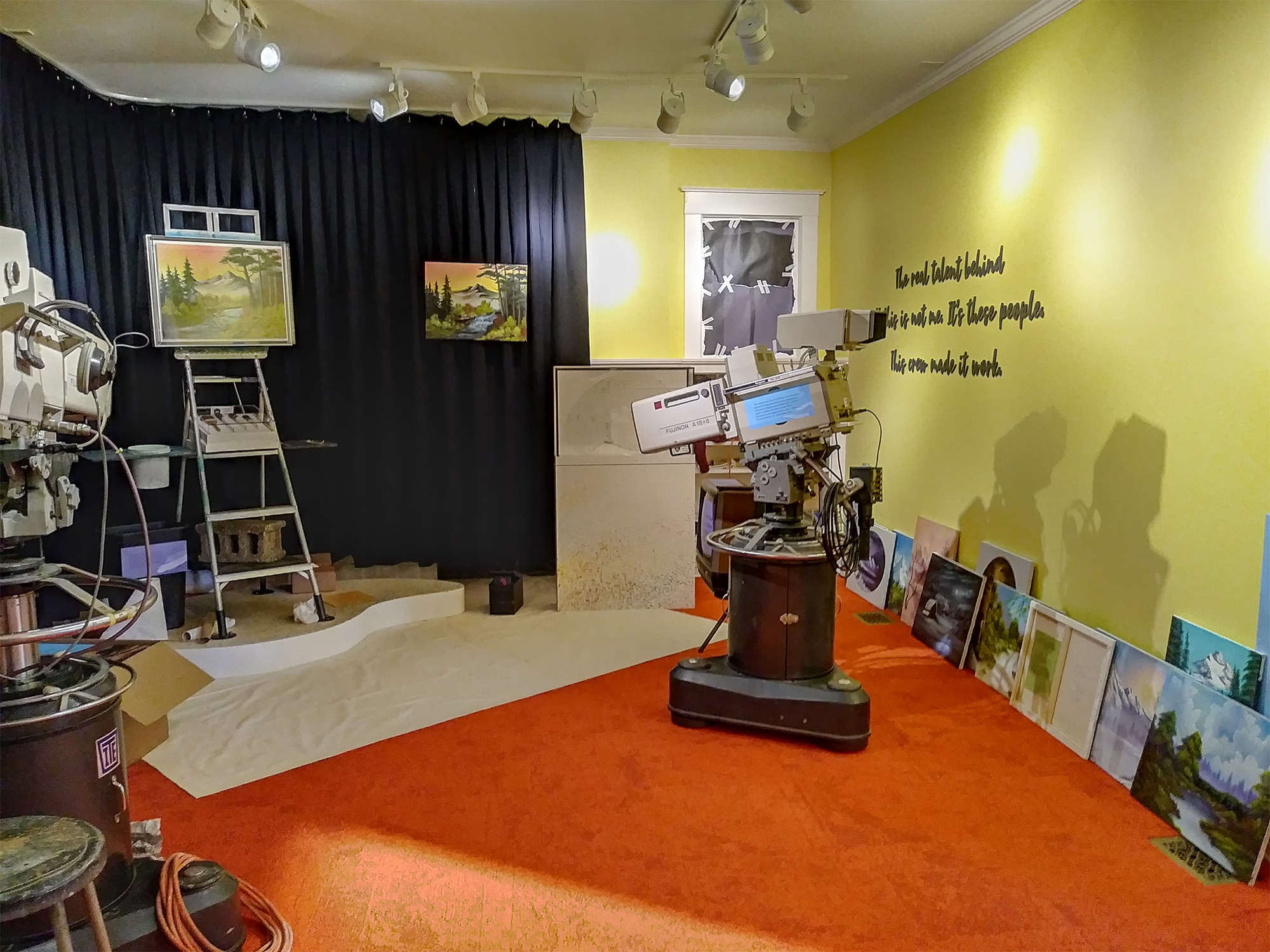
But unlike most other fandoms, the devoted lovers of Bob Ross have had no place to call their own. They might show up in Bob Ross cosplay at comic con. Yet no Bob Ross Con has made the scene. Leave it to Ross’s original Joy of Painting studio to fill the gap with a museum dedicated to the painting instructor. The Bob Ross Experience is part of a larger campus of buildings called Minnetrista in Muncie, Indiana, founded by the Ball family of Ball mason jars. It’s an “immersive exhibit,” featuring “original paintings and artifacts” and “inspiring visitors with Bob’s message of fearless creativity.”
What more could you want from a Bob Ross museum? Well, maybe a fully-online experience these days. For now, you’ll have to make the trip to Muncie, where locals pay $8 a ticket (kids $6, 3 & under are free) and non-residents shell out $15 ($12 per kid, etc). There may be nowhere else you can see Ross’s happy little trees in person. As Ayun Halliday wrote here recently, “sales of his work hover around zero.” Almost all of his paintings, save a few owned by the Smithsonian and a few private individuals, reside in storage in Northern Virginia, where an exhibit came and went last year.
Ross himself, who honed his method during short breaks in the Air Force, hardly ever exhibited in his lifetime; he was a made-for-TV painter with a small merchandising empire to match. Now, fans can make the pilgrimage to his creative TV home at the Lucius L. Ball house. Swoon over personal relics like his keys and hair pick and, of course, “the artist’s palette knife, easel, and brushes,” writes Colossal. “Many of the artifacts are free to touch.” A current exhibition at the Experience, “Bob Ross at Home” through August 15, 2021, showcases “a few dozen of the artist’s canvases, many on loan from Muncieans who got the works directly from Ross.”
Not only can you hang out on set and view Ross’s paintings and personal effects, but you can also, Artnet reports, “sign up for $70 master classes with certified Bob Ross instructors.” That’s $70 more than it costs to watch the master himself on YouTube, but if you’ve already made the trip…. One only hopes the instructors can channel what George Buss, vice president of the Experience, calls Ross’s best quality, his gentle fearlessness: “He takes what looks like a mistake and turns it into something beautiful.” And that, friends, is the true joy of the Bob Ross experience.
There are a few names anyone interested in Japanese woodblock printing today can’t help but hear sooner or later: Utagawa Hiroshige, Katsushika Hokusai, Kitagawa Utamaro, David Bull. That last, you may have guessed, is not the name of an 18th-century Japanese man. In fact, David Bull still walks among us today, especially if we happen to live in the old Asakusa section of Tokyo, where he keeps his woodblock-print studio Mokuhankan.
Born in England and raised in Canada, Bull discovered the world of ukiyo‑e, those Japanese “pictures of the floating world,” in his late twenties. Just a few years after first trying his hand, without formal training, at making his own prints, he moved to the Japanese capital to dedicate himself to the form. Today, on his personal site and Youtube channel, he offers a wealth of English-language resources on the art and craft of the Japanese woodblock print.
In the video up top, he provides expert commentary on the making of one particular print by a young Mokuhankan printer named Natsuki Suga. The work is broken into ten stages, beginning with the application of the basic orange background color, moving on through the addition of sky blues and tea-field greens (not to mention shadows, shadows, and “more shadows”), all the way through to the final embossing of the title and artist’s name. The result, revealed at the end in a stage-by-stage time lapse, is a vivid and idyllic scene aesthetically balanced between ukiyo‑e tradition and the present-day art styles.
In the video just above, you can see Bull himself provide commentary as he makes a woodblock print of his own — in real time, from start to finish, with no cuts. Originally shot as a live Twitch stream, it shows Bull’s entire process from blank block to completed print, which takes nearly three and a half hours. That may actually seem like a surprisingly short time in which to create a work of art, but then, Bull has been at this for nearly 40 years.
Bull’s experience also comes through in his ability to explain his techniques and tell stories about the Japanese woodblock’s artistic development as well as his own. What may seem like a video of interest only to ukiyo‑e specialists has in fact racked up, as of this writing, more than 1.2 million views on Youtube alone. But then, it isn’t entirely unknown for a soft-spoken artist dedicated to a highly specific form to win a wide audience with his educational productions. “I’m completely certain that Bob Ross hasn’t died,” as one commenter puts it. “He just got a new haircut.”
Based in Seoul, Colin Marshall writes and broadcasts on cities, language, and culture. His projects include the Substack newsletterBooks on Cities, the book The Stateless City: a Walk through 21st-Century Los Angeles and the video series The City in Cinema. Follow him on Twitter at @colinmarshall, on Facebook, or on Instagram.
“You can’t think of that song without thinking of Janis,” says Kris Kristofferson of Janis Joplin’s raw, bittersweet, posthumously released “Me and Bobby McGee.” Kristofferson, who wrote the song, only heard Joplin’s version after her death, when he returned to California after playing the Isle of Wight in 1970. He met the producer of Joplin’s last album, Pearl, in L.A., who told him to come to the studio “to play me her recording of ‘Bobby McGee.’ And it just blew me away. Just blew me away.” Above, you can hear a rare recording, possibly the first take, and possibly one of the early versions Kristofferson heard in the studio.
Many people have assumed Kristofferson wrote the song for Joplin, but that’s not the case: he didn’t know she was recording it at all. It was written, in 1969, about a woman, Barbara “Bobby” McKee, who worked as a secretary in songwriter Fred Foster’s building. Foster gave Kristofferson the title “Me and Bobby McKee,” Kristofferson misheard the last name, assumed it was a man, and wrote the famous lyrics, inspired not by Barbara but by Federico Fellini’s La Strada, in which Anthony Quinn and Giulietta Masina travel together on a motorcycle as a performing duo. (The Louisiana references come in because Kristofferson was working as a helicopter pilot in the Gulf at the time.)
In La Strada, Quinn “got to the point where he couldn’t put up with [Masina] anymore and left her by the side of the road while she was sleeping,” says Kristofferson. Later, when he finds out she has died, he “goes to a bar and gets in a fight. He’s drunk and ends up howling at the stars on the beach.” In a parallel to this mournful scene, Tom Breihan at Stereogum describes how Kristofferson, after hearing Joplin’s version of the song, “spent the rest of the day walking around Los Angeles, crying. He probably wasn’t alone. A lot of people probably cried when they heard Joplin singing ‘Me and Bobby McGee.’” A lot of people still do.
A long list of famous singers has covered the song, originally recorded by Roger Miller—just about anyone you might name in folk and country. But Joplin “made it her own,” Kristofferson says, and it’s no empty cliché. Written as a country song, Joplin doesn’t quite sing it that way, and she “doesn’t really sing it as blues or psychedelic rock either,” writes Breihan. “Instead, she just lets it rip, her phrasing immediate and instinctive,” howling at the stars like Anthony Quinn. “Joplin might’ve never hitchhiked across the country with anyone named Bobby McGee,” but she “did what great interpreters do.” She made the song “about Janis Joplin, because that’s what Janis Joplin made it.”
Chess is amazing. The simplicity of its characters and plot (capture the king!) can be appreciated and understood by children; the complexity of its tactics can consume an adult life. Despite its medieval origins—and stumpers for us moderns like the strategic importance of a bishop on the battlefield—chess remains as much a potent allegory for power and its tactics as it was 1,500 years ago in India when it was called “chaturanga.”
The game has inspired great works of literature, film, and arguably every creative move made by Marcel Duchamp. So why not a musical? A musical with a Cold War-era chess battle between a Bobby Fischer-like character and a Russian grandmaster loosely based on Boris Spassky, with music by the guys from ABBA and lyrics by Tim Rice?
The drama is inherent, both within the game itself and its geopolitical significance in 1984, the year the concept album above debuted in advance of the show’s first European tour, a fundraising maneuver also employed before the opening of much better-known Rice shows like Jesus Christ Superstar and Evita. While Andrew Lloyd Webber may be an excellent stage composer, though not to everyone’s taste, partisans of Mamma Mia! might agree with critic William Henry, who wrote at Time that Chess, the musical is “one of the best rock scores ever produced for the theatre.”
The show itself, Henry wrote, was “difficult, demanding and rewarding” and pushed “the boundaries of the form.” According to a site documenting its history:
Chess at London’s Prince Edward Theatre was a love story set amid a world championship chess match, the tensions of the Cold War, and a media circus. It ran for three years. When the Berlin Wall fell, a radically altered version of the show was presented on Broadway and failed.
The new version, with lyrics by Richard Nelson, ran for only two months. Its unpopularity did not tarnish the reputation of Chess, which was revived to great acclaim several times afterward. The show may not have had the widespread cultural resonance of Hamilton or the gravitas of Nixon in China, but Chess has inspired devotion among musical fans, ranking seventh in a recent BBC listener poll on the top ten essential musicals. It is now, 34 years after its London debut, running in Moscow, in a Russian translation, with “rewrites,” notes MetaFilter user Shakhmaty, “that humanize its KGB antagonist.”
Chess produced the hit “I Know Him So Well,” a duet by Elaine Paige and Barbara Dickson that “held the Number One spot on the UK singles charts for 4 weeks and won the Ivor Novello Award as the Best Selling Single,” Ice the Site writes. A VHS video appeared in 1985 featuring the performers on the album singing that song and others from the show like “One Night in Bangkok” (above), which also became a “worldwide smash.”
Like Mamma Mia!, Chess is a medley, of sorts— in this case of musical styles rather than greatest pop hits. A contemporary New York Times review called the concept album “a sumptuously recorded… grandiose pastiche that touches half a dozen bases, from Gilbert and Sullivan to late Rodgers and Hammerstein, from Italian opera to trendy synthesizer-based pop, all of it lavishly arranged for the London Symphony Orchestra with splashy electronic embellishments.” Hear the full album the top of the post, read a summary of the show’s plot here, and see Tim Rice and ABBA’s Bjorn Ulvaeus promote the show in 1986 on a British morning show just above.
Missing the scent of used book stores during quarantine? Powell’s Books has you covered with their new unisex fragrance: “Like the crimson rhododendrons in Rebecca, the heady fragrance of old paper creates an atmosphere ripe with mood and possibility. Invoking a labyrinth of books; secret libraries; ancient scrolls; and cognac swilled by philosopher-kings, Powell’s by Powell’s delivers the wearer to a place of wonder, discovery, and magic heretofore only known in literature.” You can pre-order it here…
Today we take a ride on the world’s oldest electric suspension railway—the Wuppertal Schwebebahn in Germany.
Actually, we’ll take two rides, traveling back in time to do so, thanks to YouTuber pwduze, who had a bit of fun trying to match up two videos discovered online for comparison’s sake.
The journey on the left was filmed in 1902, when this miracle of modern engineering was but a year old.
The train passes over a broad road traveled mostly by pedestrians.
Note the absence of cars, traffic lights, and signage, as well as the proliferation of greenery, animals, and space between houses.
The trip on the right was taken much more recently, shortly after the railway began upgrading its fleet to cars with cushioned seats, air conditioning, information displays, LED lighting, increased access for people with disabilities and regenerative brakes.
An extended version at the bottom of this page provides a glimpse of the control panel inside the driver’s booth.
There are some changes visible beyond the windshield, too.
Now, cars, buses, and trucks dominate the road.
A large monument seems to have disappeared at the 2:34 mark, along with the plaza it once occupied.
Fieldstone walls and 19th-century architectural flourishes have been replaced with bland cement.
There’s been a lot of building—and rebuilding. 40% of Wuppertal’s buildings were destroyed by Allied bombing in WWII.
Although Wuppertal is still the greenest city in Germany, with access to public parks and woodland paths never more than a ten-minute walk away, the views across the Wupper river to the right are decidedly less expansive.
For the Schwebebahn’s first riders at the turn of the 20th century, these vistas along the eight-mile route must have been a revelation. Many of them would have ridden trains and elevators, but the unobstructed, straight-down views from the suspended monorail would have been novel, if not terrifying.
The bridge structures appear to have changed little over the last 120 years, despite several safety upgrades.
Those steampunk silhouettes are a testament to the planning—and expense—that resulted in this unique mass transit system, whose origin story is summarized by Elmar Thyen, head of Schwebebahn’s Corporate Communications and Strategic Marketing:
We had a situation with a very rich city, and very rich citizens who were eager to be socially active. They said, ‘Which space is publicly owned so we don’t have to go over private land?… It might make sense to have an elevated railway over the river.’
In the end, this is what the merchants wanted. They wanted the emperor to come and say, ‘This is cool, this is innovative: high tech, and still Prussian.’
At present, the suspension railway is only operating on the weekends, with a return to regular service anticipated for August 2021. Face masks are required. Tickets are still just a few bucks.
It takes a lot of swagger and confidence to play a couple of barre chords on a guitar, look like the coolest cat doing so, and revolutionize rock music while doing so. That’s Link Wray we’re talking about, and the song is the 1958 instrumental hit “Rumble.” It still sounds fresh today for the same reasons it was controversial at the time. It sounds sleazy, grungy, dirty. This is a song for a pool hall, or a biker bar, and just reeks of cigarettes and liquor. And from Pulp Fiction onwards, the song has popped up in many movies and TV shows, giving a scene a bit of cool danger.
The above video is from a one-hour gig that Wray and his band performed at the Winterland Ballroom in San Francisco, 1974, the former ice skating rink that promoter Bill Graham turned into one of the primo music venues of its day. And Link Wray playing was like one of the gods of rock descending to anoint the crowd. Presley–though Wray defended him during his act–had dropped out of mainstream culture. The original rock and rollers, Wray’s peers, were either dead or nostalgia acts. So this appearance is magical, rock spirit made flesh, looking dangerous and sexual in all his swagger.
That swagger was well earned. Fred Lincoln Wray was born in North Carolina to a Shawnee mother, as a Cherokee and White father had returned from WWI with PTSD. In the mostly Black neighborhood where he grew up, he would hide underneath the bed when the Ku Klux Klan would come through on a terror campaign. “Elvis, he grew up — I don’t want to sound racist when I say this — he grew up white man poor,” Wray said in an interview. “I was growing up Shawnee poor.”
He suffered weak eyesight and bad hearing from childhood measles, and later when he served time in the army, he’d contract tuberculosis, lose one lung, and was told he wouldn’t have a singing career.
But he did have his guitar skills, which he’d learned as a child from a traveling Black guitarist called Hambone. Back from the army he formed a group with his brothers Vernon and Doug, and was going by the name Lucky. They gigged around Virginia and Washington, DC, and were asked by a local promoter to come up with a song similar to The Diamonds’ “The Stroll.” What they came up with was an instrumental called “Oddball.” It was a hit played live but when they went into a studio to record a demo, it just didn’t have “that sound”. Wray started punching holes in his speakers with a pencil and in one stroke created the fuzztone guitar sound.
The big labels wouldn’t bite, but Cadence Records’ Milt Grant said yes. Or rather, his teenage stepdaughter and her friends said yes, and Milt put aside his own distaste. Juvenile delinquents were at once both a “problem” and a way to sell product, especially with the hit musical and movie West Side Story. “Rumble” was a much better name than “Oddball,” and, on March 31, 1958, it was released.
Some DJs refused to play the single in cities where teenage gang violence was a problem. When Wray and his band played American Bandstand, Dick Clark didn’t mention the title. It didn’t stop the single from being a hit.
And it was influential. Wray pretty much invented power-chord riffing, and influenced Jimi Hendrix, Jeff Beck, Neil Young, Jimmy Page, Pete Townshend, and countless others. Curmudgeon-genius Mark E. Smith of the Fall named him as one of the only two musicians he respected (the other was Iggy Pop).
Link Wray’s Cherokee and Shawnee heritage was not well known among the general public, but the recent documentary Rumble: The Indians Who Rocked the Worldbrought the influence of Native American musicians out into the open for celebration, connecting Link Wray with Robbie Robertson, Charlie Patton, Mildred Bailey, and Stevie Salas.
Ted Mills is a freelance writer on the arts who currently hosts the Notes from the Shed podcast and is the producer of KCRW’s Curious Coast. You can also follow him on Twitter at @tedmills, and/or watch his films here.
And The Plastic Bag Store, a pop-up installation that was preparing to open in Times Square.
The theaters remain dark, but the ban is back on, as of October 19th. The 7‑month pause was hastened by the pandemic, but also by an unsuccessful lawsuit brought by flexible packing manufacturer Poly-Pak Industries.
The Plastic Bag Store was allowed to open, too, albeit in an altered format from the hybrid art installation-adult puppet show creator Robin Frohardt has been working on for several years.
She has long intended for the project’s New York premiere to coincide with the ban.
Not because she hoped to get rich selling bags to citizens accustomed to getting them free with purchase.
There’s nothing to buy in this “store.”
It’s a performance of sorts, but there’s no admission charge.
It’s definitely an education, and a meditation on how history can be doomed to repeat itself, in one way or another.
The Plastic Bag Store just ended its sold out 3‑week run, playing to crowds of ticket holders now capped at 12 audience members per performance. The live elements have morphed into a trio of short films that are projected after ticket holders—customers if you will—have had a chance to look around.
There’s plenty to see.
The Times Square installation space has been kitted out to resemble a roomy bodega stocked with produce, baked goods, sushi rolls on plastic trays, shrink wrapped meat, and other familiar, if slightly skewed items.
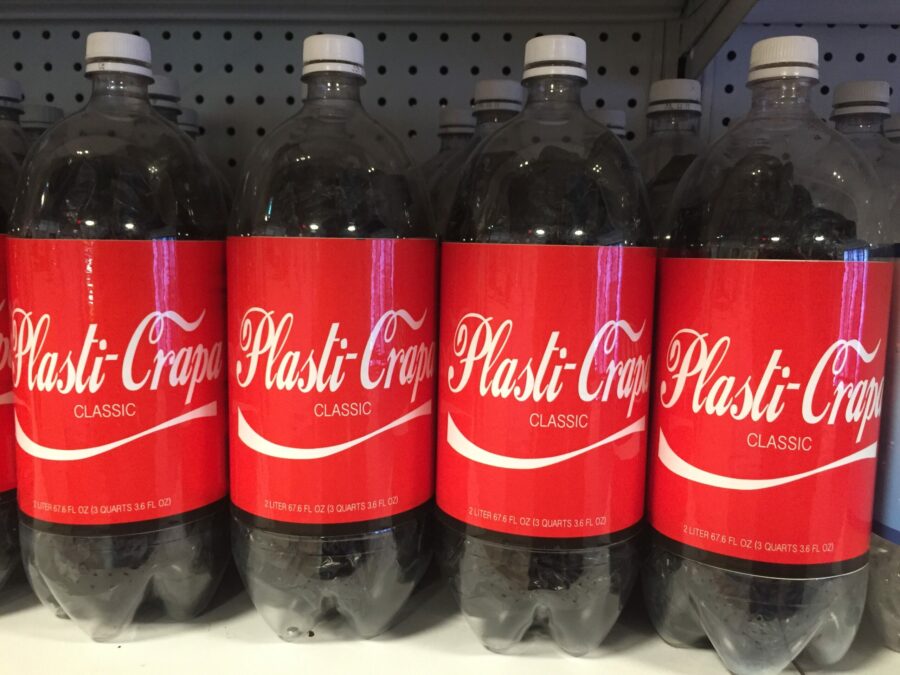
Rows of 2 liter soda bottles with iconic red labels are shelved across from the magazine rack. Tubs of Bag & Jerry’s Mint Plastic Chip are in the freezer case.
The original plan allowed for customers to handle the goods as they wanted. Now such interactions are prohibited.
Prior to March, New Yorkers were pretty handsy with produce, unabashedly pressing thumbs into avocados and holding tomatoes and melons to nostrils to determine ripeness.
The pandemic curbed that habit.
No matter. Nothing is ripe in the Plastic Bag Store, where any item not contained in a can or cardboard box has been constructed from the thousands of plastic bags Frohardt has collected over the years.
I’m a real connoisseur now. There are certain colors I’m really attracted to. Certain bags are harder to find. I definitely look at trash differently than most people. I’m always looking for reds and oranges and greens. Sometimes I find a really interesting color that I haven’t seen before, like salmon or lavender. That’s always exciting.
This diversity of materials helps with visual verisimilitude, most impressive in the produce section.
The product labels been richly fortified with satirical commentary.
A family sized package of Yucky Shards appeals to children with sparkles, a rainbow, and a bright eyed cartoon mascot who doesn’t seem to mind the 6‑pack yoke that’s attached itself to its person.
Everything about the “non-organic, triple-washed Spring Green Mix” from “Earthbag Farm” looks familiar, including the plastic container.
Packages of Sometimes feminine pads promise “super protection” that will “literally last forever.”
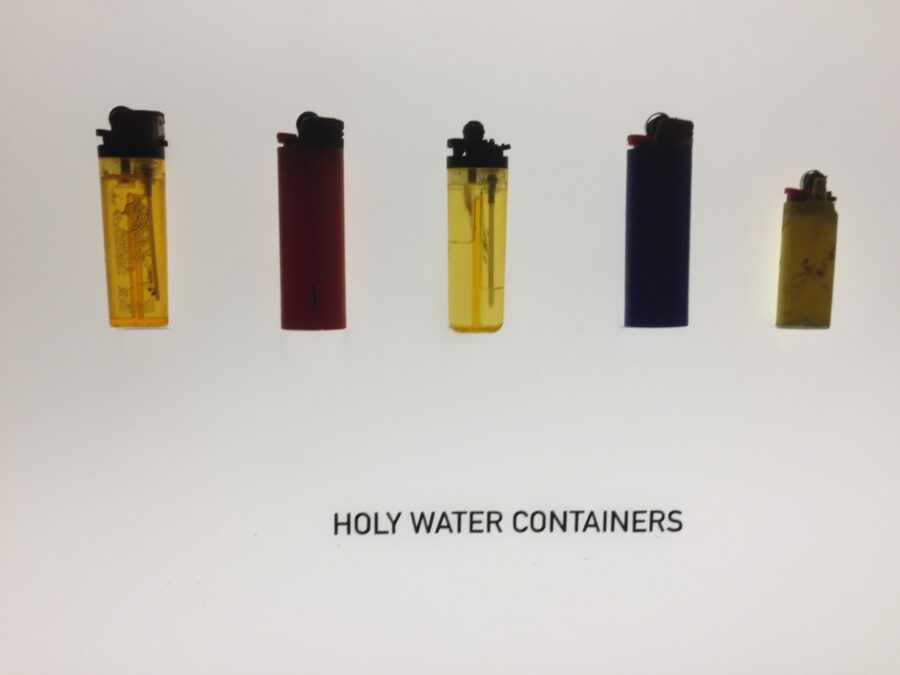
The cupcakes on display in the bakery section are topped with such festive embellishments as a “disposable” lighter and flossing pick.
The tone is not scolding but rather comic, as Frohardt uses her spoofs to delight attendees into serious consideration of the “foreverness” of plastic and its environmental impact:
There is great humor to be found in the pitfalls of capitalism, and I find that humor and satire can be powerful tools for social criticism especially with issues that feel too sad and overwhelming to confront directly.
It’s really easy to turn away from images of turtles choking on straws. That stuff comes up in my Instagram feed all the time, and I’m like “Whoa! Swipe on past” because it’s too hard to look at. So what I’m trying to do is to make something that’s fun to look at, and fun to engage with, so you can think about it. Instead of just saying, “That’s fucked up! Ok on to the next thing.”
The Plastic Bag Store’s film segments also wield comedy to get their message across.
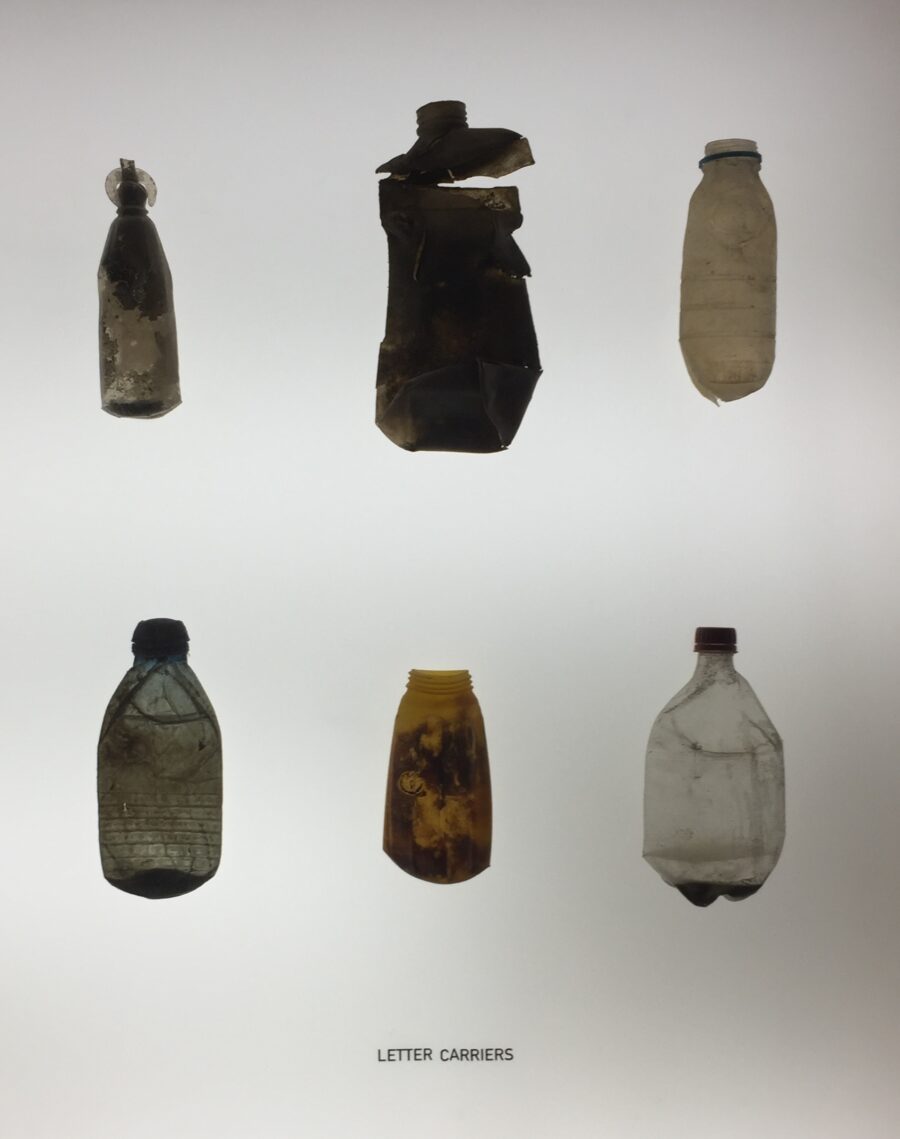
From the stiff shadow puppet Ancient Greeks who are seduced by the self-flattering slogan of a new product, Knowledge Water, which comes in single use vessels, to the recipient of a message in a plastic bottle, discovered so far into the future that he can only admire its craftsmanship, having no clue as to its purpose. (Letter carrier is his best guess. Eventually, other letter carriers are discovered in the freezing equatorial ocean, and housed in a museum alongside other hilariously mislabeled relics of a long dead civilization.)
We're hoping to rely on loyal readers, rather than erratic ads. Please click the Donate button and support Open Culture. You can use Paypal, Venmo, Patreon, even Crypto! We thank you!
Open Culture scours the web for the best educational media. We find the free courses and audio books you need, the language lessons & educational videos you want, and plenty of enlightenment in between.