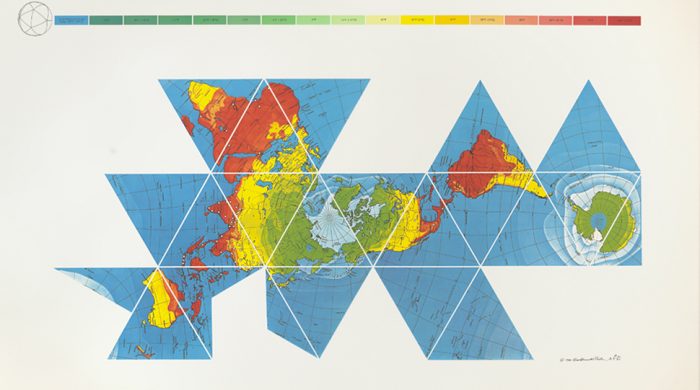
Last year, we shined a light on Buckminster Fuller’s Dymaxion Map. Unveiled back in 1943, the Dymaxion Map (shown below) revolutionized map design, allowing us to see our world in an entirely new way. As the Buckminster Fuller Institute describes it:
Also known as the “Dymaxion Map,” the Fuller Projection Map is the only flat map of the entire surface of the Earth which reveals our planet as one island in one ocean, without any visually obvious distortion of the relative shapes and sizes of the land areas, and without splitting any continents.
Fuller’s map has since inspired the award-winning AuthaGraph World Map, created by Japanese architect and artist Hajime Narukawa. And it led robotics engineer Gavin Smith to fashion The Dymaxion Globe, essentially by dividing the Dymaxion Map into triangles and and folding them into a three-dimensional figure. Smith explains the process of making a Dymaxion Globe over at Make Magazine. But above, you can watch it all happen in a video produced by Adam Savage’s Tested YouTube channel. They walk you through the creation of a laser-cut Dymaxion Globe. Enjoy.
Wim Wenders began his prolific feature filmmaking career in 1970, and nearly half a century later — having directed such cinephile favorites as Alice in the Cities, The American Friend, Paris, Texas, and Wings of Desire along the way — he shows no signs of slowing down. Known for his collaboration with cinematographers, and with Robby Müller in particular, Wenders has worked in everything from black-and-white 16-millimeter film, when he first started out, to digital 3D, which he’s spent recent years putting to a variety of cinematic ends. But we can trace all of his visions back, in one way or another, to the humble Polaroid instant camera.
“Every movie starts with a certain idea,” says Wenders in the short “Photographers in Focus” video above, and the Polaroid was just a collection of constant ideas.” The auteur speaks over images of some of the Polaroids he’s taken throughout his life, relating his history with the medium.
“My very first Polaroid camera was a very simple one. Mid-sixties. I was 20, and I used Polaroid cameras exclusively until I was about 35 or so. Most of them I gave away, because when you took Polaroids, people were always greedy and wanted them because it was an object, it was a singular thing.”
Wenders describes his Polaroids as “very insightful into the process of my first six, seven movies, all the movies I did through the seventies,” the era in which he mastered the form of the road movie first in his native Germany, then in the much-mythologized United States. He not only shot Polaroids in preparation, but during production, snapping them casually, much as one would on a genuine road trip. “Polaroids were never so exact about the framing. You didn’t really care about that. It was about the immediacy of it. It’s almost a subconscious act, and then it became something real. That makes it such a window into your soul as well.” Polaroid photographs, as Wenders sees them, capture a deeper kind of truth. It’s no surprise, then, even in age of the 3D digital camera, to see them making a comeback.
Based in Seoul, Colin Marshall writes and broadcasts on cities and culture. His projects include the book The Stateless City: a Walk through 21st-Century Los Angeles and the video series The City in Cinema. Follow him on Twitter at @colinmarshall or on Facebook.
What is it about the Voynich Manuscript—that cryptic, illustrated 15th century text of unknown origin and meaning—that has so fascinated and obsessed scholars for centuries? Written in what appears to be an invented language, with bizarre illustrations of otherworldly botany, mysterious cosmology, and strange anatomy, the book resembles other proto-scientific texts of the time, except for the fact that it is totally indecipherable, “a certain riddle of the Sphinx,” as one alchemist described it. The 240-page enigma inspires attempt after attempt by cryptologists, linguists, and historians eager to understand its secrets—that is if it doesn’t turn out to be a too-clever Medieval joke.
One recent try, by Nicholas Gibbs, has perhaps not lived up to the hype. Another recent attempt by Stephen Bax, who wrote the short TED Ed lesson above, has also come in for its share of criticism. Given the investment of scholars since the 17th century in cracking the Voynich code, both of these efforts might justifiably be called quite optimistic. The Voynich may forever elude human understanding, though it was, presumably, created by human hands. Perhaps it will take a machine to finally solve the puzzle, an artificial brain that can process more data than the combined efforts of every scholar who has ever applied their talents to the text. Computer scientists at the University of Alberta think so and claim to have cracked the Voynich code with artificial intelligence (AI).
Computer science professor Greg Kondrak and graduate student Bradley Hauer began their project by feeding a computer program 400 different languages, taken from the “Universal Declaration of Human Rights.” While “they initially hypothesized that the Voynich manuscript was written in [ancient] Arabic,” reports Jennifer Pascoe, “it turned out that the most likely language was [ancient] Hebrew.” (Previous guesses, the CBC notes, “have ranged from a type of Latin to a derivation of Sino-Tibetan.”) The next step involved deciphering the manuscript’s code. Kondrak and Hauer discovered that “the letters in each word… had been reordered. Vowels had been dropped.” The theory seemed promising, but the pair were unable to find any Hebrew scholars who would look at their findings.
Without human expertise to guide them, they turned to another AI, whose results, we know, can be notoriously unreliable. Nonetheless, feeding the first sentence into Google translate yielded the following: “She made recommendations to the priest, man of the house and me and people.” It’s at least grammatical, though Kondrak admits “it’s a kind of strange sentence to start a manuscript.” Other analyses of the first section have turned up several other words, such as “farmer,” “light,” “air,” and “fire”—indeed the scientists have found 80 percent of the manuscript’s words in ancient Hebrew dictionaries. Figuring out how they fit together in a comprehensible syntax has proven much more difficult. Kondrak and Hauer admit these results are tentative, and may be wrong. Without corroboration from Hebrew experts, they are also unlikely to be taken very seriously by the scholarly community.
But the primary goal was not to translate the Voynich but to use it as a means of creating algorithms that could decipher ancient languages. “Importantly,” notes Gizmodo, “the researchers aren’t saying they’ve deciphered the entire Voynich manuscript,” far from it. But they might have discovered the keys that others may use to do so. Or they may—as have so many others—have been led down another blind alley, as one commenter at IFL Science suggests, sarcastically quoting the wise Bullwinkle Moose: “This time for sure!”
Arguments are woven throughout our public and private lives. What determines which win the day? Renowned literary and legal theorist Stanley Fish leads us through literature, politics and the domestic to reveal the power — and inevitability — of rhetoric.
From the courtroom to the bedroom, arguments are woven throughout our private and public lives: they are how we decide what’s right, what’s true and what we should do. With examples ranging from Milton’s Paradise Lost to the legalization of same sex marriage and Donald Trump, Fish shows us how the rules of engagement shift between contexts — and how rhetoric is the key to success in all of them.
Drawing from his bestselling book Winning Arguments, Fish makes the controversial claim that facts are merely opinions that have been made to stick — and what makes them stick is nothing more than successfully deployed arguments.
Take the course to learn:
–What Milton’s Paradise Lost teaches us about the power of rhetoric and the first ever domestic quarrel
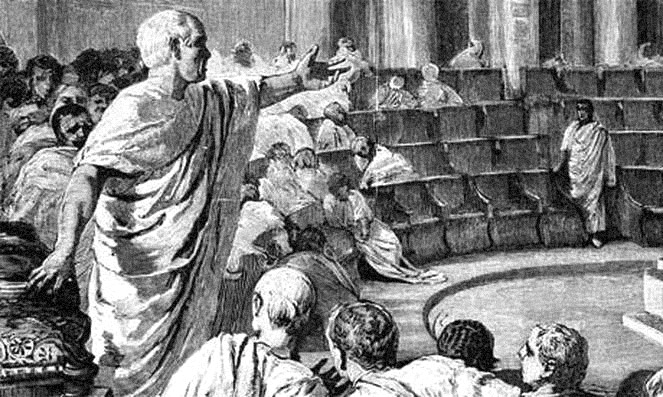
–The techniques Shakespeare’s Mark Anthony uses to provoke his audience to violence
–What characterizes Donald Trump’s rhetorical style – and how it breaks all the rules
–How the case for same sex marriage was really won through a cultural shift rather than careful legal argument
–The tricks climate change deniers use to sow doubt
–The Five Key Truths about domestic quarrels – and why self-help guides to marital harmony almost never work
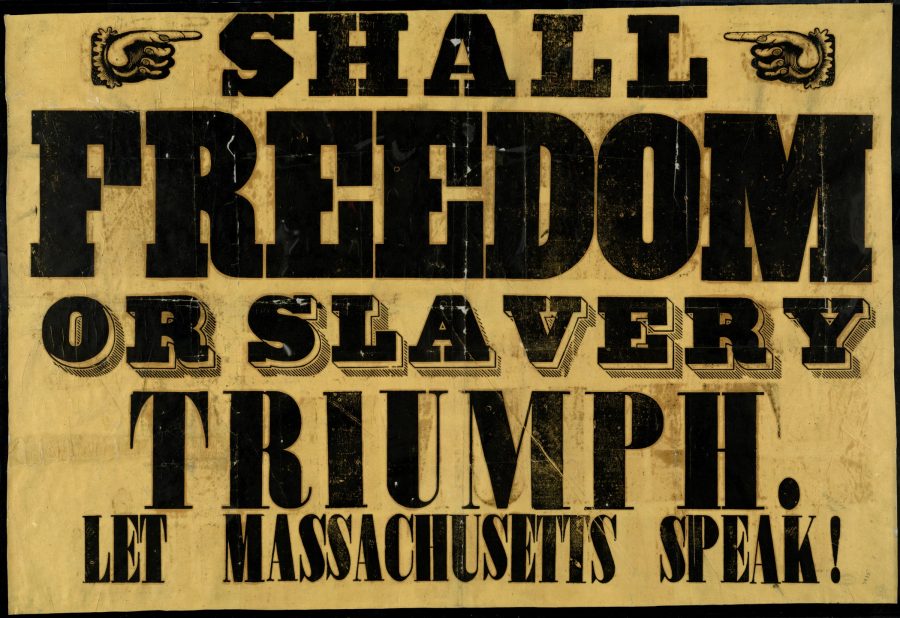
We can hardly understand America without understanding American history. Can we understand American history without understanding slavery? Many a historian would answer with an unqualified no, and not simply because they want to see Americans meditate on the sins of their ancestors: plunging into the controversies around slavery, seeing how Americans made arguments for and against it at the time, can help us approach and interpret the other large-scale legal and moral battles that have since raged in the country, and continue to rage in it today.
The Boston Public Library’s Anti-Slavery Collection, one particularly important resource in that intellectual effort, could use our help in making its considerable resources more readily available. “For the past several years, we have been diligently cataloging and digitizing manuscript correspondences from our Anti-Slavery collection,” writes the BPL’s Tom Blake, all of which “document the thoughts, transactions, and activities of the abolitionist movement in Boston, Massachusetts, and throughout New England.”
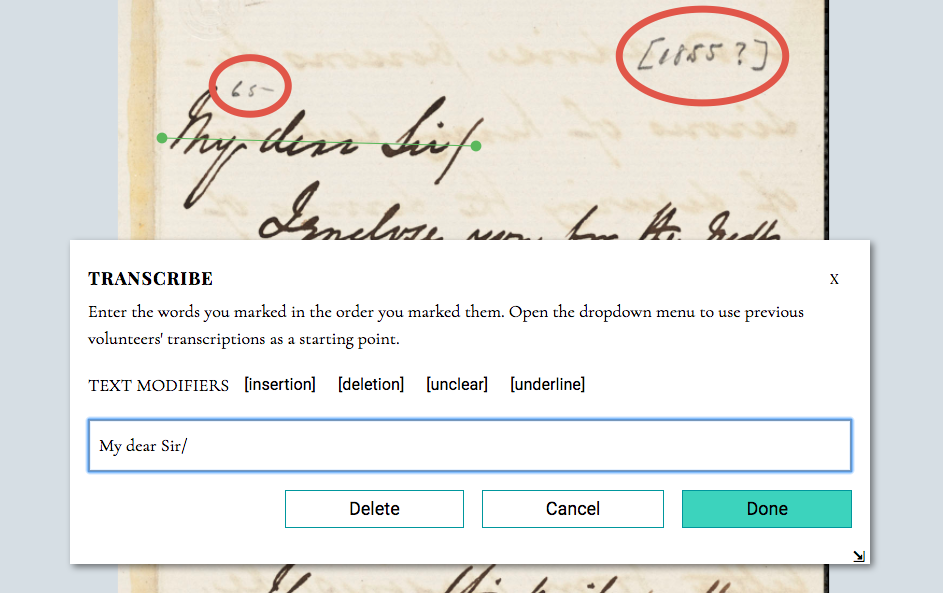
Now, “in order to make this collection more valuable to researchers, scholars, and historians we are pleased to announce the launch of a new website which will make these handwritten items available for you to transcribe into machine readable text.”
It’s no small job: the collection contains roughly 40,000 pieces of “correspondence, broadsides, newspapers, pamphlets, books, and memorabilia from the 1830s through the 1870s,” including the work of some of the most notable American, British, and Irish abolitionists of the day. But the combined efforts of everyone willing to transcribe a few documents, will, in Blake’s words, “allow the text corpus to be more precisely searchable and better suited for natural language processing applications – helping researchers better understand patterns, relationships, and trends embedded in the linguistics of this particular community.” Which, ultimately, will help us all to better understand America. If you’d like to lend a hand, you can create an account and start transcribing at the Anti-Slavery Collection’s site today.
Based in Seoul, Colin Marshall writes and broadcasts on cities and culture. His projects include the book The Stateless City: a Walk through 21st-Century Los Angeles and the video series The City in Cinema. Follow him on Twitter at @colinmarshall or on Facebook.
The Library’s Drawings Online program gives the public free access to over 10,000 downloadable images, drawn primarily from—and in—the fifteenth through nineteenth centuries. Many images are fleshed out with inscriptions, information on provenance, biographical sketches of the artist, and, in over 2000 instances, images of the verso, or flip side of the paper.
Researchers and similarly informed seekers can browse by artist or school, but what if you don’t quite know what you want?
You could tour the highlights, or better yet, bushwhack your way into the unknown by entering a random word or phrase into the “search drawings” function.
Knowing that the internet is crazy for cats, I made that my first search term, but the results were skewed by an 18th-century Dutch artist named Jacob Cats, whose work abounds with cows and sheep.
And the Where’s Waldo-esque excitement I felt upon an anonymous artist’s Mountain Landscape with Italian-Style Cloister faux-Bruegel dissipated when I realized this return owed more to the abbreviation of “catalogue” than any feline lurking in the pen-and-ink trees.
Next I entered the word “babies.” I’m not sure why. There certainly were a lot of them, almost as many as I encounter on Facebook.
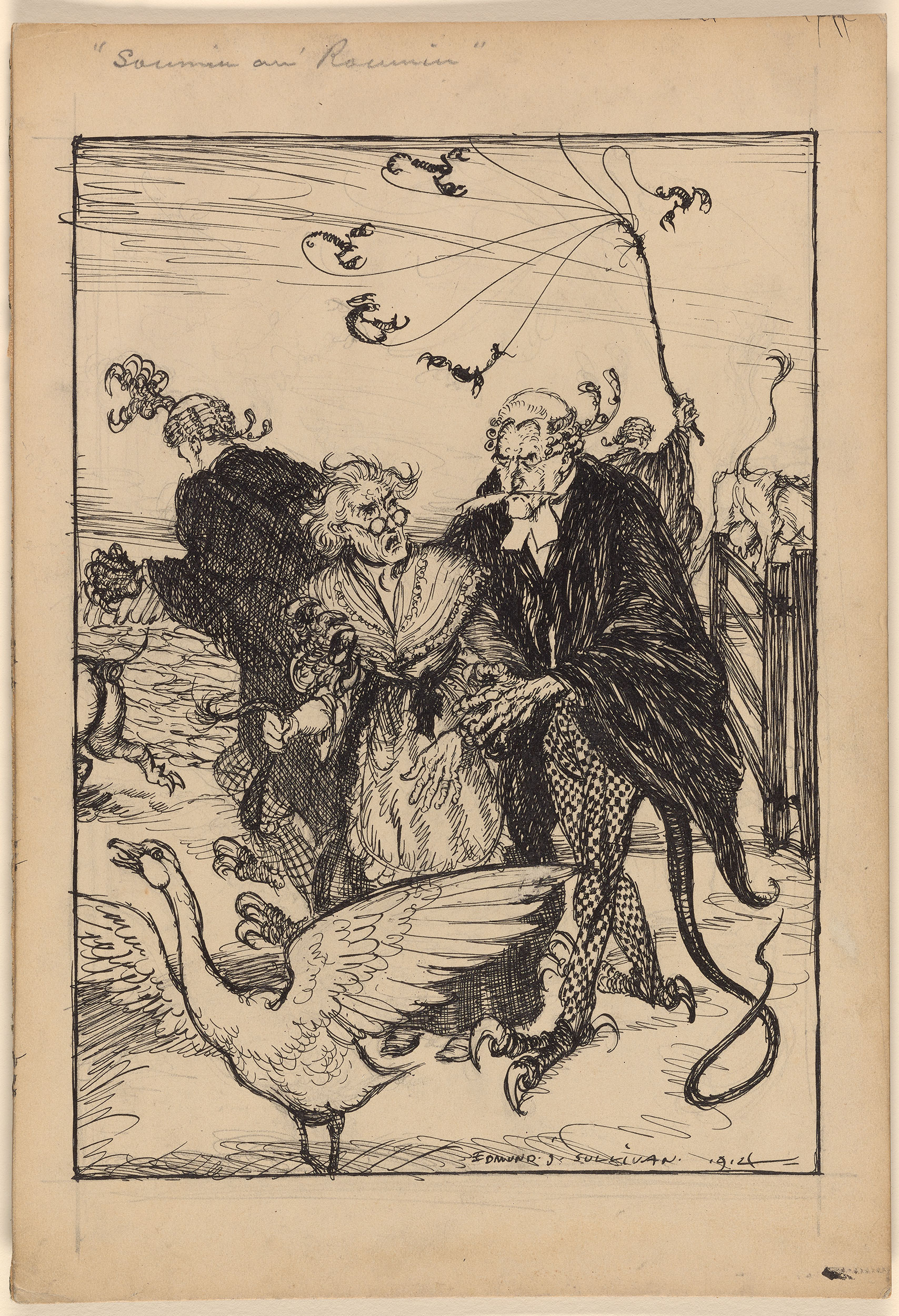
My favorite of the seven search results is illustrator Edmund J. Sullivan’s Soumin an’ Roumin from 1914. One of a dozen or so drawings Sullivan made for an updated edition of George Outram’s Legal and Other Lyrics, it shows “an old woman in a farmyard surrounded by livestock fleeing three monstrous lawyers wearing wigs and robes and armed with hideous talons instead of hands and feet. One … chases a cow with a scourge, the thongs of which end in scorpions.”
Download that one for all your lawyer friends or your lawyer spouse… upload it to a t‑shirt if you’re crafty.
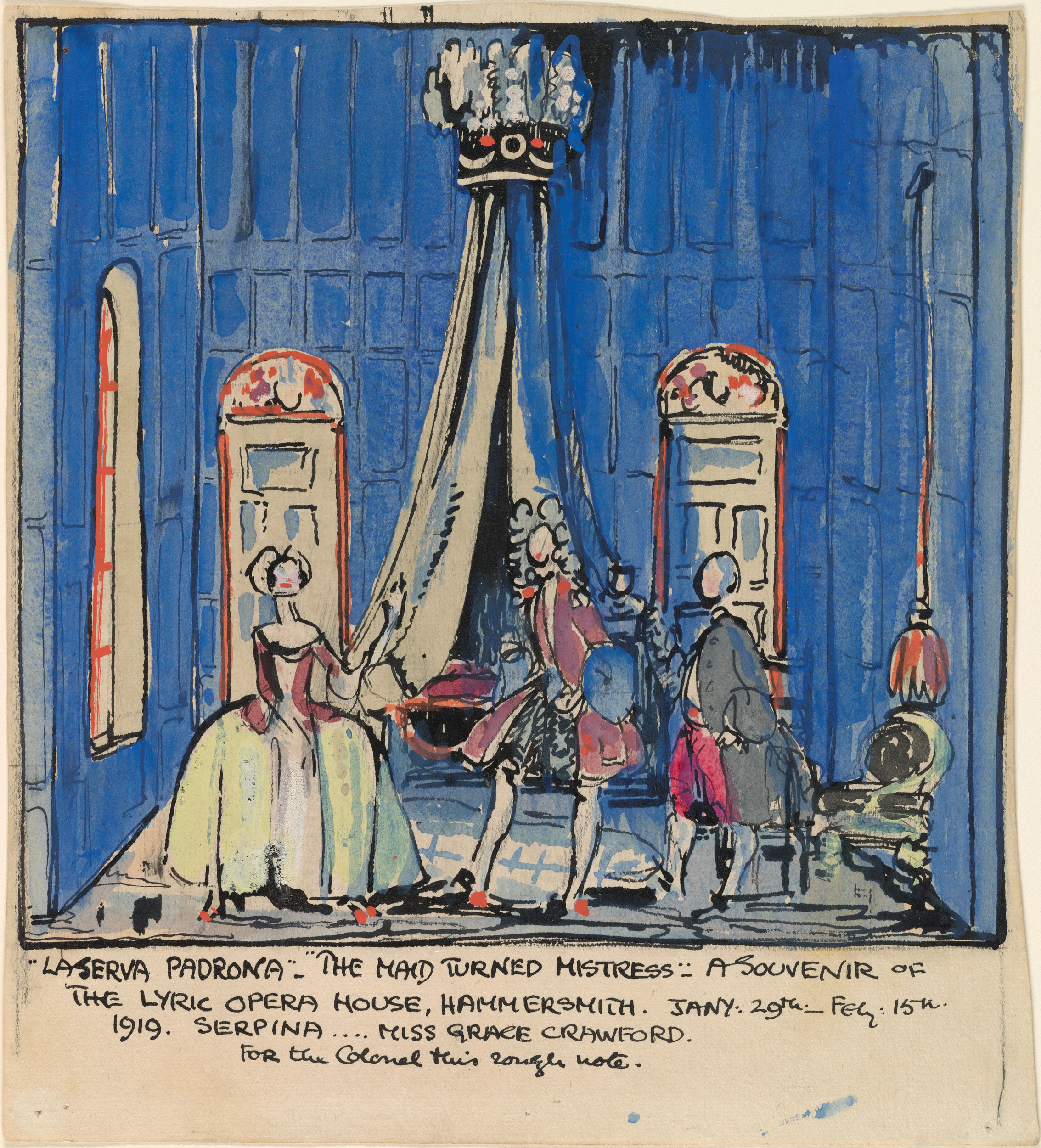
Claud Lovat Fraser’s set design for Pergolesi’s short comic opera La Serva Padrona (or The Maid Turned Mistress) at the Lyric Hammersmith doesn’t depict any lawyers, to the best of my knowledge, but he himself was one—also a caricaturist, lampooning the literary and theatrical luminaries of his day, and a soldier whose life was cut short due to exposure to gas in World War I.
In addition to the Morgan’s particularly well-fleshed-out artist bio for this work, the verso is a treat in the form of a printed announcement for the Chelsea Arts Club Costume Ball.
Some writers are restless by nature, roaming like Ernest Hemingway or Henry Miller, settling nowhere and everywhere. Others are homebodies, like William Faulkner and Virginia Woolf. Their fiction reflects their desire to nest in place. Strolling the grounds of Faulkner’s Rowan Oak one sweltering summer, I swear I saw the author round a corner of the house, lost in thought and wearing riding clothes. Visitors to Virginia Woolf’s home in the village of Rodmell in East Sussex have surely had similar visions.
Woolf’s home contains her writing life within the lush garden grounds and cottage walls of the 17th century Monk’s House—Virginia and Leonard’s retreat, then permanent home, from 1919 until her suicide by drowning in the nearby River Ouse in 1941.
Even in death she belonged to the house; Leonard buried her ashes beneath an elm in the Monk’s House garden. Although Leonard was the gardener, “there are very few entries” in Virginia’s diary “which do not mention the garden.”
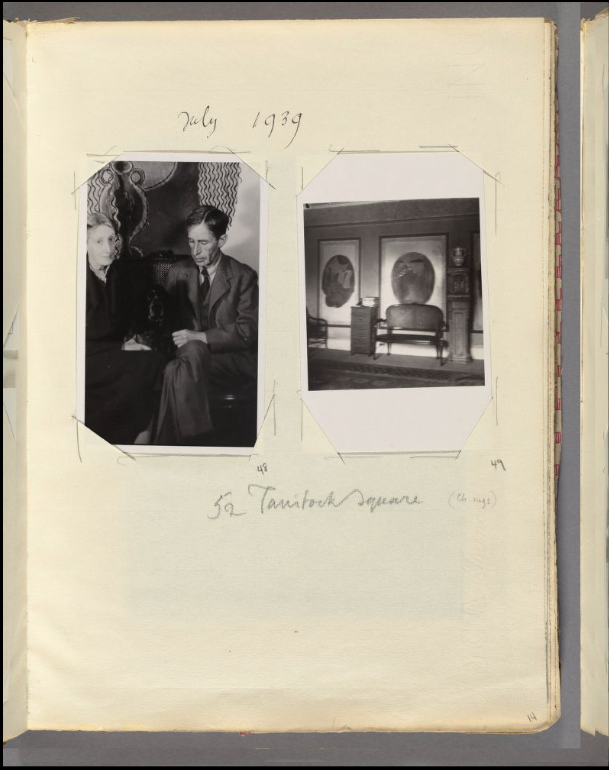
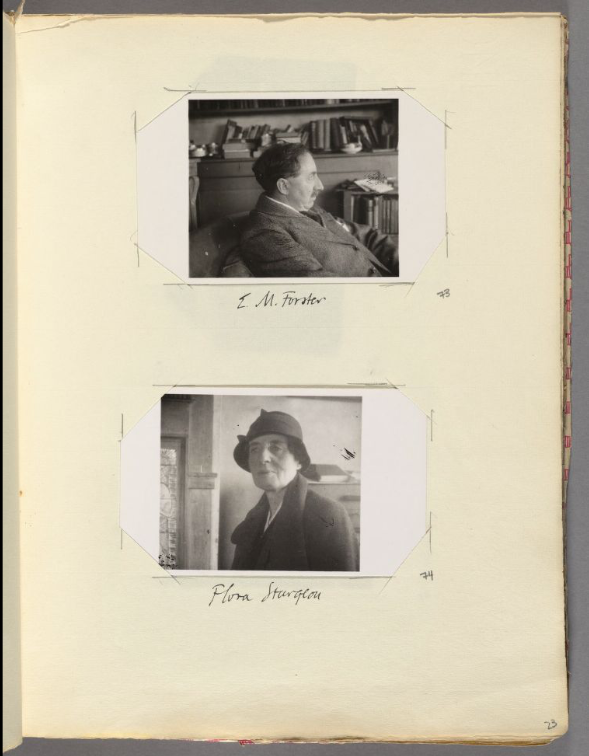
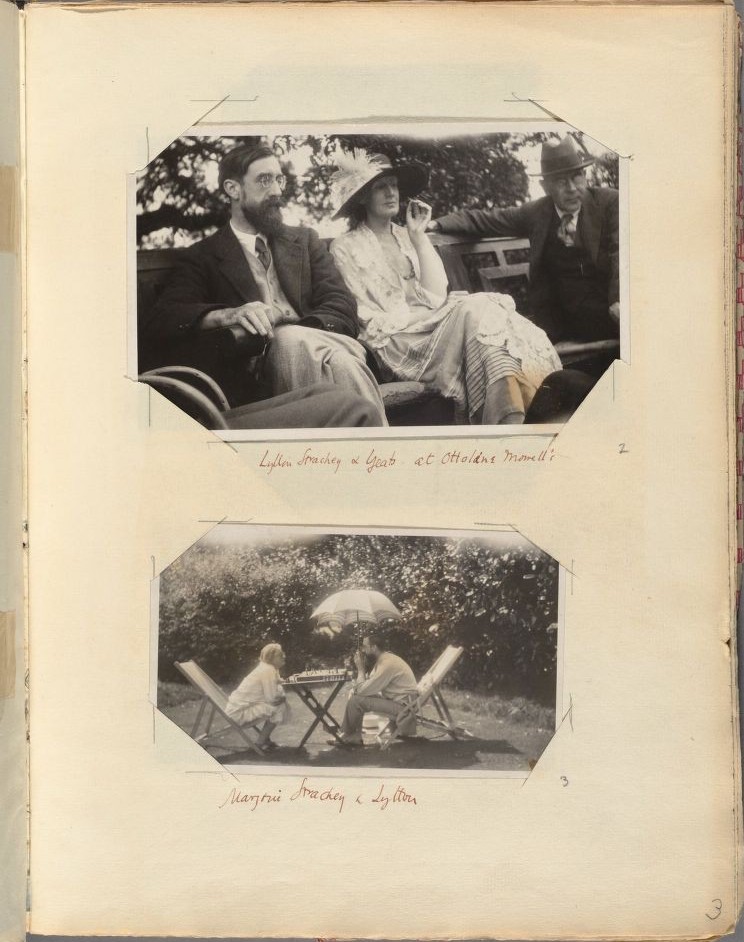
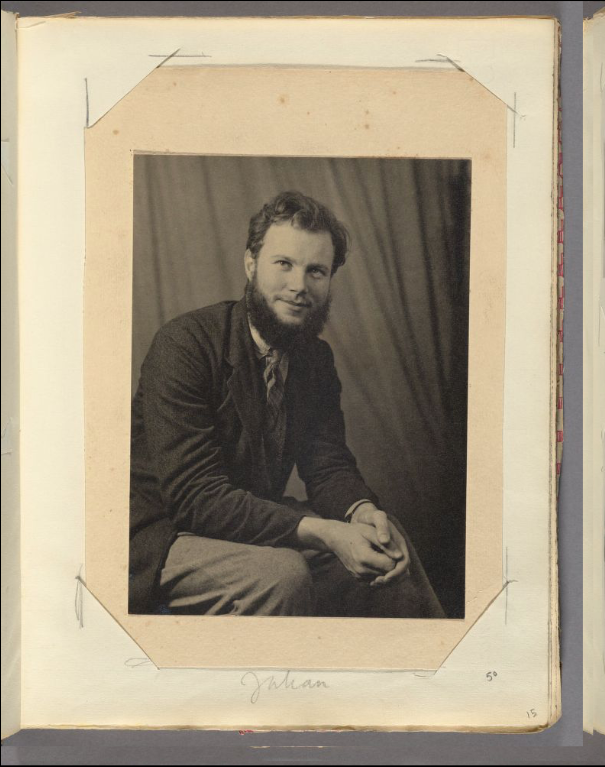
But there are many other ways to meet the author of Mrs. Dalloway and Jacob’s Room than traveling to her writer’s lodge, a tidy, tiny house on the Monk’s House grounds that served as her office. Like an avid Instragrammer—or like my mother and probably yours—Woolf kept careful record of her life in photo albums, which now reside at Harvard’s Houghton Library. The Monk’s House albums, numbered 1–6, contain images of Woolf, her family, and her many friends, including such famous members of the Bloomsbury group as E.M. Forster (above, top), John Maynard Keynes, and Lytton Strachey (below, with Woolf and W.B. Yeats, and playing chess with sister Marjorie). Harvard has digitized one album, Monk’s House 4, dated 1939 on the cover. You can view its scanned pages at their library site.
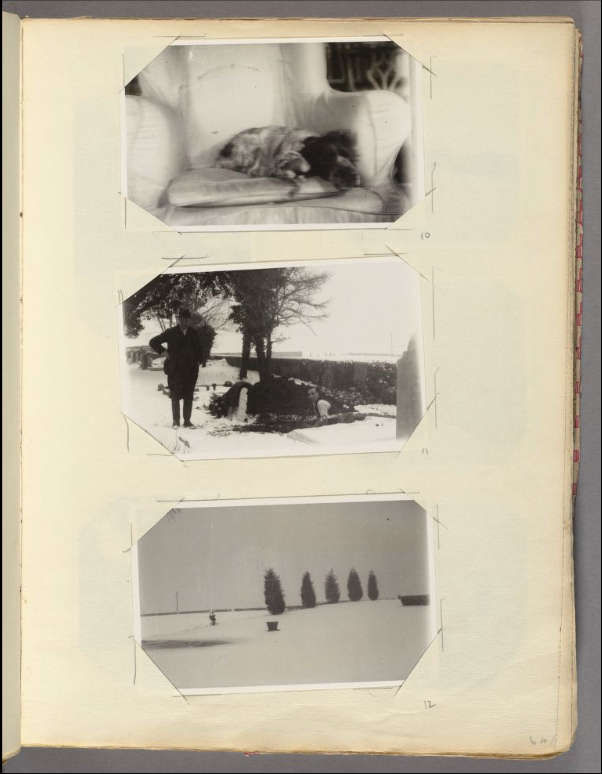
There are vacation photos and family photos; landscapes and photos of pets; clippings from newspapers and magazines; and, of course, the garden. The albums span the period 1890 to 1947 (including additions by Leonard after Virginia’s death). Many of the photos are labeled, many are not. Many of the albums’ pages are left blank. The photographs are arranged in no particular order. The net effect is that of a life recollected in pregnant images laced with lacunae, a psychological theme of so much of Woolf’s writing. Woolf, writes Maggie Humm, “believed that photographs could help her to survive those identity-destroying moments of her own life—her incoherent illnesses.”
But photography was also a means for cultivating relationships. Woolf “skillfully transformed friends and moments into artful tableaux, and she was surrounded by female friends and family who were also energetic photographers,” including her sister, Lady Ottoline Morrell, her friend and lover Vita Sackville-West, and her great aunt Julia Margaret Cameron. She “frequently invited friends to share her reflections. The letters and diaries describe a constant exchange of photographs, in which the photographs become a meeting-place, a conversation, aide-mémoires, and sometimes mechanisms of survival and enticement.”
Unlike Monk’s House, a world built and shared with her husband, Woolf’s albums represent her own personal network of relationships. They serve as memorials and meditations after the deaths of those close to her. “Photographs of friends were important memento mori,” such as the portrait of poet Julian Bell, above, her nephew, who was killed in the Spanish Civil War. The photos document gatherings and important life events among her social circle. They perform all the tasks of ordinary photo albums, and more—showing us the “chain of perceptions” of which personal identity is made in Woolf’s modernist vision, with repetitions and sequences centered around familiar objects like her favorite chair.
For fans, avid readers, critics, and literary historians, the photographs provide a visual record of a life we come to know so well through the letters, diaries, and romans à clef. Writing to her sister, Woolf once described painting a portrait “using dozens of snapshots in the paint.” Visit her photo album here at the Harvard Library site, and flip through the pages of her life in snapshots.
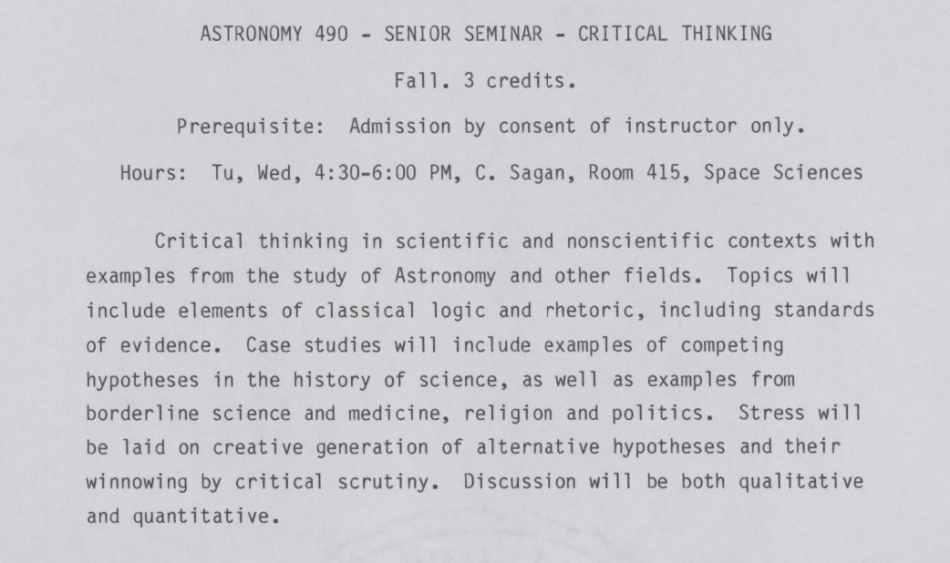
Though now more than twenty years gone, Carl Sagan, through his many books and his classic television series Cosmos, continues to teach us all he knew about life, the universe, and everything. Three decades’ worth of students will also remember learning from him in person, in the lecture halls of Harvard and Cornell where he kept up his professorial duties alongside the considerable demands of his career as a public intellectual. If you’ve ever learned anything from Sagan, whether from the man himself or from his work, you know he didn’t just want to teach humanity about outer space: he wanted to teach humanity how to think.
That goal became explicit in Astronomy 490, also known as “Critical Thinking in Science and Non-Science Context,” which Sagan taught at Cornell in 1986. You can read its course materials at the Library of Congress, whose Jennifer Harbster writes that they “include mention of the important balance between openness to new ideas and skeptical engagement with those ideas in science,” a point that “animates much of Carl Sagan’s work as an educator and science communicator.”
Based in Seoul, Colin Marshall writes and broadcasts on cities and culture. His projects include the book The Stateless City: a Walk through 21st-Century Los Angeles and the video series The City in Cinema. Follow him on Twitter at @colinmarshall or on Facebook.
“The internet made me do it,” says musician Julian Velard. For whatever reason, it made him take H.P Lovecraft’s 1917 poem “Nemesis” and mash it up with Billy Joel’s “Piano Man.” Find the original poem below. But know Velard “had to cut a couple lines to get it to fit.” Enjoy.
Thro’ the ghoul-guarded gateways of slumber,
Past the wan-moon’d abysses of night,
I have liv’d o’er my lives without number,
I have sounded all things with my sight;
And I struggle and shriek ere the daybreak, being driven to madness with fright.
I have whirl’d with the earth at the dawning,
When the sky was a vaporous flame;
I have seen the dark universe yawning,
Where the black planets roll without aim;
Where they roll in their horror unheeded, without knowledge or lustre or name.
I had drifted o’er seas without ending,
Under sinister grey-clouded skies
That the many-fork’d lightning is rending,
That resound with hysterical cries;
With the moans of invisible daemons that out of the green waters rise.
I have plung’d like a deer thro’ the arches
Of the hoary primordial grove,
Where the oaks feel the presence that marches
And stalks on where no spirit dares rove;
And I flee from a thing that surrounds me, and leers thro’ dead branches above.
I have stumbled by cave-ridden mountains
That rise barren and bleak from the plain,
I have drunk of the fog-foetid fountains
That ooze down to the marsh and the main;
And in hot cursed tarns I have seen things I care not to gaze on again.
I have scann’d the vast ivy-clad palace,
I have trod its untenanted hall,
Where the moon writhing up from the valleys
Shews the tapestried things on the wall;
Strange figures discordantly woven, which I cannot endure to recall.
I have peer’d from the casement in wonder
At the mouldering meadows around,
At the many-roof’d village laid under
The curse of a grave-girdled ground;
And from rows of white urn-carven marble I listen intently for sound.
I have haunted the tombs of the ages,
I have flown on the pinions of fear
Where the smoke-belching Erebus rages,
Where the jokulls loom snow-clad and drear:
And in realms where the sun of the desert consumes what it never can cheer.
I was old when the Pharaohs first mounted
The jewel-deck’d throne by the Nile;
I was old in those epochs uncounted
When I, and I only, was vile;
And Man, yet untainted and happy, dwelt in bliss on the far Arctic isle.
Oh, great was the sin of my spirit,
And great is the reach of its doom;
Not the pity of Heaven can cheer it,
Nor can respite be found in the tomb:
Down the infinite aeons come beating the wings of unmerciful gloom.
Thro’ the ghoul-guarded gateways of slumber,
Past the wan-moon’d abysses of night,
I have liv’d o’er my lives without number,
I have sounded all things with my sight;
And I struggle and shriek ere the daybreak, being driven to madness with fright.
One of the central problems of inequality is that it perpetuates itself by nature. The inherent social capital of those born in certain places and classes grants access to even more social capital. Questions of merit can seem marginal when the credentials required by elite institutions prove inaccessible to most people. In an admirable effort to break this cycle globally, MIT is now admitting students to a graduate program in economics, without GRE scores, without letters of recommendation, and without a college degree.
Instead students begin with something called a “MicroMasters” program, which is like “a method used in medicine… randomized control trials,” reports WBUR. This entryway removes many of the usual barriers to access by allowing students to first “take rigorous courses online for credit, and if they perform well on exams, to apply for a master’s degree program on campus”—a degree in data, economics and development policy (DEDP), which focuses on methods for reducing global inequality.
Enrollment in the online MicroMasters courses began in February of last year (the next round starts on February 6, 2018), and the DEDP master’s program will start in 2019. “The world of development policy has become more and more evidence-based over the past 10–15 years,” explains MIT professor of economics Ben Olken, who co-created the program with economics professors Esther Duflo and Abhijit Banerjee. “Development practitioners need to understand not just development issues, but how to analyze them rigorously using data. This program is designed to help fill that gap.”
Duflo, co-founder of MIT’s Abdul Latif Jameel Poverty Action Lab (J‑PAL), explains the innovation of MicroMasters’ radically open admissions. (For anyone with access to the internet, that is, still a huge barrier for millions worldwide): “Anybody could do that. At this point, you don’t need to have gone to college. For that matter, you don’t need to have gone to high school.” Students who are accepted after their initial online course work will move into a “blended” program that combines their prior work with a semester on MIT’s campus.
MicroMasters courses are priced on a sliding scale (from $100 to $1,000), according to what students can afford, and costs are nowhere near what traditional students pay—after having already paid, or taken loans, for a four-year degree, various testing regimens, admissions costs, living expenses, etc. The current program might feasibly be scaled up to include other fields in the future. Thus far, over 8,000 students in the world have enrolled in the MicroMasters program. “In total,” Duflo says, “there are 182 countries represented,” including ten percent from China, a large group from India, and “even some from the U.S.”
…and the scabby steel fences/railings surrounding a number of South London housing estates?
These mesh-and-pipe barriers look utterly unremarkable until one hears their origin story—as emergency stretchers for bearing away civilian casualties from the rubble of Luftwaffe raids.
The no-frills design was intended less for patient comfort than easy clean up. Kinks in the long stretcher poles kept the injured off the ground, and allowed for easy pick up by volunteers from the Civil Defence Service.
Some 600,000 of these stretchers were produced in preparation for airborne attacks. The Blitz killed over 28,000 London civilians. The number of wounded was nearly as high. The manufacture of child-sized stretchers speaks to the citizens’ awareness that the human price would be ghastly indeed.
”I am almost glad we have been bombed,” Queen Elizabeth “the Queen Mum” told a friend after Buckingham Palace was strafed in 1940. ”Now I feel I can look the East End in the face.”
Few neighborhood residents, let alone tourists, seem aware of the fences’ history, as evidenced in the video above.
Perhaps the recently formed Stretcher Railing Society—for the promotion, protection and preservation of London’s Air Raid Protection Stretcher Railings—will change that, or at the very least, put up some plaques.
We're hoping to rely on loyal readers, rather than erratic ads. Please click the Donate button and support Open Culture. You can use Paypal, Venmo, Patreon, even Crypto! We thank you!
Open Culture scours the web for the best educational media. We find the free courses and audio books you need, the language lessons & educational videos you want, and plenty of enlightenment in between.