Cats in Medieval Manuscripts & Paintings

Renais­sance artist Albrecht Dür­er  (1471–1528) nev­er saw a rhi­no him­self, but by rely­ing on eye­wit­ness descrip­tions of the one King Manuel I of Por­tu­gal intend­ed as a gift to the Pope, he man­aged to ren­der a fair­ly real­is­tic one, all things con­sid­ered.

Medieval artists’ ren­der­ings of cats so often fell short of the mark, Youtu­ber Art Deco won­ders if any of them had seen a cat before.

Point tak­en, but cats were well inte­grat­ed into medieval soci­ety.

Roy­al 12 C xix f. 36v/37r (13th cen­tu­ry)

Cats pro­vid­ed medieval cit­i­zens with the same pest con­trol ser­vices they’d been per­form­ing since the ancient Egyp­tians first domes­ti­cat­ed them.

Ancient Egyp­tians con­veyed their grat­i­tude and respect by regard­ing cats as sym­bols of divin­i­ty, pro­tec­tion, and strength.

Cer­tain Egypt­ian god­dess­es, like Bastet, were imbued with unmis­tak­ably feline char­ac­ter­is­tics.

The Vin­tage News reports that harm­ing a cat in those days was pun­ish­able by death, export­ing them was ille­gal, and, much like today, the death of a cat was an occa­sion for pub­lic sor­row:

When a cat died, it was buried with hon­ors, mum­mi­fied and mourned by the humans. The body of the cat would be wrapped in the finest mate­ri­als and then embalmed in order to pre­serve the body for a longer time. Ancient Egyp­tians went so far that they shaved their eye­brows as a sign of their deep sor­row for the deceased pet.

Aberdeen Uni­ver­si­ty Library, MS 24  f. 23v (Eng­land, c 1200)

The medieval church took a much dark­er view of our feline friends.

Their close ties to pagan­ism and ear­ly reli­gions were enough for cats to be judged guilty of witch­craft, sin­ful sex­u­al­i­ty, and frat­er­niz­ing with Satan.

In the late 12th-cen­tu­ry, writer Wal­ter Map, a soon-to-be archdea­con of Oxford, declared that the dev­il appeared before his devo­tees in feline form:

… hang­ing by a rope, a black cat of great size. As soon as they see this cat, the lights are turned out. They do not sing or recite hymns in a dis­tinct way, but they mut­ter them with their teeth closed and they feel in the dark towards where they saw their lord], and when they find it, they kiss it, the more humbly depend­ing on their fol­ly, some on the paws, some under the tail, some on the gen­i­tals. And as if they have, in this way, received a license for pas­sion, each one takes the near­est man or woman and they join them­selves with the oth­er for as long as they choose to draw out their game.

Pope Inno­cent VIII issued a papal bull in 1484 con­demn­ing the “devil’s favorite ani­mal and idol of all witch­es” to death, along with their human com­pan­ions to death.

13th-cen­tu­ry Fran­cis­can monk Bartholo­maeus Angli­cus refrained from demon­ic tat­tle, but nei­ther did he paint cats as angels:

He is a full lech­er­ous beast in youth, swift, pli­ant, and mer­ry, and leapeth and reseth on every­thing that is to fore him: and is led by a straw, and playeth there­with: and is a right heavy beast in age and full sleepy, and lieth sly­ly in wait for mice: and is aware where they be more by smell than by sight, and hunteth and reseth on them in privy places: and when he taketh a mouse, he playeth there­with, and eateth him after the play. In time of love is hard fight­ing for wives, and one scratch­eth and ren­deth the oth­er griev­ous­ly with bit­ing and with claws. And he maketh a ruth­ful noise and ghast­ful, when one prof­fer­eth to fight with anoth­er: and unneth is hurt when he is thrown down off an high place. And when he hath a fair skin, he is as it were proud there­of, and goeth fast about: and when his skin is burnt, then he bideth at home; and is oft for his fair skin tak­en of the skin­ner, and slain and flayed.

Pigs and rats also had a bad rep, and like cats, were tor­tured and exe­cut­ed in great num­bers by pious humans.

The Work­sop Bes­tiary Mor­gan Library, MS M.81 f. 47r (Eng­land, c 1185)

Not every medieval city was anti-cat. As the Aca­d­e­m­ic Cat Lady Johan­na Feen­stra writes of the above illus­tra­tion from The Work­sop Bes­tiary, one of the ear­li­est Eng­lish bes­tiaries:

Some would have inter­pret­ed the image of a cat pounc­ing on a rodent as a sym­bol for the dev­il going after the human soul. Oth­ers might have seen the cat in a com­plete­ly dif­fer­ent light. For instance, as Eucharis­tic guardians, mak­ing sure rodents could not steal and eat the Eucharis­tic wafers.

Bodleian Library Bod­ley 764 f. 51r (Eng­land, c 1225–50)

St John’s Col­lege Library, MS. 61 (Eng­land (York), 13th cen­tu­ry)

It took cat lover Leonar­do DaVin­ci to turn the sit­u­a­tion around, with eleven sketch­es from life por­tray­ing cats in char­ac­ter­is­tic pos­es, much as we see them today. We’ll delve more into that in a future post.

Con­rad of Megen­berg, ‘Das Buch der Natur’, Ger­many ca. 1434. Stras­bourg, Bib­lio­thèque nationale et uni­ver­si­taire, Ms.2.264, fol. 85r

Relat­ed Con­tent

Medieval Cats Behav­ing Bad­ly: Kit­ties That Left Paw Prints … and Peed … on 15th Cen­tu­ry Man­u­scripts

An Ani­mat­ed His­to­ry of Cats: How Over 10,000 Years the Cat Went from Wild Preda­tor to Sofa Side­kick

- Ayun Hal­l­i­day is the Chief Pri­ma­tol­o­gist of the East Vil­lage Inky zine and author, most recent­ly, of Cre­ative, Not Famous: The Small Pota­to Man­i­festo.  Fol­low her @AyunHalliday.

Lizzo Plays James Madison’s Priceless, 200-Year-Old Crystal Flute

In the annals of mod­ern pop­u­lar music, one does not find a sur­feit of flautists. Tim Weis­berg, in part­ner­ship with singer-song­writer Dan Fogel­berg, did score a mod­est his or two in the sev­en­ties. More incon­gru­ous­ly, Jethro Tul­l’s Ian Ander­son set his band apart with his deci­sion to take up the flute not long before their ear­li­est per­for­mances. But today, out­side the realm of orches­tral music, there is sure­ly no high­er-pro­file flautist than Liz­zo. Though best known as a pop singer, she con­tin­ues to put to use the flute skills she honed at the Uni­ver­si­ty of Hous­ton, with­out which she would­n’t have been able to han­dle a pre­cious piece of Amer­i­can his­to­ry.

Last month, writes the Library of Con­gress’ April Slay­ton, one of that insti­tu­tion’s librar­i­ans Car­la Hay­den “saw that the one and only Liz­zo was com­ing to D.C. for a con­cert.” Giv­en that “the Library has the world’s largest flute col­lec­tion,” Hay­den took the oppor­tu­ni­ty to point out that fact to the pop star on Twit­ter. “One of about 1,700 flutes in the col­lec­tion, she teased, is the crys­tal flute made for Pres­i­dent James Madi­son by Claude Lau­rent — a price­less instru­ment that Dol­ley Madi­son res­cued from the White House in April 1814 as the British entered Wash­ing­ton, DC dur­ing the War of 1812.. Might she want to drop by and play a few bars?”

Indeed she did, with results you can see in the video above: at the Library itself, Liz­zo tries out one of the col­lec­tion’s many flutes; then she plays the crys­tal flute itself on onstage at Capi­tol One Are­na, hav­ing been hand­ed it by the instru­men­t’s own secu­ri­ty detail. “It’s like play­ing out of a wine glass,” she tells her thrilled audi­ence. One won­ders if the com­par­i­son would ever have occurred to its first own­er: “It’s not clear if Madi­son did much with the flute oth­er than admire it,” Slay­ton writes, “but it became a fam­i­ly heir­loom and an arti­fact of the era.” Now it has become a unit­ing sym­bol of Amer­i­can cul­ture past and present: how­ev­er for­ward-look­ing the Found­ing Fathers were, we can safe­ly say they nev­er imag­ine twerk­ing.

The Library of Con­gress has post­ed pic­tures of Liz­zo’s vis­it on Flickr. See them here.

Relat­ed con­tent:

But­ter­fly Lands on Flutist’s Face Dur­ing Flute Com­pe­ti­tion: The Show Must Go On

Hear the World’s Old­est Instru­ment, the “Nean­derthal Flute,” Dat­ing Back Over 43,000 Years

Hear a 9,000 Year Old Flute — the World’s Old­est Playable Instru­ment — Get Played Again

The Flute of Shame: Dis­cov­er the Instrument/Device Used to Pub­licly Humil­i­ate Bad Musi­cians Dur­ing the Medieval Peri­od

The Library of Con­gress Makes 25 Mil­lion Records From Its Cat­a­log Free to Down­load

Based in Seoul, Col­in Mar­shall writes and broad­casts on cities, lan­guage, and cul­ture. His projects include the Sub­stack newslet­ter Books on Cities, the book The State­less City: a Walk through 21st-Cen­tu­ry Los Ange­les and the video series The City in Cin­e­ma. Fol­low him on Twit­ter at @colinmarshall or on Face­book.

How Writing Has Spread Across the World, from 3000 BC to This Year: An Animated Map

The old­est known writ­ing sys­tems first emerged in Mesopotamia, between 3400 and 3100 BC, and Egypt, around 3250 BC. The Latin alpha­bet, which I’m using to write this post and you’re using to read it, grad­u­al­ly took the shape we know between the sev­enth cen­tu­ry BC and the Mid­dle Ages. Over the eras since, it has spread out­ward from Europe to become the most wide­ly used script in the world. These are impor­tant devel­op­ments in the his­to­ry of writ­ing, but hard­ly the only ones. It is with all known writ­ing sys­tems that his­tor­i­cal map ani­ma­tor Ollie Bye deals in the video above: not just those used today, but over the whole of the past five mil­len­nia.

The con­quests of Alexan­der the Great; the Gal­lic Wars; the col­o­niza­tion of Latin Amer­i­ca; the “scram­ble for Africa”: these and oth­er major his­tor­i­cal events are vivid­ly reflect­ed in the spread of cer­tain writ­ing sys­tems.

Up until 1492 — after the expi­ra­tion of eight and a half of the video’s eleven min­utes — the map con­cerns itself only with Europe, Asia, and the north­ern three-quar­ters of Africa (as well as an inlaid sec­tion depict­ing the civ­i­liza­tions of what is now Cen­tral Amer­i­ca). There­after it zooms out to include the New World, and indeed the whole world, though cen­turies pass before most of its blank spaces fill up with the col­ors that indi­cate the adop­tion of a dom­i­nant script.

Ara­bic and Per­sian appear in lime green, sim­pli­fied Chi­nese in red, and Cyril­lic in light blue. Before Bye’s ani­ma­tion reach­es the mid­dle twen­ti­eth cen­tu­ry, most of the world has turned medi­um blue, which rep­re­sents the now-mighty Latin alpha­bet. The use of these very let­ters for all writ­ten com­mu­ni­ca­tion by such a wide vari­ety of cul­tures mer­its a vol­umes-long his­to­ry by itself. But per­haps most intrigu­ing here is the per­sis­tence of rel­a­tive­ly minor scripts: Cree, used among the natives of north­ern Cana­da; hira­ganakatakana, and kan­ji in Japan; and also hangul in Korea — which I read and write myself every day of my life in Seoul, and to whose con­tin­ued dom­i­nance here I can con­fi­dent­ly attest.

Relat­ed con­tent:

The Atlas of Endan­gered Alpha­bets: A Free Online Atlas That Helps Pre­serve Writ­ing Sys­tems That May Soon Dis­ap­pear

The Evo­lu­tion of the Alpha­bet: A Col­or­ful Flow­chart, Cov­er­ing 3,800 Years, Takes You From Ancient Egypt to Today

Dic­tio­nary of the Old­est Writ­ten Language–It Took 90 Years to Com­plete, and It’s Now Free Online

How to Write in Cuneiform, the Old­est Writ­ing Sys­tem in the World: A Short, Charm­ing Intro­duc­tion

The Improb­a­ble Inven­tion of Chi­nese Type­writ­ers & Com­put­er Key­boards: Three Videos Tell the Tech­no-Cul­tur­al Sto­ry

You Could Soon Be Able to Text with 2,000 Ancient Egypt­ian Hiero­glyphs

Based in Seoul, Col­in Mar­shall writes and broad­casts on cities, lan­guage, and cul­ture. His projects include the Sub­stack newslet­ter Books on Cities, the book The State­less City: a Walk through 21st-Cen­tu­ry Los Ange­les and the video series The City in Cin­e­ma. Fol­low him on Twit­ter at @colinmarshall or on Face­book.

What It’s Like to Work in Frank Lloyd Wright’s Iconic Office Building

Frank Lloyd Wright, who drew so much inspi­ra­tion from the wide open spaces of mid­dle Amer­i­ca, designed just two high-rise build­ings. The sec­ond, com­plet­ed late in his long career, was 1956’s Price Tow­er in Bartlesville, Okla­homa. The first opened six years before that, as an addi­tion to one of his already-famous projects. That was the head­quar­ters of S. C. John­son & Son, bet­ter known as John­son Wax, in Racine, Wis­con­sin. Seen at a dis­tance, the Research Tow­er stands out as the sig­nal fea­ture of the com­plex, but it’s the ear­li­er Admin­is­tra­tion Build­ing that offered the world a glimpse of the future of work.

The Admin­is­tra­tion Build­ing’s con­struc­tion fin­ished in 1939. Back then, says Vox’s Phil Edwards (him­self an estab­lished Wright fan) in the video above, “offices were small and cramped, or pri­vate. This build­ing had a spa­cious cen­tral room instead, meant to encour­age the spread of ideas.” Such a con­cept may sound famil­iar — per­haps all too famil­iar — to any­one who’s ever worked in what we now call an “open-plan office.” But it was dar­ing at the time, and it seems that no archi­tect has ever imple­ment­ed it quite as strik­ing­ly again. What oth­er office makes you “feel like you’re under­wa­ter, that you’re in, maybe, a lily pond”?

That descrip­tion comes from archi­tect and Wright schol­ar Jonathan Lip­man, one of the experts Edwards con­sults on his own pil­grim­age to John­son Wax Head­quar­ters. He want­ed to spend some time work­ing there him­self, some­thing eas­i­ly arranged since S. C. John­son has by now moved most of its oper­a­tions into oth­er facil­i­ties. But how­ev­er sat­is­fy­ing it feels to sit in the shade of Wright’s “den­dri­form columns” sprout­ing through­out the Great Work­room, the expe­ri­ence proves unsat­is­fy­ing. “It was­n’t a real thing with­out any peo­ple around,” Edwards says, “with­out the ener­gy of being in that office.”

Wright spoke of his inten­tions to cre­ate “as inspir­ing a place to work in as any cathe­dral ever was to wor­ship in.” Today, amid the silent absence of typ­ists on the ground floor and man­agers on the mez­za­nine, the Admin­is­tra­tion Build­ing must feel holi­er than ever. The space exudes a mag­nif­i­cent lone­li­ness, and open­ing a Mac­Book to log into Slack sure­ly inten­si­fies the lone­li­ness rather than the mag­nif­i­cence. “In 1939, this was the future of work,” Edwards says. “These big cor­po­rate cam­pus­es, the Googles and Metas and Ama­zons: they owe a debt to this cam­pus here.” But for the increas­ing­ly many liv­ing the remote-work life, even those twen­ty-first-cen­tu­ry big-tech head­quar­ters have begun to seem like tem­ples from a pass­ing era.

Relat­ed con­tent:

A Vir­tu­al Tour of Frank Lloyd Wright’s Lost Japan­ese Mas­ter­piece, the Impe­r­i­al Hotel in Tokyo

12 Famous Frank Lloyd Wright Hous­es Offer Vir­tu­al Tours: Hol­ly­hock House, Tal­iesin West, Falling­wa­ter & More

Build Wood­en Mod­els of Frank Lloyd Wright’s Great Build­ing: The Guggen­heim, Uni­ty Tem­ple, John­son Wax Head­quar­ters & More

When Frank Lloyd Wright Designed a Dog­house, His Small­est Archi­tec­tur­al Cre­ation (1956)

The Mod­ernist Gas Sta­tions of Frank Lloyd Wright and Mies van der Rohe

When the Indi­ana Bell Build­ing Was Rotat­ed 90° While Every­one Worked Inside in 1930 (by Kurt Vonnegut’s Archi­tect Dad)

Based in Seoul, Col­in Mar­shall writes and broad­casts on cities, lan­guage, and cul­ture. His projects include the Sub­stack newslet­ter Books on Cities, the book The State­less City: a Walk through 21st-Cen­tu­ry Los Ange­les and the video series The City in Cin­e­ma. Fol­low him on Twit­ter at @colinmarshall or on Face­book.

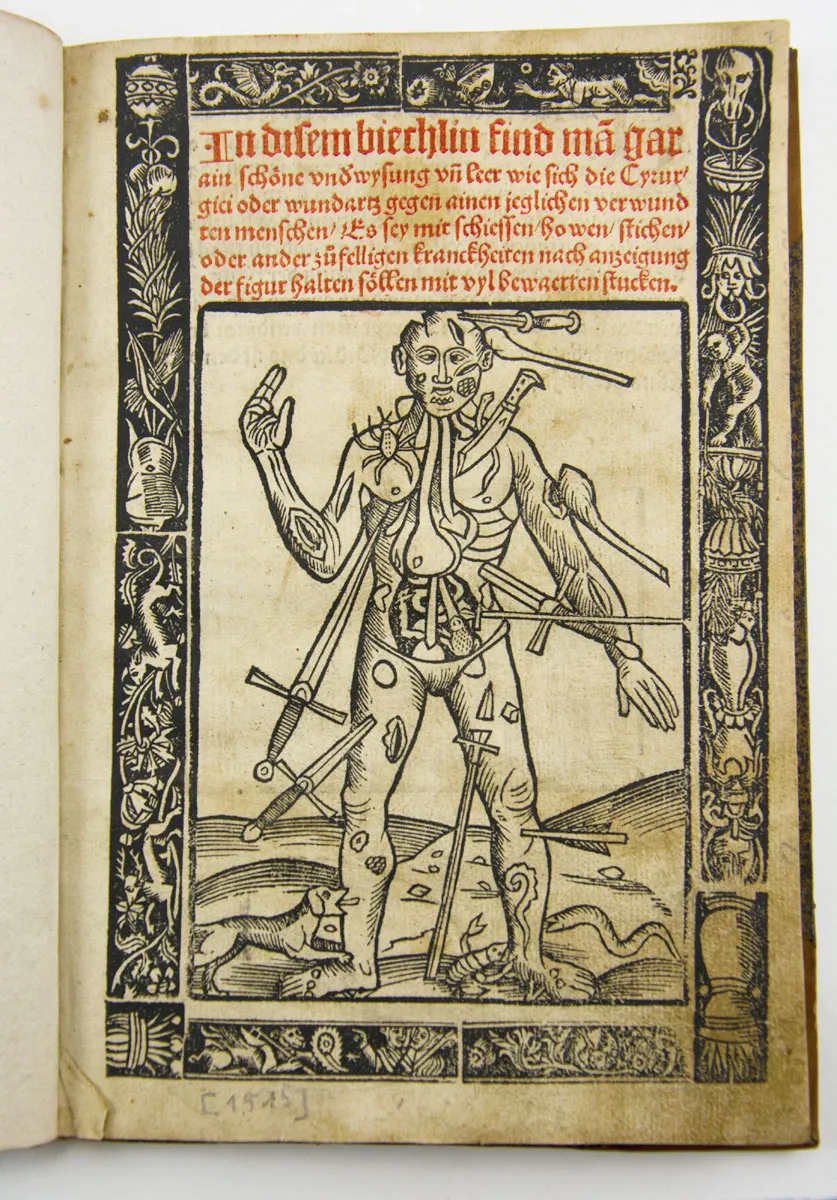
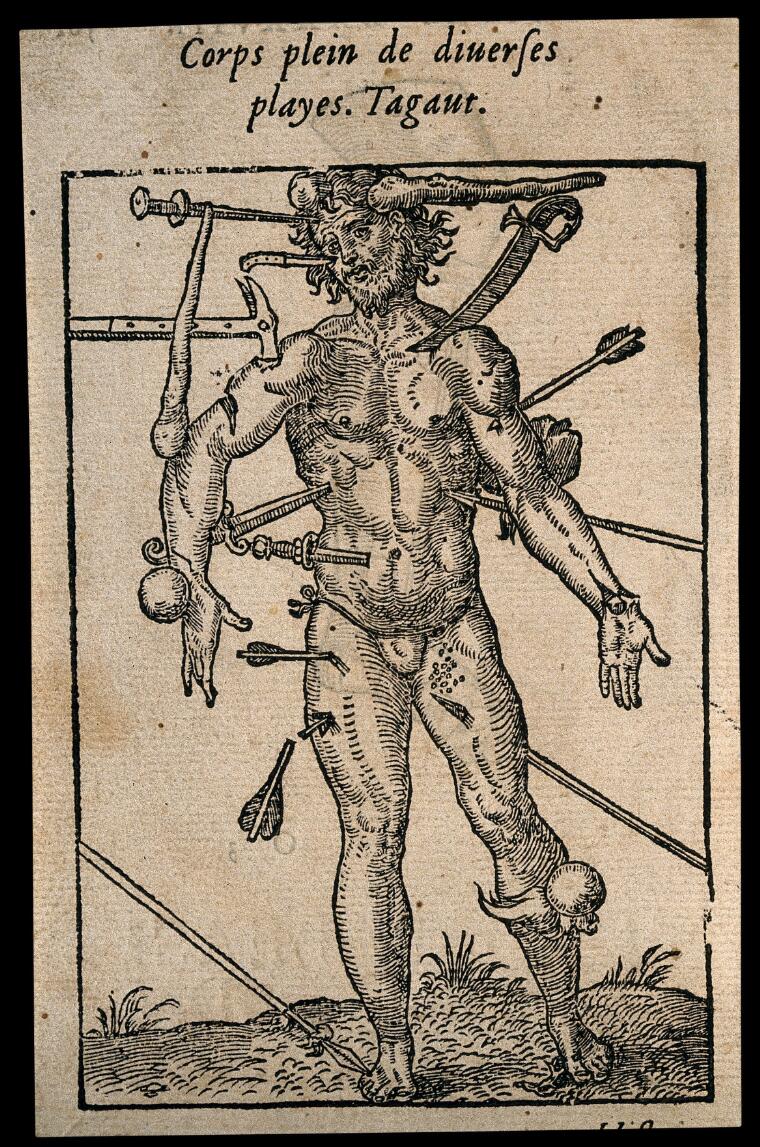
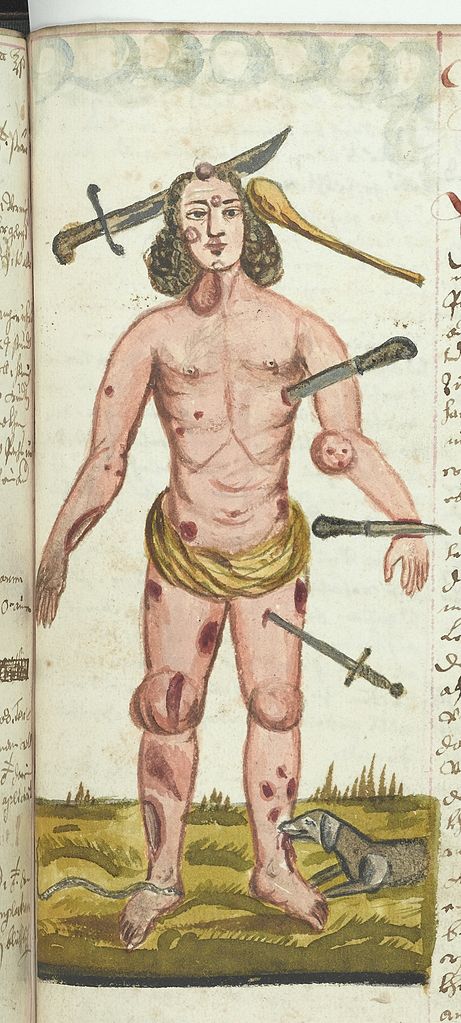
Behold the Medieval Wound Man: The Poor Soul Who Illustrated the Injuries a Person Might Receive Through War, Accident or Disease

Do you swoon at the sight of blood?

Suf­fer paper cuts as major trau­ma?

Cov­er your eyes when the knife comes out in the hor­ror movie?

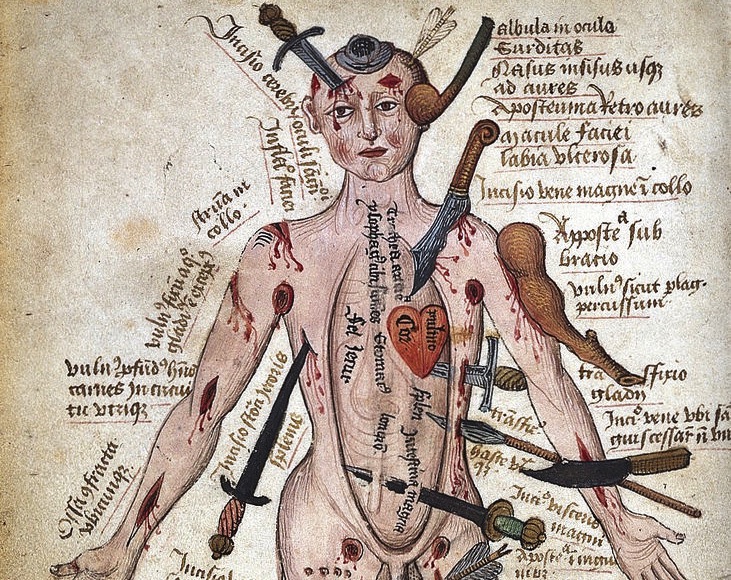
If so, and also if not, fall to your knees and give thanks that you’re not the Wound Man, above.

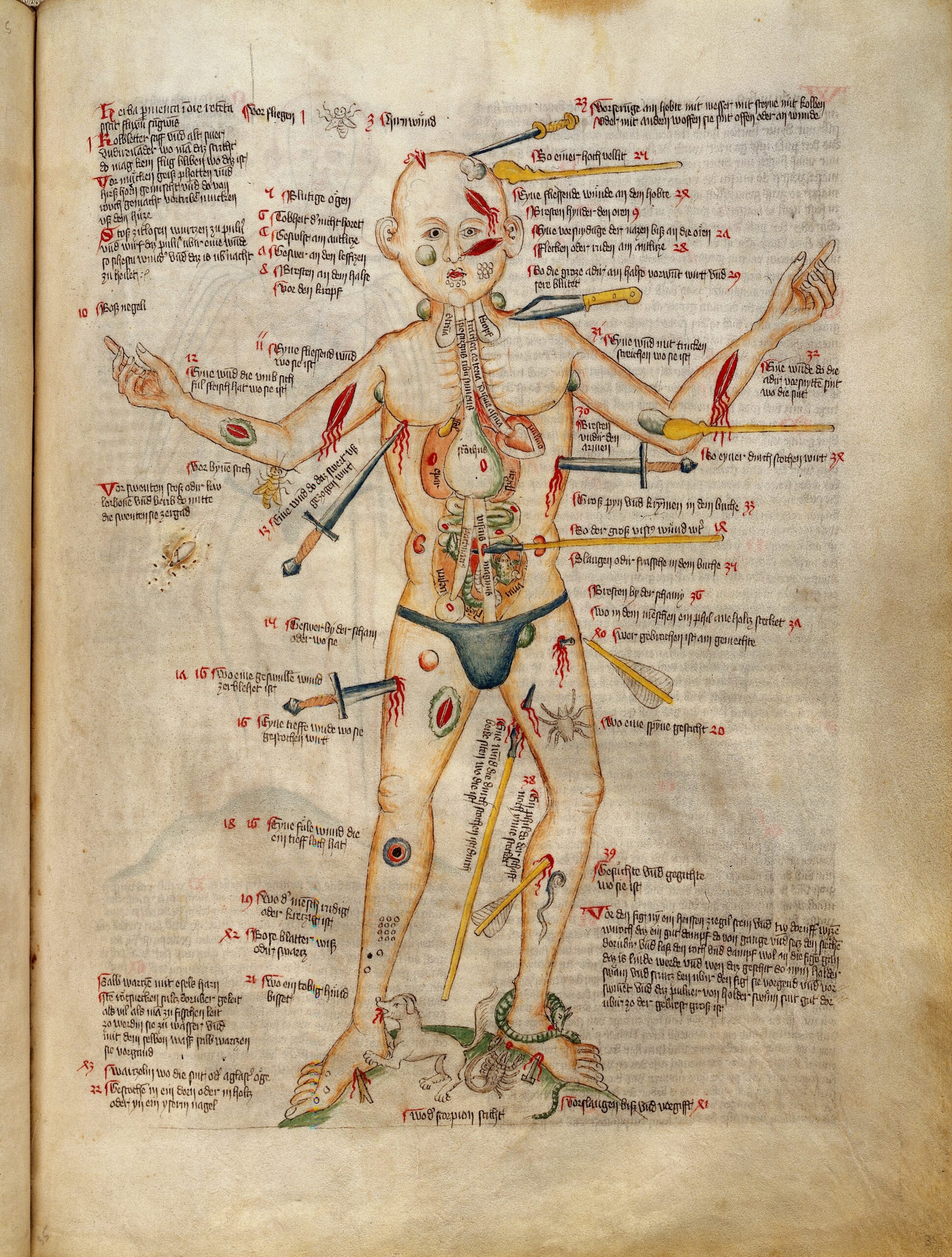
A sta­ple of medieval med­ical his­to­ry, he’s a gris­ly com­pendi­um of the injuries and exter­nal afflic­tions that might befall a mor­tal of the peri­od- insect and ani­mal bites, spilled entrails, abscess­es, boils, infec­tions, plague-swollen glands, pierc­ings and cuts, both acci­den­tal and delib­er­ate­ly inflict­ed.

Any one of these trou­bles should be enough to fell him, yet he remains upright, dis­play­ing every last one of them simul­ta­ne­ous­ly, his expres­sion sto­ic.

He’s hard to look at, but as art his­to­ri­an Jack Hart­nell , author of Medieval Bod­ies: Life, Death and Art in the Mid­dle Ages writes in British Art Stud­ies:

The Wound Man was not a fig­ure designed to inspire fear or to men­ace. On the con­trary, he rep­re­sent­ed some­thing more hope­ful: an imag­i­na­tive and arrest­ing her­ald of the pow­er­ful knowl­edge that could be chan­nelled and dis­pensed through the prac­tice of medieval med­i­cine.

A valu­able edu­ca­tion­al resource for sur­geons for some three cen­turies, he began crop­ping up in south­ern Ger­many in the ear­ly 1400s. In an essay for the Pub­lic Domain Review, Hart­nell notes how these ear­ly spec­i­mens served “as a human table of con­tents”, direct­ing inter­est­ed par­ties to the spe­cif­ic pas­sages in the var­i­ous med­ical texts where infor­ma­tion on exist­ing treat­ments could be found.

The pro­to­col for injuries to the intestines or stom­ach called for stitch­ing the wound up with a fine thread and sprin­kling it with an anti­he­m­or­rhag­ic pow­der made from wine, hematite, nut­meg, white frank­in­cense, gum ara­bic, bright red sap from the Dra­cae­na cinnabari tree and a restora­tive quan­ti­ty of mum­my.

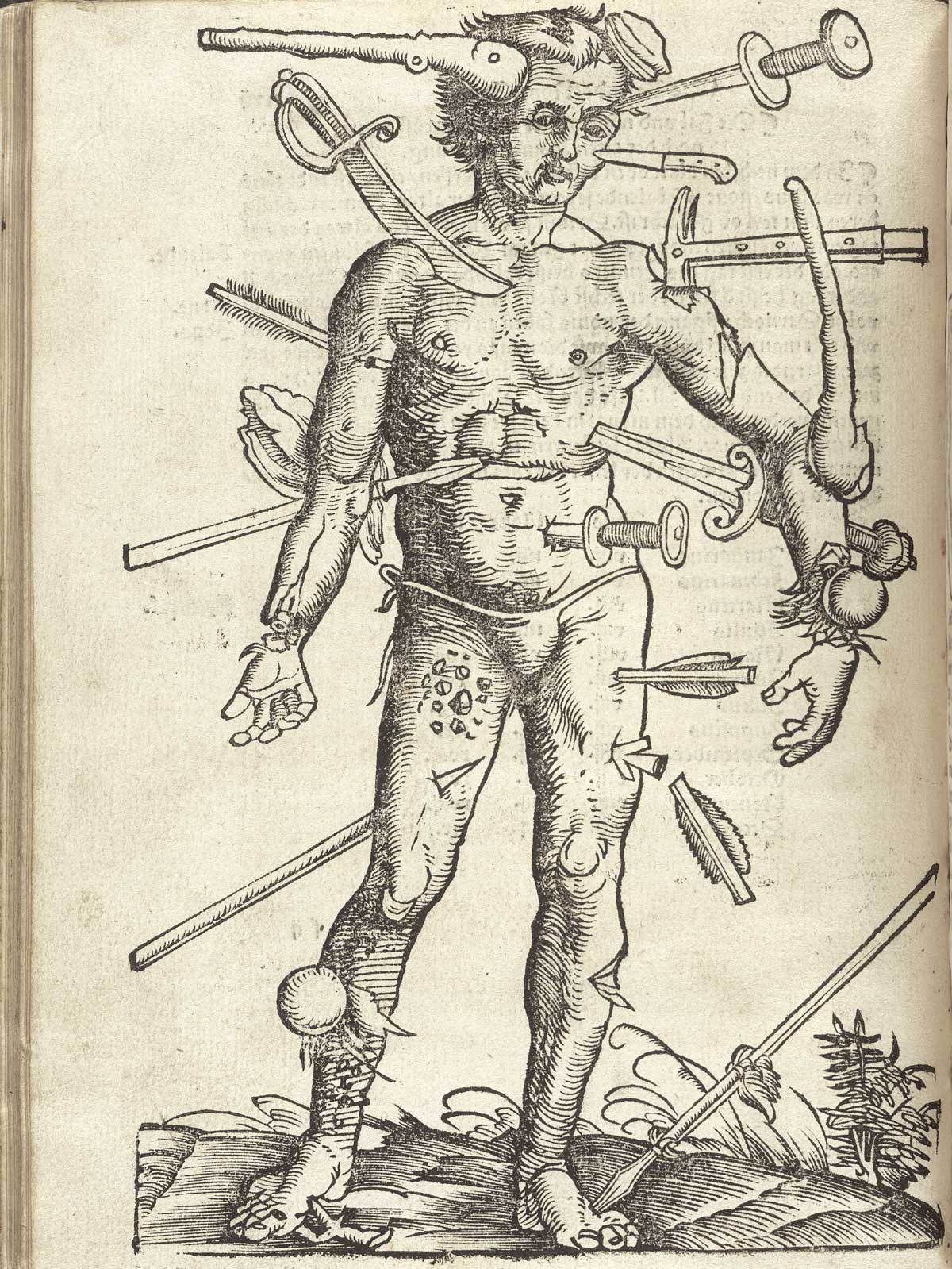
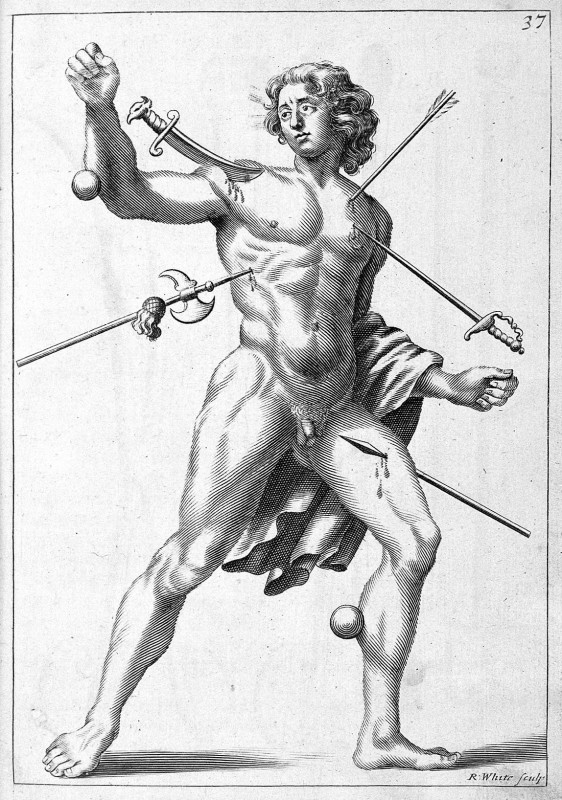
The Wound Man evolved along with med­ical knowl­edge, weapons of war­fare and art world trends.

The wood­cut Wound Man in Hans von Gersdorff’s 1517 land­mark Field­book of Surgery intro­duces can­non­balls to the ghast­ly mix.

And the engraver Robert White’s Wound Man in British sur­geon John Browne’s 1678 Com­pleat Dis­course of Wounds los­es the loin­cloth and grows his hair, mor­ph­ing into a neo­clas­si­cal beau­ty in the Saint Sebas­t­ian mold.

Sur­gi­cal knowl­edge even­tu­al­ly out­paced the Wound Man’s use­ful­ness, but pop­u­lar cul­ture is far from ready for him to lay down and die, as evi­denced by recent cameos in episodes of Han­ni­bal and the British com­e­dy quiz show, QI.


Delve into the his­to­ry of the Wound Man in Jack Hart­nel­l’s British Art Stud­ies arti­cle “Word­ing the Wound Man.”

via Pub­lic Domain Review

Relat­ed Con­tent

1,000-Year-Old Illus­trat­ed Guide to the Med­i­c­i­nal Use of Plants Now Dig­i­tized & Put Online

Dis­cov­er the Per­sian 11th Cen­tu­ry Canon of Med­i­cine, “The Most Famous Med­ical Text­book Ever Writ­ten”

How Illu­mi­nat­ed Medieval Man­u­scripts Were Made: A Step-by-Step Look at this Beau­ti­ful, Cen­turies-Old Craft

- Ayun Hal­l­i­day is the Chief Pri­ma­tol­o­gist of the East Vil­lage Inky zine and author, most recent­ly, of Cre­ative, Not Famous: The Small Pota­to Man­i­festo. Fol­low her @AyunHalliday.

Meet the Hyperpolyglots, the People Who Can Mysteriously Speak Up to 32 Different Languages

Poly­glot, as its Greek roots take no great pains to con­ceal, means the speak­ing of mul­ti­ple lan­guages. Some­what less obvi­ous is the mean­ing of the asso­ci­at­ed term hyper­poly­lot. “Coined two decades ago, by a British lin­guist, Richard Hud­son, who was launch­ing an Inter­net search for the world’s great­est lan­guage learn­er,” the New York­er’s Judith Thur­man writes, it refers not just to the speak­ing of mul­ti­ple lan­guages but the speak­ing of many lan­guages. How many is “many”? “The accept­ed thresh­old is eleven,” which dis­qual­i­fies even most of us avid lan­guage con­nois­seurs. But Vaughn Smith eas­i­ly makes the cut.

You can meet this for­mi­da­ble hyper­poly­glot in the Wash­ing­ton Post video above, which com­ple­ments Jes­si­ca Con­tr­era’s sto­ry in the paper. Smith grew up in D.C. speak­ing not just Eng­lish but Span­ish, his moth­er’s native lan­guage. On his father’s side of the fam­i­ly, dis­tant cousins from Bel­gium expand­ed Smith’s lin­guis­tic world­view fur­ther still.

At 46 years of age, he now speaks just about as many lan­guages, “with at least 24 he speaks well enough to car­ry on lengthy con­ver­sa­tions. He can read and write in eight alpha­bets and scripts. He can tell sto­ries in Ital­ian and Finnish and Amer­i­can Sign Lan­guage. He’s teach­ing him­self Indige­nous lan­guages, from Mexico’s Nahu­atl. to Montana’s Sal­ish. The qual­i­ty of his accents in Dutch and Cata­lan daz­zle peo­ple from the Nether­lands and Spain.”

Unlike his fel­low hyper­poly­glot Ioan­nis Ikonomou, pro­filed in the Great Big Sto­ry video above, Smith is not a trans­la­tor. Nor does he work as a lin­guist, a diplo­mat, or any­thing else you’d expect. “Vaughn has been a painter, a bounc­er, a punk rock road­ie and a Kom­bucha deliv­ery man,” writes Con­tr­era. “He was once a dog walk­er for the Czech art col­lec­tor Meda Mlád­ková, the wid­ow of an Inter­na­tion­al Mon­e­tary Fund gov­er­nor,” which was “the clos­est he ever came to hav­ing a career that uti­lized his lan­guages.” Hav­ing brought him most recent­ly to the pro­fes­sion of car­pet clean­ing, Smith’s life resem­bles a beloved genre of Amer­i­can sto­ry: that of the undis­cov­ered work­ing-class genius, most pop­u­lar­ly told by movies like Good Will Hunt­ing. Con­tr­era’s inves­ti­ga­tion adds a chap­ter in line with a major 21st-cen­tu­ry trend in reportage: the brain activ­i­ty-reveal­ing func­tion­al mag­net­ic res­o­nance imag­ing (fMRI) scan.

Under the fMRI scan­ner, “Vaughn works through a series of tests, read­ing Eng­lish words, watch­ing blue squares move around and lis­ten­ing to lan­guages, some he knows and some he doesn’t.” The results were sur­pris­ing: “the parts of Vaughn’s brain used to com­pre­hend lan­guage are far small­er and qui­eter than mine,” writes the monoglot Con­tr­era. “Even when we are read­ing the same words in Eng­lish, I am using more of my brain and work­ing hard­er than he ever has to.” Per­haps “Vaughn was born with his lan­guage areas being small­er and more effi­cient”; per­haps “his brain start­ed out like mine, but because he learned so many lan­guages while it was still devel­op­ing, his ded­i­ca­tion trans­formed his anato­my.” Smith him­self seems to have enjoyed the expe­ri­ence — not that it took his mind off a mat­ter of great impor­tance even to the less inten­sive lan­guage-learn­ers: keep­ing his Duolin­go streak intact.

Relat­ed con­tent:

Learn 48 Lan­guages Online for Free: Span­ish, Chi­nese, Eng­lish & More

What Are the Most Effec­tive Strate­gies for Learn­ing a For­eign Lan­guage?: Six TED Talks Pro­vide the Answers

215 Hours of Free For­eign Lan­guage Lessons on Spo­ti­fy: French, Chi­nese, Ger­man, Russ­ian & More

The Tree of Lan­guages Illus­trat­ed in a Big, Beau­ti­ful Info­graph­ic

A Map Show­ing How Much Time It Takes to Learn For­eign Lan­guages: From Eas­i­est to Hard­est

Based in Seoul, Col­in Mar­shall writes and broad­casts on cities, lan­guage, and cul­ture. His projects include the Sub­stack newslet­ter Books on Cities, the book The State­less City: a Walk through 21st-Cen­tu­ry Los Ange­les and the video series The City in Cin­e­ma. Fol­low him on Twit­ter at @colinmarshall or on Face­book.

Why Predator — A Discussion of the Film Franchise on Pretty Much Pop: A Culture Podcast #133

 width=

Thanks to the new film Prey by Dan Tra­cht­en­berg and Patrick Aison, we now have six films (start­ing with 1987’s Preda­tor) fea­tur­ing the dread­locked, cam­ou­flaged, infrared-see­ing race of alien hunters who have appar­ent­ly been fly­ing around col­lect­ing our skulls for 300 years.

Thank­ful­ly, the new film is good, and adds to the recent spate of Indige­nous-cen­tered media, with its young, female Comanche pro­tag­o­nist tak­ing on evil French bison-killers, her sex­ist peers, and a moun­tain lion, in addi­tion to a rel­a­tive­ly low-tech ver­sion of what many com­ic books have called a Yaut­ja.

We talk about what makes for a good Preda­tor film, the appeal of the mon­ster (and when in the films it gets revealed), the pac­ing of the films, the music, direc­tion, effects, humor, social com­men­tary, and more.

A few of the arti­cles we con­sult­ed includ­ed:

This marks the first episode of Pret­ty Much Pop sea­son three, where Mark Lin­sen­may­er’s recur­ring co-hosts will by default ten­ta­tive­ly be those you will hear today: Phi­los­o­phy prof/entertainment writer Lawrence Ware, novelist/writing prof Sarahlyn Bruck, and ex-musi­cian, ex-phi­los­o­phy grad stu­dent, and now ex-research man­ag­er Al Bak­er. The var­i­ous con­vo­ca­tions of musi­cians, come­di­ans, et al, will still hap­pen too, but will at least alter­nate with some per­mu­ta­tion of that core group.

Hear more Pret­ty Much Pop. Sup­port the show and hear bonus talk­ing for this and near­ly every oth­er episode at patreon.com/prettymuchpop or by choos­ing a paid sub­scrip­tion through Apple Pod­casts. This pod­cast is part of the Par­tial­ly Exam­ined Life pod­cast net­work.

Pret­ty Much Pop: A Cul­ture Pod­cast is the first pod­cast curat­ed by Open Cul­ture. Browse all Pret­ty Much Pop posts.

When Marlon Brando Refused the Oscar for His Role in The Godfather to Support the Rights of Native Americans (1973)

At the 45th Acad­e­my Awards, Mar­lon Bran­do won the Best Actor award for his per­for­mance in The God­fa­ther — but sent a Native Amer­i­can civ­il rights activist named Sacheen Lit­tle­feath­er to decline it on his behalf. “The twen­ty-six-year-old activist took the stage in a fringed buck­skin dress and moc­casins,” writes the New York­er’s Michael Schul­man. “When she explained that Brando’s rea­sons for refus­ing the award were Hollywood’s mis­treat­ment of Native Amer­i­cans and the stand­off in Wound­ed Knee, South Dako­ta, there were loud boos and scat­tered cheers.”

More sev­en­ties things have hap­pened, but sure­ly not many. With time, Schul­man writes, “the whole thing cement­ed into a pop-cul­ture punch line: preen­ing actor, fake Indi­an” — the “cry­ing Indi­an” envi­ron­men­tal PSA had aired just a few years before — “kitschy Hol­ly­wood freak show. But what if it wasn’t that at all?”

Almost half a cen­tu­ry lat­er, this notable chap­ter in Oscars his­to­ry has come back into the news in the wake of the Acad­e­my of Motion Pic­ture Arts and Sci­ences’ offi­cial apol­o­gy to Lit­tle­feath­er. It’s now more wide­ly under­stood who Lit­tle­feath­er is, and what Bran­do was going for when he made her his emis­sary that night in 1973.

Bran­do was­n’t espe­cial­ly hes­i­tant to explain his actions even at the time: less than three months after the event, he laid out all his rea­sons on The Dick Cavett Show. “I don’t think that peo­ple gen­er­al­ly real­ize what the motion pic­ture indus­try has done to the Amer­i­can Indi­an,” he tells Cavett. “As a mat­ter of fact, all eth­nic groups.” He then runs down the “sil­ly ren­di­tions of human behav­ior” deliv­ered night­ly on tele­vi­sion, high­light­ing the phe­nom­e­non of “Indi­an chil­dren see­ing Indi­ans rep­re­sent­ed as sav­age, as ugly, as nasty, vicious, treach­er­ous, drunk­en.”

Such clichéd por­tray­als were what Bran­do meant to address by speak­ing through Lit­tle­feath­er. But the pub­lic’s imme­di­ate reac­tion, as Cavett puts it, went along the lines of, “There’s Bran­do jump­ing on a social-cause band­wag­on now, get­ting in on the Indi­ans.” They’d for­got­ten that the actor’s con­nec­tion with Native Amer­i­can caus­es went back at least to 1964, when he was arrest­ed at a Pacif­ic North­west “fish-in” by the Puyallup tribe protest­ing the denial of their treaty rights. And as Lit­tle­feath­er’s fêt­ing by the Acad­e­my shows, that con­nec­tion has long sur­vived even Bran­do him­self.

Relat­ed con­tent:

Inter­ac­tive Map Shows the Seizure of Over 1.5 Bil­lion Acres of Native Amer­i­can Land Between 1776 and 1887

Albert Ein­stein Sports a Native Amer­i­can Head­dress and a Peace Pipe at the Grand Canyon, 1931

1,000+ Haunt­ing & Beau­ti­ful Pho­tos of Native Amer­i­can Peo­ples, Shot by the Ethno­g­ra­ph­er Edward S. Cur­tis (Cir­ca 1905)

The God­fa­ther With­out Bran­do?: It Almost Hap­pened

How Dick Cavett Brought Sophis­ti­ca­tion to Late Night Talk Shows: Watch 270 Clas­sic Inter­views Online

Based in Seoul, Col­in Mar­shall writes and broad­casts on cities, lan­guage, and cul­ture. His projects include the Sub­stack newslet­ter Books on Cities, the book The State­less City: a Walk through 21st-Cen­tu­ry Los Ange­les and the video series The City in Cin­e­ma. Fol­low him on Twit­ter at @colinmarshall or on Face­book.

« Go BackMore in this category... »
Quantcast